July 2011Cambridge NanoTech ALD Tutorial
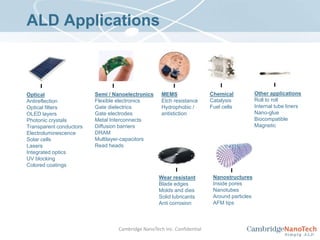
ALD ApplicationsOther applicationsRoll to rollInternal tube linersNano-glueBiocompatibleMagneticChemicalCatalysisFuel cellsSemi / NanoelectronicsFlexible electronicsGate dielectricsGate electrodesMetal InterconnectsDiffusion barriersDRAMMultilayer-capacitorsRead headsMEMSEtch resistanceHydrophobic / antistictionOpticalAntireflectionOptical filtersOLED layersPhotonic crystalsTransparent conductorsElectroluminescenceSolar cellsLasersIntegrated opticsUV blockingColored coatingsNanostructuresInside poresNanotubesAround particlesAFM tipsWear resistantBlade edgesMolds and diesSolid lubricantsAnti corrosionCambridge NanoTech Inc. Confidential
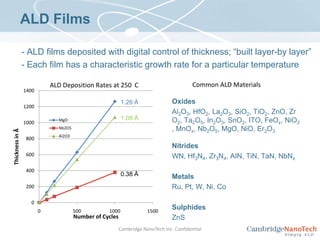
ALD Films- ALD films deposited with digital control of thickness; “built layer-by layer”	- Each film has a characteristic growth rate for a particular temperatureCommon ALD MaterialsALD Deposition Rates at 250°COxidesAl2O3, HfO2, La2O3, SiO2, TiO2, ZnO, ZrO2, Ta2O5, In2O3, SnO2, ITO, FeOx, NiO2, MnOx, Nb2O5, MgO, NiO, Er2O3NitridesWN, Hf3N4, Zr3N4, AIN, TiN, TaN, NbNxMetalsRu, Pt, W, Ni, CoSulphidesZnS1.26 Å1.08 Å0.38 ÅCambridge NanoTech Inc. Confidential
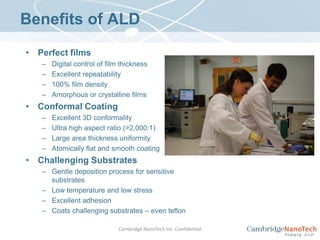
Benefits of ALDPerfect filmsDigital control of film thicknessExcellent repeatability100% film densityAmorphous or crystalline filmsConformal CoatingExcellent 3D conformalityUltra high aspect ratio (>2,000:1)Large area thickness uniformityAtomically flat and smooth coatingChallenging SubstratesGentle deposition process for sensitive substratesLow temperature and low stressExcellent adhesionCoats challenging substrates – even teflonCambridge NanoTech Inc. Confidential
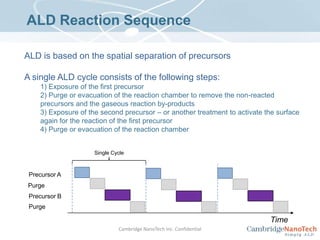
ALD Reaction SequenceALD is based on the spatial separation of precursorsA single ALD cycle consists of the following steps:1) Exposure of the first precursor2) Purge or evacuation of the reaction chamber to remove the non-reacted precursors and the gaseous reaction by-products3) Exposure of the second precursor – or another treatment to activate the surface again for the reaction of the first precursor4) Purge or evacuation of the reaction chamberSingle CyclePrecursor APurgePrecursor BPurgeTimeCambridge NanoTech Inc. Confidential
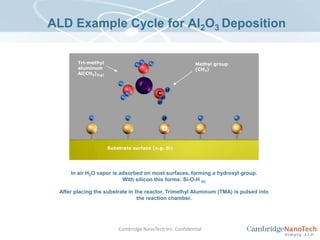
ALD Example Cycle for Al2O3 Deposition Tri-methylaluminumAl(CH3)3(g)Methyl group(CH3)AlHCHHHOSubstrate surface (e.g. Si)In air H2O vapor is adsorbed on most surfaces, forming a hydroxyl group. With silicon this forms: Si-O-H (s)After placing the substrate in the reactor, Trimethyl Aluminum (TMA) is pulsed into the reaction chamber.Cambridge NanoTech Inc. Confidential
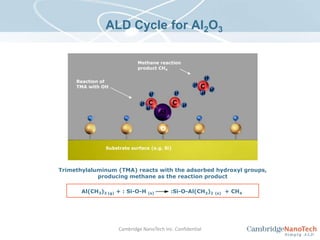
Methane reactionproduct CH4HReaction ofTMA with OHHCHHHHCCHHHAlOSubstrate surface (e.g. Si)Al(CH3)3 (g) + : Si-O-H (s)         :Si-O-Al(CH3)2(s)  + CH4ALD Cycle for Al2O3Trimethylaluminum(TMA) reacts with the adsorbed hydroxyl groups,producing methane as the reaction productCambridge NanoTech Inc. Confidential
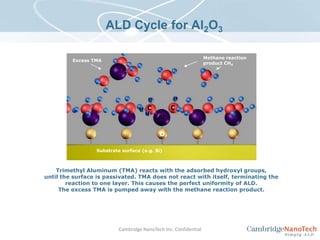
ALD Cycle for Al2O3Methane reactionproduct CH4Excess TMAHHCCHHAlOSubstrate surface (e.g. Si)Trimethyl Aluminum (TMA) reacts with the adsorbed hydroxyl groups,until the surface is passivated. TMA does not react with itself, terminating the reaction to one layer. This causes the perfect uniformity of ALD.The excess TMA is pumped away with the methane reaction product.Cambridge NanoTech Inc. Confidential
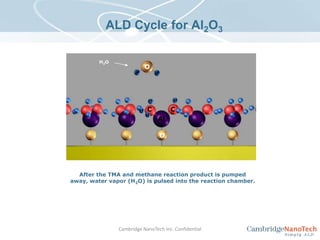
ALD Cycle for Al2O3H2OOHHHHCCHHAlOAfter the TMA and methane reaction product is pumped away, water vapor (H2O) is pulsed into the reaction chamber.Cambridge NanoTech Inc. Confidential
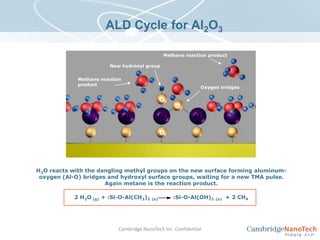
  2 H2O (g) + :Si-O-Al(CH3)2(s)          :Si-O-Al(OH)2(s)  + 2 CH4ALD Cycle for Al2O3Methane reaction productNew hydroxyl groupMethane reaction productOxygen bridgesHOOAlAlAlOH2O reacts with the dangling methyl groups on the new surface forming aluminum-oxygen (Al-O) bridges and hydroxyl surface groups, waiting for a new TMA pulse. Again metane is the reaction product. Cambridge NanoTech Inc. Confidential
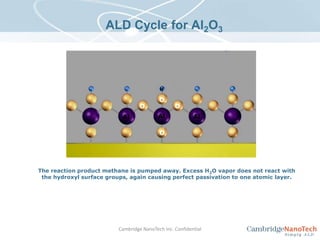
ALD Cycle for Al2O3HOOOAlAlAlOThe reaction product methane is pumped away. Excess H2O vapor does not react with the hydroxyl surface groups, again causing perfect passivation to one atomic layer.Cambridge NanoTech Inc. Confidential
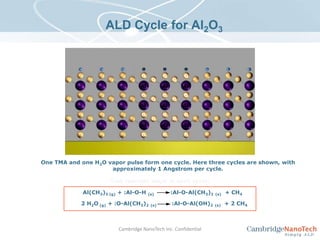
HHHOOOOOAlAlAlOOOOOAlAlAlOOOOOAlAlAlOOOAl(CH3)3 (g) + :Al-O-H (s)         :Al-O-Al(CH3)2(s)  + CH4ALD Cycle for Al2O3One TMA and one H2O vapor pulse form one cycle. Here three cycles are shown, with approximately 1 Angstrom per cycle. Two reaction steps in each cycle:  2 H2O (g) + :O-Al(CH3)2(s)          :Al-O-Al(OH)2(s)  + 2 CH4Cambridge NanoTech Inc. Confidential
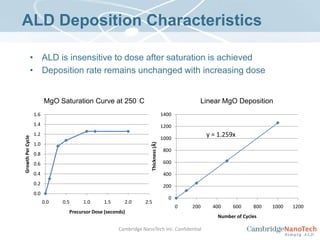
ALD Deposition CharacteristicsALD is insensitive to dose after saturation is achievedDeposition rate remains unchanged with increasing doseMgO Saturation Curve at 250°CLinear MgO DepositionCambridge NanoTech Inc. Confidential
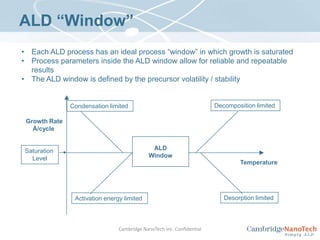
ALD “Window”Each ALD process has an ideal process “window” in which growth is saturated
Process parameters inside the ALD window allowfor reliable and repeatable results
The ALD window is defined by the precursor volatility / stabilityDecomposition limitedCondensation limitedGrowth RateÅ/cycleALDWindowSaturationLevelTemperatureDesorption limitedActivation energy limitedCambridge NanoTech Inc. Confidential
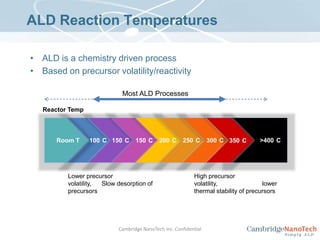
ALD Reaction TemperaturesALD is a chemistry driven processBased on precursor volatility/reactivityMost ALD ProcessesReactor Temp>400°C250°C300°C150°C150°CRoom T200°C100°C350°CHigh precursor volatility,                          lower thermal stability of precursorsLower precursor volatility,      Slow desorption of precursorsCambridge NanoTech Inc. Confidential
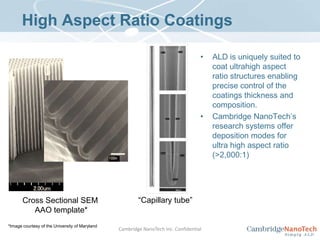
High Aspect Ratio CoatingsALD is uniquely suited to coat ultrahigh aspect ratio structures enabling precise control of the coatings thickness and composition.  Cambridge NanoTech’s research systems offer deposition modes for ultra high aspect ratio (>2,000:1)“Capillary tube”Cross Sectional SEMAAO template**Image courtesy of the University of MarylandCambridge NanoTech Inc. Confidential
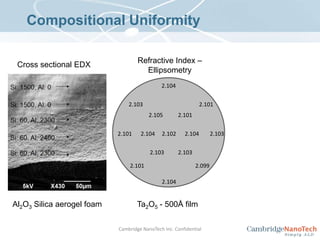
Compositional UniformityRefractive Index – EllipsometryCross sectional EDX 2.1042.1032.1012.1012.1052.1022.1042.1042.1012.1032.1032.1032.0992.1012.104Al2O3 Silica aerogel foamTa2O5 - 500Å filmCambridge NanoTech Inc. Confidential
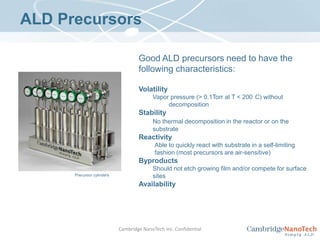
ALD Precursors	Good ALD precursors need to have the following characteristics: Volatility Vapor pressure (> 0.1Torr at T < 200°C) without decomposition Stability No thermal decomposition in the reactor or on the substrate Reactivity 	Able to quickly react with substrate in a self-limiting fashion (most precursors are air-sensitive) Byproducts 	Should not etch growing film and/or compete for surface sites Availability Precursor cylindersCambridge NanoTech Inc. Confidential
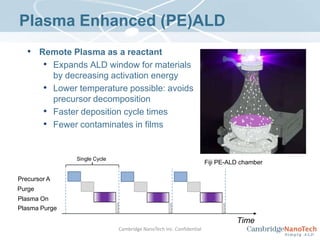
Plasma Enhanced (PE)ALDRemote Plasma as a reactant
Expands ALD window for materials by decreasing activation energy
Lower temperature possible: avoids precursor decomposition

ALD Tutorial

  • 1.
  • 2.
    ALD ApplicationsOther applicationsRollto rollInternal tube linersNano-glueBiocompatibleMagneticChemicalCatalysisFuel cellsSemi / NanoelectronicsFlexible electronicsGate dielectricsGate electrodesMetal InterconnectsDiffusion barriersDRAMMultilayer-capacitorsRead headsMEMSEtch resistanceHydrophobic / antistictionOpticalAntireflectionOptical filtersOLED layersPhotonic crystalsTransparent conductorsElectroluminescenceSolar cellsLasersIntegrated opticsUV blockingColored coatingsNanostructuresInside poresNanotubesAround particlesAFM tipsWear resistantBlade edgesMolds and diesSolid lubricantsAnti corrosionCambridge NanoTech Inc. Confidential
  • 3.
    ALD Films- ALDfilms deposited with digital control of thickness; “built layer-by layer” - Each film has a characteristic growth rate for a particular temperatureCommon ALD MaterialsALD Deposition Rates at 250°COxidesAl2O3, HfO2, La2O3, SiO2, TiO2, ZnO, ZrO2, Ta2O5, In2O3, SnO2, ITO, FeOx, NiO2, MnOx, Nb2O5, MgO, NiO, Er2O3NitridesWN, Hf3N4, Zr3N4, AIN, TiN, TaN, NbNxMetalsRu, Pt, W, Ni, CoSulphidesZnS1.26 Å1.08 Å0.38 ÅCambridge NanoTech Inc. Confidential
  • 4.
    Benefits of ALDPerfectfilmsDigital control of film thicknessExcellent repeatability100% film densityAmorphous or crystalline filmsConformal CoatingExcellent 3D conformalityUltra high aspect ratio (>2,000:1)Large area thickness uniformityAtomically flat and smooth coatingChallenging SubstratesGentle deposition process for sensitive substratesLow temperature and low stressExcellent adhesionCoats challenging substrates – even teflonCambridge NanoTech Inc. Confidential
  • 5.
    ALD Reaction SequenceALDis based on the spatial separation of precursorsA single ALD cycle consists of the following steps:1) Exposure of the first precursor2) Purge or evacuation of the reaction chamber to remove the non-reacted precursors and the gaseous reaction by-products3) Exposure of the second precursor – or another treatment to activate the surface again for the reaction of the first precursor4) Purge or evacuation of the reaction chamberSingle CyclePrecursor APurgePrecursor BPurgeTimeCambridge NanoTech Inc. Confidential
  • 6.
    ALD Example Cyclefor Al2O3 Deposition Tri-methylaluminumAl(CH3)3(g)Methyl group(CH3)AlHCHHHOSubstrate surface (e.g. Si)In air H2O vapor is adsorbed on most surfaces, forming a hydroxyl group. With silicon this forms: Si-O-H (s)After placing the substrate in the reactor, Trimethyl Aluminum (TMA) is pulsed into the reaction chamber.Cambridge NanoTech Inc. Confidential
  • 7.
    Methane reactionproduct CH4HReactionofTMA with OHHCHHHHCCHHHAlOSubstrate surface (e.g. Si)Al(CH3)3 (g) + : Si-O-H (s) :Si-O-Al(CH3)2(s) + CH4ALD Cycle for Al2O3Trimethylaluminum(TMA) reacts with the adsorbed hydroxyl groups,producing methane as the reaction productCambridge NanoTech Inc. Confidential
  • 8.
    ALD Cycle forAl2O3Methane reactionproduct CH4Excess TMAHHCCHHAlOSubstrate surface (e.g. Si)Trimethyl Aluminum (TMA) reacts with the adsorbed hydroxyl groups,until the surface is passivated. TMA does not react with itself, terminating the reaction to one layer. This causes the perfect uniformity of ALD.The excess TMA is pumped away with the methane reaction product.Cambridge NanoTech Inc. Confidential
  • 9.
    ALD Cycle forAl2O3H2OOHHHHCCHHAlOAfter the TMA and methane reaction product is pumped away, water vapor (H2O) is pulsed into the reaction chamber.Cambridge NanoTech Inc. Confidential
  • 10.
    2H2O (g) + :Si-O-Al(CH3)2(s) :Si-O-Al(OH)2(s) + 2 CH4ALD Cycle for Al2O3Methane reaction productNew hydroxyl groupMethane reaction productOxygen bridgesHOOAlAlAlOH2O reacts with the dangling methyl groups on the new surface forming aluminum-oxygen (Al-O) bridges and hydroxyl surface groups, waiting for a new TMA pulse. Again metane is the reaction product. Cambridge NanoTech Inc. Confidential
  • 11.
    ALD Cycle forAl2O3HOOOAlAlAlOThe reaction product methane is pumped away. Excess H2O vapor does not react with the hydroxyl surface groups, again causing perfect passivation to one atomic layer.Cambridge NanoTech Inc. Confidential
  • 12.
    HHHOOOOOAlAlAlOOOOOAlAlAlOOOOOAlAlAlOOOAl(CH3)3 (g) +:Al-O-H (s) :Al-O-Al(CH3)2(s) + CH4ALD Cycle for Al2O3One TMA and one H2O vapor pulse form one cycle. Here three cycles are shown, with approximately 1 Angstrom per cycle. Two reaction steps in each cycle: 2 H2O (g) + :O-Al(CH3)2(s) :Al-O-Al(OH)2(s) + 2 CH4Cambridge NanoTech Inc. Confidential
  • 13.
    ALD Deposition CharacteristicsALDis insensitive to dose after saturation is achievedDeposition rate remains unchanged with increasing doseMgO Saturation Curve at 250°CLinear MgO DepositionCambridge NanoTech Inc. Confidential
  • 14.
    ALD “Window”Each ALDprocess has an ideal process “window” in which growth is saturated
  • 15.
    Process parameters insidethe ALD window allowfor reliable and repeatable results
  • 16.
    The ALD windowis defined by the precursor volatility / stabilityDecomposition limitedCondensation limitedGrowth RateÅ/cycleALDWindowSaturationLevelTemperatureDesorption limitedActivation energy limitedCambridge NanoTech Inc. Confidential
  • 17.
    ALD Reaction TemperaturesALDis a chemistry driven processBased on precursor volatility/reactivityMost ALD ProcessesReactor Temp>400°C250°C300°C150°C150°CRoom T200°C100°C350°CHigh precursor volatility, lower thermal stability of precursorsLower precursor volatility, Slow desorption of precursorsCambridge NanoTech Inc. Confidential
  • 18.
    High Aspect RatioCoatingsALD is uniquely suited to coat ultrahigh aspect ratio structures enabling precise control of the coatings thickness and composition. Cambridge NanoTech’s research systems offer deposition modes for ultra high aspect ratio (>2,000:1)“Capillary tube”Cross Sectional SEMAAO template**Image courtesy of the University of MarylandCambridge NanoTech Inc. Confidential
  • 19.
    Compositional UniformityRefractive Index– EllipsometryCross sectional EDX 2.1042.1032.1012.1012.1052.1022.1042.1042.1012.1032.1032.1032.0992.1012.104Al2O3 Silica aerogel foamTa2O5 - 500Å filmCambridge NanoTech Inc. Confidential
  • 20.
    ALD Precursors Good ALDprecursors need to have the following characteristics: Volatility Vapor pressure (> 0.1Torr at T < 200°C) without decomposition Stability No thermal decomposition in the reactor or on the substrate Reactivity Able to quickly react with substrate in a self-limiting fashion (most precursors are air-sensitive) Byproducts Should not etch growing film and/or compete for surface sites Availability Precursor cylindersCambridge NanoTech Inc. Confidential
  • 21.
    Plasma Enhanced (PE)ALDRemotePlasma as a reactant
  • 22.
    Expands ALD windowfor materials by decreasing activation energy
  • 23.
    Lower temperature possible:avoids precursor decomposition
  • 24.
  • 25.
    Fewer contaminates infilmsSingle CycleFiji PE-ALD chamberPrecursor APurgePlasma OnPlasma PurgeTimeCambridge NanoTech Inc. Confidential
  • 26.
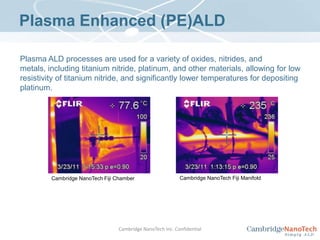
    Plasma Enhanced (PE)ALDPlasmaALD processes are used for a variety of oxides, nitrides, and metals, including titanium nitride, platinum, and other materials, allowing for low resistivity of titanium nitride, and significantly lower temperatures for depositing platinum. Cambridge NanoTech Fiji ManifoldCambridge NanoTech Fiji ChamberCambridge NanoTech Inc. Confidential
  • 27.
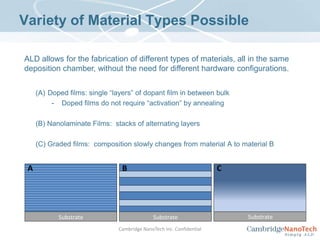
    Variety of MaterialTypes PossibleALD allows for the fabrication of different types of materials, all in the same deposition chamber, without the need for different hardware configurations. Doped films: single “layers” of dopant film in between bulkDoped films do not require “activation” by annealing(B) Nanolaminate Films: stacks of alternating layers(C) Graded films: composition slowly changes from material A to material BM1Cambridge NanoTech Inc. Confidential
  • 28.
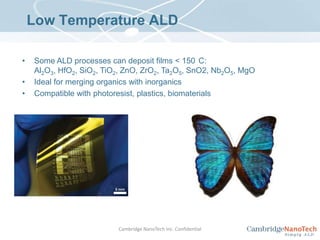
    Low Temperature ALDSomeALD processes can deposit films < 150°C: Al2O3, HfO2, SiO2, TiO2, ZnO, ZrO2, Ta2O5, SnO2, Nb2O5, MgOIdeal for merging organics with inorganicsCompatible with photoresist, plastics, biomaterialsCambridge NanoTech Inc. Confidential
  • 29.
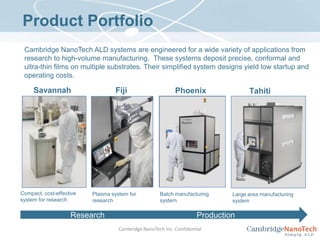
    Product PortfolioCambridge NanoTechALD systems are engineered for a wide variety of applications from research to high-volume manufacturing. These systems deposit precise, conformal and ultra-thin films on multiple substrates. Their simplified system designs yield low startup and operating costs. Savannah FijiPhoenixTahitiCompact, cost-effective system for research Plasma system for researchBatch manufacturing systemLarge area manufacturing systemProductionResearchCambridge NanoTech Inc. Confidential

Editor's Notes

  • #6 Taking out cost / availability from the equation, the Must be thermally stable;Volatile / Reactive; Compatibility with substrate / manufacturing
  • #16 Taking out cost / availability from the equation, the Must be thermally stable;Volatile / Reactive; Compatibility with substrate / manufacturing
  • #18 MgCp2 – shows decomposition above 300C, high carbon contamination below 200