The Boat is Sinking!
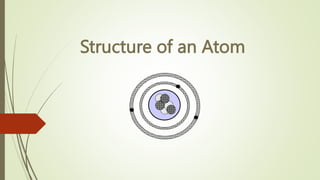
Structure of an Atom
What Is an Atom?
Atoms are often referred to as the building
blocks of matter.
Each element on the periodic table is
composed of one type of atom and cannot
be broken down into a simpler substance.
What Is an Atom?
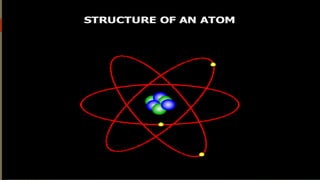
Atoms are composed of smaller subatomic
particles such as the proton, neutron, and
electron.
Atoms contain a nucleus surrounded by an
electron cloud that consists of one or more
energy levels.
Inner Structure of an Atom
• Nucleus - Small, dense, positively
charged center of the atom which
contains most of the atom’s mass
Inner Structure of an Atom
The nucleus contains the following
subatomic particles:
Protons - positively (+) charged particles
Neutrons - particles that have no charge
(neutral), but contribute to the atom’s
mass
Outer Structure of an Atom
• Electron cloud - an area around the
nucleus where electrons are likely to
be found orbiting the nucleus in
several energy levels
Outer Structure of an Atom
• The electron cloud contains several
energy levels
 Electrons - negatively (-) charged
particles located in specific energy
levels surrounding the nucleus
Outer Structure of an Atom
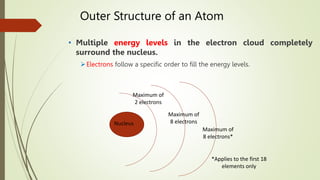
• Multiple energy levels in the electron cloud completely
surround the nucleus.
Electrons follow a specific order to fill the energy levels.
Maximum of
2 electrons
Nucleus
Maximum of
8 electrons
Maximum of
8 electrons*
*Applies to the first 18
elements only
Outer Structure of an Atom
• The electrons in the outermost
energy level are called valence
electrons
• We will go into more detail about
the importance of valence
electrons in our next unit.
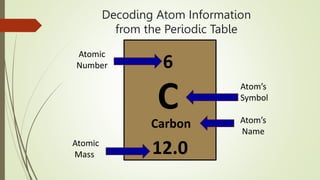
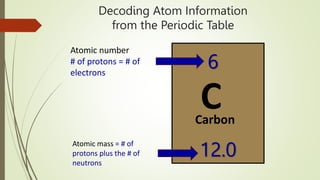
Decoding Atom Information
from the Periodic Table
C
Carbon
6
12.0
Atom’s
Symbol
Atom’s
Name
Atomic
Number
Atomic
Mass
Decoding Atom Information
from the Periodic Table
Carbon
12.0
Atomic number
# of protons = # of
electrons
Atomic mass = # of
protons plus the # of
neutrons
6
C
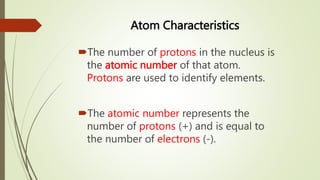
Atom Characteristics
The number of protons in the nucleus is
the atomic number of that atom.
Protons are used to identify elements.
The atomic number represents the
number of protons (+) and is equal to
the number of electrons (-).
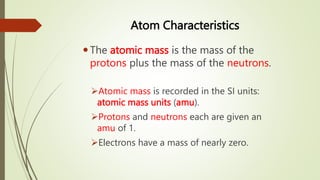
Atom Characteristics
The atomic mass is the mass of the
protons plus the mass of the neutrons.
Atomic mass is recorded in the SI units:
atomic mass units (amu).
Protons and neutrons each are given an
amu of 1.
Electrons have a mass of nearly zero.

Nstional Learning Camp Grade 8 POWERPOINT.pptx

  • 2.
    The Boat isSinking!
  • 4.
  • 6.
    What Is anAtom? Atoms are often referred to as the building blocks of matter. Each element on the periodic table is composed of one type of atom and cannot be broken down into a simpler substance.
  • 7.
    What Is anAtom? Atoms are composed of smaller subatomic particles such as the proton, neutron, and electron. Atoms contain a nucleus surrounded by an electron cloud that consists of one or more energy levels.
  • 8.
    Inner Structure ofan Atom • Nucleus - Small, dense, positively charged center of the atom which contains most of the atom’s mass
  • 9.
    Inner Structure ofan Atom The nucleus contains the following subatomic particles: Protons - positively (+) charged particles Neutrons - particles that have no charge (neutral), but contribute to the atom’s mass
  • 10.
    Outer Structure ofan Atom • Electron cloud - an area around the nucleus where electrons are likely to be found orbiting the nucleus in several energy levels
  • 11.
    Outer Structure ofan Atom • The electron cloud contains several energy levels  Electrons - negatively (-) charged particles located in specific energy levels surrounding the nucleus
  • 12.
    Outer Structure ofan Atom • Multiple energy levels in the electron cloud completely surround the nucleus. Electrons follow a specific order to fill the energy levels. Maximum of 2 electrons Nucleus Maximum of 8 electrons Maximum of 8 electrons* *Applies to the first 18 elements only
  • 13.
    Outer Structure ofan Atom • The electrons in the outermost energy level are called valence electrons • We will go into more detail about the importance of valence electrons in our next unit.
  • 14.
    Decoding Atom Information fromthe Periodic Table C Carbon 6 12.0 Atom’s Symbol Atom’s Name Atomic Number Atomic Mass
  • 15.
    Decoding Atom Information fromthe Periodic Table Carbon 12.0 Atomic number # of protons = # of electrons Atomic mass = # of protons plus the # of neutrons 6 C
  • 16.
    Atom Characteristics The numberof protons in the nucleus is the atomic number of that atom. Protons are used to identify elements. The atomic number represents the number of protons (+) and is equal to the number of electrons (-).
  • 17.
    Atom Characteristics The atomicmass is the mass of the protons plus the mass of the neutrons. Atomic mass is recorded in the SI units: atomic mass units (amu). Protons and neutrons each are given an amu of 1. Electrons have a mass of nearly zero.

Editor's Notes

  • #7 Structure of the atom. (n.d.). Retrieved from http://www.nyu.edu/pages/mathmol/textbook/atoms.html
  • #18 Structure of the atom. (n.d.). Retrieved from http://www.nyu.edu/pages/mathmol/textbook/atoms.html