Classification of elements
The arranging of elements into different
groups on the basis of the similarities in
their properties is called classification of
elements. The classification of similar
elements into groups makes the study of
elements easier. There are about 114
different elements known so far.
The earliest attempt to classify elements was
grouping the then known elements (about 30
elements) into two groups called metals and
non metals.
The defect in this classification was that it had
no place for metalloids (elements which have
properties of both metals and non metals)
which were discovered later.
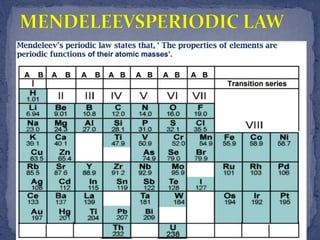
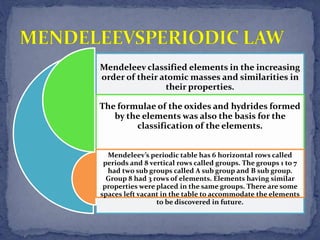
Mendeleev classified elements in the increasing
order of their atomic masses and similarities in
their properties.
The formulae of the oxides and hydrides formed
by the elements was also the basis for the
classification of the elements.
Mendeleev’s periodic table has 6 horizontal rows called
periods and 8 vertical rows called groups. The groups 1 to 7
had two sub groups called A sub group and B sub group.
Group 8 had 3 rows of elements. Elements having similar
properties were placed in the same groups. There are some
spaces left vacant in the table to accommodate the elements
to be discovered in future.
Elements were
classified on a
more
fundamental
basis of their
atomic masses
and
properties.
Spaces were
left vacant to
accommodate
the elements
to be
discovered in
future.
It could
predict the
properties of
the elements
which helped
in the
discovery of
new elements.
The inert gas
elements
discovered
later could be
placed in a
separate group
without
disturbing the
table
Some elements are not arranged in the increasing order
of their atomic masses. Co is placed before Ni, Te is
placed before I etc.
Position of hydrogen is not clear because it shows
properties similar to metals as well as non metals.
The position of isotopes of elements is not clear.
Chapter 4- periodic classification of elements

Chapter 4- periodic classification of elements

  • 2.
    Classification of elements Thearranging of elements into different groups on the basis of the similarities in their properties is called classification of elements. The classification of similar elements into groups makes the study of elements easier. There are about 114 different elements known so far.
  • 3.
    The earliest attemptto classify elements was grouping the then known elements (about 30 elements) into two groups called metals and non metals. The defect in this classification was that it had no place for metalloids (elements which have properties of both metals and non metals) which were discovered later.
  • 8.
    Mendeleev classified elementsin the increasing order of their atomic masses and similarities in their properties. The formulae of the oxides and hydrides formed by the elements was also the basis for the classification of the elements. Mendeleev’s periodic table has 6 horizontal rows called periods and 8 vertical rows called groups. The groups 1 to 7 had two sub groups called A sub group and B sub group. Group 8 had 3 rows of elements. Elements having similar properties were placed in the same groups. There are some spaces left vacant in the table to accommodate the elements to be discovered in future.
  • 9.
    Elements were classified ona more fundamental basis of their atomic masses and properties. Spaces were left vacant to accommodate the elements to be discovered in future. It could predict the properties of the elements which helped in the discovery of new elements. The inert gas elements discovered later could be placed in a separate group without disturbing the table
  • 10.
    Some elements arenot arranged in the increasing order of their atomic masses. Co is placed before Ni, Te is placed before I etc. Position of hydrogen is not clear because it shows properties similar to metals as well as non metals. The position of isotopes of elements is not clear.