Periodic Table
Comparing the Periodic Table to
Other Chemical Tables
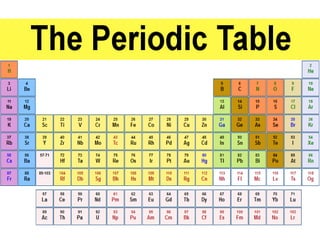
• The periodic table, also known as the periodic
table of chemical elements, is a tabular display
of the chemical elements. It used in chemistry,
physics, and other sciences, and is generally
seen as an icon of chemistry.
Introduction to the periodic table
• The concept of periodic table has been known since 1850
and was first described in 1806 by French scientist Georges-
Louis Leclerc, Comte de Verdon. However, it was not until
the publication of periodic table of chemical elements by
Dmitri Mendeleev, a Russian scientist and Nikolai
Shikhmatov, a Russian scientist, in 1869 that it became a
reality. The publication of the periodic table was followed
by further additions in 1882. The periodic table became a
popular tool for students, chemists, and other scientists to
analyze, and even predict, the properties of chemical
elements.
•
• Organ metallic compounds that are inorganic are called as
'chemical elements'.
What are other types of chemical
tables?
• There are many chemical tables, for example the Torr table, which lists the nitrogen elements. The
3-dimensional encyclopaedia on the encyclopedic city of London and the chemical periodic table
can be found at Wikipedia: https://en.wikipedia.org/wiki/Chemical_table.
•
• You can find numerous chemical tables on internet, some of them are sorted by element, starting
with hydrogen and ending with the heaviest elements.
•
• This page was last updated in August 2016.
•
• FAQs on the periodic table
•
• What are some common misconceptions about the periodic table?
•
• Many students think that elements are classified in groups based on their chemical properties, but
it is not the case.
•
• Only one group is related to their chemical behaviour, the group of chemical elements.
What are the differences between the
periodic table and other chemical
tables?
• The other tables are general-purpose tables used for measuring quantity or
chemical structure of compounds and simple substances.
•
• These tables do not contain references for periodic elements. They are not
necessarily designed to represent the period of existence for a particular element.
•
• For instance, the traditional table of densities or physical properties of gases
contains the listing of the elements. This table of the density is used for a single
element and contains nothing about the number of atoms of that element.
•
• This table may be viewed in a more current context by seeing the number of
atoms in one of the atoms of the gas. This atomic number is then referred to as
the atomic number of the element.
Conclusion
• Chemistry is a difficult subject, yet it is one of the most
popular fields among people who choose to become
scientists. It has several interesting questions such as, how
did it all begin, how is the bond formed, where do new
molecules form, and many more. In this article, I have
attempted to give you a well-balanced overview of the
chemistry, from the basic, to more complex concepts. With
the various key terms and the popular misconceptions, you
will be able to understand chemistry much better.
•
• Thank you for visiting Chemistry Student as well as wish
you all the best in your further studies!
•
Thanks & Regards
• https://www.homeworkassignmenthelp.com/
• Email: hahassignment@gmail.com
• WhatsApp:+91-9540660064

Periodic table

  • 1.
  • 2.
    Comparing the PeriodicTable to Other Chemical Tables • The periodic table, also known as the periodic table of chemical elements, is a tabular display of the chemical elements. It used in chemistry, physics, and other sciences, and is generally seen as an icon of chemistry.
  • 3.
    Introduction to theperiodic table • The concept of periodic table has been known since 1850 and was first described in 1806 by French scientist Georges- Louis Leclerc, Comte de Verdon. However, it was not until the publication of periodic table of chemical elements by Dmitri Mendeleev, a Russian scientist and Nikolai Shikhmatov, a Russian scientist, in 1869 that it became a reality. The publication of the periodic table was followed by further additions in 1882. The periodic table became a popular tool for students, chemists, and other scientists to analyze, and even predict, the properties of chemical elements. • • Organ metallic compounds that are inorganic are called as 'chemical elements'.
  • 4.
    What are othertypes of chemical tables? • There are many chemical tables, for example the Torr table, which lists the nitrogen elements. The 3-dimensional encyclopaedia on the encyclopedic city of London and the chemical periodic table can be found at Wikipedia: https://en.wikipedia.org/wiki/Chemical_table. • • You can find numerous chemical tables on internet, some of them are sorted by element, starting with hydrogen and ending with the heaviest elements. • • This page was last updated in August 2016. • • FAQs on the periodic table • • What are some common misconceptions about the periodic table? • • Many students think that elements are classified in groups based on their chemical properties, but it is not the case. • • Only one group is related to their chemical behaviour, the group of chemical elements.
  • 5.
    What are thedifferences between the periodic table and other chemical tables? • The other tables are general-purpose tables used for measuring quantity or chemical structure of compounds and simple substances. • • These tables do not contain references for periodic elements. They are not necessarily designed to represent the period of existence for a particular element. • • For instance, the traditional table of densities or physical properties of gases contains the listing of the elements. This table of the density is used for a single element and contains nothing about the number of atoms of that element. • • This table may be viewed in a more current context by seeing the number of atoms in one of the atoms of the gas. This atomic number is then referred to as the atomic number of the element.
  • 6.
    Conclusion • Chemistry isa difficult subject, yet it is one of the most popular fields among people who choose to become scientists. It has several interesting questions such as, how did it all begin, how is the bond formed, where do new molecules form, and many more. In this article, I have attempted to give you a well-balanced overview of the chemistry, from the basic, to more complex concepts. With the various key terms and the popular misconceptions, you will be able to understand chemistry much better. • • Thank you for visiting Chemistry Student as well as wish you all the best in your further studies! •
  • 7.
    Thanks & Regards •https://www.homeworkassignmenthelp.com/ • Email: hahassignment@gmail.com • WhatsApp:+91-9540660064