Atmospheric PressureAtmospheric Pressure
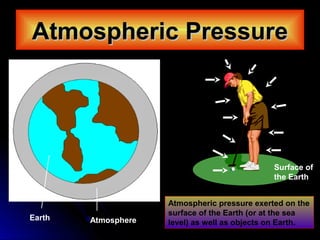
Earth Atmosphere
Surface of
the Earth
Atmospheric pressure exerted on the
surface of the Earth (or at the sea
level) as well as objects on Earth.
Atmospheric PressureAtmospheric Pressure
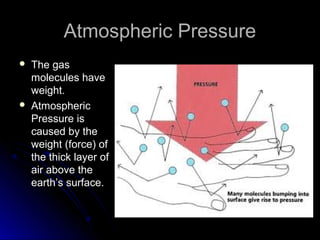
 The gasThe gas
molecules havemolecules have
weight.weight.
 AtmosphericAtmospheric
Pressure isPressure is
caused by thecaused by the
weight (force) ofweight (force) of
the thick layer ofthe thick layer of
air above theair above the
earth’s surface.earth’s surface.
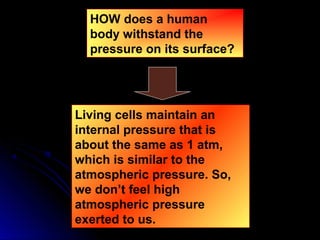
HOW does a human
body withstand the
pressure on its surface?
Living cells maintain an
internal pressure that is
about the same as 1 atm,
which is similar to the
atmospheric pressure. So,
we don’t feel high
atmospheric pressure
exerted to us.
Surface of bottle
Internal pressure
External
pressure
External
pressure
Internal
pressure
Internal Pressure = External pressure
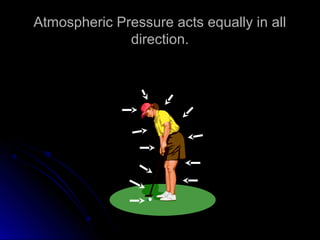
Atmospheric Pressure acts equally in allAtmospheric Pressure acts equally in all
direction.direction.
Characteristics of AtmosphericCharacteristics of Atmospheric
PressurePressure
 It is not affected by the surface area.It is not affected by the surface area.
 The pressure exerted by the air molecules at
sea level is 1.013 × 10⁵
Pa.
 At sea level, PAt sea level, Patmatm == 1.013 × 10⁵
Pa (Nm-2
)
= 76 cmHg= 76 cmHg
= 10mH= 10mH22OO
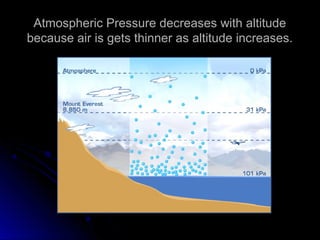
Atmospheric Pressure decreases with altitudeAtmospheric Pressure decreases with altitude
because air is gets thinner as altitude increases.because air is gets thinner as altitude increases.
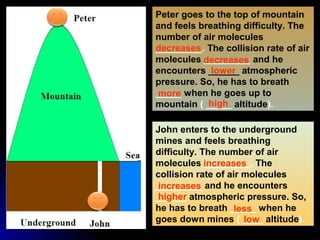
Peter goes to the top of mountain
and feels breathing difficulty. The
number of air molecules
_________. The collision rate of air
molecules _________ and he
encounters ______ atmospheric
pressure. So, he has to breath
_____ when he goes up to
mountain ( _____ altitude).
John enters to the underground
mines and feels breathing
difficulty. The number of air
molecules _________. The
collision rate of air molecules
_________ and he encounters
______ atmospheric pressure. So,
he has to breath _____ when he
goes down mines ( ____ altitude).
decreases
decreases
lower
more
high
increases
increases
higher
less
low
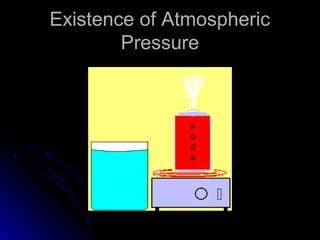
Existence of AtmosphericExistence of Atmospheric
PressurePressure
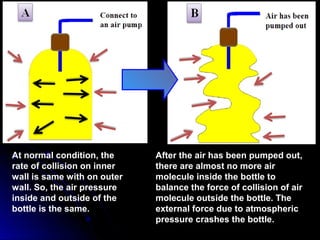
At normal condition, the
rate of collision on inner
wall is same with on outer
wall. So, the air pressure
inside and outside of the
bottle is the same.
After the air has been pumped out,
there are almost no more air
molecule inside the bottle to
balance the force of collision of air
molecule outside the bottle. The
external force due to atmospheric
pressure crashes the bottle.
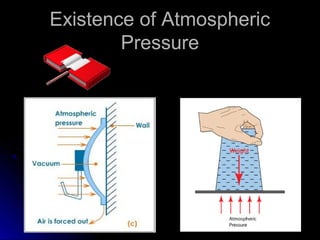
Existence of AtmosphericExistence of Atmospheric
PressurePressure
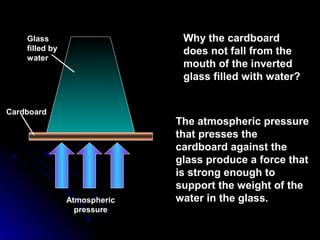
Glass
filled by
water
Atmospheric
pressure
Cardboard
Why the cardboard
does not fall from the
mouth of the inverted
glass filled with water?
The atmospheric pressure
that presses the
cardboard against the
glass produce a force that
is strong enough to
support the weight of the
water in the glass.
Existence of AtmosphericExistence of Atmospheric
PressurePressure
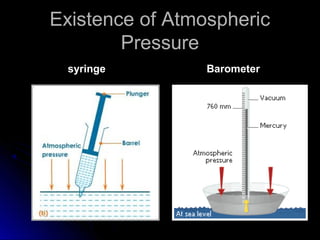
syringesyringe BarometerBarometer
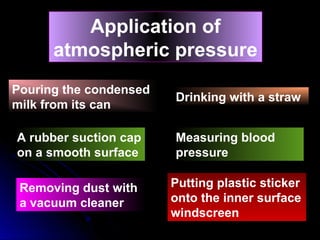
Application of
atmospheric pressure
Pouring the condensed
milk from its can
A rubber suction cap
on a smooth surface
Drinking with a straw
Removing dust with
a vacuum cleaner
Putting plastic sticker
onto the inner surface
windscreen
Measuring blood
pressure
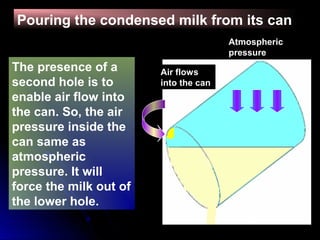
The presence of a
second hole is to
enable air flow into
the can. So, the air
pressure inside the
can same as
atmospheric
pressure. It will
force the milk out of
the lower hole.
Pouring the condensed milk from its can
Milk
Air flows
into the can
Atmospheric
pressure
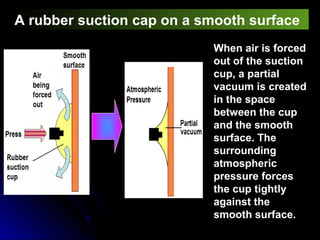
A rubber suction cap on a smooth surface
When air is forced
out of the suction
cup, a partial
vacuum is created
in the space
between the cup
and the smooth
surface. The
surrounding
atmospheric
pressure forces
the cup tightly
against the
smooth surface.
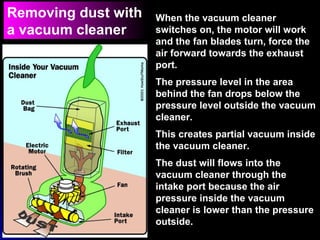
Removing dust with
a vacuum cleaner
When the vacuum cleaner
switches on, the motor will work
and the fan blades turn, force the
air forward towards the exhaust
port.
The pressure level in the area
behind the fan drops below the
pressure level outside the vacuum
cleaner.
This creates partial vacuum inside
the vacuum cleaner.
The dust will flows into the
vacuum cleaner through the
intake port because the air
pressure inside the vacuum
cleaner is lower than the pressure
outside.
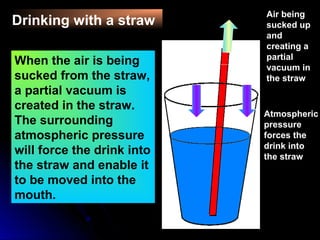
Drinking with a straw
Straw
Atmospheric
pressure
forces the
drink into
the straw
Air being
sucked up
and
creating a
partial
vacuum in
the straw
When the air is being
sucked from the straw,
a partial vacuum is
created in the straw.
The surrounding
atmospheric pressure
will force the drink into
the straw and enable it
to be moved into the
mouth.
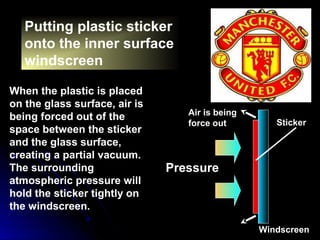
Putting plastic sticker
onto the inner surface
windscreen
When the plastic is placed
on the glass surface, air is
being forced out of the
space between the sticker
and the glass surface,
creating a partial vacuum.
The surrounding
atmospheric pressure will
hold the sticker tightly on
the windscreen.
Windscreen
Sticker
Pressure
Air is being
force out
Instruments for measuringInstruments for measuring
Atmospheric PressureAtmospheric Pressure
Mercury barometerMercury barometer
Fortin barometerFortin barometer
Aneroid barometerAneroid barometer
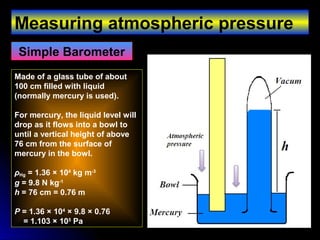
Measuring atmospheric pressure
Simple Barometer
Made of a glass tube of about
100 cm filled with liquid
(normally mercury is used).
For mercury, the liquid level will
drop as it flows into a bowl to
until a vertical height of above
76 cm from the surface of
mercury in the bowl.
ρHg = 1.36 × 10⁴
kg m-3
g = 9.8 N kg-1
h = 76 cm = 0.76 m
P = 1.36 × 104
× 9.8 × 0.76
= 1.103 × 10⁵
Pa
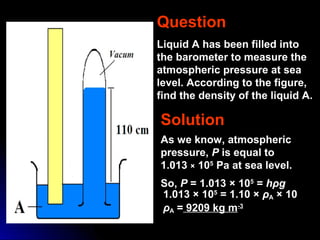
Question
Liquid A has been filled into
the barometer to measure the
atmospheric pressure at sea
level. According to the figure,
find the density of the liquid A.
Solution
As we know, atmospheric
pressure, P is equal to
1.013 × 10⁵
Pa at sea level.
So, P = 1.013 × 105
= hρg
1.013 × 105
= 1.10 × ρA × 10
ρA = 9209 kg m-3
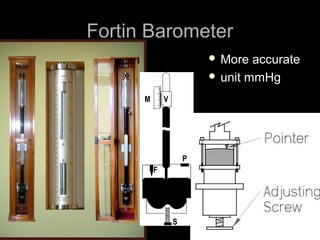
Fortin BarometerFortin Barometer
 More accurateMore accurate
 unit mmHgunit mmHg
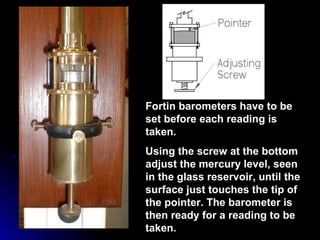
Fortin barometers have to be
set before each reading is
taken.
Using the screw at the bottom
adjust the mercury level, seen
in the glass reservoir, until the
surface just touches the tip of
the pointer. The barometer is
then ready for a reading to be
taken.
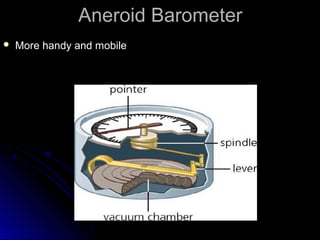
Aneroid BarometerAneroid Barometer
 More handy and mobileMore handy and mobile
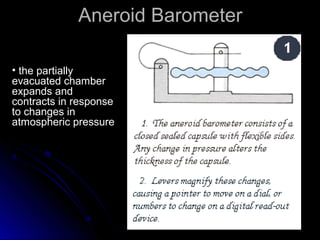
Aneroid BarometerAneroid Barometer
• the partially
evacuated chamber
expands and
contracts in response
to changes in
atmospheric pressure
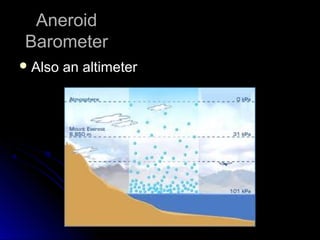
AneroidAneroid
BarometerBarometer
 Also an altimeterAlso an altimeter
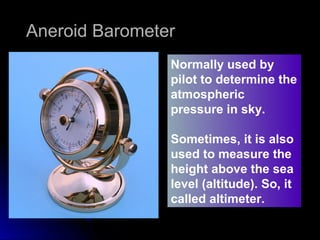
Normally used by
pilot to determine the
atmospheric
pressure in sky.
Sometimes, it is also
used to measure the
height above the sea
level (altitude). So, it
called altimeter.
Aneroid BarometerAneroid Barometer
Gas PressureGas Pressure
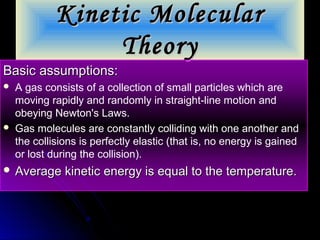
Kinetic MolecularKinetic Molecular
TheoryTheory
Basic assumptions:Basic assumptions:
 A gas consists of a collection of small particles which are
moving rapidly and randomly in straight-line motion and
obeying Newton's Laws.
 Gas molecules are constantly colliding with one another and
the collisions is perfectly elastic (that is, no energy is gained
or lost during the collision).
 Average kinetic energy is equal to the temperature.Average kinetic energy is equal to the temperature.
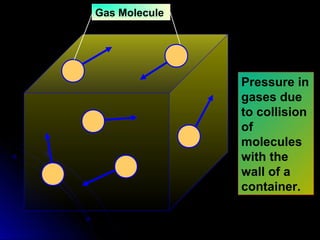
Gas Molecule
Pressure in
gases due
to collision
of
molecules
with the
wall of a
container.
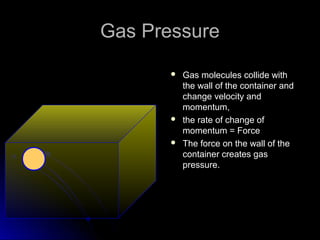
Gas PressureGas Pressure
 Gas molecules collide withGas molecules collide with
the wall of the container andthe wall of the container and
change velocity andchange velocity and
momentum,momentum,
 the rate of change ofthe rate of change of
momentum = Forcemomentum = Force
 The force on the wall of theThe force on the wall of the
container creates gascontainer creates gas
pressure.pressure.
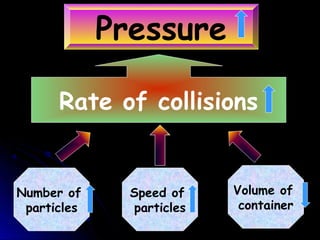
Pressure
Rate of collisions
Number of
particles
Speed of
particles
Volume of
container
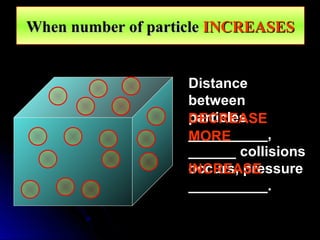
When number of particleWhen number of particle INCREASESINCREASES
Distance
between
particles
__________,
______ collisions
occurs, pressure
__________.
DECREASE
MORE
INCREASE
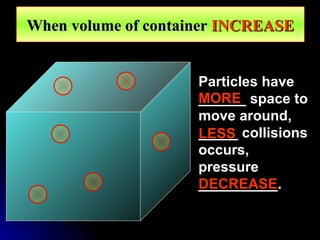
When volume of containerWhen volume of container INCREASEINCREASE
Particles have
______ space to
move around,
_____ collisions
occurs,
pressure
__________.
MORE
LESS
DECREASE
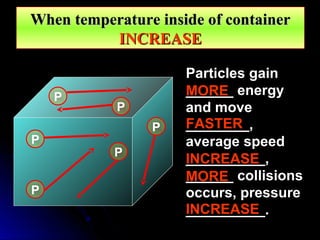
When temperature inside of containerWhen temperature inside of container
INCREASEINCREASE
P
P
P
P
P
P
Particles gain
______ energy
and move
________,
average speed
__________,
______ collisions
occurs, pressure
__________.
MORE
MORE
INCREASE
INCREASE
FASTER
Instruments for measuringInstruments for measuring
Gas pressureGas pressure
 ManometerManometer
 Bourdon gaugeBourdon gauge
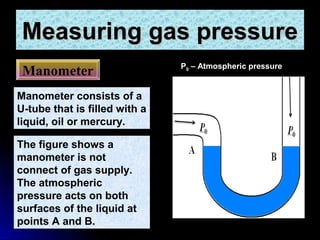
Measuring gas pressureMeasuring gas pressure
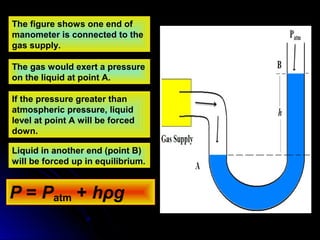
Manometer
Manometer consists of a
U-tube that is filled with a
liquid, oil or mercury.
The figure shows a
manometer is not
connect of gas supply.
The atmospheric
pressure acts on both
surfaces of the liquid at
points A and B.
P0 – Atmospheric pressure
The figure shows one end of
manometer is connected to the
gas supply.
The gas would exert a pressure
on the liquid at point A.
If the pressure greater than
atmospheric pressure, liquid
level at point A will be forced
down.
Liquid in another end (point B)
will be forced up in equilibrium.
P = Patm + hρg
Question
A mercury manometer with one end attached
to a gas supply measures a difference in the
level of mercury of 32 cm as in figure.
Calculate the pressure of the gas supply in
(a) cmHg (b) Pascal
[ Patm = 76 cmHg; g = 10 Nkg-1
;
ρmercury = 1.36 × 10⁴
kgm-3
]
Solution
(a) Pressure = Atmospheric pressure +
pressure due to mercury column
= 76 cmHg + 32 cmHg
= 108 cmHg
(b) Pressure of gas supply = hρg= 108 × 10-2
× 1.36 × 104
× 10
= 1.46 × 10⁵
Pa
Question
A mercury manometer with one end attached
to a gas supply measures a difference in the
level of mercury of 10 cm as in figure.
Calculate the pressure of the gas supply in
(a) cmHg (b) Pascal
[ Patm = 76 cmHg; g = 10 Nkg-1
;
ρmercury = 1.36 × 10⁴
kgm-3
]
Solution
(a) Pgas = PHg + Patm
= 10 cmHg + 76 cmHg
= 86 cmHg
(b) Pressure of gas supply = hρg
= 86 × 10-2
× 1.36 × 104
× 10
= 1.1696 × 10⁵
Pa
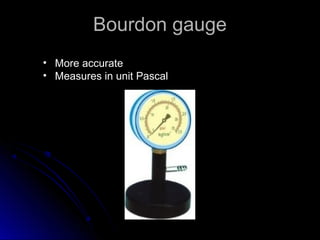
Bourdon gaugeBourdon gauge
• More accurate
• Measures in unit Pascal
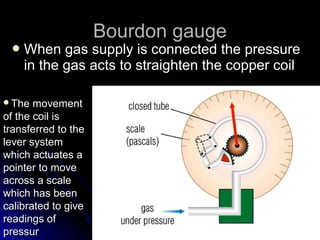
Bourdon gaugeBourdon gauge
 When gas supply is connected the pressureWhen gas supply is connected the pressure
in the gas acts to straighten the copper coilin the gas acts to straighten the copper coil
The movementThe movement
of the coil isof the coil is
transferred to thetransferred to the
lever systemlever system
which actuates awhich actuates a
pointer to movepointer to move
across a scaleacross a scale
which has beenwhich has been
calibrated to givecalibrated to give
readings ofreadings of
pressurpressur

Atmospheric n gas pressure

  • 1.
  • 2.
    Atmospheric PressureAtmospheric Pressure EarthAtmosphere Surface of the Earth Atmospheric pressure exerted on the surface of the Earth (or at the sea level) as well as objects on Earth.
  • 3.
    Atmospheric PressureAtmospheric Pressure The gasThe gas molecules havemolecules have weight.weight.  AtmosphericAtmospheric Pressure isPressure is caused by thecaused by the weight (force) ofweight (force) of the thick layer ofthe thick layer of air above theair above the earth’s surface.earth’s surface.
  • 4.
    HOW does ahuman body withstand the pressure on its surface? Living cells maintain an internal pressure that is about the same as 1 atm, which is similar to the atmospheric pressure. So, we don’t feel high atmospheric pressure exerted to us.
  • 5.
    Surface of bottle Internalpressure External pressure External pressure Internal pressure Internal Pressure = External pressure
  • 6.
    Atmospheric Pressure actsequally in allAtmospheric Pressure acts equally in all direction.direction.
  • 7.
    Characteristics of AtmosphericCharacteristicsof Atmospheric PressurePressure  It is not affected by the surface area.It is not affected by the surface area.  The pressure exerted by the air molecules at sea level is 1.013 × 10⁵ Pa.  At sea level, PAt sea level, Patmatm == 1.013 × 10⁵ Pa (Nm-2 ) = 76 cmHg= 76 cmHg = 10mH= 10mH22OO
  • 8.
    Atmospheric Pressure decreaseswith altitudeAtmospheric Pressure decreases with altitude because air is gets thinner as altitude increases.because air is gets thinner as altitude increases.
  • 10.
    Peter goes tothe top of mountain and feels breathing difficulty. The number of air molecules _________. The collision rate of air molecules _________ and he encounters ______ atmospheric pressure. So, he has to breath _____ when he goes up to mountain ( _____ altitude). John enters to the underground mines and feels breathing difficulty. The number of air molecules _________. The collision rate of air molecules _________ and he encounters ______ atmospheric pressure. So, he has to breath _____ when he goes down mines ( ____ altitude). decreases decreases lower more high increases increases higher less low
  • 11.
    Existence of AtmosphericExistenceof Atmospheric PressurePressure
  • 12.
    At normal condition,the rate of collision on inner wall is same with on outer wall. So, the air pressure inside and outside of the bottle is the same. After the air has been pumped out, there are almost no more air molecule inside the bottle to balance the force of collision of air molecule outside the bottle. The external force due to atmospheric pressure crashes the bottle.
  • 13.
    Existence of AtmosphericExistenceof Atmospheric PressurePressure
  • 14.
    Glass filled by water Atmospheric pressure Cardboard Why thecardboard does not fall from the mouth of the inverted glass filled with water? The atmospheric pressure that presses the cardboard against the glass produce a force that is strong enough to support the weight of the water in the glass.
  • 15.
    Existence of AtmosphericExistenceof Atmospheric PressurePressure syringesyringe BarometerBarometer
  • 16.
    Application of atmospheric pressure Pouringthe condensed milk from its can A rubber suction cap on a smooth surface Drinking with a straw Removing dust with a vacuum cleaner Putting plastic sticker onto the inner surface windscreen Measuring blood pressure
  • 17.
    The presence ofa second hole is to enable air flow into the can. So, the air pressure inside the can same as atmospheric pressure. It will force the milk out of the lower hole. Pouring the condensed milk from its can Milk Air flows into the can Atmospheric pressure
  • 18.
    A rubber suctioncap on a smooth surface When air is forced out of the suction cup, a partial vacuum is created in the space between the cup and the smooth surface. The surrounding atmospheric pressure forces the cup tightly against the smooth surface.
  • 19.
    Removing dust with avacuum cleaner When the vacuum cleaner switches on, the motor will work and the fan blades turn, force the air forward towards the exhaust port. The pressure level in the area behind the fan drops below the pressure level outside the vacuum cleaner. This creates partial vacuum inside the vacuum cleaner. The dust will flows into the vacuum cleaner through the intake port because the air pressure inside the vacuum cleaner is lower than the pressure outside.
  • 20.
    Drinking with astraw Straw Atmospheric pressure forces the drink into the straw Air being sucked up and creating a partial vacuum in the straw When the air is being sucked from the straw, a partial vacuum is created in the straw. The surrounding atmospheric pressure will force the drink into the straw and enable it to be moved into the mouth.
  • 21.
    Putting plastic sticker ontothe inner surface windscreen When the plastic is placed on the glass surface, air is being forced out of the space between the sticker and the glass surface, creating a partial vacuum. The surrounding atmospheric pressure will hold the sticker tightly on the windscreen. Windscreen Sticker Pressure Air is being force out
  • 22.
    Instruments for measuringInstrumentsfor measuring Atmospheric PressureAtmospheric Pressure Mercury barometerMercury barometer Fortin barometerFortin barometer Aneroid barometerAneroid barometer
  • 23.
    Measuring atmospheric pressure SimpleBarometer Made of a glass tube of about 100 cm filled with liquid (normally mercury is used). For mercury, the liquid level will drop as it flows into a bowl to until a vertical height of above 76 cm from the surface of mercury in the bowl. ρHg = 1.36 × 10⁴ kg m-3 g = 9.8 N kg-1 h = 76 cm = 0.76 m P = 1.36 × 104 × 9.8 × 0.76 = 1.103 × 10⁵ Pa
  • 24.
    Question Liquid A hasbeen filled into the barometer to measure the atmospheric pressure at sea level. According to the figure, find the density of the liquid A. Solution As we know, atmospheric pressure, P is equal to 1.013 × 10⁵ Pa at sea level. So, P = 1.013 × 105 = hρg 1.013 × 105 = 1.10 × ρA × 10 ρA = 9209 kg m-3
  • 25.
    Fortin BarometerFortin Barometer More accurateMore accurate  unit mmHgunit mmHg
  • 26.
    Fortin barometers haveto be set before each reading is taken. Using the screw at the bottom adjust the mercury level, seen in the glass reservoir, until the surface just touches the tip of the pointer. The barometer is then ready for a reading to be taken.
  • 27.
    Aneroid BarometerAneroid Barometer More handy and mobileMore handy and mobile
  • 28.
    Aneroid BarometerAneroid Barometer •the partially evacuated chamber expands and contracts in response to changes in atmospheric pressure
  • 29.
  • 30.
    Normally used by pilotto determine the atmospheric pressure in sky. Sometimes, it is also used to measure the height above the sea level (altitude). So, it called altimeter. Aneroid BarometerAneroid Barometer
  • 31.
  • 32.
    Kinetic MolecularKinetic Molecular TheoryTheory Basicassumptions:Basic assumptions:  A gas consists of a collection of small particles which are moving rapidly and randomly in straight-line motion and obeying Newton's Laws.  Gas molecules are constantly colliding with one another and the collisions is perfectly elastic (that is, no energy is gained or lost during the collision).  Average kinetic energy is equal to the temperature.Average kinetic energy is equal to the temperature.
  • 33.
    Gas Molecule Pressure in gasesdue to collision of molecules with the wall of a container.
  • 34.
    Gas PressureGas Pressure Gas molecules collide withGas molecules collide with the wall of the container andthe wall of the container and change velocity andchange velocity and momentum,momentum,  the rate of change ofthe rate of change of momentum = Forcemomentum = Force  The force on the wall of theThe force on the wall of the container creates gascontainer creates gas pressure.pressure.
  • 35.
    Pressure Rate of collisions Numberof particles Speed of particles Volume of container
  • 36.
    When number ofparticleWhen number of particle INCREASESINCREASES Distance between particles __________, ______ collisions occurs, pressure __________. DECREASE MORE INCREASE
  • 37.
    When volume ofcontainerWhen volume of container INCREASEINCREASE Particles have ______ space to move around, _____ collisions occurs, pressure __________. MORE LESS DECREASE
  • 38.
    When temperature insideof containerWhen temperature inside of container INCREASEINCREASE P P P P P P Particles gain ______ energy and move ________, average speed __________, ______ collisions occurs, pressure __________. MORE MORE INCREASE INCREASE FASTER
  • 39.
    Instruments for measuringInstrumentsfor measuring Gas pressureGas pressure  ManometerManometer  Bourdon gaugeBourdon gauge
  • 40.
    Measuring gas pressureMeasuringgas pressure Manometer Manometer consists of a U-tube that is filled with a liquid, oil or mercury. The figure shows a manometer is not connect of gas supply. The atmospheric pressure acts on both surfaces of the liquid at points A and B. P0 – Atmospheric pressure
  • 41.
    The figure showsone end of manometer is connected to the gas supply. The gas would exert a pressure on the liquid at point A. If the pressure greater than atmospheric pressure, liquid level at point A will be forced down. Liquid in another end (point B) will be forced up in equilibrium. P = Patm + hρg
  • 42.
    Question A mercury manometerwith one end attached to a gas supply measures a difference in the level of mercury of 32 cm as in figure. Calculate the pressure of the gas supply in (a) cmHg (b) Pascal [ Patm = 76 cmHg; g = 10 Nkg-1 ; ρmercury = 1.36 × 10⁴ kgm-3 ] Solution (a) Pressure = Atmospheric pressure + pressure due to mercury column = 76 cmHg + 32 cmHg = 108 cmHg (b) Pressure of gas supply = hρg= 108 × 10-2 × 1.36 × 104 × 10 = 1.46 × 10⁵ Pa
  • 43.
    Question A mercury manometerwith one end attached to a gas supply measures a difference in the level of mercury of 10 cm as in figure. Calculate the pressure of the gas supply in (a) cmHg (b) Pascal [ Patm = 76 cmHg; g = 10 Nkg-1 ; ρmercury = 1.36 × 10⁴ kgm-3 ] Solution (a) Pgas = PHg + Patm = 10 cmHg + 76 cmHg = 86 cmHg (b) Pressure of gas supply = hρg = 86 × 10-2 × 1.36 × 104 × 10 = 1.1696 × 10⁵ Pa
  • 44.
    Bourdon gaugeBourdon gauge •More accurate • Measures in unit Pascal
  • 45.
    Bourdon gaugeBourdon gauge When gas supply is connected the pressureWhen gas supply is connected the pressure in the gas acts to straighten the copper coilin the gas acts to straighten the copper coil The movementThe movement of the coil isof the coil is transferred to thetransferred to the lever systemlever system which actuates awhich actuates a pointer to movepointer to move across a scaleacross a scale which has beenwhich has been calibrated to givecalibrated to give readings ofreadings of pressurpressur