Farzana Aziz
Hina Ambreen
M.Ed
University of education
Athens
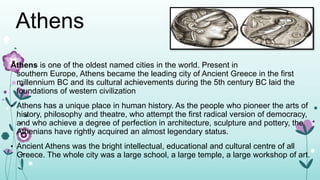
Athens is one of the oldest named cities in the world. Present in
southern Europe, Athens became the leading city of Ancient Greece in the first
millennium BC and its cultural achievements during the 5th century BC laid the
foundations of western civilization
• Athens has a unique place in human history. As the people who pioneer the arts of
history, philosophy and theatre, who attempt the first radical version of democracy,
and who achieve a degree of perfection in architecture, sculpture and pottery, the
Athenians have rightly acquired an almost legendary status.
• Ancient Athens was the bright intellectual, educational and cultural centre of all
Greece. The whole city was a large school, a large temple, a large workshop of art.
Aim Of Education
• The Athenian education aimed at the cultivation
of the person´s mental, physical and moral
qualities, leading the youth to become "strong
and decent", useful to his city and fellow
citizens. The balance between body and soul
was the main target of the Athenian education,
the noblest the worlds has known.
Steps of Education
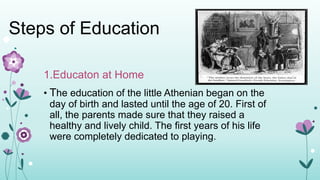
1.Educaton at Home
• The education of the little Athenian began on the
day of birth and lasted until the age of 20. First of
all, the parents made sure that they raised a
healthy and lively child. The first years of his life
were completely dedicated to playing.
Elementary Level
• At the age of 7, the child would start going to school, although school
was not compulsory, even the poorest Athenian citizen tried to provide
his children with – at least – a basic education. Schooling was private,
usually taking place at the teachers house, girls were educated at
home.
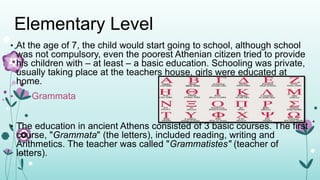
• Grammata
• The education in ancient Athens consisted of 3 basic courses. The first
course, "Grammata" (the letters), included reading, writing and
Arithmetics. The teacher was called "Grammatistes" (teacher of
letters).
Kytharistes & Gymnasium
Kytharistes
The second course consisted of the
subjects of Music: Singing, Playing
of the lyre and the flute, Reciting
and musical performance of poetry.
The teacher was
called "Kytharistes". Through letters,
music and poetry, the pupils were
also taught History, Geography,
Ethics and all the values of life. That
way they cultivated their mind and
soul.
Gymnasium
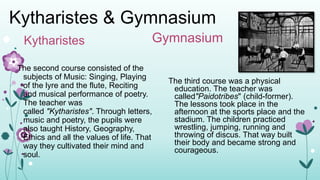
The third course was a physical
education. The teacher was
called"Paidotribes" (child-former).
The lessons took place in the
afternoon at the sports place and the
stadium. The children practiced
wrestling, jumping, running and
throwing of discus. That way built
their body and became strong and
courageous.
Hina Ambreen
M.Ed
University of education
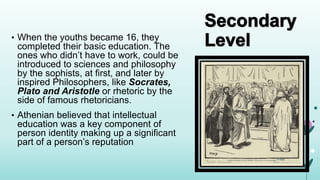
• When the youths became 16, they
completed their basic education. The
ones who didn’t have to work, could be
introduced to sciences and philosophy
by the sophists, at first, and later by
inspired Philosophers, like Socrates,
Plato and Aristotle or rhetoric by the
side of famous rhetoricians.
• Athenian believed that intellectual
education was a key component of
person identity making up a significant
part of a person’s reputation
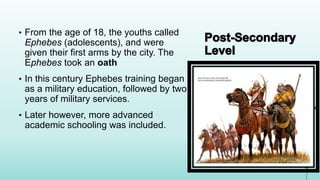
• From the age of 18, the youths called
Ephebes (adolescents), and were
given their first arms by the city. The
Ephebes took an oath
• In this century Ephebes training began
as a military education, followed by two
years of military services.
• Later however, more advanced
academic schooling was included.
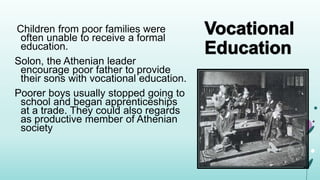
Children from poor families were
often unable to receive a formal
education.
Solon, the Athenian leader
encourage poor father to provide
their sons with vocational education.
Poorer boys usually stopped going to
school and began apprenticeships
at a trade. They could also regards
as productive member of Athenian
society
Athenian

Athenian

  • 1.
  • 2.
    Athens Athens is oneof the oldest named cities in the world. Present in southern Europe, Athens became the leading city of Ancient Greece in the first millennium BC and its cultural achievements during the 5th century BC laid the foundations of western civilization • Athens has a unique place in human history. As the people who pioneer the arts of history, philosophy and theatre, who attempt the first radical version of democracy, and who achieve a degree of perfection in architecture, sculpture and pottery, the Athenians have rightly acquired an almost legendary status. • Ancient Athens was the bright intellectual, educational and cultural centre of all Greece. The whole city was a large school, a large temple, a large workshop of art.
  • 3.
    Aim Of Education •The Athenian education aimed at the cultivation of the person´s mental, physical and moral qualities, leading the youth to become "strong and decent", useful to his city and fellow citizens. The balance between body and soul was the main target of the Athenian education, the noblest the worlds has known.
  • 4.
    Steps of Education 1.Educatonat Home • The education of the little Athenian began on the day of birth and lasted until the age of 20. First of all, the parents made sure that they raised a healthy and lively child. The first years of his life were completely dedicated to playing.
  • 5.
    Elementary Level • Atthe age of 7, the child would start going to school, although school was not compulsory, even the poorest Athenian citizen tried to provide his children with – at least – a basic education. Schooling was private, usually taking place at the teachers house, girls were educated at home. • Grammata • The education in ancient Athens consisted of 3 basic courses. The first course, "Grammata" (the letters), included reading, writing and Arithmetics. The teacher was called "Grammatistes" (teacher of letters).
  • 6.
    Kytharistes & Gymnasium Kytharistes Thesecond course consisted of the subjects of Music: Singing, Playing of the lyre and the flute, Reciting and musical performance of poetry. The teacher was called "Kytharistes". Through letters, music and poetry, the pupils were also taught History, Geography, Ethics and all the values of life. That way they cultivated their mind and soul. Gymnasium The third course was a physical education. The teacher was called"Paidotribes" (child-former). The lessons took place in the afternoon at the sports place and the stadium. The children practiced wrestling, jumping, running and throwing of discus. That way built their body and became strong and courageous.
  • 7.
  • 8.
    • When theyouths became 16, they completed their basic education. The ones who didn’t have to work, could be introduced to sciences and philosophy by the sophists, at first, and later by inspired Philosophers, like Socrates, Plato and Aristotle or rhetoric by the side of famous rhetoricians. • Athenian believed that intellectual education was a key component of person identity making up a significant part of a person’s reputation
  • 9.
    • From theage of 18, the youths called Ephebes (adolescents), and were given their first arms by the city. The Ephebes took an oath • In this century Ephebes training began as a military education, followed by two years of military services. • Later however, more advanced academic schooling was included.
  • 10.
    Children from poorfamilies were often unable to receive a formal education. Solon, the Athenian leader encourage poor father to provide their sons with vocational education. Poorer boys usually stopped going to school and began apprenticeships at a trade. They could also regards as productive member of Athenian society