The Greek Educational
system
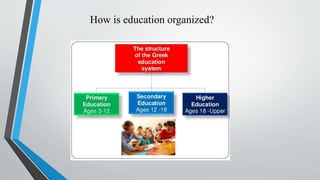
How is education organized?
All levels are overseen by the Ministry of Education,
Research and ReligiousAffairs.The Greek education
system is very centralised; both in terms of organisation
and administration.
Pre-Primary level 1 : Kindergarden
• Students’ age 5-6 years old
• Two year courses
• No tuition fees
• No books
• Compulsory Education
Primary level 2: Elementary schools
• Studies: 6 years/ six classes
• Books centrally produced
• No tuition fees
• 8.00-13.15
• All day schools
• Public or private
Student Vacations
• Summer vacation (about 3 months)
• Christmas vacation (2 weeks)
• Easter vacation (2 weeks).
• Two national celebrations
• Drop-out rate in primary education in Greece
(1,76%)
Basic subjects:
Modern Greek Language (7-9 classes/week)
Mathematics (4-5 classes/week)
Environmental Studies (2–4 classes/week)
Physical Education (2-3 classes/week)
Music (1 class/week)
Art (1 class/week)
Theatre (1 class/week)
English (3 classes/week)
Second Foreign Language (2 classes/week and only for years 5 and 6)
History (2 classes/week and for years 3-6)
Geography (2 classes/week)
Assessment
• Descriptive Assessment for the first two years
• No final exams
• Assessed on a ABC scale from grade 3 to 4.
• Assessed on a mark scale 0-10 from grade 5 to
6.
Special schools
• Multicultural
• Minority schools
• Schools for students with special learning
difficulties
• Experimentals
All day schools
• Extended timetable and enriched curriculum
• 13.15 - 16.00
• Student preparation
Secondary Level 1 : Junior High School
• Children admitted after Primary Schools
• Studies : 3 years/ 3 classes
• Students’ age: 12-15
• School year divided in 2 terms
Subjects added to the curriculum
• Ancient Greek Language and literature
• Chemistry
• Biology Informatics
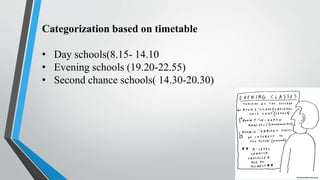
Categorization based on timetable
• Day schools(8.15- 14.10
• Evening schools (19.20-22.55)
• Second chance schools( 14.30-20.30)
Types of High schools
• General Gymnasium
• Athletic Gymnasium
• Musical Gymnasium
• Art Gymnasium
• Experimental Gymnasium
• Church Gymnasium
Higher secondary education:
• Lycea ( General, Scientific subject, lasts 3 three
years)
• E.P.A.L (Scientific and Technological subject,
lasts 3 three years) Provide vocational training
and education in 14 fields
• Technical Vocational Institutes
Class 2 of the unified lyceum
• Three directions to choose from: Theoretical,
Scientific and Technological.
• 60% of school time allotted to general education
and 40% to courses allotted to the direction
chosen
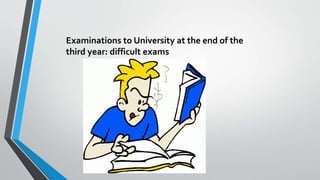
Examinations to University at the end of the
third year: difficult exams
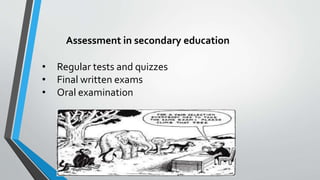
Assessment in secondary education
• Regular tests and quizzes
• Final written exams
• Oral examination
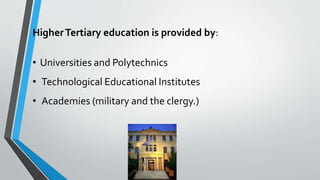
HigherTertiary education is provided by:
• Universities and Polytechnics
• Technological Educational Institutes
• Academies (military and the clergy.)
Higher education institutes
• Courses last 4 years (certain faculties excluded)
• Two semester in an academic year.
• 13 weeks of lessons
Post graduate studies
• Lead to the award of a postgraduate diploma of
specialization
• Courses last at least one calendar year
• With and without tuition fees
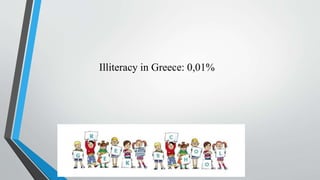
Illiteracy in Greece: 0,01%
Iliadou Vasiliki
3rd Primary school of Oreokastro,
Greece
Erasmus+ KA1 2016-2017
Thank you for your attention
Sas efcharisto

Educational system in Greece

  • 1.
  • 2.
    How is educationorganized?
  • 3.
    All levels areoverseen by the Ministry of Education, Research and ReligiousAffairs.The Greek education system is very centralised; both in terms of organisation and administration.
  • 4.
    Pre-Primary level 1: Kindergarden • Students’ age 5-6 years old • Two year courses • No tuition fees • No books • Compulsory Education
  • 5.
    Primary level 2:Elementary schools • Studies: 6 years/ six classes • Books centrally produced • No tuition fees • 8.00-13.15 • All day schools • Public or private
  • 6.
    Student Vacations • Summervacation (about 3 months) • Christmas vacation (2 weeks) • Easter vacation (2 weeks). • Two national celebrations • Drop-out rate in primary education in Greece (1,76%)
  • 7.
    Basic subjects: Modern GreekLanguage (7-9 classes/week) Mathematics (4-5 classes/week) Environmental Studies (2–4 classes/week) Physical Education (2-3 classes/week) Music (1 class/week) Art (1 class/week) Theatre (1 class/week) English (3 classes/week) Second Foreign Language (2 classes/week and only for years 5 and 6) History (2 classes/week and for years 3-6) Geography (2 classes/week)
  • 8.
    Assessment • Descriptive Assessmentfor the first two years • No final exams • Assessed on a ABC scale from grade 3 to 4. • Assessed on a mark scale 0-10 from grade 5 to 6.
  • 9.
    Special schools • Multicultural •Minority schools • Schools for students with special learning difficulties • Experimentals
  • 10.
    All day schools •Extended timetable and enriched curriculum • 13.15 - 16.00 • Student preparation
  • 11.
    Secondary Level 1: Junior High School • Children admitted after Primary Schools • Studies : 3 years/ 3 classes • Students’ age: 12-15 • School year divided in 2 terms
  • 12.
    Subjects added tothe curriculum • Ancient Greek Language and literature • Chemistry • Biology Informatics
  • 13.
    Categorization based ontimetable • Day schools(8.15- 14.10 • Evening schools (19.20-22.55) • Second chance schools( 14.30-20.30)
  • 14.
    Types of Highschools • General Gymnasium • Athletic Gymnasium • Musical Gymnasium • Art Gymnasium • Experimental Gymnasium • Church Gymnasium
  • 15.
    Higher secondary education: •Lycea ( General, Scientific subject, lasts 3 three years) • E.P.A.L (Scientific and Technological subject, lasts 3 three years) Provide vocational training and education in 14 fields • Technical Vocational Institutes
  • 16.
    Class 2 ofthe unified lyceum • Three directions to choose from: Theoretical, Scientific and Technological. • 60% of school time allotted to general education and 40% to courses allotted to the direction chosen
  • 17.
    Examinations to Universityat the end of the third year: difficult exams
  • 18.
    Assessment in secondaryeducation • Regular tests and quizzes • Final written exams • Oral examination
  • 19.
    HigherTertiary education isprovided by: • Universities and Polytechnics • Technological Educational Institutes • Academies (military and the clergy.)
  • 20.
    Higher education institutes •Courses last 4 years (certain faculties excluded) • Two semester in an academic year. • 13 weeks of lessons
  • 21.
    Post graduate studies •Lead to the award of a postgraduate diploma of specialization • Courses last at least one calendar year • With and without tuition fees
  • 22.
  • 23.
    Iliadou Vasiliki 3rd Primaryschool of Oreokastro, Greece Erasmus+ KA1 2016-2017
  • 24.
    Thank you foryour attention Sas efcharisto