KALLIONTZI MYRSINI
It is compulsory for every
child between the age of
5 to 12 years. Consists of
the Kindergarden
(lasting 1 year) and the
Elementery school
“dimotiko” (lasting 6
years). The aim of these
schools is to provide
pupils subject-specific
knowledge and prepare
them for the role of
citizens in the society.
Grading System:
1st Year: no grades
2nd Year: no grades
3rd Year: A-E
4th Year: A-E
5th Year: 1-10
6th Year: 1-10
The best and most
common grade in the 3rd
and 4th year is A, when in
5th and 6th year is 10.
This level is compulsory
as well and falls into the
secondary education
level. It consists of a 3-
year school which is
called “Gymnasium”
(ages 12 to 15). The aim of
this school is again to
provide subject-specific
knowledge and teach
kids how to become good
citizens in future.
Grading system:
1st year: 1-20
2nd year: 1-20
3rd year: 1-20
Yet it is unusual for a
pupil to get 1-7, because
the lowest grade teachers
give is 8.
The best grades are 18-
20.
It consists of 2 different
types of schools:
The unified upper secondary,
an academically oriented
school -Unified Lyceum-
(lasting 3 years)
The technical vocational
school-TEE (lasting 3 years as
well)
The aim of these 2 schools is
to provide more extended
education and prepare
teenagers for Pan-hellenic
national examinations.
Grading system:
1st year: 1-20
2nd year: 1-20
3rd year: 1-20
Again it is unusual for a pupil
to get grades 1-7.
The best grades are 18-20.
Mutual student transfer from
one type of school to the
other is possible.
The Lyceum helps students
acquire a general and
comprehensive education. In the
first year of Lyceum, students
follow a common curriculum
which aims to broaden their
general knowledge. At the end of
the first year, students may opt
to follow a more
technical/vocational training
and switch to the T.E.E. Similarly
after T.E.E. students may register
in the 2nd grade of Lyceum
following the successful
completion of the first year of
technical training.
Pan-hellenic national exams
take place when the 3rd year of
the upper secondary education is
over-before summer. Those
exams are the most important
for Greek citizens because the
result defines their future.
Students from Lyceums
participate in the exams in order
to attend Universities,
Technological Educational
Institutions, Military Academies,
Merchant Marine Academies
and other post-secondary
schools. Students from the T.E.E.
participate in exams for entrance
to the Technological Educational
Institutions.
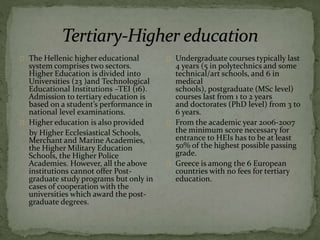
The Hellenic higher educational
system comprises two sectors.
Higher Education is divided into
Universities (23 )and Technological
Educational Institutions –TEI (16).
Admission to tertiary education is
based on a student’s performance in
national level examinations.
Higher education is also provided
by Higher Ecclesiastical Schools,
Merchant and Marine Academies,
the Higher Military Education
Schools, the Higher Police
Academies. However, all the above
institutions cannot offer Post-
graduate study programs but only in
cases of cooperation with the
universities which award the post-
graduate degrees.
Undergraduate courses typically last
4 years (5 in polytechnics and some
technical/art schools, and 6 in
medical
schools), postgraduate (MSc level)
courses last from 1 to 2 years
and doctorates (PhD level) from 3 to
6 years.
From the academic year 2006-2007
the minimum score necessary for
entrance to HEIs has to be at least
50% of the highest possible passing
grade.
Greece is among the 6 European
countries with no fees for tertiary
education.
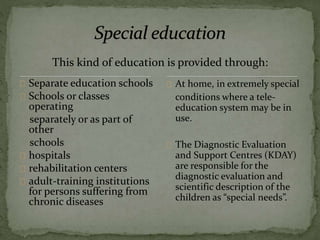
This kind of education is provided through:
Separate education schools
Schools or classes
operating
separately or as part of
other
schools
hospitals
rehabilitation centers
adult-training institutions
for persons suffering from
chronic diseases
At home, in extremely special
conditions where a tele-
education system may be in
use.
The Diagnostic Evaluation
and Support Centres (KDAY)
are responsible for the
diagnostic evaluation and
scientific description of the
children as “special needs”.
There is also a number of
private tutors schools,
colleges and universities
operating alongside the
state education and
providing supplementary
tuition.
These parallel schools
provide foreign language
tuition, supplementary
lessons for weak students
as well as exam preparation
courses for the
competitive Panhellenic
national examinations.
Most of the students
typically attend such
classes at the tutors schools
in the afternoon and
evening in addition to their
normal schooling.
Labour market
Higher Education
Postgraduate studies(Universities, TEI- Hellenic Open University) - Hellenic Open
University
Universities
Conventional ----- Technological Education Institutes (TEI)
Secondary Education
Lykeia:
- Musical
- Ecclesiastical (self sufficient and autonomous)
- Physical Education Schools B' grade
- Special A' grade
TEE:
Β and A Level
C and B Level
IEK
GYMNASIO:
(General, Musical, Ecclesiastical, Physical Education, Special) compulsory education
Primary Education
DIMOTIKO (mainstream, All-day, Special)
NIPIAGOGEIO (mainstream, All-day, Special)
NIPIAKA TMIMATA
PAIDIKOI STATHMOI
The Greek educational
system is under the
supervision of the Ministry of
National Education and
Religious Affairs (YPEPTH).
According to the Greek
Constitution, the government
is required to offer free and
mandatory educational
services for all children aged 6
to 15 years (in other words, a
mandatory 9-year
educational system).
There is a special law for the
implementation of the
principle of equal treatment
regardless of racial or
national origin, of religious or
other beliefs, of disability, age
or sex orientation in
accepting students in Greek
schools.
• Equal treatment of men and
women with regards to
employment, vocational
training, and professional
development, as far as labour
and universities are
concerned.
All levels of education are catered
for by both private and public
schools. State-run schools and
universities do not charge tuition
fees and textbooks are provided free
to all students by the School Book
Publishing Organization.
The main source of funding is the
state budget and the European
funds.
Moreover the Greek government
increased on an annual basis and in
real figures the funding of
education.
Formal education is characterized
by the fixed length of study, the
possibility of repetition and the
award of a formal school-leaving
certificate which is the official
authorization.
As a consequence of the
classification of the educational
institutions, a title (school-leaving
certificate, degree etc.) is
compulsory for students at each
educational level in order to
continue to the next.
Students in Greece are on holidays
during the below periods:
Summer (June-August)
Easter (2 weeks usually in April)
Christmas (22nd December- 7th
January)
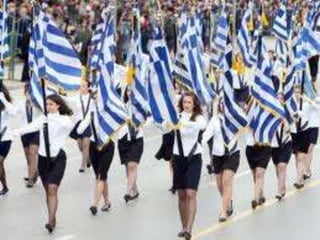
National celebrations (usually
lasting 2 days).
Facilities:
765 libraries in secondary
education
30 second chance schools
46 Adult Educational Centres
40 Parent schools
Distance Adult Learning Centres
Programs:
Joint Postgraduate Study
Programs and Joint PhDs, which
allow the use of a language other
than Greek in study programs
• Educational programs HERON
(training in new technologies)
Learning Greek as a second
language
Health educational programs
(preventing AIDS).
Programs of intercultural
education are provided to
repatriated students of Greek
origin and to students of foreign
or gipsy origin, while minority
schools are established for the
education of the Muslim
minority of Thrace.
There are public and private school
units of all levels and types of
primary and secondary education.
School units are characterized by
autonomous operation, regardless of
their size in terms of student
population.
Special-orientation schools (i.e.
athletic, music and ecclesiastical)
exist in parallel with mainstream
lower and upper secondary schools.
There are also experimental schools
functioning under the supervision
of Universities applying
experimental methods of teaching.
The regular school life of the
students should start from 2.5 years
of age termed as the pre-school
education, offered in institutions-
both private and public- which are
called “Vrefonipiakoi Paidikoi
Stathmoi” or creches.
In some institutions nursery classes
are combined with the
kindergardens at one single stretch.
Along with the kindergardens, the
primary schools are also in the
process, with a disciplined timetable
and an updated curriculum.
schools
Number of
public
schools
Number of
private
schools
Other
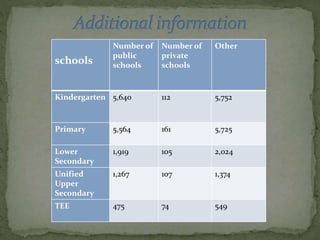
Kindergarten 5,640 112 5,752
Primary 5,564 161 5,725
Lower
Secondary
1,919 105 2,024
Unified
Upper
Secondary
1,267 107 1,374
TEE 475 74 549

Greek educational system

  • 1.
  • 3.
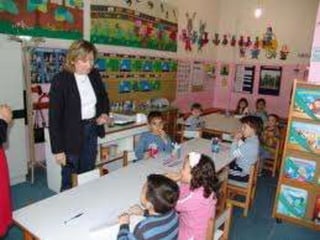
    It is compulsoryfor every child between the age of 5 to 12 years. Consists of the Kindergarden (lasting 1 year) and the Elementery school “dimotiko” (lasting 6 years). The aim of these schools is to provide pupils subject-specific knowledge and prepare them for the role of citizens in the society. Grading System: 1st Year: no grades 2nd Year: no grades 3rd Year: A-E 4th Year: A-E 5th Year: 1-10 6th Year: 1-10 The best and most common grade in the 3rd and 4th year is A, when in 5th and 6th year is 10.
  • 5.
    This level iscompulsory as well and falls into the secondary education level. It consists of a 3- year school which is called “Gymnasium” (ages 12 to 15). The aim of this school is again to provide subject-specific knowledge and teach kids how to become good citizens in future. Grading system: 1st year: 1-20 2nd year: 1-20 3rd year: 1-20 Yet it is unusual for a pupil to get 1-7, because the lowest grade teachers give is 8. The best grades are 18- 20.
  • 7.
    It consists of2 different types of schools: The unified upper secondary, an academically oriented school -Unified Lyceum- (lasting 3 years) The technical vocational school-TEE (lasting 3 years as well) The aim of these 2 schools is to provide more extended education and prepare teenagers for Pan-hellenic national examinations. Grading system: 1st year: 1-20 2nd year: 1-20 3rd year: 1-20 Again it is unusual for a pupil to get grades 1-7. The best grades are 18-20. Mutual student transfer from one type of school to the other is possible.
  • 8.
    The Lyceum helpsstudents acquire a general and comprehensive education. In the first year of Lyceum, students follow a common curriculum which aims to broaden their general knowledge. At the end of the first year, students may opt to follow a more technical/vocational training and switch to the T.E.E. Similarly after T.E.E. students may register in the 2nd grade of Lyceum following the successful completion of the first year of technical training. Pan-hellenic national exams take place when the 3rd year of the upper secondary education is over-before summer. Those exams are the most important for Greek citizens because the result defines their future. Students from Lyceums participate in the exams in order to attend Universities, Technological Educational Institutions, Military Academies, Merchant Marine Academies and other post-secondary schools. Students from the T.E.E. participate in exams for entrance to the Technological Educational Institutions.
  • 10.
    The Hellenic highereducational system comprises two sectors. Higher Education is divided into Universities (23 )and Technological Educational Institutions –TEI (16). Admission to tertiary education is based on a student’s performance in national level examinations. Higher education is also provided by Higher Ecclesiastical Schools, Merchant and Marine Academies, the Higher Military Education Schools, the Higher Police Academies. However, all the above institutions cannot offer Post- graduate study programs but only in cases of cooperation with the universities which award the post- graduate degrees. Undergraduate courses typically last 4 years (5 in polytechnics and some technical/art schools, and 6 in medical schools), postgraduate (MSc level) courses last from 1 to 2 years and doctorates (PhD level) from 3 to 6 years. From the academic year 2006-2007 the minimum score necessary for entrance to HEIs has to be at least 50% of the highest possible passing grade. Greece is among the 6 European countries with no fees for tertiary education.
  • 13.
    This kind ofeducation is provided through: Separate education schools Schools or classes operating separately or as part of other schools hospitals rehabilitation centers adult-training institutions for persons suffering from chronic diseases At home, in extremely special conditions where a tele- education system may be in use. The Diagnostic Evaluation and Support Centres (KDAY) are responsible for the diagnostic evaluation and scientific description of the children as “special needs”.
  • 14.
    There is alsoa number of private tutors schools, colleges and universities operating alongside the state education and providing supplementary tuition. These parallel schools provide foreign language tuition, supplementary lessons for weak students as well as exam preparation courses for the competitive Panhellenic national examinations. Most of the students typically attend such classes at the tutors schools in the afternoon and evening in addition to their normal schooling.
  • 16.
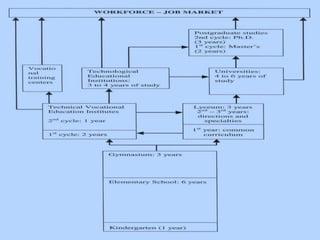
    Labour market Higher Education Postgraduatestudies(Universities, TEI- Hellenic Open University) - Hellenic Open University Universities Conventional ----- Technological Education Institutes (TEI) Secondary Education Lykeia: - Musical - Ecclesiastical (self sufficient and autonomous) - Physical Education Schools B' grade - Special A' grade TEE: Β and A Level C and B Level IEK GYMNASIO: (General, Musical, Ecclesiastical, Physical Education, Special) compulsory education Primary Education DIMOTIKO (mainstream, All-day, Special) NIPIAGOGEIO (mainstream, All-day, Special) NIPIAKA TMIMATA PAIDIKOI STATHMOI
  • 17.
    The Greek educational systemis under the supervision of the Ministry of National Education and Religious Affairs (YPEPTH). According to the Greek Constitution, the government is required to offer free and mandatory educational services for all children aged 6 to 15 years (in other words, a mandatory 9-year educational system). There is a special law for the implementation of the principle of equal treatment regardless of racial or national origin, of religious or other beliefs, of disability, age or sex orientation in accepting students in Greek schools. • Equal treatment of men and women with regards to employment, vocational training, and professional development, as far as labour and universities are concerned.
  • 18.
    All levels ofeducation are catered for by both private and public schools. State-run schools and universities do not charge tuition fees and textbooks are provided free to all students by the School Book Publishing Organization. The main source of funding is the state budget and the European funds. Moreover the Greek government increased on an annual basis and in real figures the funding of education. Formal education is characterized by the fixed length of study, the possibility of repetition and the award of a formal school-leaving certificate which is the official authorization. As a consequence of the classification of the educational institutions, a title (school-leaving certificate, degree etc.) is compulsory for students at each educational level in order to continue to the next. Students in Greece are on holidays during the below periods: Summer (June-August) Easter (2 weeks usually in April) Christmas (22nd December- 7th January) National celebrations (usually lasting 2 days).
  • 20.
    Facilities: 765 libraries insecondary education 30 second chance schools 46 Adult Educational Centres 40 Parent schools Distance Adult Learning Centres Programs: Joint Postgraduate Study Programs and Joint PhDs, which allow the use of a language other than Greek in study programs • Educational programs HERON (training in new technologies) Learning Greek as a second language Health educational programs (preventing AIDS). Programs of intercultural education are provided to repatriated students of Greek origin and to students of foreign or gipsy origin, while minority schools are established for the education of the Muslim minority of Thrace.
  • 22.
    There are publicand private school units of all levels and types of primary and secondary education. School units are characterized by autonomous operation, regardless of their size in terms of student population. Special-orientation schools (i.e. athletic, music and ecclesiastical) exist in parallel with mainstream lower and upper secondary schools. There are also experimental schools functioning under the supervision of Universities applying experimental methods of teaching. The regular school life of the students should start from 2.5 years of age termed as the pre-school education, offered in institutions- both private and public- which are called “Vrefonipiakoi Paidikoi Stathmoi” or creches. In some institutions nursery classes are combined with the kindergardens at one single stretch. Along with the kindergardens, the primary schools are also in the process, with a disciplined timetable and an updated curriculum.
  • 23.
    schools Number of public schools Number of private schools Other Kindergarten5,640 112 5,752 Primary 5,564 161 5,725 Lower Secondary 1,919 105 2,024 Unified Upper Secondary 1,267 107 1,374 TEE 475 74 549