Athens & Sparta A Brief Overview of City States of Ancient Greece
 
Greek City-States (700 - 338 BCE)
 
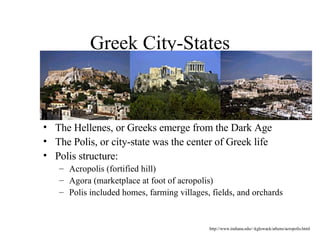
Greek City-States The Hellenes, or Greeks emerge from the Dark Age The Polis, or city-state was the center of Greek life Polis structure: Acropolis (fortified hill) Agora (marketplace at foot of acropolis) Polis included homes, farming villages, fields, and orchards http://www.indiana.edu/~kglowack/athens/acropolis.html
Sparta Military state, lives of Spartans were strictly disciplined and rigidly controlled Boys received military education, entered army at the age of 20, lived in barracks until 30 Spartans could marry at 20, vote at 30, but must stay in military until 60 Spartan women lived at home while husbands lived in barracks Women were expected to stay fit, bear and raise children
Temple of Artemis: Spartan Boys Were Flogged on the Steps
Age group / activity Purpose   Effects Training restricted the size of the homoioi population. Spartan males lacked skill in most  areas. They were largely illiterate. They were restricted in outlook. Spartans were never able to govern their conquests adequately Training:  10 days old: inspected by Council of Elders. 7-12 years old: training in physical fitness and obedience. 20-30 years old: At 20 years old permission was given to marry, but remained in barracks. Dined in "clubs." Attendance was compulsory. Members had to be accepted by all other members. A potential member might be "blackballed". 30 years old: becomes a full citizen (or homoioi). Might sleep at home but eats in a common mess. This eating in a common mess continued throughout a Spartan male's life. 60 years old: eligible for membership in the "Council of Elders" or Gerousia. At this age, many became involved in the training of younger Spartans.  To produce strong, healthy children. The training system was aimed at developing strong morale through association with peers and common experience. It instilled the Spartan with unquestioning loyalty to the state. .
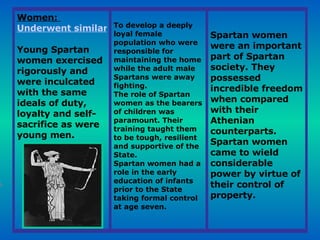
Women:  Underwent similar training   Young Spartan women exercised rigorously and were inculcated with the same ideals of duty, loyalty and self-sacrifice as were young men. To develop a deeply loyal female population who were responsible for maintaining the home while the adult male Spartans were away fighting.   The role of Spartan women as the bearers of children was paramount. Their training taught them to be tough, resilient and supportive of the State. Spartan women had a role in the early education of infants prior to the State taking formal control at age seven. Spartan women were an important part of Spartan society. They possessed incredible freedom when compared with their Athenian counterparts. Spartan women came to wield considerable power by virtue of their control of property.
Sparta Two kings led the oligarchy government Council of Elders decided on important decision the assembly would vote on C of E = 2 kings, 28 men over 60 years Ephors = 5 men who were responsible for youth education and citizen conduct Sparta closed themselves from the rest of the world Only the art of war mattered to the Spartans
Athens King originally ruled Athens, eventually ruled by oligarchy of Aristocrats Aristocrats owned the best life and controlled political life By the end of the 7 th  century b.c. had serious economic and political problems Many Athenian farmers were sold into slavery due to nonpayment of their debts At one time = 1/3 of all people were slaves Solon = reformist leader who cancelled debts but did not give land to the poor which led to internal strife
Patron Goddess Of Athens Athena
Athens Pisistratus seized power, helped merchants and gave the poor land/Athenians revolted against his son and ended his tyranny Cleisthenes was appointed by Athenians Cliesthenes created council of 500 to propose laws, supervise treasury, foreign affairs Assembly had final vote to pass laws  Cleisthenes reforms led to foundation of Athenian democracy
 
Great Peloponnesian War Greek world had become divided between Athens and Sparta War broke due to series of disputes Athens planned to win by staying behind its walls Spartans surrounded Athens and hoped they would come out and fight Pericles knew they could not beat Spartans In 430 bc plague broke out in Athens – 1/3 of people were killed, but Athenians fought for 27 more years Athens was defeated in 405 bc War weakened the Greek city-states
Assignment You are an ancient Greek . The class will divide into two teams one Athens, one Sparta Your team must come up with 10 things using resources available that make your city-state the better place to live

Athens & Sparta

  • 1.
    Athens & SpartaA Brief Overview of City States of Ancient Greece
  • 2.
  • 3.
  • 4.
  • 5.
    Greek City-States TheHellenes, or Greeks emerge from the Dark Age The Polis, or city-state was the center of Greek life Polis structure: Acropolis (fortified hill) Agora (marketplace at foot of acropolis) Polis included homes, farming villages, fields, and orchards http://www.indiana.edu/~kglowack/athens/acropolis.html
  • 6.
    Sparta Military state,lives of Spartans were strictly disciplined and rigidly controlled Boys received military education, entered army at the age of 20, lived in barracks until 30 Spartans could marry at 20, vote at 30, but must stay in military until 60 Spartan women lived at home while husbands lived in barracks Women were expected to stay fit, bear and raise children
  • 7.
    Temple of Artemis:Spartan Boys Were Flogged on the Steps
  • 8.
    Age group /activity Purpose Effects Training restricted the size of the homoioi population. Spartan males lacked skill in most  areas. They were largely illiterate. They were restricted in outlook. Spartans were never able to govern their conquests adequately Training: 10 days old: inspected by Council of Elders. 7-12 years old: training in physical fitness and obedience. 20-30 years old: At 20 years old permission was given to marry, but remained in barracks. Dined in "clubs." Attendance was compulsory. Members had to be accepted by all other members. A potential member might be "blackballed". 30 years old: becomes a full citizen (or homoioi). Might sleep at home but eats in a common mess. This eating in a common mess continued throughout a Spartan male's life. 60 years old: eligible for membership in the "Council of Elders" or Gerousia. At this age, many became involved in the training of younger Spartans. To produce strong, healthy children. The training system was aimed at developing strong morale through association with peers and common experience. It instilled the Spartan with unquestioning loyalty to the state. .
  • 9.
    Women: Underwentsimilar training Young Spartan women exercised rigorously and were inculcated with the same ideals of duty, loyalty and self-sacrifice as were young men. To develop a deeply loyal female population who were responsible for maintaining the home while the adult male Spartans were away fighting.  The role of Spartan women as the bearers of children was paramount. Their training taught them to be tough, resilient and supportive of the State. Spartan women had a role in the early education of infants prior to the State taking formal control at age seven. Spartan women were an important part of Spartan society. They possessed incredible freedom when compared with their Athenian counterparts. Spartan women came to wield considerable power by virtue of their control of property.
  • 10.
    Sparta Two kingsled the oligarchy government Council of Elders decided on important decision the assembly would vote on C of E = 2 kings, 28 men over 60 years Ephors = 5 men who were responsible for youth education and citizen conduct Sparta closed themselves from the rest of the world Only the art of war mattered to the Spartans
  • 11.
    Athens King originallyruled Athens, eventually ruled by oligarchy of Aristocrats Aristocrats owned the best life and controlled political life By the end of the 7 th century b.c. had serious economic and political problems Many Athenian farmers were sold into slavery due to nonpayment of their debts At one time = 1/3 of all people were slaves Solon = reformist leader who cancelled debts but did not give land to the poor which led to internal strife
  • 12.
    Patron Goddess OfAthens Athena
  • 13.
    Athens Pisistratus seizedpower, helped merchants and gave the poor land/Athenians revolted against his son and ended his tyranny Cleisthenes was appointed by Athenians Cliesthenes created council of 500 to propose laws, supervise treasury, foreign affairs Assembly had final vote to pass laws Cleisthenes reforms led to foundation of Athenian democracy
  • 14.
  • 15.
    Great Peloponnesian WarGreek world had become divided between Athens and Sparta War broke due to series of disputes Athens planned to win by staying behind its walls Spartans surrounded Athens and hoped they would come out and fight Pericles knew they could not beat Spartans In 430 bc plague broke out in Athens – 1/3 of people were killed, but Athenians fought for 27 more years Athens was defeated in 405 bc War weakened the Greek city-states
  • 16.
    Assignment You arean ancient Greek . The class will divide into two teams one Athens, one Sparta Your team must come up with 10 things using resources available that make your city-state the better place to live