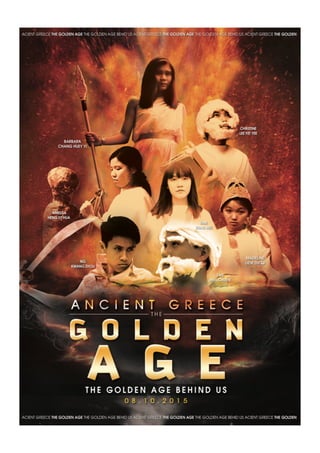
Table of Content
• Project Brief
• Introduction to Group Members
• Distribution of Work for the Research
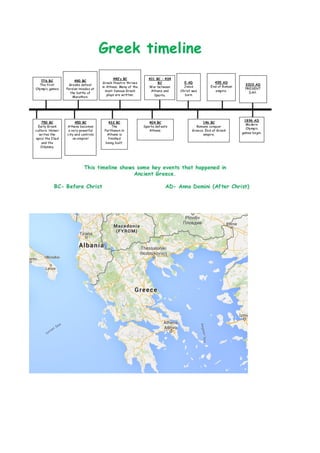
• Introduction to Greece : Greek Timeline
• Introduction to Athens :
- Social Strata
- Education
- Culture
- Arts
- Administration
- Tradition
- Superstitions
• Introduction to Sparta :
- Social Strata
- Education
- Culture
- Administration
- Marriage
- Gay Spartan
- Spartan Military
- ‘Diamastigosis’
- Naked Spartans
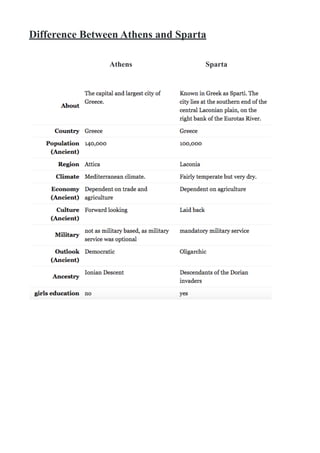
• Differences Between Athens and Sparta
• Important Historical Events in Greece
• Individual’s Character
• Introduction to the Characters
• Story Plot
• The Script
• Costume Research
• Paper Doll of Individuals’ Character
• Storyboard
• Behind the Scenes (Prop Making)
• A Summary of the Whole Research
Group Members
1. Christine Lee Yet Yee
2. Barbara Chang Huey Yi
3. Tan Min Chuen
4. Ng Kwang Zhou
5. Amelisa Heng Sy Hua
6. Madeline Liew Zhi Qi
7. Tam Zhao Wei
Distribution of Work for the Research
- History and Myth - Christine
- Timeline Research - Barbara & Zhao Wei
- Tradition - Madeline
- Culture of Athens - Kwang Zhou
- Culture of Sparta - Min C
- Administration - Zhao Wei
- Social Strata - Amelisa
!
!
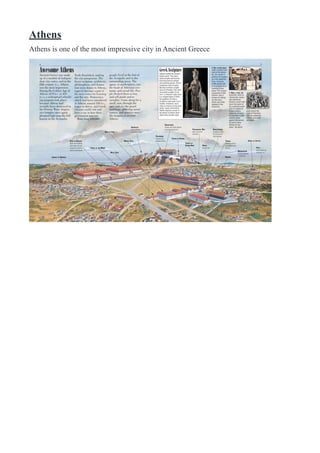
Athens
Athens is one of the most impressive city in Ancient Greece
!
Social Strata of Athens
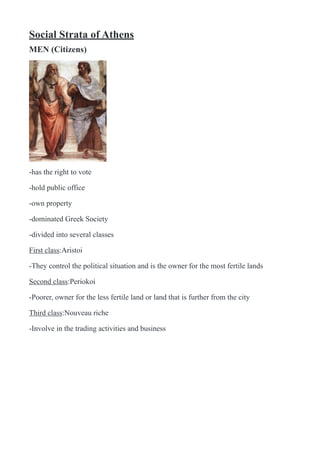
MEN (Citizens)
!
-has the right to vote
-hold public office
-own property
-dominated Greek Society
-divided into several classes
First class:Aristoi
-They control the political situation and is the owner for the most fertile lands
Second class:Periokoi
-Poorer, owner for the less fertile land or land that is further from the city
Third class:Nouveau riche
-Involve in the trading activities and business
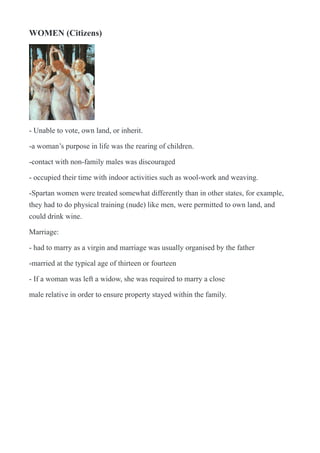
WOMEN (Citizens)
!
- Unable to vote, own land, or inherit.
-a woman’s purpose in life was the rearing of children.
-contact with non-family males was discouraged
- occupied their time with indoor activities such as wool-work and weaving.
-Spartan women were treated somewhat differently than in other states, for example,
they had to do physical training (nude) like men, were permitted to own land, and
could drink wine.
Marriage:
- had to marry as a virgin and marriage was usually organised by the father
-married at the typical age of thirteen or fourteen
- If a woman was left a widow, she was required to marry a close
male relative in order to ensure property stayed within the family.
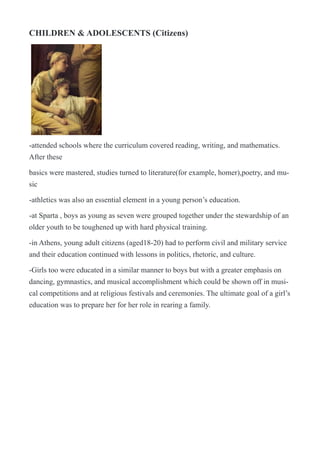
CHILDREN & ADOLESCENTS (Citizens)
!
-attended schools where the curriculum covered reading, writing, and mathematics.
After these
basics were mastered, studies turned to literature(for example, homer),poetry, and mu-
sic
-athletics was also an essential element in a young person’s education.
-at Sparta , boys as young as seven were grouped together under the stewardship of an
older youth to be toughened up with hard physical training.
-in Athens, young adult citizens (aged18-20) had to perform civil and military service
and their education continued with lessons in politics, rhetoric, and culture.
-Girls too were educated in a similar manner to boys but with a greater emphasis on
dancing, gymnastics, and musical accomplishment which could be shown off in musi-
cal competitions and at religious festivals and ceremonies. The ultimate goal of a girl’s
education was to prepare her for her role in rearing a family.
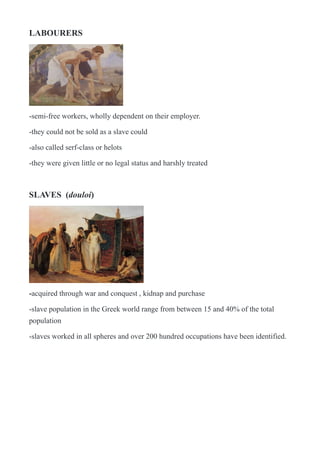
LABOURERS
!
-semi-free workers, wholly dependent on their employer.
-they could not be sold as a slave could
-also called serf-class or helots
-they were given little or no legal status and harshly treated
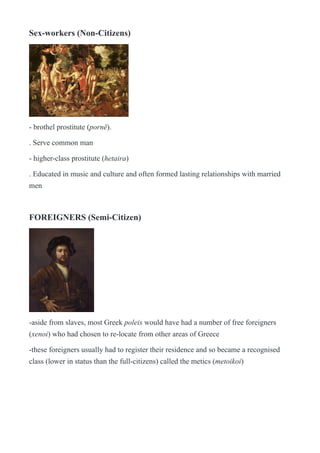
SLAVES (douloi)
!
-acquired through war and conquest , kidnap and purchase
-slave population in the Greek world range from between 15 and 40% of the total
population
-slaves worked in all spheres and over 200 hundred occupations have been identified.
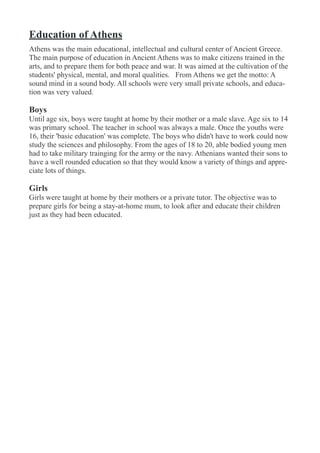
Sex-workers (Non-Citizens)
!
- brothel prostitute (pornē).
. Serve common man
- higher-class prostitute (hetaira)
. Educated in music and culture and often formed lasting relationships with married
men
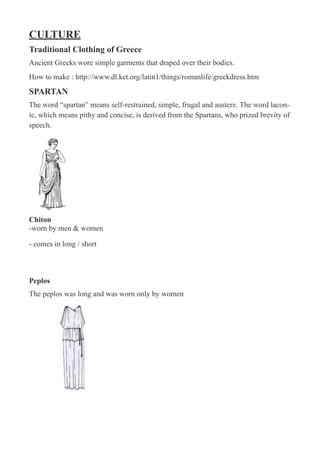
FOREIGNERS (Semi-Citizen)
!
-aside from slaves, most Greek poleis would have had a number of free foreigners
(xenoi) who had chosen to re-locate from other areas of Greece
-these foreigners usually had to register their residence and so became a recognised
class (lower in status than the full-citizens) called the metics (metoikoi)
Education of Athens
Athens was the main educational, intellectual and cultural center of Ancient Greece.
The main purpose of education in Ancient Athens was to make citizens trained in the
arts, and to prepare them for both peace and war. It was aimed at the cultivation of the
students' physical, mental, and moral qualities. From Athens we get the motto: A
sound mind in a sound body. All schools were very small private schools, and educa-
tion was very valued.
Boys
Until age six, boys were taught at home by their mother or a male slave. Age six to 14
was primary school. The teacher in school was always a male. Once the youths were
16, their 'basic education' was complete. The boys who didn't have to work could now
study the sciences and philosophy. From the ages of 18 to 20, able bodied young men
had to take military trainging for the army or the navy. Athenians wanted their sons to
have a well rounded education so that they would know a variety of things and appre-
ciate lots of things.
Girls
Girls were taught at home by their mothers or a private tutor. The objective was to
prepare girls for being a stay-at-home mum, to look after and educate their children
just as they had been educated.
CULTURE
Traditional Clothing of Greece
Ancient Greeks wore simple garments that draped over their bodies.
How to make : http://www.dl.ket.org/latin1/things/romanlife/greekdress.htm
SPARTAN
The word “spartan” means self-restrained, simple, frugal and austere. The word lacon-
ic, which means pithy and concise, is derived from the Spartans, who prized brevity of
speech.
!
Chiton
-worn by men & women
- comes in long / short


Peplos
The peplos was long and was worn only by women
!
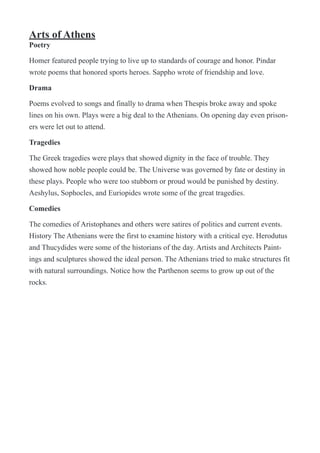
Arts of Athens
Poetry
Homer featured people trying to live up to standards of courage and honor. Pindar
wrote poems that honored sports heroes. Sappho wrote of friendship and love.
Drama
Poems evolved to songs and finally to drama when Thespis broke away and spoke
lines on his own. Plays were a big deal to the Athenians. On opening day even prison-
ers were let out to attend.
Tragedies
The Greek tragedies were plays that showed dignity in the face of trouble. They
showed how noble people could be. The Universe was governed by fate or destiny in
these plays. People who were too stubborn or proud would be punished by destiny.
Aeshylus, Sophocles, and Euriopides wrote some of the great tragedies.
Comedies
The comedies of Aristophanes and others were satires of politics and current events.
History The Athenians were the first to examine history with a critical eye. Herodutus
and Thucydides were some of the historians of the day. Artists and Architects Paint-
ings and sculptures showed the ideal person. The Athenians tried to make structures fit
with natural surroundings. Notice how the Parthenon seems to grow up out of the
rocks.
ADMINISTRATION OF ATHENS
Athens was ruled by archons, who were elected annually. Thus, because both parts of
Athens' government had leaders who were elected, Athens is said to have been the
birthplace of democracy.
Athenian life was creative. As an Athenian, you could get a good education and could
pursue any of several kinds of arts or sciences. You could serve in the army or navy,
but you didn't have to. (This applied only to boys, however: Girls were restricted to
other pursuits, not war or business or education.)
Traditions of Athens
Name day celebration - Most Greeks are named after a religious saint. A very impor-
tant tradition is that everyone who has a name coming from a saint celebrated by the
church celebrates his name on a given day of the year. On the "name day" of someone,
his friends and family visit him without invitation and offer wishes and small presents.
The hostess of the house offers pastries, sweets and hors d'oeuvres to the guests. In
Greece, name days are more important than birthdays.
Carnival In Greece - The Carnival is called "Apokries". The festival consists of two
weeks of feast, beginning from the Sunday of Meat Fare and ends with the first day of
the Lent, called Clean Monday (Kathari Deutera). Everyone is costumed and parties
take place in the streets and bars, throwing coloured confetti to each other. The most
famous Carnival Parade takes place in the city of Patra. In many towns around Greece
and in the islands, local customs revive. The Carnival is believed to come from pagan-
ism, and more precisely from the old festivities worshiping Dionysus, the god of wine
and feast.
Easter - Easter is the most important celebration for the Greeks, even more than
Christmas. On Good Thursday or Good Saturday, women dye eggs in red and bake
buns. On Good Friday, the day of mourning, the Epitaphios, the tomb of Christ with
its icon, decorated with flowers, is taken out of the church and carried around the vil-
lage followed by a slow procession. After the procession returns to the church where
the believers kiss the image of the Christ.
Greek Independence Day - The Greek Independence Day is celebrating the declara-
tion of the Independence War against the Ottomans on March 25th, 1821. Apart from a
national celebration, this day is also a religious celebration dedicated to the Annuncia-
tion of Virgin Mary.
Superstitions
1. Bread
In Greece, especially in villages, bread is considered a gift of God. Because of that
women bless the bread and make the sign of the cross with a knife before slicing it.
2. Evil Eye
Some Greeks believe that someone can catch the evil eye, or “matiasma”, from jealous
or envious people. Those, who have caught the evil eye, usually feel bad physically
and mentally. To avoid the matiasma one must wear a charm: a little blue marble glass
with an eye painted on it or a blue bracelet. Blue is believed to be the color that pro-
tects against the evil eye but it is also believed that people with blue eyes can give ma-
tiasma. Garlic is another way to guard against the evil eye, and people often hang it in
their houses.
3. Knives
Greeks never hand a knife to someone because they believe it will bring a fight with
the person. Therefore they set it down on the table and let the other person take it.
4. Spitting
Some Greeks believe that spitting chases the devil away. That is why when someone
talks about bad news (deaths, accidents, etc…) or compliments babies, children and
even adults, the others slightly spit three times saying “ftou, ftou, ftou”.
5. Tuesday the 13th
Unlike the Western belief, in Greece the unlucky day is Tuesday the 13th and not Fri-
day the 13th. Tuesday is considered to be the unluckiest day of the week because on
Tuesday, May 29th, 1453 the city of Constantinople was besieged and taken by the Ot-
toman Turks. Greeks also consider the number 13 to be good luck and the main theory
is the belief that having 12 apostles of Christ made Christ the 13th of the group. How-
ever, the combination of Tuesday and 13 as Tuesday the 13th of the month is consid-
ered a very unlucky day in Greek culture.
6. "Piase kokkino" (Touch Red)
Greeks believe that saying the same thing at the same time is an omen and the two
people will get into a fight or an argument. Because of this, when people say the same
thing together they must immediately follow by telling one another "piase kokkino"
and both have to touch any red item they can find around them.
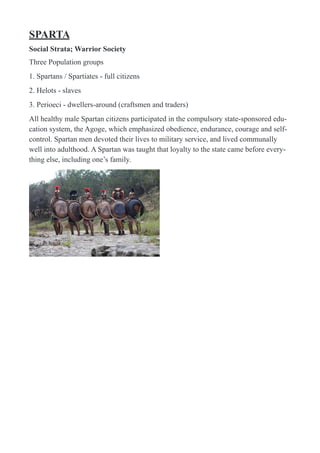
SPARTA
Social Strata; Warrior Society
Three Population groups
1. Spartans / Spartiates - full citizens
2. Helots - slaves
3. Perioeci - dwellers-around (craftsmen and traders)
All healthy male Spartan citizens participated in the compulsory state-sponsored edu-
cation system, the Agoge, which emphasized obedience, endurance, courage and self-
control. Spartan men devoted their lives to military service, and lived communally
well into adulthood. A Spartan was taught that loyalty to the state came before every-
thing else, including one’s family.
!
Education
!
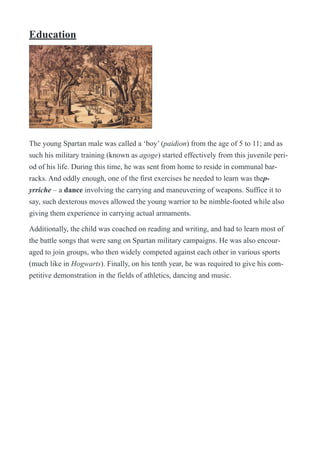
The young Spartan male was called a ‘boy’ (paidion) from the age of 5 to 11; and as
such his military training (known as agoge) started effectively from this juvenile peri-
od of his life. During this time, he was sent from home to reside in communal bar-
racks. And oddly enough, one of the first exercises he needed to learn was thep-
yrriche – a dance involving the carrying and maneuvering of weapons. Suffice it to
say, such dexterous moves allowed the young warrior to be nimble-footed while also
giving them experience in carrying actual armaments.
Additionally, the child was coached on reading and writing, and had to learn most of
the battle songs that were sang on Spartan military campaigns. He was also encour-
aged to join groups, who then widely competed against each other in various sports
(much like in Hogwarts). Finally, on his tenth year, he was required to give his com-
petitive demonstration in the fields of athletics, dancing and music.
Culture of Spartans
The culture of Sparta and the Spartans was pinpoint focused upon their military, they
were a highly efficient unit on and off the battlefield. The only truly military state in
ancient Greece, Spartans, men, women and children were born into, and lived in an
existence that was ruled by regiment and organisation. It was this military regimented
mentality that allowed the small Spartan population to become rulers of ancient
Greece and the dominant fighting force of the time.
ADMINISTRATION OF SPARTA
Sparta was ruled by two kings, who ruled until they died or were forced out of office.
Spartan life was simple. The focus was on obedience and war. Slavery made this pos-
sible by freeing the young men from household and industrial duties and allowing
them to focus on their military duties. Young boys were trained to be warriors; young
girls were trained to be mothers of warriors.
For many years, Spartan armies provided much of the defense of the Greek lands. The
Spartan heroism at the Battle of Thermopylae, during the Persian Wars, inspired all
of Greece to fight back with all their might against the invading Persians. Athenian
and Spartan fought side by side in the Battle of Plataea, which ended Persian invasions
of Greece.
MARRIAGE
In part to attract mates, females engaged in athletic competitions, including javelin-
throwing and wrestling, and also sang and danced competitively. As adults, Spartan
women were allowed to own and manage property. Additionally, they were typically
unencumbered by domestic responsibilities such as cooking, cleaning and making
clothing, tasks which were handled by the helots.
Marriage was important to Spartans, as the state put pressure on people to have male
children who would grow up to become citizen-warriors, and replace those who died
in battle. Men who delayed marriage were publically shamed, while those who fa-
thered multiple sons could be rewarded.
In preparation for marriage, Spartan women had their heads shaved; they kept their
hair short after they wed. Married couples typically lived apart, as men under 30 were
required to continue residing in communal barracks. In order to see their wives during
this time, husbands had to sneak away at night.
Gay Spartan
Most historians generally concur that significant numbers of Sparta’s adult male popu-
lation were actively homosexuals, and between them the practice of pederasty (homo-
sexual relationship between an adult male and a pubescent male) was not unheard
of. However, it should be noted that these relationships went beyond just the physical
basis. So the adult male intently acted as the younger trainee’s guardian, and thus was
responsible for the teenager’s conduct and courage in the agoge.
Spartan Military
Unlike such Greek city-states as Athens, a center for the arts, learning and philosophy,
Sparta was centered on a warrior culture. Male Spartan citizens were allowed only one
occupation: solider. Indoctrination into this lifestyle began early. Spartan boys started
their military training at age 7, when they left home and entered the Agoge. The boys
lived communally under austere conditions. They were subjected to continual physi-
cal, competitions (which could involve violence), given meager rations and expected
to become skilled at stealing food, among other survival skills.
The teenage boys who demonstrated the most leadership potential were selected for
participation in the Crypteia, which acted as a secret police force whose primary goal
was to terrorize the general Helot population and murder those who were troublemak-
ers. At age 20, Spartan males became full-time soldiers, and remained on active duty
until age 60.
‘Diamastigosis’
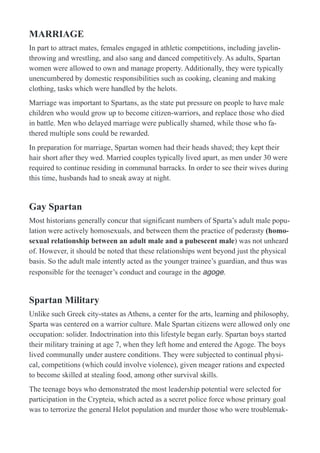
The nigh inhumane ritual involved the annual flogging of adolescents in front of the
an altar at the temple of Artemis Orthia. Underneath its pseudo-religious veneer, the
practice often tested the endurance level and courage of the young Spartans under mil-
itary training. But in spite of its seemingly arduous nature, the ritual did result in
deaths – with the fatality frequency increasing more by the latter part of the Spartan
state (especially during Roman rule). There are even evidences of a 3rd century AD
amphitheater which was specifically used for such bloody events with a spectator
base.
!
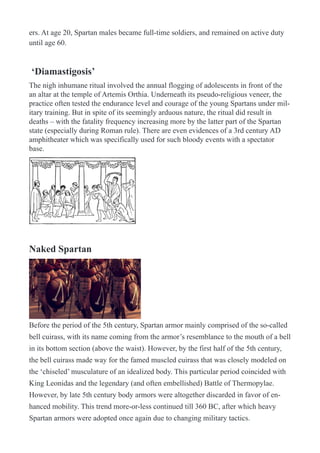
Naked Spartan
!
Before the period of the 5th century, Spartan armor mainly comprised of the so-called
bell cuirass, with its name coming from the armor’s resemblance to the mouth of a bell
in its bottom section (above the waist). However, by the first half of the 5th century,
the bell cuirass made way for the famed muscled cuirass that was closely modeled on
the ‘chiseled’ musculature of an idealized body. This particular period coincided with
King Leonidas and the legendary (and often embellished) Battle of Thermopylae.
However, by late 5th century body armors were altogether discarded in favor of en-
hanced mobility. This trend more-or-less continued till 360 BC, after which heavy
Spartan armors were adopted once again due to changing military tactics.
Beyond the body, another significant part of the Spartan armor was the shield. In fact,
the shield was given far more value than any type of armor or weaponry – and Spartan
warriors who threw away their shields were rigorously punished. When asked why, the
Spartan king Demaratos made a succinct reply – “because the latter [other armors]
they put on for their own protection, but the shield for the common good of the whole
line.”
Difference Between Athens and Sparta
Athens Sparta
!
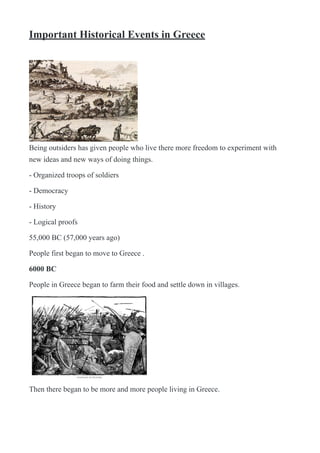
Important Historical Events in Greece
!
Being outsiders has given people who live there more freedom to experiment with
new ideas and new ways of doing things.
- Organized troops of soldiers
- Democracy
- History
- Logical proofs
55,000 BC (57,000 years ago)
People first began to move to Greece .
6000 BC
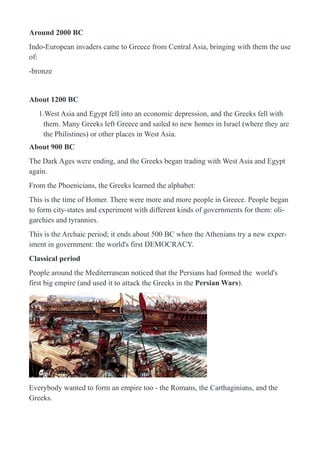
People in Greece began to farm their food and settle down in villages.
!
Then there began to be more and more people living in Greece.
Around 2000 BC
Indo-European invaders came to Greece from Central Asia, bringing with them the use
of:
-bronze
About 1200 BC
1.West Asia and Egypt fell into an economic depression, and the Greeks fell with
them. Many Greeks left Greece and sailed to new homes in Israel (where they are
the Philistines) or other places in West Asia.
About 900 BC
The Dark Ages were ending, and the Greeks began trading with West Asia and Egypt
again.
From the Phoenicians, the Greeks learned the alphabet:
This is the time of Homer. There were more and more people in Greece. People began
to form city-states and experiment with different kinds of governments for them: oli-
garchies and tyrannies.
This is the Archaic period; it ends about 500 BC when the Athenians try a new exper-
iment in government: the world's first DEMOCRACY.
Classical period
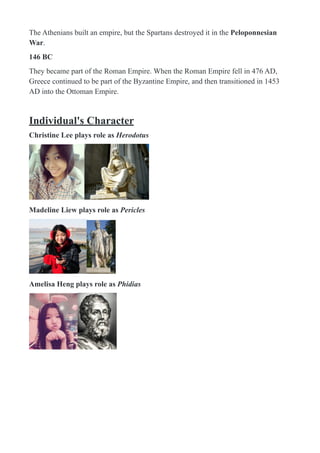
People around the Mediterranean noticed that the Persians had formed the world's
first big empire (and used it to attack the Greeks in the Persian Wars).
!
Everybody wanted to form an empire too - the Romans, the Carthaginians, and the
Greeks.
The Athenians built an empire, but the Spartans destroyed it in the Peloponnesian
War.
146 BC
They became part of the Roman Empire. When the Roman Empire fell in 476 AD,
Greece continued to be part of the Byzantine Empire, and then transitioned in 1453
AD into the Ottoman Empire.
Individual's Character
Christine Lee plays role as Herodotus
! !
Madeline Liew plays role as Pericles
! !
Amelisa Heng plays role as Phidias
! !
Tan Min Chuen plays role as Socrates
! !
Ng Kwang Zhou plays role as Xenophone
! !
Tam Zhao Wei plays role as Plato
! !
Barbara Chang plays role as Athena
! !
Introduction to the Characters
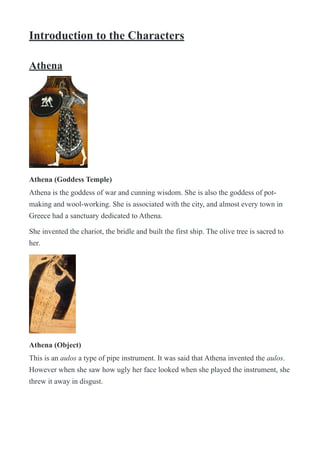
Athena
!
Athena (Goddess Temple)
Athena is the goddess of war and cunning wisdom. She is also the goddess of pot-
making and wool-working. She is associated with the city, and almost every town in
Greece had a sanctuary dedicated to Athena.
She invented the chariot, the bridle and built the first ship. The olive tree is sacred to
her.
!
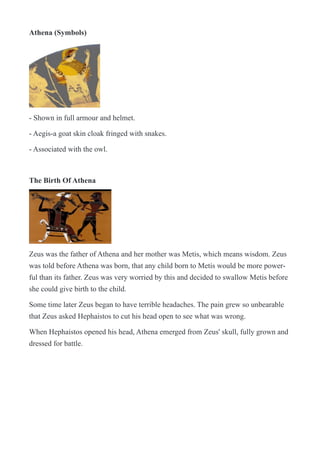
Athena (Object)
This is an aulos a type of pipe instrument. It was said that Athena invented the aulos.
However when she saw how ugly her face looked when she played the instrument, she
threw it away in disgust.
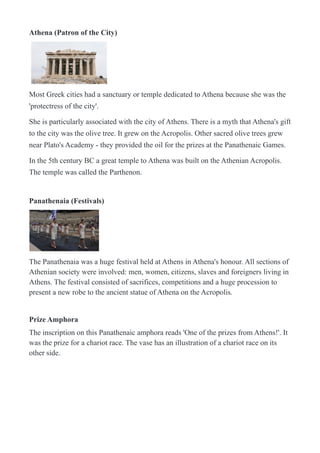
Athena (Symbols)
!
- Shown in full armour and helmet.
- Aegis-a goat skin cloak fringed with snakes.
- Associated with the owl.
The Birth Of Athena
!
Zeus was the father of Athena and her mother was Metis, which means wisdom. Zeus
was told before Athena was born, that any child born to Metis would be more power-
ful than its father. Zeus was very worried by this and decided to swallow Metis before
she could give birth to the child.
Some time later Zeus began to have terrible headaches. The pain grew so unbearable
that Zeus asked Hephaistos to cut his head open to see what was wrong.
When Hephaistos opened his head, Athena emerged from Zeus' skull, fully grown and
dressed for battle.
Athena (Patron of the City)
!
Most Greek cities had a sanctuary or temple dedicated to Athena because she was the
'protectress of the city'.
She is particularly associated with the city of Athens. There is a myth that Athena's gift
to the city was the olive tree. It grew on the Acropolis. Other sacred olive trees grew
near Plato's Academy - they provided the oil for the prizes at the Panathenaic Games.
In the 5th century BC a great temple to Athena was built on the Athenian Acropolis.
The temple was called the Parthenon.
Panathenaia (Festivals)
!
The Panathenaia was a huge festival held at Athens in Athena's honour. All sections of
Athenian society were involved: men, women, citizens, slaves and foreigners living in
Athens. The festival consisted of sacrifices, competitions and a huge procession to
present a new robe to the ancient statue of Athena on the Acropolis.
Prize Amphora
The inscription on this Panathenaic amphora reads 'One of the prizes from Athens!'. It
was the prize for a chariot race. The vase has an illustration of a chariot race on its
other side.
Socrates
!
One of the founders of Western philosophy
Socrates was with friends when he drank the hemlock and uttered his last words. In
death, as in life, Socrates was surrounded by people who were totally devoted to him:
who loved, respected, and admired him. His comrades wanted him to run away to
safety and begged him to leave Athens to preserve his life. Socrates chose to face his
death penalty in the same fashion he had lived his life: with a clarity of spirit and de-
void of fear.
WISDOM
!
"I know that I am intelligent, because I know that I know nothing"
-Socrates
Socrates often brought people to the realization that they were not the best they could
be, and perhaps they did not know what they thought they did. In the Symposium,
Socrates says:
[Man] is always becoming a new being and undergoing a process of loss and repara-
tion, which affects ... his soul as well. No man's character, habits, opinions, desires,
pleasures, pains, and fears remain always the same; new ones come into existence and
old ones disappear.
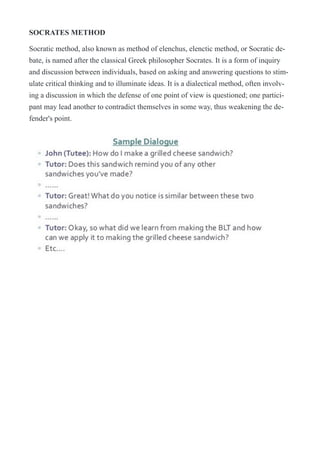
SOCRATES METHOD
Socratic method, also known as method of elenchus, elenctic method, or Socratic de-
bate, is named after the classical Greek philosopher Socrates. It is a form of inquiry
and discussion between individuals, based on asking and answering questions to stim-
ulate critical thinking and to illuminate ideas. It is a dialectical method, often involv-
ing a discussion in which the defense of one point of view is questioned; one partici-
pant may lead another to contradict themselves in some way, thus weakening the de-
fender's point.
!
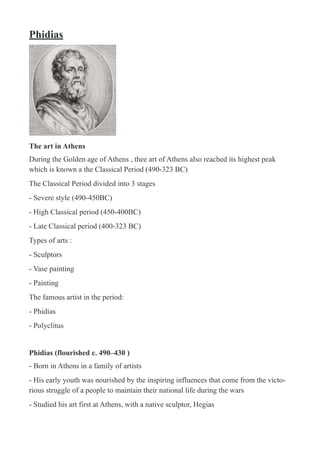
Phidias
!
The art in Athens
During the Golden age of Athens , thee art of Athens also reached its highest peak
which is known a the Classical Period (490-323 BC)
The Classical Period divided into 3 stages
- Severe style (490-450BC)
- High Classical period (450-400BC)
- Late Classical period (400-323 BC)
Types of arts :
- Sculptors
- Vase painting
- Painting
The famous artist in the period:
- Phidias
- Polyclitus
Phidias (flourished c. 490–430 )
- Born in Athens in a family of artists
- His early youth was nourished by the inspiring influences that come from the victo-
rious struggle of a people to maintain their national life during the wars
- Studied his art first at Athens, with a native sculptor, Hegias
- The downfall of Pericles, due to the jealousies of his rivals, carried with it the ruin of
Phidias, by charging him with appropriating to himself a portion of the gold which is
used to built the sculpture of Athena
Phidias famous work
Statue of Athena (Athena Parthenos)
Details: Athena's head is inclined slightly forward. She stands with her left hand rest-
ing on an upright shield. Her left knee is slightly bent, her weight slightly shifted to
her right leg. The Nike on her outstretched right hand is winged. The exact position of
a spear, often omitted, is also not fully determined, whether held in the crook of
Athena's right arm or supported by one of the snakes in the aegis.
Material used : wooden core, covered with shaped bronze plates covered in turn with
removable gold plates
Phidias famous work
!
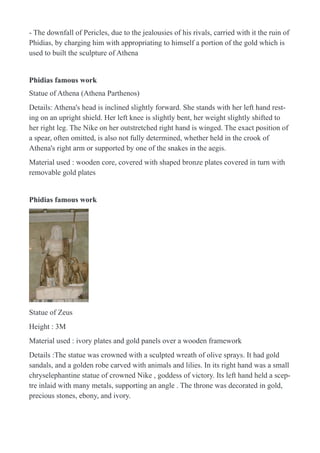
Statue of Zeus
Height : 3M
Material used : ivory plates and gold panels over a wooden framework
Details :The statue was crowned with a sculpted wreath of olive sprays. It had gold
sandals, and a golden robe carved with animals and lilies. In its right hand was a small
chryselephantine statue of crowned Nike , goddess of victory. Its left hand held a scep-
tre inlaid with many metals, supporting an angle . The throne was decorated in gold,
precious stones, ebony, and ivory.
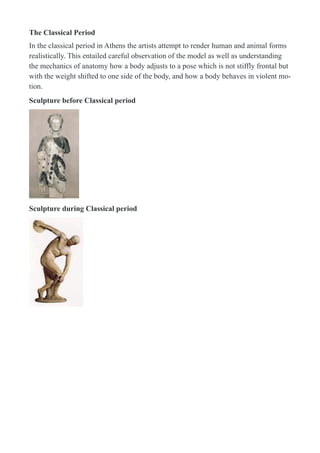
The Classical Period
In the classical period in Athens the artists attempt to render human and animal forms
realistically. This entailed careful observation of the model as well as understanding
the mechanics of anatomy how a body adjusts to a pose which is not stiffly frontal but
with the weight shifted to one side of the body, and how a body behaves in violent mo-
tion.
Sculpture before Classical period
!
Sculpture during Classical period
!
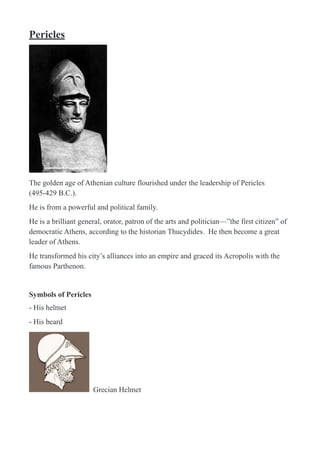
Pericles
!
The golden age of Athenian culture flourished under the leadership of Pericles
(495-429 B.C.).
He is from a powerful and political family.
He is a brilliant general, orator, patron of the arts and politician—”the first citizen” of
democratic Athens, according to the historian Thucydides. He then become a great
leader of Athens.
He transformed his city’s alliances into an empire and graced its Acropolis with the
famous Parthenon.
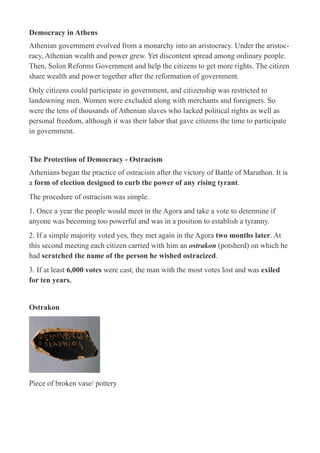
Symbols of Pericles
- His helmet
- His beard
! Grecian Helmet
Democracy in Athens
Athenian government evolved from a monarchy into an aristocracy. Under the aristoc-
racy, Athenian wealth and power grew. Yet discontent spread among ordinary people.
Then, Solon Reforms Government and help the citizens to get more rights. The citizen
share wealth and power together after the reformation of government.
Only citizens could participate in government, and citizenship was restricted to
landowning men. Women were excluded along with merchants and foreigners. So
were the tens of thousands of Athenian slaves who lacked political rights as well as
personal freedom, although it was their labor that gave citizens the time to participate
in government.
The Protection of Democracy - Ostracism
Athenians began the practice of ostracism after the victory of Battle of Marathon. It is
a form of election designed to curb the power of any rising tyrant.
The procedure of ostracism was simple.
1. Once a year the people would meet in the Agora and take a vote to determine if
anyone was becoming too powerful and was in a position to establish a tyranny.
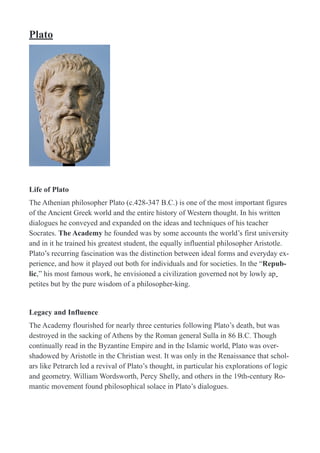
2. If a simple majority voted yes, they met again in the Agora two months later. At
this second meeting each citizen carried with him an ostrakon (potsherd) on which he
had scratched the name of the person he wished ostracized.
3. If at least 6,000 votes were cast, the man with the most votes lost and was exiled
for ten years.
Ostrakon
!
Piece of broken vase/ pottery
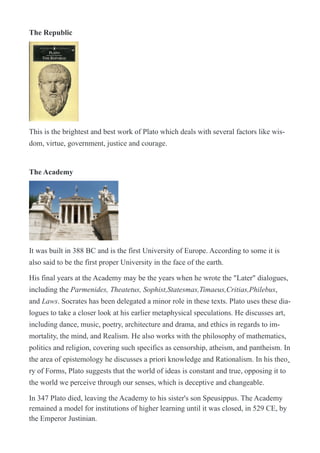
Plato
!
Life of Plato
The Athenian philosopher Plato (c.428-347 B.C.) is one of the most important figures
of the Ancient Greek world and the entire history of Western thought. In his written
dialogues he conveyed and expanded on the ideas and techniques of his teacher
Socrates. The Academy he founded was by some accounts the world’s first university
and in it he trained his greatest student, the equally influential philosopher Aristotle.
Plato’s recurring fascination was the distinction between ideal forms and everyday ex-
perience, and how it played out both for individuals and for societies. In the “Repub-
lic,” his most famous work, he envisioned a civilization governed not by lowly ap-
petites but by the pure wisdom of a philosopher-king.
Legacy and Influence
The Academy flourished for nearly three centuries following Plato’s death, but was
destroyed in the sacking of Athens by the Roman general Sulla in 86 B.C. Though
continually read in the Byzantine Empire and in the Islamic world, Plato was over-
shadowed by Aristotle in the Christian west. It was only in the Renaissance that schol-
ars like Petrarch led a revival of Plato’s thought, in particular his explorations of logic
and geometry. William Wordsworth, Percy Shelly, and others in the 19th-century Ro-
mantic movement found philosophical solace in Plato’s dialogues.
The Republic
!
This is the brightest and best work of Plato which deals with several factors like wis-
dom, virtue, government, justice and courage.
The Academy
!
It was built in 388 BC and is the first University of Europe. According to some it is
also said to be the first proper University in the face of the earth.
His final years at the Academy may be the years when he wrote the "Later" dialogues,
including the Parmenides, Theatetus, Sophist,Statesmas,Timaeus,Critias,Philebus,
and Laws. Socrates has been delegated a minor role in these texts. Plato uses these dia-
logues to take a closer look at his earlier metaphysical speculations. He discusses art,
including dance, music, poetry, architecture and drama, and ethics in regards to im-
mortality, the mind, and Realism. He also works with the philosophy of mathematics,
politics and religion, covering such specifics as censorship, atheism, and pantheism. In
the area of epistemology he discusses a priori knowledge and Rationalism. In his theo-
ry of Forms, Plato suggests that the world of ideas is constant and true, opposing it to
the world we perceive through our senses, which is deceptive and changeable.
In 347 Plato died, leaving the Academy to his sister's son Speusippus. The Academy
remained a model for institutions of higher learning until it was closed, in 529 CE, by
the Emperor Justinian.
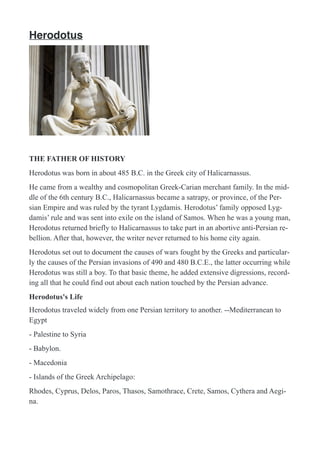
Herodotus
!
THE FATHER OF HISTORY
Herodotus was born in about 485 B.C. in the Greek city of Halicarnassus.
He came from a wealthy and cosmopolitan Greek-Carian merchant family. In the mid-
dle of the 6th century B.C., Halicarnassus became a satrapy, or province, of the Per-
sian Empire and was ruled by the tyrant Lygdamis. Herodotus’ family opposed Lyg-
damis’ rule and was sent into exile on the island of Samos. When he was a young man,
Herodotus returned briefly to Halicarnassus to take part in an abortive anti-Persian re-
bellion. After that, however, the writer never returned to his home city again.
Herodotus set out to document the causes of wars fought by the Greeks and particular-
ly the causes of the Persian invasions of 490 and 480 B.C.E., the latter occurring while
Herodotus was still a boy. To that basic theme, he added extensive digressions, record-
ing all that he could find out about each nation touched by the Persian advance.
Herodotus's Life
Herodotus traveled widely from one Persian territory to another. --Mediterranean to
Egypt
- Palestine to Syria
- Babylon.
- Macedonia
- Islands of the Greek Archipelago:
Rhodes, Cyprus, Delos, Paros, Thasos, Samothrace, Crete, Samos, Cythera and Aegi-
na.
He sailed through the Hellespont to the Black Sea and kept going until he hit the
Danube River. While he traveled, Herodotus collected what he called “autopsies,” or
“personal inquiries”: He listened to myths and legends, recorded oral histories and
made notes of the places and things that he saw.
When Herodotus was not traveling, he returned to Athens; there, he became something
of a celebrity. He gave readings in public places and collected fees from officials for
his appearances. In 445 B.C., the people of Athens voted to give him a prize of 10 tal-
ents–almost $200,000 in today’s money–to honor him for his contributions to the
city’s intellectual life.
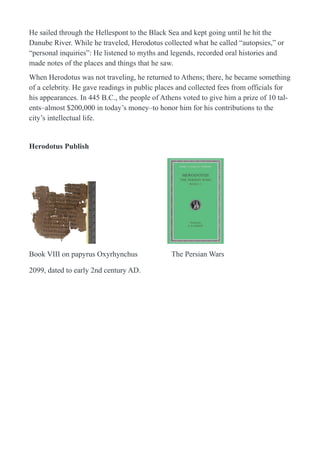
Herodotus Publish
!
Book VIII on papyrus Oxyrhynchus The Persian Wars
2099, dated to early 2nd century AD.
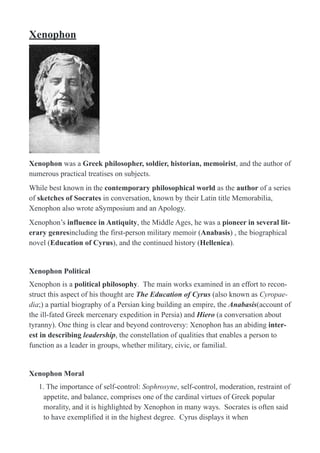
Xenophon
!
Xenophon was a Greek philosopher, soldier, historian, memoirist, and the author of
numerous practical treatises on subjects.
While best known in the contemporary philosophical world as the author of a series
of sketches of Socrates in conversation, known by their Latin title Memorabilia,
Xenophon also wrote aSymposium and an Apology.
Xenophon’s influence in Antiquity, the Middle Ages, he was a pioneer in several lit-
erary genresincluding the first-person military memoir (Anabasis) , the biographical
novel (Education of Cyrus), and the continued history (Hellenica).
Xenophon Political
Xenophon is a political philosophy. The main works examined in an effort to recon-
struct this aspect of his thought are The Education of Cyrus (also known as Cyropae-
dia;) a partial biography of a Persian king building an empire, the Anabasis(account of
the ill-fated Greek mercenary expedition in Persia) and Hiero (a conversation about
tyranny). One thing is clear and beyond controversy: Xenophon has an abiding inter-
est in describing leadership, the constellation of qualities that enables a person to
function as a leader in groups, whether military, civic, or familial.
Xenophon Moral
1. The importance of self-control: Sophrosyne, self-control, moderation, restraint of
appetite, and balance, comprises one of the cardinal virtues of Greek popular
morality, and it is highlighted by Xenophon in many ways. Socrates is often said
to have exemplified it in the highest degree. Cyrus displays it when
(Cyropaedia V.i-VII.iii) he is invited to look upon the most beautiful woman in
Asia, who happens to be his prisoner of war. He firmly declines this temptation;
his general Araspas by contrast stares at her endlessly, falls in lust, insults her
honor and ignites a chain of events that ends in her suicide over her husband’s
corpse.
2. A demanding work-ethic: Hard work makes for virtue in several ways. It con-
duces to health, it results in earned rewards, it keeps us off the streets of tempta-
tion, and builds character. In the Oeconomicus, a treatise on household manage-
ment, Xenophon tells the story of a visit paid by a Greek ambassador to Cyrus the
Persian king in his royal gardens. Cyrus astounds the Greek by stating that he
himself laid out the garden plan and works in it regularly. Cyrus continues (Oeco-
nomicus IV.24),
3. "I never yet sat down to dinner when in sound health, without first working hard
at some task of war or agriculture, or exerting myself somehow."
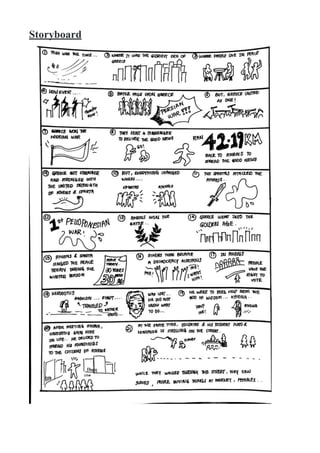
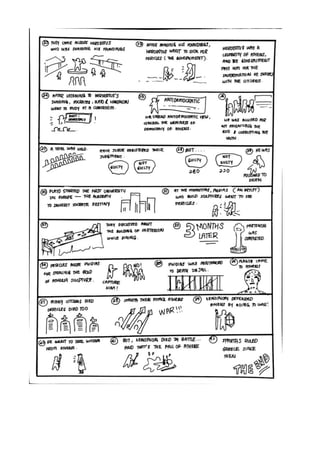
Story Plot
!
Scenes [Golden Age]
- shows individual characters
!
The Script
Golden Age - Intro
Athenians began the practice of ostracism after the victory of Battle of
Marathon. It is a form of election designed to curb the power of any rising
tyrant.
The procedure of ostracism was simple.
1. Once a year the people would meet in the Agora and take a vote to determine
if anyone was becoming too powerful and was in a position to establish a tyran-
ny.
2. If a simple majority voted yes, they met again in the Agora two months later.
At this second meeting each citizen carried with him an ostrakon (potsherd) on
which he had scratched the name of the person he wished ostracized.
3. If at least 6,000 votes were cast, the man with the most votes lost and was ex-
iled for ten years.
Scenes
Scene 1:
Props needed:
1. pieces of broken pottery
2. a big ballot box ( to put in the pieces)
3. people counting the pieces
SCENE 1 -
HERODOTUS WENT TO ATHENA TEMPLE
HERODOTUS : Athena, Athena, I am very confused about my situation right now. I
don’t know what to do. I need u to change me. Refresh my mind, body and soul. Teach
me to accept life in terms with faith in you or your will. There’s so many normal
things in life I want to do, I let my disease of addiction lead me to believe I’m differ-
ent. Teach me isolation isn't the answer, show me and give me strength. I surrender to
you, show me the right way.
ATHENA : I grant you the serenity to accept the things that you cannot change.
Courage to change the things that you can, and wisdom to know the difference. Living
one day at a time, enjoying one moment at time, accepting hardships as the pathway to
peace. This is a sinful world, trusting that I will make all the things right. I surrender
to My Will, that you may be reasonably happy in this life and supremely happy with
me forever in the next.
HERODOTUS : Athena, keep me your prayers that I may grow closer to my savior
each day. Learning to be patient and just be mindful of your grace and mercy.
ATHENA : Remember. Let your smile change the world but don’t let the world change
your smile.
HERODOTUS : Thank you Athena for guiding me and giving me strength through
this difficult time. Please heal my body and calm my soul as I put my trust in you.
A servant goes up to Pericles and informs him that Herodotus came to meet him
Pericles: Let him in.
Scene 2:
Herodotus: Greetings pericles
Pericles: It’s been a while since you have visited. Please take a sit.
Herodotus: Yes indeed. I have been traveling around Egypt to gather information and
testimonies about the Persian war.
Pericles: Oh yes. The Persian war. How is your investigation going on?
Herodotus: Quite smooth actually, I am just missing out of a few parts.
Pericles: I heard that you were sharing your findings in the market today.
Herodotus: Yes, I was.
Pericles: You have contributed well in the city’s intellectual life by doing so. All the
citizens treats you like a celebrity. I guess I will have to reward you for this.
Pericles asked his servant to fetch a bag of money for Herodotus.
Slave passes the money to him.
Herodotus: Well that’s very generous of you.
Pericles: So, where are you traveling next?
Herodotus: To Babylon, I feel that I can get some information there.
Pericles: Well I wish you luck then.
Herodotus: Thanks, I guess I have to get going.
Pericles: Until then Herodotus.
Herodotus leaves pericles house.
Scene 3:
CLASSROOM
Socrates teaching Plato and Xenophon in classroom
Socrates write on whiteboard “WEAKNESSES OF DEMOCRACY”
Socrates: ANTI-DEMOCRACY
DARK ROOM
Someone report to the leaders of the Athens
A: Socrates is spreading anti-democratic view.
Pericles nod his head
CLASSROOM
The guards break into the room and bring Socrates for a trial at the city square.
Accuser says: You, refuse to recognize the gods recognized by the state
Accuser: You, corrupt the youth of the nation
Socrates: I know that I am intelligent, because I know that I know nothing.
Socrates: my fellow Athenians, you must now decide whether to acquit me or not.
Socrates: But whichever you do, understand that I will never change my ways, not
even if I have to die many times.
Socrates: To talk daily about what makes us good, and to question myself and others,
is the greatest thing man can do. For the unexamined life is not worth living.
The juries discuss for a while. In a split vote, they reached their final verdict. Socrates
is condemned to death by the vote of 220/280.
Jury: I condemn that we found Socrates is guilty
Socrates: Men of Athens, you have condemned me to death. To those of you who are
my friends and who voted to acquit me let me say that death may be a good thing.
Socrates is taken to a jail
JAIL
Narrator: Athenian law prescribed death by drinking a cup of poison hemlock.
Socrates would be his own executioner.
Socrates drink the poison, and lay on his back.
UNIVERSITY
Narrator: Plato, the most famous student of Socrates, continue the belief of Socrates
and started the first university in Europe.
Props :
Tables, benches, blackboard/ white board, papers and box (for voting)
Scene 4:
Pericles find Phidias.
Pericles: Greetings Phidias! How are you lately?
Phidias: Greetings Pericles! Everything’s fine. How about you?
Pericles: I’m fine too, lets enjoy the feast tonight.
[Dinner scene] -
1.eating bread dipped in wine
2.served with olives, figs, cheese or dried fish.
3.grapes
4.table with drape cloth
Bread was often used to scoop out thick soups. Bread was also used as a napkin to
clean hands. After being used as a napkin, the bread was then thrown on the floor for
the dogs or slaves to clean up at a later time.
[narrator]
[The Greek diet consisted of foods that were easily raised in the rocky terrain of
Greece’s landscape. Breakfast was eaten just after sunrise and consisted of bread
dipped in wine. Lunch was again bread dipped in wine along with some olives, figs,
cheese or dried fish.
Supper was the main meal of each day. It was eaten near sunset. It consisted of veg-
etables, fruit, fish, and possibly honey cakes. Sugar was unknown to ancient Greeks,
so natural honey was used as a sweetener.
Fish was the main source of protein in the Greek diet. Beef was very expensive, so it
was rarely eaten. Beef and pork were only available to poor people during religious
festivals. It was during the festivals that cows or pigs were sacrificed to the gods, and
the meat was cooked and handed out to the public.
Wine was the main drink in ancient Greece. It was watered down; to drink it straight
was considered barbaric. Milk was rarely drunk, because again, it was considered bar-
baric. Milk was used for cheese production. Water was another possible choice as a
drink.
[During dinner]
[conversation continues]
Pericles: I need your help to carve an Athena sculpture to put into the Parthenon.
Phidias: Sure, just give me some time to complete my work first.
Pericles: I’m sure that it will be a splendid work after completion.
Phidias: That’s my pleasure to help you in this wonderful task.
Pericles: Indeed, the Parthenon needs some more architectural touch up.
Phidias: The columns are the main point of the Parthenon, we should emphasis on
that.
Pericles: What idea do you have for the design?
3months later, Parthenon construction complete.
[Phidias is accused for stealing the gold for construction of Athena sculpture.]
Phidias: Pericles, let me tour you around the Parthenon.
Pericles: Sure!
Phidias: The whole building is made up of marble, and the sculpture of Athena, is
here.
Pericles: [Take a look at the sculpture] Are you sure that the sculpture are made of
gold?
Phidias: I’m sure! I sculpt it for a long time in my own workspace.
Pericles: It doesn’t seem like it is carved out of gold! Did you steal it?
Phidias: No I didn’t. I assure you that it is made out of gold.
Pericles: I know that we are friends, but the gold is the tribute money from our allies,
and you dare to misuse the gold.
Phidias: NO!!! I did not steal the gold!!! I SWEAR !!!
Pericles: I will put you in the jail for the time being while the investigation are going
on.
[ 1 week later ]
[Phidias has been hang as the evidence pointed out that he stole the gold for construc-
tion of Athena sculpture]
Props needed:
1.food
2.table with drape cloth
3.sculpture of Athena ( gold )
4.columns
5.jail
Scene 5 :
Plague in Athens, many citizens of Athens die. Pericles die
[Plague happen in Athens]
[Both of Pericles’ son died due to plague]
[Pericles also suffer due to plague]
[They couldn’t save Pericles ]
[Pericles die]
Props needed:
1.bed / cloth to lie on
2.plague symptoms ( little pox)
Scene 6
Xenophon: We pray for the victory! Athens! Athens! Athens!
(Athena spray water as signal of bless)
(Xenophon leads the team and marching to war)
(war scene)
Xenophon: Arghhh ! I won’t surrender and I’ll be back !
(slowly close his eyes and Xenophon lose the war and Athens started fall after that
war)
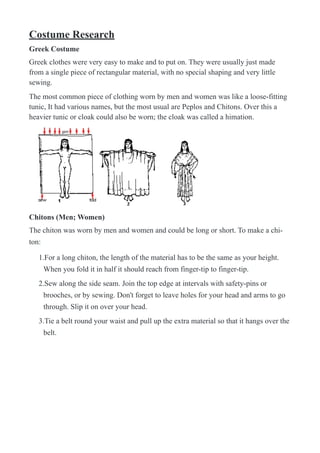
Costume Research
Greek Costume
Greek clothes were very easy to make and to put on. They were usually just made
from a single piece of rectangular material, with no special shaping and very little
sewing.
The most common piece of clothing worn by men and women was like a loose-fitting
tunic, It had various names, but the most usual are Peplos and Chitons. Over this a
heavier tunic or cloak could also be worn; the cloak was called a himation.
!
Chitons (Men; Women)
The chiton was worn by men and women and could be long or short. To make a chi-
ton:
1.For a long chiton, the length of the material has to be the same as your height.
When you fold it in half it should reach from finger-tip to finger-tip.
2.Sew along the side seam. Join the top edge at intervals with safety-pins or
brooches, or by sewing. Don't forget to leave holes for your head and arms to go
through. Slip it on over your head.
3.Tie a belt round your waist and pull up the extra material so that it hangs over the
belt.
!
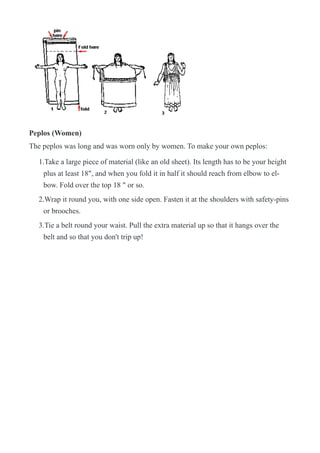
Peplos (Women)
The peplos was long and was worn only by women. To make your own peplos:
1.Take a large piece of material (like an old sheet). Its length has to be your height
plus at least 18", and when you fold it in half it should reach from elbow to el-
bow. Fold over the top 18 " or so.
2.Wrap it round you, with one side open. Fasten it at the shoulders with safety-pins
or brooches.
3.Tie a belt round your waist. Pull the extra material up so that it hangs over the
belt and so that you don't trip up!
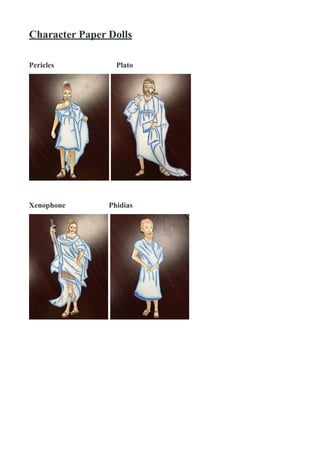
Character Paper Dolls
Pericles Plato
! !
Xenophone Phidias
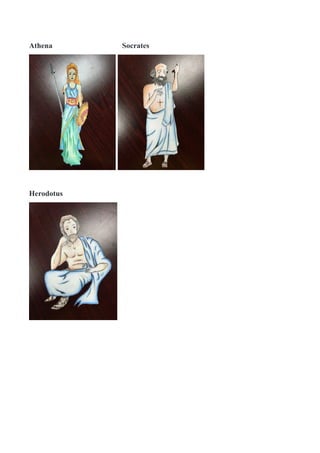
! !
Athena Socrates
! !
Herodotus
!
Storyboard
!
!
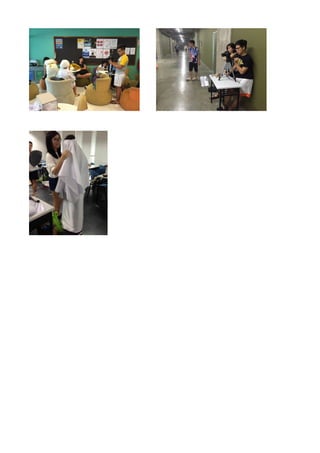
BEHIND THE SCENE (PROPS MAKING)
! !
! !
! !
! !
!
A summary of your research and how you have adapted the research into
your story.
To conclude our findings, we had done research on various aspects of Greece, mainly
Athens and Sparta including the culture, architecture and social strata. We also inves-
tigated Greece’s timeline and historical events in order to find more interesting plots
for our story.
We decided to choose Athens as it relates more to culture and social strata. In the time-
line, we found out that Athens has it’s glory time that is the golden age and we decided
to work more on it. We found the characters that were involved in this time frame and
divided it evenly among our group members. It includes Herodotus, Pericles, Phidias,
Plato, Xenophon, Socrates and Athena. Each of them play an important role in the
golden age.
Next, we found the common parts of our character and linked it all together according
to the timeline. We decided to add in a scene in the market to adapt the social strata
into our story such as the slavery system. Social strata is also shown by different char-
acters as they came from different background. For example, Pericles is a general
while Phidias is a sculptor. They are in different social strata as general is one of the
royalties and sculptor is only a normal citizen.
We also included their unique dining culture into our story, which consists of breads
and fruits. Another special dining culture is that they will wipe their hands after their
meal with bread as they do not have napkins at that time. The bread will then be fed to
the slaves or dogs.
In addition, democracy is an important aspect in Athens. This was shown by Socrates
story which was him being voted by the people of Athens whether to live or die.
As for our clothing, we adapted it and use white cloth as our main material for the
clothing. Royalties will have more decoration such as gold ribbons and gold acces-
sories that symbolise wealth and power. The weapons are also made based on the an-
cient Greece weapon photo that we found online. Most of the citizens do not have any
extra accessories as they do not have much money.
Lastly, we as well implemented the education of ancient Greece to our story, which is
Socrates teaching Plato and Xenophon about the weakness of democracy. This can
show how the knowledge is passed down from one generation to another during the
ancient times. Although it is hard to educate the poor, but Athens built the first univer-
sity in Europe and this proves that education is one of the important aspect in Athens.

Greece Compilation Report Final

  • 2.
    Table of Content •Project Brief • Introduction to Group Members • Distribution of Work for the Research • Introduction to Greece : Greek Timeline • Introduction to Athens : - Social Strata - Education - Culture - Arts - Administration - Tradition - Superstitions • Introduction to Sparta : - Social Strata - Education - Culture - Administration - Marriage - Gay Spartan - Spartan Military - ‘Diamastigosis’ - Naked Spartans • Differences Between Athens and Sparta • Important Historical Events in Greece • Individual’s Character • Introduction to the Characters • Story Plot • The Script • Costume Research
  • 3.
    • Paper Dollof Individuals’ Character • Storyboard • Behind the Scenes (Prop Making) • A Summary of the Whole Research
  • 4.
    Group Members 1. ChristineLee Yet Yee 2. Barbara Chang Huey Yi 3. Tan Min Chuen 4. Ng Kwang Zhou 5. Amelisa Heng Sy Hua 6. Madeline Liew Zhi Qi 7. Tam Zhao Wei Distribution of Work for the Research - History and Myth - Christine - Timeline Research - Barbara & Zhao Wei - Tradition - Madeline - Culture of Athens - Kwang Zhou - Culture of Sparta - Min C - Administration - Zhao Wei - Social Strata - Amelisa
  • 5.
  • 6.
    Athens Athens is oneof the most impressive city in Ancient Greece !
  • 7.
    Social Strata ofAthens MEN (Citizens) ! -has the right to vote -hold public office -own property -dominated Greek Society -divided into several classes First class:Aristoi -They control the political situation and is the owner for the most fertile lands Second class:Periokoi -Poorer, owner for the less fertile land or land that is further from the city Third class:Nouveau riche -Involve in the trading activities and business
  • 8.
    WOMEN (Citizens) ! - Unableto vote, own land, or inherit. -a woman’s purpose in life was the rearing of children. -contact with non-family males was discouraged - occupied their time with indoor activities such as wool-work and weaving. -Spartan women were treated somewhat differently than in other states, for example, they had to do physical training (nude) like men, were permitted to own land, and could drink wine. Marriage: - had to marry as a virgin and marriage was usually organised by the father -married at the typical age of thirteen or fourteen - If a woman was left a widow, she was required to marry a close male relative in order to ensure property stayed within the family.
  • 9.
    CHILDREN & ADOLESCENTS(Citizens) ! -attended schools where the curriculum covered reading, writing, and mathematics. After these basics were mastered, studies turned to literature(for example, homer),poetry, and mu- sic -athletics was also an essential element in a young person’s education. -at Sparta , boys as young as seven were grouped together under the stewardship of an older youth to be toughened up with hard physical training. -in Athens, young adult citizens (aged18-20) had to perform civil and military service and their education continued with lessons in politics, rhetoric, and culture. -Girls too were educated in a similar manner to boys but with a greater emphasis on dancing, gymnastics, and musical accomplishment which could be shown off in musi- cal competitions and at religious festivals and ceremonies. The ultimate goal of a girl’s education was to prepare her for her role in rearing a family.
  • 10.
    LABOURERS ! -semi-free workers, whollydependent on their employer. -they could not be sold as a slave could -also called serf-class or helots -they were given little or no legal status and harshly treated SLAVES (douloi) ! -acquired through war and conquest , kidnap and purchase -slave population in the Greek world range from between 15 and 40% of the total population -slaves worked in all spheres and over 200 hundred occupations have been identified.
  • 11.
    Sex-workers (Non-Citizens) ! - brothelprostitute (pornē). . Serve common man - higher-class prostitute (hetaira) . Educated in music and culture and often formed lasting relationships with married men FOREIGNERS (Semi-Citizen) ! -aside from slaves, most Greek poleis would have had a number of free foreigners (xenoi) who had chosen to re-locate from other areas of Greece -these foreigners usually had to register their residence and so became a recognised class (lower in status than the full-citizens) called the metics (metoikoi)
  • 12.
    Education of Athens Athenswas the main educational, intellectual and cultural center of Ancient Greece. The main purpose of education in Ancient Athens was to make citizens trained in the arts, and to prepare them for both peace and war. It was aimed at the cultivation of the students' physical, mental, and moral qualities. From Athens we get the motto: A sound mind in a sound body. All schools were very small private schools, and educa- tion was very valued. Boys Until age six, boys were taught at home by their mother or a male slave. Age six to 14 was primary school. The teacher in school was always a male. Once the youths were 16, their 'basic education' was complete. The boys who didn't have to work could now study the sciences and philosophy. From the ages of 18 to 20, able bodied young men had to take military trainging for the army or the navy. Athenians wanted their sons to have a well rounded education so that they would know a variety of things and appre- ciate lots of things. Girls Girls were taught at home by their mothers or a private tutor. The objective was to prepare girls for being a stay-at-home mum, to look after and educate their children just as they had been educated.
  • 13.
    CULTURE Traditional Clothing ofGreece Ancient Greeks wore simple garments that draped over their bodies. How to make : http://www.dl.ket.org/latin1/things/romanlife/greekdress.htm SPARTAN The word “spartan” means self-restrained, simple, frugal and austere. The word lacon- ic, which means pithy and concise, is derived from the Spartans, who prized brevity of speech. ! Chiton -worn by men & women - comes in long / short 
 Peplos The peplos was long and was worn only by women !
  • 14.
    Arts of Athens Poetry Homerfeatured people trying to live up to standards of courage and honor. Pindar wrote poems that honored sports heroes. Sappho wrote of friendship and love. Drama Poems evolved to songs and finally to drama when Thespis broke away and spoke lines on his own. Plays were a big deal to the Athenians. On opening day even prison- ers were let out to attend. Tragedies The Greek tragedies were plays that showed dignity in the face of trouble. They showed how noble people could be. The Universe was governed by fate or destiny in these plays. People who were too stubborn or proud would be punished by destiny. Aeshylus, Sophocles, and Euriopides wrote some of the great tragedies. Comedies The comedies of Aristophanes and others were satires of politics and current events. History The Athenians were the first to examine history with a critical eye. Herodutus and Thucydides were some of the historians of the day. Artists and Architects Paint- ings and sculptures showed the ideal person. The Athenians tried to make structures fit with natural surroundings. Notice how the Parthenon seems to grow up out of the rocks.
  • 15.
    ADMINISTRATION OF ATHENS Athenswas ruled by archons, who were elected annually. Thus, because both parts of Athens' government had leaders who were elected, Athens is said to have been the birthplace of democracy. Athenian life was creative. As an Athenian, you could get a good education and could pursue any of several kinds of arts or sciences. You could serve in the army or navy, but you didn't have to. (This applied only to boys, however: Girls were restricted to other pursuits, not war or business or education.) Traditions of Athens Name day celebration - Most Greeks are named after a religious saint. A very impor- tant tradition is that everyone who has a name coming from a saint celebrated by the church celebrates his name on a given day of the year. On the "name day" of someone, his friends and family visit him without invitation and offer wishes and small presents. The hostess of the house offers pastries, sweets and hors d'oeuvres to the guests. In Greece, name days are more important than birthdays. Carnival In Greece - The Carnival is called "Apokries". The festival consists of two weeks of feast, beginning from the Sunday of Meat Fare and ends with the first day of the Lent, called Clean Monday (Kathari Deutera). Everyone is costumed and parties take place in the streets and bars, throwing coloured confetti to each other. The most famous Carnival Parade takes place in the city of Patra. In many towns around Greece and in the islands, local customs revive. The Carnival is believed to come from pagan- ism, and more precisely from the old festivities worshiping Dionysus, the god of wine and feast. Easter - Easter is the most important celebration for the Greeks, even more than Christmas. On Good Thursday or Good Saturday, women dye eggs in red and bake buns. On Good Friday, the day of mourning, the Epitaphios, the tomb of Christ with its icon, decorated with flowers, is taken out of the church and carried around the vil- lage followed by a slow procession. After the procession returns to the church where the believers kiss the image of the Christ. Greek Independence Day - The Greek Independence Day is celebrating the declara- tion of the Independence War against the Ottomans on March 25th, 1821. Apart from a national celebration, this day is also a religious celebration dedicated to the Annuncia- tion of Virgin Mary.
  • 16.
    Superstitions 1. Bread In Greece,especially in villages, bread is considered a gift of God. Because of that women bless the bread and make the sign of the cross with a knife before slicing it. 2. Evil Eye Some Greeks believe that someone can catch the evil eye, or “matiasma”, from jealous or envious people. Those, who have caught the evil eye, usually feel bad physically and mentally. To avoid the matiasma one must wear a charm: a little blue marble glass with an eye painted on it or a blue bracelet. Blue is believed to be the color that pro- tects against the evil eye but it is also believed that people with blue eyes can give ma- tiasma. Garlic is another way to guard against the evil eye, and people often hang it in their houses. 3. Knives Greeks never hand a knife to someone because they believe it will bring a fight with the person. Therefore they set it down on the table and let the other person take it. 4. Spitting Some Greeks believe that spitting chases the devil away. That is why when someone talks about bad news (deaths, accidents, etc…) or compliments babies, children and even adults, the others slightly spit three times saying “ftou, ftou, ftou”. 5. Tuesday the 13th Unlike the Western belief, in Greece the unlucky day is Tuesday the 13th and not Fri- day the 13th. Tuesday is considered to be the unluckiest day of the week because on Tuesday, May 29th, 1453 the city of Constantinople was besieged and taken by the Ot- toman Turks. Greeks also consider the number 13 to be good luck and the main theory is the belief that having 12 apostles of Christ made Christ the 13th of the group. How- ever, the combination of Tuesday and 13 as Tuesday the 13th of the month is consid- ered a very unlucky day in Greek culture. 6. "Piase kokkino" (Touch Red) Greeks believe that saying the same thing at the same time is an omen and the two people will get into a fight or an argument. Because of this, when people say the same thing together they must immediately follow by telling one another "piase kokkino" and both have to touch any red item they can find around them.
  • 17.
    SPARTA Social Strata; WarriorSociety Three Population groups 1. Spartans / Spartiates - full citizens 2. Helots - slaves 3. Perioeci - dwellers-around (craftsmen and traders) All healthy male Spartan citizens participated in the compulsory state-sponsored edu- cation system, the Agoge, which emphasized obedience, endurance, courage and self- control. Spartan men devoted their lives to military service, and lived communally well into adulthood. A Spartan was taught that loyalty to the state came before every- thing else, including one’s family. !
  • 18.
    Education ! The young Spartanmale was called a ‘boy’ (paidion) from the age of 5 to 11; and as such his military training (known as agoge) started effectively from this juvenile peri- od of his life. During this time, he was sent from home to reside in communal bar- racks. And oddly enough, one of the first exercises he needed to learn was thep- yrriche – a dance involving the carrying and maneuvering of weapons. Suffice it to say, such dexterous moves allowed the young warrior to be nimble-footed while also giving them experience in carrying actual armaments. Additionally, the child was coached on reading and writing, and had to learn most of the battle songs that were sang on Spartan military campaigns. He was also encour- aged to join groups, who then widely competed against each other in various sports (much like in Hogwarts). Finally, on his tenth year, he was required to give his com- petitive demonstration in the fields of athletics, dancing and music.
  • 19.
    Culture of Spartans Theculture of Sparta and the Spartans was pinpoint focused upon their military, they were a highly efficient unit on and off the battlefield. The only truly military state in ancient Greece, Spartans, men, women and children were born into, and lived in an existence that was ruled by regiment and organisation. It was this military regimented mentality that allowed the small Spartan population to become rulers of ancient Greece and the dominant fighting force of the time. ADMINISTRATION OF SPARTA Sparta was ruled by two kings, who ruled until they died or were forced out of office. Spartan life was simple. The focus was on obedience and war. Slavery made this pos- sible by freeing the young men from household and industrial duties and allowing them to focus on their military duties. Young boys were trained to be warriors; young girls were trained to be mothers of warriors. For many years, Spartan armies provided much of the defense of the Greek lands. The Spartan heroism at the Battle of Thermopylae, during the Persian Wars, inspired all of Greece to fight back with all their might against the invading Persians. Athenian and Spartan fought side by side in the Battle of Plataea, which ended Persian invasions of Greece.
  • 20.
    MARRIAGE In part toattract mates, females engaged in athletic competitions, including javelin- throwing and wrestling, and also sang and danced competitively. As adults, Spartan women were allowed to own and manage property. Additionally, they were typically unencumbered by domestic responsibilities such as cooking, cleaning and making clothing, tasks which were handled by the helots. Marriage was important to Spartans, as the state put pressure on people to have male children who would grow up to become citizen-warriors, and replace those who died in battle. Men who delayed marriage were publically shamed, while those who fa- thered multiple sons could be rewarded. In preparation for marriage, Spartan women had their heads shaved; they kept their hair short after they wed. Married couples typically lived apart, as men under 30 were required to continue residing in communal barracks. In order to see their wives during this time, husbands had to sneak away at night. Gay Spartan Most historians generally concur that significant numbers of Sparta’s adult male popu- lation were actively homosexuals, and between them the practice of pederasty (homo- sexual relationship between an adult male and a pubescent male) was not unheard of. However, it should be noted that these relationships went beyond just the physical basis. So the adult male intently acted as the younger trainee’s guardian, and thus was responsible for the teenager’s conduct and courage in the agoge. Spartan Military Unlike such Greek city-states as Athens, a center for the arts, learning and philosophy, Sparta was centered on a warrior culture. Male Spartan citizens were allowed only one occupation: solider. Indoctrination into this lifestyle began early. Spartan boys started their military training at age 7, when they left home and entered the Agoge. The boys lived communally under austere conditions. They were subjected to continual physi- cal, competitions (which could involve violence), given meager rations and expected to become skilled at stealing food, among other survival skills. The teenage boys who demonstrated the most leadership potential were selected for participation in the Crypteia, which acted as a secret police force whose primary goal was to terrorize the general Helot population and murder those who were troublemak-
  • 21.
    ers. At age20, Spartan males became full-time soldiers, and remained on active duty until age 60. ‘Diamastigosis’ The nigh inhumane ritual involved the annual flogging of adolescents in front of the an altar at the temple of Artemis Orthia. Underneath its pseudo-religious veneer, the practice often tested the endurance level and courage of the young Spartans under mil- itary training. But in spite of its seemingly arduous nature, the ritual did result in deaths – with the fatality frequency increasing more by the latter part of the Spartan state (especially during Roman rule). There are even evidences of a 3rd century AD amphitheater which was specifically used for such bloody events with a spectator base. ! Naked Spartan ! Before the period of the 5th century, Spartan armor mainly comprised of the so-called bell cuirass, with its name coming from the armor’s resemblance to the mouth of a bell in its bottom section (above the waist). However, by the first half of the 5th century, the bell cuirass made way for the famed muscled cuirass that was closely modeled on the ‘chiseled’ musculature of an idealized body. This particular period coincided with King Leonidas and the legendary (and often embellished) Battle of Thermopylae. However, by late 5th century body armors were altogether discarded in favor of en- hanced mobility. This trend more-or-less continued till 360 BC, after which heavy Spartan armors were adopted once again due to changing military tactics.
  • 22.
    Beyond the body,another significant part of the Spartan armor was the shield. In fact, the shield was given far more value than any type of armor or weaponry – and Spartan warriors who threw away their shields were rigorously punished. When asked why, the Spartan king Demaratos made a succinct reply – “because the latter [other armors] they put on for their own protection, but the shield for the common good of the whole line.”
  • 23.
    Difference Between Athensand Sparta Athens Sparta !
  • 24.
    Important Historical Eventsin Greece ! Being outsiders has given people who live there more freedom to experiment with new ideas and new ways of doing things. - Organized troops of soldiers - Democracy - History - Logical proofs 55,000 BC (57,000 years ago) People first began to move to Greece . 6000 BC People in Greece began to farm their food and settle down in villages. ! Then there began to be more and more people living in Greece.
  • 25.
    Around 2000 BC Indo-Europeaninvaders came to Greece from Central Asia, bringing with them the use of: -bronze About 1200 BC 1.West Asia and Egypt fell into an economic depression, and the Greeks fell with them. Many Greeks left Greece and sailed to new homes in Israel (where they are the Philistines) or other places in West Asia. About 900 BC The Dark Ages were ending, and the Greeks began trading with West Asia and Egypt again. From the Phoenicians, the Greeks learned the alphabet: This is the time of Homer. There were more and more people in Greece. People began to form city-states and experiment with different kinds of governments for them: oli- garchies and tyrannies. This is the Archaic period; it ends about 500 BC when the Athenians try a new exper- iment in government: the world's first DEMOCRACY. Classical period People around the Mediterranean noticed that the Persians had formed the world's first big empire (and used it to attack the Greeks in the Persian Wars). ! Everybody wanted to form an empire too - the Romans, the Carthaginians, and the Greeks.
  • 26.
    The Athenians builtan empire, but the Spartans destroyed it in the Peloponnesian War. 146 BC They became part of the Roman Empire. When the Roman Empire fell in 476 AD, Greece continued to be part of the Byzantine Empire, and then transitioned in 1453 AD into the Ottoman Empire. Individual's Character Christine Lee plays role as Herodotus ! ! Madeline Liew plays role as Pericles ! ! Amelisa Heng plays role as Phidias ! !
  • 27.
    Tan Min Chuenplays role as Socrates ! ! Ng Kwang Zhou plays role as Xenophone ! ! Tam Zhao Wei plays role as Plato ! ! Barbara Chang plays role as Athena ! !
  • 28.
    Introduction to theCharacters Athena ! Athena (Goddess Temple) Athena is the goddess of war and cunning wisdom. She is also the goddess of pot- making and wool-working. She is associated with the city, and almost every town in Greece had a sanctuary dedicated to Athena. She invented the chariot, the bridle and built the first ship. The olive tree is sacred to her. ! Athena (Object) This is an aulos a type of pipe instrument. It was said that Athena invented the aulos. However when she saw how ugly her face looked when she played the instrument, she threw it away in disgust.
  • 29.
    Athena (Symbols) ! - Shownin full armour and helmet. - Aegis-a goat skin cloak fringed with snakes. - Associated with the owl. The Birth Of Athena ! Zeus was the father of Athena and her mother was Metis, which means wisdom. Zeus was told before Athena was born, that any child born to Metis would be more power- ful than its father. Zeus was very worried by this and decided to swallow Metis before she could give birth to the child. Some time later Zeus began to have terrible headaches. The pain grew so unbearable that Zeus asked Hephaistos to cut his head open to see what was wrong. When Hephaistos opened his head, Athena emerged from Zeus' skull, fully grown and dressed for battle.
  • 30.
    Athena (Patron ofthe City) ! Most Greek cities had a sanctuary or temple dedicated to Athena because she was the 'protectress of the city'. She is particularly associated with the city of Athens. There is a myth that Athena's gift to the city was the olive tree. It grew on the Acropolis. Other sacred olive trees grew near Plato's Academy - they provided the oil for the prizes at the Panathenaic Games. In the 5th century BC a great temple to Athena was built on the Athenian Acropolis. The temple was called the Parthenon. Panathenaia (Festivals) ! The Panathenaia was a huge festival held at Athens in Athena's honour. All sections of Athenian society were involved: men, women, citizens, slaves and foreigners living in Athens. The festival consisted of sacrifices, competitions and a huge procession to present a new robe to the ancient statue of Athena on the Acropolis. Prize Amphora The inscription on this Panathenaic amphora reads 'One of the prizes from Athens!'. It was the prize for a chariot race. The vase has an illustration of a chariot race on its other side.
  • 31.
    Socrates ! One of thefounders of Western philosophy Socrates was with friends when he drank the hemlock and uttered his last words. In death, as in life, Socrates was surrounded by people who were totally devoted to him: who loved, respected, and admired him. His comrades wanted him to run away to safety and begged him to leave Athens to preserve his life. Socrates chose to face his death penalty in the same fashion he had lived his life: with a clarity of spirit and de- void of fear. WISDOM ! "I know that I am intelligent, because I know that I know nothing" -Socrates Socrates often brought people to the realization that they were not the best they could be, and perhaps they did not know what they thought they did. In the Symposium, Socrates says: [Man] is always becoming a new being and undergoing a process of loss and repara- tion, which affects ... his soul as well. No man's character, habits, opinions, desires, pleasures, pains, and fears remain always the same; new ones come into existence and old ones disappear.
  • 32.
    SOCRATES METHOD Socratic method,also known as method of elenchus, elenctic method, or Socratic de- bate, is named after the classical Greek philosopher Socrates. It is a form of inquiry and discussion between individuals, based on asking and answering questions to stim- ulate critical thinking and to illuminate ideas. It is a dialectical method, often involv- ing a discussion in which the defense of one point of view is questioned; one partici- pant may lead another to contradict themselves in some way, thus weakening the de- fender's point. !
  • 33.
    Phidias ! The art inAthens During the Golden age of Athens , thee art of Athens also reached its highest peak which is known a the Classical Period (490-323 BC) The Classical Period divided into 3 stages - Severe style (490-450BC) - High Classical period (450-400BC) - Late Classical period (400-323 BC) Types of arts : - Sculptors - Vase painting - Painting The famous artist in the period: - Phidias - Polyclitus Phidias (flourished c. 490–430 ) - Born in Athens in a family of artists - His early youth was nourished by the inspiring influences that come from the victo- rious struggle of a people to maintain their national life during the wars - Studied his art first at Athens, with a native sculptor, Hegias
  • 34.
    - The downfallof Pericles, due to the jealousies of his rivals, carried with it the ruin of Phidias, by charging him with appropriating to himself a portion of the gold which is used to built the sculpture of Athena Phidias famous work Statue of Athena (Athena Parthenos) Details: Athena's head is inclined slightly forward. She stands with her left hand rest- ing on an upright shield. Her left knee is slightly bent, her weight slightly shifted to her right leg. The Nike on her outstretched right hand is winged. The exact position of a spear, often omitted, is also not fully determined, whether held in the crook of Athena's right arm or supported by one of the snakes in the aegis. Material used : wooden core, covered with shaped bronze plates covered in turn with removable gold plates Phidias famous work ! Statue of Zeus Height : 3M Material used : ivory plates and gold panels over a wooden framework Details :The statue was crowned with a sculpted wreath of olive sprays. It had gold sandals, and a golden robe carved with animals and lilies. In its right hand was a small chryselephantine statue of crowned Nike , goddess of victory. Its left hand held a scep- tre inlaid with many metals, supporting an angle . The throne was decorated in gold, precious stones, ebony, and ivory.
  • 35.
    The Classical Period Inthe classical period in Athens the artists attempt to render human and animal forms realistically. This entailed careful observation of the model as well as understanding the mechanics of anatomy how a body adjusts to a pose which is not stiffly frontal but with the weight shifted to one side of the body, and how a body behaves in violent mo- tion. Sculpture before Classical period ! Sculpture during Classical period !
  • 36.
    Pericles ! The golden ageof Athenian culture flourished under the leadership of Pericles (495-429 B.C.). He is from a powerful and political family. He is a brilliant general, orator, patron of the arts and politician—”the first citizen” of democratic Athens, according to the historian Thucydides. He then become a great leader of Athens. He transformed his city’s alliances into an empire and graced its Acropolis with the famous Parthenon. Symbols of Pericles - His helmet - His beard ! Grecian Helmet
  • 37.
    Democracy in Athens Atheniangovernment evolved from a monarchy into an aristocracy. Under the aristoc- racy, Athenian wealth and power grew. Yet discontent spread among ordinary people. Then, Solon Reforms Government and help the citizens to get more rights. The citizen share wealth and power together after the reformation of government. Only citizens could participate in government, and citizenship was restricted to landowning men. Women were excluded along with merchants and foreigners. So were the tens of thousands of Athenian slaves who lacked political rights as well as personal freedom, although it was their labor that gave citizens the time to participate in government. The Protection of Democracy - Ostracism Athenians began the practice of ostracism after the victory of Battle of Marathon. It is a form of election designed to curb the power of any rising tyrant. The procedure of ostracism was simple. 1. Once a year the people would meet in the Agora and take a vote to determine if anyone was becoming too powerful and was in a position to establish a tyranny. 2. If a simple majority voted yes, they met again in the Agora two months later. At this second meeting each citizen carried with him an ostrakon (potsherd) on which he had scratched the name of the person he wished ostracized. 3. If at least 6,000 votes were cast, the man with the most votes lost and was exiled for ten years. Ostrakon ! Piece of broken vase/ pottery
  • 38.
    Plato ! Life of Plato TheAthenian philosopher Plato (c.428-347 B.C.) is one of the most important figures of the Ancient Greek world and the entire history of Western thought. In his written dialogues he conveyed and expanded on the ideas and techniques of his teacher Socrates. The Academy he founded was by some accounts the world’s first university and in it he trained his greatest student, the equally influential philosopher Aristotle. Plato’s recurring fascination was the distinction between ideal forms and everyday ex- perience, and how it played out both for individuals and for societies. In the “Repub- lic,” his most famous work, he envisioned a civilization governed not by lowly ap- petites but by the pure wisdom of a philosopher-king. Legacy and Influence The Academy flourished for nearly three centuries following Plato’s death, but was destroyed in the sacking of Athens by the Roman general Sulla in 86 B.C. Though continually read in the Byzantine Empire and in the Islamic world, Plato was over- shadowed by Aristotle in the Christian west. It was only in the Renaissance that schol- ars like Petrarch led a revival of Plato’s thought, in particular his explorations of logic and geometry. William Wordsworth, Percy Shelly, and others in the 19th-century Ro- mantic movement found philosophical solace in Plato’s dialogues.
  • 39.
    The Republic ! This isthe brightest and best work of Plato which deals with several factors like wis- dom, virtue, government, justice and courage. The Academy ! It was built in 388 BC and is the first University of Europe. According to some it is also said to be the first proper University in the face of the earth. His final years at the Academy may be the years when he wrote the "Later" dialogues, including the Parmenides, Theatetus, Sophist,Statesmas,Timaeus,Critias,Philebus, and Laws. Socrates has been delegated a minor role in these texts. Plato uses these dia- logues to take a closer look at his earlier metaphysical speculations. He discusses art, including dance, music, poetry, architecture and drama, and ethics in regards to im- mortality, the mind, and Realism. He also works with the philosophy of mathematics, politics and religion, covering such specifics as censorship, atheism, and pantheism. In the area of epistemology he discusses a priori knowledge and Rationalism. In his theo- ry of Forms, Plato suggests that the world of ideas is constant and true, opposing it to the world we perceive through our senses, which is deceptive and changeable. In 347 Plato died, leaving the Academy to his sister's son Speusippus. The Academy remained a model for institutions of higher learning until it was closed, in 529 CE, by the Emperor Justinian.
  • 40.
    Herodotus ! THE FATHER OFHISTORY Herodotus was born in about 485 B.C. in the Greek city of Halicarnassus. He came from a wealthy and cosmopolitan Greek-Carian merchant family. In the mid- dle of the 6th century B.C., Halicarnassus became a satrapy, or province, of the Per- sian Empire and was ruled by the tyrant Lygdamis. Herodotus’ family opposed Lyg- damis’ rule and was sent into exile on the island of Samos. When he was a young man, Herodotus returned briefly to Halicarnassus to take part in an abortive anti-Persian re- bellion. After that, however, the writer never returned to his home city again. Herodotus set out to document the causes of wars fought by the Greeks and particular- ly the causes of the Persian invasions of 490 and 480 B.C.E., the latter occurring while Herodotus was still a boy. To that basic theme, he added extensive digressions, record- ing all that he could find out about each nation touched by the Persian advance. Herodotus's Life Herodotus traveled widely from one Persian territory to another. --Mediterranean to Egypt - Palestine to Syria - Babylon. - Macedonia - Islands of the Greek Archipelago: Rhodes, Cyprus, Delos, Paros, Thasos, Samothrace, Crete, Samos, Cythera and Aegi- na.
  • 41.
    He sailed throughthe Hellespont to the Black Sea and kept going until he hit the Danube River. While he traveled, Herodotus collected what he called “autopsies,” or “personal inquiries”: He listened to myths and legends, recorded oral histories and made notes of the places and things that he saw. When Herodotus was not traveling, he returned to Athens; there, he became something of a celebrity. He gave readings in public places and collected fees from officials for his appearances. In 445 B.C., the people of Athens voted to give him a prize of 10 tal- ents–almost $200,000 in today’s money–to honor him for his contributions to the city’s intellectual life. Herodotus Publish ! Book VIII on papyrus Oxyrhynchus The Persian Wars 2099, dated to early 2nd century AD.
  • 42.
    Xenophon ! Xenophon was aGreek philosopher, soldier, historian, memoirist, and the author of numerous practical treatises on subjects. While best known in the contemporary philosophical world as the author of a series of sketches of Socrates in conversation, known by their Latin title Memorabilia, Xenophon also wrote aSymposium and an Apology. Xenophon’s influence in Antiquity, the Middle Ages, he was a pioneer in several lit- erary genresincluding the first-person military memoir (Anabasis) , the biographical novel (Education of Cyrus), and the continued history (Hellenica). Xenophon Political Xenophon is a political philosophy. The main works examined in an effort to recon- struct this aspect of his thought are The Education of Cyrus (also known as Cyropae- dia;) a partial biography of a Persian king building an empire, the Anabasis(account of the ill-fated Greek mercenary expedition in Persia) and Hiero (a conversation about tyranny). One thing is clear and beyond controversy: Xenophon has an abiding inter- est in describing leadership, the constellation of qualities that enables a person to function as a leader in groups, whether military, civic, or familial. Xenophon Moral 1. The importance of self-control: Sophrosyne, self-control, moderation, restraint of appetite, and balance, comprises one of the cardinal virtues of Greek popular morality, and it is highlighted by Xenophon in many ways. Socrates is often said to have exemplified it in the highest degree. Cyrus displays it when
  • 43.
    (Cyropaedia V.i-VII.iii) heis invited to look upon the most beautiful woman in Asia, who happens to be his prisoner of war. He firmly declines this temptation; his general Araspas by contrast stares at her endlessly, falls in lust, insults her honor and ignites a chain of events that ends in her suicide over her husband’s corpse. 2. A demanding work-ethic: Hard work makes for virtue in several ways. It con- duces to health, it results in earned rewards, it keeps us off the streets of tempta- tion, and builds character. In the Oeconomicus, a treatise on household manage- ment, Xenophon tells the story of a visit paid by a Greek ambassador to Cyrus the Persian king in his royal gardens. Cyrus astounds the Greek by stating that he himself laid out the garden plan and works in it regularly. Cyrus continues (Oeco- nomicus IV.24), 3. "I never yet sat down to dinner when in sound health, without first working hard at some task of war or agriculture, or exerting myself somehow."
  • 44.
    Story Plot ! Scenes [GoldenAge] - shows individual characters !
  • 45.
    The Script Golden Age- Intro Athenians began the practice of ostracism after the victory of Battle of Marathon. It is a form of election designed to curb the power of any rising tyrant. The procedure of ostracism was simple. 1. Once a year the people would meet in the Agora and take a vote to determine if anyone was becoming too powerful and was in a position to establish a tyran- ny. 2. If a simple majority voted yes, they met again in the Agora two months later. At this second meeting each citizen carried with him an ostrakon (potsherd) on which he had scratched the name of the person he wished ostracized. 3. If at least 6,000 votes were cast, the man with the most votes lost and was ex- iled for ten years.
  • 46.
    Scenes Scene 1: Props needed: 1.pieces of broken pottery 2. a big ballot box ( to put in the pieces) 3. people counting the pieces SCENE 1 - HERODOTUS WENT TO ATHENA TEMPLE HERODOTUS : Athena, Athena, I am very confused about my situation right now. I don’t know what to do. I need u to change me. Refresh my mind, body and soul. Teach me to accept life in terms with faith in you or your will. There’s so many normal things in life I want to do, I let my disease of addiction lead me to believe I’m differ- ent. Teach me isolation isn't the answer, show me and give me strength. I surrender to you, show me the right way. ATHENA : I grant you the serenity to accept the things that you cannot change. Courage to change the things that you can, and wisdom to know the difference. Living one day at a time, enjoying one moment at time, accepting hardships as the pathway to peace. This is a sinful world, trusting that I will make all the things right. I surrender to My Will, that you may be reasonably happy in this life and supremely happy with me forever in the next. HERODOTUS : Athena, keep me your prayers that I may grow closer to my savior each day. Learning to be patient and just be mindful of your grace and mercy. ATHENA : Remember. Let your smile change the world but don’t let the world change your smile. HERODOTUS : Thank you Athena for guiding me and giving me strength through this difficult time. Please heal my body and calm my soul as I put my trust in you. A servant goes up to Pericles and informs him that Herodotus came to meet him Pericles: Let him in.
  • 47.
    Scene 2: Herodotus: Greetingspericles Pericles: It’s been a while since you have visited. Please take a sit. Herodotus: Yes indeed. I have been traveling around Egypt to gather information and testimonies about the Persian war. Pericles: Oh yes. The Persian war. How is your investigation going on? Herodotus: Quite smooth actually, I am just missing out of a few parts. Pericles: I heard that you were sharing your findings in the market today. Herodotus: Yes, I was. Pericles: You have contributed well in the city’s intellectual life by doing so. All the citizens treats you like a celebrity. I guess I will have to reward you for this. Pericles asked his servant to fetch a bag of money for Herodotus. Slave passes the money to him. Herodotus: Well that’s very generous of you. Pericles: So, where are you traveling next? Herodotus: To Babylon, I feel that I can get some information there. Pericles: Well I wish you luck then. Herodotus: Thanks, I guess I have to get going. Pericles: Until then Herodotus. Herodotus leaves pericles house.
  • 48.
    Scene 3: CLASSROOM Socrates teachingPlato and Xenophon in classroom Socrates write on whiteboard “WEAKNESSES OF DEMOCRACY” Socrates: ANTI-DEMOCRACY DARK ROOM Someone report to the leaders of the Athens A: Socrates is spreading anti-democratic view. Pericles nod his head CLASSROOM The guards break into the room and bring Socrates for a trial at the city square. Accuser says: You, refuse to recognize the gods recognized by the state Accuser: You, corrupt the youth of the nation Socrates: I know that I am intelligent, because I know that I know nothing. Socrates: my fellow Athenians, you must now decide whether to acquit me or not. Socrates: But whichever you do, understand that I will never change my ways, not even if I have to die many times. Socrates: To talk daily about what makes us good, and to question myself and others, is the greatest thing man can do. For the unexamined life is not worth living. The juries discuss for a while. In a split vote, they reached their final verdict. Socrates is condemned to death by the vote of 220/280. Jury: I condemn that we found Socrates is guilty Socrates: Men of Athens, you have condemned me to death. To those of you who are my friends and who voted to acquit me let me say that death may be a good thing. Socrates is taken to a jail JAIL Narrator: Athenian law prescribed death by drinking a cup of poison hemlock. Socrates would be his own executioner.
  • 49.
    Socrates drink thepoison, and lay on his back. UNIVERSITY Narrator: Plato, the most famous student of Socrates, continue the belief of Socrates and started the first university in Europe. Props : Tables, benches, blackboard/ white board, papers and box (for voting)
  • 50.
    Scene 4: Pericles findPhidias. Pericles: Greetings Phidias! How are you lately? Phidias: Greetings Pericles! Everything’s fine. How about you? Pericles: I’m fine too, lets enjoy the feast tonight. [Dinner scene] - 1.eating bread dipped in wine 2.served with olives, figs, cheese or dried fish. 3.grapes 4.table with drape cloth Bread was often used to scoop out thick soups. Bread was also used as a napkin to clean hands. After being used as a napkin, the bread was then thrown on the floor for the dogs or slaves to clean up at a later time. [narrator] [The Greek diet consisted of foods that were easily raised in the rocky terrain of Greece’s landscape. Breakfast was eaten just after sunrise and consisted of bread dipped in wine. Lunch was again bread dipped in wine along with some olives, figs, cheese or dried fish. Supper was the main meal of each day. It was eaten near sunset. It consisted of veg- etables, fruit, fish, and possibly honey cakes. Sugar was unknown to ancient Greeks, so natural honey was used as a sweetener. Fish was the main source of protein in the Greek diet. Beef was very expensive, so it was rarely eaten. Beef and pork were only available to poor people during religious festivals. It was during the festivals that cows or pigs were sacrificed to the gods, and the meat was cooked and handed out to the public. Wine was the main drink in ancient Greece. It was watered down; to drink it straight was considered barbaric. Milk was rarely drunk, because again, it was considered bar- baric. Milk was used for cheese production. Water was another possible choice as a drink.
  • 51.
    [During dinner] [conversation continues] Pericles:I need your help to carve an Athena sculpture to put into the Parthenon. Phidias: Sure, just give me some time to complete my work first. Pericles: I’m sure that it will be a splendid work after completion. Phidias: That’s my pleasure to help you in this wonderful task. Pericles: Indeed, the Parthenon needs some more architectural touch up. Phidias: The columns are the main point of the Parthenon, we should emphasis on that. Pericles: What idea do you have for the design? 3months later, Parthenon construction complete. [Phidias is accused for stealing the gold for construction of Athena sculpture.] Phidias: Pericles, let me tour you around the Parthenon. Pericles: Sure! Phidias: The whole building is made up of marble, and the sculpture of Athena, is here. Pericles: [Take a look at the sculpture] Are you sure that the sculpture are made of gold? Phidias: I’m sure! I sculpt it for a long time in my own workspace. Pericles: It doesn’t seem like it is carved out of gold! Did you steal it? Phidias: No I didn’t. I assure you that it is made out of gold. Pericles: I know that we are friends, but the gold is the tribute money from our allies, and you dare to misuse the gold. Phidias: NO!!! I did not steal the gold!!! I SWEAR !!!
  • 52.
    Pericles: I willput you in the jail for the time being while the investigation are going on. [ 1 week later ] [Phidias has been hang as the evidence pointed out that he stole the gold for construc- tion of Athena sculpture] Props needed: 1.food 2.table with drape cloth 3.sculpture of Athena ( gold ) 4.columns 5.jail
  • 53.
    Scene 5 : Plaguein Athens, many citizens of Athens die. Pericles die [Plague happen in Athens] [Both of Pericles’ son died due to plague] [Pericles also suffer due to plague] [They couldn’t save Pericles ] [Pericles die] Props needed: 1.bed / cloth to lie on 2.plague symptoms ( little pox) Scene 6 Xenophon: We pray for the victory! Athens! Athens! Athens! (Athena spray water as signal of bless) (Xenophon leads the team and marching to war) (war scene) Xenophon: Arghhh ! I won’t surrender and I’ll be back ! (slowly close his eyes and Xenophon lose the war and Athens started fall after that war)
  • 54.
    Costume Research Greek Costume Greekclothes were very easy to make and to put on. They were usually just made from a single piece of rectangular material, with no special shaping and very little sewing. The most common piece of clothing worn by men and women was like a loose-fitting tunic, It had various names, but the most usual are Peplos and Chitons. Over this a heavier tunic or cloak could also be worn; the cloak was called a himation. ! Chitons (Men; Women) The chiton was worn by men and women and could be long or short. To make a chi- ton: 1.For a long chiton, the length of the material has to be the same as your height. When you fold it in half it should reach from finger-tip to finger-tip. 2.Sew along the side seam. Join the top edge at intervals with safety-pins or brooches, or by sewing. Don't forget to leave holes for your head and arms to go through. Slip it on over your head. 3.Tie a belt round your waist and pull up the extra material so that it hangs over the belt.
  • 55.
    ! Peplos (Women) The peploswas long and was worn only by women. To make your own peplos: 1.Take a large piece of material (like an old sheet). Its length has to be your height plus at least 18", and when you fold it in half it should reach from elbow to el- bow. Fold over the top 18 " or so. 2.Wrap it round you, with one side open. Fasten it at the shoulders with safety-pins or brooches. 3.Tie a belt round your waist. Pull the extra material up so that it hangs over the belt and so that you don't trip up!
  • 56.
    Character Paper Dolls PericlesPlato ! ! Xenophone Phidias ! !
  • 57.
  • 58.
  • 59.
  • 60.
    BEHIND THE SCENE(PROPS MAKING) ! ! ! ! ! !
  • 61.
  • 62.
    A summary ofyour research and how you have adapted the research into your story. To conclude our findings, we had done research on various aspects of Greece, mainly Athens and Sparta including the culture, architecture and social strata. We also inves- tigated Greece’s timeline and historical events in order to find more interesting plots for our story. We decided to choose Athens as it relates more to culture and social strata. In the time- line, we found out that Athens has it’s glory time that is the golden age and we decided to work more on it. We found the characters that were involved in this time frame and divided it evenly among our group members. It includes Herodotus, Pericles, Phidias, Plato, Xenophon, Socrates and Athena. Each of them play an important role in the golden age. Next, we found the common parts of our character and linked it all together according to the timeline. We decided to add in a scene in the market to adapt the social strata into our story such as the slavery system. Social strata is also shown by different char- acters as they came from different background. For example, Pericles is a general while Phidias is a sculptor. They are in different social strata as general is one of the royalties and sculptor is only a normal citizen. We also included their unique dining culture into our story, which consists of breads and fruits. Another special dining culture is that they will wipe their hands after their meal with bread as they do not have napkins at that time. The bread will then be fed to the slaves or dogs. In addition, democracy is an important aspect in Athens. This was shown by Socrates story which was him being voted by the people of Athens whether to live or die. As for our clothing, we adapted it and use white cloth as our main material for the clothing. Royalties will have more decoration such as gold ribbons and gold acces- sories that symbolise wealth and power. The weapons are also made based on the an- cient Greece weapon photo that we found online. Most of the citizens do not have any extra accessories as they do not have much money. Lastly, we as well implemented the education of ancient Greece to our story, which is Socrates teaching Plato and Xenophon about the weakness of democracy. This can show how the knowledge is passed down from one generation to another during the ancient times. Although it is hard to educate the poor, but Athens built the first univer- sity in Europe and this proves that education is one of the important aspect in Athens.