PREDICTIVE LL(1)
PARSING
PRESENTED TO :-
PRATIK N. PATEL
PRESENTED BY :-
PATEL KHYATI (170050107079)
PATEL NIRMOHI (170050107084)
PARSING
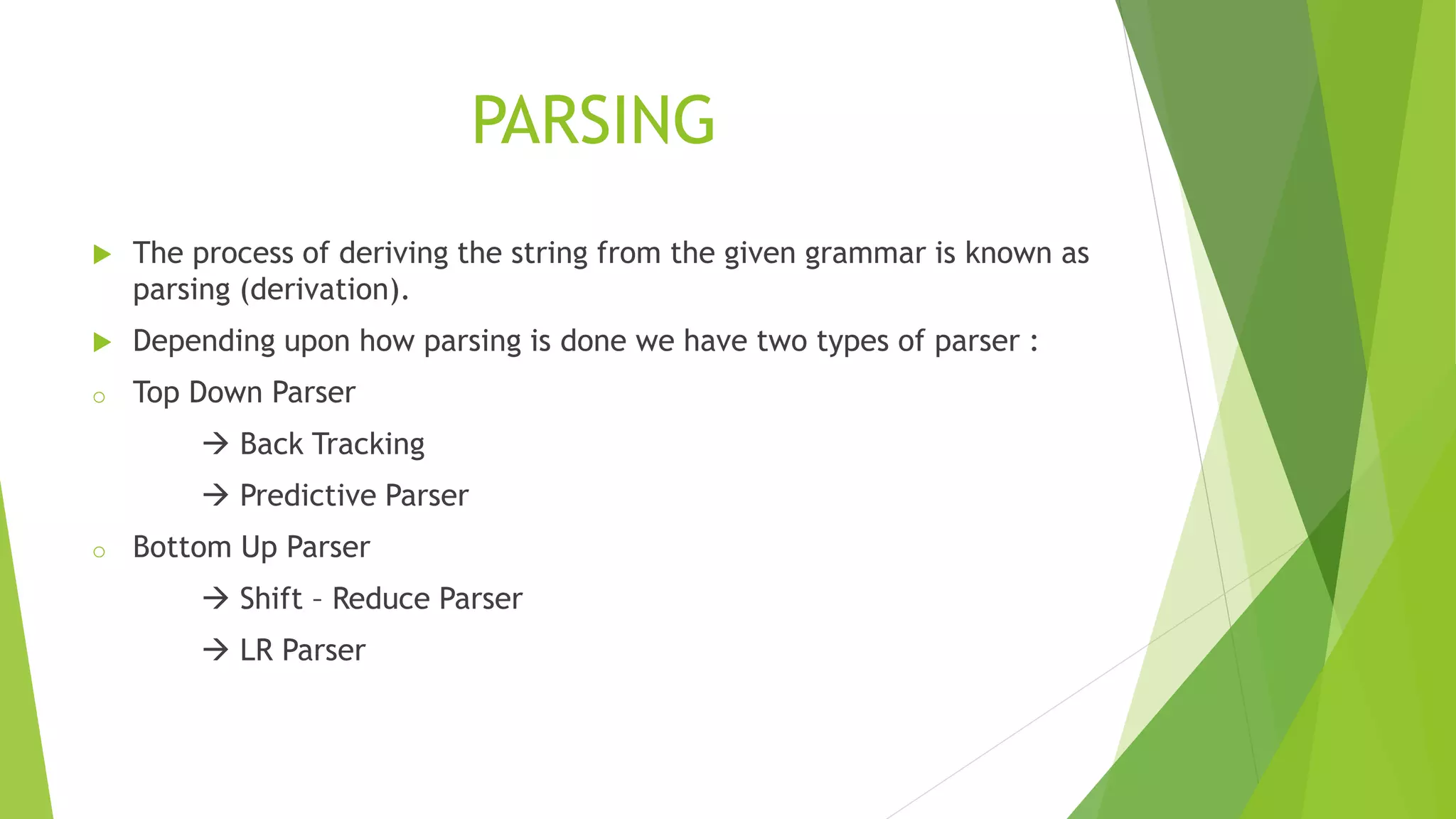
 The process of deriving the string from the given grammar is known as
parsing (derivation).
 Depending upon how parsing is done we have two types of parser :
o Top Down Parser
 Back Tracking
 Predictive Parser
o Bottom Up Parser
 Shift – Reduce Parser
 LR Parser
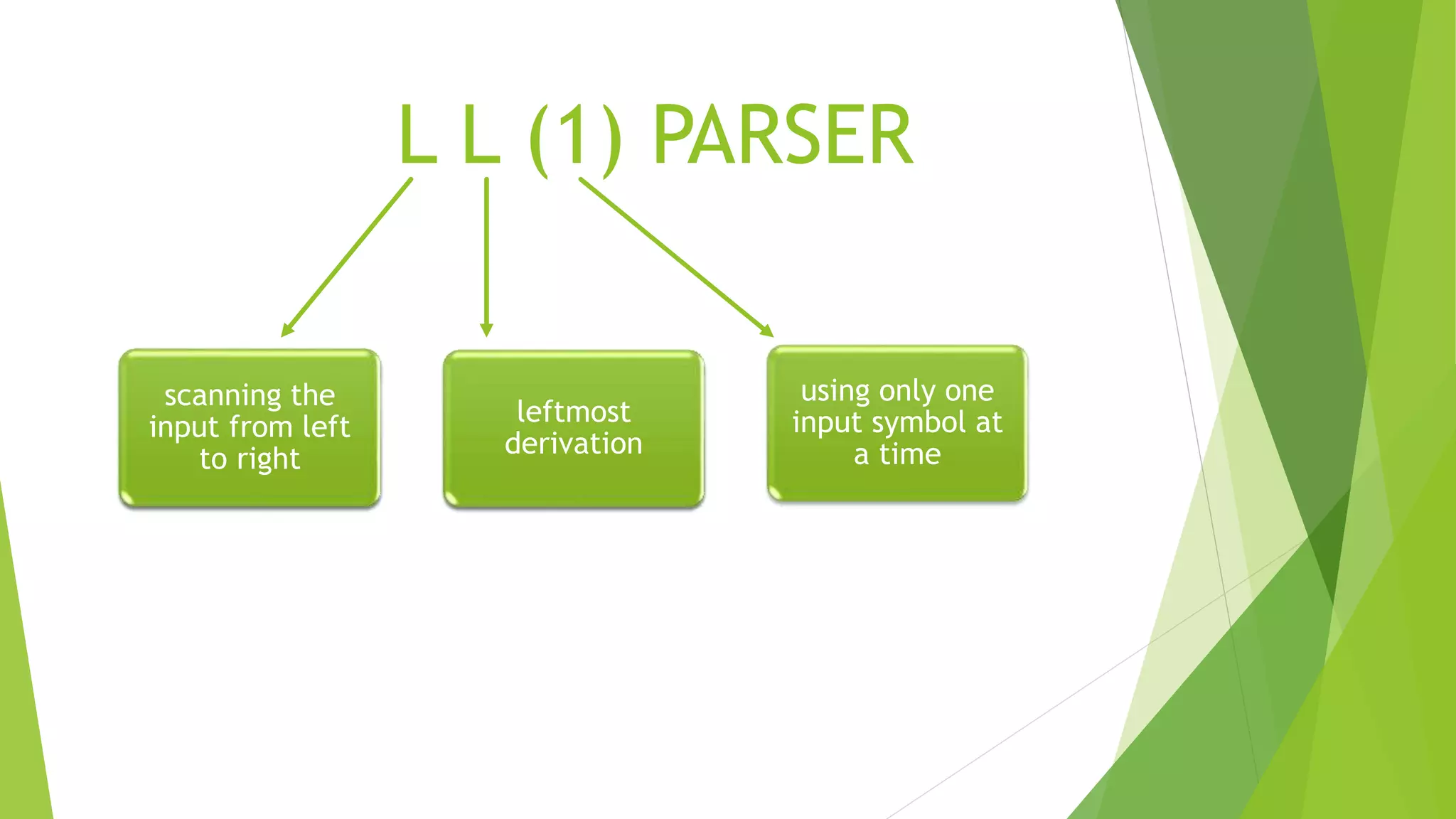
L L (1) PARSER
scanning the
input from left
to right
leftmost
derivation
using only one
input symbol at
a time
scanning the
input from left
to right
leftmost
derivation
Steps to convert LL(1) parser
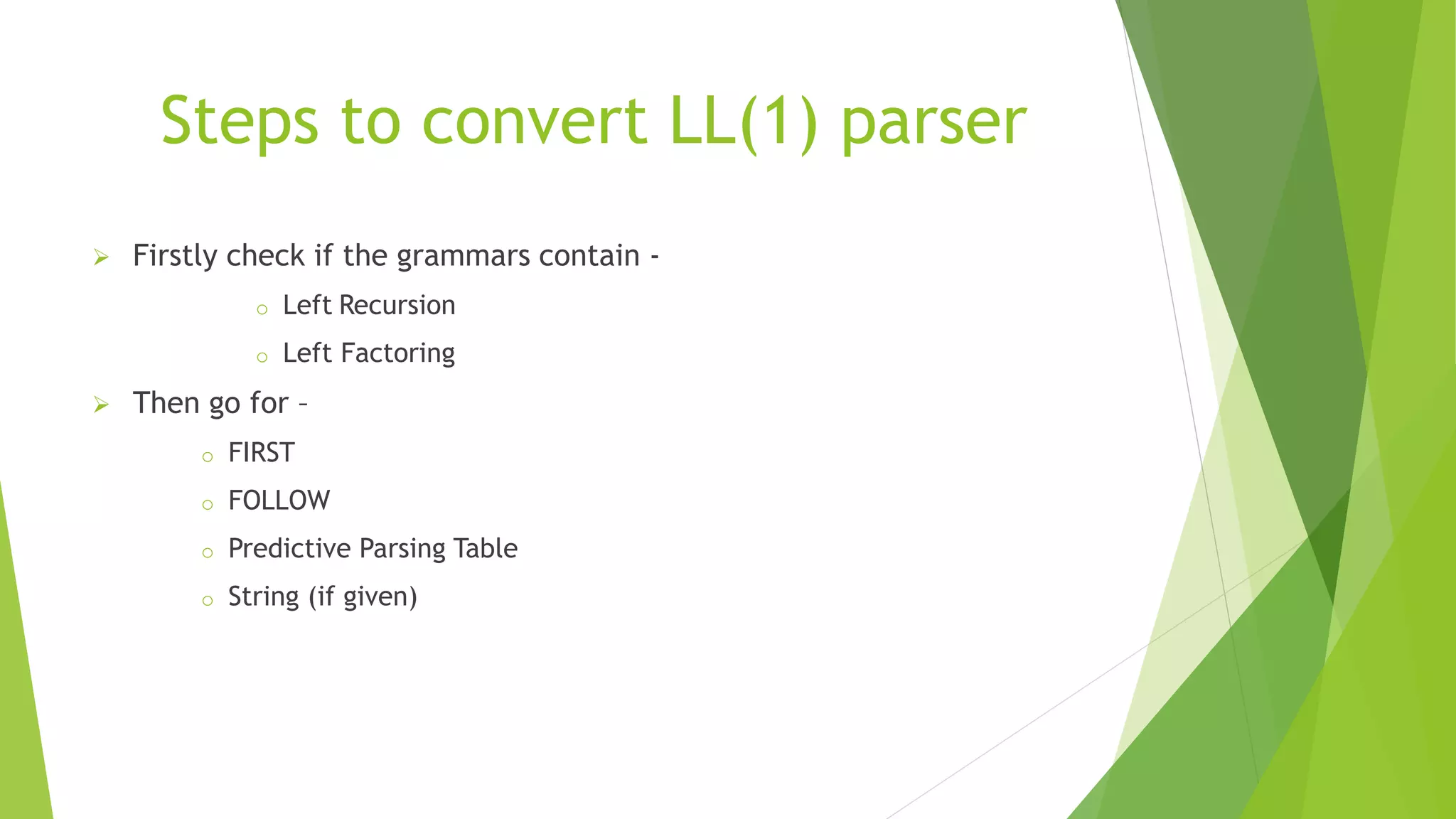
 Firstly check if the grammars contain -
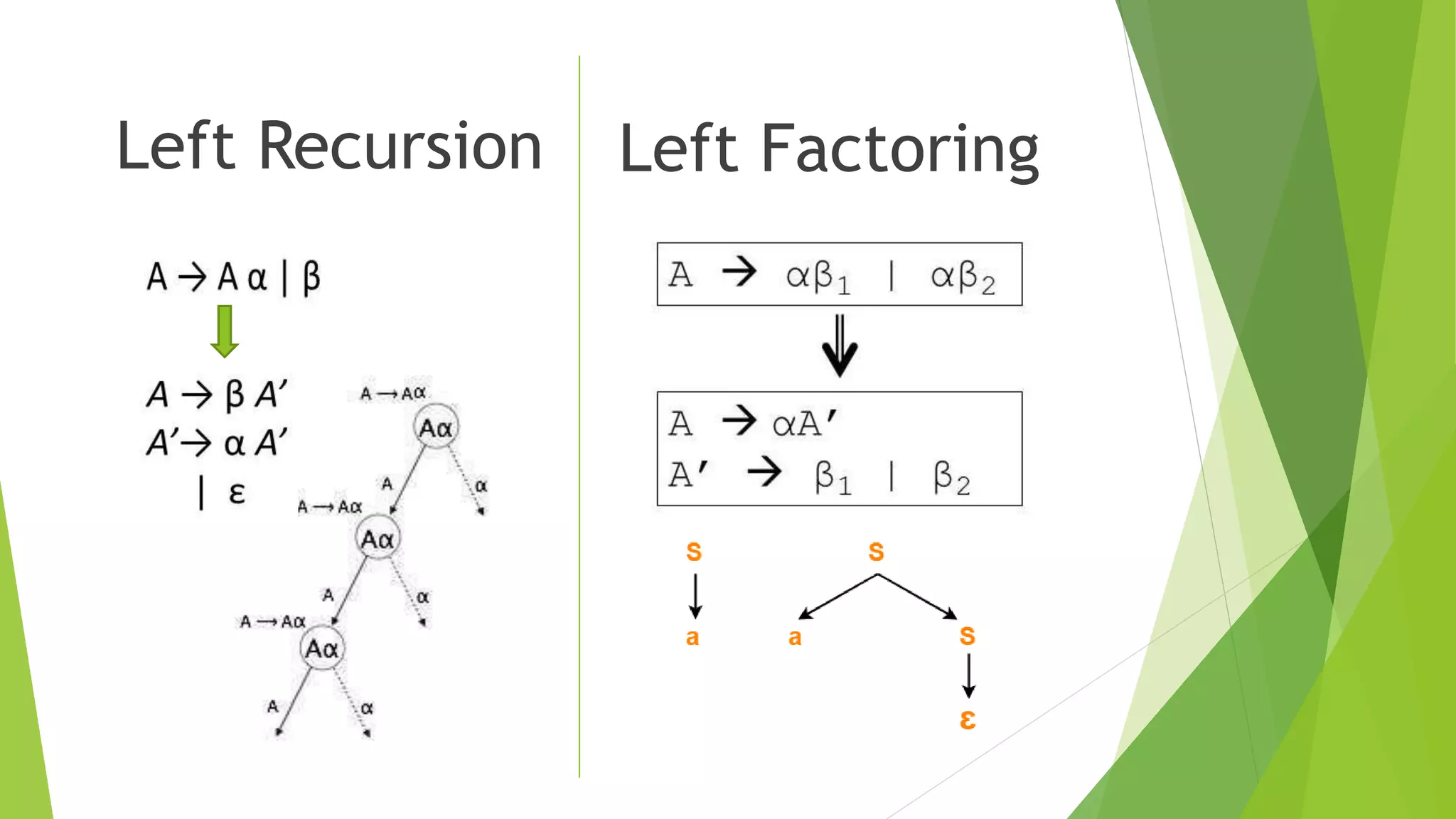
o Left Recursion
o Left Factoring
 Then go for –
o FIRST
o FOLLOW
o Predictive Parsing Table
o String (if given)
Left Recursion Left Factoring
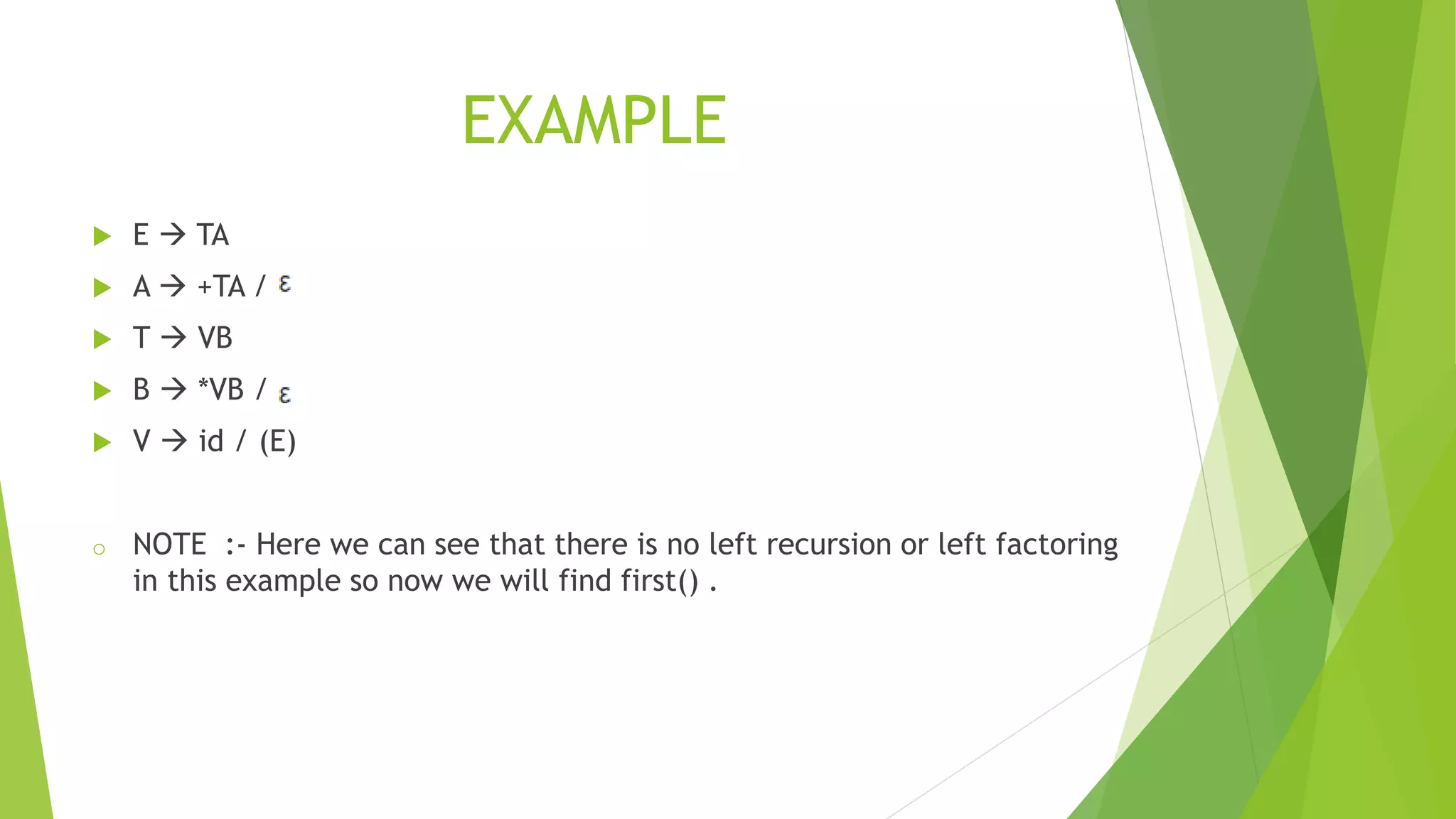
EXAMPLE
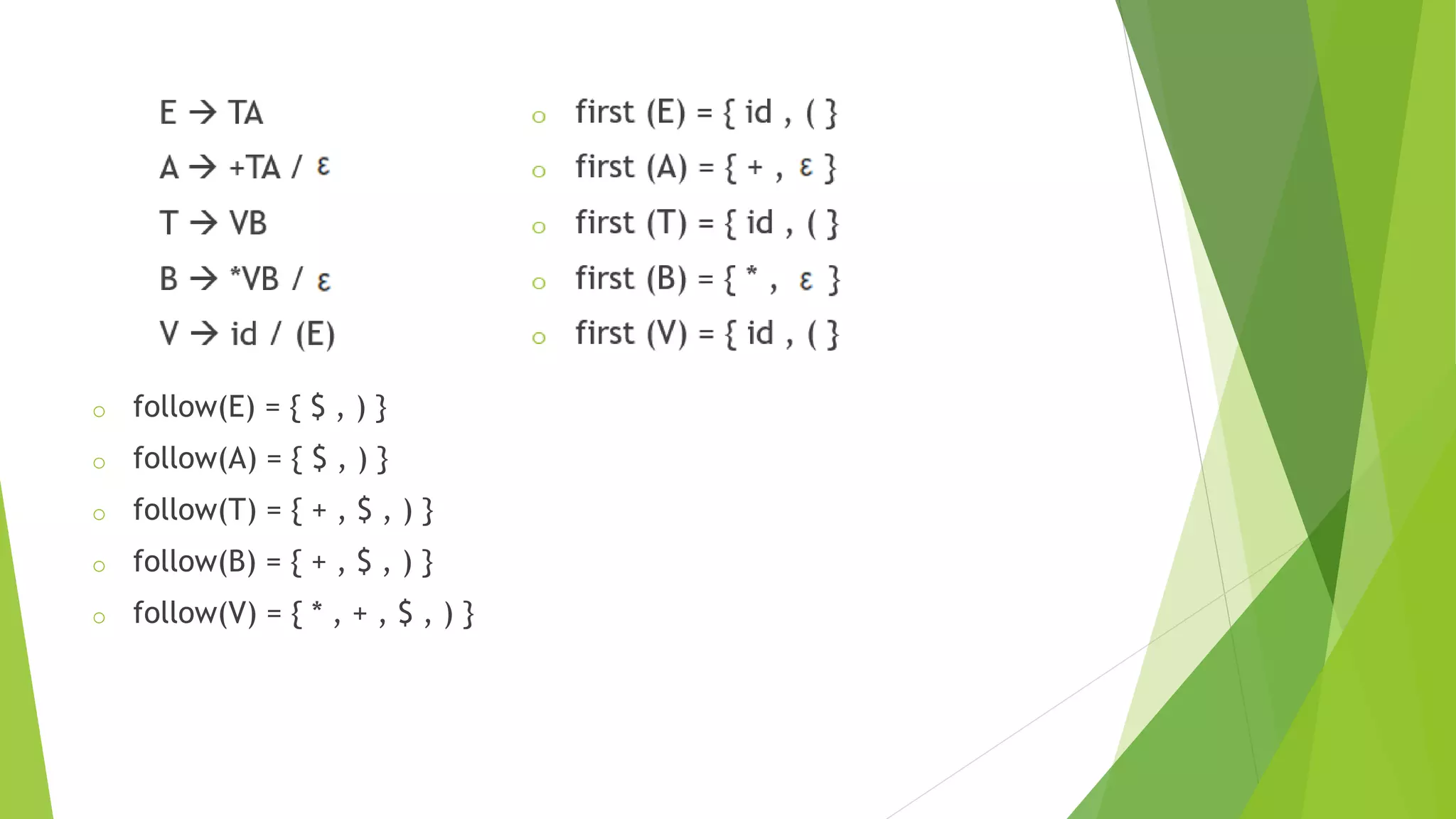
 E  TA
 A  +TA /
 T  VB
 B  *VB /
 V  id / (E)
o NOTE :- Here we can see that there is no left recursion or left factoring
in this example so now we will find first() .
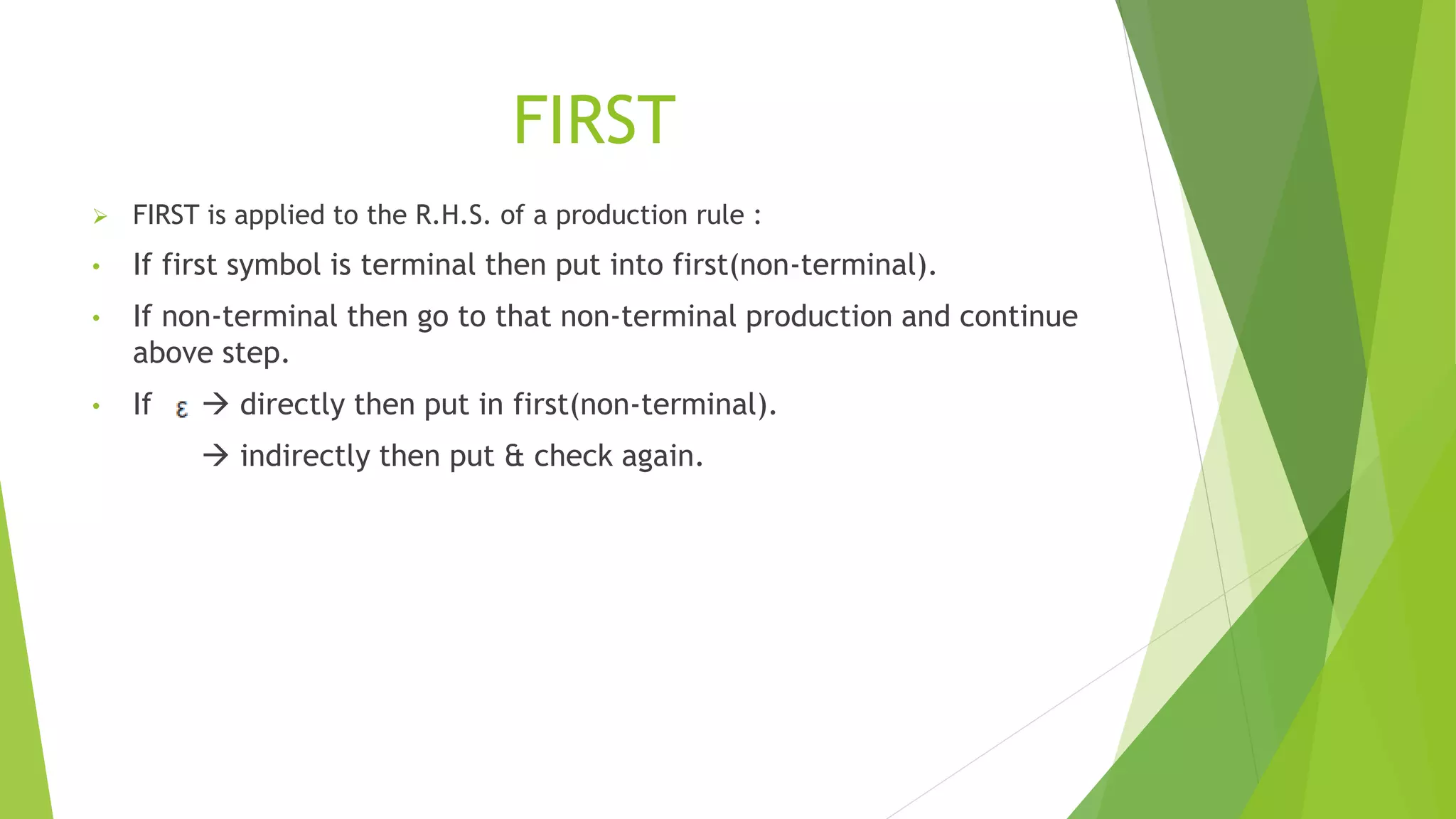
FIRST
 FIRST is applied to the R.H.S. of a production rule :
• If first symbol is terminal then put into first(non-terminal).
• If non-terminal then go to that non-terminal production and continue
above step.
• If  directly then put in first(non-terminal).
 indirectly then put & check again.
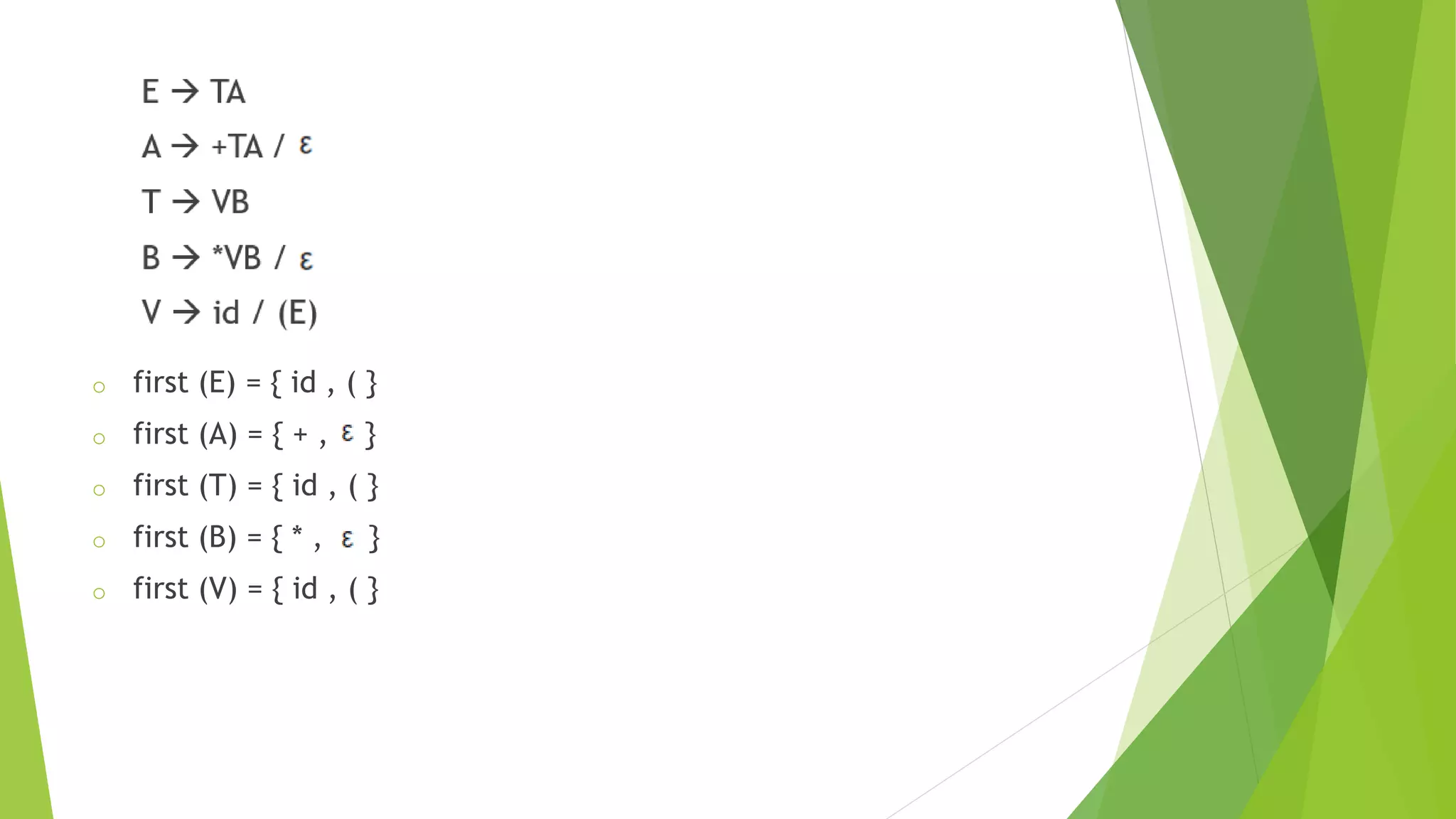
o first (E) = { id , ( }
o first (A) = { + , }
o first (T) = { id , ( }
o first (B) = { * , }
o first (V) = { id , ( }
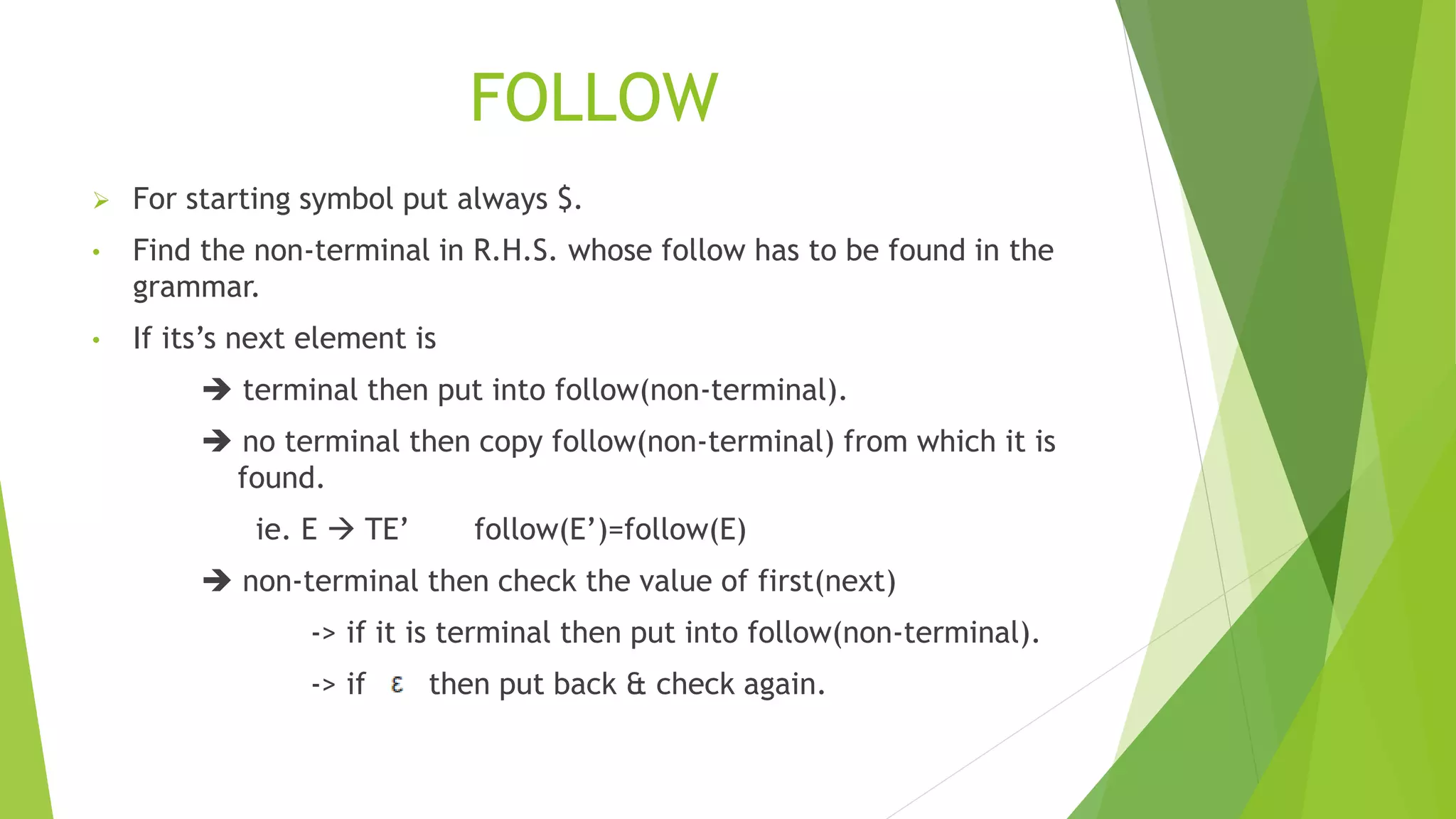
FOLLOW
 For starting symbol put always $.
• Find the non-terminal in R.H.S. whose follow has to be found in the
grammar.
• If its’s next element is
 terminal then put into follow(non-terminal).
 no terminal then copy follow(non-terminal) from which it is
found.
ie. E  TE’ follow(E’)=follow(E)
 non-terminal then check the value of first(next)
-> if it is terminal then put into follow(non-terminal).
-> if then put back & check again.
o follow(E) = { $ , ) }
o follow(A) = { $ , ) }
o follow(T) = { + , $ , ) }
o follow(B) = { + , $ , ) }
o follow(V) = { * , + , $ , ) }
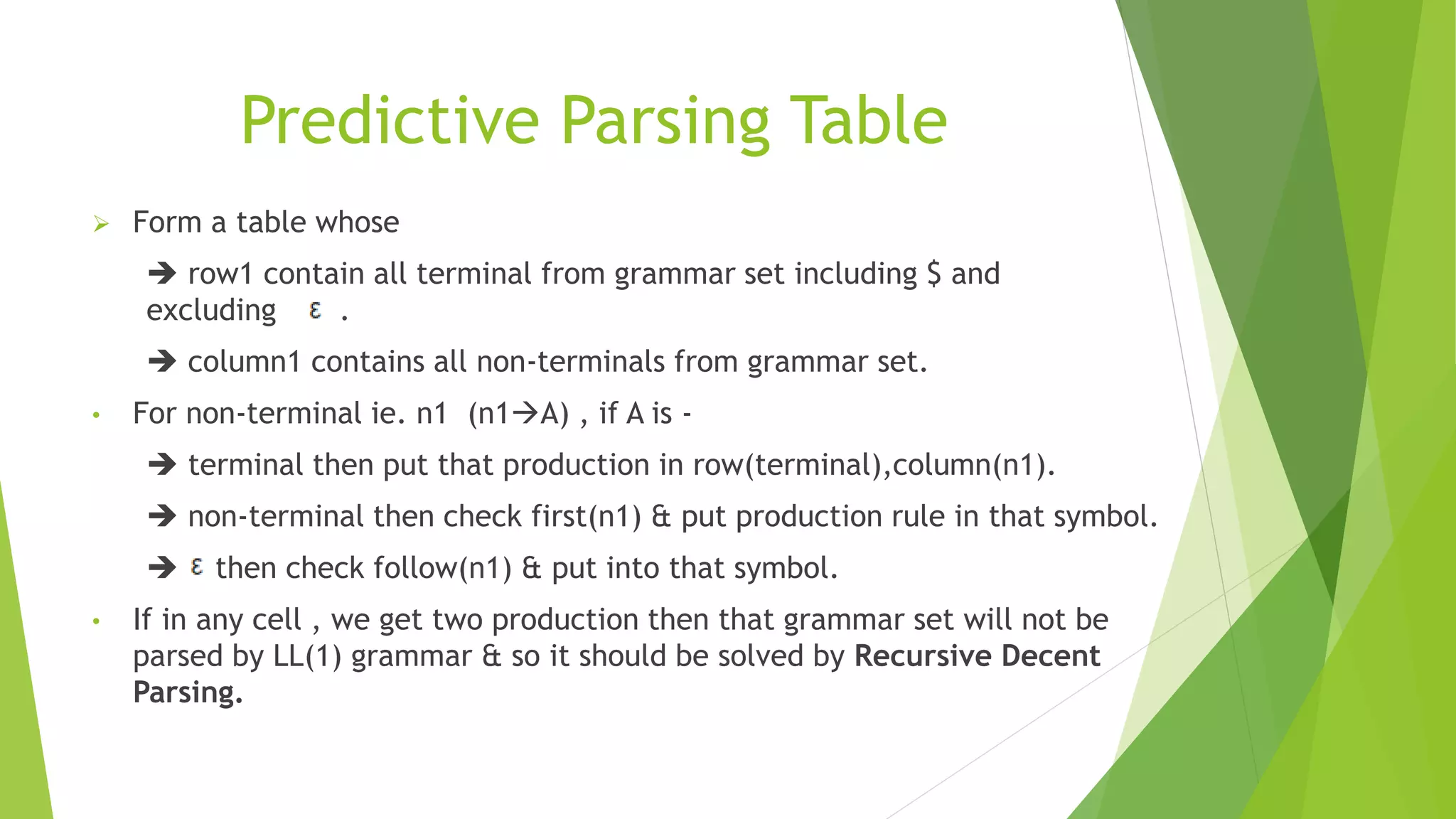
Predictive Parsing Table
 Form a table whose
 row1 contain all terminal from grammar set including $ and
excluding .
 column1 contains all non-terminals from grammar set.
• For non-terminal ie. n1 (n1A) , if A is -
 terminal then put that production in row(terminal),column(n1).
 non-terminal then check first(n1) & put production rule in that symbol.
 then check follow(n1) & put into that symbol.
• If in any cell , we get two production then that grammar set will not be
parsed by LL(1) grammar & so it should be solved by Recursive Decent
Parsing.
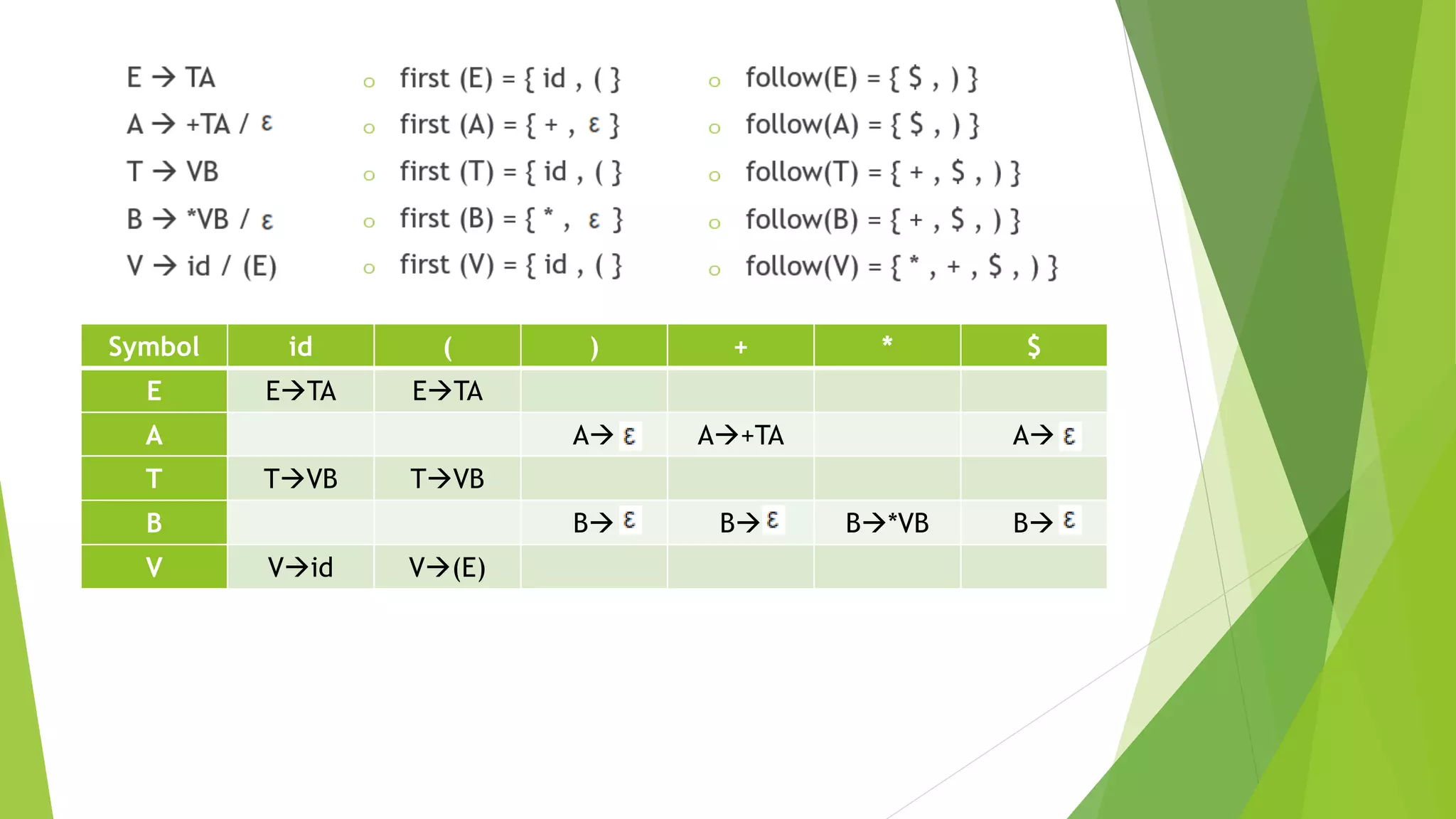
Symbol id ( ) + * $
E ETA ETA
A A A+TA A
T TVB TVB
B B B B*VB B
V Vid V(E)
Parse Input String
(optional)
 Parse given string from left to right.
 Start from $ and starting symbol.
 Replace symbol with it’s production, from which we can form the
given input string.
 Also write the action which we performed in stack.
 Continue till we are left with $ in stack and input.
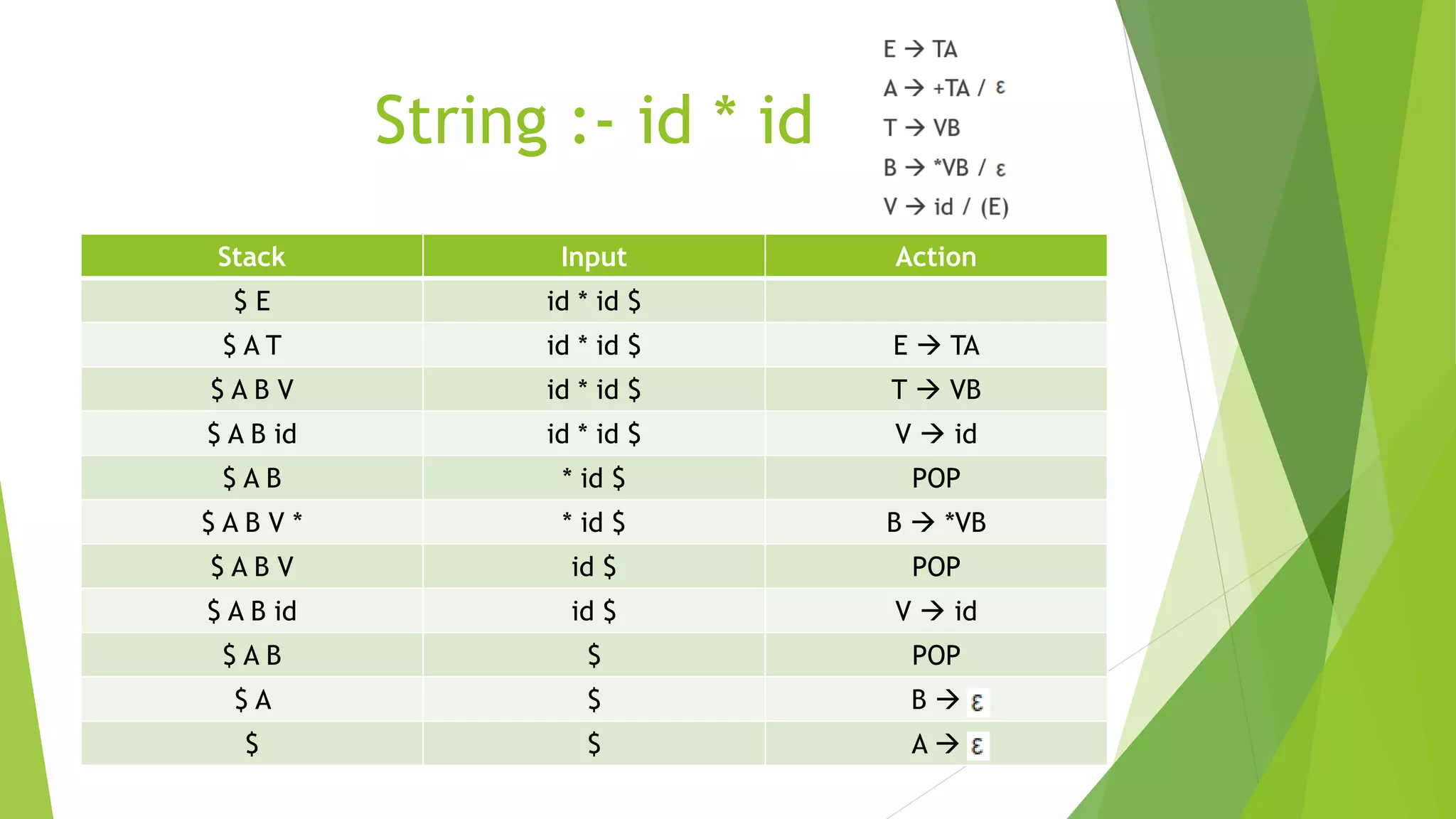
String :- id * id
Stack Input Action
$ E id * id $
$ A T id * id $ E  TA
$ A B V id * id $ T  VB
$ A B id id * id $ V  id
$ A B * id $ POP
$ A B V * * id $ B  *VB
$ A B V id $ POP
$ A B id id $ V  id
$ A B $ POP
$ A $ B 
$ $ A 
String :- id * id
LL(1) parsing

LL(1) parsing

  • 1.
    PREDICTIVE LL(1) PARSING PRESENTED TO:- PRATIK N. PATEL PRESENTED BY :- PATEL KHYATI (170050107079) PATEL NIRMOHI (170050107084)
  • 2.
    PARSING  The processof deriving the string from the given grammar is known as parsing (derivation).  Depending upon how parsing is done we have two types of parser : o Top Down Parser  Back Tracking  Predictive Parser o Bottom Up Parser  Shift – Reduce Parser  LR Parser
  • 3.
    L L (1)PARSER scanning the input from left to right leftmost derivation using only one input symbol at a time scanning the input from left to right leftmost derivation
  • 4.
    Steps to convertLL(1) parser  Firstly check if the grammars contain - o Left Recursion o Left Factoring  Then go for – o FIRST o FOLLOW o Predictive Parsing Table o String (if given)
  • 5.
  • 6.
    EXAMPLE  E TA  A  +TA /  T  VB  B  *VB /  V  id / (E) o NOTE :- Here we can see that there is no left recursion or left factoring in this example so now we will find first() .
  • 7.
    FIRST  FIRST isapplied to the R.H.S. of a production rule : • If first symbol is terminal then put into first(non-terminal). • If non-terminal then go to that non-terminal production and continue above step. • If  directly then put in first(non-terminal).  indirectly then put & check again.
  • 8.
    o first (E)= { id , ( } o first (A) = { + , } o first (T) = { id , ( } o first (B) = { * , } o first (V) = { id , ( }
  • 9.
    FOLLOW  For startingsymbol put always $. • Find the non-terminal in R.H.S. whose follow has to be found in the grammar. • If its’s next element is  terminal then put into follow(non-terminal).  no terminal then copy follow(non-terminal) from which it is found. ie. E  TE’ follow(E’)=follow(E)  non-terminal then check the value of first(next) -> if it is terminal then put into follow(non-terminal). -> if then put back & check again.
  • 10.
    o follow(E) ={ $ , ) } o follow(A) = { $ , ) } o follow(T) = { + , $ , ) } o follow(B) = { + , $ , ) } o follow(V) = { * , + , $ , ) }
  • 11.
    Predictive Parsing Table Form a table whose  row1 contain all terminal from grammar set including $ and excluding .  column1 contains all non-terminals from grammar set. • For non-terminal ie. n1 (n1A) , if A is -  terminal then put that production in row(terminal),column(n1).  non-terminal then check first(n1) & put production rule in that symbol.  then check follow(n1) & put into that symbol. • If in any cell , we get two production then that grammar set will not be parsed by LL(1) grammar & so it should be solved by Recursive Decent Parsing.
  • 12.
    Symbol id () + * $ E ETA ETA A A A+TA A T TVB TVB B B B B*VB B V Vid V(E)
  • 13.
    Parse Input String (optional) Parse given string from left to right.  Start from $ and starting symbol.  Replace symbol with it’s production, from which we can form the given input string.  Also write the action which we performed in stack.  Continue till we are left with $ in stack and input.
  • 14.
    String :- id* id Stack Input Action $ E id * id $ $ A T id * id $ E  TA $ A B V id * id $ T  VB $ A B id id * id $ V  id $ A B * id $ POP $ A B V * * id $ B  *VB $ A B V id $ POP $ A B id id $ V  id $ A B $ POP $ A $ B  $ $ A  String :- id * id