Cinchona bark
S. G. M. C. P. Mahagaon Page 1
CINCHONA
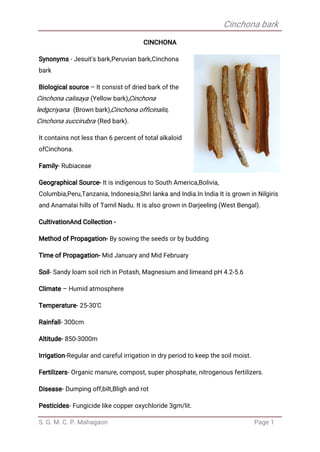
Synonyms - Jesuit's bark,Peruvian bark,Cinchona
bark
Biological source – It consist of dried bark of the
Cinchona calisaya (Yellow bark),Cinchona
ledgcriyana (Brown bark),Cinchona officinalis,
Cinchona succirubra (Red bark).
It contains not less than 6 percent of total alkaloid
ofCinchona.
Family- Rubiaceae
Geographical Source- It is indigenous to South America,Bolivia,
Columbia,Peru,Tanzania, Indonesia,Shri lanka and India.In India It is grown in Nilgiris
and Anamalai hills of Tamil Nadu. It is also grown in Darjeeling (West Bengal).
CultivationAnd Collection -
Method of Propagation- By sowing the seeds or by budding
Time of Propagation- Mid January and Mid February
Soil- Sandy loam soil rich in Potash, Magnesium and limeand pH 4.2-5.6
Climate – Humid atmosphere
Temperature- 25-30'C
Rainfall- 300cm
Altitude- 850-3000m
Irrigation-Regular and careful irrigation in dry period to keep the soil moist.
Fertilizers- Organic manure, compost, super phosphate, nitrogenous fertilizers.
Disease- Dumping off,bilt,Bligh and rot
Pesticides- Fungicide like copper oxychloride 3gm/lit.
Cinchona bark
S. G. M. C. P. Mahagaon Page 2
Harvesting Time- After 4-20 years old
Drying and storage- The collected bark was expose to the sun and further drying by
artificial heat.
Yield- 10 t/ha
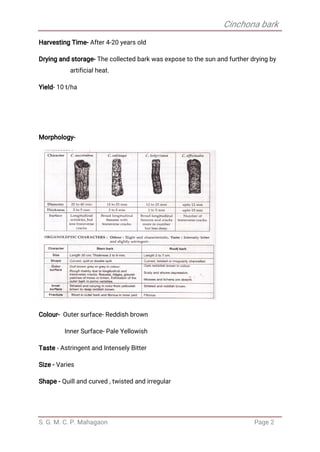
Morphology-
Colour- Outer surface- Reddish brown
Inner Surface- Pale Yellowish
Taste - Astringent and Intensely Bitter
Size - Varies
Shape - Quill and curved , twisted and irregular
Cinchona bark
S. G. M. C. P. Mahagaon Page 3
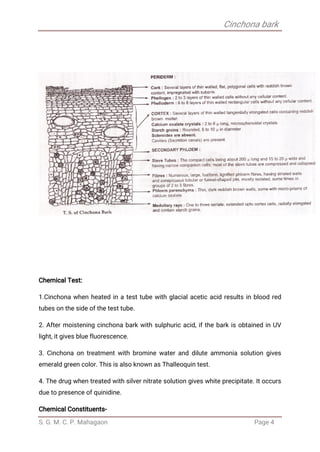
Microscopical characters:
PERIDERM:
Cork- Several layers of thin walked,flat,polygonal cells with reddish brown content
impregnated with suberin
Phellgen - 2-3 layers of thin walled cells without any cellular content.
Phelloderm - 6-8 layers of thin walled rectangular cells without any cellular content.
Cortex - Several layers of thin walled tangentially elongated cells containing reddish
brown matter
Calcium oxalate crystals - 2-6micron long microsphenoidal crystals
Starch Grains - Rounded 6-10 micron in diameter.Scleroids are absent.Cavities
(secretion canals) are present.
SECONDARY PHLOEM:
Sieve tubes:
The contact cells being about 200micron long 15-20micron wide and having narrow
companion cells, most of the sieve tubes are compressed and collapsed.
Fibres:
Numerous,large, fusiform, lignified, phloem fibres, having striated walls and
conspicuous tubular or funnel shaped pits.Mostly isolated,some time in groups of 2-
3 fibres.
Phloem Parenchyma:
Thin, dark reddish brown walls,some with microprisms of calcium oxalate.
Medullary Rays:
One to three seriate , extended upto cortex cells, radially elongated and contain
starch grains.
Cinchona bark
S. G. M. C. P. Mahagaon Page 4
Chemical Test:
1.Cinchona when heated in a test tube with glacial acetic acid results in blood red
tubes on the side of the test tube.
2. After moistening cinchona bark with sulphuric acid, if the bark is obtained in UV
light, it gives blue fluorescence.
3. Cinchona on treatment with bromine water and dilute ammonia solution gives
emerald green color. This is also known as Thalleoquin test.
4. The drug when treated with silver nitrate solution gives white precipitate. It occurs
due to presence of quinidine.
Chemical Constituents-
Cinchona bark
S. G. M. C. P. Mahagaon Page 5
The primary alkaloids in cinchona are quinine and quinidine. Moreover, cinchonidine
and cinchonine are also present in good quantity. Again, the amount of alkaloids
present differs from one variety to another.Other constituents are quinic acid,
cinchotannic acid and quinovin. Quinovine on hydrolysis gives quinovaic acid and
quinovose (isorhodeose).
Uses:
Cinchona has a number of uses and it can be used to treat a variety of diseases.
Here are some of the uses:
1. Cinchona bark has antimalarial properties. It also used in fever to reduce the body
temperature and as an analgesic.
2. The drug is also useful in cases related to cardiac problems like arrhythmia.
3. The drug is also used as an antiseptic and has been found to be useful in diseases
like abscesses, cavities, and ulcers.
4. It is useful in dyspepsia and gastric catarrh.
Allied Drugs-
1. Cuprea bark -
Coppery red ,dense, very hard with a granular and splintery fracture.Sclereids are
present and fibres are partly associated in small groups.
2. Colombian Bark (Cinchona lancifolia) -
Occurs in flat pieces or single quills.Reddish brown in colour and spongy in texture.
Outer surface bears patches of silvery cork . Abundant sclereids are present.
Cinchona bark
S. G. M. C. P. Mahagaon Page 6
Prepared By:-
Vaibhav Kalkundrikar

CINCHONA BARK

  • 1.
    Cinchona bark S. G.M. C. P. Mahagaon Page 1 CINCHONA Synonyms - Jesuit's bark,Peruvian bark,Cinchona bark Biological source – It consist of dried bark of the Cinchona calisaya (Yellow bark),Cinchona ledgcriyana (Brown bark),Cinchona officinalis, Cinchona succirubra (Red bark). It contains not less than 6 percent of total alkaloid ofCinchona. Family- Rubiaceae Geographical Source- It is indigenous to South America,Bolivia, Columbia,Peru,Tanzania, Indonesia,Shri lanka and India.In India It is grown in Nilgiris and Anamalai hills of Tamil Nadu. It is also grown in Darjeeling (West Bengal). CultivationAnd Collection - Method of Propagation- By sowing the seeds or by budding Time of Propagation- Mid January and Mid February Soil- Sandy loam soil rich in Potash, Magnesium and limeand pH 4.2-5.6 Climate – Humid atmosphere Temperature- 25-30'C Rainfall- 300cm Altitude- 850-3000m Irrigation-Regular and careful irrigation in dry period to keep the soil moist. Fertilizers- Organic manure, compost, super phosphate, nitrogenous fertilizers. Disease- Dumping off,bilt,Bligh and rot Pesticides- Fungicide like copper oxychloride 3gm/lit.
  • 2.
    Cinchona bark S. G.M. C. P. Mahagaon Page 2 Harvesting Time- After 4-20 years old Drying and storage- The collected bark was expose to the sun and further drying by artificial heat. Yield- 10 t/ha Morphology- Colour- Outer surface- Reddish brown Inner Surface- Pale Yellowish Taste - Astringent and Intensely Bitter Size - Varies Shape - Quill and curved , twisted and irregular
  • 3.
    Cinchona bark S. G.M. C. P. Mahagaon Page 3 Microscopical characters: PERIDERM: Cork- Several layers of thin walked,flat,polygonal cells with reddish brown content impregnated with suberin Phellgen - 2-3 layers of thin walled cells without any cellular content. Phelloderm - 6-8 layers of thin walled rectangular cells without any cellular content. Cortex - Several layers of thin walled tangentially elongated cells containing reddish brown matter Calcium oxalate crystals - 2-6micron long microsphenoidal crystals Starch Grains - Rounded 6-10 micron in diameter.Scleroids are absent.Cavities (secretion canals) are present. SECONDARY PHLOEM: Sieve tubes: The contact cells being about 200micron long 15-20micron wide and having narrow companion cells, most of the sieve tubes are compressed and collapsed. Fibres: Numerous,large, fusiform, lignified, phloem fibres, having striated walls and conspicuous tubular or funnel shaped pits.Mostly isolated,some time in groups of 2- 3 fibres. Phloem Parenchyma: Thin, dark reddish brown walls,some with microprisms of calcium oxalate. Medullary Rays: One to three seriate , extended upto cortex cells, radially elongated and contain starch grains.
  • 4.
    Cinchona bark S. G.M. C. P. Mahagaon Page 4 Chemical Test: 1.Cinchona when heated in a test tube with glacial acetic acid results in blood red tubes on the side of the test tube. 2. After moistening cinchona bark with sulphuric acid, if the bark is obtained in UV light, it gives blue fluorescence. 3. Cinchona on treatment with bromine water and dilute ammonia solution gives emerald green color. This is also known as Thalleoquin test. 4. The drug when treated with silver nitrate solution gives white precipitate. It occurs due to presence of quinidine. Chemical Constituents-
  • 5.
    Cinchona bark S. G.M. C. P. Mahagaon Page 5 The primary alkaloids in cinchona are quinine and quinidine. Moreover, cinchonidine and cinchonine are also present in good quantity. Again, the amount of alkaloids present differs from one variety to another.Other constituents are quinic acid, cinchotannic acid and quinovin. Quinovine on hydrolysis gives quinovaic acid and quinovose (isorhodeose). Uses: Cinchona has a number of uses and it can be used to treat a variety of diseases. Here are some of the uses: 1. Cinchona bark has antimalarial properties. It also used in fever to reduce the body temperature and as an analgesic. 2. The drug is also useful in cases related to cardiac problems like arrhythmia. 3. The drug is also used as an antiseptic and has been found to be useful in diseases like abscesses, cavities, and ulcers. 4. It is useful in dyspepsia and gastric catarrh. Allied Drugs- 1. Cuprea bark - Coppery red ,dense, very hard with a granular and splintery fracture.Sclereids are present and fibres are partly associated in small groups. 2. Colombian Bark (Cinchona lancifolia) - Occurs in flat pieces or single quills.Reddish brown in colour and spongy in texture. Outer surface bears patches of silvery cork . Abundant sclereids are present.
  • 6.
    Cinchona bark S. G.M. C. P. Mahagaon Page 6 Prepared By:- Vaibhav Kalkundrikar