
ASTIGMATISM
DEFINITION
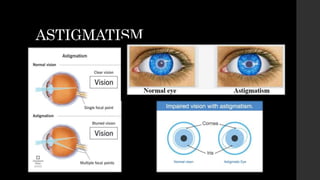
 Astigmatism by definition is a condition where the
parallel beam of light rays incident on the cornea
after refraction are not focused to form a point image
near or on the retina
ASTIGMATISM
ASTIGMATISM
ETIOLOGY
Irregular curvature or RI in the anterior surface of
cornea
Irregular curvature or RI and also the position of
lens/IOL
The refracting power is not uniform in all meridians
of both lens or cornea
The principal meridians are the meridians of greatest
and least refracting powers
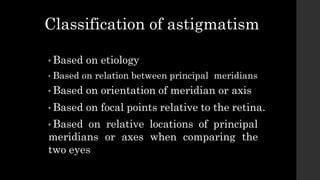
Classification of astigmatism
• Based on etiology
• Based on relation between principal meridians
• Based on orientation of meridian or axis
• Based on focal points relative to the retina.
• Based on relative locations of principal
meridians or axes when comparing the
two eyes
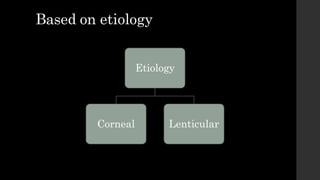
Based on etiology
Etiology
Corneal Lenticular
• When the cornea has unequal curvature on the anterior
surface
Reasons:
• Asymmetric cornea
• Meridional difference in RI
• Varying RI
Corneal astigmatism
Lenticular Astigmatism
When the crystalline lens has an unequal
on the surface or in its layers
Reasons:
•Asymmetric crystalline lens
•Asymmetric lens layers
•Tilted crystalline lens
•Varying RI of the lens layers
Total Astigmatism
The sum of corneal astigmatism and
lenticular astigmatism
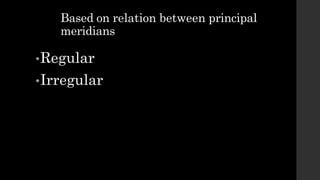
•Regular
•Irregular
Based on relation between principal
meridians
Regular Astigmatism
When the two principal meridians are
perpendicular to each other
Most cases of astigmatism are regular astigmatism
The three types are with-the-rule, against- the-rule,
and oblique astigmatism
Can be corrected with Cyl or Sph- Cyl lens
Irregular Astigmatism
When the two principal meridians are not
perpendicular to each other –more than two
principal meridians
Curvature of any one meridian is not
uniform
Associated with trauma, disease, or
degeneration
VA is often not correctable to 20/20
• With the rule
• Against the rule
• Oblique
• Bi oblique
Based on orientation of meridian or axis
Based on relation between principle
meridian
 WTR-With The Rule Astigmatism
 Vertical meridian of cornea is more curved
 Myopic power is more in vertical meridian
With-The-Rule (WTR)
Astigmatism
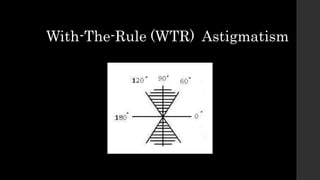
• When the greatest refractive power is within ±30 of the vertical meridian
(i.e., between 060 and 120 meridians)
• Vertical meridian is more myopic than horizontal
 Eg :- -3.0D cyl x 180
• Minus cylinder axis around horizontal meridian
• The most common type of astigmatism based on the orientation of
meridians
With-The-Rule (WTR) Astigmatism
Against-The-Rule (ATR) Astigmatism
• When the greatest refractive power is within 030 of the horizontal
meridian (i.e., between 030 and 150 meridians)
• Minus cylinder axis around vertical meridian
• Horizontal meridian of cornea is more curved
• Myopic power is more in horizontal meridian
 Eg :- -3.0D cyl x 90˚
Against-The-Rule (ATR)
Astigmatism
Based on orientation of meridian
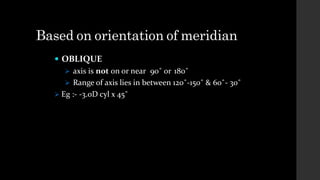
 OBLIQUE
 axis is not on or near 90˚ or 180˚
 Range of axis lies in between 120˚-150˚ & 60˚- 30˚
 Eg :- -3.0D cyl x 45˚
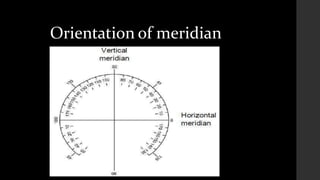
Orientation of meridian
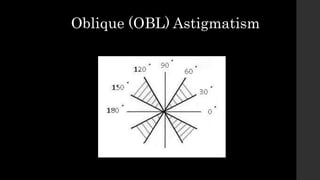
Oblique (OBL) Astigmatism
• When the greatest refractive power is within 030 of the
oblique meridians (i.e., between 30 and 60 or 120 and 150)
Oblique (OBL) Astigmatism
 BIOBLIQUE
 The meridians are not perpendicular
 Eg :- -3.0D cyl x 90˚/ -2.0 D cyl x 110˚
Based on focal points relative to retina
 Simple astigmatism
 One focal point on retina and the other front or behind
 Of 2 types simple myopic and simple hyperopic
 Compound astigmatism
 Both the 2 focal points are in front or behind the retina
 Of 2 types compound myopic and hyperopic
 Mixed astigmatism
 One focal point in front and other behind the retina
Simple Astigmatism
• When one of the principal meridians is focused on the retina and the
other is not focused on the retina (with accommodation relaxed)
Simple Myopic Astigmatism
• When one of the principal meridians is focused in front of the retina and the
other is focused on the retina (with accommodation relaxed)
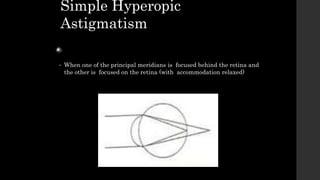
Simple Hyperopic
Astigmatism
• When one of the principal meridians is focused behind the retina and
the other is focused on the retina (with accommodation relaxed)
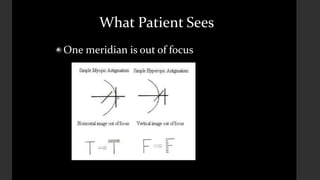
What Patient Sees
One meridian is out of focus
Compound Astigmatism
• When both principal meridians are focused
either in front or behind the retina (with
accommodation relaxed)
Compound Myopic Astigmatism
• When both principal meridians are focused in front
of the retina (with accommodation relaxed)
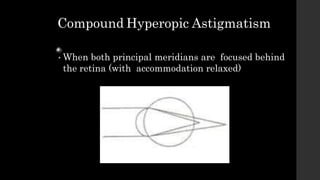
Compound Hyperopic Astigmatism
• When both principal meridians are focused behind
the retina (with accommodation relaxed)
What Patient Sees
Both meridians are out of focus
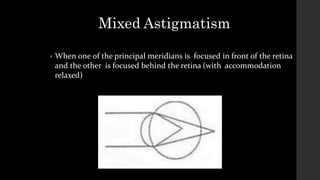
Mixed Astigmatism
• When one of the principal meridians is focused in front of the retina
and the other is focused behind the retina (with accommodation
relaxed)
Based on relative locations of principal meridians
or axes when comparing the two eyes
1. Symmetrical
2. Asymmetrical
Symmetrical Astigmatism
The principal meridians or axes of the two
eyes are symmetrical (e.g., both eyes are
WTR or ATR)
The sum of the two axes of the two eyes
equals approximately 180
Symmetrical Astigmatism
Example


OD: Plano -1.00 x 175
OS: Plano -1.00 x 05
Both eyes are WTR astigmatism, and the
sum of the two axes equal approximately
180
Asymmetrical Astigmatism
The principal meridians or axes of the two
eyes are not symmetrical (e.g., one eye is
WTR while the other eye is ATR)
The sum of the two axes of the two eyes
does not equal approximately 180
Asymmetrical Astigmatism
Example:


OD: pl -1.00 x 180
OS: pl -1.00 x 090
One eye is WTR astigmatism, and the other eye is ATR
astigmatism, and the sum of the two axes do not equal
approximately 180
Prevalence
Age




Infants are born with ATR astigmatism, where the cornea is the source of the
astigmatism
Preschool children have little or no astigmatism
Teenage children demonstrate a shift towards WTR astigmatism
Older adults show a shift towards ATR astigmatism
Prevalence
Gender

In general, there are no significant differences between
males and females
Prevalence
Ethnicity



Higher prevalence in North Americans,
Latinos
Asian infants tend to be WTR astigmatism
Caucasian infants tend to be ATR
astigmatism
Incidence
General trend
 For older adults, the average rate of change
towards ATR astigmatism is less than or
equal to 0.25D every 10 years
Symptoms
Distorted vision at distance and near
Letter confusion
Asthenopia or ocular fatigue
 Due to constantly squinting to clear up
distorted vision
Headaches
Squinting
Signs
Decreased visual acuities at distance and
near
Clinical Tests
Visual acuity tests – distance and near
Autorefraction
Keratometry
Retinoscopy
 Most reliable source of information for cylinder
power and axis
Monocular subjective refraction, including
Jackson cross cylinder
Refining astigmatism
 Astigmatic fan
 Clock dial
 Jackson’sc0rosscylinder
 Stenopic slit
Management
 Spectacles
 Cylindrical lenses and spherocylindrical lenses in spectacles
 Contact lens
 Toric soft contact lenses
 rigid gas permeable contact lenses
 Refractive surgery
 Photorefractive keratectomy (PRK)
 Laser in-situ keratomileusis (LASIK)
Guidelines for optical
treatment
Small astigmatism- treatment is required
In presence of asthenopic symptoms
Decreased vision
• High astigmatism- full correction
• Better to avoid new astigmatic correction in
adults because of intolerable distraction
• Bi-oblique,mixed,high astigmatism arebetter
treated by contact lenses
• Correction of spherical component
Residual astigmatism
The amount of astigmatism that still
remains after correction of a refractive error.
In the case of correction of corneal
astigmatism using rigid contact lens
,lenticular residual astigmatism is exposed.
Thank you

ASTIGMATISM.pptx

  • 1.
  • 2.
    DEFINITION  Astigmatism bydefinition is a condition where the parallel beam of light rays incident on the cornea after refraction are not focused to form a point image near or on the retina
  • 3.
  • 4.
  • 5.
    ETIOLOGY Irregular curvature orRI in the anterior surface of cornea Irregular curvature or RI and also the position of lens/IOL The refracting power is not uniform in all meridians of both lens or cornea The principal meridians are the meridians of greatest and least refracting powers
  • 6.
    Classification of astigmatism •Based on etiology • Based on relation between principal meridians • Based on orientation of meridian or axis • Based on focal points relative to the retina. • Based on relative locations of principal meridians or axes when comparing the two eyes
  • 7.
  • 8.
    • When thecornea has unequal curvature on the anterior surface Reasons: • Asymmetric cornea • Meridional difference in RI • Varying RI Corneal astigmatism
  • 9.
    Lenticular Astigmatism When thecrystalline lens has an unequal on the surface or in its layers Reasons: •Asymmetric crystalline lens •Asymmetric lens layers •Tilted crystalline lens •Varying RI of the lens layers
  • 10.
    Total Astigmatism The sumof corneal astigmatism and lenticular astigmatism
  • 11.
    •Regular •Irregular Based on relationbetween principal meridians
  • 12.
    Regular Astigmatism When thetwo principal meridians are perpendicular to each other Most cases of astigmatism are regular astigmatism The three types are with-the-rule, against- the-rule, and oblique astigmatism Can be corrected with Cyl or Sph- Cyl lens
  • 13.
    Irregular Astigmatism When thetwo principal meridians are not perpendicular to each other –more than two principal meridians Curvature of any one meridian is not uniform Associated with trauma, disease, or degeneration VA is often not correctable to 20/20
  • 14.
    • With therule • Against the rule • Oblique • Bi oblique Based on orientation of meridian or axis
  • 15.
    Based on relationbetween principle meridian  WTR-With The Rule Astigmatism  Vertical meridian of cornea is more curved  Myopic power is more in vertical meridian
  • 16.
    With-The-Rule (WTR) Astigmatism • Whenthe greatest refractive power is within ±30 of the vertical meridian (i.e., between 060 and 120 meridians) • Vertical meridian is more myopic than horizontal  Eg :- -3.0D cyl x 180 • Minus cylinder axis around horizontal meridian • The most common type of astigmatism based on the orientation of meridians
  • 17.
  • 18.
    Against-The-Rule (ATR) Astigmatism •When the greatest refractive power is within 030 of the horizontal meridian (i.e., between 030 and 150 meridians) • Minus cylinder axis around vertical meridian • Horizontal meridian of cornea is more curved • Myopic power is more in horizontal meridian  Eg :- -3.0D cyl x 90˚
  • 19.
  • 20.
    Based on orientationof meridian  OBLIQUE  axis is not on or near 90˚ or 180˚  Range of axis lies in between 120˚-150˚ & 60˚- 30˚  Eg :- -3.0D cyl x 45˚
  • 21.
  • 22.
    Oblique (OBL) Astigmatism •When the greatest refractive power is within 030 of the oblique meridians (i.e., between 30 and 60 or 120 and 150)
  • 23.
  • 24.
     BIOBLIQUE  Themeridians are not perpendicular  Eg :- -3.0D cyl x 90˚/ -2.0 D cyl x 110˚
  • 25.
    Based on focalpoints relative to retina  Simple astigmatism  One focal point on retina and the other front or behind  Of 2 types simple myopic and simple hyperopic  Compound astigmatism  Both the 2 focal points are in front or behind the retina  Of 2 types compound myopic and hyperopic  Mixed astigmatism  One focal point in front and other behind the retina
  • 26.
    Simple Astigmatism • Whenone of the principal meridians is focused on the retina and the other is not focused on the retina (with accommodation relaxed)
  • 27.
    Simple Myopic Astigmatism •When one of the principal meridians is focused in front of the retina and the other is focused on the retina (with accommodation relaxed)
  • 28.
    Simple Hyperopic Astigmatism • Whenone of the principal meridians is focused behind the retina and the other is focused on the retina (with accommodation relaxed)
  • 29.
    What Patient Sees Onemeridian is out of focus
  • 30.
    Compound Astigmatism • Whenboth principal meridians are focused either in front or behind the retina (with accommodation relaxed)
  • 31.
    Compound Myopic Astigmatism •When both principal meridians are focused in front of the retina (with accommodation relaxed)
  • 32.
    Compound Hyperopic Astigmatism •When both principal meridians are focused behind the retina (with accommodation relaxed)
  • 33.
    What Patient Sees Bothmeridians are out of focus
  • 34.
    Mixed Astigmatism • Whenone of the principal meridians is focused in front of the retina and the other is focused behind the retina (with accommodation relaxed)
  • 35.
    Based on relativelocations of principal meridians or axes when comparing the two eyes 1. Symmetrical 2. Asymmetrical
  • 36.
    Symmetrical Astigmatism The principalmeridians or axes of the two eyes are symmetrical (e.g., both eyes are WTR or ATR) The sum of the two axes of the two eyes equals approximately 180
  • 37.
    Symmetrical Astigmatism Example   OD: Plano-1.00 x 175 OS: Plano -1.00 x 05 Both eyes are WTR astigmatism, and the sum of the two axes equal approximately 180
  • 38.
    Asymmetrical Astigmatism The principalmeridians or axes of the two eyes are not symmetrical (e.g., one eye is WTR while the other eye is ATR) The sum of the two axes of the two eyes does not equal approximately 180
  • 39.
    Asymmetrical Astigmatism Example:   OD: pl-1.00 x 180 OS: pl -1.00 x 090 One eye is WTR astigmatism, and the other eye is ATR astigmatism, and the sum of the two axes do not equal approximately 180
  • 40.
    Prevalence Age     Infants are bornwith ATR astigmatism, where the cornea is the source of the astigmatism Preschool children have little or no astigmatism Teenage children demonstrate a shift towards WTR astigmatism Older adults show a shift towards ATR astigmatism
  • 41.
    Prevalence Gender  In general, thereare no significant differences between males and females
  • 42.
    Prevalence Ethnicity    Higher prevalence inNorth Americans, Latinos Asian infants tend to be WTR astigmatism Caucasian infants tend to be ATR astigmatism
  • 43.
    Incidence General trend  Forolder adults, the average rate of change towards ATR astigmatism is less than or equal to 0.25D every 10 years
  • 44.
    Symptoms Distorted vision atdistance and near Letter confusion Asthenopia or ocular fatigue  Due to constantly squinting to clear up distorted vision Headaches Squinting
  • 45.
    Signs Decreased visual acuitiesat distance and near
  • 46.
    Clinical Tests Visual acuitytests – distance and near Autorefraction Keratometry Retinoscopy  Most reliable source of information for cylinder power and axis Monocular subjective refraction, including Jackson cross cylinder
  • 47.
    Refining astigmatism  Astigmaticfan  Clock dial  Jackson’sc0rosscylinder  Stenopic slit
  • 48.
    Management  Spectacles  Cylindricallenses and spherocylindrical lenses in spectacles  Contact lens  Toric soft contact lenses  rigid gas permeable contact lenses  Refractive surgery  Photorefractive keratectomy (PRK)  Laser in-situ keratomileusis (LASIK)
  • 49.
    Guidelines for optical treatment Smallastigmatism- treatment is required In presence of asthenopic symptoms Decreased vision • High astigmatism- full correction • Better to avoid new astigmatic correction in adults because of intolerable distraction • Bi-oblique,mixed,high astigmatism arebetter treated by contact lenses • Correction of spherical component
  • 50.
    Residual astigmatism The amountof astigmatism that still remains after correction of a refractive error. In the case of correction of corneal astigmatism using rigid contact lens ,lenticular residual astigmatism is exposed.
  • 51.