ASTIGMATISM
Dr.Prafulla C.Patil.
S.C.H.M.C.JALGAON.
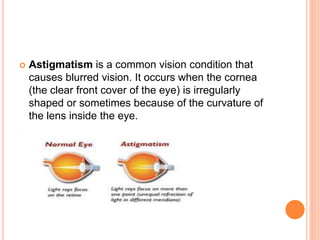
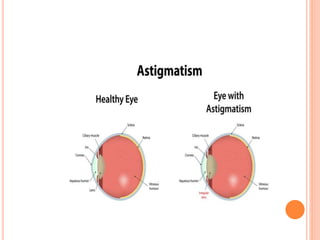
 Astigmatism is a common vision condition that
causes blurred vision. It occurs when the cornea
(the clear front cover of the eye) is irregularly
shaped or sometimes because of the curvature of
the lens inside the eye.
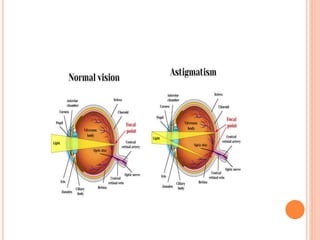
 It is an error of refraction in which the parallel rays
of light from infinity can not coverage to a point
focus due to unequal refraction in differrent
meridians of the optical system of the eye ,but form
focal lines.
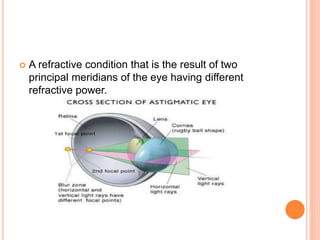
 A refractive condition that is the result of two
principal meridians of the eye having different
refractive power.
CAUSES OF ASTIGMATISM:-
 Astigmatism occurs when the cornea or the lens ,has a
slightly different surface curvature in one direction from
the other.
 There is a steep meridian and a flat meridian.
 Varying refractive index.
 Asymmetry of the cornea, or the lens or the posterior
retina.
 Any variation in refractive index.
 Tilting of the lens.
 Any eye mass lesion.
 The weight of the upper eyelid resting on the eyeball
 Any healed aberration or injury of the cornea which can
be due to any infection or trauma.
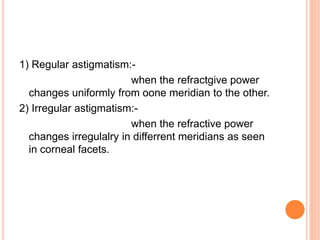
TYPES OF ASTIGMATISM:-
ASTIGMATISM
REGULAR
ASTIGMATISM
SIMPLE
ASTIGMATISM
COMPOUND
ASTIGMATISM
MIXED
ASTIGMATISM
IRREGULAR
ASTIGMATISM
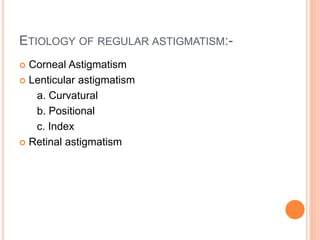
1) Regular astigmatism:-
when the refractgive power
changes uniformly from oone meridian to the other.
2) Irregular astigmatism:-
when the refractive power
changes irregulalry in differrent meridians as seen
in corneal facets.
ETIOLOGY OF REGULAR ASTIGMATISM:-
 Corneal Astigmatism
 Lenticular astigmatism
a. Curvatural
b. Positional
c. Index
 Retinal astigmatism
TYPES OF REGULAR ASTIGMATISM:-
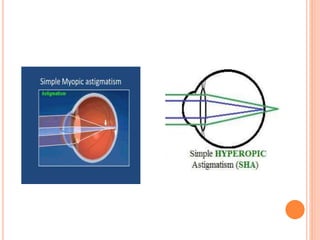
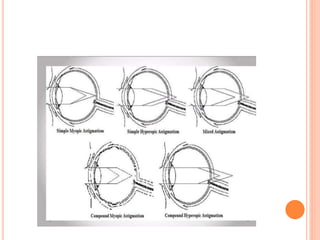
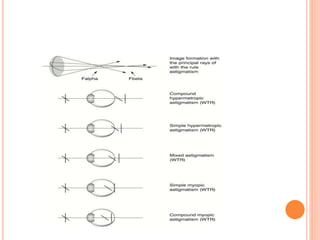
 1) Simple Astigmatism:-
In this,one foacl line falls on the
retina and the other falls either in front of of behind
the retina ,when the eye is at rest.when one focal
line falls in front of the retina the other being formed
on the retina ,the condition is known as simple
myopic astigmatism.
similarly in simple hypermetropic astigmatism one
line is formed behind the retina and other on the
retina.
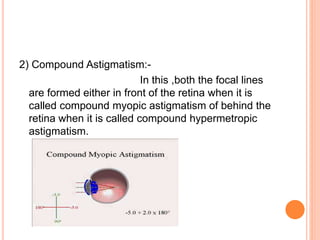
2) Compound Astigmatism:-
In this ,both the focal lines
are formed either in front of the retina when it is
called compound myopic astigmatism of behind the
retina when it is called compound hypermetropic
astigmatism.
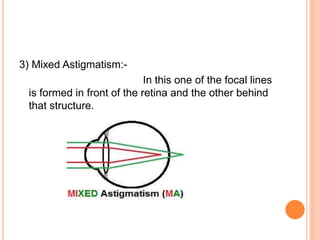
3) Mixed Astigmatism:-
In this one of the focal lines
is formed in front of the retina and the other behind
that structure.
SYMPTOMS OF ASTIGMATISM:-
 Blurring of vertical , horizontal or diagonal lines
 Eyestrain or fatigue
 Headaches
 Distortion in portions of the visual field
 Squinting
INVESTIGATION:-
 Retinoscopy
 Keratometry
 Astigmatic fan test
 Jackson cross cylinder test
TREATMENT:-
 Spectacles
 Contact lenses
surgical trreatment:-
 Lasik
 PRK
 https://www.youtube.com/watch?v=92_LIlBIO84
HOMOEOPATHIC TREATMENT:-
 Gels., lil-t., phys., sep., tub.

Astigmatism

  • 1.
  • 2.
     Astigmatism isa common vision condition that causes blurred vision. It occurs when the cornea (the clear front cover of the eye) is irregularly shaped or sometimes because of the curvature of the lens inside the eye.
  • 5.
     It isan error of refraction in which the parallel rays of light from infinity can not coverage to a point focus due to unequal refraction in differrent meridians of the optical system of the eye ,but form focal lines.
  • 6.
     A refractivecondition that is the result of two principal meridians of the eye having different refractive power.
  • 7.
    CAUSES OF ASTIGMATISM:- Astigmatism occurs when the cornea or the lens ,has a slightly different surface curvature in one direction from the other.  There is a steep meridian and a flat meridian.  Varying refractive index.  Asymmetry of the cornea, or the lens or the posterior retina.  Any variation in refractive index.  Tilting of the lens.  Any eye mass lesion.  The weight of the upper eyelid resting on the eyeball  Any healed aberration or injury of the cornea which can be due to any infection or trauma.
  • 8.
  • 9.
    1) Regular astigmatism:- whenthe refractgive power changes uniformly from oone meridian to the other. 2) Irregular astigmatism:- when the refractive power changes irregulalry in differrent meridians as seen in corneal facets.
  • 10.
    ETIOLOGY OF REGULARASTIGMATISM:-  Corneal Astigmatism  Lenticular astigmatism a. Curvatural b. Positional c. Index  Retinal astigmatism
  • 11.
    TYPES OF REGULARASTIGMATISM:-  1) Simple Astigmatism:- In this,one foacl line falls on the retina and the other falls either in front of of behind the retina ,when the eye is at rest.when one focal line falls in front of the retina the other being formed on the retina ,the condition is known as simple myopic astigmatism. similarly in simple hypermetropic astigmatism one line is formed behind the retina and other on the retina.
  • 14.
    2) Compound Astigmatism:- Inthis ,both the focal lines are formed either in front of the retina when it is called compound myopic astigmatism of behind the retina when it is called compound hypermetropic astigmatism.
  • 15.
    3) Mixed Astigmatism:- Inthis one of the focal lines is formed in front of the retina and the other behind that structure.
  • 17.
    SYMPTOMS OF ASTIGMATISM:- Blurring of vertical , horizontal or diagonal lines  Eyestrain or fatigue  Headaches  Distortion in portions of the visual field  Squinting
  • 18.
    INVESTIGATION:-  Retinoscopy  Keratometry Astigmatic fan test  Jackson cross cylinder test
  • 19.
    TREATMENT:-  Spectacles  Contactlenses surgical trreatment:-  Lasik  PRK  https://www.youtube.com/watch?v=92_LIlBIO84
  • 20.
    HOMOEOPATHIC TREATMENT:-  Gels.,lil-t., phys., sep., tub.