DIABETES MELLITUS
TYPE 1
By : Pediatric Unit- 6
DEFINITION
 Metabolic disorder of multiple
etiologies characterized by chronic
hyperglycemia with disturbances of
carbohydrate, fat and protein
metabolism resulting from defects of
insulin secretion, insulin action or
both.
OLD CLASSIFICATION (1985)
 Type 1, Insulin-dependent (IDDM)
 Type 2, Non Insulin-dependent (NIDDM)
◦ obese
◦ non-obese
◦ MODY (between 18 to 25 years)
 IGT
 Gestational Diabetes Mellitus
New Classification (WHO)
 Is based on etiology not on type of treatment
or age of the patient.
 Type I(Beta cell destruction-absolute insulin
deficiency)
Immune mediated
Idiopathic
 Type II
predominant insulin resistant with
relative insulin deficiency
predominant secretory defect with
insulin resistance
Other specific Types
 Genetic defect of beta cell function
MODY (maturity onset diabetes of the young)
syndromes
mitochondrial mutions
 Infections
Congenital rubella
CMV
 Disease of pancreas
Pancreatitis
Trauma/pancreatectomy
Neoplasia
Cystic fibrosis
 Endocrinopathies
Acromegaly
Cushing’s Syndrome
Pheochromocytoma
 Drug or chemical induced
Nicotinic acid
Glucocorticoids
Thiazides
 Genetic disorder with diabetes
Down syndrome
Turner syndrome
Klinefelter syndrome
Prader willi syndrome
 Gestational Diabetes Mellitus
 Neonatal Diabetes Mellitus
Other specific Types
Type 1 Diabetes Mellitus
Formerly called insulin-dependent
diabetes mellitus (IDDM) or juvenile
diabetes
T1DM is characterized by low or absent levels of
endogenously produced insulin
EPIDEMIOLOGY
• Most common endocrine disorder of
childhood and adolescence.
• The onset occurs predominantly in
childhood, with 2 peak one 5-7 yr, and
another at puberty but it may present at
any age.
• In india an average prevalence of Type I
diabetes is 10 per 100000 population.
Risk of development of Type 1 DM
 If mother has Type1DM risk in child is
2%.
 If father is affected risk is 7%.
 In a sibling of the index case is
estimated as 6%.
 Risk is 6-10% in diazygotic twins
& 30-65% in monozygotic twins
Pathogenesis & Natural
history
The natural history includes distinct
stages
1) Initiation of autoimmunity
2) Preclinical autoimmunity with
progressive loss of β-cell function
3) Onset of clinical disease
4) Transient remission( “Honeymoon
period”)
5) Established disease
6) Development of complications
Beta Cells: secrete
insulin.
The Pancreas
Alpha Cells: secrete
glucagon
Autoimmunity occurs in islet of Langerhans
against the beta cells...
CLINICAL PRESENTATIONS
 DKA ( most common presentation
in pediatrics)
 Classical symptom triad:
polyuria, polydipsia and weight loss
 Accidental diagnosis
 In symptomatic (polydipsia , polyurea,
weight loss) children a random plasma
glucose >11.1 mmol (200 mg) is
diagnostic.
 Hemoglobin A1C >= 6.5 %
Remember: acute infections in young
non-diabetic children can cause
hyperglycemia without ketoacidosis.
DIAGNOSTIC CRITERIA
DIAGNOSTIC CRITERIA
 Fasting blood glucose level
IGT (Impaired glucose
tolerance)
6.0-6.9 mmol (100-126
mg/dl)
Diabetic
>=7.0 mmol (126mg/dl)
 2 hours after oral glucose
IGT (Impaired glucose
tolerance)
7.8-11.0 mmol (140-200
mg/dl)
Diabetic
>=11.1 mmol (200
mg/dl)
modified OGTT (oral glucose 1.75gm/kg max 75
gm) may be needed in
 Asymptomatic children with
hyperglycemia (RBS >140)
 Symptomatic with hyperglycemia
(RBS between 140 to 200)
TREATMENT ELEMENTS
 Education
 Insulin therapy
 Glycemic control Monitoring
 Diet and meal planning
 Prevention and early dectection of
complication
EDUCATION
 Educate child & care givers
about:
 Diabetes type 1
 life long Insulin therapy
 self monitoring and maintaining records
 Recognition of Hypoglycemia & DKA
 Meal plan
 Sick-day management
 Possible long term complication
INSULIN Therapy
Insulin
 A polypeptide made of 2 b-chains.
 Discovered by Bants & Best in 1921.
 Animal types (porcine & bovine) were used
before the introduction of human-like insulin
(DNA-recombinant types).
 Recently more potent insulin analogs are
produced by changing aminoacid sequence.
Rapid-acting Insulin
Examples: insulin lispro or insulin aspart
Onset: Begins to work at about 5
minutes
Peaktime: Peak is about 1 hour
Duration: Continues to work for about
2-4 hours
Regular or Short-acting
Insulin
Examples: insulin regular
Onset: Reaches the bloodstream within
30 minutes after injection.
Peaktime: Peaks anywhere from 2-3
hours after injection.
Duration: Effective for approximately 3-
6 hours.
Intermediate-acting
Insulin
Examples:NPH, Lente
Onset: Reaches the blood stream about
2 to 4 hours after injection.
Peaktime: Peaks 4-12 hours later.
Duration: Effective for about 12 to 18
hours
Long-acting Insulin
Examples: insulin glargine
Onset: Reaches the bloodstream 6-
10 hours after injection
Duration: Usually effective for 20-24
hours
Overview of Insulin and Action
INSULIN CONCENTRATIONS
 Insulin is available in different
concentrations 40, 80 & 100 Unit/ml.
 WHO now recommends U 100/ml to be the
only used insulin to prevent confusion.
 Special preparation for infusion pumps is
soluble insulin 500 U/ml.
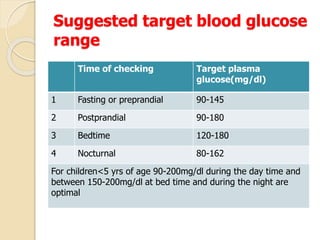
Suggested target blood glucose
range
Time of checking Target plasma
glucose(mg/dl)
1 Fasting or preprandial 90-145
2 Postprandial 90-180
3 Bedtime 120-180
4 Nocturnal 80-162
For children<5 yrs of age 90-200mg/dl during the day time and
between 150-200mg/dl at bed time and during the night are
optimal
Key aspect of Insulin Therapy
 Aim-To mimic natural pattern of insulin secretion
 Administration- insulin is administered subcutaneously
using insulin syringes, pens, or insulin pumps.
 Dose-
DKA/with overt symptoms:
-Total daily dose(TDD)-0.8 to1 unit/kg/day
Incidentally diagnosed: at lower dose
Toddlers & pre-school (2-5 yrs)-0.2-0.4unit/kg/day
Pre-pubertal children(5-9 yrs)-0.5-0.8 unit/kg/day
Adolescents-(9-14 yrs) 0.8-1.5unit/kg/day
Injection sites
• Anterolateral thighs
• Anterior and lateral
abdominal wall
• Posterior aspect of upper
arms
• Superolateral aspects of
buttocks.
(site rotation : following a
regular pattern of using the
different sites and different
areas within the same site
is important)
Key aspect of Insulin Therapy
 Regimes-
 Split mix regime ( mixtard 30:70 or NPH 2/3 +
Regular insulin 1/3; twice a daily)
2/3 dose-45 min BBF
1/3 dose-45 min BD
1 IU of Mixtard takes care of BS 50mg/dl above
target
 Basal bolus regime with multiple daily
injection(MDI)
30-50% of Total daily dose as one dose- long
action (Glargine,Detemir)
3-4 doses of rapid insulin as remainder
Key aspect of Insulin Therapy
Calculation of Bolus Dose –
 CIR (carbohydrate to insulin ratio)
- Amount of carohydrate in gram covered by one unit of
insulin
- Initial calculation-500/Total daily dose
more accurate estimation is based on
- amount of carbohydrate consumed in a meal
- units of insulin administered
- pre and post prandial blood glucose
 ISF-insulin sensitivity factor
- Reduction in blood glucose by one unit of insulin
- Initial calculation as 1800/Total daily dose
- For correcting Pre meal high sugar (actual BS- Target
BS/ISF)
Key aspect of Insulin Therapy
 Example for 10 yrs old 33 kg wt child
Total insulin requirement 0.8 IU * 33=26 IU
Carbohydrate to Insulin Ratio = 500/26=20
Insulin sensitivity factor = 1800/26 = 70
Inj Glargine 40% = 11 IU
If child is taking 80 gm carbohydrates in
lunch , insulin needed is 80/ CIR =4 IU
If pre lunch BS is 200 than to correct pre
lunch BS insulin needed is 200-130/ISF
= 1
So Inj lispro is given 5 IU before lunch.
Key aspect of Insulin Therapy
Insulin Pump Therapy
 Continuous subcutaneous insulin infusion
(CSII) via battery-powered pumps provides
a closer approximation of normal plasma
insulin profiles.
 It accurately deliver a small baseline
continuous infusion of insulin, coupled with
parameters for bolus therapy.
 The bolus insulin determined by amount of
carbohydrate intake and blood sugar level
Monitoring of glycemic control
 Self monitoring of blood glucose(SMBG)
-fasting
-before and 2 hours after meals
-during night
 Real time continuous glucose monitoring
 Urinary Glucose
-Reflects glycemic level over the preceding
several hours
-It is positive if renal theshold is exceeded.
-Crude indicator of hyperglycemia
 Measuring ketones in urine-More
sensitive and accurate
In-BG>250 mg/dl
Illness with fever and or vomiting
abdominal pain , polyurea,
drowsiness, rapid breathing
 Glycosylated Hemoglobin (HbA1C)
- every 3-4 monthly
Monitoring of glycemic control
ADVERSE EFFECTS OF INSULIN
 Hypoglycemia
 Lipoatrophy
 Lipohypertrophy
 Obesity
 Insulin allergy
 Insulin antibodies
PRACTICAL PROBLEMS
 Non-availability of insulin in poor countries
 injection sites & technique
 Insulin storage & transfer
 Mixing insulin preparations
 Insulin & school hours
 Adjusting insulin dose at home
 Sick-day management
 Recognition & Rx of hypoglycemia at home
Management on Sick days
 Insulin requirement may increase or
decrease during illness.
 Fever, dehydration, and the stress of
illness can cause hyperglycemia due
to increase production of
counterregulatory hormones , whereas
vomiting and loss of appetite can lead
to hypoglycemia.
 The risk of Ketosis is increased due to
starvation and dehydration.
 Take plenty of fluids.
 Blood glucose and urine ketones monitered
frequently.
 “moderate” or “large” ketones in the urine in
the presence of hyperglycemia indicate
insulin deficiency and risk of DKA.
 Child should be given rapid acting analog or
regular insulin and oral fluids and ketones
should be rechecked in the next urine.
 If there is vomiting with hyperglycemia and
large ketones , or persistent hypoglycemia,
child should be taken to emergency
department.
Management on Sick days
URINE KETONE
STATUS
INSULI
N
CORRECTION DOSE COMMENT
Negative or small q2hr q2hr for glucose
>250mg/dl
Check ketones
every other void
Moderate to large q1hr q1hr for glucose >250
mg/dl
Check ketones
each void go to
hospital if emesis
occurs.
RBS 2hrly
INSULIN short acting (0.1u/kg) or if
RBS >250
DIET REGULATION
 Regular meal plans with calorie exchange
options are encouraged.
 50-60% of required energy to be obtained
from complex carbohydrates.
 Distribute carbohydrate load evenly during
the day preferably 3 meals & 2 snacks with
avoidance of simple sugars.
 Encouraged low salt, low saturated fats and
high fiber diet.
 Avoid simple sugar
 In patient with split mix regime-
6 meals-3 major(70% of total calories)
-3midmeal(30% of total calories)
 In children with MDI(multiple dose
regime)
mid meal is not essential
majority of the calories should be
consumed as a part of the meals,
mid meal should have less than 10-15
gm of carbohydrate.
DIET REGULATION
Glycemic Index :
 ranking of carbohydrates on a scale from 0 to 100
according to the extent to which they raise blood
sugar levels after eating.
 Foods with a high GI are those which are rapidly
digested and absorbed and result in marked
fluctuations in blood sugar levels. Like corn flakes,
potato, watermelon, biscuits, chocolates
 Low-GI foods, by virtue of their slow digestion and
absorption, produce gradual rises in blood sugar
and insulin levels, and have proven benefits
diabetics. Like Most fruits and vegetables (except
potato & water melon), pasta, pulses, milk, curd,
DIET REGULATION
EXERCISE
 Decreases insulin requirement in
diabetic subjects by increasing both
sensitivity of muscle cells to insulin &
glucose utilization.
 It can precipitate hypoglycemia in the
unprepared diabetic patient.
PITFALLS OF MANAGEMENT
 Delayed diagnosis of IDDM
 The honey-moon period
 Problems with diagnosis & treatment
of DKA & hypoglycemia
 Somogyi’s effect & dawn phenomenon
may go unrecognized.
Dawn Phenomenon
 Blood glucose levels increase in early
morning hours before breakfast due to
decline in insulin levels. Which results
in elevated morning glucose.
 This phenomenon mainly caused by
overnight growth hormone secretion and
increased insulin clearance.
 It’s a normal physiologic process seen in
most adolescents without diabetes, who
compensate with more insulin output.
Child with TIDM cannot compensate.
Somogyi Phenomenon
 It’s a theoretical rebound from late-
night or early morning hypoglycemia,
thought to be from an exaggerated
counter-regulatory response.
 Continuous glucose monitoring
systems or night time blood glucose
may help clarify ambiguously elevated
morning glucose levels.
COMPLICATIONS OF DIABETES
 Acute:
DKA
Hypoglycemia
Hyperosmolar Coma
 Late-onset:
Retinopathy
Neuropathy
Nephropathy
Ischemic heart disease & stroke
Guidelines regarding monitoring
for complications
Parameter Recommendation
HbA1c 3-4 times per year
Height and Weight 3-4 times per year
Nutritional
counseling
At diagnosis, 4-6 weeks later
,then annually.
Lipid profile Prepubertal child :every 5 yr
Pubertal child: within 6-12
months after diagnosis, then
every 2 yrs.
Blood pressure Annually after age 10 yrs.
RETINOPATHY :
 Screening - after 5 yr duration in prepubertal children
- after 2 yr in pubertal children
 Frequency- 1-2 yearly
 Method preferred- fundal photography
NEPHROPATHY:
 Screening - after 5 yr duration in prepubertal children
- after 2 yr in pubertal children
 Frequency- annually
 Preferred method- spot urine sample for
albumin:creatinine ratio
Prevention and Early
detection of complication
NEUROPATHY:
 Screening-unclear in children ; adults at
diagnosis in type 2 DM and 5yr after
diagnosis in type 1DM
 Frequency- unclear
 Method preferred-physical examination
MACROVASCULAR DISEASE:
 Screening- after age 2 yrs
 Frequency- every 5 yrs
 Method preferred- lipid profile test
Prevention and Early
detection of complication
THYROID DISEASE
 Screening- at diagnosis
 Frequency- every 2-3 yr or more frequently
based on symptoms or the presence of
antithyroid antibodies.
 Method preferred- TSH
CELIAC DISEASE:
 Screening- at diagnosis
 Frequency- every 2-3 yr
 Method preferred- tissue transglutaminase
endomysial antibody.
Prevention and Early
detection of complication
.
MANAGEMENT OF
ACUTE COMPLICATIONS
Diabetic Ketoacidosis
 DKA,a life threatning complication of
diabetes mellitus,occurs more
commonly in children with type 1 DM
than type 2 DM.
 DKA in children is defined as
hypgerglycemia(serum glucose conc.
>200-300mg/dl) in the presence of
metabolic acidosis (blood pH<7.3 with
serum bicarbonate level<15 mEq/L)
and ketonemia(presence of ketones in
blood).
Signs and symptoms
 Nausea,vomiting,abdominal pain
 Fruity odour in breath
 Tachycardia
 Low volume pulses
 Hypotension
 Impaired skin turgor
 Delayed capillary refill time
 Dehydration
 Rapid,Deep sighing respiration Kussumaul
respiration(met. Acidosis)
Diabetic Ketoacidosis
Classification of diabetic
ketoacidosis
NORMAL MILD MODERATE SEVERE
Co2 mEq/L
venous)
20-28 16-20 10-15 <10
pH 7.35-7.45 7.25-7.35 7.15-7.25 <7.15
clinical No change Oriented,
alert but
fatigued
Kussmaul
respirations;
oriented but
sleepy;
arousable
Kussmaul or
depressed
respirations;
sleepy to
depressed
sensorium to
coma
DIABETIC KETOACIDOSIS TREATMENT
PROTOCOL.
1ST hr 10-20 ml/kg IV bolus 0.9% NaCl
or LR
Insulin drip at 0.05 to 0.10
u/kg/hr
Quick volume expansion;may be
repeated.NPO.Monitor I/O,neurological
status.Usefloe sheet. Have Mannitol at
bedside;1 g/kg IV push for cerebral edema
2nd hr until
DKA resolution
0.45%NaCl:plus continue
Insulin drip
20 mEq/l Kphos and .5%
glucose if blood sugar <250
mg/dl
IV rate= 85 ml/kg+maintainence-
bolus/23hr
If K<3mEq/L,give 0.5 to 1 mEq/kg as oral K
solution OR increase IV K to 80 mEq/L
After
correction of
dehydration
and acidosis
Oral intake with subcutaneous
insulin
No emesis;CO2> 16 mEq/L;normal
electrolytes
TIME THERAPY COMMENTS
Transition to subcutaneous insulin
therapy
• As oral feeds advanced iv fluids reduced and change to
subcutaneous insulin planned.
• Timing-ideal time to begin is just before a meal.
• Rapid acting insulin(lispro,aspart) are administered sc
15-30 mins prior and regular insulin 1-2 hr prior to
stopping infusion to avoid rebound hyperglycemia.
• Dose-For pt with DKA at ds onset,recommended TDD
is 0.75-1 u/kg(pre pubertal) and 1-1.2 u/kg(pubertal).
• Before Breakfast-2/3 tdd(1/3 regular and 2/3 NPH
insulin)
• Before dinner-1/3 tdd(1/3 regular and 2/3 NPH insulin)
Cerebral Edema.
Management
•Head end elevation
•Give Mannitol 0.5-1 gm/kg and repeat if there is
no response in 30 mins-2hrs
•3% Hypertonic saline (5 ml/kg over 30 mins) can
be given
•Restrict iv fluids to 2/3
•Replace fluid deficit in 72 hr rather than 24 hr
•Intubation and ventilation if required
Non-Ketotic Hyperosmolar
Coma
 Severe hyperglycemia(blood
glucose>800mg/dl), absence of or only slight
ketosis, nonketotic acidosis, severe
dehydration, depressed sensorium or frank
coma, and various neurological signs that
may include grand mal seizures,
hyperthermia,hemiparesis, and positive
babinski signs.
 Respirations are usually shallow , but
coexistent metabolic acidosis may be
manifested by kussmaul breathing .
 Serum osmolarity is commonly 350mOsm/kg
or greater. This condition is uncommon in
children.
Treatment of Nonketotic
Hyperosmolar coma
 Rapid repletion of the vascular volume deficit and very
slow correction of the hyperosmolar state.
 One half isotonic saline(0.45% NaCl) administered at a
rate estimated to replace 50% of the volume deficit in
the 1st 12hr,and remainder is administered in ensuing
24hr.
 When blood glucose concentration approaches to
300mg/dl, the hydrating fluid should be changed to
5%dextrose in 0.2 normal saline.
 Approximately 20mEq/L of potassium chloride should be
added to each of these fluids to prevent hypokalemia.
 Insulin can be given by continuous intravenous infusion
beginning with the 2nd hr of fluid therapy. The IV insulin
dosage should be 0.05 units/kg/hr.
Hypoglycemia
 Blood glucose <70mg/dl. Risk increases as
the duration of diabetes increases.
 Mild to moderate symptoms- immediate oral
intake of 0.3 g/kg of glucose dissolved in
small amount of water, raises the blood
glucose value by 45-65 mg/dl. Blood glucose
is retested after 10-15 min. and glucose
readministered if the response is inadequate.
 Chocolate, milk, sweets containing fat are not
a good choices as fat delays the absorption
of glucose. Treating it with child’s favourite
sweets or beverages should be avoided.
 Severe hypoglycemia (altered mental
status, unconsciousness or seizures)-
glucagon is administered
subcutaneously or intramuscularly.
DOSE:
0.5 mg for <12yrs.
0.1 mg for>12 yrs.
(if glucagon injections are not available
glucose gel, honey can be administered
into buccal pouch.)
 Nelson textbook of paediatrics 20 Edition
 Harrison’s Textbook of Internal Medicine
 Case based reviews of paediatric endocrinology
 National Diabetes Fact Sheet 2003, DEPARTMENT OF HEALTH
AND HUMAN SERVICES Centres for Disease Control and
Prevention
 World Health Organization. Definition, Diagnosis and Classification
of Diabetes Mellitus and its Complications. Report of WHO.
Department of Non-communicable Disease Surveillance. Geneva
1999
References
RECENT ADVANCES
Pancreas & Islet Cell Transplantation
 Pancreas transplants are usually given
to diabetics with end stage renal
disease.
 Islet cell transplants, the ultimate
treatment of type 1 diabetes is under
trial in many centers in the US &
Europe with encouraging results but
graft rejection & recurrence of
autoimmunity are serious limitations.
IMMUNE MODULATION
 Immunosuppressive therapy for
Newly diagnosed
Prolonged the honey moon
For high risk children
 Immune modulating drugs
Nicotinamide
mycophenolate
GENE THERAPY
 Blocks the immunologic attack against
islet-cells by DNA-plasmids encoding
self antigen.
 Gene encode cytokine inhibitors.
 Modifying gene expressed islet-cell
antigens like GAD.
PREDICTION OF DIABETES
 Sensitive & specific immunologic
markers
GAD Antibodies
GLIMA antibodies
IA-2 antibodies
For single antibody risk is 2-6 %
Two antibodies ; risk is 21-40 %
more than 2 antibodies risk is 59-80 %
PREVENTION OF DIABETES
Primary prevention
• Identification of diabetes gene
• Tampering with the immune system
• Elimination of environmental factor
Secondary prevention
• Immunosuppressive therapy(cyclosporin,
GLP-1 agonist)
Tertiary prevention
• Tight metabolic control & good monitoring

Diebetes mellitus type 1

  • 1.
    DIABETES MELLITUS TYPE 1 By: Pediatric Unit- 6
  • 2.
    DEFINITION  Metabolic disorderof multiple etiologies characterized by chronic hyperglycemia with disturbances of carbohydrate, fat and protein metabolism resulting from defects of insulin secretion, insulin action or both.
  • 3.
    OLD CLASSIFICATION (1985) Type 1, Insulin-dependent (IDDM)  Type 2, Non Insulin-dependent (NIDDM) ◦ obese ◦ non-obese ◦ MODY (between 18 to 25 years)  IGT  Gestational Diabetes Mellitus
  • 4.
    New Classification (WHO) Is based on etiology not on type of treatment or age of the patient.  Type I(Beta cell destruction-absolute insulin deficiency) Immune mediated Idiopathic  Type II predominant insulin resistant with relative insulin deficiency predominant secretory defect with insulin resistance
  • 5.
    Other specific Types Genetic defect of beta cell function MODY (maturity onset diabetes of the young) syndromes mitochondrial mutions  Infections Congenital rubella CMV  Disease of pancreas Pancreatitis Trauma/pancreatectomy Neoplasia Cystic fibrosis
  • 6.
     Endocrinopathies Acromegaly Cushing’s Syndrome Pheochromocytoma Drug or chemical induced Nicotinic acid Glucocorticoids Thiazides  Genetic disorder with diabetes Down syndrome Turner syndrome Klinefelter syndrome Prader willi syndrome  Gestational Diabetes Mellitus  Neonatal Diabetes Mellitus Other specific Types
  • 7.
    Type 1 DiabetesMellitus Formerly called insulin-dependent diabetes mellitus (IDDM) or juvenile diabetes T1DM is characterized by low or absent levels of endogenously produced insulin
  • 8.
    EPIDEMIOLOGY • Most commonendocrine disorder of childhood and adolescence. • The onset occurs predominantly in childhood, with 2 peak one 5-7 yr, and another at puberty but it may present at any age. • In india an average prevalence of Type I diabetes is 10 per 100000 population.
  • 9.
    Risk of developmentof Type 1 DM  If mother has Type1DM risk in child is 2%.  If father is affected risk is 7%.  In a sibling of the index case is estimated as 6%.  Risk is 6-10% in diazygotic twins & 30-65% in monozygotic twins
  • 10.
    Pathogenesis & Natural history Thenatural history includes distinct stages 1) Initiation of autoimmunity 2) Preclinical autoimmunity with progressive loss of β-cell function 3) Onset of clinical disease 4) Transient remission( “Honeymoon period”) 5) Established disease 6) Development of complications
  • 11.
    Beta Cells: secrete insulin. ThePancreas Alpha Cells: secrete glucagon Autoimmunity occurs in islet of Langerhans against the beta cells...
  • 14.
    CLINICAL PRESENTATIONS  DKA( most common presentation in pediatrics)  Classical symptom triad: polyuria, polydipsia and weight loss  Accidental diagnosis
  • 15.
     In symptomatic(polydipsia , polyurea, weight loss) children a random plasma glucose >11.1 mmol (200 mg) is diagnostic.  Hemoglobin A1C >= 6.5 % Remember: acute infections in young non-diabetic children can cause hyperglycemia without ketoacidosis. DIAGNOSTIC CRITERIA
  • 16.
    DIAGNOSTIC CRITERIA  Fastingblood glucose level IGT (Impaired glucose tolerance) 6.0-6.9 mmol (100-126 mg/dl) Diabetic >=7.0 mmol (126mg/dl)  2 hours after oral glucose IGT (Impaired glucose tolerance) 7.8-11.0 mmol (140-200 mg/dl) Diabetic >=11.1 mmol (200 mg/dl) modified OGTT (oral glucose 1.75gm/kg max 75 gm) may be needed in  Asymptomatic children with hyperglycemia (RBS >140)  Symptomatic with hyperglycemia (RBS between 140 to 200)
  • 17.
    TREATMENT ELEMENTS  Education Insulin therapy  Glycemic control Monitoring  Diet and meal planning  Prevention and early dectection of complication
  • 18.
    EDUCATION  Educate child& care givers about:  Diabetes type 1  life long Insulin therapy  self monitoring and maintaining records  Recognition of Hypoglycemia & DKA  Meal plan  Sick-day management  Possible long term complication
  • 19.
    INSULIN Therapy Insulin  Apolypeptide made of 2 b-chains.  Discovered by Bants & Best in 1921.  Animal types (porcine & bovine) were used before the introduction of human-like insulin (DNA-recombinant types).  Recently more potent insulin analogs are produced by changing aminoacid sequence.
  • 20.
    Rapid-acting Insulin Examples: insulinlispro or insulin aspart Onset: Begins to work at about 5 minutes Peaktime: Peak is about 1 hour Duration: Continues to work for about 2-4 hours
  • 21.
    Regular or Short-acting Insulin Examples:insulin regular Onset: Reaches the bloodstream within 30 minutes after injection. Peaktime: Peaks anywhere from 2-3 hours after injection. Duration: Effective for approximately 3- 6 hours.
  • 22.
    Intermediate-acting Insulin Examples:NPH, Lente Onset: Reachesthe blood stream about 2 to 4 hours after injection. Peaktime: Peaks 4-12 hours later. Duration: Effective for about 12 to 18 hours
  • 23.
    Long-acting Insulin Examples: insulinglargine Onset: Reaches the bloodstream 6- 10 hours after injection Duration: Usually effective for 20-24 hours
  • 24.
  • 25.
    INSULIN CONCENTRATIONS  Insulinis available in different concentrations 40, 80 & 100 Unit/ml.  WHO now recommends U 100/ml to be the only used insulin to prevent confusion.  Special preparation for infusion pumps is soluble insulin 500 U/ml.
  • 26.
    Suggested target bloodglucose range Time of checking Target plasma glucose(mg/dl) 1 Fasting or preprandial 90-145 2 Postprandial 90-180 3 Bedtime 120-180 4 Nocturnal 80-162 For children<5 yrs of age 90-200mg/dl during the day time and between 150-200mg/dl at bed time and during the night are optimal
  • 27.
    Key aspect ofInsulin Therapy  Aim-To mimic natural pattern of insulin secretion  Administration- insulin is administered subcutaneously using insulin syringes, pens, or insulin pumps.  Dose- DKA/with overt symptoms: -Total daily dose(TDD)-0.8 to1 unit/kg/day Incidentally diagnosed: at lower dose Toddlers & pre-school (2-5 yrs)-0.2-0.4unit/kg/day Pre-pubertal children(5-9 yrs)-0.5-0.8 unit/kg/day Adolescents-(9-14 yrs) 0.8-1.5unit/kg/day
  • 28.
    Injection sites • Anterolateralthighs • Anterior and lateral abdominal wall • Posterior aspect of upper arms • Superolateral aspects of buttocks. (site rotation : following a regular pattern of using the different sites and different areas within the same site is important) Key aspect of Insulin Therapy
  • 29.
     Regimes-  Splitmix regime ( mixtard 30:70 or NPH 2/3 + Regular insulin 1/3; twice a daily) 2/3 dose-45 min BBF 1/3 dose-45 min BD 1 IU of Mixtard takes care of BS 50mg/dl above target  Basal bolus regime with multiple daily injection(MDI) 30-50% of Total daily dose as one dose- long action (Glargine,Detemir) 3-4 doses of rapid insulin as remainder Key aspect of Insulin Therapy
  • 30.
    Calculation of BolusDose –  CIR (carbohydrate to insulin ratio) - Amount of carohydrate in gram covered by one unit of insulin - Initial calculation-500/Total daily dose more accurate estimation is based on - amount of carbohydrate consumed in a meal - units of insulin administered - pre and post prandial blood glucose  ISF-insulin sensitivity factor - Reduction in blood glucose by one unit of insulin - Initial calculation as 1800/Total daily dose - For correcting Pre meal high sugar (actual BS- Target BS/ISF) Key aspect of Insulin Therapy
  • 31.
     Example for10 yrs old 33 kg wt child Total insulin requirement 0.8 IU * 33=26 IU Carbohydrate to Insulin Ratio = 500/26=20 Insulin sensitivity factor = 1800/26 = 70 Inj Glargine 40% = 11 IU If child is taking 80 gm carbohydrates in lunch , insulin needed is 80/ CIR =4 IU If pre lunch BS is 200 than to correct pre lunch BS insulin needed is 200-130/ISF = 1 So Inj lispro is given 5 IU before lunch. Key aspect of Insulin Therapy
  • 32.
    Insulin Pump Therapy Continuous subcutaneous insulin infusion (CSII) via battery-powered pumps provides a closer approximation of normal plasma insulin profiles.  It accurately deliver a small baseline continuous infusion of insulin, coupled with parameters for bolus therapy.  The bolus insulin determined by amount of carbohydrate intake and blood sugar level
  • 34.
    Monitoring of glycemiccontrol  Self monitoring of blood glucose(SMBG) -fasting -before and 2 hours after meals -during night  Real time continuous glucose monitoring  Urinary Glucose -Reflects glycemic level over the preceding several hours -It is positive if renal theshold is exceeded. -Crude indicator of hyperglycemia
  • 35.
     Measuring ketonesin urine-More sensitive and accurate In-BG>250 mg/dl Illness with fever and or vomiting abdominal pain , polyurea, drowsiness, rapid breathing  Glycosylated Hemoglobin (HbA1C) - every 3-4 monthly Monitoring of glycemic control
  • 36.
    ADVERSE EFFECTS OFINSULIN  Hypoglycemia  Lipoatrophy  Lipohypertrophy  Obesity  Insulin allergy  Insulin antibodies
  • 37.
    PRACTICAL PROBLEMS  Non-availabilityof insulin in poor countries  injection sites & technique  Insulin storage & transfer  Mixing insulin preparations  Insulin & school hours  Adjusting insulin dose at home  Sick-day management  Recognition & Rx of hypoglycemia at home
  • 38.
    Management on Sickdays  Insulin requirement may increase or decrease during illness.  Fever, dehydration, and the stress of illness can cause hyperglycemia due to increase production of counterregulatory hormones , whereas vomiting and loss of appetite can lead to hypoglycemia.  The risk of Ketosis is increased due to starvation and dehydration.
  • 39.
     Take plentyof fluids.  Blood glucose and urine ketones monitered frequently.  “moderate” or “large” ketones in the urine in the presence of hyperglycemia indicate insulin deficiency and risk of DKA.  Child should be given rapid acting analog or regular insulin and oral fluids and ketones should be rechecked in the next urine.  If there is vomiting with hyperglycemia and large ketones , or persistent hypoglycemia, child should be taken to emergency department. Management on Sick days
  • 40.
    Management on Sickdays URINE KETONE STATUS INSULI N CORRECTION DOSE COMMENT Negative or small q2hr q2hr for glucose >250mg/dl Check ketones every other void Moderate to large q1hr q1hr for glucose >250 mg/dl Check ketones each void go to hospital if emesis occurs. RBS 2hrly INSULIN short acting (0.1u/kg) or if RBS >250
  • 41.
    DIET REGULATION  Regularmeal plans with calorie exchange options are encouraged.  50-60% of required energy to be obtained from complex carbohydrates.  Distribute carbohydrate load evenly during the day preferably 3 meals & 2 snacks with avoidance of simple sugars.  Encouraged low salt, low saturated fats and high fiber diet.
  • 42.
     Avoid simplesugar  In patient with split mix regime- 6 meals-3 major(70% of total calories) -3midmeal(30% of total calories)  In children with MDI(multiple dose regime) mid meal is not essential majority of the calories should be consumed as a part of the meals, mid meal should have less than 10-15 gm of carbohydrate. DIET REGULATION
  • 43.
    Glycemic Index : ranking of carbohydrates on a scale from 0 to 100 according to the extent to which they raise blood sugar levels after eating.  Foods with a high GI are those which are rapidly digested and absorbed and result in marked fluctuations in blood sugar levels. Like corn flakes, potato, watermelon, biscuits, chocolates  Low-GI foods, by virtue of their slow digestion and absorption, produce gradual rises in blood sugar and insulin levels, and have proven benefits diabetics. Like Most fruits and vegetables (except potato & water melon), pasta, pulses, milk, curd, DIET REGULATION
  • 44.
    EXERCISE  Decreases insulinrequirement in diabetic subjects by increasing both sensitivity of muscle cells to insulin & glucose utilization.  It can precipitate hypoglycemia in the unprepared diabetic patient.
  • 45.
    PITFALLS OF MANAGEMENT Delayed diagnosis of IDDM  The honey-moon period  Problems with diagnosis & treatment of DKA & hypoglycemia  Somogyi’s effect & dawn phenomenon may go unrecognized.
  • 46.
    Dawn Phenomenon  Bloodglucose levels increase in early morning hours before breakfast due to decline in insulin levels. Which results in elevated morning glucose.  This phenomenon mainly caused by overnight growth hormone secretion and increased insulin clearance.  It’s a normal physiologic process seen in most adolescents without diabetes, who compensate with more insulin output. Child with TIDM cannot compensate.
  • 47.
    Somogyi Phenomenon  It’sa theoretical rebound from late- night or early morning hypoglycemia, thought to be from an exaggerated counter-regulatory response.  Continuous glucose monitoring systems or night time blood glucose may help clarify ambiguously elevated morning glucose levels.
  • 48.
    COMPLICATIONS OF DIABETES Acute: DKA Hypoglycemia Hyperosmolar Coma  Late-onset: Retinopathy Neuropathy Nephropathy Ischemic heart disease & stroke
  • 49.
    Guidelines regarding monitoring forcomplications Parameter Recommendation HbA1c 3-4 times per year Height and Weight 3-4 times per year Nutritional counseling At diagnosis, 4-6 weeks later ,then annually. Lipid profile Prepubertal child :every 5 yr Pubertal child: within 6-12 months after diagnosis, then every 2 yrs. Blood pressure Annually after age 10 yrs.
  • 50.
    RETINOPATHY :  Screening- after 5 yr duration in prepubertal children - after 2 yr in pubertal children  Frequency- 1-2 yearly  Method preferred- fundal photography NEPHROPATHY:  Screening - after 5 yr duration in prepubertal children - after 2 yr in pubertal children  Frequency- annually  Preferred method- spot urine sample for albumin:creatinine ratio Prevention and Early detection of complication
  • 51.
    NEUROPATHY:  Screening-unclear inchildren ; adults at diagnosis in type 2 DM and 5yr after diagnosis in type 1DM  Frequency- unclear  Method preferred-physical examination MACROVASCULAR DISEASE:  Screening- after age 2 yrs  Frequency- every 5 yrs  Method preferred- lipid profile test Prevention and Early detection of complication
  • 52.
    THYROID DISEASE  Screening-at diagnosis  Frequency- every 2-3 yr or more frequently based on symptoms or the presence of antithyroid antibodies.  Method preferred- TSH CELIAC DISEASE:  Screening- at diagnosis  Frequency- every 2-3 yr  Method preferred- tissue transglutaminase endomysial antibody. Prevention and Early detection of complication
  • 53.
  • 54.
    Diabetic Ketoacidosis  DKA,alife threatning complication of diabetes mellitus,occurs more commonly in children with type 1 DM than type 2 DM.  DKA in children is defined as hypgerglycemia(serum glucose conc. >200-300mg/dl) in the presence of metabolic acidosis (blood pH<7.3 with serum bicarbonate level<15 mEq/L) and ketonemia(presence of ketones in blood).
  • 55.
    Signs and symptoms Nausea,vomiting,abdominal pain  Fruity odour in breath  Tachycardia  Low volume pulses  Hypotension  Impaired skin turgor  Delayed capillary refill time  Dehydration  Rapid,Deep sighing respiration Kussumaul respiration(met. Acidosis) Diabetic Ketoacidosis
  • 56.
    Classification of diabetic ketoacidosis NORMALMILD MODERATE SEVERE Co2 mEq/L venous) 20-28 16-20 10-15 <10 pH 7.35-7.45 7.25-7.35 7.15-7.25 <7.15 clinical No change Oriented, alert but fatigued Kussmaul respirations; oriented but sleepy; arousable Kussmaul or depressed respirations; sleepy to depressed sensorium to coma
  • 57.
    DIABETIC KETOACIDOSIS TREATMENT PROTOCOL. 1SThr 10-20 ml/kg IV bolus 0.9% NaCl or LR Insulin drip at 0.05 to 0.10 u/kg/hr Quick volume expansion;may be repeated.NPO.Monitor I/O,neurological status.Usefloe sheet. Have Mannitol at bedside;1 g/kg IV push for cerebral edema 2nd hr until DKA resolution 0.45%NaCl:plus continue Insulin drip 20 mEq/l Kphos and .5% glucose if blood sugar <250 mg/dl IV rate= 85 ml/kg+maintainence- bolus/23hr If K<3mEq/L,give 0.5 to 1 mEq/kg as oral K solution OR increase IV K to 80 mEq/L After correction of dehydration and acidosis Oral intake with subcutaneous insulin No emesis;CO2> 16 mEq/L;normal electrolytes TIME THERAPY COMMENTS
  • 58.
    Transition to subcutaneousinsulin therapy • As oral feeds advanced iv fluids reduced and change to subcutaneous insulin planned. • Timing-ideal time to begin is just before a meal. • Rapid acting insulin(lispro,aspart) are administered sc 15-30 mins prior and regular insulin 1-2 hr prior to stopping infusion to avoid rebound hyperglycemia. • Dose-For pt with DKA at ds onset,recommended TDD is 0.75-1 u/kg(pre pubertal) and 1-1.2 u/kg(pubertal). • Before Breakfast-2/3 tdd(1/3 regular and 2/3 NPH insulin) • Before dinner-1/3 tdd(1/3 regular and 2/3 NPH insulin)
  • 59.
    Cerebral Edema. Management •Head endelevation •Give Mannitol 0.5-1 gm/kg and repeat if there is no response in 30 mins-2hrs •3% Hypertonic saline (5 ml/kg over 30 mins) can be given •Restrict iv fluids to 2/3 •Replace fluid deficit in 72 hr rather than 24 hr •Intubation and ventilation if required
  • 60.
    Non-Ketotic Hyperosmolar Coma  Severehyperglycemia(blood glucose>800mg/dl), absence of or only slight ketosis, nonketotic acidosis, severe dehydration, depressed sensorium or frank coma, and various neurological signs that may include grand mal seizures, hyperthermia,hemiparesis, and positive babinski signs.  Respirations are usually shallow , but coexistent metabolic acidosis may be manifested by kussmaul breathing .  Serum osmolarity is commonly 350mOsm/kg or greater. This condition is uncommon in children.
  • 61.
    Treatment of Nonketotic Hyperosmolarcoma  Rapid repletion of the vascular volume deficit and very slow correction of the hyperosmolar state.  One half isotonic saline(0.45% NaCl) administered at a rate estimated to replace 50% of the volume deficit in the 1st 12hr,and remainder is administered in ensuing 24hr.  When blood glucose concentration approaches to 300mg/dl, the hydrating fluid should be changed to 5%dextrose in 0.2 normal saline.  Approximately 20mEq/L of potassium chloride should be added to each of these fluids to prevent hypokalemia.  Insulin can be given by continuous intravenous infusion beginning with the 2nd hr of fluid therapy. The IV insulin dosage should be 0.05 units/kg/hr.
  • 62.
    Hypoglycemia  Blood glucose<70mg/dl. Risk increases as the duration of diabetes increases.  Mild to moderate symptoms- immediate oral intake of 0.3 g/kg of glucose dissolved in small amount of water, raises the blood glucose value by 45-65 mg/dl. Blood glucose is retested after 10-15 min. and glucose readministered if the response is inadequate.  Chocolate, milk, sweets containing fat are not a good choices as fat delays the absorption of glucose. Treating it with child’s favourite sweets or beverages should be avoided.
  • 63.
     Severe hypoglycemia(altered mental status, unconsciousness or seizures)- glucagon is administered subcutaneously or intramuscularly. DOSE: 0.5 mg for <12yrs. 0.1 mg for>12 yrs. (if glucagon injections are not available glucose gel, honey can be administered into buccal pouch.)
  • 64.
     Nelson textbookof paediatrics 20 Edition  Harrison’s Textbook of Internal Medicine  Case based reviews of paediatric endocrinology  National Diabetes Fact Sheet 2003, DEPARTMENT OF HEALTH AND HUMAN SERVICES Centres for Disease Control and Prevention  World Health Organization. Definition, Diagnosis and Classification of Diabetes Mellitus and its Complications. Report of WHO. Department of Non-communicable Disease Surveillance. Geneva 1999 References
  • 66.
  • 67.
    Pancreas & IsletCell Transplantation  Pancreas transplants are usually given to diabetics with end stage renal disease.  Islet cell transplants, the ultimate treatment of type 1 diabetes is under trial in many centers in the US & Europe with encouraging results but graft rejection & recurrence of autoimmunity are serious limitations.
  • 68.
    IMMUNE MODULATION  Immunosuppressivetherapy for Newly diagnosed Prolonged the honey moon For high risk children  Immune modulating drugs Nicotinamide mycophenolate
  • 69.
    GENE THERAPY  Blocksthe immunologic attack against islet-cells by DNA-plasmids encoding self antigen.  Gene encode cytokine inhibitors.  Modifying gene expressed islet-cell antigens like GAD.
  • 70.
    PREDICTION OF DIABETES Sensitive & specific immunologic markers GAD Antibodies GLIMA antibodies IA-2 antibodies For single antibody risk is 2-6 % Two antibodies ; risk is 21-40 % more than 2 antibodies risk is 59-80 %
  • 71.
    PREVENTION OF DIABETES Primaryprevention • Identification of diabetes gene • Tampering with the immune system • Elimination of environmental factor Secondary prevention • Immunosuppressive therapy(cyclosporin, GLP-1 agonist) Tertiary prevention • Tight metabolic control & good monitoring