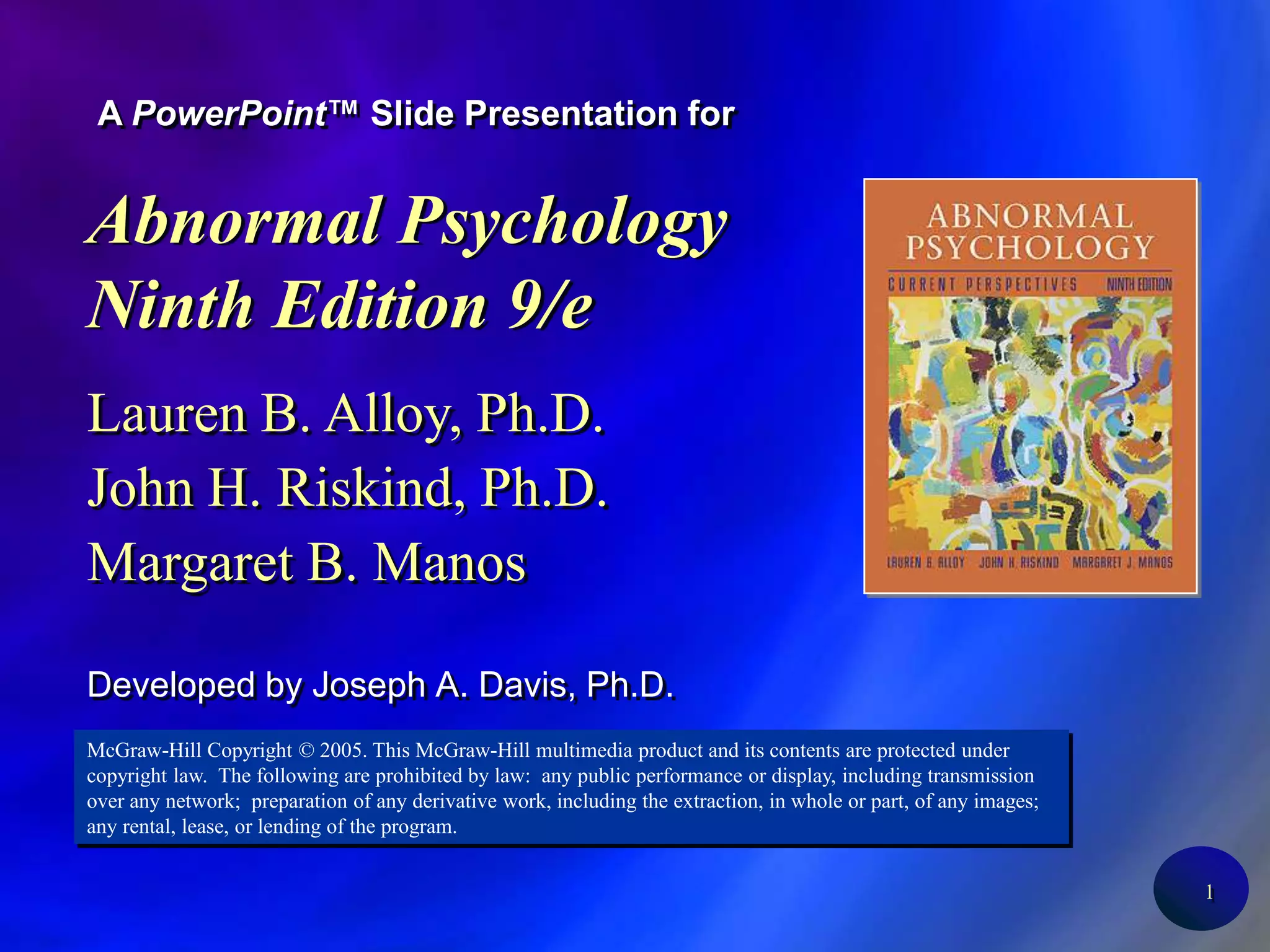
1A PowerPoint™ Slide Presentation forAbnormal Psychology Ninth Edition 9/eLauren B. Alloy, Ph.D.John H. Riskind, Ph.D.Margaret B. ManosDeveloped by Joseph A. Davis, Ph.D.McGraw-Hill Copyright © 2005. This McGraw-Hill multimedia product and its contents are protected under copyright law.  The following are prohibited by law:  any public performance or display, including transmission over any network;  preparation of any derivative work, including the extraction, in whole or part, of any images;  any rental, lease, or lending of the program.
2Chapter 2Diagnosis and Assessment
3Chapter Main PointsDiagnosis and Assessment: The IssuesMethods of AssessmentCultural Bias in Assessment
4Diagnosis and AssessmentPsychological Assessment:The collection, organization, and interpretation of information about a  person and his or her situation
5Why Assessment?Description:The rendering of an accurate portrait of personality, cognitive functioning, mood, and behaviorPrediction:Predict future behavior based on present functioning
6Diagnosis of Mental DisordersDiagnosis:The person’s problem is classified within one of a set of recognized categories of abnormal behavior and is labeled accordingly
7Diagnosis of Mental DisordersThe Classification of Abnormal BehaviorThe Practice of DiagnosisPrognosisCriticisms of Diagnosis
8Diagnosis of Mental DisordersCategorical Classification:Sorting of patients into diagnostic categoriesDimensional Classification:Based on dimensions of pathology
9The DSM-IV SystemSpecific Diagnostic Criteria:Essential featuresAssociated featuresDiagnostic criteriaDifferential diagnosis
10The DSM-IV SystemDSM Five Axes of DiagnosisAxis I - Clinical syndromeAxis II - Personality disordersAxis III - General medical disordersAxis IV - Psychosocial/environmental problemsAxis V - Global assessment of functioning
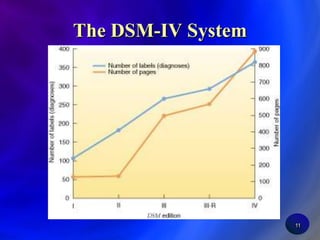
11The DSM-IV System
12The DSM-IV SystemUnspecified Cause:Avoids any suggestion as to the cause of a disorder unless the cause has been definitely established
13ReliabilityReliability:The degree to which findings can stand the test of repeated measurementsCriteria for Reliability:Internal consistencyTest-retest reliabilityInterjudge (interrater) reliability
14ValidityValidity:Extent to which a test measures what it is supposed to measureDescriptive Validity:Degree to which an assessment device provides significant information about the current behavior of the people being assessed
15ValidityPredictive Validity:Degree to which an assessment answers questions about cause, prognosis, and treatment
16Problems in AssessmentProblems in Assessment:Manner in which assessor conducts interviewManner in which assessor interprets the evidencePragmatic considerations that interfere with accurate evaluation
17The InterviewThe Interview:A face-to-face conversation between subject and examinerMental Status Exam (MSE):a very broad examination aimed at turning up any sign of disorder
18Psychological TestsPsychological Test:A standard procedure in which persons are presented with a series of stimuli to which they are asked to respondPsychometric Approach:Psychometrists attempt to locate stable underlying characteristics, or traits, that presumably exist in differing degrees in everyone
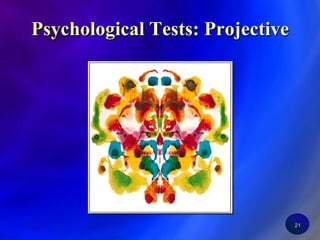
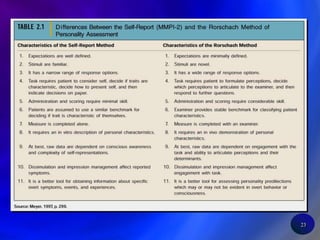
19Psychological TestsIntelligence Testing:Concept of Intelligence Quotient (IQ)WAIS-R, Stanford-Binet, K-ABC, OtherProjective Personality Testing:Rorschach Psychodiagnostic Inkblot TestThematic Apperception Test (TAT)Sentence Completion Test
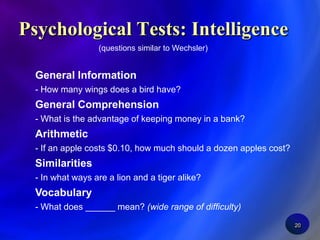
20Psychological Tests: Intelligence(questions similar to Wechsler)General Information- How many wings does a bird have?General Comprehension- What is the advantage of keeping money in a bank?Arithmetic - If an apple costs $0.10, how much should a dozen apples cost?Similarities - In what ways are a lion and a tiger alike?Vocabulary - What does ______ mean? (wide range of difficulty)
21Psychological Tests: Projective
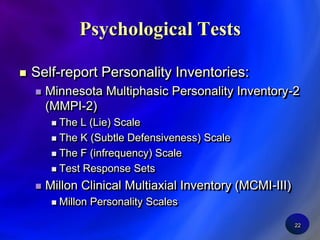
22Psychological TestsSelf-report Personality Inventories:Minnesota Multiphasic Personality Inventory-2 (MMPI-2)The L (Lie) ScaleThe K (Subtle Defensiveness) ScaleThe F (infrequency) ScaleTest Response SetsMillon Clinical Multiaxial Inventory (MCMI-III)Millon Personality Scales
23
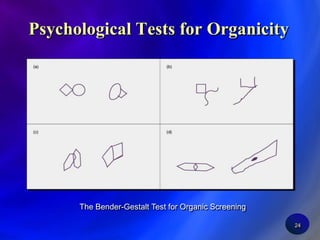
24Psychological Tests for OrganicityThe Bender-Gestalt Test for Organic Screening
25 Laboratory TestsElectroencephalogram (EEG)Polygraph ExaminationGalvanic Skin Response (GSR)Electromyogram (EMG)Polysomnography
26Observation in Natural SettingsSituational Variables:Environmental stimuli that precede and follow any given actionPerson Variables:The person’s stable traits
27Recapping the Main PointsDiagnosis and Assessment: The IssuesMethods of AssessmentCultural Bias in Assessment
28End of Chapter 2Diagnosis and Assessment

PSY285 Chapter 2

  • 1.
    1A PowerPoint™ SlidePresentation forAbnormal Psychology Ninth Edition 9/eLauren B. Alloy, Ph.D.John H. Riskind, Ph.D.Margaret B. ManosDeveloped by Joseph A. Davis, Ph.D.McGraw-Hill Copyright © 2005. This McGraw-Hill multimedia product and its contents are protected under copyright law.  The following are prohibited by law: any public performance or display, including transmission over any network; preparation of any derivative work, including the extraction, in whole or part, of any images; any rental, lease, or lending of the program.
  • 2.
  • 3.
    3Chapter Main PointsDiagnosisand Assessment: The IssuesMethods of AssessmentCultural Bias in Assessment
  • 4.
    4Diagnosis and AssessmentPsychologicalAssessment:The collection, organization, and interpretation of information about a person and his or her situation
  • 5.
    5Why Assessment?Description:The renderingof an accurate portrait of personality, cognitive functioning, mood, and behaviorPrediction:Predict future behavior based on present functioning
  • 6.
    6Diagnosis of MentalDisordersDiagnosis:The person’s problem is classified within one of a set of recognized categories of abnormal behavior and is labeled accordingly
  • 7.
    7Diagnosis of MentalDisordersThe Classification of Abnormal BehaviorThe Practice of DiagnosisPrognosisCriticisms of Diagnosis
  • 8.
    8Diagnosis of MentalDisordersCategorical Classification:Sorting of patients into diagnostic categoriesDimensional Classification:Based on dimensions of pathology
  • 9.
    9The DSM-IV SystemSpecificDiagnostic Criteria:Essential featuresAssociated featuresDiagnostic criteriaDifferential diagnosis
  • 10.
    10The DSM-IV SystemDSMFive Axes of DiagnosisAxis I - Clinical syndromeAxis II - Personality disordersAxis III - General medical disordersAxis IV - Psychosocial/environmental problemsAxis V - Global assessment of functioning
  • 11.
  • 12.
    12The DSM-IV SystemUnspecifiedCause:Avoids any suggestion as to the cause of a disorder unless the cause has been definitely established
  • 13.
    13ReliabilityReliability:The degree towhich findings can stand the test of repeated measurementsCriteria for Reliability:Internal consistencyTest-retest reliabilityInterjudge (interrater) reliability
  • 14.
    14ValidityValidity:Extent to whicha test measures what it is supposed to measureDescriptive Validity:Degree to which an assessment device provides significant information about the current behavior of the people being assessed
  • 15.
    15ValidityPredictive Validity:Degree towhich an assessment answers questions about cause, prognosis, and treatment
  • 16.
    16Problems in AssessmentProblemsin Assessment:Manner in which assessor conducts interviewManner in which assessor interprets the evidencePragmatic considerations that interfere with accurate evaluation
  • 17.
    17The InterviewThe Interview:Aface-to-face conversation between subject and examinerMental Status Exam (MSE):a very broad examination aimed at turning up any sign of disorder
  • 18.
    18Psychological TestsPsychological Test:Astandard procedure in which persons are presented with a series of stimuli to which they are asked to respondPsychometric Approach:Psychometrists attempt to locate stable underlying characteristics, or traits, that presumably exist in differing degrees in everyone
  • 19.
    19Psychological TestsIntelligence Testing:Conceptof Intelligence Quotient (IQ)WAIS-R, Stanford-Binet, K-ABC, OtherProjective Personality Testing:Rorschach Psychodiagnostic Inkblot TestThematic Apperception Test (TAT)Sentence Completion Test
  • 20.
    20Psychological Tests: Intelligence(questionssimilar to Wechsler)General Information- How many wings does a bird have?General Comprehension- What is the advantage of keeping money in a bank?Arithmetic - If an apple costs $0.10, how much should a dozen apples cost?Similarities - In what ways are a lion and a tiger alike?Vocabulary - What does ______ mean? (wide range of difficulty)
  • 21.
  • 22.
    22Psychological TestsSelf-report PersonalityInventories:Minnesota Multiphasic Personality Inventory-2 (MMPI-2)The L (Lie) ScaleThe K (Subtle Defensiveness) ScaleThe F (infrequency) ScaleTest Response SetsMillon Clinical Multiaxial Inventory (MCMI-III)Millon Personality Scales
  • 23.
  • 24.
    24Psychological Tests forOrganicityThe Bender-Gestalt Test for Organic Screening
  • 25.
    25 Laboratory TestsElectroencephalogram(EEG)Polygraph ExaminationGalvanic Skin Response (GSR)Electromyogram (EMG)Polysomnography
  • 26.
    26Observation in NaturalSettingsSituational Variables:Environmental stimuli that precede and follow any given actionPerson Variables:The person’s stable traits
  • 27.
    27Recapping the MainPointsDiagnosis and Assessment: The IssuesMethods of AssessmentCultural Bias in Assessment
  • 28.
    28End of Chapter2Diagnosis and Assessment