Sach Sentence Completion Test
Reported by:
Iris Frani
BSE VE
What is Projective Techniques?
 Based on the phenomenon of projection.
 “Belief is to believe in something that is intangible and
invisible.” (Napoleon Bonaparte )
 Unstructured tests used for personality assessment that
rely on the subject's interpretation of ambiguous stimuli.
 Involve asking subjects to interpret or fill in visual stimuli,
complete sentences, or report what associations particular
words bring to mind.
Theoretical Foundations
 Uncover feelings, beliefs, attitudes and motivation which
many consumers find difficult to articulate.
 Discover the person’s characteristic modes of perceiving
his or her world and how to behave in it
 Enter the private worlds of subjects to uncover their inner
perspectives in a way they feel comfortable with
Practical Approach of Projective
Techniques
 A way of transcending communication barriers.
• Not always share their innermost feelings.
• Unaware of their underlying motives, aspirations,
values and attitudes
• Fear being considered irrational or stupid
• Reluctant to admit to certain types of behavior
• Instead of questioning them directly,
 In talking about a third party or an object, the subjects
project their covert feelings to the third party or object:
 Low literate consumers
 Children, adolescents
 Impulsive/compulsive/addictive buyers
 People in the face of catastrophe
 Gay and lesbian consumers
Advantages
(+) 1. The amount, richness and accuracy of the
information.
2. A view of the overall functioning of individuals.
3. “Breaking the Ice” in a focus-group discussion.
Disadvantages
(-) 1.The complexity of the data and the
corresponding skills
2.Expensive to administer
3.Sampling & Generalization
4.The reliability of measures
BACKGROUND OF THE AUTHOR
Dr. Joseph M. Sacks and other psychologist of the
New York Veterans Administrative Mental
Hygiene Service developed a sentence
completion test designed to obtain significant
clinical material in four representative areas of
adjustment.
Description of the Scale
 The Sacks Sentence Completion test was administered for
self-concept, interpersonal relation and family
environment.
 It provide respondents with beginnings of sentences,
referred to as “stems,” and respondents then complete the
sentences in ways that are meaningful to them.
 It has felt that items included in this test present sufficient
opportunities for the subject to express his attitudes so
that clinical psychologist may infer his
dominant personality traits or trends.
DESCRIPTION OF THE SCALE
It is a sixty (60) item-test, in the following group of
variables:
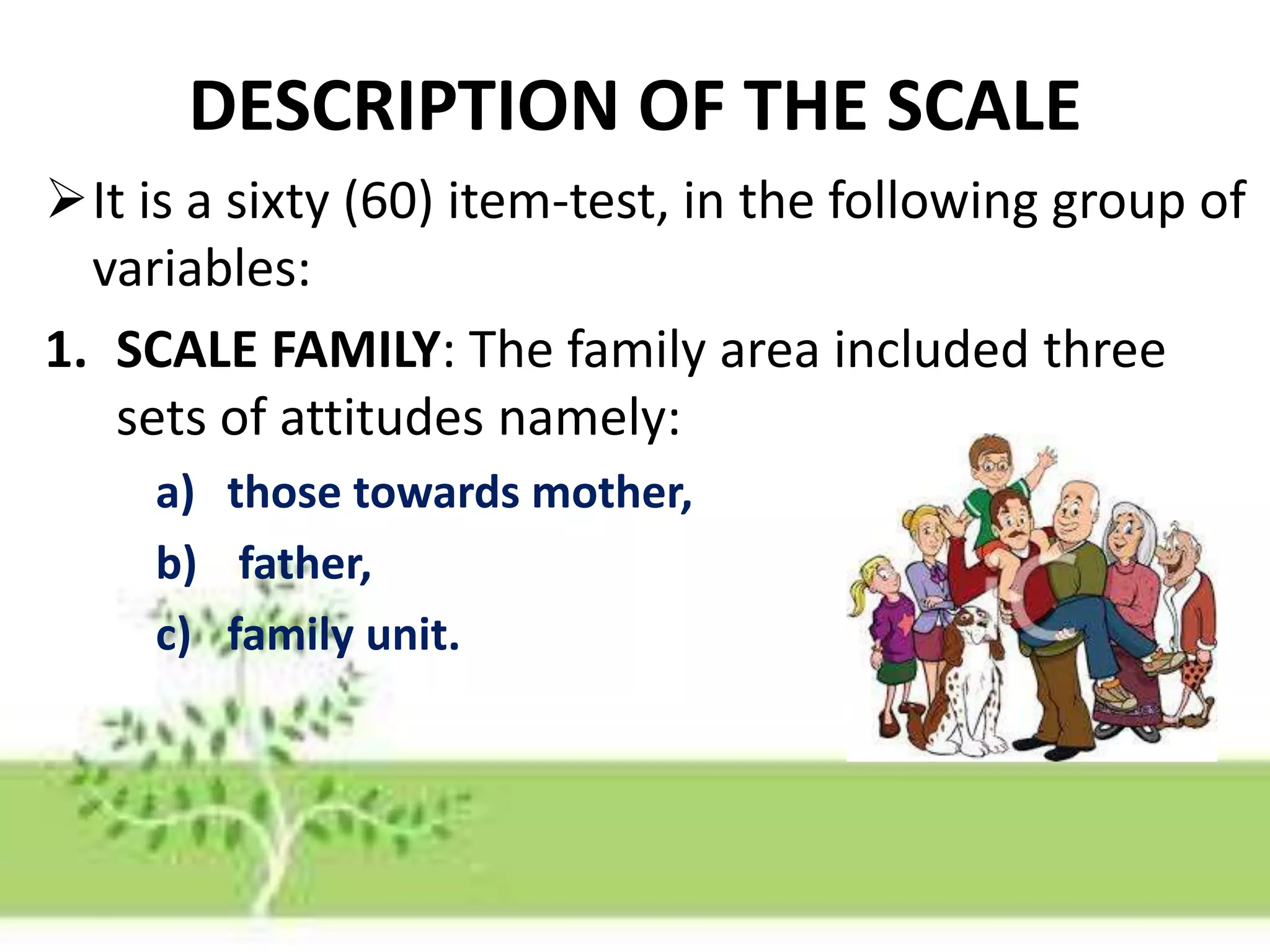
1. SCALE FAMILY: The family area included three
sets of attitudes namely:
a) those towards mother,
b) father,
c) family unit.
DESCRIPTION OF THE SCALE
2. The Sex Area
The sex area includes attitude towards woman
and heterosexual relationship.
DESCRIPTION OF THE SCALE
3. INTERPERSONAL RELATIONSHIP
The area of interpersonal relationship includes
attitudes towards friends and acquaintances,
colleagues at work or school, superior at work or
school, and people supervised.
DESCRIPTION OF THE SCALE
4. SELF-CONCEPT:
The area of self-concept includes fear, guilt
feelings, goals and attitudes towards one’s own
ability, concept of himself as he is, he was and as
he hopes to be.
USAGE OF THE TEST
The uses of sach sentences completion test
include personality analysis, clinical application,
attitude assessment, achievement motivation
and measurement of other constructs. They are
used in several disciplines, including psychology,
management, education, and marketing.
Validity and Reliability
Usually, sentence completion tests can be interpreted
in two different ways:
subjective-intuitive analysis of the underlying motivations
projected in the subject's responses
objective analysis by means of scores assigned to each
completed sentence.
Multiple themes can occur in a short test, which gives
the examinee multiple opportunities to reveal
underlying motivations about each topic during data
analysis.
Validity and Reliability
It usually include some formal coding procedure or
manual. The validity of each sentence completion
test must be determined independently.
The validity of the rating is dependent of course
upon the clinical background of the examiner as
well as the materials produced by the subject.
A rating is made of the subject’s degree of
disturbance in this area according to the following
scale:
2 - SEVERELY DISTURBED Appears to require
the therapeutic aid in handling emotional
conflicts in this area.
1 – MILDLY DISTURBED Has emotional conflict
in this area but appears able to handle them
without therapeutic aid.
0 – No Significant disturbance rated in this area
X – Unknown, Insufficient evidence
• The following are the summaries and ratings of
the individual attitudes and outlines presented
for a general summary of the SSCT findings. This
includes the following:
1. Statement of those areas in which subject
shows the most disturbed attitudes. This may
provide significant clues for therapist.
2. A description of the interrelationships between
attitudes with respect to content. This often
illuminates dynamic factors in the case.
Certain influences on the subject’s personality
structure case be made on the basis of the SSCT,
such as:
1. The subject’s manner of response to impulse
from within or to stimuli from the environment.
2. The subject’s nature of response to stress –
impulsive or well-controlled.
3. The subject’s thinking content: realistic,
artistic, and fantastic.
References:
http://psychology.jrank.org/pages/506/Projective-
Techniques.html#ixzz3gy6afUeW
http://legendarycon.blogspot.com/2010/07/sacks-sentence-completion-test-
nature.html
https://prezi.com/jvkx9avef9bo/sacks-sentence-completion-test/

Sach sentence completion

  • 1.
    Sach Sentence CompletionTest Reported by: Iris Frani BSE VE
  • 2.
    What is ProjectiveTechniques?  Based on the phenomenon of projection.  “Belief is to believe in something that is intangible and invisible.” (Napoleon Bonaparte )  Unstructured tests used for personality assessment that rely on the subject's interpretation of ambiguous stimuli.  Involve asking subjects to interpret or fill in visual stimuli, complete sentences, or report what associations particular words bring to mind.
  • 3.
    Theoretical Foundations  Uncoverfeelings, beliefs, attitudes and motivation which many consumers find difficult to articulate.  Discover the person’s characteristic modes of perceiving his or her world and how to behave in it  Enter the private worlds of subjects to uncover their inner perspectives in a way they feel comfortable with
  • 4.
    Practical Approach ofProjective Techniques  A way of transcending communication barriers. • Not always share their innermost feelings. • Unaware of their underlying motives, aspirations, values and attitudes • Fear being considered irrational or stupid • Reluctant to admit to certain types of behavior
  • 5.
    • Instead ofquestioning them directly,  In talking about a third party or an object, the subjects project their covert feelings to the third party or object:  Low literate consumers  Children, adolescents  Impulsive/compulsive/addictive buyers  People in the face of catastrophe  Gay and lesbian consumers
  • 6.
    Advantages (+) 1. Theamount, richness and accuracy of the information. 2. A view of the overall functioning of individuals. 3. “Breaking the Ice” in a focus-group discussion.
  • 7.
    Disadvantages (-) 1.The complexityof the data and the corresponding skills 2.Expensive to administer 3.Sampling & Generalization 4.The reliability of measures
  • 8.
    BACKGROUND OF THEAUTHOR Dr. Joseph M. Sacks and other psychologist of the New York Veterans Administrative Mental Hygiene Service developed a sentence completion test designed to obtain significant clinical material in four representative areas of adjustment.
  • 9.
    Description of theScale  The Sacks Sentence Completion test was administered for self-concept, interpersonal relation and family environment.  It provide respondents with beginnings of sentences, referred to as “stems,” and respondents then complete the sentences in ways that are meaningful to them.  It has felt that items included in this test present sufficient opportunities for the subject to express his attitudes so that clinical psychologist may infer his dominant personality traits or trends.
  • 10.
    DESCRIPTION OF THESCALE It is a sixty (60) item-test, in the following group of variables: 1. SCALE FAMILY: The family area included three sets of attitudes namely: a) those towards mother, b) father, c) family unit.
  • 11.
    DESCRIPTION OF THESCALE 2. The Sex Area The sex area includes attitude towards woman and heterosexual relationship.
  • 12.
    DESCRIPTION OF THESCALE 3. INTERPERSONAL RELATIONSHIP The area of interpersonal relationship includes attitudes towards friends and acquaintances, colleagues at work or school, superior at work or school, and people supervised.
  • 13.
    DESCRIPTION OF THESCALE 4. SELF-CONCEPT: The area of self-concept includes fear, guilt feelings, goals and attitudes towards one’s own ability, concept of himself as he is, he was and as he hopes to be.
  • 14.
    USAGE OF THETEST The uses of sach sentences completion test include personality analysis, clinical application, attitude assessment, achievement motivation and measurement of other constructs. They are used in several disciplines, including psychology, management, education, and marketing.
  • 15.
    Validity and Reliability Usually,sentence completion tests can be interpreted in two different ways: subjective-intuitive analysis of the underlying motivations projected in the subject's responses objective analysis by means of scores assigned to each completed sentence. Multiple themes can occur in a short test, which gives the examinee multiple opportunities to reveal underlying motivations about each topic during data analysis.
  • 16.
    Validity and Reliability Itusually include some formal coding procedure or manual. The validity of each sentence completion test must be determined independently. The validity of the rating is dependent of course upon the clinical background of the examiner as well as the materials produced by the subject.
  • 17.
    A rating ismade of the subject’s degree of disturbance in this area according to the following scale: 2 - SEVERELY DISTURBED Appears to require the therapeutic aid in handling emotional conflicts in this area. 1 – MILDLY DISTURBED Has emotional conflict in this area but appears able to handle them without therapeutic aid. 0 – No Significant disturbance rated in this area X – Unknown, Insufficient evidence
  • 18.
    • The followingare the summaries and ratings of the individual attitudes and outlines presented for a general summary of the SSCT findings. This includes the following: 1. Statement of those areas in which subject shows the most disturbed attitudes. This may provide significant clues for therapist. 2. A description of the interrelationships between attitudes with respect to content. This often illuminates dynamic factors in the case.
  • 19.
    Certain influences onthe subject’s personality structure case be made on the basis of the SSCT, such as: 1. The subject’s manner of response to impulse from within or to stimuli from the environment. 2. The subject’s nature of response to stress – impulsive or well-controlled. 3. The subject’s thinking content: realistic, artistic, and fantastic.
  • 20.

Editor's Notes

  • #3 What is “projection”?  A defense mechanism with which the ego protects itself from anxiety by externalizing unpleasant feelings or experiential element is a theory in psychology in which humans defend themselves against unpleasant impulses by denying their existence in themselves, while attributing them to others. For example, a person who is rude may constantly accuse other people of being rude. unable to be touched or grasped; not having physical presence. "my companions do not care about cyberspace or anything else so intangible" synonyms:impalpable, untouchable, incorporeal, discarnate, abstract; incapable of being conquered, overcome, or subdued a stimulant in just about any sensorial mode in such a way that it could well be construed in one or more ways. AMBIGUOUS STIMULUS: "Ambiguous stimuli are all about perception." Stimulus ambiguity is an aspect of stimulation and occurs where aspects of a stimulus can be open to interpretation. For example when we view in an ambiguous image our perception may move from one interpretation of the object to the other. But these issues run deeper as theses historical discussions show. Psychology Dictionary: What is AMBIGUOUS STIMULUS? definition of AMBIGUOUS STIMULUS (Psychology Dictionary) 
  • #4 (of a person or a person's words) having or showing the ability to speak fluently and coherently. "an articulate account of their experiences" synonyms:eloquent, fluent, effective, persuasive, lucid, expressive, silver-tongued; More 2. having joints or jointed segments. verb ärˈtikyəˌlāt/ 1. express (an idea or feeling) fluently and coherently. "they were unable to articulate their emotions" synonyms:express, voice, vocalize, put in words, communicate, state; More 2. form a joint.
  • #5 Transcend-be or go beyond the range or limits of (something abstract, typically a conceptual field or division). "this was an issue transcending party politics" synonyms:go beyond, rise above, cut across"an issue that transcended party politics" surpass (a person or an achievement). synonyms:surpass, exceed, beat, cap, tower above, outdo, outclass, outstrip,leave behind, outshine, eclipse, overshadow, throw into the shade,upstage, top Motive-a reason for doing something, especially one that is hidden or not obvious. Aspiration-a hope or ambition of achieving something. Values-the regard that something is held to deserve; the importance, worth, or usefulness of something. Attitudes- settled way of thinking or feeling about someone or something, typically one that is reflected in a person's behavior. "she took a tough attitude toward other people's indulgences" synonyms:view, viewpoint, outlook, perspective, stance, standpoint, position,inclination, temper, orientation, approach, reaction; More a position of the body proper to or implying an action or mental state. Reluctant to admit-Tend to offer answers that are socially acceptable and stereotypical in an interview situation
  • #11 The family environment “involves the circumstances and social climate conditions within families. Since each family is made up of different individuals in a different setting, each family environment is unique. The environments can differ in many ways. For example, one obvious difference lies in the socio-economic level.
  • #13 An interpersonal relationship is a strong, deep, or close association or acquaintance between two or more people that may range in duration from brief to enduring. This association may be based on inference, love, solidarity, regular business interactions, or some other type of social commitment. An interpersonal relationship is a strong, deep, or close association or acquaintance between two or more people that may range in duration from brief to enduring. This association may be based on inference, love, solidarity, regular business interactions, or some other type of social commitment. Interpersonal relationships are formed in the context of social, cultural and other influences. The context can vary from family or kinship relations, friendship, marriage, relations with associates, work, clubs, neighborhoods, and places of worship. They may be regulated by law, custom, or mutual agreement, and are the basis of social groups and societyas a whole. Human beings are innately social and are shaped by their experiences with others. There are multiple perspectives to understand this inherent motivation to interact with others. Need to belong, Social exchange, Relational self
  • #14 Self Concept is an important term for both social psychology and humanism. This is the most basic part of the self-scheme or self-concept; the sense of being separate and distinct from others and the awareness of the constancy of the self” (Bee, 1992). One's self-concept (also called self-construction, self-identity, self-perspective or self-structure) is a collection of beliefs about oneself[1][2] that includes elements such as academic performance,[3][4][5][6][7] gender roles and sexuality,[8][9][10] and racial identity.[11]Generally, self-concept embodies the answer to "Who am I?".[12] One's self-concept is made up of self-schemas, and their past, present, and future selves. Self-concept is distinguishable from self-awareness, which refers to the extent to which self-knowledge is defined, consistent, and currently applicable to one's attitudes and dispositions.[13] Self-concept also differs from self-esteem: self-concept is a cognitive or descriptive component of one's self (e.g. "I am a fast runner"), while self-esteem is evaluative and opinionated (e.g. "I feel good about being a fast runner"). Self-concept is made up of one's self-schemas, and interacts with self-esteem, self-knowledge, and the social self to form the self as whole. It includes the past, present, and future selves, where future selves (or possible selves) represent individuals' ideas of what they might become, what they would like to become, or what they are afraid of becoming. Possible selves may function as incentives for certain behavior.[12][14] The perception people have about their past or future selves is related to the perception of their current selves. The temporal self-appraisal theory[15] argues that people have a tendency to maintain a positive self-evaluation by distancing themselves from their negative self and paying more attention to their positive one. In addition, people have a tendency to perceive the past self less favorably[16] (e.g. "I'm better than I used to be") and the future self more positively[17] (e.g. "I will be better than I am now").