PORTFOLIO
ASSESSMENT:
Meaning, Nature &
Characteristics
Prepared by: Suan, Richel L.
Objectives
At the end of the chapter, the students can:
Describe the nature of portfolio through
its meaning, characteristics, and
purpose.
Differentiate the different types
and elements of portfolio.
Apply the steps in developing
a portfolio assessment
Enumerate the advantages and
disadvantages of portfolio
assessment
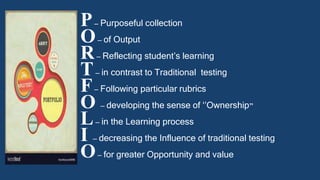
P– Purposeful collection
O– of Output
R– Reflecting student’s learning
T– in contrast to Traditional testing
F– Following particular rubrics
O – developing the sense of ‘’Ownership’’
L– in the Learning process
I – decreasing the Influence of traditional testing
O– for greater Opportunity and value
Student’s creative output
showcasing his/her learning
journey
Evidence of student’s
achievements based on the
desired learning outcome
Compilation of students’
artifacts relative to their
learning experiences
Meaning
COLLECTIONS
Highlight student’s strengths and
weaknesses
• Gives portfolio
life and
meaning.
ARTIFACTS
Written works
Videos
Artwork
Projects
Journals
Etc.
• The highlight in creating
portfolios
• Highlights how students
learn overtime
• Provides opportunities
to actively engage self-
assessment process
REFLECTION
Student’s Portfolio is assembled for the purpose of:
•Evaluating coursework quality,
learning progress, and academic
achievement;
•Determining whether students
have met learning standards or
other academic requirements
for courses, grade level
promotion, graduation;
•Helping students reflect on
their academic goals and
progress as learners; and
•Creating a lasting archive of
academic work products,
accomplishments, and other
documentation.
Hence, portfolio assessment is characterized with
several features listed below”
1. A portfolio is a form of
assessment that students
do together with their
teachers.
2. A portfolio represents
selection of what the
students believe.
3. A portfolio provides samples
of the student’s works which
show growth over time.
4. The criteria for selecting and
assessing the portfolio contents
must be clear to the teacher and
the students at the outset of the
process
Elements
of
PORTFOLIO •Cover letter
•Table of Contents
•Entries
•Dates
•Drafts
•Reflections
Cover Letter •Tells about the author of the
portfolio
•What the portfolio shows
about the author as a learner
•It summarizes the evidence of
the students learning and
progress
Table of Contents
•Detailed contents
in the portfolio
•With numbered
pages
Entries
•Core Entries: items the
students have to
include
•Optional Entries: Entries
of student’s choice
Entries
•Core Elements: provide
common base from which
to make decisions on
assessment
•Optional Elements: permit
each student to represent
his/her uniqueness
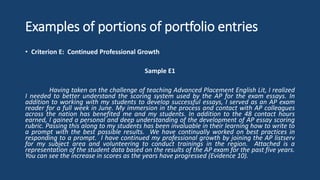
Examples of portions of portfolio entries
• Criterion E: Continued Professional Growth
Sample E1
Having taken on the challenge of teaching Advanced Placement English Lit, I realized
I needed to better understand the scoring system used by the AP for the exam essays. In
addition to working with my students to develop successful essays, I served as an AP exam
reader for a full week in June. My immersion in the process and contact with AP colleagues
across the nation has benefited me and my students. In addition to the 48 contact hours
earned, I gained a personal and deep understanding of the development of AP essay scoring
rubric. Passing this along to my students has been invaluable in their learning how to write to
a prompt with the best possible results. We have continually worked on best practices in
responding to a prompt. I have continued my professional growth by joining the AP listserv
for my subject area and volunteering to conduct trainings in the region. Attached is a
representation of the student data based on the results of the AP exam for the past five years.
You can see the increase in scores as the years have progressed (Evidence 10).
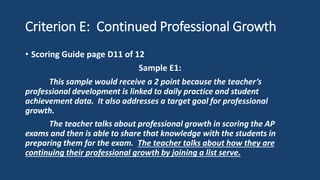
Criterion E: Continued Professional Growth
• Scoring Guide page D11 of 12
Sample E1:
This sample would receive a 2 point because the teacher’s
professional development is linked to daily practice and student
achievement data. It also addresses a target goal for professional
growth.
The teacher talks about professional growth in scoring the AP
exams and then is able to share that knowledge with the students in
preparing them for the exam. The teacher talks about how they are
continuing their professional growth by joining a list serve.
Dates
•Facilitate evidence
of growth overtime
Drafts
•Drafts of aural,
oral, written
products, and
revised versions
have to be
included in the
portfolio
Reflections
•Students can reflect their
feelings regarding their
progress as learners.
•Can appear at different
stages in the learning
process.
Reflections
•Students can choose to reflect
upon:
• What did I learn from it?
• What did I do well
• Why did I choose this item?
• What do I want to improve in the
item?
• How do I feel about my performance?
• What were the problem areas?
PORTFOLIO ASSESSMENT
An assessment form that children do together with their teachers, and
is an alternative to the classic classroom test. The portfolio contains
samples of the children/student work and shows growth over time
Important Keyword/s
•Reflection
•Learning
Objective
Reflection •Students begin to identify
their strengths and
weaknesses of their own.
•Weaknesses becomes
improvement goal
•It is the quality that counts not
the quantity
• Portfolio assessment is
important because it measures
the progress of a student and
examines the instructional
process, not just the final
product.
• Portfolio assessment can
provide multiple levels of
learning evidence and
demonstrate what a student
knows and how he uses this
knowledge
Learning
Objectives
•The contents of portfolios can
include drawing, photos,
videos, etc.
•Data sources can include
parents, staff, communities
who know the topic.
•Achieving systematic process
of collecting and evaluating
student’s products to
documents progress
Learning
Objectives
THEREFORE,
a solid portfolio can truly assess a
student’s development.
THANK YOU
for listening!

Portfolio assessment.pptx,..............

  • 1.
  • 2.
    Objectives At the endof the chapter, the students can: Describe the nature of portfolio through its meaning, characteristics, and purpose. Differentiate the different types and elements of portfolio.
  • 3.
    Apply the stepsin developing a portfolio assessment Enumerate the advantages and disadvantages of portfolio assessment
  • 4.
    P– Purposeful collection O–of Output R– Reflecting student’s learning T– in contrast to Traditional testing F– Following particular rubrics O – developing the sense of ‘’Ownership’’ L– in the Learning process I – decreasing the Influence of traditional testing O– for greater Opportunity and value
  • 5.
    Student’s creative output showcasinghis/her learning journey Evidence of student’s achievements based on the desired learning outcome Compilation of students’ artifacts relative to their learning experiences Meaning
  • 6.
  • 7.
    • Gives portfolio lifeand meaning. ARTIFACTS Written works Videos Artwork Projects Journals Etc.
  • 8.
    • The highlightin creating portfolios • Highlights how students learn overtime • Provides opportunities to actively engage self- assessment process REFLECTION
  • 9.
    Student’s Portfolio isassembled for the purpose of: •Evaluating coursework quality, learning progress, and academic achievement; •Determining whether students have met learning standards or other academic requirements for courses, grade level promotion, graduation;
  • 10.
    •Helping students reflecton their academic goals and progress as learners; and •Creating a lasting archive of academic work products, accomplishments, and other documentation.
  • 11.
    Hence, portfolio assessmentis characterized with several features listed below” 1. A portfolio is a form of assessment that students do together with their teachers. 2. A portfolio represents selection of what the students believe.
  • 12.
    3. A portfolioprovides samples of the student’s works which show growth over time. 4. The criteria for selecting and assessing the portfolio contents must be clear to the teacher and the students at the outset of the process
  • 13.
    Elements of PORTFOLIO •Cover letter •Tableof Contents •Entries •Dates •Drafts •Reflections
  • 14.
    Cover Letter •Tellsabout the author of the portfolio •What the portfolio shows about the author as a learner •It summarizes the evidence of the students learning and progress
  • 15.
    Table of Contents •Detailedcontents in the portfolio •With numbered pages
  • 16.
    Entries •Core Entries: itemsthe students have to include •Optional Entries: Entries of student’s choice
  • 17.
    Entries •Core Elements: provide commonbase from which to make decisions on assessment •Optional Elements: permit each student to represent his/her uniqueness
  • 18.
    Examples of portionsof portfolio entries • Criterion E: Continued Professional Growth Sample E1 Having taken on the challenge of teaching Advanced Placement English Lit, I realized I needed to better understand the scoring system used by the AP for the exam essays. In addition to working with my students to develop successful essays, I served as an AP exam reader for a full week in June. My immersion in the process and contact with AP colleagues across the nation has benefited me and my students. In addition to the 48 contact hours earned, I gained a personal and deep understanding of the development of AP essay scoring rubric. Passing this along to my students has been invaluable in their learning how to write to a prompt with the best possible results. We have continually worked on best practices in responding to a prompt. I have continued my professional growth by joining the AP listserv for my subject area and volunteering to conduct trainings in the region. Attached is a representation of the student data based on the results of the AP exam for the past five years. You can see the increase in scores as the years have progressed (Evidence 10).
  • 19.
    Criterion E: ContinuedProfessional Growth • Scoring Guide page D11 of 12 Sample E1: This sample would receive a 2 point because the teacher’s professional development is linked to daily practice and student achievement data. It also addresses a target goal for professional growth. The teacher talks about professional growth in scoring the AP exams and then is able to share that knowledge with the students in preparing them for the exam. The teacher talks about how they are continuing their professional growth by joining a list serve.
  • 20.
  • 21.
    Drafts •Drafts of aural, oral,written products, and revised versions have to be included in the portfolio
  • 22.
    Reflections •Students can reflecttheir feelings regarding their progress as learners. •Can appear at different stages in the learning process.
  • 23.
    Reflections •Students can chooseto reflect upon: • What did I learn from it? • What did I do well • Why did I choose this item? • What do I want to improve in the item? • How do I feel about my performance? • What were the problem areas?
  • 24.
    PORTFOLIO ASSESSMENT An assessmentform that children do together with their teachers, and is an alternative to the classic classroom test. The portfolio contains samples of the children/student work and shows growth over time
  • 25.
  • 26.
    Reflection •Students beginto identify their strengths and weaknesses of their own. •Weaknesses becomes improvement goal •It is the quality that counts not the quantity
  • 27.
    • Portfolio assessmentis important because it measures the progress of a student and examines the instructional process, not just the final product. • Portfolio assessment can provide multiple levels of learning evidence and demonstrate what a student knows and how he uses this knowledge Learning Objectives
  • 28.
    •The contents ofportfolios can include drawing, photos, videos, etc. •Data sources can include parents, staff, communities who know the topic. •Achieving systematic process of collecting and evaluating student’s products to documents progress Learning Objectives
  • 29.
    THEREFORE, a solid portfoliocan truly assess a student’s development.
  • 31.