The design anduse of portfolio begins with a clear description
of your purpose and focus. The questions, “Why do I
want portfolio? And “What learning targets and curriculum
goals will it serve?” sharpen the focus of identifying the
purpose and focus of portfolio. With these, you can clearly
identify why you want your students to create a portfolio.
1. IDENTIFY OVERALL PURPOSE AND FOCUS
STEPS FOR DEVELOPING PORTFOLIO ASSESSMENT
PORTFOLIOS
• Used toassess understanding but are ideal for assessing
product, skill, and reasoning targets. This is especially true for
multi-dimensional skills such as writing, reading, and problem
solving that are continually improved and demonstrated
through products.
• With extensive self-reflection, critical thinking is an important
target.
• Students develop metacognitive and decision-making skills.
• As with other performance assessments, portfolios generally
are not very efficient for assessing knowledge targets.
(McMillan, 2007)
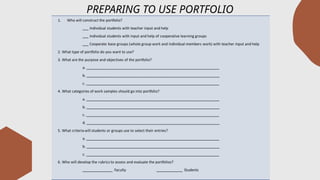
5.
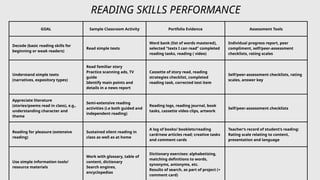
GOAL Sample ClassroomActivity Portfolio Evidence Assessment Tools
Decode (basic reading skills for
beginning or weak readers)
Read simple texts
Word bank (list of words mastered),
selected “texts I can read” completed
reading tasks, reading ( video)
Individual progress report, peer
compliment, self/peer-assessment
checklists, rating scales
Understand simple texts
(narratives, expository types)
Read familiar story
Practice scanning ads, TV
guide
Identify main points and
details in a news report
Cassette of story read, reading
strategies checklist, completed
reading task, corrected test item
Self/peer-assessment checklists, rating
scales, answer key
Appreciate literature
(stories/poems read in class), e.g.,
understanding character and
theme
Semi-extensive reading
activities (i.e both guided and
independent reading)
Reading logs, reading journal, book
tasks, cassette video clips, artwork
Self/peer-assessment checklists
Reading for pleasure (extensive
reading)
Sustained silent reading in
class as well as at home
A log of books/ booklets/reading
card/new articles read; creative tasks
and comment cards
Teacher’s record of student’s reading:
Rating scale relating to content,
presentation and language
Use simple information tools/
resource materials
Work with glossary, table of
content, dictionary
Search engines,
encyclopedias
Dictionary exercises: alphabetizing,
matching definitions to words,
synonyms, antonyms, etc.
Results of search, as part of project (+
comment card)
READING SKILLS PERFORMANCE
6.
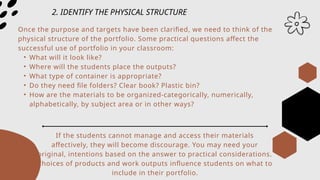
2. IDENTIFY THEPHYSICAL STRUCTURE
Once the purpose and targets have been clarified, we need to think of the
physical structure of the portfolio. Some practical questions affect the
successful use of portfolio in your classroom:
• What will it look like?
• Where will the students place the outputs?
• What type of container is appropriate?
• Do they need file folders? Clear book? Plastic bin?
• How are the materials to be organized-categorically, numerically,
alphabetically, by subject area or in other ways?
If the students cannot manage and access their materials
affectively, they will become discourage. You may need your
original, intentions based on the answer to practical considerations.
Choices of products and work outputs influence students on what to
include in their portfolio.
7.
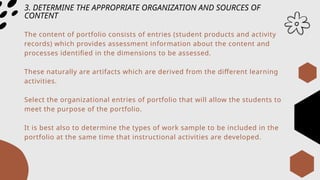
3. DETERMINE THEAPPROPRIATE ORGANIZATION AND SOURCES OF
CONTENT
The content of portfolio consists of entries (student products and activity
records) which provides assessment information about the content and
processes identified in the dimensions to be assessed.
These naturally are artifacts which are derived from the different learning
activities.
Select the organizational entries of portfolio that will allow the students to
meet the purpose of the portfolio.
It is best also to determine the types of work sample to be included in the
portfolio at the same time that instructional activities are developed.
8.
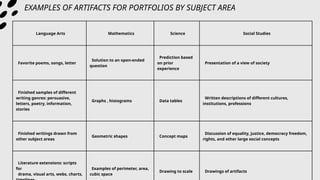
Language Arts MathematicsScience Social Studies
Favorite poems, songs, letter
Solution to an open-ended
question
Prediction based
on prior
experience
Presentation of a view of society
Finished samples of different
writing genres: persuasive,
letters, poetry, information,
stories
Graphs , histograms Data tables
Written descriptions of different cultures,
institutions, professions
Finished writings drawn from
other subject areas
Geometric shapes Concept maps
Discussion of equality, justice, democracy freedom,
rights, and other large social concepts
Literature extensions: scripts
for
drama, visual arts, webs, charts,
Examples of perimeter, area,
cubic space
Drawing to scale Drawings of artifacts
EXAMPLES OF ARTIFACTS FOR PORTFOLIOS BY SUBJECT AREA
9.
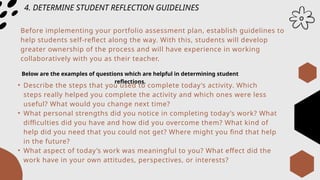
4. DETERMINE STUDENTREFLECTION GUIDELINES
Before implementing your portfolio assessment plan, establish guidelines to
help students self-reflect along the way. With this, students will develop
greater ownership of the process and will have experience in working
collaboratively with you as their teacher.
Below are the examples of questions which are helpful in determining student
reflections.
• Describe the steps that you used to complete today’s activity. Which
steps really helped you complete the activity and which ones were less
useful? What would you change next time?
• What personal strengths did you notice in completing today’s work? What
difficulties did you have and how did you overcome them? What kind of
help did you need that you could not get? Where might you find that help
in the future?
• What aspect of today’s work was meaningful to you? What effect did the
work have in your own attitudes, perspectives, or interests?
10.
5. IDENTIFY ANDEVALUATE SCORING CRITERIA
By working the students criteria, students will develop greater
ownership of the process and will have experience in working
cooperatively with you as a teacher. However, as the facilitator
of learning you are responsible to ensure the reliability and
high quality of scoring criteria. The students should be
informed also on how you will evaluate their portfolios. This can
be sharing the scoring criteria with your students so that they
can ask questions, give their suggestions and insights.
11.
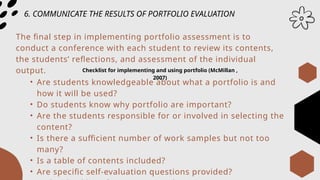
6. COMMUNICATE THERESULTS OF PORTFOLIO EVALUATION
The final step in implementing portfolio assessment is to
conduct a conference with each student to review its contents,
the students’ reflections, and assessment of the individual
output. Checklist for implementing and using portfolio (McMillan ,
2007)
• Are students knowledgeable about what a portfolio is and
how it will be used?
• Do students know why portfolio are important?
• Are the students responsible for or involved in selecting the
content?
• Is there a sufficient number of work samples but not too
many?
• Is a table of contents included?
• Are specific self-evaluation questions provided?


![74676371-Coagulation-and-Flocculation[1].ppt](https://cdn.slidesharecdn.com/ss_thumbnails/74676371-coagulation-and-flocculation1-260116154109-a3cbf55e-thumbnail.jpg?width=640&height=640&fit=bounds)


