How can youth work
collaborate?
- Case Helsinki
Director of Youth Affairs Tommi Laitio
Twitter @tommilaitio
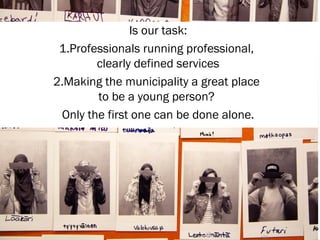
Is our task:
1.Professionals running professional,
clearly defined services
2.Making the municipality a great place
to be a young person?
Only the first one can be done alone.
”Capabilities approach starts with a very simple
question: What are people actually able to be and
do?”
- Philosopher Martha Nussbaum
The moral significance of individuals’ capability of
achieving the kind of lives they have reason to
value.
-Economist Amartya Sen
Joint theoretical framework helps in having a shared goal
with other services. In Helsinki the capabilities approach.
• Good life is active life, using one´s skills for the sake
of one´s community.
• Wellbeing without agency is not sustainable.
• Choice is an end as well as a means to an end.
• Young people´s experience of their capabilities
is reliable information.
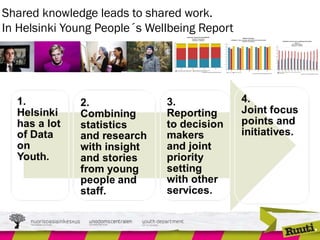
Shared knowledge leads to shared work.
In Helsinki Young People´s Wellbeing Report
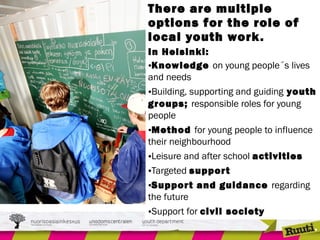
There are multiple
options for the role of
local youth work.
In Helsinki:
•Knowledge on young people´s lives
and needs
•Building, supporting and guiding youth
groups; responsible roles for young
people
•Method for young people to influence
their neighbourhood
•Leisure and after school activities
•Targeted support
•Support and guidance regarding
the future
•Support for civil society
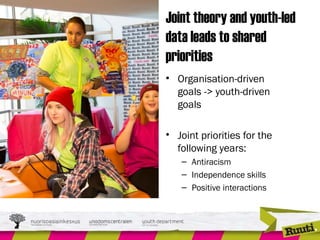
Joint theory and youth-led
data leads to shared
priorities
• Organisation-driven
goals -> youth-driven
goals
• Joint priorities for the
following years:
– Antiracism
– Independence skills
– Positive interactions
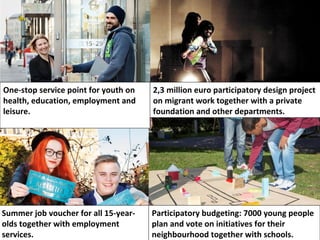
2,3 million euro participatory design project
on migrant work together with a private
foundation and other departments.
Participatory budgeting: 7000 young people
plan and vote on initiatives for their
neighbourhood together with schools.
Summer job voucher for all 15-year-
olds together with employment
services.
One-stop service point for youth on
health, education, employment and
leisure.
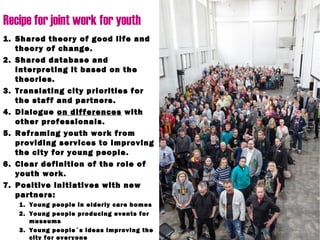
Recipe for joint work for youth
1. Shared theory of good life and
theory of change.
2. Shared database and
interpreting it based on the
theories.
3. Translating city priorities for
the staff and partners.
4. Dialogue on differences with
other professionals.
5. Reframing youth work from
providing services to improving
the city for young people.
6. Clear definition of the role of
youth work.
7. Positive initiatives with new
partners:
1. Young people in elderly care homes
2. Young people producing events for
museums
3. Young people´s ideas improving the
city for everyone
Tommi Laitio
Director of Youth Affairs
City of Helsinki, Youth Department
Hietaniemenkatu 9B
PL 5000, 00099 City of Helsinki
tommi.laitio (a) hel.fi
tommilaitio.munstadi.fi
ruuti.net
twitter: tommilaitio
Tommi Laitio
Director of Youth Affairs
City of Helsinki, Youth Department
Hietaniemenkatu 9B
PL 5000, 00099 City of Helsinki
tommi.laitio (a) hel.fi
tommilaitio.munstadi.fi
ruuti.net
twitter: tommilaitio

How can youth work collaborate?

  • 1.
    How can youthwork collaborate? - Case Helsinki Director of Youth Affairs Tommi Laitio Twitter @tommilaitio
  • 2.
    Is our task: 1.Professionalsrunning professional, clearly defined services 2.Making the municipality a great place to be a young person? Only the first one can be done alone.
  • 3.
    ”Capabilities approach startswith a very simple question: What are people actually able to be and do?” - Philosopher Martha Nussbaum The moral significance of individuals’ capability of achieving the kind of lives they have reason to value. -Economist Amartya Sen Joint theoretical framework helps in having a shared goal with other services. In Helsinki the capabilities approach. • Good life is active life, using one´s skills for the sake of one´s community. • Wellbeing without agency is not sustainable. • Choice is an end as well as a means to an end. • Young people´s experience of their capabilities is reliable information.
  • 4.
    Shared knowledge leadsto shared work. In Helsinki Young People´s Wellbeing Report
  • 5.
    There are multiple optionsfor the role of local youth work. In Helsinki: •Knowledge on young people´s lives and needs •Building, supporting and guiding youth groups; responsible roles for young people •Method for young people to influence their neighbourhood •Leisure and after school activities •Targeted support •Support and guidance regarding the future •Support for civil society
  • 6.
    Joint theory andyouth-led data leads to shared priorities • Organisation-driven goals -> youth-driven goals • Joint priorities for the following years: – Antiracism – Independence skills – Positive interactions
  • 7.
    2,3 million europarticipatory design project on migrant work together with a private foundation and other departments. Participatory budgeting: 7000 young people plan and vote on initiatives for their neighbourhood together with schools. Summer job voucher for all 15-year- olds together with employment services. One-stop service point for youth on health, education, employment and leisure.
  • 8.
    Recipe for jointwork for youth 1. Shared theory of good life and theory of change. 2. Shared database and interpreting it based on the theories. 3. Translating city priorities for the staff and partners. 4. Dialogue on differences with other professionals. 5. Reframing youth work from providing services to improving the city for young people. 6. Clear definition of the role of youth work. 7. Positive initiatives with new partners: 1. Young people in elderly care homes 2. Young people producing events for museums 3. Young people´s ideas improving the city for everyone
  • 9.
    Tommi Laitio Director ofYouth Affairs City of Helsinki, Youth Department Hietaniemenkatu 9B PL 5000, 00099 City of Helsinki tommi.laitio (a) hel.fi tommilaitio.munstadi.fi ruuti.net twitter: tommilaitio
  • 10.
    Tommi Laitio Director ofYouth Affairs City of Helsinki, Youth Department Hietaniemenkatu 9B PL 5000, 00099 City of Helsinki tommi.laitio (a) hel.fi tommilaitio.munstadi.fi ruuti.net twitter: tommilaitio