Introduction to Assertive Skill
S. LAKSHMANAN, M.Phil(Psy), M.A.(Psy), PGDBA., DCL.,
Psychologist (Govt. Registered)
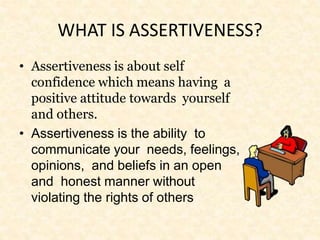
WHAT IS ASSERTIVENESS?
• Assertiveness is about self
confidence which means having a
positive attitude towards yourself
and others.
• Assertiveness is the ability to
communicate your needs, feelings,
opinions, and beliefs in an open
and honest manner without
violating the rights of others
Dictionary Definitions
• The dictionary definitions of “assertiveness”
have a range of descriptions that don’t quite
capture the essence of Assertiveness. You’ll
read “dogmatic”, “forthright”, “positive”,
“confident” and “insistent”. Don’t be fooled.
These are only starting points. Assertiveness is
much more than any of these.
Origins
• One clue to the meaning of Assertiveness lies
in its origins. Assertiveness came to most
people’s awareness in the late 20th century in
connection with movements such as Civil
Rights in America, the women’s movement,
and the self-development movement. These
were all non-forceful movements and they
were all successful in changing the rights of
under-privileged groups.
The Origins of Assertiveness
• Assertiveness is your birth right. It is the kind of
person you were born to be. If you think about
yourself as a new-born baby, you’ll know that
your instinctive way of relating to the world
around you was one of love, openness and
honesty. That’s why others were loving, open
and honest in return. However, things didn’t stay
this way for long. As soon as your thinking brain
kicked in, those around you started to fear for
you.
The Origins of Assertiveness
• They saw dangers that you didn’t see and they,
naturally, wanted to protect you. That’s when
they started to teach you the strategies that they
believed would keep you safe throughout your
life. In this way, they trained you to behave in
ways that were non-assertive. But your
Assertiveness didn’t disappear. It simply went
underground waiting for the day when you could
re-claim it as your birthright.
The Assertive Child
If you look at a baby, you’ll see all you ever need to know about how assertive
you can be. A baby is unconditionally trusting; expresses its needs freely;
and is endlessly curious and joyful about the world. A baby lives totally in
the present and is free from a self-centred ego. A baby knows no fears; it
knows only love.
As babies,...
• we are able to express our needs freely
• we trust others unconditionally
• we are innocently allowed to be ourselves
• we are wide-eyed and endlessly curious about our world
• we have fun, laughter and play
• we are instinctively creative
• we can express our feelings out loud whether joy or sadness
• we live totally in the present
• we have a potential for growth.
The Protective Parent
• In the early years of our lives, our thinking brains are
undeveloped. We function from the instinctive brain that
doesn’t analyse, interpret, or stress. However, around the
age of 2 or 3, our thinking brains start to assert their power
over our lives, egged on by all those around us who have
our best interests at heart.
• We start to learn patterns of behaviour that are designed to
protect us from a world that we are repeatedly told is
hostile. Our freedom is restricted by do’s and don’ts. Our
playfulness in the present is replaced by punishment for
wrong-doing. Honest communication about our needs and
wants is replaced by a raft of non-honest communication to
get what we want. In the process, we learn that blame and
shame are the ways that the world works.
The Protective Parent
• It is natural for the parent to believe that he (or she)
knows best. After all, he has more experience of life
than the child, he “knows” more than the child and he
has a more developed, if not necessarily better,
thinking brain than the child. As a result, the parent
rejects much of what has hitherto made the child the
complete and perfect being it was. Out goes
satisfaction of every need and in comes negotiation
over the meeting of needs. Out goes free and honest
communication and in comes guarded and
manipulative communication. Out goes unconditional
love and in comes love on other peoples’ terms.
Our Early Years’ Programming
• As a result of these early years’ training, we develop a
range of life strategies that we believe are necessary to
survive in a hostile world.
The Blame Programme
In a hostile world, the name of the game is to work out how to
survive while keeping the love of those around us. One of
the ways we do this is the Blame Game. When we do
something that risks losing the love of those around us, we
seek to get this love back either by blaming others or
blaming ourselves. In one fell swoop, we learn to be
aggressive or submissive. In time, we work out which of
these two strategies works best and, from then on, use it
whenever we can.
The False Self Programme
When we lose the true self of babyhood, we create a new self, based on survival. We
learn that “might is right” and that avoiding punishment is better than being found
out. Our thinking brains take over our lives, creating an ego that has a field day
working out just what it needs to do to come out on top. This thinking brain
creates a false self which, some people believe, is the root cause of much of our
unhappiness throughout our lives.
Some of the beliefs of the False Self programme are...
• 1. forgiveness is weakness
• 2. you change others by criticising them
• 3. your anger shows you’re right and others are wrong
• 4. revenge helps you to establish justice
• 5. it is weakness to ever let yourself be vulnerable
• 6. judging others proves what a good character you are
• 7. you protect yourself by attacking people and/or withdrawing love in order to
control them through fear, guilt and shame
• 8. manipulating and deceiving others can help you to become successful.
The Personality Type Programme
• By the time our early years are at an end, we will have
developed a predominant personality type that reflects
the world view that we have been taught. In the
personality typology known as the Enneagram (from
the Greek words ἐννέα [ennéa, meaning "nine"] ,
these personality types split into 9 types and are the
ways we predominantly react to life situations, in
particular, stress and danger. These types include the
winner, the perfectionist, the peacemaker, the rebel,
the self-doubter, and the observer. These personalities
define who we are and how we behave in all situations
with others.
The Assertive Journey
• Writer Beverley Hare describes Assertiveness
in terms of a journey. Her own personal
journey to assertiveness took her from low
self-esteem to high self-esteem; from
dependence to interdependence; from
believing she was unattractive to knowing she
was attractive. Her journey to assertiveness
was a life-changing and life-enhancing
experience. This was her journey...
The Assertive Journey
• from low self-esteem to improved self-esteem
• from little confidence to improved confidence
• from believing she was unintelligent to believing she was
intelligent
• from believing she was unattractive to believing she was attractive
• from dependence to independence
• from feeling passive to feeling active
• from predominantly non-assertive to predominantly assertive
behaviour
• from obsessive dependent relationships to interdependent
relationships
• from being sensitive to criticism to handling criticism well
Your Self-Esteem
• A high level of self-esteem has now become an
essential requirement of modern business life.
Unlike the past models of business life, where
people at work were required to know their place
and look up to those above and down on those
below, today’s businesses require co-operation,
equality, and respect for diversity. One of the
skills that takes you there is self-esteem, the
appreciation of your own worth and importance.
And Assertiveness is one of the daily habits that
will produce self-esteem.
The Confidence Lane
• Assertiveness, self-esteem and confidence are inextricably linked.
• For example, when you know that you have a right to be in your place in
the world, to occupy the space you are in, and the right to express what
you want, you are both thinking and behaving assertively and
confidently.
• Imagine a 3-lane highway, labelled respectively “Weakness”,
“Confidence”, and “Dominance”. When you drive along the inside lane
of letting others walk all over you, you know you’re in the slow lane of
Weakness and it’s time to step up into a better lane. When you find
yourself driving along the outside lane of overtaking everyone else with
your power, you know you’re in the high-speed lane of Dominance and
it’s time to step down. Use your dashboard gauge of awareness and
feedback to stay in the middle lane of Confidence and your journey will
be successful for both you and others.
The Three Modes
• The classic way to define Assertiveness is to contrast it
with its two “side-kicks”, aggression and
submissiveness. Aggression is easily defined as a way
of behaving that denies other people’s rights.
Submissiveness is equally easily defined as a way of
behaving that denies us our own rights. That leaves
Assertiveness as the “third way of behaving” that
simultaneously acknowledges our own rights and those
of others.
• A.J.Lange and P.Jakubowski, in their book “Responsible
Assertive Behaviour” provide a definition of
Assertiveness in which it is compared to aggression and
non-assertion.
The Three Modes
• 1. Non-assertion is violating one’s own rights by failing
to express honest feelings, thoughts and beliefs and
consequently allowing others to violate oneself.
• 2. Aggression is directly standing up for personal rights
and expressing thoughts, feelings and beliefs in a way
which is often dishonest, usually inappropriate and
always violates the rights of the other person.
• 3. Assertiveness is standing up for personal rights and
expressing thoughts, feelings and beliefs in direct,
honest and appropriate ways which do not violate
another person’s rights.
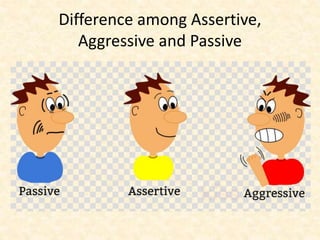
Aggressive Behaviour
Aggressive behaviour means...
• getting your own way, no matter what
• winning at all costs
• being loud, abusive, controlling, manipulative, intimidating,
violent, sarcastic
• using put-downs of others
• using any trick or game to show others are weaker than you.
While in many parts of our society the aggressive type is
admired for their strength, the aggressive person is
basically a coward at heart. Their behaviour towards others
is likely to create a resentment-revenge cycle which will re-
bound on them one day.
Non-Assertion
Non-assertive or passive behaviour means...
• keeping quiet for fear of upsetting others
• avoiding conflict at any cost
• putting others’ needs ahead of your own
• being vague about your own needs
• excessive apologising
• pretending to be indecisive as a way of taking a different stand
• bottling things up.
The person who relies on passive behaviour does so in the hope that
they will be safe and protected by others. There is every likelihood
that others will despise their weakness and soon come to lose
respect for them. The passive person may become bitter in later life
for lost opportunities.
Assertive Behaviour
Assertive behaviour means...
• being open, honest and vulnerable
• standing up for yourself
• refusing to be frightened
• finding win-win solutions to conflict
• being equal with others while retaining your uniqueness
• listening to others
• showing understanding.
While on the surface an assertive lifestyle seems to carry with
it many dangers - the possibility that others will knock you
down in flames for being so open and honest - it is the only
route to personal respect and respect for others.
Outcomes
• One of the touchstones of Assertiveness is
that it is a way of being that is without fear.
When you operate from predominantly
aggressive and submissive standpoints, you
are really operating from standpoints of fear:
the fear of others that makes you want to
dominate them or submit to them.
Assertiveness, on the other hand, is honest,
calm, and trusting. It does not come from a
place of fear, but of trust and respect.
Benefits
• The reason why Assertiveness matters is that
it is the key that unlocks success in so many
areas of our lives. In the workplace, it
underlies so many of the skills we use in
relating to others, such as communication,
negotiating, and leadership. In personal
relationships, it is the best way to solve
problems and manoeuvre our way out of
conflict. In ourselves, it is the way to feel good
about our lives.
Benefits
• One of the key benefits of Assertiveness is that it helps you eliminate
the fear and stress which still today are present in many of our life and
work relationships, be they demanding bosses, angry customers, or
unhelpful colleagues. Fear and stress-based relationships create
different forms of flight-fight reactions in us. These can take the form
of avoiding people, giving in to them, battling them, bullying them, or
manipulating them. All these routes lead to unease, disease, and
ultimate exhaustion. With Assertiveness skills, you learn that fear
doesn’t have to exist in any relationship you choose to have, whatever
the other person wants. Assertiveness gives you back personal control
that allows you to act rather than react and to see everyone else the
way you see yourself. With love and respect.
• Assertiveness is a prime social skill. It may not be as quick at resolving
issues as forceful dominance or quiet submission. But it is the route to
the most healthy and satisfactory of human behaviours.
Aspects of Assertiveness
• Assertiveness has many facets. It is a way of
behaving. It is a way of thinking. It is also a
way of resolving conflict. These different
facets are like the faces of a diamond; they
reflect different views of the same thing. Here
are the main facets of the Assertiveness
diamond.
Winning and Losing
• In every situation in which we have to work with others, it is
primarily our thoughts and perceptions that influence our
behaviour. These can centre around positive and winning
interpretations of life or negative and losing ones. Winning and
losing options seem to be at the very heart of the way we run our
societies. Our legal, judicial, political and governmental systems
are strongly adversarial. They are about either-or choices. “If you
are not for me, you must be against me.” Because of this, many
people develop conditional winning perceptions of life, ie for me
to win, others must lose. These result in aggressive, competitive
and manipulative strategies. Others develop losing perceptions of
life, ie I’m not as good, clever, strong or popular as he is, therefore
he is better than me. These result in non-assertive strategies.
Assertive Rights
• Assertive rights are one of the trademarks of the
assertive movement. These are not legal rights
but basic human rights. They are not written
down but stem from any situation you find
yourself in. They include: the right to say No to
things you don’t want to do; the right to be heard
with respect; the right to stay quiet; the right to
change your mind; the right to make mistakes.
The unassertive person dares not have these
rights. The aggressive person demands them for
themselves but not for others.
Difference among Assertive,
Aggressive and Passive
Acting Assertively
• If Assertiveness doesn’t come easily to you, you
can act your way into it. First, think win-win
whatever situation you’re in. Then, when you
are engaged in exchanges with others, relax. Be
fluid, real and honest. Ground yourself in the
present. Free yourself from fear. Every time you
slip into one of the other modes of aggression
or submissiveness, simply move yourself back
into the open mannerisms of Assertiveness.
Acting Assertively
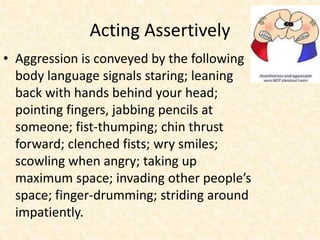
• Aggression is conveyed by the following
body language signals staring; leaning
back with hands behind your head;
pointing fingers, jabbing pencils at
someone; fist-thumping; chin thrust
forward; clenched fists; wry smiles;
scowling when angry; taking up
maximum space; invading other people’s
space; finger-drumming; striding around
impatiently.
Acting Assertively
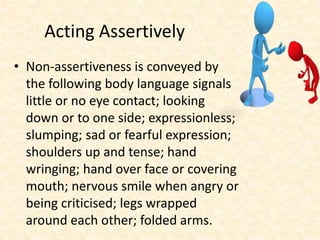
• Non-assertiveness is conveyed by
the following body language signals
little or no eye contact; looking
down or to one side; expressionless;
slumping; sad or fearful expression;
shoulders up and tense; hand
wringing; hand over face or covering
mouth; nervous smile when angry or
being criticised; legs wrapped
around each other; folded arms.
Acting Assertively
• Assertive behaviour is conveyed by the
following body language signals steady eye
contact without staring; smiling when pleased,
frowning when angry, otherwise open;
spontaneous and fluid; open hands; relaxed
posture; low level of unnecessary gestures;
facial expression reflects feeling being
expressed; sitting and standing upright; taking
up the appropriate amount of space.
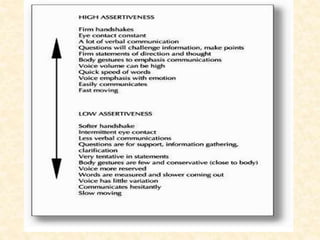
Modes of body Language
Speaking Assertively
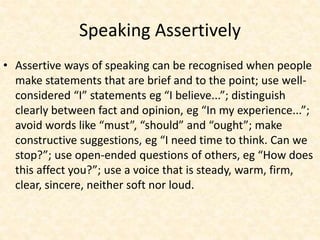
• Assertive ways of speaking can be recognised when people
make statements that are brief and to the point; use well-
considered “I” statements eg “I believe...”; distinguish
clearly between fact and opinion, eg “In my experience...”;
avoid words like “must”, “should” and “ought”; make
constructive suggestions, eg “I need time to think. Can we
stop?”; use open-ended questions of others, eg “How does
this affect you?”; use a voice that is steady, warm, firm,
clear, sincere, neither soft nor loud.
Speaking Assertively
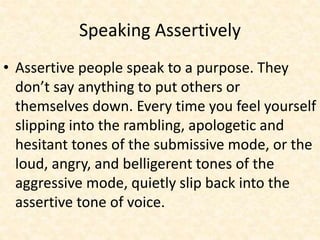
• Assertive people speak to a purpose. They
don’t say anything to put others or
themselves down. Every time you feel yourself
slipping into the rambling, apologetic and
hesitant tones of the submissive mode, or the
loud, angry, and belligerent tones of the
aggressive mode, quietly slip back into the
assertive tone of voice.
Problem-Solving
• Tuning in to our assertive rights allows us to
handle difficult situations with assertiveness.
Let’s say you live next door to someone who
regularly plays loud music late at night. Your
rights to a quiet night’s sleep are infringed.
• You might do nothing and the situation goes
unresolved. You might get angry and call the
police but your neighbour then gets angry and
plots revenge. The assertive route sees you
calling on your neighbour and trying to work out
a win-win solution to the problem.
Natural Assertion
• Although assertiveness lacks the heated
emotion of the angry aggressive or the
trembling fear of the timid submissive, it is not
empty of feeling. You can be assertive by
letting others know your feelings, for example,
in spontaneous outbursts of positive
enjoyment. “Great meeting!” “Well done!”
“That was an excellent report!”
To conclude: What happens when
you behave assertively?
• You feel more comfortable with yourself
• Your self-esteem improves
• You become more valued and respected
• Your technical & professional abilities are
highlighted by excellent interpersonal skills
Last note
• In most situations we have the choice to be
passive, assertive, or aggressive.
Being assertive is often the best choice.
Thanks for
your time

128. Assertive skill

  • 1.
    Introduction to AssertiveSkill S. LAKSHMANAN, M.Phil(Psy), M.A.(Psy), PGDBA., DCL., Psychologist (Govt. Registered)
  • 2.
    WHAT IS ASSERTIVENESS? •Assertiveness is about self confidence which means having a positive attitude towards yourself and others. • Assertiveness is the ability to communicate your needs, feelings, opinions, and beliefs in an open and honest manner without violating the rights of others
  • 3.
    Dictionary Definitions • Thedictionary definitions of “assertiveness” have a range of descriptions that don’t quite capture the essence of Assertiveness. You’ll read “dogmatic”, “forthright”, “positive”, “confident” and “insistent”. Don’t be fooled. These are only starting points. Assertiveness is much more than any of these.
  • 4.
    Origins • One clueto the meaning of Assertiveness lies in its origins. Assertiveness came to most people’s awareness in the late 20th century in connection with movements such as Civil Rights in America, the women’s movement, and the self-development movement. These were all non-forceful movements and they were all successful in changing the rights of under-privileged groups.
  • 5.
    The Origins ofAssertiveness • Assertiveness is your birth right. It is the kind of person you were born to be. If you think about yourself as a new-born baby, you’ll know that your instinctive way of relating to the world around you was one of love, openness and honesty. That’s why others were loving, open and honest in return. However, things didn’t stay this way for long. As soon as your thinking brain kicked in, those around you started to fear for you.
  • 6.
    The Origins ofAssertiveness • They saw dangers that you didn’t see and they, naturally, wanted to protect you. That’s when they started to teach you the strategies that they believed would keep you safe throughout your life. In this way, they trained you to behave in ways that were non-assertive. But your Assertiveness didn’t disappear. It simply went underground waiting for the day when you could re-claim it as your birthright.
  • 7.
    The Assertive Child Ifyou look at a baby, you’ll see all you ever need to know about how assertive you can be. A baby is unconditionally trusting; expresses its needs freely; and is endlessly curious and joyful about the world. A baby lives totally in the present and is free from a self-centred ego. A baby knows no fears; it knows only love. As babies,... • we are able to express our needs freely • we trust others unconditionally • we are innocently allowed to be ourselves • we are wide-eyed and endlessly curious about our world • we have fun, laughter and play • we are instinctively creative • we can express our feelings out loud whether joy or sadness • we live totally in the present • we have a potential for growth.
  • 8.
    The Protective Parent •In the early years of our lives, our thinking brains are undeveloped. We function from the instinctive brain that doesn’t analyse, interpret, or stress. However, around the age of 2 or 3, our thinking brains start to assert their power over our lives, egged on by all those around us who have our best interests at heart. • We start to learn patterns of behaviour that are designed to protect us from a world that we are repeatedly told is hostile. Our freedom is restricted by do’s and don’ts. Our playfulness in the present is replaced by punishment for wrong-doing. Honest communication about our needs and wants is replaced by a raft of non-honest communication to get what we want. In the process, we learn that blame and shame are the ways that the world works.
  • 9.
    The Protective Parent •It is natural for the parent to believe that he (or she) knows best. After all, he has more experience of life than the child, he “knows” more than the child and he has a more developed, if not necessarily better, thinking brain than the child. As a result, the parent rejects much of what has hitherto made the child the complete and perfect being it was. Out goes satisfaction of every need and in comes negotiation over the meeting of needs. Out goes free and honest communication and in comes guarded and manipulative communication. Out goes unconditional love and in comes love on other peoples’ terms.
  • 10.
    Our Early Years’Programming • As a result of these early years’ training, we develop a range of life strategies that we believe are necessary to survive in a hostile world. The Blame Programme In a hostile world, the name of the game is to work out how to survive while keeping the love of those around us. One of the ways we do this is the Blame Game. When we do something that risks losing the love of those around us, we seek to get this love back either by blaming others or blaming ourselves. In one fell swoop, we learn to be aggressive or submissive. In time, we work out which of these two strategies works best and, from then on, use it whenever we can.
  • 11.
    The False SelfProgramme When we lose the true self of babyhood, we create a new self, based on survival. We learn that “might is right” and that avoiding punishment is better than being found out. Our thinking brains take over our lives, creating an ego that has a field day working out just what it needs to do to come out on top. This thinking brain creates a false self which, some people believe, is the root cause of much of our unhappiness throughout our lives. Some of the beliefs of the False Self programme are... • 1. forgiveness is weakness • 2. you change others by criticising them • 3. your anger shows you’re right and others are wrong • 4. revenge helps you to establish justice • 5. it is weakness to ever let yourself be vulnerable • 6. judging others proves what a good character you are • 7. you protect yourself by attacking people and/or withdrawing love in order to control them through fear, guilt and shame • 8. manipulating and deceiving others can help you to become successful.
  • 12.
    The Personality TypeProgramme • By the time our early years are at an end, we will have developed a predominant personality type that reflects the world view that we have been taught. In the personality typology known as the Enneagram (from the Greek words ἐννέα [ennéa, meaning "nine"] , these personality types split into 9 types and are the ways we predominantly react to life situations, in particular, stress and danger. These types include the winner, the perfectionist, the peacemaker, the rebel, the self-doubter, and the observer. These personalities define who we are and how we behave in all situations with others.
  • 13.
    The Assertive Journey •Writer Beverley Hare describes Assertiveness in terms of a journey. Her own personal journey to assertiveness took her from low self-esteem to high self-esteem; from dependence to interdependence; from believing she was unattractive to knowing she was attractive. Her journey to assertiveness was a life-changing and life-enhancing experience. This was her journey...
  • 14.
    The Assertive Journey •from low self-esteem to improved self-esteem • from little confidence to improved confidence • from believing she was unintelligent to believing she was intelligent • from believing she was unattractive to believing she was attractive • from dependence to independence • from feeling passive to feeling active • from predominantly non-assertive to predominantly assertive behaviour • from obsessive dependent relationships to interdependent relationships • from being sensitive to criticism to handling criticism well
  • 15.
    Your Self-Esteem • Ahigh level of self-esteem has now become an essential requirement of modern business life. Unlike the past models of business life, where people at work were required to know their place and look up to those above and down on those below, today’s businesses require co-operation, equality, and respect for diversity. One of the skills that takes you there is self-esteem, the appreciation of your own worth and importance. And Assertiveness is one of the daily habits that will produce self-esteem.
  • 16.
    The Confidence Lane •Assertiveness, self-esteem and confidence are inextricably linked. • For example, when you know that you have a right to be in your place in the world, to occupy the space you are in, and the right to express what you want, you are both thinking and behaving assertively and confidently. • Imagine a 3-lane highway, labelled respectively “Weakness”, “Confidence”, and “Dominance”. When you drive along the inside lane of letting others walk all over you, you know you’re in the slow lane of Weakness and it’s time to step up into a better lane. When you find yourself driving along the outside lane of overtaking everyone else with your power, you know you’re in the high-speed lane of Dominance and it’s time to step down. Use your dashboard gauge of awareness and feedback to stay in the middle lane of Confidence and your journey will be successful for both you and others.
  • 17.
    The Three Modes •The classic way to define Assertiveness is to contrast it with its two “side-kicks”, aggression and submissiveness. Aggression is easily defined as a way of behaving that denies other people’s rights. Submissiveness is equally easily defined as a way of behaving that denies us our own rights. That leaves Assertiveness as the “third way of behaving” that simultaneously acknowledges our own rights and those of others. • A.J.Lange and P.Jakubowski, in their book “Responsible Assertive Behaviour” provide a definition of Assertiveness in which it is compared to aggression and non-assertion.
  • 18.
    The Three Modes •1. Non-assertion is violating one’s own rights by failing to express honest feelings, thoughts and beliefs and consequently allowing others to violate oneself. • 2. Aggression is directly standing up for personal rights and expressing thoughts, feelings and beliefs in a way which is often dishonest, usually inappropriate and always violates the rights of the other person. • 3. Assertiveness is standing up for personal rights and expressing thoughts, feelings and beliefs in direct, honest and appropriate ways which do not violate another person’s rights.
  • 19.
    Aggressive Behaviour Aggressive behaviourmeans... • getting your own way, no matter what • winning at all costs • being loud, abusive, controlling, manipulative, intimidating, violent, sarcastic • using put-downs of others • using any trick or game to show others are weaker than you. While in many parts of our society the aggressive type is admired for their strength, the aggressive person is basically a coward at heart. Their behaviour towards others is likely to create a resentment-revenge cycle which will re- bound on them one day.
  • 20.
    Non-Assertion Non-assertive or passivebehaviour means... • keeping quiet for fear of upsetting others • avoiding conflict at any cost • putting others’ needs ahead of your own • being vague about your own needs • excessive apologising • pretending to be indecisive as a way of taking a different stand • bottling things up. The person who relies on passive behaviour does so in the hope that they will be safe and protected by others. There is every likelihood that others will despise their weakness and soon come to lose respect for them. The passive person may become bitter in later life for lost opportunities.
  • 21.
    Assertive Behaviour Assertive behaviourmeans... • being open, honest and vulnerable • standing up for yourself • refusing to be frightened • finding win-win solutions to conflict • being equal with others while retaining your uniqueness • listening to others • showing understanding. While on the surface an assertive lifestyle seems to carry with it many dangers - the possibility that others will knock you down in flames for being so open and honest - it is the only route to personal respect and respect for others.
  • 22.
    Outcomes • One ofthe touchstones of Assertiveness is that it is a way of being that is without fear. When you operate from predominantly aggressive and submissive standpoints, you are really operating from standpoints of fear: the fear of others that makes you want to dominate them or submit to them. Assertiveness, on the other hand, is honest, calm, and trusting. It does not come from a place of fear, but of trust and respect.
  • 23.
    Benefits • The reasonwhy Assertiveness matters is that it is the key that unlocks success in so many areas of our lives. In the workplace, it underlies so many of the skills we use in relating to others, such as communication, negotiating, and leadership. In personal relationships, it is the best way to solve problems and manoeuvre our way out of conflict. In ourselves, it is the way to feel good about our lives.
  • 24.
    Benefits • One ofthe key benefits of Assertiveness is that it helps you eliminate the fear and stress which still today are present in many of our life and work relationships, be they demanding bosses, angry customers, or unhelpful colleagues. Fear and stress-based relationships create different forms of flight-fight reactions in us. These can take the form of avoiding people, giving in to them, battling them, bullying them, or manipulating them. All these routes lead to unease, disease, and ultimate exhaustion. With Assertiveness skills, you learn that fear doesn’t have to exist in any relationship you choose to have, whatever the other person wants. Assertiveness gives you back personal control that allows you to act rather than react and to see everyone else the way you see yourself. With love and respect. • Assertiveness is a prime social skill. It may not be as quick at resolving issues as forceful dominance or quiet submission. But it is the route to the most healthy and satisfactory of human behaviours.
  • 25.
    Aspects of Assertiveness •Assertiveness has many facets. It is a way of behaving. It is a way of thinking. It is also a way of resolving conflict. These different facets are like the faces of a diamond; they reflect different views of the same thing. Here are the main facets of the Assertiveness diamond.
  • 26.
    Winning and Losing •In every situation in which we have to work with others, it is primarily our thoughts and perceptions that influence our behaviour. These can centre around positive and winning interpretations of life or negative and losing ones. Winning and losing options seem to be at the very heart of the way we run our societies. Our legal, judicial, political and governmental systems are strongly adversarial. They are about either-or choices. “If you are not for me, you must be against me.” Because of this, many people develop conditional winning perceptions of life, ie for me to win, others must lose. These result in aggressive, competitive and manipulative strategies. Others develop losing perceptions of life, ie I’m not as good, clever, strong or popular as he is, therefore he is better than me. These result in non-assertive strategies.
  • 27.
    Assertive Rights • Assertiverights are one of the trademarks of the assertive movement. These are not legal rights but basic human rights. They are not written down but stem from any situation you find yourself in. They include: the right to say No to things you don’t want to do; the right to be heard with respect; the right to stay quiet; the right to change your mind; the right to make mistakes. The unassertive person dares not have these rights. The aggressive person demands them for themselves but not for others.
  • 28.
  • 29.
    Acting Assertively • IfAssertiveness doesn’t come easily to you, you can act your way into it. First, think win-win whatever situation you’re in. Then, when you are engaged in exchanges with others, relax. Be fluid, real and honest. Ground yourself in the present. Free yourself from fear. Every time you slip into one of the other modes of aggression or submissiveness, simply move yourself back into the open mannerisms of Assertiveness.
  • 30.
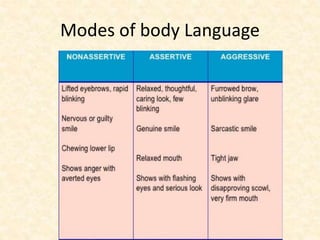
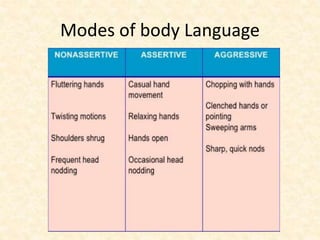
    Acting Assertively • Aggressionis conveyed by the following body language signals staring; leaning back with hands behind your head; pointing fingers, jabbing pencils at someone; fist-thumping; chin thrust forward; clenched fists; wry smiles; scowling when angry; taking up maximum space; invading other people’s space; finger-drumming; striding around impatiently.
  • 31.
    Acting Assertively • Non-assertivenessis conveyed by the following body language signals little or no eye contact; looking down or to one side; expressionless; slumping; sad or fearful expression; shoulders up and tense; hand wringing; hand over face or covering mouth; nervous smile when angry or being criticised; legs wrapped around each other; folded arms.
  • 32.
    Acting Assertively • Assertivebehaviour is conveyed by the following body language signals steady eye contact without staring; smiling when pleased, frowning when angry, otherwise open; spontaneous and fluid; open hands; relaxed posture; low level of unnecessary gestures; facial expression reflects feeling being expressed; sitting and standing upright; taking up the appropriate amount of space.
  • 33.
    Modes of bodyLanguage
  • 34.
    Modes of bodyLanguage
  • 35.
    Speaking Assertively • Assertiveways of speaking can be recognised when people make statements that are brief and to the point; use well- considered “I” statements eg “I believe...”; distinguish clearly between fact and opinion, eg “In my experience...”; avoid words like “must”, “should” and “ought”; make constructive suggestions, eg “I need time to think. Can we stop?”; use open-ended questions of others, eg “How does this affect you?”; use a voice that is steady, warm, firm, clear, sincere, neither soft nor loud.
  • 36.
    Speaking Assertively • Assertivepeople speak to a purpose. They don’t say anything to put others or themselves down. Every time you feel yourself slipping into the rambling, apologetic and hesitant tones of the submissive mode, or the loud, angry, and belligerent tones of the aggressive mode, quietly slip back into the assertive tone of voice.
  • 37.
    Problem-Solving • Tuning into our assertive rights allows us to handle difficult situations with assertiveness. Let’s say you live next door to someone who regularly plays loud music late at night. Your rights to a quiet night’s sleep are infringed. • You might do nothing and the situation goes unresolved. You might get angry and call the police but your neighbour then gets angry and plots revenge. The assertive route sees you calling on your neighbour and trying to work out a win-win solution to the problem.
  • 38.
    Natural Assertion • Althoughassertiveness lacks the heated emotion of the angry aggressive or the trembling fear of the timid submissive, it is not empty of feeling. You can be assertive by letting others know your feelings, for example, in spontaneous outbursts of positive enjoyment. “Great meeting!” “Well done!” “That was an excellent report!”
  • 41.
    To conclude: Whathappens when you behave assertively? • You feel more comfortable with yourself • Your self-esteem improves • You become more valued and respected • Your technical & professional abilities are highlighted by excellent interpersonal skills
  • 42.
    Last note • Inmost situations we have the choice to be passive, assertive, or aggressive. Being assertive is often the best choice.
  • 43.