Satellite Systems 
5.3. Basics
Basics 
• Satellites orbit around the Earth either in 
– Circular Path or 
– Elliptical Path 
• They maintain the circular orbital path using 2 
forces 
– The Attractive Force of the Earth Fg 
– The Centrifugal Force Fc
Basics 
• Satellites in circular orbits 
– Attractive force Fg = m g (R/r)² 
– Centrifugal force Fc = m r ² 
m: mass of the satellite 
R: radius of the earth (R = 6370 km) 
r: distance of satellite to the center of the earth 
g: acceleration of gravity (g = 9.81 m/s²) 
: angular velocity ( = 2  f, f: rotation frequency) 
• For a Stable orbit 
Fg = Fc (mass of a satellite is irrelevant). We get 
3 
2 
2 
gR 
(2 f ) 
r 
 

Satellite Period and Orbits 
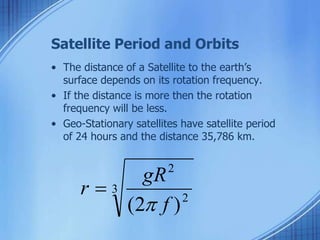
• The distance of a Satellite to the earth’s 
surface depends on its rotation frequency. 
• If the distance is more then the rotation 
frequency will be less. 
• Geo-Stationary satellites have satellite period 
of 24 hours and the distance 35,786 km. 
3 
2 
2 
gR 
(2 f ) 
r 
 

Satellite Period and Orbits 
10 20 30 40 x106 m 
24 
20 
16 
12 
8 
4 
radius 
satellite 
velocity [ x1000 km/h] period [h] 
synchronous distance 
35,786 km
Importance Parameters 
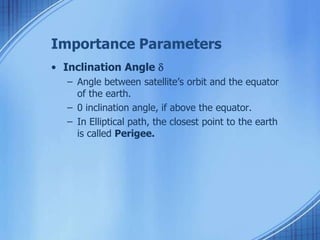
• Inclination Angle d 
– Angle between satellite’s orbit and the equator 
of the earth. 
– 0 inclination angle, if above the equator. 
– In Elliptical path, the closest point to the earth 
is called Perigee.
Inclination angle 
d 
inclination d 
satellite orbit 
perigee 
plane of satellite orbit 
equatorial plane
Important Parameters 
• Elevation Angle e 
– Angle between the center of the Satellite‘s 
beam and the earth‘s surface. 
– The area on earth where the satellite‘s signal 
can be received is called footprint. 
– LOS (Line of Sight) to the satellite necessary for 
connection 
 high elevation needed, less absorption due to 
e.g. buildings 
 Uplink: connection base station - satellite 
 Downlink: connection satellite - base station
Elevation angle 
Elevation: 
angle e between center of 
satellite beam and surface 
e 
minimal elevation: 
elevation needed at least 
to communicate with 
the satellite
Loss of Signal 
• Attenuation – Loss of Signal Power depending 
on the following: 
– Distance between the receiver on earth and the 
satellite 
– Satellite Elevation (If less than 10° no use) 
– Atmospheric Conditions – Rain, Fog etc..
Loss of Signal 
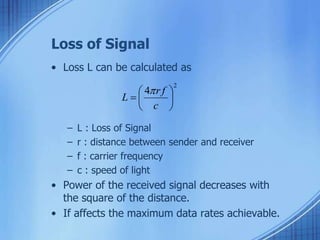
• Loss L can be calculated as 
2 
4 
 
 
 
 
 
 
 
r f 
 
c 
L 
– L : Loss of Signal 
– r : distance between sender and receiver 
– f : carrier frequency 
– c : speed of light 
• Power of the received signal decreases with 
the square of the distance. 
• If affects the maximum data rates achievable.
Satellite Link Budget 
• It is needed to design optimum satellite 
communication link. 
• It considers the following: 
– Antenna size 
– Modulation technique availability 
– Satellite power and Bandwidth 
– Carrier noise 
– Free space pass-loss 
– Multipath propagation effects 
– Atmospheric conditions 
– Signal delays
Atmospheric Attenuation 
Example: satellite systems at 4-6 GHz 
5° 10° 20° 30° 40° 50° 
elevation of the satellite 
Attenuation of 
the signal in % 
50 
40 
30 
20 
10 
rain absorption 
fog absorption 
atmospheric 
absorption 
e
Latency (Propagation Delay) 
• Latency is the time delay between the actual 
moment of a signal's broadcast and the time it 
is received at its destination. 
• The amount of latency depends on the 
distance travelled and the speed of light. 
• Eg. Geostationary orbit – 36000 kms away 
One way propagation delay is = 36x106/ 3x108 
= 0.12 seconds 
Total round trip propagation delay is 0.24 seconds
Types of Satellite Orbits 
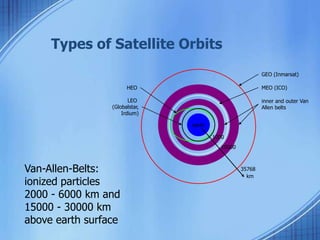
• Four different types of satellite orbits can be identified 
depending on the shape and diameter of the orbit: 
• GEO: geostationary orbit, ca. 36000 km above earth 
surface 
• LEO (Low Earth Orbit): ca. 500 - 1500 km 
• MEO (Medium Earth Orbit) or ICO (Intermediate 
Circular Orbit): ca. 6000 - 20000 km 
• HEO (Highly Elliptical Orbit) elliptical orbits
Types of Satellite Orbits 
earth 
35768 
km 
1000 
10000 
HEO 
LEO 
(Globalstar, 
Irdium) 
GEO (Inmarsat) 
MEO (ICO) 
inner and outer Van 
Allen belts 
Van-Allen-Belts: 
ionized particles 
2000 - 6000 km and 
15000 - 30000 km 
above earth surface
5.3.1 GEO Satellites 
• Orbit 35,786 km distance to earth surface, orbit in 
equatorial plane (inclination 0°) 
• complete rotation exactly one day, satellite is 
synchronous to earth rotation. 
• 3 satellites are enough to cover every part of earth 
• Advantages 
– Fixed antenna positions, no adjusting necessary 
– Ideal for TV and Radio Broadcasting 
– High life time – about 15 years. 
– Large footprint. So no handover needed. 
– No Doppler shift because of 0 movement
Disadvantages of GEO 
• Northern, southern regions have problem of bad 
elevation angle – need for larger antennas 
• Shading of signals in cities due to large buildings 
• High transmit power is needed – problem for 
battery powered devices 
• No global coverage, so cannot be used for small 
mobile phones 
• High latency of 0.25 seconds for one way makes it 
unfit for voice and data communications 
• Due to large footprints the frequencies cannot be 
reused
5.3.2 LEO Satellites 
• Satellite period is about 95 to 120 minutes. 
Orbits ca. 500 - 1500 km above earth surface 
• Visible from earth for about 10-40 minutes 
only. 
• Has high elevation angle and high quality 
communication link 
• Further Classifications 
– LEO with low bandwidth service (ca. 100bits/s) 
– Big LEOs (ca. 1000 bit/s) 
– Broadband LEOs (ca. 1 Mbit/s)
Advantages of LEO 
• LEO provides bandwidth of 2400 bit/s (which 
is sufficient of voice communication) with low 
transmit power (1 w) 
• Very low latency – ca.10 milli seconds 
• Smaller footprints so better frequency reuse 
• Provides higher elevation for polar regions and 
provides better global coverage
Disadvantages of LEO 
• Need for more number of satellites (50-200) 
because of small footprint 
• Mechanism for connection handover required 
due to short time visibility with high elevation 
• High number of satellites involves high 
complexity 
• Lifetime is shorter – 5-8 years only 
• Routing from satellite to satellite or satellite to 
base stations needed for global coverage
5.3.3 MEO Satellites 
• Orbits around 10000 km 
• Advantages 
– Requires 12 satellites to cover the earth 
– Requires fewer handover 
– Movement is slower 
• Disadvantages 
– Delay is about 70-80 ms 
– Needs higher transmit power and special 
antennas for smaller footprints

Satellite systems

  • 1.
  • 2.
    Basics • Satellitesorbit around the Earth either in – Circular Path or – Elliptical Path • They maintain the circular orbital path using 2 forces – The Attractive Force of the Earth Fg – The Centrifugal Force Fc
  • 3.
    Basics • Satellitesin circular orbits – Attractive force Fg = m g (R/r)² – Centrifugal force Fc = m r ² m: mass of the satellite R: radius of the earth (R = 6370 km) r: distance of satellite to the center of the earth g: acceleration of gravity (g = 9.81 m/s²) : angular velocity ( = 2  f, f: rotation frequency) • For a Stable orbit Fg = Fc (mass of a satellite is irrelevant). We get 3 2 2 gR (2 f ) r  
  • 4.
    Satellite Period andOrbits • The distance of a Satellite to the earth’s surface depends on its rotation frequency. • If the distance is more then the rotation frequency will be less. • Geo-Stationary satellites have satellite period of 24 hours and the distance 35,786 km. 3 2 2 gR (2 f ) r  
  • 5.
    Satellite Period andOrbits 10 20 30 40 x106 m 24 20 16 12 8 4 radius satellite velocity [ x1000 km/h] period [h] synchronous distance 35,786 km
  • 6.
    Importance Parameters •Inclination Angle d – Angle between satellite’s orbit and the equator of the earth. – 0 inclination angle, if above the equator. – In Elliptical path, the closest point to the earth is called Perigee.
  • 7.
    Inclination angle d inclination d satellite orbit perigee plane of satellite orbit equatorial plane
  • 8.
    Important Parameters •Elevation Angle e – Angle between the center of the Satellite‘s beam and the earth‘s surface. – The area on earth where the satellite‘s signal can be received is called footprint. – LOS (Line of Sight) to the satellite necessary for connection  high elevation needed, less absorption due to e.g. buildings  Uplink: connection base station - satellite  Downlink: connection satellite - base station
  • 9.
    Elevation angle Elevation: angle e between center of satellite beam and surface e minimal elevation: elevation needed at least to communicate with the satellite
  • 10.
    Loss of Signal • Attenuation – Loss of Signal Power depending on the following: – Distance between the receiver on earth and the satellite – Satellite Elevation (If less than 10° no use) – Atmospheric Conditions – Rain, Fog etc..
  • 11.
    Loss of Signal • Loss L can be calculated as 2 4        r f  c L – L : Loss of Signal – r : distance between sender and receiver – f : carrier frequency – c : speed of light • Power of the received signal decreases with the square of the distance. • If affects the maximum data rates achievable.
  • 12.
    Satellite Link Budget • It is needed to design optimum satellite communication link. • It considers the following: – Antenna size – Modulation technique availability – Satellite power and Bandwidth – Carrier noise – Free space pass-loss – Multipath propagation effects – Atmospheric conditions – Signal delays
  • 13.
    Atmospheric Attenuation Example:satellite systems at 4-6 GHz 5° 10° 20° 30° 40° 50° elevation of the satellite Attenuation of the signal in % 50 40 30 20 10 rain absorption fog absorption atmospheric absorption e
  • 14.
    Latency (Propagation Delay) • Latency is the time delay between the actual moment of a signal's broadcast and the time it is received at its destination. • The amount of latency depends on the distance travelled and the speed of light. • Eg. Geostationary orbit – 36000 kms away One way propagation delay is = 36x106/ 3x108 = 0.12 seconds Total round trip propagation delay is 0.24 seconds
  • 15.
    Types of SatelliteOrbits • Four different types of satellite orbits can be identified depending on the shape and diameter of the orbit: • GEO: geostationary orbit, ca. 36000 km above earth surface • LEO (Low Earth Orbit): ca. 500 - 1500 km • MEO (Medium Earth Orbit) or ICO (Intermediate Circular Orbit): ca. 6000 - 20000 km • HEO (Highly Elliptical Orbit) elliptical orbits
  • 16.
    Types of SatelliteOrbits earth 35768 km 1000 10000 HEO LEO (Globalstar, Irdium) GEO (Inmarsat) MEO (ICO) inner and outer Van Allen belts Van-Allen-Belts: ionized particles 2000 - 6000 km and 15000 - 30000 km above earth surface
  • 17.
    5.3.1 GEO Satellites • Orbit 35,786 km distance to earth surface, orbit in equatorial plane (inclination 0°) • complete rotation exactly one day, satellite is synchronous to earth rotation. • 3 satellites are enough to cover every part of earth • Advantages – Fixed antenna positions, no adjusting necessary – Ideal for TV and Radio Broadcasting – High life time – about 15 years. – Large footprint. So no handover needed. – No Doppler shift because of 0 movement
  • 18.
    Disadvantages of GEO • Northern, southern regions have problem of bad elevation angle – need for larger antennas • Shading of signals in cities due to large buildings • High transmit power is needed – problem for battery powered devices • No global coverage, so cannot be used for small mobile phones • High latency of 0.25 seconds for one way makes it unfit for voice and data communications • Due to large footprints the frequencies cannot be reused
  • 19.
    5.3.2 LEO Satellites • Satellite period is about 95 to 120 minutes. Orbits ca. 500 - 1500 km above earth surface • Visible from earth for about 10-40 minutes only. • Has high elevation angle and high quality communication link • Further Classifications – LEO with low bandwidth service (ca. 100bits/s) – Big LEOs (ca. 1000 bit/s) – Broadband LEOs (ca. 1 Mbit/s)
  • 20.
    Advantages of LEO • LEO provides bandwidth of 2400 bit/s (which is sufficient of voice communication) with low transmit power (1 w) • Very low latency – ca.10 milli seconds • Smaller footprints so better frequency reuse • Provides higher elevation for polar regions and provides better global coverage
  • 21.
    Disadvantages of LEO • Need for more number of satellites (50-200) because of small footprint • Mechanism for connection handover required due to short time visibility with high elevation • High number of satellites involves high complexity • Lifetime is shorter – 5-8 years only • Routing from satellite to satellite or satellite to base stations needed for global coverage
  • 22.
    5.3.3 MEO Satellites • Orbits around 10000 km • Advantages – Requires 12 satellites to cover the earth – Requires fewer handover – Movement is slower • Disadvantages – Delay is about 70-80 ms – Needs higher transmit power and special antennas for smaller footprints