
Geographic Sciences Diploma – Remote    Term Project: Jan – May
                 Sensing                           2012


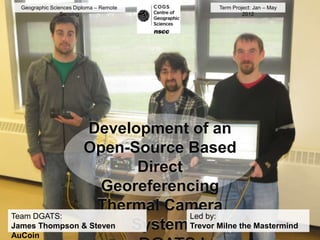
                 Development of an
               Open-Source Based
                         Direct
                    Georeferencing
                   Thermal Camera
Team DGATS:                     Led by:
James Thompson & Steven System Trevor Milne the Mastermind
AuCoin
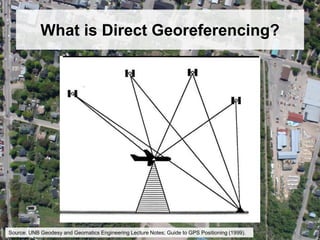
What is Direct Georeferencing?


Source: UNB Geodesy and Geomatics Engineering Lecture Notes; Guide to GPS Positioning (1999).
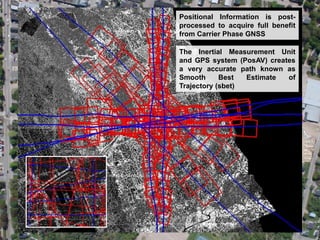
Positional Information is post-
processed to acquire full benefit
from Carrier Phase GNSS

The Inertial Measurement Unit
and GPS system (PosAV) creates
a very accurate path known as
Smooth      Best  Estimate  of
Trajectory (sbet)
Sensors Used
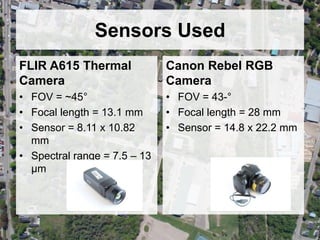
FLIR A615 Thermal             Canon Rebel RGB
Camera                        Camera
• FOV = ~45°                  • FOV = 43-°
• Focal length = 13.1 mm      • Focal length = 28 mm
• Sensor = 8.11 x 10.82       • Sensor = 14.8 x 22.2 mm
  mm
• Spectral range = 7.5 – 13
  µm
Positioning Equipment
Applanix Position and Orientation System for
Airborne Vehicles (POS AV)
                                     2


1. PCS              1
2. GNSS antenna
                                         3
3. IMU
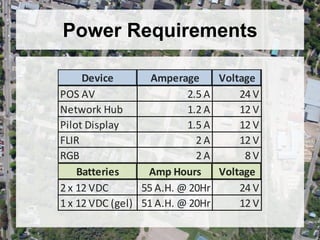
Power Requirements

     Device        Amperage     Voltage
POS AV                    2.5 A     24 V
Network Hub               1.2 A     12 V
Pilot Display             1.5 A     12 V
FLIR                        2A      12 V
RGB                         2A       8V
    Batteries     Amp Hours     Voltage
2 x 12 VDC       55 A.H. @ 20Hr     24 V
1 x 12 VDC (gel) 51 A.H. @ 20Hr     12 V
Circuitry
• All equipment powered
  with three 12V batteries
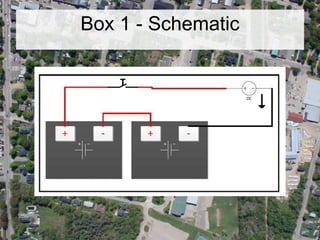
• Two 12V batteries wired in
  series for the POS AV,
  stored in box 1
• Gel-cell 12V battery used
  in box 2 for remaining
  equipment
• 12V converted to 8V for
  the RGB camera
Box 1 - Schematic
Box 2 - Schematic
Software Development Kits


System Requirements:       C language interface that
An IDE which understands   recommends using Microsoft
ActiveX components eg.     Visual Studio for Development
Visual Basic, Visual C#    projects
etc.
Position and Timing
We need to use the POS’s User Datagram
Protocol stream to make decisions and to
update the Pilot’s onboard display

DGATS receives UDP updates once per
second
IMU records platform attitude 200x per
second
IMU speed and accuracy are important because the plane speed averages
above 50 m/s. GPS signal restrains IMU from ‘drifting’ and gives real world
coordinates.
The ‘datagrams’ are binary packages of information that require restructuring
in DGATS before being used for processing. The information is constantly
varying in length and data types.

This functionality could not interfere with the user-driven interface, but
how?
A Complex Event Driven Program
User Interface for a complex event driven
program


   Show picture of
   DGATS!!!!!!!!!!!!!!!!!!!!!!!!!!!!!!!!!!!!!!
   !!!!!!!!!!!!!!!!!!!!!!!!!!!!!!!!!!!!!!!!!!!!!!!!!!!!!!!!!!!!!!!!!!!!!!!!!!!
   !!!!!!!!!!!!!!!!!!!!!!!!!!!!!!!!!!!!!!!!!!!!!!!!!!!!!!!!!!!!!!!!!!!!!!!!!!!
   !!
   !!!!!!!!!!!!!!!!!!!!!!!!!!!!!!!!!!!!!!!!!!!!!!!!!!!!!!!!!!!!!!!!!!!!!!!!!!!
   !!!!!!!!!!!!!!!!!!!!!!!!!!!!!!!!!!!!!!!!!!!!!!!!!!!!!!!!!!!!!!!!!!!!!!!!!!!
   !!
   !!!!!!!!!!!!!!!!!!!!!!!!!!!!!!!!!!!!!!!!!!!!!!!!!!!!!!!!!!!!!!!!!!!!!!!!!!!
   !!!!!!!!!!!!!!!!!!!!!!!!!!!!!!!!!!!!!!!!!!!!!!!!!!!!!!!!!!!!!!!!!!!!!!!!!!!
   !!
Planning a Flight
               Lots of preflight planning and information had to
               be compiled and either integrated into DGATS
               or the flight maps.
    We
  needed:
Sensor specifications:
-   Sensor size and focal length to calculate image footprints and airbase to
    ensure correct overlap for our flying height
-   Equation: fl/ss = H/D

Survey specifics and terrain details:
- Subject area was the Middleton Transect
- AGRG provided LiDAR data for DEM and post-processing

Flight details:
- Weather and timing were essential.
- Expected the morning flight to have best thermal information.
Middleton
Transect Planning
Map
This was distributed to all the parties
involved in the flight. It indicates the
primary subject area as well as the
lines required (indicative of time). The
elevations seen in the DEM overlay
posed the next problem.

Our system processes and records
information in the GPS standard
WGS84 datum. Photogrammetric
accuracy and the DGATS decisions
require height above ground level
(AGL) to be used.
Pilot Display
Lever Arm Offsets
GNSS – IMU                IMU – RGB
• Initial X, Y, Z         • X, Y, Z
  -5 cm, 0 cm, -87.5 cm    2.5 cm, 0 cm, 37 cm
• Calibrated X, Y, Z      IMU – FLIR
  -5 cm, 2.8 cm, -91 cm   • X, Y, Z
                           -1.5 cm, 10.5 cm, 37 cm
Installation
Cessna 172
• Single engine
• Fixed-wing
• Maximum altitude
  of 14 000 ft.
• Maximum speed of
  124 ktas
Installation


Mount supports both sensors and the IMU
Installation

Vertically oriented cameras


           All equipment installed in cargo
Preliminary Results
No electrical
malfunctions in flight!
Plenty of power!
Software functioned
flawlessly. Logs
successfully recorded
events and times.
Initial estimates indicate a potential residual of 2 metres for
RGB imagery.
This is a product of a 40 millisecond delay in the camera
events.
For context, a blink takes 300-400 milliseconds
Potential
  Applications
& Future Projects
Morning
NSCC Middleton Campus
- Maximum Temp. 38 C
Afternoon
NSCC Middleton Campus
- Maximum Temp. 44 C
River Temperature
       and
     Sewage
   Temperature
Acknowledgements
COGS
Trevor Milne, Paul Illsley, Bruce Hicks, Brian Pyke, Dave
MacLean, Jim Norton, Dave Wedlock
AGRG
Dr. Timothy Webster, David Colville, Suzanne Monette,
Theresa Constantine-Smith
ESET
Scott Henderson, Dennis Kingston
Greenwood Flight Center
Allen Jacob

Open-Source Based Direct Georeferencing Thermal Camera System

  • 1.
    Geographic Sciences Diploma– Remote Term Project: Jan – May Sensing 2012 Development of an Open-Source Based Direct Georeferencing Thermal Camera Team DGATS: Led by: James Thompson & Steven System Trevor Milne the Mastermind AuCoin
  • 2.
    What is DirectGeoreferencing? Source: UNB Geodesy and Geomatics Engineering Lecture Notes; Guide to GPS Positioning (1999).
  • 3.
    Positional Information ispost- processed to acquire full benefit from Carrier Phase GNSS The Inertial Measurement Unit and GPS system (PosAV) creates a very accurate path known as Smooth Best Estimate of Trajectory (sbet)
  • 4.
    Sensors Used FLIR A615Thermal Canon Rebel RGB Camera Camera • FOV = ~45° • FOV = 43-° • Focal length = 13.1 mm • Focal length = 28 mm • Sensor = 8.11 x 10.82 • Sensor = 14.8 x 22.2 mm mm • Spectral range = 7.5 – 13 µm
  • 5.
    Positioning Equipment Applanix Positionand Orientation System for Airborne Vehicles (POS AV) 2 1. PCS 1 2. GNSS antenna 3 3. IMU
  • 6.
    Power Requirements Device Amperage Voltage POS AV 2.5 A 24 V Network Hub 1.2 A 12 V Pilot Display 1.5 A 12 V FLIR 2A 12 V RGB 2A 8V Batteries Amp Hours Voltage 2 x 12 VDC 55 A.H. @ 20Hr 24 V 1 x 12 VDC (gel) 51 A.H. @ 20Hr 12 V
  • 7.
    Circuitry • All equipmentpowered with three 12V batteries • Two 12V batteries wired in series for the POS AV, stored in box 1 • Gel-cell 12V battery used in box 2 for remaining equipment • 12V converted to 8V for the RGB camera
  • 8.
    Box 1 -Schematic
  • 9.
    Box 2 -Schematic
  • 10.
    Software Development Kits SystemRequirements: C language interface that An IDE which understands recommends using Microsoft ActiveX components eg. Visual Studio for Development Visual Basic, Visual C# projects etc.
  • 11.
    Position and Timing Weneed to use the POS’s User Datagram Protocol stream to make decisions and to update the Pilot’s onboard display DGATS receives UDP updates once per second IMU records platform attitude 200x per second IMU speed and accuracy are important because the plane speed averages above 50 m/s. GPS signal restrains IMU from ‘drifting’ and gives real world coordinates. The ‘datagrams’ are binary packages of information that require restructuring in DGATS before being used for processing. The information is constantly varying in length and data types. This functionality could not interfere with the user-driven interface, but how?
  • 12.
    A Complex EventDriven Program
  • 13.
    User Interface fora complex event driven program Show picture of DGATS!!!!!!!!!!!!!!!!!!!!!!!!!!!!!!!!!!!!!! !!!!!!!!!!!!!!!!!!!!!!!!!!!!!!!!!!!!!!!!!!!!!!!!!!!!!!!!!!!!!!!!!!!!!!!!!!! !!!!!!!!!!!!!!!!!!!!!!!!!!!!!!!!!!!!!!!!!!!!!!!!!!!!!!!!!!!!!!!!!!!!!!!!!!! !! !!!!!!!!!!!!!!!!!!!!!!!!!!!!!!!!!!!!!!!!!!!!!!!!!!!!!!!!!!!!!!!!!!!!!!!!!!! !!!!!!!!!!!!!!!!!!!!!!!!!!!!!!!!!!!!!!!!!!!!!!!!!!!!!!!!!!!!!!!!!!!!!!!!!!! !! !!!!!!!!!!!!!!!!!!!!!!!!!!!!!!!!!!!!!!!!!!!!!!!!!!!!!!!!!!!!!!!!!!!!!!!!!!! !!!!!!!!!!!!!!!!!!!!!!!!!!!!!!!!!!!!!!!!!!!!!!!!!!!!!!!!!!!!!!!!!!!!!!!!!!! !!
  • 14.
    Planning a Flight Lots of preflight planning and information had to be compiled and either integrated into DGATS or the flight maps. We needed: Sensor specifications: - Sensor size and focal length to calculate image footprints and airbase to ensure correct overlap for our flying height - Equation: fl/ss = H/D Survey specifics and terrain details: - Subject area was the Middleton Transect - AGRG provided LiDAR data for DEM and post-processing Flight details: - Weather and timing were essential. - Expected the morning flight to have best thermal information.
  • 15.
    Middleton Transect Planning Map This wasdistributed to all the parties involved in the flight. It indicates the primary subject area as well as the lines required (indicative of time). The elevations seen in the DEM overlay posed the next problem. Our system processes and records information in the GPS standard WGS84 datum. Photogrammetric accuracy and the DGATS decisions require height above ground level (AGL) to be used.
  • 16.
  • 17.
    Lever Arm Offsets GNSS– IMU IMU – RGB • Initial X, Y, Z • X, Y, Z -5 cm, 0 cm, -87.5 cm 2.5 cm, 0 cm, 37 cm • Calibrated X, Y, Z IMU – FLIR -5 cm, 2.8 cm, -91 cm • X, Y, Z -1.5 cm, 10.5 cm, 37 cm
  • 18.
    Installation Cessna 172 • Singleengine • Fixed-wing • Maximum altitude of 14 000 ft. • Maximum speed of 124 ktas
  • 19.
  • 20.
    Installation Vertically oriented cameras All equipment installed in cargo
  • 21.
    Preliminary Results No electrical malfunctionsin flight! Plenty of power! Software functioned flawlessly. Logs successfully recorded events and times. Initial estimates indicate a potential residual of 2 metres for RGB imagery. This is a product of a 40 millisecond delay in the camera events. For context, a blink takes 300-400 milliseconds
  • 22.
    Potential Applications &Future Projects
  • 23.
  • 24.
  • 25.
    River Temperature and Sewage Temperature
  • 26.
    Acknowledgements COGS Trevor Milne, PaulIllsley, Bruce Hicks, Brian Pyke, Dave MacLean, Jim Norton, Dave Wedlock AGRG Dr. Timothy Webster, David Colville, Suzanne Monette, Theresa Constantine-Smith ESET Scott Henderson, Dennis Kingston Greenwood Flight Center Allen Jacob

Editor's Notes

  • #5 Images courtesy of Paul Illsley.
  • #8 Image courtesy of Paul Illsley.
  • #18 Images courtesy of Paul Illsley.
  • #19 Image courtesy of Paul Illsley.
  • #20 Images courtesy of Paul Illsley.
  • #21 Images courtesy of Paul Illsley.