American Spinal Injury
Association(ASIA) SCALE
Dr Awaneesh Katiyar
Case Report
• A 30 yrs. Man presented in ED with history of fall from height (8
feet), vitals were normal, complaining of inability to move his lower
limbs and severe backache Immediately after trauma.
• Motor lower limb – 0/5, upper limb - 5/5
• Sensory level – at the level of inguinal region.
• No voluntary anal contraction, DAP, but sensation over S4-S5 present.
• ASIA grade?
History
• Frankel five-grade system introduced - In 1969,
• Frankel scale was adapted by ASIA- In 1982.
Frankel classification 1969
Frankel Grade Motor Sensory
Grade A No motor function No sensory function.
Grade B No motor function detected below
level of lesion
Some sensory function below level of lesion
preserved
Grade C Preserved motor, Nonfunctional Sensation may or may not be preserved
Grade D Preserved motor, functional Normal Sensory
Grade E Normal motor Normal Sensory
STEPS OF CLASSIFICATION
1. Determine sensory levels for right and left sides.
2. Determine motor levels for right and left sides.
3. Determine the neurological level of injury (NLI)
4. Determine whether the injury is Complete or Incomplete
5. Determine ASIA Impairment Scale (AIS) Grade
Determine sensory levels for right and left sides.
Determine motor levels for right and left sides.
Lowest key muscle function that has a grade of at least 3 (on supine testing),
Key muscle functions represented by segments above that level are judged to be intact .
The motor level is presumed to be the same as the sensory level.
Key Muscles upper Extremity
Upper extremities
Elbow flexors C5
Wrist extensors C6
Elbow extensors C7
Finger flexors C8
Little finger abductor T1
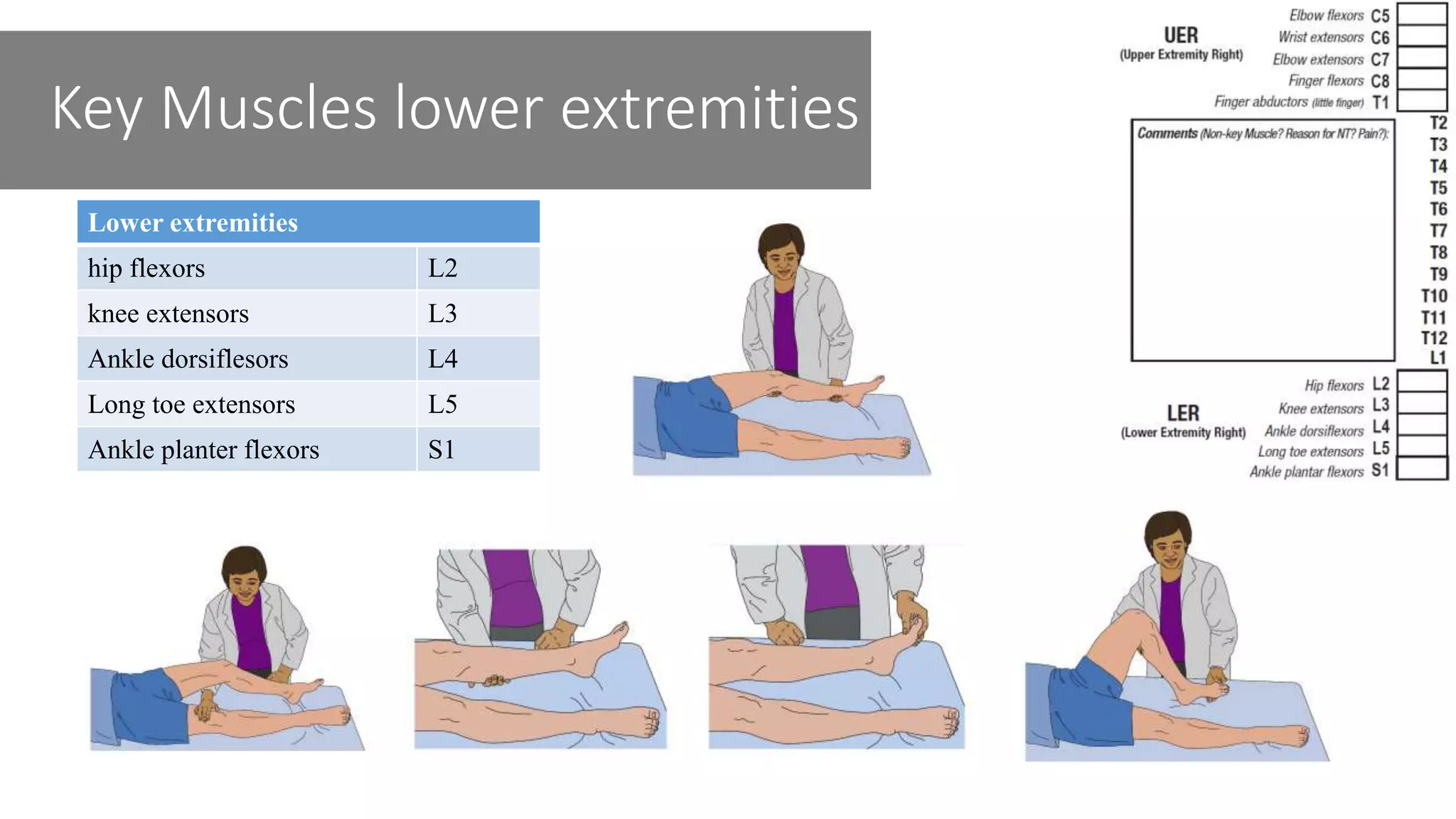
Key Muscles lower extremities
Lower extremities
hip flexors L2
knee extensors L3
Ankle dorsiflesors L4
Long toe extensors L5
Ankle planter flexors S1
Determine the Neurological Level of Injury(NLI)
The most caudal segment of the cord with intact sensation and antigravity (3 or more)
muscle function strength,
There is normal (intact) sensory and motor function rostrally respectively. The NLI is the
most cephalad of the sensory and motor levels determined in steps 1 and 2.
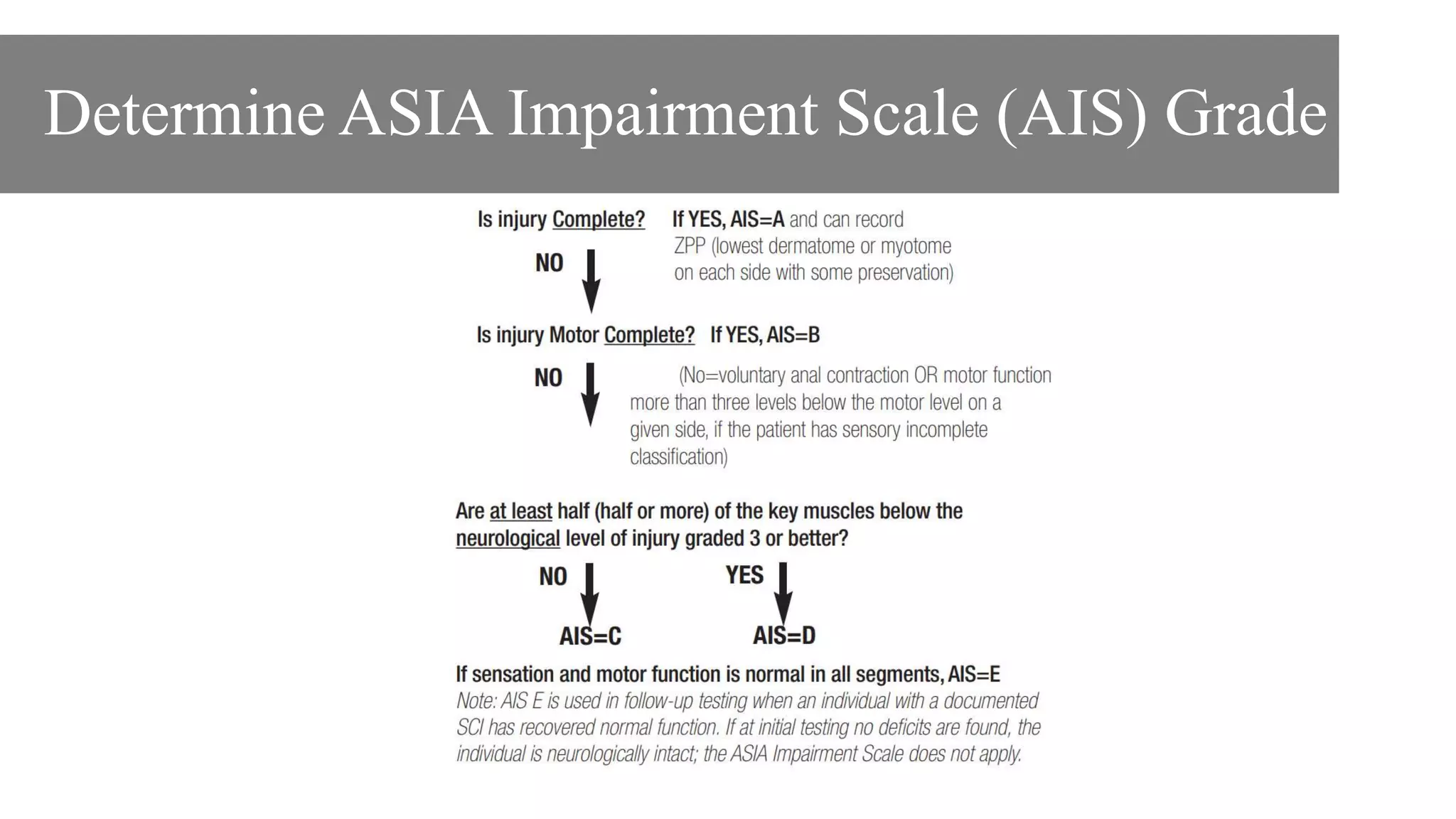
Determine whether the injury is Complete or Incomplete
• If voluntary anal contraction = No AND all S4-5 sensory scores = 0
AND deep anal pressure = No, then injury is Complete.
• Otherwise, injury is Incomplete.
Determine ASIA Impairment Scale (AIS) Grade
ASIA IMPAIRMENT SCALE
ASIA Grade Motor Sensory
Grade A No motor function No sensory function included sacral sensation.
Grade B Not motor function is preserved Sensory function intact or altered, decreased or
hypersensitive
Grade C Motor Incomplete -single NLI have a
muscle grade ≥ 3.
Sensory function intact or altered, decreased or
hypersensitive
Grade D Motor Incomplete - the single NLI having
a muscle grade  3.
Sensory function intact or altered, decreased or
hypersensitive
Grade E Normal. Normal
Muscle Function Grading
0 = Total paralysis
1 = Palpable or visible contraction
2 = Active movement, full range of motion (ROM) with gravity eliminated.
3 = Active movement, full ROM against gravity
4 = Active movement, full ROM against gravity and moderate resistance in a muscle specific position
5 = (Normal) active movement, full ROM against gravity and full resistance in a functional muscle position expected from an
otherwise unimpaired person
5* = (Normal) active movement, full ROM against gravity and sufficient resistance to be considered normal if identified inhibiting
factors (i.e. pain, disuse) were not present.
NT = Not testable (i.e. due to immobilization, severe pain such that the patient cannot be graded, amputation of limb, or contracture
of > 50% of the normal ROM)
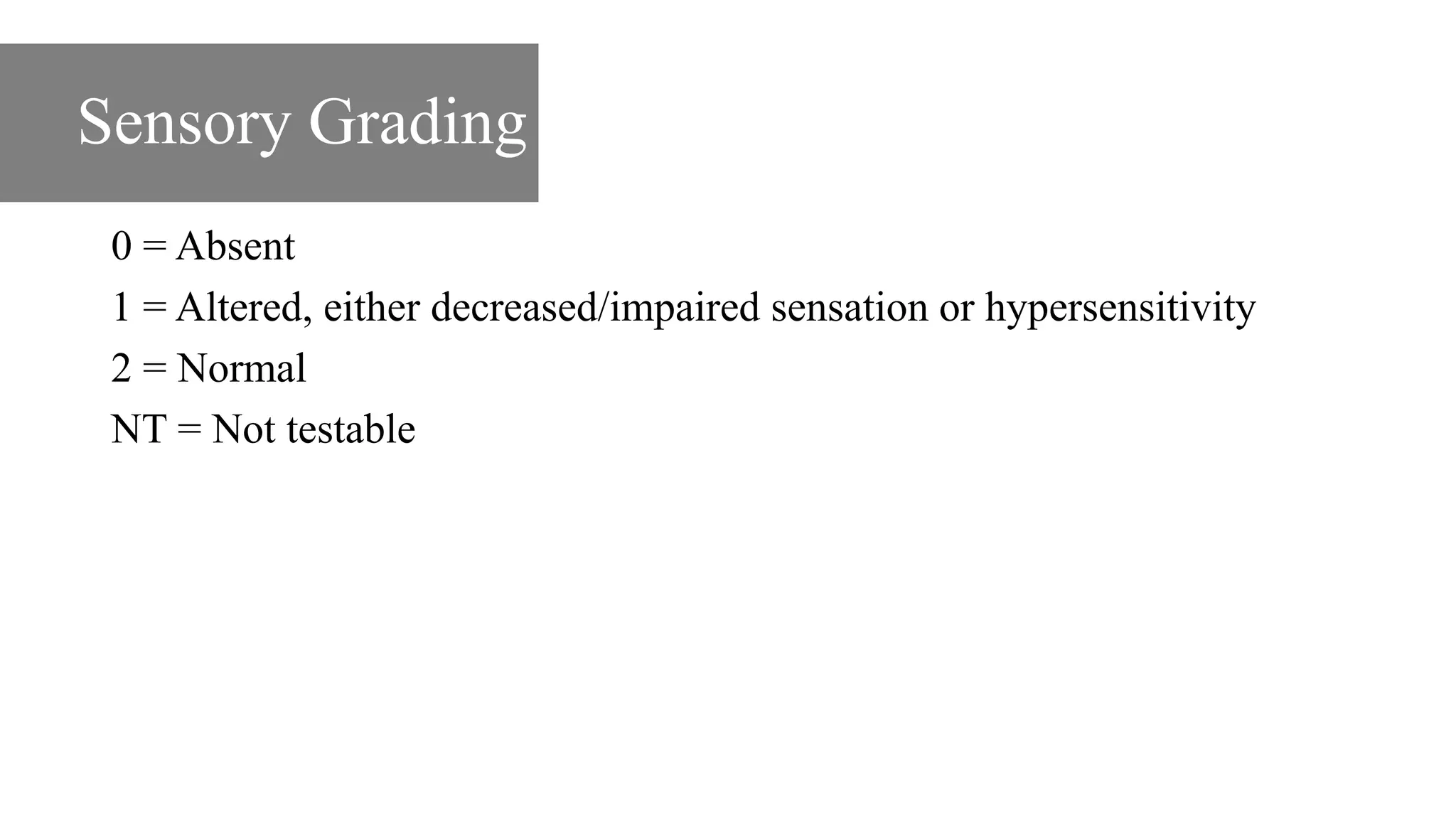
Sensory Grading
0 = Absent
1 = Altered, either decreased/impaired sensation or hypersensitivity
2 = Normal
NT = Not testable
Uses of ASIA chart
• Neurological assessment
• Daily evaluation and
neurological assessment
• Diagnosis – spinal shock
vs complete cord injury
Disability is not about nonfunctional limbs,
but its about nonfunctional mind.
Thank you ………
drawaneeshkatiyar@gmail.com

Asia scale

  • 1.
  • 2.
    Case Report • A30 yrs. Man presented in ED with history of fall from height (8 feet), vitals were normal, complaining of inability to move his lower limbs and severe backache Immediately after trauma. • Motor lower limb – 0/5, upper limb - 5/5 • Sensory level – at the level of inguinal region. • No voluntary anal contraction, DAP, but sensation over S4-S5 present. • ASIA grade?
  • 3.
    History • Frankel five-gradesystem introduced - In 1969, • Frankel scale was adapted by ASIA- In 1982.
  • 4.
    Frankel classification 1969 FrankelGrade Motor Sensory Grade A No motor function No sensory function. Grade B No motor function detected below level of lesion Some sensory function below level of lesion preserved Grade C Preserved motor, Nonfunctional Sensation may or may not be preserved Grade D Preserved motor, functional Normal Sensory Grade E Normal motor Normal Sensory
  • 7.
    STEPS OF CLASSIFICATION 1.Determine sensory levels for right and left sides. 2. Determine motor levels for right and left sides. 3. Determine the neurological level of injury (NLI) 4. Determine whether the injury is Complete or Incomplete 5. Determine ASIA Impairment Scale (AIS) Grade
  • 8.
    Determine sensory levelsfor right and left sides.
  • 10.
    Determine motor levelsfor right and left sides. Lowest key muscle function that has a grade of at least 3 (on supine testing), Key muscle functions represented by segments above that level are judged to be intact . The motor level is presumed to be the same as the sensory level.
  • 11.
    Key Muscles upperExtremity Upper extremities Elbow flexors C5 Wrist extensors C6 Elbow extensors C7 Finger flexors C8 Little finger abductor T1
  • 12.
    Key Muscles lowerextremities Lower extremities hip flexors L2 knee extensors L3 Ankle dorsiflesors L4 Long toe extensors L5 Ankle planter flexors S1
  • 13.
    Determine the NeurologicalLevel of Injury(NLI) The most caudal segment of the cord with intact sensation and antigravity (3 or more) muscle function strength, There is normal (intact) sensory and motor function rostrally respectively. The NLI is the most cephalad of the sensory and motor levels determined in steps 1 and 2.
  • 14.
    Determine whether theinjury is Complete or Incomplete • If voluntary anal contraction = No AND all S4-5 sensory scores = 0 AND deep anal pressure = No, then injury is Complete. • Otherwise, injury is Incomplete.
  • 15.
    Determine ASIA ImpairmentScale (AIS) Grade
  • 16.
    ASIA IMPAIRMENT SCALE ASIAGrade Motor Sensory Grade A No motor function No sensory function included sacral sensation. Grade B Not motor function is preserved Sensory function intact or altered, decreased or hypersensitive Grade C Motor Incomplete -single NLI have a muscle grade ≥ 3. Sensory function intact or altered, decreased or hypersensitive Grade D Motor Incomplete - the single NLI having a muscle grade  3. Sensory function intact or altered, decreased or hypersensitive Grade E Normal. Normal
  • 17.
    Muscle Function Grading 0= Total paralysis 1 = Palpable or visible contraction 2 = Active movement, full range of motion (ROM) with gravity eliminated. 3 = Active movement, full ROM against gravity 4 = Active movement, full ROM against gravity and moderate resistance in a muscle specific position 5 = (Normal) active movement, full ROM against gravity and full resistance in a functional muscle position expected from an otherwise unimpaired person 5* = (Normal) active movement, full ROM against gravity and sufficient resistance to be considered normal if identified inhibiting factors (i.e. pain, disuse) were not present. NT = Not testable (i.e. due to immobilization, severe pain such that the patient cannot be graded, amputation of limb, or contracture of > 50% of the normal ROM)
  • 18.
    Sensory Grading 0 =Absent 1 = Altered, either decreased/impaired sensation or hypersensitivity 2 = Normal NT = Not testable
  • 19.
    Uses of ASIAchart • Neurological assessment • Daily evaluation and neurological assessment • Diagnosis – spinal shock vs complete cord injury
  • 21.
    Disability is notabout nonfunctional limbs, but its about nonfunctional mind. Thank you ……… drawaneeshkatiyar@gmail.com