ASCE Utility Standards
Jim Anspach, P.G. F.ASCE
Cardno, Inc.
Director of Utility Market & Practice Development
Chair – ASCE 38 Member – Committee for
Technical Advancement
Chair – CI Construction
Standards Council
Member – Utility “As-Built”
Standard
Chair – UESI Utility Risk
Division
Member – PL Task Force
Chair (emeritus) – Codes and
Standards Division
Board Governor: UESI
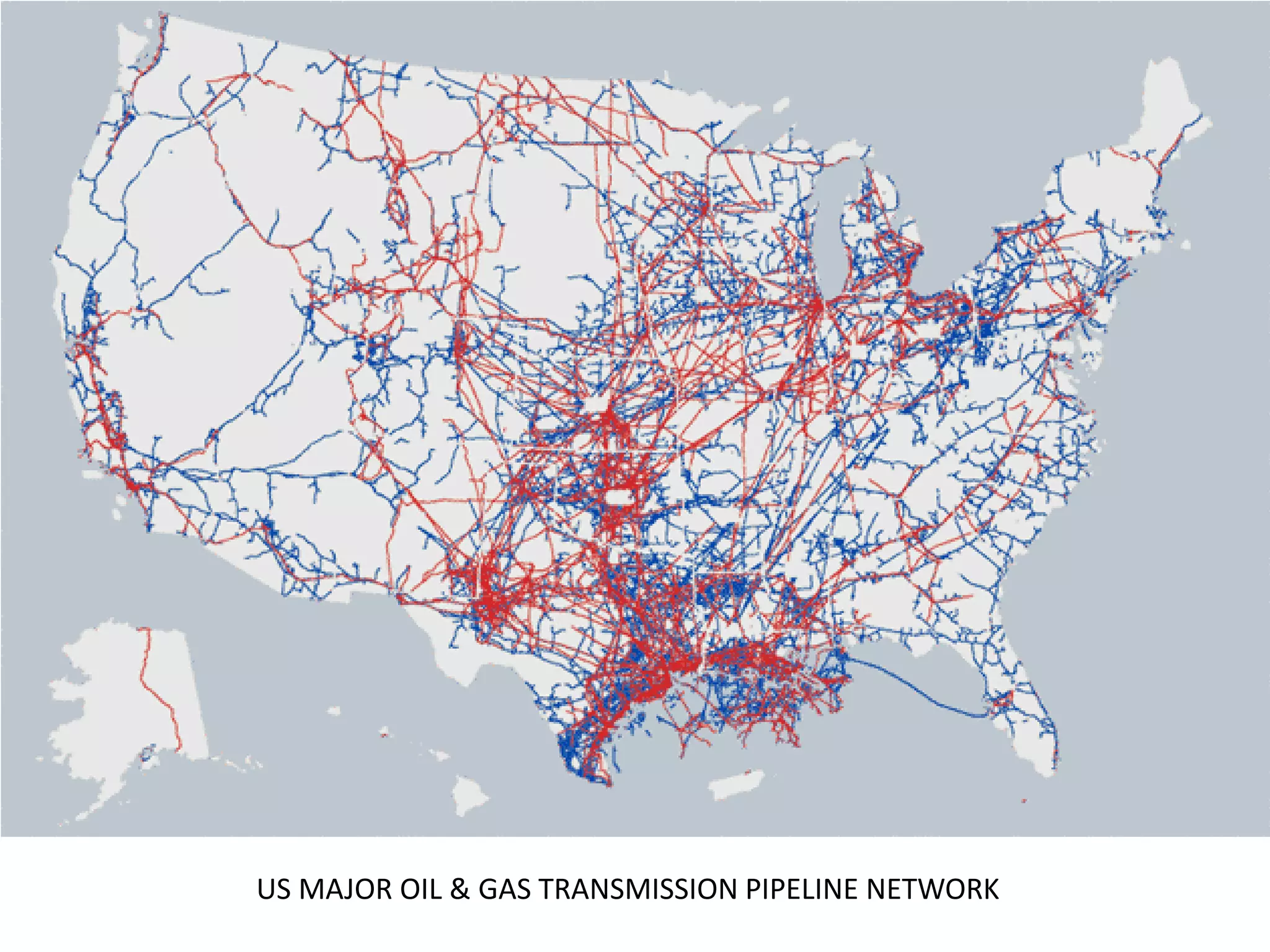
35+ Million Miles of Underground
Utilities in the US and Counting
US MAJOR OIL & GAS TRANSMISSION PIPELINE NETWORK
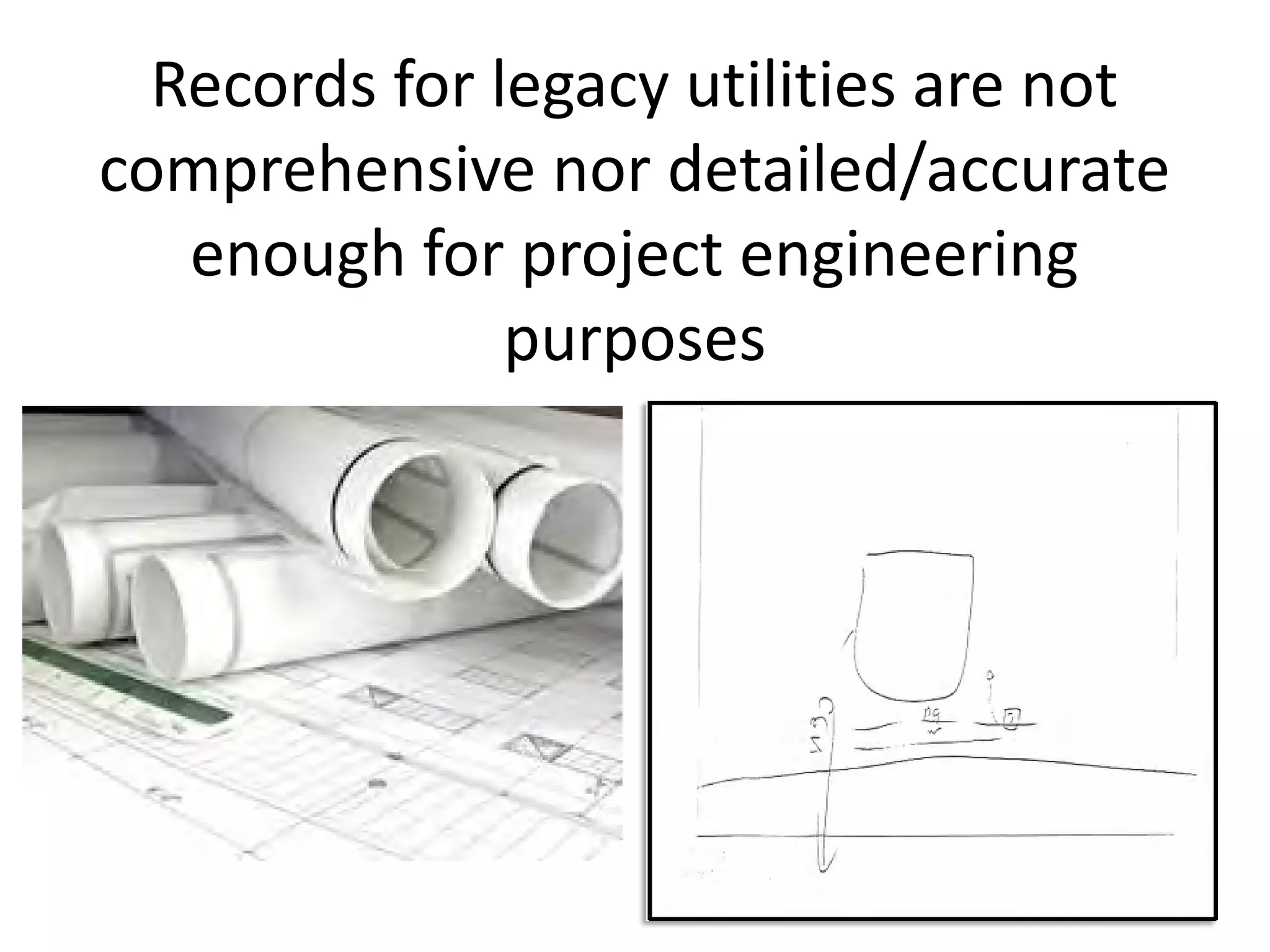
Records for legacy utilities are not
comprehensive nor detailed/accurate
enough for project engineering
purposes
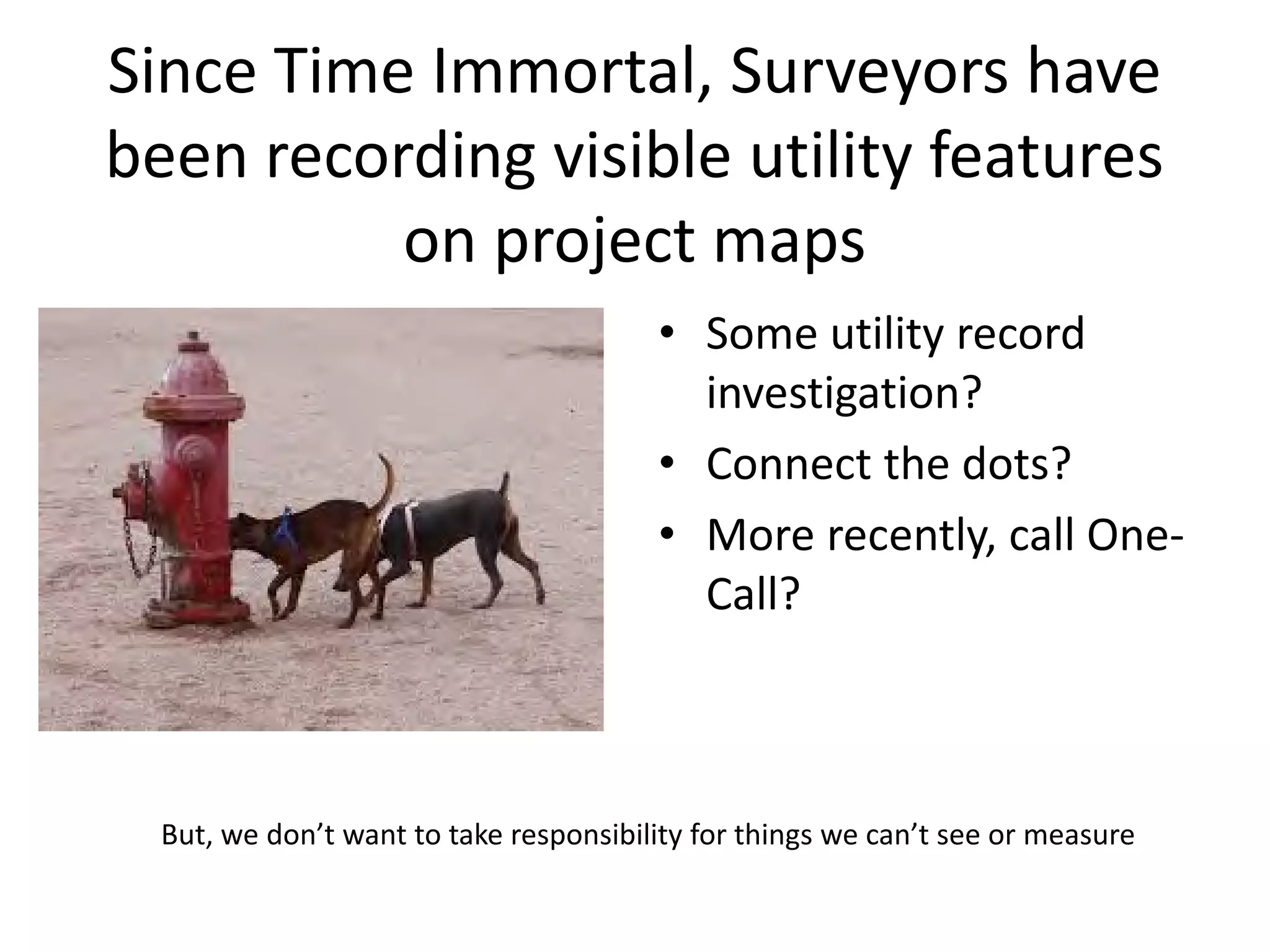
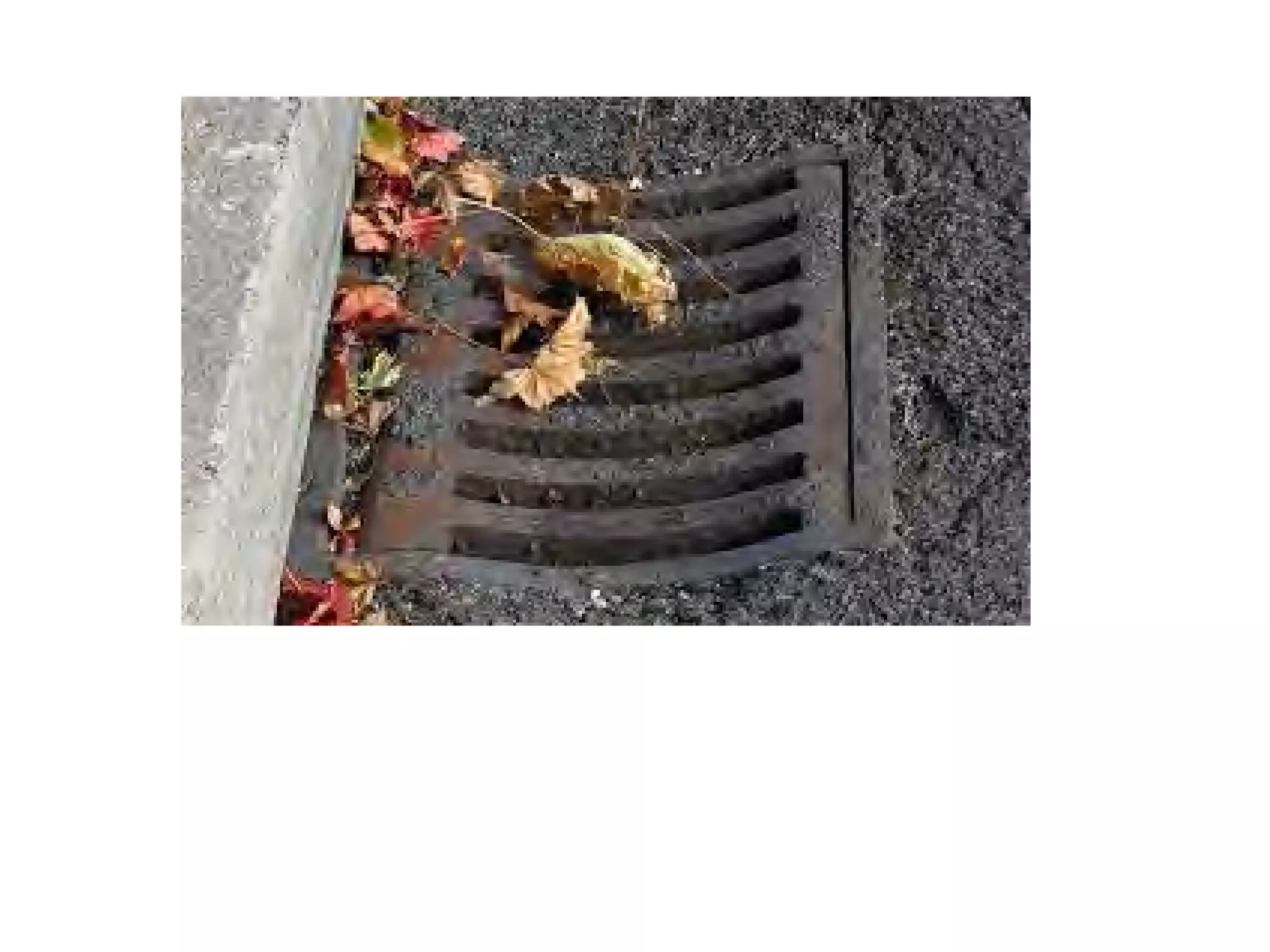
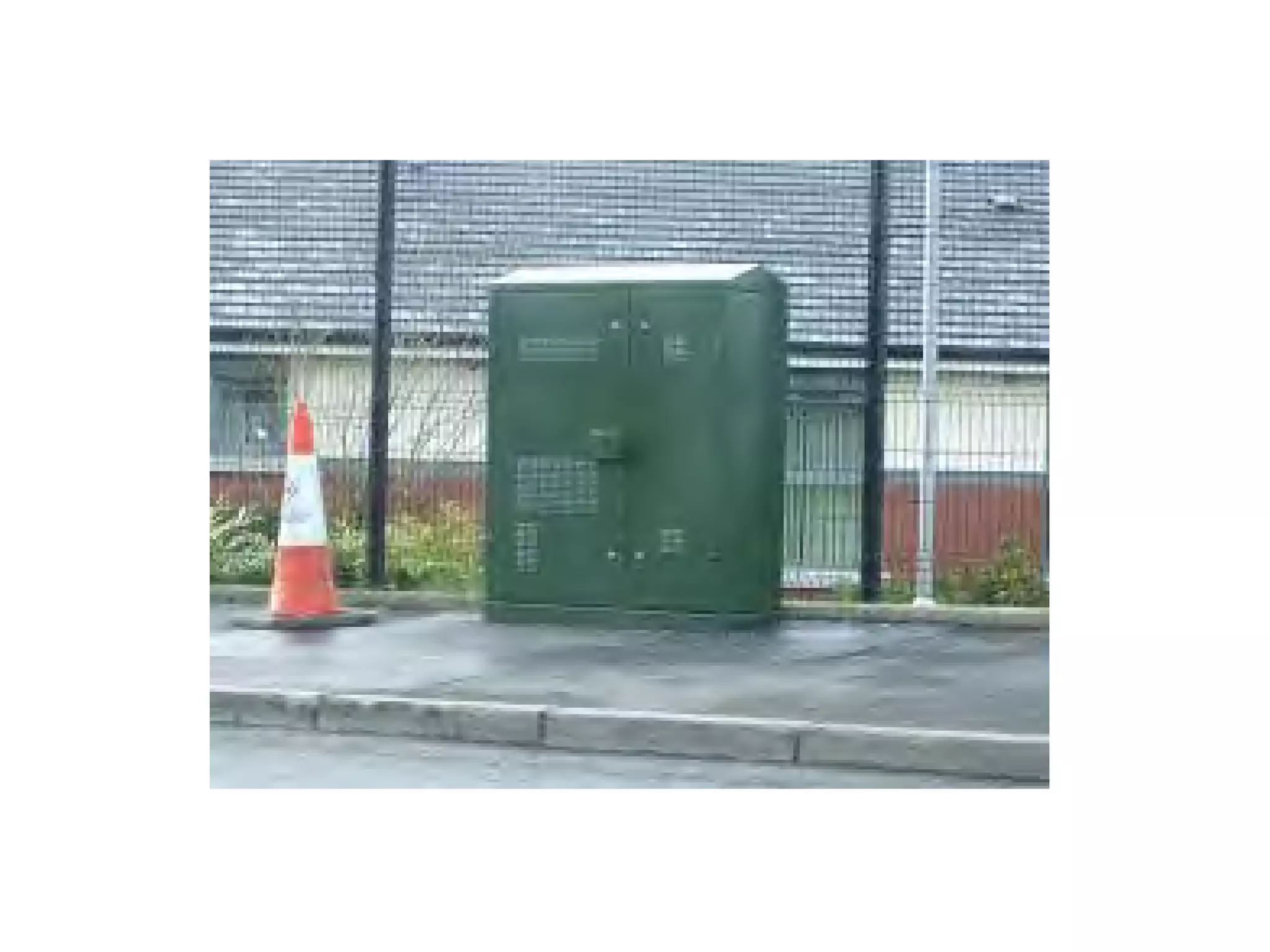
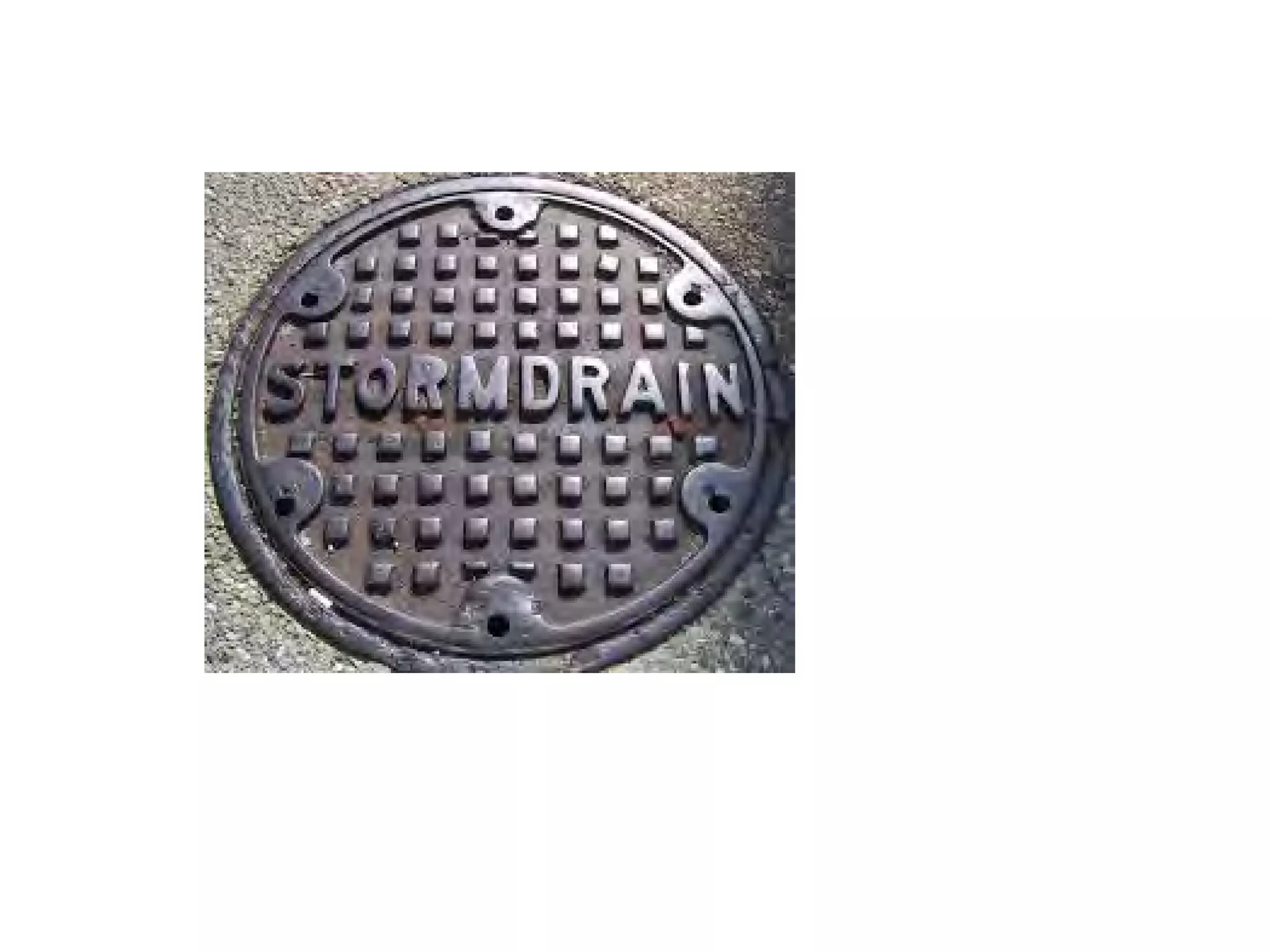
Since Time Immortal, Surveyors have
been recording visible utility features
on project maps
• Some utility record
investigation?
• Connect the dots?
• More recently, call One-
Call?
But, we don’t want to take responsibility for things we can’t see or measure
PLAN NOTES
1. Engineer and Surveyor take no
responsibility for the accuracy and
completeness of the utility
information shown on these plans.
2. Utilities are depicted on these plans
from records and visual observation.
It is the responsibility of the
contractor to verify all utilities before
construction.
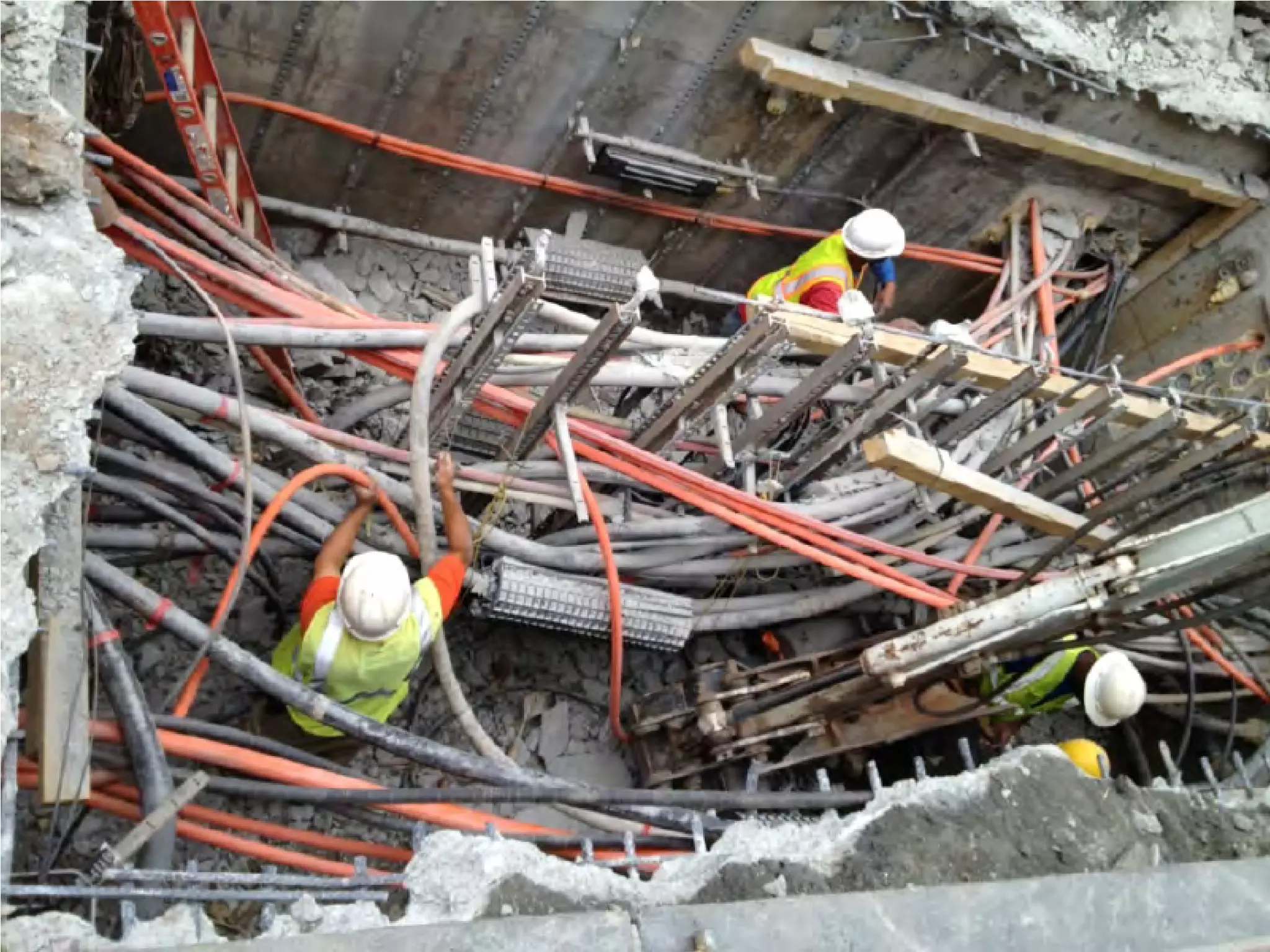
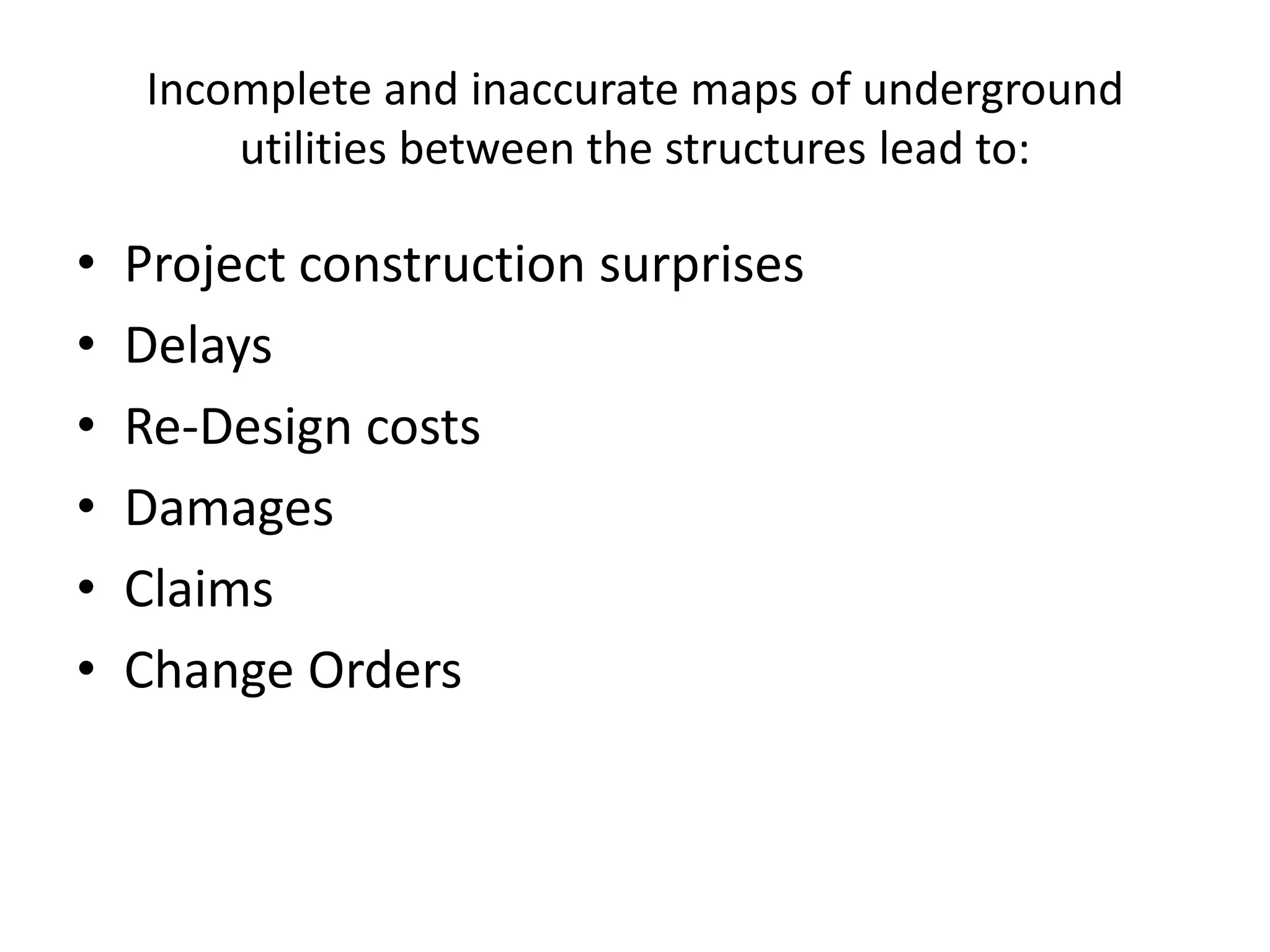
Incomplete and inaccurate maps of underground
utilities between the structures lead to:
• Project construction surprises
• Delays
• Re-Design costs
• Damages
• Claims
• Change Orders
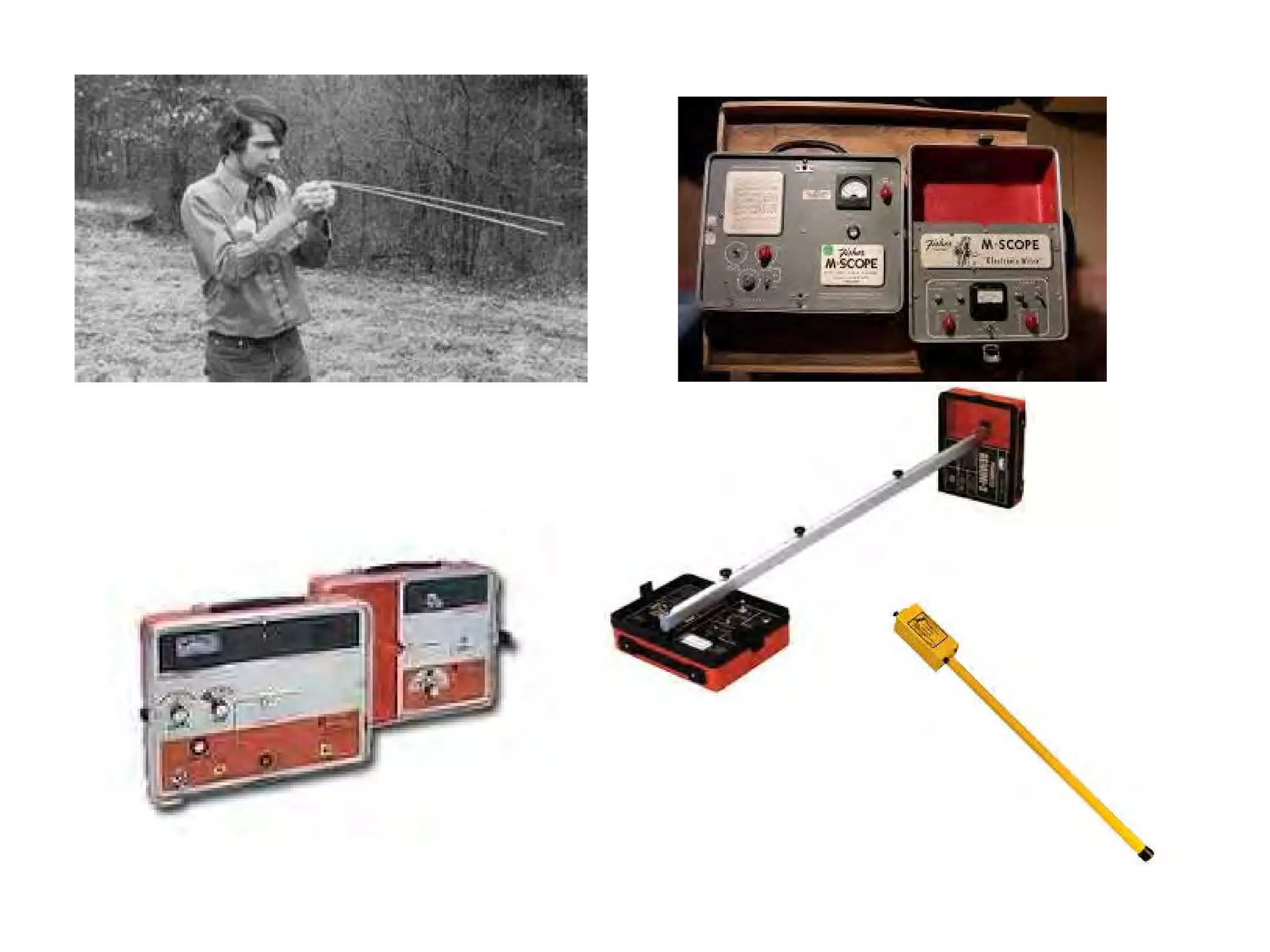
Pre 1980
• One-Call just starting
• Few devices for finding utilities
• Few firms were mapping utilities
• Utility Owners did “locating” for their own maintenance/repair
purposes
• Finding Utilities was considered an “Art” or WITCHCRAFT
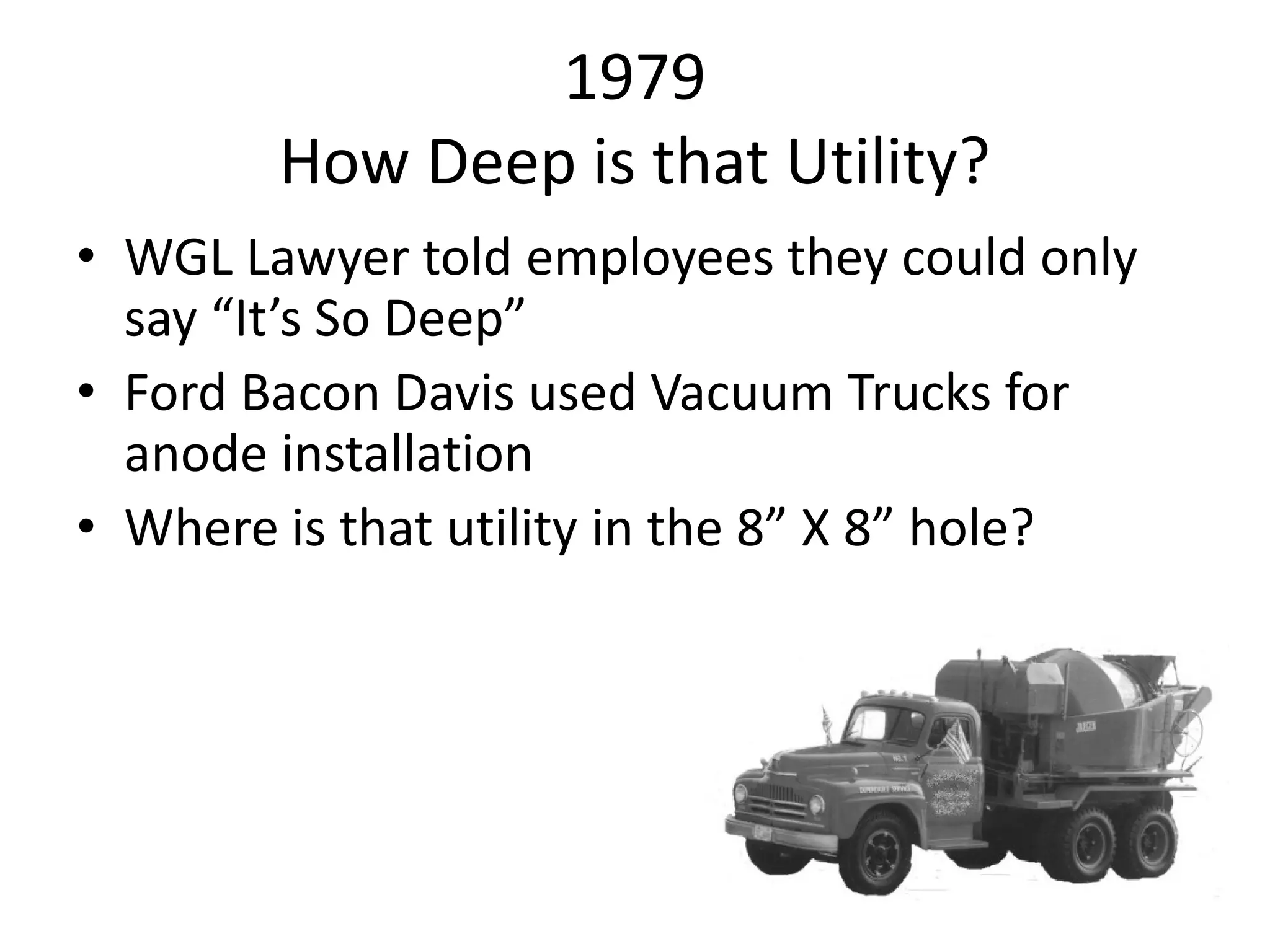
1979
How Deep is that Utility?
• WGL Lawyer told employees they could only
say “It’s So Deep”
• Ford Bacon Davis used Vacuum Trucks for
anode installation
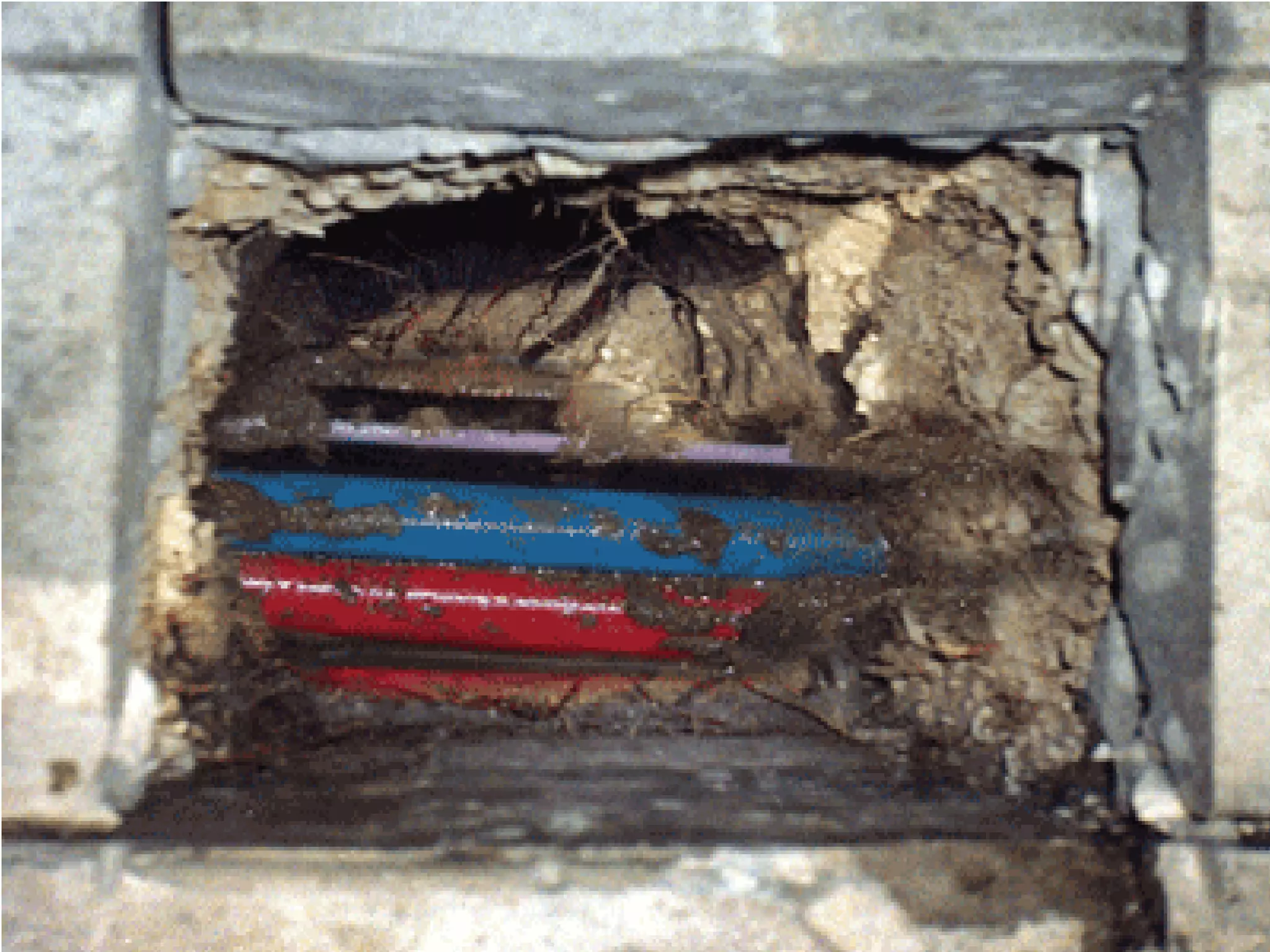
• Where is that utility in the 8” X 8” hole?
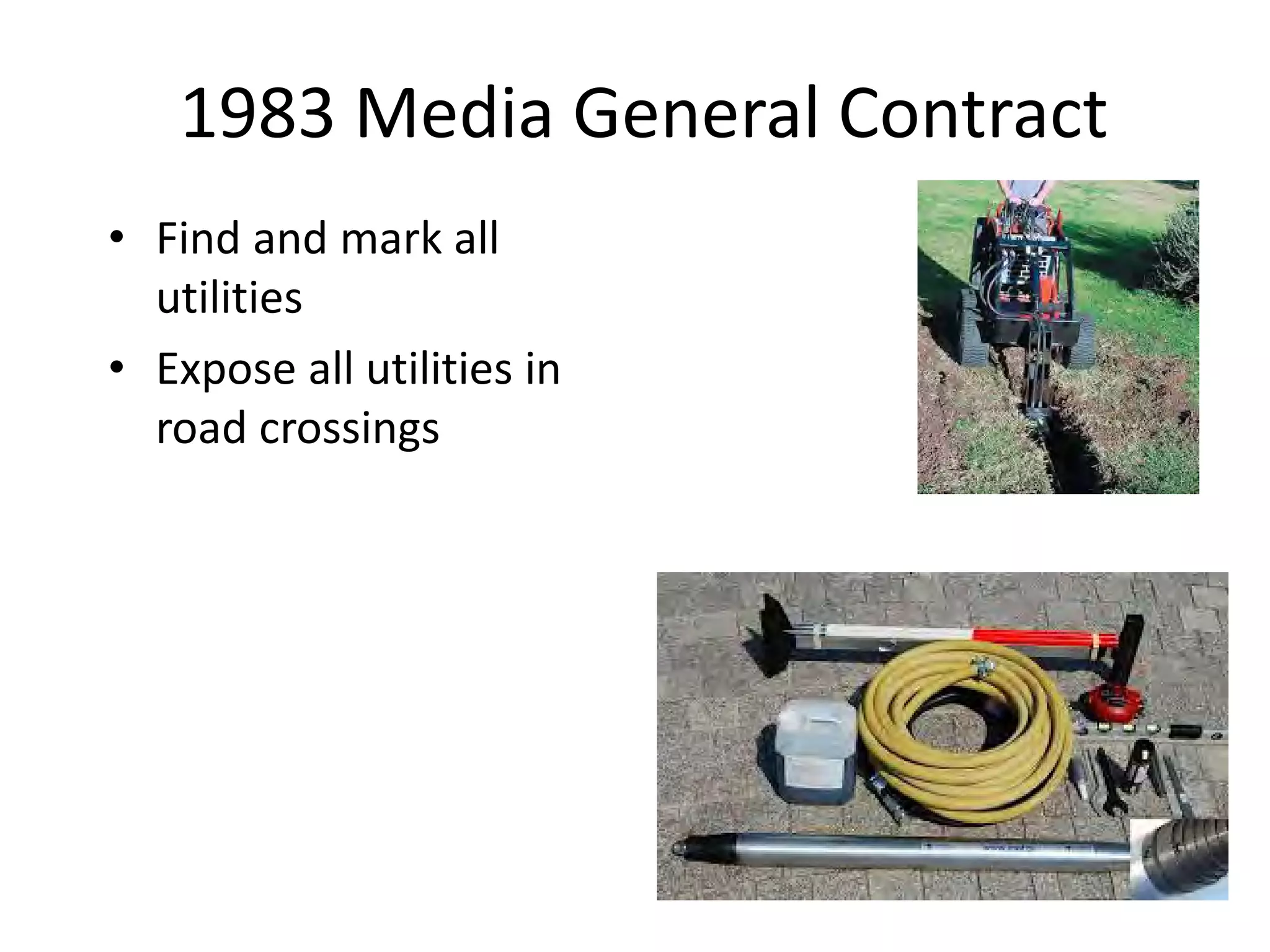
1983 Media General Contract
• Find and mark all
utilities
• Expose all utilities in
road crossings
1984 VDOT Project
• $1M in savings
reported to FHWA
• $7M in savings
reported “off-the-
record”
• Markings surveyed
by VDOT survey
crews
Significant Advances in SUE
• Integrated Survey (1985)
• WGL Union Stoppage (1986)
• MD WSSC “Seal” requirement (1987)
• CNA PL Insurance (1988)
• VDOT Court Case (1989)
• OR – 1st Design Ticket (in lieu of records)
• FHWA Road Trip and Trials (1991)
• “SUE” Association Talks Begin (1995)
• ASCE 38 started (1996)
UTILITY INVESTIGATION, LOCATION,
& DEPICTION STANDARDS
?
Standard for the Collection,
Administration, and
Exchange of Utility
Installation Information
(Utility “As-Builts”)
FIND EXISTING UTILITIES DOCUMENT NEW UTILITIES
“Engineer shall show utilities…”
Utility Investigations Vary:
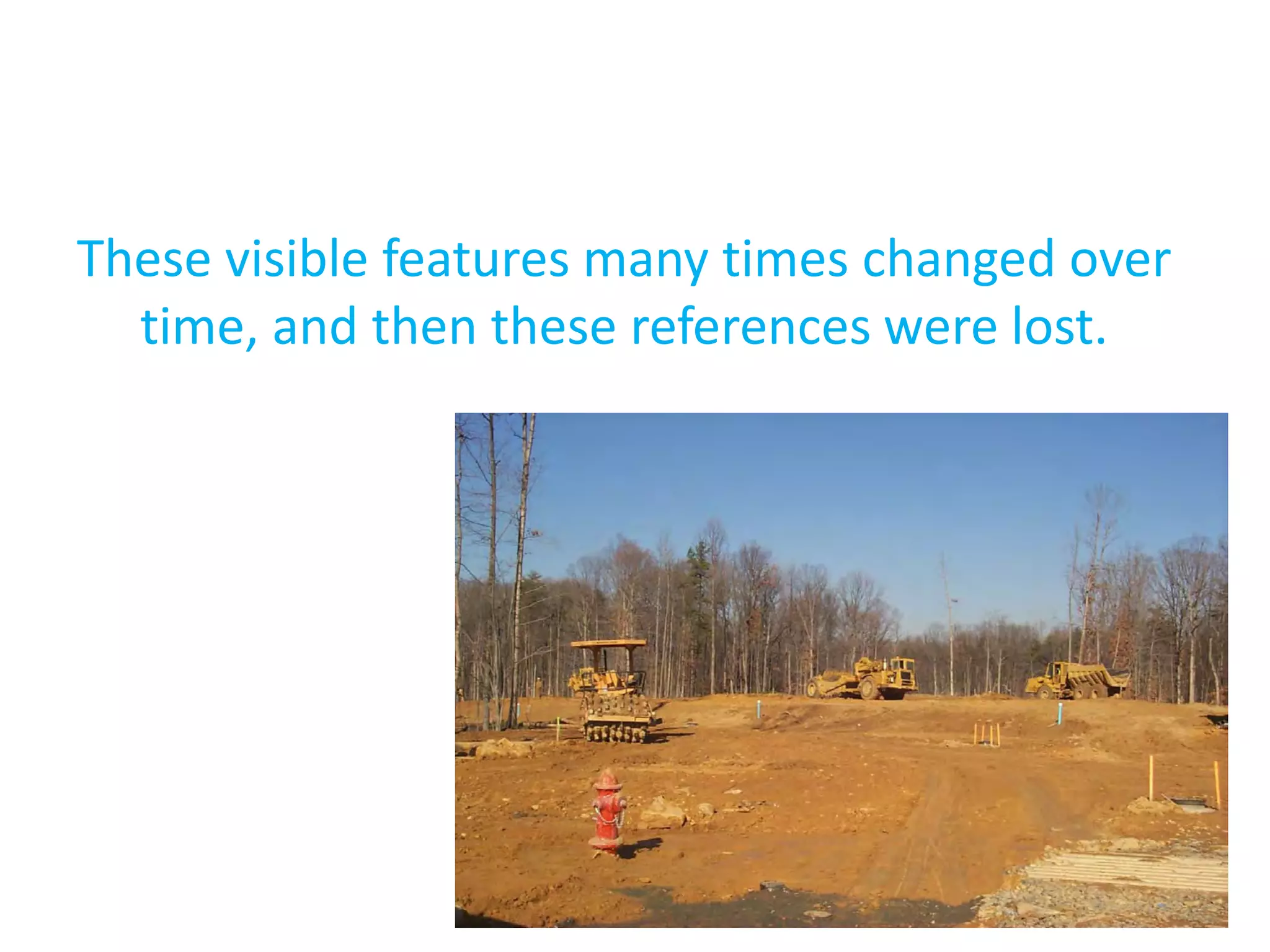
> Records
> Visual Correlations
> Surface Geophysics
> Exposures and
Certified Record
Drawings
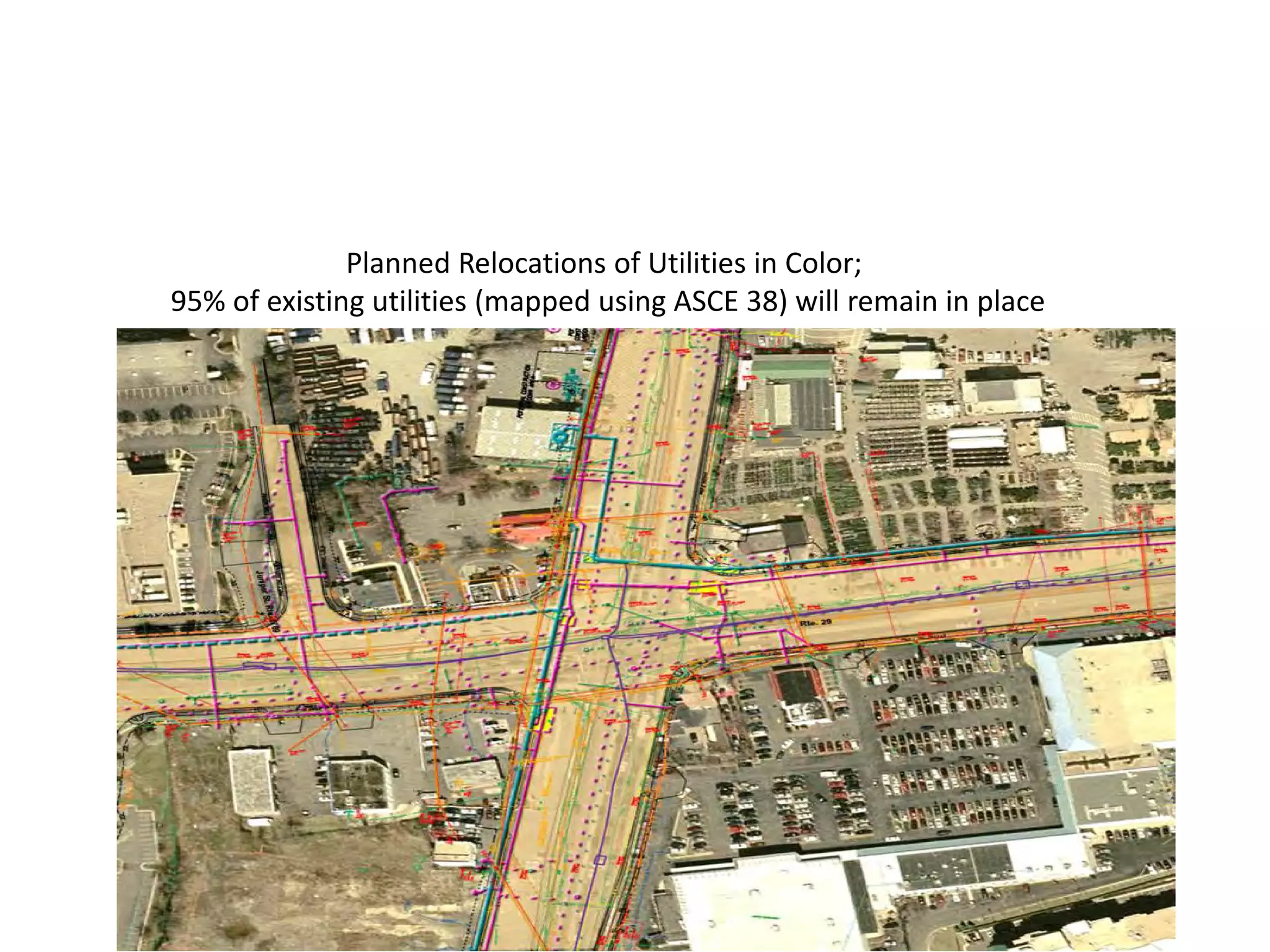
> Best Guess
But Depictions May Not:
> Utilities all shown on
the design plans the
same regardless of
method of
investigation.
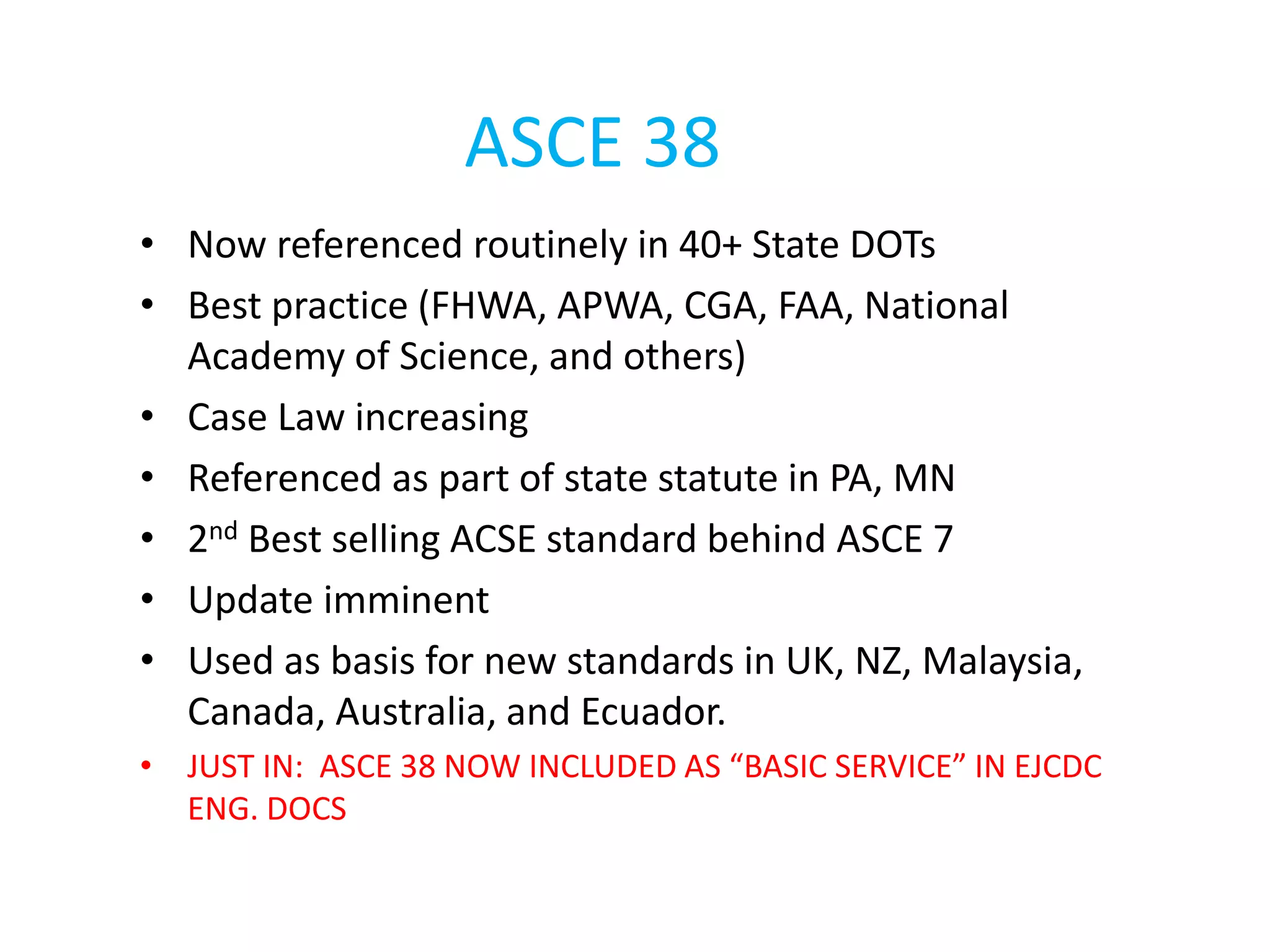
• Outlines specific steps for the engineer /
surveyor to take that result in increasingly
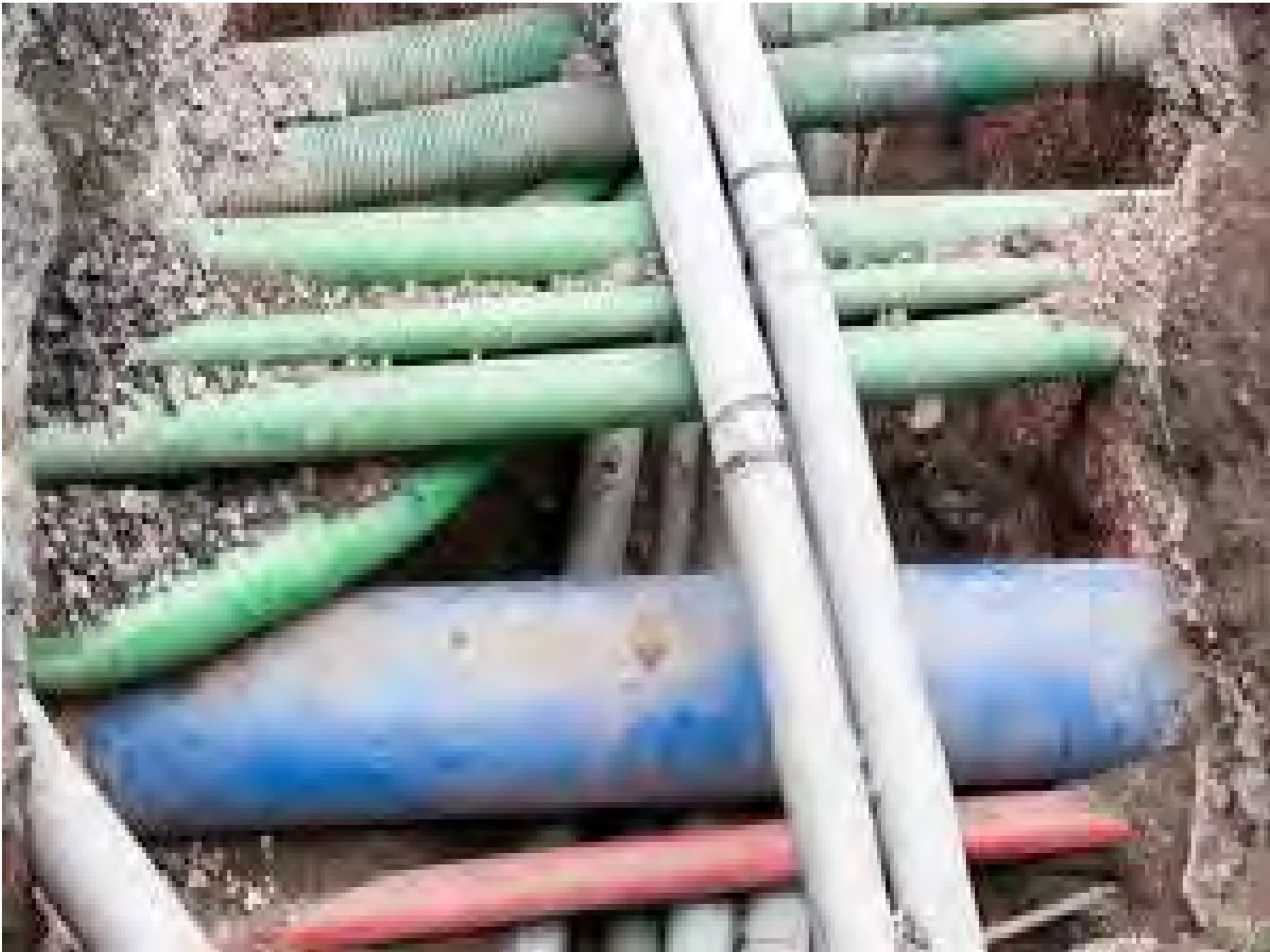
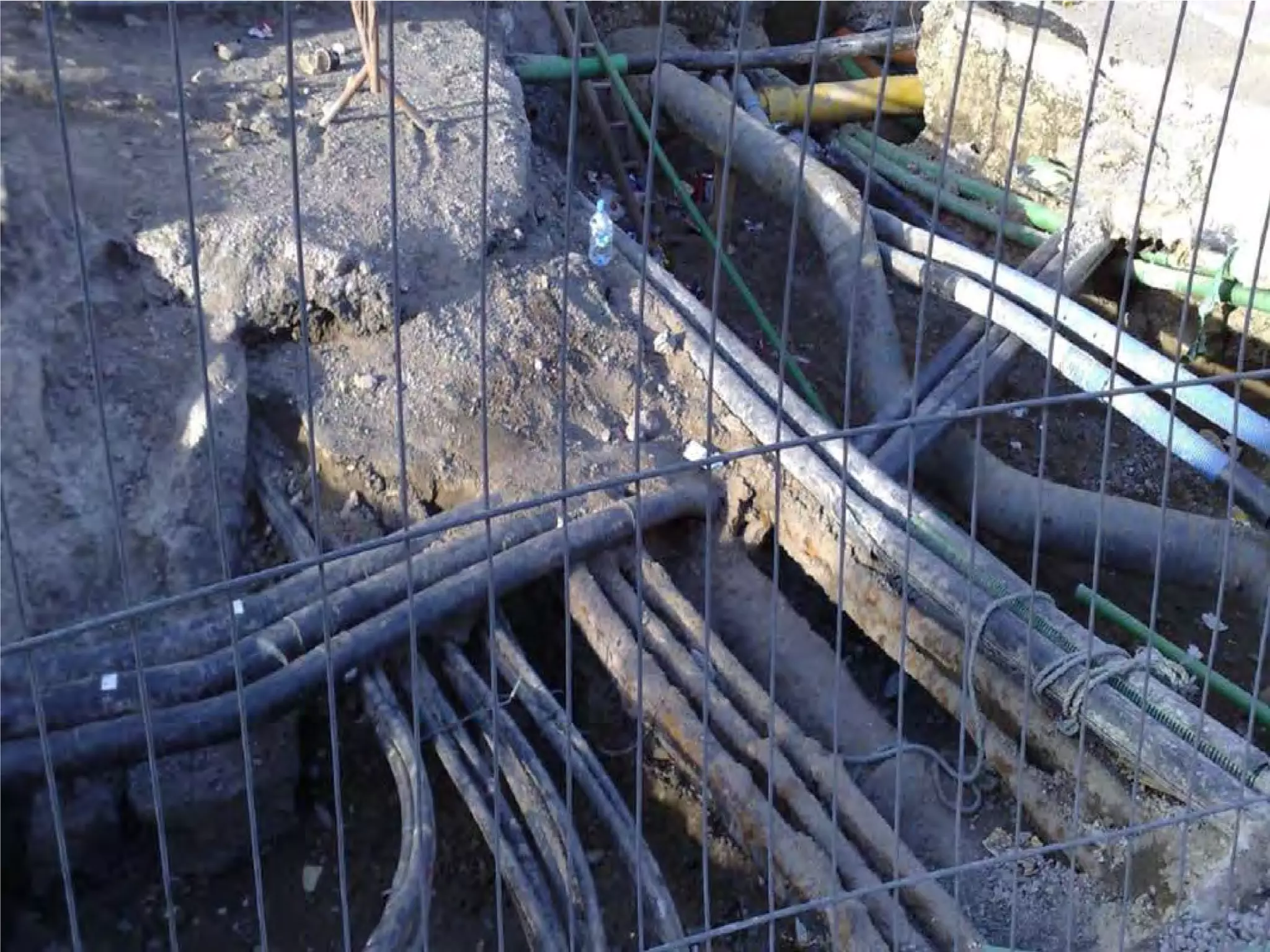
better utility mapping.
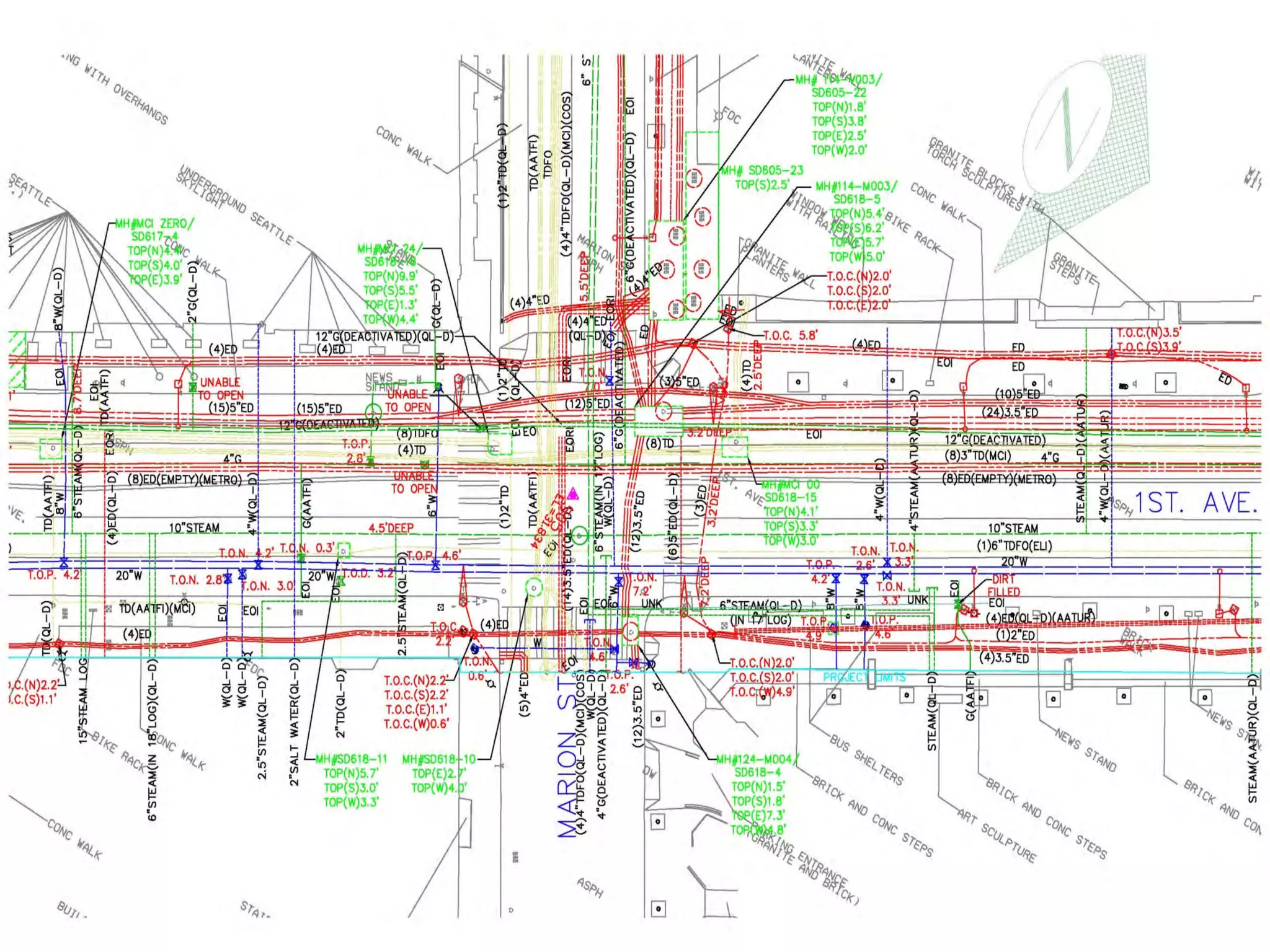
• Utilities as mapped are shown according to
their “Utility Quality Level” which allows all
parties to make better risk decisions.
• Use of Utility Quality Levels protects engineers
and surveyors
• Requires all utility mapping to be performed
under the direct responsible charge of a
registered professional, experienced in utility
issues, surface geophysics, survey, and
depiction methods
• Increasing usage across the country is
increasing its importance in cases where
standard of care is an issue.
ASCE 38
• Now referenced routinely in 40+ State DOTs
• Best practice (FHWA, APWA, CGA, FAA, National
Academy of Science, and others)
• Case Law increasing
• Referenced as part of state statute in PA, MN
• 2nd Best selling ACSE standard behind ASCE 7
• Update imminent
• Used as basis for new standards in UK, NZ, Malaysia,
Canada, Australia, and Ecuador.
• JUST IN: ASCE 38 NOW INCLUDED AS “BASIC SERVICE” IN EJCDC
ENG. DOCS
• To assist owners and engineers in developing an
unambiguous comprehensive scope of work
concerning collecting and depicting utility
information on documents
• To standardize how utilities are portrayed on
documents
• And most importantly, to standardize an attribute for
utility information that indicates its reliability and
quality (utility quality level attribute).
Purpose of the standard
• By Engineers – to make decisions on designing
around existing utilities versus relocating them and
to avoid redesign
• By Contractors – to determine construction bids and
excavation methods
• By Project Owners – to retain a reliable map for
future maintenance, security, or other needs
• By Courts – to allocate responsibility for errors and
omissions and damages
These utility quality levels are used
A Utility Quality Level (QL):
• Is about the means and methods used by engineers to
investigate and depict utility information on plans.
• There are four of them
• When using them, engineers protect themselves against
negligence claims
• They are risk and reliability-based; other stakeholders can
then use them to manage their project risks
• Plotted on plans from records.
• Sometimes a field visit - to look for utility indications on the site - is made.
• Sometimes “verbal recollections” are plotted.
This level of effort
is great for Project
Planning purposes,
utility “inventories,”
and very preliminary
utility relocation cost
estimates
The least reliable data“Quality Level D”
• Surface Appurtenances are surveyed and accurately plotted
on a current site plan
• Utility data from records (QL D) are correlated to the
appurtenances
“Quality Level C”
Problems with records
interpretations still exist: e.g.
schematics, no appurtenances
depicted, utilities not straight
between appurtenances, no
records exist, and so on.
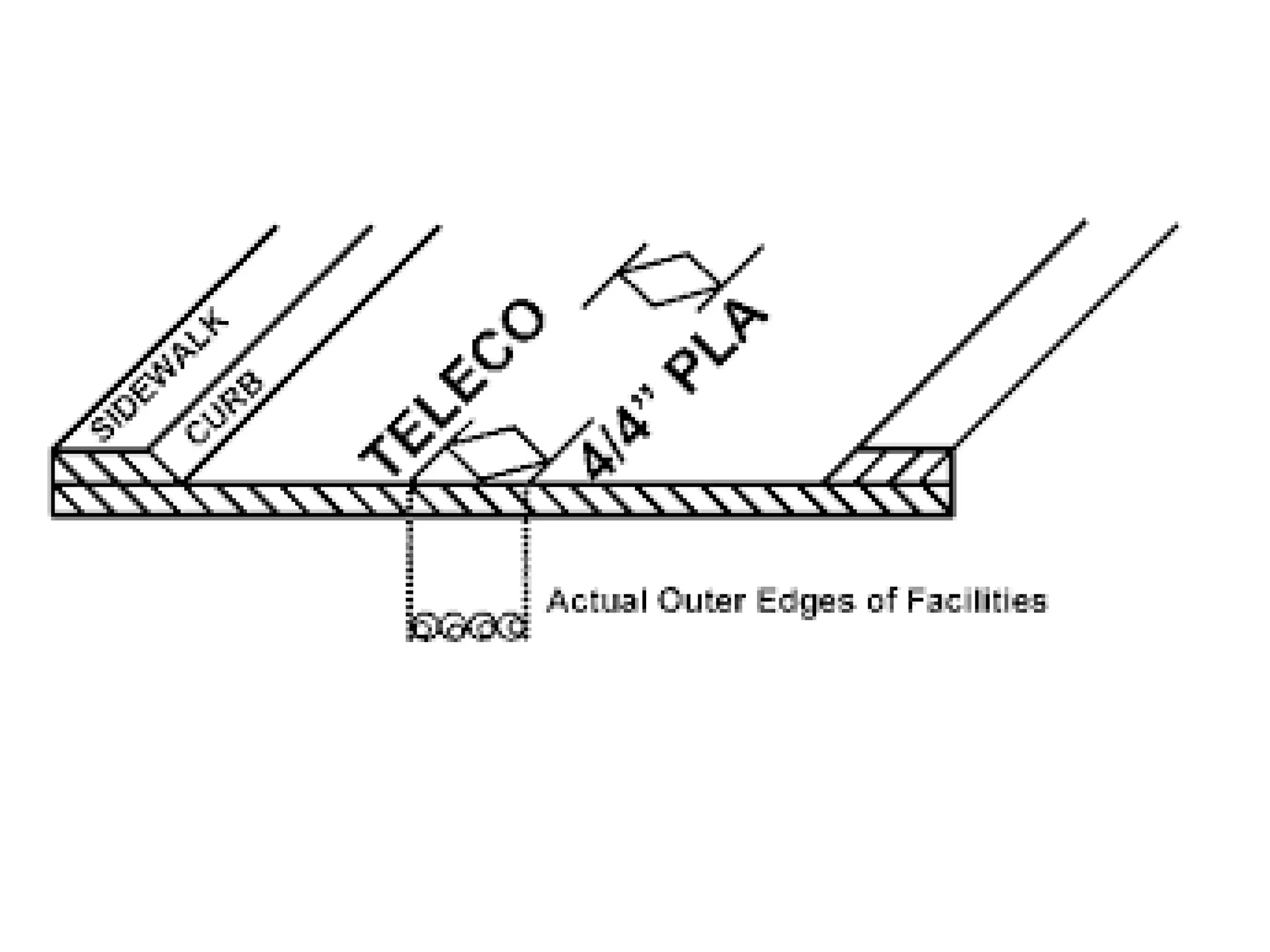
The “traditional” utility depiction
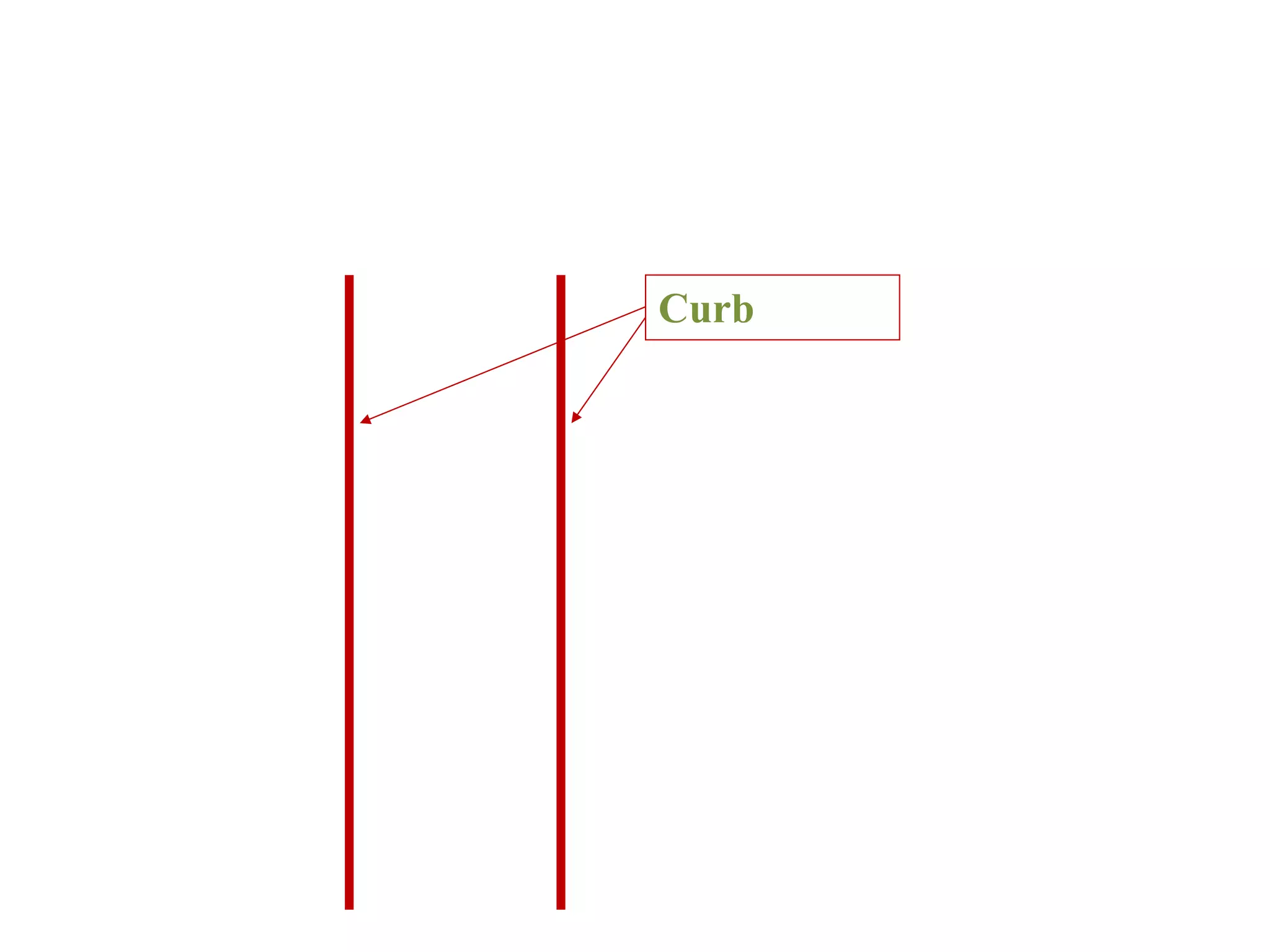
Curb
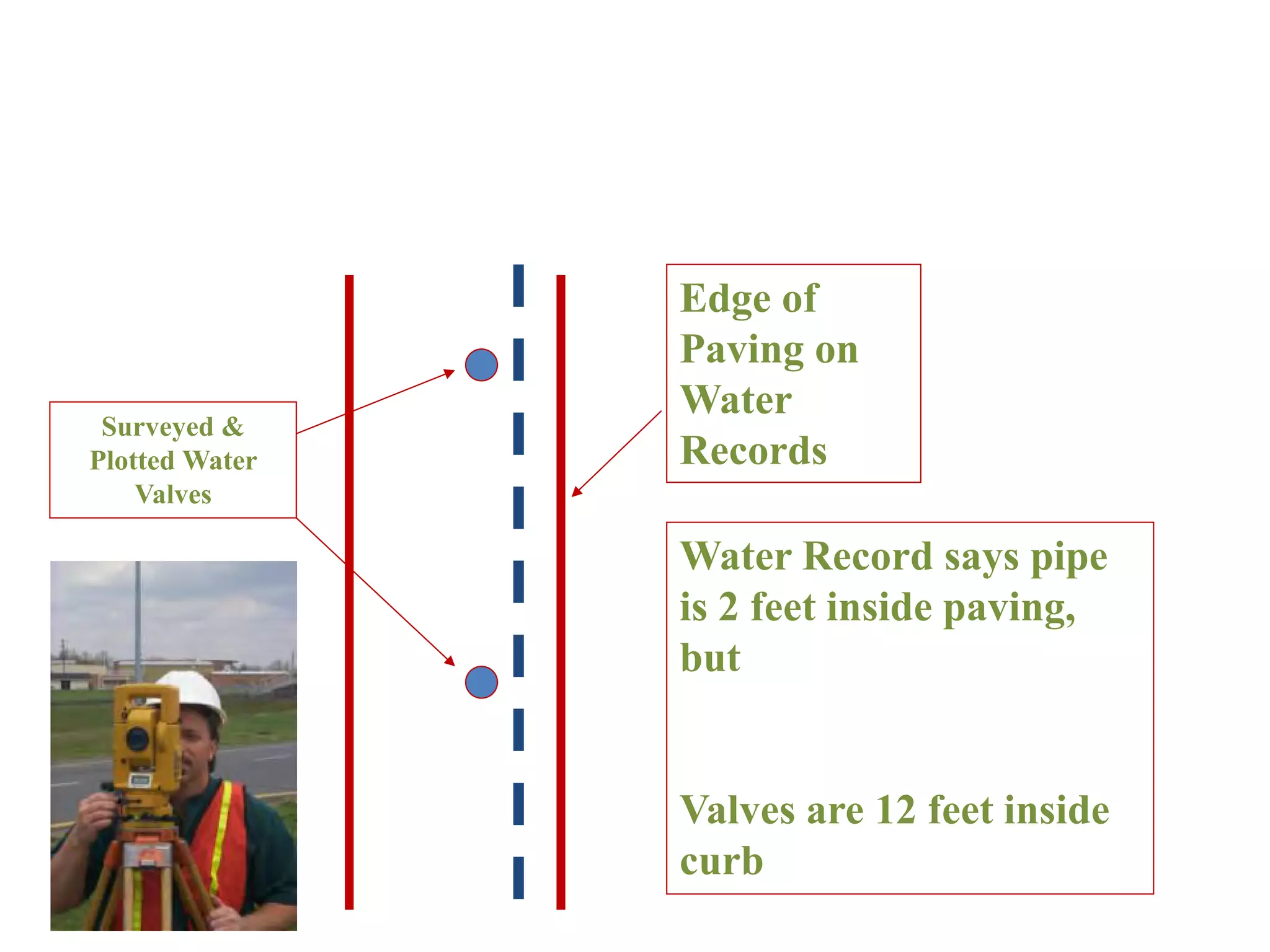
Edge of
Paving on
Water
Records
Water Record says 4”
pipe is two feet inside
paving
WATER RECORD
Water Record says pipe
is 2 feet inside paving,
but
Valves are 12 feet inside
curb
Surveyed &
Plotted Water
Valves
Edge of
Paving on
Water
Records
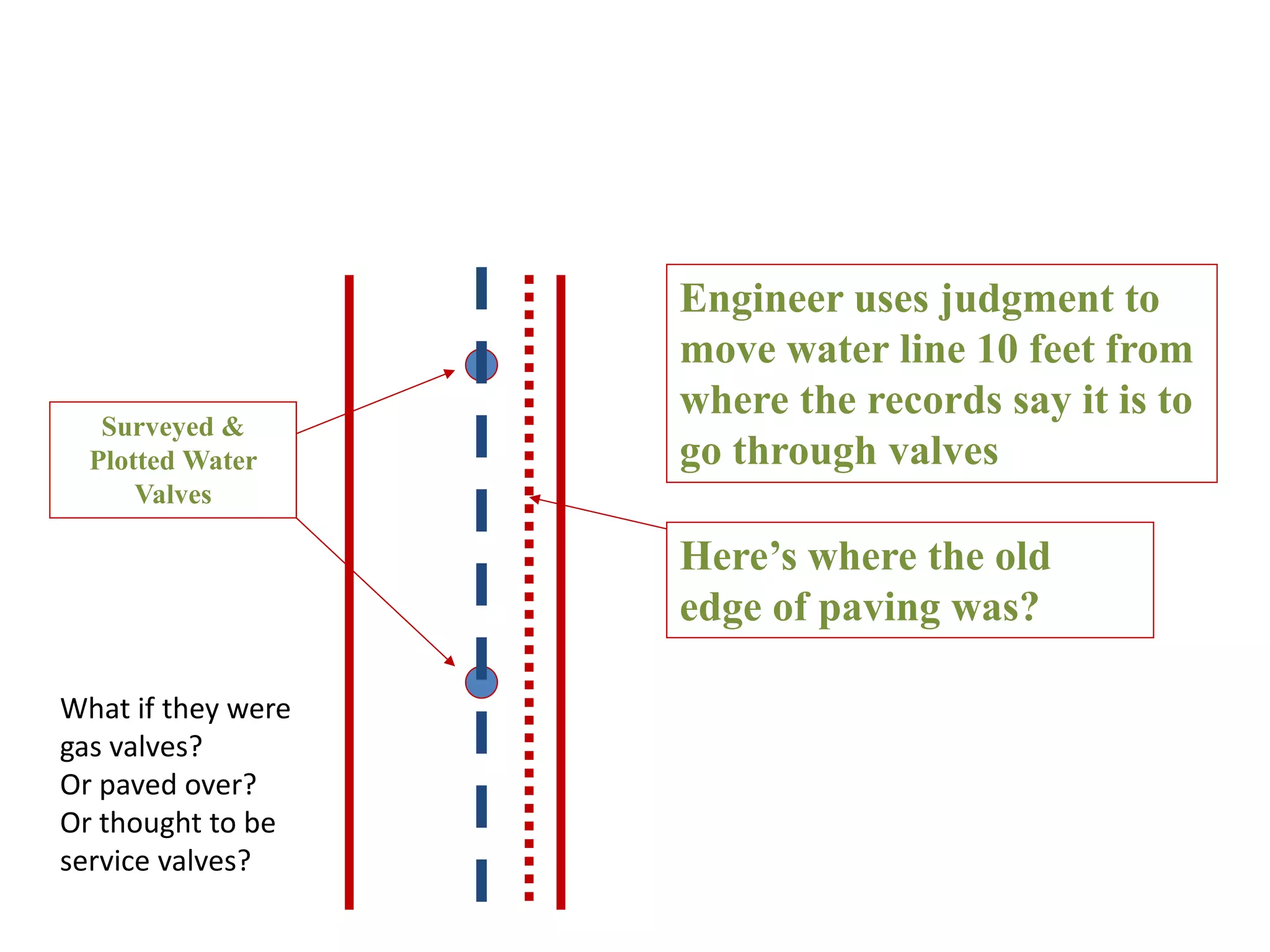
Here’s where the old
edge of paving was
Surveyed &
Plotted Water
Valves
Edge of Paving on
Water Records can’t
be determined using
visual evidence today.
Here’s where the old
edge of paving was?
Surveyed &
Plotted Water
Valves
Engineer uses judgment to
move water line 10 feet from
where the records say it is to
go through valves
What if they were
gas valves?
Or paved over?
Or thought to be
service valves?
Interpretation #2
Engineer responsible for
judgment - ∆ of 10’
Surveyed &
Plotted Water
Service Valves?
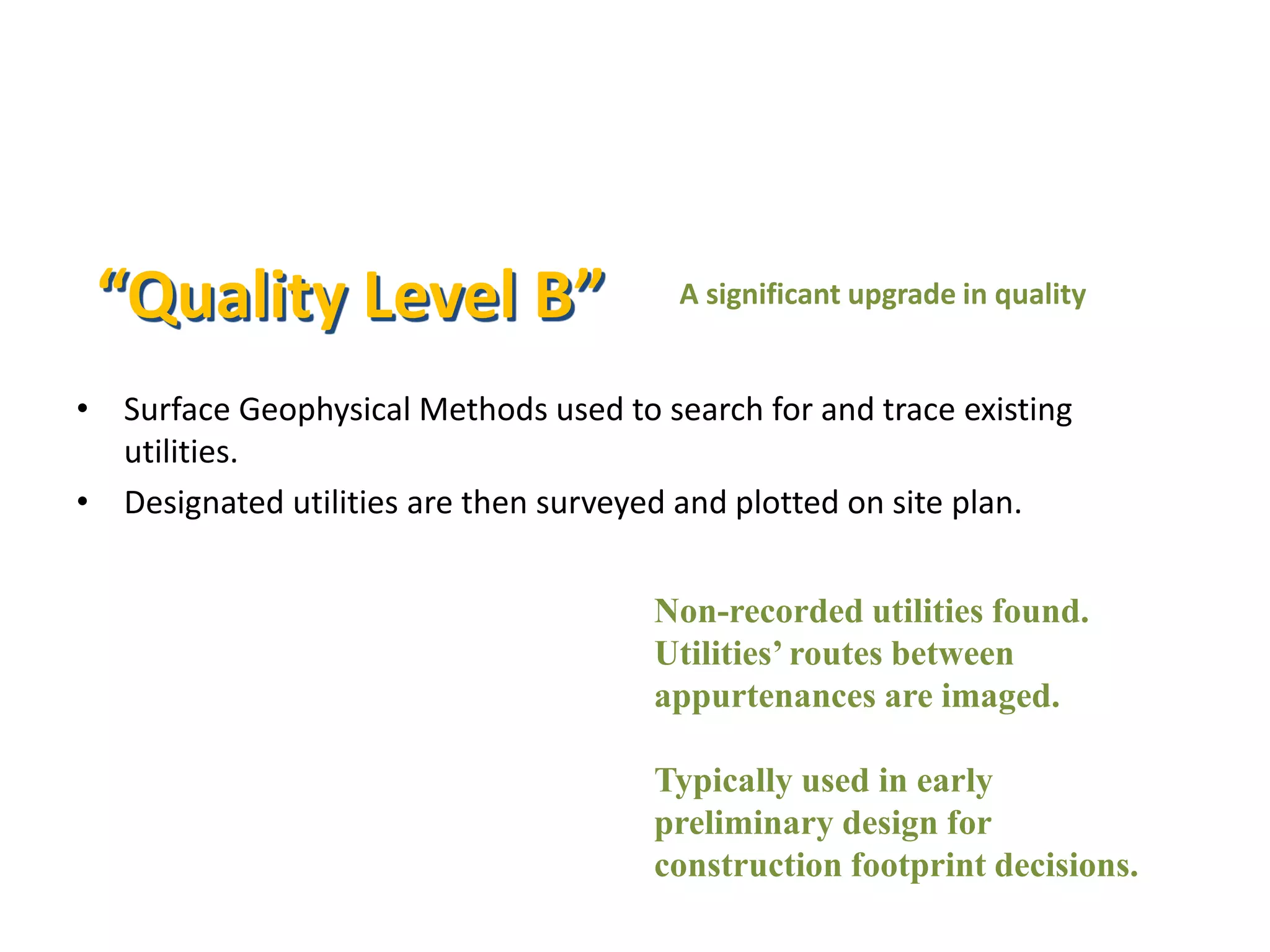
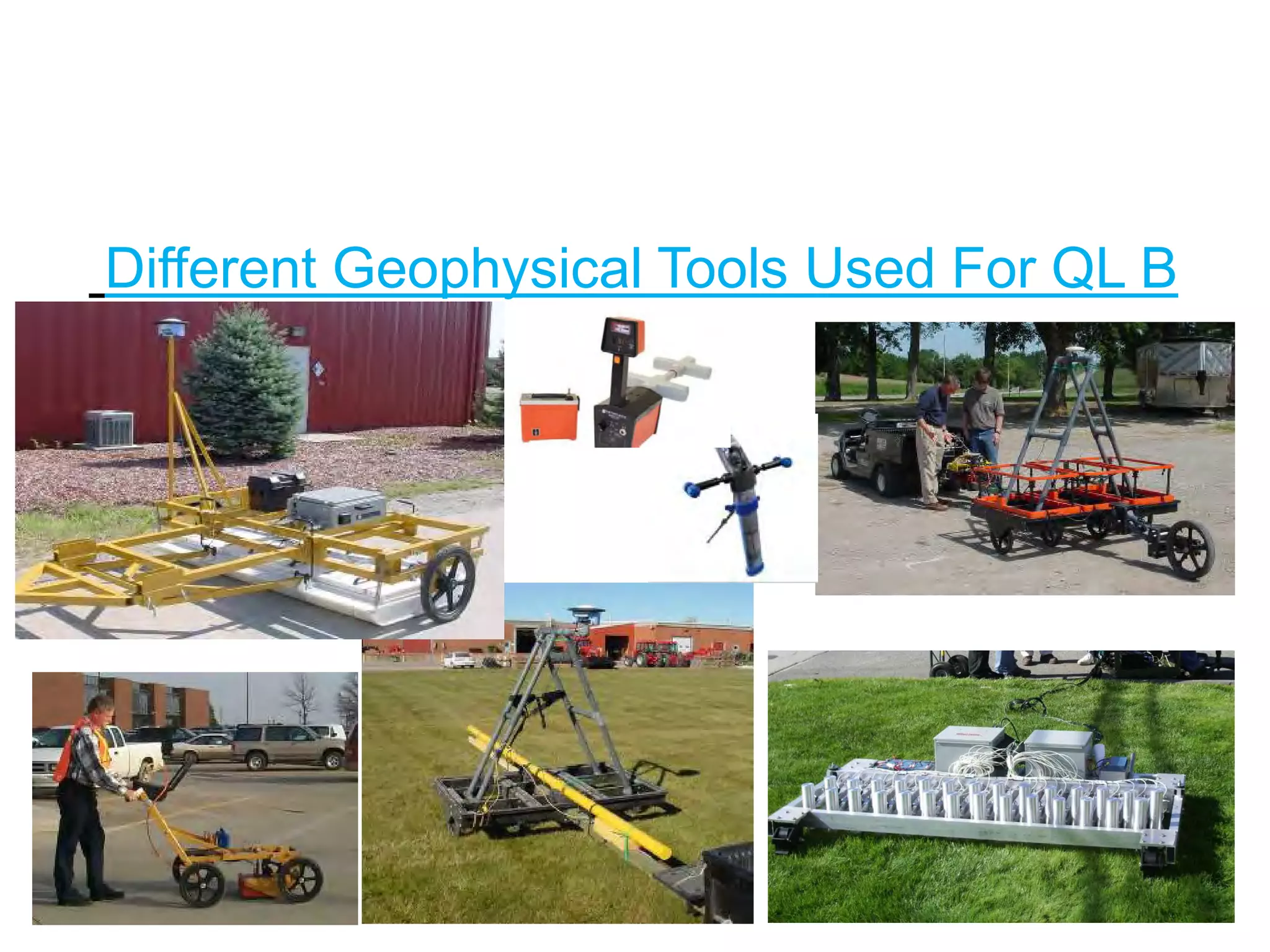
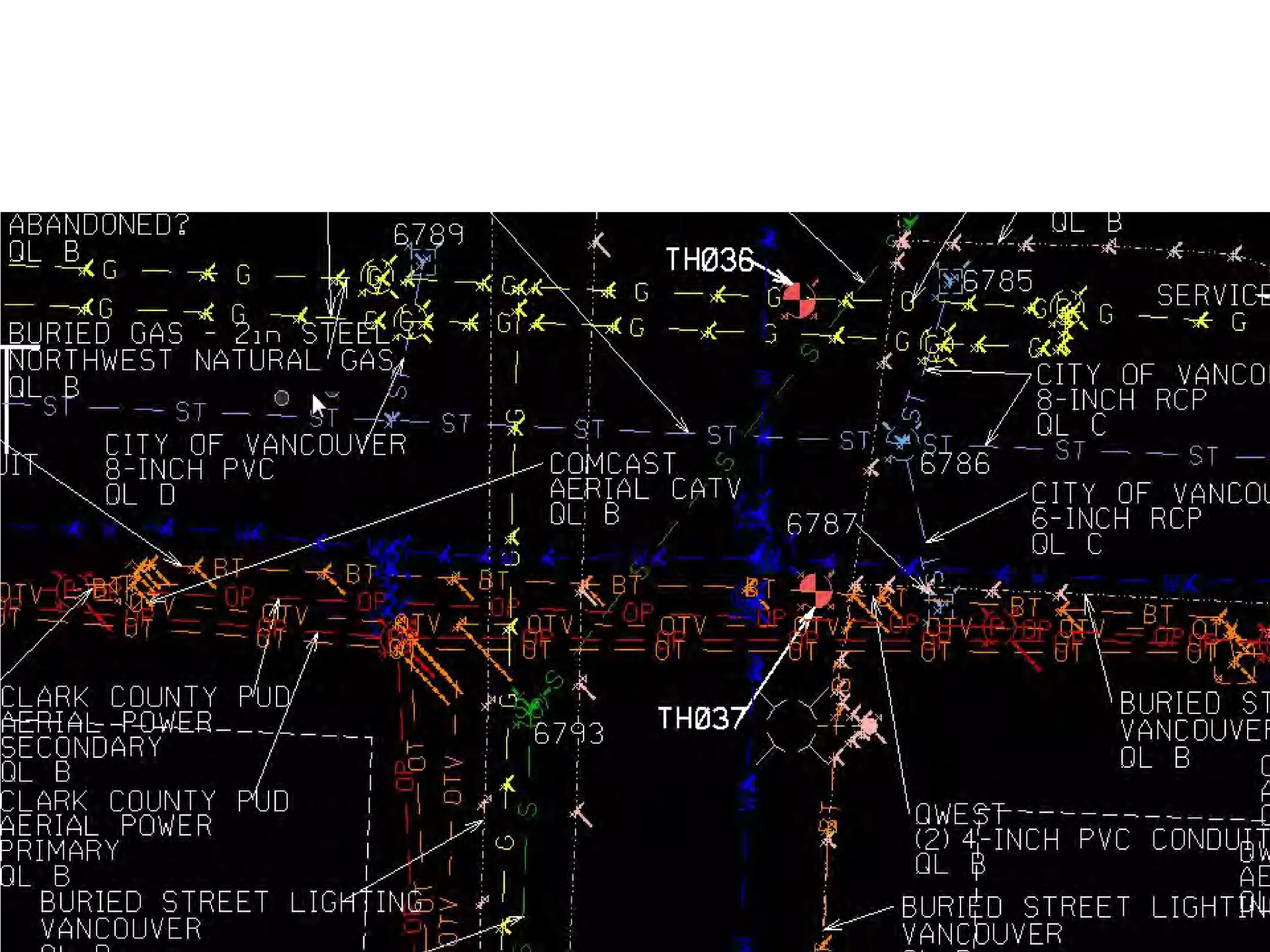
• Surface Geophysical Methods used to search for and trace existing
utilities.
• Designated utilities are then surveyed and plotted on site plan.
“Quality Level B”
Non-recorded utilities found.
Utilities’ routes between
appurtenances are imaged.
Typically used in early
preliminary design for
construction footprint decisions.
A significant upgrade in quality
Water Record says pipe
is two feet off of curb.
Designating indicates
otherwise.
QL D and QL C interpretations
by engineer were significantly
wrong
Abandoned section of water line
Unknown Non-recorded
Utility
Different Geophysical Tools Used For QL B
Geophysics Analogy – Medical Imaging
• Most studied object in
history
• Consists of widely different
materials
• Research into imaging in the
billions of dollars for CAT,
Ultrasound, MRI, etc.
• Highly controlled imaging
environment
• Great records
• No one method works for
everything
• Exploratory surgery still
common
• Highly trained interpreters
of data
• Utilities exposed via non-destructive air-vacuum means
• Exposed utilities are then surveyed and plotted on site plan
Elevations, Size, Condition, Materials, Precise Horizontal Positions
are measured and documented
“Quality Level A”
Typically used in final
design stages. Allows
small adjustments in
design for big savings
in construction
A Guarantee in 3-D
Ground
surface
Water line found at
CL Station 23+40, L10
to be 6 3/4” in diameter and
5.56’ deep, slightly corroded
and cast iron rather than
ductile
Where to
Dig?
Technology can’t overcome poor procedures
Love Canal faux pas:
Test holes before Geophysics
• First six
exploratory
boreholes at Love
Canal
• Geophysical map of
the dump site
• ALL SIX HOLES
MISSED THE
TARGET!
The end result is a map suitable for current needs, and retrievable for
future needs, with the reliability of the utilities clearly indicated
The total risk for the engineering pool decreases as quality level increases,
while within the engineering pool, The risks shift towards the subsurface utility
engineer as quality levels trend towards QLA data
DESIGN
ENGINEER
Without SUE With SUE
TOTAL RISK
RISK ELIMINATED
SUE
ENGINEER
D C B A
DEFINED QUALITY LEVELUNDEFINED QUALITY LEVEL
TOTAL ENGINEERING RISK POOL ALLOCATION OF RISK
WITHIN ENGINEERING POOL
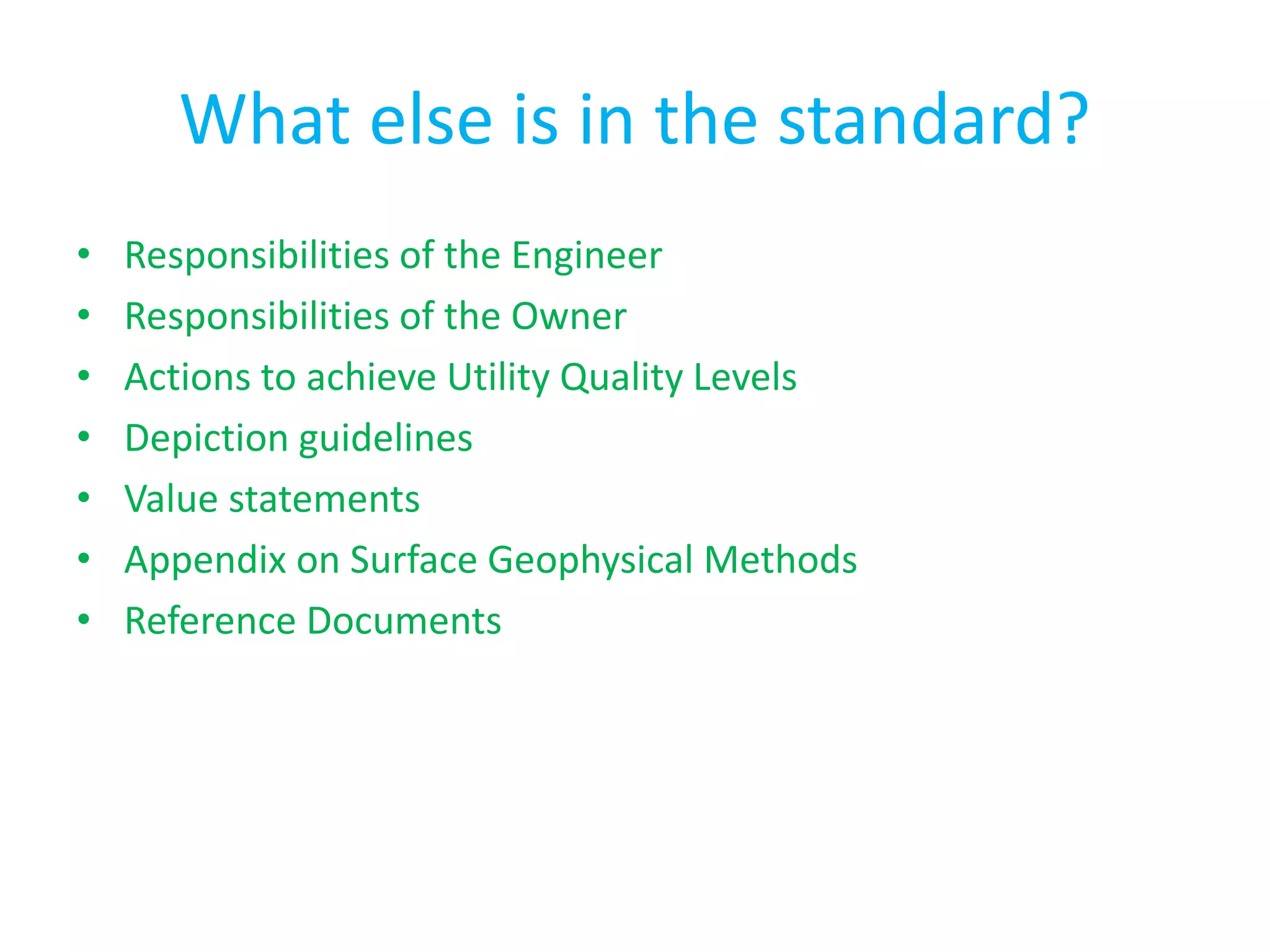
What else is in the standard?
• Responsibilities of the Engineer
• Responsibilities of the Owner
• Actions to achieve Utility Quality Levels
• Depiction guidelines
• Value statements
• Appendix on Surface Geophysical Methods
• Reference Documents
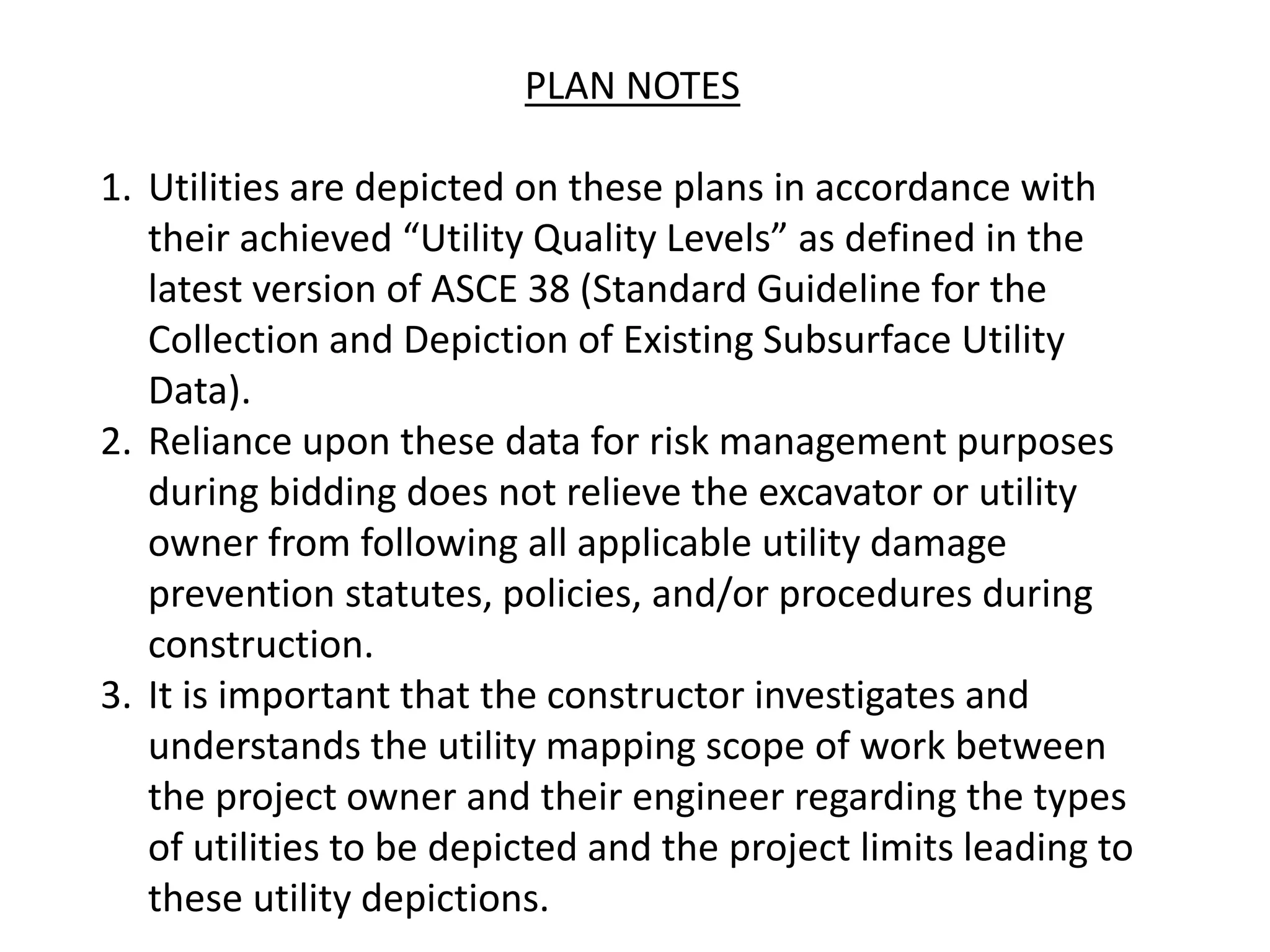
PLAN NOTES
1. Utilities are depicted on these plans in accordance with
their achieved “Utility Quality Levels” as defined in the
latest version of ASCE 38 (Standard Guideline for the
Collection and Depiction of Existing Subsurface Utility
Data).
2. Reliance upon these data for risk management purposes
during bidding does not relieve the excavator or utility
owner from following all applicable utility damage
prevention statutes, policies, and/or procedures during
construction.
3. It is important that the constructor investigates and
understands the utility mapping scope of work between
the project owner and their engineer regarding the types
of utilities to be depicted and the project limits leading to
these utility depictions.
How do you achieve a utility quality level ?
Quality Level D: Plotting from record
information
> Records research. How much?
> Is calling the One-Call adequate?
> Is a site visit necessary to look for utility
signs or appurtenances?
> Do I need to plot everything for which
there is a record? (e.g. individual
services, traffic control sensors?)
> What if there is an indication of a utility,
but no record?
How do you achieve a utility quality level ?
Quality Level C: Correlation of records to surveyed
features / utility appurtenances
> Is using someone else’s survey of utility features
OK?
> How many surveyed features are required to call a
long run of utility Quality Level C?
> When does a Quality Level C line need to revert to
Quality Level D?
> Do I need to plot everything for which there is a
record? (e.g. individual services, traffic control
sensors)
> What if there is an surveyed utility feature, but no
record?
How do you achieve a utility quality level ?
Quality Level B: Geophysics + Survey
> Is using someone else’s survey of utility marks
OK?
> What geophysics should I use?
> Do I search for a specific utility, or for
everything?
> How do I handle signals that are unknowns?
> How do I handle gaps in geophysical signals?
> What level of effort do I need to go to if I can’t
find a utility of record?
> Do I need to get into all the manholes and
vaults?
> To what Accuracy am I held responsible?
How do you achieve a utility quality level ?
Quality Level A: Exposure + Survey
> Does it matter what I use to excavate?
> What if I don’t find anything?
> How deep should I go?
> What if I find something different than I
thought was there?
> Can I trust someone else to survey my
patch and record the data?
> Do I need to convert to an elevation?
> To what accuracy am I held responsible?
> Water vs. Air vacuum?
ASCE
ACEC
NSPE
CSI
NUCA
ABA
AWWA
AIA
CMAA
ACSM
WWEMA
IMLA
USDA
XL
VOSCO
Engineering Series Contracts
Owner-Engineer
Engineer – Sub-Consultant
Engineer – Geotechnical Firm
Engineer - Surveyor
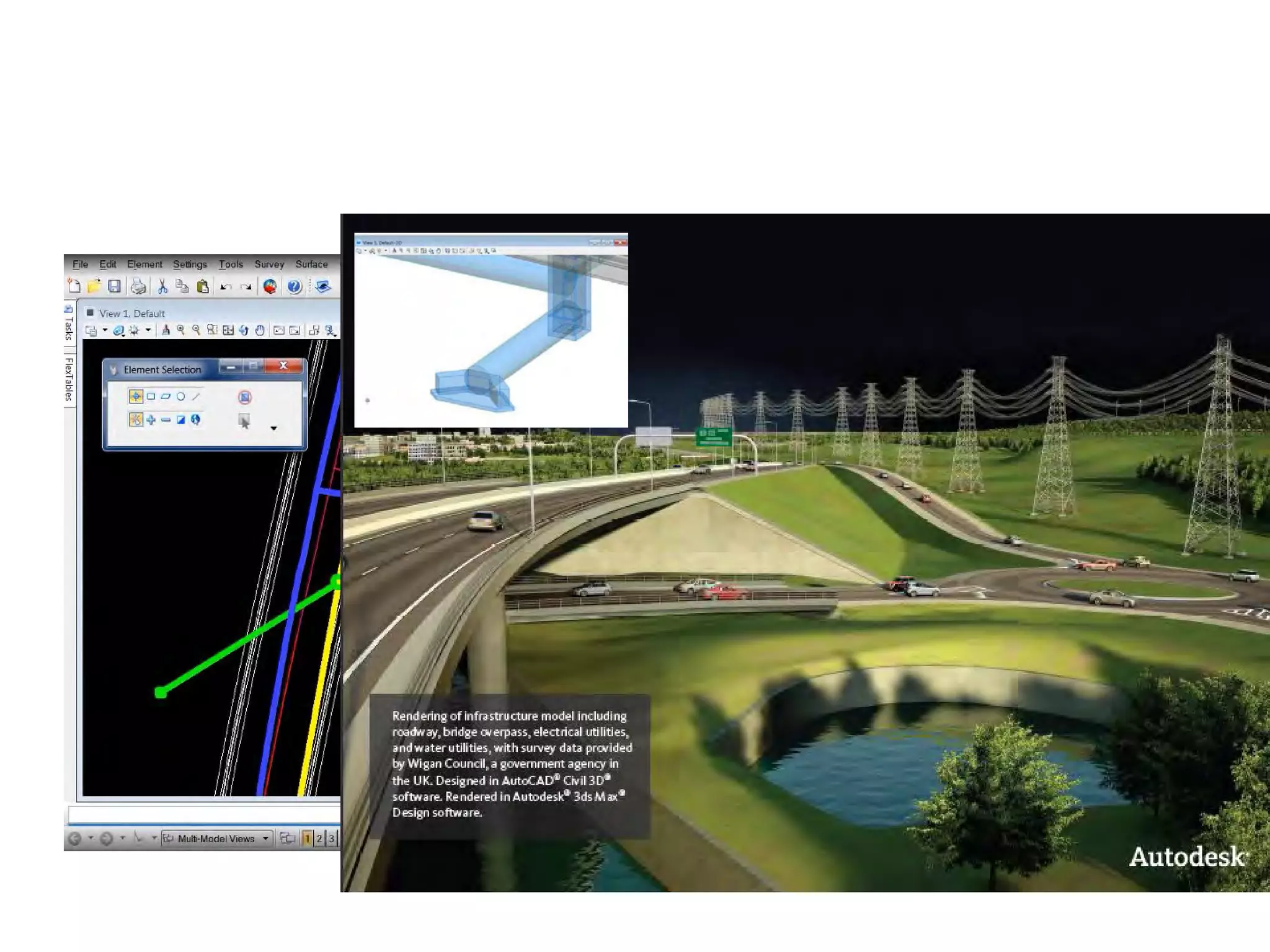
3D Model of Existing Facilities
3D Mapping and Marking of Underground
Utilities during Project Development and
Delivery
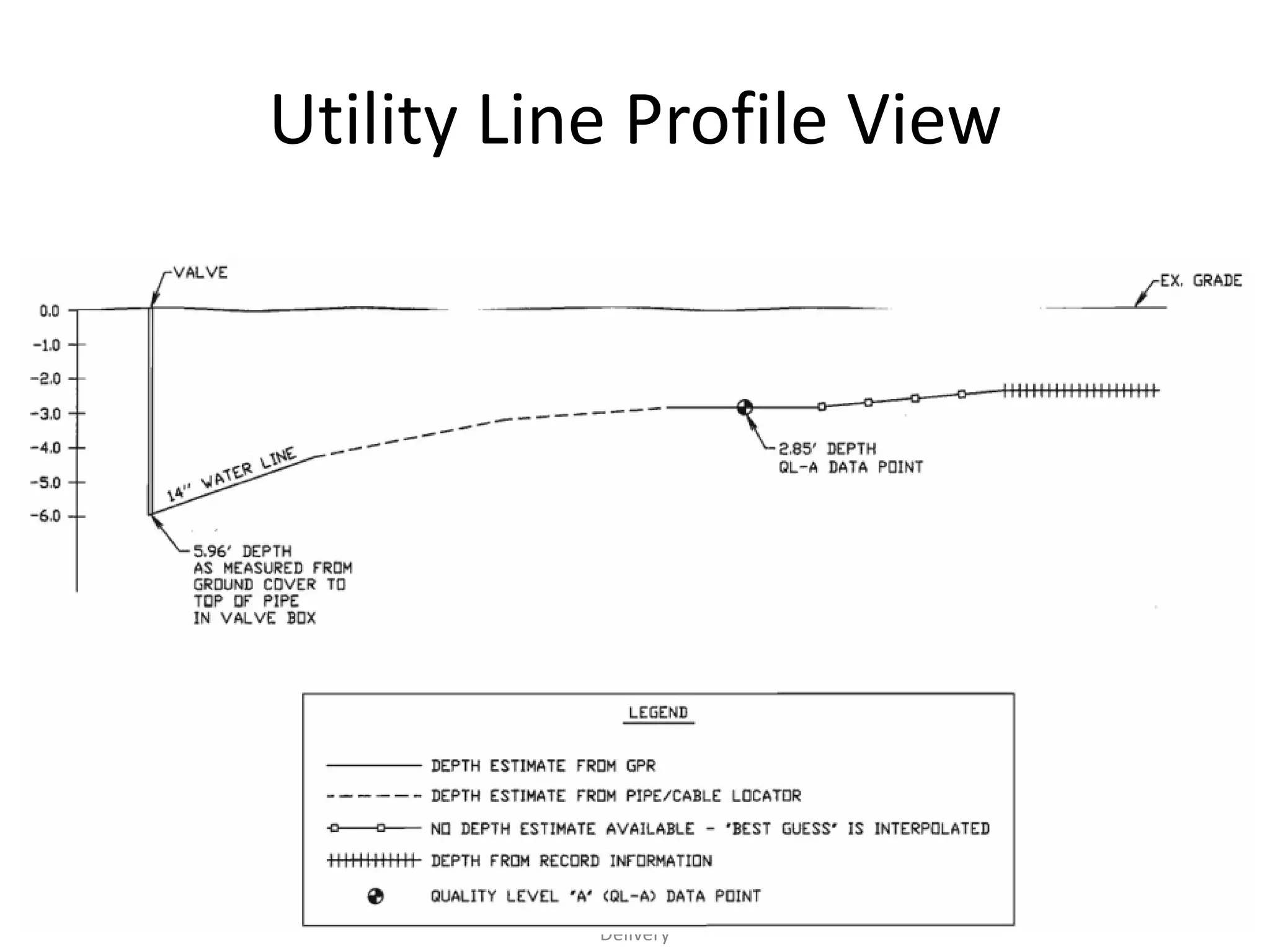
Utility Line Profile View
3D Mapping and Marking of Underground
Utilities during Project Development and
Delivery
87
3D Mapping and Marking of Underground
Utilities during Project Development and
Delivery
88
3D Mapping and Marking of Underground
Utilities during Project Development and
Delivery
89
Locations with QLA Data
3D Mapping and Marking of Underground
Utilities during Project Development and
Delivery
90
Test hole Test hole
Valve
Manhole
Assumed Curved Pipe Alignment
3D Mapping and Marking of Underground
Utilities during Project Development and
Delivery
91
Test hole Test hole
Valve
Manhole
Assumed Straight Pipe Alignment
3D Mapping and Marking of Underground
Utilities during Project Development and
Delivery
92
Test hole Test hole
Valve
Manhole
Assumed Horizontal Interpolation
3D Mapping and Marking of Underground
Utilities during Project Development and
Delivery
93
Test hole Test hole
Valve
Manhole
3D Model Including Utilities
94
ATTRIBUTES
Quality Level
Method of “z” value
Starting elevation
Ending elevation
Size
Material
Owner
Condition
Age
Pressure
3D Utility Visualization – Ireland
3D Mapping and Marking of Underground
Utilities during Project Development and
Delivery
95
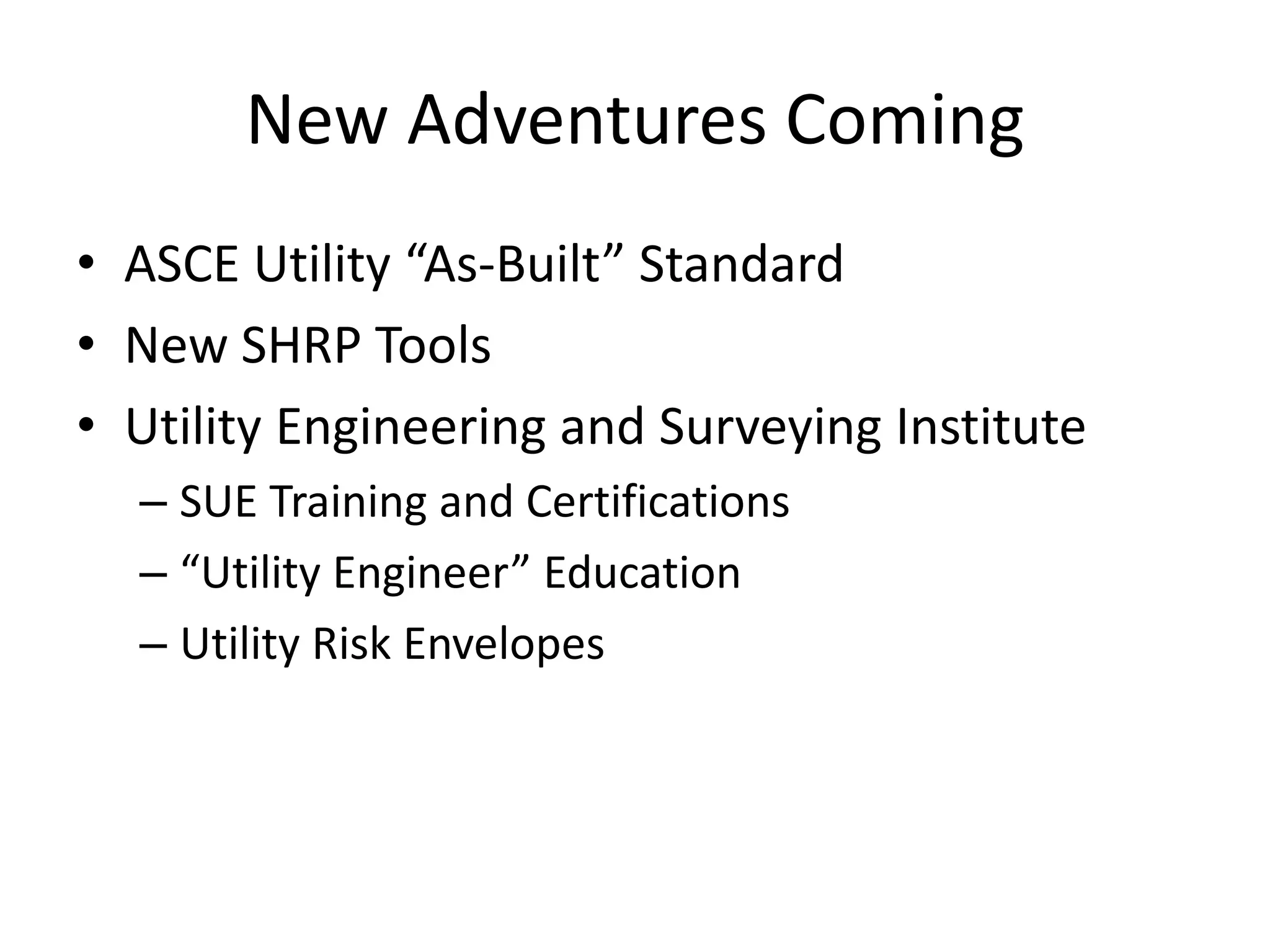
New Adventures Coming
• ASCE Utility “As-Built” Standard
• New SHRP Tools
• Utility Engineering and Surveying Institute
– SUE Training and Certifications
– “Utility Engineer” Education
– Utility Risk Envelopes
The Need for Utility As-Built Standardization
Who Creates Utility Records?
• State DOT utility engineer
• State DOT survey section
personnel
• State DOT Property Department
• Railroad Companies
• DOT traffic Department
• Design or Planning Consultant
hired by the state
• Survey consultant hired by the
state
• State One-Call Center
• Utility company records personnel
• Utility company engineering
personnel
• State DOT maintenance personnel
• Utility company “locators”
• Utility company “contract locators”
• Private industry “private utility locators”
• State construction inspectors
• Utility company construction inspectors
• State consultants for construction
inspection
• Utility company consultants for
relocation design
• State utility design or relocation
designers
• Municipal engineers or their consultants
• Municipal GIS departments
• Federal Aviation Administration (FAA),
Corps of Engineers, military, industrial,
and other utility owners
• Federal Highway Administration (FHWA)
• Subsurface utility engineering
consultants
Locational references were tied to existing visible features like sides of
roads or building edges or other utilities.
These visible features many times changed over
time, and then these references were lost.
Accurate and precise location data are valuable, but the costs of
acquiring and managing such data were historically out of reach
Why didn’t we accurately document utilities as
they went in the ground?
We believed that the existing references
(buildings, trees, road edges) would
be in place forever.
We did not contemplate keeping these
same utilities in service for the many
years that we have.
We did not have technology that cost
effectively allowed us to survey the
utility locations to a more
permanent datum.
The technology that we did have was
expensive and limited to the use of
highly trained and paid professionals
We did not contemplate the expensive
and risky situations that digging into
utilities would create.
Higher pressures and voltages, more
fragile materials, and
environmentally unfriendly products
were not anticipated at the time of
installation.
We could not imagine the cost of
moving a utility as we needed more
road space.
ASCE 38 deals with Legacy Data, mostly in the stages of
Planning & Design within Project Development.
Standard for the Collection,
Administration, and Exchange
of Utility Installation Information
(“As-Built” Records)
This standard will deal with mostly new data, mostly
in the construction stages of Project Development.
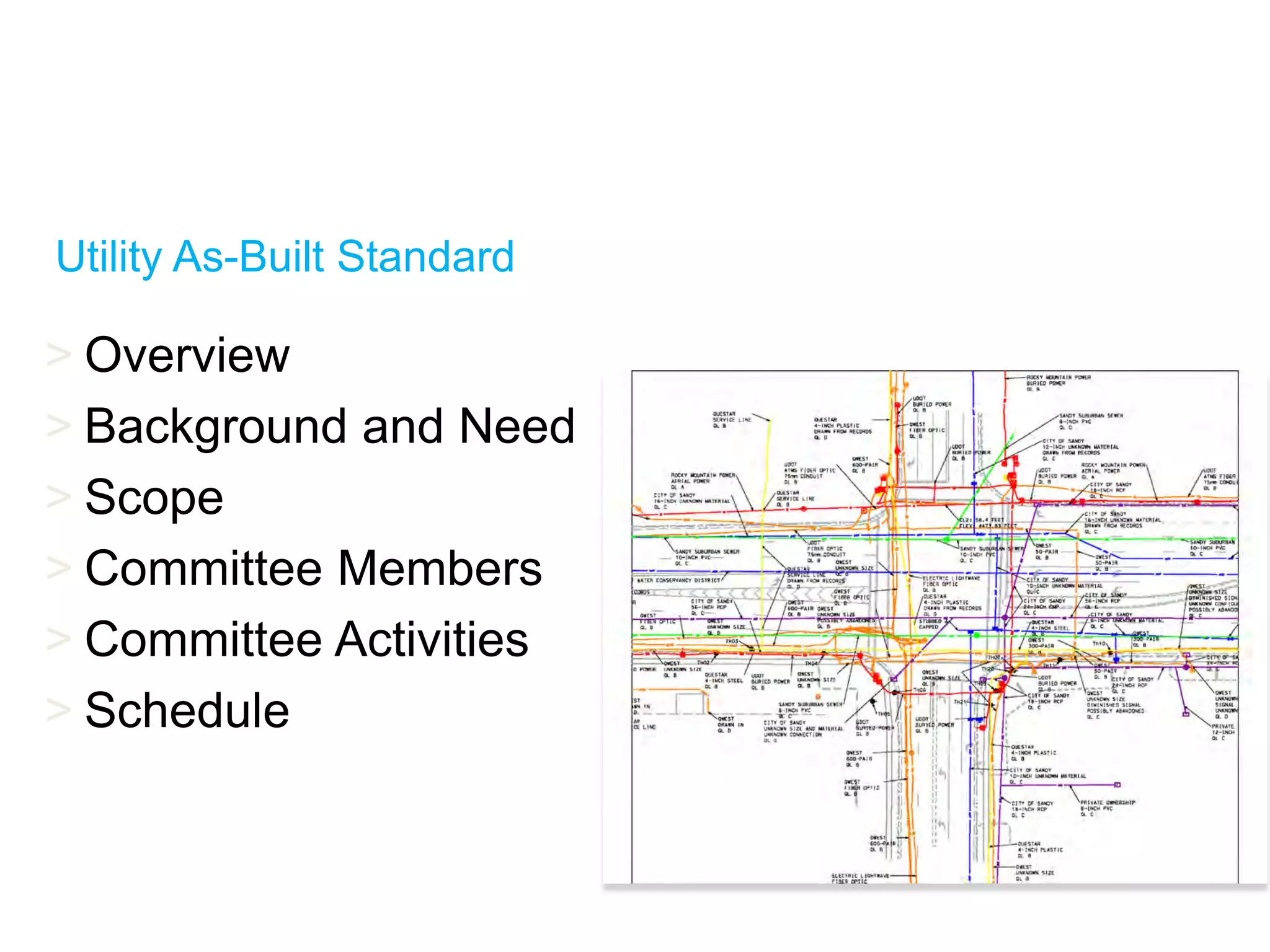
Utility As-Built Standard
> Overview
> Background and Need
> Scope
> Committee Members
> Committee Activities
> Schedule
Planned Relocations of Utilities in Color;
95% of existing utilities (mapped using ASCE 38) will remain in place
Background
• Nearly all agencies granting permits
mandate permittees (i.e., facility owners)
to provide upon request “accurate”
utility record information for permitted
installations.
• Not all agencies, however, have a
standard process for acquiring or a
standard format for submitting the
information.
Background
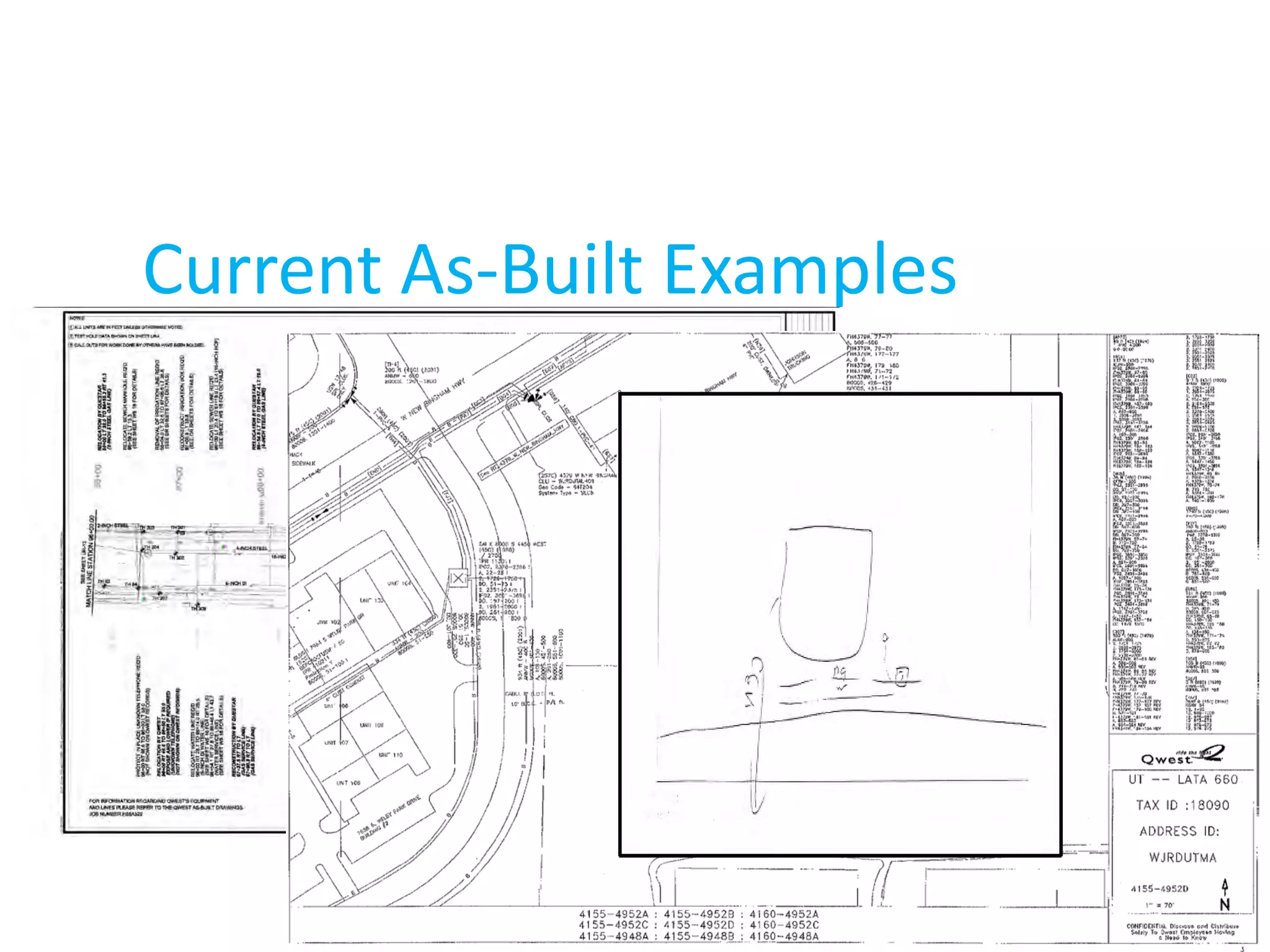
Accordingly utility records are largely:
• at an inventory / schematic level
• not tied to a common spatial datum
• of inconsistent quality and content
• in formats often incompatible for sharing or
referencing into CADD or viewing platforms
commonly utilized by agencies in charge of
granting easements and managing the
properties through which these easements
pass
Current As-Built Examples
What’s Changed?
Population growth
Public preference for buried cables
Utility deregulation
Rise in internet usage and dependence
• e-commerce boom
• cloud data management
Web Use
• eCommerce
• Banking, Securities, Stocks
• Business Ops (Accounting, email, file)
• News, Entertainment, Social Networking
• Telecommunications / Cellular Services
• Advertisement / Marketing
• GPS-Map / GIS Services
• Education
• Data Management Services
New Construction
> In U.S., over 50,000 miles of new gas pipeline per year
due to shale gas
> In U.S., 250,000 miles of new tel-com cables per year
> In U.S., 850,000 new houses in 2012
> In U.S., 6,500 miles of new road each year
Increasing Risk
The implications of poor utility records are far reaching
and directly impact the public through:
1. rising risk and costs for civil projects and private
developments;
2. increased costs for utility infrastructure relocation
activities;
3. worker and public safety issues; and
4. disrupting public and commerce overwhelming
dependence on web services.
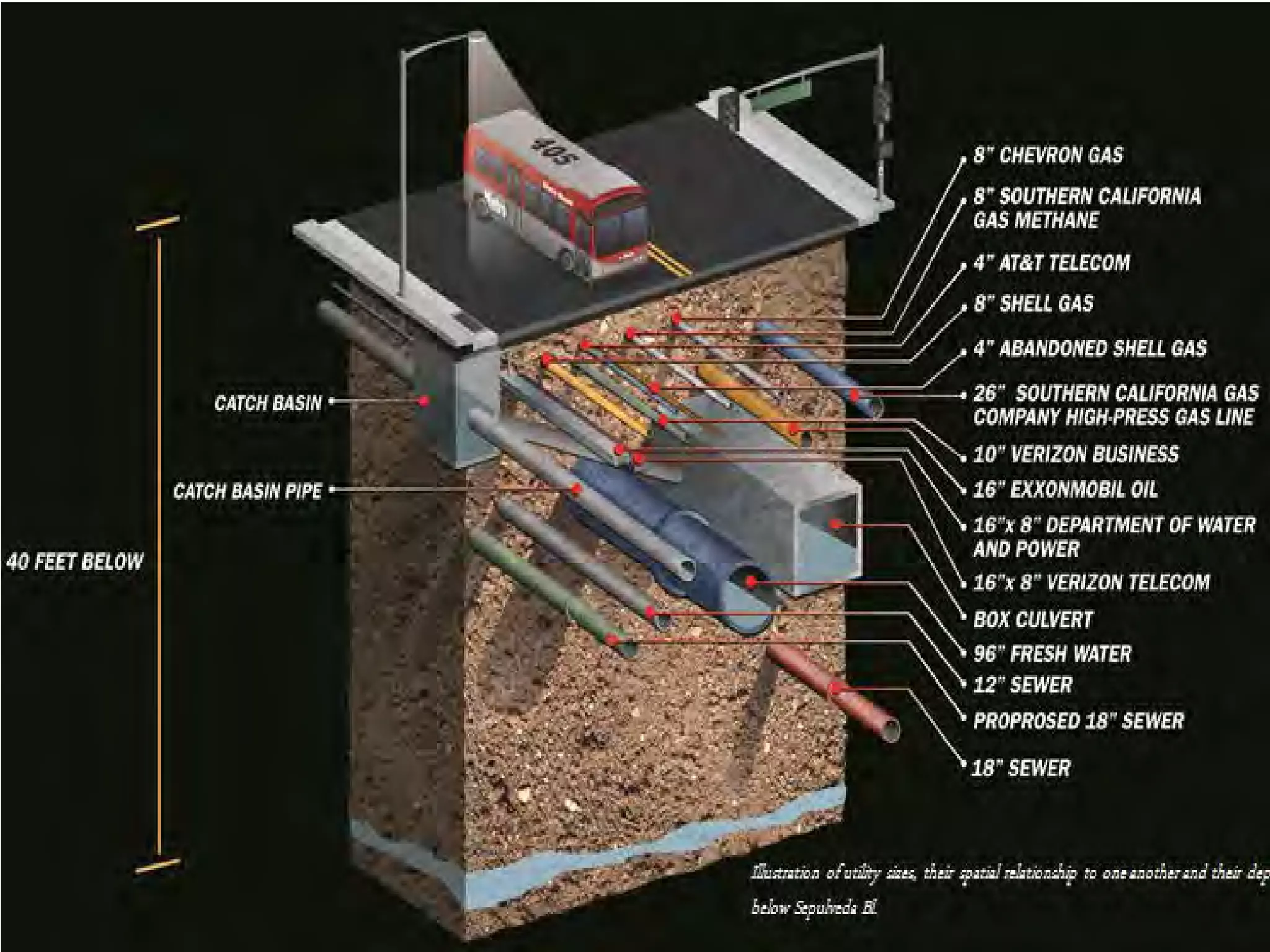
Increasing Congestion
Utility congestion at problematic levels within public roadway corridors.
Finding this stuff by any
means other than whole-scale
excavation is challenging.
It’s better to document it
accurately as it is going in
Scope
Develop a new standard for the collection and submittal of utility “as-
built” records and publish as an ASCE non-mandatory consensus
standard. Stem from:
• CI/ASCE 38 & CSA S250-11
• International Organization for Standardization (ISO)
• Open Geospatial Consortium (OGC)
• Federal Geographic Data Committee (FGDC)
• American National Standards Institute (ANSI)
• National Oceanic and Atmospheric Administration (NOAA) / National
Geodetic Survey (NGS) of the U.S. Department of Commerce
• Pipeline Open Data Standard (PODS)
• American Society of Mechanical Engineers (ASME)
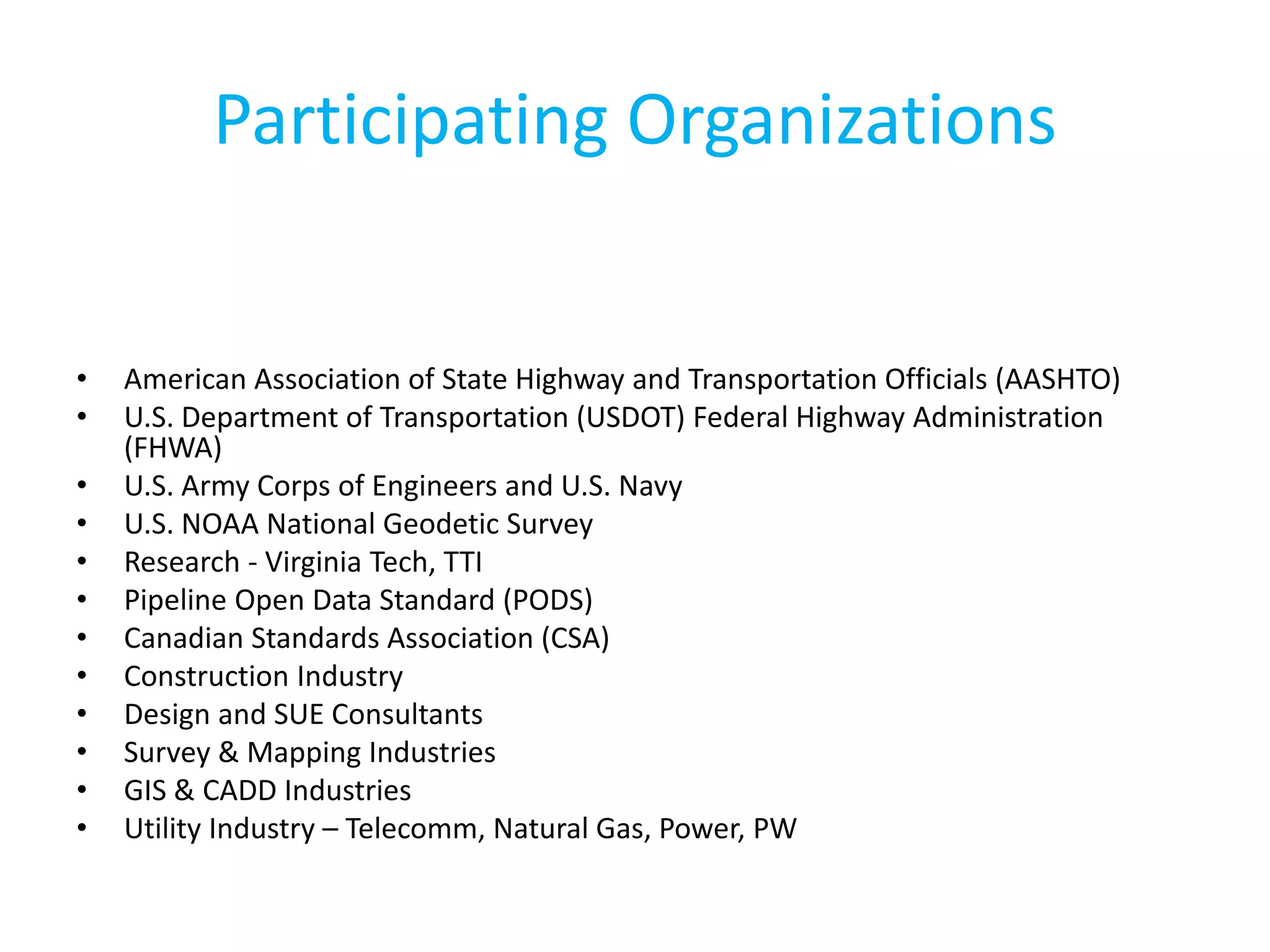
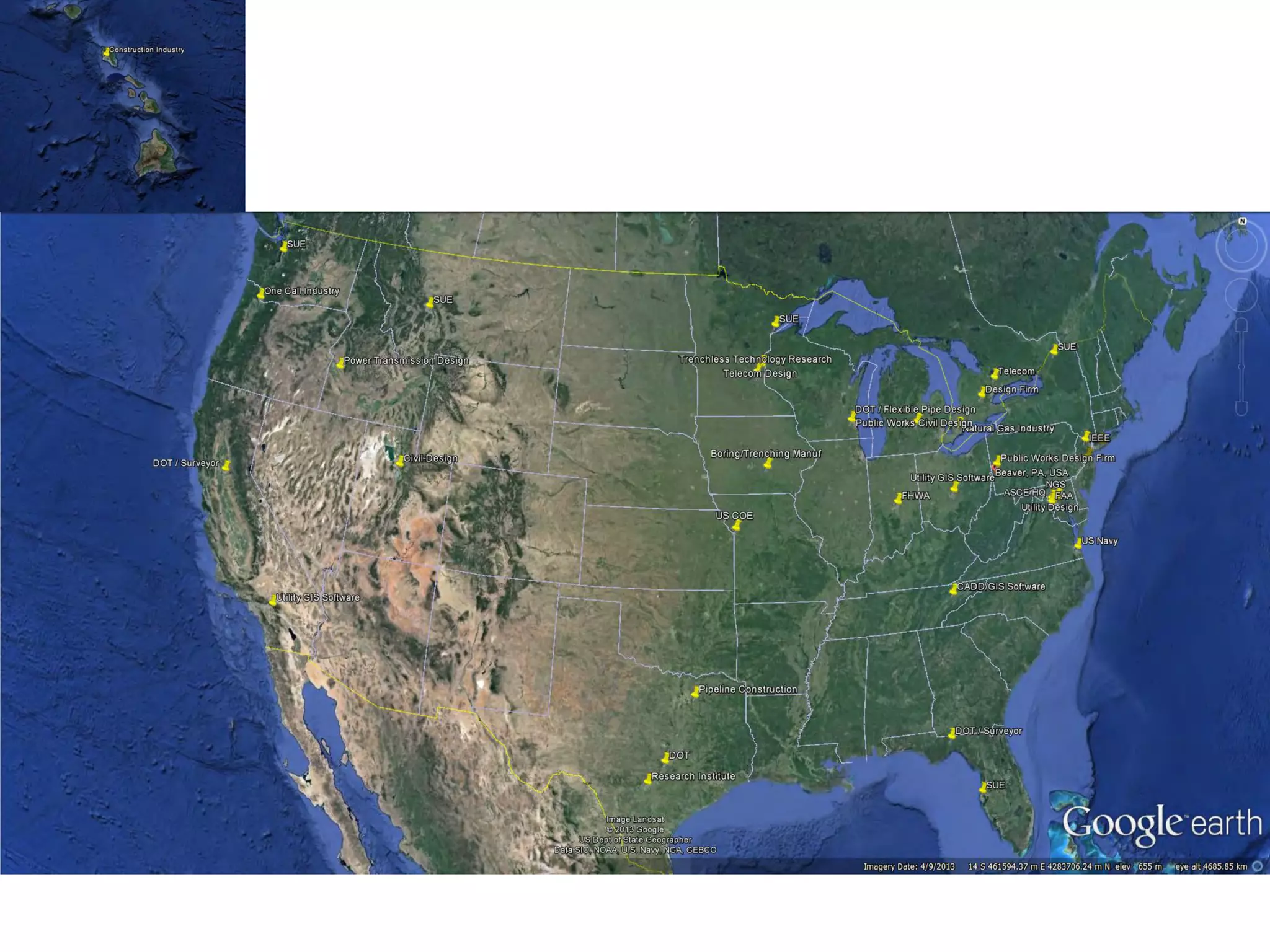
Participating Organizations
• American Association of State Highway and Transportation Officials (AASHTO)
• U.S. Department of Transportation (USDOT) Federal Highway Administration
(FHWA)
• U.S. Army Corps of Engineers and U.S. Navy
• U.S. NOAA National Geodetic Survey
• Research - Virginia Tech, TTI
• Pipeline Open Data Standard (PODS)
• Canadian Standards Association (CSA)
• Construction Industry
• Design and SUE Consultants
• Survey & Mapping Industries
• GIS & CADD Industries
• Utility Industry – Telecomm, Natural Gas, Power, PW
Standard Name
Utility “As-Built” Standard
“Standard for the Collection,
Administration, and Exchange of
Utility Installation Information”
Sub Tasks
• Collection-Gathering of all required
information during installation
• Administration-Ability to meet all
state statutes, regulations and
harmonize with existing standards
• Exchange-Ensure that data meets all
current digital interchange standards
for current and potential future uses
Collection
• Trenchless Installations
• Open Cut Installations
• Surface Appurtenances
• Overhead installations
• Spatial Positioning and Metadata (NSRS)
• Attributes (non-spatial metadata)
• RFID (radio-frequency identification)
• Remote Sensing Technologies and Data
Administration
• State Statutes
• Existing Standards
–(ASCE 38, CSA S250, PODS, etc.)
• Existing Regulations
• Legal implications
• Manuals of practice
Exchange
• Data Interchange Standards - OGC, VISTA, INSPIRE,
IEC (IEEE of rest of world), ISO, ANSI
• Potential and Future Uses of the Data:
Proactive and Real-Time Planning
Asset Management
Effective Damage Control Practices
CAD/CADD, GIS, CIM, 3D Modeling, VDC
Clash Detection, Sensitivity Modeling
Machine Control
Schedule
The committee is established and approved by
the ASCE Codes and Standards Committee.
Inaugural meeting Savannah, GE May 3rd, 2013.
Develop, review and finalize the standard for the
first balloting by the end of 2016.
Putting ASCE 38 and CSA S250 (ASCE XX) Together:
A Sample Spec for a Water Development Project
• Perform QLD mapping of all
utilities within the footprint of
the reservoir, treatment
facility, and potential paths for
the transmission and
connection piping early in the
planning stage of the project.
• Determine piping corridors
that make sense given existing
utility presence.
• At time of early design, further
upgrade the reliability of utility
information by attempting to
gather QLB data on existing
utility mains and commercial
services within the selected
corridors.
• Where necessary on critical
existing utilities, upgrade at
selected points to QLA.
• Use this mapping to either
design around or determine
relocation designs for existing
utilities.
• Due to the critical nature
of the raw water
transmission pipe,
document its location at
Accuracy Level 1.
• Also at Level 1:
– Document the location of
the connection mains
– Document all relocated
utilities that are
transmission facilities
– Document all Fiber Optic
cables
• At Level 2
– Relocated distribution
piping and cables
• At Level 3
– New and Relocated
Commercial service lines
• At Level 4
– Relocated residential
service lines
Q & A

ASCE Utility Standards

  • 1.
    ASCE Utility Standards JimAnspach, P.G. F.ASCE Cardno, Inc. Director of Utility Market & Practice Development Chair – ASCE 38 Member – Committee for Technical Advancement Chair – CI Construction Standards Council Member – Utility “As-Built” Standard Chair – UESI Utility Risk Division Member – PL Task Force Chair (emeritus) – Codes and Standards Division Board Governor: UESI
  • 2.
    35+ Million Milesof Underground Utilities in the US and Counting
  • 7.
    US MAJOR OIL& GAS TRANSMISSION PIPELINE NETWORK
  • 16.
    Records for legacyutilities are not comprehensive nor detailed/accurate enough for project engineering purposes
  • 25.
    Since Time Immortal,Surveyors have been recording visible utility features on project maps • Some utility record investigation? • Connect the dots? • More recently, call One- Call? But, we don’t want to take responsibility for things we can’t see or measure
  • 26.
    PLAN NOTES 1. Engineerand Surveyor take no responsibility for the accuracy and completeness of the utility information shown on these plans. 2. Utilities are depicted on these plans from records and visual observation. It is the responsibility of the contractor to verify all utilities before construction.
  • 43.
    Incomplete and inaccuratemaps of underground utilities between the structures lead to: • Project construction surprises • Delays • Re-Design costs • Damages • Claims • Change Orders
  • 45.
    Pre 1980 • One-Calljust starting • Few devices for finding utilities • Few firms were mapping utilities • Utility Owners did “locating” for their own maintenance/repair purposes • Finding Utilities was considered an “Art” or WITCHCRAFT
  • 48.
    1979 How Deep isthat Utility? • WGL Lawyer told employees they could only say “It’s So Deep” • Ford Bacon Davis used Vacuum Trucks for anode installation • Where is that utility in the 8” X 8” hole?
  • 49.
    1983 Media GeneralContract • Find and mark all utilities • Expose all utilities in road crossings
  • 52.
    1984 VDOT Project •$1M in savings reported to FHWA • $7M in savings reported “off-the- record” • Markings surveyed by VDOT survey crews
  • 53.
    Significant Advances inSUE • Integrated Survey (1985) • WGL Union Stoppage (1986) • MD WSSC “Seal” requirement (1987) • CNA PL Insurance (1988) • VDOT Court Case (1989) • OR – 1st Design Ticket (in lieu of records) • FHWA Road Trip and Trials (1991) • “SUE” Association Talks Begin (1995) • ASCE 38 started (1996)
  • 54.
    UTILITY INVESTIGATION, LOCATION, &DEPICTION STANDARDS ? Standard for the Collection, Administration, and Exchange of Utility Installation Information (Utility “As-Builts”) FIND EXISTING UTILITIES DOCUMENT NEW UTILITIES
  • 55.
    “Engineer shall showutilities…” Utility Investigations Vary: > Records > Visual Correlations > Surface Geophysics > Exposures and Certified Record Drawings > Best Guess But Depictions May Not: > Utilities all shown on the design plans the same regardless of method of investigation.
  • 56.
    • Outlines specificsteps for the engineer / surveyor to take that result in increasingly better utility mapping. • Utilities as mapped are shown according to their “Utility Quality Level” which allows all parties to make better risk decisions. • Use of Utility Quality Levels protects engineers and surveyors • Requires all utility mapping to be performed under the direct responsible charge of a registered professional, experienced in utility issues, surface geophysics, survey, and depiction methods • Increasing usage across the country is increasing its importance in cases where standard of care is an issue.
  • 57.
    ASCE 38 • Nowreferenced routinely in 40+ State DOTs • Best practice (FHWA, APWA, CGA, FAA, National Academy of Science, and others) • Case Law increasing • Referenced as part of state statute in PA, MN • 2nd Best selling ACSE standard behind ASCE 7 • Update imminent • Used as basis for new standards in UK, NZ, Malaysia, Canada, Australia, and Ecuador. • JUST IN: ASCE 38 NOW INCLUDED AS “BASIC SERVICE” IN EJCDC ENG. DOCS
  • 58.
    • To assistowners and engineers in developing an unambiguous comprehensive scope of work concerning collecting and depicting utility information on documents • To standardize how utilities are portrayed on documents • And most importantly, to standardize an attribute for utility information that indicates its reliability and quality (utility quality level attribute). Purpose of the standard
  • 59.
    • By Engineers– to make decisions on designing around existing utilities versus relocating them and to avoid redesign • By Contractors – to determine construction bids and excavation methods • By Project Owners – to retain a reliable map for future maintenance, security, or other needs • By Courts – to allocate responsibility for errors and omissions and damages These utility quality levels are used
  • 60.
    A Utility QualityLevel (QL): • Is about the means and methods used by engineers to investigate and depict utility information on plans. • There are four of them • When using them, engineers protect themselves against negligence claims • They are risk and reliability-based; other stakeholders can then use them to manage their project risks
  • 61.
    • Plotted onplans from records. • Sometimes a field visit - to look for utility indications on the site - is made. • Sometimes “verbal recollections” are plotted. This level of effort is great for Project Planning purposes, utility “inventories,” and very preliminary utility relocation cost estimates The least reliable data“Quality Level D”
  • 62.
    • Surface Appurtenancesare surveyed and accurately plotted on a current site plan • Utility data from records (QL D) are correlated to the appurtenances “Quality Level C” Problems with records interpretations still exist: e.g. schematics, no appurtenances depicted, utilities not straight between appurtenances, no records exist, and so on. The “traditional” utility depiction
  • 63.
  • 64.
    Edge of Paving on Water Records WaterRecord says 4” pipe is two feet inside paving WATER RECORD
  • 65.
    Water Record sayspipe is 2 feet inside paving, but Valves are 12 feet inside curb Surveyed & Plotted Water Valves Edge of Paving on Water Records
  • 66.
    Here’s where theold edge of paving was Surveyed & Plotted Water Valves Edge of Paving on Water Records can’t be determined using visual evidence today.
  • 67.
    Here’s where theold edge of paving was? Surveyed & Plotted Water Valves Engineer uses judgment to move water line 10 feet from where the records say it is to go through valves What if they were gas valves? Or paved over? Or thought to be service valves?
  • 68.
    Interpretation #2 Engineer responsiblefor judgment - ∆ of 10’ Surveyed & Plotted Water Service Valves?
  • 69.
    • Surface GeophysicalMethods used to search for and trace existing utilities. • Designated utilities are then surveyed and plotted on site plan. “Quality Level B” Non-recorded utilities found. Utilities’ routes between appurtenances are imaged. Typically used in early preliminary design for construction footprint decisions. A significant upgrade in quality
  • 70.
    Water Record sayspipe is two feet off of curb. Designating indicates otherwise. QL D and QL C interpretations by engineer were significantly wrong Abandoned section of water line Unknown Non-recorded Utility
  • 71.
  • 72.
    Geophysics Analogy –Medical Imaging • Most studied object in history • Consists of widely different materials • Research into imaging in the billions of dollars for CAT, Ultrasound, MRI, etc. • Highly controlled imaging environment • Great records • No one method works for everything • Exploratory surgery still common • Highly trained interpreters of data
  • 73.
    • Utilities exposedvia non-destructive air-vacuum means • Exposed utilities are then surveyed and plotted on site plan Elevations, Size, Condition, Materials, Precise Horizontal Positions are measured and documented “Quality Level A” Typically used in final design stages. Allows small adjustments in design for big savings in construction A Guarantee in 3-D
  • 74.
    Ground surface Water line foundat CL Station 23+40, L10 to be 6 3/4” in diameter and 5.56’ deep, slightly corroded and cast iron rather than ductile
  • 75.
    Where to Dig? Technology can’tovercome poor procedures Love Canal faux pas: Test holes before Geophysics • First six exploratory boreholes at Love Canal • Geophysical map of the dump site • ALL SIX HOLES MISSED THE TARGET!
  • 76.
    The end resultis a map suitable for current needs, and retrievable for future needs, with the reliability of the utilities clearly indicated
  • 77.
    The total riskfor the engineering pool decreases as quality level increases, while within the engineering pool, The risks shift towards the subsurface utility engineer as quality levels trend towards QLA data DESIGN ENGINEER Without SUE With SUE TOTAL RISK RISK ELIMINATED SUE ENGINEER D C B A DEFINED QUALITY LEVELUNDEFINED QUALITY LEVEL TOTAL ENGINEERING RISK POOL ALLOCATION OF RISK WITHIN ENGINEERING POOL
  • 78.
    What else isin the standard? • Responsibilities of the Engineer • Responsibilities of the Owner • Actions to achieve Utility Quality Levels • Depiction guidelines • Value statements • Appendix on Surface Geophysical Methods • Reference Documents
  • 79.
    PLAN NOTES 1. Utilitiesare depicted on these plans in accordance with their achieved “Utility Quality Levels” as defined in the latest version of ASCE 38 (Standard Guideline for the Collection and Depiction of Existing Subsurface Utility Data). 2. Reliance upon these data for risk management purposes during bidding does not relieve the excavator or utility owner from following all applicable utility damage prevention statutes, policies, and/or procedures during construction. 3. It is important that the constructor investigates and understands the utility mapping scope of work between the project owner and their engineer regarding the types of utilities to be depicted and the project limits leading to these utility depictions.
  • 80.
    How do youachieve a utility quality level ? Quality Level D: Plotting from record information > Records research. How much? > Is calling the One-Call adequate? > Is a site visit necessary to look for utility signs or appurtenances? > Do I need to plot everything for which there is a record? (e.g. individual services, traffic control sensors?) > What if there is an indication of a utility, but no record?
  • 81.
    How do youachieve a utility quality level ? Quality Level C: Correlation of records to surveyed features / utility appurtenances > Is using someone else’s survey of utility features OK? > How many surveyed features are required to call a long run of utility Quality Level C? > When does a Quality Level C line need to revert to Quality Level D? > Do I need to plot everything for which there is a record? (e.g. individual services, traffic control sensors) > What if there is an surveyed utility feature, but no record?
  • 82.
    How do youachieve a utility quality level ? Quality Level B: Geophysics + Survey > Is using someone else’s survey of utility marks OK? > What geophysics should I use? > Do I search for a specific utility, or for everything? > How do I handle signals that are unknowns? > How do I handle gaps in geophysical signals? > What level of effort do I need to go to if I can’t find a utility of record? > Do I need to get into all the manholes and vaults? > To what Accuracy am I held responsible?
  • 83.
    How do youachieve a utility quality level ? Quality Level A: Exposure + Survey > Does it matter what I use to excavate? > What if I don’t find anything? > How deep should I go? > What if I find something different than I thought was there? > Can I trust someone else to survey my patch and record the data? > Do I need to convert to an elevation? > To what accuracy am I held responsible? > Water vs. Air vacuum?
  • 85.
  • 86.
    3D Model ofExisting Facilities 3D Mapping and Marking of Underground Utilities during Project Development and Delivery
  • 87.
    Utility Line ProfileView 3D Mapping and Marking of Underground Utilities during Project Development and Delivery 87
  • 88.
    3D Mapping andMarking of Underground Utilities during Project Development and Delivery 88
  • 89.
    3D Mapping andMarking of Underground Utilities during Project Development and Delivery 89
  • 90.
    Locations with QLAData 3D Mapping and Marking of Underground Utilities during Project Development and Delivery 90 Test hole Test hole Valve Manhole
  • 91.
    Assumed Curved PipeAlignment 3D Mapping and Marking of Underground Utilities during Project Development and Delivery 91 Test hole Test hole Valve Manhole
  • 92.
    Assumed Straight PipeAlignment 3D Mapping and Marking of Underground Utilities during Project Development and Delivery 92 Test hole Test hole Valve Manhole
  • 93.
    Assumed Horizontal Interpolation 3DMapping and Marking of Underground Utilities during Project Development and Delivery 93 Test hole Test hole Valve Manhole
  • 94.
    3D Model IncludingUtilities 94 ATTRIBUTES Quality Level Method of “z” value Starting elevation Ending elevation Size Material Owner Condition Age Pressure
  • 95.
    3D Utility Visualization– Ireland 3D Mapping and Marking of Underground Utilities during Project Development and Delivery 95
  • 96.
    New Adventures Coming •ASCE Utility “As-Built” Standard • New SHRP Tools • Utility Engineering and Surveying Institute – SUE Training and Certifications – “Utility Engineer” Education – Utility Risk Envelopes
  • 98.
    The Need forUtility As-Built Standardization Who Creates Utility Records? • State DOT utility engineer • State DOT survey section personnel • State DOT Property Department • Railroad Companies • DOT traffic Department • Design or Planning Consultant hired by the state • Survey consultant hired by the state • State One-Call Center • Utility company records personnel • Utility company engineering personnel • State DOT maintenance personnel • Utility company “locators” • Utility company “contract locators” • Private industry “private utility locators” • State construction inspectors • Utility company construction inspectors • State consultants for construction inspection • Utility company consultants for relocation design • State utility design or relocation designers • Municipal engineers or their consultants • Municipal GIS departments • Federal Aviation Administration (FAA), Corps of Engineers, military, industrial, and other utility owners • Federal Highway Administration (FHWA) • Subsurface utility engineering consultants
  • 99.
    Locational references weretied to existing visible features like sides of roads or building edges or other utilities.
  • 100.
    These visible featuresmany times changed over time, and then these references were lost.
  • 101.
    Accurate and preciselocation data are valuable, but the costs of acquiring and managing such data were historically out of reach
  • 102.
    Why didn’t weaccurately document utilities as they went in the ground? We believed that the existing references (buildings, trees, road edges) would be in place forever. We did not contemplate keeping these same utilities in service for the many years that we have. We did not have technology that cost effectively allowed us to survey the utility locations to a more permanent datum. The technology that we did have was expensive and limited to the use of highly trained and paid professionals We did not contemplate the expensive and risky situations that digging into utilities would create. Higher pressures and voltages, more fragile materials, and environmentally unfriendly products were not anticipated at the time of installation. We could not imagine the cost of moving a utility as we needed more road space.
  • 103.
    ASCE 38 dealswith Legacy Data, mostly in the stages of Planning & Design within Project Development. Standard for the Collection, Administration, and Exchange of Utility Installation Information (“As-Built” Records) This standard will deal with mostly new data, mostly in the construction stages of Project Development.
  • 104.
    Utility As-Built Standard >Overview > Background and Need > Scope > Committee Members > Committee Activities > Schedule
  • 105.
    Planned Relocations ofUtilities in Color; 95% of existing utilities (mapped using ASCE 38) will remain in place
  • 107.
    Background • Nearly allagencies granting permits mandate permittees (i.e., facility owners) to provide upon request “accurate” utility record information for permitted installations. • Not all agencies, however, have a standard process for acquiring or a standard format for submitting the information.
  • 108.
    Background Accordingly utility recordsare largely: • at an inventory / schematic level • not tied to a common spatial datum • of inconsistent quality and content • in formats often incompatible for sharing or referencing into CADD or viewing platforms commonly utilized by agencies in charge of granting easements and managing the properties through which these easements pass
  • 109.
  • 110.
    What’s Changed? Population growth Publicpreference for buried cables Utility deregulation Rise in internet usage and dependence • e-commerce boom • cloud data management
  • 111.
    Web Use • eCommerce •Banking, Securities, Stocks • Business Ops (Accounting, email, file) • News, Entertainment, Social Networking • Telecommunications / Cellular Services • Advertisement / Marketing • GPS-Map / GIS Services • Education • Data Management Services
  • 112.
    New Construction > InU.S., over 50,000 miles of new gas pipeline per year due to shale gas > In U.S., 250,000 miles of new tel-com cables per year > In U.S., 850,000 new houses in 2012 > In U.S., 6,500 miles of new road each year
  • 113.
    Increasing Risk The implicationsof poor utility records are far reaching and directly impact the public through: 1. rising risk and costs for civil projects and private developments; 2. increased costs for utility infrastructure relocation activities; 3. worker and public safety issues; and 4. disrupting public and commerce overwhelming dependence on web services.
  • 114.
    Increasing Congestion Utility congestionat problematic levels within public roadway corridors.
  • 118.
    Finding this stuffby any means other than whole-scale excavation is challenging. It’s better to document it accurately as it is going in
  • 119.
    Scope Develop a newstandard for the collection and submittal of utility “as- built” records and publish as an ASCE non-mandatory consensus standard. Stem from: • CI/ASCE 38 & CSA S250-11 • International Organization for Standardization (ISO) • Open Geospatial Consortium (OGC) • Federal Geographic Data Committee (FGDC) • American National Standards Institute (ANSI) • National Oceanic and Atmospheric Administration (NOAA) / National Geodetic Survey (NGS) of the U.S. Department of Commerce • Pipeline Open Data Standard (PODS) • American Society of Mechanical Engineers (ASME)
  • 122.
    Participating Organizations • AmericanAssociation of State Highway and Transportation Officials (AASHTO) • U.S. Department of Transportation (USDOT) Federal Highway Administration (FHWA) • U.S. Army Corps of Engineers and U.S. Navy • U.S. NOAA National Geodetic Survey • Research - Virginia Tech, TTI • Pipeline Open Data Standard (PODS) • Canadian Standards Association (CSA) • Construction Industry • Design and SUE Consultants • Survey & Mapping Industries • GIS & CADD Industries • Utility Industry – Telecomm, Natural Gas, Power, PW
  • 124.
    Standard Name Utility “As-Built”Standard “Standard for the Collection, Administration, and Exchange of Utility Installation Information”
  • 125.
    Sub Tasks • Collection-Gatheringof all required information during installation • Administration-Ability to meet all state statutes, regulations and harmonize with existing standards • Exchange-Ensure that data meets all current digital interchange standards for current and potential future uses
  • 126.
    Collection • Trenchless Installations •Open Cut Installations • Surface Appurtenances • Overhead installations • Spatial Positioning and Metadata (NSRS) • Attributes (non-spatial metadata) • RFID (radio-frequency identification) • Remote Sensing Technologies and Data
  • 127.
    Administration • State Statutes •Existing Standards –(ASCE 38, CSA S250, PODS, etc.) • Existing Regulations • Legal implications • Manuals of practice
  • 128.
    Exchange • Data InterchangeStandards - OGC, VISTA, INSPIRE, IEC (IEEE of rest of world), ISO, ANSI • Potential and Future Uses of the Data: Proactive and Real-Time Planning Asset Management Effective Damage Control Practices CAD/CADD, GIS, CIM, 3D Modeling, VDC Clash Detection, Sensitivity Modeling Machine Control
  • 130.
    Schedule The committee isestablished and approved by the ASCE Codes and Standards Committee. Inaugural meeting Savannah, GE May 3rd, 2013. Develop, review and finalize the standard for the first balloting by the end of 2016.
  • 131.
    Putting ASCE 38and CSA S250 (ASCE XX) Together: A Sample Spec for a Water Development Project • Perform QLD mapping of all utilities within the footprint of the reservoir, treatment facility, and potential paths for the transmission and connection piping early in the planning stage of the project. • Determine piping corridors that make sense given existing utility presence. • At time of early design, further upgrade the reliability of utility information by attempting to gather QLB data on existing utility mains and commercial services within the selected corridors. • Where necessary on critical existing utilities, upgrade at selected points to QLA. • Use this mapping to either design around or determine relocation designs for existing utilities.
  • 132.
    • Due tothe critical nature of the raw water transmission pipe, document its location at Accuracy Level 1. • Also at Level 1: – Document the location of the connection mains – Document all relocated utilities that are transmission facilities – Document all Fiber Optic cables • At Level 2 – Relocated distribution piping and cables • At Level 3 – New and Relocated Commercial service lines • At Level 4 – Relocated residential service lines
  • 133.