ROAD SAFETY AUDIT- Case study of Tarasali flyover bridge to
Jambuva bridge, Baroda
Birla Vishvakarma Mahavidyalaya
(Civil Engineering Department)
Guided by:-
Prof. N. F. Umrigar
BVM Engineering College
Presented by:-
140070106022 - Tejas B. Der
140070106024 - Hardik K. Dhaduk
140070106049 - Kamlesh S. Kundariya
140070106058 - Vairag A. Moradiya
140070106082 - Pinkal M. Patel
Content
Introduction
Objectives
Applications of RSA
Site Visits
Checklists
Introduction
In most regions of the world,
 over 1.2 million people die every year due to road crashes.
 about 50 million suffer non-fatal injuries.
 In India,
 In 2010, No. of accidents around 5 lakhs and casualties 134,513 died
& 5 lakh injured.
 It means that 1 road accident every minute & 1 road accident death
every four minutes.
 53.1% of road accident victims were in the age group of 25 to 65
years.
 NHAI lunched massive Road Safety Audit Programs to carry out the audit
at different stages.
 On 11 May 2011, the Decade of Action for Road Safety 2011-2020 was
launched in more than 100 countries including India, with one goal: to
prevent five million road traffic deaths globally by 2020.
What is Road Safety Audit ?
 “A means of checking the design, implementation and operation of road
projects against a set of safety principles as a means of accident prevention
and treatment”.
 It is also the systematic checking of the safety aspects of new/existing
highway and traffic management schemes, including modifications to
existing layouts.
 Safety Audit can be applied on (a) new roads (b) existing roads.
 On new projects safety audit will lead to avoiding building road crash-
prone situations and on existing roads audit will lead to improved roads
from the safety point of view.
Objectives
 Minimize the risk of road accidents.
 Minimize the need for remedial work after construction.
 Reduce the whole-life costs of the project
 Improve the awareness of the safe design in the planning, design,
construction and maintenance of roads
Scope of study
 Future accident can be minimized.
 The loss of human lives can be reduced.
 The expenditure can be saved in remedial work.
Application of road safety audit
 Road safety audit may be carried out at any or all following stages
 Stage 1: Feasibility
 A safety audit can influence
 the scope of a project
 route choice
 selection of design standards
 impact on existing road network
 provisions of interchanges or intersections
 access control
 number of lanes
 route terminals, stage development, etc.
 Stage 2:- Draft design
 This audit stage is undertaken on completion of a draft plan or
a preliminary design. Typical considerations include
Horizontal and vertical alignment
Sightlines
Intersection layouts
Lane and shoulder width
Super elevation
Overtaking lanes
Provisions for parked and stationary vehicles
Provisions for bicyclists and pedestrians
Effects of departures from standards and guidelines
Safety during construction, etc.
 Stage 3:- Detailed design
 This stage is on completion of detailed design, normally before preparation of
contract documents, considerations include:
 Line markings
 Signing
 Delineation
 Lighting
 Intersection details
 Clearance to roadside objects
 Provision to road user groups with special requirements
 Temporary traffic management and control during construction
 Drainage
 Roadside objects
 Landscaping
 Batters
 Guard fencing, etc.
 Stage 4:- Pre- opening
 Prior to opening of the road to traffic
 The audit would involve driving, riding and walking through the
project to check the adequacy for the needs of all road users.
• Involve night-time inspection
• Inspection of both wet and dry conditions
 It would consider similar issues raised in stage 2 and 3, but with the
view of assessing their adequacy as actually constructed.
 Taking specific note of variations that might have occurred from the
plans in the process of construction.
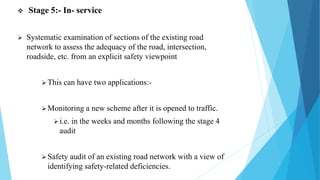
 Stage 5:- In- service
 Systematic examination of sections of the existing road
network to assess the adequacy of the road, intersection,
roadside, etc. from an explicit safety viewpoint
This can have two applications:-
Monitoring a new scheme after it is opened to traffic.
i.e. in the weeks and months following the stage 4
audit
Safety audit of an existing road network with a view of
identifying safety-related deficiencies.
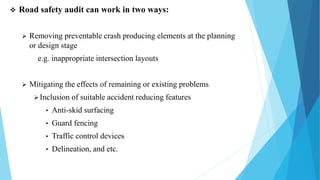
 Road safety audit can work in two ways:
 Removing preventable crash producing elements at the planning
or design stage
e.g. inappropriate intersection layouts
 Mitigating the effects of remaining or existing problems
Inclusion of suitable accident reducing features
• Anti-skid surfacing
• Guard fencing
• Traffic control devices
• Delineation, and etc.
 As part of our Project, our group members did preliminary Road
Safety Audit (RSA) of NH 8, in the stretch Tarasali fly over Bridge
to jambuva bridge (Km 5.4 ).
 Site visits
First visit : July 8, 2017
Second visit : July 16, 2017
Third visit : July 22, 2017
Fourth visit : August 2, 2017
Fifth visit : August 29, 2017
14
Site visit 2- Baroda area Site visit 2- Vasad chokdi
Site visit 3 Site visit 3
Jambuva bridge
Tarasali flyover bridge
Google satellite map of NH 8, in the stretch Tarasali fly
over Bridge to jambuva bridge (Km 5.4 ).
Checklists
 A set of checklists
 Use of checklists which show type of issues and problems that
can potentially arise at the relevant stage of the project.
 Checklists are a memory prompt.
 When using checklists, it is less likely to overlook problems.
 They can not be a substitute for expertise.
 One of the main benefits of checklists is that designers can use
that to audit themselves before their work gets to the auditor.
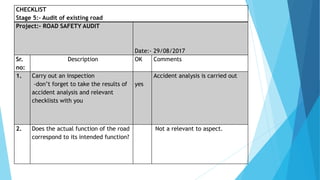
CHECKLIST
Stage 5:- Audit of existing road
Project:- ROAD SAFETY AUDIT
Date:- 29/08/2017
Sr.
no:
Description OK Comments
1. Carry out an inspection
-don’t forget to take the results of
accident analysis and relevant
checklists with you
yes
Accident analysis is carried out
2. Does the actual function of the road
correspond to its intended function?
Not a relevant to aspect.
3. Is the prevailing speed level
as desired?
yes no, due to over bridge
speed is not achieved.
Refer photo no. 1.
4.
Do road users park in ways that
could constitute hazards?
yes Due to parked vehicle on
carriageway capacity
reduced. It’s shown in
photo no.2
5. Do plantations obscure
visibility or mask the view of
signs?
yes Do not obstruct to visibility.
It’s shown in photo no.1
Photo no. 1
Photo no. 2
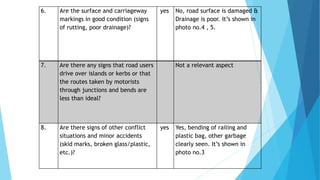
6. Are the surface and carriageway
markings in good condition (signs
of rutting, poor drainage)?
yes No, road surface is damaged &
Drainage is poor. It’s shown in
photo no.4 , 5.
7. Are there any signs that road users
drive over islands or kerbs or that
the routes taken by motorists
through junctions and bends are
less than ideal?
Not a relevant aspect
8. Are there signs of other conflict
situations and minor accidents
(skid marks, broken glass/plastic,
etc.)?
yes Yes, bending of railing and
plastic bag, other garbage
clearly seen. It’s shown in
photo no.3
Photo no. 3
Photo no. 4
Photo no. 5
9. Are the specified distances to rigid
obstacles maintained (plantations
and road equipment, etc.) for all
groups of road user?
yes No, the distance is not
sufficiently maintained.
It’s shown in photo no.6
10. Is speed limit at all points where it is
necessary?
yes Yes, sign posts are
established. It’s shown in
photo no.8
11. Are the shoulders satisfying their
intended function?
yes No, some of them are
eroded and some are
occupied by plantations.
It’s shown in photo no.7
Photo no. 6
Photo no. 7
Photo no. 8
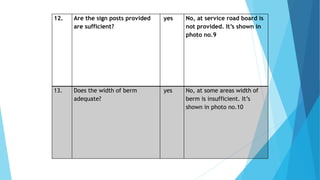
12. Are the sign posts provided
are sufficient?
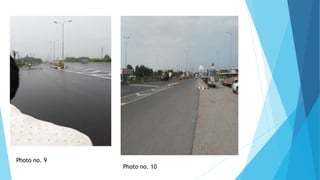
yes No, at service road board is
not provided. It’s shown in
photo no.9
13. Does the width of berm
adequate?
yes No, at some areas width of
berm is insufficient. It’s
shown in photo no.10
Photo no. 9
Photo no. 10
14. Will it be possible to carry out
maintenance work safely and
without using carriage way or
cycle path?
yes No, there is no separate cycle
paths.
15. Is there a suitable gradient or is
the carriage way laid at a
suitable height above the
shoulder?
yes Yes, gradient slop is as per rain
fall intensity.
16. Are there any unlit areas that
could conceal hazards?
yes Yes, bharat petroleum. It’s
shown in photo no.11
Photo no. 11
17. Guardrails hedges and railings:
a) Are all vulnerable areas protected?
b) Are bridge pillars steel posts etc.,
protected by guard rails necessary?
c) Are there places where hedges are
necessary to prevent pedestrians from
crossing?
d) Are the chosen hedges or guard rails
light enough?
Yes
Yes
yes
yes
b)No, guard rails should be provided at
necessary lines.
Yes, bridge pillars protected by rails.
No, there is no hedges to prevent
pedestrians.
Not relevant
18. Plantations:
a) Will plantations obscure visibility?
b) Will fully grown trees or any other rigid
obstacles be observed?
c) Can maintenance be carried out safely?
Yes
Yes
yes
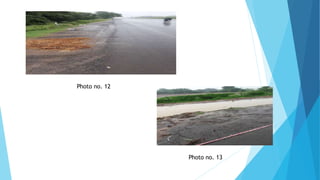
No, plantations do not obscuring visibility.
No, there is no sufficient sight distance to
observe the rigid obstacles
No, maintenance could not be carried out
safely. It’s shown in photo no 12& 13
Photo no. 12
Photo no. 13
Reference
 IRC:SP-88-2010
 RSA report published by Dhiraj N Kumar & Arun S Bagi
 RSA report published by NIMS university, Rajasthan.
 Other research papers published online.
 Slideshare .
 Traffic data by sayajigunj head quarter, Baroda.
 http://pmgsy.nic.in/Road%20Safety%20Audit%20Guide.doc
Road safety audit case study

Road safety audit case study

  • 1.
    ROAD SAFETY AUDIT-Case study of Tarasali flyover bridge to Jambuva bridge, Baroda Birla Vishvakarma Mahavidyalaya (Civil Engineering Department) Guided by:- Prof. N. F. Umrigar BVM Engineering College Presented by:- 140070106022 - Tejas B. Der 140070106024 - Hardik K. Dhaduk 140070106049 - Kamlesh S. Kundariya 140070106058 - Vairag A. Moradiya 140070106082 - Pinkal M. Patel
  • 2.
  • 3.
    Introduction In most regionsof the world,  over 1.2 million people die every year due to road crashes.  about 50 million suffer non-fatal injuries.  In India,  In 2010, No. of accidents around 5 lakhs and casualties 134,513 died & 5 lakh injured.  It means that 1 road accident every minute & 1 road accident death every four minutes.  53.1% of road accident victims were in the age group of 25 to 65 years.
  • 4.
     NHAI lunchedmassive Road Safety Audit Programs to carry out the audit at different stages.  On 11 May 2011, the Decade of Action for Road Safety 2011-2020 was launched in more than 100 countries including India, with one goal: to prevent five million road traffic deaths globally by 2020.
  • 5.
    What is RoadSafety Audit ?  “A means of checking the design, implementation and operation of road projects against a set of safety principles as a means of accident prevention and treatment”.  It is also the systematic checking of the safety aspects of new/existing highway and traffic management schemes, including modifications to existing layouts.  Safety Audit can be applied on (a) new roads (b) existing roads.  On new projects safety audit will lead to avoiding building road crash- prone situations and on existing roads audit will lead to improved roads from the safety point of view.
  • 6.
    Objectives  Minimize therisk of road accidents.  Minimize the need for remedial work after construction.  Reduce the whole-life costs of the project  Improve the awareness of the safe design in the planning, design, construction and maintenance of roads
  • 7.
    Scope of study Future accident can be minimized.  The loss of human lives can be reduced.  The expenditure can be saved in remedial work.
  • 8.
    Application of roadsafety audit  Road safety audit may be carried out at any or all following stages  Stage 1: Feasibility  A safety audit can influence  the scope of a project  route choice  selection of design standards  impact on existing road network  provisions of interchanges or intersections  access control  number of lanes  route terminals, stage development, etc.
  • 9.
     Stage 2:-Draft design  This audit stage is undertaken on completion of a draft plan or a preliminary design. Typical considerations include Horizontal and vertical alignment Sightlines Intersection layouts Lane and shoulder width Super elevation Overtaking lanes Provisions for parked and stationary vehicles Provisions for bicyclists and pedestrians Effects of departures from standards and guidelines Safety during construction, etc.
  • 10.
     Stage 3:-Detailed design  This stage is on completion of detailed design, normally before preparation of contract documents, considerations include:  Line markings  Signing  Delineation  Lighting  Intersection details  Clearance to roadside objects  Provision to road user groups with special requirements  Temporary traffic management and control during construction  Drainage  Roadside objects  Landscaping  Batters  Guard fencing, etc.
  • 11.
     Stage 4:-Pre- opening  Prior to opening of the road to traffic  The audit would involve driving, riding and walking through the project to check the adequacy for the needs of all road users. • Involve night-time inspection • Inspection of both wet and dry conditions  It would consider similar issues raised in stage 2 and 3, but with the view of assessing their adequacy as actually constructed.  Taking specific note of variations that might have occurred from the plans in the process of construction.
  • 12.
     Stage 5:-In- service  Systematic examination of sections of the existing road network to assess the adequacy of the road, intersection, roadside, etc. from an explicit safety viewpoint This can have two applications:- Monitoring a new scheme after it is opened to traffic. i.e. in the weeks and months following the stage 4 audit Safety audit of an existing road network with a view of identifying safety-related deficiencies.
  • 13.
     Road safetyaudit can work in two ways:  Removing preventable crash producing elements at the planning or design stage e.g. inappropriate intersection layouts  Mitigating the effects of remaining or existing problems Inclusion of suitable accident reducing features • Anti-skid surfacing • Guard fencing • Traffic control devices • Delineation, and etc.
  • 14.
     As partof our Project, our group members did preliminary Road Safety Audit (RSA) of NH 8, in the stretch Tarasali fly over Bridge to jambuva bridge (Km 5.4 ).  Site visits First visit : July 8, 2017 Second visit : July 16, 2017 Third visit : July 22, 2017 Fourth visit : August 2, 2017 Fifth visit : August 29, 2017 14
  • 15.
    Site visit 2-Baroda area Site visit 2- Vasad chokdi Site visit 3 Site visit 3
  • 16.
  • 17.
    Google satellite mapof NH 8, in the stretch Tarasali fly over Bridge to jambuva bridge (Km 5.4 ).
  • 18.
  • 19.
     A setof checklists  Use of checklists which show type of issues and problems that can potentially arise at the relevant stage of the project.  Checklists are a memory prompt.  When using checklists, it is less likely to overlook problems.  They can not be a substitute for expertise.  One of the main benefits of checklists is that designers can use that to audit themselves before their work gets to the auditor.
  • 20.
    CHECKLIST Stage 5:- Auditof existing road Project:- ROAD SAFETY AUDIT Date:- 29/08/2017 Sr. no: Description OK Comments 1. Carry out an inspection -don’t forget to take the results of accident analysis and relevant checklists with you yes Accident analysis is carried out 2. Does the actual function of the road correspond to its intended function? Not a relevant to aspect.
  • 21.
    3. Is theprevailing speed level as desired? yes no, due to over bridge speed is not achieved. Refer photo no. 1. 4. Do road users park in ways that could constitute hazards? yes Due to parked vehicle on carriageway capacity reduced. It’s shown in photo no.2 5. Do plantations obscure visibility or mask the view of signs? yes Do not obstruct to visibility. It’s shown in photo no.1
  • 22.
  • 23.
    6. Are thesurface and carriageway markings in good condition (signs of rutting, poor drainage)? yes No, road surface is damaged & Drainage is poor. It’s shown in photo no.4 , 5. 7. Are there any signs that road users drive over islands or kerbs or that the routes taken by motorists through junctions and bends are less than ideal? Not a relevant aspect 8. Are there signs of other conflict situations and minor accidents (skid marks, broken glass/plastic, etc.)? yes Yes, bending of railing and plastic bag, other garbage clearly seen. It’s shown in photo no.3
  • 24.
    Photo no. 3 Photono. 4 Photo no. 5
  • 25.
    9. Are thespecified distances to rigid obstacles maintained (plantations and road equipment, etc.) for all groups of road user? yes No, the distance is not sufficiently maintained. It’s shown in photo no.6 10. Is speed limit at all points where it is necessary? yes Yes, sign posts are established. It’s shown in photo no.8 11. Are the shoulders satisfying their intended function? yes No, some of them are eroded and some are occupied by plantations. It’s shown in photo no.7
  • 26.
    Photo no. 6 Photono. 7 Photo no. 8
  • 27.
    12. Are thesign posts provided are sufficient? yes No, at service road board is not provided. It’s shown in photo no.9 13. Does the width of berm adequate? yes No, at some areas width of berm is insufficient. It’s shown in photo no.10
  • 28.
  • 29.
    14. Will itbe possible to carry out maintenance work safely and without using carriage way or cycle path? yes No, there is no separate cycle paths. 15. Is there a suitable gradient or is the carriage way laid at a suitable height above the shoulder? yes Yes, gradient slop is as per rain fall intensity. 16. Are there any unlit areas that could conceal hazards? yes Yes, bharat petroleum. It’s shown in photo no.11
  • 30.
  • 31.
    17. Guardrails hedgesand railings: a) Are all vulnerable areas protected? b) Are bridge pillars steel posts etc., protected by guard rails necessary? c) Are there places where hedges are necessary to prevent pedestrians from crossing? d) Are the chosen hedges or guard rails light enough? Yes Yes yes yes b)No, guard rails should be provided at necessary lines. Yes, bridge pillars protected by rails. No, there is no hedges to prevent pedestrians. Not relevant 18. Plantations: a) Will plantations obscure visibility? b) Will fully grown trees or any other rigid obstacles be observed? c) Can maintenance be carried out safely? Yes Yes yes No, plantations do not obscuring visibility. No, there is no sufficient sight distance to observe the rigid obstacles No, maintenance could not be carried out safely. It’s shown in photo no 12& 13
  • 32.
  • 33.
    Reference  IRC:SP-88-2010  RSAreport published by Dhiraj N Kumar & Arun S Bagi  RSA report published by NIMS university, Rajasthan.  Other research papers published online.  Slideshare .  Traffic data by sayajigunj head quarter, Baroda.  http://pmgsy.nic.in/Road%20Safety%20Audit%20Guide.doc