SUESUBSURFACE UTILITY ENGINEERING FOR LOCATION AND
DAMAGE PREVENTION OF UNDERGROUND UTILITIES
SUBSURFACE UTILITY ENGINEERING
• Understanding SUE
• Why SUE is important
• Mechanics of SUE
UNDERSTANDING SUE
UNDERSTANDING SUE
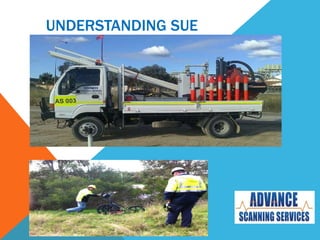
Subsurface utility engineering is an engineering practice that encompasses
the management of risks associated with many aspects of infrastructure
project management such as ……
• Underground utility relocation
• Infrastructure planning and estimation
• 3d mapping of utilities for design
• Correct Identification and location of underground utilities
• Road and Highway upgrades
UNDERSTANDING SUE
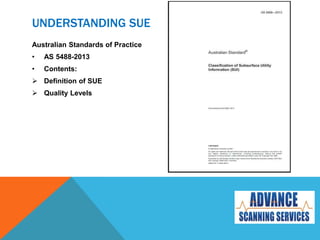
Australian Standards of Practice
• AS 5488-2013
• Contents:
 Definition of SUE
 Quality Levels
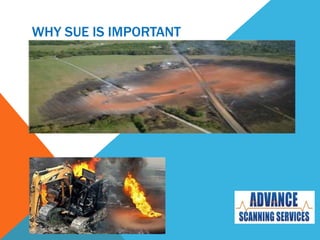
WHY SUE IS IMPORTANT
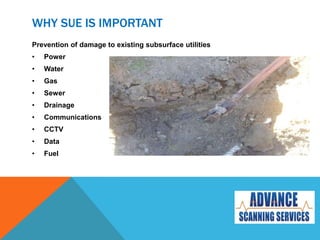
Prevention of damage to existing subsurface utilities
• Power
• Water
• Gas
• Sewer
• Drainage
• Communications
• CCTV
• Data
• Fuel
WHY SUE IS IMPORTANT
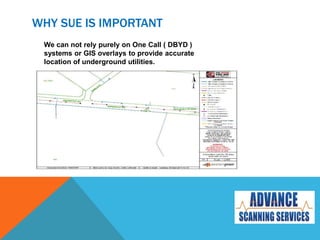
We can not rely purely on One Call ( DBYD )
systems or GIS overlays to provide accurate
location of underground utilities.
WHY SUE IS IMPORTANT
Risk management is the essence of SUE, by utilizing all aspects
of SUE you are minimizing costly delays and potentially saving lives.
• The Risks
 Project delays
 Damage to critical utilities
 Safety of the public
 Environmental damage
 Costly design errors
 Insurance claims
 Loss of reputation
 Time / Budget penalties
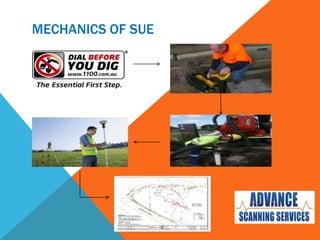
MECHANICS OF SUE
MECHANICS OF SUE
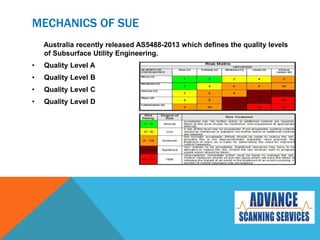
Australia recently released AS5488-2013 which defines the quality levels
of Subsurface Utility Engineering.
• Quality Level A
• Quality Level B
• Quality Level C
• Quality Level D
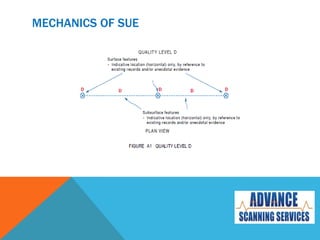
MECHANICS OF SUEQUALITY LEVEL D (QL-D) IS THE LOWEST OF THE FOUR QUALITY
LEVELS. THE ATTRIBUTE INFORMATION AND METADATA OF A
SUBSURFACE UTILITY CAN BE COMPILED FROM ANY, OR A COMBINATION
OF THE FOLLOWING :
• Existing records.
• Cursory site
inspection.
• Anecdotal
evidence.
• Utility owner.
• Indication of utility
type.
• The date of
installation.
• An indicative location
of the surface and
subsurface features.
• The date the data was
captured
• The source of
information
MECHANICS OF SUE
MECHANICS OF SUE
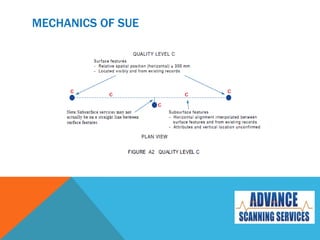
QUALITY LEVEL C (QL-C) IS DESCRIBED AS A SURFACE FEATURE
CORRELATION OR AN INTERPRETATION OF THE APPROXIMATE LOCATION AND
ATTRIBUTES OF A SUBSURFACE UTILITY ASSET USING A COMBINATION OF
EXISTING RECORDS AND A SITE SURVEY OF VISIBLE EVIDENCE.
• Full utilization of QL-D.
• An interpolation of the
location and direction of
the utility using surface
features as points of
reference.
• Feature codes of
surface features, pits,
access chambers,
poles, valves and
hydrants
• The location of
surface features
measured in terms of
relative spatial
positioning with a
maximum horizontal
tolerance of +-300mm
MECHANICS OF SUE
MECHANICS OF SUE
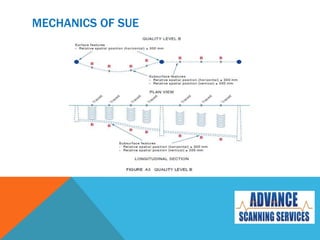
QUALITY LEVEL B (QL-B) PROVIDES RELATIVE SUBSURFACE FEATURE
LOCATION IN THREE DIMENSIONS. THE MINIMUM REQUIREMENT FOR QUALITY
LEVEL B IS RELATIVE SPATIAL POSITION.
• Full utilization of QL-D &
QL-C
• The location of surface
features measured in
terms of relative spatial
positioning with a
maximum horizontal
tolerance of +-300 mm
and maximum vertical
tolerance of +- 500mm.
• The locating method(s)
used to obtain the
attribute information
MECHANICS OF SUE
MECHANICS OF SUE
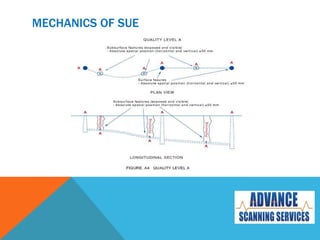
QUALITY LEVEL A (QL-A) IS THE HIGHEST QUALITY LEVEL AND CONSISTS OF
THE POSITIVE IDENTIFICATION OF THE ATTRIBUTE AND LOCATION OF A SUBSURFACE
UTILITY AT A POINT TO AN ABSOLUTE SPATIAL POSITION IN THREE DIMENSIONS. IT IS
THE ONLY QUALITY LEVEL THAT DEFINES A SUBSURFACE UTILITY IS “VALIDATED”
• Full utilization of QL-D,
QL-C, QL-B.
• Utility type, status,
material, size &
configuration.
• The location of points
surveyed on surface and
subsurface features
measured in terms of
absolute spatial
positioning with a
maximum horizontal and
vertical tolerance of +-
50mm.
• Survey control information
used to determine the
absolute spatial position of
the utility.
• The survey and locating
methods used to obtain the
attribute information.
MECHANICS OF SUE
SUESUBSURFACE UTILITY ENGINEERING FOR LOCATION AND
DAMAGE PREVENTION OF UNDERGROUND UTILITIES

Subsurface utility engineering by Advance Scanning Services

  • 1.
    SUESUBSURFACE UTILITY ENGINEERINGFOR LOCATION AND DAMAGE PREVENTION OF UNDERGROUND UTILITIES
  • 2.
    SUBSURFACE UTILITY ENGINEERING •Understanding SUE • Why SUE is important • Mechanics of SUE
  • 3.
  • 4.
    UNDERSTANDING SUE Subsurface utilityengineering is an engineering practice that encompasses the management of risks associated with many aspects of infrastructure project management such as …… • Underground utility relocation • Infrastructure planning and estimation • 3d mapping of utilities for design • Correct Identification and location of underground utilities • Road and Highway upgrades
  • 5.
    UNDERSTANDING SUE Australian Standardsof Practice • AS 5488-2013 • Contents:  Definition of SUE  Quality Levels
  • 6.
    WHY SUE ISIMPORTANT
  • 7.
    WHY SUE ISIMPORTANT Prevention of damage to existing subsurface utilities • Power • Water • Gas • Sewer • Drainage • Communications • CCTV • Data • Fuel
  • 8.
    WHY SUE ISIMPORTANT We can not rely purely on One Call ( DBYD ) systems or GIS overlays to provide accurate location of underground utilities.
  • 9.
    WHY SUE ISIMPORTANT Risk management is the essence of SUE, by utilizing all aspects of SUE you are minimizing costly delays and potentially saving lives. • The Risks  Project delays  Damage to critical utilities  Safety of the public  Environmental damage  Costly design errors  Insurance claims  Loss of reputation  Time / Budget penalties
  • 10.
  • 11.
    MECHANICS OF SUE Australiarecently released AS5488-2013 which defines the quality levels of Subsurface Utility Engineering. • Quality Level A • Quality Level B • Quality Level C • Quality Level D
  • 12.
    MECHANICS OF SUEQUALITYLEVEL D (QL-D) IS THE LOWEST OF THE FOUR QUALITY LEVELS. THE ATTRIBUTE INFORMATION AND METADATA OF A SUBSURFACE UTILITY CAN BE COMPILED FROM ANY, OR A COMBINATION OF THE FOLLOWING : • Existing records. • Cursory site inspection. • Anecdotal evidence. • Utility owner. • Indication of utility type. • The date of installation. • An indicative location of the surface and subsurface features. • The date the data was captured • The source of information
  • 13.
  • 14.
    MECHANICS OF SUE QUALITYLEVEL C (QL-C) IS DESCRIBED AS A SURFACE FEATURE CORRELATION OR AN INTERPRETATION OF THE APPROXIMATE LOCATION AND ATTRIBUTES OF A SUBSURFACE UTILITY ASSET USING A COMBINATION OF EXISTING RECORDS AND A SITE SURVEY OF VISIBLE EVIDENCE. • Full utilization of QL-D. • An interpolation of the location and direction of the utility using surface features as points of reference. • Feature codes of surface features, pits, access chambers, poles, valves and hydrants • The location of surface features measured in terms of relative spatial positioning with a maximum horizontal tolerance of +-300mm
  • 15.
  • 16.
    MECHANICS OF SUE QUALITYLEVEL B (QL-B) PROVIDES RELATIVE SUBSURFACE FEATURE LOCATION IN THREE DIMENSIONS. THE MINIMUM REQUIREMENT FOR QUALITY LEVEL B IS RELATIVE SPATIAL POSITION. • Full utilization of QL-D & QL-C • The location of surface features measured in terms of relative spatial positioning with a maximum horizontal tolerance of +-300 mm and maximum vertical tolerance of +- 500mm. • The locating method(s) used to obtain the attribute information
  • 17.
  • 18.
    MECHANICS OF SUE QUALITYLEVEL A (QL-A) IS THE HIGHEST QUALITY LEVEL AND CONSISTS OF THE POSITIVE IDENTIFICATION OF THE ATTRIBUTE AND LOCATION OF A SUBSURFACE UTILITY AT A POINT TO AN ABSOLUTE SPATIAL POSITION IN THREE DIMENSIONS. IT IS THE ONLY QUALITY LEVEL THAT DEFINES A SUBSURFACE UTILITY IS “VALIDATED” • Full utilization of QL-D, QL-C, QL-B. • Utility type, status, material, size & configuration. • The location of points surveyed on surface and subsurface features measured in terms of absolute spatial positioning with a maximum horizontal and vertical tolerance of +- 50mm. • Survey control information used to determine the absolute spatial position of the utility. • The survey and locating methods used to obtain the attribute information.
  • 19.
  • 20.
    SUESUBSURFACE UTILITY ENGINEERINGFOR LOCATION AND DAMAGE PREVENTION OF UNDERGROUND UTILITIES