Flowers for Algernon 
Overview of the Brain and how it 
functions. Fill in the blanks on your 
guided notes as we go through the PPT. 
Feel free to add information where you 
please.
What do you already know? 
• Write down anything you know about the 
parts of the brain and how it functions? 
What facts, parts, or knowledge do you know 
about the brain either in humans or other 
animals? 
– Take 1 minute, write down what you know about 
the brain. 
– After 1 minute, share with a partner. 
– Add to your list if you’d like. 
– Be prepared to share with the class.
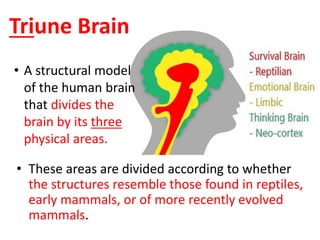
Triune Brain 
• A structural model 
of the human brain 
that divides the 
brain by its three 
physical areas. 
• These areas are divided according to whether 
the structures resemble those found in reptiles, 
early mammals, or of more recently evolved 
mammals.
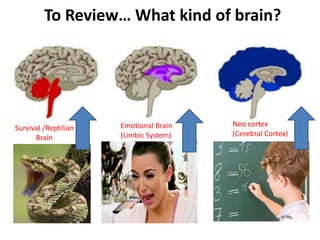
To Review… What kind of brain? 
Neo cortex 
(Cerebral Cortex) 
Emotional Brain 
(Limbic System) 
Survival /Reptilian 
Brain
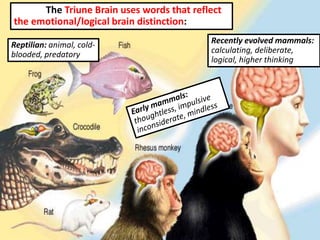
The Triune Brain uses words that reflect 
Recently evolved mammals: 
calculating, deliberate, 
logical, higher thinking 
the emotional/logical brain distinction: 
Reptilian: animal, cold-blooded, 
predatory
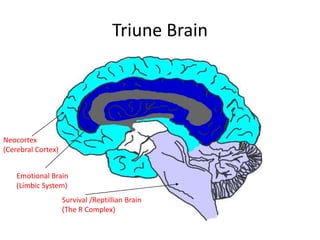
Triune Brain 
Neocortex 
(Cerebral Cortex) 
Emotional Brain 
(Limbic System) 
Survival /Reptillian Brain 
(The R Complex)
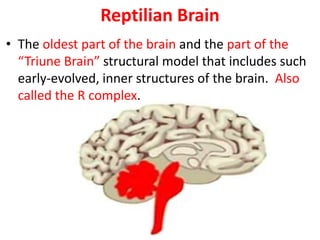
Reptilian Brain 
• The oldest part of the brain and the part of the 
“Triune Brain” structural model that includes such 
early-evolved, inner structures of the brain. Also 
called the R complex.
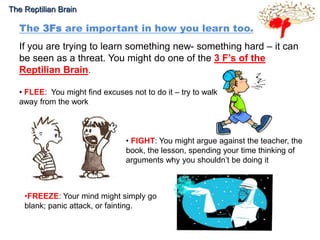
The Reptilian Brain 
The 3Fs are important in how you learn too. 
If you are trying to learn something new- something hard – it can 
be seen as a threat. You might do one of the 3 F’s of the 
Reptilian Brain. 
• FLEE: You might find excuses not to do it – try to walk 
away from the work 
• FIGHT: You might argue against the teacher, the 
book, the lesson, spending your time thinking of 
arguments why you shouldn’t be doing it 
•FREEZE: Your mind might simply go 
blank; panic attack, or fainting.
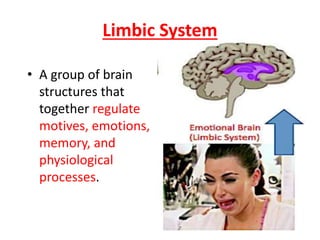
Limbic System 
• A group of brain 
structures that 
together regulate 
motives, emotions, 
memory, and 
physiological 
processes.
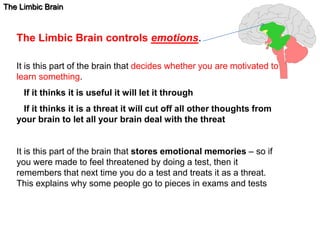
The Limbic Brain 
The Limbic Brain controls emotions. 
It is this part of the brain that decides whether you are motivated to 
learn something. 
If it thinks it is useful it will let it through 
If it thinks it is a threat it will cut off all other thoughts from 
your brain to let all your brain deal with the threat 
It is this part of the brain that stores emotional memories – so if 
you were made to feel threatened by doing a test, then it 
remembers that next time you do a test and treats it as a threat. 
This explains why some people go to pieces in exams and tests
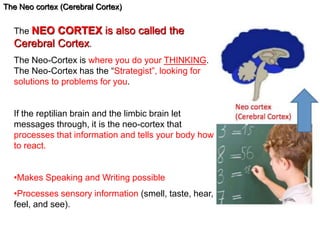
The Neo cortex (Cerebral Cortex) 
The NEO CORTEX is also called the 
Cerebral Cortex. 
The Neo-Cortex is where you do your THINKING. 
The Neo-Cortex has the “Strategist”, looking for 
solutions to problems for you. 
If the reptilian brain and the limbic brain let 
messages through, it is the neo-cortex that 
processes that information and tells your body how 
to react. 
•Makes Speaking and Writing possible 
•Processes sensory information (smell, taste, hear, 
feel, and see).
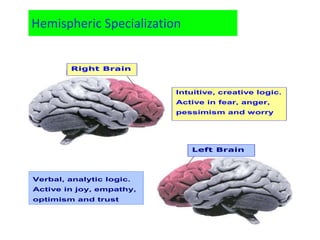
Hemispheric Specialization 
Right Brain 
Intuitive, creative logic. 
Active in fear, anger, 
pessimism and worry 
Left Brain 
Verbal, analytic logic. 
Active in joy, empathy, 
optimism and trust
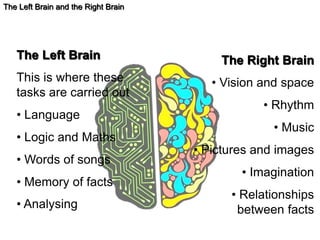
The Left Brain and the Right Brain 
The Left Brain 
This is where these 
tasks are carried out 
• Language 
• Logic and Maths 
• Words of songs 
• Memory of facts 
• Analysing 
The Right Brain 
• Vision and space 
• Rhythm 
• Music 
• Pictures and images 
• Imagination 
• Relationships 
between facts
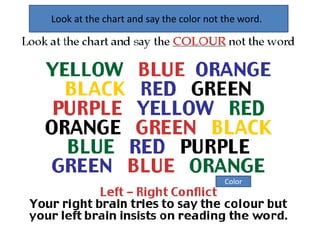
Look at the chart and say the color not the word. 
Color
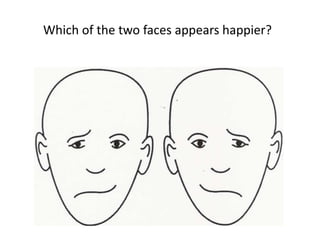
Which of the two faces appears happier?
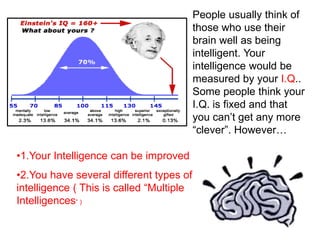
•1.Your Intelligence can be improved 
•2.You have several different types of 
intelligence ( This is called “Multiple 
Intelligences” ) 
People usually think of 
those who use their 
brain well as being 
intelligent. Your 
intelligence would be 
measured by your I.Q.. 
Some people think your 
I.Q. is fixed and that 
you can’t get any more 
“clever”. However…
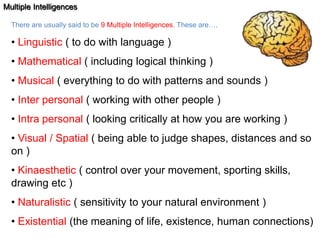
Multiple Intelligences 
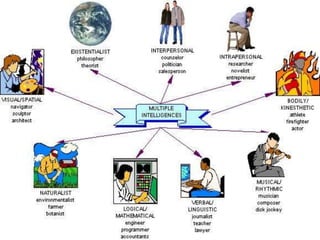
There are usually said to be 9 Multiple Intelligences. These are…. 
• Linguistic ( to do with language ) 
• Mathematical ( including logical thinking ) 
• Musical ( everything to do with patterns and sounds ) 
• Inter personal ( working with other people ) 
• Intra personal ( looking critically at how you are working ) 
• Visual / Spatial ( being able to judge shapes, distances and so 
on ) 
• Kinaesthetic ( control over your movement, sporting skills, 
drawing etc ) 
• Naturalistic ( sensitivity to your natural environment ) 
• Existential (the meaning of life, existence, human connections)
The Human Brain Clip 
http://www.youtube.com/watch?v=9UukcdU258A 
Listen carefully, the man is British. 
Note: Watch from Beginning-4:30, skip 2 min, then 
from 6:30 to end.
Works Cited 
• www.acwa.asn.au/Conf2006/Wed_Bath.ppt 
• www.response-education.org/Brain.ppt

Intro Brain Algernon

  • 1.
    Flowers for Algernon Overview of the Brain and how it functions. Fill in the blanks on your guided notes as we go through the PPT. Feel free to add information where you please.
  • 2.
    What do youalready know? • Write down anything you know about the parts of the brain and how it functions? What facts, parts, or knowledge do you know about the brain either in humans or other animals? – Take 1 minute, write down what you know about the brain. – After 1 minute, share with a partner. – Add to your list if you’d like. – Be prepared to share with the class.
  • 3.
    Triune Brain •A structural model of the human brain that divides the brain by its three physical areas. • These areas are divided according to whether the structures resemble those found in reptiles, early mammals, or of more recently evolved mammals.
  • 4.
    To Review… Whatkind of brain? Neo cortex (Cerebral Cortex) Emotional Brain (Limbic System) Survival /Reptilian Brain
  • 5.
    The Triune Brainuses words that reflect Recently evolved mammals: calculating, deliberate, logical, higher thinking the emotional/logical brain distinction: Reptilian: animal, cold-blooded, predatory
  • 6.
    Triune Brain Neocortex (Cerebral Cortex) Emotional Brain (Limbic System) Survival /Reptillian Brain (The R Complex)
  • 7.
    Reptilian Brain •The oldest part of the brain and the part of the “Triune Brain” structural model that includes such early-evolved, inner structures of the brain. Also called the R complex.
  • 8.
    The Reptilian Brain The 3Fs are important in how you learn too. If you are trying to learn something new- something hard – it can be seen as a threat. You might do one of the 3 F’s of the Reptilian Brain. • FLEE: You might find excuses not to do it – try to walk away from the work • FIGHT: You might argue against the teacher, the book, the lesson, spending your time thinking of arguments why you shouldn’t be doing it •FREEZE: Your mind might simply go blank; panic attack, or fainting.
  • 9.
    Limbic System •A group of brain structures that together regulate motives, emotions, memory, and physiological processes.
  • 10.
    The Limbic Brain The Limbic Brain controls emotions. It is this part of the brain that decides whether you are motivated to learn something. If it thinks it is useful it will let it through If it thinks it is a threat it will cut off all other thoughts from your brain to let all your brain deal with the threat It is this part of the brain that stores emotional memories – so if you were made to feel threatened by doing a test, then it remembers that next time you do a test and treats it as a threat. This explains why some people go to pieces in exams and tests
  • 11.
    The Neo cortex(Cerebral Cortex) The NEO CORTEX is also called the Cerebral Cortex. The Neo-Cortex is where you do your THINKING. The Neo-Cortex has the “Strategist”, looking for solutions to problems for you. If the reptilian brain and the limbic brain let messages through, it is the neo-cortex that processes that information and tells your body how to react. •Makes Speaking and Writing possible •Processes sensory information (smell, taste, hear, feel, and see).
  • 12.
    Hemispheric Specialization RightBrain Intuitive, creative logic. Active in fear, anger, pessimism and worry Left Brain Verbal, analytic logic. Active in joy, empathy, optimism and trust
  • 13.
    The Left Brainand the Right Brain The Left Brain This is where these tasks are carried out • Language • Logic and Maths • Words of songs • Memory of facts • Analysing The Right Brain • Vision and space • Rhythm • Music • Pictures and images • Imagination • Relationships between facts
  • 14.
    Look at thechart and say the color not the word. Color
  • 15.
    Which of thetwo faces appears happier?
  • 20.
    •1.Your Intelligence canbe improved •2.You have several different types of intelligence ( This is called “Multiple Intelligences” ) People usually think of those who use their brain well as being intelligent. Your intelligence would be measured by your I.Q.. Some people think your I.Q. is fixed and that you can’t get any more “clever”. However…
  • 21.
    Multiple Intelligences Thereare usually said to be 9 Multiple Intelligences. These are…. • Linguistic ( to do with language ) • Mathematical ( including logical thinking ) • Musical ( everything to do with patterns and sounds ) • Inter personal ( working with other people ) • Intra personal ( looking critically at how you are working ) • Visual / Spatial ( being able to judge shapes, distances and so on ) • Kinaesthetic ( control over your movement, sporting skills, drawing etc ) • Naturalistic ( sensitivity to your natural environment ) • Existential (the meaning of life, existence, human connections)
  • 23.
    The Human BrainClip http://www.youtube.com/watch?v=9UukcdU258A Listen carefully, the man is British. Note: Watch from Beginning-4:30, skip 2 min, then from 6:30 to end.
  • 24.
    Works Cited •www.acwa.asn.au/Conf2006/Wed_Bath.ppt • www.response-education.org/Brain.ppt