BHASMA
INTRODUCTION
2
medicine.
 Concept of reduction in particle size  Charaka
Samhita(1500 B.C)  Louhadi rasayana.
 Concept of Bhasma preparation  7th century.
 Bhasmas  the unique Ayurvedic metallic/mineral
preparations  metals or minerals are treated with herbal
juices or decoctions make them into pellets  exposed
to certain quantum of heat as per Puta.
 Bhasmas  the most ancient application of Nano
BHASMA
3
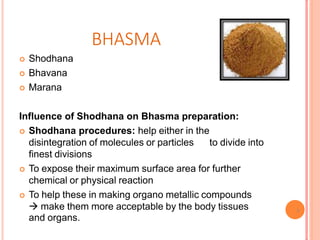
 Shodhana
 Bhavana
 Marana
Influence of Shodhana on Bhasma preparation:
 Shodhana procedures: help either in the
disintegration of molecules or particles to divide into
finest divisions
 To expose their maximum surface area for further
chemical or physical reaction
 To help these in making organo metallic compounds
 make them more acceptable by the body tissues
and organs.
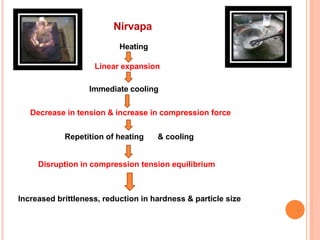
Nirvapa
Heating
Linear expansion
Immediate cooling
Decrease in tension & increase in compression force
Repetition of heating & cooling
Disruption in compression tension equilibrium
Increased brittleness, reduction in hardness & particle size
4
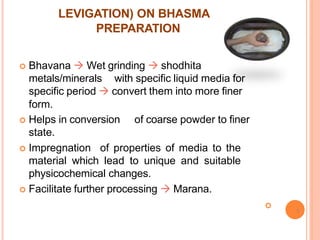
 Bhavana  Wet grinding  shodhita
metals/minerals with specific liquid media for
specific period  convert them into more finer
form.
 Helps in conversion of coarse powder to finer
state.
 Impregnation of properties of media to the
material which lead to unique and suitable
physicochemical changes.
 Facilitate further processing  Marana.

LEVIGATION) ON BHASMA
PREPARATION
5
JARANA
6
 Jarana is the intermediate procedure for the
metals having low melting point, between
Shodhana and Marana.
 Metals are melted  mixed with particular plant
drug powders  are rubbed by iron ladle until
metals become complete powder form.
 Oxidation of metals occurs during heating at
open air , which increases the melting point of
the metal.
 Facilitates reduction of particle size.
CONCEPT OF MARANA
 The process which converts purified metals and
minerals into Bhasma after subjecting them to
levigation and incineration is called Marana
Role of Marana
 Marana responsible for feasible changes 
converts these industrial materials 
magnificent medicine.
 Increase in no of puta
particle
 Conjugation of trace elements
 Elimination of impurities.
Decease in size of
 Formation of desirable compounds which are
biologically favorable to the body. 7
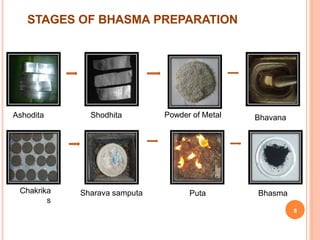
Ashodita Shodhita Powder of Metal Bhavana
Chakrika
s
Sharava samputa Puta Bhasma
STAGES OF BHASMA PREPARATION
8
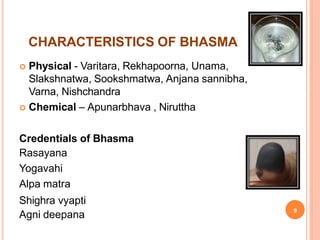
CHARACTERISTICS OF BHASMA
 Physical - Varitara, Rekhapoorna, Unama,
Slakshnatwa, Sookshmatwa, Anjana sannibha,
Varna, Nishchandra
 Chemical – Apunarbhava , Niruttha
Credentials of Bhasma
Rasayana
Yogavahi
Alpa matra
Shighra vyapti
9
Agni deepana
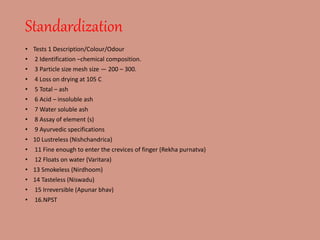
Standardization
• Tests 1 Description/Colour/Odour
• 2 Identification –chemical composition.
• 3 Particle size mesh size — 200 – 300.
• 4 Loss on drying at 105 C
• 5 Total – ash
• 6 Acid – insoluble ash
• 7 Water soluble ash
• 8 Assay of element (s)
• 9 Ayurvedic specifications
• 10 Lustreless (Nishchandrica)
• 11 Fine enough to enter the crevices of finger (Rekha purnatva)
• 12 Floats on water (Varitara)
• 13 Smokeless (Nirdhoom)
• 14 Tasteless (Niswadu)
• 15 Irreversible (Apunar bhav)
• 16.NPST
Bhasma

Bhasma

  • 1.
  • 2.
    INTRODUCTION 2 medicine.  Concept ofreduction in particle size  Charaka Samhita(1500 B.C)  Louhadi rasayana.  Concept of Bhasma preparation  7th century.  Bhasmas  the unique Ayurvedic metallic/mineral preparations  metals or minerals are treated with herbal juices or decoctions make them into pellets  exposed to certain quantum of heat as per Puta.  Bhasmas  the most ancient application of Nano
  • 3.
    BHASMA 3  Shodhana  Bhavana Marana Influence of Shodhana on Bhasma preparation:  Shodhana procedures: help either in the disintegration of molecules or particles to divide into finest divisions  To expose their maximum surface area for further chemical or physical reaction  To help these in making organo metallic compounds  make them more acceptable by the body tissues and organs.
  • 4.
    Nirvapa Heating Linear expansion Immediate cooling Decreasein tension & increase in compression force Repetition of heating & cooling Disruption in compression tension equilibrium Increased brittleness, reduction in hardness & particle size 4
  • 5.
     Bhavana Wet grinding  shodhita metals/minerals with specific liquid media for specific period  convert them into more finer form.  Helps in conversion of coarse powder to finer state.  Impregnation of properties of media to the material which lead to unique and suitable physicochemical changes.  Facilitate further processing  Marana.  LEVIGATION) ON BHASMA PREPARATION 5
  • 6.
    JARANA 6  Jarana isthe intermediate procedure for the metals having low melting point, between Shodhana and Marana.  Metals are melted  mixed with particular plant drug powders  are rubbed by iron ladle until metals become complete powder form.  Oxidation of metals occurs during heating at open air , which increases the melting point of the metal.  Facilitates reduction of particle size.
  • 7.
    CONCEPT OF MARANA The process which converts purified metals and minerals into Bhasma after subjecting them to levigation and incineration is called Marana Role of Marana  Marana responsible for feasible changes  converts these industrial materials  magnificent medicine.  Increase in no of puta particle  Conjugation of trace elements  Elimination of impurities. Decease in size of  Formation of desirable compounds which are biologically favorable to the body. 7
  • 8.
    Ashodita Shodhita Powderof Metal Bhavana Chakrika s Sharava samputa Puta Bhasma STAGES OF BHASMA PREPARATION 8
  • 9.
    CHARACTERISTICS OF BHASMA Physical - Varitara, Rekhapoorna, Unama, Slakshnatwa, Sookshmatwa, Anjana sannibha, Varna, Nishchandra  Chemical – Apunarbhava , Niruttha Credentials of Bhasma Rasayana Yogavahi Alpa matra Shighra vyapti 9 Agni deepana
  • 10.
    Standardization • Tests 1Description/Colour/Odour • 2 Identification –chemical composition. • 3 Particle size mesh size — 200 – 300. • 4 Loss on drying at 105 C • 5 Total – ash • 6 Acid – insoluble ash • 7 Water soluble ash • 8 Assay of element (s) • 9 Ayurvedic specifications • 10 Lustreless (Nishchandrica) • 11 Fine enough to enter the crevices of finger (Rekha purnatva) • 12 Floats on water (Varitara) • 13 Smokeless (Nirdhoom) • 14 Tasteless (Niswadu) • 15 Irreversible (Apunar bhav) • 16.NPST