Seminar on भावना
samskar
By Dr Bankimchandra S J
PG Scholar
Dept of RS&BK
Defination of Samskara
• Acharya Charaka defines Samskara as transformation of the inherent
attribute and addition of extra properties to substance.Various modes of
Samskara are mentioned in Ayurvedic pharmaceutics, viz Svedana ,
Mardana, Manthana, Bhavana .
• One of them is Bhavana samskara
Defination
• Bhavana is an important Samskara mentioned in classics by which even a
small dose of a drug may be made to produce a very high result i.e. to
increase its potency.
• Bhavana is a triturition method and also a technique used to reduce particle
size
• Bhavana is defined as in which the powder drugs are mixed with some
specific liquids and are triturate dry them4 . In this the raw material will be
taken in powder form which is called as Bhavya Dravya and the liquid which
is used along with is called as Dravya.
• It is not a single process but a combination of small stepwise processes like;
1. Combination (Sanyoga) of low potency drugs with specified liquid Medias
to। bring drugs of higher potency.
2. Modification in properties (Gunantaradhana)
3.Trituration (Mardana) which produce the assimiliable particle size of the drug.
4. Agnisannikarsha occurs, as tritutaion produce heat by friction due to which
causes chemical and physical bonding and there is conversion of properties
from its previous form (transformed).
Quantity of media in Bhavana
• The quantity of Kasaya Dravya must be equal to the quantity of the is added
in the Kwatha prepration. Here the heat produced during grinding and the
atmospheric heat helps in drying the materials quickly. By applying
Bhawana the drugs are rendered fine and potentiated.[3]
• If Kwatha is employed for Bhawana process it should always be Astamamsa
- Asasesita Kashaya (reduced to 1/8th part)[4]
• Amount of liquid for Bhavana.The liquid added should be optimum in
quantity so as to form soft or soggy mass and to keep the material wet
throughout grinding.
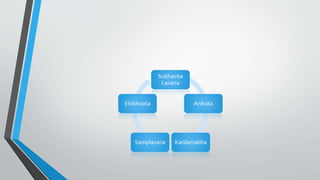
• Quantity of liquid should be sufficient to fulfil the following criteria
(observed in the drug under Bhawana): Ardrata , Kardmabha (clay like
consistency), Samplavana (immersion) and Ekibhoot (becoming
homogeneous mixture).The process is carried out till attainment of
Subhavit Lakshana (confirmatory test for completion of levigation).
Subhavita
Laxana
Ardrata
KardamabhaSamplavana
Ekibhoota
Cycles and duration of Bhavana
• 1. Number of Bhavana - Gandhaka Rasayana - 84
• 2. Duration of Bhavana in days or hours is quoted in texts under various terms such as
Yama or Prahara or Divas - Aganikumar rasa (3Yama).
• 3.Types of liquid media - Anand Bhairav Rasa (Jambiri juice),
BrahmiVati (Brahmi Hima),
Kravyada Rasa (Panchkola Phanta
Kalpna)
• 4. Animal origin -Vasantmalati Rasa (Cow navneeta).
• 5. Mineral origin - Karpur Rasa (Jala).
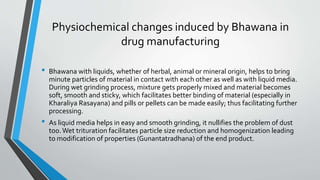
Physiochemical changes induced by Bhawana in
drug manufacturing
• Bhawana with liquids, whether of herbal, animal or mineral origin, helps to bring
minute particles of material in contact with each other as well as with liquid media.
During wet grinding process, mixture gets properly mixed and material becomes
soft, smooth and sticky, which facilitates better binding of material (especially in
Kharaliya Rasayana) and pills or pellets can be made easily; thus facilitating further
processing.
• As liquid media helps in easy and smooth grinding, it nullifies the problem of dust
too.Wet trituration facilitates particle size reduction and homogenization leading
to modification of properties (Gunantatradhana) of the end product.
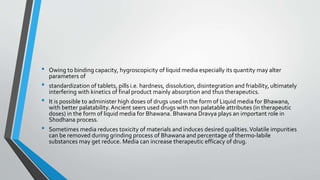
• Owing to binding capacity, hygroscopicity of liquid media especially its quantity may alter
parameters of
• standardization of tablets, pills i.e. hardness, dissolution, disintegration and friability, ultimately
interfering with kinetics of final product mainly absorption and thus therapeutics.
• It is possible to administer high doses of drugs used in the form of Liquid media for Bhawana,
with better palatability.Ancient seers used drugs with non palatable attributes (in therapeutic
doses) in the form of liquid media for Bhawana. Bhawana Dravya plays an important role in
Shodhana process.
• Sometimes media reduces toxicity of materials and induces desired qualities.Volatile impurities
can be removed during grinding process of Bhawana and percentage of thermo-labile
substances may get reduce. Media can increase therapeutic efficacy of drug.
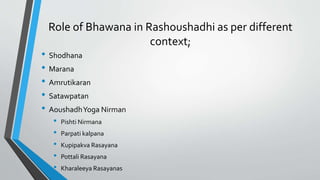
Role of Bhawana in Rashoushadhi as per different
context;
• Shodhana
• Marana
• Amrutikaran
• Satawpatan
• AoushadhYoga Nirman
• Pishti Nirmana
• Parpati kalpana
• Kupipakva Rasayana
• Pottali Rasayana
• Kharaleeya Rasayanas
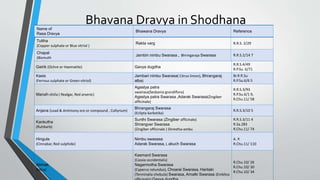
Bhavana Dravya in ShodhanaName of
Rasa Dravya
Bhawana Dravya Reference
Tuttha
(Copper sulphate or Blue vitriol )
Rakta varg R.R.S. 2/29
Chapal
(Bismuth
Jambiri nimbu Swarasa , Bhringaraja Swarasa R.R.S.2/14 7
Gairik (Ochre or Haematite) Gavya dugdha
R.R.S.4/49
R.P.Su. 6/71
Kasis
(Ferrous sulphate or Green vitriol)
Jambari nimbu Swarasa( Citrus limon), Bhrangaraj
alba)
Br.R.R.Su
R.P.Su.6/6 5
Manah-shiila ( Realgar, Red arsenic)
Agastya patra
swairasa(Sesbania grandiflora)
Agastya patra Swarasa ,Adarak Swarasa(Zingiber
officinale)
R.R.S.3/93
R.P.Su.6/1 9,
R.Chu.11/ 58
Anjana (Lead & Antimony ore or compound , Collyrium)
Bhrangaraj Swarasa
(Eclipta karkotika)
R.R.S.3/10 5
Kankutha
(Ruhbarb)
Sunthi Swarasa (Zingiber officinale)
Shrangver Swarasa
(Zingiber officinale ) Shrestha-ambu
R.R.S.3/11 4
R.Sa.283
R.Chu.11/ 74
Hingula
(Cinnabar, Red sulphide)
Nimbu swasasa
Adarak Swarasa, L akuch Swarasa
A. P.
R.Chu.11/ 110
Abhrak
(Mica)
Kasmard Swarasa
(Cassia occidentalis)
Nagarmotha Swarasa
(Cyperus rotundus), Choarai Swarasa, Haritaki
(Terminalia chebula) Swarasa, Amalki Swarasa (Emblica
R.Chu.10/ 26
R.Chu.10/ 30
R.Chu.10/ 34
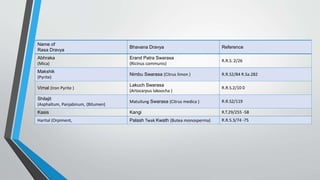
Name of
Rasa Dravya
Bhavana Dravya Reference
Abhraka
(Mica)
Erand Patra Swarasa
(Ricinus communis)
R.R.S. 2/26
Makshik
(Pyrite)
Nimbu Swarasa (Citrus limon ) R.R.S2/84 R.Sa.282
Vimal (Iron Pyrite )
Lakuch Swarasa
(Artocarpus lakoocha )
R.R.S.2/10 0
Shilajit
(Asphaltum, Panjabinum, (Bitumen)
Matuilung Swarasa (Citrus medica ) R.R.S2/119
Kasis Kangi R.T.29/255 -58
Harital (Orpiment, Palash Twak Kwath (Butea monosperma) R.R.S.3/74 -75
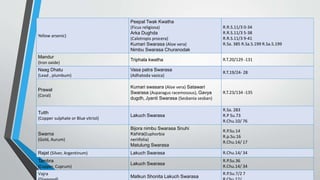
Yellow arsenic)
Peepal Twak Kwatha
(Ficus religiosa)
Arka Dughda
(Calotropis procera)
Kumari Swarasa (Aloe vera)
Nimbu Swarasa Churanodak
R.R.S.11/3 0-34
R.R.S.11/3 5-38
R.R.S.11/3 9-41
R.Sa. 385 R.Sa.S.199 R.Sa.S.199
Mandur
(Iron oxide)
Triphala kwatha R.T.20/129 -131
Naag Dhatu
(Lead , plumbum)
Vasa patra Swarasa
(Adhatoda vasica)
R.T.19/24- 28
Prawal
(Coral)
Kumari swasara (Aloe vera) Satawari
Swarasa (Asparagus racemosous), Gavya
dugdh, Jyanti Swarasa (Sesbania sesban)
R.T.23/134 -135
Tutth
(Copper sulphate or Blue vitriol)
Lakuch Swarasa
R.Sa. 283
R.P Su.73
R.Chu.10/ 76
Swarna
(Gold, Aurum)
Bijora nimbu Swarasa Snuhi
Kshira(Euphorbia
neriifolia)
Matulung Swarasa
R.P.Su.14
R.p.Su.16
R.Chu.14/ 17
Rajat (Silver, Argentinum) Lakuch Swarasa R.Chu.14/ 34
Tambra
(Copper, Cuprum)
Lakuch Swarasa
R.P.Su.36
R.Chu.14/ 34
Vajra
Matkun Shonita Lakuch Swarasa
R.P.Su.7/2 7
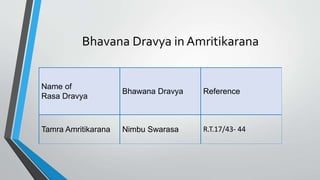
Bhavana Dravya in Amritikarana
Name of
Rasa Dravya
Bhawana Dravya Reference
Tamra Amritikarana Nimbu Swarasa R.T.17/43- 44
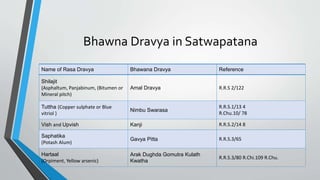
Bhawna Dravya in Satwapatana
Name of Rasa Dravya Bhawana Dravya Reference
Shilajit
(Asphaltum, Panjabinum, (Bitumen or
Mineral pitch)
Amal Dravya R.R.S 2/122
Tuttha (Copper sulphate or Blue
vitriol )
Nimbu Swarasa
R.R.S.1/13 4
R.Chu.10/ 78
Vish and Upvish Kanji R.R.S.2/14 8
Saphatika
(Potash Alum)
Gavya Pitta R.R.S.3/65
Hartaal
(Orpiment, Yellow arsenic)
Arak Dughda Gomutra Kulath
Kwatha
R.R.S.3/80 R.Chi.109 R.Chu.
CONCLUSION
Bhavana plays a very important role in making theAyurvedic metallic and
mineral preparations free from toxicity and making the easily absorbable into
the system. Remove harmful substances or impurities present in the drugs.
The natural properties are also enhanced and even new properties are also
inducted. During wet grinding method, combination gets correctly uniform
and substance becomes pliable, silky and gummy, which facilitates improved
required of material (especially in Kharaliya Rasayana) and tablets or pellets
can be made easily.
THANKYOU

BHAVANA SAMSKARA

  • 1.
    Seminar on भावना samskar ByDr Bankimchandra S J PG Scholar Dept of RS&BK
  • 2.
    Defination of Samskara •Acharya Charaka defines Samskara as transformation of the inherent attribute and addition of extra properties to substance.Various modes of Samskara are mentioned in Ayurvedic pharmaceutics, viz Svedana , Mardana, Manthana, Bhavana . • One of them is Bhavana samskara
  • 3.
    Defination • Bhavana isan important Samskara mentioned in classics by which even a small dose of a drug may be made to produce a very high result i.e. to increase its potency. • Bhavana is a triturition method and also a technique used to reduce particle size
  • 4.
    • Bhavana isdefined as in which the powder drugs are mixed with some specific liquids and are triturate dry them4 . In this the raw material will be taken in powder form which is called as Bhavya Dravya and the liquid which is used along with is called as Dravya.
  • 5.
    • It isnot a single process but a combination of small stepwise processes like; 1. Combination (Sanyoga) of low potency drugs with specified liquid Medias to। bring drugs of higher potency. 2. Modification in properties (Gunantaradhana) 3.Trituration (Mardana) which produce the assimiliable particle size of the drug. 4. Agnisannikarsha occurs, as tritutaion produce heat by friction due to which causes chemical and physical bonding and there is conversion of properties from its previous form (transformed).
  • 6.
    Quantity of mediain Bhavana • The quantity of Kasaya Dravya must be equal to the quantity of the is added in the Kwatha prepration. Here the heat produced during grinding and the atmospheric heat helps in drying the materials quickly. By applying Bhawana the drugs are rendered fine and potentiated.[3] • If Kwatha is employed for Bhawana process it should always be Astamamsa - Asasesita Kashaya (reduced to 1/8th part)[4]
  • 7.
    • Amount ofliquid for Bhavana.The liquid added should be optimum in quantity so as to form soft or soggy mass and to keep the material wet throughout grinding. • Quantity of liquid should be sufficient to fulfil the following criteria (observed in the drug under Bhawana): Ardrata , Kardmabha (clay like consistency), Samplavana (immersion) and Ekibhoot (becoming homogeneous mixture).The process is carried out till attainment of Subhavit Lakshana (confirmatory test for completion of levigation).
  • 8.
  • 9.
    Cycles and durationof Bhavana • 1. Number of Bhavana - Gandhaka Rasayana - 84 • 2. Duration of Bhavana in days or hours is quoted in texts under various terms such as Yama or Prahara or Divas - Aganikumar rasa (3Yama). • 3.Types of liquid media - Anand Bhairav Rasa (Jambiri juice), BrahmiVati (Brahmi Hima), Kravyada Rasa (Panchkola Phanta Kalpna) • 4. Animal origin -Vasantmalati Rasa (Cow navneeta). • 5. Mineral origin - Karpur Rasa (Jala).
  • 10.
    Physiochemical changes inducedby Bhawana in drug manufacturing • Bhawana with liquids, whether of herbal, animal or mineral origin, helps to bring minute particles of material in contact with each other as well as with liquid media. During wet grinding process, mixture gets properly mixed and material becomes soft, smooth and sticky, which facilitates better binding of material (especially in Kharaliya Rasayana) and pills or pellets can be made easily; thus facilitating further processing. • As liquid media helps in easy and smooth grinding, it nullifies the problem of dust too.Wet trituration facilitates particle size reduction and homogenization leading to modification of properties (Gunantatradhana) of the end product.
  • 11.
    • Owing tobinding capacity, hygroscopicity of liquid media especially its quantity may alter parameters of • standardization of tablets, pills i.e. hardness, dissolution, disintegration and friability, ultimately interfering with kinetics of final product mainly absorption and thus therapeutics. • It is possible to administer high doses of drugs used in the form of Liquid media for Bhawana, with better palatability.Ancient seers used drugs with non palatable attributes (in therapeutic doses) in the form of liquid media for Bhawana. Bhawana Dravya plays an important role in Shodhana process. • Sometimes media reduces toxicity of materials and induces desired qualities.Volatile impurities can be removed during grinding process of Bhawana and percentage of thermo-labile substances may get reduce. Media can increase therapeutic efficacy of drug.
  • 12.
    Role of Bhawanain Rashoushadhi as per different context; • Shodhana • Marana • Amrutikaran • Satawpatan • AoushadhYoga Nirman • Pishti Nirmana • Parpati kalpana • Kupipakva Rasayana • Pottali Rasayana • Kharaleeya Rasayanas
  • 13.
    Bhavana Dravya inShodhanaName of Rasa Dravya Bhawana Dravya Reference Tuttha (Copper sulphate or Blue vitriol ) Rakta varg R.R.S. 2/29 Chapal (Bismuth Jambiri nimbu Swarasa , Bhringaraja Swarasa R.R.S.2/14 7 Gairik (Ochre or Haematite) Gavya dugdha R.R.S.4/49 R.P.Su. 6/71 Kasis (Ferrous sulphate or Green vitriol) Jambari nimbu Swarasa( Citrus limon), Bhrangaraj alba) Br.R.R.Su R.P.Su.6/6 5 Manah-shiila ( Realgar, Red arsenic) Agastya patra swairasa(Sesbania grandiflora) Agastya patra Swarasa ,Adarak Swarasa(Zingiber officinale) R.R.S.3/93 R.P.Su.6/1 9, R.Chu.11/ 58 Anjana (Lead & Antimony ore or compound , Collyrium) Bhrangaraj Swarasa (Eclipta karkotika) R.R.S.3/10 5 Kankutha (Ruhbarb) Sunthi Swarasa (Zingiber officinale) Shrangver Swarasa (Zingiber officinale ) Shrestha-ambu R.R.S.3/11 4 R.Sa.283 R.Chu.11/ 74 Hingula (Cinnabar, Red sulphide) Nimbu swasasa Adarak Swarasa, L akuch Swarasa A. P. R.Chu.11/ 110 Abhrak (Mica) Kasmard Swarasa (Cassia occidentalis) Nagarmotha Swarasa (Cyperus rotundus), Choarai Swarasa, Haritaki (Terminalia chebula) Swarasa, Amalki Swarasa (Emblica R.Chu.10/ 26 R.Chu.10/ 30 R.Chu.10/ 34
  • 14.
    Name of Rasa Dravya BhavanaDravya Reference Abhraka (Mica) Erand Patra Swarasa (Ricinus communis) R.R.S. 2/26 Makshik (Pyrite) Nimbu Swarasa (Citrus limon ) R.R.S2/84 R.Sa.282 Vimal (Iron Pyrite ) Lakuch Swarasa (Artocarpus lakoocha ) R.R.S.2/10 0 Shilajit (Asphaltum, Panjabinum, (Bitumen) Matuilung Swarasa (Citrus medica ) R.R.S2/119 Kasis Kangi R.T.29/255 -58 Harital (Orpiment, Palash Twak Kwath (Butea monosperma) R.R.S.3/74 -75
  • 15.
    Yellow arsenic) Peepal TwakKwatha (Ficus religiosa) Arka Dughda (Calotropis procera) Kumari Swarasa (Aloe vera) Nimbu Swarasa Churanodak R.R.S.11/3 0-34 R.R.S.11/3 5-38 R.R.S.11/3 9-41 R.Sa. 385 R.Sa.S.199 R.Sa.S.199 Mandur (Iron oxide) Triphala kwatha R.T.20/129 -131 Naag Dhatu (Lead , plumbum) Vasa patra Swarasa (Adhatoda vasica) R.T.19/24- 28 Prawal (Coral) Kumari swasara (Aloe vera) Satawari Swarasa (Asparagus racemosous), Gavya dugdh, Jyanti Swarasa (Sesbania sesban) R.T.23/134 -135 Tutth (Copper sulphate or Blue vitriol) Lakuch Swarasa R.Sa. 283 R.P Su.73 R.Chu.10/ 76 Swarna (Gold, Aurum) Bijora nimbu Swarasa Snuhi Kshira(Euphorbia neriifolia) Matulung Swarasa R.P.Su.14 R.p.Su.16 R.Chu.14/ 17 Rajat (Silver, Argentinum) Lakuch Swarasa R.Chu.14/ 34 Tambra (Copper, Cuprum) Lakuch Swarasa R.P.Su.36 R.Chu.14/ 34 Vajra Matkun Shonita Lakuch Swarasa R.P.Su.7/2 7
  • 16.
    Bhavana Dravya inAmritikarana Name of Rasa Dravya Bhawana Dravya Reference Tamra Amritikarana Nimbu Swarasa R.T.17/43- 44
  • 17.
    Bhawna Dravya inSatwapatana Name of Rasa Dravya Bhawana Dravya Reference Shilajit (Asphaltum, Panjabinum, (Bitumen or Mineral pitch) Amal Dravya R.R.S 2/122 Tuttha (Copper sulphate or Blue vitriol ) Nimbu Swarasa R.R.S.1/13 4 R.Chu.10/ 78 Vish and Upvish Kanji R.R.S.2/14 8 Saphatika (Potash Alum) Gavya Pitta R.R.S.3/65 Hartaal (Orpiment, Yellow arsenic) Arak Dughda Gomutra Kulath Kwatha R.R.S.3/80 R.Chi.109 R.Chu.
  • 18.
    CONCLUSION Bhavana plays avery important role in making theAyurvedic metallic and mineral preparations free from toxicity and making the easily absorbable into the system. Remove harmful substances or impurities present in the drugs. The natural properties are also enhanced and even new properties are also inducted. During wet grinding method, combination gets correctly uniform and substance becomes pliable, silky and gummy, which facilitates improved required of material (especially in Kharaliya Rasayana) and tablets or pellets can be made easily.
  • 21.