Satvapatana
Dr.MAHANTESHB RUDRAPURI,
M.D(AYU),FAGE
H.O.D& Guide,Pg dept,of rasashastra& bhaishajyakalpana.
Ssramc, inchal,
9972710790
mbrudrapuri@gmail.com
Inroduction
Satva - Essence
Patana - Separation
Satvapatana means – Extacting the active principle or
Essence from its Ore or Mineral.
Reducing the ore/mineral to it,s original metal in
element form.
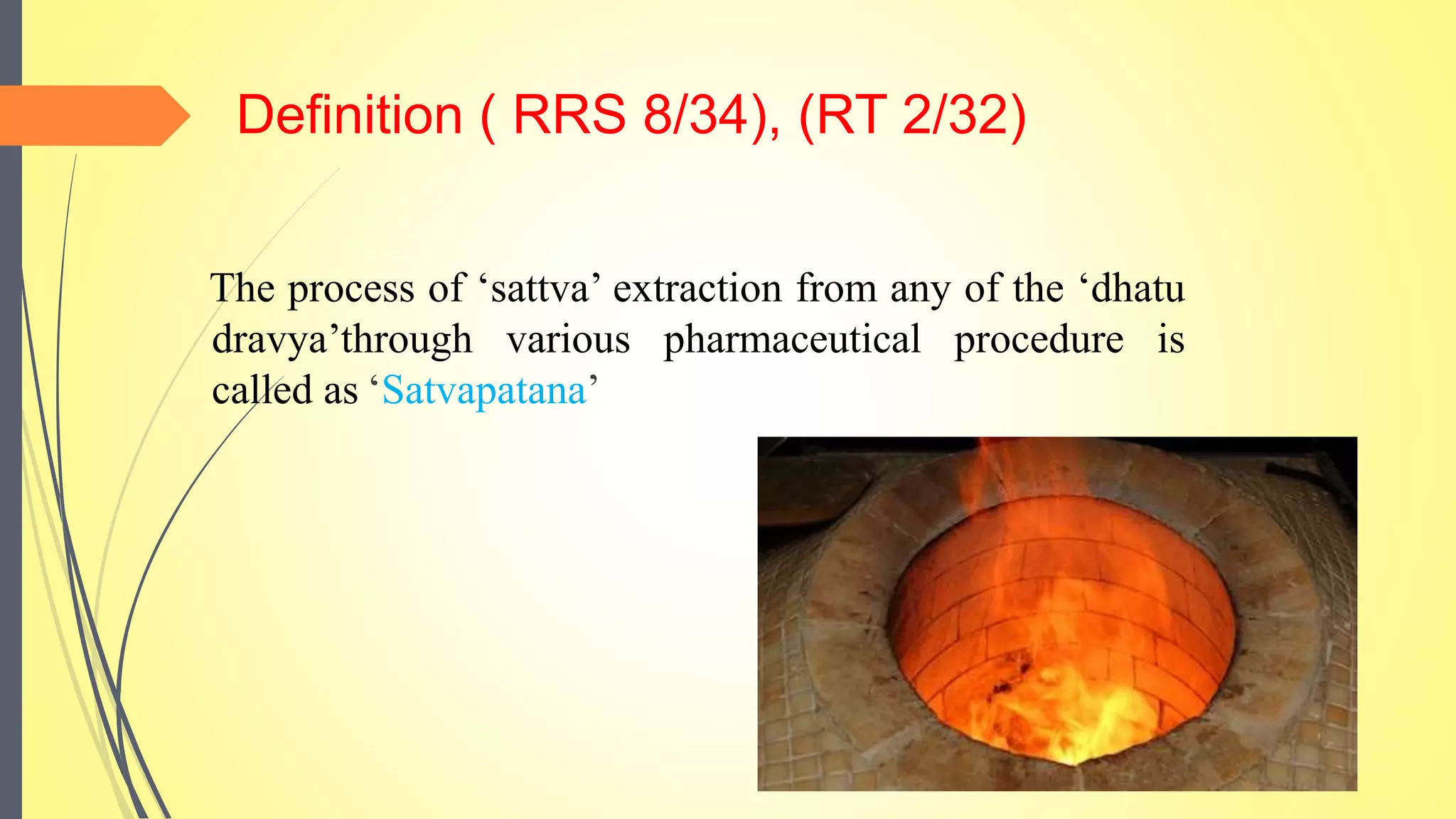
Definition ( RRS 8/34), (RT 2/32)
The process of ‘sattva’ extraction from any of the ‘dhatu
dravya’through various pharmaceutical procedure is
called as ‘Satvapatana’
Classification
 I) According to form of Satwas are classified into two –
(1) Dhaturupa (Metal form) eg. From Sasyaka, Svarnamaksika etc.
(2) Adhaturupa (Non-metallic form) eg. From Manahshila,Haratala, Somal etc.
 (II) The process of Satwapatana differs according to the nature of Satva.
And according to form of Dravyas having Satwa, they can classified into two
–
(1) Complex compound ore - eg. Abhraka, Maksika etc.
(2) Simple compound ore - eg. Malla, Gairika etc.
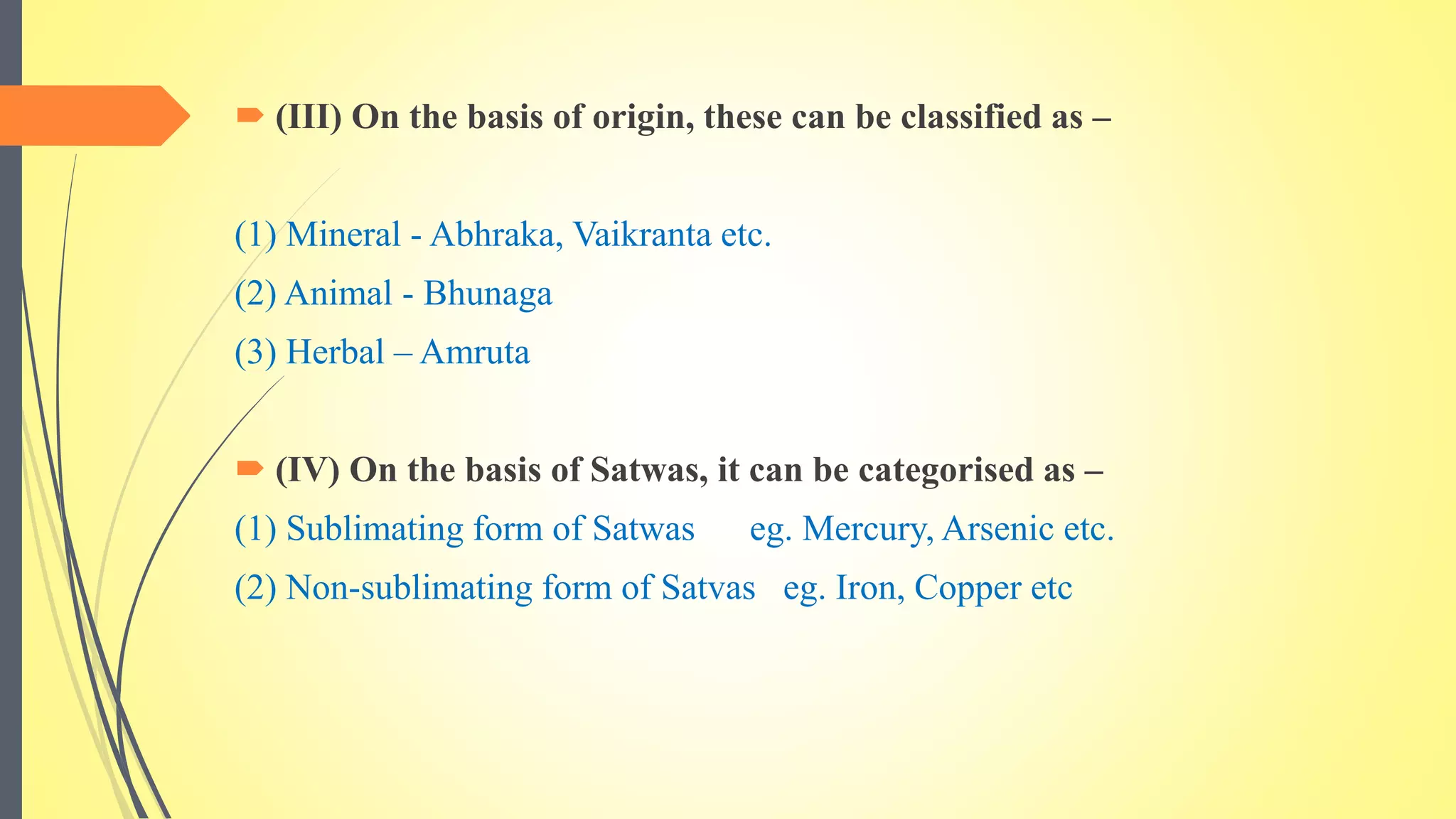
 (III) On the basis of origin, these can be classified as –
(1) Mineral - Abhraka, Vaikranta etc.
(2) Animal - Bhunaga
(3) Herbal – Amruta
 (IV) On the basis of Satwas, it can be categorised as –
(1) Sublimating form of Satwas eg. Mercury, Arsenic etc.
(2) Non-sublimating form of Satvas eg. Iron, Copper etc
Aims & Objectives of Satvapatana
•To extract the active principle of the ore.
•To utilize Satva for further procedures like shodhana and marana, etc.
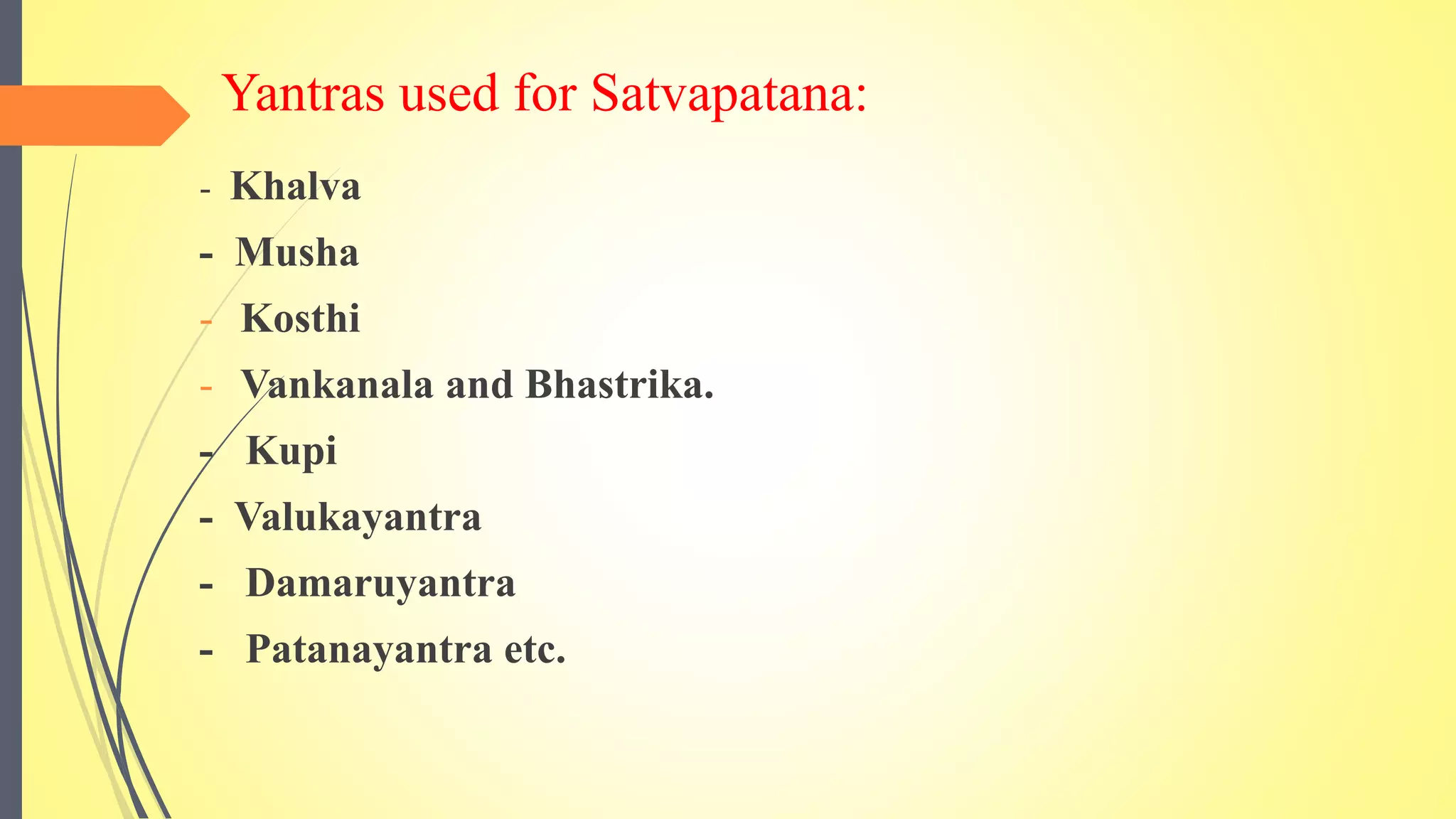
Yantras used for Satvapatana:
- Khalva
- Musha
- Kosthi
- Vankanala and Bhastrika.
- Kupi
- Valukayantra
- Damaruyantra
- Patanayantra etc.
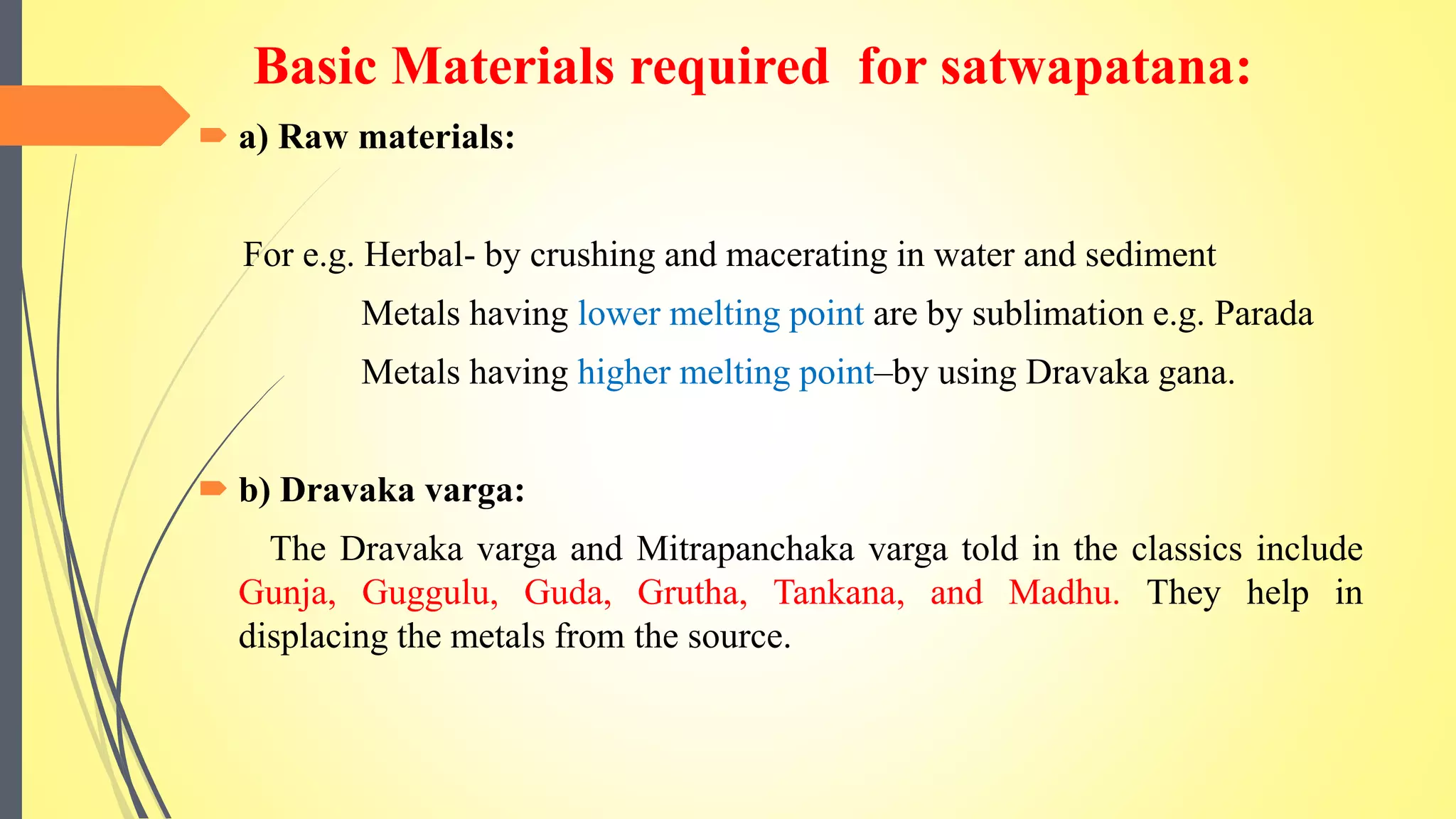
Basic Materials required for satwapatana:
 a) Raw materials:
For e.g. Herbal- by crushing and macerating in water and sediment
Metals having lower melting point are by sublimation e.g. Parada
Metals having higher melting point–by using Dravaka gana.
 b) Dravaka varga:
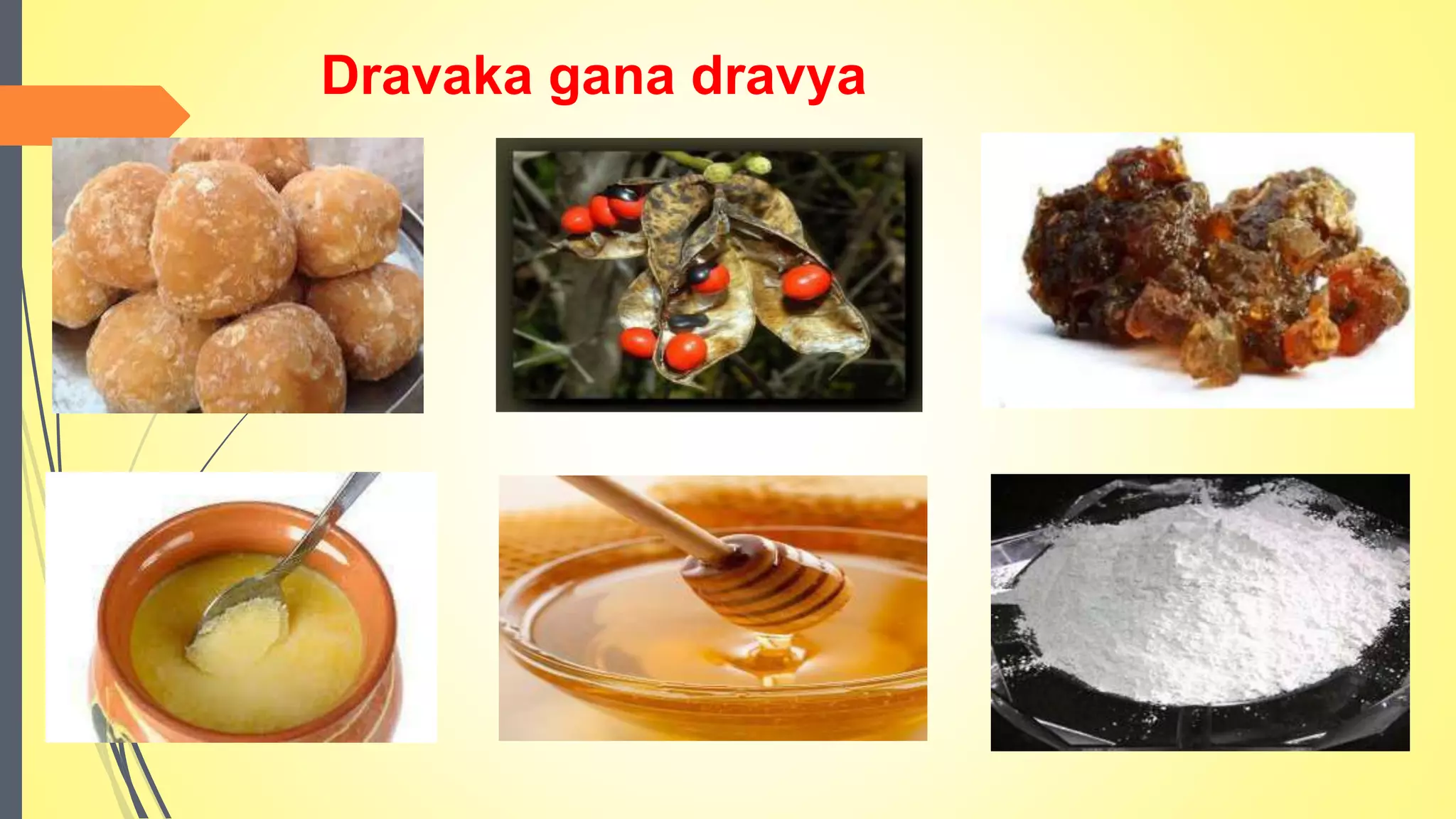
The Dravaka varga and Mitrapanchaka varga told in the classics include
Gunja, Guggulu, Guda, Grutha, Tankana, and Madhu. They help in
displacing the metals from the source.
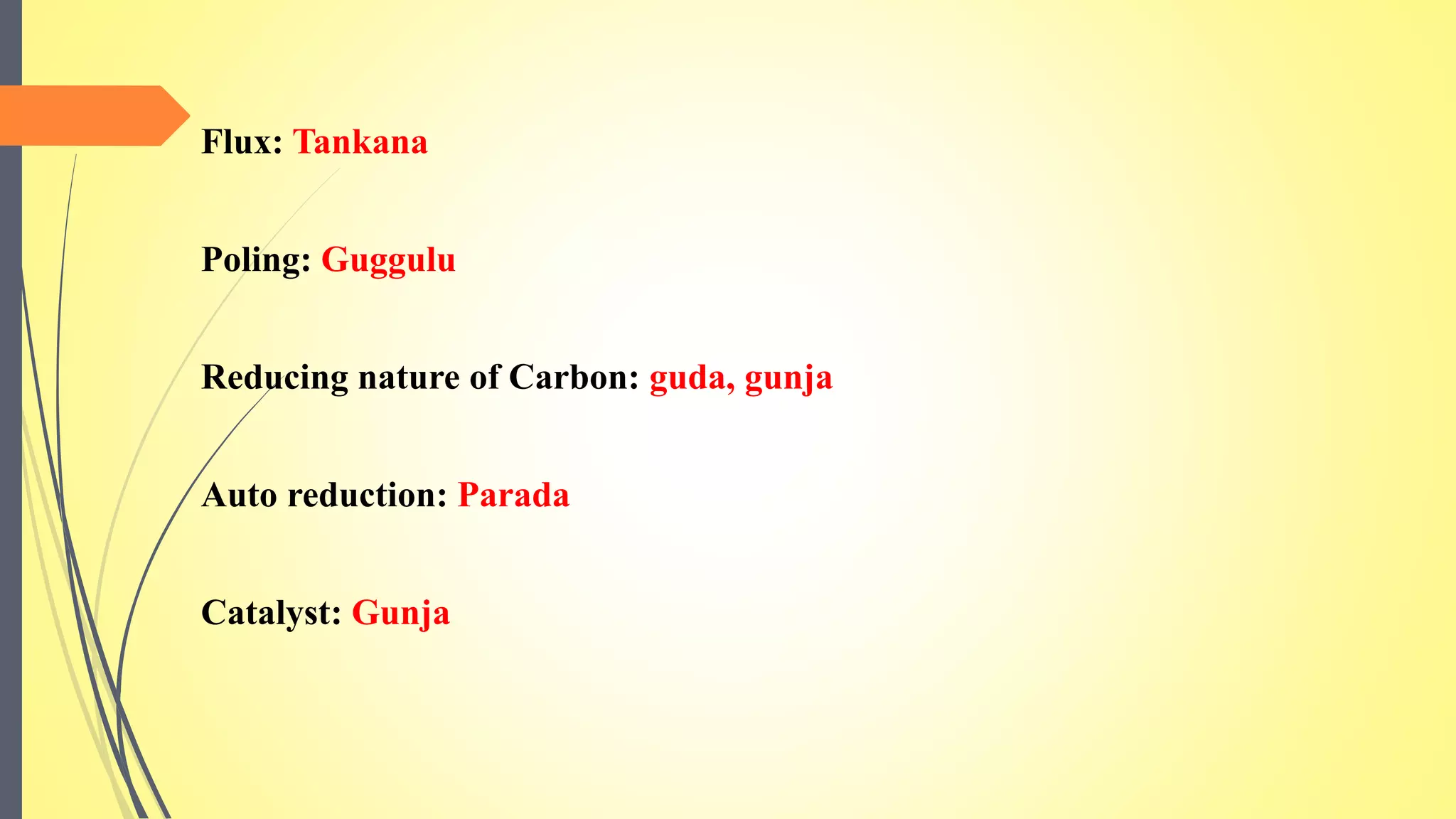
Dravaka gana dravya
Flux: Tankana
Poling: Guggulu
Reducing nature of Carbon: guda, gunja
Auto reduction: Parada
Catalyst: Gunja
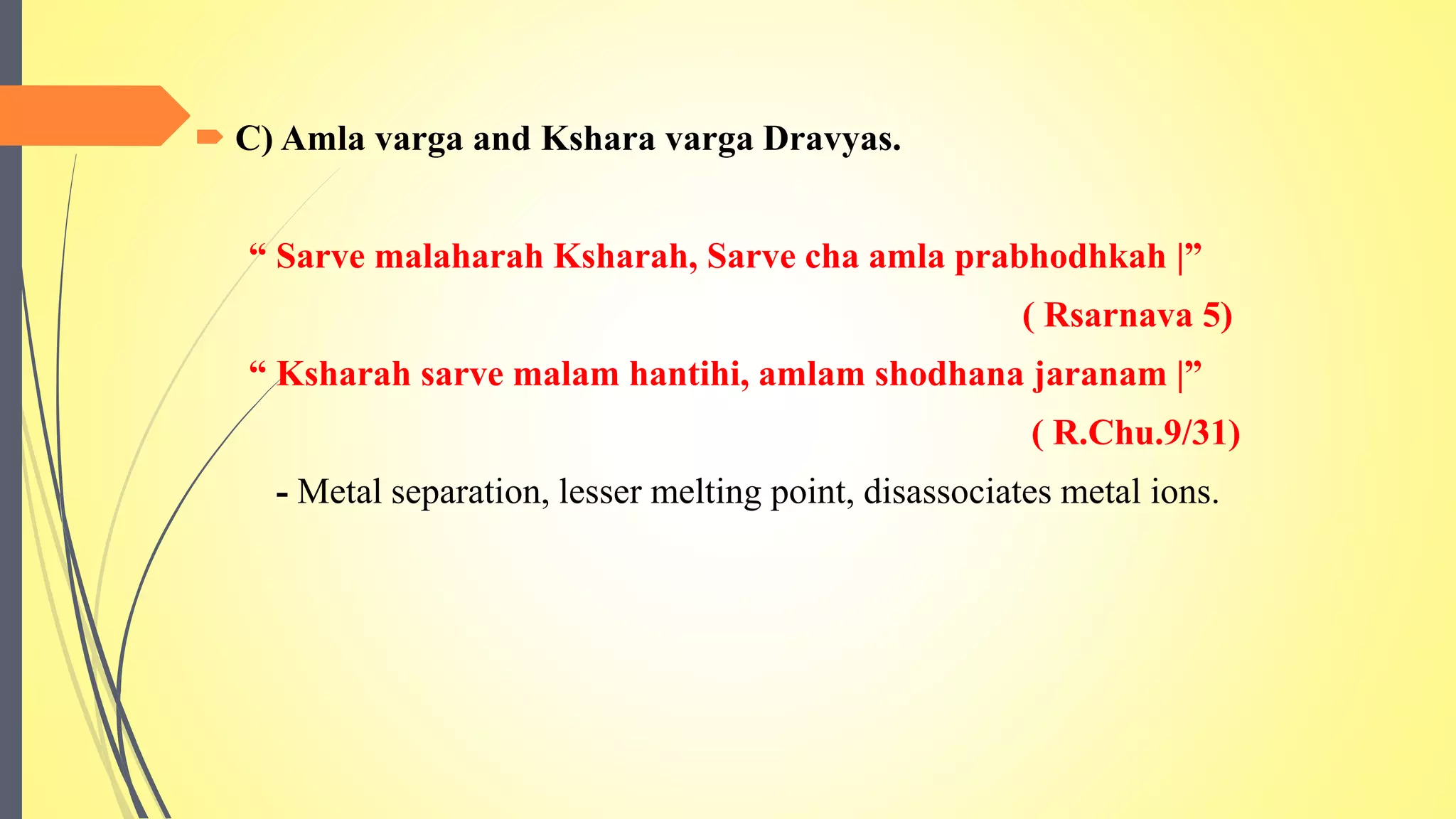
 C) Amla varga and Kshara varga Dravyas.
“ Sarve malaharah Ksharah, Sarve cha amla prabhodhkah |”
( Rsarnava 5)
“ Ksharah sarve malam hantihi, amlam shodhana jaranam |”
( R.Chu.9/31)
- Metal separation, lesser melting point, disassociates metal ions.
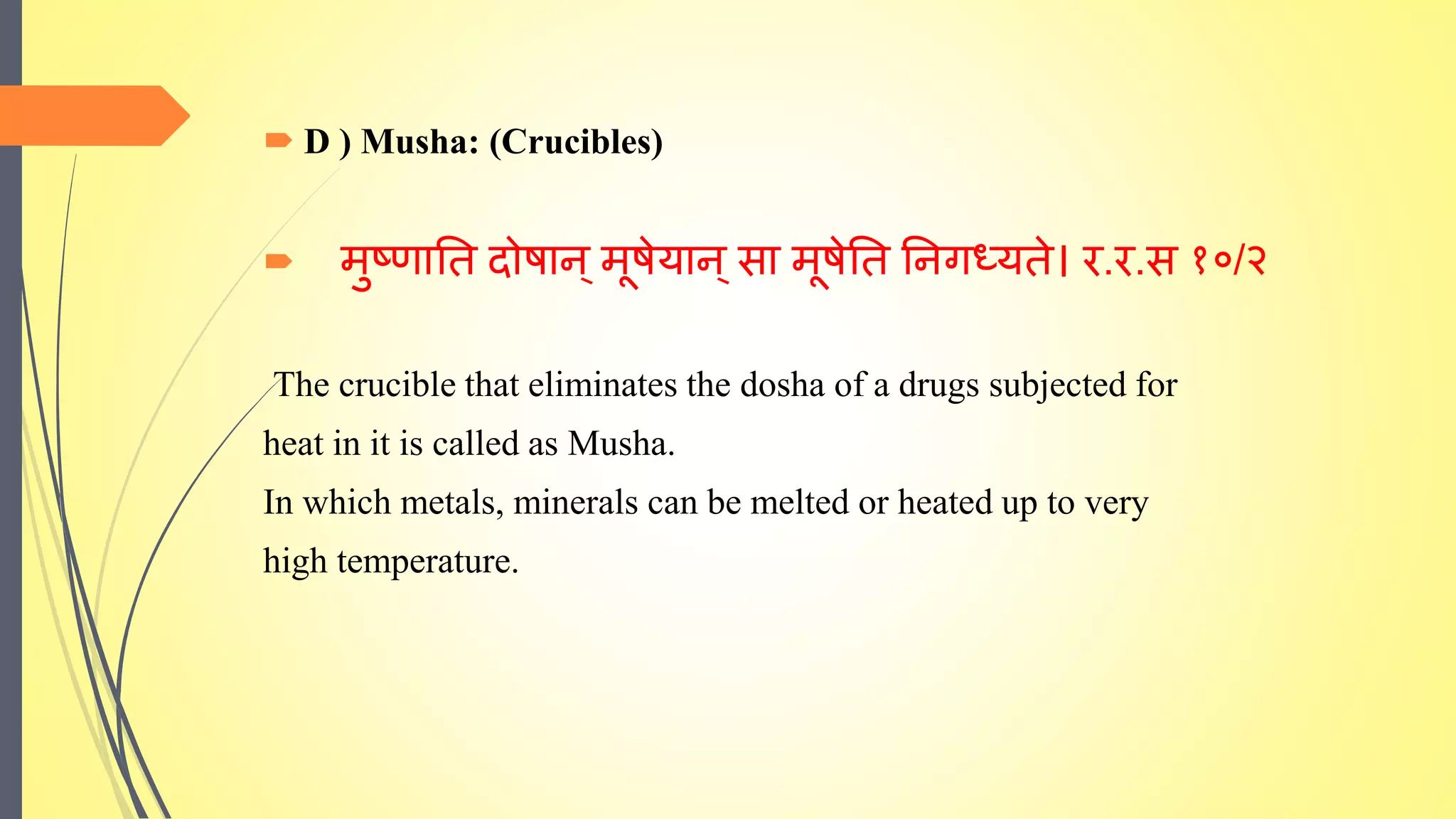
 D ) Musha: (Crucibles)
 मुष्णाति दोषान ्मूषेयान ्सा मूषेति तनगध्यिे। र.र.स १०/२
The crucible that eliminates the dosha of a drugs subjected for
heat in it is called as Musha.
In which metals, minerals can be melted or heated up to very
high temperature.
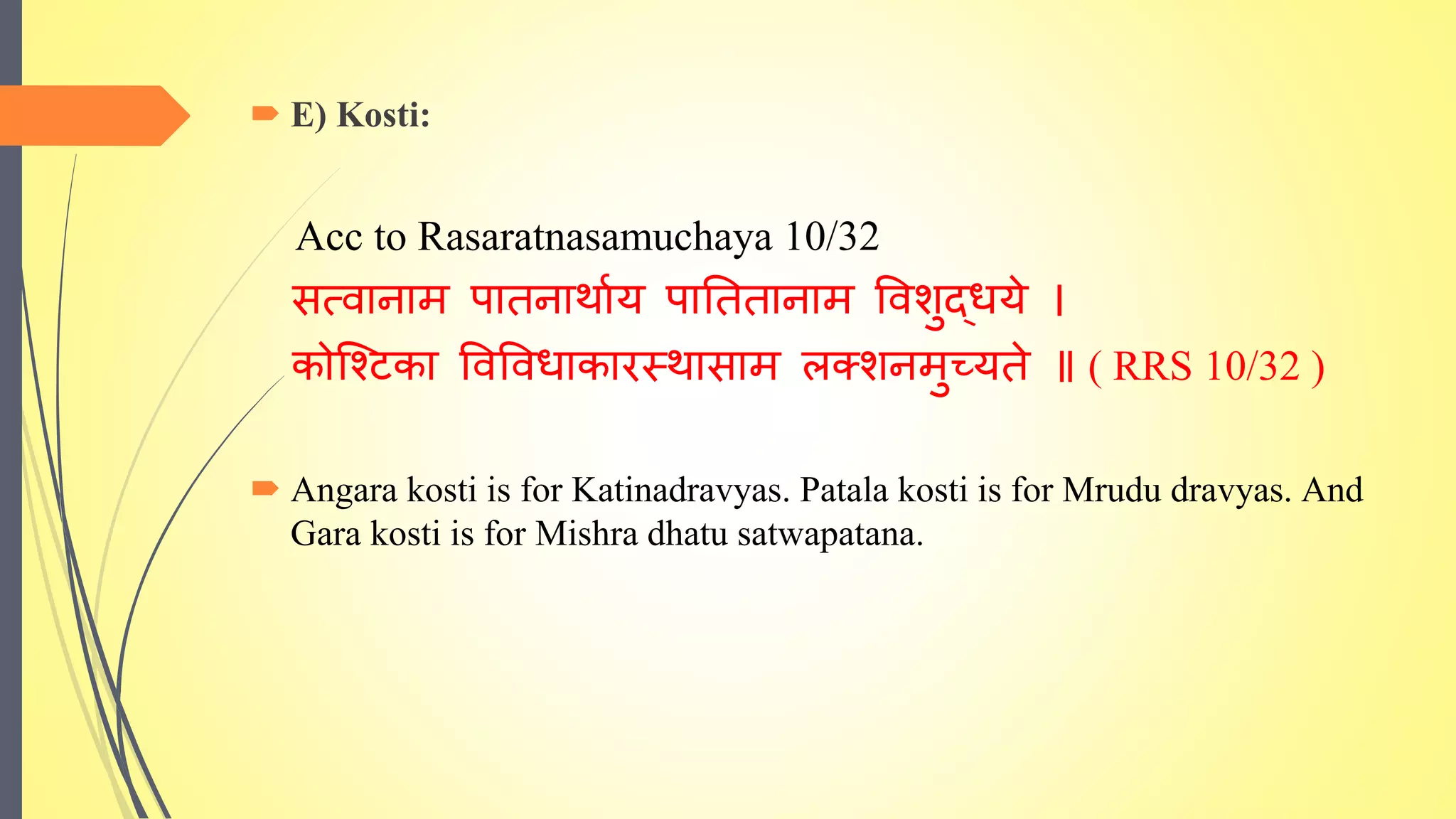
 E) Kosti:
Acc to Rasaratnasamuchaya 10/32
सत्वानाम पािनार्ााय पातििानाम ववशुद्धये ।
कोश्टिका ववववधाकारस्र्ासाम लक्शनमुच्यिे ॥ ( RRS 10/32 )
 Angara kosti is for Katinadravyas. Patala kosti is for Mrudu dravyas. And
Gara kosti is for Mishra dhatu satwapatana.
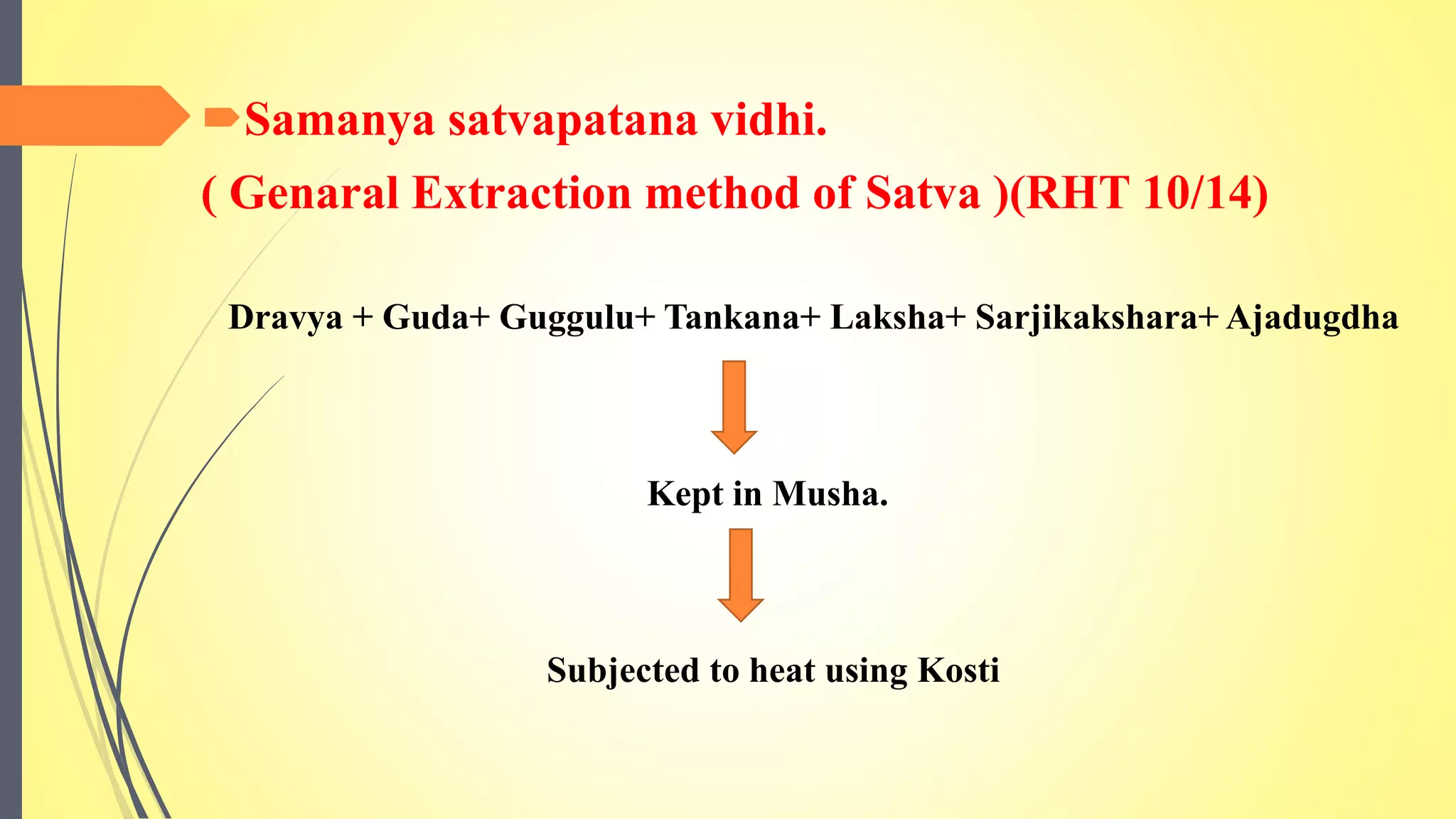
Samanya satvapatana vidhi.
( Genaral Extraction method of Satva )(RHT 10/14)
Dravya + Guda+ Guggulu+ Tankana+ Laksha+ Sarjikakshara+ Ajadugdha
Kept in Musha.
Subjected to heat using Kosti
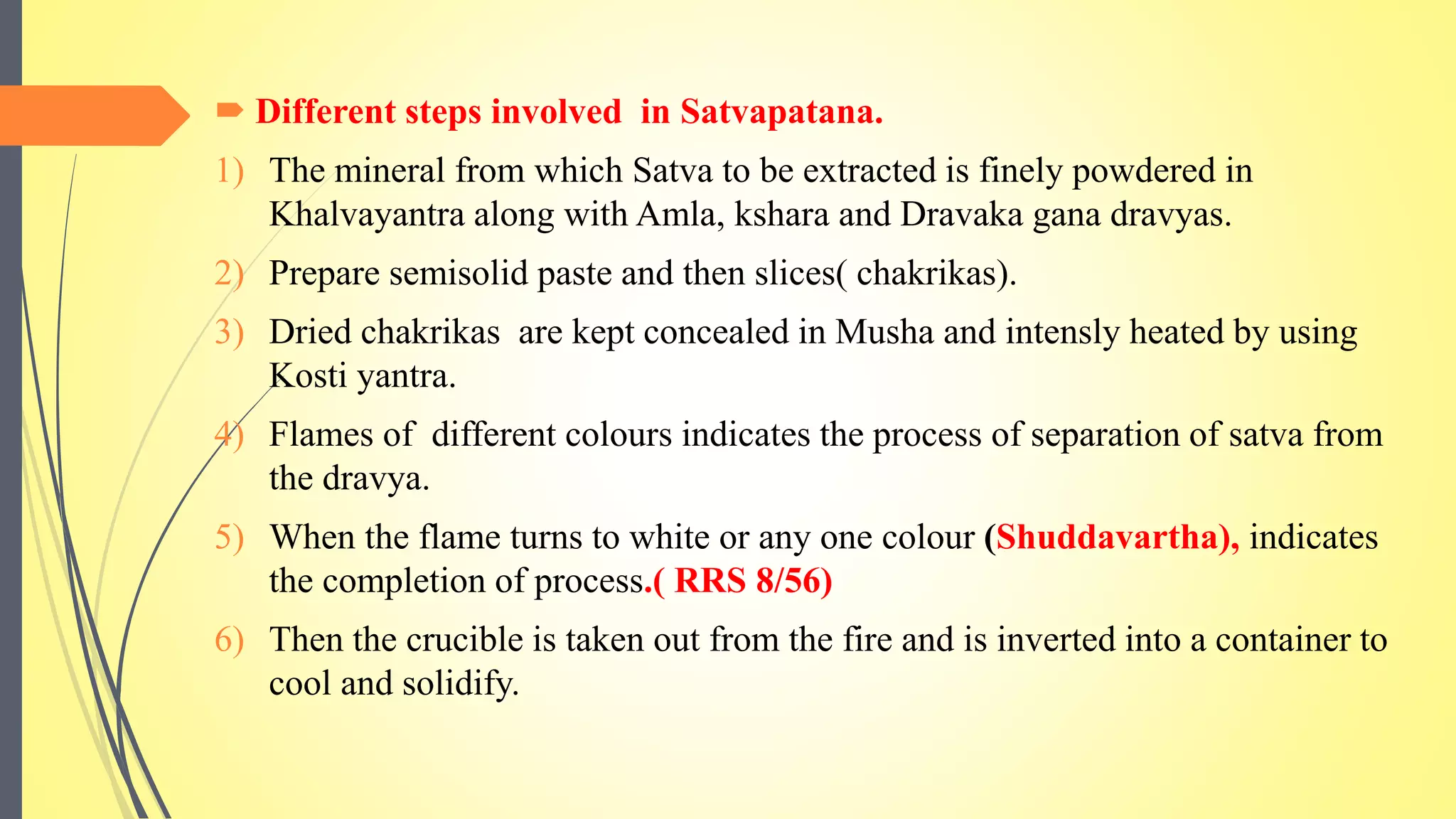
 Different steps involved in Satvapatana.
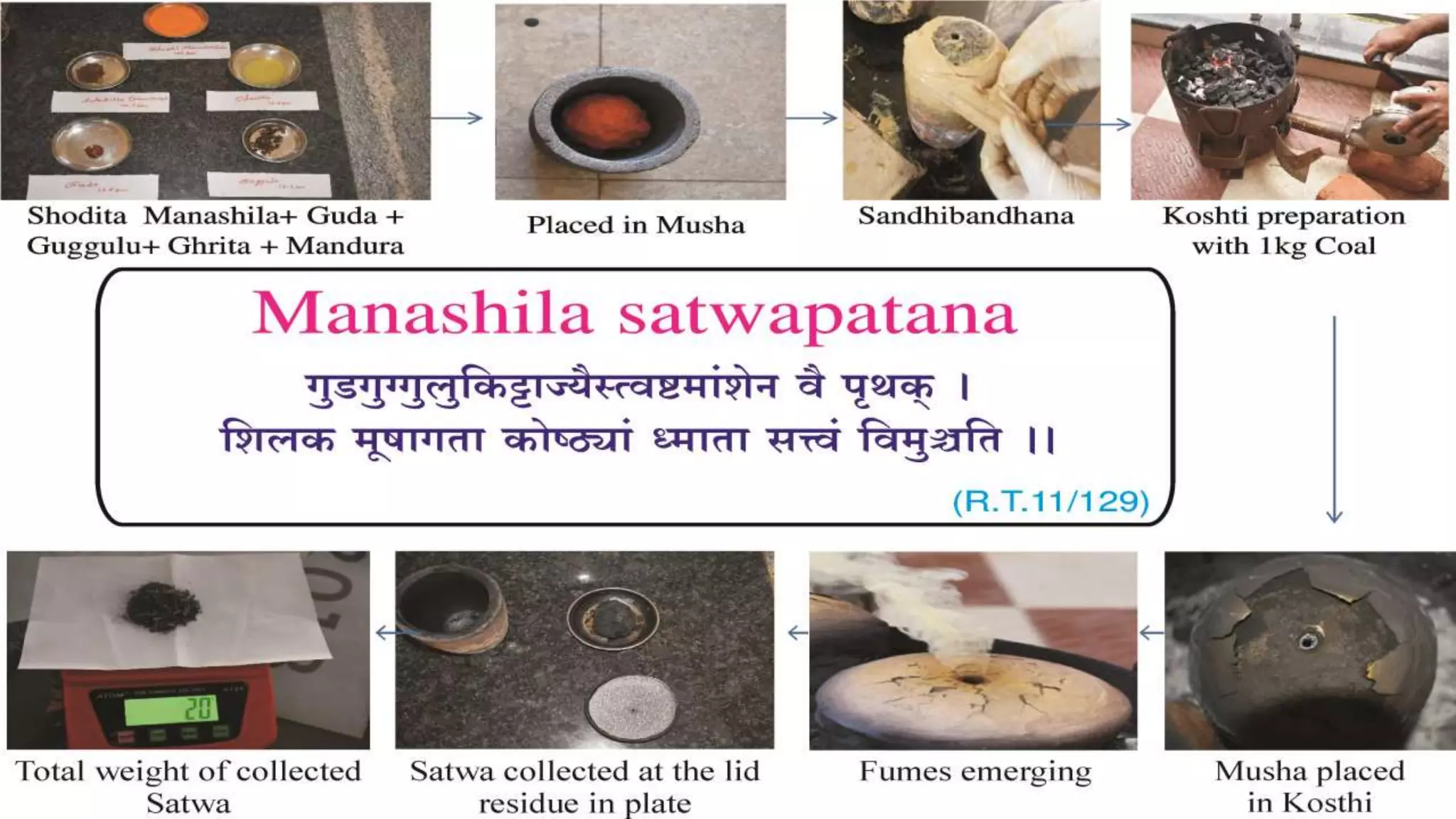
1) The mineral from which Satva to be extracted is finely powdered in
Khalvayantra along with Amla, kshara and Dravaka gana dravyas.
2) Prepare semisolid paste and then slices( chakrikas).
3) Dried chakrikas are kept concealed in Musha and intensly heated by using
Kosti yantra.
4) Flames of different colours indicates the process of separation of satva from
the dravya.
5) When the flame turns to white or any one colour (Shuddavartha), indicates
the completion of process.( RRS 8/56)
6) Then the crucible is taken out from the fire and is inverted into a container to
cool and solidify.
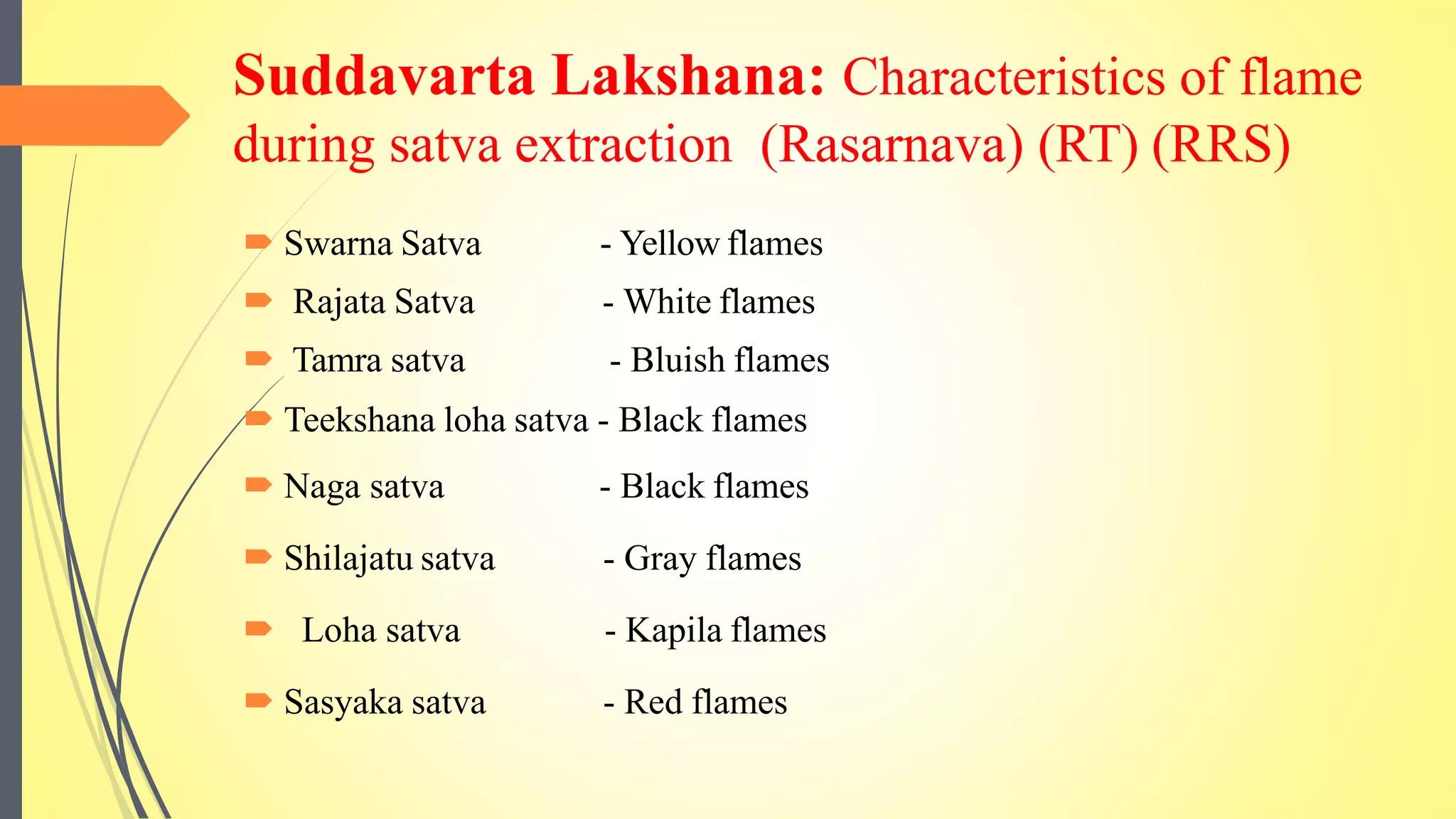
Suddavarta Lakshana: Characteristics of flame
during satva extraction (Rasarnava) (RT) (RRS)
 Swarna Satva - Yellow flames
 Rajata Satva - White flames
 Tamra satva - Bluish flames
 Teekshana loha satva - Black flames
 Naga satva - Black flames
 Shilajatu satva - Gray flames
 Loha satva - Kapila flames
 Sasyaka satva - Red flames
Before Satva is used for medicinal purpose, it has to be subjected
to other procedures as –
1) Mridukarana( Softening) – using Madhu, Taila, Vasa, Grita.
2) Nirmalikarana(Purification) – using shuddi varga dravyas –
Khacha(Lavana), Tankana, Souveera, Shipra(Muktha shuki or
Navasadara or Mahisha mutra) [ RRS 10]
3) Marana(Inciniration) – Bhasmikarana.
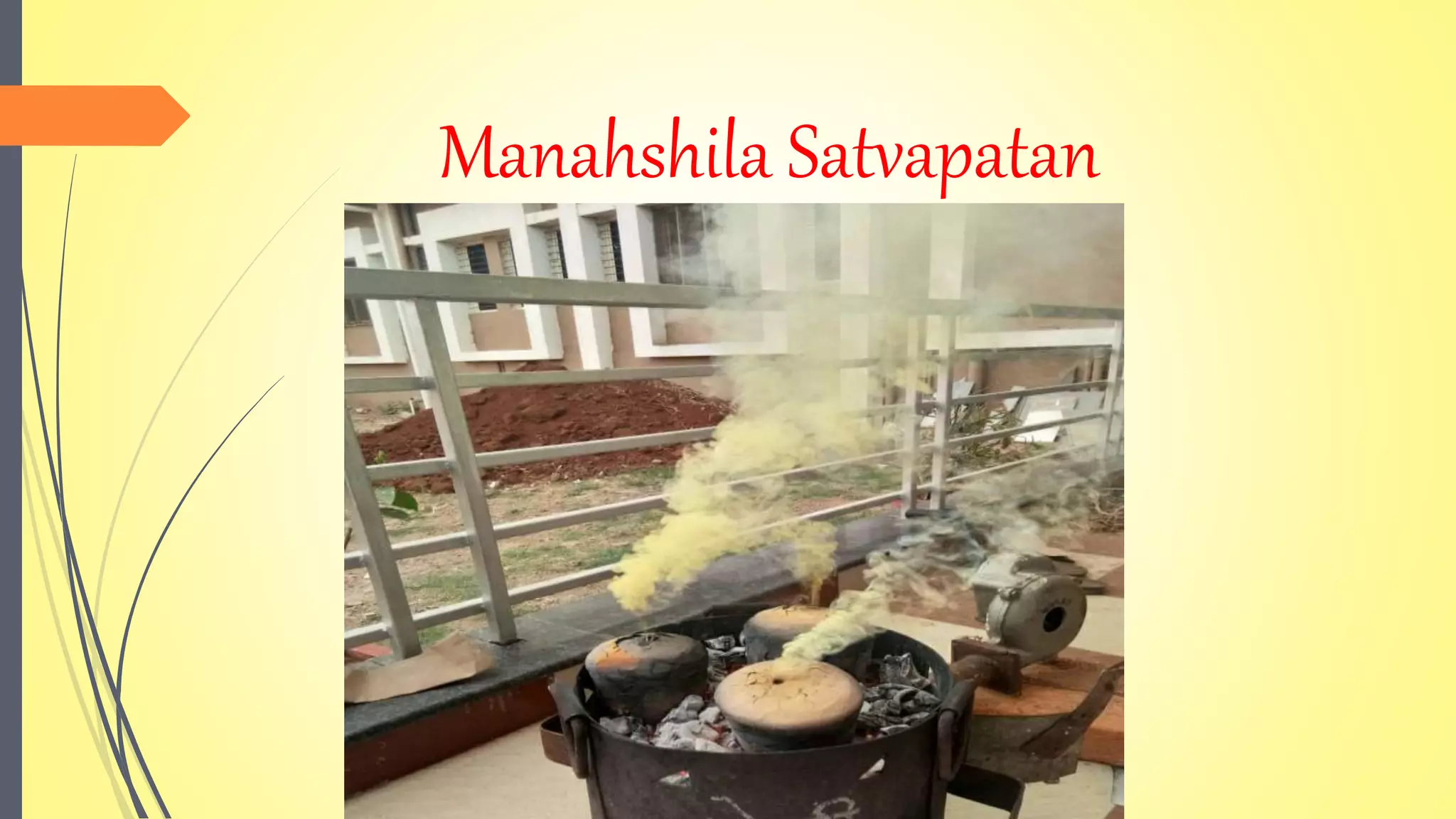
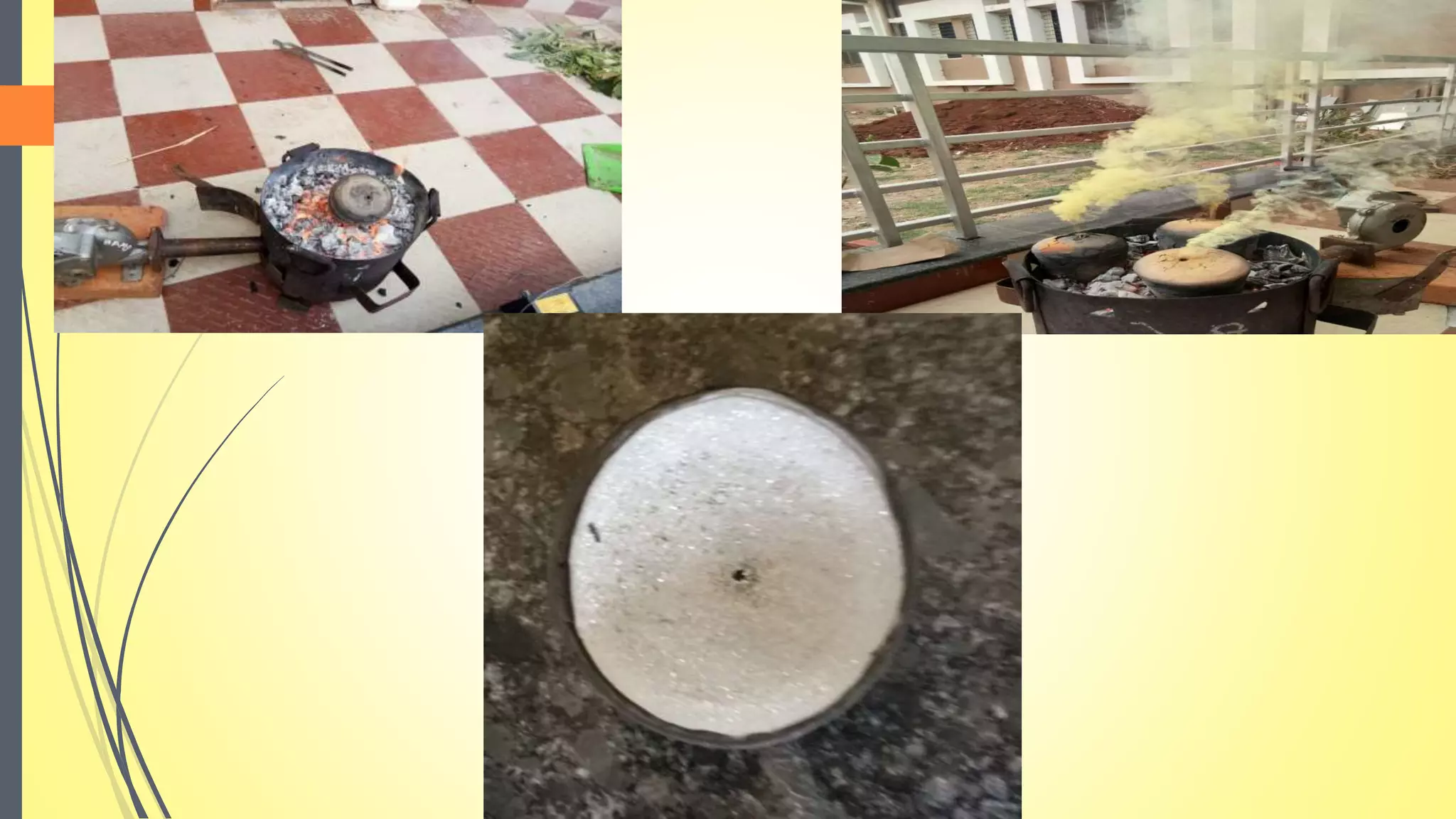
Manahshila Satvapatan
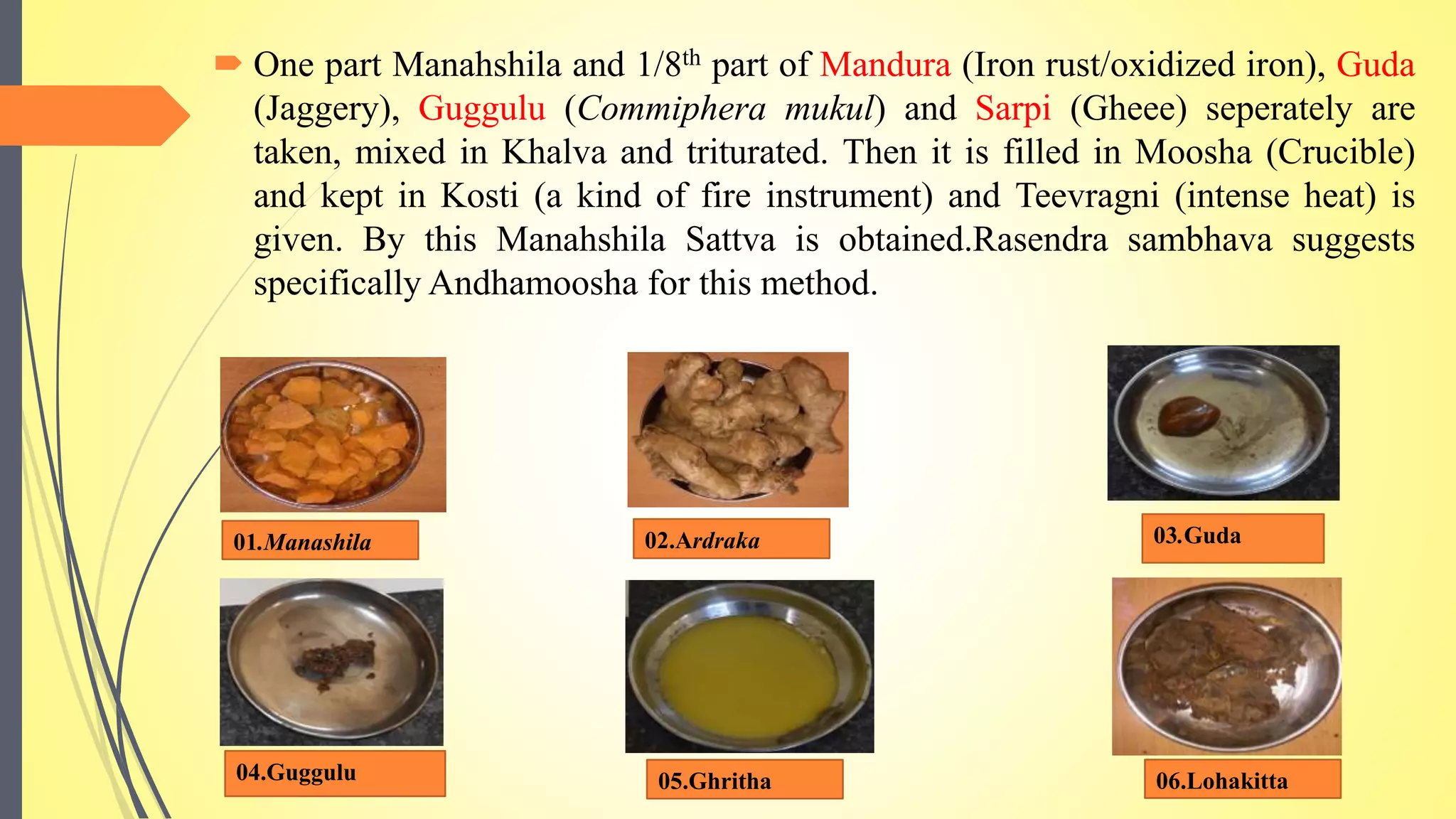
 One part Manahshila and 1/8th part of Mandura (Iron rust/oxidized iron), Guda
(Jaggery), Guggulu (Commiphera mukul) and Sarpi (Gheee) seperately are
taken, mixed in Khalva and triturated. Then it is filled in Moosha (Crucible)
and kept in Kosti (a kind of fire instrument) and Teevragni (intense heat) is
given. By this Manahshila Sattva is obtained.Rasendra sambhava suggests
specifically Andhamoosha for this method.
01.Manashila 02.Ardraka 03.Guda
04.Guggulu 05.Ghritha 06.Lohakitta
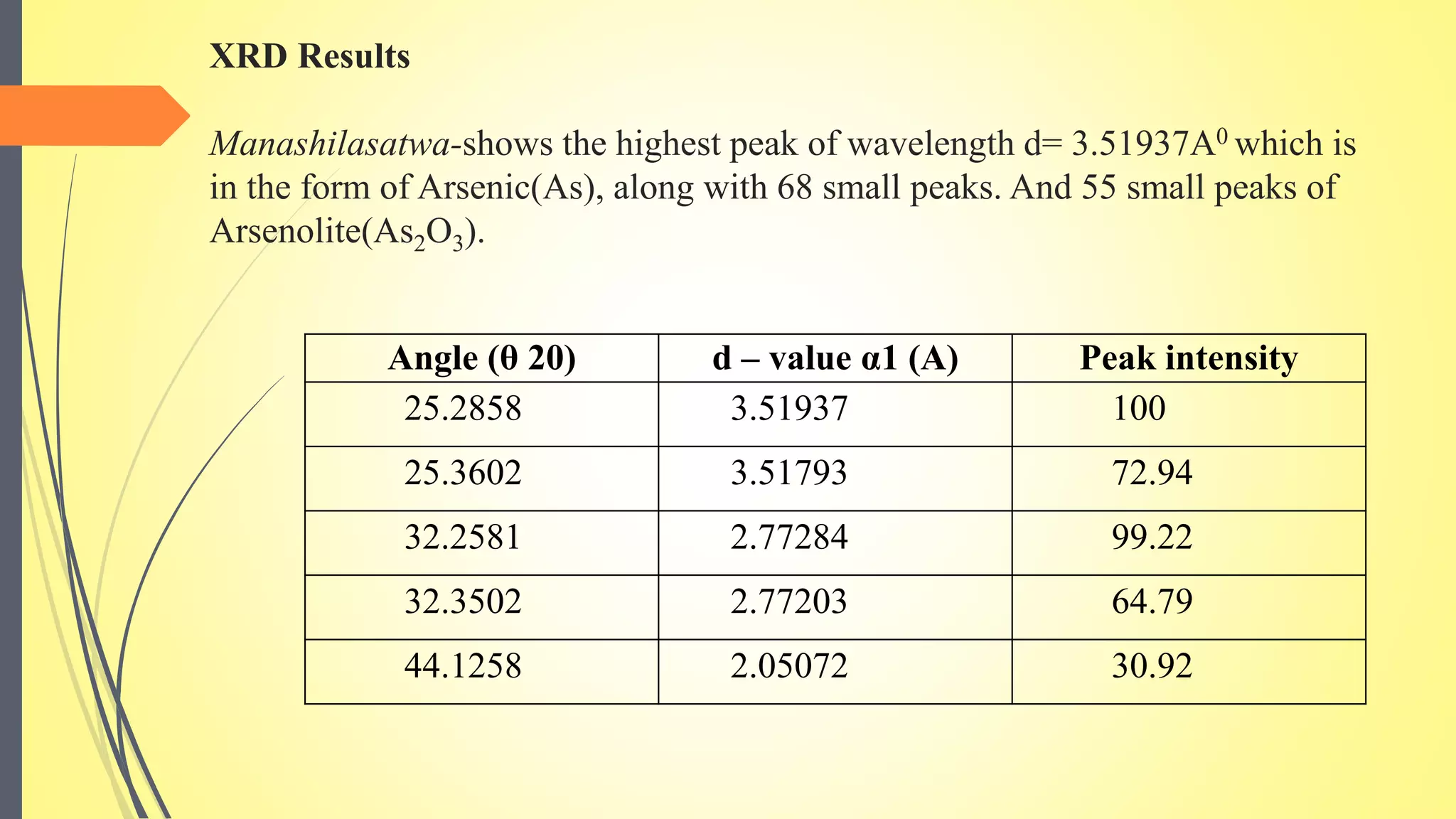
XRD Results
Manashilasatwa-shows the highest peak of wavelength d= 3.51937A0 which is
in the form of Arsenic(As), along with 68 small peaks. And 55 small peaks of
Arsenolite(As2O3).
Angle (θ 20) d – value α1 (A) Peak intensity
25.2858 3.51937 100
25.3602 3.51793 72.94
32.2581 2.77284 99.22
32.3502 2.77203 64.79
44.1258 2.05072 30.92
Visible Ref.Code Score Compound Name Displ.[°2θ] Scale Fac. Chem. Formula
* 98-001-6518 68 Arsenic 0.000 1.005 As1
* 98-000-2114 55 Arsenolite 0.000 0.247 As2 O3
Position [°2θ] (Copper (Cu))
10 20 30 40 50 60
Counts
0
10000
20000
30000
40000
Arsenolite
Arsenolite
Arsenic
Arsenolite
Arsenolite
Arsenic
Arsenic;Arsenolite
Arsenolite
Arsenolite
Arsenolite
Arsenic
Arsenolite
Arsenic
Arsenolite
Arsenic
Arsenic
Arsenolite
Arsenic
Arsenolite
Arsenic
Arsenolite
Arsenolite
Arsenic;Arsenolite
Arsenic
Arsenolite
3
Arsenic; As1
Arsenolite; As2 O3
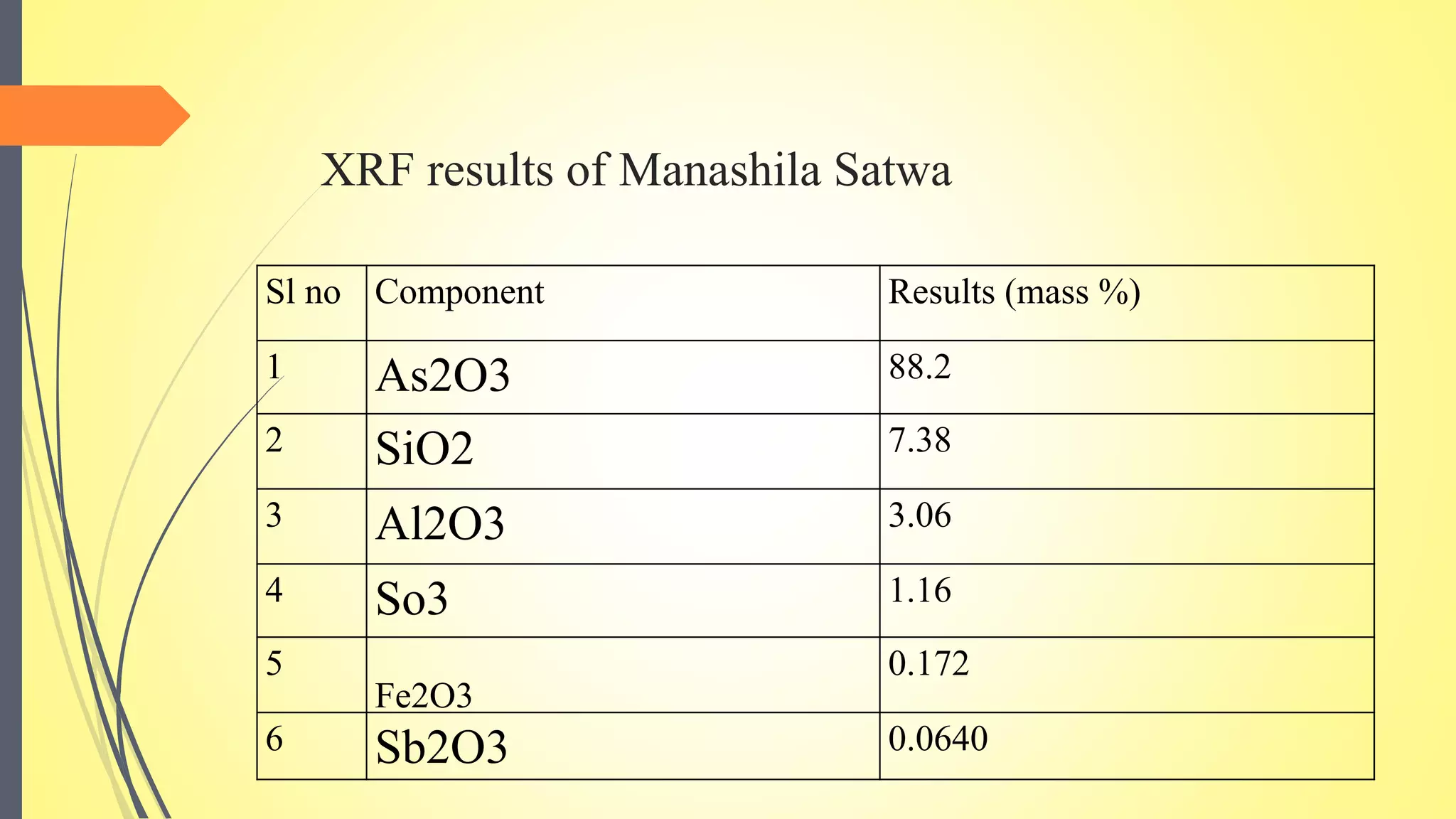
XRF results of Manashila Satwa
Sl no Component Results (mass %)
1 As2O3 88.2
2 SiO2 7.38
3 Al2O3 3.06
4 So3 1.16
5
Fe2O3
0.172
6 Sb2O3 0.0640
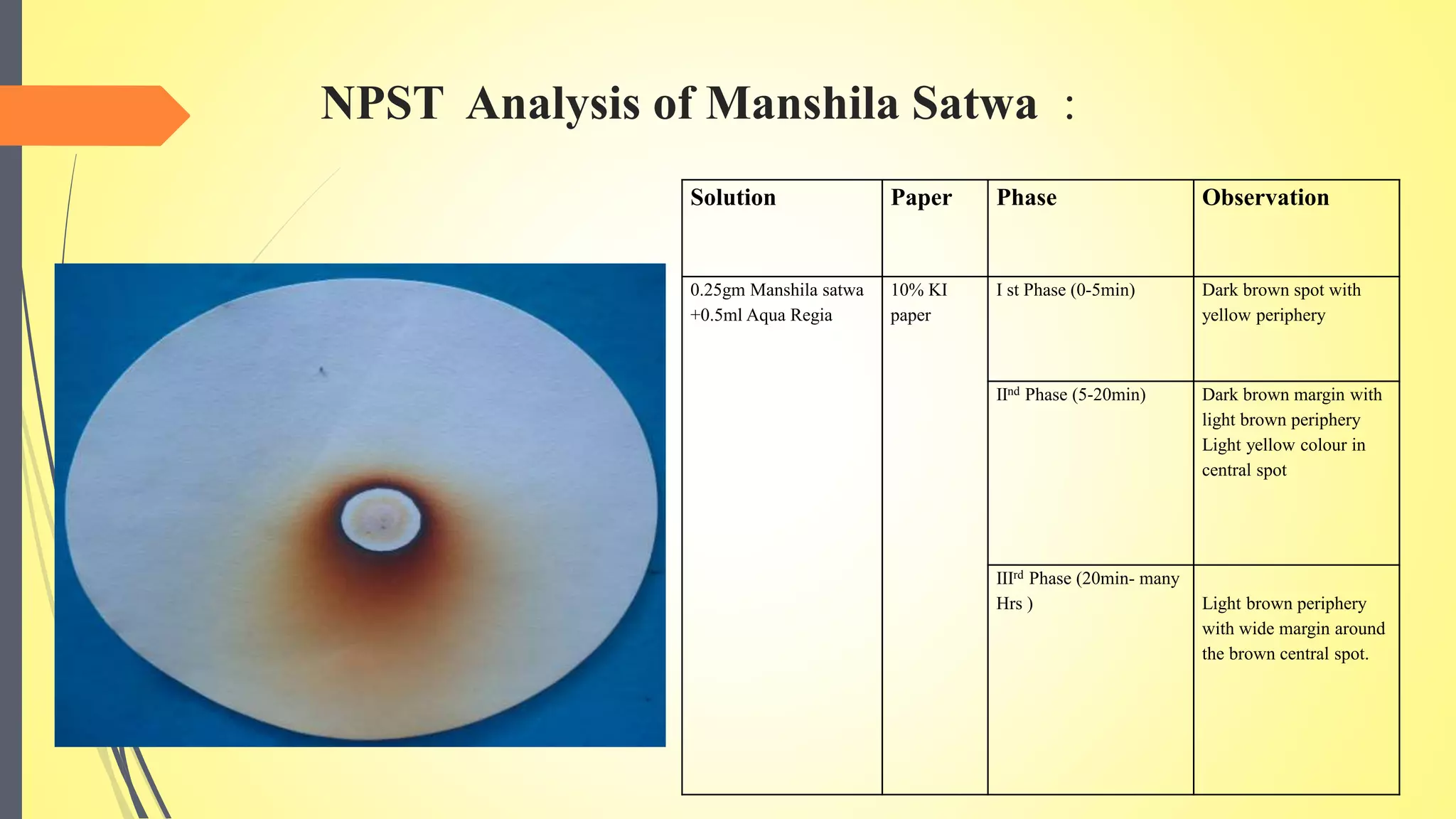
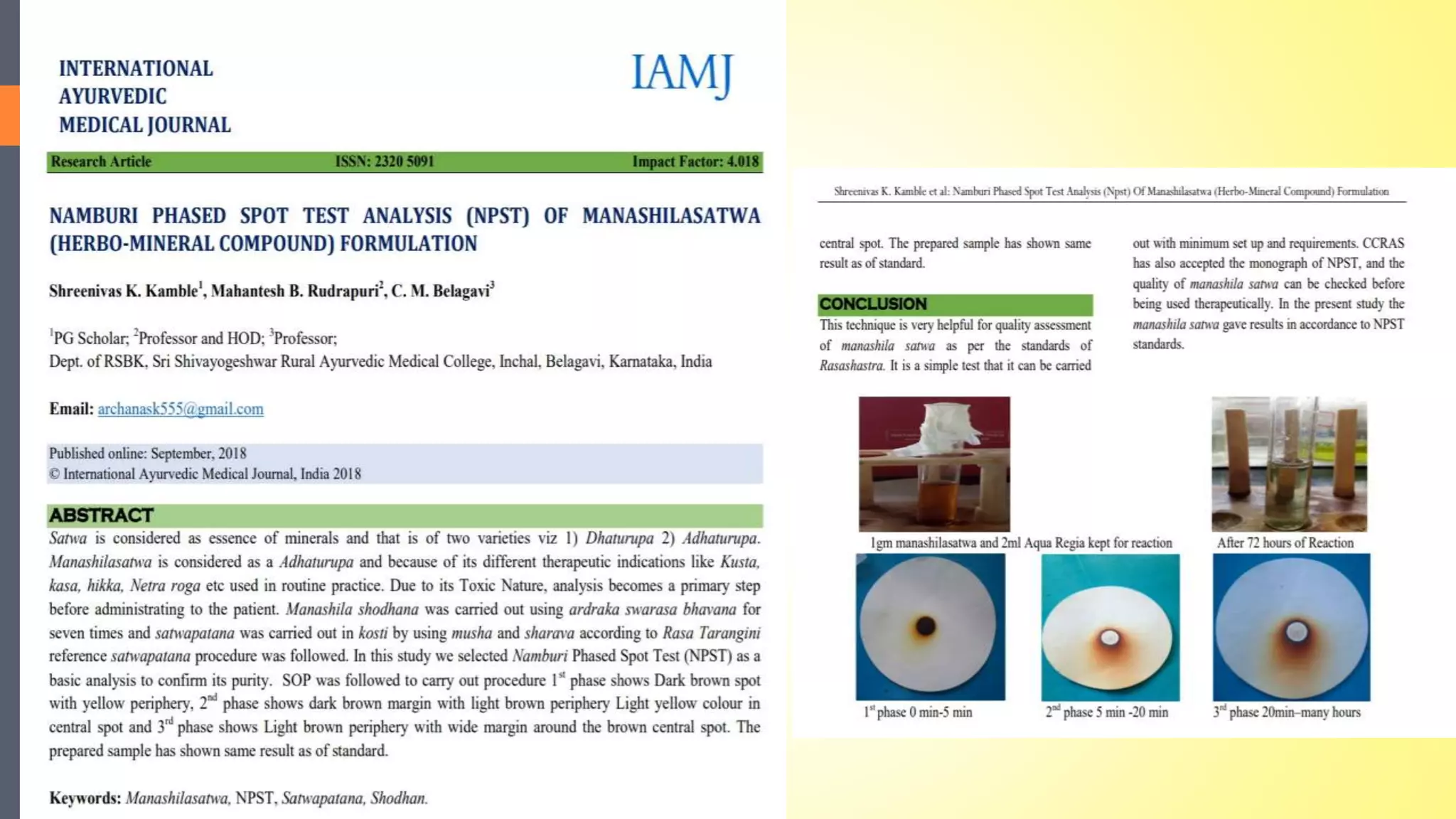
NPST Analysis of Manshila Satwa :
Solution Paper Phase Observation
0.25gm Manshila satwa
+0.5ml Aqua Regia
10% KI
paper
I st Phase (0-5min) Dark brown spot with
yellow periphery
IInd Phase (5-20min) Dark brown margin with
light brown periphery
Light yellow colour in
central spot
IIIrd Phase (20min- many
Hrs ) Light brown periphery
with wide margin around
the brown central spot.
Conclusion
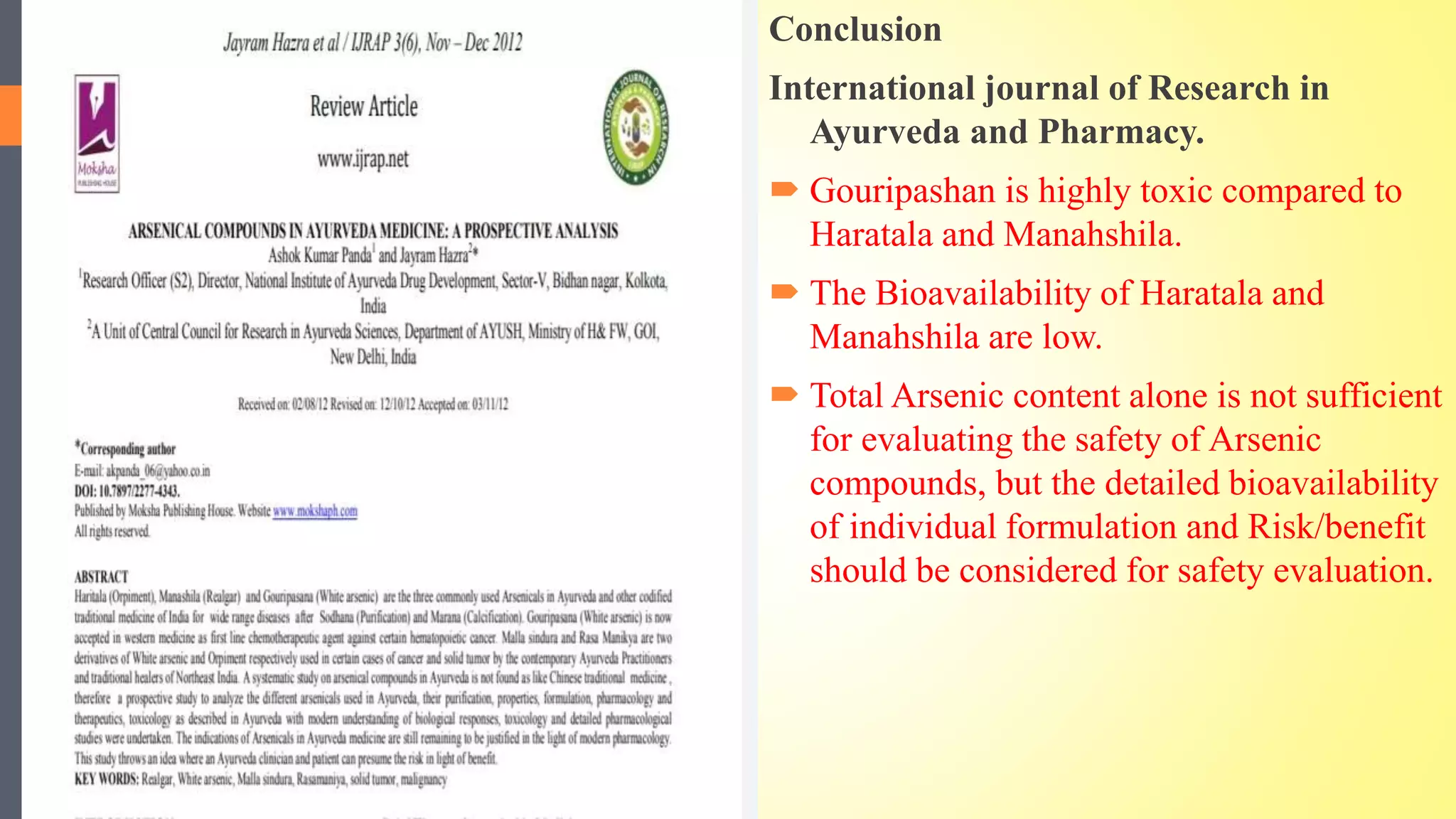
International journal of Research in
Ayurveda and Pharmacy.
 Gouripashan is highly toxic compared to
Haratala and Manahshila.
 The Bioavailability of Haratala and
Manahshila are low.
 Total Arsenic content alone is not sufficient
for evaluating the safety of Arsenic
compounds, but the detailed bioavailability
of individual formulation and Risk/benefit
should be considered for safety evaluation.
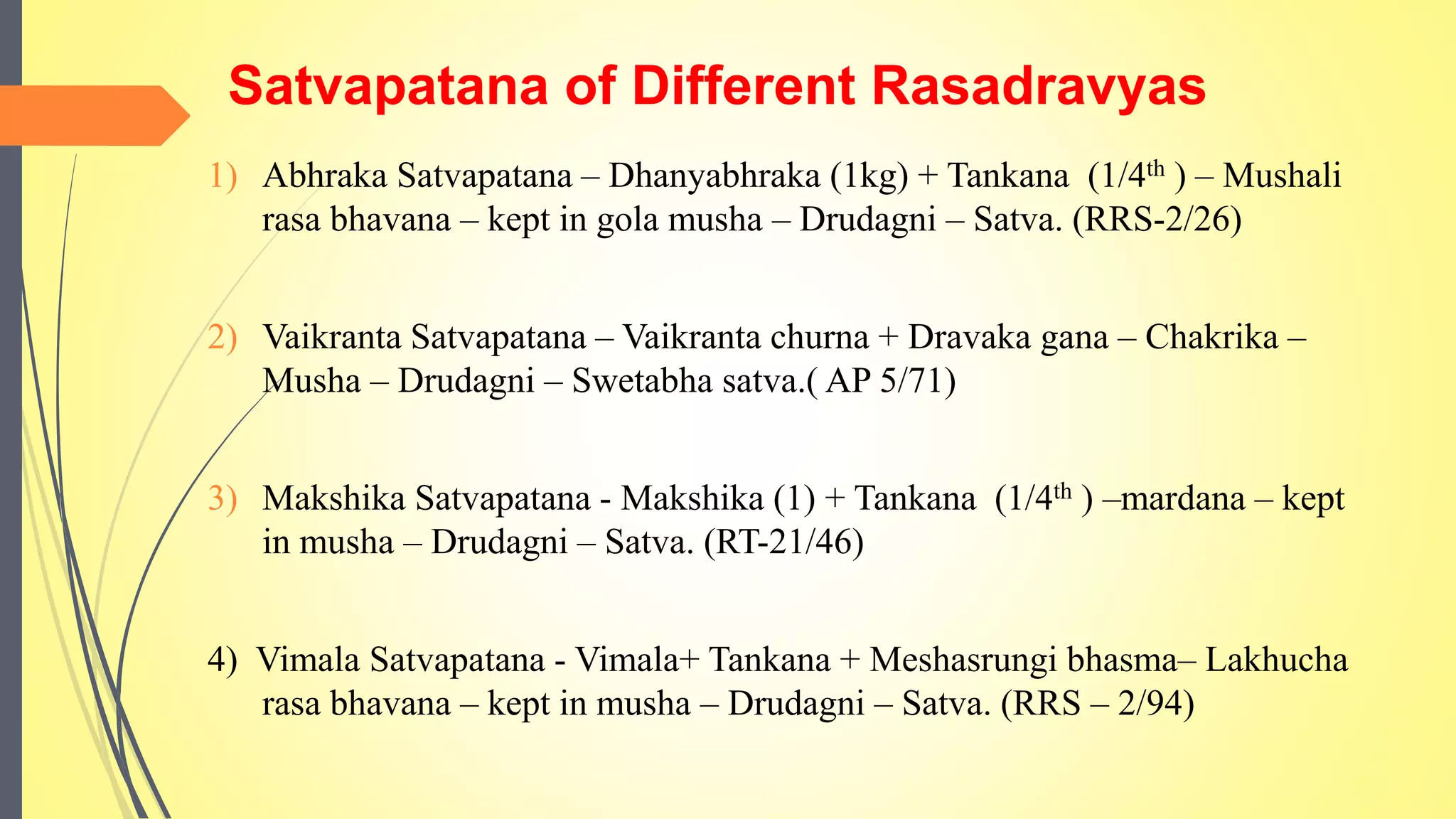
Satvapatana of Different Rasadravyas
1) Abhraka Satvapatana – Dhanyabhraka (1kg) + Tankana (1/4th ) – Mushali
rasa bhavana – kept in gola musha – Drudagni – Satva. (RRS-2/26)
2) Vaikranta Satvapatana – Vaikranta churna + Dravaka gana – Chakrika –
Musha – Drudagni – Swetabha satva.( AP 5/71)
3) Makshika Satvapatana - Makshika (1) + Tankana (1/4th ) –mardana – kept
in musha – Drudagni – Satva. (RT-21/46)
4) Vimala Satvapatana - Vimala+ Tankana + Meshasrungi bhasma– Lakhucha
rasa bhavana – kept in musha – Drudagni – Satva. (RRS – 2/94)
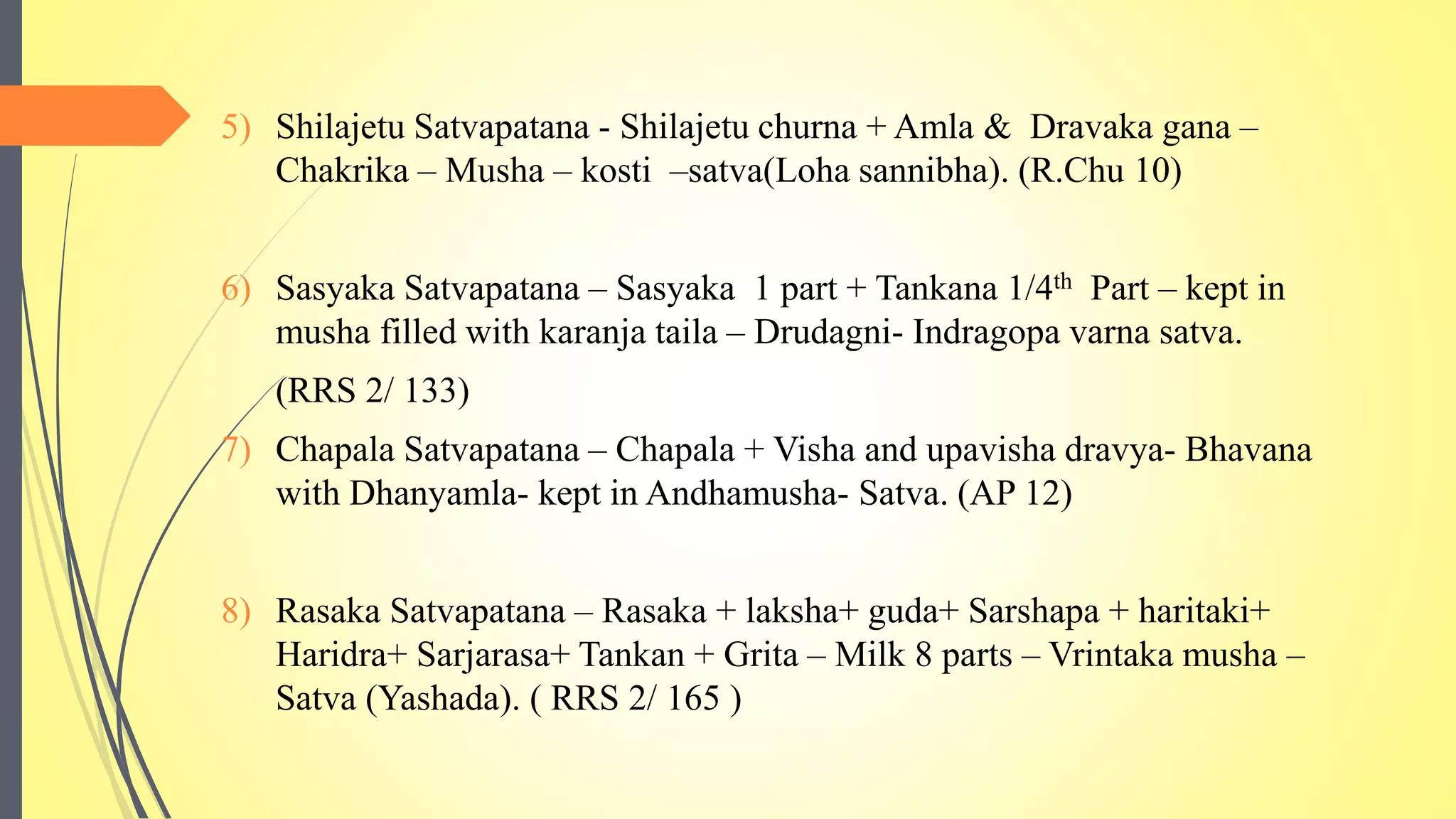
5) Shilajetu Satvapatana - Shilajetu churna + Amla & Dravaka gana –
Chakrika – Musha – kosti –satva(Loha sannibha). (R.Chu 10)
6) Sasyaka Satvapatana – Sasyaka 1 part + Tankana 1/4th Part – kept in
musha filled with karanja taila – Drudagni- Indragopa varna satva.
(RRS 2/ 133)
7) Chapala Satvapatana – Chapala + Visha and upavisha dravya- Bhavana
with Dhanyamla- kept in Andhamusha- Satva. (AP 12)
8) Rasaka Satvapatana – Rasaka + laksha+ guda+ Sarshapa + haritaki+
Haridra+ Sarjarasa+ Tankan + Grita – Milk 8 parts – Vrintaka musha –
Satva (Yashada). ( RRS 2/ 165 )
9) Gairika satvapatana - Gairika churna + Amla & Kshara– Chakrika – Musha –
kosti –satva( RRS 3/48)
10) Kasisa satvapatana – Kasisa 1 part + Yavakshara + Tankan+ Sarjakshara 1/4th
part each – Nimburasa bhavana – Gola musha- Kosti – satva. (RRS 3/55)
11) Spatika satvapatana - Spatika churna + Amla & Kshara– Chakrika – Musha
– Angara kosti –satva( RRS 3/65)
12) Haratala satvapatana – Haratala – Bhavana with arka dugdha and Tilataila –
Heated in Kachakupi for 7 prahara.(RRS 3/78)
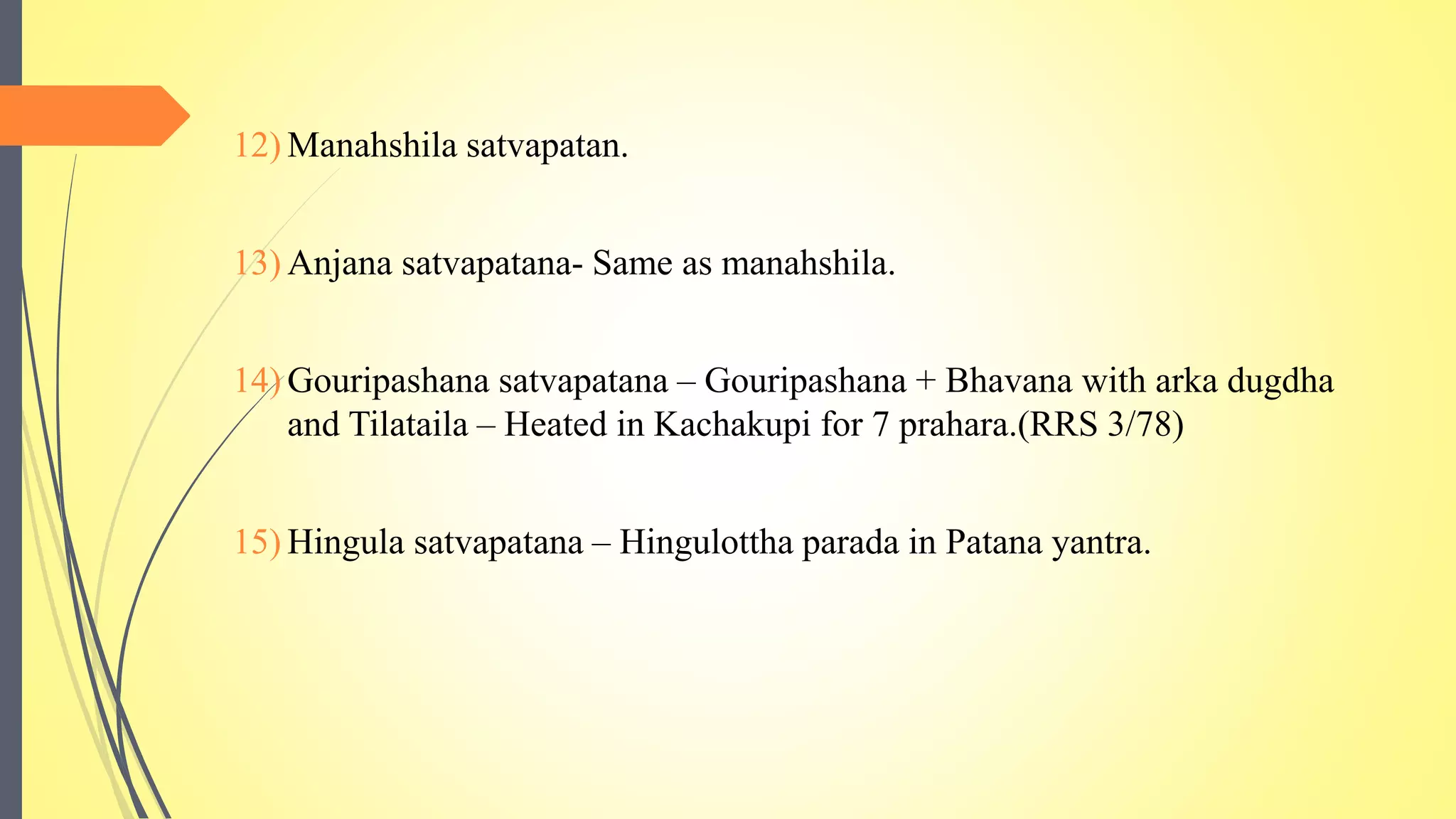
12) Manahshila satvapatan.
13) Anjana satvapatana- Same as manahshila.
14) Gouripashana satvapatana – Gouripashana + Bhavana with arka dugdha
and Tilataila – Heated in Kachakupi for 7 prahara.(RRS 3/78)
15) Hingula satvapatana – Hingulottha parada in Patana yantra.
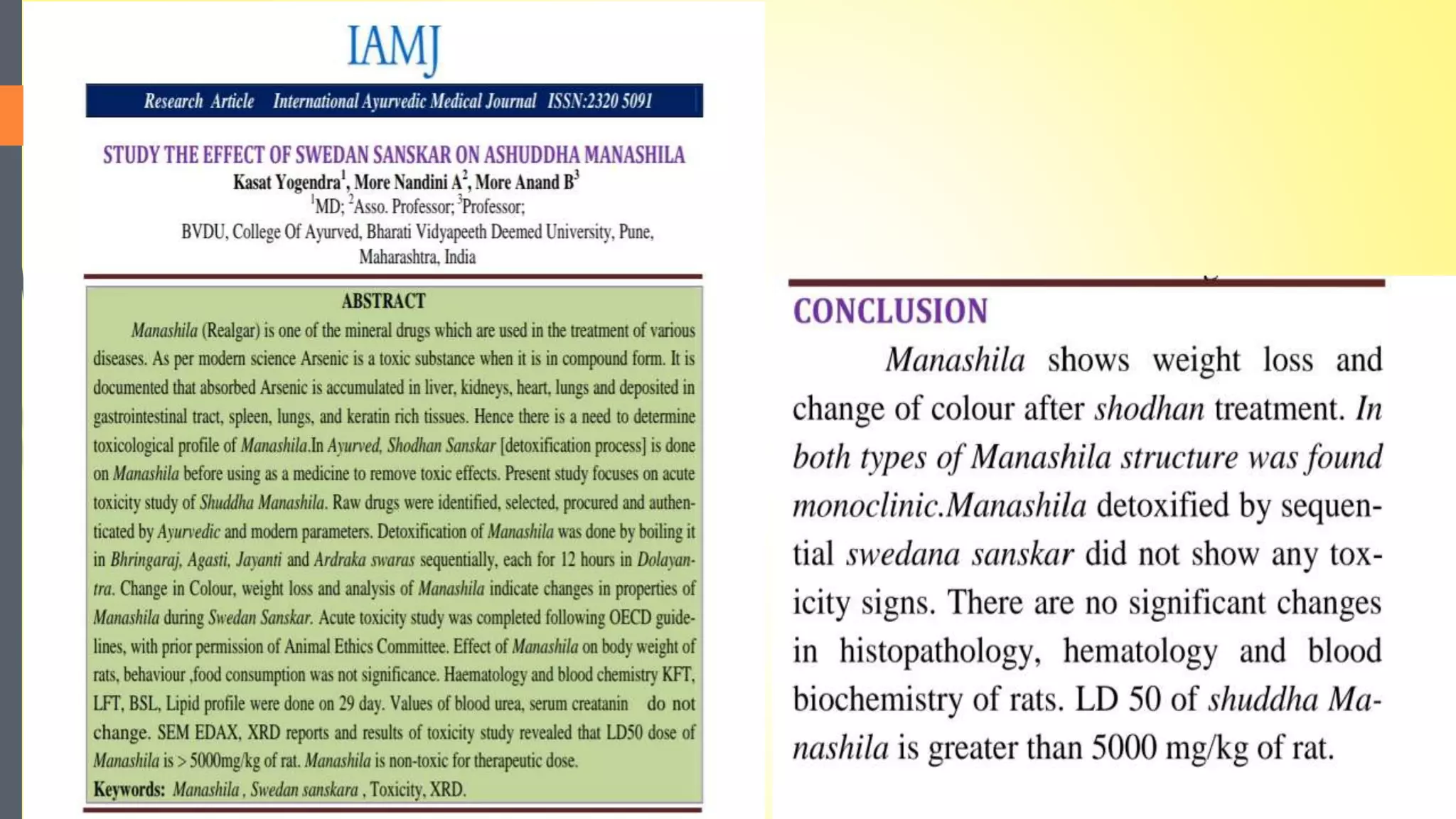
Conclusion
 Satvas are different from metals
 The aim of satvapatana is entirely different from aim of metallurgy.
Hence both cannot be the same
 Satva obtained is again processed to make it therapeutically fit.
 Satvapatana is ment to extract the therapeutically active principles from the ore
Concept of satvapatana by Dr.Mahantesh Rudrapuri

Concept of satvapatana by Dr.Mahantesh Rudrapuri

  • 1.
    Satvapatana Dr.MAHANTESHB RUDRAPURI, M.D(AYU),FAGE H.O.D& Guide,Pgdept,of rasashastra& bhaishajyakalpana. Ssramc, inchal, 9972710790 mbrudrapuri@gmail.com
  • 2.
    Inroduction Satva - Essence Patana- Separation Satvapatana means – Extacting the active principle or Essence from its Ore or Mineral. Reducing the ore/mineral to it,s original metal in element form.
  • 3.
    Definition ( RRS8/34), (RT 2/32) The process of ‘sattva’ extraction from any of the ‘dhatu dravya’through various pharmaceutical procedure is called as ‘Satvapatana’
  • 4.
    Classification  I) Accordingto form of Satwas are classified into two – (1) Dhaturupa (Metal form) eg. From Sasyaka, Svarnamaksika etc. (2) Adhaturupa (Non-metallic form) eg. From Manahshila,Haratala, Somal etc.  (II) The process of Satwapatana differs according to the nature of Satva. And according to form of Dravyas having Satwa, they can classified into two – (1) Complex compound ore - eg. Abhraka, Maksika etc. (2) Simple compound ore - eg. Malla, Gairika etc.
  • 5.
     (III) Onthe basis of origin, these can be classified as – (1) Mineral - Abhraka, Vaikranta etc. (2) Animal - Bhunaga (3) Herbal – Amruta  (IV) On the basis of Satwas, it can be categorised as – (1) Sublimating form of Satwas eg. Mercury, Arsenic etc. (2) Non-sublimating form of Satvas eg. Iron, Copper etc
  • 6.
    Aims & Objectivesof Satvapatana •To extract the active principle of the ore. •To utilize Satva for further procedures like shodhana and marana, etc.
  • 7.
    Yantras used forSatvapatana: - Khalva - Musha - Kosthi - Vankanala and Bhastrika. - Kupi - Valukayantra - Damaruyantra - Patanayantra etc.
  • 8.
    Basic Materials requiredfor satwapatana:  a) Raw materials: For e.g. Herbal- by crushing and macerating in water and sediment Metals having lower melting point are by sublimation e.g. Parada Metals having higher melting point–by using Dravaka gana.  b) Dravaka varga: The Dravaka varga and Mitrapanchaka varga told in the classics include Gunja, Guggulu, Guda, Grutha, Tankana, and Madhu. They help in displacing the metals from the source.
  • 9.
  • 10.
    Flux: Tankana Poling: Guggulu Reducingnature of Carbon: guda, gunja Auto reduction: Parada Catalyst: Gunja
  • 11.
     C) Amlavarga and Kshara varga Dravyas. “ Sarve malaharah Ksharah, Sarve cha amla prabhodhkah |” ( Rsarnava 5) “ Ksharah sarve malam hantihi, amlam shodhana jaranam |” ( R.Chu.9/31) - Metal separation, lesser melting point, disassociates metal ions.
  • 12.
     D )Musha: (Crucibles)  मुष्णाति दोषान ्मूषेयान ्सा मूषेति तनगध्यिे। र.र.स १०/२ The crucible that eliminates the dosha of a drugs subjected for heat in it is called as Musha. In which metals, minerals can be melted or heated up to very high temperature.
  • 13.
     E) Kosti: Accto Rasaratnasamuchaya 10/32 सत्वानाम पािनार्ााय पातििानाम ववशुद्धये । कोश्टिका ववववधाकारस्र्ासाम लक्शनमुच्यिे ॥ ( RRS 10/32 )  Angara kosti is for Katinadravyas. Patala kosti is for Mrudu dravyas. And Gara kosti is for Mishra dhatu satwapatana.
  • 14.
    Samanya satvapatana vidhi. (Genaral Extraction method of Satva )(RHT 10/14) Dravya + Guda+ Guggulu+ Tankana+ Laksha+ Sarjikakshara+ Ajadugdha Kept in Musha. Subjected to heat using Kosti
  • 15.
     Different stepsinvolved in Satvapatana. 1) The mineral from which Satva to be extracted is finely powdered in Khalvayantra along with Amla, kshara and Dravaka gana dravyas. 2) Prepare semisolid paste and then slices( chakrikas). 3) Dried chakrikas are kept concealed in Musha and intensly heated by using Kosti yantra. 4) Flames of different colours indicates the process of separation of satva from the dravya. 5) When the flame turns to white or any one colour (Shuddavartha), indicates the completion of process.( RRS 8/56) 6) Then the crucible is taken out from the fire and is inverted into a container to cool and solidify.
  • 16.
    Suddavarta Lakshana: Characteristicsof flame during satva extraction (Rasarnava) (RT) (RRS)  Swarna Satva - Yellow flames  Rajata Satva - White flames  Tamra satva - Bluish flames  Teekshana loha satva - Black flames  Naga satva - Black flames  Shilajatu satva - Gray flames  Loha satva - Kapila flames  Sasyaka satva - Red flames
  • 17.
    Before Satva isused for medicinal purpose, it has to be subjected to other procedures as – 1) Mridukarana( Softening) – using Madhu, Taila, Vasa, Grita. 2) Nirmalikarana(Purification) – using shuddi varga dravyas – Khacha(Lavana), Tankana, Souveera, Shipra(Muktha shuki or Navasadara or Mahisha mutra) [ RRS 10] 3) Marana(Inciniration) – Bhasmikarana.
  • 18.
  • 19.
     One partManahshila and 1/8th part of Mandura (Iron rust/oxidized iron), Guda (Jaggery), Guggulu (Commiphera mukul) and Sarpi (Gheee) seperately are taken, mixed in Khalva and triturated. Then it is filled in Moosha (Crucible) and kept in Kosti (a kind of fire instrument) and Teevragni (intense heat) is given. By this Manahshila Sattva is obtained.Rasendra sambhava suggests specifically Andhamoosha for this method. 01.Manashila 02.Ardraka 03.Guda 04.Guggulu 05.Ghritha 06.Lohakitta
  • 22.
    XRD Results Manashilasatwa-shows thehighest peak of wavelength d= 3.51937A0 which is in the form of Arsenic(As), along with 68 small peaks. And 55 small peaks of Arsenolite(As2O3). Angle (θ 20) d – value α1 (A) Peak intensity 25.2858 3.51937 100 25.3602 3.51793 72.94 32.2581 2.77284 99.22 32.3502 2.77203 64.79 44.1258 2.05072 30.92
  • 23.
    Visible Ref.Code ScoreCompound Name Displ.[°2θ] Scale Fac. Chem. Formula * 98-001-6518 68 Arsenic 0.000 1.005 As1 * 98-000-2114 55 Arsenolite 0.000 0.247 As2 O3 Position [°2θ] (Copper (Cu)) 10 20 30 40 50 60 Counts 0 10000 20000 30000 40000 Arsenolite Arsenolite Arsenic Arsenolite Arsenolite Arsenic Arsenic;Arsenolite Arsenolite Arsenolite Arsenolite Arsenic Arsenolite Arsenic Arsenolite Arsenic Arsenic Arsenolite Arsenic Arsenolite Arsenic Arsenolite Arsenolite Arsenic;Arsenolite Arsenic Arsenolite 3 Arsenic; As1 Arsenolite; As2 O3
  • 24.
    XRF results ofManashila Satwa Sl no Component Results (mass %) 1 As2O3 88.2 2 SiO2 7.38 3 Al2O3 3.06 4 So3 1.16 5 Fe2O3 0.172 6 Sb2O3 0.0640
  • 25.
    NPST Analysis ofManshila Satwa : Solution Paper Phase Observation 0.25gm Manshila satwa +0.5ml Aqua Regia 10% KI paper I st Phase (0-5min) Dark brown spot with yellow periphery IInd Phase (5-20min) Dark brown margin with light brown periphery Light yellow colour in central spot IIIrd Phase (20min- many Hrs ) Light brown periphery with wide margin around the brown central spot.
  • 30.
    Conclusion International journal ofResearch in Ayurveda and Pharmacy.  Gouripashan is highly toxic compared to Haratala and Manahshila.  The Bioavailability of Haratala and Manahshila are low.  Total Arsenic content alone is not sufficient for evaluating the safety of Arsenic compounds, but the detailed bioavailability of individual formulation and Risk/benefit should be considered for safety evaluation.
  • 31.
    Satvapatana of DifferentRasadravyas 1) Abhraka Satvapatana – Dhanyabhraka (1kg) + Tankana (1/4th ) – Mushali rasa bhavana – kept in gola musha – Drudagni – Satva. (RRS-2/26) 2) Vaikranta Satvapatana – Vaikranta churna + Dravaka gana – Chakrika – Musha – Drudagni – Swetabha satva.( AP 5/71) 3) Makshika Satvapatana - Makshika (1) + Tankana (1/4th ) –mardana – kept in musha – Drudagni – Satva. (RT-21/46) 4) Vimala Satvapatana - Vimala+ Tankana + Meshasrungi bhasma– Lakhucha rasa bhavana – kept in musha – Drudagni – Satva. (RRS – 2/94)
  • 32.
    5) Shilajetu Satvapatana- Shilajetu churna + Amla & Dravaka gana – Chakrika – Musha – kosti –satva(Loha sannibha). (R.Chu 10) 6) Sasyaka Satvapatana – Sasyaka 1 part + Tankana 1/4th Part – kept in musha filled with karanja taila – Drudagni- Indragopa varna satva. (RRS 2/ 133) 7) Chapala Satvapatana – Chapala + Visha and upavisha dravya- Bhavana with Dhanyamla- kept in Andhamusha- Satva. (AP 12) 8) Rasaka Satvapatana – Rasaka + laksha+ guda+ Sarshapa + haritaki+ Haridra+ Sarjarasa+ Tankan + Grita – Milk 8 parts – Vrintaka musha – Satva (Yashada). ( RRS 2/ 165 )
  • 33.
    9) Gairika satvapatana- Gairika churna + Amla & Kshara– Chakrika – Musha – kosti –satva( RRS 3/48) 10) Kasisa satvapatana – Kasisa 1 part + Yavakshara + Tankan+ Sarjakshara 1/4th part each – Nimburasa bhavana – Gola musha- Kosti – satva. (RRS 3/55) 11) Spatika satvapatana - Spatika churna + Amla & Kshara– Chakrika – Musha – Angara kosti –satva( RRS 3/65) 12) Haratala satvapatana – Haratala – Bhavana with arka dugdha and Tilataila – Heated in Kachakupi for 7 prahara.(RRS 3/78)
  • 34.
    12) Manahshila satvapatan. 13)Anjana satvapatana- Same as manahshila. 14) Gouripashana satvapatana – Gouripashana + Bhavana with arka dugdha and Tilataila – Heated in Kachakupi for 7 prahara.(RRS 3/78) 15) Hingula satvapatana – Hingulottha parada in Patana yantra.
  • 35.
    Conclusion  Satvas aredifferent from metals  The aim of satvapatana is entirely different from aim of metallurgy. Hence both cannot be the same  Satva obtained is again processed to make it therapeutically fit.  Satvapatana is ment to extract the therapeutically active principles from the ore