AHARONAOV-BOHM EFFECT
Presented By
Anzar Ali
PH14006
Instructor Dr. K.P. Yogendran
Indian Institute of Science Education and Research
Mohali Punjab
18/04/2015
1) Introduction
2) Maxwell’s equation
3) Gauge transformation
4) Charge particle in electromagnetic field
5) Aharonov-Bohm effect experiment
6) Practical use of Aharonov-Bohm effect
7) Conclusion
8) References
Aharonov-Bohm Effect By Anzar Ali2/15
Outline of the talk
Introduction
 Description of electromagnetic phenomena can be
simplified by introduction of electromagnetic potentials:
scalar potential φ and vector potential A.
 Until the beginning of the twenty century it was
widely believed that potentials are only a mathematical
construct to simplify calculations and that they contain
no physical significance.
Aharonov-Bohm Effect By Anzar Ali3/15
 With the development of quantum mechanics in the
early twenty century, this view was put under question,
because Schrödinger equation, basic equation of
quantum mechanics, doesn’t contain fields but
potentials.
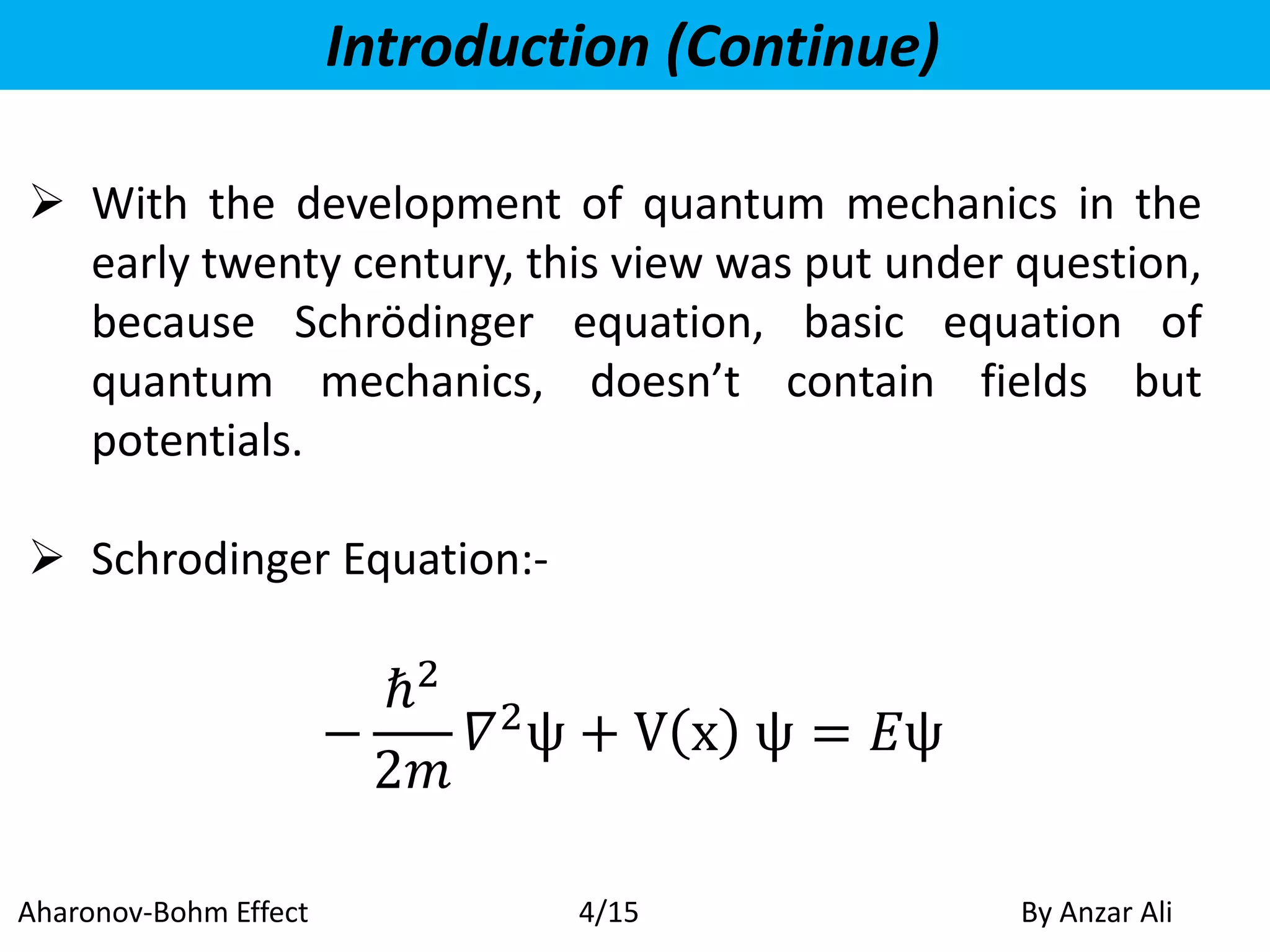
 Schrodinger Equation:-
Introduction (Continue)
Aharonov-Bohm Effect By Anzar Ali4/15
−
ℏ2
2𝑚
𝛻2
ψ + V x ψ = 𝐸ψ
The heart of the
experiment is the effect in
which wave function
acquire some additional
phase when travelling
through space with no
electromagnetic fields,
only potentials. This is
called Aharonov-Bohm
effect.
Introduction (Continue)
Aharonov-Bohm Effect By Anzar Ali5/15
Maxwell Equations
𝜵. 𝑬 =
ρ
𝜀0
𝜵 × 𝑬 = −
𝜕𝑩
𝜕𝑡
𝜵. 𝑩 = 0
𝜵 × 𝑩 = μ0 𝑱 + μ0ε0
𝜕𝑬
𝜕𝑡
𝑩 = 𝜵 × 𝑨
𝑬 = −𝜵ɸ −
𝜕𝑨
𝜕𝑡
1- 2-
3- 4-
From equation (2)
From equation (3)
Aharonov-Bohm Effect By Anzar Ali6/15
(5)
(6)
In 1861, Scottish physicist and mathematician James Clerk
Maxwell wrote four differential equations[1].
Gauge Transformation
𝑨′ = 𝑨 + 𝜵λ
ɸ′ = ɸ −
𝜕λ
𝜕𝑡
Aharonov-Bohm Effect By Anzar Ali7/15
Electromagnetic Potential have another important
property.
Where function λ is called “gauge function.”
Because we can satisfy Maxwell’s equation with different
potentials, we can say that the equations are gauge
invariant.
Charged particle in electromagnetic field
[
1
2𝑚
−𝑖ℏ𝛁 − 𝑒𝑨 𝒓 )2
+ 𝑒ɸ 𝒓 + 𝑉 𝒓 𝜓 = 𝑖ℏ
𝜕𝜓
𝜕𝑡
For a charged particle in electromagnetic field, Hamiltonian
is of the form[2].
𝐻 =
1
2𝑚
(𝒑 − 𝑒𝑨(𝒓) )2 + 𝑒ɸ(r)
If we write 𝒑 = −𝑖ℏ𝜵 and put Hamiltonian in Schrodinger
equation, we get
Aharonov-Bohm Effect By Anzar Ali8/15
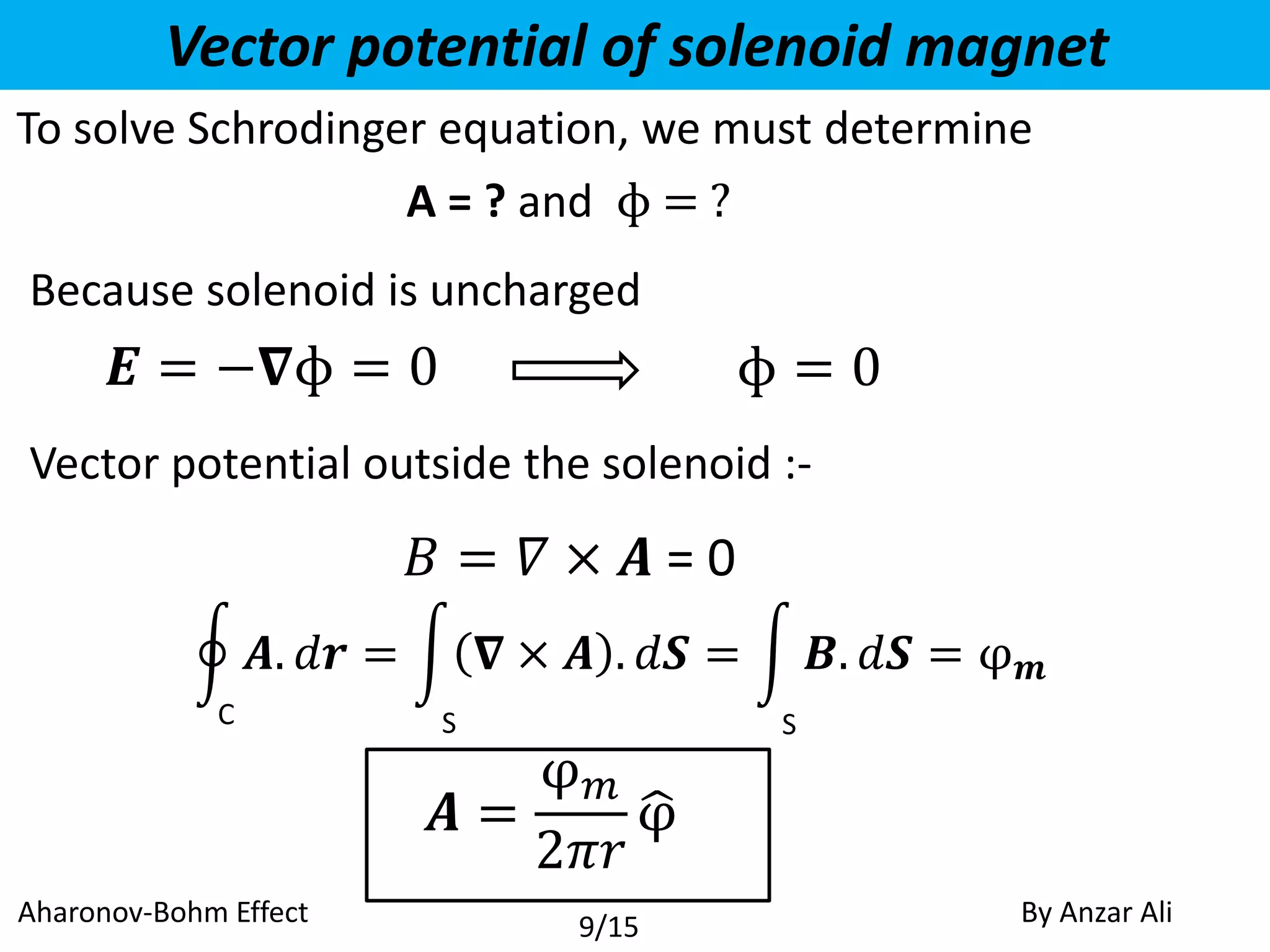
Vector potential of solenoid magnet
𝑬 = −𝛁ɸ = 0 ɸ = 0
𝐵 = 𝛻 × 𝑨 = 0
𝑨 =
φ 𝑚
2𝜋𝑟
φ
To solve Schrodinger equation, we must determine
A = ? and ɸ = ?
Because solenoid is uncharged
Vector potential outside the solenoid :-
𝑨. 𝑑𝒓 = 𝛁 × 𝑨 . 𝑑𝑺 = 𝑩. 𝑑𝑺 = φ 𝒎
C S S
Aharonov-Bohm Effect By Anzar Ali9/15
Wavefunction in vector potential
ψ 𝐫, t = eig(𝐫)ψ’(r, t) Where 𝑔 𝒓 =
𝑒
ℏ
0
𝑟
𝑨 𝒓 . 𝑑𝒓
In term of ψ’, the gradient of ψ is
𝜵𝜓 = 𝑒 𝑖𝑔 𝒓
𝑖𝜵𝑔 𝒓 𝜓′
+ 𝑒 𝑖𝑔 𝒓
(𝜵ψ′
)
Because
𝜵𝑔 𝑟 =
𝑒
ℏ
𝑨
Aharonov-Bohm Effect By Anzar Ali10/15
To describe wavefunction of charged particle, we have to
solve Schrodinger equation. In our case it can be simplified
by writing the wavefunction in the form
−𝑖ℏ𝜵 − 𝑒𝑨 ψ = −𝑖ℏ𝑒 𝑖𝑔 𝒓
𝜵ψ′
(−𝑖ℏ𝜵 − 𝑒𝑨)2
ψ = −ℏ2
𝑒 𝑖𝑔 𝒓
𝜵2
ψ′
−
ℏ2
2𝑚
𝜵2
ψ′
− 𝑉ψ′
= 𝑖ℏ
𝜕ψ′
𝜕𝑡
The solution in presence of vector field is the same
wavefunction, multiplied by phase factor 𝑒 𝑖𝑔(𝑟).
Wavefunction in vector potential (Continue)
Aharonov-Bohm Effect By Anzar Ali11/15
Aharonov-Bohm effect Experiment
ψ1 = 𝐴𝑒 𝑖𝑘𝑥1 ψ2 = 𝐴𝑒 𝑖𝑘𝑥2
∆𝚽0 = 𝑘(𝑥1 − 𝑥2)
∆𝚽 = 𝑔1 − 𝑔2
∆𝚽 = 𝑒/ℏ[ 𝑨 𝒓 . 𝑑𝒓 − 𝑨 𝒓 . 𝑑𝒓]
∆𝚽 = 𝑒/ℏ 𝑨 𝒓 . 𝑑𝒓
∆𝚽 = 𝑒φ 𝑚/ℏ
Aharonov-Bohm Effect By Anzar Ali12/15
𝐶1 𝐶2
Phys. Rev., 115, 485, (1959)
Practical use of Aharonov-Bohm effect
 Phase shift between electron beams strongly depends on
enclosed magnetic flux.
 Interference pattern shifts one fringe for every ∆ɸ 𝑚 =
ℎ
𝑒0
= 4.1 × 10⁻¹⁵
𝑇𝑚2
, which is very small value[6].
 In principle, the effect enables us measurement of
extremely small differences in magnetic flux.
Aharonov-Bohm Effect By Anzar Ali13/15
Conclusion
The main objective of this talk was to show that in
quantum mechanics, electromagnetic potentials appear
to be more fundamental physical entities than fields.
Aharonov-Bohm effect is phenomenon which can’t be
describe in terms of classical mechanics and is of purely
quantum origin. The effect was confirmed by many
different experiments and today it’s existence is widely
accepted.
Aharonov-Bohm Effect By Anzar Ali14/15
References
1) Griffits, D.J., Introduction to electrodynamics
2) Griffits, D.J., Introduction to Quantum Mechanics
3) Sakurai, J.J., Modern Quantum Mechanics
4) Y. Aharonov and D. Bohm, Significance of electromagnetic potential
in the quantum theory Phys Rev., 115, 485, (1959)
5) R.G. Chambers, Shift of an electron interference pattern by enclosed
magnetic flux, Phys. Rev. Lett. 5, 3, (1960)
6) N. Osakabe et. al., Experimental confirmation of Aharonov-Bohm
effect using a toroid magnetic field confined by a superconductor,
Phys. Rev. A 34, 815, (1986)
Aharonov-Bohm Effect By Anzar Ali15/15

Aharonaov bohm effect

  • 1.
    AHARONAOV-BOHM EFFECT Presented By AnzarAli PH14006 Instructor Dr. K.P. Yogendran Indian Institute of Science Education and Research Mohali Punjab 18/04/2015
  • 2.
    1) Introduction 2) Maxwell’sequation 3) Gauge transformation 4) Charge particle in electromagnetic field 5) Aharonov-Bohm effect experiment 6) Practical use of Aharonov-Bohm effect 7) Conclusion 8) References Aharonov-Bohm Effect By Anzar Ali2/15 Outline of the talk
  • 3.
    Introduction  Description ofelectromagnetic phenomena can be simplified by introduction of electromagnetic potentials: scalar potential φ and vector potential A.  Until the beginning of the twenty century it was widely believed that potentials are only a mathematical construct to simplify calculations and that they contain no physical significance. Aharonov-Bohm Effect By Anzar Ali3/15
  • 4.
     With thedevelopment of quantum mechanics in the early twenty century, this view was put under question, because Schrödinger equation, basic equation of quantum mechanics, doesn’t contain fields but potentials.  Schrodinger Equation:- Introduction (Continue) Aharonov-Bohm Effect By Anzar Ali4/15 − ℏ2 2𝑚 𝛻2 ψ + V x ψ = 𝐸ψ
  • 5.
    The heart ofthe experiment is the effect in which wave function acquire some additional phase when travelling through space with no electromagnetic fields, only potentials. This is called Aharonov-Bohm effect. Introduction (Continue) Aharonov-Bohm Effect By Anzar Ali5/15
  • 6.
    Maxwell Equations 𝜵. 𝑬= ρ 𝜀0 𝜵 × 𝑬 = − 𝜕𝑩 𝜕𝑡 𝜵. 𝑩 = 0 𝜵 × 𝑩 = μ0 𝑱 + μ0ε0 𝜕𝑬 𝜕𝑡 𝑩 = 𝜵 × 𝑨 𝑬 = −𝜵ɸ − 𝜕𝑨 𝜕𝑡 1- 2- 3- 4- From equation (2) From equation (3) Aharonov-Bohm Effect By Anzar Ali6/15 (5) (6) In 1861, Scottish physicist and mathematician James Clerk Maxwell wrote four differential equations[1].
  • 7.
    Gauge Transformation 𝑨′ =𝑨 + 𝜵λ ɸ′ = ɸ − 𝜕λ 𝜕𝑡 Aharonov-Bohm Effect By Anzar Ali7/15 Electromagnetic Potential have another important property. Where function λ is called “gauge function.” Because we can satisfy Maxwell’s equation with different potentials, we can say that the equations are gauge invariant.
  • 8.
    Charged particle inelectromagnetic field [ 1 2𝑚 −𝑖ℏ𝛁 − 𝑒𝑨 𝒓 )2 + 𝑒ɸ 𝒓 + 𝑉 𝒓 𝜓 = 𝑖ℏ 𝜕𝜓 𝜕𝑡 For a charged particle in electromagnetic field, Hamiltonian is of the form[2]. 𝐻 = 1 2𝑚 (𝒑 − 𝑒𝑨(𝒓) )2 + 𝑒ɸ(r) If we write 𝒑 = −𝑖ℏ𝜵 and put Hamiltonian in Schrodinger equation, we get Aharonov-Bohm Effect By Anzar Ali8/15
  • 9.
    Vector potential ofsolenoid magnet 𝑬 = −𝛁ɸ = 0 ɸ = 0 𝐵 = 𝛻 × 𝑨 = 0 𝑨 = φ 𝑚 2𝜋𝑟 φ To solve Schrodinger equation, we must determine A = ? and ɸ = ? Because solenoid is uncharged Vector potential outside the solenoid :- 𝑨. 𝑑𝒓 = 𝛁 × 𝑨 . 𝑑𝑺 = 𝑩. 𝑑𝑺 = φ 𝒎 C S S Aharonov-Bohm Effect By Anzar Ali9/15
  • 10.
    Wavefunction in vectorpotential ψ 𝐫, t = eig(𝐫)ψ’(r, t) Where 𝑔 𝒓 = 𝑒 ℏ 0 𝑟 𝑨 𝒓 . 𝑑𝒓 In term of ψ’, the gradient of ψ is 𝜵𝜓 = 𝑒 𝑖𝑔 𝒓 𝑖𝜵𝑔 𝒓 𝜓′ + 𝑒 𝑖𝑔 𝒓 (𝜵ψ′ ) Because 𝜵𝑔 𝑟 = 𝑒 ℏ 𝑨 Aharonov-Bohm Effect By Anzar Ali10/15 To describe wavefunction of charged particle, we have to solve Schrodinger equation. In our case it can be simplified by writing the wavefunction in the form
  • 11.
    −𝑖ℏ𝜵 − 𝑒𝑨ψ = −𝑖ℏ𝑒 𝑖𝑔 𝒓 𝜵ψ′ (−𝑖ℏ𝜵 − 𝑒𝑨)2 ψ = −ℏ2 𝑒 𝑖𝑔 𝒓 𝜵2 ψ′ − ℏ2 2𝑚 𝜵2 ψ′ − 𝑉ψ′ = 𝑖ℏ 𝜕ψ′ 𝜕𝑡 The solution in presence of vector field is the same wavefunction, multiplied by phase factor 𝑒 𝑖𝑔(𝑟). Wavefunction in vector potential (Continue) Aharonov-Bohm Effect By Anzar Ali11/15
  • 12.
    Aharonov-Bohm effect Experiment ψ1= 𝐴𝑒 𝑖𝑘𝑥1 ψ2 = 𝐴𝑒 𝑖𝑘𝑥2 ∆𝚽0 = 𝑘(𝑥1 − 𝑥2) ∆𝚽 = 𝑔1 − 𝑔2 ∆𝚽 = 𝑒/ℏ[ 𝑨 𝒓 . 𝑑𝒓 − 𝑨 𝒓 . 𝑑𝒓] ∆𝚽 = 𝑒/ℏ 𝑨 𝒓 . 𝑑𝒓 ∆𝚽 = 𝑒φ 𝑚/ℏ Aharonov-Bohm Effect By Anzar Ali12/15 𝐶1 𝐶2 Phys. Rev., 115, 485, (1959)
  • 13.
    Practical use ofAharonov-Bohm effect  Phase shift between electron beams strongly depends on enclosed magnetic flux.  Interference pattern shifts one fringe for every ∆ɸ 𝑚 = ℎ 𝑒0 = 4.1 × 10⁻¹⁵ 𝑇𝑚2 , which is very small value[6].  In principle, the effect enables us measurement of extremely small differences in magnetic flux. Aharonov-Bohm Effect By Anzar Ali13/15
  • 14.
    Conclusion The main objectiveof this talk was to show that in quantum mechanics, electromagnetic potentials appear to be more fundamental physical entities than fields. Aharonov-Bohm effect is phenomenon which can’t be describe in terms of classical mechanics and is of purely quantum origin. The effect was confirmed by many different experiments and today it’s existence is widely accepted. Aharonov-Bohm Effect By Anzar Ali14/15
  • 15.
    References 1) Griffits, D.J.,Introduction to electrodynamics 2) Griffits, D.J., Introduction to Quantum Mechanics 3) Sakurai, J.J., Modern Quantum Mechanics 4) Y. Aharonov and D. Bohm, Significance of electromagnetic potential in the quantum theory Phys Rev., 115, 485, (1959) 5) R.G. Chambers, Shift of an electron interference pattern by enclosed magnetic flux, Phys. Rev. Lett. 5, 3, (1960) 6) N. Osakabe et. al., Experimental confirmation of Aharonov-Bohm effect using a toroid magnetic field confined by a superconductor, Phys. Rev. A 34, 815, (1986) Aharonov-Bohm Effect By Anzar Ali15/15