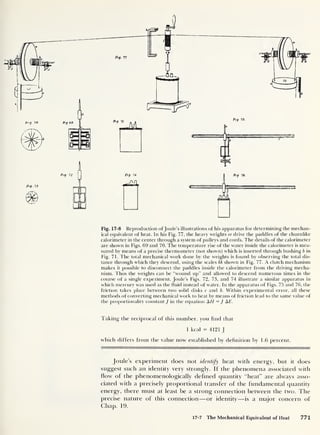
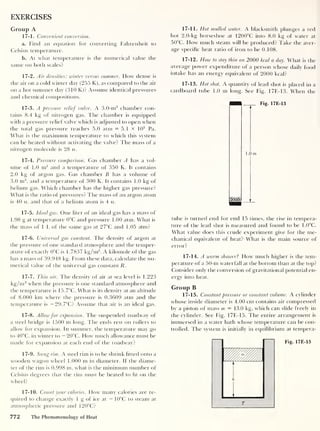
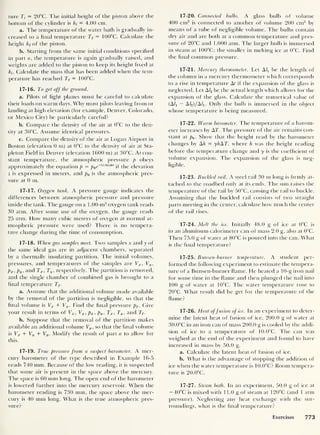
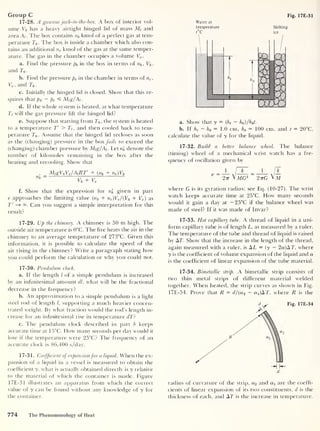
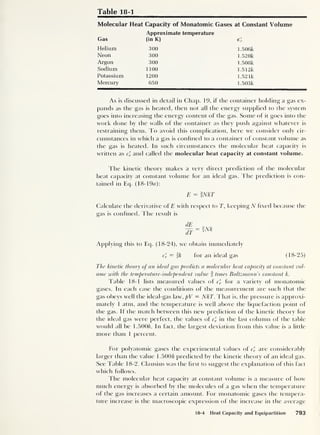
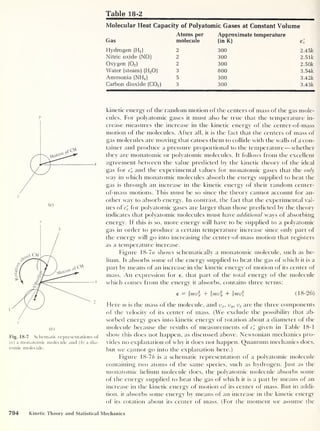
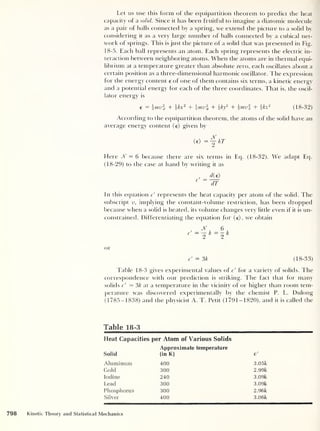
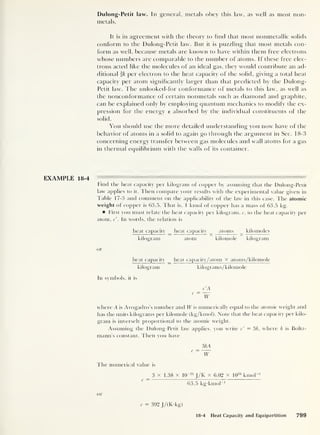
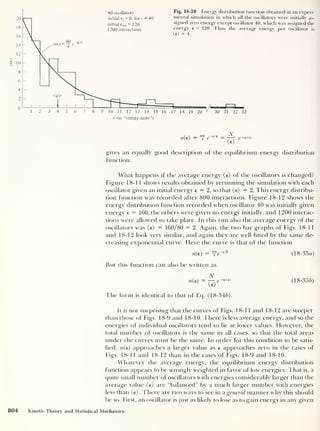
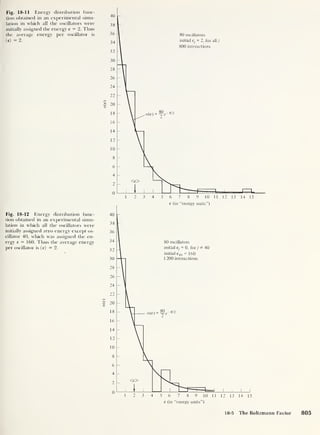
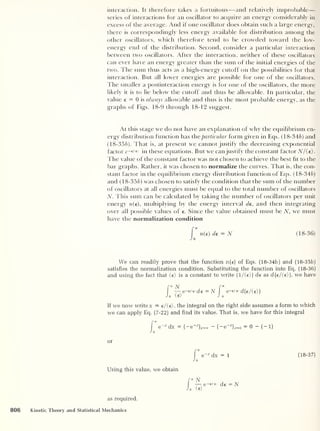
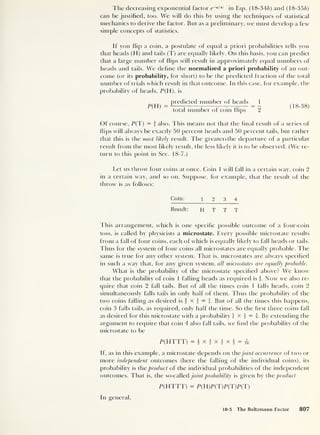
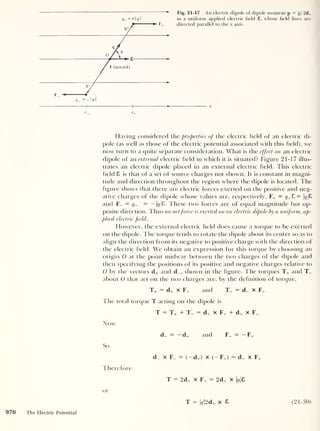
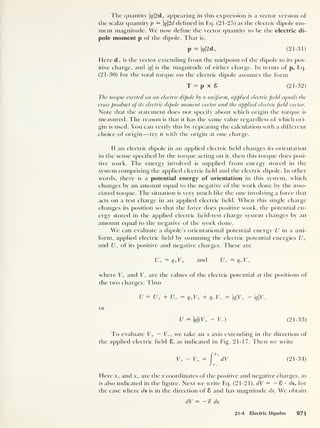
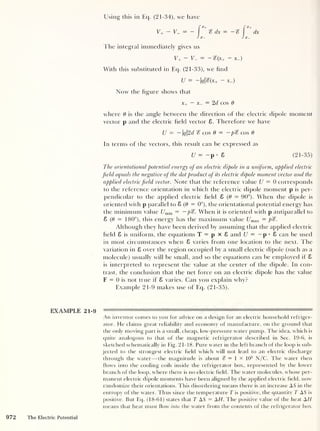
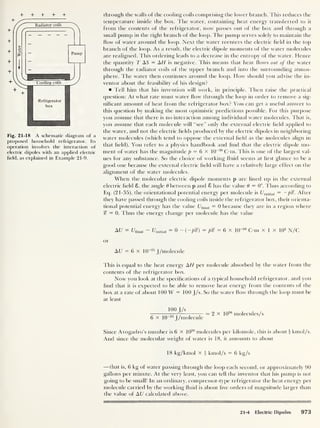
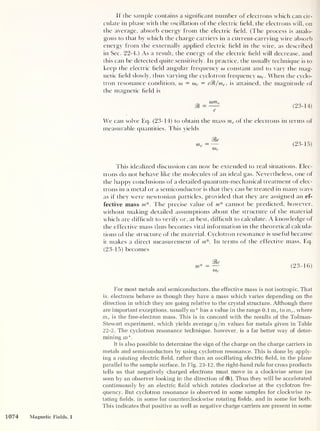
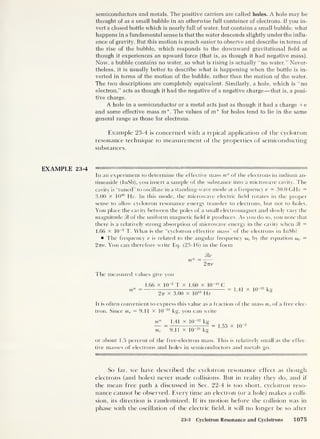
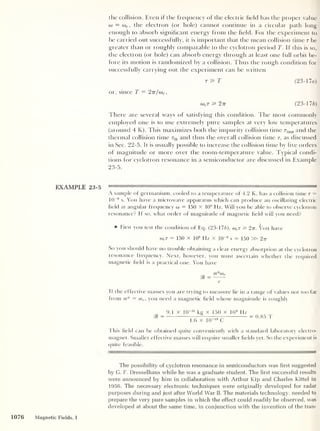
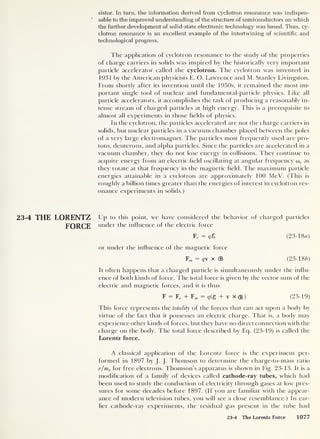
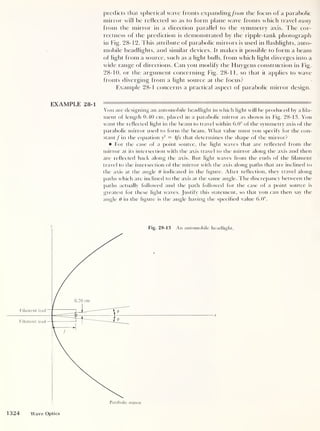
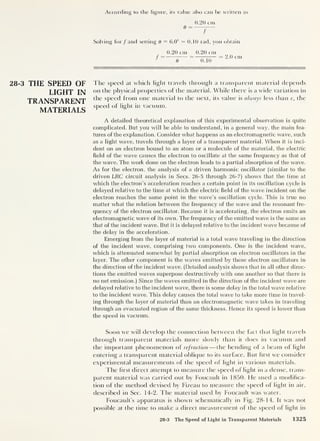
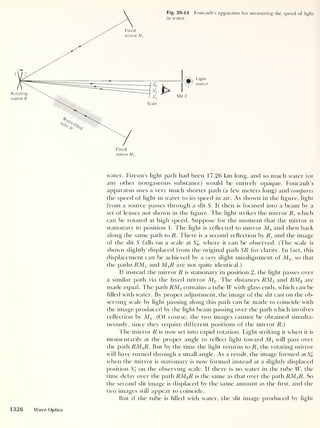
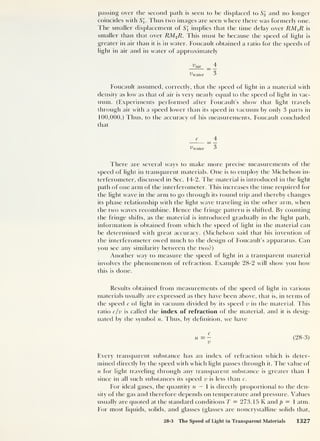
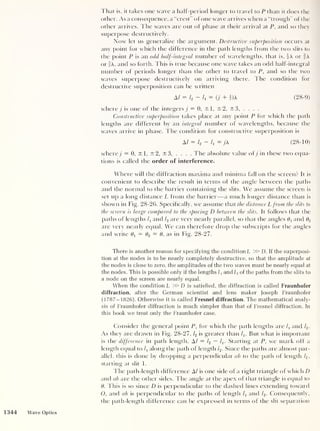
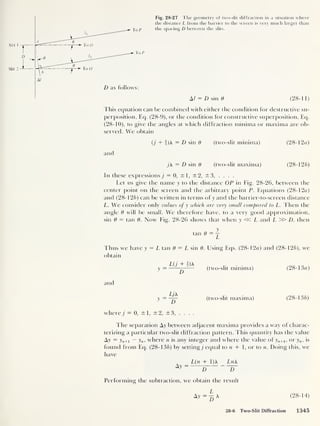
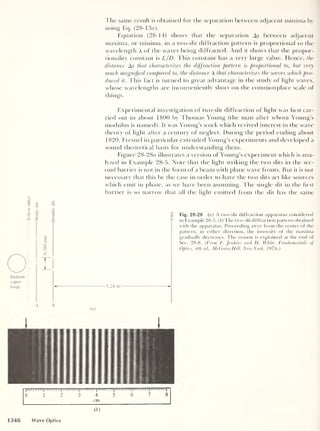
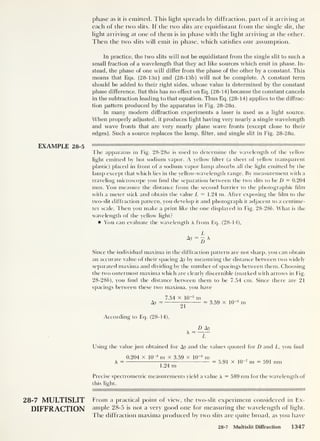
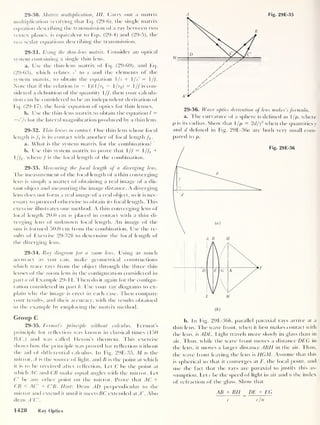
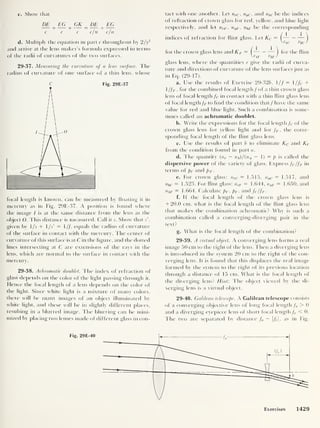
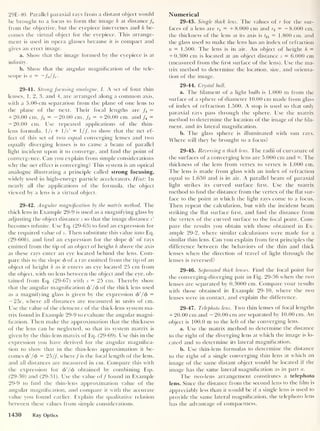
PHYSICS volume II
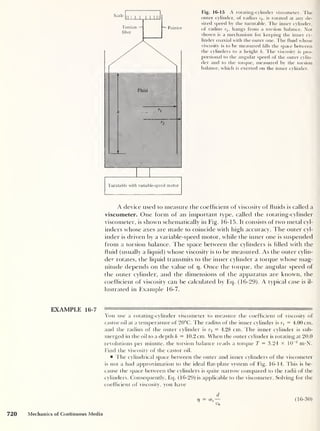
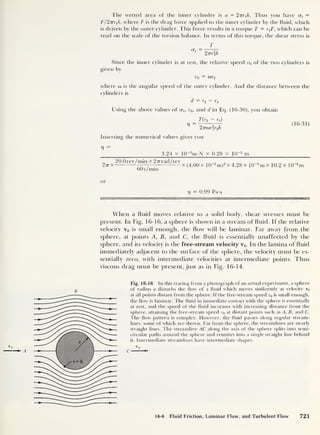
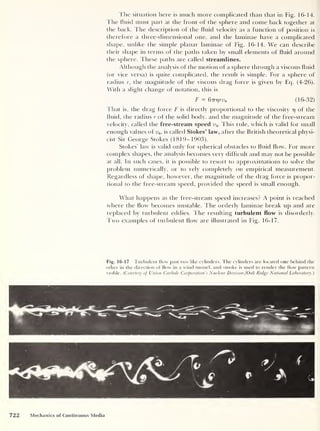
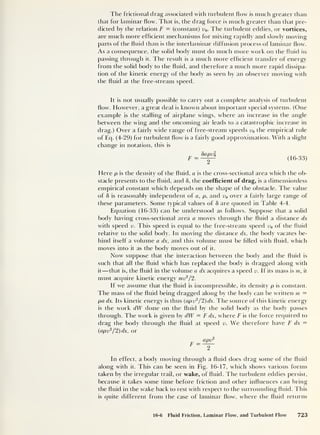
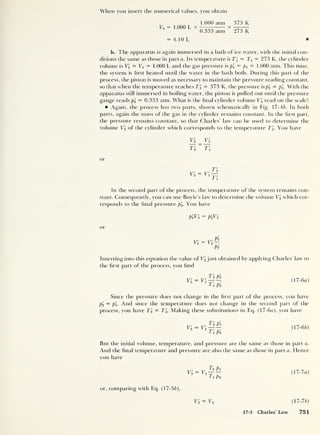
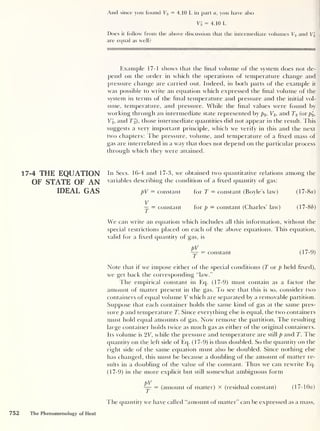
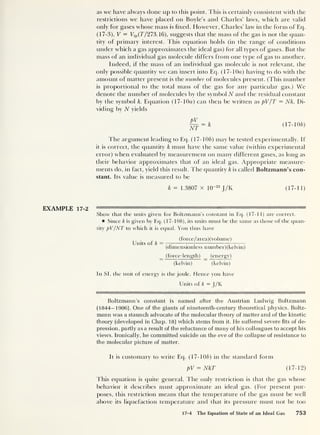
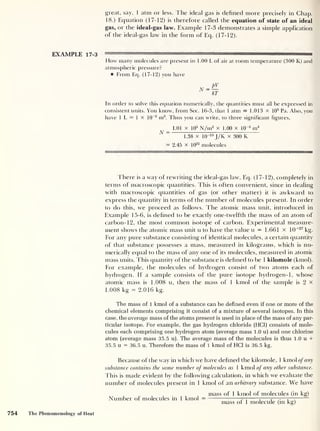
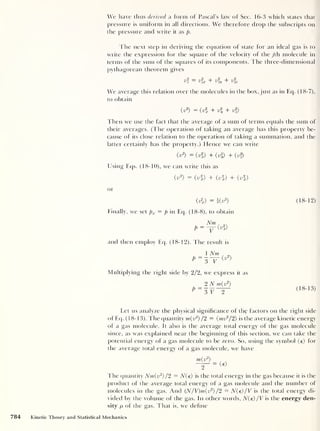
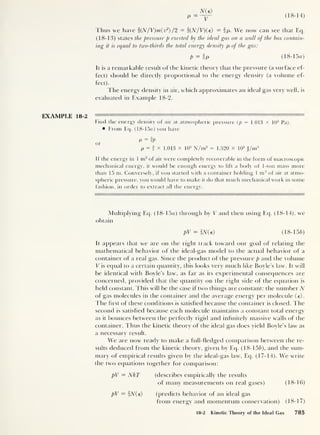
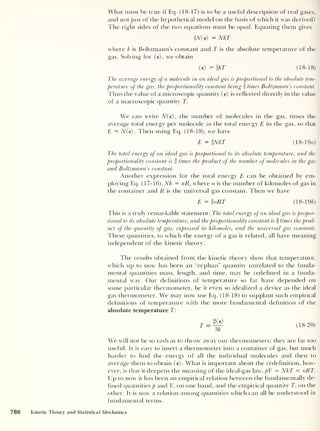
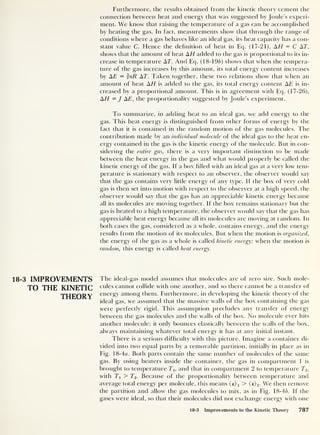
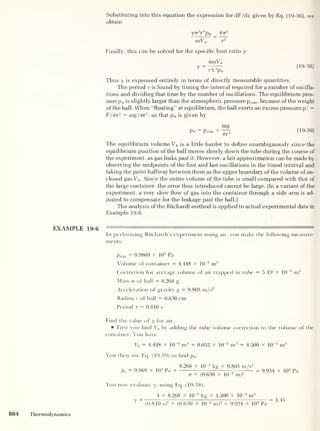
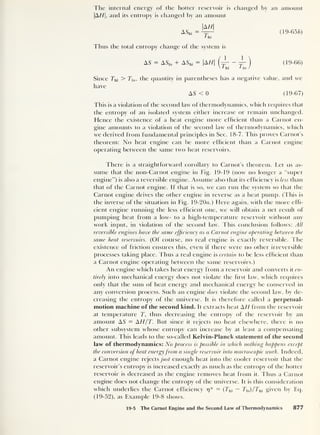
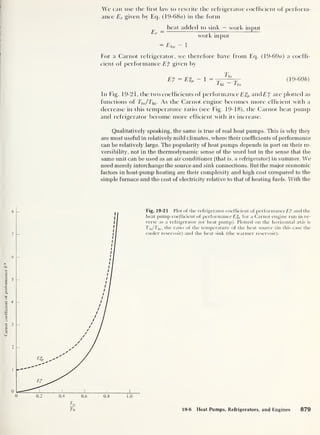
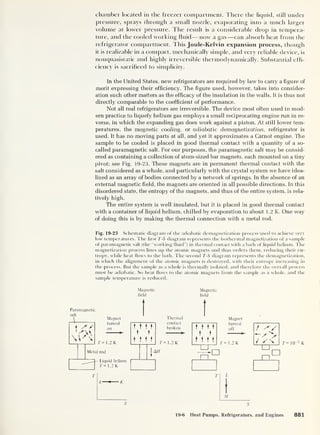
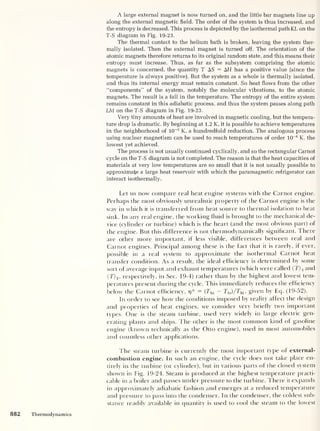
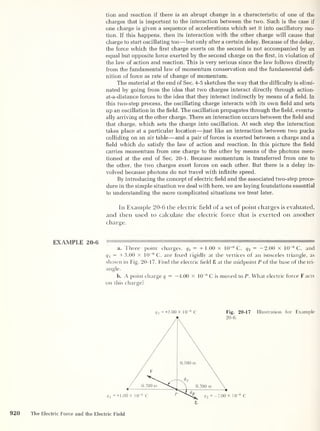
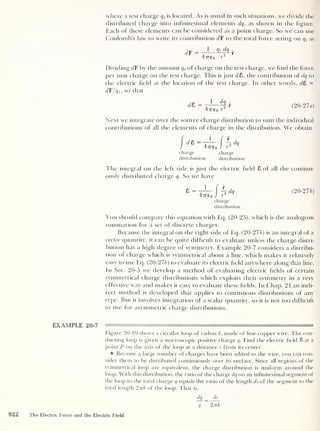
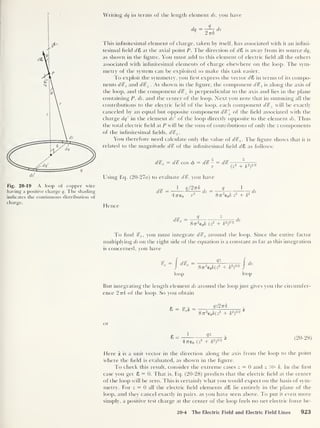
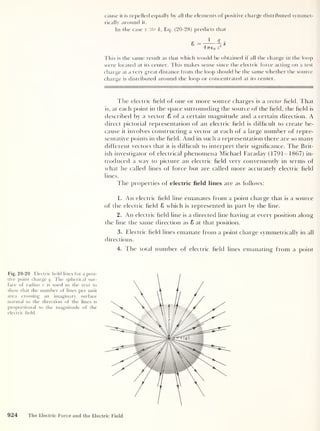
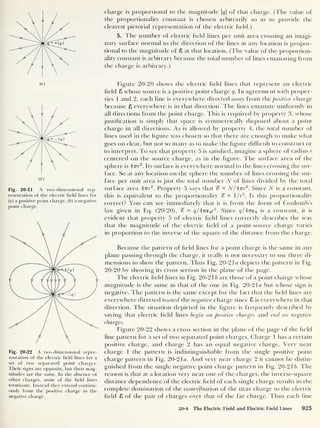
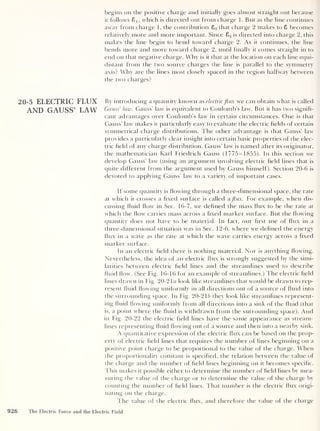
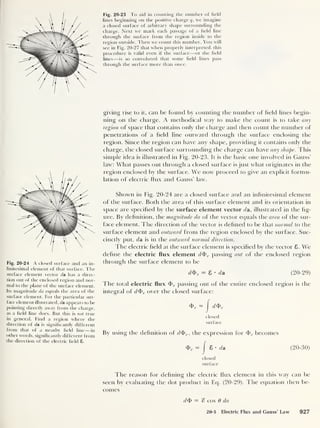
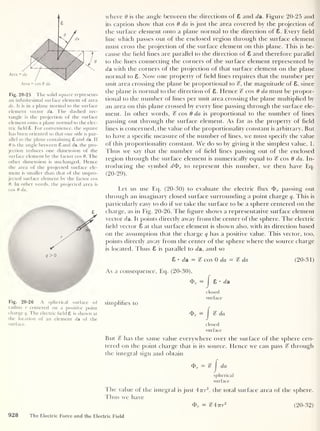
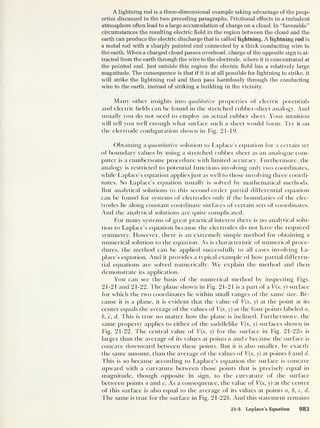
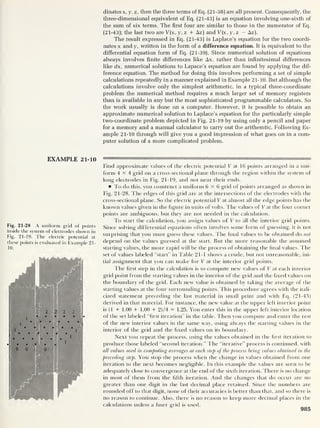
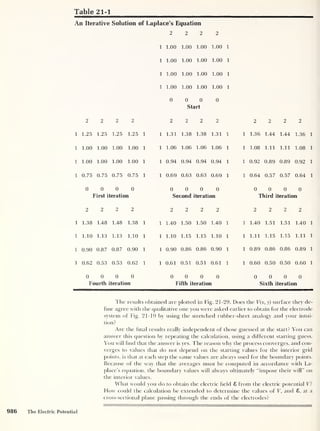
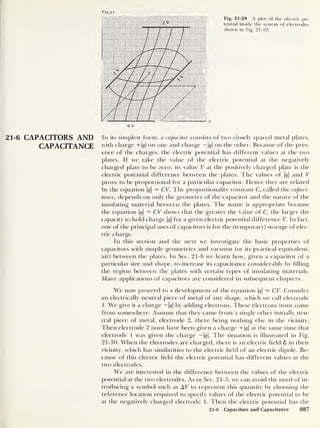
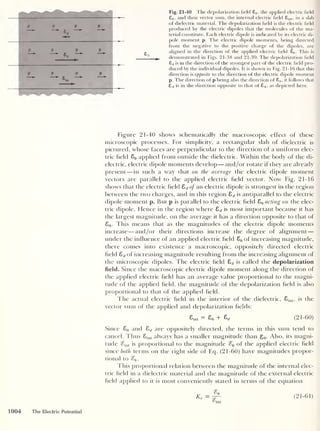
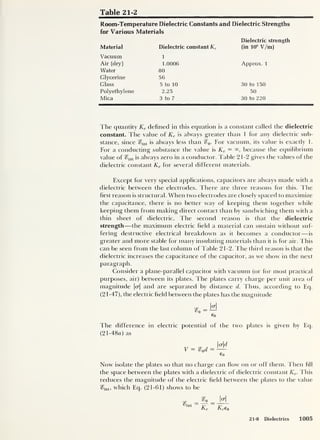
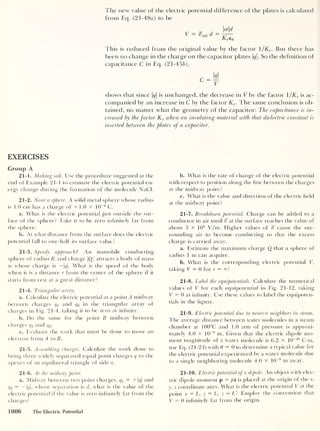
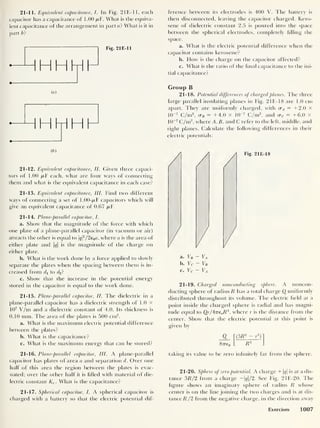
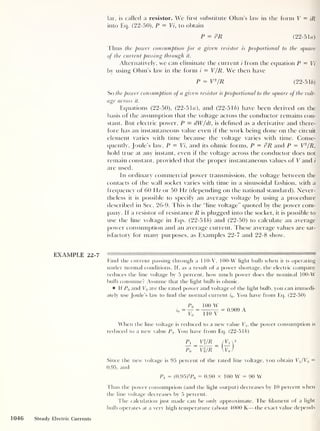
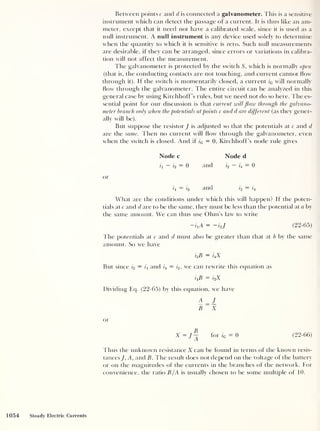
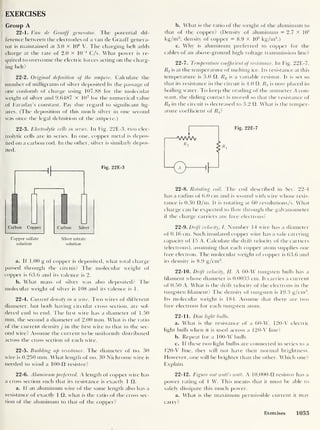
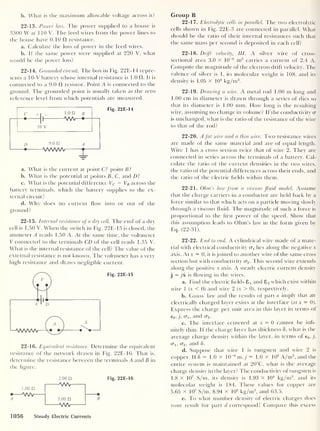
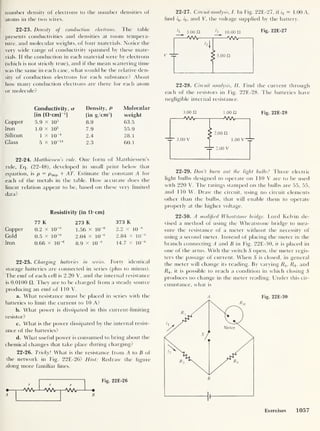
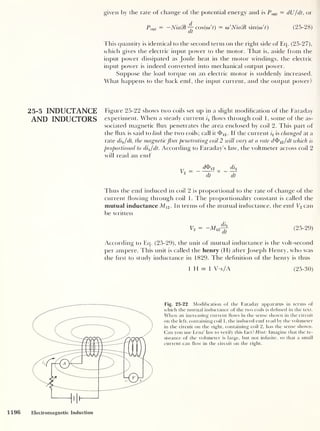
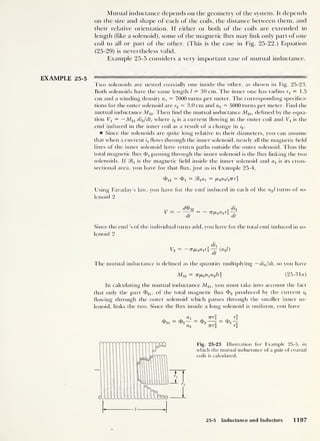
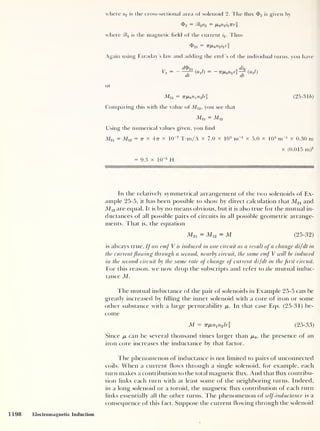
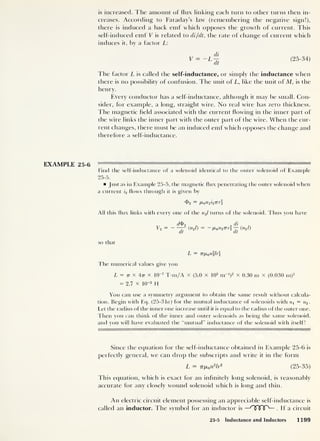
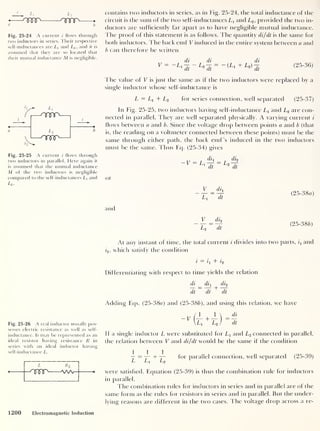
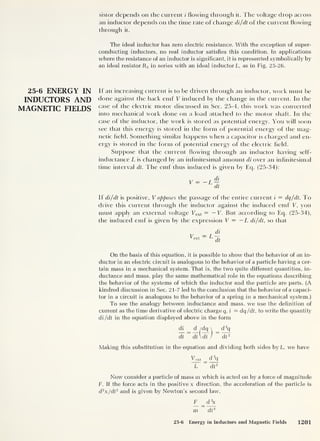
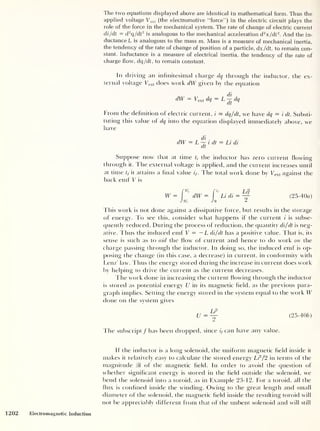
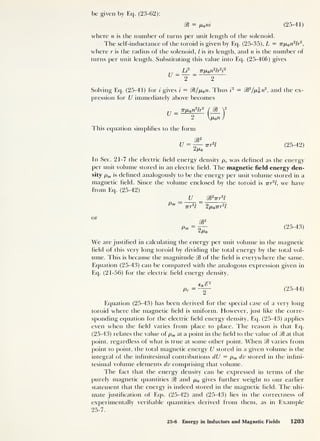
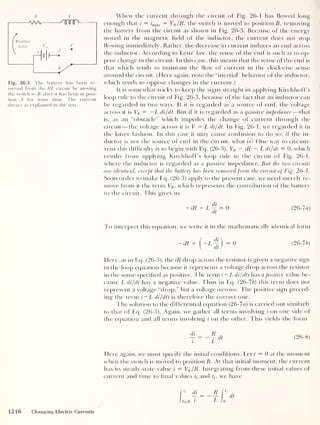
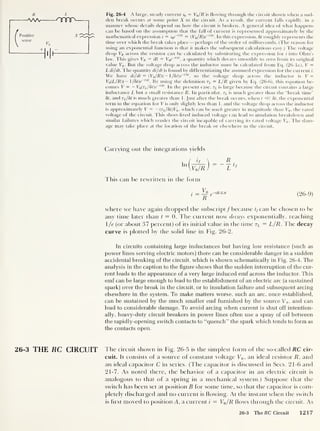
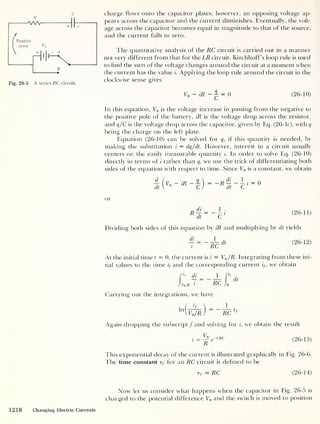
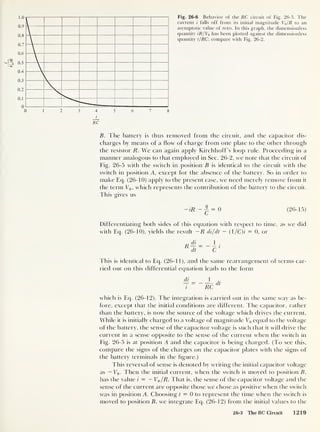
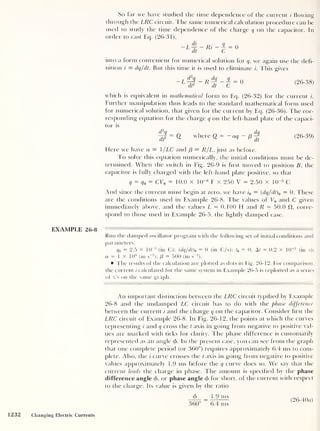
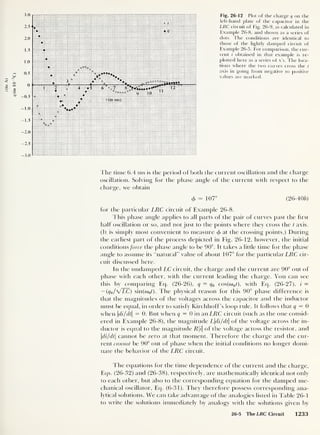
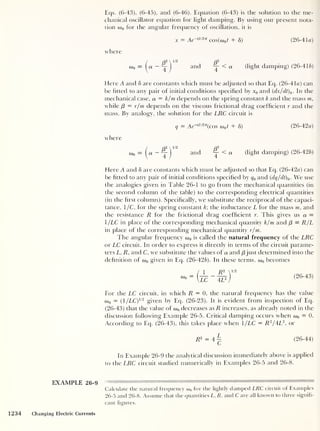
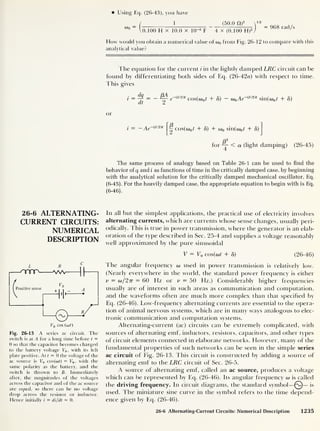
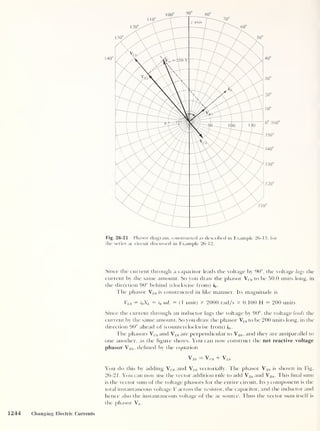
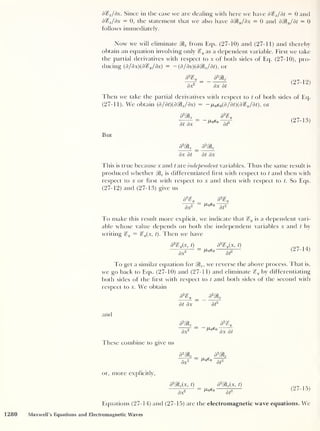
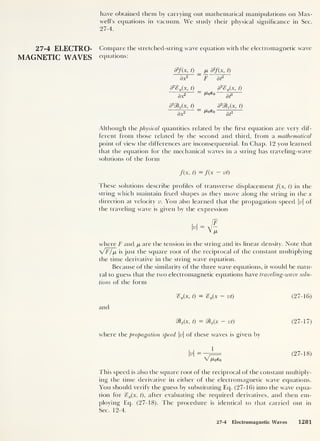
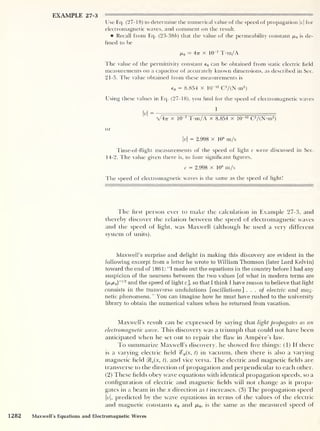
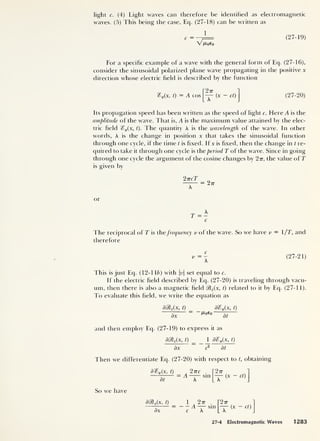
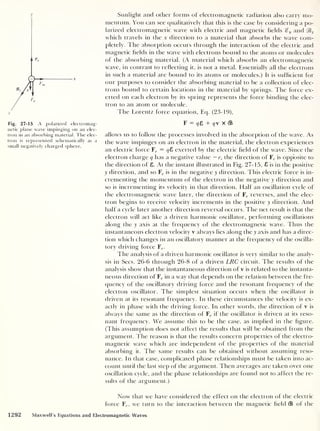
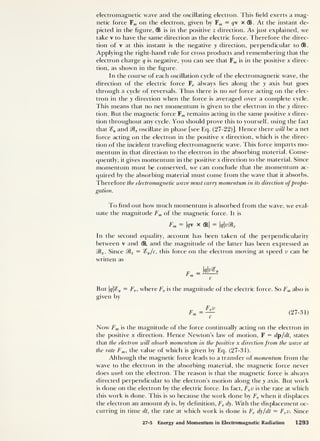
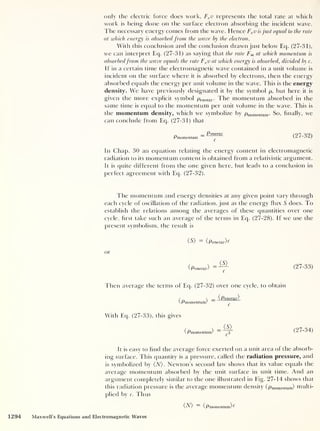
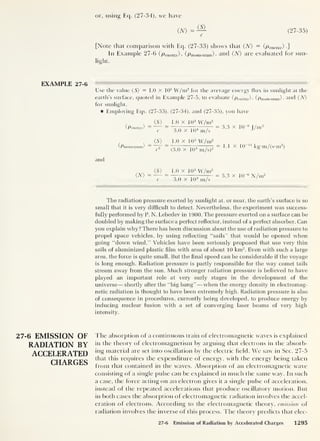
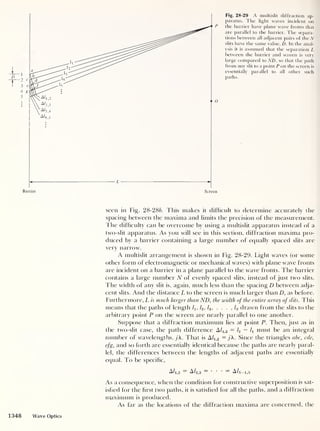
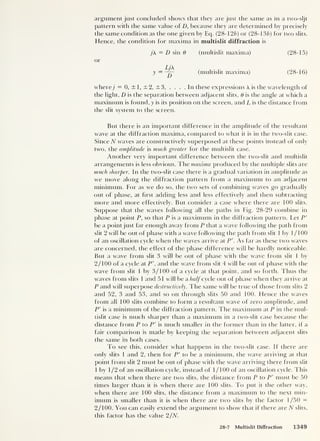
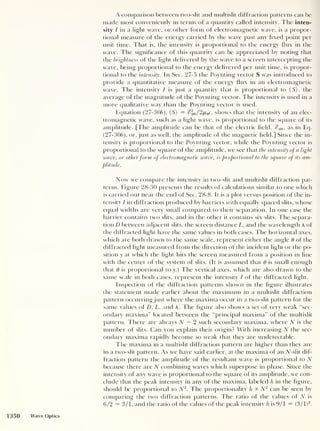
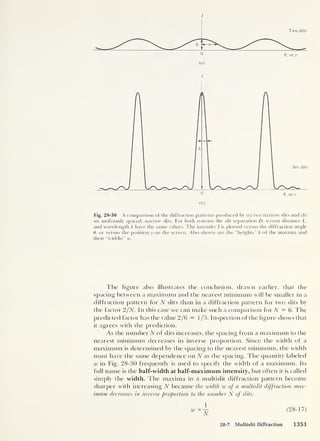
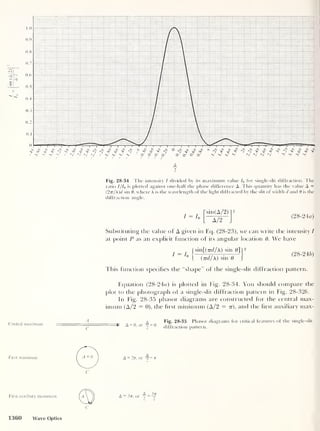
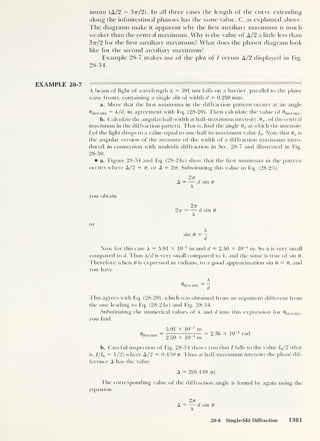
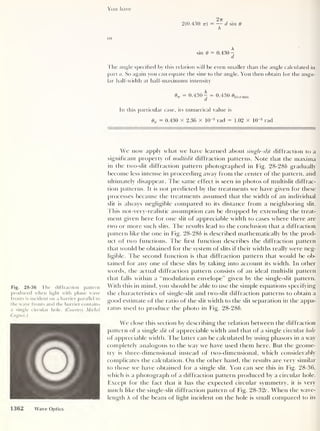
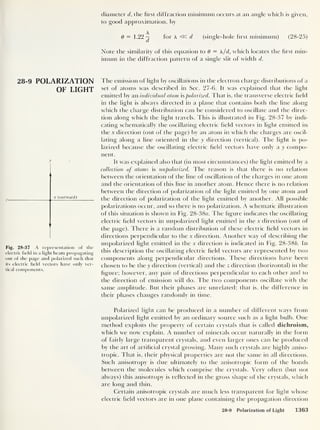
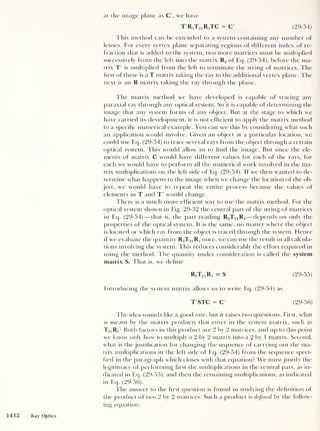
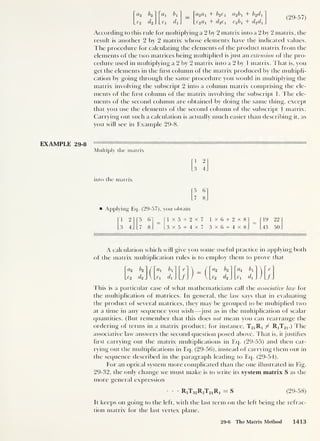
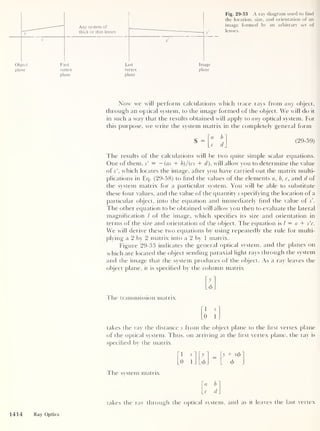
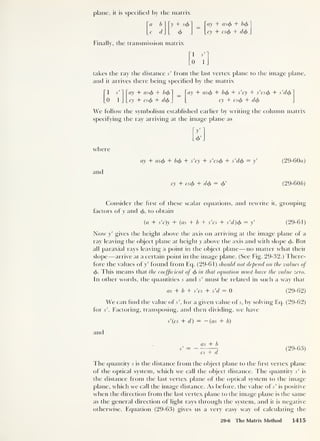
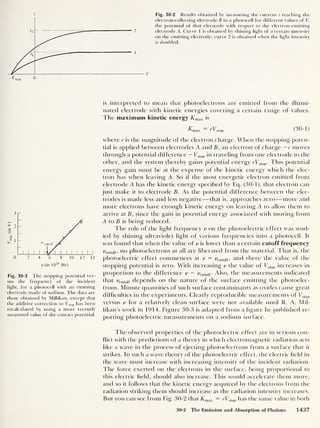
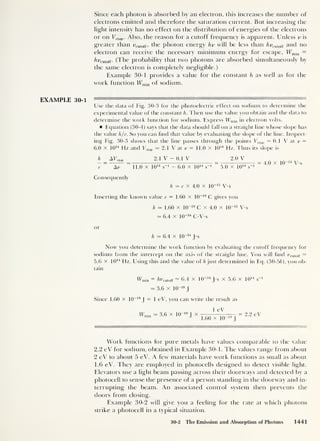
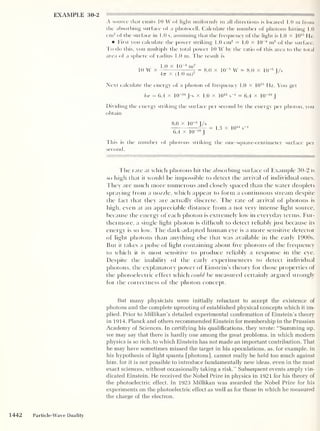
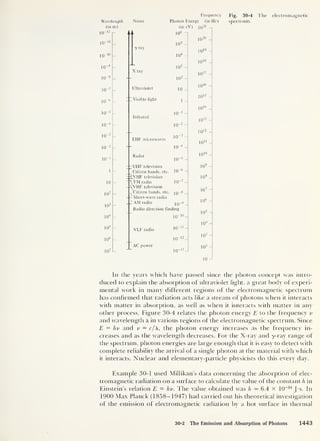
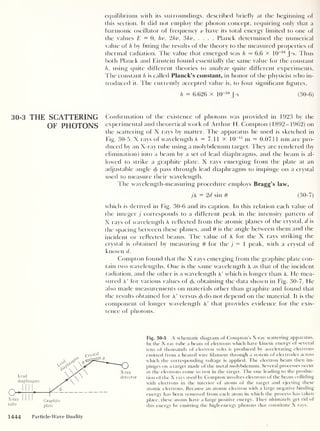
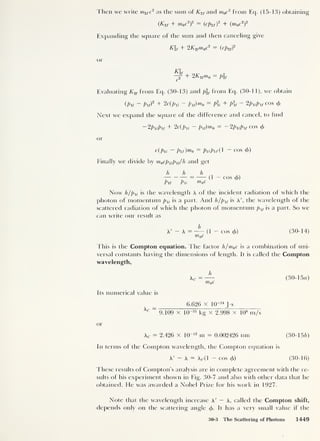
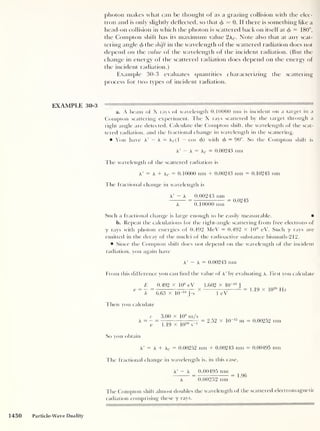
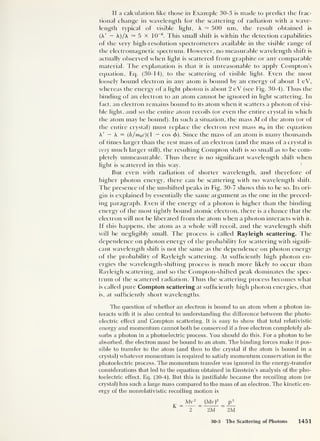
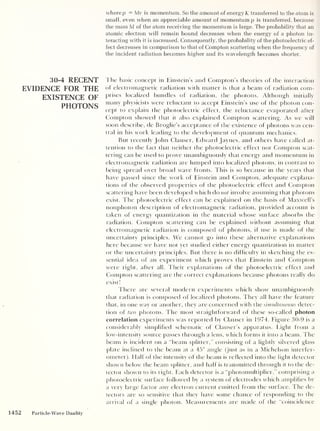
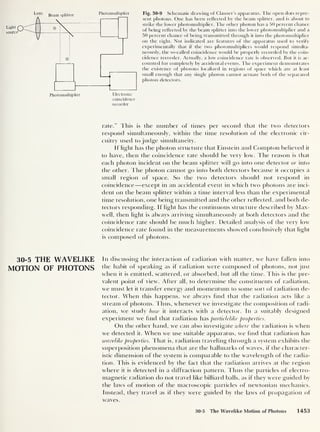
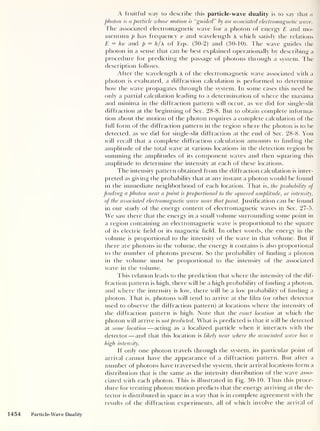
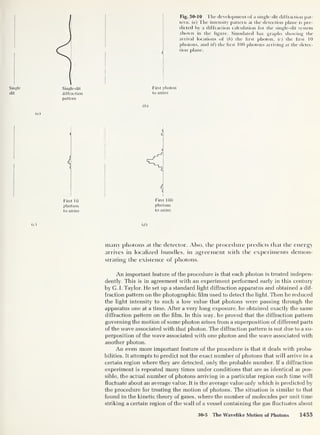
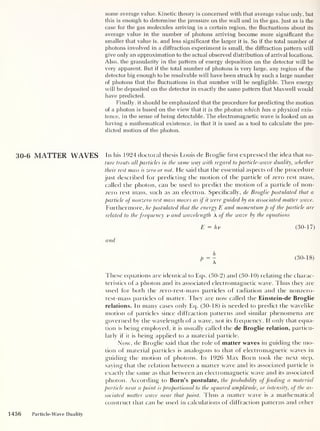
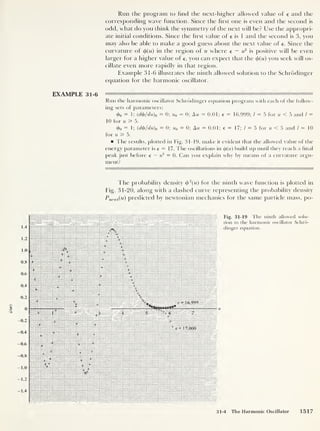
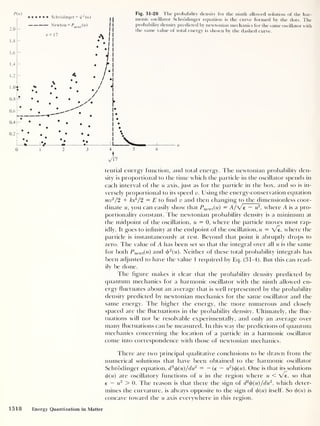
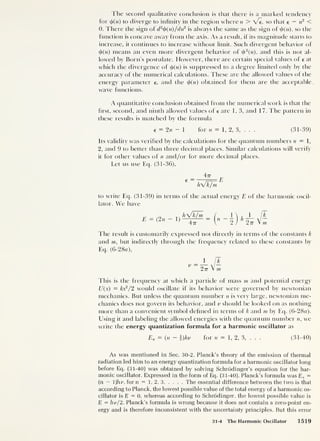
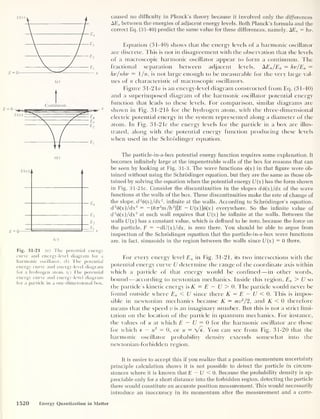
Foundations and Applications
ROBERT M. EISBERG
LAWRENCE S. LERNER
nun
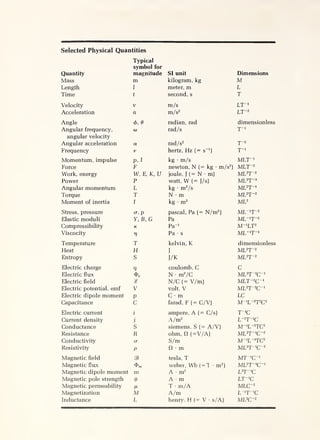
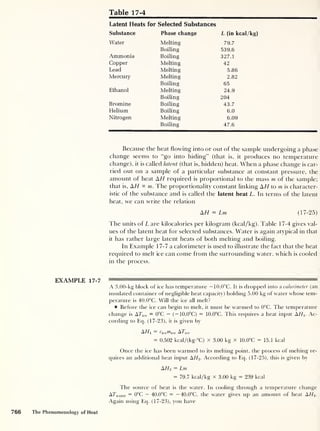
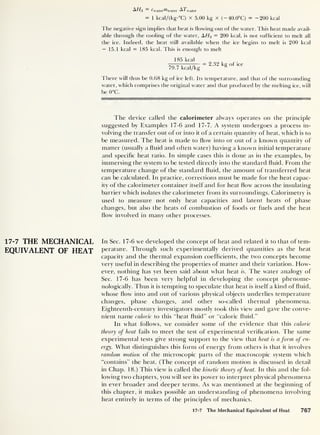
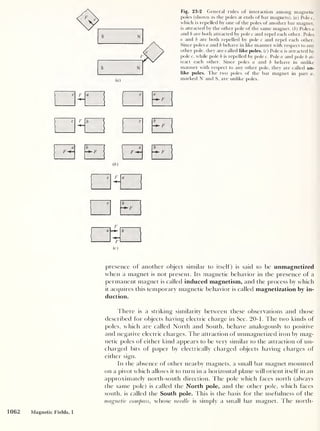
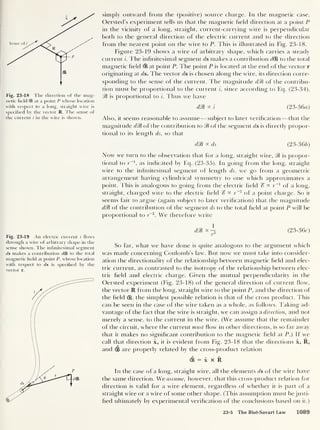
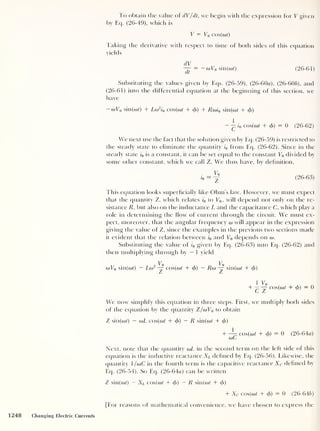
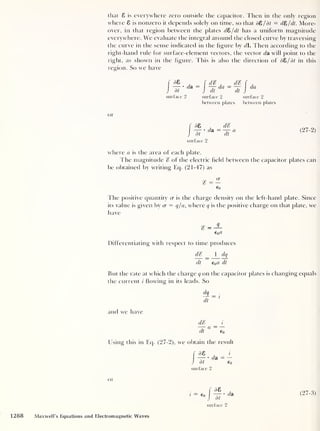
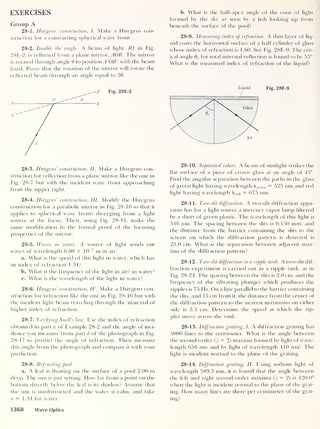
Selected Physical Quantities
Typical
symbol for
Quantity magnitude SI unit Dimensions
Mass m kilogram, kg M
Length 1 meter, m L
Time t second, s T
Velocity V m/s LT-1
Acceleration a m/s2
LT~2
Angle </>, e radian, rad dimensionless
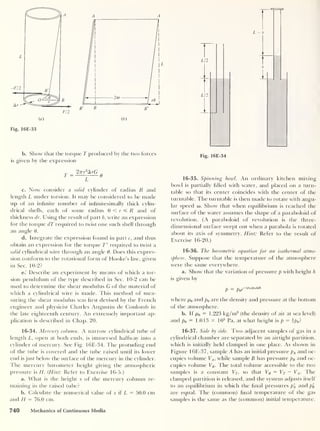
Angular frequency, a> rad/s T-i
angular velocity
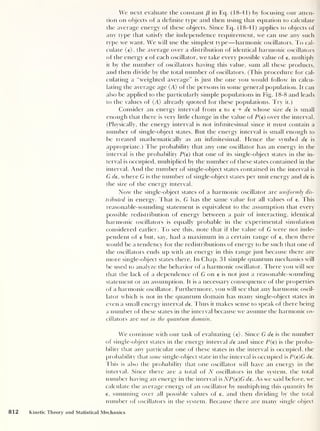
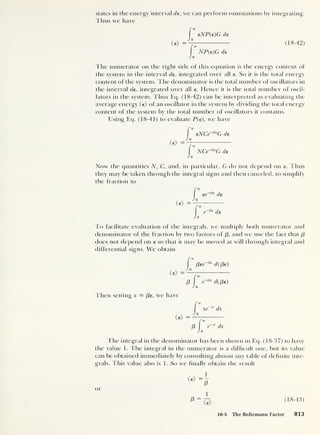
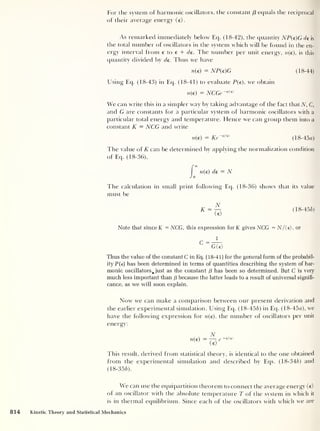
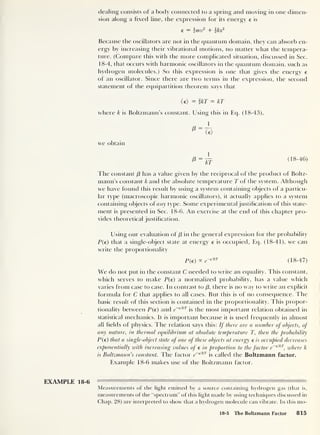
Angular acceleration a rad/s2 r
J~'—2
Frequency V hertz, Hz (= s
_1
)
T
~1
Momentum, impulse p, I kg •
m/s MLT-1
Force F newton, N (= kg m/s2
)
MLT~2
Work, energy W, E, K, U joule, J (= N •
m) ML2
T~2
Power P watt, W (= J/s) ML2
T-3
Angular momentum L kg •
m2
/s ML2
T^
Torque T N •
m ML2
T~2
Moment of inertia I kg •
m2
ML2
Stress, pressure cr, p pascal, Pa (= N/m2
)
ML^T-2
Elastic moduli Y, B, G Pa ML-'T~2
Compressibility K Pa”1
M-'LT2
Viscocity V Pa s ML-‘T
-1
Temperature T kelvin, K dimensionless
Heat H J ML2
T~2
Entropy S J/K ML2
T~2
Electric charge q coulomb, C C
Electric flux <t>e N •
m2
/C ML3
t-2c-i
Electric field % N/C (= V/m) MLT-2
C -1
Electric potential, emf V volt, V ML2
T
-2
c->
Electric dipole moment p C •
m LC
Capacitance c farad, F (= C/V) M~1
L~2
T2
C2
Electric current i ampere, A (= C/s) T_1
C
Current density j A/m2
L“2
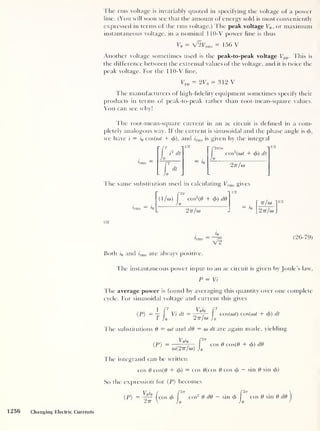
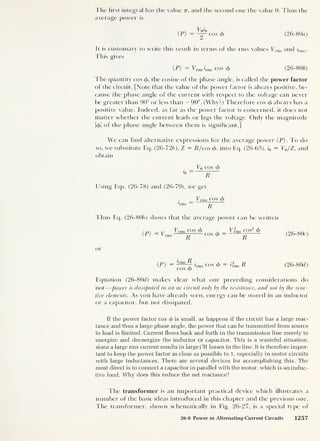
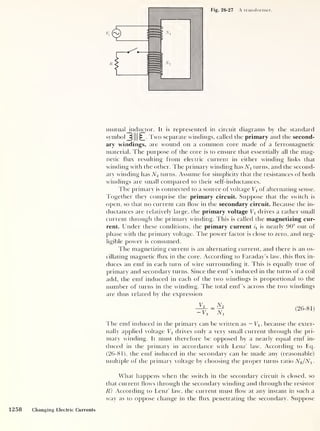
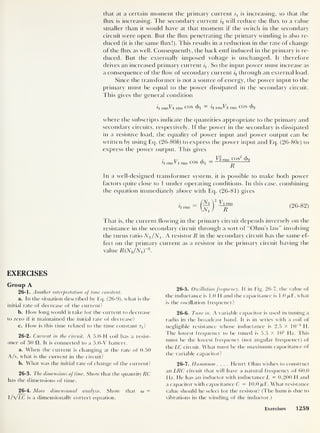
T-1
C
Conductance S siemens, S (= A/V) M_1
L_2
TC2
Resistance R ohm, Fl (=V/A) ML2
T-1
C-2
Conductivity C
T
S/m M~'L~3
TC2
Resistivity P O •
m ML3
T-1
C-2
Magnetic field tesla, T MT-'C-1
Magnetic flux weber, Wb (
= 1 •
m2
)
ML2
T_1
C_1
Magnetic dipole moment m A m2
L2
T~'C
Magnetic pole strength A m LT_1
C
Magnetic permeability P T •
m/A MLC~2
Magnetization M A/m L-’T-'C
Inductance L henry. H (= V •
s/A) ML2
C-2
WILLIAM H. INGHAM
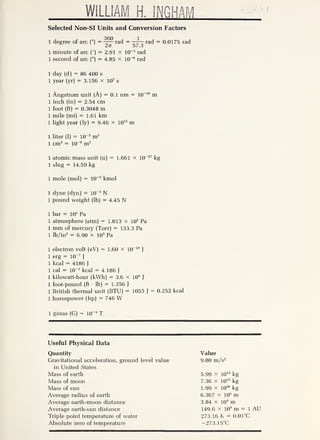
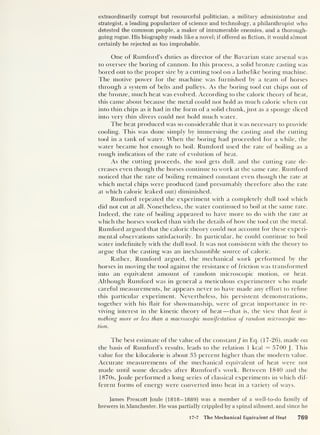
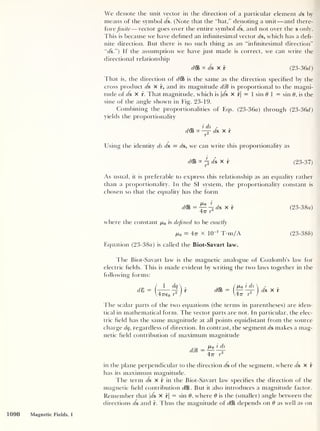
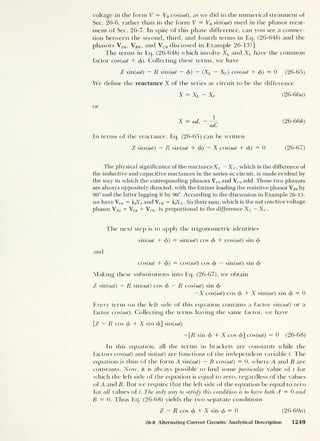
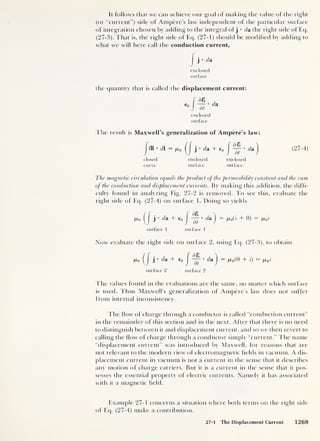
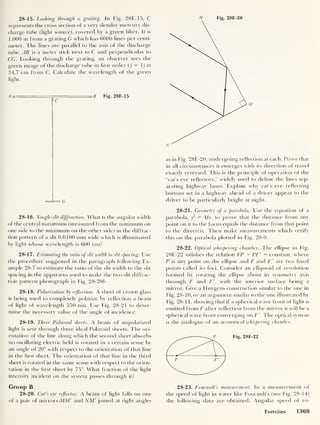
Selected Non-SI Units and Conversion Factors
360 
1 degree of arc (°) = rad = rad = 0.0175 rad
1 minute of arc (') = 2.91 x 10~4
rad
1 second of arc ("} = 4.85 x 10~6
rad
1 day (d) = 86 400 s
1 year (yr) = 3.156 x 10⁷
s
1 Angstrom unit (A) = 0.1 nm = 10~10
m
1 inch (in) = 2.54 cm
1 foot (ft) = 0.3048 m
1 mile (mi) = 1.61 km
1 light year (ly) = 9.46 x 10¹⁵
m
1 liter (1) = 10
-3
m3
1 cm3 = 10
-6
m3
1 atomic mass unit (u) = 1.661 x 10
-27
kg
1 slug = 14.59 kg
1 mole (mol) = 10^3
kmol
1 dyne (dyn) = 10~5
N
1 pound weight (lb) = 4.45 N
1 bar = 105
Pa
1 atmosphere (atm) = 1.013 x 10⁵
Pa
1 mm of mercury (Torr) = 133.3 Pa
1 lb/in2 = 6.90 x 10³
Pa
1 electron volt (eV) = 1.60 x 10⁻¹⁹
|
1 erg = 10
-7
)
1 kcal = 4186 J
1 cal = 10
-3
kcal = 4.186 J
1 kilowatt-hour (kWh) = 3.6 x 10⁶
J
1 foot-pound (ft •
lb) = 1.356 J
1 British thermal unit (BTU) = 1055 J
= 0.252 kcal
1 horsepower (hp) = 746 W
1 gauss (G) = 10~4
T
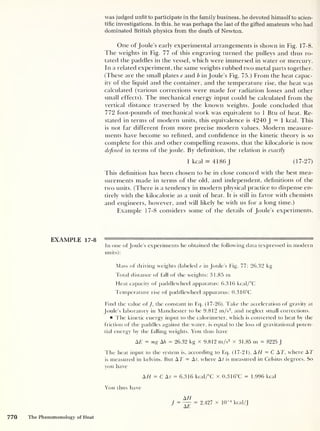
Useful Physical Data
Quantity
Gravitational acceleration, ground level value
in United States
Mass of earth
Mass of moon
Mass of sun
Average radius of earth
Average earth-moon distance
Average earth-sun distance
Triple point temperature of water
Absolute zero of temperature
Value
9.80 m/s2
5.99 x 1024
kg
7.36 x 10²²
kg
1.99 x 10³° kg
6.367 X 10⁶
m
3.84 x 10⁸
m
149.6 x 10⁹
m = 1 AU
273.16 K = 0.01°C
— 273.1 5°C
PHYSICS
Foundations and Applications
volume II
PHYSICS
Foundations and Applications
volume II
ROBERT M. EISBERG
Professor of Physics
University of California, Santa Barbara
LAWRENCE S. LERNER
Professor of Physics
California State University, Long Beach
McGraw-Hill Book Company
New York St. Louis San Francisco Auckland Bogota Hamburg
Johannesburg London Madrid Mexico Montreal New Delhi
Panama Paris Sao Paulo Singapore Sydney Tokyo Toronto
PHYSICS: Foundations and Applications, volume II
Copyright © 1981 by McGraw-Hill, Inc. All rights reserved. Printed in
the United States of America. No part of this publication may be repro-
duced, stored in a retrieval system, or transmitted, in any form or by any
means, electronic, mechanical, photocopying, recording, or otherwise,
without the prior written permission of the publisher.
1234567890 RMRM 8987654321
This book was set in Baskerville by Progressive Typographers.
4'he editor was John J. Corrigan;
the designer was Merrill Haber;
the production supervisor was Dominick Petrellese.
The photo researcher was Mira Schachne.
The drawings were done by J & R Services, Inc.
Rand McNally 8c Company was printer and hinder.
Library of Congress Cataloging in Publication Data
Eisberg, Robert Martin.
Physics, foundations and applications.
Includes index.
1. Physics. I. Lerner, Lawrence S., date
joint author. II. Title.
QC21.2.E4 530 80-24417
ISBN 0-07-019091-7 (v. I)
ISBN 0-07-019092-5 (v. II)
Cover: “Vega-Nor” by Victor de Vasarely, reproduced by courtesy of
the Albright-Knox Art Gallery, Buffalo, New York, and the Vasarely
Center, New York, New York.
Contents
PREFACE ix
Chapter 16 MECHANICS OF CONTINUOUS MEDIA 697
16-1 Continuous Media 697
16-2 Stress and Strain 698
16-3 Fluids and Pressure 706
16-4 Boyle’s Law 713
16-5 Bulk Modulus and Compressibility 714
16-6 Fluid Friction, Laminar Flow, and Turbulent Flow 718
16-
7 Dynamics of Ideal Fluids 725
Exercises 735
Chapter 17 THE PHENOMENOLOGY OF HEAT 743
17-
1 The Phenomenological Approach 743
17-2 Temperature 744
17-3 Charles’ Law 747
17-4 The Equation of State of an Ideal Gas 752
17-5 Thermal Expansion of Solids and Liquids 756
17-6 Heat 761
17-
7 The Mechanical Equivalent of Heat 767
Exercises 772
Chapter 18 KINETIC THEORY AND STATISTICAL MECHANICS 776
18-
1 The Ideal-Gas Model 776
18-2 Kinetic Theory of the Ideal Gas 778
18-3 Improvements to the Kinetic Theory 787
18-4 Heat Capacity and Equipartition 792
18-5 The Boltzmann Factor 800
18-6 The Maxwell-Boltzmann Speed Distribution 818
18-
7 Disorder and Entropy 825
Exercises 835
Chapter 19 THERMODYNAMICS 842
19-
1 Thermodynamic Interactions and the
First Law of Thermodynamics 842
19-2 Isometric and Isobaric Processes 848
19-3 Isothermal and Adiabatic Processes 855
19-4 Entropy, Temperature, and Thermodynamic Efficiency 865
19-5 The Carnot Engine and the Second Law of
Thermodynamics 870
19-6 Heat Pumps, Refrigerators, and Engines 878
19-
7 The Third Law of Thermodynamics 885
Exercises 888
Chapter 20 THE ELECTRIC FORCE AND THE ELECTRIC FIELD 894
20-
1 The Electromagnetic Force 894
20-2 Electric Charge and Coulomb’s Law 896
v
20-3 Alpha-Particle Scattering 907
20-4 The Electric Field and Electric Field Lines 917
20-5 Electric Flux and Gauss’ Law 926
20-6 Applications of Gauss’ Law 932
Exercises 940
Chapter 21 THE ELECTRIC POTENTIAL 944
21-1 Electric Potential Energy and Electric Potential 944
21-2 Evaluation of Electric Field from Electric Potential 954
21-3 Equipotential Surfaces and Electric Field Lines 958
21-4 Electric Dipoles 964
21-5 Laplace’s Equation 974
21-6 Capacitors and Capacitance 987
21-7 Energy in Capacitors and Electric Fields 997
21-8 Dielectrics 1002
Exercises 1006
Chapter 22 STEADY ELECTRIC CURRENTS 1012
22-1 Electromotive Force and Its Sources 1012
22-2 Flow of Electric Charge and Electric Current 1018
22-3 Ohm’s Law 1024
22-4 The Electron Gas 1034
22-5 The Microscopic Basis of Electric Resistance 1036
22-6 Joule’s Law 1044
22-7 Direct-Current Circuits 1047
Exercises 1055
Chapter 23 MAGNETIC FIELDS, I 1061
23-1 Magnetic Poles and Magnetic Field Lines 1061
23-2 The Magnetic Force and the Magnetic Field 1065
23-3 Cyclotron Resonance and Cyclotrons 1073
23-4 The Lorentz Force 1077
23-5 The Biot-Savart Law 1086
23-6 Ampere’s Law 1096
23-7 Applications of Ampere’s Law 1107
Exercises 1116
Chapter 24 MAGNETIC FIELDS, II 1122
24-1 Ampere’s Experiment and the Ampere 1122
24-2 Relativistic Origin of the Magnetic Force 1129
24-3 Magnetic Dipoles and Their Applications 1140
24-4 Ampere’s Conjecture and Diamagnetism 1150
24-5 Paramagnetism and Ferromagnetism 1157
Exercises 1166
Chapter 25 ELECTROMAGNETIC INDUCTION 1172
25-1 Faraday’s Law: Induced Currents 1172
25-2 Faraday’s Law: The Crucial Role of Changing
Magnetic Flux 1178
25-3 Faraday’s Law: Induced Electric Fields 1184
25-4 Electric Generators and Motors 1191
25-5 Inductance and Inductors 1196
25-6 Energy in Inductors and Magnetic Fields 1201
Exercises 1205
Chapter 26 CHANGING ELECTRIC CURRENTS 1211
26-1 Inductance, Resistance, and Capacitance in Electric
Circuits 1211
26-2 The RL Circuit 1212
26-3 The RC Circuit 1217
26-4 The LC Circuit 1221
26-5 The LRC Circuit 1226
26-6 Alternating-Current Circuits: Numerical Description 1235
26-7 Alternating-Current Circuits: Phasor Description 1241
26-8 Alternating-Current Circuits: Analytical Description 1247
26-
9 Power in Alternating-Current Circuits 1255
Exercises 1259
Chapter 27 MAXWELL’S EQUATIONS AND
ELECTROMAGNETIC WAVES 1265
27-
1 The Displacement Current 1265
27-2 Maxwell’s Equations 1273
27-3 The Electromagnetic Wave Equations 1274
27-4 Electromagnetic Waves 1281
27-5 Energy and Momentum in Electromagnetic
Radiation 1288
27-
6 Emission of Radiation by Accelerated Charges 1295
Exercises 1309
Chapter 28 WAVE OPTICS 1314
28-
1 Huygens’ Construction 1314
28-2 Reflection 1318
28-3 The Speed of Light in Transparent Materials 1325
28-4 Refraction and Total Internal Reflection 1328
28-5 Dispersion 1337
28-6 Two-Slit Diffraction 1340
28-7 Multislit Diffraction 1347
28-8 Single-Slit Diffraction 1354
28-
9 Polarization of Light 1363
Exercises 1368
Chapter 29 RAY OPTICS 1373
29-
1 Wave Optics and Ray Optics 1373
29-2 Fermat’s Principle 1375
29-3 Lenses 1377
29-4 Image Formation 1387
29-5 Optical Systems 1395
29-6 The Matrix Method 1405
29-
7 Applications of the Matrix Method 1417
Exercises 1425
Chapter 30 PARTICLE-WAVE DUALITY 1432
30-
1 The Quantum Domain 1432
30-2 The Emission and Absorption of Photons 1435
30-3 The Scattering of Photons 1444
30-4 Recent Evidence for the Existence of Photons 1452
30-5 The Wavelike Motion of Photons 1453
30-6 Matter Waves 1456
30-7 The Uncertainty Principles 1465
Exercises 1480
Contents vii
Chapter 31 ENERGY QUANTIZATION IN MATTER 1485
31-1 The Particle in a Box 1485
31-2 The Hydrogen Atom 1492
31-3 Schrodinger’s Equation 1505
31-4 The Harmonic Oscillator 1510
Exercises 1522
ANSWERS Al
INDEX II
vm Contents
Preface
Science is constructed offacts, as a house is of stones.
But a collection offacts is no more a science than a
heap of stones is a house.
Henri Poincare
Science and Hypothesis
In this book we present the science of physics in a carefully structured man-
ner which emphasizes its foundations as well as its applications. The struc-
ture is flexible enough, however, for there to be paths through it compati-
ble with the various presentations encountered in introductory physics
courses having calculus as a corequisite or prerequisite.
We have always kept in view the idea that a textbook should be a com-
plete study aid. Thus we have started each topic at the beginning and have
included everything that a student needs to know. T his feature is central to
the senior author’s successful textbooks on modern physics and on quan-
tum physics.
The book is written in an expansive style. Attention paid to motivating
the introduction of new topics is one aspect of this style. Another is the
space devoted to showing that physics is an experimentally based science.
In Volume I direct experimental evidence is repeatedly brought into the
developments by the use of photographs. And although the experiments
underlying the topics considered in Volume II generally do not lend them-
selves to photographic presentation, at least the flavor of the laboratory
work is given by including careful descriptions of the experiments. Still
another aspect of the expansive style is found in the frequent discussions of
the microscopic basis of macroscopic phenomena.
Developments are often presented in “spiral" fashion. That is, a quali-
tative discussion is followed by a more rigorous treatment. An example is
found in the development of Newton’s second law. Chapter 1 introduces its
most important features in a purely qualitative way. When the second law is
treated systematically in Chap. 4, Newton’s approach, using intuitive no-
tions of mass and force, is followed by Mach’s approach, where mass and
force are defined logically in terms of momentum in a manner suggested
by the analysis of a set of collision experiments.
The book contains many features designed to help the student. For in-
stance, when a term is defined formally or by implication, or is redefined in
a broader way, it is emphasized with boldface letters. And all such items in
boldface are listed in the index to make it easy to locate definitions which a
student may have forgotten.
It is not intended that course lectures cover every point made in the
IX
book. The book can be relied upon to do many of the straightforward
things that need to be done, thereby freeing the instructor to concentrate
on the things that cause students the most trouble. Instructors interested in
teaching a self-paced course will find that the completeness of this book
makes it well adapted to use in such a course.
A novel feature of this book is the use of numerical procedures em-
ploying programmable calculating devices. At the risk of giving them more
emphasis than is warranted by their importance to the book, we describe
in the following paragraphs what these procedures make possible, and how
they can be implemented. Numerical procedures are used for:
1. Numerical differentiation and integration. For students concur-
rently studying calculus this drives home the fundamental concepts of a
limit, a derivative, and an integral.
2. Assistance in curve plotting. This is put to good use in studying bal-
listic trajectories, electric field lines and equipotentials, and wave groups.
3. Numerical solution of differential equations. This procedure per-
mits the use of Newton’s second law in a variety of cases involving varying
forces. It also is applied to the vibration of a circular drumhead, LRC cir-
cuits, and Schrodinger’s equation.
4. Simulation of statistical experiments. The procedure allows funda-
mental topics of statistical mechanics to be introduced in an elementary
way.
5. Multiplication of several 2 by 2 matrices. This makes practical the
introduction of a very simple yet very powerful method of doing ray optics.
fhe principal advantage of using numerical procedures in the intro-
ductory course is that it frees the physics content of the course from the limi-
tations normally imposed by the students’ inability to manipulate differen-
tial equations analytically or to handle certain other analytical techniques.
To give just one example of the many embodied in this book, we have
found that students are quite interested in the numerical work on celestial
mechanics and are well able to understand the physics involved. It is the
mathematical difficulty of the traditionally used analytical techniques that
normally mandate the deferral of this material to advanced courses.
fhe advantages of the numerical procedures go the other way as well
—they open up mathematical horizons not usually accessible to the intro-
ductory-level student. The analytical solution of a differential equation
generally requires an educated guess at the form of the solution. It is pre-
cisely such a guess that the student is not prepared to make, or to accept
from others. But the numerical solution suggests the correct guess strongly
and directly. Our experience is that students armed with such insight can
go through the analytical solution confidently. The book exploits this ad-
vantage on several occasions.
fhe numerical work can be presented in the lecture part of a course in
various ways. One which has proven to be successful is to demonstrate to
the students the first numerical procedure that is emphasized by using a
closed-circuit TV system to provide an enlarged view of the display of a
programmable calculator or small computer running through the proce-
dure. (Programs for every numerical procedure used in the book, and step-
by-step operating instructions, are given in the accompanying pamphlet,
the Numerical Calculation Supplement.) After the demonstration, a graph of
the results obtained is shown to the students by projecting a transparency
made from the appropriate figure in the book, and the significance of the
results is explained. In subsequent lectures involving numerical proce-
dures, all that need be done is to graph their results and then discuss the
meaning of the results. An instructor who is more inclined to numerical
procedures may want to give more demonstrations; one who is less con-
vinced of their worth need not give any. The essential point is that explana-
tions of the physics emerging from the numerical work can be well under-
stood by students who do no more than look carefully at graphs of the
results obtained.
But it goes without saying that students will get more out of an active
involvement with the numerical procedures than a passive one. The most
active approach is to ask the students to do several of the homework exer-
cises labeled Numerical in each of the fourteen chapters where some use is
made of numerical procedures. But the instructor should not assign too
many numerical exercises, particularly at first, because some are rather
time-consuming. A good way to start is to make the numerical exercises op-
tional or to give extra credit for them. Instruction in operating a program-
mable calculator or small computer can be given in a laboratory period or
in one or two discussion periods.
We now describe paths which may be taken through this book, other
than the one going continuously from the beginning to the end.
1. Several entire topics can be deleted without difficulty. These are:
relativity, Chaps. 14 and 15; fluid dynamics, Secs. 16-6 and 16-7; thermal
physics, Chaps. 17 through 19; changing electric currents, Chap. 26; elec-
tromagnetic waves, Chap. 27; optics, Chaps. 28 and 29; and quantum phys-
ics, Chaps. 30 and 31.
2 . We believe the book contains as much modern physics as should be
in the introductory course. This material is distributed throughout the
book, but it has been written in such a way that there will be no problem in
presenting it all in the final term. To do so, the following material should
be skipped in proceeding through the book, and presented at the end:
Chaps. 14 and 15; Secs. 20-1, 20-3, 22-4, 22-5, 23-3, 24-2, 24-4, and 24-5.
Then close with Chaps. 30 and 31.
3 . In some schools the study of thermal physics is undertaken before
that of wave motion. For such a purpose Chaps. 16 through 19 can be
treated before Chaps. 12 and 13.
4. If it is desired to present a shorter course in which no major topics
are to be deleted, the sections in the following list can be dropped without
significantly interrupting the flow of the argument and without passing
over material essential to subsequent subject matter. (In some cases it will
be necessary to substitute a very brief qualitative summary of the ideas not
treated formally when the need for these ideas arises. Sections marked with
an asterisk are those to be deleted if it is desired to avoid entirely the wave
equation in its various forms. If this is done, electromagnetic radiation may
still be treated on a semiquantitative basis.) The sections which can be
dropped are: 2-5, 2-8, 3-7, 4-2 (if some of the examples are used later), 5-4,
5-5, 6-1, 6-6, 7-1, 7-3, 8-2, 8-5, 9-7, 10-2, 10-3, 11-2, 11-4, 11-7, 12-3*,
12-4*, 12-5, 12-6, 13-4*, 13-5*, 13-6, 13-7, 13-8, 15-5, 15-6, 16-5, 16-6,
17-5, 18-6, 19-6, 19-7, 20-1, 20-3, 21-5, 21-8, 22-4, 22-5, 23-3, 24-2, 24-4,
24-5, 25-4, 26-6, 26-7, 26-8, 26-9, 27-3*, 27-4*, 27-6, 28-5, 28-7, 29-2, 29-6,
Preface xi
29-7, 30-3, 30-4, 31-3, and 3 1 -4. In addition, any material in small print can
be dropped.
Many persons have assisted us in writing this book. In particular, ad-
vice on presentation or on technical points and/or aid in producing many
of the photographs was given by R. Dean Ayers, Alfred Bork, John
Clauser, Roger H. Hildebrand, Daniel Hone, Anthony Korda, Jill H. Lar-
ken, Isidor Lerner, Narcinda R. Lerner, Ralph K. Myers, Roger Osborne,
and Abel Rosales. The manuscript was reviewed at various stages, in part
or in whole, by Raymond L. Askew, R. Dean Ayers, Carol Bartnick,
George H. Bowen, Sumner P. Davis, Joann Eisberg, Lila Eisberg, Austin
Gleeson, Russell K. Hobbie, William H. Ingham, Isidor Lerner, Ralph K.
Myers, Herbert D. Peckham, Earl R. Pinkston, James Smith, Jacqueline D.
Spears, Edwin F. Taylor, Gordon G. Wiseman, Mason Yearian, Arthur M.
Yelon, and Dean Zollman. Isidor Lerner contributed many of the exer-
cises; others were written by Van Blnemel, Don Chodrow, Eugene God-
fredsen, John Hutcherson, William Ingham, Daniel Schechter, and Mark F.
Taylor. Dean Zollman assisted greatly in selecting and editing exercises.
Don Chodrow and William Ingham checked all solutions, compiled the
short answers that appear in the back of the book, and prepared the Solu-
tions Manual. Herbert D. Peckham wrote the original versions of the
computer programs lor the Numerical Calculation Supplement. Lila Eisberg
played a major role in reading proof and prepared the index. Important
contributions to the development of the manuscript and its transformation
into a book were made by John J. Corrigan, Mel Haber, Annette Hall.
Alice Macnow, Peter Nalle, Janice Rogers, [o Satloff, and Robert Zappa at
McGraw-Hill, and by our photo researcher, Mira Schaclme. Many students
at the University of California, Santa Barbara, and at California State Uni-
versity, Long Beach, had a real impact on the manuscript by asking just
the right questions in class. To all these persons we express our warmest
thanks.
Robert M. Eisberg
Lawrence S. Lerner
PHYSICS
Foundations and Applications
volume II
I
Mechanics
of Continuous Media
16-1 CONTINUOUS We open the second half of our study of physics by returning to the new-
MEDIA tonian domain. In developing newtonian mechanics, it was logical to begin
with the mechanics ofparticles. Systems containing a single particle or a few
particles are the simplest ones to which the laws of mechanics can be ap-
plied. Fortunately, many systems which do not actually consist of a small
number of particles can be treated for many purposes as if they did. We
treated many oscillating systems, for example, as if a point mass were acted
on by a Hooke’s-law force exerted by a massless spring. The mechanical de-
tails of the part of the system which supplied that force were deliberately
ignored.
Next considered was the mechanics of rigid bodies, whose parts main-
tain a fixed position with respect to one another. In such a body there must
be internal forces exerted on the parts by one another. However, we found
ways of treating the motion of rigid bodies so that these forces could be
neglected.
In discussing the mechanics of waves, it is not possible to ignore the in-
teractions among neighboring parts of the continuous medium through
which the wave propagates. While we still assumed that Hooke’s law was
valid, we no longer made an explicit physical separation between ideal,
massless springs, which supply the forces that act when the system is dis-
turbed, and ideal, inert particles whose mass furnishes an inertial resistance
to those forces. Rather, we pictured the mass of the system (such as a string
or a drumhead) as smoothly distributed throughout the system. We as-
sumed the “springiness” of the system to be likewise smoothly distributed.
In other words, we treated the system as a continuous medium whose iner-
tial and elastic properties are no longer spatially isolated from one another
(as would be the case for a linear array or network of ideal particles hooked
697
together by ideal massless springs). It was necessary in studying the passage
of waves through continuous media to ascribe certain properties to the
media. However, we took these properties more or less for granted. In this
chapter we study them in detail.
Since all matter is made up on the atomic scale of discrete particles, a
continuous picture can be valid only on the macroscopic scale. Neverthe-
less, it can be very useful. In this and the next three chapters, we consider
first the gross behavior of continuous systems and then the microscopic me-
chanical behavior which underlies it. In particular, in this chapter we con-
sider some of the explicitly mechanical properties of continuous media.
Chapter 17 is devoted to their thermal properties. In Chap. 18, the most
important aspects of the macroscopic thermal and mechanical behavior of
matter are interpreted in terms of the mechanics of their microscopic parts,
which are treated as particles. In Chap. 19, we proceed from the micro-
scopic back to the macroscopic world and interpret the thermal behavior
of macroscopic systems in terms of the branch of physics called thermo-
dynamics.
16-2 STRESS AND
STRAIN
Positive
x direction
/ «
1
1
1 1
[+ A/> 0
(a)
Positive
x direction
( 6 )
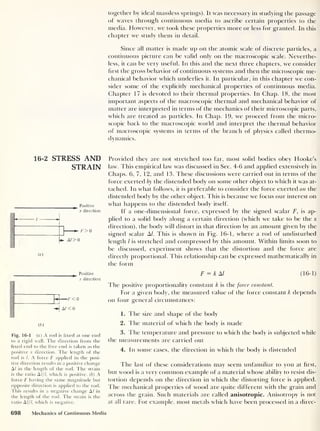
Fig. 16-1 (a) A rod is fixed at one end
to a rigid wall. The direction from the
fixed end to the free end is taken as the
positive x direction. The length of the
rod is l. A force F applied in the posi-
tive direction results in a positive change
Al in the length of the rod. The strain
is the ratio A///, which is positive. ( b ) A
force F having the same magnitude but
opposite direction is applied to the rod.
This results in a negative change A l in
the length of the rod. The strain is the
ratio A l/l, which is negative.
Provided they are not stretched too far, most solid bodies obey Hooke’s
law. This empirical law was discussed in Sec. 4-6 and applied extensively in
Chaps. 6, 7, 12, and 13. These discussions were carried out in terms of the
force exerted by the distended body on some other object to which it was at-
tached. In what follows, it is preferable to consider the force exerted on the
distended body by the other object. This is because we focus our interest on
what happens to the distended body itself .
If a one-dimensional force, expressed by the signed scalar F, is ap-
plied to a solid body along a certain direction (which we take to be the x
direction), the body will distort in that direction by an amount given by the
signed scalar A/. This is shown in Fig. 16-1, where a rod of undisturbed
length / is stretched and compressed by this amount. Within limits soon to
be discussed, experiment shows that the distortion and the force are
directly proportional. This relationship can be expressed mathematically in
the form
F = kM (16-1)
l he positive proportionality constant k is the force constant.
For a given body, the measured value of the force constant k depends
on four general circumstances:
1. The size and shape of the body
2. The material of which the body is made
3. The temperature and pressure to which the body is subjected while
the measurements are carried out
4. In some cases, the direction in which the body is distended
The last of these considerations may seem unfamiliar to you at Hrst,
but wood is a very common example of a material whose ability to resist dis-
tortion depends on the direction in which the distorting force is applied.
The mechanical properties of wood are quite different with the grain and
across the grain. Such materials are called anisotropic. Anisotropy is not
at all rare. For example, most metals which have been processed in a direc-
698 Mechanics of Continuous Media
tional fashion, such as cold-rolled steel, exhibit anisotropic properties. The
mathematical technique which has been developed to deal with anisotropy
is beyond the scope of this book. Therefore, we do not consider item 4. We
limit our discussion to isotropic materials, that is, those whose mechanical
properties are the same in all directions.
Since most everyday experience with materials takes place close to
room temperature and at negligible external pressures, for the most part
we confine our discussion to such environments. Therefore, we do not con-
sider item 3 either.
With these simplifications, we must still consider the size and shape of
the object subjected to a force, as well as the material of which it is made.
We begin with the latter. Everyone knows that some materials are stiffer
than others. This means, stated precisely, that if two identical forms are
fabricated from different materials, the object made of the stiffer material
will have the larger force constant k. That is, the distortion A/ of the stiffer
material will be less for the same applied force F. This leads us naturally to
try to express the stiffness of a material quantitatively, in such a way that it is
independent of the form into which the material happens to be fabricated.
This is of great practical importance to the engineer, for example, who
knows what materials are available and needs to design a structure which
will bear a given load.
The key to the desired quantitative expression for the stiffness of a
material lies in taking into consideration the length and thickness of the
particular sample which is tested. In Example 4-10, you found that two
springs linked end to end have less stiffness than either spring alone. When
the two linked springs are subjected to a certain external force F, each
spring bears the entire force and thus distorts just as much as it would if it
were not linked to the other. Consequently, the linked pair stretches far-
ther than either spring alone, and the force constant k' of the pair is smaller
than the force constant k of either spring.
The main practical advantage in using coil springs is that they can
usually be stretched a greater proportion of their undisturbed length than
is possible with a straight wire or rod without violating Hooke’s law. Never-
theless, although solid straight wires or rods are usually stiffer than the coil
springs which were considered in Example 4-10, the very same conclusions
apply as long as Hooke’s law is obeyed —that is, as long as the wire or rod is
not stretched too far. The result of the example is that if two identical rods
each having force constant k are linked end to end, the force constant k' of
the combination will be
What would be the result for N identical rods?
Two identical rods linked end to end amount to the same thing as a
single bar twice as long as either original one. Other things being equal, the
change in length of a bar of material when it is subjected to a given externalforce is
directly proportional to its length. In order to make possible comparisons of
samples of material when they are subjected to external forces, in a way
which is independent of their length, we define the strain e (lowercase
Greek epsilon) to be
16-2 Stress and Strain 699
The strain e is the change in length A/ of a sample per unit of undistorted length l of
the sample; the quantities A/ and / are shown in Fig. 16-1. Since strain is the
quotient of two lengths, it is a dimensionless number. The quantity A/ is a
signed scalar which is defined so that its value is positive when the sample is
stretched and negative when it is compressed. Since the length l of the
sample is always positive, the value of the strain e is positive for stretch and
negative for compression.
To see that the strain is a quantity which is indeed independent of the length
of the sample on which it is measured, consider again the system of two identical
springs linked end to end. If each spring has length], the two together have length
21. If each spring stretches an amount AJ, the two together stretch by an amount
2A1. Thus the strain of each spring individually is given by e = AI /l. The strain of
the two taken together is given by e' = 2 AJ/21 = e.
Now that we have defined a quantity, strain, which is independent of
the length of the sample, we develop a definition of a quantity which is
independent of its thickness. Example 16-1 investigates the effect of
thickness by considering two identical rods mounted side by side.
EXAMPLE 16-1
Positive
x direction
F
*
Fig. 16-2 Illustration for Example 16-1.
Two identical steel rods, each having a square cross section of area Aa and a force
constant k, are arranged side by side in the apparatus shown in Fig. 16-2. (The as-
sumption of a square cross section is for simplicity only and does not affect the con-
clusions.) Find the effective force constant k" of the pair. Then let the force constant
k for each rod be k = 2 X 10
7
N/m, and find the force constant required to stretch
the pair of rods 1 mm.
The symmetry of the apparatus is such that the force applied to the crossbar at
a point midway between the rods must be balanced by two opposite forces, each of
magnitude F/2, exerted by the two rods. According to Hooke’s law, each rod will
therefore stretch by an amount Al" given by the equation
F 1 F
But the whole system stretches by the same amount as either rod, and the force ap-
plied to the whole system is F. When you insert these whole-system values into
Hooke’s law, you obtain
F
Al"
F
F/ 2k
or
k" = 2k
Since the force constant is a measure of stiffness, it is not surprising that two iden-
tical rods tied together in parallel, as shown, and sharing the external load are twice
as stiff as either rod alone.
You can now find the force required to stretch the system an amount A/" =
A/ = 1 mm. Since k = 2 x 10
7
N/m, you have for the pair of rods
k" = 2 X 2 x 10
7
N/m = 4 x 10
7
N/m
Hooke’s law thus gives you
F = k" M" = 4 x 10
7
N/m x 1 x 10“3
m = 4 x 10
4
N
700 Mechanics of Continuous Media
—F
/
F
Fig. 16-3 A rod of cross-sectional area
a may be regarded as a bundle of N small
rods each of cross-sectional area Aa
where a = N Aa. A force applied to
the end of the large rod is distributed
uniformly among the imaginary small
rods.
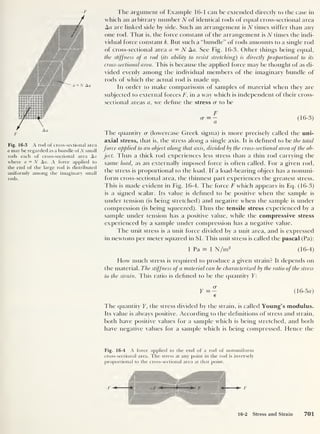
The argument of Example 16-1 can be extended directly to the case in
which an arbitrary number N of identical rods of equal cross-sectional area
Aa are linked side by side. Such an arrangement is N times stiffer than any
one rod. That is, the force constant of the arrangement is N times the indi-
vidual force constant k. But such a “bundle” of rods amounts to a single rod
of cross-sectional area a = N Aa. See Fig. 16-3. Other things being equal,
the stiffness of a rod ( its ability to resist stretching) is directly proportional to its
cross-sectional area. This is because the applied force may be thought of as di-
vided evenly among the individual members of the imaginary bundle of
rods of which the actual rod is made tip.
In order to make comparisons of samples of material when they are
subjected to external forces F, in a way which is independent of their cross-
sectional areas a, we define the stress cr to be
The quantity cr (lowercase Greek sigma) is more precisely called the uni-
axial stress, that is, the stress along a single axis. It is defined to be the total
force applied to an object along that axis, divided by the cross-sectional area of the ob-
ject. Thus a thick rod experiences less stress than a thin rod carrying the
same load, as an externally imposed force is often called. For a given rod,
the stress is proportional to the load. If a load-bearing object has a nonuni-
form cross-sectional area, the thinnest part experiences the greatest stress.
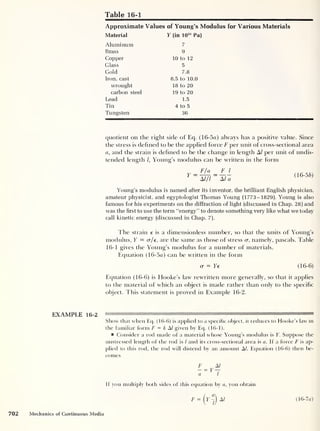
This is made evident in Fig. 16-4. The force F which appears in Eq. (16-3)
is a signed scalar. Its value is defined to be positive when the sample is
under tension (is being stretched) and negative when the sample is under
compression (is being squeezed). Thus the tensile stress experienced by a
sample under tension has a positive value, while the compressive stress
experienced by a sample under compression has a negative value.
The unit stress is a unit force divided by a unit area, and is expressed
in newtons per meter squared in SI. This unit stress is called the pascal (Pa):
1 Pa = 1 N/m2
(16-4)
Flow much stress is required to produce a given strain? It depends on
the material. The stiffness of a material can be characterized by the ratio of the stress
to the strain. This ratio is defined to be the quantity Y:
Y = — (16-5a)
€
The quantity Y, the stress divided by the strain, is called Young’s modulus.
Its value is always positive. According to the definitions of stress and strain,
both have positive values for a sample which is being stretched, and both
have negative values for a sample which is being compressed. Hence the
Fig. 16-4 A force applied to the end of a rod of nonuniform
cross-sectional area. The stress at any point in the rod is inversely
proportional to the cross-sectional area at that point.
16-2 Stress and Strain 701
Table 16-1
Approximate Values of Young’s Modulus for Various Materials
Material Y (in 10 10
Pa)
Aluminum
Brass
Copper
Glass
Gold
Iron, cast
wrought
carbon steel
Lead
Tin
Tungsten
7
9
10 to 12
5
7.8
8.5 to 10.0
18 to 20
19 to 20
1.5
4 to 5
36
quotient on the right side of Eq. (16-5a) always has a positive value. Since
the stress is defined to be the applied force F per unit of cross-sectional area
a, and the strain is defined to be the change in length A/
per unit of undis-
tencled length /, Young’s modulus can be written in the form
_ F/a _ F l
F “ AJ/l
~
Ala
(16-5 b)
Young’s modulus is named after its inventor, the brilliant English physician,
amateur physicist, and egyptologist Thomas Young (1773-1829). Young is also
famous for his experiments on the diffraction of light (discussed in Chap. 28) and
was the first to use the term “energy” to denote something very like what we today
call kinetic energy (discussed in Chap. 7).
The strain e is a dimensionless number, so that the units of Young’s
modulus, Y = cr/e, are the same as those of stress cr, namely, pascals. Table
16-1 gives the Young’s modulus for a number of materials.
Equation (16-5a) can be written in the form
cr = Ye (16-6)
Equation (16-6) is Hooke’s law rewritten more generally, so that it applies
to the material of which an object is made rather than only to the specific
object. This statement is proved in Example 16-2.
Show that when Eq. (16-6) is applied to a specific object, it reduces to Hooke’s law in
the familiar form F = k A! given by Eq. (16-1).
Consider a rod made of a material whose Young’s modulus is Y. Suppose the
unstressed length of the rod is / and its cross-sectional area is a. If a force F is ap-
plied to this rod, the rod will distend by an amount A/. Equation (16-6) then be-
comes
F At
~a
~ Y
~l
If you multiply both sides of this equation by a, you obtain
(16-7a)
702 Mechanics of Continuous Media
Since Y, a, and l are all constants, you can identify the quantity Ya/l with the force
constant k of the rod and rewrite the equation in the form
F = k 11 where k = Y — (16-7b)
The definition of the force constant given by Eq. ( 1 6-76) makes it clear
that the force constant of any object made of a given material is directly
proportional to its cross-sectional area and inversely proportional to its
length. The results of Example 4-10 for two identical springs linked end to
end, and of Example 16-1 for identical rods linked side by side, are special
cases of Eq. (16-76).
You can used Eq. (16-7a) to predict the force constant for a uniform
rod made of a specified substance, as show n in Example 16-3.
EXAMPLE 16-3 ^
You are designing the cylindrical suspender rods for a suspension bridge. These
rods hang from the main suspension cable and support the roadway. If the rods are
to be of steel and if the longest rod is to be 30 m long, what must their diameter be if
a 20-ton (2 x 10
4
kg) truck crossing the bridge is not to depress the roadway more
than 1 cm? Assume that the spacing of the rods is such that most of the weight of
the truck is borne by a single rod at a time, and the distortion of the main cable is
relatively negligible.
The loading force is the weight of the truck, which is F = 2 x 10
4
kg x 9.8
nr/s2 = 2 x 10³
N. From Eq. ( 16-7a) and Table 16- 1 ,
you have for the cross-sectional
area
a
FI
Yii
2 x 10
5
N x 30 m
20 x 10
10
Pa x 1 x Hr2
m
3 x 1(T3
m2
For a cylindrical rod, a = 7rd
2
/4, where d is the diameter. Thus d = ( 4a/-ir )
1/2
= (4 x
3 X 10
-3
m2
/7r)
1,a
= 0.06 m, or 6 cm. The shorter suspender rods, hanging from the
lower part of the main cable, will stretch proportionately less.
Since Eq. (16-6) is a form of Hooke’s law, we expect the behavior of a
rod under stress to be symmetrical about its undistended length. That is, a
compressive stress will shorten the rod by the same amount as an equal tensile
(that is, stretching) stress lengthens it. This is true as long as the strain is not
so great that Hooke’s law fails to give a correct description of the behavior
of the rock In dealing with Young’s modulus, it must always be remem-
bered that the constant Y cannot be defined if Hooke’s law' does not apply.
As you almost certainly know' from having played with rubber bands
as a child, an object which is stretched along one direction becomes thinner
as it becomes longer. (Similarly, objects become thicker as they become
shorter when they are compressed.) To put it another way, if a stress is ap-
plied along the x axis of a set of coordinates fixed with respect to the object,
there is a strain along that axis which w'e call the primary strain. This primary
strain is accompanied by a strain of opposite sign along the y and z axes,
16-2 Stress and Strain 703
which we call the induced strain. The phenomenon is illustrated in Fig. 16-5.
F
Fig. 16-5 When a rod is stretched, it
becomes thinner. Here the applied stress
results in a positive primary strain
and negative induced strains.
We can account qualitatively for this phenomenon on the microscopic level.
In an isotropic substance [one whose macroscopic properties are the same in all
directions), every atom lies equidistant, on the average, from its nearest
neighbors. This is the position in which all the attractive and repulsive forces
between it and neighboring atoms balance. In Fig. 16-6 are shown two neighboring
atoms A andB, lying along thex direction. When a tensile stress is applied along
the x axis, the average interatomic distance along that direction increases as the
sample stretches. As A and B separate, their neighbors C and D tend to move
toward the axis joining A and B —that is, the stress axis. This displacement of C
and D reduces the average interatomic distance toward the undisturbed value. The
result in the large is a reduction in the dimensions of the sample in the plane
normal to the direction of stress. In similar manner, a compressive stress along the
x axis and its accompanying negative strain will result in an expansion of the
sample in the yz plane normal to the axis of stress.
A uniaxial stress always leads to a change in the volume of the sample.
That is, the strain induced in the plane normal to the applied stress (which
contains C and D in Fig. 1 6-6) is never sufficient to make up for the primary
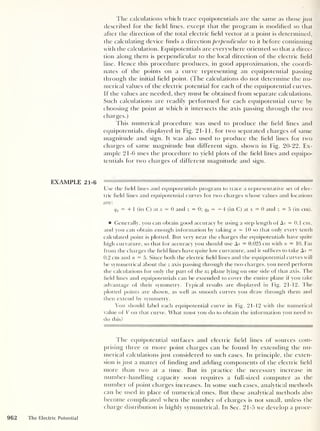
strain along the stress axis (along which A and B lie in the same figure).
In an isotropic substance the induced strain is the same in all directions
in the plane normal to the primary strain. The ratio of the induced strain to
the primary strain is called Poissons ratio [after the French mathematician
and physicist Simon Poisson (1781-1840)]. Poisson’s ratio is expressed
mathematically as follows. Suppose that a stress is applied lengthwise to a
sample of length /, width w, and thickness t. As a result, the length changes
by an amount A/, while the width and thickness change, respectively, by
amounts Arc and At, whose values are of opposite sign to that of A/. The pri-
mary strain is then given by the ratio A///, while the induced strain has a
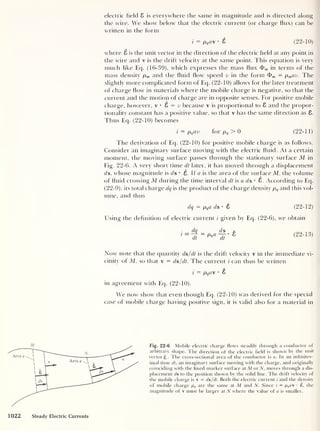
value given by either the ratio Aw/w or the ratio At/t, which have equal val-
ues. Poisson’s ratio v is then defined by the equation
Aw/w At/t
A///
=
“ATfl
(16-8)
A
• D
r
Ax
Fig. 16-6 Idealized microscopic picture of the pro-
cess shown in Fig. 16-5. Atoms A, B. C, and D are
equidistant in the unstressed isotropic sample. Stress
applied along the x axis separates A and B. Atoms
C and D move to new equilibrium positions closer to
one another, in such a way as to reduce the change in
the average interatomic distance produced by the
applied stress.
Av
D
I
704 Mechanics of Continuous Media
(Because of the minus sign in the definition of Poisson’s ratio, v always has a
positive value.)
If we call the primary strain e and the induced strain e,, we can write
Eq. (16-8) in the form
e;
e
(16-9)
According to Eq. (16-6), <x = Ee, the stress is proportional to the strain.
Therefore, Poisson’s ratio can also be expressed in terms of stress as
follows:
v = 1
(16-10)
<
where cr, is the stress induced in a direction perpendicular to the axis of the
applied stress cr. Poisson’s ratio can be measured directly by experiment.
For most materials, its value lies between 0.1 and 0.4.
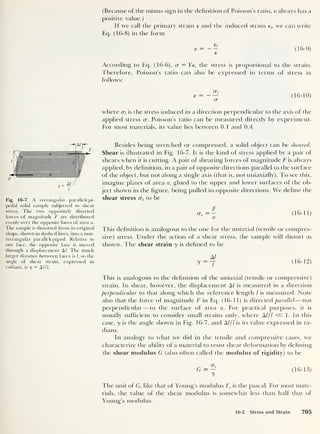
Fig. 16-7 A rectangular parallelepi-
pedal solid sample subjected to shear
stress. The two oppositely directed
forces of magnitude F are distributed
evenly over the opposite faces of area a.
The sample is distorted from its original
shape, shown in dashed lines, into a non-
rectangular parallelepiped. Relative to
one face, the opposite face is moved
through a displacement A/. The much
larger distance between faces is l, so the
angle of shear strain, expressed in
radians, is y = A///.
Besides being stretched or compressed, a solid object can be sheared.
Shear is illustrated in Fig. 16-7. It is the kind of stress applied by a pair of
shears when it is cutting. A pair of shearing forces of magnitude F is always
applied, by definition, in a pair of opposite directions parallel to the surface
of the object, but not along a single axis (that is, not uniaxially). To see this,
imagine plates of area a, glued to the upper and lower surfaces of the ob-
ject shown in the figure, being pulled in opposite directions. We define the
shear stress crs to be
crs
(16-11)
This definition is analogous to the one for the uniaxial (tensile or compres-
sive) stress. Under the action of a shear stress, the sample will distort as
shown. The shear strain y is defined to be
M
y = ~j (16-12)
This is analogous to the definition of the uniaxial (tensile or compressive)
strain. In shear, however, the displacement A/ is measured in a direction
perpendicular to that along which the reference length l is measured. Note
also that the force of magnitude F in Eq. (16-11) is directed parallel —not
perpendicular —to the surface of area a. For practical purposes, it is
usually sufficient to consider small strains only, where Al/l «. 1. In this
case, y is the angle shown in Fig. 16-7, and Al/l is its value expressed in ra-
dians.
In analogy to what we did in the tensile and compressive cases, we
characterize the ability of a material to resist shear deformation by defining
the shear modulus G (also often called the modulus of rigidity) to be
G = — (16-13)
y
The unit of G, like that of Young’s modulus Y, is the pascal. For most mate-
rials, the value of the shear modulus is somewhat less than half that of
Young’s modulus.
16-2 Stress and Strain 705
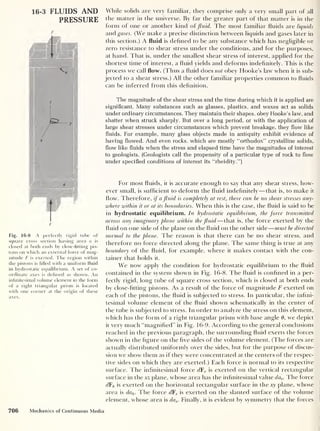
16-3 FLUIDS AND
PRESSURE
F
Fig. 16-8 A perfectly rigid tube of
square cross section having area a is
closed at both ends by close-fitting pis-
tons on which an external force of mag-
nitude F is exerted. The region within
the pistons is filled with a uniform fluid
in hydrostatic equilibrium. A set of co-
ordinate axes is defined as shown. An
infinitesimal volume element in the form
of a right triangular prism is located
with one corner at the origin of these
axes.
While solids are very familiar, they comprise only a very small part of all
the matter in the universe. By far the greater part of that matter is in the
form of one or another kind offluid. The most familiar fluids are liquids
andgzwcs. (We make a precise distinction between liquids and gases later in
this section.) A fluid is defined to be any substance which has negligible or
zero resistance to shear stress under the conditions, and for the purposes,
at hand. That is, under the smallest shear stress of interest, applied for the
shortest time of interest, a fluid yields and deforms indefinitely. This is the
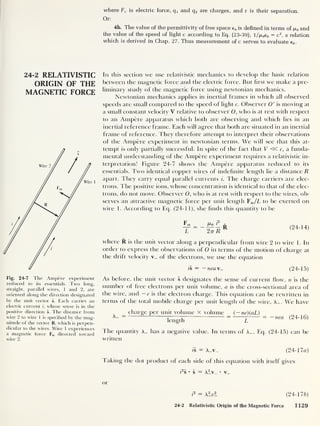
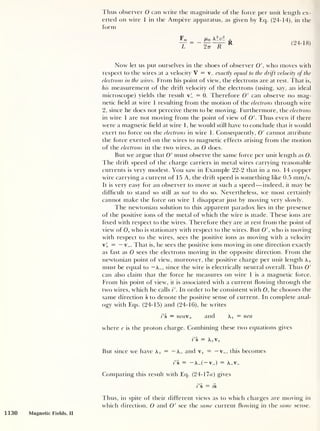
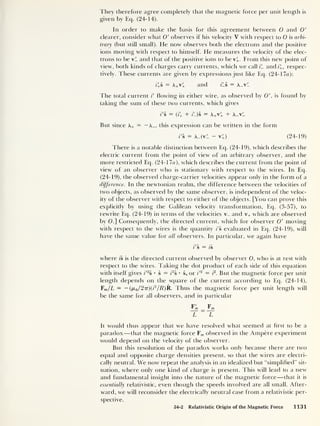
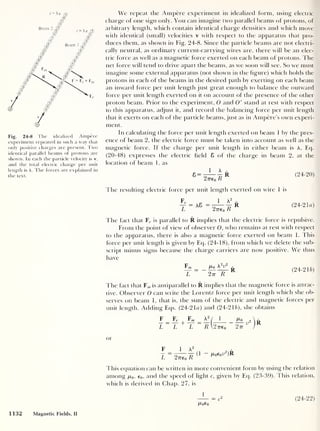
process we call flow. (Thus a fluid does not obey Hooke’s law when it is sub-
jected to a shear stress.) All the other familiar properties common to fluids
can be inferred from this definition.
The magnitude of the shear stress and the time during which it is applied are
significant. Many substances such as glasses, plastics, and waxes act as solids
under ordinary circumstances. They maintain their shapes, obey Hooke’s law, and
shatter when struck sharply. But over a long period, or with the application of
large shear stresses under circumstances which prevent breakage, they flow like
fluids. For example, many glass objects made in antiquity exhibit evidence of
having flowed. And even rocks, which are mostly “orthodox” crystalline solids,
flow like fluids when the stress and elapsed time have the magnitudes of interest
to geologists. (Geologists call the propensity of a particular type of rock to flow
under specified conditions of interest its “rheidity.”)
For most fluids, it is accurate enough to say that any shear stress, how-
ever small, is sufficient to deform the fluid indefinitely —that is, to make it
flow. Therefore, if a fluid is completely at rest, there can be no shear stresses any-
where within it or at its boundaries. When this is the case, the fluid is said to be
in hydrostatic equilibrium. In hydrostatic equilibrium, the force transmitted
across any imaginary plane within the fluid —that is, the force exerted by the
fluid on one side of the plane on the fluid on the other side
—
must be directed
normal to the plane. The reason is that there can be no shear stress, and
therefore no force directed along the plane. The same thing is true at any
boundary of the fluid, for example, where it makes contact with the con-
tainer that holds it.
We now apply the condition for hydrostatic equilibrium to the fluid
contained in the system shown in Fig. 16-8. The fluid is confined in a per-
fectly rigid, long tube of square cross section, which is closed at both ends
by close-fitting pistons. As a result of the force of magnitude F exerted on
each of the pistons, the fluid is subjected to stress. In particular, the infini-
tesimal volume element of the fluid shown schematically in the center of
the tube is subjected to stress. In order to analyze the stress on this element,
which has the form of a right triangular prism with base angle 6, we depict
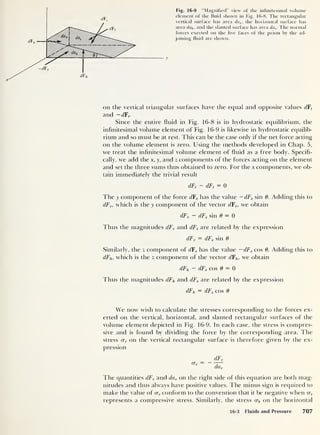
it very much “magnified” in Fig. 16-9. According to the general conclusions
reached in the previous paragraph, the surrounding fluid exerts the forces
shown in the figure on the five sides of the volume element. (The forces are
actually distributed uniformly over the sides, but for the purpose of discus-
sion we show them as if they were concentrated at the centers of the respec-
tive sides on which they are exerted.) Each force is normal to its respective
surface. The infinitesimal force dFv is exerted on the vertical rectangular
surface in the xz plane, whose area has the infinitesimal value dav . The force
dFh is exerted on the horizontal rectangular surface in the xy plane, whose
area is dah . The force dFs is exerted on the slanted surface of the volume
element, whose area is das . Finally, it is evident by symmetry that the forces
706 Mechanics of Continuous Media
z
Fig. 16-9 “Magnified" view of the infinitesimal volume
element of the fluid shown in Fig. 16-8. The rectangular
vertical surface has area da v ,
the horizontal surface has
area dah ,
and the slanted surface has area das . The normal
forces exerted on the five faces of the prism by the ad-
joining fluid are shown.
z"'" -dF,
dFh
y
X
on the vertical triangular surfaces have the equal and opposite values dFt
and — dF,.
Since the entire fluid in Fig. 16-8 is in hydrostatic equilibrium, the
infinitesimal volume element of Fig. 16-9 is likewise in hydrostatic equilib-
rium and so must be at rest. This can be the case only if the net force acting
on the volume element is zero. Using the methods developed in Chap. 5,
we treat the infinitesimal volume element of fluid as a free body. Specifi-
cally, we add the x, y, and z components of the forces acting on the element
and set the three sums thus obtained to zero. For the x components, we ob-
tain immediately the trivial result
dFt
- dF, = 0
The y component of the force dFs has the value — dFs sin 0. Adding this to
dFv ,
which is the y component of the vector dFv,
we obtain
dFv
— dFs sin 0 = 0
Thus the magnitudes dFv and dFs are related by the expression
dFv = dFs sin 0
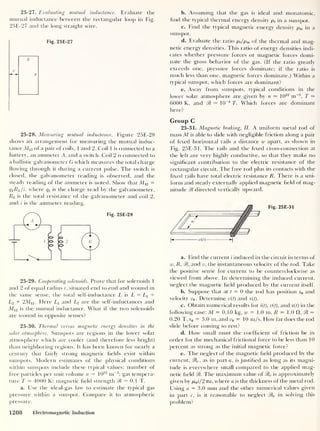
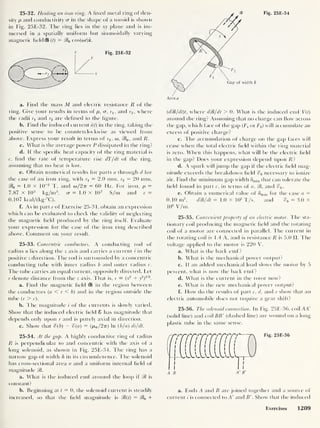
Similarly, the z component of dFs has the value — dFs cos 0. Adding this to
dFh, which is the z component of the vector dFh , we obtain
dFh ~ dFs cos 0 = 0
Thus the magnitudes dFh and dFs are related by the expression
dFh = dFs cos 0
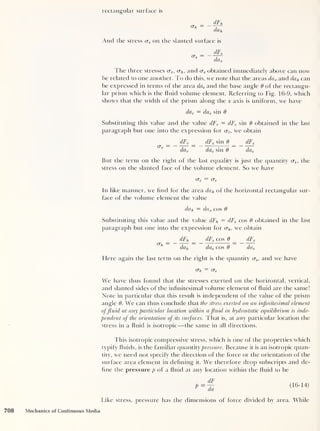
We now wish to calculate the stresses corresponding to the forces ex-
erted on the vertical, horizontal, and slanted rectangular surfaces of the
volume element depicted in Fig. 16-9. In each case, the stress is compres-
sive and is found by dividing the force by the corresponding area. The
stress crv on the vertical rectangular surface is therefore given by the ex-
pression
The quantities dFv and dav on the right side of this equation are both mag-
nitudes and thus always have positive values. The minus sign is required to
make the value of <x„ conform to the convention that it be negative when crv
represents a compressive stress. Similarly, the stress crh cm the horizontal
16-3 Fluids and Pressure 707
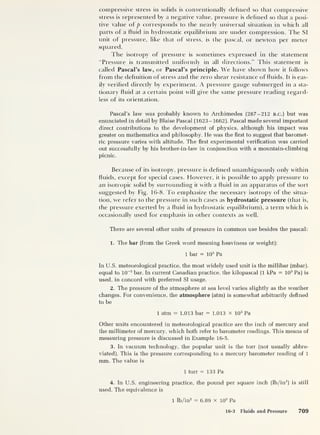
rectangular surface is
CTft
= dFh
dcit.
And the stress cr, on the slanted surface is
(To
dFs
da o
I he three stresses cr„, crh ,
and crs obtained immediately above can now
be related to one another. To do this, we note that the areas da v and dah can
be expressed in terms of the area das and the base angle 9 of the rectangu-
lar prism which is the fluid volume element. Referring to Fig. 16-9, which
shows that the width of the prism along the x axis is uniform, we have
dav = das sin 9
Substituting this value and the value dFv = dFs sin 9 obtained in the last
paragraph but one into the expression for crv ,
we obtain
cr„ = - dFv
dav
dFs sin 9
da, sin 9
dFs
da,
But the term on the right of the last equality is just the quantity <xs , the
stress on the slanted face of the volume element. So we have
Vv (Ts
In like manner, we find for the area da h of the horizontal rectangular sur-
face of the volume element the value
dah = das cos 6
Substituting this value and the value dFh — dFs cos 9 obtained in the last
paragraph but one into the expression for crh , we obtain
CTh
dFh
dah
dFs cos 0
da^ cos 6
dFs
das
Flere again the last term on the right is the quantity <xs ,
and we have
o~s
We have thus found that the stresses exerted on the horizontal, vertical,
and slanted sides of the infinitesimal volume element of fluid are the same!
Note in particular that this result is independent of the value of the prism
angle 9. We can thus conclude that the stress exerted on an infinitesimal element
offluid at any particular location within a fluid in hydrostatic equilibrium is inde-
pendent of the orientation of its surfaces. That is, at any particular location the
stress in a fluid is isotropic —the same in all directions.
This isotropic compressive stress, which is one of the properties which
typify fluids, is the familiar q uantity pressure. Because it is an isotropic quan-
tity, we need not specify the direction of the force or the orientation of the
surface area element in defining it. We thexefore drop subscripts and de-
fine the pressure p of a fluid at any location within the fluid to be
P =
dF
da
(16-14)
Like stress, pressure has the dimensions of force divided by area. While
708 Mechanics of Continuous Media
compressive stress in solids is conventionally defined so that compressive
stress is represented by a negative value, pressure is defined so that a posi-
tive value of p corresponds to the nearly universal situation in which all
parts of a fluid in hydrostatic equilibrium are under compression. The SI
unit of pressure, like that of stress, is the pascal, or newton per meter
squared.
The isotropy of pressure is sometimes expressed in the statement
"Pressure is transmitted uniformly in all directions.” This statement is
called Pascal’s law, or Pascal’s principle. We have shown how it follows
from the definition of stress and the zero shear resistance of fluids. It is eas-
ily verified directly by experiment. A pressure gauge submerged in a sta-
tionary fluid at a certain point will give the same pressure reading regard-
less of its orientation.
Pascal’s law was probably known to Archimedes (287—212 b.c.) but was
enunciated in detail by Blaise Pascal (1623-1662). Pascal made several important
direct contributions to the development of physics, although his impact was
greater on mathematics and philosophy. He was the first to suggest that baromet-
ric pressure varies with altitude. The first experimental verification was carried
out successfully by his brother-in-law in conjunction with a mountain-climbing
picnic.
Because of its isotropy, pressure is defined unambiguously only within
fluids, except for special cases. However, it is possible to apply pressure to
an isotropic solid by surrounding it with a fluid in an apparatus of the sort
suggested by Fig. 16-8. To emphasize the necessary isotropy of the situa-
tion, we refer to the pressure in such cases as hydrostatic pressure (that is,
the pressure exerted by a fluid in hydrostatic equilibrium), a term which is
occasionally used for emphasis in other contexts as well.
There are several other units of pressure in common use besides the pascal:
1. The bar (from the Greek word meaning heaviness or weight):
1 bar = 103
Pa
In U.S. meteorological practice, the most widely used unit is the millibar (mbar),
equal to 10~3
bar. In current Canadian practice, the kilopascal (1 kPa = 103
Pa) is
used, in concord with preferred SI usage.
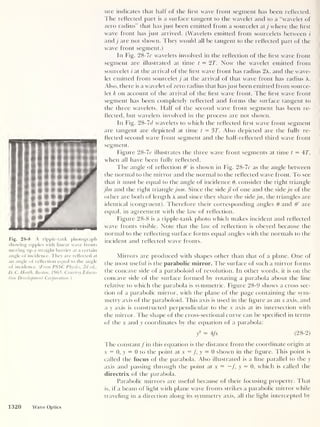
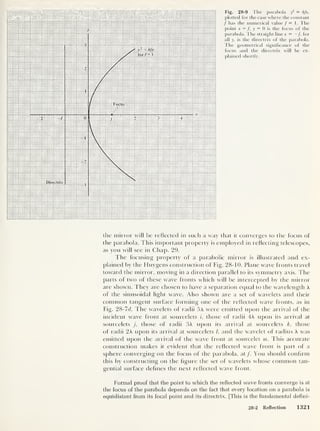
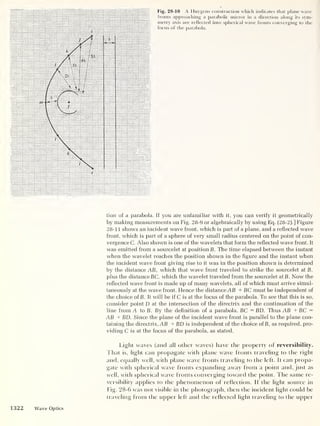
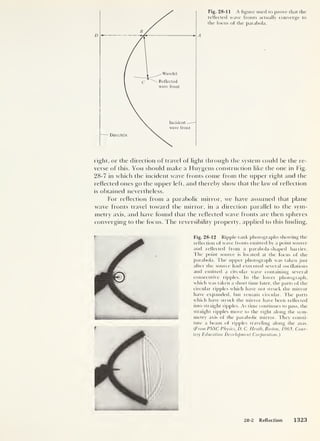
2. The pressure of the atmosphere at sea level varies slightly as the weather
changes. For convenience, the atmosphere (atm) is somewhat arbitrarily defined
to be
1 atm = 1.013 bar = 1.013 x 10 5
Pa
Other units encountered in meteorological practice are the inch of mercury and
the millimeter of mercury, which both refer to barometer readings. This means of
measuring pressure is discussed in Example 16-5.
3.
In vacuum technology, the popular unit is the torr (not usually abbre-
viated). This is the pressure corresponding to a mercury barometer reading of 1
mm. The value is
1 torr = 133 Pa
4.
In U.S. engineering practice, the pound per square inch (lb/in
2
)
is still
used. The equivalence is
1 lb/in2
= 6.89 x 10³
Pa
16-3 Fluids and Pressure 709
F
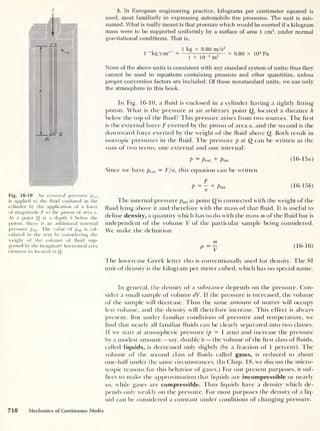
Fig. 16-10 An external pressure jf) ext
is applied to the fluid confined in the
cylinder by the application of a force
of magnitude F to the piston of area a.
At a point Q at a depth h below the
piston, there is an additional internal
pressure pint . The value of piM is cal-
culated in the text by considering the
weight of the column of fluid sup-
ported by the imaginary horizontal area
element da located at Q.
5. In European engineering practice, kilograms per centimeter squared is
used, most familiarly in expressing automobile tire pressures. The unit is mis-
named. What is really meant is that pressure which would be exerted if a kilogram
mass were to be supported uniformly by a surface of area 1 cm2
, under normal
gravitational conditions. That is,
1 “kg/cm2 ” 1 kg x 9.80 m/s2
1 x 10“4
m2
= 9.80 x 10⁴
Pa
None of the above units is consistent with any standard system of units; thus they
cannot be used in equations containing pressure and other quantities, unless
proper conversion factors are included. Of these nonstandard units, we use only
the atmosphere in this book.
In Fig. 16-10, a fluid is enclosed in a cylinder having a tightly fitting
piston. What is the pressure at an arbitrary point Q, located a distance h
below the top of the fluid? T his pressure arises from two sources. The first
is the external force F exerted by the piston of area a, and the second is the
downward force exerted by the weight of the fluid above Q. Both result in
isotropic pressures in the fluid. T he pressure p at Q can be written as the
sum of two terms, one external and one internal:
P
— Pext
"F pini (
16-lotf)
Since we have pext — F/a, this equation can be written
P=~ + Pm. (16-156)
The internal pressure pint at point Q is connected with the weight of the
fluid lying above it and therefore with the mass of that fluid. It is useful to
define density, a quantity which has to clo with the mass m of the fluid but is
independent of the volume V of the particular sample being considered.
We make the definition
P = ^ (16-16)
The lowercase Greek letter rho is conventionally used for density. The SI
unit of density is the kilogram per meter cubed, which has no special name.
In general, the density of a substance depends on the pressure. Con-
sider a small sample of volume dV. If the pressure is increased, the volume
of the sample will decrease. Thus the same amount of matter will occupy
less volume, and the density will therefore increase. This effect is always
present. But under familiar conditions of pressure and temperature, we
find that nearly all familiar fluids can be clearly separated into two classes.
If we start at atmospheric pressure (p
= 1 atm) and increase the pressure
by a modest amount —say, double it —the volume of the first class of fluids,
called liquids, is decreased only slightly (by a fraction of 1 percent). The
volume of the second class of fluids called gases, is reduced to about
one-half under the same circumstances. (In Chap. 18, we discuss the micro-
scopic reasons for this behavior of gases.) For our present purposes, it suf-
fices to make the approximation that liquids are incompressible or nearly
so, while gases are compressible. Thus liquids have a density which de-
pends only weakly on the pressure. For most purposes the density of a liq-
uid can be considered a constant under conditions of changing pressure.
710 Mechanics of Continuous Media
There is a very convenient connection between pressure and density in
a uniform liquid. Consider the column of liquid of height h and cross-
sectional area da, which lies above Q in Fig. 16-10. The volume of this col-
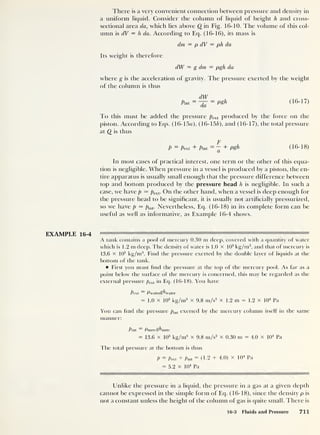
umn is dV = h da. According to Eq. (16-16), its mass is
dm = p dV = ph da
Its weight is therefore
dW = g dm = pgh da
where g is the acceleration of gravity. The pressure exerted by the weight
of the column is thus
Pint
=
~da
= Pgh (16-17)
To this must be added the pressure pext produced by the force on the
piston. According to Eqs. (16-15«), (16-156), and (16-17), the total pressure
at Q is thus
F
P = Pext + Pint
= ~ + Pgh (16-18)
In most cases of practical interest, one term or the other of this equa-
tion is negligible. When pressure in a vessel is produced by a piston, the en-
tire apparatus is usually small enough that the pressure difference between
top and bottom produced by the pressure head h is negligible. In such a
case, we have p — pext . On the other hand, when a vessel is deep enough for
the pressure head to be significant, it is usually not artificially pressurized,
so we have p — pint . Nevertheless, Eq. (16-18) in its complete form can be
useful as well as informative, as Example 16-4 shows.
EXAMPLE 16-4
A tank contains a pool of mercury 0.30 m deep, covered with a quantity of water
which is 1.2 m deep. The density of water is 1.0 x 10
3
kg/m3
,
and that of mercury is
13.6 x 10
3
kg/m3
. Find the pressure exerted by the double layer of liquids at the
bottom of the tank.
First you must find the pressure at the top of the mercury pool. As far as a
point below the surface of the mercury is concerned, this may be regarded as the
external pressure pex ,
in Eq. (16-18). You have
Pext Pwaterghwater
= 1.0 x 10³
kg/m3
x 9.8 m/s2
x 1.2 m = 1.2 x 10
4
Pa
You can find the pressure pint exerted by the mercury column itself in the same
manner:
^int Pmevcghmere
= 13.6 x 10
3
kg/m3
x 9.8 m/s2
x 0.30 m = 4.0 x 10
4
Pa
The total pressure at the bottom is thus
P = Pext + Pint
= (1.2 + 4.0) x 104
Pa
= 5.2 x 10
4
Pa
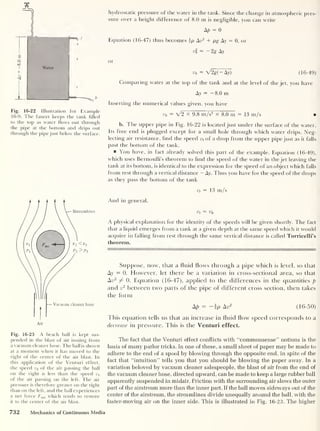
iii—"ii pf wni ii ni l
1
ii
1
iiFf miii 'i mm iiii
'
Mi iiiBiii—i
|i|
i
ii
LTnlike the pressure in a liquid, the pressure in a gas at a given depth
cannot be expressed in the simple form of Eq. (16-18), since the density p is
not a constant unless the height of the column of gas is quite small. There is
16-3 Fluids and Pressure 711
Vacuum
^atm
d H
• •B
Mercury
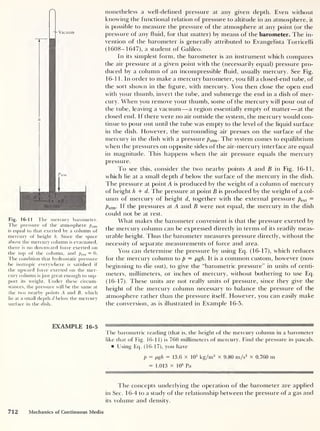
Fig. 16-11 The mercury barometer.
The pressure of the atmosphere patm
is equal to that exerted by a column of
mercury of height h. Since the space
above the mercury column is evacuated,
there is no downward force exerted on
the top of the column, and pext = 0.
The condition that hydrostatic pressure
-be isotropic everywhere is satisfied if
the upward force exerted on the mer-
cury column is just great enough to sup-
port its weight. Under these circum-
stances, the pressure will be the same at
the two nearby points A and B, which
lie at a small depth d below the mercury
surface in the dish.
nonetheless a well-defined pressure at any given depth. Even without
knowing the functional relation of pressure to altitude in an atmosphere, it
is possible to measure the pressure of the atmosphere at any point (or the
pressure of any fluid, for that matter) by means of the barometer. The in-
vention of the barometer is generally attributed to Evangelista Torricelli
(1608-1647), a student of Galileo.
In its simplest form, the barometer is an instrument which compares
the air pressure at a given point with the (necessarily equal) pressure pro-
duced by a column of an incompressible fluid, usually mercury. See Fig.
16-11. In order to make a mercury barometer, you fill a closed-end tube, of
the sort shown in the figure, with mercury. You then close the open end
with your thumb, invert the tube, and submerge the end in a dish of mer-
cury. When you remove your thumb, some of the mercury will pour out of
the tube, leaving a vacuum —a region essentially empty of matter —at the
closed end. If there were no air outside the system, the mercury would con-
tinue to pour out until the tube was empty to the level of the liquid surface
in the dish. However, the surrounding air presses on the surface of the
mercury in the dish with a pressure pa , m . The system comes to equilibrium
when the pressures on opposite sides of the air-mercury interface are ecjual
in magnitude. This happens when the air pressure equals the mercury
pressure.
To see this, consider the two nearby points A and B in Fig. 16-11,
which lie at a small depth d below the surface of the mercury in the dish.
The pressure at point A is produced by the weight of a column of mercury
of height h + d. The pressure at point B is produced by the weight of a col-
umn of mercury of height d, together with the external pressure pext =
Patm- If the pressures at A and B were not equal, the mercury in the dish
could not be at rest.
What makes the barometer convenient is that the pressure exerted by
the mercury column can be expressed directly in terms of its readily meas-
urable height. Thus the barometer measures pressure directly, without the
necessity of separate measurements of force and area.
You can determine the pressure by using Eq. (16-17), which reduces
for the mercury column to p — pgh. It is a common custom, however (now
beginning to die out), to give the “barometric pressure” in units of centi-
meters, millimeters, or inches of mercury, without bothering to use Eq.
(16-17). These units are not really units of pressure, since they give the
height of the mercury column necessary to balance the pressure of the
atmosphere rather than the pressure itself. However, you can easily make
the conversion, as is illustrated in Example 16-5.
The barometric reading (that is, the height of the mercury column in a barometer
like that of Fig. 16-1 1) is 760 millimeters of mercury. Find the pressure in pascals.
Using Eq. (16-17), you have
p = pgh = 13.6 x 10
3
kg/m3
X 9.80 m/s2
x 0.760 nr
= 1.013 x 10⁵
Pa
The concepts underlying the operation of the barometer are applied
in Sec. 16-4 to a study of the relationship between the pressure of a gas and
its volume and density.
712 Mechanics of Continuous Media
16-4 BOYLE’S LAW The density p of a substance always depends in some manner on the pres-
sure p to which it is subject. Equation (16-16), rewritten slightly so as to
bring out the functional dependence explicitly, becomes
m
pW = V(J)
<16‘
19)
That is, the density p is influenced by the pressure p because the volume V
into which a given mass m of the substance is packed depends on the pres-
sure. Gases are substances for which the density is influenced significantly
by the pressure because the volume depends strongly on the pressure. In
this section we are concerned with the relation between pressure and vol-
ume for a fixed quantity of gas.
We can determine the relationship between the pressure and the vol-
ume for an arbitrary quantity of gas by trapping the gas in a cylinder with a
leakproof piston and measuring the pressure in the gas as its volume is
varied. In doing such an experiment, we must be sure not to vary any other
quantity which might affect the pressure reading obtained for a given vol-
ume. It turns out that this condition can be satisfied by keeping the temper-
ature constant throughout the experiment. (Temperature effects are stud-
ied in Chap. 17.)
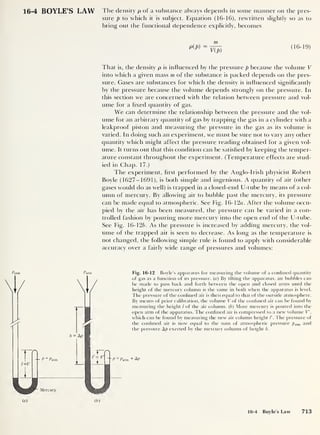
The experiment, first performed by the Anglo-Irish physicist Robert
Boyle (1627-1691), is both simple and ingenious. A quantity of air (other
gases would do as well) is trapped in a closed-end U-tube by means of a col-
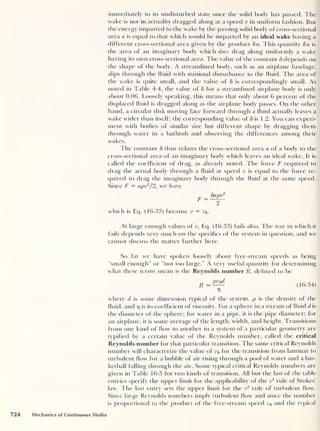
umn of mercury. By allowing air to bubble past the mercury, its pressure
can be made equal to atmospheric. See Fig. 16- 12a. After the volume occu-
pied by the air has been measured, the pressure can be varied in a con-
trolled fashion by pouring more mercury into the open end of the U-tube.
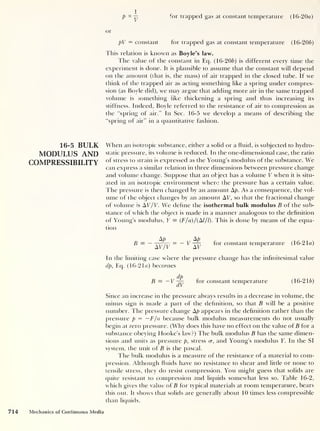
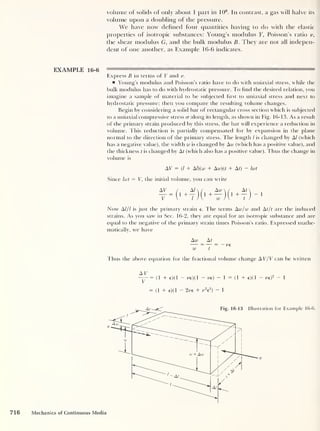
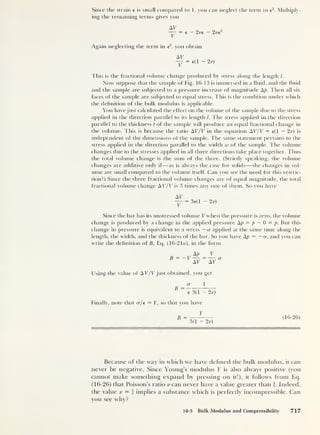
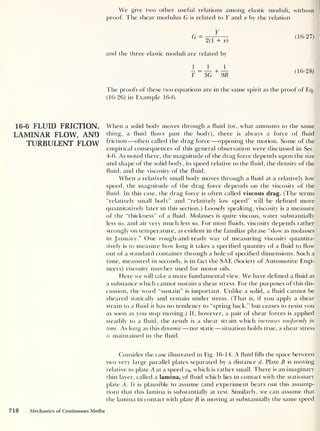
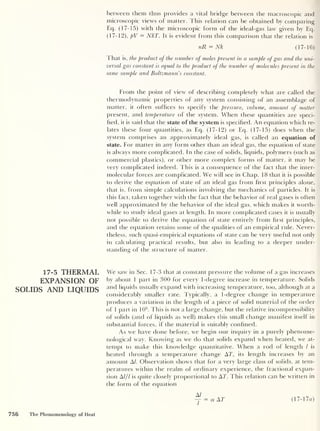
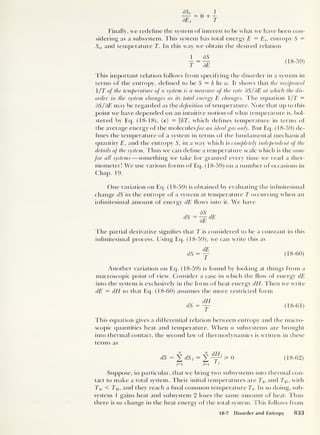
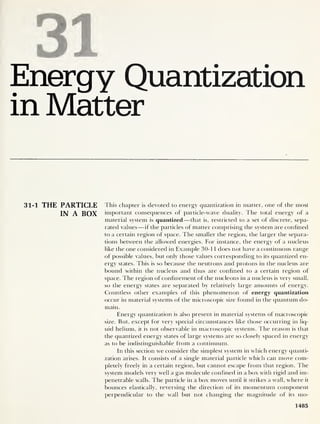
See Fig. 16-126. As the pressure is increased by adding mercury, the vol-
ume of the trapped air is seen to decrease. As long as the temperature is
not changed, the following simple rule is found to apply with considerable
accuracy over a fairly wide range of pressures and volumes:
Patm
r
P ~ Patm
/ay
Mercury
(a)
Fig. 16-12 Boyle’s apparatus for measuring the volume of a confined quantity
of gas as a function of its pressure, (a) By tilting the apparatus, air bubbles can
be made to pass back and forth between the open and closed arms until the
height of the mercury column is the same in both when the apparatus is level.
The pressure of the confined air is then equal to that of the outside atmosphere.
By means of prior calibration, the volume V of the confined air can be found by
measuring the height / of the air column, (b) More mercury is poured into the
open arm of the apparatus. The confined air is compressed to a new volume V
,
which can be found by measuring the new air column height The pressure of
the confined air is now equal to the sum of atmospheric pressure patm and
the pressure Ap exerted by the mercury column of height h.
P = Patm + Ap
(b)
16-4 Boyle’s Law 713
p K — for trapped gas at constant temperature (16-20a)
V
or
pV = constant for trapped gas at constant temperature (16-206)
This relation is known as Boyle’s law.
The value of the constant in Eq. (16-206) is different every time the
experiment is done. It is plausible to assume that the constant will depend
on the amount (that is, the mass) of air trapped in the closed tube. If we
think of the trapped air as acting something like a spring under compres-
sion (as Boyle did), we may argue that adding more air in the same trapped
volume is something iike thickening a spring and thus increasing its
stiffness. Indeed, Boyle referred to the resistance of air to compression as
the “spring of air.” In Sec. 16-5 we develop a means of describing the
“spring of air” in a quantitative fashion.
16-5 BULK
MODULUS AND
COMPRESSIBILITY
When an isotropic substance, either a solid or a fluid, is subjected to hydro-
static pressure, its volume is reduced. In the one-dimensional case, the ratio
of stress to strain is expressed as the Young’s modulus of the substance. We
can express a similar relation in three dimensions between pressure change
and volume change. Suppose that an object has a volume V when it is situ-
ated in an isotropic environment where the pressure has a certain value.
The pressure is then changed by an amount Ap. As a consequence, the vol-
ume of the object changes by an amount AE, so that the fractional change
of volume is W/V. We define the isothermal bulk modulus B of the sub-
stance of which the object is made in a manner analogous to the definition
of Young’s modulus, Y = (F/a)/(Al/l). This is done by means of the equa-
tion
B = — ±P
W/V for constant temperature (16-2 la)
In the limiting case where the pressure change has the infinitesimal value
dp, Eq. (16-2 la) becomes
dp
B =
~Jy *
or constant temperature (16-216)
Since an increase in the pressure always results in a decrease in volume, the
minus sign is made a part of the definition, so that B will be a positive
number. The pressure change Ap appears in the definition rather than the
pressure p = —F/a because bulk modulus measurements do not usually
begin at zero pressure. (Why does this have no effect on the value of B for a
substance obeying Hooke’s law?) The bulk modulus B has the same dimen-
sions and units as pressure p, stress cr, and Young’s modulus Y. In the SI
system, the unit of B is the pascal.
The bulk modulus is a measure of the resistance of a material to com-
pression. Although fluids have no resistance to shear and little or none to
tensile stress, they do resist compression. You might guess that solids are
quite resistant to compression and liquids somewhat less so. Table 16-2,
which gives the value of .6 for typical materials at room temperature, bears
this out. It shows that solids are generally about 10 times less compressible
than liquids.
714 Mechanics of Continuous Media
Table 16-2
Bulk Modulus for Typical Solids andI Liquids
Substance B (in Pa)
Aluminum 7.46 X 10¹⁰
Brass 10.7 X 10¹⁰
Copper 13.1 X 10¹⁰
Glass 1.4 X 10¹⁰
Steel 18 X 1010
Lead 5.0 X 10¹⁰
Diamond 20 X 1010
Ethanol (grain alcohol) 0.9 X 10⁹
Glycerine 4.6 X 10⁹
Mercury 27.0 X 10⁹
Water (20°C) 2.06 X 10⁹
For gases, the bulk modulus can be deduced directly from Boyle’s law.
From Ec]. (16-206) we have
P=^ (16-22)
where c is some constant. If the pressure is changed by an infinitesimal
amount dp, the corresponding change in the volume can he found by dif-
ferentiating both sides of this equation with respect to V, to obtain
dp c
~dV
= ~
V*
(16-23)
Substituting this value of dp/dV into the definition of B, Eq. (16-216), we
obtain
Comparing this with Eq. (16-22) gives the final result
B = p for constant temperature (16-24)
Thus/or a gas, the bulk modulus is just equal to the pressure. The limitations on
the applicability of this equation are the same as the limitations on Boyle’s
law. Generally speaking, it is accurate if the pressure is not too high and the
temperature is not too low. It is quite accurate for familiar gases such as
oxygen and nitrogen near atmospheric pressure and room temperature.
Particularly in the case of gases, it is often more convenient to speak in
terms of the susceptibility to compression rather than the resistance to com-
pression. For this purpose, we define the compressibility k (lowercase
Greek kappa) to be the reciprocal of the bulk modulus. That is,
1 _
B
~ ~ V ~dp
(16-25)
The compressibility of solids is of the order of 10
-11
Pa
-1
. In other
words, an increase in pressure of 1 Pa results in a reduction in volume of
about 1 part in 1011
. In terms of commonly encountered pressures, a
doubling of the pressure from 1 atm to 2 atm results in a reduction in the
16-5 Bulk Modulus and Compressibility 715
volume of solids of only about 1 part in 106
. In contrast, a gas will halve its
volume upon a doubling of the pressure.
We have now defined four quantities having to do with the elastic
properties of isotropic substances: Young’s modulus Y, Poisson’s ratio v,
the shear modulus G, and the bulk modulus B. They are not all indepen-
dent of one another, as Example 16-6 indicates.
EXAMPLE 16-6
Express B in terms of Y and r.
Young’s modulus and Poisson’s ratio have to do with uniaxial stress, while the
bulk modulus has to do with hydrostatic pressure. To find the desired relation, you
imagine a sample of material to be subjected first to uniaxial stress and next to
hydrostatic pressure; then you compare the resulting volume changes.
Begin by considering a solid bar of rectangular cross section which is subjected
to a uniaxial compressive stress cr along its length, as shown in Fig. 1 6- 1 3. As a result
of the primary strain produced by this stress, the bar will experience a reduction in
volume. This reduction is partially compensated for by expansion in the plane
normal to the direction of the primary stress. The length / is changed by A/ (which
has a negative value), the width w is changed by Aw (which has a positive value), and
the thickness t is changed by At (which also has a positive value). Thus the change in
volume is
AV = (l + Al)(w + Aw)(t + At) — hut
Since hut = V, the initial volume, you can write
AY
~V
- 1
Now Al/l is just the primary strain e. The terms Aw/w and At/t are the induced
strains. As you saw in Sec. 16-2, they are equal for an isotropic substance and are
equal to the negative of the primary strain times Poisson’s ratio. Expressed mathe-
matically, we have
Aw At
w t
Thus the above equation for the fractional volume change AV/V can be written
AV
—= ( 1 + e)( 1 - re)( 1 - re) ~ 1 = ( 1 + e)( 1
= (1 + e)(l - 2 re + me2
)
- 1
re)
2 - 1
716 Mechanics of Continuous Media
Since the strain e is small compared to 1, you can neglect the term in e
2
. Multiply-
ing the remaining terms gives you
AT
— = e - 2^e
Again neglecting the term in e
2
,
you obtain
AT
— = e(l - 2v)
2 re
2
This is the fractional volume change produced by stress along the length /.
Now suppose that the sample of Fig. 16-13 is immersed in a fluid, and the fluid
and the sample are subjected to a pressure increase of magnitude Ap. Then all six
faces of the sample are subjected to equal stress. This is the condition under which
the definition of the bulk modulus is applicable.
You have just calculated the effect on the volume of the sample due to the stress
applied in the direction parallel to its length l. The stress applied in the direction
parallel to the thickness t of the sample will produce an equal fractional change in
the volume. This is because the ratio AT/T in the equation AT/T = e(l - 2v) is
independent of the dimensions of the sample. The same statement pertains to the
stress applied in the direction parallel to the width w of the sample. The volume
changes due to the stresses applied in all three directions take place together. Thus
the total volume change is the sum of the three. (Strictly speaking, the volume
changes are additive only if—as is always the case for solids —the changes in vol-
ume are small compared to the volume itself. Can you see the need for this restric-
tion?) Since the three fractional volume changes are of equal magnitude, the total
fractional volume change AT/T is 3 times any one of them. So you have
AT
- = 36(1 2v)
Since the bar has its unstressed volume T when the pressure is zero, the volume
change is produced by a change in the applied pressure Ap = p
— 0 = p. But this
change in pressure is equivalent to a stress — cr applied at the same time along the
length, the width, and the thickness of the bar. So you have Ap = — cr, and you can
write the definition of B, Eq. (16-21«), in the form
B = —V
Ap V
AT AT
Using the value of AT/Tjust obtained, you get
B
a 1
e 3(1 - 2v)
Finally, note that a/e = Y, so that you have
Y
B
3(1 - 2v)
(16-26)
Because of the way in which we have defined the bulk modulus, it can
never be negative. Since Young’s modulus Y is also always positive (you
cannot make something expand by pressing on it!), it follows from Eq.
(16-26) that Poisson’s ratio v can never have a value greater than i. Indeed,
the value v = i implies a substance which is perfectly incompressible. Can
you see why?
16-5 Bulk Modulus and Compressibility 717
We give two other useful relations among elastic moduli, without
proof. The shear modulus G is related to Y and v by the relation
Y
G ~
2(1 + v)
and the three elastic moduli are related by
J. _ J_ J_
Y
~
3G
+
9B
(16-27)
(16-28)
The proofs of these two equations are in the same spirit as the proof of Eq.
(16-26) in Example 16-6.
16-6 FLUID FRICTION,
LAMINAR FLOW, AND
TURBULENT FLOW
When a solid body moves through a fluid (or, what amounts to the same
thing, a fluid flows past the body), there is always a force of fluid
friction —often called the drag force —opposing the motion. Some of the
empirical consequences of this general observation were discussed in Sec.
4-6. As noted there, the magnitude of the drag force depends upon the size
and shape of the solid body, its speed relative to the fluid, the density of the
fluid, and the viscosity of the fluid.
When a relatively small body moves through a fluid at a relatively low
speed, the magnitude of the drag force depends on the viscosity of the
fluid. In this case, the drag force is often called viscous drag. (The terms
“relatively small body” and “relatively low speed” will be defined more
quantitatively later in this section.) Loosely speaking, viscosity is a measure
of the “thickness” of a fluid. Molasses is quite viscous, water substantially
less so, and air very much less so. For most fluids, viscosity depends rather
strongly on temperature, as evident in the familiar phrase “slow as molasses
in January.” One rough-and-ready way of measuring viscosity quantita-
tively is to measure how long it takes a specified quantity of a fluid to flow
out of a standard container through a hole of specified dimensions. Such a
time, measured in seconds, is in fact the SAE (Society of Automotive Engi-
neers) viscosity number used for motor oils.
Here we will take a more fundamental view. We have defined a fluid as
a substance which cannot sustain a shear stress. For the purposes of this dis-
cussion, the word “sustain” is important. LTnlike a solid, a fluid cannot be
sheared statically and remain under stress. (That is, if you apply a shear
strain to a fluid it has no tendency to “spring back,” but ceases to resist you
as soon as you stop moving.) If, however, a pair of shear forces is applied
steadily to a fluid, the result is a shear strain which increases uniformly in
time. As long as this dynamic —not static —situation holds true, a shear stress
is maintained in the fluid.
Consider the case illustrated in Fig. 16-14. A fluid fills the space between
two very large parallel plates separated by a distance d. Plate B is moving
relative to plate A at a speed y0 >
which is rather small. There is an imaginary
thin layer, called a lamina, of fluid which lies in contact with the stationary
plate A. It is plausible to assume (and experiment bears out this assump-
tion) that this lamina is substantially at rest. Similarly, we can assume that
the lamina in contact with plate B is moving at substantially the same speed
718 Mechanics of Continuous Media
Plate B
b
a
Plate A
i f
2
Fig. 16-14 Viscous drag in an idealized system. Two very
large parallel plates A and B are separated by a distance d.
The space between them is filled with fluid. A constant
force F must be applied to plate B to keep it moving at a
constant speed v0 with respect to plate A. If a thin lamina
of fluid at a uniform distance y from plate A moves with a
speed v(y) = v^y/d, the flow is laminar. The text discusses
the situation where the fluid is a gas. Adjacent laminae a
and b move at speeds va and respectively. Momentum is
transferred between the laminae by molecules such as 1 and
2, which migrate from one to the other.
as plate B itself. Intermediate laminae move with speed
y
v(y) = v0
^
where y is the distance of a lamina from the stationary plate. That is, each
lamina slips slowly past its neighbor on the side nearer to plate A, and the
speed of any lamina is directly proportional to its distance from plate A.
This orderly motion is called laminar flow.
Why must a force be continually applied to keep the system in motion?
That is, what is the source of the friction? There is no single answer for all
fluids, but the qualitative account which follows is correct for gases.
Two adjacent laminae a and b are shown schematically in Fig. 16-14.
Lamina b is moving faster than lamina a. However, the molecules in both
laminae are in continual individual random motion, aside from their par-
ticipation in the overall motion of the laminae of which they are part. As a
result, molecules continally migrate from one lamina to the next. If mole-
cule 1 moves from a to b, it will (on the average) be going too slowly to keep
up with the overall motion. Other molecules in lamina b will collide with it
in such a way as to accelerate it to the speed characteristic of lamina b (again
on the average). The forward-directed forces necessary to maintain the dif-
ferences in speeds of the laminae are transmitted from lamina to lamina in
the same way. The original source of these forces is plate B.
The same thing happens in reverse to molecule 2, which migrates
from lamina b to lamina a. It (and molecules acting similarly) must be
slowed down. The necessary backward forces come ultimately from
plate A.
The shear stress applied by the plates to the fluid is defined by Eq.
(16-11), <xs = F/a, where F is the applied force and a is the area of either
plate. It is found by experiment that c
r
s is directly proportional to the rela-
tive speed of the plates and inversely proportional to the distance between
them. This relation is expressed mathematically by the equation
(16-29)
The proportionality constant rj is called the coefficient of viscosity (or vis-
cosity, for short), which we used in Sec. 4-6 without defining it. According
to Eq. (16-29), the dimensions of viscosity are those of stress multiplied by
length divided by velocity, or stress multiplied by time. The SI unit of vis-
cosity is thus the pascal-second (Pa-s). [An older unit of viscosity still in
frequent use is the poise (P); 1 P = 0.1 Pa-s.] Some typical values of the co-
efficient of viscosity r) are given in Table 4-3.
16-6 Fluid Friction, Laminar Flow, and Turbulent Flow 719
Scale
Fig. 16-15 A rotating-cylinder viscometer. The
outer cylinder, of radius r2 , is rotated at any de-
sired speed by the turntable. The inner cylinder,
of radius r1 ,
hangs from a torsion balance. Not
shown is a mechanism for keeping the inner cy-
linder coaxial with the outer one. The fluid whose
viscosity is to be measured fills the space between
the cylinders to a height h. The viscosity is pro-
portional to the angular speed of the outer cylin-
der and to the torque, measured by the torsion
balance, which is exerted on the inner cylinder.
A device used to measure the coefficient of viscosity of fluids is called a
viscometer. One form of an important type, called the rotating-cylinder
viscometer, is shown schematically in Fig. 16-15. It consists of two metal cyl-
inders whose axes are made to coincide with high accuracy. The outer cyl-
inder is driven by a variable-speed motor, while the inner one is suspended
from a torsion balance. The space between the cylinders is filled with the
fluid (usually a liquid) whose viscosity is to be measured. As the outer cylin-
der rotates, the liquid transmits to the inner cylinder a torque whose mag-
nitude depends on the value of 17. Once the torque, the angular speed of
the outer cylinder, and the dimensions of the apparatus are known, the
coefficient of viscosity can be calculated by Eq. (16-29). A typical case is il-
lustrated in Example 16-7.
EXAMPLE 16-7 — '
'
r
You use a rotating-cylinder viscometer to measure the coefficient of viscosity of
castor oil at a temperature of 20°C. The radius of the inner cylinder is rx
= 4.00 cm,
and the radius of the outer cylinder is r2 = 4.28 cm. The inner cylinder is sub-
merged in the oil to a depth h = 10.2 cm. When the outer cylinder is rotating at 20.0
revolutions per minute, the torsion balance reads a torque T = 3.24 x 10
-2
m-N.
Find the viscosity of the castor oil.
l ire cylindrical space between the outer and inner cylinders of the viscometer
is not a bad approximation to the ideal flat-plate system of Fig. 16-14. This is be-
cause the space between the cylinders is quite narrow compared to the radii of the
cylinders. Consequently, Eq. (16-29) is applicable to the viscometer. Solving for the
coefficient of viscosity, you have
720 Mechanics of Continuous Media
d
V = crs
-
Vo
(16-30)
The wetted area of the inner cylinder is a = 27rr 1 /r. Thus you have as =
F/2TT)h, where F is the drag force applied to the inner cylinder by the fluid, which
is driven by the outer cylinder. This force results in a torque T = r1 F, which can be
read on the scale of the torsion balance. In terms of this torque, the shear stress is
crs
T
2 miA
Since the inner cylinder is at rest, the relative speed v0 of the two cylinders is
given by
v0 = a>r2
where w is the angular speed of the outer cylinder. And the distance between the
cylinders is
d = r2 ~ r1
Using the above values of crs , y0 ,
and d in Eq. (16-30), you obtain
_ T(r2 - rt )
^ 2TTu>rr<Ji
(16-31)
Inserting the numerical values gives you
V =
3.24 x 10~2
m-N x 0.28 x 10~2
m
2tt x
20.0rev/min x 277 rad/rev
60s/min
x (4.00 x l(U2
m)2
x 4.28 x 10“2
m x 10.2 x 10
_2
m
or
17 = 0.99 Pa-s
When a fluid moves relative to a solid body, shear stresses must be
present. In Fig. 16-16, a sphere is shown in a stream of fluid. If the relative
velocity v0 is small enough, the flow will be laminar. Far away from the
sphere, at points A, B, and C, the fluid is essentially unaffected by the
sphere, and its velocity is the free-stream velocity v0 . In the lamina of fluid
immediately adjacent to the surface of the sphere, the velocity must be es-
sentially zero, with intermediate velocities at intermediate points. Thus
viscous drag must be present, just as in Fig. 16-14.
B
Fig. 16-16 In this tracing from a photograph of an actual experiment, a sphere
of radius a disturbs the flow of a fluid which moves uniformly at velocity v0
at all points distant from the sphere. If the free-stream speed v0 is small enough,
the flow is laminar. The fluid in immediate contact with the sphere is essentially
at rest, and the speed of the fluid increases with increasing distance from the
sphere, attaining the free-stream speed v0 at distant points such as A, B, and C.
The flow pattern is complex. However, the fluid passes along regular stream-
lines, some of which are shown. Far from the sphere, the streamlines are nearly
straight lines. The streamline AC along the axis of the sphere splits into semi-
circular paths around the sphere and reunites into a single straight line behind
it. Intermediate streamlines have intermediate shapes.
16-6 Fluid Friction, Laminar Flow, and Turbulent Flow 721
The situation here is much more complicated than that in Fig. 16-14.
The fluid must part at the front of the sphere and come back together at
the back. The description of the fluid velocity as a function of position is
therefore a three-dimensional one, and the laminae have a complicated
shape, unlike the simple planar laminae of Fig. 16-14. We can describe
their shape in terms of the paths taken by small elements of fluid around
the sphere. These paths are called streamlines.
Although the analysis of the motion of a sphere through a viscous fluid
(or vice versa) is cpiite complicated, the result is simple. For a sphere of
radius r, the magnitude of the viscous drag force is given by Eq. (4-26).
With a slight change of notation, this is
F = 6vr)rvo (16-32)
That is, the drag force F is directly proportional to the viscosity 77 of the
fluid, the radius r of the solid body, and the magnitude of the free-stream
velocity, called the free-stream speed v0 . This rule, which is valid for small
enough values of v0 , is called Stokes’ law, after the British theoretical physi-
cist Sir George Stokes (1819-1903).
Stokes’ law is valid only for spherical obstacles to fluid flow. For more
complex shapes, the analysis becomes very difficult and may not be possible
at all. In such cases, it is possible to resort to approximations to solve the
problem numerically, or to rely completely on empirical measurement.
Regardless of shape, however, the magnitude of the drag force is propor-
tional to the free-stream speed, provided the speed is small enough.
What happens as the free-stream speed increases? A point is reached
where the flow becomes unstable. The orderly laminae break up and are
replaced by turbulent eddies. The resulting turbulent flow is disorderly.
Two examples of turbulent flow are illustrated in Fig. 16-17.
Fig. 16-17 Turbulent flow past two like cylinders. The cylinders are located one behind the
other in the direction of flow in a wind tunnel, and smoke is used to render the flow pattern
visible. (
Courtesy of Union Carbide Corporation s Nuclear Division /Oak Ridge National Laboratory.)
The frictional drag associated with turbulent flow7
is much greater than
that for laminar flow. That is, the drag force is much greater than that pre-
dicted by the relation F = (constant) v0 . The turbulent eddies, or vortices,
are much more efficient mechanisms for mixing rapidly and slowly moving
parts of the fluid than is the interlaminar diffusion process of laminar flow.
As a consequence, the solid body must do much more work on the fluid in
passing through it. The result is a much more efficient transfer of energy
from the solid body to the fluid, and therefore a much more rapid dissipa-
tion of the kinetic energy of the body as seen by an observer moving with
the fluid at the free-stream speed.
It is not usually possible to carry out a complete analysis of turbulent
flow. However, a great deal is knowm about important special systems. (One
example is the stalling of airplane wings, where an increase in the angle
between the wing and the oncoming air leads to a catastrophic increase in
drag.) Over a fairly wide range of free-stream speeds v0 the empirical rule
of Eq. (4-29) for turbulent flow7
is a fairly good approximation. With a slight
change in notation, this is
SapVo
2
(16-33)
Here p is the density of the fluid, a is the cross-sectional area w'hich the ob-
stacle presents to the fluid, and 5, the coefficient of drag, is a dimensionless
empirical constant which depends on the shape of the obstacle. The value
of 8 is reasonably independent of a, p, and v0 over a fairly large range of
these parameters. Some typical values of 8 are quoted in Table 4-4.
Equation (16-33) can be understood as follows. Suppose that a solid
body having cross-sectional area a moves through the fluid a distance dx
with speed v. This speed is equal to the free-stream speed v0 of the fluid
relative to the solid body. In moving the distance dx, the body vacates be-
hind itself a volume a dx, and this volume must be filled with fluid, which
moves into it as the body moves out of it.
Now suppose that the interaction between the body and the fluid is
such that all the fluid which has replaced the body is dragged along with
it —that is, the fluid in the volume a dx acquires a speed v. If its mass is m, it
must acquire kinetic energy mr2
/2.
If we assume that the fluid is incompressible, its density p is constant.
The mass of the fluid being dragged along by the body can be written m —
pa dx. Its kinetic energy is thus (apv2
/2)dx. The source of this kinetic energy
is the w7
ork dW done on the fluid by the solid body as the body passes
through. The work is given by dW = F dx, where F is the force required to
drag the body through the fluid at speed v. We therefore have F dx =
(
apv2
/2)dx
,
or
apir
2
In effect, a body moving through a fluid does drag some of the fluid
along with it. This can be seen in Fig. 16-17, which shows various forms
taken by the irregular trail, or wake, of fluid. The turbulent eddies persist,
because it takes some time before friction and other influences can bring
the fluid in the wake back to rest with respect to the surrounding fluid. This
is quite different from the case of laminar flow, where the fluid returns
16-6 Fluid Friction, Laminar Flow, and Turbulent Flow 723
724
immediately to its undisturbed state once the solid body has passed. The
wake is not in actuality dragged along at a speed v in uniform fashion. But
the energy imparted to the wake by the passing solid body of cross-sectional
area a is equal to that which would be imparted by an ideal wake having a
different cross-sectional area given by the product 8 a. This quantity 8a is
the area of an imaginary body which does drag along uniformly a wake
having its own cross-sectional area. The value of the constant 8 depends on
the shape of the body. A streamlined body, such as an airplane fuselage,
slips through the fluid with minimal disturbance to the fluid. The area of
the wake is quite small, and the value of 6 is correspondingly small. As
noted in Table 4-4, the value of 8 for a streamlined airplane body is only
about 0.06. Loosely speaking, this means that only about 6 percent of the
displaced fluid is dragged along as the airplane body passes. On the other
hand, a circular disk moving face forward through a fluid actually leaves a
wake wider than itself ; the corresponding value of 8 is 1.2. You can experi-
ment with bodies of similar size but different shape by dragging them
through water in a bathtub and observing the differences among their
wakes.
The constant 8 thus relates the cross-sectional area a of a body to the
cross-sectional area of an imaginary body which leaves an ideal wake. It is
called the coefficient of drag, as already noted. The force F required to
drag the actual body through a fluid at speed v is equal to the force re-
quired to drag the imaginary body through the fluid at the same speed.
Since F = apv2
/2, we have
8apv2
2
which is Eq. (16-33) because v — tv
At large enough values of v, Eq. (16-33) fails also. The way in which it
fails depends very much on the specifics of the system in question, and we
cannot discuss the matter further here.
So far we have spoken loosely about free-stream speeds as being
“small enough” or “not too large.” A very useful quantity for determining
what these terms mean is the Reynolds number R,
defined to be
V
where d is some dimension typical of the system, p is the density of the
fluid, and r is its coefficient of viscosity. For a sphere in a stream of fluid d is
the diameter of the sphere; for water in a pipe, it is the pipe diameter; for
an airplane, it is some average of the length, width, and height. Transitions
from one kind of flow to another in a system of a particular geometry are
typified by a certain value of the Reynolds number, called the critical
Reynolds number for that particular transition. The same critical Reynolds
number will characterize the value of v0 for the transition from laminar to
turbulent flow for a bubble of air rising through a pool of water and a bas-
ketball falling through the air. Some typical critical Reynolds numbers are
given in Table 16-3 for two kinds of transition. All but the last of the table
entries specify the upper limit for the applicability of the v
1
rule of Stokes’
law. The last entry sets the upper limit for the v
2
rule of turbulent flow.
Since large Reynolds numbers imply turbulent flow and since the number
is proportional to the product of the free-stream speed v0 and the typical
Mechanics of Continuous Media
Table 16-3
Some Critical Reynolds Numbers
R (approx) Phenomenon
10
1200
3000
20,000
3 X 10⁵
Upper limit for strict conformance to Stokes’ law for a sphere
Onset of turbulent flow in a cylindrical pipe with an irregular
inlet
Onset of turbulent flow in a long cylindrical pipe
Onset of turbulent flow in a pipe with entrance section of opti-
mized shape
Upper limit for v2
law [Eq. (16-33)]
dimension d, the v1
rule of Stokes’ law, Eq. (16-32), applies to small bodies
moving slowly. The v
2
empirical rule of Eq. (16-33) applies to larger bodies
moving more rapidly, while rules involving si ill higher powers of v apply to
still larger bodies moving still more rapidly.
A nuclear submarine is 100 m long. The shape of its hull is roughly cylindrical, with
a diameter of 15 m. When it is submerged, it cruises at a speed of about 40 knots,
or 20 m/s. Is the flow of water around the hull laminar or turbulent?
Even though the watei in question is seawater rather than pure water, the val-
ues of the viscosity t) and density p for pure water are a sufficiently good approxi-
mation for the purposes of calculating the Reynolds number. From Table 4-3 you
haverj = 1 X 10
-3
Pa-s. And the density of water is p = 1 X 10³
kg/m3
. In choosing
a value for d to use in Eq. (16-34), you must guess at some value between the length
of 100 m and the diameter of 15 m, so you can try d = 30 m. Equation ( 1 6-34) then
gives you
R =
pv0d 1 x 10
3
kg/m3
x 20 m/s X 30 m
T~~
1 x 10“3
Pa-s
= 1 x 10
9
Referring to Table 16-3, you see that this value is far above the critical Reynolds
numbers given for transition from laminar to turbulent flow, so the flow must be
turbulent and the drag force is probably proportional to a power of v greater than
the square. Is the flow of water around a ship ever laminar for practical purposes?
Suppose you replace the engine of a ship with one of double power output. Will this
affect the maximum speed appreciably?
16-7 DYNAMICS OF Section 16-6 was concerned with fluids in motion. Our attention was fo-
IDEAL FLUIDS cused, however, on the frictional forces which remove mechanical energy
from the system and hence tend to make it come to rest. Here we adopt the
point of view which has proved so fruitful in studying systems of
particles —we ignore friction. That is, we assume that the fluid under study
has zero viscosity. As an additional simplification, we assume that the fluid is
incompressible as well. Such a fluid is called an ideal fluid.
Since the constituent elements of a fluid have mass and since they exert
forces on one another, fluids can possess kinetic and potential energy just as
solids can. However, we do not usually consider the motion of fluids in dis-
crete blobs. Rather, we are interested in the way in which they flow in a con-
tinuous stream, as in a pipe. It is therefore most useful to consider the en-
ergy per unit, volume of the ideal fluid rather than the total energy.
16-7 Dynamics of Ideal Fluid 725
Fig. 16-18 A tube of flow. Typical
streamlines within the tube are shown
as clashed lines. All fluid passing through
the tube must first penetrate the planar
cross section M and later the planar
cross section N.
But even if we imagine a certain volume of an ideal (and therefore
incompressible) fluid to be flowing through a system of pipes, tanks, and so
forth, the shape of this volume generally will not remain constant. If the
pipe narrows, for instance, a squat, cylindrical volume of fluid will become
long and thin, as the "front” end of the cylinder enters the narrow region
hrst and speeds up first. To deal with this difficulty, we introduce the con-
cept of the tube of flow. We assume that the fluid flows steadily. In this
so-called steady state each microscopic element of fluid follows a stream-
line (see the definition of streamline in Sec. 16-6). You may think of a tube
of flow as a bundle of streamlines, as illustrated in Fig. 16-18. In the ab-
sence of viscosity, all elements of the fluid on any surface normal to the
streamlines flow at the same speed. 1 bus elements of fluid which are simul-
taneously located on the plane surface M will later find themselves simul-
taneously on the plane surface N.
It follows directly from the definition of a streamline that no fluid
enters or leaves the tube of flow through its sides. However, every bit of
fluid which crosses the surface M must later cross the surface N. Since the
flow is steady, the masses of fluid crossing these surfaces per second are the
same.
This is true for steady flow even if the fluid is compressible. To see this, imag-
ine a hypothetical tube of flow in which the fluid density is uniform, except in one
region where it has some greater value, because the pressure there is greater. Even
though this region contains more fluid per unit volume than the rest of the tube of
flow, matter must leave the region at the same rate as it enters or else the local den-
sity will change, in contradiction to what we mean by steady flow.
The rate at which mass crosses a surface is called the flux. More specifi-
cally, the rate of flow of mass is called the mass flux <I>. That is, if in time dt
the mass dm crosses the surface, then the mass flux is defined to be
(16-35)
[See Sec. 12-6 for a different but related use of the concept of flux. In the
three-dimensional situation considered there, we used the symbol S to rep-
resent the (energy) flux —that is, the (energy) flow per unit time —across a
unit area. Here we use the symbol <f> to represent the total (mass) flux —that
is, the (mass) flow per unit time —across a surface of arbitrary area a. The
relation between the two quantities is S = df/m]
It is useful to reexpress Eq. (16-35) in terms of the density p, the mass
per unit volume. From Eq. (16-16) we have
m — pV
where the mass rn of fluid occupies a volume V. Since the density p is a
constant for an incompressible fluid, we can substitute this expression into
Eq. (16-35), writing dm = p dV to obtain
dV
cfi = p— (16-36)
It is often convenient to consider flux $ as a signed scalar, with flux
into a closed region having a positive value and flux outward having a negative
value. For the region enclosed by M and N in Fig. 16-18, you can see that
= -&M (16-37)
726 Mechanics of Continuous Media
Since the flux through the walls of the tube is zero, Eq. (16-37) can be
written in the more general form
Fig. 16-19 A tube of flow shown in
profile. All fluid located on the surface
M at a certain instant lies at a time dt
later on another surface located a dis-
tance ds downstream. The local speed of
the fluid is vM = ds/dt. A similar state-
ment can be made about fluid which at
a certain instant lies on the surface N.
But if the area aN of surface N is not the
same as the area aM of surface M, then
vN / vM .
v o = o (16-38)
entire
surface
where “entire surface" includes M, N, and the boundary of the tube of flow
between them. Either Eq. (16-37) or (16-38) is called the continuity equa-
tion. The continuity equation says simply that the net amount of fluid en-
tering the tube of flow is zero, provided that fluid is neither created nor
destroyed within the tube. It is true of any closed region in a steadily flow-
ing fluid, provided that there are no sources, or sinks, of fluid within the
region —that is, places where fluid “appears” or “disappears.” The conti-
nuity equation is of fundamental importance in the theory of fluids, where
it is quite clear what is flowing. As you will see in Chap. 20, it is equally im-
portant in the theory of electricity, where what is “flowing” is not fluid but
the much more abstract entity called electric field.
Associated with the fluid is a velocity. Consider an imaginary surface,
moving with the fluid, which passes through the stationary surface M at a
certain moment. At a time dt later, the moving surface will have passed
downstream an infinitesimal distance ds, as shown in Fig. 16-19. Since ds is
infinitesimal, the cross-sectional area of the tube of flow will not be appre-
ciably different from aM,
its value at M. The volume dV of the space con-
tained between M and the moving surface contains all the fluid which has
passed through the surface M in the time dt, and no other fluid has entered
this space. The volume of fluid passing M in time dt is thus
dV = aM ds
Equation (16-36) can therefore be written in the form
ds
4>m = pau
it
Since vM — ds/dt is the speed of fluid flow at M, this can be written
<$>m = paMvM (16-39)
The same argument can be applied at any other location along the tube of
flow, so that in general at any location the flux has magnitude
|<f>| = pa(s)v{s) (16-40)
where a and v are functions of the distance s along the curved path fol-
lowed by the fluid. [Compare this equation with the analogous equation,
Eq. (12-62) for energy flux, which in our present notation would be written
|<f>|/a = pv.]
Now take the case of an incompressible fluid, where p is constant.
Combining Eq. (16-40) with Eq. (16-37), the continuity equation for any
two surfaces M and N, immediately yields
Vm _ <Zn
vN aM
(16-41)
That is, for an incompressible fluid the flow speed is inversely proportional
to the cross-sectional area of the tube of flow.
16-7 Dynamics of Ideal Fluid 727
yM
Ly = 0
Fig. 16-20 Diagram for the derivation
of Bernoulli's theorem. A region MN of
a tube of flow is shown. Fluid enters
the region through surface M at speed
vM . Its local pressure is
pM, and M lies
at a height yM with respect to an arbi-
trary reference level y
= 0. Fluid leaves
the region through surface TV, where the
corresponding parameters are vn, Pn ,
and yN .
We are now ready to apply energy considerations to an incompressible
fluid passing through a tube of flow. This will lead to a general expression
which relates the change in pressure of the fluid, the change in its speed,
and the change in its vertical position as the fluid flows. Through any
cross-sectional area such as those labeled M and N in Fig. 16-20, there con-
stantly passes a mass flux whose magnitude is |<f>|. If the pressure of the
fluid at M is pM,
there must be a force FM = pMaM exerted on the fluid above
M by the entering fluid. According to Eq. (8-4), the power P expended by a
force F applied to an object along the direction of its motion is related to
the force and the speed v of the point of application of the force by the re-
lation P = Fv. Hence the power necessary to move the fluid is
Pm = Fmvm
or
Pm — PmCImVm
This power represents energy flowing into the fluid in the region MN. Ac-
cording to Eq. (16-39), the fluid speed vM at M is given by vM = |T| /paM .
Since TM ,
the flux into the region MN at M, has a positive value, this can be
written vM = fpM/paM . Thus the input power to the region MN is
<PM
Pm — Pm
P
At the same time, mass flux T^ of equal magnitude but opposite sign is
leaving the region MN at N. The power required to expel this fluid has the
negative value
Tv _ TV/
Pn ~ pN
P P
It represents energy flowing out of the region MN. The net power input P to
the region MN is thus
P ~ Pm + Pn ~ (Pm Pn)
^
And since TM = |T|, this can be written
T
P ~ ( Pm ~ Pn) (16-42)
Let us assume for the sake of argument that the value of P in Eq.
(16-42) is positive. That is, whatever is driving fluid into the region MN
must do work on it. (The ultimate source of this work might be a pump.)
Since the fluid is ideal, this input tends to increase the energy of the fluid in
the region MN. But we have stipulated that the system is in the steady state.
This means that the energy content of the region MN (or any other region
in the system) cannot change. If this condition is to be satisfied, the fluid
must transport out of region MN an amount of energy per unit time equal
to the power input. This the fluid can clo if the sum of its kinetic energy and
its potential energy as it passes out of the region at N is greater than the
corresponding sum as it passes into the region at M. More specifically, the
total mechanical energy of the fluid which leaves the region per unit time at
N minus the total mechanical energy of the fluid which enters the region
per unit time at M must be equal to the power input to the region.
728 Mechanics of Continuous Media
Equation (16-42) already gives a quantitative expression for the power
input to region MTV. (If the value of the term pM — pN is negative —that is, if
the fluid pressure is greater at TV than at M—the power “input” is negative
and thus signifies a power output from the region.) In order to write quan-
titatively the equation described in words at the end of the previous para-
graph, we must find quantitative expressions for the rates at which the fluid
carries energy into and out of the region. We do this separately for kinetic
and potential energy, and then we take the sum of the two to find the rate
of transport of total energy.
First consider the kinetic energy. In a time dt, an amount of fluid
having mass dm enters the region MTV at M, where it has a speed vM. The
kinetic energy of this fluid is thus dXM = dm x%/2. Thus the rate at which
kinetic energy enters the region at M is
dKM dm v2
m
dt dt 2
But at M, dm/dt = <J>;U ,
so we have
dKM
dt
= i®MV2
M
for the rate at which kinetic energy enters MN at M. An identical argument
is made at TV. Here the mass flux is <1>
N = — and the fluid flows with
speed Vff. This leads to the corresponding expression for the rate dKN/dt at
which kinetic energy enters MN at TV. It has the negative value
The negative value signifies the fact that kinetic energy is actually leaving
MN at TV.
The net rate dK/dt at which the fluid carries energy into the region MTV
in the form of kinetic energy is dK/dt = dKM/dt + dKN/dt. Consequently,
the net rate at which the fluid carries kinetic energy out of the region is
_dK _ _cIKn dXM
dt dt dt
or
dK
dt
— 2 ^m(vN V
2
m) — v%) (16-43)
In the particular case shown in Fig. 16-20, this represents a net outflow of
kinetic energy, since vN > vM.
Similarly, there is a change in the potential energy, since as fluid enters
MTV at the height yM (with respect to an arbitrary reference level), an equal
amount leaves at the generally different height yN. A calculation analogous
to the calculation above for -dK/dt yields a rate —dlJ/dt at which the fluid
carries potential energy out of region MTV. This rate is given by
dU
dt
(I l y dUM
dt dt
or
dU
dt
l^lgOiv - Jm) (16-44)
16-7 Dynamics of Ideal Fluid 729
where g is the acceleration of gravity. In the particular case shown in Fig.
16-20, this represents a net outflow of potential energy, since yN > yM.
We have now evaluated P, the flow of power into the region MN, and
— dK/dt — dU/dt, the rate of flow of mechanical energy out of the region.
To satisfy the steady-state condition, these quantities must be equal, so that
the total energy content of the region may remain constant. That is, the
steady-state condition requires
dK _ dU
dt dt
(16-45)
The three quantities in this equation are given, respectively, by Eqs.
(16-42), (16-43), and (16-44). Inserting those values into Eq. (16-45) gives
|o|
(Pm ~ Pn)
— = - vh) + - Jm)
Canceling the common factor |<I>| and multiplying through by p, we obtain
Pm ~ Pn = $P(v
2
n ~ vh) + pg(yN - yM) (16-46)
This equation tells us that in the steady state the power put into region MN
clue to the pressure difference between its ends results in a change in the
speed and/or height of the fluid passing through it. These changes just suf-
fice to remove energy from MN at a rate which keeps the energy content of
the region constant.
We have taken here a point of view subtly different from the one taken in all
previous energy calculations. Up to now, we have spoken of the energy (kinetic or
potential) possessed by matter. It is still true here that the energy involved is the
mechanical energy of matter, namely, the energy of the fluid. But because of the
continuous nature of the flow, it is more convenient to think in terms of the energy
content of a region. The specific fluid contained in the region changes from instant
to instant. But because of the steady flow, the region does not look different from
instant to instant. So we argue in terms of the energy content of the region —
energy which is actually possessed by different parts of the fluid as time
passes —instead of the energy content of a moving “package” of fluid. By doing so
we take advantage of the steady state to write what appears superficially to be an
energy conservation equation, Eq. (16-45). But neither the region MN nor the fluid
system as a whole is an isolated system, and in fact energy is not conserved. The
pump or other device driving the fluid through the system continually increases
the energy of the fluid. Nevertheless, the energy content of region MN does not
change with time, and Eq. (16-45) holds. This pseudoconservation equation is
called a steady-state equation. We make further use of such equations in the study
of electric current flow.
We now rewrite Eq. (16-46) by subtracting pM — pN from both sides.
This gives
Pn - Pm + ip(v2
N ~ vh) + pg(yN ~ yM)
= 0
Defining the differences &p = pN — pM, An2
= v% — vh, and Ay = yN — y^,
we can write this equation in the form
Ap + ip An2
+ pg Ay = 0 (16-47)
Since region MN was defined arbitrarily, this equation applies to the dif-
ferences betwen any two locations in the fluid. It is called Bernoulli’s
730 Mechanics of Continuous Media
Fig. 16-21 Application of Bernoulli’s theorem
to steady flow in a nonlevel pipe of uniform
cross section. The theorem gives the change
in pressure from plt the value at a location
having height ylt to p2 ,
the value at a location
having height y2 . The speed of the fluid does
theorem, after Daniel Bernoulli (1700-1782), a noted mathematician and
physicist from a family of many distinguished Swiss mathematicians, physi-
cists, and other scholars. Bernoulli made significant contributions to the
theory of differential equations and to the theory of fluids.
Bernoulli’s theorem has a number of important, simple, special cases.
If we set v = 0 everywhere (the hydrostatic case), then Aw2 = 0, and
Ap
= - pg Ay (16-48)
This is just Eq. (16-17) written in a slightly different form. Even if the flow
speed is not zero but is the same everywhere (as is the case for a pipe of con-
stant cross section), Eq. (16-48) still holds. This is illustrated in Fig. 16-21.
While such a case differs from the hydrostatic case in that the fluid has
kinetic energy, the kinetic energy does not change as the fluid moves along.
Thus any increase in the gravitational potential energy of the fluid per unit
volume [the third term in Eq. (16-47)] must be accompanied by a numeri-
cally equal decrease in the pressure, just as in the hydrostatic case. T his is
illustrated in Example 16-9.
EXAMPLE 16-9
The tank shown in Fig. 16-22 is kept filled with water to a depth of 8.0 m.
a. Find the speed with which the jet of water emerges from the small pipe
just at the bottom of the tank.
You apply Bernoulli’s theorem to the differences Av2
, A p, and Ay between
the locations t and b in Fig. 16-22. Since the tank is large and the pipe is small, you
can neglect the speed with which water at the top of the tank descends through the
tank to replace the water flowing out via the jet at the bottom. That is, the water has
negligible speed until it is actually in the outlet pipe. In applying Eq. (16-47), you
can therefore write
An2 = vl - 0
so that
The water surface in the tank is at atmospheric pressure. But so is the water jet,
which consists of water that has emerged from the tank and is not subject to the
16-7 Dynamics of Ideal Fluid 731
a
o
00
Water
t
<
t
Fig. 16-22 Illustration for Example
16-9. The faucet keeps the tank filled
to the top as water flows out through
the pipe at the bottom and drips out
through the pipe just below the surface.
Fig. 16-23 A beach ball is kept sus-
pended in the blast of air issuing from
a vacuum cleaner hose. The ball is shown
at a moment when it has moved to the
right of the center of the air blast. In
this application of the Venturi effect,
the speed v2 of the air passing the ball
on the right is less than the speed v1
of the air passing on the left. The air
pressure is therefore greater on the right
than on the left, and the ball experiences
a net force Fnet which tends to restore
it to the center of the air blast.
hydrostatic pressure of the water in the tank. Since the change in atmospheric pres-
sure over a height difference of 8.0 m is negligible, you can write
Ap = 0
Equation (16-47) thus becomes ip Av2
+ pg Ay = 0, or
vl = -2g Ay
or
vb = V2g(- Ay) (16-49)
Comparing water at the top of the tank and at the level of the jet, you have
Ay = — 8.0 m
Inserting the numerical values given, you have
vb = V2 x 9.8 m/s2
X 8.0 m = 13 m/s
b. I he upper pipe in Fig. 16-22 is located just under the surface of the water.
Its free end is plugged except for a small hole through which water drips. Neg-
lecting air resistance, find the speed vt
of a drop from the upper pipe just as it falls
past the bottom of the tank.
You have, in fact already solved this part of the example. Equation (16-49),
which uses Bernoulli’s theorem to find the speed of the water in the jet leaving the
tank at its bottom, is identical to the expression for the speed of an object which falls
from rest through a vertical distance - Ay. Thus you have for the speed of the drops
as they pass the bottom of the tank
vt = 13 m/s
And in general.
vt = vb
A physical explanation for the identity of the speeds will be given shortly. The fact
that a liquid emerges from a tank at a given depth at the same speed which it would
acquire in falling from rest through the same vertical distance is called Torricelli’s
theorem.
Suppose, now, that a fluid flows through a pipe which is level, so that
Ay = 0. However, let there be a variation in cross-sectional area, so that
An2
7^ 0. Equation (16-47), applied to the differences in the quantities p
and v
2
between two parts of the pipe of different cross section, then takes
the form
Ap = — |p Ay2
(16-50)
This equation tells us that an increase in fluid flow speed corresponds to a
decrease in pressure. This is the Venturi effect.
The fact that the Venturi effect conflicts with “commonsense” notions is the
basis of many parlor tricks. In one of these, a small sheet of paper may be made to
adhere to the end of a spool by blowing through the opposite end, in spite of the
fact that “intuition” tells you that you should be blowing the paper away. In a
variation beloved by vacuum cleaner salespeople, the blast of air from the end of
the vacuum cleaner hose, directed upward, can be made to keep a large rubber ball
apparently suspended in midair. Friction with the surrounding air slows the outer
part of the airstream more than the inner part. If the ball moves sideways out of the
center of the airstream, the streamlines divide unequally around the ball, with the
faster-moving air on the inner side. This is illustrated in Fig. 16-23. The higher
732 Mechanics of Continuous Media
Fig. 16-24 Schematic drawing of a Venturi
meter. The operation of the device is explained
in Example 16-10.
pressure of the relatively slow-moving air then pushes the ball back toward the
center of the airstream.
A quantitative illustration of the Venturi effect is the Venturi meter of
Fig. 16-24, which can be used variously to measure fluid fluxes or speeds.
Its use is illustrated in Example 16-10.
EXAMPLE 16-10
Air flows through the horizontal main tube of the Venturi meter of Fig. 16-24 from
left to right. If the U-tube of the meter contains mercury, find the mercury-level
difference h between the two arms. Let the radii of the wide and narrow parts of the
main tube be r1 = 1.0 cm and r2 = 0.50 cm, respectively, and let the speed of the air
entering the meter be vx
= 15.0 m/s. The density of air is pair =1.3 kg/m3
,
and that
of mercury is pme, c = 13.6 x 10 3
kg/m3
.
Since the air moves horizontally, you have Ay = 0, and Eq. ((16-47) becomes
= -iPaiv An2
(16-51)
In order to find Av2
, you begin with Eq. (16-41), v2 /v1
= a^/a2,
where a
i
and a2 are
the cross-sectional areas of the two parts of the main tube. This gives you
ax r
V2 = V — = Vi
—
a2 ri
Thus you have
Av2
v v v
ri
r
Inserting this value into Eq. (16-51) leads to the relation
AP Paired
r
ri
(16-52)
This difference in pressure between the two ends of the mercury-containing U-tube
produces a mercury-level difference between the two arms. Specifically, the extra
hydrostatic pressure produced by the extra column of mercury in the right armjust
compensates for the higher pressure of the air passing above the left arm. You can
apply Eq. (16-17), which in the present notation can be written
|A/t| — Pmerc£p
Taking the absolute value of both sides of Eq. (16-52) and combining the result with
this equation, you have
2
PaiTl f
1
16-7 Dynamics of Ideal Fluid 733
Solving for the mercury-level difference h, you obtain
,
Paii-tti
h =
2pmerest
(16-53)
Inserting the numerical values given, you find the result
1.3 kg/m3
x (15.0 m/s)2
" / 1
'
“ 2 x 13.6 x 10 3
kg/m3
x 9.80 m/s2
L VoT
1 .0 cm
0.50 cm
= 0.01 6 m =1.6 cm
Fig. 16-25 Schematic drawing of an
airspeed indicator. This is a modifica-
tion of the Venturi meter which meas-
ures the difference in pressure between
the freely flowing air at B and the stag-
nant air at A.
The reason for the paradoxical Venturi effect —the lowering of the in-
ternal pressure of a fluid as its speed is increased —is that the pressure of a
fluid is related to its potential energy. Note that every term in Eq. (16-47),
Ap + ip An2
+ pg Ay = 0, has the dimensions of energy per unit volume.
The second term, ip Av2
,
is the kinetic energy change per unit volume of
fluid as it passes from the initial to the final location (for example, from M
to N in Fig. 16-20). The third term, pg Ay, is the gravitational potential en-
ergy change per unit volume of fluid as it passes from the initial to the final
location. The first term in the equation, the quantity Ap, is the potential en-
ergy change per unit volume of fluid due to the change in pressure as the
fluid passes from the initial to the final location. That is, potential energy is
stored in a fluid when the fluid is subjected to pressure.
Consider, for instance, the mechanical energy of a small volume ele-
ment of water as it passes through the system discussed in Example 16-9
and illustrated in Fig. 16-22. When the water is at the top of the tank, it pos-
sesses gravitational potential energy relative to a reference location taken at
the bottom of the tank. As the water descends through the tank, its gravita-
tional potential energy decreases. But the total mechanical energy of the
volume element is conserved because the potential energy associated with
the pressure increases by an equal amount. When the water passes through
the jet. that potential energy is converted into an equal amount of kinetic
energy.
But now consider what happens in a level pipe, like that in Fig. 16-24,
when an increase in flow speed results in an increase in the kinetic energy
per unit volume of the fluid. Since the pipe is level, this increase in kinetic
energy can arise only from a decrease in the potential energy associated
with pressure. This is what we have called the Venturi effect.
An important variant on the Venturi meter is the airspeed indicator il-
lustrated in Fig. 16-25. Air moving with free-stream speed u0 passes the two
openings A and B. At B, the air flows by essentially unimpeded, and the pres-
sure pB is essentially the hydrostatic pressure p0 which would be measured by
a barometer, that is, pB = po But in the steady state, when the mercury in the
U-tube is in equilibrium as shown, the speed of the air at A must be vA — 0,
since the tube presents an obstacle to the passage of air. The streamlines
representing the path of the oncoming air split as shown. But the air pre-
cisely at A —called the stagnation point —is at rest. Since it was previously
moving along the streamline at the free-stream speed u0 >
there is a loss of
kinetic energy. This must be compensated by an increase in potential en-
ergy and hence an increase of pressure to a value pA which is greater than
po- The pressure pA is called the stagnation pressure.
Fig. 16-25 Schematic drawing of an
airspeed indicator. This is a modifica-
tion of the Venturi meter which meas-
ures the difference in pressure between
the freely flowing air at B and the stag-
nant air at A.
734 Mechanics of Continuous Media
As in Example 16-10, the pressure difference between the two arms of
the U-tube is given by Bernoulli’s equation in the special form of Eq.
(16-51). This can be written
N? = Pa ~ Po
= -2Pair &v2
And since Air = v — v
2
0
= 0 — v2
,
we have Aw2 = — u2
. Thus the dif-
ference between the stagnation pressure and the hydrostatic pressure is
Pa ~ Po = iPaiAo
We have already noted that pB — p0 . Consequently, the difference in pres-
sure between points A and B is
Pa ~ Pb = ipair^o (16-54)
That is, the pressure difference is proportional to the square of the air-
speed v0 —the free-stream speed of the air flowing past the airspeed indi-
cator. In Fig. 16-25 the pressure difference is shown schematically as being
measured by means of a mercury-filled U-tube. However, it can be mea-
sured by any suitable gauge, which can be calibrated directly in units of
speed. In actual practice, it is necessary to compensate for the fact that the
density of air pair is itself a function of altitude.
In this section we have considered mainly the flow of ideal fluids, whose den-
sity may be considered to be constant. In particular, Bernoulli’s theorem depends
on this condition. Why? For systems containing liquids only, the condition is well
met, since the compressibility of liquids is negligible under commonly encoun-
tered conditions. Even in the case of gas flow, Bernoulli’s theorem is often not a
bad approximation. In the Venturi meter discussed in Example 16-10, for instance,
the pressure difference was sufficient to support a mercury column of height h =
1.6 cm. If the pressure of the incoming air was 1 atm —sufficient to support a mer-
cury column of height 7 6 cm—the fractional change in pressure was 1 . 6 cm/7 6 cm =
2 percent. The magnitude of the fractional change in density must be the same.
Why? Hence Bernoulli’s theorem produces a result whose accuracy is acceptable
for many purposes.
However, in cases where the change in fluid flow speed is quite large, the
variation in the density of the fluid must be taken into consideration, and Ber-
noulli’s theorem no longer applies. Even a liquid may experience a pressure drop
so great that it begins to boil spontaneously. This phenomenon is called cavita-
tion. Cavitation is a problem in marine propellers, where it can cause serious effi-
ciency losses and even damage to the propeller. It must be minimized by careful
design.
EXERCISES
Group A
16-1 Bending. A heavy weight hangs from one end of
a plank whose other end is embedded in a wall. As a re-
sult, the plank bends somewhat.
a. Which part of the plank is under tension? under
compression?
b. Is there any part of the plank that is neither
stretched nor compressed?
16-2. Measuring Young’s modulus. An iron wire 1.0 m
long and 1.0 mm in diameter is attached to a hook. When
a 1.0- kg mass is hung from the other end, the wire’s length
increases by 0.059 mm. What is the value of Young’s mod-
ulus for the wire?
16-3. Two in line. A 1.0-m length of aluminum wire is
attached to a hook. A 1.0-m length of brass wire is welded
to the free end of the aluminum wire, and a 10-kg mass is
attached to the free end of the brass wire. If both wires
have diameters of 1.0 mm, what will be the total increase
in length?
Exercises 735
16-4. The Magdeburg hemispheres. Practical vacuum
pumps, capable of exhausting most of the air from a
closed container, were first developed in the seventeenth
century. Exploiting one such pump which he had devel-
oped, Otto von Guericke invented the so-called Magde-
burg hemispheres as a dramatic demonstration of the
existence of air pressure. Two hemispherical metal shells
of equal radius R are fitted together rim to rim so that
they form an airtight sphere. An exhaust tube mounted
on one of them is connected to the vacuum pump. When
substantially all of the air has been pumped out of the
spherical container, a valve on the tube is closed. A heavy
ring on each of the hemispheres is then hitched to a team
of strong horses. If the value of R is large enough, and if
the system is leakproof, the horses cannot pull the hemi-
spheres apart.
A student wishes to calculate the force with which the
atmosphere presses one of the hemispheres against the
other. He multiplies the atmospheric pressure, pa tm, by the
surface area of the hemisphere, 2ttR2
. Why is this incor-
rect? What is the correct result?
16-5. Height of a barometer column. Standard atmo-
spheric pressure can support a column of mercury 760
mm high.
a. Show that this is equivalent to 1.01 X 10 5
Pa.
b. How high a column of water can the standard
atmosphere support? The density of mercury is 13.6 x
103
kg/m3
,
and the density of water is 1.00 x 10³
kg/m3
.
16-6. Sea of air. The density of the earth’s atmo-
sphere actually diminishes gradually with height above
the earth’s surface. But imagine instead that it is uniform
in density and has a well-defined top, as a lake does. If the
density of the imaginary atmosphere were equal to the
density of the actual atmosphere at sea level, 1.29 kg/m3
,
and its sea-level pressure were the same as that of the
actual atmosphere, what would be its height? Compare
this value with the heights of some actual mountains.
16-7. Pneumatic lift. The piston of an automobile lift
of the kind used in service stations is 25.0 cm in diameter.
What gauge pressure (excess pressure over atmospheric)
does it require to lift a 1500-kg car by having compressed
air push against the piston? (The gauge pressure is the
pressure measured by a tire gauge.)
16-8. Expansion of a rising bubble. A gas bubble is rising
through a considerable depth of water. As the bubble
rises, the gas pressure p(J
in the bubble continually adjusts
itself to equal the water pressure outside the bubble.
a. If the bubble is formed at an initial depth d, under
the surface with an initial volume Vh find its volume V as a
function of its depth d. The pressure at the surface is that
of the atmosphere, patm . Neglect any change in the mass or
temperature of the gas in the bubble; that is, assume
Boyle’s law is applicable.
b. A bubble originates at a depth d = 100 m. Let g =
9.8 m/s2
. Assume a uniform water density of 1.0 X 10³
kg/m3
and a pressure of 1.0 atm at the surface. What is
the volume of the bubble as it breaks the surface?
16-9. Mississippi mud. A typical riverborne silt par-
ticle has a radius of 20 /am = 2.0 x 10
-5
m and a density
of 2 x 10³
kg/m3
.
a. Find the terminal speed with which such a particle
will settle to the bottom of a motionless volume of water.
(Unless the speed of internal fluid motions is smaller than
this settling speed, the silt particles will not settle to the
bottom. Hint: See Example 4-12 and allow for buoyancy.)
b. Suppose that you filled a one-liter soda-pop bottle
with water from a muddy river, such as the lower Missis-
sippi. After all internal motions of the water itself had
stopped, about how long would it take for all the silt to
settle to the bottom? (Hint: This time is accurately given
by the ratio of water depth to terminal speed, because
each silt particle reaches its terminal speed in a time very
short compared to the total settling time.)
c. In the lower part of its course, the Mississippi
River is typically 6 m deep and flows at about 1.5 m/s.
Suppose that the river is thoroughly laden with silt as it
passes Natchez (which is the case) and that there is no ad-
ditional mixing due to internal fluid motions once the
river passes Natchez (which is not actually the case). How
far downstream from Natchez would the river water first
become clear to the bottom?
16-10. A child’s garden of Reynolds numbers.
a. For each of the following motions, a typical speed v
and characteristic dimension d are given. Compute the
corresponding Reynolds number. For motions in air, use
p = 1.2 kg/m3
and 17
= 1.8 x 10
-5
Pa-s for the density
and viscosity, respectively. For motions in water, use the
values p = 1.0 x 10
3
kg/m3
and 17
= 1.0 x 10
-3
Pa-s.
(i) a peregrine falcon in a hunting dive(u = 70 m/s;
d = 0.15 m)
(ii) a minnow swimming in a quiet stream (1.0 m/s;
0.030 m)
(iii) a paramecium moving about in a pond
(1.0 x 10"3
m/s; 2.0 x 1CT4
m)
(iv) a pitched baseball (30 m/s; 9.0 x 10
-2
m)
(v) a rifle bullet fired underwater (6.0 x 10
2
m/s;
2.0 x 10“2
m)
(vi) airborne dust particles settling at terminal speed
on a calm day (2.0 x 10~4
m/s; 1.0 x 10
-6
m)
(vii) a cruising dirigible (10 m/s; 50 m)
b. Construct a logarithmic scale for Reynolds
numbers, ranging from R = 1CT5
to R = 10
10
. Mark and
label the appropriate location on your scale for each of the
motions listed in part a. With the help of Table 16-3, indi-
cate which motions should involve laminar flow, which
motions should involve turbulent flow described by a
quadratic drag law, and which motions are probably too
“rapid” to obey a quadratic drag law.
736 Mechanics of Continuous Media
16-11. Delivery capacity of a pipe.
a. Calculate the speed at which the flow of water in a
long cylindrical pipe of diameter 2.0 cm becomes turbu-
lent. Assume that the temperature is 20°C, and refer to
Tables 4-3 and 16-3 for the necessary data.
b. When water is flowing through the pipe at the crit-
ical speed calculated in part a, what is the rate at which the
pipe delivers water to a tank at iis end? Express your
answer in m3
/s and in liters/min.
c. Suppose someone suggests that the water delivery
rate of the pipe to the tank be increased by increasing the
pressure produced by the pump which drives water
through the system. Why would you advise against this?
16-12. Dimensional check. Show that the Reynolds
number R = pv0d/iq is dimensionless.
16-13. Hydraulic press. The apparatus shown in Fig.
16E-13 is filled with a liquid, and the mass of the body
resting on piston A is 1.00 kg. If pistons A and B, both of
negligible mass, lie at the same level and are stationary,
then according to Bernoulli's theorem pA = pB , where p
stands for pressure. If the cross-sectional area of piston A
is 1.00 cm2
,
then pA = 9.8 x 10⁴
Pa, and this must also be
the value of pB .
i
Fig. 16E-13
V J
a. If the system is at rest when the body resting on
piston B has a mass of 100 kg, what must be the cross-
sectional area of piston B't
b. Show that energy conservation holds (neglecting
friction) if the imposition of a small additional downward
force at A leads to the slow descent of piston A and the cor-
responding rise of piston B. This device is known as the
hydraulic press.
16-14. Under pressure. In Fig. 16E-14, the system is
filled to height h with a liquid of density p. The atmo-
spheric pressure is patm . Neglecting fluid friction, evaluate
the pressure of the fluid at each of the points lablecl 1,2,4,
and 5. compare the pressure at point 3 with that at point
5.
Patm
± 1
Patm
3
Fig. 16E-14
Group B
16-15. Combined stresses. A bar is subject to a tensile
stress, cr = F/a, as in Fig. 16E-15. Consider a thin planar
slab within the solid making an angle 0 with the bottom of
the bar. For this plane:
a. What is the force on its upper surface perpendic-
ular to the plane? Parallel to the plane?
b. What is the tensile stress at this plane? the shear
stress?
c. For what value of 0 is the tensile stress a max-
imum? the shear stress a maximum?
16-16. Alternative derivation of Pascal's principle. At any
given point in a fluid, the pressure is the same in all direc-
tions. This can be shown to follow from the fact that the
force acting on any surface in a fluid at rest must be at
right angles to the surface so that there may be no shear
stress.
z Fig. 16E-16
Figure 16E-16 represents an infinitesimal triangular
prism of fluid anywhere in a fluid in equilibrium. Hence
the forces have been drawn at right angles to the surface
on which each acts. Two forces that would be labeled Fx
have been neglected. Why?
a. Show that Fs sin 6 = Fy and Fs cos 0 = Fz .
b. Using your answer to part a show that ps = py and
Ps ~ Pz so that ps = py = pz ,
where py , pz ,
and ps are the
pressures on the faces perpendicular to the y axis and the
z axis, and the pressure on the slanting face, respectively.
16-17. Force and torque on a dam. The length of a dam
is L and its height is H. Its vertical cross-sectional area is
thus LH = A.
a. Show that the total force exerted by the water
against the dam equals pgA H
/
2, where p is the density of
the water.
b. Show i hat the torque about the bottom edge of the
dam due to the water is equal to pgA H2
/6.
Exercises 737
16-18. Relative densities. The U-shaped tube in Fig.
16E-18 contains water and carbon tetrachloride. The
height AB is 2.5 cm; AC equals 4.0 cm. What is the density
ratio Pccij/Pmo?
Carbon
tetrachloride
Fig. 16E-18
16-19. Liquid level. A liquid cannot withstand a
shear stress. How does this imply that the surface of a
liquid at rest must be level, that is, normal to the gi'avita-
tional force?
16-20. Good thing train soup is never hot! A bowl of
soup rests on a table in the dining car of a train. If the
acceleration of the train is g/4 in the forward direction,
what angle does the surface of the soup make with the
horizontal? (Hint: See Exercise 16-19.)
16-21. Up, down, sideways. A long capillary (a thin
tube) with uniform internal diameter and closed at one
end is positioned horizontally. See Fig. 16E-21. In that
position, the air trapped in the closed end by mercury in
the capillary occupies 30 cm and the mercury 50 cm, as
indicated. What will be the length of the column of trapped
air when the tube is turned so that it is vertical with the
open end up? with the open end down? Assume that the
temperature of the system remains unchanged and that
the atmospheric pressure at the time of the experiment
is 1.0 atm.
V
Fig. 16E-21
30 cm
50 cm
16-22. Journey to the center of the earth. In a simplified
model, the innermost part of the earth is described as a
core of molten iron, with a radius of 3500 km. The density
of the core ranges from 9 x 10
3
kg/m3
at its outer bound-
ary to 12 x 10
3
kg/nr3
at the center. (The average density
of the earth as a whole is about 5.5 x I0
3
kg/m3
.) At these
pressures, the bulk modulus of iron is 12 X 10
12
Pa. Calcu-
late the increase in pressure between the edge of the core
and the center of the earth.
16-23. Deep-sea litterbug. As the research submarine
Alvin descends through a depth where the pressure is 200
atm, the pilot sees, suspended freely in the water, an open,
water-filled plastic container that had been lost on a pre-
vious dive. The “normal” density of the plastic at the sur-
face is p = 0.75 x 10³
kg/m3
. The bulk modulus of
seawater is 2.2 x 10
9
Pa.
a. What is the bulk modulus of the plastic?
b. What would happen to the container if Alvin
nudged it upward or downward? (Is the equilibrium
stable?)
c. Would you expect to see large amounts of debris
suspended at various depths throughout the ocean? Why
or why not?
16-24. Relating the elastic moduli. Derive Eq. (16-28),
1/F = 1/3G — 1/9B. from Eqs. (16-26) and (16-27).
16-25. Steel spheres, I. A number of tiny spheres made
of steel with density ps , and having various radii rs ,
are re-
leased from rest just under the surface of a tank of water,
whose density is p. They fall under the combined action of
the net gravitational force (the weight minus the buoyant
force) and viscous drag.
a. Show that the net gravitational force acting on a
sphere has magnitude (47r/3) rf (ps — p) g.
b. Assuming that the fluid How around each descend-
ing sphere is laminar, find the terminal speed 8 of a
sphere in terms of rs , ps . p, and the viscosity p of the water.
c. Find the Reynolds number corresponding to the
speed v found in part b. Use the sphere diameter 2rs as
the “characteristic length.” For what range of radii rs is it
correct to assume strictly laminar flow? (See Table 16-3.)
d. Obtain numerical results for the quantities found
in parts b and c, given that ps = 7.9 x 10³
kg/m3
.
16-26. Reynolds numbers and the rotating viscometer.
a. Evaluate the Reynolds number of the flow in the
rotating-cylinder viscometer of Example 16-7. Assume
that the density of castor oil is 0.96 x 10³
kg/m3
. Compare
your result with the “critical" Reynolds numbers given in
Table 16-3.
b. Do you think that the assumption of laminar flow
in Example 16-7 is a valid one?
c. How could you use the viscometer to check the as-
sumption of laminar flow?
d. Suppose you wished to use the same viscometer to
check the viscosity of a sample of water. Could you run the
turntable at the same speed? If not, approximately what
speed should you use?
16-27. Down the drain. A rectangular tank with cross-
sectional area A is filled with a liquid to a depth h. There
is an opening of area a in the bottom of the tank. Show
that the time required for the tank to empty is T =
(A/a) V2 h/g.
738 Mechanics of Continuous Media
Fig. 16E-30
16- 28. Vena contracta. In Fig. 16E-28, the opening
through which water leaves the vessel has a sharp edge.
When this is the case, the cross-sectional area of the
stream to the right of the opening is smaller than the
opening. The water has not completed its acceleration at
the opening, but continues to speed up for a short dis-
tance past it. This causes the stream to narrow and the
narrowed region is called the vena contracta. For sharp
openings, the observed minimal cross-sectional area for
which Torricelli’s theorem holds is 0.62 times the actual
opening area. Suppose the vessel is filled to a height h.
What is the flux through the opening?
Fig. 16E-28
0.62 A
16- 29. A Venturi flowmeter. Figure 16E-29 illustrates
a Venturi meter, which can measure the rate at which
water is being delivered. The difference in pressure
between the locations where the areas of the cross sections
are A and a is indicated by the difference d in the water
levels in tubes connected to the pipe at these places. Using
Bernoulli’s Theorem, show that the volume of water deliv-
ered iaer__unit__time, dV/dt, is given by dV/dt =
AaV2 gd/(A2 - a
2
).
1
Fig. 16E-29
16- 30. A siphon. A tube of uniform cross section is
used to siphon water from a vessel, as in Fig. 16E-30. The
atmospheric pressure is patm = 1.0 x 10
5
Pa.
a. Derive an expression for the speed with which the
water leaves the tube at B.
b. It h2 = 3.0 m, what is the speed with which water
flows out at B?
c. For this value of h2 , what is the greatest value of
h l
for which the siphon will work?
16- 31 . Falling water. Water leaves a faucet with a
downward velocity of 3.0 m/s. As the water falls below
the faucet, it accelerates with acceleration g. The cross-
sectional area of the water stream leaving the faucet is 1.0
cm2
. What is the cross-sectional area of the stream 0.50 m
below the faucet?
16- 32 . Pumping power. A pump draws water from a
reservoir and sends it through a horizontal hose. Since the
water starts at rest and is set into motion by the pump, the
pump must deliver power P to the water when the flow
rate is d>, even if fluid friction is negligible. A new pump is
to be ordered which will pump water through the same
system at a rate = 20. What must be the power P' of
the new pump? Assume that friction is still negligible.
Group C
16- 33 . Torsionfiber. Figure 16E-33« illustrates the tor-
sion of a hollow cylindrical shell of length L. The upper
end is rigidly clamped. AB is a line drawn along the sur-
face of the cylinder parallel to its axis. Two antiparallel
forces each of magnitude F/2 twist the lower end of the
shell through an angle 6. so that the point B moves to B'
and the line AB is now the line AB'
.
The radius of the
cylindrical shell is r and its thickness is Ar, which is very
much less than r.
Torsion is not a new type of deformation. Rather, it is
a case of pure shear, as can be seen by imagining the cylin-
drical shell slit along AB' and “unrolled” open as in Fig.
16E-33E
a. Show that the magnitude of the twisting force is re-
lated to the angle of torsion according to the equation
2rrr
2
ArG
F ~
z
^
where G is the shear modulus.
Exercises 739
Fig. 16E-33
b. Show that the torque T produced by the two forces
is given by the expression
2vr3
ArG „
T ~
z
6
c. Now consider a solid cylinder of radius R and
length L under torsion. It may be considered to be made
up of an infinite number of infinitesimally thick cylin-
drical shells, each of some radius 0 < r =£ R and of
thickness dr. Using the result of part b, write an expression
for the torque dT required to twist one such shell through
an angle 0.
d. Integrate the expression found in part c, and thus
obtain an expression for the torque T' required to twist a
solid cylindrical wire through an angle 6. Does this expres-
sion conform to the rotational form of Hooke’s law, given
in Sec. 10-2?
e. Describe an experiment by means of which a tor-
sion pendulum of the type described in Sec. 10-2 can be
used to determine the shear modulus G of the material of
which a cylindrical wire is made. This method of mea-
suring the shear modulus was first devised by the French
engineer and physicist Charles Augustin de Coulomb in
the late eighteenth century. An extremely important ap-
plication is described in Chap. 20.
16-34. Mercury column. A narrow cylindrical tube of
length L, open at both ends, is immersed halfway into a
cylinder of mercury. See Fig. 16E-34. The protuding end
of the tube is covered and the tube raised until its lower
end is just below the surface of the mercury in the cylinder.
The mercury barometer height giving the atmospheric
pressure is H. (Hint: Refer to Exercise 16-5.)
a. What is the height x of the mercury column re-
maining in the raised tube?
b. Calculate the numerical value of x if L = 50.0 cm
and H = 76.0 cm.
1
Fig. 16E-34
16-35. Spinning bowl. An ordinary kitchen mixing
bowl is partially filled with water, and placed on a turn-
table so that its center coincides with the center of the
turntable. The turntable is then made to rotate with angu-
lar speed a). Show that when equilibrium is reached the
surface of the water assumes the shape of a paraboloid of
revolution. (A paraboloid of revolution is the three-
dimensional surface swept out when a parabola is rotated
about its axis of symmetry. Hint: Refer to the result of
Exercise 16-20.)
16-36. The barometric equation for an isothermal atmo-
sphere. Suppose that the temperature of the atmosphere
were the same everywhere.
a. Show that the variation of pressure p with height h
is given by
p = p0e~wMah
where p0 and p0 are the density and pressure at the bottom
of the atmosphere.
b. If p0
= 1-223 kg/m3
(the density of air at sea level)
and p0 = 1.013 X 10⁵
Pa, at what height is p = ip0 ?
16-37. Side by side. Two adjacent samples of gas in a
cylindrical chamber are separated by an airtight partition,
which is initially held clamped in one place. As shown in
Figure 16E-37, sample A has an initial pressure pA and oc-
cupies volume VA ,
while sample B has pressure pB and oc-
cupies volume VB . The total volume accessible to the two
samples is a constant Vr,
so that VB = VT — VA . The
clamped partition is released, and the system adjusts itself
to an equilibrium in which the final pressures p'
A and p'
B
are equal. The (common) final temperature of the gas
samples is the same as the (common) initial temperature.
740 Mechanics of Continuous Media
fixed total volume Vp Fig. 16E-37
a. Find p'
A ,
p'
B ,
V'
A ,
and VB in terms of pA , pB ,
VA ,
and
VB .
b. Obtain numerical values for p'
A /pA and for V'
A /VA
for the case pB = 3pA and VB = 2VA .
16-38. Steel spheres, II. Consider one of the sinking
steel spheres described in Exercise 16-25. Assume that the
sphere is small enough that the flow is laminar, even at
terminal speed. Furthermore, assume that as the sphere
accelerates from rest to its terminal speed, the viscous
drag force is given by Stokes’ law, Eq. (16-32), at each in-
stant, with v0 being the instantaneous speed vs of the
sphere.
a. If the sphere is released from rest at time t
= 0,
find its speed vs as a function of time t.
b. Find the distance ds through which the sphere
descends in time t.
c. How long is required for the sphere to reach each
of the following fractions of its terminal speed? (1)
1 - /e = 0.63; (2) 0.90; (3) 0.99.
d. What are the distances that correspond to the
times found in part c?
e. Evaluate numerically the results of parts c and d
for a sphere of radius rs = 50 pan = 5.0 x 10
-5
m. How
many times its own diameter does this sphere descend be-
fore reaching 99 percent of its terminal speed?
16-39. Tiny bubbles. Show that when a small gas
bubble is formed underwater, if buoyancy were the only
important force, the bubble would have an initial upward
acceleration much greater in magnitude than g. The
rapid rise of small bubbles can be observed in a glass of
carbonated beverage. (Hint
:
Refer to Exercise 16-38a,
and assume that the gas is approximately at atmosphere
pressure so that its density is p„ — 1.22 kg/m3
.)
16-40. Deriving the generalform of Stokes’ law by dimen-
sional analysis. Assume that the drag force F acting on a
sphere falling through a fluid depends only on the viscos-
ity r] of the fluid, the radius r of the sphere, and the veloc-
ity v of the sphere. The force must then be given by an
equation of the form F = (constant) 7)
xrvif,
where x, y,
and z are exponents whose values you would like to deter-
mine and the constant is dimensionless. By considering
the known dimensions of the quantity F, and the known
dimensions of the quantities 17, r, and v, show that x = y
=
z = 1 , so that the force is given by an equation of the form
F = (constant) 7yv. Compare this result with Stokes’ law,
Eq. (16-32).
16-41. Poiseuille’s law. In Fig. 16-14, the speed of the
fluid in laminar flow is proportional to the first power of
the distance from the stationary plate. This is also approx-
imately true in the rotating-cylinder viscometer of Fig.
16-15. However, when fluid flows through a cylindrical
pipe of radius R and length Lin a direction parallel to the
pipe axis, the result is otherwise because of the different
geometry. Imagine the fluid in the pipe to be subdivided
into cylindrical shells of infinitesimal thickness. These
shells correspond to the laminae of Fig. 16-14. The outer-
most shell, in contact with the pipe itself, moves with neg-
ligible speed. Shells of successively smaller radii move with
successively greater speeds, being driven by the pressure
difference between the ends of the pipe.
The shear stress at any location within the fluid is still
given by Eq. (16-29), expressed in the differential form
dv
This stress has the same value at any point on the surface
of a cylinder of radius r (where r < R) and surface area
27rrL. The retarding force exerted on that cylinder by the
fluid outside it is thus of magnitude F = crs 2TTrL. Since in
the steady state none of the fluid within the cylinder of
radius r is accelerating, the net force exerted on the cylin-
der must be zero. This is possible only if the retarding
force is equal and opposite to the driving force due to the
pressure difference Ap between the ends of the cylinder.
That driving force is given by the product Apirr2
,
where
rrr
2
is the area of either end of the cylinder.
a. Show that the above argument leads to the equation
dv = — AP
2t)L
r dr
b. Integrate this equation to obtain the relation
between v and r for laminar flow in a cylindrical pipe.
{Hint: Set the limits of integration at the inner surface of
the pipe, where the fluid speed is zero, and at the surface
of an arbitrary cylinder of radius r, where the fluid speed
is v.)
c. Show that if the density of the fluid is p, the fluid
flux through the pipe is given by
77 p ApR*
$ =
8 r] L
fhis relation is known as Poiseuille’s law.
16-42. Mariotte’s bottle. If water runs out of an opening
near the bottom of a full container with an open top,
the exit speed of the water will decrease as the level of the
water drops. If a steady rate of flow is desired, the arrange-
ment shown in Figure 16E-42, called Mariotte’s bottle, can
be used. The bottle is initially completely full of water.
When the water level has fallen so that it lies a (decreasing)
distance h + hi above B within the bottle, and a (fixed)
distance h above B within the tube (actually at the bottom
of the tube):
a. What is the pressure at A?
Exercises 741
b. Apply Bernoulli’s theorem to obtain the speed of
flow at B.
c. What is the pressure of the air trapped in the
bottle above the water surface?
d. What happens to this pressure as water flows out
at Bit What causes this pressure change?
16-43. Letting it out. The opening near the bottom of
the vessel in Fig. 16E-43 has an area a. A disk is held
against the opening to keep the liquid, of density p, from
running out.
Fig. 16E-43
a. With what force does the liquid press on the disk?
b. The disk is moved away from the opening a short
distance. The liquid squirts out, striking the disk inelasti-
cally. After striking the disk, the water drops vertically
downward. Show that the force exerted by the water on
the disk is twice the force in part a.
16-44. Undershot water wheel. In Fig. 16E-44, a steady
stream of water of cross-sectional area a and speed v strikes
one of the vanes of an undershot water wheel in an ap-
proximately normal direction.
a. If the vanes are moving with speed V, what is the
magnitude of the force exerted by the water stream on the
vane? Assume that the water drops vertically from the
vane after impact.
b. What is the power obtained from the wheel?
c. What is the desired relation betwen V and v for
maximum power?
Fig. 16E-44
d. What is the efficiency of the system at maximum
power? [Efficiency is defined to be the ratio of output
power to input power (or input energy per unit time).]
16-45. Leaky can. A water-filled can sits on a table.
The water squirts out of a small hole in the side of the can,
located a distance y below the water surface. The height of
the water in the can is h.
a. At what distance x from the base of the can,
directly below the hole, does the water strike the table top?
Neglect air resistance.
b. Flow far from the bottom of the can must a second
small hole be located if the water coming out of this hole is
to have the same range x?
c. How far from the surface of the water must the
hole be located to give the maximum range?
742 Mechanics of Continuous Media
S 7
The Phenomenology
of Heat
17-1 THE
PHENOMENOLOGICAL
APPROACH
This chapter is concerned principally with two concepts —temperature and
heat —which appear at first glance to lie outside mechanics, the subject
matter of this book as it has been developed so far. But the mechanical
properties of substances depend very much on their temperature. And
physical systems can be made to do mechanical work by transferring heat
into and out of them. (Indeed, specially designed systems called heat
engines, such as the gasoline engine and the steam turbine, are intended to
exploit this fact to the greatest possible advantage.) These are onlv two ex-
amples of the many ways in which temperature and heat are closely linked
with mechanics, even from the most casual point of view.
In this chapter, we deal with temperature and heat, and their applica-
tion to mechanical systems, in a phenomenological way. That is, we describe
a number of important experimental observations in a systematic, quantita-
tive way. But we do not attempt here to understand them in depth, in terms
of newtonian mechanics. For example, suppose we heat a specific mechan-
ical system —using the term “heat” in the everyday sense —to a certain
temperature. We can define heat and temperature quantitatively in terms
of the observed changes that occur in the system. From a phenome-
nological point of view, “temperature” is nothing more nor less than the
scale reading at the end of the mercury column in a particular mechanical
system called a thermometer, and “heat” is whatever it is that must be “put
into” the system in order to raise its temperature. (We will soon discuss
these matters more explicitly.)
The quantities thus defined phenomenologically can then be used to
quantitatively describe the behavior of a wide variety of mechanical
systems. The resulting descriptions, while they can be quite precise and
very useful, do not tell us what temperature and heat really are. That is,
743
they say nothing as to how temperature and heat are related in a funda-
mental, logical way to such now-familiar quantities as energy or mo-
mentum or to the framework of newtonian mechanics in general. Never-
theless, the systematic description to which this chapter is devoted
furnishes an essential background for just such a deeper understanding.
This is developed in Chap. 18 in terms of the behavior of macroscopic
systems as seen from the microscopic point of view. For example, we will
relate the pressure, volume, temperature, and quantity of a gas confined in
a container to the collisions of the molecules of the gas with the container
walls and with one another. Out of this study will emerge an understanding
of the microscopic structure of gases. (This is not a trivial matter, as is evi-
denced by the fact that the very word “gas” was coined in 1632 as a deriva-
tive of the Greek word chaos.)
Thus in Chap. 18 the subject matter of this chapter is explicitly incor-
porated into newtonian mechanics. Temperature, heat, and other related
quantities defined phenomenologically in this chapter are then redefined
in more general and fundamental terms.
17-2 TEMPERATURE Although we take the concept of temperature almost for granted, the path
of reasoning that leads from the qualitative idea to an unambiguous, uni-
versally applicable definition is a moderately intricate one. Such a defini-
tion depends in an essential way on the microscopic theory developed in
Chap. 18, while the derivation of the theory depends on at least some prior
understanding of temperature. Thus we will have to raise ourselves by our
own bootstraps. Fortunately, we will be able to do so without resorting to
circular reasoning.
A rough-and-ready measurement of temperature is essential in all
sorts of human activity, notably in cooking, metallurgy, and pottery manu-
facture. But there are some fairly delicate cases, too, where temperature
measurement is important. As an example, the Paduan physician Sanc-
torius was probably the first to use a crude thermometer to obtain consist-
ent, objective, and quantitative readings of the small variations in human
body temperature for aid in medical diagnosis (although mothers have
doubtless been feeling their children’s foreheads for millennia). Credit for
the invention of the thermometer Sanctorius used was claimed by his
fellow professor Galileo, although it was probably invented independently
by others at about the same time.
If temperature measurement is to be useful, serviceable thermometers
must be built and a temperature scale established. The first problem is a
practical one: to devise a thermometer which is rugged, convenient, and
reliable and which gives reproducible results over a long period. 1 he
mercury-in-glass thermometer, shown schematically in Fig. 17-1, is a very
satisfactory solution of this problem over a wide range of applications. As
the temperature changes, the mercury expands or contracts slightly in a re-
producible fashion. (We discuss thermal expansion in Sec. 17-5. Here it suf-
fices to be aware of the phenomenon.) While the glass envelope expands
and contracts as well, the mercury does so to a greater extent. Since the
relatively large volume of mercury in the bulb can expand only into the
very fine (narrow) capillary tube, small changes in this volume —and hence
small temperature changes —can be measured.
744 The Phenomenology of Heat
Fig. 17-1 Schematic illustration of the mercury-in-glass thermom-
eter. The thin-walled bulb at the bottom is connected to the very
fine, thick-walled, highly uniform capillary tube on which the tem-
perature scale is etched. Just as in the barometer, the space above
the mercury column is evacuated. Most of the mercury is contained
in the bulb, whose volume is much larger than that of the capillary.
When the bulb is immersed in the medium whose temperature is to
be measured, the mercury soon comes into thermal equilibrium
with its surroundings —that is, the mercury and the surrounding
medium come to the same temperature. In this process, the tem-
perature of the mercury must usually change, and its volume
changes slightly in a corresponding manner. Specifically, the mer-
cury expands when its temperature is increased and contracts
when its temperature is decreased, and the final volume depends
on the temperature in a reproducible fashion. Because the capil-
lary tube is very fine, a small change in the total volume of the mer-
cury results in a readily measurable change in the position of the
end of the mercury column. The temperature is read by noting the
location along the scale of the end of the mercury column. (The
glass envelope also expands and contracts with changing tempera-
ture, but this effect is small compared to the expansion and con-
traction of the mercury.)
The first fairly accurate liquid-in-glass thermometers were devised
about 1720 by Daniel G. Fahrenheit (1686-1736). His development of
techniques for drawing fine capillary tubes of highly uniform diameter and
then filling and evacuating them was a technological triumph of his time.
The second problem in practical thermometry is to devise a tempera-
ture scale which can be reproduced at will, so that persons measuring tem-
peratures at different places and times can compare their results. A fairly
satisfactory but completely empirical recipe for doing this is as follows:
1. Pick two phenomena which are believed always to occur at repro-
ducible temperatures.
2. Make marks on the scale of a thermometer, constructed in a speci-
fied fashion, when it is immersed successively in the two media in which the
chosen phenomena are occurring.
3. Divide the distance between the two marks into a convenient
number of equally spaced marks. Each of these represents one degree (°) of
the temperature scale.
In following this recipe, Fahrenheit defined as the zero of temperature
the lowest temperature he could then achieve in the laboratory, that of an
ice-salt mixture. That is, he immersed the bulb of his thermometer in an
ice-salt mixture and then made a mark on its scale which he labeled 0°. For
the upper defining temperature, which he chose to call 100°, he took
normal human body temperature. One Fahrenheit degree is then automat-
ically just 1/100 of the temperature difference between the two defining
temperatures, which are called fixed points.
It was apparent quite early that the phenomena chosen by Fahrenheit
to define his fixed points were not accurately reproducible. As it happens,
the lowest temperature that can be obtained with an ice-salt mixture is
about 6 Fahrenheit degrees lower than the best he could do. The fact that
17-2 Temperature 745
human body temperature is about 98.6°, and not 100°, has to do with the
limits of accuracy of Fahrenheit’s early thermometers, as well as with the
variability of body temperature.
The Fahrenheit scale was therefore redefined by using the melting
and boiling “points” of water at atmospheric pressure as the new fixed
points. In order to make the newly defined scale approximately reconcil-
able to the old one, the new points were defined to be 32° and 212°, respec-
tively, which is about what they had been on the old scale. We will soon
discuss other very similar redefinitions of temperature scales.
I he Fahrenheit scale is almost exclusively of historical interest today;
our discussion is intended mostly to show the essentially arbitrary nature of
the choice of fixed points and to illustrate the practical considerations
which lead to particular choices for these points. The Celsius scale, which
we discuss next, is used almost exclusively in the civilized world. Only the
United States and a few other countries still use the Fahrenheit scale to a
limited and rapidly diminishing extent.
The Swedish astronomer Anders Celsius (1701-1744) was among the
first to realize fully the importance of using easily reproducible fixed points
exclusively (as we have done above in the redefinition of the Fahrenheit
scale). Taking the melting point of ice and the boiling point of water at
atmospheric pressure as the fixed points, Celsius chose, as had Fahrenheit,
to divide the interval between his fixed points into 100 degrees. Since both
the interval and the fixed points are different from Fahrenheit’s original
ones, the two scales differ in the sizes of their degrees as well as in the loca-
tion of their zero points.
It is a common misnomer to call the Celsius scale the centigrade scale.
Strictly speaking, any scale which has 100 degrees between its fixed points
is a centigrade (that is, a 100-degree) scale. In this sense the original Fahr-
enheit scale is a centigrade scale. The Celsius scale used to be the particular
centigrade scale in which the fixed points are taken to be the freezing and
boiling points of water, but even this is no longer true, except approxi-
mately. The Celsius scale has been redefined in terms of the absolute tem-
perature scale in a manner which we discuss later. This redefinition in-
volves only one arbitrarily chosen, fixed point (the other being absolute
zero). The old fixed points were abandoned as being too difficult to repro-
duce with sufficient accuracy. The fixed point now used is the triple point
of water. This is the unique combination of pressure and temperature at
which alone water can exist simultaneously in the three phases: solid (ice), liq-
uid (water), and gas (water vapor). Since this can happen at one pressure
only, there is no possibility that an error in pressure control will result in a
temperature error.
Such a scale can no longer be spoken of properly as a centigrade scale.
The temperature t tp of the triple point is defined to be exactly 0.01 degrees
Celsius. We write this definition as
*t P = 0.0 1°C
(It is conventional to refer to a specific temperature on the Celsius scale in
the form “degrees Celsius” (°C). But in referring to a difference between two
temperature measurements on this scale, we refer to “Celsius degrees.”)
The freezing point of water at atmospheric pressure lies quite close to 0.01
Celsius degrees below the triple-point temperature —that is, quite close to
0°C. The boiling point of water at atmospheric pressure is close to 100°C,
746 The Phenomenology of Heat
so that the temperature difference between the freezing and boiling points
is close to (but not exactly) 100 Celsius degrees. But that is simply a con-
venience; neither of these two points is used in defining the temperature
scale.
17-3 CHARLES’ LAW Now that we have an empirical (that is, experimentally based) definition of
temperature, let us consider quantitatively the connection between temper-
ature and such other quantities as pressure and volume. On the basis of the
Boyle’s-law experiment described in Sec. 16-4, we derived an empirical
rule connecting pressure with volume under conditions of constant tempera-
ture. We now consider a very similar (if somewhat idealized) experiment in
which temperature is varied and the volume is observed under conditions
of constant pressure. The experimental apparatus, depicted schematically in
Fig. 17-2, is called the constant-pressure gas thermometer. A drop of liquid,
which is free to move in the long horizontal tube, defines the volume of the
gas trapped to the left of it. The pressure of that gas must be equal to atmo-
spheric pressure, since the chop will move until it is. With such a device it is
easy to make the qualitative observation that the volume of the trapped gas
increases with increasing temperature and decreases with decreasing tem-
perature. (Indeed, this was the basis of Galileo's primitive thermometer.)
In order to make this observation quantitative, hrst we place the gas
thermometer in a bath at the triple-point temperature of water. With <t P =
0.01°C, we carefully measure the volume Ttp of the trapped gas. Using an
empirical thermometer of the sort described in Sec. 17-2, say a mercury-
in-glass one, we prepare a series of baths at various temperatures, both
above and below 0.0 1°C. Immersing the gas thermometer successively in
these baths, we find that each temperature increase (or decrease) of 1
Celsius degree results in a corresponding increase (or decrease) of the gas
volume by ( 1/273. 16)Vtp . That is. if a series of measurements of volume V
are made at various temperatures t with the pressure held constant for all
measurements, each volume V is related to the corresponding temperature
t by the relation
V = Utp ^1 + )
f°r constant pressure and mass (17-1)
The qualification of constant mass arises from the fact that the gas within
the apparatus is trapped. That is, no gas can enter or leave the apparatus.
This empirical expression is known as Charles’ law, or Gay-Lussac’s law,
after Jacques A. C. Charles (1746-1823) and Joseph Louis Gay-Lussac
t
t p
= 0.01 °c
t, > t.
tp
dp 6 +
273.1
6
)
Fig. 17-2 A constant-pressure gas thermometer. A fixed quantity
of gas is confined to the left of the liquid drop in the horizontal arm
of the device. The gas pressure must be equal to that of the atmo-
sphere. As the temperature changes, the volume of the confined gas
changes as shown, relative to its value Ttp at the triple-point tempera-
ture f,
p = 0.0 1°C.
h 0 ,
Vxv 0 +
273.16
17-3 Charles' Law 747
(1778-1850), both of whom made significant inquiries into the thermal
properties of gases.
Like Boyle’s law, Charles' law is very general in the sense that it applies
to all gases, as long as the temperature is well above the liquefaction point
of the gas in question and the pressure is not too high. This is something of
a surprise. While we might have expected all gases to contract on cooling,
we would probably not have predicted in advance that they would all con-
tract at the same rate.
If we were to carry out the experiment with a large variety of gases, we
would see one after another “drop out” by liquefying as the temperature
were lowered. Once liquefied, a substance is no longer a gas, and Charles’
law no longer applies to it. The remaining gases, however, would continue
to obey Charles’ law. On the basis of this observation, we assert that insofar
as a gas resists liquefaction, it approximates the behavior of what we call an
ideal gas —one which obeys Charles’ law perfectly at all temperatures. In
this sense, some gases are closer to ideal than others. Helium, in particular,
does not liquefy at atmospheric pressure until its volume is only 1.5 percent
of Tt p< a point reached at about — 269°C, which is only about 4.2 Celsius de-
grees above the temperature at which we would expect its volume to go to
zero, according to Eq. (17-1), if it did not liquefy. Thus helium comes very
close to approximating an ideal gas.
Charles’ law predicts that if we could somehow invent an ideal gas to
fill the gas thermometer, the trapped volume would vanish completely at a
temperature 273.16 Celsius degrees below the triple-point temperature of
water tip . Since D> = 0.0 1°C, this would occur at the Celsius temperature
t = — 273.15°C. Thus t = — 273.15°C is the lowest conceivable temperature,
at least for gases. It is the best possible choice for a zero point on an absolute
temperature scale. If we use such a scale, all temperatures must be positive,
at least for gases.
This absolute zero is the basis for the Kelvin scale of temperature; we
define it to be 0 kelvin (0 K). But we must still define the size of the degree
of temperature, called the kelvin. In order to make it quite closely the same
as the old centigrade degree, we define the Kelvin temperature of the triple point
of water Ttp to have the value
Dp = 273.16 K
as already noted. The conversion between Kelvin and Celsius temperatures
is then given by a simple equation and its inverse, which in fact define the
temperature t on the Celsius scale in terms of the temperature T on the
Kelvin scale. These are
T = t + 273.15 and t = T - 273.15 (17-2)
Thus 0°C = 273.15 K. And a temperature difference of 1 Celsius degree is
equal to a difference of 1 K.
In older literature, the standard nomenclature was °K (degrees Kelvin) or oc-
casionally °A (degrees absolute) rather than simply K. The degree sign, however,
is really a historical appendage. It tends to be misleading in that it suggests that
temperature is a quantity possessing dimensions. Inspection of Eq. (17-1), how-
ever, will convince you that it is really a dimensionless number. The kelvin is
named after William Thomson, Lord Kelvin (1824-1907), who was probably the
748 The Phenomenology of Heat
first to suggest the use of an absolute temperature scale. Kelvin made an enormous
number of important contributions to science and engineering, notably in thermo-
dynamics and electricity.
The use of the Kelvin scale makes possible a simplification of Eq.
(17-1). Using the second of Eqs. (17-2) and noting that i tp = 0.01°C, we
obtain for the volume V at any Kelvin temperature T the relation V =
Vtp[l + (T — 273.15 - 0.01)/273.16], or
T
V = Ttp
— for constant pressure and mass (17-3)
This equation shows that the volume of an ideal gas is directly proportional to its
absolute temperature. In order to stress the fundamental importance of this
point, we rewrite Charles’ law in the general form V/T = Ttp/273.16, or
V
— = constant for constant pressure and mass (17-4)
In Example 17-1, Boyle’s law and Charles’ law are used to describe the
behavior of a quantity of confined gas as its pressure and its temperature
are changed.
EXAMPLE 17-1 ———
^
The cylinder shown in Fig. 17-3 is equipped with a leakproof piston. A pointer at-
tached to the piston rod and a scale provide a means of measuring the cylinder vol-
ume V at any time. The cylinder is also fitted with a pressure gauge, so that the pres-
sure p of the gas trapped inside it can also be measured.
a. The apparatus is immersed in a bath of ice water. Its temperature is thus
7 = 273 K. The position of the piston is adjusted until the cylinder volume is V1 =
1.000 liter (L) (1 L = 1 X 10~3
m3
). The pressure gauge shows that the gas pressure
inside is px = 1.000 atm. With the apparatus still immersed in ice water, the piston
is pulled out until the pressure gauge reads p2 — 0.333 atm.
A gas heater under the bath is then turned on. All the ice melts, and the bath
temperature then slowly rises until the water begins to boil. The system thus comes
to a final temperature T3 = 373 K. During this process, the piston is moved as neces-
sary to keep the pressure reading constant. Thus the final pressure reading is p3 =
p2 = 0.333 atm. What is the final cylinder volume V3 read on the scale?
The process has two parts, shown schematically in Fig. 17-4a. In the first
part, the temperature of the system remains constant, being fixed at the freezing
point of water. Since the piston is leakproof, the mass of the gas in the cylinder re-
Fig. 17-3 Illustration for Example 17-1.
I I I I II I
II I I I II I I I
Y I II I I I I II I r I TTT
V
Volume scale
17-3 Charles' Law 749
(a)
(b)
Fig. 17-4 Schematic diagram of two processes carried out on the system shown in Fig. 17-3
and described in Example 17-1. Each of the two processes involves a temperature change at
constant pressure and a pressure change at constant temperature. It is shown in Example 17-1
that if the initial conditions are the same, the final conditions will be the same, regardless of
the order in which the changes are carried out. It is only necessary that the temperature and
pressure changes be the same in the two cases.
mains constant throughout. Consequently, you can use Boyle’s law of Eq. (16-206),
pV = constant, to determine the volume V2 of the cylinder which corresponds to
the pressure p2 . Since for constant temperature and mass the product pV remains
constant, you have
P2 V2
= pV1
or
In the second part of the process, the pressure of the system remains constant.
Consequently, you can use Charles’ law to determine the volume V3 from the pres-
sure p2 ,
the corresponding temperature T2 , and the final temperature T3 . Ex-
pressing the temperatures on the Kelvin scale makes possible the use of Charles’ law
in the convenient form of Eq. (17-4). Since for constant pressure and mass Charles’
law in this form requires that the ratio V/T remain constant, you have
Va
=
V2
T3
~ Ti
or
Inserting into this equation the value of V2 just obtained by applying Boyle’s law to
the first part of the process, you find
p1 T3
V3 = V1
^~— (17-5a)
pi Ti
Since the temperature does not change in the first part of the process, you have
T2 = Tx . And since the pressure does not change in the second part of the process,
you have p2 = p3 . Making these substitutions in Eq. (l7-5a), you have
Pi t3
V3 = V1 ^--^ (17-5 b)
Ps T1
750 The Phenomenology of Heat
When you insert the numerical values, you obtain
V3 = 1-000 L x
1.000 atm
0.333 atm
X
373 K
273 K
= 4.10 L
b. The apparatus is again immersed in a bath of ice water, with the initial con-
ditions the same as those in part a. Its temperature is T[ = Tl = 273 K, the cylinder
volume is V[ = V1 = 1.000 L and the gas pressure is p[ = p1 = 1.000 atm. This time,
the system is first heated until the water in the bath boils. During this part of the
process, the piston is moved as necessary to maintain the pressure reading constant,
so that when the temperature reaches Ti — 373 K, the pressure is pi = pi. With the
apparatus still immersed in boiling water, the piston is pulled out until the pressure
gauge reads pi = 0.333 atm. What is the final cylinder volume Vi read on the scale?
Again, the process has two parts, shown schematically in Fig. 17-4b. In both
parts, again the mass of the gas in the cylinder remains constant. In the first part,
the pressure remains constant, so that Charles’ law can be used to determine the
volume V'
2 of the cylinder which corresponds to the temperature Ti. You have
Vi
Ti T[
or
In the second part of the process, the temperature of the system remains con-
stant. Consequently, you can use Boyle’s law to determine the volume V3 which cor-
responds to the final pressure pi. You have
PiVi = piVi
or
p2
Vs = Vi r;
Pi
Inserting into this equation the value of Vi just obtained by applying Charles’ law to
the first part of the process, you find
Ti pi
vi = t; —
T pi
(17-6a)
Since the pressure does not change in the hrst part of the process, you have
pi = p[. And since the temperature does not change in the second part of the
process, you have Ti
= Ti. Making these substitutions in Eq. ( 1 7-6« ), you have
Vi = Ti
Tipi
Tipi
(17-6b)
But the initial volume, temperature, and pressure are the same as those in part a.
And the final temperature and pressure are also the same as those in part a. Hence
you have
T3 pi
Vi = Vi —^ (17-7a)
Ti p3
or, comparing with Eq. ( 1 7-56),
Ti = V3 (17-76)
17-3 Charles’ Law 751
And since you found V3 = 4. 10 L in part a, you have also
Vi = 4.10 L
Does it follow from the above discussion that the intermediate volumes V2 and V2
are equal as well?
Example 17-1 shows that the final volume of the system does not de-
pend on the order in which the operations of temperature change and
pressure change are carried out. Indeed, in both parts of the example it
was possible to write an ecpiation which expressed the final volume of the
system in terms of the final temperature and pressure and the initial vol-
ume, temperature, and pressure. While the final values were found by
working through an intermediate state represented by p2 ,
V2 ,
and T2 (or p2 ,
V2 ,
and T2 ), those intermediate quantities did not appear in the result. This
suggests a very important principle, which we verify in this and the next
two chapters: The pressure, volume, and temperature of a fixed mass of
gas are interrelated in a way that does not depend on the particular process
through which they were attained.
17-4 THE EQUATION
OF STATE OF AN
IDEAL GAS
In Secs. 16-4 and 17-3, we obtained two quantitative relations among the
variables describing the condition of a fixed quantity of gas:
pV = constant for T = constant (Boyle’s law) (l7-8a)
V
— = constant for p — constant (Charles’ law) (17-86)
We can write an equation which includes all this information, without the
special restrictions placed on each of the above equations. This equation,
valid for a fixed quantity of gas, is
pV
— = constant ( 1 / -9)
Note that if we impose either of the special conditions (T or p held fixed),
we get back the corresponding “law.”
lire empirical constant in Eq. (17-9) must contain as a factor the
amount of matter present in the gas. To see that this is so, consider two
containers of equal volume V which are separated by a removable partition.
Suppose that each container holds the same kind of gas at the same pres-
sure p and temperature T. Since everything else is equal, the two containers
must hold equal amounts of gas. Now remove the partition. The resulting
large container holds twice as much gas as either of the original containers.
Its volume is 2V, while the pressure and temperature are still p and T. The
quantity on the left side of Eq. (17-9) is thus doubled. So the quantity on the
right side of the same equation must also be doubled. Since nothing else
has changed, this must be because a doubling of the amount of matter re-
sults in a doubling of the value of the constant. Thus we can rewrite Eq.
(17-9) in the more explicit but still somewhat ambiguous form
pV
— = (amount of matter) x (residual constant) (17- 10a)
The quantity we have called “amount of matter” can be expressed as a mass,
752 The Phenomenology of Heat
as we have always done up to this point. This is certainly consistent with the
restrictions we have placed on Boyle’s and Charles’ laws, which are valid
only for gases whose mass is fixed. However, Charles’ law in the form of Eq.
(17-3), V = Vtp (7’/273.16), suggests that the mass of the gas is not the quan-
tity of primary interest. This equation holds (in the range of conditions
under which a gas approximates the ideal gas) for all types of gases. But the
mass of an individual gas molecule differs from one type of gas to another.
Indeed, if the mass of an individual gas molecule is not relevant, the
only possible quantity we can insert into Eq. (17- 10a) having to do with the
amount of matter present is the number of molecules present. (This number
is proportional to the total mass of the gas for any particular gas.) We
denote the number of molecules by the symbol N and the residual constant
by the symbol k. Equation (17- 10a) can then be written as pV/T = Nk. Di-
viding by N yields
pv
Jjf
= k (17-10/d
The argument leading to Eq. (17-10/0 may be tested experimentally. If
it is correct, the quantity k must have the same value (within experimental
error) when evaluated by measurement on many different gases, as long as
their behavior approximates that of an ideal gas. Appropriate measure-
ments do, in fact, yield this result. The quantity k is called Boltzmann’s con-
stant. Its value is measured to be
k = 1.3807 x 10“23
J/K (17-11)
EXAMPLE 17-2
Show that the units given for Boltzmann’s constant in Eq. (17-11) are correct.
Since k is given by Eq. (17-10/0, its units must be the same as those of the quan-
tity pV/NT to which it is equal. You thus have
(force/area)(voIume)
Units of k = — :
— ——
—
(dimensionless n umber) (kelvin)
(force-length) _ (energy)
(kelvin) (kelvin)
In SI, the unit of energy is the joule. Hence you have
Units of k — J/K
Boltzmann’s constant is named after the Austrian Ludwig Boltzmann
(1844-1906). One of the giants of nineteenth-century theoretical physics, Boltz-
mann was a staunch advocate of the molecular theory of matter and of the kinetic
theory (developed in Chap. 18) which stems from it. He suffered severe fits of de-
pression, partly as a result of the reluctance of many of his colleagues to accept his
views. Ironically, he committed suicide on the eve of the collapse of resistance to
the molecular picture of matter.
It is customary to write Ecp (17-10b) in the standard form
pV = NkT (17-12)
This equation is quite general. The only restriction is that the gas whose
behavior it describes must approximate an ideal gas. (For present pur-
poses, this restriction means that the temperature of the gas must be well
above its liquefaction temperature and that its pressure must not be too
17-4 The Equation of State of an Ideal Gas 753
great, say, 1 atm or less. The ideal gas is defined more precisely in Chap.
18.) Equation (17-12) is therefore called the equation of state of an ideal
gas, or the ideal-gas law. Example 17-3 demonstrates a simple application
of the ideal-gas law in the form of Eq. (17-12).
EXAMPLE 17-3 ———
—
How many molecules are present in 1.00 L of air at room temperature (300 K) and
atmospheric pressure?
From Eq. (17-12) you have
In order to solve this equation numerically, the quantities must all be expressed in
consistent units. You know, from Sec. 16-3, that 1 atm = 1.013 x 10
5
Pa. Also, you
have 1 L = 1 X 10
-3
m3
. Thus you can write, to three significant figures,
1.01 x 10⁵
N/m2
x 1.00 x 10“3
m3
A “
1.38 x 10“23
J/K x 300 K
= 2.45 x 10
22
molecules
There is a way of rewriting the ideal-gas law, Eq. (17-12), completely in
terms of macroscopic quantities. This is often convenient, since in dealing
with macroscopic quantities of gas (or other matter) it is awkward to
express the quantity in terms of the number of molecules present. In order
to do this, we proceed as follows. The atomic mass unit, introduced in
Example 15-6, is defined to be exactly one-twelfth the mass of an atom of
carbon- 12, the most common isotope of carbon. Experimental measure-
ment shows the atomic mass unit u to have the value u = 1.661 x 10
-27
kg.
For any pure substance consisting of identical molecules, a certain quantity
of that substance possesses a mass, measured in kilograms, which is nu-
merically equal to the mass of any one of its molecules, measured in atomic
mass units. This quantity of the substance is defined to be 1 kilomole (kmol).
For example, the molecules of hydrogen consist of two atoms each of
hydrogen. If a sample consists of the pure isotope hydrogen- 1, whose
atomic mass is 1.008 u, then the mass of 1 kmol of the sample is 2 x
1 .008 kg = 2.016 kg.
The mass of 1 kmol of a substance can be defined even if one or more of the
chemical elements comprising it consist of a mixture of several isotopes. In this
case, the average mass of the atoms present is used in place of the mass of any par-
ticular isotope. For example, the gas hydrogen chloride (HCl) consists of mole-
cules each comprising one hydrogen atom (average mass 1.0 u) and one chlorine
atom (average mass 35.5 u). The average mass of the molecules is thus 1.0 u +
35.5 u = 36.5 u. Therefore the mass of 1 kmol of HCl is 36.5 kg.
Because of the way in which we have defined the kilomole, 1 kmol of any
substance contains the same number of molecules as 1 kmol of any other substance.
This is made evident by the following calculation, in which we evaluate the
number of molecules present in 1 kmol of an arbitrary substance. We have
mass of 1 kmol of molecules (in kg)
Number of molecules in 1 kmol = ttt: ; ;
— —;
—r
mass of 1 molecule (in kg)
754 The Phenomenology of Heat
The denominator of this fraction can be expressed in the form [mass of 1
molecule (in u)] x [1 u (in kg)]. Thus we have
Number of molecules in 1 kmol
_ mass of 1 kmol of molecules (in kg) 1
mass of 1 molecule (in u) 1 u (in kg)
The first fraction on the right side of this equation has the numerical value
1, because of the definition of the quantity 1 kmol. Thus the second frac-
tion, the reciprocal of the atomic mass unit expressed in kilograms, is equal
to the number of molecules in 1 kmol. This number, which is a universal con-
stant, is called Avogadro’s number A. The value of A is determined experi-
mentally to be
A = 6.022 x 10
26
(17-13)
Just as 1 kmol is defined to be the quantity of a substance whose mass in kilo-
grams is numerically equal to the mass of its individual molecules in atomic mass
units, 1 mole (mol) is defined to be the quantity of a substance whose mass in
grams is numerically equal to the mass of its individual molecules in atomic mass
units. One mole contains 10~3
as many molecules as 1 kmol, that is, 6.022 x 10²³
molecules. In chemical practice, where substances are handled experimentally
more often in gram quantities than in kilogram quantities, this is the value usually
quoted for Avogadro’s number. In this book, however, we use the kilomole exclu-
sively, so that the proper value for Avogadro’s number will be that expressed in
Eq. (
17- 13 ).
Since 1 kmol of any substance contains A molecules, n kmol of the
same substance must contain nA molecules. If we call the total number of
molecules present N, it follows that N = nA. Substituting this value of N
into the ideal-gas law, pV = NkT, we have
pV = nAkT
But Avogadro’s number A and Boltzmann’s constant k are both universal
constants. So we may as well lump them together into a single constant. We
define the universal gas constant R to be
R = Ak (17-1 4zz)
The numerical value of R is
R = 6.022 x 10
26
x 1.3807 x 10"23
J/K
or
R = 8.314 x 10
3
J/K (17-14b)
Expressing the ideal-gas law in terms of R, we have
pV = nRT (17-15)
Unlike Boltzmann’s constant, the universal gas constant R can be deter-
mined directly by measuring the pressure p, the volume V, and the temper-
ature T of a macroscopic sample containing a known number n of kilomoles
of some gas under conditions in which its behavior approximates that of an
ideal gas.
The universal gas constant R plays the same role in equations describ-
ing the macroscopic behavior of a gas as Boltzmann’s constant k plays in
equations describing the microscopic behavior of the gas. The relation
17-4 The Equation of State of an Ideal Gas 755
between them thus provides a vital bridge between the macroscopic and
microscopic views of matter. This relation can be obtained by comparing
Eq. (17-15) with the microscopic form of the ideal-gas law given by Eq.
(17-12), pV = NkT. It is evident from this comparison that the relation is
nR = Nk (17-16)
That is, the product of the number of moles present in a sample of gas and the uni-
versal gas constant is equal to the product of the number of molecules present in the
same sample and Boltzmann s constant.
From the point of view of describing completely what are called the
thermodynamic properties of any system consisting of an assemblage of
matter, it often suffices to specify the pressure, volume, amount of matter
present, and temperature of the system. When these quantities are speci-
fied, it is said that the state of the system is specified. An equation which re-
lates these four quantities, as Eq. (17-12) or Eq. (17-15) does when the
system comprises an approximately ideal gas, is called an equation of
state. For matter in any form other than an ideal gas, the equation of state
is always more complicated. In the case of solids, liquids, polymers (such as
commercial plastics), or other more complex forms of matter, it may be
very complicated indeed. This is a consequence of the fact that the inter-
molecular forces are complicated. We will see in Chap. 18 that it is possible
to derive the equation of state of an ideal gas from first principles alone,
that is, from simple calculations involving the mechanics of particles. It is
this fact, taken together with the fact that the behavior of real gases is often
well approximated by the behavior of the ideal gas, which makes it worth-
while to study ideal gases at length. In more complicated cases it is usually
not possible to derive the equation of state entirely from first principles,
and the equation retains some of the qualities of an empirical rule. Never-
theless, such quasi-empirical equations of state can be very useful not only
in calculating practical results, but also in leading to a deeper under-
standing of the structure of matter.
17-5 THERMAL
EXPANSION OF
SOLIDS AND LIQUIDS
We saw in Sec. 17-3 that at constant pressure the volume of a gas increases
by about 1 part in 300 for every 1 -degree increase in temperature. Solids
and liquids usually expand with increasing temperature, too, although at a
considerably smaller rate. Typically, a 1-degree change in temperature
produces a variation in the length of a piece of solid material of the order
of 1 part in 105
. This is not a large change, but the relative incompressibility
of solids (and of liquids as well) makes this small change manifest itself in
substantial forces, if the material is suitably confined.
As we have done before, we begin our inquiry in a purely phenome-
nological way. Knowing as we do that solids expand when heated, we at-
tempt to make this knowledge quantitative. When a rod of length l is
heated through a temperature change AT, its length increases by an
amount A/. Observation shows that for a very large class of solids, at tem-
peratures within the realm of ordinary experience, the fractional expan-
sion A/// is quite closely proportional to AT. This relation can be written in
the form of the equation
756 The Phenomenology of Heat
A/
-r = a AT (17-17a)
Table 17-1
Typical Coefficients of Linear Expansion
Material T (in K) a (in 10 6
K ')
Aluminum 293 25.5
Calcite 273-358
Parallel to crystal axis 25.1
Perpendicular to axis 5.6
Copper 298-373 16.8
Hard rubber 298-308 84.2
Glass (soft) 300 (approx.) 8.5
Invar 293 0.9
Steel 313 10.5 (typical)
Quartz (fused) 273-303 0.42
Wood 275-307
Along grain 2. 5-6.6
Across grain 26-54
where a is a proportionality constant. If we consider an infinitesimal tem-
perature change dT instead of the finite temperature change AT, the in-
crease in length of the bar will be the infinitesimal quantity dl. Under these
circumstances, Eq. (17- 17a) assumes the form dl/l — a dT. We solve this
equation for the proportionality constant a and obtain
a= ldT
(I 7- ! 7 b)
This equation may be regarded as the definition of the quantity a, which is
called the coefficient of linear expansion. Its value may be determined em-
pirically for each material. Table 17-1 gives some typical values of a. Sev-
eral points are apparent from inspection of the table. The first, and most
striking, is how little the coefficient of expansion varies from material to
material. Metals generally have relatively small values of a, and nonmetals
have larger ones. Polymers (an example in the table is hard rubber) tend to
have rather large values of a, but wood is an exception to this general state-
ment. Finally, anisotropic substances (such as calcite) have different values
of a for different directions. However, we consider only isotropic sub-
stances quantitatively.
Example 17-4 explores some of the mechanical aspects of thermal ex-
pansion.
A rod made of the steel listed in Table 17-1 is 2.50 m long at 300 K and has a cir-
cular cross section of diameter 2.00 cm.
a. Find the increase in length when the temperature is increased to 350 K.
From Eq. (17-1 7« )
you have
A/ = al AT
Taking the value of the linear expansion coefficient a given for steel in Table 17-1,
together with the values given for the rod length l and the temperature change AT,
you find from this equation the length change
Al = 10.5 x 10~6
K_1
x 2.50 m X 50 K = 1.31 x lO^3
m
= 1.31 mm
Such a change is rather easy to detect.
17-5 Thermal Expansion of Solids and Liquids 757
b. If the rod is rigidly clamped in a strong holder at 300 K and the rod (but not
the bulk of the holder) is heated to 350 K, find the stress along the axis of the rod
and the magnitude of the force required to hold it. Take Young’s modulus to be
Y = 2.00 x 10“ N/m2
,
and assume that the rod is not stressed beyond its elastic
limit.
If the rod were not clamped, its length would be increased by 1.31 x 10
-3
m.
The uniaxial stress rr in the rod is the same as if the rod had been allowed to expand
freely and had then been squeezed back to its original length. This process would
involve a strain e = A///. And since Young’s modulus is defined to be Y = cr/e, you
have
A/
a = eY = — Y
Using the given numerical values of / and Y and the value of A/ calculated in part a,
you obtain
1.31 X 10'3
m
a = x 2.00 x 10
11
N/m2
2.50 nr
= 1.05 x 10
8
N/m2
The magnitude F of the force is the product of the stress and the cross-sectional
area. The area is 7rr
2
, and the radius r is one-half the rod diameter, 2.00 cm. So you
have
F = 1.05 x 10
8
N/m2
x [> x (1.00 x 10~2
m)2
]
= 3.30 x 10
4
N
This is more than 3 tons.
c. How much mechanical energy is stored in the rod by heating it? That is, how
much mechanical work can it do when it is unclampecl with the temperature at
350 K?
If you assume that the rod is not compressed beyond its elastic limit, it will
obey Hooke’s law when allowed to expand. According to Eq. (7-58), the potential
energy stored in such a system is given by
U =
k(Al)
2
where k is the force constant given by
F
Combining the two equations, you have
U
F A/
I he numerical value is
U = 3.30 x 10 4
N x 1.31 x 10“3
m
= 21.6
In the case of a long, thin rod, the linear expansion is of greatest inter-
est. But the rod expands in girth as well as in length. For a solid of more
general shape, and for all fluids, we are interested primarily in the increase
in volume rather than that of a specific dimension. Like the fractional
linear expansion, the fractional volume expansion —that is, the ratio of the
758 The Phenomenology of Heat
Fig. 17-5 An isotropic material is fab-
ricated into a cube of side l and vol-
ume l
3
, as shown by the solid lines.
When its temperature is increased by an
amount AT, it expands. According to
Eq. (17- 17a), each side of original length
l expands by an amount A/ = la AT, so
that its hnal length is l + Al = 1(1 +
a AT). Thus the cube now has an in-
creased volume (Z + Al)3
, as shown by
the dashed lines. The fractional change
in volume can be expressed in terms of a
volume coefficient of expansion y. As
explained in the text, y = 3a.
volume change AV to the original volume V—is for very many materials
proportional to the temperature change AT. Thus, in analogy to Eq.
(17- 17a) we can write
AV
V
= y AT (17- 18a)
where y is a proportionality constant. Again considering an infinitesimal
temperature change dT instead of the finite change AT, we find that Eq.
(17- 18a) assumes the form dV/V — y dT. Solving for the proportionality
constant y, we obtain
1 dV
7 ~VdT (17-18b)
I his equation may be regarded as the definition of the quantity y, which is
called the coefficient of volume expansion, or the bulk expansion coeffi-
cient.
For an isotropic solid or a liquid, there is a simple relation between y
and a. Consider the cube of side / shown in Fig. 17-5. Its original volume is
V = l
3
. As its temperature is increased, its volume expands at a rate
dV_
= d(T)
dT dT
Evaluating the derivative of /
3
with respect to T, we have d(l
3
)/dT =
3 T dl/dT, or
dV I 2 Ji
dT dT
Inserting this value of dV/dT into Eq. (17-1 8b) and again using the fact that
V = l
3
,
we have
y = — 3/
2 —
y j
3
* 1
dT
3
1 dl
l dT
But according to Eq. (17-176), a = (1 /l)(dl/dT). Thus we have
y
= 3a (17-19)
Table 17-2 lists the volume coefficients of expansion y for selected liquids
at T = 293 K.
Example 17-5 discusses the operation of the familiar mercury-in-glass
thermometer described in Fig. 17-1 in terms of the coefficient of volume
expansion.
Table 17-2
Coefficient of Volume Expansion for Typical Liquids at 293 K
Substance y (in 10
-6
K ')
Ethanol (grain alcohol) 1120
Bromine 1132
Glycerine 505
Mercury 181.9
Water 207
17-5 Thermal Expansion of Solids and Liquids 759
EXAMPLE 17-5
Vacuum
AV
Glass envelope
Mercury
Figure 17-6 shows a mercury-in-glass thermometer whose bulb has a volume V =
75.0 mm3
. If the capillary tube has a diameter of 0.100 mm, how far will the end of
the mercury column move when the temperature, which is initially near room tem-
perature, increases by an amount AT = 1.00 K? Neglect the expansion of the glass
and the contribution to the total mercury volume V of the small amount of mercury
already in the capillary tube.
You have from Eq. (17- 18a) a volume increase AV given by
AV = yV AT
Using the value of the coefficient of volume expansion y given in Table 17-2 for
mercury near room temperature, you have
AT = 181.9 x 10⁻⁶
R-1
x 75.0 mm3
x 1.00 K
= 1.36 x 10⁻²
mm3
If the radius of the capillary is r, the volume of a segment of the capillary
having length Al is vr2
A!. Thus the length required to accommodate the additional
mercury volume is
Fig. 17-6 Schematic drawing of a mer- Using this expression to calculate the numerical value of Al, you obtain
cury-in-glass thermometer, discussed in
Example 17-5.
^ 1.36 X 10
-2
mm3
A/ ~~
7T x (5.00 x 10
-2
mm)2
= 1.73 mm
Why do you not need to convert the volume into units of cubic meters before car-
rying out the calculation?
It should be noted that the expansion coefficients a and y are depen-
dent on temperature. As has been done in Tables 1 7-1 and 1 7-2, the temper-
ature range over which their values have been measured must always be
specified. (Where a single temperature is specified, the temperature range
of measurement was small and no variation of the coefficient over that
range was detected.)
There are exceptions to the general rule that materials expand when
heated. Most notable is water, which contracts by a fractional volume of
about 1 part in 104
when the temperature increases from its melting point
of 0°C to 4°C, where water attains its maximum density and begins to ex-
pand “normally.” Materials which exhibit this behavior are called icelike.
I bis is because they all are characterized by the fact that the solid is less
dense than the liquid (remember that ice floats!). Other than water, the
most common icelike materials are the heavy metals bismuth and anti-
mony. The icelike property is turned to advantage by including these
metals in alloys used for precision casting, notably in printing. Most mate-
rials contract on freezing and cooling and thus produce castings with
rounded edges. But type metal (an alloy of lead, tin, antimony, and some-
times bismuth and copper) expands on freezing, forcing its way into the
corners of the mold and producing sharp castings.
A final generalization may be made concerning expansion coefficients
of materials. They all tend to zero at low temperatures. We will see in Chap.
19 that this is a consequence of a fundamental property of matter.
760 The Phenomenology of Heat
17-6 HEAT Heat and temperature are very closely related concepts, and they are often
confused. Part of this confusion arises from the nomenclature we use,
which we inherit from a day when temperature as an independent idea did
not exist at all. When we raise the temperature of an object, for example,
we say that we are making it hotter. There is nothing wrong with that, pro-
vided we know what we are talking about.
A large part of the confusion between heat and temperature comes
from the intimate qualitative connection between “putting heat into” an ob-
ject (whatever that may mean in the microscopic sense) and raising its tem-
perature. This is analogous to the connection between putting water into a
container and raising its water level, two things which are related but are
not the same. Indeed, the analogy between raising the water level in a con-
tainer by adding water and raising the temperature of an object by heating
it, is very useful in understanding what happens from a phenomenological
point of view. But like all analogies, it must ultimately fail when it is pushed
too far. This failure and the deeper understanding of the nature of heat
which arises from it are discussed in Sec. 17-7.
The distinction between heat and temperature was hrst made clear by
the Scottish chemist and physician Joseph Black (1728-1799). We now
make that distinction in phenomenological terms.
It takes a greater volume of water to raise the water level in a container
of large cross-sectional area by a certain amount than to raise the water
level by the same amount in a container of small cross-sectional area. We
will use this commonplace observation to illustrate by analogy the fact that
one object requires more of the quantity called “heat” to raise its tempera-
ture by a certain amount than does another object. That is, what is true of
the water capacity of containers is also true of the “heat capacity” of objects
in general. In the case of adding water to containers, we can measure
directly both the volume of the added water and the change in water level
which results from this addition in a specific container. In the analogous
case, where heat is “added” to a body, we can measure the resulting change
in temperature by using a thermometer. But there is no direct way to mea-
sure the “added heat” as we can measure the added volume of water.
Rather, we must work backward from the measurement of temperature
change to infer the change in “heat content” of an object when its tempera-
ture is changed.
Let us carry the analogy a little farther. If a container has a cross-
sectional area a(y) at level y, the volume of additional water A V required to
fill it from some initial level yt
to a final level yf is
In the same way, the amount of heat AH required to raise the temperature
of an object from an initial value 7j- to a final value Tf is given by the expres-
sion
AH = J
Tf
C(T) dT (17-20)
The empirical quantity C(T) is called the heat capacity of the object. In
general, it is a function of the temperature T of the object.
Unlike the volume change AU and the cross-sectional area a(y), which
we understand outside the context of the water analogy, the quantities AH
17-6 Heat 761
and C(T) have meaning only in terms of Eq. (17-20). At this point, there-
fore, we can define AH and C(T) only relative to some standard object. To
do this, we return to the water analogy. Suppose for some reason we could
not measure the volume of a quantity of water directly, but only the water
levels in a series of containers. We could still calibrate the cross-sectional
areas of the containers in terms of one standard container. We might, for
example, siphon water from the standard container into another arbitrary
container until the water levels were the same and water ceased to flow.
Suppose that the water-level change Ay in the arbitrary container and the
level change Ays in the standard container are sufficiently small that both
cross-sectional areas are essentially constant. We define “1 area unit” to be
the cross-sectional area of the standard container. In terms of this unit, the
cross-sectional area of the arbitrary container is a area units.
Since the increase in the volume of water in one of the containers must
be equal to the decrease in the volume of water in the other, we can
equate their magnitudes. This gives us
(a area units) Ay = (1 area unit) Ays
Solving for a, we obtain
a =
Ay»
Ay
In the case of heat, there is an operation analogous to siphoning water
from a container having a higher water level to another container having a
lower water level. This operation is the placing in close contact of two ob-
jects having different temperatures. The temperature of the “hotter” ob-
ject will decrease, and that of the “colder” object will increase until their
temperatures are the same. (If the two objects are both quantities of water,
for example, this operation can be accomplished simply by mixing them.)
The standard “container” is taken to be 1 kg of water at 15°C. (This
temperature is chosen in part because of its convenience and in part be-
cause the heat capacity of water changes relatively slowly with temperature
at this temperature.) In analogy with the equation displayed immediately
above, which gives the value of the cross-sectional area a of an arbitrary
container relative to a standard container, the heat capacity C of an object in
the temperature range close to 15°C is found by measuring its temperature
change AT and the temperature change ATS of 1 kg of water when the two
are brought into close contact until their temperatures are the same. We
have
r _ ATs
AT
In the light of the preceding discussion, we can define “quantity of
heat." The quantity of heat required to raise the temperature of 1 kg of waterfrom
14.5°C to 15.5°C is called a kilocalorie (kcal). It is sometimes also called a large
Calorie (Cal) —this is the dietician’s calorie.
The above definition of the kilocalorie is no longer the primary one. You will
see in Sec. 17-7 that heat is a form of energy, and the kilocalorie is therefore de-
fined in terms of the joule. But for this purely phenomenological discussion, the
definition above is adequate.
Another unit frequently used is the calorie, or small calorie (cal). Its value is
762 The Phenomenology of Heat
one-thousandth that of the kilocalorie, so that 1 cal = 10
-3
kcal. How much water
can be raised in temperature from 14.5°C to 15.5°C by 1 cal of heat?
The British thermal unit (Btu], still used in U.S. engineering practice, is the
amount of heat required to raise the temperature of 1 pound of water from 63° Fahr-
enheit to 64° Fahrenheit. In terms of the kilocalorie, its value is 1 Btu — 0.252 kcal.
The heat capacity C(T) of all substances changes abruptly and signifi-
cantly when they undergo melting, boiling, or similar phase changes. Even
in the absence of such changes, the heat capacities of all substances decrease
rapidly with decreasing temperature when the temperature is low enough.
(For most substances, “low enough” means at temperatures well below
room temperature.) Otherwise, however, the heat capacity for most sub-
stances varies quite slowly with temperature and can therefore be regarded
as constant for many practical purposes. When this is the case, Eq. (17-20)
can be simplified to obtain
[
Tf
AH = C dT — C(Tf - T,)
Jti
Calling AT = T{
— Tu we write this in the compact form
AH = C AT (17-21)
In the particular case where C has the value appropriate to a sample of
matter consisting of 1 kg of water in the temperature range between 14.5°C
and 15.5°C, Eq. (17-21) becomes the definition ofi quantity of heat AH. To see
this, compare Eq. (17-21) applied to this special case with the italicized state-
ment used to define the quantity of heat called a kilocalorie.
It seems plausible (and it is borne out by experimentation) that the
beat capacity of a homogeneous object is directly proportional to its mass m.
We therefore define the specific heat capacity c of a substance as its heat
capacity per unit mass:
c (17-22)
In terms of this quantity (which is the one invariably tabulated) we can
rewrite Eq. (17-21) in the form
AH — cm AT (17-23)
That is, the quantity of heat AH required to change the temperature ofi a homoge-
neous object whose mass is m, and which is made of a substance whose specific heat
capacity is c, by an amount AT is given by the product of the specific heat capacity, the
mass, and the temperature change. If the temperature dependence of c is not
negligible, we can use an equation like Eq. (17-22) to rewrite Eq. (17-20) in
the more general form
f
T
f
AH — m c(T) dT (17-24)
JTf
The units of specific heat capacity are kilocalories per kilogram-kelvin
[kcal/(kg-K)] when SI units are used in defining it phenomenologically,
as we have just clone. Tables often quote the specific heat capacity in units
of calories per grant-degree Celsius [cal/(g-°C]. However, the specific heat
capacity of any substance has the same numerical value in either set of units.
Can yon see why? The numerical value of the quantity c is also often given
in terms of the specific heat ratio, that is, the ratio of the specific heat
17-6 Heat 763
Table 17-3
Specific Heat Ratios of Selected Substances
Substance T (in K) Specific heat ratio
Water 288 1 (by definition)
Ice 271 0.502
Steam (1 atm) 383 0.481
Aluminum 293 0.214
Bromine
Solid 260 0.088
Liquid 286-318 0.107
Copper 293 0.0921
Gold 291 0.0312
Lead 293 0.0306
Lithium 373 1.041
Mercury 293 0.03325
Sodium chloride 273 0.204
Ammonia (liquid) 293 1.125
Ethanol 298 0.581
capacity of a substance to that of water at 288 K = 15°C. This ratio also has
the same numerical value as the specific heat capacity, since for water at that
temperature we have by definition c — 1 kcal/(kg-K) = 1 cal/(g-°C). The
specific heat ratio is dimensionless since it is the ratio of two specific heat
capacities. (You have probably encountered the specific heat ratio in your
previous studies under the name “specific heat." We do not use this name
because it is imprecise and tends to be confusing.) Some typical specific heat
ratios are given in Table 1 7-3. The specific heat ratios of different substances
range over about two orders of magnitude for temperatures in the vicinity
of room temperature.
Equation (17-23), H = cm AT, was derived on the basis of an anal-
ogy between a heat experiment and an experiment involving containers of
water. The latter was a thought experiment in which water was transferred
between a standard container and an arbitrary container. By doing this, it
was possible to determine the cross-sectional area of the arbitrary container
relative to that of the standard container. But the analogous heat experi-
ment is by no means a thought experiment. Rather, it is a standard method
for determining the heat capacity of an object. Examples 17-6 and 17-7 ex-
plore the principles of this method, which is called calorimetry (a word
derived from Latin and Greek roots meaning "heat measurement”).
EXAMPLE 17-6 «^''**°*~***'***'"*i**>**-' •> '
—
A 5.00-kg lump of lead having a temperature of 90.0°C is dropped into an insulated
container called a calorimeter. The calorimeter holds 10.00 kg of water at an initial
temperature of 20.0°C. Neglecting the heat capacity of the container, find the final
temperature of the system.
You know from experience that the system will come to equilibrium —that is,
no further temperature changes will take place in any part of the system —when all
parts of it are at the same final temperature Tf. If you neglect any flow of heat into
or out of the system comprising the lead and the water, all the heat that flows out of
the lead as it cools must how into the water and warm it. Thus you have
Ah/iead A//wat er
764 The Phenomenology of Heat
Assuming the specific heat capacities of lead and water to be constant over the tem-
perature range of the experiment, you use Ecj. (17-23) to obtain
deadhead ATjead ^water^hvater A7 wat er
Dividing both sides of this equation by the quantity rwater , you obtain
Oead
AT = _ AT
wiead ^ ‘
lead ^water * water
Water
The fraction on the left side of this equation is the specific heat ratio of lead, which
you can obtain from Table 17-3. In terms of the final system temperature Tf,
the
temperature changes are
ATlead = 7> - 90.0°C and A
T
water = Tf - 20.0°C
Using these numerical quantities together with the given masses of the lead and the
water, you have
0.0306 x 5.00 kg x (Tf - 90.0°C) = -10.00 kg x (Tf - 20.0°C)
or
Tf - 90°C -10.00 kg
Tf - 20°C
“
0.0306 x 5.00 kg
"
or
T, - 90°C = -65.4 Tf + 1 3 10°C
or
64.4 Tf = 1 400°C
Thus
Tr =
1400OC
= 21.7°C
Because of the relatively large specific heat capacity ot the water, and because
the mass of the water is greater than that of the lead, the temperature change of the
water is relatively small. Of common substances, water has the largest specific heat
capacity, while metals in general have rather small specific heat capacities. Among
the metals, the specific heat capacity tends to decrease with increasing density. We
return to this point in Chap. 18.
Fig. 17-7 Melting a block of ice. It is
evident from the way the system is set
up that there is a steady flow of heat into
the ice.
When heat flows into or out of an object, its temperature usually
changes in a smooth and steady fashion. An important exception to this
statement, however, is the phenomenon called change of phase. The most
familiar phase changes are those in which a substance transforms from
solid to liquid {melting), from liquid to gas (evaporation or boiling), from solid
to gas (sublimation), from gas to solid or liquid (condensation), and from liq-
uid to solid (freezing). Such changes of phase violate our primitive observa-
tion at the beginning of this section, according to which a flow of heat into
or out of a substance is accompanied by a change in temperature. This may
seem paradoxical, in view of our assertion that a flow of heat can be de-
tected only indirectly, through a change in temperature. However, the ad-
dition or extraction of heat appears to be required for the change of phase
itself, when it occurs at constant pressure. This can be seen by observing,
for example, the melting of a block of ice into which heat is made to flow at
a constant rate, as shown in Fig. 17-7. As the ice melts and water appears,
the temperature of the system remains at 0°C (provided the system is well
stirred to avoid the formation of hot spots, so that it really has a well-
defined temperature). The amount of liquid water increases at a constant
rate. Only when the last bit of ice disappears does the temperature begin to
rise.
17-6 Heat 765
Table 17-4
Latent Heats for Selected Substances
Substance Phase change L (in kcal/kg)
Water Melting 79.7
Boiling 539.6
Ammonia Boiling 327.1
Copper Melting 42
Lead Melting 5.86
Mercury Melting 2.82
Boiling 65
Ethanol Melting 24.9
Boiling 204
Bromine Boiling 43.7
Helium Boiling 6.0
Nitrogen Melting 6.09
Boiling 47.6
Because the heat flowing into or out of the sample undergoing a phase
change seems to “go into hiding” (that is, it produces no temperature
change), it is called latent (that is, hidden) heat. When a phase change is car-
ried out on a sample of a particular substance at constant pressure, the
amount of heat AH required is proportional to the mass m of the sample;
that is, AH <x m. The proportionality constant linking AH to m is character-
istic of the substance and is called the latent heat L. In terms of the latent
heat, we can write the relation
AH = Lm (17-25)
The units of L are kilocalories per kilogram (kcal/kg). Table 17-4 gives val-
ues of the latent heat for selected substances. Water is again atypical in that
it has rather large latent heats of both melting and boiling.
In Example 17-7 a calorimeter is used to illustrate the fact that the heat
required to melt ice can come from the surrounding water, which is cooled
in the process.
EXAMPLE 17-7
A 3.00-kg block of ice has temperature — 10.0°C. It is dropped into a calorimeter (an
insulated container of negligible heat capacity) holding 5.00 kg of water whose tem-
perature is 40.0°C. Will the ice all melt?
Before the ice can begin to melt, it must be warmed to 0°C. The temperature
change is Arjce = 0°C — (— 10.0°C) = 10.0°C. This requires a heat input AHv Ac-
cording to Eq. (17-23), it is given by
AE/i Cice^tice ATce
= 0.502 kcal/(kg-°C) x 3.00 kg x 10.0°C = 15.1 kcal
Once the ice has been warmed to its melting point, the process of melting re-
quires an additional heat input AH2 . According to Eq. (17-25), this is given by
AH2 = Lm
= 79.7 kcal/kg x 3.00 kg = 239 kcal
The source of heat is the water. In cooling through a temperature change
ATvater = 0°C - 40.0°C = -40.0°C, the water gives up an amount of heat AH3 .
Again using Eq. (17-23), you have
766 The Phenomenology of Heat
17-7 THE MECHANICAL
EQUIVALENT OF HEAT
A//3 Cwater^bvater AYva t er
= 1 kcal/(kg-°C) x 5.00 kg x (-40.0°C) = -200 kcal
The negative sign implies that heat is flowing out of the water. This heat made avail-
able through the cooling of the water, AHz = 200 kcal, is not sufficient to melt all
the ice. Indeed, the heat still available when the ice begins to melt is 200 kcal
- 15.1 kcal = 185 kcal. This is enough to melt
185 kcal
,
—rj.
— = 2.32 kg of ice
79.7 kcal/kg 8
There w ill thus be 0.68 kg of ice left. Its temperature, and that of the surrounding
water, which comprises the original water and that produced by the melting ice, will
be 0°C.
The device called the calorimeter always operates on the principle
suggested by Examples 17-6 and 17-7. A system undergoes a process in-
volving the transfer out of or into it of a certain quantity of heat, which is to
be measured. The heat is made to flow into or out of a known quantity of
matter (usually a fluid and often water) having a known initial temperature
and specific heat ratio. In simple cases this is done as in the examples, by
immersing the system to be tested directly into the standard fluid. From the
temperature change of the standard fluid, the amount of transferred heat
can be calculated. In practice, corrections must be made for the heat capac-
ity of the calorimeter container itself and for heat flow across the insulating
barrier which isolates the calorimeter from its surroundings. Calorimetry is
used to measure not only heat capacities and latent heats of phase
changes, but also the heats of combustion of foods or fuels and the heat
flow involved in many other processes.
In Sec. 17-6 we developed the concept of heat and related it to that of tem-
perature. Through such experimentally derived quantities as the heat
capacity and the thermal expansion coefficients, the two concepts become
very useful in describing the properties of matter and their variation. How-
ever, nothing has yet been said about what heat is. The water analogy of
Sec. 17-6 has been very helpful in developing the concept phenome-
nologically. Thus it is tempting to speculate that heat is itself a kind of fluid,
whose flow into and out of various physical objects underlies temperature
changes, phase changes, and other so-called thermal phenomena.
Eighteenth-century investigators mostly took this view and gave the conve-
nient name caloric to this “heat fluid” or “caloric fluid.”
In what follows, we consider some of the evidence that this caloric
theory of heat fails to meet the test of experimental verification. The same
experimental tests give strong support to the view that heat is a form of en-
ergy. What distinguishes this form of energy from others is that it involves
random motion of the microscopic parts of the macroscopic system which
“contains” the heat. (The concept of random motion is discussed in detail
in Chap. 18.) This view is called the kinetic theory of heat. In this and the fol-
lowing two chapters, you will see its power to interpret physical phenomena
in ever broader and deeper terms. As was mentioned at the beginning of
this chapter, it makes possible an understanding of phenomena involving
heat entirely in terms of the principles of mechanics.
17-7 The Mechanical Equivalent of Heat 767
It has been known since prehistoric times that there is a connection
between friction and heat. Primitive people have made fire by frictional
means for at least 600,000 years. Nails driven into wood are heated sub-
stantially; hammering or drilling on metal can produce enough heat to
make the metal red-hot. And milkmaids have known for a long time that
freshly churned butter is considerably warmer than the cream from which
it is made. (We will soon see the elegant scientific use to which Joule put this
observation.) The idea which these observations suggest —that heat is a
form of motion —dates at least as far as classical Greek times.
In 1620, the great English philosopher Francis Bacon (1561-1626) inquired
into the nature of heat on the basis of the above observations, taken together with a
large number of others. His explicit purpose was to make the study of heat into a
model science, conforming to the rules of scientific investigation which he had
devised. Although his method was open to question from the modern point of
view, he concluded: “Heat is a motion, expansive, restrained, and acting in its
strife upon the smaller particles of bodies. ... If in any natural body you can ex-
cite a[n] . . . expanding motion, and can so repress this motion and turn it back
upon itself, . . . you will undoubtedly generate heat.”
One way of elaborating Bacon’s point of view is to postulate that an in-
crease of temperature of a body implies its molecules are moving faster.
(This motion is random from molecule to molecule, so that the center of
mass of the body does not move at all.) It is possible to measure the me-
chanical energy AE put into a system by friction. If the system is inside a
calorimeter, we can also find the increase A// in the “heat content” of the
system from the measured temperature increase and the known heat
capacity of the system. For that particular experiment, we can then write
the empirical relation
A// = J AT (17-26)
where J is the proportionality constant determined by the experiment. If A//
is measured in kilocalories and AT in joules, the units ofJ must be kilocalo-
ries per joule (kcal/J).
Now suppose that the experiment is carried out with different systems
and with different friction mechanisms. And suppose that (within experi-
mental error) the value of J is always the same. Such a result constitutes
a strong experimental (though indirect) evidence that heat is indeed a
microscopic form of mechanical energy. Moreover, Eq. (17-26) takes on the
character of a universal relation. The quantity J becomes the conversion
factor which relates the arbitrarily defined unit of “heat” —which is now
better called heat energy, or energy in the form of random microscopic
motion —to the fundamental unit of energy, the joule.
I he earliest semiquantitative effort of note in this direction was the
series of experiments performed in the 1780s and 1790s by Rumford.
Benjamin Thompson, Count Rumford (1753-1814), is one of the most
remarkable personages in the history of science. Born of poor parents in colonial
Massachusetts, he died a Count of the Holy Roman Empire. His second wife —he
had abandoned his first when he left the United States —was the widow of the im-
mortal chemist Lavoisier and was herself an accomplished chemist and leader of
Parisian intellectual society. Besides being a physicist, chemist, engineer, nutri-
tionist, and agronomist of the first rank, Rumford was an immensely versatile in-
ventor, a social engineer and reformer, a master Tory spy and a double agent, an
768 The Phenomenology of Heat
extraordinarily corrupt but resourceful politician, a military administrator and
strategist, a leading popularizer of science and technology, a philanthropist who
detested the common people, a maker of innumerable enemies, and a thorough-
going rogue. His biography reads like a novel; if offered as fiction, it would almost
certainly be rejected as too improbable.
One of Rumford’s duties as director of the Bavarian state arsenal was
to oversee the boring of cannon. In this process, a solid bronze casting was
bored out to the proper size by a cutting tool on a lathelike boring machine.
The motive power for the machine was furnished by a team of horses
through a system of belts and pulleys. As the boring tool cut chips out of
the bronze, much heat was evolved. According to the caloric theory of heat,
this came about because the metal could not hold as much caloric when cut
into thin chips as it had in the form of a solid chunk, just as a sponge sliced
into very thin slivers could not hold much water.
The heat produced was so considerable that it was necessary to provide
cooling. This was done simply by immersing the casting and the cutting
tool in a tank of water. When the boring had proceeded for a while, the
water became hot enough to boil. Rumford used the rate of boiling as a
rough indication of the rate of evolution of heat.
As the cutting proceeds, the tool gets dull, and the cutting rate de-
creases even though the horses continue to work at the same rate. Rumford
noticed that the rate of boiling remained constant even though the rate at
which metal chips were produced (and presumably therefore also the rate
at which caloric leaked out) diminished.
Rumford repeated the experiment with a completely dull tool which
did not cut at all. Nonetheless, the water continued to boil at the same rate.
Indeed, the rate of boiling appeared to have more to do with the rate at
which the horses worked than with the details of how the tool cut the metal.
Rumford argued that the caloric theory could not account for these experi-
mental observations satisfactorily. In particular, he could continue to boil
water indefinitely with the dull tool. It was not consistent with the theory to
argue that the casting was an inexhaustible source of caloric.
Rather, Rumford argued, the mechanical work performed by the
horses in moving the tool against the resistance of friction was transformed
into an equivalent amount of random microscopic motion, or heat.
Although Rumford was in general a meticulous experimenter who made
careful measurements, he appears never to have made any effort to refine
this particular experiment. Nevertheless, his persistent demonstrations,
together with his flair for showmanship, were of great importance in re-
viving interest in the kinetic theory of heat —that is, the view that heat is
nothing more or less than a macroscopic manifestation of random microscopic mo-
tion.
The best estimate of the value of the constant J in Eq. (17-26), made on
the basis of Rumford’s results, leads to the relation 1 kcal — 5700 }. This
value for the kilocalorie is about 35 percent higher than the modern value.
Accurate measurements of the mechanical equivalent of heat were not
made until some decades after Rumford’s work. Between 1840 and the
1870s, Joule performed a long series of classical experiments in which dif-
ferent forms of energy were converted into heat in a variety of ways.
James Prescott Joule (1818-1889) was a member of a well-to-do family of
brewers in Manchester. He was partially crippled by a spinal ailment, and since he
17-7 The Mechanical Equivalent of Heat 769
was judged unfit to participate in the family business, he devoted himself to scien-
tific investigations. In this, he was perhaps the last of the gifted amateurs who had
dominated British physics from the death of Newton.
One of Joule’s early experimental arrangements is shown in Fig. 17-8.
The weights in Fig. 77 of this engraving turned the pulleys and thus ro-
tated the paddles in the vessel, which were immersed in water or mercury.
In a related experiment, the same weights rubbed two metal parts together.
(These are the small plates e and b in Joule’s Fig. 75.) From the heat capac-
ity of the liquid and the container, and the temperature rise, the heat was
calculated (various corrections were made for radiation losses and other
small effects). The mechanical energy input could be calculated from the
vertical distance traversed by the known weights. Joule concluded that
772 foot-pounds of mechanical work was equivalent to 1 Btu of heat. Re-
stated in terms of modern units, this equivalence is 4240 J = 1 kcal. This
is not far different from more precise modern values. Modern measure-
ments have become so refined, and confidence in the kinetic theory is so
complete for this and other compelling reasons, that the kilocalorie is now
defined in terms of the joule. By definition, the relation is exactly
1 kcal s 4186 J (17-27)
This definition has been chosen to be in close concord with the best mea-
surements made in terms of the old, and independent, definitions of the
two units. (There is a tendency in modern physical practice to dispense en-
tirely with the kilocalorie as a unit of heat. It is still in favor with chemists
and engineers, however, and will likely be with us for a long time.)
Example 17-8 considers some of the details of Joule’s experiments.
In one of Joule’s experiments he obtained the following data (expressed in modern
units):
Mass of driving weights (labeled e in Joule's Fig. 77: 26.32 kg
Total distance of fall of the weights: 31.85 m
Fleat capacity of paddlewheel apparatus: 6.316 kcal/°C
Temperature rise of paddlewheel apparatus: 0.316°C
Find the value of J, the constant in Eq. (17-26). Take the acceleration of gravity at
Joule’s laboratory in Manchester to be 9.812 m/s2
,
and neglect small corrections.
The kinetic energy input to the calorimeter, which is converted to heat by the
friction of the paddles against the water, is equal to the loss of gravitational poten-
tial energy by the falling weights. You thus have
AE = mg Ah = 26.32 kg X 9.812 m/s2
x 31.85 m = 8225 J
The heat input to the system is, according to Eq. (17-21), A H = C AT, where AT
is measured in kelvins. But AT = At, where At is measured in Celsius degrees. So
you have
AH = C At = 6.316 kcal/°C x 0.316°C = 1.996 kcal
You thus have
J
AH
~AE
= 2.427 x 1(T4
kcal/J
770 The Phenomenology of Heat
JUL..
Fig. 17-8 Reproduction of Joule’s illustrations of his apparatus for determining the mechan-
ical equivalent of heat. In his Fig. 77, the heavy weights ee drive the paddles of the churnlike
calorimeter in the center through a system of pulleys and cords. The details of the calorimeter
are shown in Figs. 69 and 70. The temperature rise of the water inside the calorimeter is mea-
sured by means of a precise thermometer (not shown) which is inserted through bushing b in
Fig. 71. The total mechanical work done by the weights is found by observing the total dis-
tance through which they descend, using the scales kk shown in Fig. 77. A clutch mechanism
makes it possible to disconnect the paddles inside the calorimeter from the driving mecha-
nism. Thus the weights can be “wound up” and allowed to descend numerous times in the
course of a single experiment. Joule’s Figs. 72, 73, and 74 illustrate a similar apparatus in
which mercury was used as the fluid instead of water. In the apparatus of Figs. 75 and 76, the
friction takes place between two solid disks e and b. Within experimental error, all these
methods of converting mechanical work to heat by means of friction lead to the same value of
the proportionality constant J in the equation AH = J AE.
Taking the reciprocal of this number, you find that
1 kcal = 4121 J
which differs from the value now established by definition by 1.6 percent.
Joule’s experiment does not identify heat with energy, but it does
suggest such an identity very strongly. If the phenomena associated with
flow of the phenomenologically defined quantity “heat” are always asso-
ciated with a precisely proportional transfer of the fundamental quantity
energy, there must at least be a strong connection between the two. The
precise nature of this connection —or identity —is a major concern of
Chap. 19.
17-7 The Mechanical Equivalent of Heat 771
EXERCISES
Group A
17-1. Convenient conversion.
a. Find an equation for converting Fahrenheit to
Celsius temperature.
b. At what temperature is the numerical value the
same on both scales?
17-2. Air densities: winter versus summer. How dense is
the air on a cold winter day (255 K), as compared to the air
on a hot summer day (310 K)? Assume identical pressures
and chemical compositions.
17-3. A pressure relief valve. A 3.0-m3
chamber con-
tains 8.4 kg of nitrogen gas. The chamber is equipped
with a pressure relief valve which is adjusted to open when
the total gas pressure reaches 5.0 atm = 5.1 X 10⁵
Pa.
What is the maximum temperature to which this system
can be heated without activating the valve? The mass of a
nitrogen molecule is 28 u.
O
17-4. Pressure comparison. Gas chamber A has a vol-
ume of 1.0 m3
and a temperature of 350 K. It contains
2.0 kg of argon gas. Gas chamber B has a volume of
3.0 m3
, and a temperature of 300 K. It contains 1.0 kg of
helium gas. Which chamber has the higher gas pressure?
What is the ratio of pressures? The mass of an argon atom
is 40 u, and that of a helium atom is 4 u.
17-5. Ideal gas. One liter of an ideal gas has a mass of
1.98 g at temperature 0°C and pressure 1.00 atm. What is
the mass of 1 L of the same gas at 27°C and 1.05 atm?
17-6. Universal gas constant. The density of argon at
the pressure of one standard atmosphere and the temper-
ature of exactly 0°C is 1.7837 kg/m3
. A kilomole of the gas
has a mass of 39.948 kg. From these data, calculate the nu-
merical value of the universal gas constant R
.
17-7. Thin air. The density of air at sea level is 1.223
kg/m3
when the pressure is one standard atmosphere and
the temperature is 15.7°C. What is its density at an altitude
of 8.000 km where the pressure is 0.3609 atm and the
temperature is — 29.7°C? Assume that air is an ideal gas.
17-8. Allow for expansion. The suspended roadway of
a steel bridge is 1500 m long. The ends rest on rollers to
allow for expansion. In summer, the temperature may go
to 40°C, in winter to — 20°C. How much allowance must be
made for expansion at each end of the roadway?
17-9. Snug rim. A steel rim is to be shrink fitted onto a
wooden wagon wheel 1.000 m in diameter. If the diame-
ter of the rim is 0.998 m, what is the minimum number of
Celsius degrees that the rim must be heated to ht on the
wheel?
17-10. Count your calories. How many calories are re-
quired to change exactly 1 g of ice at — 10°C to steam at
atmospheric pressure and 120°C?
17-11. Hot mulled water. A blacksmith plunges a red
hot 2.0-kg horseshoe at 1200°C into 8.0 kg of water at
50°C. How much steam will be produced? Take the aver-
age specific heat ratio of iron to be 0.108.
17-12. How to stay thin on 2000 kcal a day. What is the
average power expenditure of a person whose dailv food
intake has an energy equivalent of 2000 kcal?
17-13. Hot shot. A quantity of lead shot is placed in a
cardboard tube 1.0 m long. See Fig. 17E-13. When the
Fig. 17E-13
tube is turned end for end 15 times, the rise in tempera-
ture of the lead shot is measured and found to be 1.0°C.
What value does this crude experiment give for the me-
chanical equivalent of heat? What is the main source of
error?
17-14. A warm shower
?
How much higher is the tem-
perature of a 50-nt waterfall at the bottom than at the top?
Consider only the conversion of gravitational potential en-
ergy into heat.
Group B
17-15. Constant pressure or constant volume. A cylinder
whose inside diameter is 4.00 cm contains air compressed
by a piston of mass m = 13.0 kg, which can slide freely in
the cylinder. See Fig. 17E-15. The entire arrangement is
immersed in a water bath whose temperature can be con-
trolled. The system is initially in equilibrium at tempera-
Fig. 17E-15
772 The Phenomenology of Heat
ture Ti = 20°C. The initial height of the piston above the
bottom of the cylinder is ht
= 4.00 cm.
a. The temperature of the water bath is gradually in-
creased to a final temperature Tf
= 100°C. Calculate the
height hf of the piston.
b. Starting from the same initial conditions specified
in part a, the temperature is again gradually raised, and
weights are added to the piston to keep its height fixed at
hi. Calculate the mass that has been added when the tem-
perature has reached Tf
= 100°C.
17-16. To get off the ground.
a. Pilots of light planes must be careful to calculate
their loads on warm days. Why must pilots leaving from or
landing at high elevation (for example, Denver, Colorado,
or Mexico City) be particularly careful?
b. Compare the density of the air at 0°C to the den-
sity at 30°C. Assume identical pressures.
c. Compare the density of the air at Logan Airport in
Boston (elevation 0 m) at 0°C to the density of air at Sta-
pleton Field in Denver (elevation 1600 m) at 30°C. At con-
stant temperature, the atmospheric pressure p obeys
approximately the equation p = p0e~
,zl8i50>
if the elevation
z is expressed in meters, and p0 is the atmospheric pres-
sure at 0 m.
17-17. Oxygen tank. A pressure gauge indicates the
differences between atmospheric pressure and pressure
inside the tank. The gauge on a 1.00-m3
oxygen tank reads
30 atm. After some use of the oxygen, the gauge reads
25 atm. How many cubic meters of oxygen at normal at-
mospheric pressure were used? There is no tempera-
ture change during the time of consumption.
17-18. When gas samples meet. Two samples x and y of
the same ideal gas are in adjacent chambers, separated
by a thermallv insulating partition. The initial volumes,
pressures, and temperatures of the samples are Vx ,
Vy ,
px ,py ,
and Tx . Ty ,
respectively. The partition is removed,
and the single chamber of combined gas is brought to a
final temperature Tf .
a. Assume that the additional volume made available
by the removal of the partition is negligible, so that the
final volume is Vx + Vy . Find the final pressure pf . Give
your result in terms of Vx ,
Vy , px , py ,
Tx ,
Ty ,
and Tf.
b. Suppose that the removal of the partition makes
available an additional volume Vp , so that the final volume
is Vx + Vy + Vp . Modify the result of part a to allow for
this.
17-19. True pressure from a suspect barometer. A mer-
cury barometer of the type described in Example 16-5
reads 740 mm. Because of the low reading, it is suspected
that some air is present in the space above the mercury.
The space is 60 mm long. The open end of the barometer
is lowered further into the mercury reservoir. When the
barometer reading is 730 mm, the space above the mer-
cury is 40 mm long. What is the true atmospheric pres-
sure?
17-20. Connected bulbs. A glass bulb of volume
400 cm3
is connected to another of volume 200 cm3
by
means of a tube of negligible volume. The bulbs contain
dry air and are both at a common temperature and pres-
sure of 20°C and 1.000 atm. The larger bulb is immersed
in steam at 100°C; the smaller in melting ice at 0°C. Find
the final common pressure.
17-21. Mercury thermometer. Let A/j be the length of
the column in a mercury thermometer which corresponds
to a rise in temperature At if the expansion of the glass is
neglected. Let A
/
2 be the actual length which allows for the
expansion of the glass. Calculate the numerical value of
(A/! — A/aJ/A/j. Only the bulb is immersed in the object
whose temperature is being measured.
17-22. Warm barometer. The temperature of a barom-
eter increases by AT. The pressure of the air remains con-
stant at p0 . Show that the height read by the barometer
changes by Ah = y/tAT, where h was the height reading
before the temperature change and y is the coefficient of
volume expansion. The expansion of the glass is neg-
ligible.
17-23. Buckled rail. A steel rail 30 m long is firmly at-
tached to the roadbed only at its ends. The sun raises the
temperature of the rail by 50°C, causing the rail to buckle.
Assuming that the buckled rail consists of two straight
parts meeting in the center, calculate how much the center
of the rail rises.
17-24. Melt the ice. Initially 48.0 g of ice at 0°C is
in an aluminum calorimeter can of mass 2.0 g, also at 0°C.
Then 75.0 g of water at 80°C is poured into the can. What
is the final temperature?
17-25. Bunsen-burner temperature. A student per-
formed the follow'ing experiment to estimate the tempera-
ture of a Bunsen-burner flame. He heated a 10-g iron nail
for some time in the flame and then plunged the nail into
100 g of water at 10°C. The water temperature rose to
20°C. What result did he get for the temperature of the
flame?
17-26. Heat offusion of ice. In an experiment to deter-
mine the latent heat of fusion of ice, 200.0 g of water at
30.0°C in an iron can of mass 200.0 g is cooled by the addi-
tion of ice to a temperature of 10.0°C. The can w'as
weighed at the end of the experiment and found to have
increased in mass by 50.0 g.
a. Calculate the latent heat of fusion of ice.
b. What is the advantage of stopping the addition of
ice when the water temperature is 10.0°C? Room tempera-
ture is 20.0°C.
17-27. Steam bath. In an experiment, 50.0 g of ice at
— 40°C is mixed with 1 1.0 g of steam at 120°C (and 1 atm
pressure). Neglecting any heat exchange with the sur-
roundings, what is the final temperature?
Exercises 773
Fig. 17E-31
Group C
17-28. A gaseous jack-in-the-box. A box of interior vol-
ume Vb has a heavy airtight hinged lid of mass Mt
and
area A; . The box contains nb kmol of a perfect gas at tem-
perature T0 - The box is inside a chamber which also con-
tains an additional nc kmol of the gas at the same temper-
ature. The gas in the chamber occupies a volume Vc .
a. Find the pressure pb in the box in terms of nb , Vb ,
and T0 .
b. Find the pressure pc in the chamber in terms of nc ,
Vc ,
and T0 .
c. Initially the hinged lid is closed. Show that this re-
quires that pb - pc «£ Mig/Ai
.
d. If the whole system is heated, at what temperature
Ti will the gas pressure lift the hinged lid?
e. Suppose that starting from T0 . the system is heated
to a temperature T' > Tt ,
and then cooled back to tem-
perature T0 . Assume that the hinged lid recloses as soon
as the (changing) pressure in the box fails to exceed the
(changing) chamber pressure by Mig/Ai
.
Let n'
b denote the
number of kilomoles remaining in the box after the
heating and recooling. Show that
, _ MigVbVc/AiRT' + (nb + nc )Vb
Hb
Vb + Ve
f. Show that the expression for nb given in part
e approaches the limiting value (nb + nc )Vc /{Vb + Vc ) as
T' —* °°. Can you suggest a simple interpretation for this
result?
17-29. Up the chimney. A chimney is 50 m high. The
outside air temperature is 0°C. The fire heats the air in the
chimney to an average temperature of 273°C. Given this
information, it is possible to calculate the speed of the
air rising in the chimney? Write a paragraph stating how
you could perform the calculation or why you could not.
17-30. Pendulum clock.
a. If the length / of a simple pendulum is increased
by an infinitesimal amount dl, what will be the fractional
decrease in the frequency?
b. An approximation to a simple pendulum is a light
steel rod of length /, supporting a much heavier concen-
trated weight. By what fraction would the rod’s length in-
crease for an infinitesimal rise in temperature dT?
c. The pendulum clock described in part b keeps
accurate time at 15°C. How many seconds per day would it
lose if the temperature were 25°C? The frequency of an
accurate clock is 86,400 s/day.
17-31. Coefficient ofexpansion for a liquid. When the ex-
pansion of a liquid in a vessel is measured to obtain the
coefficient y, what is actually obtained directly is y relative
to the material of which the container is made. Figure
17E-31 illustrates an apparatus from which the correct
value of y can be found without any knowledge of y for
the container.
Water at
temperature Melting
t°C ice
a. Show that y = (h t
— h0 )/h0t.
b. If ht
— h0
= 1.0 cm, h0
= 100 cm, and t = 20°C,
calculate the value of y for the liquid.
17-32. Build a better balance wheel. The balance
(timing) wheel of a mechanical wrist watch has a fre-
quency of oscillation given by
= _L /
k _ i
V ~
2tt VMG2
2ttG VM
where G is its gyration radius; see Eq. (10-27). The wrist
watch keeps accurate time at 25°C. How many seconds
would it gain a day at — 25°C if the balance wheel was
made of steel? If it was made of Invar?
17-33. Hot capillary tube. A thread of liquid in a uni-
form capillary tube is of length L, as measured by a ruler.
The temperature of the tube and thread of liquid is raised
by AT. Show that the increase in the length of the thread,
again measured with a ruler, is AT = (y — 2a) AT, where
y is the coefficient of volume expansion of the liquid and a
is the coefficient of linear expansion of the tube material.
17-34. Bimetallic strip. A bimetallic strip consists of
two thin metal strips of different material welded
together. When heated, the strip curves as shown in Fig.
17E-34. Prove that R = d/(a2
— adA T, where R is the
Fig. 17E-34
radius of curvature of the strip, a2 and ax are the coeffi-
cients of linear expansion of its two constituents, d is the
thickness of each, and AT is the increase in temperature.
774 The Phenomenology of Heat
Fig. 17E-35 17-35. Temperature-independent pendulum clock. The
pendulum of a clock illustrated in Fig. 17E-35 has a bob
consisting of glass tubes containing mercury supported by
a steel rod 80.0 cm long. If the period is to be unaffected
by temperature changes, how high should the mercury
column be in each of the tubes?
17-36. Hot rods. An aluminum rod and a steel rod,
both 50 cm long and with the same cross-sectional area,
are placed end to end between two rigid supports. The
temperature is raised 20°C. What is the stress in either
rod? Young’s modulus for steel is 21 X 1010
N/m2
.
Young’s modulus for aluminum is 7.0 x 10 10
N/m2
.
17-37. Specific heat capacity of metals at low temperatures.
At low temperatures, the specific heat capacity of metals
can be expressed as c = k{T + k3 T3
,
where T is in K. For
Cu, k 3 = 2.48 x 10~7
cal/tg-K
4
), Kl = 2.75 x 10“6
cal/(g-K2
). How much heat energy is required to raise the
temperature of a 15-g block of Cu from 5 K to 30 K?
Exercises 775
18
Kinetic Theory
and Statistical
Mechanics
18-1 THE IDEAL- We have arrived at the equation of state of an ideal gas by summarizing the
GAS MODEL results of careful experimentation. That is, so far the equation describes a
purely empirical relation among its variables. Now we consider the matter
from the point of view of newtonian mechanics for the purpose of ex-
plaining the relation. Attempts to do this were made by many people,
starting from the time that Boyle hrst enunciated his rule concerning the
inverse proportionality between the pressure of a gas and its volume. Each
attempt involved applying fundamental physical laws to a model of a gas.
A model is one of the most powerful tools available to the physical sci-
entist. A model of an actual physical system is a simpler system —usually an
imaginary one —whose behavior is supposed to be relevant to what
happens in the actual system. While a model may be a figment of the imagi-
nation, it has one incomparable virtue: It is simple enough that its behavior
can be analyzed in some detail by using the basic laws of physics. If we as-
sume that a model does not contain logical contradictions and is not in con-
flict with these basic laws, its validity is judged by the extent to which the
analysis leads to descriptions of its behavior which agree with experimental
observations made on the actual system. The better the model, the more its
predicted properties have in common with the observed properties of the
system it models. Yet even for a very good model it should not be thought
that the model is the system. Rather, the model behaves like the system in
important respects.
Most of the early models for a gas were static. That is, they assumed
that the component parts of a gas were at rest. Some of these models as-
sumed that a gas was composed of molecules, and others assumed that it
was continuous. There were two main kinds of difficulties with the static
776
models. First, when their behavior was analyzed and compared with accu-
rate experiments, it became necessary to invent all sorts of special hypothe-
ses, many of which were quite implausible. Special hypotheses tend to spoil
the main purpose of any model, which is to explain the behavior of a
system —in this case a gas —on the basis of well-founded physical laws only.
Second, the models tended to be so complex that it was difficult or impos-
sible to make quantitative predictions as to how real gases should behave.
This precluded stringent tests of the models themselves.
The kinetic models of gases that we will now discuss do not share in
these difficulties. They make two basic assumptions:
1. Gases are composed of a large number of individual molecules.
2. The molecules are in constant motion.
Both of these assumptions have been amply confirmed since 1900 by direct
experimental obervation.
Kinetic models predict many aspects of the behavior of gases quite ac-
curately. Even more encouraging is the fact that it is clear from a kinetic
model itself why it fails under those circumstances when it does fail. It is
then possible to extend the model very fruitfully by elaboration. More-
over, kinetic models make it possible to understand the concept of temper-
ature, so far an isolated one, in terms of the laws of mechanics. Still further,
it is possible to show that heat, an even more elusive quantity, is a particular
form of energy.
A kinetic model of a gas was first proposed by Hermann in 1716. In 1738, pre-
dictions concerning its behavior were obtained by applying newtonian me-
chanics, in the work of Daniel Bernoulli. This work was published, but it lay
fallow for over a century. This was due largely to the contemporary distaste for
assuming the existence of molecules. No one had ever seen a molecule, and it then
appeared highly unlikely that anyone ever would. Today, when we have a very
large number of independent means for detecting and studying individual mole-
cules, atoms, and even smaller entities, it may seem naive to be so suspicious of
molecules. But we cannot say that the skepticism of scientists of earlier days was
unwarranted. Indeed, it is the very sort of skepticism, concerning that which is
unobserved (or unobservable), on which science must almost certainly be founded
if it is to make progress.
During the nineteenth century all sorts of indirect evidence for the existence
of molecules piled up, both in physics and in chemistry. And during that period
the utility of kinetic models of gases (and hence their validity) was well estab-
lished by the far-ranging and exceedingly detailed predictions of the behavior of
gases to which they lead. Such predictions were made by Maxwell, Boltzmann,
Gibbs, Helmholtz, and others.
We now describe the simplest kinetic model of a gas and the one that
we analyze in Sec. 18-2. It is called the ideal-gas model. In addition to the
two assumptions common to all kinetic models—that gases consist of many
molecules, which are in constant motion —the ideal gas model assumes
that:
3. A gas molecule is so small that it can be considered as an ideal
particle —a body of nonzero mass but zero size.
4. The only forces acting between gas molecules and other objects are
contact forces.
18-1 The Ideal-Gas Model 777
The justification of assumption 3 is that gases are so very much less dense
than liquids or solids that the size of a gas molecule is at almost all times
negligibly small compared to the separation between it and any other gas
molecule. And its size is certainly always negligible compared to the dimen-
sions of the container holding the gas. There are two points to be made in
justification of assumption 4. One is that a gas molecule has a very small
mass. Hence the gravitational forces acting between it and anything else
separated from it by an appreciable distance will be so weak that they
can be neglected. The other point is that a gas molecule has no net electric
charge. So when a gas molecule is at an appreciable distance from some
other object, electric forces will not be exerted between them.
These two assumptions allow us to neglect any interaction between the
gas molecules in a container of gas. Assumption 4 says that two molecules
can exert forces on each other only at the instant when they are in contact
in a collision, and assumption 3 says that there are no collisions because
molecules have no size. Thus in the ideal-gas model a molecule travels with
constant momentum in a straight path through a container of gas and never
interacts with another molecule.
However, the ideal-gas model does allow for interactions between the
molecules of a gas and the walls of the container holding the gas. At the in-
stant when a molecule moves up to a wall and attempts to enter it, forces
arise which are quite strong on the scale of objects of molecular mass. They
are electric in nature, but we need not be concerned with their details at
this point. Their effect is to produce a contact force which acts on the gas
molecule in the direction away from the wall and causes it to bounce back
into the region where the gas is contained. At the same time, the gas mole-
cule exerts an equal but oppositely directed force on the wall. This force,
directed into the wall, and the similar forces exerted on the wall by other
gas molecules when they bounce from it, gives rise to the gas pressure ex-
erted on the wall. We evaluate the pressure in Sec. 18-2.
18-2 KINETIC THEORY Now we will apply newtonian mechanics to the ideal-gas model in order to
OF THE IDEAL GAS derive the equation of state of an ideal gas. In so doing, we work with what
is called the kinetic theory of the ideal gas.
We have assumed that there are no interactions among the molecules
in the ideal-gas model. Hence each one acts precisely as it would if none of
the others were present. This makes possible an extremely important sim-
plification. We can start by studying a box containing just one single mole-
cule and derive an equation of state for such a “gas.” The extension of the
theory to a box containing a very large number of molecules then becomes
a simple matter of addition.
For the moment we assume that each wall of the box is perfectly rigid.
That is, we assume that no molecule of the wall can move with respect to
any other such molecule, so that an entire wall acts as a single body. And in
comparison to the mass of the gas molecule, the wall can be considered as
having infinite mass.
When the gas molecule collides with a wall of the box containing it, the
wall exerts a force on the gas molecule, as described in Sec. 18-1. As a re-
sult, momentum is transferred to the gas molecule so that it bounces off the
wall. Momentum conservation requires that momentum of the same mag-
nitude be transferred to the wall. Now for any body of mass M, its kinetic
778 Kinetic Theory and Statistical Mechanics
y
Fig. 18-1 A molecule of mass m mov-
ing with velocity v in a cubical box of
edge length L.
energy K is related to the magnitude p of its momentum by the equation
K = p
2
/2M. [To obtain this relation, write K = Mv2
/
2
and multiply the
right side by M/M to obtain K — (Mv)2
/2M. Then write p = Mil] This
equation can be applied to calculate the kinetic energy K = p
2
/2M trans-
ferred to the wall of mass M when the gas molecule bounces from it, trans-
ferring in the process momentum of magnitude p to the wall. The calcula-
tion tells us that K can be considered to be zero since we can consider M to
be infinite. And since there is no energy transferred to the wall from the
gas molecule, there can be no energy transferred to the gas molecule from
the wall. Our assumption —that a wall of the box is perfectly rigid and in-
finitely massive in comparison to the mass of a gas molecule —leads to the
conclusion that the total mechanical energy of the molecule leaving the wall
after a collision is the same as when the molecule approaches the wall be-
fore the collision.
Figure 18-1 depicts the single-molecule “gas.” For convenience, the
box containing the gas is a cube of edge length L. The molecule has mass m
and at the instant illustrated is moving with velocity v. Every so often, the
molecule bounces from one of the walls in a collision which does not
change its total mechanical energy. We describe these collisions by saying
the molecule collides elastically with the walls. Since no force is exerted on
the molecule except at the walls of the box, we can take the potential energy
associated with the molecule to have the value zero everywhere within the
walls. Then the total energy of the molecule is the same as its kinetic en-
ergy, and we can say that as it bounces elastically from the walls, it main-
tains constant kinetic and total energies. (It should be pointed out that if the
collisions of the molecule with the walls were inelastic, so that it lost energy
in each collision, then in time it would have no energy. The molecule then
would not have the constant motion required by the ideal-gas model. Thus
the assumptions w’hich lead to elastic collisions are consistent with the
ideal-gas model, but ones which lead to inelastic collisions would not be
consistent with the model.)
In terms of its components along unit vectors x, y, z aligned with the
edges of the box in Fig. 18-1, the velocity vector v of the molecule can be
written
v = vx x + Vy y + vz i
Suppose the molecule hits the right-hand wall of the box. We simplify the
calculations, without affecting their final results, by assuming that the force
exerted on the molecule by a wall is always directed normal to the wall and
toward the interior of the box. In this case the force on the molecule acts in
the negative x direction. Hence it changes only the x component of the mol-
ecule’s momentum and therefore only the x component of its velocity, vx.
The force simply reverses the sign of the value of vx. This must be true in
order that the molecule’s speed v = (vx + v + v2
z )
112
be the same after it
hits the wall as it is before, so that its kinetic energy remains constant.
After the molecule strikes the right-hand wall, it moves off to the left.
Which of the five other walls it will strike next we cannot tell in general, but
we know that it must soon strike the left-hand wall. Any intermediate colli-
sions with other walls will not change the x component of its velocity since,
according to our assumption that the forces are normal, these walls cannot
exert forces on the molecule in the x direction. Thus since the distance
between the right- and left-hand walls is L, the time required for the mole-
18-2 Kinetic Theory of the Ideal Gas 779
cule to travel between them is L/vx ,
where vx
is the magnitude of the x
component of its velocity. After the molecule strikes the left-hand wall, the
sign of this component of velocity is reversed again, but its magnitude is
again unchanged. Hence the molecule takes the same amount of time,
L/vx ,
to travel hack to the right-hand wall, regardless of intermediate colli-
sions with other walls. The total time At between collisions with the
right-hand wall is therefore given by the expression
2L
At=T-, (18-1)
Kl
The value of At is determined in Example 18-1 for a typical case.
EXAMPLE 18-1 —nil'll rT.n.i i ii
At room temperature (T = 300 K) a typical oxygen molecule has a velocity compo-
nent in the x direction of magnitude luj = 278 m/s. If a single such molecule were
confined in a cubical box of edge length L = 1.00 m, how many times per second
would it collide with the right-hand wall?
From Eq. (18-1) you have
At
2 x 1.00 m
278 m/s
= 7.19 x 1CT3
s
This is the number of seconds per collision. The number of collisions per second is
its reciprocal.
1
At
139 s"
1
The collisions are very frequent on the scale of everyday experience.
I
—
—
The force exerted on the right-hand wall by the molecule is very non-
uniform. Most of the time there is no force at all, but at intervals At =
2L/vx 
apart there is a large force. This is depicted schematically by the
series of uniformly spaced “spikes” in Fig. 18-2. What we would really like
to find, though, is the average force exerted by the molecule on the wall,
because we ultimately will relate it to the pressure exerted on the wall. This
is represented in Fig. 18-2 by the constant-value horizontal line, the area
under which is equal to that under the spiked curve.
F Fig. 18-2 Spikes representing the time de-
pendence of the magnitude of the force ex-
erted on the right-hand wall of a box by a
molecule bouncing between its walls. The
horizontal line represents the magnitude of
the average force (F) exerted on the wall.
780 Kinetic Theory and Statistical Mechanics
We can find the average force (F) exerted by the molecule on the
right-hand wall by calculating the momentum A(rav) transferred to the wall
by the molecule in one collision with the wall, dividing by the time interval
At between collisions, and then invoking Newton's second law in the form
A(mv)
At
(18-2)
Before it collides with the wall, the x component of the molecule’s velocity
has the value vx = |yx |. Afterward it has the value vx = — |wj|. The change in
this velocity component is its final value minus its initial value, that is,
— Ittrl — |uj.|
= — 2vx . The change in the x component of the molecule’s
momentum is the product of its mass m and this quantity. So the x compo-
nent of the momentum changes by the amount — 2m|v r |. Since there are no
changes in the y or z components of the molecule’s momentum in its colli-
sion with the right-hand wall, this accounts for all the momentum trans-
ferred from the wall to the molecule. The law of momentum conservation
requires that the momentum transferred from the molecule to the wall be
just the negative of this quantity. Hence if we write the momentum trans-
ferred to the wall as the vector A (m), the value of this vector is given by
the expression
A(mv) = 2w.|trr |
x
Dividing by the time interval At = 2L/vx 
and then using Eq. (18-2), we
find the average force exerted on the right-hand wall to be
(F)
2mvx 
x _m{vx )
2
,
2L/vx
~
Z
X
Since (|fx |)
2
— vx ,
this can be written
<F>
mv2
x
1
T
X
This force is exerted on the wall in the outward direction.
(18-3)
In a formal sense, we can calculate the pressure p exerted on the wall
by the molecule by dividing the magnitude of this average force by the area
of the wall. It may seem artificial to speak of a pressure (which we usually
think of as a steady and distributed effect) produced by the periodic impact
of a point molecule at one place or another on a large wall. But under ordi-
nary circumstances, the round-trip time At is so short on the macroscopic
time scale that even a single molecule would seem to produce a “continu-
ous” bombardment. That is, a macroscopic device designed to measure the
force would not respond to the fluctuations, but would read the average
value. More important, however, is the fact that eventually we will be
dealing with a vast number of molecules. Each molecule will be colliding
with the walls independently of all the others. These collisions will be so
well spread over time, and over the surface of the wall, that the total ob-
served effect will be steady, and uniform everywhere on the wall. The situa-
tion is indicated schematically in Fig. 18-3.
Thus it makes some sense to calculate the pressure exerted on the
right-hand wall, of area L2
, by the “one-molecule gas.” Because this pres-
sure is exerted in the x direction by a molecule to which we can assign the
18-2 Kinetic Theory of the Ideal Gas 781
F Fig. 18-3 Spikes representing the time de-
pendence of the magnitude of the force ex-
erted on the right-hand wall of a box con-
taining three molecules moving with
velocities having x components of different
magnitudes |wx |. The molecule with the
smallest value of |wx |
produces a force,
when it bounces from the wall, whose mag-
nitude is smaller than that produced by the
molecule with the largest value of |t>x |
by a
factor equal to the ratio of these quantities.
Also, the frequency at which it bounces is
smaller than that of the other molecule by
the same factor. These two effects, taken
together, mean that its contribution to the
total average force, of magnitude (F), is
smaller than that of the other molecule by
the square of the factor.
label 1, we write it as pXx . Since pressure is defined to be force per unit area,
the value of this pressure is
, _ K F>I
Pl*
L2
Using Eq. (18-3), we obtain
mv2
x/L mv%
Plx =
~lT~
=
~iy
or
mv
Pix
= — (18-4)
where V = L3
is the volume of the container.
It makes complete sense to calculate the pressure if we put a very large
number N of molecules in the box. Because the molecules act completely
independently of one another, we can write the total pressure px that they
exert on the right-hand wall of the box as the sum of the separate
pressures —that is, partial pressures —exerted by the individual molecules.
Labeling the typical molecule as j, we have
N N yyj .7)?
= I^rr (18-5)
3=1 j=l
This use of the concept of partial pressure is quite consistent with what chem-
ists call the law of partial pressures. The law states that the pressure of a gas con-
sisting of a mixture of substances is equal to the sum of the pressure which would
be exerted by each gaseous substance separately. Here, of course, our gas consists
of a “mixture” of “gases” each of which is an individual molecule.
Taking all the molecules in the box to have the same mass by setting
nij = m for ally, we can pass this common value, as well as the volume V of
the box, through the summation sign. We obtain
Px=Tf^E vfx (
18- 6 )
V
3=1
The quantity vfx,
the square of the x component of velocity of a molecule,
will not be the same for all molecules. The molecules of a gas move in a
782 Kinetic Theory and Statistical Mechanics
random manner, not in a uniform manner. Nevertheless, we can define an
average of this quantity over the collection of molecules. We write the
average as (v
2
f and evaluate it by adding the vfx and then dividing by the
total number N of molecules. That is,
<t£> =
t=i
N (18-7)
Next we solve Eq. (18-7) for the summation over j, to find
N(v*)
j=i
Then we use this relation to substitute the quantity N(v%) for the summa-
tion in Eq. (18-6), and we get
Nm
Px =
V (Vi) (18-8)
Equation (18-8) gives the total pressure exerted on the right-hand wall
of the container by all the molecules. What about the left-hand wall? The
pressure there must be the same, although it is exerted in the negative x
direction. Aside from the dictates of symmetry, note that Eq. (18-8) con-
tains only the square of vx , not vx itself. The square is always positive and
therefore independent of direction.
There are still four more walls to account for. Or rather, there are two
additional pairs of walls to account for, since the argument immediately
above demonstrates that the pressure on any wall is the same as that on the
opposite wall. The expressions for the pressure py exerted on the front and
back walls and for the pressure pz exerted on the top and bottom walls can
be derived just as we have done for the left and right walls. The expressions
are
Pi
Nm
(v%) Py
Nm
(vl) Pz
Nm
(vl) (8-9)
1 he three equations for the pressures on the three pairs of walls are iden-
tical in form.
We can show that the pressures themselves are identical in value by
considering what we mean by the average of the square of the velocity com-
ponent appearing in each of these expressions for the pressures. Ac-
cording to Eqs. (18-9), the pressures do not depend on the square of the
velocity component of any particular molecule. This is an important simpli-
fication because the velocity components differ from one molecule to the
next. For example, one molecule may be moving very fast in the x direction
but quite slowly in the y and z directions. Another may be moving fast in
the x and z directions but slowly in the y direction. But whatever may be
true of a single molecule, we are dealing here with the squares of the velocity
components averaged over a very large number of molecules. Since there is no reason
for one direction to be differentfrom any other, these averages must be equal. Hence
we must have
(vl) =< vl) =(v*> (18-10)
Using these equalities in Eqs. (18-9), we get
Px = Py
= Pz — P (
18- 11 )
18-2 Kinetic Theory of the Ideal Gas 783
We have i has derived a form of Pascal's law of Sec. 16-3 which states that
pressure is uniform in all directions. We therefore drop the subscripts on
the pressure and write it as p.
The next step in deriving the equation of state for an ideal gas is to
write the expression for the square of the velocity of the jth molecule in
terms of the sum of the squares of its components. The three-dimensional
Pythagorean theorem gives
= 71? -|- 7 »? 7 1?
uj
ujx ' ujy ' ujz
We average this relation over the molecules in the box, just as in Eq. (18-7),
to obtain
( V
2
) = (v% + vl + vl)
Then we use the fact that the average of a sum of terms equals the sum of
their averages. (The operation of taking an average has this property be-
cause of its close relation to the operation of taking a summation, and the
latter certainly has the property.) Hence we can write
(v
2
) = (vl) + (v2
y) + (vl)
Using Eqs. (18-10), we can write this as
<^
2
> = (v%) + (v%) + (vl)
or
= i(v
2
) (18-12)
Finally, we set px = p in Eq. (18-8), to obtain
and then employ Eq. (18-12). The result is
1 Nm
P
=
3 V
(v
2
)
Multiplying the right side by 2/2, we express it as
P =¥
2 N m(v2
)
3 V 2
(18-13)
Let us analyze the physical significance of the factors on the right side
of Eq. (1 8-13). The quantity m(v2
) /2 = (mv2
/2) is the average kinetic energy
of a gas molecule. It also is the average total energy of the gas molecule
since, as was explained near the beginning of this section, we can take the
potential energy of a gas molecule to be zero. So, using the symbol (e) for
the average total energy of a gas molecule, we have
The quantity Nm(v2
) /2 = N(e) is the total energy in the gas because it is the
product of the average total energy of a gas molecule and the number of
molecules in the gas. And (N/V)m(v2
) /2 = N(e) /V is the total energy di-
vided by the volume of the gas. In other words, N(e) /V is the energy den-
sity p of the gas. That is, we define
784 Kinetic Theory and Statistical Mechanics
(18-14)
N(e)
Thus we have %(N/V)m(v2
) /2 = i(N/V)(e) = fp. We now can see that Eq.
(18-13) states the pressure p exerted by the ideal gas on a wall of the box contain-
ing it is equal to two-thirds the total energy density p of the gas:
p
= fp (18-1 5a)
It is a remarkable result of the kinetic theory that the pressure (a surface ef-
fect) should be directly proportional to the energy density (a volume ef-
fect).
The energy density in air, which approximates an ideal gas very well, is
evaluated in Example 18-2.
EXAMPLE 18-2
Find the energy density of air at atmospheric pressure (p
= 1.013 X 10
5
Pa).
From Eq. (18- 15a) you have
P = ip
or
p = I x 1.013 X 10⁵
N/m2
= 1.520 x 10
s
J/m3
If the energy in 1 m3
of air were completely recoverable in the form of macroscopic
mechanical energy, it would be enough energy to lift a body of 1-ton mass more
than 15 m. Conversely, if you started with a container holding 1 m3
of air at atmo-
spheric pressure, you would have to make it do that much mechanical work in some
fashion, in order to extract all the energy.
Multiplying Eq. (18- 15a) through by V and then using Eq. (18-14), we
obtain
pV = fjV(e) (18-156)
It appears that we are on the right track toward our goal of relating the
mathematical behavior of the ideal-gas model to the actual behavior of a
container of a real gas. Since the product of the pressure p and the volume
V is equal to a certain quantity, this looks very much like Boyle’s law. It will
be identical with Boyle’s law, as far as its experimental consequences are
concerned, provided that the quantity on the right side of the equation is
held constant. This will be the case if two things are constant: the number iV
of gas molecules in the container and the average energy per molecule (e).
The first of these conditions is satisfied because the container is closed. The
second is satisfied because each molecule maintains a constant total energy
as it bounces between the perfectly rigid and infinitely massive walls of the
container. Thus the kinetic theory of the ideal gas does yield Boyle's law as
a necessary result.
We are now ready to make a full-fledged comparison between the re-
sults deduced from the kinetic theory, given by Eq. (18-156), and the sum-
mary of empirical results given by the ideal-gas law, Eq. (17-14). We write
the two equations together for comparison:
pV = NkT (describes empirically the results
of many measurements on real gases) (18-16)
pV = fN{e) (predicts behavior of an ideal gas
from energy and momentum conservation) (18-17)
18-2 Kinetic Theory of the Ideal Gas 785
What must be true if Eq. (18-17) is to be a useful description of real gases,
and not just of the hypothetical model on the basis of which it was derived?
The right sides of the two equations must be equal. Equating them gives
fiV(e> = NkT
where k is Boltzmann’s constant and T is the absolute temperature of the
gas. Solving for (e), we obtain
<e)=fkT (18-18)
The average energy of a. molecule in an ideal gas is proportional to the absolute tem-
perature of the gas, the proportionality constant being f times Boltzmann’s constant.
Thus the value of a microscopic quantity (e) is reflected directly in the value
of a macroscopic quantity T.
We can write N(e), the number of molecules in the gas, times the
average total energy per molecule as the total energy E in the gas, so that
E = N(e) . Then using Eq. (18-18), we have
E = iNkT (18- 19a)
The toted energy of an ideal gas is proportional to its absolute temperature, and the
proportionality constant is I times the product of the number of molecules in the gas
and Boltzmann s constant.
Another expression for the total energy E can be obtained by em-
ploying Eq. (17-16), Nk = nR, where n is the number of kilomoles of gas in
the container and R is the universal gas constant. Then we have
E = hiRT (18-196)
This is a truly remarkable statement: The total energy of an ideal gas is propor-
tional to its absolute temperature, and the proportionality constant is f times the prod-
uct of the quantity of gas, expressed in kilomoles, and the universal gas constant.
These quantities, to which the energy of a gas is related, all have meaning
independent of the kinetic theory.
The results obtained from the kinetic theory show that temperature,
which up to now has been an “orphan” quantity unrelated to the funda-
mental quantities mass, length, and time, may be redefined in a funda-
mental way. Our definitions of temperature so far have depended on
some particular thermometer, be it even so idealized a device as the ideal
gas thermometer. We may now use Eq. (18-18) to supplant such empirical
definitions of temperature with the more fundamental definition of the
absolute temperature T:
2(e)
T = (18-
20)
We will not be so rash as to throw away our thermometers; they are far too
useful. It is easy to insert a thermometer into a container of gas, but much
harder to find the energy of all the individual molecules and then to
average them to obtain (e). What is important about the redefinition, how-
ever, is that it deepens the meaning of the ideal-gas law, pV = NkT = nRT.
Up to now it has been an empirical relation between the fundamentally de-
fined quantities p and V, on one hand, and the empirical quantity T, on the
other. It is now a relation among quantities which can all be understood in
fundamental terms.
786 Kinetic Theory and Statistical Mechanics
Furthermore, the results obtained from the kinetic theory cement the
connection between heat and energy that was suggested by Joule’s experi-
ment. We know that raising the temperature of a gas can be accomplished
by heating the gas. In fact, measurements show that through the range of
conditions where a gas behaves like an ideal gas, its heat capacity has a con-
stant value C. Hence the definition of heat in Eq. (17-21), AH = C AT,
shows that the amount of heat AH added to the gas is proportional to its in-
crease in temperature AT. And Eq. (18-196) shows that when the tempera-
ture of the gas increases by this amount, its total energy content increases
by AE = nR AT. Taken together, these two relations show that when an
amount of heat AH is added to the gas, its total energy content AE is in-
creased by a proportional amount. This is in agreement with Eq. (17-26),
AH = J AE, the proportionality suggested by Joule’s experiment.
To summarize, in adding heat to an ideal gas, we add energy to the
gas. This heat energy is distinguished from other forms of energy by the
fact that it is contained in the random motion of the gas molecules. The
contribution made by an individual molecule of the ideal gas to the heat en-
ergy contained in the gas is the kinetic energy of the molecule. But in con-
sidering the entire gas, there is a very important distinction to be made
between the heat energy in the gas and what would properly be called the
kinetic energy of the gas. If a box filled with an ideal gas at a very low tem-
perature is stationary with respect to an observer, the observer would say
that the gas contains very little energy of any type. If the box of very cold
gas is then set into motion with respect to the observer at a high speed, the
observer would say that the gas has an appreciable kinetic energy because
all its molecules are moving together. If the box remains stationary but the
gas is heated to a high temperature, the observer would say that the gas has
appreciable heat energy because all its molecules are moving at random. In
both cases the gas, considered as a whole, contains energy, and the energy
results from the motion of its molecules. But when the motion is organized,
the energy of the gas as a whole is called kinetic energy; when the motion is
random, this energy is called heat energy.
18-3 IMPROVEMENTS The ideal-gas model assumes that molecules are of zero size. Such mole-
TO THE KINETIC cul es cannot collide with one another, and so there cannot be a transfer of
THEORY energy among them. Furthermore, in developing the kinetic theory of the
ideal gas, we assumed that the massive walls of the box containing the gas
were perfectly rigid. This assumption precludes any transfer of energy
between the gas molecules and the walls of the box. No molecule ever hits
another molecule; it only bounces elastically between the walls of the box,
always maintaining whatever total energy it has at any initial instant.
There is a serious difficulty with this picture. Imagine a container di-
vided into two equal parts by a removable partition, initially in place as in
Fig. 18-4o. Both parts contain the same number of molecules of the same
gas. By using heaters inside the container, the gas in compartment 1 is
brought to temperature Tu and that in compartment 2 to temperature To,
with Tx > To. Because of the proportionality between temperature and
average total energy per molecule, this means (e)i > (e) 2 . We then remove
the partition and allow the gas molecules to mix, as in Fig. 18-46. If the
gases were ideal, so that their molecules did not exchange energy with one
18-3 Improvements to the Kinetic Theory 787
(a)
ib)
Ti t2
t
x -
' 1
x x
i
" a *
Betore
' ' / > *T
After
Fig. 18-4 The mixing of molecules of a
gas having a high temperature 7 and
molecules of a gas having a low tem-
perature T2 , if we assume that the mole-
cules are ideal point particles and the
walls of the container are perfectly
rigid. The arrows represent molecular
velocities, showing high-speed mole-
cules in the high-temperature gas and
low-speed molecules in the low-
temperature gas.
another, and if the container walls were perfectly rigid, so that the mole-
cules did not exchange energy with the walls, all the molecules would retain
whatever total energy they had before the partition was removed. Conse-
quentlv, we would end up with two intimately mixed but distinct popula-
tions of gas molecules —one with molecules of average total energy (e)i and
the other with molecules in which this quantity has the value (e) 2 . Our
everyday experience with the mixing process suggests that this is not what
happens. We have every reason to expect that in a very short time after the
removal of the partition the molecules from the two sides will have merged
into a single population of gas molecules with an average total energy inter-
mediate between (e)i and (e) 2 ,
and hence with a temperature intermediate
between 7 and TV After all, we know that hot air added to cold air yields
warm air.
In order for this to happen, there must be some way for gas molecules
to exchange energy, in contradiction to what we have assumed. Is there a
way to allow this to happen without doing essential damage to the suc-
cessful results already obtained? There are, in fact, two ways, each of which
is suggested by realistic physical considerations. First we will consider how
gas molecules exchange energy indirectly by means of the walls of the
vessel containing the gas.
Now, the walls of a container cannot be perfectly rigid on the molecu-
lar scale. The walls are, themselves, composed of atoms (or possibly ions)
which are bound to their equilibrium positions by electric forces acting
between each of these particles and its neighbors. The forces are much like
the forces that would be produced by the set of springs illustrated in Fig.
18-5. When a gas molecule strikes the surface of a wall, it strikes one atom
(or at most a few neighbors) and then rebounds into the volume occupied
by the gas. In this process the struck atom (or small group of atoms) acts
like a body whose mass is not infinitely large compared to that of the gas
molecule. So energy —as well as momentum —can be exchanged between a
gas molecule and a wall.
Fig. 18-5 A model of the atomic structure
of the solid material of which the wall of a
container is made.
788 Kinetic Theory and Statistical Mechanics
Consider a single-compartment box containing a gas and an internal
heater. The heater is turned on so that the temperature of the gas is rapidly
raised to some high value, and then the heater is turned off. At this point
the temperature of the walls of the box is much lower than that of the gas.
This means that the average energy of an atom in the wall is much smaller
than that of a molecule of the gas. But the discrepancy does not persist.
The constant bombardment by rapidly moving gas molecules soon increases
the oscillatory motion of the atoms in the walls and thereby increases their
average energy. This increase in energy is at the expense of the average en-
ergy of the gas molecules. That is, in most collisions energy is transferred
from a gas molecule to a wall atom. The energy transfer does not continue
in this direction indefinitely, however. As the energy of the atoms in the
walls increases, significant energy begins to How in the other direction as
well. Eventually, the energy flow from walls to gas is equal to that from gas
to walls, and there is no further net transfer of energy. In this situation it is
said that the gas and the walls of the box are in thermal equilibrium.
While approaching thermal equilibrium, the temperature of the gas
decreases as the energy of its molecules decreases, and the temperature of
the walls increases as the energy of its atoms increases. When thermal equilib-
rium is achieved, the temperatures of the two parts of the system have reached a
common value.
In thermal equilibrium, no energy flows from the gas to the walls or
from the walls to the gas, on the average. But energy usually is transferred
from a gas molecule to a wall atom, or in the other direction, in an individual
collision. The point is that saying the gas and the walls have a certain tem-
perature says something only about the average value of the energy of a gas
molecule and the average energy of a wall atom. The energy of specific
particles of either type can have values which depart significantly from the
average energy for that type. Consider a gas molecule whose energy is ap-
preciably smaller than the average for all the gas molecules, and assume
that it happens to collide with a wall atom whose energy is appreciably
larger than the average for all the wall atoms. Then the particular wall
atom will be moving more rapidly than the average wall atom, and the par-
ticular gas molecule will be moving more slowly than the average gas mole-
cule, when the two collide. In the collision the wall atom will likely hit the
gas molecule so as to knock it back from the wall at a higher speed than
when it approached the wall. Energy has been transferred from the wall
atom to the gas molecule. It can just as well go the other way if a gas mole-
cule whose energy content is appreciably larger than the average for gas
molecules strikes a wall atom whose energy content is appreciably smaller
than the average for wall atoms.
The continual exchanges of energy between the gas and the wall in
individual collisions are the mechanism which keeps the two in thermal
equilibrium, once thermal equilibrium has been achieved. If, by chance, a
sequence of individual collisions occurs in which the energy flow is pre-
dominantly in a single direction, then the temperature of the gas will shift
slightly one way and that of the wall will shift slightly the other way. But this
means that the particles in the part of the gas-plus-walls system that has had
a small increase in temperature will be moving a little more rapidly than be-
fore. The opposite is true for the particles in the other part. As a conse-
quence, they will be moving in such a way that in the next sequence of colli-
sions energy will tend to flow predominantly in the other direction, and so
the temperatures of the two parts of the system will tend to come back into
18-3 Improvements to the Kinetic Theory 789
balance. The continual small energy exchanges in individual collisions
make the thermal equilibrium self-regulating.
Now let us reconsider the two-compartment box in Fig. 18-4, assuming
that the walls are initially at a temperature less than that of the gas in either
compartment. What actually happens after the partition is removed is that
the gas with the initially higher temperature loses energy to the walls by
means of collisions of its molecules with the atoms of the walls. The same is
true for the gas with the initially lower temperature —but it loses energy at
a low^er rate. The flow of energy continues until the gas from one compart-
ment comes into thermal equilibrium with the walls and the gas from the
other compartment does the same. Then the entire system has achieved
some common temperature. At this point both gases are in thermal equilib-
rium w'ith the walls, and so they are in thermal equilibrium with each other.
Since the gases have the same temperatures, they have the same average
energies per molecule. Each gas has exchanged energy wdth the wf
alls, and
so the gases have, in effect, exchanged energy with each other. This indirect
exchange of energy between the two gases allows them to come into thermal
equilibrium with each other. The process which has taken place is an ex-
ample of what is called the zeroth law of thermodynamics: If two objects are
each in thermal equilibrium with a third, then they are in thermal equilibrium with
each other.
There is also a direct exchange of energy between the gases from the two
compartments in Fig. 18-4. Although the ideal-gas model assumes gas mol-
ecules to be particles of zero size, this is not true of real gases. Because their
sizes are not zero, molecules of a real gas do collide with one another.
These collisions lead to the transfer of energy between the two gases and
thereby provide a mechanism for them to come into thermal equilibrium
wr
ith each other.
We close this section by describing briefly how the kinetic theory deri-
vation of the ideal-gas law in Sec. 18-2 can be modified to take into account
the size of real gas molecules. The nonzero size produces twr
o effects. One
is that it makes the molecules of the gas collide with each other, as has just
been mentioned. This is in contrast to what was assumed in the derivation
of Sec. 18-2. But these collisions cause no change in the results of the deri-
vation. The law of momentum conservation requires that in any collision
between gas molecules their total momentum be unchanged. A collision
only redistributes the momentum between the two molecules of the gas, and
this does not change the total rate at which momentum is transferred to the
w'alls of the container by the two molecules in their collisions with these
walls. The same is true of the entire set of molecules and of the total rate of
momentum transfer from the entire set of molecules to the walls. Since this
total rate of momentum transfer gives the total force exerted on a w'all and
the total force divided by the area of a w'all gives the pressure exerted on it,
there is no change in the pressure.
The second consequence of the nonzero size of real gas molecules is a
reduction of the volume accessible to any molecule from the volume that
would be accessible if the molecules had zero size, as assumed in the
ideal-gas model. This reduction can be handled by the simple expedient of
subtracting from the volume V of the container a small volume b ,
but
making no other modification in the derivation of Sec. 18-2. The result is to
790 Kinetic Theory and Statistical Mechanics
produce an equation of state for a
size which has the form
Fig. 18-6 A pair of impenetrable spherical
molecules of radii r, at their closest possible
approach. The dashed sphere of radius 2 r
represents the region of space from which
the center of one molecule is excluded by
the presence of the other molecule. Its vol-
ume is f-7r(2r)
3 = 8|77r3
. In a gas contain-
ing N molecules, there are Nl2 such pairs.
Thus the total inaccessible volume is
(./V/2)8f 77-r
3
= 4Ninr3
. This volume is
designated as b in Eq. (18-22).
gas comprising molecules of nonzero
p(V — b) = NkT (18-2 la)
or equally well,
p(V — b) = nRT (18-2 lb)
This is called the Clausius equation of state, after Rudolf Clausius, the
German physicist who first proposed it in the 1850s.
Figure 18-6, and the argument given in its caption, shows that if the
gas molecules are impenetrable spheres of radius r and volume t-nr
3
and if
there are N of them in the gas, then the inaccessible volume b has the value
b = 4N($Trr3
) (18-22)
Example 18-3 shows how Eqs. (18-21a), ( 1 8-2 16), and (18-22) can be
used to determine the radius of the monatomic molecule helium.
EXAMPLE 18-3
A quantity of helium gas equal to 1.230 X 10~3
kmol is pumped into a container
whose volume is 1.000 X 10
-3
m3
. With the temperature maintained at 0.0°C, the
pressure is measured to be 2.822 x 10
6
Pa.
a. Use these data to determine the volume b in the Clausius equation of state.
b. Then use the value of b in Eq. (18-22) to determine the radius of the helium
molecule.
a. Solving Eq. (18-21&) for b, you obtain
nRT
b = V
P
Substituting the given values for the volume V, number of kilomoles n, temperature
T, pressure p, and the standard value of the universal gas constant R, you have
b = 1.000 x 10“3
m3
1.230 x 10“3
x 8.314 x 10
3
J/K x 273.2 K
2.822 x 10
6
Pa
= 1.000 x 10"3
m3 - 0.990 x 10“3
m3
or
b = 0.010 x 10
-3
m3 = 1.0 x 10“5
m3
b. Solving Eq. (18-22) for the radius r of the molecule gives you
l
3 b
r ~
l 1677-M
18-3 Improvements to the Kinetic Theory 791
Now N, the number of molecules in the gas, is the product of n, the number of kilo-
moles, and Avogadro’s number A, the number of molecules per kilomole. Thus
N = nA = 1.23 x KT3
x 6.02 x 10
26
Substituting in this value and the value of b, you find
( 3 x 1.0 x 10
-5
m3
y/3
V I677 x 1.23 x 10“3
x 6.02 x 10
26
/
or
r = 9.3 x 10“ n nr
This result provides a fairly accurate determination of the radius of a helium
molecule because such a molecule is very much like an impenetrable sphere, as as-
sumed in Eq. (18-22). Its shape is spherical since the helium molecule consists of a
single helium atom. Furthermore, a molecule of the noble gas helium has a quite
distinct boundary inside which another helium molecule finds it very difficult to
penetrate.
18-4 HEAT CAPACITY One of the striking successes of the kinetic theory of gases is its ability, even
AND EQUIPARTITION * n ' ts simplest form, to predict the heat capacity of monatomic gases. This is
a major subject of this section.
In Sec. 17-6 we introduced the idea of the heat capacity per unit mass
of some material, called the specific heat capacity c, through Eq. (17-23).
Rearranging that equation to obtain an explicit expression for its value, we
have
1 AH
C ~ m ~T
Here m is the mass of the material, AH is the amount of heat added to it,
and AT is its temperature increase. Subsequently we have seen that sup-
plying heat to a gas is a matter of supplying energy to it. Thus we can just as
well specify the specific heat capacity c of a gas in terms of the amount of
energy added to it, AT, in raising its temperature by the amount AT, di-
vided by the mass m of the gas:
1 AE
C ~ m AT
Even if c is a function of temperature, we can still use this relation to evalu-
ate it by taking the limit as AT approaches zero. Doing so, we obtain
1 dE
m dT
(18-23)
When the heat capacity per unit mass c is expressed in this form, the
proper SI units for c are joules per kilogram-kelvin [ J/ (kg- K)].
There is another way of expressing heat capacity which we will find
particularly useful here. It is to define a heat capacity per molecule, called the
molecular heat capacity c'
.
Its value is
1 dE_
nJt
(18-24)
In this expression N is the number of molecules present in the gas, E is its
heat energy content, and T is its temperature.
792 Kinetic Theory and Statistical Mechanics
Table 18-1
Molecular Heat Capacity of Monatomic Gases at Constant Volume
Approximate temperature
Gas (in K) C'
v
Helium 300 1.506k
Neon 300 1.520k
Argon 300 1.508k
Sodium 1100 1.512k
Potassium 1200 1.521k
Mercury 650 1.503k
As is discussed in detail in Chap. 19, if the container holding a gas ex-
pands as the gas is heated, then not all the energy supplied to the system
goes into increasing the energy content of the gas. Some of it goes into the
work done by the walls of the container as they push against whatever is
restraining them. To avoid this complication, here we consider only cir-
cumstances in which a gas is confined to a container of constant volume as
the gas is heated. In such circumstances the molecular heat capacity is
written as c,', and called the molecular heat capacity at constant volume.
The kinetic theory makes a very direct prediction of the molecular
heat capacity at constant volume for an ideal gas. The prediction is con-
tained in Eq. (18- 19a):
E = INkT
Calculate the derivative of E with respect to T, keeping N fixed because the
gas is confined. The result is
dE
~dT
tNk
Applying this to Eq. (18-24), we obtain immediately
c'
v = §k for an ideal gas (18-25)
The kinetic theory of an ideal gas predicts a molecular heat capacity at constant vol-
ume with the temperature-independent value f times Boltzmann s constant k.
Table 18-1 lists measured values of c'
v for a variety of monatomic
gases. In each case the conditions of the measurement are such that the
gas obeys well the ideal-gas law, pV = NkT. That is, the pressure is approxi-
mately 1 atm, and the temperature is well above the liquefaction point of
the gas. If the match between this new prediction of the kinetic theory for
the ideal gas were perfect, the values of c» in the last column of the table
would all be 1.500&. In fact, the largest deviation from this value is a little
more than 1 percent.
For polyatomic gases the experimental values of c'
v are considerably
larger than the value 1.500k predicted by the kinetic theory of an ideal gas.
See Table 18-2. Clausius was the first to suggest the explanation of this fact
which follows.
The molecular heat capacity at constant volume is a measure of how
much energy is absorbed by the molecules of a gas when the temperature
of the gas increases a certain amount. For monatomic gases the tempera-
ture increase is the macroscopic expression of the increase in the average
18-4 Heat Capacity and Equipartition 793
Rotary
Table 18-2
Molecular Heat Capacity of Polyatomic Gases at Constant Volume
Atoms per Approximate temperature
Gas molecule (in K) C'v
Hydrogen (H2 )
2 300 2.45k
Nitric oxide (NO) 2 300 2.51k
Oxygen (02 )
2 300 2.50k
Water (steam) (H2 0) 3 800 3.54k
Ammonia (NFLd 5 300 3.42k
Carbon dioxide (C02 ) 3 300 3.43k
y
X
z
(tf)
(b)
Fig. 18-7 Schematic representations of
(a) a monatomic molecule and ( b )
a dia-
tomic molecule.
kinetic energy of the random motion of the centers of mass of the gas mole-
cules. For polyatomic gases it must also be true that the temperature in-
crease measures the increase in the kinetic energy of the center-of-mass
motion of the molecules. After all, it is the fact that the centers of mass of
gas molecules are moving that causes them to collide with the walls of a con-
tainer and produce a pressure proportional to the temperature —whether
they are monatomic or polyatomic molecules. It follows from the excellent
agreement between the value predicted by the kinetic theory of the ideal
gas for c'
v and the experimental values for monatomic gases that the only
way in which monatomic molecules absorb the energy supplied to heat the
gas is through an increase in the kinetic energy of their random center-
of-mass motions. This must be so since the theory cannot account for an-
other way to absorb energy. In contrast, the fact that the experimental val-
ues of c'
v for polyatomic gases are larger than those predicted by the theory
indicates that polyatomic molecules must have additional ways of absorbing
energy. If this is so, more energy will have to be supplied to a polyatomic
gas in order to produce a certain temperature increase since only part of
the energy will go into increasing the center-of-mass motion that registers
as a temperature increase.
Figure 18-7a shows schematically a monatomic molecule, such as he-
lium. It absorbs some of the energy supplied to heat the gas of which it is a
part by means of an increase in the kinetic energy of motion of its center of
mass. An expression for e, that part of the total energy of the molecule
which comes from the energy it absorbs, contains three terms:
e = bnv% + 2 mvl + mv (18-26)
Here m is the mass of the molecule, and vx,
vy,
vz are the three components
of the velocity of its center of mass. (We exclude the possibility that ab-
sorbed energy goes into kinetic energy of rotation about a diameter of the
molecule because the results of measurements of c'
v given in Table 18-1
show this does not happen, as discussed above. Newtonian mechanics pro-
vides no explanation of why it does not happen. Quantum mechanics does,
but we cannot go into the explanation here.)
Figure 18-7/; is a schematic representation of a polyatomic molecule
containing two atoms of the same species, such as hydrogen. Just as the
monatomic helium molecule does, the polyatomic molecule absorbs some
of the energy supplied to heat the gas of which it is a part by means of an
increase in the kinetic energy of motion of its center of mass. But in addi-
tion, it absorbs some energy by means of an increase in the kinetic energy
of its rotation about its center of mass. (For the moment we assume the
794 Kinetic Theory and Statistical Mechanics
spacing between the atoms is fixed.) The expression for the part of the mol-
ecule’s total energy originating in the energy it absorbs contains five terms:
e = mv + mv% + mv + f/tW] + I2o& (18-27)
The first three terms represent the kinetic energy of motion of the center
of mass, just as for a monatomic molecule. In the last two terms, /, and I2
are the molecule’s moments of inertia for rotation about the axes labeled 1
and 2 in the figure. Axes 1 and 2 are perpendicular to each other, and both
are perpendicular to axis 3 extending along a common diameter of the
atoms in the molecule. (The molecule does not rotate about a diameter of
both atoms because of the same quantum-mechanical property that pre-
vents a monatomic molecule from rotating about a diameter of its single
atom.) The quantities a> 1
and oj2 are the components of the molecule's
angular velocity along axes 1 and 2. Thus the last two terms represent the
kinetic energy of rotation of the molecule about axes perpendicular to the
one that is a diameter of both atoms.
If you review briefly the steps involved in deriving the result
c'v = ik
for the constant-volume molecular heat capacity of an ideal gas or, equally
well, a monatomic gas, you will see that the 3 in the factor | arises because,
on the average, molecules of the gas absorb the same amount of energy in
each of three different ways. Each of these corresponds to one of the three
terms in the energy expression of Eq. (18-26). Next note that the values of
c'
v listed in Table 18-2 for hydrogen, and other gases with diatomic mole-
cules, are all close to the value
C'
v - k
Here the numerator in the fraction multiplying k is 5. And there are five
different ways that the molecule has for absorbing energy, corresponding
to the five terms in Eq. (18-27). This is not a coincidence, but a consequence
of an important theorem, which we now consider.
According to the theorem of equipartition of energy, if molecules are in
thermal equilibrium with their surroundings, then on the average they absorb an
equal amount of energy in each way that they have of absorbing that energy. The
name of the theorem reflects the fact that the energy absorbed by mole-
cules is partitioned (divided) equally, on the average, between the different
ways the molecules have of absorbing energy. [The equipartition theorem
applies only if the terms in the expression for the molecule’s total energy
are each proportional to the square of a velocity component or to the
square of a coordinate —including angular velocity components and angu-
lar coordinates. All the cases we consider satisfy this restriction. See Eqs.
(18-26) and (18-27), and also Eq. (18-28).]
We will give some justification to the equipartition theorem soon. But
first we apply it to a gas ol hydrogen molecules. The theorem requires that
each of the five different ways which molecules of the gas have of absorbing
energy receive, on the average, the same amount of energy, providing the
molecules are in thermal equilibrium with one another. Thus when 5 units
of energy is absorbed by the molecules of the gas in equilibrium, 3 units
goes into increasing the kinetic energy of center-of-mass motion, while 2
units goes into increasing the kinetic energy of rotation. Hence only 3 parts
18-4 Heat Capacity and Equipartition 795
in 5 of the absorbed energy will be the increase in kinetic energy of
center-of-mass motion that leads to a temperature increase. To put it an-
other way, 5 energy units must be added to the gas to produce the same
temperature increase that would be produced by adding 3 energy units if
the gas were monatomic. As a consequence cl is f times larger than the
value of this quantity for a monatomic gas. Thus the equipartition theorem
predicts the value cl
= f fk = f&, in good agreement with the results
of measurement quoted in Table 18-2.
Figure 18-76 indicates another possible motion of the hydrogen mole-
cule. In this motion the two atoms move with respect to the molecular
center of mass so that the separation between their centers oscillates about
its equilibrium value. The atoms oscillate like two equal balls connected to
opposite ends of a spring. Can molecules in a hydrogen gas absorb energy
by means of an increase in the energy of this motion? Not at T = 300 K, the
temperature at which the value cl — k quoted in Table 18-2 was mea-
sured. We can say this because the factor f has been completely accounted
for by the two motions already discussed.
Bui at much higher temperatures experimental evidence indicates that
absorption of heat energy into vibrational motion does take place. (The ab-
sence of this absorption, except at very high temperatures, is a phenome-
non of quantum mechanics. It is explained in Example 18-6 at the end of
Sec. 18-5.) At T — 3000 K the measured value of cl is quite close to Ik.
This is interpreted to mean that in these circumstances the expression for
the total absorbed energy of a hydrogen molecule contains seven terms.
The expression is
e = mv + mv% + mv + i/jcof + i/2 col + i/uut
2
+ kdr (18-28)
The next-to-last term on the right side of this equation is the kinetic energy
of vibrational motion of the molecule, evaluated by using the reduced-mass
procedure of Sec. 1 1-4. That is, /r is the reduced mass of one of the hy-
drogen atoms, and u2
is the square of its speed of vibration relative to the
other atom of the molecule. In the last term, k is a constant that plays the
same role as the force constant in a harmonic oscillator consisting of a body
attached to one end of a spring. The cpiantity d is the difference between
the center-to-center separation of the two atoms and the equilibrium value
of that separation. Thus the last term is the potential energy stored in the
“spring” (actually, in the electric interaction between the two atoms) in-
volved in the vibrational motion.
Each term in Eq. (18-28) corresponds to a different way that molecules
of hydrogen gas, in thermal equilibrium at a very high temperature, have
of absorbing energy. According to the equipartition theorem, they absorb
the same average amount of energy in each way. Hence 7 units of energy
must be added to the gas to produce the temperature increase that would
result from adding 3 units if the gas were monatomic. And therefore the
molecular heat capacity at constant volume should have the value cl
=
is fk — Ik, as is confirmed by measurement.
The equipartition theorem can be proved from very general arguments. But
the proof is above the level of this book, so we justify it by the following consider-
ations:
1. In cases where a molecule absorbs energy only by increasing the kinetic
energy of its center-of-mass motion [as in Eq. (18-26)], the equipartition of this en-
796 Kinetic Theory and Statistical Mechanics
ergy among the x, y, and z components of this motion reflects the fact that there
must be symmetry among the x, y, and z directions. This is essentially the same
argument as used in Sec. 18-2 to derive the ideal-gas law from kinetic theory.
2. When the molecule can also absorb energy by increasing the kinetic energy
of rotation about its center of mass [as in Eq. (18-27)], then we can say that a
self-regulation process —much like the one described in Sec. 18-3 to explain
thermal equilibrium —operates to keep the kinetic energy partitioned equally
among the terms associated with the various components of the motion of its
center of mass and of the rotation about its center of mass. For instance, if by
chance the molecule happens to gain rotational energy in excess of the average
value, then when it next collides with the wall of the container (or with another
molecule), it is likely that it will lose some of this energy and gain some energy of
motion of its center of mass. Think of what would happen if a dumbbell spinning
rapidly about its axis were thrown slowly at a rigid wall.
3. Next consider a molecule in which, in addition, vibrational motion is pos-
sible [as in Eq. (18-28)]. The equipartition of absorbed energy between the poten-
tial and kinetic energies associated with the vibration is easy to understand. Just
look at Fig. 8-16, which is a plot of the potential and kinetic energies of a har-
monic oscillator over several cycles of oscillation. As was noted when the figure
was presented, it shows that even for a single harmonic oscillator the potential en-
ergy averaged over any cycle equals the kinetic energy averaged over the same
cycle.
We can obtain two very useful results by noting that the molecular heat
capacity at constant volume is just the rate of change with temperature of
the average energy content of gas molecules. That is,
cV
die)
dT
(18-29)
Then we note that in all the cases discussed the value ofc^ is observed to be
cV (18-30)
where Jf is the number of terms in the expression for the energy e of a mol-
ecule. For each term in the expression for the energy content of the molecules of a
gas, there is a contribution of k to the molecular heat capacity at constant volume of
the gas, k being Boltzmann's constant. This is an important generalization of
Eq. (18-25), c'
v
= |A, which we derived for an ideal monatomic gas using the
kinetic theory in its simplest form.
To obtain the second result, we note also that if we write the average
value of the energy (e) as
<e>
=Y kT (18-31)
then applying Eq. (18-29) produces immediately the observed values of c'
v
in Eq. (18-30). Hence Eq. (18-31) must give a correct description of the
average energy of the molecules (or of atoms if the molecules are mon-
atomic) in a gas.
In fact, it can be shown that Eq. (18-31) applies to atoms, molecules, or
entities of any type that are in a solid, liquid, gas, or any state. In words, this
form of the theorem of equipartition of energy says the following: If an en-
tity is in thermal equilibrium with its surroundings at absolute temperature T, then
for each term in the expressionfor its energy content e there is a contribution ofkT to
the average value (e) of that energy, k being Boltzmann s constan t.
18-4 Heat Capacity and Equipartition 797
Let us use this form of the equipartition theorem to predict the heat
capacity of a. solid. Since it has been fruitful to imagine a diatomic molecule
as a pair of balls connected by a spring, we extend the picture to a solid by
considering it as a very large number of balls connected by a cubical net-
work of springs. This is just the picture of a solid that was presented in Fig.
18-5. Each ball represents an atom. Each spring represents the electric in-
teraction between neighboring atoms. When the atoms are in thermal equi-
librium at a temperature greater than absolute zero, each oscillates about a
certain position as a three-dimensional harmonic oscillator. The expression
for the energy content e of one of them contains six terms, a kinetic energy
and a potential energy for each of the three coordinates. That is, the oscil-
lator energy is
e = mv + ikx
2
+ mv% -I- iky'
1
+ imv'i + ikz
2
(18-32)
According to the equipartition theorem, the atoms of the solid have an
average energy content (e) given by
<€>
=Y kT
Here Jf = 6 because there are six terms in Eq. (18-32). We adapt Eq.
(18-29) to the case at hand by writing it as
, _ d(e)
C
dT
In this equation c' represents the heat capacity per atom of the solid. The
subscript v, implying the constant-volume restriction, has been dropped
because when a solid is heated, its volume changes very little even if it is un-
constrained. Differentiating the equation for (e), we obtain
or
c' = 3k (18-33)
Table 18-3 gives experimental values of c' for a variety of solids. The
correspondence with our prediction is striking. The fact that for many
solids c' — 3k at a temperature in the vicinity of or higher than room tem-
perature was discovered experimentally by the chemist P. L. Dulong
(1785-1838) and the physicist A. T. Petit (1791 - 1820), and it is called the
Table 18-3
Heat Capacities per Atom of Various Solids
Approximate temperature
Solid (in K) c'
Aluminum 400 3.05k
Gold 300 2.99k
Iodine 240 3.09k
Lead 300 3.09k
Phosphorus 300 2.96k
Silver 400 3.06k
798 Kinetic Theory and Statistical Mechanics
Dulong- Petit law. In general, metals obey this law, as well as most non-
metals.
It is in agreement with the theory to find that most nonmetallic solids
conform to the Dulong-Petit law. But it is puzzling that most metals con-
form as well, because metals are known to have within them free electrons
whose numbers are comparable to the number of atoms. If these free elec-
trons acted like the molecules of an ideal gas, they would contribute an ad-
ditional ik per electron to the heat capacity of the solid, giving a total heat
capacity per atom significantly larger than that predicted by the Dulong-
Petit law. The unlooked-for conformance of metals to this law, as well as
the nonconformance of certain nonmetals such as diamond and graphite,
can be explained only by employing quantum mechanics to modify the ex-
pression for the energy e absorbed by the individual constituents of the
solid.
You should use the more detailed understanding you now have of the
behavior of atoms in a solid to again go through the argument in Sec. 18-3
concerning energy transfer between gas molecules and wall atoms for a gas
in thermal equilibrium with the walls of its container.
EXAMPLE 18-4
Find the heat capacity per kilogram of copper by assuming that the Dulong-Petit
law applies to it. Then compare your results with the experimental value given in
Table 17-3 and comment on the applicability of the law in this case. The atomic
weight of copper is 63.5. That is, 1 kmol of copper has a mass of 63.5 kg.
First you must relate the heat capacity per kilogram, c, to the heat capacity per
atom, c'
.
In words, the relation is
heat capacity _ heat capacity
^
atoms kilomoles
kilogram atom kilomole kilogram
or
heat capacity _ heat capacity/atom X atoms/kilomole
kilogram kilograms/kilomole
In symbols, it is
c
c'A
~W
where A is Avogadro's number and W is numerically equal to the atomic weight and
has the units kilograms per kilomole (kg/kmol). Note that the heat capacity per kilo-
gram is inversely proportional to the atomic weight.
Assuming the Dulong-Petit law applies, you write c' = 3k, where k is Boltz-
mann's constant. Then you have
c
3kA
~W
The numerical value is
3 x 1.38 x 10~23
J/K x 6.02 x 10
26
kmol"1
63.5 kg-kmol
-1
or
c = 392 J/(K-kg)
18-4 Heat Capacity and Equipartition 799
Before comparing this with the datum in Table 17-3, you must express c in
terms of kilocalories, instead ofjoules. Using Eq. (17-27), 1 kcal = 4186 J.
you have
c 392 J/(K-kg)
1 kcal
4186 J
or
c = 0.0936 kcal/(K-kg)
The experimental value fore, quoted in Table 17-3 in terms of the specific heat
ratio, is
c = 0.0921 kcal/(K-kg)
The good agreement shows that the Dulong-Petit law applies well to copper.
18-5 THE BOLTZMANN We turn now from the kinetic theory to a closely related but more general
FACTOR theory of the behavior of a system containing a large number of objects,
such as gas molecules. The more general theory is called statistical me-
chanics.
Much has been learned when large numbers of molecules are dealt
with by considering average values. For instance, we have been able to de-
fine and evaluate the very important macroscopic quantity temperature in
terms of the average energy of the molecules of a gas. But the average is
only the simplest and most familiar of a number of important quantities
which describe a collection of objects, such as the molecules of a gas. And
the average does not convey all the useful information there is to know
about a collection of objects.
To give an example, consider the two groups of 10,000 persons whose
ages are graphed in Fig. 18-8. Half of the first group consists of persons
who are 10 years old, and the other half comprises persons who are 69
years old. The second group consists of equal numbers of persons who are
35, 36, 37, . . . , 44 years old. In each case the average age of the group is
(A) = 40 years. However, the death rate of the first group will be much
greater than that of the second because death rate does not depend linearly
on age but instead increases more and more rapidly as old age is ap-
proached.
In the above example, important information is contained in the distri-
bution of ages which is not conveyed by the average age. A complete descrip-
tion of the distribution is given by its distribution function. For instance,
the distribution functions nx (A) and n2 (A) of Fig. 18-8 give the number of
persons of every possible age comprising the sample populations. The unit
of age is taken to be the year, and the distribution functions divide their
sample populations into subgroups that each span one year. The function
n x (A) specifies the number of persons per unit age that have age A for pop-
ulation 1, and the function n2 (A) has the same role for population 2. In this
section we develop the distribution function n(e) for a large number of
identical objects which are in thermal equilibrium with one another. The
quantity e is the energy of an object, and the distribution function gives the
number of objects per unit energy that have energy e. If used appropri-
ately, the results that we will obtain pertain to objects of any type, such as
gas molecules.
Like the age distribution functions of Fig. 1 8-8, the energy distribution
functions which we will consider must, in principle, be bar-graph functions.
800 Kinetic Theory and Statistical Mechanics
n
2
(A)
n
x
(A)
5000
0 L
5000
10 20 30 40
t
<A>
Fig. 18-8 Age distribution functions n^A)
and w2 (A) for two populations of 10,000
_ persons each. The age distribution func-
tions are represented by bar graphs be-
cause of the way in which the ages are speci-
fied. A person who is 38 years old, for
J L_ IJ „. _. example, has passed his or her 38th birth-
50 60 70 day but has not yet attained the 39th birth-
Age A (in yr) day.
0
10 20 30
J I I
40
t
<A>
50 60 70
Age A (in yr)
This is because the number of objects in any sample on which we actually
make measurements is finite and we can measure the energy of each object
only within finite limits. But although finite, the number of objects is very
large in most circumstances, and the energy resolution of a measurement
(that is, the ability to distinguish small differences in energy) can be very
good. So it will be reasonable for us to approximate the bar-graph function
by a continuous function, at a certain point in the development.
At the beginning of Sec. 18-3 we discussed qualitatively how two popu-
lations of ideal-gas molecules which are mixed come to thermal equilibrium
by means of a sequence of energy exchanges. (These were the indirect ex-
changes from gas molecule to wall atom to gas molecule.) Let us analyze a
quantitative “experiment” in a similar vein. Imagine an isolated system con-
sisting of a large number of separated harmonic oscillators. Each of these
identical oscillators is a body connected to a spring and able to move only
along a fixed line. Any of these oscillators is able to interact with any other.
Hence the exchanges of energy between the oscillators, which are required
to maintain thermal equilibrium, can take place. We make a great simplifi-
cation in the analysis, without affecting the basic results obtained from it,
by assuming that the energy exchanges take place between oscillators in-
teracting only two at a time, and never three or more at a time.
The mechanism of the interaction is not important. But if you want a picture
of how it might take place, you can visualize one free body that moves very slowly
along a random path until it happens upon an oscillator. The body in the oscillator
collides with the free body, giving it part of or all the oscillator’s energy. The free
body then carries this energy until by chance it collides with the body in another
oscillator. Essentially all its energy is given to this oscillator, and the free body
moves away very slowly along some random path. Eventually it comes across an-
other oscillator and starts another energy exchange process.
We have no idea which oscillator will interact with which other oscil-
lator first, which pair will interact next, and so forth. All we know is that it is
possible for any one to interact with any other. We therefore make the plau-
sible assumption that, in the absence of a reason to think otherwise, it is
equally probable that any oscillator will interact with any other oscillator. This is
called a postulate of equal a priori probabilities. (A priori is a Latin term
meaning “before the fact.”) The assumption is the same as the one which
18-5 The Boltzmann Factor 801
leads us to believe that heads and tails are equally likely in a coin-flipping
game or that a playing card pulled from a shuffled deck is just as likely to
be the jack of diamonds as the six of hearts. We therefore feel justified in
choosing pairs of oscillators at random when we need to decide which oscil-
lator is going to interact with which other one next.
When two oscillators interact, any fraction of the energy of one can be
transferred to the other. The first oscillator may give up a large part of its
energy to the second, for example, or the second may give up a small part
of its energy to the first. We assume energy is conserved in each of these in-
teractions, so that the total energy of the isolated system of oscillators re-
mains constant. Thus the sum of the energies of two oscillators cannot
change in an interaction between them. But we have no idea how the in-
teraction redistributes this energy between them. Therefore again we in-
voke a postulate of equal a priori probabilities, and we assume that in each
interaction all possible redistributions of energy are equally probable. Hence we
choose at random a fraction whose value can lie equally well anywhere
between 0 and 1 , let the final energy of one of the interacting oscillators be
this fraction of the sum of their initial energies, and let the other oscillator
have whatever energy remains.
In the “experiment” we begin by assigning each oscillator of the system
a certain amount of energy. That is, we start by arbitrarily imposing some
energy distribution function on the system. Next two oscillators are picked at
random, and their energy is redistributed between them at random. This
process is repeated a number of times. We then stop, inspect the energy of
each oscillator, and from these energies determine the energy distribution
function of the system at this stage. Then we continue the energy redistri-
bution processes until we stop again to determine the new energy distribu-
tion function. And so on.
What we find is that in general the energy distribution function
changes from the form we imposed on it initially. The change is rapid at
first, but then becomes more gradual until the distribution function settles
down to an equilibrium form. After it reaches the equilibrium form, contin-
uing the process of randomly redistributing energy between pairs of oscil-
lators only makes the energy distribution function execute small fluctua-
tions about the equilibrium form.
Our “experiment” is not just a thought experiment. It is also an experi-
mental simulation that can be carried out on a programmable pocket
calculator —provided that the calculator has enough addressable storage
registers to keep track of the energy of each of a reasonably large number
of oscillators. Or a simulation can be carried out on a small computer. A
simulation is possible because there is a quite simple way to make a com-
puting device generate the uniformly distributed, random numbers needed to
pick out oscillators for interaction and redistribute their total energy
among them. An exercise at the end of this chapter indicates the steps in-
volved in programming a device to carry out the simulation.
Figure 18-9 is an energy distribution function n(e) showing the
number of oscillators per unit energy at energy e. It was obtained in an
experimental simulation run as follows. The system contained 80 oscil-
lators. Initially, each was assigned the same energy, e = 4, with energy
measured in some arbitrary unit. Thus a bar graph of the energy distribu-
tion function initially imposed on the system would consist of a single bar at
e = 4 of height 80. There had been a total of 800 interactions between
802 Kinetic Theory and Statistical Mechanics
n(e)
Fig. 18-9 Energy distribution function ob-
tained in an experimental simulation in
which all the oscillators were initially as-
signed the energy e = 4. Thus the average
energy per oscillator is (e) = 4.
17 18 19 20
pairs of oscillators when the data in the figure were recorded. Hence the
system had had ample opportunity to approach the equilibrium distribu-
tion of energy among its oscillators. This was confirmed, subsequently, by
letting the energy redistribution process continue, stopping it periodically
to record the new distribution function. It was found always to maintain
the general form indicated in the figure by the continuous curve. All that
happened was that the subsequent distribution functions fluctuated mildly
about the continuous curve. Thus, within the accuracy of the experiment,
the continuous curve describes the equilibrium energy distribution func-
tion.
The continuous curve is also a plot of the decreasing exponential func-
tion
n(e) = (18-34a)
The number 80 is the number of oscillators in the system. The number 4 is
the average energy per oscillator. It has this value since initially each of the
80 oscillators had energy 4, so initially the total energy in the system was
320. The total energy is not changed by the energy-conserving interactions.
Hence at all times the average energy of the oscillators is 320/80 = 4. Using
N to represent the number of oscillators in the system and (e) to represent
their average energy, we can express the decreasing exponential function
as
n(e) = 7
-~,e
€li€}
(18-346)
<e)
Evidently the equilibrium energy distribution function is not one in
which all oscillators have equal energies. But what happens if we start with
a different initial distribution? Figure 18-10 shows the result, after 1200 in-
teractions, of starting with the same total energy of 320 units. But in this
simulation oscillator 40 was given all the energy to begin with, and the
others were given zero initial energy. Thus a bar graph of the initially im-
posed energy distribution function would contain a single bar at e = 320 of
height 1. At first, most of the randomly chosen interactions are between
two oscillators which both have zero energy, and these interactions have no
effect on the distribution function. It therefore takes more interactions for
the system to reach equilibrium. Nevertheless, the same decreasing expo-
nential function
18-5 The Boltzmann Factor 803
n(e)
n(e) = f f
6,4 = ~rr e-ei<d
(e>
gives an equally good description of the equilibrium energy distribution
function.
What happens if the average energy (e) of the oscillators is changed?
Figure 18-11 shows results obtained by rerunning the simulation with each
oscillator given an initial energy e = 2, so that (e) = 2. This energy distribu-
tion function was recorded after 800 interactions. Figure 18-12 shows the
energy distribution function recorded when oscillator 40 was initially given
energy e = 160, the others were given no energy initially, and 1200 interac-
tions were allowed to take place. In this run also the average energy of the
oscillators was (e) = 160/80 = 2. Again, the two bar graphs of Figs. 18-11
and 18-12 look very similar, and again they are well fitted by the same de-
creasing exponential curve. Here the curve is that of the function
n(e) = ^e~d2
(18-35a)
But this function can also be written as
N
n(e)
— —t e _€/<e>
(18-356)
The form is identical to that of Eq. (18-346).
It is not surprising that the curves of Figs. 18-11 and 18-12 are steeper
than those of Figs. 18-9 and 18-10. There is less average energy, and so the
energies of individual oscillators tend to lie at lower values. However, the
total number of oscillators is the same in all cases, so that the total areas
under the curves must be the same. In order for this condition to be satis-
fied, n(e) approaches a larger value as e approaches zero in the cases of
Figs. 18-11 and 18-12 than in the cases of Figs. 18-9 and 18-10.
Whatever the average energy, the equilibrium energy distribution
function appears to be strongly weighted in favor of low energies. That is, a
quite small number of oscillators with energies considerably larger than the
average value (e) are “balanced” by a much larger number with energies
less than (e). There are two ways to see in a general manner why this should
be so. First, an oscillator is just as likely to lose as to gain energy in any given
804 Kinetic Theory and Statistical Mechanics
Fig. 18-11 Energy distribution func-
tion obtained in an experimental simu-
lation in which all the oscillators were
initially assigned the energy e = 2. Thus
the average energy per oscillator is
<e> = 2-
Fig. 18-12 Energy distribution func-
tion obtained in an experimental simu-
lation in which all the oscillators were
initially assigned zero energy except os-
cillator 40, which was assigned the en-
ergy e = 160. Thus the average energy
per oscillator is (e> = 2.
18-5 The Boltzmann Factor 805
interaction. It therefore takes a fortuitous —and relatively improbable —
series of interactions for an oscillator to acquire an energy considerably in
excess of the average. And if one oscillator does obtain such a large energy,
there is correspondingly less energy available for distribution among the
other oscillators, which therefore tend to be crowded toward the low-
energy end of the distribution. Second, consider a particular interaction
between two oscillators. After the interaction, neither of these oscillators
can ever have an energy greater than the sum of the initial energies of the
two. The sum thus acts as a high-energy cutoff on the possibilities for that
interaction. But all lower energies are possible for one of the oscillators.
The smaller a postinteraction energy is for one of the oscillators, the more
likely it is to lie below the cutoff and thus be allowable. In particular, the
value e — 0 is always allowable and thus is the most probable energy, as the
graphs of Figs. 18-9 through 18-12 suggest.
At this stage we do not have an explanation of why the equilibrium en-
ergy distribution function has the particular form given in Eqs. (18-346) and
(18-356). That is, at present we cannot justify the decreasing exponential
factor c-e/'e in these equations. But we can justify the constant factor N/(e).
The value of the constant factor was not chosen to achieve the best ht to the
bar graphs. Rather, it was chosen to normalize the curves. That is, the con-
stant factor in the equilibrium energy distribution function of Eqs. (18-346)
and ( 18-356) was chosen to satisfy the condition that the sum of the number
of oscillators at all energies must be equal to the total number of oscillators
N. This sum can be calculated by taking the number of oscillators per unit
energy n(e), multiplying by the energy interval de, and then integrating
over all possible values of e. Since the value obtained must be N, we must
have the normalization condition
n(e) de = N ( 18-
36)
We can readily prove that the function n(e) of Eqs. (18-34b) and (18-35b)
satisfies the normalization condition. Substituting the function into Eq. (18-36)
and using the fact that (e) is a constant to write (l/(e>) de as d(e/(e}), we have
f°° N f *
—e-e/'e>de=N e—e/<e> d(e/(e))
Jo (e) J 0
If we now write x = e/(e), the integral on the right side assumes a form to which
we can apply Eq. (7-22) and find its value. That is, we have for this integral
|
e~x
dx = (-e _x
) J=a, - (
— e
-J
j x=0 = 0 - (-1)
J 0
or
Using this value, we obtain
as required.
dx = 1
N
— e -
de = N
o (e)
(18-37)
806 Kinetic Theory and Statistical Mechanics
The decreasing exponential factor e~elie)
in Eqs. (18-346) and (18-356)
can be justified, too. We will do this by using the techniques of statistical
mechanics to derive the factor. But as a preliminary, we must develop a few
simple concepts of statistics.
If you flip a coin, a postulate of equal a priori probabilities tells you
that heads (H) and tails (T) are equally likely. On this basis, you can predict
that a large number of flips will result in approximately equal numbers of
heads and tails. We define the normalized a priori probability of an out-
come (or its probability, for short) to be die predicted fraction of the total
number of trials which result in that outcome. In this case, for example, the
probability of heads, P(H), is
P(H)
predicted number of heads
total number of coin flips 2
(18-38)
Of course, P(T) = i also. This means not that the final result of a series of
flips will always be exactly 50 percent heads and 50 percent tails, but rather
that this is the most likely result. The greater.the departure of a particular
result from the most likely result, the less likely it is to be observed. (We re-
turn to this point in Sec. 18-7.)
Let us throw four coins at once. Coin 1 will fall in a certain way, coin 2
in a certain way, and so on. Suppose, for example, that the result of the
throw is as follows:
Coin: 12 3 4
Result: H T T T
This arrangement, which is one specific possible outcome of a four-coin
toss, is called by physicists a microstate. Every possible microstate results
from a fall of four coins, each of which is equally likely to fall heads or tails.
Thus for the system of four coins all microstates are equally probable. The
same is true for any other system. That is, microstates are always specified
in such a way that, for any given system, all microstates are equally probable.
What is the probability of the microstate specified above? We know
that the probability of coin 1 falling heads as required is Now we also re-
quire that coin 2 fall tails. But of all the times coin 1 falls heads, coin 2
simultaneously falls tails in only half of them. Thus the probability of the
two coins falling as desired is f x } = j. But of all the times this happens,
coin 3 falls tails, as required, only half the time. So the first three coins fall
as desired for this microstate with a probability  x 4 = i. By extending the
argument to require that coin 4 also fall tails, we find the probability of the
microstate to be
P(HTTT) = |x jx|x j = ^
If, as in this example, a microstate depends on thejoint occurrence of two or
more independent outcomes (here the falling of the individual coins), its
probability is the product of the individual probabilities of the independent
outcomes. That is, the so-called joint probability is given by the product
P(HTTT) = P(EI)P(T)P(T)P(T)
In general.
18-5 The Boltzmann Factor 807
Table 18-4
Microstates of a Four-Coin
1 2 3 4
H H H H
H H H T
H H T H
H T H H
T H H H
H H T T
H T H T
H T T H
T H H T
T H T H
T T H H
H T T T
T H T T
T T H T
T T T H
T T T T
Toss
Macrostate “four heads”: One microstate
Macrostate “three heads”: Four microstates
Macrostate “two heads”: Six microstates
Macrostate “one head”: Four microstates
Macrostate “zero heads”: One microstate
^(outcome 1 and outcome 2 and . . . and outcome N)
= P(outcome l)P(outcome 2)
• •
•
P(outcome AO (18-39)
We can check this result by listing all possible outcomes of the four-coin
toss and counting them. They are listed in fable 18-4. There are 16 possi-
bilities, all being equally probable microstates. The microstate HTTT is one of
them, and so its probability is indeed
P(HTTT) = tV
Suppose, now, that you are playing a game in which you bet on the
number of heads that come up in a four-coin toss. If your bet is that one
head and three tails will turn up, you do not particularly care which coin
falls which way, but only that any one coin, and only that one, fall heads.
Physicists call such an outcome a macrostate. In Table 18-4, all the micro-
states belonging to the same macrostate are listed together, and the macro-
states are separated by dashed lines. There are four equally probable
ways —m other words, microstates —in which one head and three tails can
come up. Since any one of these ways will do, the total probability P(one
head) of this occurrence is the sum of the four equal probabilities
P(HTTT), P(THTT), P(TTHT), and P(TTTH). That is,
P(one head) = P(HTTT) + P(THTT) + P(TTHT) + P(TTTH)
= lV+lV + l^+lV = 4
And since all the microstates have the same probability, we can also calcu-
late the probability of the macrostate as follows:
P(one head) = 4P(HTTT) = 4 x iV = 
So in a fair game you should bet against 4-to-l odds on the one-head mac-
rostate.
We have just deduced and made use of the following rule: The probabil-
808 Kinetic Theory and Statistical Mechanics
ity of a macrostate is the number of microstates included in it multiplied by the proba
bility of any one of the microstates. The rule is used also in Example 18-5.
EXAMPLE 18-5
What is the probability of throwing a 3 with a pair of dice?
Each die has six sides numbered 1 through 6 (by means of spots). You employ
a postulate of equal a priori probabilities to predict that each of the six numbers is
an equally probable result of a throw. Thus the probability of each is i. When you
throw both dice, the probability of any microstate must be the joint probability
P( any microstate) = |xj = s
You now count the microstates which comprise macrostate “3.” There are exactly
two:
Die: 1 2
Macrostate “3”: Two microstates
2 1
Applying the rule that we have deduced, we evaluate the probability P(3) of the
macrostate for throwing a 3 by multiplying the number of its microstates, 2, by
the probability of any of them, is- That is,
P( 3) = 2x^ = ,l
If you are willing to spend some time throwing a pair of dice and recording the
number of limes you throw a 3, as well as the total number of throws, you can test
this prediction. When you have accumulated enough data for your test to be statisti-
cally significant, you will find the prediction to be correct.
One of the features of the rule for calculating the probability of a
macrostate plays a very important role throughout the remainder of this
chapter. It is this: The probability of a certain macrostate of the system is propor-
tional to the number of microstates included in that macrostate.
We are now ready to apply these statistical ideas to a system compris-
ing a set of many identical objects in thermal equilibrium. In this work we
will derive the decreasing exponential factor in Eqs. (18-346) and (18-356),
which is called the Boltzmannfactor. In addition to being the principal topic
of this section, the Boltzmann factor is central to the theory of statistical
mechanics. It is of great importance because it plays a key role in the
description of microscopic systems in almost all fields of physics. The Boltz-
mann factor is also of great importance in applications of physics, such as
chemistry and electrical engineering. For example, the operation of the
transistor depends on the way in which the Boltzmann factor governs the
distribution of energy among the microscopic entities w hich carry electric
current through a transistor.
Consider a system containing a set of objects which interact to maintain
thermal equilibrium. The total energy of the system has the value E, and
this value remains constant because the system is isolated from its sur-
roundings. All the objects in the system are identical, and there are a very
large number N of them. They can be harmonic oscillators, atoms, mole-
cules, or anything, providing only that they satisfy what can be called the
independence requirement. That is, we require that the fact that one ob-
ject happens to have a particular energy have no direct influence on the
18-5 The Boltzmann Factor 809
probability of another object’s having the same energy. (Of course, there
will always be an indirect influence if one object has an energy greater than
half the total energy of the system. In this case another object cannot have
the same energy because if it did, the sum of the energies of the two objects
would exceed the available energy. But this indirect influence has to do
with energy conservation and is not a violation of the independence re-
quirement.) The independence requirement is satisfied for all systems in
the newtonian domain and by systems in the quantum domain in any of the
cases with which we will be concerned. But there are very important cases
in the quantum domain where the requirement is not satisfied and where
the results we will obtain from this argument therefore do not apply.
Let one of the objects have energy e x . Specify nothing about the indi-
vidual energies of the other objects. Although the individual energies of
these N — 1 objects are unknown, it is known that they must have total en-
ergy £ — ex . This energy can be distributed among the N - 1 objects in a
great many ways, each of which is an equally probable microstate. The
number of such microstates depends on E — ci. Since £ is a constant, we
can also say that the number of microstates depends on ej. The probability
of the macrostate in which one of the objects has energy is proportional
to the number of these microstates, all of which are included within the
macrostate. Hence, this probability depends on e x
and can be written P(efl.
The functional dependence of P(ed on e x
is yet to be determined.
Now let some other object have a specified energy, the energy e2 , and
apply the argument of the preceding paragraph. We conclude immediately
that the probability of this macrostate can be written as P(e2 ). The two prob-
abilities are given by the same function since the objects are identical. But
here the function is evaluated for the energy e2 .
Next consider a situation in which we specify that some object has en-
ergy e x and that some other object has energy e2 . Specifying that some ob-
ject has one energy e x
does not affect the probability than some other object
has some other energy e2 because the objects satisfy the independence re-
quirement. In other words, the probabilities remain P(ex ) and P(e2 )
since
they are independent probabilities. In view of this independence, the joint
probability that an object has energy e x and another object has energy e2 is
given by the product P(ei)P(e2 ).
Now' we modify slightly the flrst argument to find a different expres-
sion for this joint probability. When two objects have energies e x and e2 ,
the
remaining A - 2 objects of the system must have energy £ — (e x + e2 ).Just
as in the first argument, we say that there are a large number of ways in
w'hich this energy can be distributed over the N — 2 objects, each being an
equally probable microstate of the macrostate in which one object has en-
ergy e x
and another has energy e2 . The number of these microstates de-
pends on £ — (e x + e2) or, since £ is a constant, simply on € x + e2 . Since the
probability of the macrostate is proportional to the number of microstates,
it depends on e x + e2 . We write this probability as P(e 1 + e2 ). The symbol P
used for this function is the same as that used before in order to indicate
that the functional dependence of this probability on its argument (the
quantity within parentheses) is the same as that of the functions P(e x )
and
P(c2 ).
This is true even though in the present case the microstates involved in deter-
mining the probability of a macrostate are microstates of a collection of N - 2 ob-
jects of unspecified energies, whereas in the earlier case we were concerned with
microstates of collections of N — 1 objects of unspecified energies. To see this,
810 Kinetic Theory and Statistical Mechanics
consider a situation in which the total energy of the objects of unspecified en-
ergies has the same value in both cases. Then by comparing the present case to the
earlier case, we find there will be fewer microstates in the macrostate because
there are only N - 2 objects of unspecified energies instead of N - 1 . But there
will also be fewer microstates altogether—that is, for all macrostates. Thus the
normalized probability of a microstate within the macrostate will be greater.
When N is large enough that the difference between N — 2 and N — 1 is very
small compared to N, the decrease in the number of microstates within the mac-
rostate is just compensated by the increase in the probability of each microstate,
and there is no change in the probability of the macrostate.
We have found two different expressions for the probability that some
object has energy e x and some other has energy e2 - The first is P(ei)P(e2).
The second is P(ex + e2). Since the two express the same thing, their values
are equal:
P(e1 )P(e2)
= P(ei + e2) (18-40)
Equation (18-40) shows that the probability function P(e) is subject to a very
strong mathematical restriction: The product of the values of the function for
any two particular arguments must equal the value of the function for the sum of
those two arguments. The only class of mathematical functions for which this
is true is the class of exponentialfunctions. It is most convenient to use e as the
base in writing such a function. (Doing so involves no loss of generality. An
exponential function written to any other base a can always be converted to
the base e by using the relation ax = e
xXna
.) Consequently, the probability
of finding an object at energy e must be either of the form P(e) = Cd36
or of
the form P(e) = Ce~ee
,
where C and (3 are positive constants yet to be deter-
mined. The form with the positive exponent would satisfy the mathemati-
cal conditions imposed on the function. But it would mean that the proba-
bility of finding an object with a certain energy e increased without limit as e
increases. This would imply that the system of objects had infinite energy in
all circumstances. So the form Cd36
must be rejected on physical grounds.
We conclude that the probability P(e) that an object has energy e is given by
P(e) = Ce~
^
(18-41)
The following considerations explain why P(e) decreases with increas-
ing e. The larger the energy e of one object in the system whose total en-
ergy is E, the smaller the energy E — e that remains for the other N — 1 ob-
jects of the system. The smaller the energy E — e, the fewer ways there are
for it to be shared among the N — 1 objects. That is, the fewer the number
of microstates that belong to the macrostate in which one object has energy
e. Since the probability of the macrostate is proportional to the number of
its microstates, that probability becomes smaller as e becomes larger. And
the probability of the macrostate is just equal to P(e).
It is most useful to say that P(e) is the probability that “a single-object
state at energy e is occupied.” A single-object state is a complete specifica-
tion of whatever quantities must be known in order to know everything of
interest about the particular condition of a single object. Saying that a
single-object state at energy e is occupied amounts to saying that the condi-
tion of the object is specified by the quantities associated with that state. Since
the single-object state is at energy e, in saying that it is occupied we specify
that the energy of the object is e. The utility of this way of speaking will
become more apparent as we continue.
18-5 The Boltzmann Factor 811
We next evaluate the constant (3 in Eq. (18-41) by focusing our atten-
tion on objects of a definite type and then using that equation to calculate
the average energy of these objects. Since Eq. (18-41) applies to objects of
any type that satisfy the independence requirement, we can use any such
type we want. We will use the simplest type —harmonic oscillators. To cal-
culate (e), the average over a distribution of identical harmonic oscillators
of the energy e of each oscillator, we take every possible value of e, multiply
it by the number of oscillators having this value, sum all these products,
and then divide by the total number of oscillators. (This procedure for cal-
culating a “weighted average” is just the one you would follow in calcu-
lating the average age (A) of the persons in some general population. It can
also be applied to the particularly simple populations in Fig. 18-8 and leads
to the values of (A) already quoted for these populations. Try it.)
Consider an energy interval from e to e + de whose size de is small
enough that there is very little change in the value of P(e) over the interval.
(Physically, the energy interval is not infinitesimal since it must contain a
number of single-object states. But the energy interval is small enough to
be treated mathematically as an infinitesimal. Hence the symbol de is
appropriate.) The probability that any one oscillator has an energy in the
interval is the probability P(e) that one of its single-object states in the in-
terval is occupied, multiplied by the number of these states contained in the
interval. And the number of single-object states contained in the interval is
G de , where G is the number of single-object states per unit energy and de is
the size of the energy interval.
Now the single-object states of a harmonic oscillator are uniformly dis-
tributed in energy. That is, G has the same value for all values of e. I bis
reasonable-sounding statement is equivalent to the assumption that every
possible redistribution of energy between a pair of interacting, identical
harmonic oscillators is equally probable in the experimental simulation
considered earlier. To see this, note that if the value of G were not inde-
pendent of e but, say, had a maximum in a certain range of e, then there
would be a tendency for the redistributions of energy to be such that one of
the oscillators ends up with an energy in this range just because there are
more single-object states there. In Chap. 31 simple quantum mechanics will
be used to analyze the behavior of a harmonic oscillator. There you will see
that the lack of a dependence of G on e is not just a reasonable-sounding
statement or an assumption. It is a necessary consequence of the properties
of a harmonic oscillator. Furthermore, you will see that any harmonic oscil-
lator which is not in the quantum domain has many single-object states in
even a small energy interval de. Thus it makes sense to speak of there being
a number of these states in the interval because we assume the harmonic os-
cillators are not in the quantum domain.
We continue with our task of evaluating (e). Since G de is the number
of single-object states in the energy interval de and since P(e) is the proba-
bility that any particular one of these states in the interval is occupied, the
probability that some single-object state in the interval is occupied is P(e)G de.
This is also the probability that one oscillator will have an energy in the
interval. Since there are a total of N oscillators in the system, the total
number having an energy in the interval is NP(e)G de. As we said before, we
calculate the average energy of an oscillator by multiplying this quantity by
e, summing over all possible values of e, and then dividing by the total
number of oscillators in the system. Because there are many single object
812 Kinetic Theory and Statistical Mechanics
states in the energy interval de , we can perform summations by integrating.
Thus we have
<e> =
eNP(e)G de
NP(e)G de
(18-42)
The numerator on the right side of this equation is the energy content of
the system in the interval de , integrated over all e. So it is the total energy
content of the system. The denominator is the total number of oscillators in
the interval de, integrated over all e. Hence it is the total number of oscil-
lators in the system. Thus Eq. (18-42) can be interpreted as evaluating the
average energy (e) of an oscillator in the system by dividing the total energy
content of the system by the total number of oscillators it contains.
Using Eq. (18-41) to evaluate P(e), we have
<e> =
eNCe-^G de
NCe-^G de
Now the quantities N, C, and, in particular, G do not depend on e. Thus
they may be taken through the integral signs and then canceled, to simplify
the fraction to
ee de
<€>
='
de
J o
To facilitate evaluation of the integrals, we multiply both numerator and
denominator of the fraction by two factors of /3, and we use the fact that f3
does not depend on e so that it may be moved at will through integral and
differential signs. We obtain
<e> =
Then setting x = f3e , we have
<€>
J 0
[3ee d( /3e )
/3 e-^d((3e)
xe x dx
/3 e
x
dx
The integral in the denominator has been shown in Eq. (18-37) to have
the value 1. The integral in the numerator is a difficult one, but its value
can be obtained immediately by consulting almost any table of definite inte-
grals. This value also is 1. So we finally obtain the result
or
(18-43)
18-5 The Boltzmann Factor 813
For the system of harmonic oscillators, the constant ($ equals the reciprocal
of their average energy (e).
As remarked immediately below Eq. (18-42), the quantity NP{e)G de is
the total number of oscillators in the system which will be found in the en-
ergy interval from e to t + de. The number per unit energy, n(e), is this
quantity divided by de. Thus we have
n(e) = NP(e)G (18-44)
Using Eq. (18-43) in Eq. (18-41) to evaluate P{e), we obtain
n(e) = NCGe -£/<e>
We can write this in a simpler way by taking advantage of the fact that A, C,
and G are constants for a particular system of harmonic oscillators with a
particular total energy and temperature. Hence we can group them into a
constant K = NCG and write
n(e) = Ke~€lie)
(18-45a)
The value of K can be determined by applying the normalization condition
of Eq. (18-36),
I n(e) de = N
Jo
The calculation in small print following Eq. (18-36) shows that its value
must be
K = (18-456)
<e>
Note that since K = NCG, this expression forK gives NCG = N/(e), or
c=
g^>
Thus the value of the constant C in Eq. (18-41) for the general form of the probabil-
ity P(e) has been determined in terms of quantities describing the system of har-
monic oscillators^ just as the constant /3 has been so determined. But C is very
much less important than f3 because the latter leads to a result of universal signifi-
cance, as we will soon explain.
Now we can make a comparison between our present derivation and
the earlier experimental simulation. Using Eq. (18-456) in Eq. (18-45«), we
have the following expression for n(e), the number of oscillators per unit
energy:
N
n{e) = ~re -£/<e>
(e)
This result, derived from statistical theory, is identical to the one obtained
from the experimental simulation and described by Eqs. (18-346) and
(18-356).
We can use the equipartition theorem to connect the average energy (e)
of an oscillator with the absolute temperature T of the system in which it
is in thermal equilibrium. Since each of the oscillators with which we are
814 Kinetic Theory and Statistical Mechanics
dealing consists of a body connected to a spring and moving in one dimen-
sion along a fixed line, the expression for its energy e is
e = 2 mv2
+ {kx
1
Because the oscillators are not in the quantum domain, they can absorb en-
ergy by increasing their vibrational motions, no matter what the tempera-
ture. (Compare this with the more complicated situation, discussed in Sec.
18-4, that occurs with harmonic oscillators in the quantum domain, such as
hydrogen molecules.) So this expression is one that gives the energy e
of an oscillator. Since there are two terms in the expression, the second
statement of the equipartition theorem says that
(e) = ikT = kT
where k is Boltzmann’s constant. Using this in Eq. (18-43),
we obtain
(18-46)
The constant /3 has a value given by the reciprocal of the product of Boltz-
mann’s constant k and the absolute temperature T of the system. Although
we have found this result by using a system containing objects of a particu-
lar type (macroscopic harmonic oscillators), it actually applies to a system
containing objects of any type. Some experimental justification of this state-
ment is presented in Sec. 18-6. An exercise at the end of this chapter pro-
vides dieoretical justification.
Using our evaluation of /3 in the general expression for the probability
P(e) that a single-object state at energy e is occupied, Eq. (18-41), we can
write the proportionality
P(e) °c e~
£lkT
(18-47)
We do not put in the constant C needed to write an equality. This constant,
which serves to make P(e) a normalized probability, has a value which
varies from case to case. In contrast to /3 ,
there is no way to write an explicit
formula for C that applies to all cases. But this is of no consequence. The
basic result of this section is contained in the proportionality. This propor-
tionality between P(e) and e~
elkT
is the most important relation obtained in
statistical mechanics. It is important because it is used frequently in almost
all fields of physics. The relation says this: If there are a number of objects, of
any nature, in thermal equilibrium at absolute temperature T, then the probability
P(e) that a single-object state of one of these objects at energy e is occupied decreases
exponentially with increasing values of e in proportion to the factor e~
elkT
,
where k
is Boltzmann’s constant. Idle factor e~
€lkl
is called the Boltzmann factor.
Example 18-6 makes use of the Boltzmann factor.
EXAMPLE 18-6
Measurements of the light emitted by a source containing hydrogen gas (that is,
measurements of the “spectrum" of this light made by using techniques discussed in
Chap. 28) are interpreted to show that a hydrogen molecule can vibrate. In this mo-
18-5 The Boltzmann Factor 815
e4 =30.59 X KT20
J
e 3 = 21.85 X 10⁻²⁰
J
lion, the separation between the centers of iis two atoms performs harmonic oscilla-
tions about an equilibrium value (as discussed qualitatively in Sec. 18-4). Associated
with this vibrational motion is an energy e. The measurements indicate that only
certain values of e occur. The hrst four are
e, = 4.37 x IQ”
20
J
e 2 = 13.1 1 X 10" 20
J
e2 = 13.11 x IO"20
J
e3 = 21.85 x 1(T20
J
e4 = 30.59 x 10“2o
J
ej =4.37 X io
-20
J
e = 0
Fig. 18-13 A diagram representing the
energies e}
of the first four states of vi-
brational motion of a hydrogen mole-
cule.
These energies are plotted in Fig. 18-13 as horizontal lines whose distances above
the line e = 0 are proportional measures of the corresponding energies. Each of
these energies corresponds to a single-object state of the vibrational motion of the
molecule. You shotdd not be surprised to see that these states are uniformly distrib-
uted in energy, since this is characteristic of any harmonic oscillator. But you may be
very surprised that each is well separated in energy from its neighbors. That is, the
energies have a discrete set of values. This is characteristic of a harmonic oscillator
whose size is in the atomic or molecular range, so that the oscillator is in the
quantum domain. The phenomenon is described by saying that the energy is quan-
tized. Energy quantization is explored at length in Chap. 31.
a. A sample of hydrogen gas is in thermal equilibrium at room temperature,
T = 300 K. Use the Boltzmann factor to calculate P(e2 )/P(e i), the ratio of the proba-
bility that a molecule in the gas will occupy its single-object state at energy e2 to the
probability that it will occupy its state at energy ej.
b. Use the results obtained in part a to evaluate the average vibrational energy
(e) of a molecule.
c. Repeat parts a and b for T = 600 K. Then calculate the contribution of the
vibrational motion to the molecular heat capacity at constant volume, c'
v ,
at room
temperature.
d. Calculate P(e2 )/P{e1 ) and P{e3 )/P(€i) at T = 10,000 K. Then predict (e) and
the contribution of vibrational motion to c'
v.
a. The probability ratio is given by the ratio of the Boltzmann factors. That is,
p{€i)
g—eilkT
Now
e2 - ei = 13.11 x 10“20
|
- 4.37 x 10~20
J
= 8.74 x IO”20
J
And the value of kT at room temperature is
kT = 1.38 x 10"23
J/K x 300 K = 4.14 x 1(T
21
J
Thus
e, - ex 8.74 x 1(T20
I
— = = 21 1
kT 4.14 x 1(T
21
J'
So you have
= e
-21.1 = 6 86 x 10-'°
P(ex)
b. You can see from the result just obtained that the probability of a molecule
occupying its single-object state at energy e2 is extremely small relative to the proba-
bility of its occupying the one at energy Ex. And a moment's consideration will show
you that the relative probability of its occupying the one at energy e3 is completely
negligible. Thus to an approximation very much better than the accuracy of the
quoted values, you can say that essentially all the molecules are in their single-object
states at energy ex- Their average vibrational energy is therefore
<e> = Ex = 4.37 x IQ-
20
J
816 Kinetic Theory and Statistical Mechanics
c. At T = 600 K, you have
kT = 2 X 4.14 X 10“21
J
and
P(e2)
= e
-*i -i« = 2.49 x 10“s
P(ei)
Since this relative probability is still extremely small, you again obtain, to a high de-
gree of accuracy,
(e) = = 4.37 x lO”
20
J
Comparing the results found for (e) at T = 600 K with those found at T =
300 K, you see that essentially no energy has been absorbed by the gas through an
increase in the vibrational motion of its molecules as a result of the temperature in-
crease. I hus you can conclude that the vibrational motion makes no contribution to the
molecular heat capacity at constant volume of hydrogen gas at room temperature. This con-
clusion agrees with the direct measurements of heat capacity discussed in Sec. 18-4.
These considerations provide insight into what is meant in Sec. 18-4 by phrases
like “the number of ways of absorbing energy” or “the number of terms in the ex-
pression for the energy content,” in referring to the equipartition theorem. The in-
ternal structure of hydrogen molecules makes them harmonic oscillators. But they
are harmonic oscillators whose size puts them in the quantum domain. As a result,
their states of vibrational motion are well separated in energy. In fact, the separa-
tion between the lowest state and the one above it, e2
— elt is about 20 times larger
than kT at room temperature. Because of the exponential nature of the Boltzmann
factor, in these circumstances the oscillators are essentially confined to their lowest
energy states of vibrational motion at temperatures up to, and well above, room
temperature. They cannot absorb any part of the energy supplied to heat hydrogen
gas, by means of an increase in their vibrational motions which "promotes" that mo-
tion to the next higher energy. Such a "promotion" requires energy e2 — e l
much
larger than the energy kT, which is comparable to the energy available per mole-
cule. Hence in this temperature range vibrational motion is not to be counted in
applying the equipartition theorem.
d. At T = 10,000 K, the value of AT is
kT = 1.38 x 10“23
J/K x 1.00 x 10
4
K = 1.38 x 10~19
J
Now you have
e2
- £i 8.74 x 10⁻²⁰
|
= = 0 633
kT 1.38 x ur19
J
and
Also, you have
T(62 )
P(€l)
e
~0.633
0.531
e3 Cl
—— = 2 X 0.633
kT
and
P(e3 )
—
=
c
”2 * 0- 633 = 0.281
P(ei)
At T = 10,000 K, the energy e2 — is only about half the energy kT. So a mole-
cule has a quite appreciable chance of occupying the vibrational single-object state
at energy e2 . 1 he same is true ot the one at energy e3 . Indeed, calculation shows that
P(e3
)/P(£x )
does not fall below 1 percent until j exceeds 7. (This assumes that the
18-5 The Boltzmann Factor 817
spacing in e between adjacent single-object states continues to be essentially constant
as j increases through 7. But the assumption is not critical.) Thus at this quite
high temperature the widely separated states of vibrational motion combined with
the effect of the Boltzmann factor do not operate to prevent a hydrogen molecule
from occupying its single-object states of higher energy by absorbing energy by
means of increased vibrational motion.
This conclusion gives you justification in arguing that the equipartition
theorem can be applied to hydrogen molecules at T = 10,000 K, with the vibrational
motion taken into account, to calculate a value of (e) that is at least approximately
correct. Hence you may predict that on the average the energy of a molecule has a
contribution of approximately kT from the kinetic energy of vibration and a con-
tribution of approximately ikT from the potential energy of vibration. Thus the
average energy of vibration should be approximately fkT, or
(e) — kT
If you write a program to make a calculator or computer do the numerical
work, you will find it easy to verify this prediction by calculating the value of
_ eiP(ei) + e2PGi) + • • •
+ ejP(ej)
P(ei) + T(e2 )
+ • • •
+ P(ej)
€1 + eoP{e2 )/P{e-i) + • • •
+ c_:
;f( tj) jP{ 1 1
)
1 + P(e2 )/P(e1 ) + • •
+ P(ej
)/P(el )
What is the justification for this equation? How is it related to Eq. (18-42)? At what
value of j should you stop?
You have concluded that at T = 10,000 K the equipartition theorem can be
used to predict an approximate value for (e) by taking vibrational motion into ac-
count. So you can also use the theorem to conclude that the contribution of vibra-
tional motion to c'
v is approximately k = k at this quite high temperature. If you
have written a program to evaluate (e), you can verify this prediction by using it to
calculate ((e) llj0ooK
— (€)io,oook)/( 1 1,000 K - 10,000 K). As discussed in Sec. 18-4,
direct measurements of c'
v also confirm this prediction.
18-6 THE MAXWELL-
BOLTZMANN SPEED
DISTRIBUTION
In this section we use the Boltzmann factor to find the distribution function
n(v) for the speed v of molecules of an ideal gas in thermal equilibrium at a
certain temperature. This quantity gives the number of molecules per unit
speed as a function of the speed. It provides much more information about
what happens in an ideal gas than we have at present. All we know now is
the average value of the kinetic energy of the ideal-gas molecules —that is,
the average value of something which is proportional to the square of the
molecular speed.
I he speed distribution function can be written as a product of three
factors, in a manner analogous to Eq. (18-44) for the energy distribution
function n(e). The quantity n(e) is the number of oscillators per unit energy
at energy e. The equation is n(e) — AfP(e)G, where N is the total number of
oscillators, P(e) is the probability that a single-object state of an oscillator at
energy e is occupied, and G is the number of these states per unit energy.
In the present case the independent variable is the speed v, not the energy
€. So we write the following equation for n(v), the number of molecules per
unit speed:
n(v) = NP(v)G(v) (18-48)
Here N is the total number of molecules, P{v) is the probability that a
single-object state of an ideal-gas molecule at the energy corresponding to
818 Kinetic Theory and Statistical Mechanics
v
z
Fig. 18-14 A construction used to
show that G(v), the number of different
single-object states of an ideal-gas mole-
cule per unit speed, is proportional to
the square of the speed, v 2
. The spheri-
cal shell of inner radius v and outer ra-
dius v + dv extends all the way around the
origin, although only the part in the
positive octant of the vx ,
v„, vz coordi-
nate system is shown. The shell is filled
with cubes of equal, small edge lengths
8vx ,
8vy , 8vz ,
of which only two are
shown. All velocity vectors v whose tips
lie anywhere in a single cube are consid-
ered to describe the same single-object
state of the molecule. So there are as
many such states in the speed interval v
to v + dv as there are cubes in the
spherical shell.
the speed v is occupied, and G(v) is the number of these states per unit
speed interval. Equation (18-48) makes the evidently correct statement that
the number of molecules per unit speed equals the total number of mole-
cules times the probability that any one will be in a single-object state with a
certain speed times the number of such states per unit speed.
Since an ideal-gas molecule has only translational motion, the relation
between its energy e and its speed v is e = mv2
/ 2, with m being its mass. The
probability that a single-object state at energy e = mv2
/2 is occupied is pro-
portional to the Boltzmann factor e~
elkT = e
~mv2l2kT
f
where k is Boltz-
mann’s constant and T is the absolute temperature of the gas. Thus we
haVC
P(v) k e
-™mkT (18-49)
The number of single-object states per unit speed interval for an
ideal-gas molecule is written in Eq. (18-48) as G(v) because it depends on
the molecule’s speed v. (This is in contrast to the number of these states per
unit energy interval for a harmonic oscillator, which does not depend on
the oscillator’s energy, and so is written as G.) The fact that the number of
single-object states per unit speed depends on the speed can be seen by
considering two points. First, an ideal-gas molecule with a particular speed v
can have many different velocities v. Each velocity that is measurably dif-
ferent from other velocities corresponds to a different single-object state of the
molecule. This follows from the definition of a single-object state: a com-
plete specification of whatever quantities must be known in order to know
the particular condition of the object. Such a specification involves not only
how fast the molecule is moving (the magnitude of its velocity vector) but
also the direction in which it is moving (the direction of its velocity vector).
Second, the number of measurably different velocities —and hence of dif-
ferent single-object states —in a speed range v to v + dv depends on v. This
point is demonstrated in the following paragraph.
Figure 18-14 illustrates a velocity vector v extending from the origin of
a set of axes vx ,
vu , vz in a velocity space. Its components lie, respectively,
somewhere within the equal ranges vx to vx + 8vx,
vy to vy + 8vy ,
and vz to
vz + 8vz . Hence the tip of the vector lies within a little cube of equal edge
lengths 8vx,
8vy,
and 8vz ,
as shown. This velocity vector represents one
single-object state of the ideal-gas molecule. Any other vector whose tip lies
in the same cube is so nearly like the one shown that the difference in the
behaviors of the molecule specified by the two vectors is not considered
enough to be measurable. That is, such a vector represents the same
single-object state of the molecule. But a vector whose tip lies somewhere in
the adjacent cube drawn in the figure is sufficiently different that a vector
satisfying this criterion specifies a different single-object state of the mole-
cule. Now consider the spherical shell centered on the origin with inner
radius v and outer radius v + dv. The number of different single-object
states in the speed range v to v + dv is just the number of little cubes in this
shell. It is given by the volume of the shell divided by the volume of a cube.
We do not have to specify the volume of a cube (in other words, what we
consider to be a measurable velocity difference) because the point of inter-
est is simply that the number of single-object states is proportional to the
volume of the shell. This volume is its surface area 47tv
2
multiplied by its
thickness dv. Thus the number of different single-object states in the speed
range v to v + dv is proportional to 4ttv
2
dv or, equally well, to v2
dv. The
number per unit speed, which is the quantity G(v), is proportional to v2
.
Hence we conclude that
18-6 The Maxwell-Boltzmann Speed Distribution 819
ti(v
)
(Relative
G(v) « v
2
(18-50)
The quantity G(v) is often called the density-of-states factor.
Using the proportionalities of Eqs. (18-49) and (18-50) in Eq. (18-48),
which is the expression for the number of molecules per unit speed n(v) =
NP(v)G{v), we have
n(v) oz Ne~mvmkTv2
Since the total number of molecules N is fixed, we can write this as
n(v) a v2
e
-mv*l2kT
Then we can introduce a proportionality constant K to convert it to the
equality
n(v) = Kv2
e~
mvmkT (18-51)
The value of K can be determined by applying the normalization condition
of Eq. (18-36). But often it is not necessary to know K. The formula we
have obtained for n(v) is called the Maxwell-Boltzmann speed distribu-
tion. It was obtained first by James Clerk Maxwell in 1859 and later in a
much more general way (similar to the approach we have used) by Boltz-
mann.
Having been derived for an ideal gas, the Maxwell-Boltzmann speed
distribution applies most accurately to gases which most accurately approx-
imate an ideal gas. These are the monatomic gases. But it also can be used
for a polyatomic gas as an approximation which is accurate insofar as the
gas satisfies the ideal-gas law, pV = NkT. This statement can be justified by
repeating the derivation, considering only the part of the energy of a mole-
cule that arises from its center-of-mass motion.
Figure 18- 15 is a plot of the speed distribution n(v), evaluated from Eq.
(18-51) for T = 300 K and with m the mass of an oxygen molecule.
(Although these molecules are diatomic, at room temperature and pres-
sure oxygen behaves very nearly as an ideal gas.) For small values of v, the
v (in m/s)
Fig. 18-15 The Maxwell-Boltzmann speed distribu-
tion n(v) for oxygen at T = 300 K. The curve is not
normalized. In other words, the ordinate shows only
relative values of n(v). The most probable speed vrap
and the root-mean-square speed urms are indicated on
the speed axis. Note that vmp corresponds to the peak of
the curve. Can you explain qualitatively why z/rms > i> mp?
820 Kinetic Theory and Statistical Mechanics
n(v)
——
[in
(m/s)
y(in m/s)
Fig. 18-16 Maxwell-Boltzmann speed
distributions n(v) for a container of he-
lium gas at T = 300 K and T = 6000 K.
The curves are normalized so that the
scale of the ordinate is the same for
both. That is, the container holds the
same number of molecules at both tem-
peratures. When multiplied by the total
number N of molecules in the gas, a
value of the ordinate is the number of
molecules in a 1-m/s range of speed.
density-of-states factor v
2
increases with increasing v faster than the Boltz-
mann factor e
~ mv2l2kr
decreases. So their product increases. It reaches a
peak, and then, as the exponential Boltzmann factor takes over, it
descends. In the descending region the speed distribution is not an expo-
nentially decreasing function of v; rather it is an exponentially decreasing
function of v2
.
Because T appears in the exponent of Eq. (18-51), the Maxwell-
Boltzmann distribution is very sensitive to temperature. In Fig. 18-16, the
speed distribution is plotted for a gas of the monatomic molecule helium at
T — 300 K and T = 6000 K. To facilitate comparison, both curves have
been normalized to correspond to the same number of molecules in the
gas. That is, the value of the constant K in both has been adjusted so that
the areas under both curves have the same value.
In the speed distribution of Fig. 18-15, two particular speeds are indi-
cated. Each is useful in certain cases where it is sufficient to characterize the
speed of the molecules in a gas by a single value. One is the most probable
speed ump . The other is the root-mean-square speed urms . Equations for vmp
and urms are obtained in Example 18-7.
EXAMPLE 18-7
a. Find an expression for the speed t>mp at which the Maxwell-Boltzmann speed
distribution has its maximum.
At the maximum of the speed distribution n(v), its slope is zero. Hence the
value of ump ,
the speed at which the maximum occurs, can be obtained by calcu-
lating dn(v)/dv, setting it equal to zero, and then Ending the value of v that satisfies
the resulting equation. Employing the rule for differentiating the product of two
functions, you have
—(Kv2
e~"
n,zl2kT
)
dii
K ( 9 yg-m&mr l,U '
-mipnkT 
 kT 1
dn(v)
dv
18-6 The Maxwell-Boltzmann Speed Distribution 821
= Kve-mv2 l2kT
2 -
mv
~kT
= 0
The last equality is satisfied for a speed v at which
mv
2 — = 0
kT
Solving for this speed and calling it ump ,
you have
12k?
^TTID
m
(18-52)
1'his is the most probable speed ump . It is the value that you would most probably
obtain in a measurement of the speed of an ideal-gas molecule of mass m in a gas at
temperature T.
b. Find an expression for the speed urms = (( v2
})
1/2
,
the square root of the mean
(that is, average) of the square of the speeds of molecules in an ideal gas at tempera-
ture T.
a You can make use of the kinetic theory results obtained in Sec. 18-2, specifi-
cally Eq. (18-18):
(e) =|kT
Here (e) is the average energy of the ideal-gas molecules. Since for any such mole-
cule its energy is e = mv2
/2, you have
Hence
m(v2
) _ 3kT
2 ~ 2
or
(v
2
)
3kT
m
Taking the square root of both sides of this equation and writing (( v2
))
1/2
= vTms ,
you
have the following expression for the root-mean-square speed urms
vrms (18-53)
Can you explain why urms is larger than vmp ?
c. Air is composed principally of the diatomic molecule nitrogen. Evaluate ump
and urms for nitrogen at room temperature, T = 300 K. The molecular weight of ni-
trogen is 28.0. That is, 1 kmol of nitrogen has a mass of 28.0 kg.
The mass of a nitrogen molecule is
mass _ mass/kilomole
molecule molecules/kilomole
or
W
m = —
A
where W is numerically equal to the molecular weight and has units ot kilograms
per kilomole (kg/kmol) and where A is Avogadro’s number. Thus
28.0 kg-kmol
_1
m ~
6.02 X 10
26
kmol"1
822 Kinetic Theory and Statistical Mechanics
Thallium vapor
Oven
or
m = 4.65 x 10
-26
kg
Using this value of m, you evaluate the most probable speed ump thus:
l2kf _ 1
2
x 1.38 x IQ-23
J/K x 300 K
Vmp ~
V m ~ V 4.65 x 10“26
kg
or
urap = 422 m/s
You can then obtain the root-mean-square speed urms most easily by comparing
Eqs. (18-52) and (18-53). They show that
'iv.mp 1.22ump
Hence
urms = 1.22 X 422 m/s
or
urms = 517 m/s
This is about 50 percent larger than the speed of sound in nitrogen gas. Why is urms
comparable to the speed of sound?
In Sec. 18-5 we proved that the Boltzmann factor has the form e~Bt
for a collec-
tion of objects of any nature. But we proved that /3 = 1/kT only for harmonic os-
cillators not in the quantum domain. There is an enormous amount of physical
theory based on using the factor e~elkT
not just for macroscopic harmonic oscil-
lators but also for microscopic atoms and molecules. For instance, the Maxwell-
Boltzmann speed distribution is obtained by using the Boltzmann factor to calcu-
late occupation probabilities, and the speed distribution is supposed to apply to
molecules. This circumstance makes it possible to test experimentally the applica-
bility of the Boltzmann factor to molecules by comparing the speed distribution
predicted by the Maxwell-Boltzmann theory with the measured speed distribution.
To make accurate measurements of the speed distribution is not easy. The
first real attempt was carried out around 1920 by Stern. Subsequent experiments
by Zartman and Ko from 1930 to 1934, and by others, led to improved results. The
best results to date are those obtained by Miller and Kusch in 1955. The apparatus
is sketched in Fig. 18-17. A vacuum chamber surrounding the entire apparatus is
not shown. A small oven, whose temperature can be controlled very accurately,
contains a supply of thallium metal. The temperature is sufficiently high that a
vapor made up of monatomic molecules of the metal fills the oven. The pressure
(about 10
-6
atm] is low enough that the molecules approximate an ideal gas very
Fig. 18-17 Apparatus used by Miller and
Kusch to measure the speed distribution of an
ideal gas. The entire region is evacuated.
Counter
18-6 The Maxwell-Boltzmann Speed Distribution 823
n(v)
(Relative)
Fig. 18-18 The speed distribution n(v) for thallium molecules. It is unnor-
malized and is plotted versus v/vmp with ump being the most probable speed.
The circles and triangles are data obtained for T = 870 K and T = 944 K,
respectively. The Maxwell-Boltzmann theory predicts that plotting the two
sets of data points in this way should make them coincide. They do. The
curve is the Maxwell-Boltzmann speed distribution n(v) plotted versus
vlvmp . It agrees with the data to within the accuracy expected of the experi-
ment.
well. There is a small hole in the side of the oven, through which molecules
“leak.” That is, a molecule which happens to be heading for the hole simply keeps
going. The hole is sufficiently small, however, to introduce only a very small de-
viation from the condition of thermal equilibrium in which the vapor would find
itself in a completely enclosed chamber.
The emerging molecules which happen to be headed toward the cylinder are
not stopped by the collimators. The cylinder, in which a number of grooves are cut
at an angle to the cylinder axis, is rotating rapidly and uniformly at an accurately
determinable speed. If a molecule headed for the cylinder happens to reach it
when the groove is in the right position, the molecule enters the groove. It cannot
pass the entire length of the groove, however, unless its speed and the rotational
speed of the cylinder are so matched that the molecule progresses along the
groove just as the groove rotates into position.
Any molecule meeting these conditions emerges from the end of the cylinder
and strikes the detector, where it is counted. From a plot of the counting rate
versus the cylinder speed, a plot can be obtained of the flux of molecules S(v)
versus the molecular speed v. The quantity S(v) is the number of molecules per
unit speed striking the detector per second. Just as in Eq. (12-56), it is related to the
density p[v) of molecules per unit speed in the beam, and their speed v, as follows:
S(v) = p[v)v
But p(v) is proportional to n(v), the number of molecules per unit speed in the
oven. So
S(v) a n(v)v
or
n(v)
S(v)
OC
V
The points in Fig. 18-18 are the values ofn(v) obtained from the measurements,
and the curve is the prediction of the Maxwell-Boltzmann speed distribution. The
magnificent agreement confirms the correctness of applying the Boltzmann factor
to molecules that act as an ideal gas, for the purpose of calculating occupation
probabilities.
824 Kinetic Theory and Statistical Mechanics
18-7 DISORDER AND In systems containing a large number of objects (such as molecules), nature
ENTROPY seems to favor disorder over order. That is, if initially the objects are or-
dered in some way and then the system is isolated from external influence,
they tend to become disordered with the passage of time. We investigate
several striking aspects of the tendency toward disorder in this section, in-
troducing in due course the concept of entropy to provide a quantitative
measure of the disorder in a system. Our investigation uses two tools we
have employed earlier in this chapter: experimental simulation and the
Boltzmann occupation probability factor.
First let us consider two examples of processes occurring in nature
which demonstrate the tendency toward disorder. These natural processes
are:
1. A box with a partition contains a hot ideal gas on one side and a cool
ideal gas of the same type on the other. Then the partition is removed. In
time the hot and cool gases mix intimately, resulting in a warm gas with a
single temperature. The molecules in the system originally were ordered in
that high-speed molecules were on the hot side of the box and low-speed
molecules were on tbe cool side. After the two populations of molecules
are allowed to mix and come into equilibrium through energy exchanges
with the walls of the box, the molecules are no longer ordered according
to speed. In other words, the molecules have become disordered.
2. A quantity of alcohol is poured carefully on top of a container of
water. When some time has passed, the alcohol and water become
thoroughly mixed. In this case the molecules of the system originally were
ordered with those of one type in one region and those of the other type in
another region. But as they come into equilibrium through their interac-
tions, this order according to type disappears, and so the molecules become
disordered.
Corresponding to each natural process is an inverse process which does
not occur in nature:
T. A box is filled with an ideal gas at a certain temperature T. Thus
the molecules have a most probable speed ump equal to (2kT/m) 1 ' 2
. But some
individual molecules have a speed higher than vmp,
and some have a speed
lower than that value. In the course of their random motions, the high-
speed molecules suddenly And themselves on the left side of the box, while
at the same time the low-speed molecules find themselves on the right side.
We quickly slide in a partition separating the two sides and end up with two
separate containers of gas, one hot and the other cold.
2'. A moonshiner has a vat of fermented corn-squeezin’s consisting
of about 10 percent alcohol mixed with 90 percent water. At some instant
the random movement of the alcohol molecules around the vat has
brought all of them to the top. The moonshiner quickly skims off the al-
cohol and avoids the necessity of chopping wood for his still.
We will never see one of the unnatural processes actually occur. Never-
theless, there is a way in which we can “watch” one. All we need do is to set
up its inverse process. Since the inverse process is a natural process, there is
no difficulty in doing this. Then we take a motion picture of the natural
process and look at it while the film is run backward through the projector.
Of course, no one will be fooled. It will be apparent immediately to all
18-7 Disorder and Entropy 825
Fig. 18-19 A box divided into two
halves by a partition containing a small
hole covered by a movable slide. Initially
n, molecules are put in the left half and
nr in the right half. Then the hole is
opened.
0 nl
l
n, + nr
Fig. 18-20 If a number is chosen at
random from a uniformly distributed
set of numbers that ranges from 0 to 1
in value, the probability that it will be in
the shaded part of the range is just the
ratio of the extent of that part to the
total extent of the range. The ratio is
numerically equal to ni/(ni + n r ).
watchers that the him is being run backward. The intuitive understanding
of how nature works will tell everyone seeing the movies that the projec-
tionist is artificially making time “flow backward" to create an illusion. In-
deed, the situation can be summarized by a very strong statement. We can
say that the natural direction of a process —the direction toward
disorder —serves to define the natural direction of the flow of time.
These ideas can be demonstrated by carrying out an experimental sim-
ulation on a programmable calculator (of the same type used for numerical
calculations in other chapters) or on a small computer. The “experiment” is
pictured in Fig. 18-19. A box (in which the temperature is everywhere the
same) is divided down its center by a partition with a small hole. Keeping
the hole closed by a movable slide, you put a certain number of molecules in
the left half and some other number of molecules in the right half. All the
molecules are identical, and they are molecules of an ideal gas, so they do
not interact with one another. Now you open the hole. As the molecules
bounce between the walls of their halves of the box, each has the same
chance of fortuitiously taking a path that leads it through the hole. So there
is an equal chance that any molecule in either half of the box will be the
next one to pass through the hole and end up in the other half. In the
experiment you monitor the number of molecules in the left half as
that number changes each time a molecule passes through the hole in one
direction or the other.
Consider an instant when there are n molecules in the left half of the
box and nr in the right half. Since each molecule has the same chance to be
the next one to go through the hole, the probability that the next molecule
to do so will be one in the left half is just the number in the left half at that
instant divided by the total number. Thus the probability is n//(n; + n r )
that
the next thing which will happen is that a molecule in the left half of the
box will go to the right half.
To see how the process is simulated numerically, consider choosing at
random a number u}
from a set of numbers distributed uniformly in the
range extending from 0 to 1 . The chance that in so doing you will get one
whose value lies in any limited part of that range is tin extent of that part
divided by the total extent of the range, 1. Hence the probability that the
randomly chosen number will be in the part extending from zero to the
value nj{ni + nr )
is equal to the extent of that part, rq/(rq + nr). See Fig.
18-20. Comparing this conclusion to the one in the preceding paragraph,
you see that the probability that a random number iq uniformly distributed
in the range 0 to 1 will have a value tq n;
/(n;
+ nr) is the same as the
probability that the next event is for a molecule in the left half of the box to
go to the right half.
This parallelism makes it possible to simulate the “experiment" in a
manner that is in complete agreement with the laws of probability and the
properties of icleal-gas molecules, by programming a calculating device so
that at each stage in a sequence of calculations it goes through the following
steps. (1) Generate a random number from a uniformly distributed set of
random numbers with values between 0 and 1. (2) Test it against the cur-
rent value of the fraction of molecules in the left half of the box, the
numbers of molecules in the two halves being stored in two registers of the
device. (3) “Move” a molecule from left to right if the random number is
smaller than the fraction by subtracting 1 from the register storing the
number of molecules in the left half, or do the opposite if the random
826 Kinetic Theory and Statistical Mechanics
Fig. 18-21 A simulation of the experi-
ment using equipment depicted in Fig.
18-19. Initially there were 60 molecules
in the left half of the box and none in
the right half. The points plot successive
values of the number of molecules in
the left half.
number is larger than the fraction. You will find a program that carries
out this procedure in the Numerical Calculation Supplement. It is called
the molecules-in-a-box program. The program is used in Example 18-8.
EXAMPLE 18-8
Run the molecules-in-a-box program, taking the initial numbers of molecules in the
left and right halves of the box to be nt
= 60 and nr = 0.
The results obtained in the simulation are plotted in Fig. 18-21 as a set of points
showing the successive values of nt, the number of molecules in the left half of the
box. The first passage of a molecule through the hole must result in a decrease in nh
since there are initially no molecules in the right half of the box. As soon as there is
at least one molecule in the right half, it is possible that the next event will be the pas-
sage of a molecule back to the left half, with an increase in nt
. But this is a highly
unlikely event at first, because there are so few molecules in the right half and so
many in the left half. So, as you can see from the figure, the value of at first de-
creases monotonically. As the number of molecules in the right half increases, even-
tually one of them happens to be the one chosen by chance to go through the hole.
At this point there is a small upward fluctuation superimposed on the continuing
downward trend in n;. And as n; approaches 30 (half the total number of mole-
cules in the box), its fluctuations become more pronounced and its downward trend
less pronounced. Ultimately, n
/
fluctuates about an average value of 30.
We can say that the molecules in the box of Example 18-8 initially have
a high degree of order because they are all in one half of the box. It can
be said just as well that they initially have a low degree of disorder. After the
experimental simulation has run for a while, the molecules distribute them-
selves rather equally in both halves of the box. This happens spontaneously
—
the system is completely isolated from external influences once you start
the calculating device to simulate opening the hole in the partition. Thus
the molecules lose their initial order. That is, their degree of disorder
increases. The simultation demonstrates very well the tendency of an
isolated system toward disorder.
It also demonstrates how natural processes can be used to determine
the natural direction of the flow of time. If you look at Fig. 18-21, you can
tell immediately that it is plotted with time increasing to the right. Imagine
your reaction if someone showed you a movie of the molecules in the box in
which the initial value of were 26 (the value at the end of the run in Ex-
ample 18-8), with rii subsequently fluctuating around 30 for a minute or
two and then spontaneously building up to a value of 60. You would know
18-7 Disorder and Entropy 827
that the him was being run backward. Nature defines the direction of the “arrow
of time” by the tendency toward disorder in systems containing many bodies.
This is striking because the behavior of systems containing only a few bodies
is not sensitive to whether time is increasing or decreasing. For instance, Newton’s
second law, F = m d2
x/dt
2
,
is unchanged if t is replaced by —t since
d 2
x/d{ — t)
2 = d 2
x/dt
2
. You can see this if you look again at any of the satel-
lite trajectories in Chap. 11. If you have not looked at them recently, you
may not remember the direction of rotation of the satellite about the cen-
tral body. In fact, either of the two directions is possible. Therefore, if you
saw a motion picture of this two-body system with the satellite rotating in a
certain direction, you would not be able to tell whether you were seeing
what actually happened or a movie in which the satellite was started in the
opposite direction but with the direction of time reversed by running the
him backward. (The laws of quantum mechanics have the same indepen-
dence with respect to time reversal as do those of newtonian mechanics.)
Example 18-9 will illustrate to you the distinction between many-body
and few-body systems by emphasizing that the tendency toward disorder is
a statistical effect that operates only in systems where there is a large enough
number of bodies to make possible a meaningful distinction between order
and disorder.
EXAMPLE 18-9 —— ' —
Run the molecules-in-a-box program with the initial number of molecules in the left
and right halves of the box being ni = 6 and nr
= 0.
Figure 18-22 is a plot of the results obtained from the simulation. With 6 mol-
ecules in the box, fluctuations dominate and no trend from order to disorder can be
discerned. In contrast to the results obtained for 60 molecules in the box, the results
obtained here could not be used to determine the direction of the “arrow of time.”
That is, you cannot tell by inspecting Fig. 18-22 whether it is plotted with time
increasing to the right or to the left. It is evident that the molecules-in-a-box system
must be considered a few-body system when it contains 6 molecules and a many-
body system when the number of molecules contained is 60.
If you start watching the molecules-in-a-box system when there are 60
molecules in the left half and none in the right half, the chances are over-
whelming that you will see the number in the left half drop spontane-
ously and then hover around 30. But if you start watching it when there are
30 molecules in each half, there is a completely negligible chance that you
Fig. 18-22 Results obtained
from an experimental simulation
beginning with 6 molecules in the
left half of the box and none in
the right half.
828 Kinetic Theory and Statistical Mechanics
will see nt
spontaneously build up to 60. (The probability of nt
increasing
monotonically from 30 to 60 has the extremely small value 1.2 X 1
0
—21
.
)
Why does the many-body system exhibit the tendency toward disorder?
Two different explanations can be given:
1. The value of n* will not increase from 30 to 60 since as soon as ni be-
comes appreciably larger than 30 it is appreciably more likely that the pas-
sage of a molecule through the hole will decrease nt
rather than increase it.
The closer nt
comes to 60, the greater the chance that the next change will
be a decrease. For nt
actually to reach 60 would take a whole sequence of
very unlikely happenings.
2. The value of will not go to 60 since the system has a very large
number of equally probable microstates but only one of them is included
in the macrostate describing 60 molecules in the left hall of the box.
This statement is completely analogous to the statement that in Table
18-4 the macrostate “four heads” has only one microstate. But included
in the macrostate in which 30 molecules are in the left half are very
many microstates. The reason is that it makes no difference which of the
molecules are among the 30 in the left half. Thus there are many different
distributions of the molecules between the two halves that all correspond to
30 in the left half. Each of these is a microstate within the same macrostate
for 30 molecules in the left half. Flere there is a complete analogy to the
statement in Table 18-4 that the macrostate “two heads” has many micro-
states. Since the probability of a macrostate is proportional to the number
of its microstates, it follows that there is a much greater probability of hav-
ing 30 molecules in the left half of the box than 60.
In fact, the macrostate in which there are 30 molecules in the left half
of the box (so that the identical molecules are distributed symmetrically
between the symmetrical halves of the box) is the macrostate with the
greatest number of microstates. The situation is just like the one seen in
Table 18-4, where the macrostate “two heads” (the one about which the
other possibilities are distributed symmetrically) is the macrostate with the
greatest number of microstates. Since the probability of a macrostate is pro-
portional to the number of its microstates, the macrostate in which there
are 30 molecules in the left half of the box is the most probable macrostate.
This is the macrostate toward which the system tends to evolve, because it is
the one of highest probability.
The macrostate of a system having the highest probability is called the
equilibrium macrostate. The name is appropriate since the natural evolu-
tion of a system leads it toward its equilibrium macrostate. In other words,
it can be said that a system “seeks” its equilibrium macrostate. But there are
always fluctuations which cause departures from this trend. The smaller
the number of bodies in the system, the greater is the significance of these
fluctuations.
Fhe first of the explanations that we have given for the behavior of the
molecules in a box employs ideas used in the numerical calculations of the
experimental simulation. The second uses ideas developed in Sec.
18-6 —ideas better suited to analytical calculations. But both show that the
tendency for disorder in a many-body system is a consequence of the laws
of probability. Hence it is a property to be understood on the basis of statis-
tical mechanics.
18-7 Disorder and Entropy 829
Our goal is to use statistical mechanics to link the microscopic proper-
ties of a system with its macroscopic behavior. A necessary step in the direc-
tion of this goal is to give quantitative expression to the qualitative idea of
disorder. This is done, along the lines of explanation 2 above, by relating
the disorder of a system in a certain macrostate to the number of micro-
states belonging to that macrostate. It is a reasonable thing to do since the
most probable macrostate is the one with the greatest number of micro-
states and the most probable macrostate also is the one of greatest disorder.
The amount of disorder is measured by a quantity to which is assigned
the symbol S and the name entropy. (The name was introduced by
Clausius, who coined it from the Greek word trope, meaning transforma-
tion. We will see in Chap. 19 how entropy is connected with the changes, or
“transformations,” in systems.) If we use the symbol w for the number of mi-
crostates in a macrostate of a system, then we are saying that 5 should in-
crease as w increases. However, it proves most convenient to define the new
quantity 5 not to be directly proportional to w. Instead it is defined to be
proportional to In w (In is the logarithm to the base e). Somejustification for
this is found in the observation that in real systems w is usually an
extremely large quantity, but In w is of more manageable proportions. The
real convenience of so defining S will be seen later here, as well as in Chap.
19. As for the proportionality constant, we take it to be Boltzmann’s con-
stant k, for reasons which will become clear later. Thus, by definition, the
entropy S of a macrostate containing w microstates has the value
S = k In w (18-54)
The entropy of a macrostate of a system often is spoken of simply as the en-
tropy of the system.
We can summarize our basic conclusions to this point by saying that
the observed tendency toward disorder as a system approaches equilibrium
is a result of the fact that the more disordered macrostates are the more
probable ones because they are the ones with more microstates. Further-
more, we can say that since the entropy of a system increases as its disorder
increases, the tendency toward increased disorder is a tendency toward in-
creased entropy. Hence the entropy ofan isolated system increases as the system ap-
proaches its equilibrium macrostate. This is one statement of the second law of
thermodynamics. Derived here as a consequence of statistical mechanics, it
becomes one of the foundation stones of thermodynamics in Chap. 19.
We can be more specific by considering two separated subsystems, sub-
system 1 in its equilibrium macrostate at temperature Tl
and subsystem 2 in
its equilibrium macrostate at temperature T2 . At some instant the two are
placed in thermal contact to form a total system. At that instant the total
system is not in its equilibrium macrostate because its two subsystems have
different temperatures. But as time passes, their temperatures come into
equality at some value intermediate between 7 and T2 - When this has hap-
pened, the total system has attained its equilibrium macrostate.
Since at the instant the total system is formed it is in a nonequilibrium
macrostate, the total system is in a macrostate that is less probable than the
equilibrium macrostate. And since the probability of a macrostate is propor-
tional to the number of its microstates, this means that the macrostate of
the total system at the instant of formation has fewer microstates than the
equilibrium macrostate. In other words, the initial entropy S* of the total
830 Kinetic Theory and Statistical Mechanics
system is less than its final entropy Sf. Thus the change in entropy of the
total system, AS = Sf — Si, is positive as it approaches its equilibrium
macrostate.
When the total system has reached its equilibrium macrostate then
henceforth AS will be zero because it will remain in that macrostate and
so its entropy will remain constant. Thus it is true of any isolated system
that
AS ^ 0 (18-55)
This is another expression of the second law of thermodynamics.
What happens to the individual entropies of the subsystems? We give a
partial answer by first proving that the entropy S of the total system is at all
times given by the sum of the entropies S x
and S2 of its two subsystems. The
proof is simple. Let Wi be the number of microstates of subsystem 1 be-
longing to a certain macrostate of the total system, and let w2 be the number
of microstates of subsystem 2 belonging to that macrostate. For each mi-
crostate of subsystem 1, it is possible for subsystem 2 to be in any of w2 dif-
ferent microstates. Since it is possible for subsystem 1 to be in any of wx dif-
ferent microstates, the total number of different possibilities is wx w2 . This
quantity is w, the number of microstates in the total system. That is,
W = WiU>2
Now evaluate the entropy of the total system. Using Eq. (18-54), we find
S = k In w = k In (wiiu2 )
But the logarithm of the product of two quantities is the sum of their loga-
rithms. Hence we have
S = k In Wi + k In w2
or, using Eq. (18-54) again,
5 = + S2 (18-56)
Entropy is additive. This property, which will be very useful in the study of
macroscopic systems, is a principal motivation for defining entropy to be
the logarithm of the number of microstates.
We can employ the additivity of entropies to write Eq. (18-55), as the
total system approaches its equilibrium macrostate, in the form
A(S 1 + S2)
> 0
or
ASj + AS2 > 0
Thus theswra of the changes in entropy of the two subsystems is positive in
the process of approach to the equilibrium macrostate by the total system.
But at present we cannot say anything about AS X or AS2 individually.
Now we derive a very important relation among the change in the en-
tropy of a system, the change in its energy, and the temperature of the
system. Among other things, this relation will make it possible for us to cal-
culate in specific cases the individual changes AS X and AS2 in the entropies
of two subsystems when they are brought into thermal contact and the total
system then attains its equilibrium macrostate. The sum of these changes
then gives the change AS in the entropy of the total system.
18-7 Disorder and Entropy 831
Fig. 18-23 A schematic illustration of
an isolated system containing many
bodies. The total system is considered as
a subsystem containing a single body b
and a subsystem 5 that contains all the
other bodies.
An isolated system containing many bodies in its equilibrium macro-
state at temperature T is indicated schematically in Fig. 18-23. The figure
also indicates that the system can be divided into two subsystems by picking
out as one subsystem one of these bodies, body b, and calling everything
that remains the subsystem s. Let body b occupy one of its single-object
states at energy eb . Then subsystem 5 has whatever remains of the total en-
ergy of the system. We write the energy of subsystem 5 as Es . There are two
ways to express the probability that this situation occurs. One is to say that it
is proportional to the number of microstates belonging to the macrostate
describing the situation. Since body b is in one single-object state, this
number is the same as the number of microstates belonging to the macro-
state in which subsystem 5 has energy Es . We designate this number as w(Es ).
The second way of expressing the probability that the situation occurs
is to say that it is the probability of the single-object state at energy eb being
occupied by body b, which is proportional to the Boltzmann factor e~
e "
lkT
.
Since w(Es ) and e~
e“ lkl
are proportional to the same thing, they must be pro-
portional to each other. Thus we have
w(Es )
= Ae~^,kT
(18-57a)
where A is some proportionality constant.
Since the total system is isolated, its total energy has a fixed value Et
given by
Et
= Es + eb
Using this to write eb = Et
- Es in Eq. (18-57o), we obtain
w(Es)
= Ae~tE, ~Es)lkT = Ae~E,lkT
e
BslkT
But e~
E<
,kl
is a constant since the temperature T is also fixed. So we can
simplify what we have to the form
w(Es )
= BeEslkT
(18-576)
where B is another constant.
Now let us evaluate the entropy of subsystem 5 . It is
Ss = k In w(Es)
= k In (Be
ExlkT
)
Writing the logarithm of the product as the sum of their logarithms, we get
Ss = k In B + k In e
EslkT
But k In B = C, yet another constant. And, by the definition of a logarithm,
In e
EslkT = Es /kT. Thus we have
- C +
kEs
kT
or
Ss = C+y (18-58)
Now we find the relation between the change in the entropy Ss of the
subsystem and the change in its energy Es that takes place if eb changes. We
do this by differentiating Ss with respect to Es . In the differentiation, we
hold the temperature T fixed at the value it has throughout the total
system. That is, we take the partial derivative with respect to Es of all terms
in Eq. (18-58), producing
832 Kinetic Theory and Statistical Mechanics
Finally, we redefine tfie system of interest to be what we fiave been con-
sidering as a subsystem. This system has total energy E = Es ,
entropy 5 =
Ss ,
and temperature T. In this way we obtain the desired relation
_ ss_
t~He (18-59)
This important relation follows from specifying the disorder in a system in
terms of the entropy, defined to be S = k In w. It shows that the reciprocal
/T of the temperature of a system is a measure of the rate dS/ BE at which the dis-
order in the system changes as its total energy E changes. The equation 1 /T =
dS/dE may be regarded as the definition of temperature. Note that up to this
point we have depended on an intuitive notion of what temperature is, bol-
stered by Eq. (18-18), (e) = fkT, which defines temperature in terms of
the average energy of the moleculesfor an ideal gas only. But Eq. (18-59) de-
fines the temperature of a system in terms of the fundamental mechanical
quantity E, and the entropy S, in a way which is completely independent of the
details of the system. Thus we can define a temperature scale which is the same
for all systems —something we take for granted every time we read a ther-
mometer! We use various forms of Eq. (18-59) on a number of occasions in
Chap. 19.
One variation on Eq. (18-59) is obtained by evaluating the infinitesimal
change dS in the entropy of a system at temperature T occurring when an
infinitesimal amount of energy dE flows into it. We have
BS ,
dS — — dE
BE
The partial derivative signifies that T is considered to be a constant in this
infinitesimal process. Using Eq. (18-59), we can write this as
dS = y (18-60)
Another variation on Eq. (18-59) is found by looking at things from a
macroscopic point of view. Consider a case in which the flow of energy dE
into the system is exclusively in the form of heat energy dEi. Then we write
dE = dH so that Eq. (18-60) assumes the more restricted form
dH
dS=— (18-61)
This equation gives a differential relation between entropy and the macro-
scopic quantities heat and temperature. When n subsystems are brought
into thermal contact, the second law of thermodynamics is written in these
terms as
n 11
rlf-f
dS = 2 dSj =
J t ^ 0 (18-62)
j=l j=l
1 i
Suppose, in particular, that we bring two subsystems into thermal con-
tact to make a total system. Their initial temperatures are Tu and T2i-, with
El,- < T2i, and they reach a final common temperature Tf. In so doing, sub-
system 1 gains heat and subsystem 2 loses the same amount of heat. Thus
there is no change in the heat energy of the total system. This follows from
18-7 Disorder and Entropy 833
a form of the law of energy conservation, which is known as the first law of
thermodynamics in Chap. 19. But there is a change AS in the entropy of the
total system:
or
AS — ASi + AS2 — dS 1
4- dS
Tu 'ft/
Tu
rr>f dHx
[nr dH2
AS = I -zr1
+
1
T, ,
T1 t2 ,
t2
(18-63)
According to the second law of thermodynamics, the value of AS must sat-
isfy the inequality AS 3= 0. Example 18-10 shows that it does, for a specific
case, by using Eq. (18-63) to evaluate AS.
EXAMPLE 18-10 — " ,ll li rn "i™ 1
A copper can, of negligible heat capacity, contains 1.000 kg of water just above the
freezing point. A similar can contains 1.000 kg of waterjust below the boiling point.
The two cans are brought into thermal contact. Find the change in entropy of the
cold water, of the hot water, and of the total system.
To carry out the integrations required to evaluate the terms in Eq. (18-63), you
must express dHx and dHo in terms of T. In the present case you can do so bv writing
dE = dH in Eq. (18-23) and then solving for dH, to obtain
dH = cm dT
Ehis applies to either the hot water or the cold water if you use c = 4186 J/(kg-K),
the specific heat capacity of water, and m = 1.000 kg. Since the heat capacities of the
two systems are equal, the final temperature will be the average of the initial tem-
peratures:
Tv =
Tu + To, 273 K + 373 K
9
323 K
You thus have
f
T'i dT1 (
T'-r
dT2
AS = ASX + AS2 = cm — + cm—-
J Tu fi Jtu 7 2
Making use of Eq. (7-21) to evaluate the integrals, you find
AS = 4186 J/(kg-K) X 1.000 kg{[(ln 7
’
i )j-j=323 k
— (In T1 )j
'
1=273 k]
+ [(111
7'
2 )r2 =323 K ~ (l n T"2 )7’2 =373 k]}
= 4186 J/K x [In (323 K/273 K) + ln (323 K/373 K)]
= 4186 J/K x (0.168 - 0.144)
or
AS = 703 J/K - 603 J/K
Thus you have ASi = 703 J/K, AS2
= -603 J/K, and AS = 100 J/K.
The entropy of the hot water decreases on cooling, but not as much as the en-
tropy of the cold water increases on warming. So the entropy of the total system in-
creases.
The symmetry of the situation should make it apparent to you that AS will have
a maximum value when Ty = Ty = (Tu + T2i)/2, as assumed. (You can give a nu-
merical proof by evaluating AS for several pairs of values of T^and Ty which differ
by a few degrees from 323 K. How would you prove the statement analytically?)
This means that the entropy S of the total system will have a maximum value when
its two equal parts have reached a common temperature which is the average of
their initial temperatures.
834 Kinetic Theory and Statistical Mechanics
Example 18-10 allows us to establish the relation between the concept
of the equilibrium macrostate, introduced in this section, and that of thermal
equilibrium, introduced in Sec. 18-3. Immediately after the two parts of the
total system are put into thermal contact, the total system is not in thermal
equilibrium because the two joined parts are not at the same temperature.
But as the temperature of the initially cooler part increases and that of the
initially warmer part decreases, the two parts approach a common temper-
ature. When both parts have the same temperature, the total system is in
thermal equilibrium. Furthermore, the total system is not in its equilibrium
macrostate immediately after its two parts are joined, but it ends up in the
equilibrium macrostate when they have the same temperature. This is so
because the entropy of the total system is then a maximum. A maximum
entropy means that it is in a macrostate of maximum probability, and this is
the equilibrium macrostate. Hence we can say that when a system is in thermal
equilibrium, the system is in its equilibrium macrostate.
EXERCISES
Group A
18-1. Molecules in a gas mixture. One kilomole of he-
lium gas and one kilomole of argon gas are in a tightly
sealed container whose volume is V = 20 m3
. The gas
mixture is allowed to come to equilibrium at room tem-
perature.
a. What is the average energy of one of the helium
molecules? Of one of the argon molecules?
b. What is the average speed of one of the helium
molecules? Of one of the argon molecules? [One way to
state the average speed is to use the “rms (root-mean-
square) speed.” urms = V
(
v2
) .] Compare your answers with
the speed of sound in air at standard temperature and
pressure, vs
= 330 m/s.
c. Calculate the pressure in the box.
18-2. Ideal gases. Chamber A contains pure helium
gas; chamber if contains pure neon gas. The gas pressures
and temperatures in the two chambers are the same. Each
gas consists of monatomic molecules and can be consid-
ered ideal. The mass of a neon atom is five times the mass
of a helium atom.
a. Compare the number of molecules per unit vol-
ume in the two chambers.
b. Compare the mass per unit volume in the two
chambers.
18-3. Argon gas. A container of volume 8.0 nr
3
con-
tains an ideal gas at a temperature of 300 K and a pressure
of 2.0 X 10⁴
Pa (
— 0.20 atm).
a. What is the total number of gas molecules in the
container?
b. What is the number of molecules per unit volume?
c. What is the total kinetic energy of the gas mole-
cules in the container?
d. Compare the result of part c with the kinetic en-
ergy of a rifle bullet (mass — 3 X 10
-2
kg; speed — 4 x
102
m/s).
e. What is the average kinetic energy per molecule in
the gas?
18-4. Thermal energies. An energy unit that is useful in
the analysis of atomic systems is the electron volt (eV),
which is equal to 1.60210 X 10~19
J.
a. What is the temperature of an ideal gas whose
molecules have an average translational kinetic energy of
1.00 eV?
b. What is the average translational kinetic energy (in
eV) of the molecules in an ideal gas at room temperature
(300 K)?
18-5. Avogadro’s law. Avogadro's law states that equal
volumes of ideal gases at the same temperature and pres-
sure have equal numbers of molecules. Show that this
follows from Eq. (18-13) and the equipartition theorem.
18-6. All that glitters is not gold. A collector of precious
metals compares the amount of heat required to raise by
one Celsius degree the temperature of one gram of gold
and one gram of silver. What does her comparison show?
18-7. Snake eyes. In a throw of three dice, all three
showed one spot. In a second throw, the red die showed a
two, the white die a three, and the blue die a four.
a. Which of the two results was the most probable?
b. Calculate the probability of getting three ones on a
single throw of the dice.
c. Calculate the probability of getting a two, a three,
and a four on a throw, regardless of the color of the dice.
18-8. Not likely.
a. There are n molecules in a container. What is the
probability that, on examination, all the molecules will be
found in the left half of the container?
b. One kilomole of an ideal gas at 0°C and 1 atm pres-
sure contains Avogadro’s number of molecules in 22.4 m3
.
How many molecules are there in one cubic centimeter?
c. Calculate the numerical value of the probability in
part a as a power of 10 if the container has a volume of
one cubic centimeter.
Exercises 835
18-9. Molecular energies and speeds in the terrestrial
atmosphere. The hottest naturally occurring air tempera-
ture at the earth's surface is approximately 330 K; the cold-
est air temperature is about 185 K.
a. Express the average kinetic energy per molecule at
185 K as a fraction of the average kinetic energy per mole-
cule at 330 K.
b. Find the corresponding ratio of rms molecular
speeds.
18-10. Entropy change of melting ice. Exactly 1 kg of ice
at its melting point is changed to water without increasing
its temperature. How much has its entropy increased?
18-11. Velocity selector for molecules. In the apparatus
illustrated in Fig. 18-17, the length / of the rotating drum
is 20.0 cm and the angular displacement c
f>
between the
entrance and exit of a molecule from the groove is 5.0°.
See Fig. 18E-11. Calculate the angular speed of the
drum which will select molecules with speeds of 300 m/s.
How many rotations per minute is this?
Group B
18-12. Ideal gas mixtures. In accordance with the law
of partial pressures, in a mixture of ideal gases at temper-
ature T, the total pressure is p = 2j (n/AT) = (tjnj)kT =
n'kT. Here nj is the number per unit volume of gas mole-
cules of type j, and n' is the overall number per unit vol-
ume. Let p'j represent the mass per unit volume of gas
molecules of typej, and let mj represent the mass of each
type j molecule. The “molecular weight" p of type j
molecules is given by pj = Amj, where A is Avogadro’s
number.
a. Show that nj = Ap'j /pj = pj /
b. The average molecular weight (p) and the average
mass per molecule ( m
)
of a gas mixture are defined by
( m) = (p) I
A
= p' /n' ,
where p' is the total mass density:
p' = Ijp'j . Show that (m) = fan] mj) /fen] ).
c. Show that the total pressure p of a mixture of ideal
gases is given by p = p'kT/(m).
d. The average molecular weight (p) of the terres-
trial atmosphere is 28.97 kg/kmol. Find the total mass of
the air in a gymnasium where the temperature T = 295 K
and the pressure p = 1.00 atm. The gymnasium has
dimensions 40 m x 30 m x 10 m. Compare the total
mass you obtain to the mass of an African bull elephant
(6000 kg).
18-13. Helium chamber and mean free path. A chamber
contains (monatomic) helium gas at a pressure of 1.00 atm
and a temperature of 273 K.
a. What is the number per unit volume n of helium
atoms in the chamber?
b. The average separation d between any atom and
its nearest neighbor is given by the approximate equation
d — (
n')~
113
. Evaluate d for the helium gas.
The average distance A that an atom can travel
between successive collisions with other atoms is called the
mean free path. The mean free path is given by the
approximate equation A — 1 /n'cr, where cr is called the
collision cross section. The collision cross section does not
depend on the gas density.
c. For helium atoms at ordinary temperatures, the
cross section a is approximately 1 X 10
-20
m2
. Evaluate
the mean free path for the sample of helium gas described
above
.
d. Suppose the helium chamber is 1 .0 nr in diameter.
At the given temperature of 273 K. how much would the
pressure have to be reduced in order for the mean free
path to be equal to the chamber diameter?
18-14. Energy transfer by moving piston. Consider an
ideal gas confined to a cylinder, one end of which is closed
by an extremely massive smooth piston of aread. The x
axis is perpendicular to the face of the piston, which
moves with velocity wx, compressing the gas. Assume that
the piston’s speed u is much less than the average speed of
a gas molecule.
a. A molecule of mass m impinges on the piston with
velocity v = — |ux |
x + vyy + vzz. What is its velocity after it
strikes the piston? Hint: This question can be answered
fairly easily by examining the collision in a reference
frame where the piston is at rest, considering it to be
elastic.
b. What is the change in kinetic energy of the mole-
cule as a result of its collision with the piston?
c. How much work did the piston do on the mole-
cule?
d. How much work does the piston do on the entire
gas during a time At?
e. Now make the approximation that the speed u of
the piston is very much less than the average molecular
speed and show that the result of part d can be expressed
as W = pA Ax, where Ax = u At is the displacement of the
piston and p is the gas pressure. Why is this a reasonable
result?
18-15. A Clausius gas. Consider a gas of N hard-
sphere molecules which obeys the Clausius equation of
state. The total volume VN of the molecules themselves is
given by VN = N%nr3 = Nv, where r is the radius and v the
volume of each molecule.
a. Show that the Clausius equation of state, Eq.
(18-2 la), can be written as />( 1 — AVN/V) = NkT/V.
b. The Clausius equation is an accurate equation of
state only when VN « V. Show that under this restric-
tion, the following is an accurate expression for the pres-
sure:
NkT
Ua AVn
)
NkT ,
+
4MA
V  v J V l V 1
836 Kinetic Theory and Statistical Mechanics
18-16. Equipartition on an air table. A particular air
table has retaining rails that are kept in continual steady
vibration with the help of an electric vibrator. Pucks on this
table serve as a good analogue to hard-sphere molecules in
a chamber, provided that the two-dimensional character
of the air table is properly taken into account. One variety
of puck used on this table is in the form of a circular disk
of radius r and uniform density. The rim of each disk is
rough, so that these pucks can exert torques upon one an-
other during collisions. A second variety of puck has the
same mass, radius, and external appearance as the pucks
just described. However, this second variety actually has a
highly nonuniform mass distribution, with essentially all
of the mass concentrated at the rim. How could you recog-
nize these pucks if they were moving around among the
other variety on the air table?
18-17. Brownian motion. Any particle which is sus-
pended in a fluid suffers collisions with the molecules in
the fluid. As a result, the particle exhibits an aimless wan-
dering called Brownian motion. The suspended particle’s
speed and direction are not constant —they change at
each collision. Each suspended particle’s rms speed, found
as the square root of the time average of the squared speed
of that particular particle, can be shown to be equal to the
rms speed as evaluated in the standard manner given in
the text.
a. With the help of the equipartition theorem and of
the equality mentioned above, find the time-averaged rms
speed of a particle of mass M suspended in a fluid at tem-
perature T.
b. Evaluate your results for a polyethylene sphere
1.0 X 10
-6
nr in diameter; this object would be just barely
visible in a microscope. (The density of polyethylene is
0.95 g/cm3
; use a temperature of 300 K.)
c. For suspended spheres of a given density, how
does the rms speed of Brownian motion depend upon the
radius of the sphere? That is, find the exponent y in the
proportionality wrms « r
-y
.
d. If the rotational motions of a suspended sphere
are included, what is the average total kinetic energy of a
suspended sphere, as predicted by the equipartition
theorem?
18-18. Rotating oxygen molecule. An oxygen molecule
can be thought of as a dumbbell. Llsing this model, esti-
mate the angular speed of a typical molecule in a con-
tainer of oxygen at standard temperature and pressure.
How does the rotational speed of one of the atoms in the
molecule compare with the average translational speed of
the entire molecule?
18-19. Does he have all his marbles
?
There are three
boxes labeled 1, 2, and 3 and three marbles colored red,
green, and blue. How many microstates are there for the
macrostate in which
a. all the marbles are in box 3?
b. two marbles are in box 3 and one is in box 2?
c. there is one marble in each box?
18-20. Tossing dice: microstates and macrostates.
a. Tbe microstate of a tossed die is easily indexed by
the number of spots on the upper face. What is the total
number of distinct microstates of a single tossed die? What
is the probability of occurrence of any given one of these
when a die is tossed?
b. A die is tossed once and its upper face observed;
the result is denoted by the number of spots T1 . Then the
die is tossed again and the result is recorded as T2 . How
many distinct outcomes (Xj, T2 ) are possible for this
double-toss experiment?
c. What are the relative likelihoods of occurrence of
each of the double-toss outcomes (7j, T2 )? Justify your
answer. What is the actual probability of the particular
outcome (4, 2) in a double-toss experiment? The various
outcomes (7j, T2 ) are the microstates of the double-toss
experiment.
d. Let S = 7 + T2 . How many microstates corre-
spond to each of the following results (macrostates) in the
double-toss experiment? What is the probability of occur-
rence of each of the macrostates?
(i) 5 3= 9 (iii) 4 =£ S 6
(ii) S = 7 (iv) 5 / 3
e. Find the probability of each of the following mac-
rostates in the double-toss experiment.
(i) T2 > 7j (iii) T2 - Tj > 3
(ii) T2 = 7J (iv) |T2 - Ti| ^ 2.
18-21. States of a crystal in a magnetic field. Quantum
mechanical considerations tell us that when certain mag-
netic atoms are placed in a strong magnetic held they can
only have energies — e x and -l-e!. A crystal consisting of IV
such atoms is placed in a strong magnetic held.
a. Describe the single object states, the microstates,
and macrostates of the crystal.
b. The crystal is in thermal equilibrium at absolute
temperature T. Find the probability of each single object
state, the average energy of an atom, and the total energy
of the crystal.
c. Find the molecular heat capacity of the crystal.
18-22. Partitionfunction. The partition function Z of a
single object in a system is defined to be
Z = 2 e
H3e ‘
single
object
states
or, alternatively
Z = 2 G(6i)e-
e( >
energy
levels
In these expressions f3
= 1/AT. e, is the object’s energy,
and G(e,) is the density-of-states factor.
a. Show that the average energy of the object is given
by
_[dZ _ _ d In Z
C ~~
Z dp
~
df3
Exercises 837
b. Show that this is also equal to
e = ( kT2
/Z)(dZ/dT
)
18-23. An ideal gas in an imaginary world. Consider an
ideal gas in a two-dimensional world.
a. Modify the arguments leading to Eqs. (18-50) and
(18-51), and find G(v) and n(v) for the ideal gas in two di-
mensions.
b. Find the most probable speed of a molecule in the
two-dimensional gas.
c. Can you generalize these results to an imaginary-
world of D dimensions with D > 3?
18-24. Maxwell-Boltzmann energy distribution. The
number of molecules in an ideal gas having speeds
between v and v + dv is n{v)dv, where n(v) is the
Maxwell-Boltzmann speed distribution function.
a. Using the fact that the kinetic energy of a molecule
is e = imv2
,
find the range of speeds that corresponds to
the range of kinetic energies between e and e + de. Then
express the number of molecules with kinetic energies in
this range as n'(e)de and find n'(e).
b. What is the most probable kinetic energy of a mol-
ecule?
18-25. Molecules in a box. The molecules-in-a-box sim-
ulation is started with 30 molecules in each half of the box.
Show analytically that the probability for the number w(
of
molecules in the left half of the box to monotonically in-
crease to 60 is 1.2 x 10
-21
.
18-26. Entropy and a large heat reservoir. A large heat
reservoir at 100°C in contact with 1 .0 kg of water warms it
to 100°C. Show that there is an increase in the entropy of
the entire system.
18-27. Entropy and two large heat reservoirs. A quantity
of heat// is transferred from a large heat reservoir at tem-
perature Tx to another large heat reservoir at temperature
T2 ,
with Tj > T2 required for spontaneous transfer. The
heat reservoirs have such large capacities that there is no
observable change in their temperatures. Show that the
entropy of the entire system has increased.
Group C
18-28. A mixture of Clausius gases, I. Consider two
monatomic hard-sphere gases a and /3 with atomic radii ra
and rB . A pure sample of gas a obeys the equation
_ NqkT
Pa0 ~ V - Navaa/2
where vaa = in(ra + ra)
3 = 8377T3
. Expressed in words,
vaa is the volume excluded in a collision between two
atoms of type a. A pure sample of gas (3 obeys the com-
pletely analogous equation
NBkT
Pm V - NBvBB/ 2
a. Show that if gases a and (3 are mixed, so that they
must coexist within the same volume V at temperature T,
then the total gas pressure p is given by
= NqkT NB kT
V — Navaq/2 — NBv
q
B/
2
V — NB vBB/
2
— NqVoB /2
where vaB = f
7
r(ra + rB f. (Hint: Carefully account for the
volume excluded by collisions between unlike molecules.)
b. Show that the pressure p given in part a exceeds
the sum of the pressures pa0 and pB0 which each gas would
exert if it were alone in the chamber. Can you suggest a
physical explanation for this result?
c. Show that p > pa0 + pB0 even if we suppose that
rB —» 0. Can you account for this?
d. Show that if the two gases happen to be identical,
then the expression given in part a is in complete agree-
ment with the total pressure that would be obtained by
working directly with the equation for a single sample of
pure a gas (and using a total number of a molecules equal
to the sum Na + NB ). Such agreement is most certainly a
necessary condition for self-consistency; verifying the
agreement can be a source of confidence in a new and
unfamiliar equation, such as that given in part a.
18-29. A mixture of Clausius gases, II. Suppose that two
side-by-side chambers, each with the same volume V, ,
are
separated by a removable partition. One chamber con-
tains a pure Clausius gas of type a (see Exercise 18-28),
while the other chamber contains pure /3-type Clausius
gas. The pressures and temperatures in the two chambers
are equal and are given by pi and Tt ,
respectively. The
partition separating the gases is removed, allowing the
gases to mix and fill the combined volume Vf = 2T,-. The
final temperature Tf equals the initial temperature 7’,-
.
(It
is possible to show that this does not require heat flow into
or from the walls.) Is the final total pressure pf necessarily
equal to the initial common pressure pf If so, why? If not,
why not, and under what circumstances, if any, will pf =
pf
18-30. Dulong-Petit Law. The Dulong-Petit law, Eq.
(18-34), holds true surprisingly well for solids if the tem-
perature is high enough. To predict the behavior of the
heat capacity at lower temperatures, a quantum-mechan-
ical model must be used. One such model, originally used
by Einstein, assumes that all atoms in a solid vibrate at the
same frequency v. The total energy of a solid of N atoms is
then the same as the energy of iN one-dimensional oscil-
lators. The correct quantum-mechanical expression for
the average energy of this collection of oscillators is
(E) = 3Nhv[i + /(e
Bhv - U]
where f3
= 1/AT, and h = 6.63 X 10
-34
J-s.
a. Calculate the heat capacity per atom of the solid,
using this model. Show that it can be written as
c'
where 0 = hv/k.
3R
e
eiT
(e
eiT - l)
2
838 Kinetic Theory and Statistical Mechanics
b. Determine the behavior of c' in the limit 7 » 0.
c. Determine the behavior of c' in the limit T « 0.
d. Sketch a graph of your result. How does the pre-
diction of this model relate to the Dulong-Petit law?
18-31. Equilibration of harmonic oscillators, I. Consider
two separate collections of harmonic oscillators. Collection
1 consists of Ni interacting oscillators; the total energy of
collection 1 is £x . Collection 2 consists of N2 interacting os-
cillators whose combined total energy is E2
a. What is the average energy (ei) of the oscillators in
collection 1? Assuming that the collection has reached
equilibrium, what is the probability Px (e)de that any partic-
ular oscillator in collection 1 has energy between e and e +
de't
b. Give the analogous results, (e2 ) and P2 (e)de , for
collection 2.
c. Write down the number of oscillators per unit en-
ergy «i(e) and n2 (e) for the two collections. Suppose now
that the two collections are brought into “contact,” so that
each oscillator can interact with any of the other Nt +
N2
~ 1 oscillators. At the instant when the collections are
brought together, the number of oscillators per unit en-
ergy for the combined collection is certainly given by
n0 (e) = nfle) + n2 (e).
d. What is the total energy E of the combined collec-
tion? Find (e), the average energy per oscillator in the
combined collection.
e. After the combined collection has reached equilib-
rium, what is the probability P(e)de that any particular os-
cillator in the collection has an energy between e and e +
de} What is the equilibrium energy distribution n(e)?
f. Show that n(e) = n 0 (e) if and only if (e x ) = (e2 ).
g. Show that if e x < e2 ,
then P(e) < Px (e) for e < (ex )
,
and that P(e) < P2 (e) for e > (e2 ).
18-32. Equilibration of harmonic oscillators, II. Consider
the two separate collections ot oscillators described in Ex-
ercise 18-31. Suppose that Ni = 1000, £x
= 2.0 x 10
1
J
.
N2 = 2000. and £2 = 1.0 x 10“3
J.
a. Evaluate (ex ) and (e2 ).
b. Carefully graph, to the same vertical and horizon-
tal scales, the energy distributions nx (e) and w2 (e) lor 0 <
e =£ 2.0 x 10“6
J.
c. Use your results for part b to construct a graph of
the energy distribution n0 (e) = nx (e) + n2 (e).
Suppose that the collections are now combined, as
described in the Exercise 18-31.
d. Evaluate E and (e).
e. Using the same scales as in parts b and c. carefullv
graph the equilibrium energy distribution n(e).
18-33. Mean square deviation from the mean. You have
seen in Example 18-6 that the average value ot the energy
of a single object is
2 €,'£(€,) 2
i i
<e> ‘ Xfio
*
i i
where f3
= 1 /kT. The average value of any function of e
can be expressed in a similar way:
(jf|e)> = ^f(ei)e
~Be
'/£ e
~Be<
i i
(Can you show this to be true?)
a. Show that
In (V *-*«
j
-l
b. The energy of a gas fluctuates slightly from its
average value. The average fluctuation in energy is ex-
pressed as the “mean square deviation from the mean”:
(Ae2
) = ((e — (e))
2
). Show that (Ae2
) can also be written
as (Ae2
) = <e
2
> - (e>
2
.
18-34. Determining Boltzmann’s constant. This exer-
cise has to do with one method of determining Boltz-
mann’s constant k. The Boltzmann factor applies not only
to molecules but even to particles large enough to be
visible with a microscope, provided they are numerous.
The French physicist Perrin applied the equation to a
colloidal suspension containing particles visible as
microscopic specks. The particles could be considered
identical and were maintained at constant temperature.
a. Show that the effective weight m'g of a par-
ticle of density p immersed in a liquid of density p;
is m'g =
mg(p — pfl/p, where m is the ordinary mass of the colloi-
dal particle.
b. Show that the Boltzmann factor results in the rela-
tion n = n0e~
m'
ahlkT
,
where n and n0 are the number of par-
ticles per unit volume suspended in the liquid at heights
which differ by h.
c. The radius of the individual particles was too small
to measure directly even with the aid of a microscope.
Perrin let a film of the suspension evaporate. The colloi-
dal particles came together in rows and he could count
the number in a row. In one case, there were 34 in a row
0.020 mm long. Assume that they were spheres in con-
tact. It had previously been determined that for the parti-
cles p = 1.15 g/cm3
. Calculate m.
d. The particles were suspended in a solution for
which pi was equal to 1.10 g/cm3
. Perrin focused the
microscope on one level of the fluid and counted the
number of particles visible. He raised the microscope tube
to focus on a higher level and did some more counting.
He found that n/n0 was 2 when the microscope was raised
0.050 mm. The temperature was 20°C. What does this
data give for the value of A?
18-35. Maxwell’s derivation. Maxwell’s original deriva-
tion of the relation P(v) °c e~
av2
involved the use of a dia-
gram similar to Fig. 18-14. Suppose the probabilities of a
molecule having components of velocity vx , vy ,
and vz are
Px(vx ), Py(vy ), and Pz (vz ), respectively.
a. Why must the form of these three functions be the
same?
Exercises 839
b. If a molecule has these three components of veloc-
ity simultaneously, what is the expression for this proba-
bility? The choice of the direction of the axes is quite arbi-
trary. If a different set of axes were used, vx ,
vy ,
and vz
would be different and this would change each probabili-
ty. But for all sets of axes + xr
z is constant, and the
probability expression in part b, which should be inde-
pendent of the choice of axes, can be written as
F(v% + v + v).
c. Equate these two expressions for the same proba-
bility and show that the equation is satisfied by Ptvf =
Ce~arJ and that F(v
%
+ v% + v%) = CV““'l + '» +r“’
= C3
e~
av

18- 36. Maximize the entropy. Prove that the entropy of
the total system considered in Example 18-10 maximizes
when its two equal parts have reached a common temper-
ature which is the average of their initial temperatures.
18-37. General proof that /3 = 1 /kT. The text proves
that P(e) = Ce~0e
is valid for a system containing objects of
any nature, but that the constant in the exponent has the
value /3 = /kT only for macroscopic harmonic oscillators.
Prove that the relation (3 = 1 /kT applies to objects of any
nature, as follows. Let subsystem 1 consist of identical
macroscopic harmonic oscillators and subsystem 2 of iden-
tical objects of an arbitrary type. The two are in thermal
equilibrium with each other, and together they form an
isolated system of constant energy E. First justify writing
the probability of a macrostate of the system in which sub-
system 1 has energy £j as P(E/) = w(ET)/wt ,
with w(E/)
being the number of its microstates and wt
the total
number of microstates. Then show that P{E{) =
Wi(ET)W2 (E — Ef/wt, where and w2 are the number of
microstates in subsystems 1 and 2. Nextjustify saying that
in thermal equilibrium E± has a value which makes P(£j)
be at (or at least near) its maximum value. Maximize P(E/)
with respect to £j, and show that this leads to the relation
I du(E x ) _ 1 dw2 (E 2 )
Wi(Ei) dEj w2 (E 2 ) BE2
where E2 = E — Ex . Then apply to each subsystem an
argument like the one leading to Eq. (18-576), but without
assuming /3 = 1 /kT, to show that Wi/Ef) = B1 e
l3lE '
and
w2 (.
E
2 )
= B2e
p2E2
. Use this in the relation to obtain (3^ = (32 .
Then argue that since /3 X = 1/kT because subsystem 1
consists of macroscopic harmonic oscillators, it follows
that ft2 = 1 /kT for subsystem 2 composed of objects of ar-
bitrary nature.
18-38. Proof of zeroth law of thermodynamics. Apply
parts of the argument outlined in Exercise 1 8-37 to a situ-
ation in which three subsystems are in thermal equilib-
rium and prove the zeroth law of thermodynamics.
Numerical
18-39. Boltzmann factor simulation, I. This exercise re-
quires the availability of a programmable calculator with
approximately 100 indirectly addressable storage regis-
ters, or a small computer. Consult the molecules-in-a-box
program in the Numerical Calculation Supplement to see
how to generate a uniformly distributed set of random
numbers in the range 0 to 1. Then write a program to
make the calculating device you use perform the experi-
mental simulation that is related to the Boltzmann factor.
At each stage of the sequence of calculations, the program
should make the device go through the following steps:
(1) Generate at random an integer uniformly distributed
from 1 through 80, and store the number. (2) Do it again,
and store the second random number. (3) Test to see if
the two random numbers are equal. If so, go to step 1. (4)
Sum the contents of registers whose labels are the two
random numbers. (5) Generate a uniformly distributed
random number in the range from 0 to 1. (6) Multiply the
value obtained in step 4 by the random number produced
in step 5, and also by one minus this random number. (7)
Store one of the values obtained in step 6 in one of the
registers used in step 4, and the other value in the other
register. (8) Go to step 1. Use this program to run an
experimental simulation like the one whose results are
plotted in Fig. 18-9, after entering the initial value of the
energy of each molecule in the corresponding storage reg-
ister. Compare a plot of your results with that figure.
18- 40 . Boltzmann factor simulation, II. Use the pro-
gram written in Exercise 18-39 to run an experimental
simulation like the one whose results are plotted in Fig.
18-9, but with half the oscillators given the initial energy
e = 8 and the other half given zero initial energy. Com-
pare a plot of your results with that figure.
18- 41 . Boltzmann factor simulation, III. Use the pro-
gram written in Exercise 18-39 to find the equilibrium dis-
tribution when all the oscillators are given the initial
energy e = 6. Explain the differences between this dis-
tribution and the ones plotted in Figs. 18-9 and 18-11.
18-
42. Boltzmannfactor simulation, IV. Modify the pro-
gram written in Exercise 18-39 so that there are only 8
oscillators in the system. Then run an experimental simu-
lation in which all the oscillators are given the initial en-
ergy e = 4. Compare your results with those plotted in
Fig. 18-9. Explain the difference between the two results.
18- 43 . Average vibrational energy. Write a program to
make a calculator, or small computer, evaluate the expres-
sion given in Example 18-6d for (e), the average energy in
the vibrational motion of a hydrogen molecule at a high
temperature. Use it to evaluate this quantity at the tem-
perature 10,000 K, and compare your result with the pre-
diction (e) — kT.
18- 44. Vibrational heat capacity, I. Use the program
written in Exercise 18-43 to evaluate the vibrational con-
tribution to the molecular heat capacity at constant vol-
ume of hydrogen in the temperature range 10,000 K to
11,000 K, using the expression given at the end of Ex-
ample 18-6d. Compare your results with the prediction
made there that it is approximately equal to k.
840 Kinetic Theory and Statistical Mechanics
18- 45. Vibrational heat capacity, II. Use the program
written in Exercise 18-43 and the procedure of Exercise
18-44 to evaluate the vibrational contribution to the
molecular heat capacity at constant volume of hydrogen in
the following temperature ranges: 600 to 700 K. 1000 to
1 100 K. 1500 to 1600 K, 2000 to 2100 K. 3000 to 3100 K,
4000 to 4100 K, 6000 to 6100 K, and 8000 to 8100 K. Use
your results to plot the temperature dependence of the vi-
brational contribution to the molecular heat capacity of
hydrogen. Write a one paragraph discussion of the rela-
tion between your plot and the equipartition theorem.
18- 46. Molecules-in-a-box simulation, I. Run the
molecules-in-a-box program with the initial numbers ot
molecules in the left and right halves of the box being =
0 and nr = 60. Plot your results and compare those shown
in Fig. 18-21, commenting on their essential difference.
18- 47 . Molecules-in-a-box simulation, II. Run the
molecules-in-a-box program with the initial numbers of
molecules in the left and right halves of the box being n;
=
0 and nr = 6. Plot your results and compare those shown
in Fig. 18-22, commenting on their essential similarity.
18- 48. Molecules-in-a-box simulation, III. Run the
molecules-in-a-box program with the initial numbers of
molecules in the left and right halves of the box being
equal, for the following cases: nt
= nr = 2, 4, 8, 16
Stop the calculating device the first time nt
equals the ini-
tial value of ni + nr . Record the number of moves which
were required for all the molecules to go in an extreme
fluctuation to the left half of the box. The number of mol-
ecules that are contained in cube 10 cm in edge length at
room temperature and pressure exceeds 10
20
. How diffi-
cult is it for an initial nt
= 1 x 10²⁰
,
nr = 0 distribution to
become an = i X 1020
,
nr = i X 1020
distribution? How
difficult is it for an initial = i x 1020
, nr =  x 1020
dis-
tribution to become an nt
= 1 X 10²⁰
, n r = 0 distribution?
18 - 49. Random walk. Write a program to make a cal-
culator or computer perform a one-dimensional “random
walk,” to simulate gas dif f usion. At each stage of the calcu-
lation a uniformly distributed random number in the
range 0 to 1 is generated, using the routine in the
molecules-in-a-box program, and compared to the
number i. If the random number is larger, the x coordi-
nate of a molecule is increased by 1 by adding 1 to the reg-
ister storing its value. Otherwise it is decreased by 1 bv
subtracting 1 from that register. In subsequent stages the
process is repeated, until you stop the calculating device.
Make a run in which the molecule takes 20 “random steps”
from the initial location x = 0, and record its final loca-
tion. Do the same thing for a total of 20 runs. Then make
a bar graph of the final locations of the molecules. Repeat,
allowing the molecules to take 80 steps in each walk. Write
a paragraph describing the relation between the average
distance between the initial and final locations and the
number of steps in the walk and explaining it. Write a sec-
ond paragraph explaining the connection between the
experimental simulation and the dif fusion of a gas of one
species through another.
Exercises 841
Thermodynamics
19-1 THERMO-
DYNAMIC INTER-
ACTIONS AND THE
FIRST LAW OF
THERMODYNAMICS
In this chapter, we continue the study of systems consisting of very many
individual entities, such as the molecules of a gas, from a mainly macro-
scopic point of view. The insights gained through the study of such systems
from a microscopic point of view in Chap. 18 enable us to develop much
more powerful methods and to reach much more general conclusions than
were possible on the basis of the purely empirical approach of Chaps. 16
and 17.
For the most part, we focus our attention on systems which are in
thermal equilibrium. As was shown in Sec. 18-7, such a system is in (or very
near to) its equilibrium macrostate. In view of this restriction and because of
our almost exclusively macroscopic approach, we are concerned with equi-
librium macrostates only, and not with microstates or single-object states.
Therefore frequently we follow the practice standard in these circum-
stances and substitute for the long term “equilibrium macrostate of the
system” the short form state of the system (or sometimes just state) which
in this chapter means exactly the same thing. The state of a system can be
altered by any of a broad class of processes to which the name thermody-
namic interactions is given. I he study of such changes, when the system is
never allowed to depart significantly from thermal equilibrium, is called
equilibrium thermodynamics. (Provided the initial and final macrostates
of a system are in thermal equilibrium, it is possible to use equilibrium ther-
modynamics to describe the gross changes which take place when the
system passes from one to the other through a series of macrostates which
deviate significantly from equilibrium. Rut the study of such processes
themselves requires the application of nonequilibrium thermodynamics, which
is not treated in this book.)
842
Several simple special cases of thermodynamic interactions have
already been discussed in Chap. 17. Figure 19-1 illustrates the typical
system involved in Example 17-1. A gas, consisting of a very large number
of molecules, is confined in a cylinder fitted with a gas-tight but frictionless
piston of negligible mass. The system can be manipulated in a variety of
ways. All these ways involve either the transfer of heat into (or out of) the
system, or the performance of mechanical work on (or by) the system,
or both.
Heat is transferred into (or out of) the system by placing the system
in contact with another system, such as a water bath. This process is called
thermal interaction. Thermal interaction tends to change the internal en-
ergy E of the system. That is, it tends to change the energy of the system as
measured by an observer in whose reference frame the system as a whole is
at rest. (See the discussion at the end of Sec. 18-2.) In thermodynamic in-
teractions, we are interested only in changes in the internal energy. There-
fore, we need not be concerned with that part of the internal energy which
cannot be affected by manipulating the system. In the system of Fig. 19-1,
for example, it is not necessary to consider the binding energy of the
atomic nuclei of the gas, because that energy can be neither increased nor
decreased by warming the system over the temperature range of interest or
by moving the piston.
The system can be manipulated also by doing mechanical work on it.
This can be done, for instance, by moving the piston inward against the re-
sisting force produced by the pressure of the gas. This type of manipula-
tion also tends to change the internal energy of the system. Doing work on
a system always involves a change in one or more external parameters of
the system. An external parameter is some macroscopic quantity (other
than temperature) which is under external control. In this example, the
significant external parameter is the volume of the cylinder, which can be
calibrated in terms of the position of the piston. But for other systems it
could be some quite different physical quantity, such as the strength of an
externally applied magnetic field.
Now, the state of the system —that is, its equilibrium macrostate —
depends on its internal energy E, and the state changes as E changes. This
is certainly true when the energy is known exactly, as is the case for a mona-
Fig. 19-1 A typical system for studying a thermodynamic interaction. A certain quantity
of gas is confined in a cylinder. Heat can be transferred into or out of the system by placing the
system in thermal contact with a water bath. The volume of the gas can be varied, and me-
chanical work thus done, by moving the piston. The scale, the pressure gauge, and the ther-
mometer enable measurement of the volume, pressure, and temperature of the gas, respec-
tively.
19-1 Thermodynamic Interactions and the First Law of Thermodynamics 843
(19-1)
tomic ideal gas where, according to Eqs. (18-19) and (18-16),
E = inRT = ipV
But it is also true when there is no simple way of determining E, as is
usually the case in more complicated systems. We are led by our confidence
in the law of energy conservation to assert that if AH is defined to be the
amount of heat flowing into the system and AW is the amount of work done
on the system by varying one or more external parameters, then the increase
A E in the internal energy of the system is given by the sum
AE = AH + AW (19-2)
This is the first law of thermodynamics. The sign convention is chosen so
that positive values of AH and AW both lead to a change AE in the internal
energy of the system which has a positive value. (Be careful in comparing
with other books, because there are several sign conventions in current
use.)
In Chap. 18 we concentrated on situations involving thermal interac-
tion only. This corresponds to locking the piston in the cylinder in Fig. 19-1
and considering changes in internal energy due to heat flow AH only. For
an ideal monatomic gas in particular, we used such a process to derive Eq.
(18-25), which expresses c», the molecular heat capacity of an ideal gas at
constant volume, in terms of Boltzmann’s constant k. The relation is
c'
v — k. In taking the macroscopic point of view, it is more convenient to
use the kilomole rather than the molecule as the unit of matter. The molar
heat capacity at constant volume c", is defined to be the heat capacity of 1
kmol of any substance when it is subjected to a process in which its volume
remains fixed. The molar quantity c" is related to the molecular quantity c„
by the expression c'i = Ac'
v ,
where A is Avogadro's number, the number of
molecules per kilomole. The molar heat capacity of an ideal gas at constant
volume is thus
c'v
= IAk
But the universal gas constant R is defined by Eq. (17- 14a) to be R = Ak. So
the molar heat capacity of an ideal gas at constant volume can be written
cS = IR (19-3)
A process in which the volume of the system remains fixed is called iso-
metric. If the cylinder is heated isometrically, the pressure of the gas will
increase in conformity with the ideal-gas law in the form p = (
nR/V)T -
(constant)T. If the piston is then unlocked, it will move until the pressure p
inside the cylinder is equal to the external pressure paim . For a light, fric-
tionless piston this motion will be quite sudden. Work will be done in push-
ing the external air out of the way, and turbulence will be generated both
inside and outside the cylinder. T he motion of the piston may also generate
sound waves whose energy is dissipated far from the system. Then it will be
impossible to restore the piston to its original position without restoring the
lost energy to the system from some external source; the original state of
the system cannot be achieved by the system with its new, smaller energy.
The process just described typifies the class called irreversible pro-
cesses. (Other examples are processes 1
' and 2' in Sec. 18-7.) Consider such
a process as taking place in a large system comprising the universe as a
whole. This universal system is divided into two subsystems. Subsystem 1 is
the system of interest, and subsystem 2 is the rest of the universe. The en-
ergy of the universe as a whole has not changed as a result of the process.
But the entropy of the universe has increased in the conversion of the or-
dered motion of the piston to the disordered motion of the two subsystems
comprising the universe as a whole. A spontaneous restoration of sub-
system 1 to its original state would involve a decrease in entropy. But the
word “spontaneous” implies that subsystem 1 is to be either isolated from
the rest of the universe (subsystem 2) during the restoration or in both
thermal and mechanical equilibrium with the rest of the universe, which
consequently exerts no net influence on it. And the second law of thermo-
dynamics given by Eq. (18-55), A5 3= 0, requires that the entropy of an iso-
lated system (or subsystem) always increase (if it is approaching equilibrium
from a nonequilibrium macrostate) or remain the same (if it is initially in an
equilibrium macrostate.) The practical impossibility of spontaneous resto-
ration is what we mean by “irreversible.”
What is most evident from the macroscopic point of view is the way in
which the suddenness of the expansion process leads to an irrecoverable
“escape” of energy to the outside world. Such a sudden process is called
nonquasistatic, for reasons which become clear in the discussion of quasi-
static processes immediately below.
The “escape” or dissipation of energy from a system can be avoided
by making the motion of the system gradual. Instead of releasing the
piston, it is possible to reduce the external force holding it in place by an
infinitesimal amount. The piston will then move very slowly. The system
could be arranged as in Fig. 19-2, so that the resisting force is produced by
a weight, which is raised as the cylinder expands. Work is done by the gas
on the weight, whose potential energy is increased. The idealized process is
called quasistatic because the system is practically (though not quite) at
rest —and thus in mechanical equilibrium —at all times. Also, because the
mechanical process takes place slowly, the temperature changes which re-
sult from the expansion are slow, and the entire system maintains a uni-
form temperature. Thus the system is in thermal equilibrium as well. If the
force exerted by the weight-cam-gear device were increased by an infinites-
imal amount, the energy stored in the weight could be restored to the gas
by recompressing the gas to its original equilibrium macrostate. Thus this
particular quasistatic process is also a reversible process.
Fig. 19-2 A quasistatic process. The gas in the
cylinder is initially at atmospheric pressure
with the piston at the position labeled A. The
system is then heated with the piston locked in
place, until the temperature and gas pressure
achieve some new, higher values. The piston is
then released and moves to the right as the gas
in the cylinder expands. Work is done in
raising the weight by means of the rack-and-
pinion gear, the cam. and the rope which
winds up on the cam. As the cylinder expands,
the gas pressure decreases and therefore the
force exerted by the piston decreases as well.
The cam is shaped so that the force exerted by
the piston at every moment is just enough to
raise the weight. The expansion of the gas
therefore takes place very slowly, or quasistati-
cally.
19-1 Thermodynamic Interactions and the First Law of Thermodynamics 845
Fig. 19-3 An isobaric, quasistatic process. By im-
mersing the cylinder in a series of water baths of
gradually increasing temperature, the system is
warmed from initial temperature Tt to final temper-
ature Tf . The piston is exposed to the atmosphere,
and the gas pressure is always/) = patm . The gas ex-
pands, and the piston moves outward through a dis-
placement Ay.
The heating and expansion of the system of Figs. 19-1 and 19-2 can
also be made to take place simultaneously. The process is different from
the one just discussed in important ways. In Fig. 19-3, the cylinder contains
n krnol of ideal gas at an initial temperature T. The initial state is specified
by the equation of state for an ideal gas:
pV = nRT (19-4)
Now we change the temperature of the system quasistatically. In principle,
this could be done by lifting the system out of one water bath and im-
mersing it in a series of similar baths, each of which is very slightly warmer
than the last. Flere again, the system is essentially in thermal and mechan-
ical equilibrium at all times. The piston remains free and exposed to the
outside air throughout this process. Any tendency for the pressure inside
the cylinder to change results immediately in a movement of the piston,
and the pressure remains constant. Such a process is called isobaric.
Let us consider the work clone in an isobaric process. The work done
on the system in such a process is not zero, as it is in an isometric
(constant-volume) process. As the gas is warmed at constant pressure, it
must expand. In Fig. 19-3, the piston, whose area is A, moves outward
through a displacement given by the signed scalar Ay, which we take to
have a positive value for outward motion. As it does so, it exerts a constant
outward force against the outside air, whose pressure is p = pa tm . That
force is given by the signed scalar F = pA. The work done by the system on
the outside world (that is, the atmosphere) is thus given by the product
F Ay = pA Ay.
The force exerted by the atmosphere on the piston is equal in magni-
tude to, and opposite in direction to, the force exerted by the piston on the
atmosphere. Its value is therefore —F= —pA. The work AIT done on the
system by the outside world (the atmosphere) is thus given by
AIT = -pA Ay
Since the quantity A Ay is the volume change AT of the cylinder, the work
846 Thermodynamics
AW can be written
Fig. 19-4 A thermodynamic process
depicted on a p-V diagram. As the vol-
ume of the system changes from VA to
VB , the pressure p varies in a way which
is described by the curve joining the ini-
tial state A to the final state B of the
system. This curve is not the only pos-
sible path from A to B, and the thermo-
dynamic process depicted by it is not the
only one by which the system can pass
from its initial to its final state.
AW = -p Ay (19-5a)
Even in a process in which the pressure does not remain constant as
the piston moves and the cylinder volume changes —that is, a process
which is not isobaric —the work AW done on the system by the outside
world can still be expressed in terms of the pressure and the volume
change. Consider a part of the process in which the piston moves through
an infinitesimal displacement dy. The work dW done on the system is like-
wise infinitesimal and is given by the expression
dW = —pAdy
Here the value of the pressure p is that appropriate to the particular posi-
tion of the piston. Since the quantity A dy is the infinitesimal volume change
dV of the cylinder, dW can be written
dW = —p dV (19-56)
Suppose that the entire process begins with the piston in such a posi-
tion that the volume of the cylinder has the value V) and ends with the
piston in such a position that the volume of the cylinder has the value Vf.
Then the total work AW done on the system by the outside world is
[vr rvf
AW = dW = - pdV (19-5r)
J Vi J v.
If this equation is to be useful, the pressure p must be determined as a func-
tion of the volume V. Fortunately, it is frequently possible to do this, as will
become evident in due course.
Any process for which p is, in fact, known as a function of V can be de-
picted on a graph whose axes are V and p. Figure 19-4 shows such a graph,
which is called a p-V diagram. Every point on the plane of the graph for
which p and V are positive represents a unique combination of pressure
and volume. If, in addition, the system contains a fixed quantity of a certain
substance and is in thermal and mechanical equilibrium, each point must
have associated with it also a unique temperature, given by the equation of
state of that substance. Thus the state of the system is completely specifiedfor every
point on the pV plane.
Suppose, for example, that the system contains 1 kmol of an ideal gas.
Then specifying p and V automatically requires that the temperature be
T = pV/R. Depending on the conditions of the process, the system can be
made to pass slowly from state A in Fig. 19-4 to state B along any desired
path. Each path consists of a sequence of points specifying equilibrium
macrostates of the system. And for each such state, the explicit values of p
and V imply also specific values of the temperature T, the internal energy
E, and (as we will see in more detail presently) the entropy S.
According to Eq. (19-5c), the work done by the system on the outside
world in expanding from volume VA to the volume VB (that is, the negative
f
VB
of the work done on the system by the outside world) is p dV. This is just
JvA
the area under the curve in Fig. 19-4. That area depends on the particular
path followed in the process. (Such a path represents the passage of the
system through a particular sequence of pairs of values p and V.) Thus,
although the states represented by points A andfl on the p-V diagram each
19-1 Thermodynamic Interactions and the First Law of Thermodynamics 847
19-2 ISOMETRIC AND
ISOBARIC PROCESSES
p
i
Path 1
VA
Fig. 19-5 The cycle of a hypothetical
heat engine depicted on a p-V diagram.
The system passes from state A to state
B along path 1 and then returns to state
A along path 2.
have a unique internal energy E ,
there is no such thing as a unique “work
difference” between them.
How can this be? The answer lies in the first law of thermodynamics.
For a given energy difference AE between two states, any desired amount
of work ATT can be done in passing from one to the other, provided the
proper amount of heat AH flows into (or out of) the system. Thus, while
the p-V diagram explicitly depicts the work done in a particular process
going from state A to state B in the form of the area under the particular
curve connecting A and B which describes the process, it implicitly requires a
fixed heat flow for any particular process curve.
The conclusion is that “heat H" and “work IT” are not uniquely defin-
able quantities that can be nsec! to specify the state of a system. Likewise,
AH
,
the heat flowing into the system from the outside world, and ATT, the
work clone on the system by the outside world, cannot be used separately to
specify the difference between two states. But their sum, which according
to the first law of thermodynamics, AE = A.H + ATT, is the internal energy
difference AT, can be used for this purpose. Any variable which, like AE,p,
or T, can be used to specify the state of a system is called a state variable.
Since the work done on a system by the outside world, as it is made to pass
from one state to another, depends on the path taken through a diagram
like the p-V diagram of Fig. 19-4, the heat flow into the system from the
outside world likewise depends on the path. In this observation lies the pos-
sibility of heat engines. A heat engine is a device —usually (but not always)
a mechanical device in the familiar sense of the word —which cycles a
working fluid (such as an ideal gas) repeatedly around a close curve on the
p-V diagram. By means of this process, heat energy can be converted into
mechanical work, or vice versa. Figure 19-5 shows such a hypothetical heat
engine cycle. The system expands from state A (where its volume is VA ) to
state B (where its volume is VB )
along the tipper path 1, and then it returns
to state A along the lower path 2. As its pressure p and its volume V change
through one cycle, the work ATT done on the system by the outside world is,
according to Eq. (19-5r),
ATT = -
path 1
dV -
path 2
dV
This can be rewritten
ATT
path 1 path 2
( 19-6a)
The value of the first of these integrals is depicted by the area in Fig. 19-5
shaded with diagonal hatching. The value of the second integral is given by
the area shaded with horizontal hatching. Thus the work ATT done on the
system in one cycle, being the negative of the difference between the two
shaded areas, is the negative of the area inside the closed curve comprising the
two paths. We write this relation for the work done on the system as
ATT = -
closed
(19-66)
curve
This equation is applied to a specific heat engine cycle in Example 19-1.
The cycle involves a sequence of isometric or isobaric processes.
848 Thermodynamics
Fig. 19-6 A heat engine cycle dis-
cussed in Example 19-1. This not very
practical cycle is described by a rectan-
gular curve on a p-V diagram.
N M
0 12 3 4 5
V (in m3
)
3 X 10s
2? 2 X 10
5
a,
c
cs i v in5
EXAMPLE 19-1 11 1 1 11 ——
l lie cycle of a possible (but not very practical) heat engine is shown in Fig. 19-6. A
cylinder having initial volume 3.00 m3
contains 0.100 kmol of helium gas at a pres-
sure of 2.00 X 10
5
Pa (about 2 atm). This state is represented by point K in the fig-
ure. The system expands quasistatically and isobarically, doing work on some ex-
ternal load, until its volume is 5.00 m3
at point L. (In order to keep the pressure con-
stant as the volume is increased, the temperature must be increased. Thus heat
must be flowing into the system during this part of the cycle.) The piston is then
locked in position, fixing the volume, and the pressure is reduced quasistatically
and isometrically to 1.00 X 10
5
Pa at point M. (This is done by slowly cooling the
system, perhaps by placing it in a series of successively cooler baths.) The system is
then compressed quasistatically and isobarically by pushing in on the piston. (In
order to keep the pressure constant as the volume is decreased, the temperature
must be reduced still further.) At point N, with the volume returned to its initial
value of 3.00 nr3
,
the piston is again locked to fix the volume, and the pressure is in-
creased quasistatically and isometrically to its original value of 2.00 X 10
5
Pa, thus
completing the cycle. (In this last step, the temperature must again be increased.)
Find the work AW done on the engine in one cycle KLMNK.
The easiest way to proceed is to equate the work — AW done by the engine to the
area of the rectangle KLMN. That is, the negative displayed in integral of Eq.
(19-6(i) has the value
-AW = Ap AT = (2.00 x 10
5
Pa - 1.00 x 10
s
Pa) x (5.00 m3 - 3.00 m3
)
= 2.00 x 1
0
5
J
Therefore
AW = -2.00 x 10⁵
J
Alternatively, you can get the same result by evaluating
fVL r V„ p, rVK
AW = - pdV - p dV - pdV - p dV
JvK JvL
J vM J v„
= -(2.00 x 105
Pa x 2.00 m3
)
- 0 - [1.00 x 10⁵
Pa x (-2.00 m3
)]
- 0
or
AW = -2.00 x 10
5
J
The negative value of AW, the work done on the heat engine by tbe outside world,
means that the heat engine does positive work on the outside world. You will see in
Example 19-2 that the necessary energy is supplied to the engine from the outside
world in the form of heat.
It was James Watt who first recognized the connection between the enclosed
area of the p-V curve and the mechanical work output of a heat engine (which for
Watt meant the steam engine). Following up this idea, Watt invented the s team
19-2 Isometric and Isobaric Processes 849
Fig. 19-7 A steam engine indicator, a device which traces the actual operating cycle of a heat
engine as a p-V diagram.
engine indicator. In modified form, it is still used today in studies of reciprocating
engines of all kinds. One form of the device is shown in Fig. 19-7. The cord atQ is
attached to the piston rod or some other convenient oscillating part of the engine.
Thus the spring-loaded drum D rotates back and forth on its axis as the engine
runs, and the angular displacement of the drum is proportional to the instanta-
neous volume of the cylinder. The pressure gauge on the left is attached by a tube
to the cylinder head, and thus the long arm reads the gas pressure in the cylinder.
A pen on the end of the arm writes on a sheet of paper wrapped around the oscil-
lating drum and held by the clips CL. It thus produces a p-V diagram. A typical
diagram produced by such a device for a single-acting steam engine is shown in
Fig. 19-8.
Fig. 19-8 A p-V diagram for an
operating steam engine, traced by a de-
vice like that shown in Fig. 19-7.
Having calculated the work input to a hypothetical heat engine in the
course of a cycle of operation, we now turn to a calculation of the corre-
sponding heat input. This requires that we know the heat capacity at con-
stant volume (that is, determined isometrically) and the heat capacity at
constant pressure (that is, determined isobarically). In Sec. 17-6, we de-
fined the heat capacity of an arbitrary substance in an empirical fashion,
but did not specify the conditions under which the warming process was to
take place. Here, however, it is important to be explicit in this regard. Gen-
eralizing the definition we have already made in Eq. (17-3) for an ideal gas,
we therefore refine the definition of Sec. 17-6 and define the molar heat
capacity at constant volume cl so that it satisfies the empirical equation
A/L = nc'l AT for V = constant (19-7a)
In this equation, AH is the heat added to the system which contains n kmol,
and A T is the consequent temperature increase. Similarly, we define the
850 Thermodynamics
molar heat capacity at constant pressure c'l according to the empirical
equation
AH = nc'l AT for p — constant ( 19-76)
In an isobaric (constant-/?) process, the work done on a system by the
outside world is given by Eq. (19-5a), AW = —p AW The hrst law of ther-
modynamics, AT = AH + AW, can therefore be written in the special form
AE = AH - p AT for/? = constant (19-8)
And since the process described by this equation is isobaric, we can also
substitute into it the value of AH given by Eq. (19-76) to obtain
AT = nc’l AT — p AT for p
= constant (19-9)
The value of c'l depends on the equation of state of the substance to
which it applies. If the substance under consideration is a monatomic ideal
gas, we can combine the known equation of state, pV = nRT, with Eq.
(19-9) to evaluate c'l explicitly. Imagine n kmol of the ideal gas to be con-
fined in a cyclinder, where it is subjected to an isobaric process. Since only T
and T remain variable, any change AT in the volume must be proportional
to a change AT in the temperature. We thus have
p AT = nR AT for p
— constant (19-10)
The internal energy of an ideal gas is determined entirely by its tem-
perature. For a monatomic ideal gas, according to Eq. (18-19), E = fnRT.
So any change AE in internal energy can be written
AT = inR AT (19-11)
Substituting Eqs. (19-10) and (19-11) into Eq. (19-9), we find
c'l = iR (19- 12a)
The molar heat capacity at constant pressure is greater than the molar heat
capacity at constant volume. For a monatomic ideal gas, the latter is given
by Eq. (19-3), which is
c'l = IR (19-126)
The difference is due to the fact that the gas expands when it is warmed at
constant pressure and therefore does work on the outside world. Conse-
quently, energy in the form of heat must be supplied to the system over
and above that required to increase its internal energy as its temperature is
increased. Therefore more heat input is required to produce a given tem-
perature increase than is the case when the system is warmed at constant
volume.
For a monatomic ideal gas, the difference between the molar heat
capacity at constant pressure and that at constant volume can be found by
subtracting Eq. (19-126) from Eq. (19-12a). This gives
c'l
~ c'l = iR - §R
or
c'l
— c'l = R (19-13)
Why is it that for an incompressible fluid the heat capacity difference is
c'l
- c'l = 0?
19-2 Isometric and Isobaric Processes 851
In Example 19-2 the two molar heat capacities just discussed are used
to calculate the heat input required to drive the heat engine of Example
19-1 through one cycle of operation. Thus the first law of thermodynamics
is used to connect the net work output - AW of the engine with the neces-
sary net heat input AH.
EXAMPLE 19-2
For the heat engine of Example 19-1, find the temperatures of the system in the
states represented by the points K, L, M, and N in the p-V diagram of Fig. 19-6.
Then calculate the heat input, the heat output, and the net heat flow AH into the
system during one cycle.
The working fluid is helium, and since the maximum pressure is only about 2
atm, you can assume that the ideal-gas law is a good approximation, provided the
temperature is always well above the boiling point, 4 K. For any state of the system,
the ideal-gas law pV = nRT gives you
For the state represented by point K you thus have
2.00 x 10
s
Pa x 3.00 m3
r r — — 799 K
A
0.100 kmol x 8.31 x 10³
J/(kmol-K)
At point L the volume is 5.00/3.00 that at K while the pressure is the same. So the
temperature TL is
5.00
Tl = 722 K x = 1203 K
At point M the pressure is 1.00/2.00 that at L, w'hile the volume V is unchanged. So
you have for the temperature TM
1.00
Tm - 1203 K x — = 602 K
And at point N the pressure is 1.00/2.00 that at K, while the volume is unchanged,
so the temperature TN is
1.00
7 " = 722 KX
2700
= 361 K
There is heat flow along all parts of the cycle. As you saw in Example 19-1, heat
must flow into the system along paths NK and KL and out of it along paths LM and
MN. For each of these paths, you can calculate the heat flow by using the relation
AH = nc" AT, provided that you use in each case the value of the molar heat capac-
ity c" which is appropriate to the process taking place and the proper temperature
difference ATif = Tf — T,.
Path NK is isometric and path KL is isobaric, so you have
AHnkl = nc'v A
T
nk + ncl A
T
KL = nR(%ATNK + fATKL )
Inserting the numerical values gives you
AHNKL = 0.100 kmol x 8.31 x 10³
J/(kmobK)
x [f(722 K - 361 K) + §(1203 K - 722 K)]
= 1.45 x 10
6
J
Similarly, path LM is isometric and path MN is isobaric, so you have
AHLMN = nc" ATlm + nc'; A
T
MN = nR®ATLM + §ATMN)
852 Thermodynamics
Inserting the numerical values gives you
AHum = 0.100 kmol x 8.31 x 10 3
J/(kmol-K)
x [f(602 K - 1203 K) + f(361 K - 602 K)]
= -1.25 x 10
6
J
Thus there is a net heat flow AH into the system given by
AH = AHnkl + AHlmn = 1.45 x 10
6
J
- 1.25 x 10⁶
J
= 2.0 x 10⁵
J
This positive value indicates that the net heat flow is indeed into the system. The
value of AH is exactly the same as that of — AW, the net mechanical work output per
cycle calculated in Example 19-1. This must be the case in order for the first law of
thermodynamics to be satisfied.
Examples 19-1 ancl 19-2 demonstrate the central principle used in
applying the hrst law of thermodynamics, AE = AH + AW, to the opera-
tion of heat engines. As already noted, neither AH nor AW is a state vari-
able (a variable which can be used to describe the state of a system), and
therefore it is not possible to analyze the behavior of a thermodynamic
system in terms of either taken alone. But their sum AE is a state variable.
Thus its value depends on only the state of the system (represented by a
point on the p-V diagram), not on how it got there. Consequently, the net
change in the internal energy of the system over a closed cycle which begins
and ends at the same point is zero. And since for such a closed cycle AE =
0, the hrst law of thermodynamics becomes 0 = AH + AW, or
AH = -AW
In words, the net heat input to the system over a cycle is equal to the net work
output over the cycle. This general statement was verified for a particular
system in Examples 19-1 and 19-2.
A heat engine is thus a converter of heat energy to mechanical energy. That is,
it converts the disordered microscopic energy of the working fluid (in Ex-
amples 19-1 and 19-2, an ideal gas) into the ordered energy of motion of a
macroscopic object (in the same examples, the piston and whatever ex-
ternal mechanism is linked to it).
An important relation between the molar heat capacity determined
isobarically and the molar heat capacity determined isometrically is their
ratio, called the specific heat ratio y. It is defined to be
[This quantity has nothing to do with the shear strain defined in Eq.
(16-10), for which the same symbol is conventionally used.] For monatomic
ideal gases, the value of y is (5R/2)/(3R/2), or
y = I for monatomic ideal gases
The specific heat ratio y will not have this value for polyatomic gases. But
the only property of ideal gases which is actually significant in evaluating
the molar heat capacity difference c'p — c" is the equation of state, pV —
nRT. So if the behavior of a gas conforms to this equation, the molar heat
capacity difference given by Eq. (19-13), c'p — C = R, will be valid even ifc['
19-2 Isometric and Isobaric Processes 853
Table 19-1
Specific Heat Ratios and Differences for Typical Gases
Approximate
Atoms per temperature Cp Cp — c'v
Gas molecule (in K) y — c
"
R
Helium (He) 1 300 1.66 0.99
Argon (Ar) 1 300 1.67 1.01
Sodium (Na) 1 1100 1.68 1.03
Mercury (Hg) 1 650 1.67 1.01
Hydrogen (H2 )
2 500 1.40 1.00
Nitric oxide (NO) 2 300 1.40 1.00
Nitrogen (N2 )
2 300 1.40 1.00
Oxygen (02 )
2 300 1.40 1.00
Steam (H2 0) 3 800 1.30 1.05
Carbon dioxide (C02 )
3 300 1.30 1.04
Ammonia (NELd 5 300 1.31 1.06
Dry air 273 1.403
is not equal to 3R/2. Table 19-1 gives values of c'p — c» and y for typical
gases. The last column of the table lists experimental values for the ratio
{c'p ~ c’v)/R. A deviation of this value from 1 suggests that the behavior of
the gas does not conform precisely to the ideal-gas law.
In Example 19-3 the value of y is related to microscopic consider-
ations.
EXAMPLE 19-3
Evaluate the specific heat ratio y of an approximately ideal gas as a function of Jf,
the number of terms in the expression for the energy content of a gas molecule, by
using the theorem of equipartition of energy in the form of Eq. ( 18-30), c'
v = Jfk/2.
If you multiply both sides of Eq. (18-30) by Avogadro’s number A to convert
from molecular quantities to molar quantities, and use the relations c£ = Ac^ and
R = Ak, you obtain
c
n
V
JfR
~Y
And from Eq. (19-14) the molar heat capacity at constant pressure is
(Jf + 2 )R
r" = c" + R =
Thus you have for y = c'p/c'l, the value
Jf + 2
Jf
19- 15 )
The value of y for gases tends downward as the complexity of the mol-
ecules increases and the number Jf of energy terms participating in equi-
partition tends to increase. You can see that this is so by referring to Table
19-1. The largest possible value of y is § (corresponding to Jf = 3, the
smallest possible value of Jf) while the smallest possible value is greater
than 1. (In fact, the smallest observed values ofy are just under 1.1.) Here,
as in Tables 18-1 and 18-2, it appears that the molecules of diatomic gases
seem to have five participating terms, since Table 19-1 gives y = 1.40 =
i = (5 + 2)/5 quite closely for all of them. The more complicated mole-
854 Thermodynamics
19-3 ISOTHERMAL
AND ADIABATIC
PROCESSES
cules certainly seem to have values of N greater than 5, judging from the
values of y in the table, but it is impossible to distinguish on this basis
between the possibilities Jf = 6 (which would give y = I = 1.33) and Jf =
7 (which would give y = f = 1.29).
So far we have considered isometric processes, in which the volume of a
system is kept constant while its state is changed, and isobat ic processes, in
which the pressure is kept constant while the state is changed. A third im-
portant type of process is the isothermal process, in which the temperature
is kept constant while the state is changed. In such a process, heat must be
able to flow freely into or out of the system while work is done. If the
gas-containing cylinder we have been using as an example is immersed in a
large water bath while the piston is moved slowly in and out, the process
will approximate an isothermal one quite well, provided the walls of the cyl-
inder conduct heat well. (Approximately isothermal processes are common
in real heat engines, though the details are different.)
Isothermal processes are particularly easy to describe for systems com-
prising ideal gases. We have already noted that the internal energy £ of a
fixed quantity of ideal gas depends on only its temperature. Thus there is
no energy change in an isothermal process involving an ideal gas. Since
AE — 0, the first law of thermodynamics. AE = AT/ + AIT, can be written
AH = —AIT for T = constant, ideal gas (19-16)
That is, the amount of heat flowing into the system must be exactly equal to
the amount of work done by the system.
For ideal gases, isothermal processes are “Boyle’s-law processes.” Since
T is held constant, the equation of state becomes
pV — constant for T = constant, ideal gas (19-17)
which is Boyle’s law. Figure 19-9 is a p-V plot of such a process where it is
assumed that the system (say, the cylinder) contains 1 kmol of ideal gas. For
a given value of the constant in Eq. (19-17), all points satisfying the equa-
tion lie on a hyperbola. And since specifying the value of the constant fixes
the temperature, all points on a given hyperbola correspond to the same
temperature. The curve is therefore called an isotherm. The family of
isotherms specifies the paths for all possible isothermal processes for the
system. The physical meaning of the isotherm is that if the piston is moved
quasistatically in and out with the cylinder immersed in a water bath, all
attainable p-V combinations will lie on the same isotherm.
If the working fluid in the cylinder is not an ideal gas but is some other
substance, the isotherms will not be hyperbolas but will be more compli-
cated curves. Nevertheless, if the equation of state is known, it is always
possible to draw the family of isotherms. Even if the equation of state is not
known, isotherms can be traced experimentally.
The fourth important type of process is the adiabatic process. It repre-
sents the opposite extreme from the isothermal process in which heat is al-
lowed to How freely in and out of the system so that the temperature can be
maintained constant. (The power stroke in a gasoline engine approximates
an adiabatic process.) In the adiabatic process, the system is surrounded by
perfect thermal insulation, as shown in Fig. 19-10, so that no heat at all can
19-3 Isothermal and Adiabatic Processes 855
Fig. 19-9 A p-V plot of a family of isotherms
for 1 kmol of an ideal gas. This family of hy-
perbolas satisfies a set of equations of the form
pV = constant, which is the form assumed by
the ideal-gas law when the temperature is con-
stant. Thus a system whose initial state is repre-
sented by a point on such an isotherm will
always be represented by some point on that
isotherm, as long as the temperature of the
system does not change.
Fig. 19-10 Idealized representation of
a system in which an adiabatic process
can take place. The entire system is sur-
rounded by perfect insulation, so that
no heat can flow into or out of it. (The
heat capacity of the insulation itself is as-
sumed to be negligible.)
flow into or out of it. That is, an adiabatic process is defined to be one in
which A// = 0. [The word is based on the Greek adiabatos, meaning
“impermeable (to heat)."] The first law of thermodynamics, AE = AH +
AW, implies that under such circumstances any work AW done on the
system must result in a change AT in its internal energy. The first law thus
becomes
AE = AW for an adiabatic process (19-18)
What quantity is held constant in an adiabatic process? By definition,
T — constant in an isothermal process, just as p
— constant in an isobaric
process and V = constant in an isometric process. No heat flows into or out
of a system in an adiabatic process. But we cannot express this fact by writ-
ting H = constant, since H is not a state variable. We can use calorimetric
methods to measure the amount of heat A H flowing into or out of a system,
but we cannot specify its “heat H" in a unique manner.
There is. however, a quantity which will serve our purpose —the en-
tropy S. The entropy of a system is well and uniquely defined by Eq.
(18-54),
5 = k In w
where w is the number of microstates of the system contained in the equi-
librium macrostate of interest. Thus S is a state variable. While it is not
usually convenient to measure the entropy of a system in these microscopic
terms, we have already proved that a change in entropy can be expressed
macroscopically in terms of Eq. (18-61),
856 Thermodynamics
Equation (18-61) is valid for any infinitesimal process. A finite quasi-
static process is made up stepwise of such infinitesimal processes. The en-
tropy change of the system, as it passes from an initial state denoted by the
subscript i to a final state denoted by the subscript/, is found by integrating
both sides of the above equation to obtain
AS
T, (IH
n T
But since no heat flows into or out of a system in an adiabatic process, the
quantity dH is always zero, and the process can be specified in terms of the
zero change in the well-defined state variable, the entropy S. Thus we have
the condition
AS = 0 or S = constant for an adiabatic process (19-19)
(For this reason, the adiabatic process is sometimes called “isentropic.”)
What is the adiabatic law for ideal gases which corresponds to the
isothermal Boyle’s law, pV = constant? We can make a guess to begin with,
based on a consideration of the physical situation. Let the gas in the insu-
lated cylinder of Fig. 19-10 do mechanical work by expanding quasistati-
cally while the piston pushes against some external resistance, as in Fig. 19-2.
While the volume of the cylinder increases, the pressure will de-
crease, just as in the isothermal process. The reason is that the gas molecules
will strike the walls less often on the average. But there is an additional ef-
fect. According to Eq. (19-18), the energy of the gas must also decrease,
since work done by the system, — AW, represents energy flowing out of it.
(This does not happen in the isothermal process because the loss of energy
through mechanical work is made up by a flow of heat energy into the cyl-
inder.) As a result of the decrease in the energy of the gas, the average
speed of the molecules decreases, and the pressure is decreased by this ad-
ditional effect as well. Compared to the isothermal process, then, the pres-
sure depends on the volume more strongly in the adiabatic process. Thus
we must multiply the pressure by a factor which depends on the volume,
but which increases more rapidly than the volume, if we wish the product
of the factor with p to remain constant. 1 he simplest such factor is of the
form Va
,
where the constant a is greater than 1. Thus we guess the adia-
batic p-V relation to be of the form
pVa = constant for 5 = constant (adiabatic process) (19-20)
We now refine this argument by applying the equation of state of an
ideal gas directly to the adiabatic form of the first law, AE = AW; see Eq.
(19-18). If we expand the gas in a cylinder by moving the piston an infini-
tesimally small distance, the volume will be increased by an amount dV.
Since the pressure remains essentially constant over this very small volume
change, the work clone on the gas by the outside world is given by Eq.
(19-56),
dW = -p dV
In an adiabatic process this produces an infinitesimal change in the internal
energy of the gas, and the equation AE = AW assumes the infinitesimal
form dE = dW. Thus we have
dE = —p dV (19-21)
19-3 Isothermal and Adiabatic Processes 857
In an ideal gas, the internal energy depends on only the temperature.
Therefore the relation between dE and dT must be the same, regardless of
the means by which the energy is changed. So even though the change dE is
effected by doing work on the system in a volume c hange instead of by add-
ing heat to the system, so that we have dE = dW instead of dE = dH. we can
still write an equation identical to that obtained by setting dE = dH in the
differential form of Eq. (19-7«), dH = nd'
v dT. That is, the equation
dE = nc'v dT (19-22)
must hold. This is true (for ideal gases only) despite the fact that c", the
molar heat capacity at constant volume, was originally defined (and can be
experimentally measured) in a constant-volume process. Combining Eqs.
(19-21) and (19-22), we obtain
nc'v dT = —pdV (19-23)
In order to apply the equation of state of the ideal gas, pV = nRT, to
this process, we must express it in differential form also. We have
d(pV) = nR dT
But applying the differential form of Eq. (2-15) to evaluate d(pV) gives
d(pV) = pdV + V dp
So the differential form of the icleal-gas law is
p dV + V dp = nR dT (19-24)
Since we want a relation of the form of Eq. (19-20), in which the tem-
perature does not appear, we eliminate dT between Eq. (19-24) and Eq.
(19-23), to obtain
1
pdV + V dp = -nRp dV— (19-25)
ncv
or
Vdp= -
(~ + l) pdV
From Ecp (19-13), we have R = c'p
— c". Thus the quantity in parentheses in
the equation immediately above simplifies to yield
4 + i
Cv
where y is the specific heat ratio defined in Eq. (19-14). Hence Eq. (19-25)
becomes
dp dV
~p
= (19-26)
We now integrate both sides of this differential equation between an arbi-
trary initial state characterized by the pressure and volume pi and Vt
and an
arbitrary final state having pressure and volume pf and Vf . We have
[p, dp _ _ [
v
r dV_
Jp, J
~ ~
7
Jvl
~V
Evaluating the integrals by means of Eq. (7-21), we obtain
(In p)p=Pf
- (hi p)p=p.
= — y[(ln V) v=Vf - (In V) v=v.
]
858 Thermodynamics
Since the difference of two logarithms is equal to the logarithm of their
ratio, the equation simplifies to
In — y In
We now use the rule that for any coefficient —a and any argument z, we
have — a In z = In ( z~a
)
= In [( 1
/z)"]. This allows us to rewrite the right side
of the equation immediately above in the form In (V y
/V/). So the equation
becomes
In In
Consequently, pf/pi = Vy
/ Vf . Rearranging terms, we obtain the result
pfV/ = piV
7
for S = constant, ideal gas (19-27a)
1 hat is, the product pVy
remains constant as p and V vary in an adiabatic
process. Since the initial and final states are chosen arbitrarily, we can drop
the subscripts and write
pVy — constant for S = constant, ideal gas (19-276)
That is, when an ideal gas is subjected to an adiabatic process (for which the entropy
S remains constant ), the product of its pressure p and its volume V, ra ised to the power
of the specific heat ratio y, remains constant. You should compare this with
Boyle’s law, pV = constant, which applies to ideal gases under the condi-
tion T — constant.
Example 19-4 applies Eq. (19-27«) to a specific situation.
EXAMPLE 19-4
An insulated cylinder contains helium, for which y = f,
at an initial pressure of 2.00
atm. The piston is allowed to move outward quasistatically until the pressure inside
the cylinder has fallen to 1.00 atm. What is the ratio of the final volume E/to the ini-
tial volume Vi ?
You can write Eq. (19-27a) in the form
Pi
ft.y5/3 = y5/3
Pl ‘
2.00
r
or
2.00
Solving for the ratio of the final to the initial volume, you obtain
Vf
y
= (2.00)
3' 5 = 1.52
Compare this result with that for the isothermal expansion between the same initial
and final pressures, where the ratio is Vf/Vi = 2. Can you explain the fact that the
volume ratios are not the same on the basis of the first law of thermodynamics?
Adiabatic processes can be plotted on a p-V diagram in the same way as
isothermal processes. For an ideal gas, the precise shape of the curve de-
pends on the value of y for the gas involved. Figure 19-11 shows two adia-
batic curves for 1 kmol of a monatomic ideal gas such as helium (for which
y = f) and two for a diatomic ideal gas such as oxygen (for which y = |).
19-3 Isothermal and Adiabatic Processes 859
p
(in
Pa)
Fig. 19-1 1 Adiabatic curves shown on a p-V diagram. Isotherms are shown for comparison.
All curves are for 1 kmol of gas. Two adiabatics represent the behavior of a monatomic ideal
gas (7 = J), and two adiabatics represent the behavior of a diatomic ideal gas (7 = f). The
isotherms represent, respectively, the behavior of any ideal gas at T = 273 K and T = 473 K.
Any state of a particular gas is represented by a point on the p-V diagram. That point is the in-
tersection of one adiabatic and one isotherm. The slope of the adiabatic is always steeper than
that of the isotherm at the same point because the exponent 7 is always greater than 1. For a
particular gas, two adiabatics and two isotherms can be used to make up a closed heat engine
cycle. This is exemplified by the curve KLMNK, in which the adiabatics LM and NK are appro-
priate tor a monatomic ideal gas.
Two isotherms are also shown for comparison. Because y is always greater
than 1, an adiabatic curve, usually called simply an adiabatic, is always
steeper than the isotherm passing through the same point.
Since the equation of state links the quantities p, V, and T, the ideal-gas
adiabatic law of Eqs. ( 19-27a) and (19-276) can be rewritten in terms of any
pair of these variables. One way to do this is to rewrite Eq. (19-27a) in the
form
pfVf
_ (Yiy-1
PiVi Vf )
Now apply the ideal-gas law in the form
to obtain
or
PfVf _ ]j
PiVi
~ Tj
Tf vr1
TfV/-1
= TiVT1
(19-28o)
860 Thermodynamics
This can also be written in the general form
TVy~ 1
= constant for S = constant, ideal gas (19-286)
You can use a very similar algebraic manipulation to obtain the equivalent
result
piiy-i
Tf = pvy-i Ti (19-29a)
which can also be written
p
lly~i T = constant for 5 = constant, ideal gas (19-296)
Example 19-5 applies Eqs. (19-28«) and (19-29o) to the system of Ex-
ample 19-4.
EXAMPLE 19-5
In Example 19-4, the cylinder is initially at room temperature, T = 300 K. Find the
final temperature Tf.
Using Eq. (19-28a), you have
77(1.52 Vi)
y~l
= 300 K x VJ
or
Tf = 300 K x (1.52)
1_y = 300 K x (1.52)"2/s = 227 K
Alternatively, you can begin with Eq. (19-29a) and write
)
Tf = p}
ly ~1
x 300 K
or
Tf = 2
1/y_1
x 300 K = 2~215
x 300 K = 227 K
Adiabatic processes are quite common both in naturally occurring
phenomena and in practical devices. In order to apply the rule which we
have just derived for the behavior of ideal gases under adiabatic conditions,
it is necessary to have accurate values of the specific heat ratio y. These val-
ues are needed for mixtures of gases (such as air) as well as for pure gases.
From the fundamental point of view, a knowledge of the value of y
gives insight into the molecular structure of a gas, particularly in a temper-
ature range where that structure is changing because of dissociation or
other physical or chemical processes. The study of the structure of stars,
for example, depends crucially on the estimates made of the value of y for
the gaseous material of which stars are largely composed.
A knowledge of the value of y is important in many practical applica-
tions as well. The mechanical engineer needs to know' it in designing both
turbines and reciprocating engines. The chemical engineer needs the in-
formation in the design of systems intended for gaseous reaction processes.
A particularly elegant experimental method for determining y is Ruchardt’s
method (1929). The apparatus, shown in Fig. 19-12, consists of a glass tube having
a very precise cylindrical inner bore, which is connected to a large bottle. The
system is filled with the gas under study. An accurately round ball (usually a steel
ball bearing) is chosen of such a size that it barely fits through the tube. The ball is
dropped into the tube. As it falls, a small amount of gas leaks past the ball and
serves to reduce frictional contact between the ball and the tube, in much the same
way as friction is reduced in the puck-air table system. Since the leakage is rela-
tively small, the fall of the ball into the tube compresses the gas. If the tube is long
19-3 Isothermal and Adiabatic Processes 861
Fig. 19-12 Apparatus for determination of y by
using Riichardt’s method.
'
1
F
enough, the ball overshoots the equilibrium point at which its weight is balanced
by the excess pressure. As a result, the ball oscillates. The equilibrium point
moves slowly downward with time, because of the slow leakage of gas past the
ball. But with a ball and tube of carefully matched size it is possible to observe 10
to 20 oscillations, or even more.
The oscillation is relatively rapid; the period is typically of the order of 1 s. As
the pressure of the gas alternately rises and falls below atmospheric, there are
small oscillations of temperature of the gas in the system above and below the am-
bient temperature. But they are of too short a duration for any appreciable amount
of heat to flow out of or into the system. The system is thus essentially adiabatic,
even though no special insulation is used.
Consider the ball as it falls down the tube through an infinitesimal displace-
ment represented by the signed scalar dz, whose value is taken to be positive up-
ward. As it does so, the ball compresses the gas. The gas therefore opposes the
descent of the ball by acting on it with a force represented by the signed scalar F.
The work done by the gas on the ball is thus given by the product F dz. As usual,
however, we consider the work dW done on the gas by the external world. This is
given by the product of dz with the reaction force — F exerted on the gas by the
ball. Flence we have
-F dz = dW (19-30)
Substituting Eq. (19-5b), dW = —p dV, into this equation, we obtain
F (19-31)
862 Thermodynamics
We can easily find dV/dz. The cross-sectional area swept out by the ball is nr'
2
,
where r is the radius of the ball. Thus, as the ball moves through a distance dz, the
volume of the trapped gas changes by an amount dV = nr 2
dz, and
dV
— = nr 2
(19-32)
dz
In Eq. (19-31), the pressurep depends on the volume and thus on the position
of the ball. Since the process is adiabatic, we can express the pressure as an
explicit function of the volume by using Eq. (19-27a) and writing
p = (PoVo)V
-7
(19-33)
The quantities p 0 and V0 are the equilibrium values of the pressure and the vol-
ume, and the quantity in parentheses is thus a constant for the duration of the
experiment. If we substitute Eq. (19-33) into Eq. (19-31), the net force exerted by
the gas on the ball is given by
dV
F = (p 0Vn)V
-y -
7— (19-34)
We now show that the force F is a linear function of the displacement of the
ball from an equilibrium position. Thus the force will obey Hooke’s law. In order
to see this, we evaluate the quantity —dF /dz (which we hope will turn out to be a
constant that we can identify as the force constant k in the relation dF = -k dz) by
taking the derivative of Eq. (19-34) with respect to z:
dF _ dF dV
dz dV dz
d
dV
(PoV
y
0)V
dVl dV
dz J dz
But according to Eq. (19-32), dV /dz = 77-r
2
, and this is a constant. So isp 0VJ. Thus
we have
dF
dz
= (P 0V 0
7
)
d
dV
(V-7
)(7rr
2
)
2
— y(7rr
2
)
2
p 0Vo V 7 1
(19-35)
We now take advantage of the fact that the volume of the tube is very much
smaller than that of the container to which it is attached. Thus there is little loss in
precision in making the approximation that the volume V at any instant is neg-
ligibly different from the equilibrium volume V„. We therefore have VJV
-7-1 =
VoVq 7-1 = Vq 1
, and Eq. (19-35) becomes
(FF
= yTTT^po
dz
“ V0
(19-36)
This is the quantity linking the net force on the ball to its displacement from the
equilibrium position at which it would “float” on the slightly compressed gas
below it (if it were not for the slight leakage past the ball). And since the quantities
on the right side of Eq. (19-36) are all positive constants, -dF /dz is indeed a force
constant. Hooke’s law is thus obeyed, and the motion of the ball must be har-
monic, just as though it were attached to a spring. The period of oscillation is de-
termined by the force constant -dF /dz and the mass m of the ball, according to
the relation derived in Sec. 6-5 and given by Eq. (6-28a). Written in terms of the
present notation, with r being the period, that relation is
4 _ 1 / — dF /dz
r 2 77 V m
(19-37)
When this equation is solved for the quantity under the square root sign, it yields
1 dF 47t
2
m dz t
2
19-3 Isothermal and Adiabatic Processes 863
Substituting into this equation the expression fordF/dz given by Eq. (19-36), we
obtain
yn2
r
4
p 0 477
2
mV0
=
Finally, this can be solved for the specific heat ratio y:
4mV0
T
2
r
4
p0
(19-38)
Thus y is expressed entirely in terms of directly measurable quantities.
The period r is found by timing the interval required for a number of oscilla-
tions and dividing that time by the number of oscillations. The equilibrium pres-
sure p 0 is slightly larger than the atmospheric pressure p a t m »
because of the weight
of the ball. When “floating” at equilibrium, the ball exerts an excess pressure p
'
=
F /nr2 = mg/nr2
, so that p 0 is given by
mg
Po=Patm+ ; (19-39)
nr
The equilibrium volume V0 is a little harder to define unambiguously since the
equilibrium position of the ball moves slowly down the tube during the course of
the experiment, as gas leaks past it. However, a fair approximation can be made by
observing the midpoints of the first and last oscillations in the timed interval and
taking the point halfway between them as the upper boundary of the volume of en-
closed gas V0 . Since the entire volume of the tube is small compared with that of
the large container, the error thus introduced cannot be large. (In a variant of the
experiment, a very slow flow of gas into the container through a side arm is ad-
justed to compensate for the leakage past the ball.)
The analysis of the Riichardt method is applied to actual experimental data in
Example 19-6.
EXAMPLE 19-6
In performing Riichardt’s experiment using air, you make the following measure-
ments:
Patm = 0.9869 x 10
5
Pa
Volume of container = 4.448 X 10
-3
m3
Correction for average volume of air trapped in tube = 5.19 x 10
-5
m3
Mass m of ball = 8.268 g
Acceleration of gravity g = 9.803 m/s2
Radius r of ball = 0.630 cm
Period r = 0.810 s
Find the value of y for air.
H First you find V0 by adding the tube volume correction to the volume of the
container. You have
V0 = 4.448 x 10
-3
m3
+ 0.052 x 10“3
m3 = 4.500 x 10“3
m3
You then use Eq. (19-39) to find p0 :
po
= 9.869 X 10
4
Pa +
8.268 x 10“3
kg x 9.803 m/s2
n x (0.630 x 10
-2
m)2
You now evaluate y, using Eq. (19-38):
= 9.934 x 10
4
Pa
7
4 x 8.268 x 10“3
kg x 4.500 x 10“3
m3
(0.810 s)
2
X (0.630 x 10^2
m)
4
x 9.934 x 10
4
Pa
= 1.45
864 Thermodynamics
19-4 ENTROPY,
TEMPERATURE, AND
THERMODYNAMIC
EFFICIENCY
p
Path 1
Fig. 19-13 A hypothetical heat engine
cycle displayed on a p-V diagram.
Since air consists mainly of the diatomic gases nitrogen and oxygen, this experi-
mental result may be reasonably compared to the theoretical value, which is exactly
1 .4 for an ideal diatomic gas. The presence of about 1 percent of the monatomic
gas argon tends to increase the value of y above 1.4, while the presence of lesser
amounts of the triatomic gases water vapor and C02 tends to decrease it.
In Sec. 19-2 we saw that the mechanical work put out by a heat engine in
one cycle of operation is equal to the net heat input. This is a consequence
of the hi st law of thermodynamics, which can be viewed as a special form of
the principle of energy conservation. Examples 19-1 and 19-2 demon-
strated this point numerically for a specific example.
In a p-V diagram, the area enclosed by the engine cycle is equal to the
mechanical work output. In Fig. 19-5, which is reproduced here as Fig.
19-13, that work output of a heat engine is shown as the difference between
the work done by the working fluid on the outside world as it expands and
the work clone by the outside world on the working fluid as the latter is
compressed back to its initial state, ready to begin another cycle. (In actual
engines, the energy required to restore the working fluid to its initial state
is often stored temporarily in a flywheel.) It is by manipulating the pres-
sure, volume, and temperature of the working fluid that we make path 1
and path 2 as different as possible, and so maximize the net work output.
Indeed, this is a major goal of engine design.
As you have already seen, heat input and output —and thus net heat
input —are not displayed directly on a p-V diagram, but must be inferred
by the first law of thermodynamics. Explicit calculation of the sort carried
out in Example 19-2 depends on a knowledge of the equation of state of
the w'orking fluid. But it is possible to display the engine cycle graphically in
a different way, which show's the heal input and output directly, regardless
of the working fluid. To see how this is clone, we reconsider the hrst law of
thermodynamics from a somewhat more rigorous point of view than that
taken in Secs. 19-1 and 19-2.
Suppose that the internal energy of a thermodynamic system changes
by an infinitesimal amount dE. As w'e have already seen, this change can be
effected if there is a flow of heat into the system from (or out of it to) the
outside w orld, or if the system has work done on it by (or does work on) the
outside world, or both. Calling the infinitesimal quantity of heat flowing
into the system dH and the infinitesimal amount of work done on it by the
outside world dW, we wT
rite the first law of thermodynamics in the form
dE = dH + dW (19-40)
In Sec. 19-1, we began with the fact that dW could be written as —p dV.
Since the path in the pV plane gives p as a function of V, we could integrate
the function represented by that path to find the work done on the system
in one cycle. This w'ork is given by Eq. (19-66):
closed
curve
Let us do the same thing with the term dH in Eq. (19-40). The aim is to
depict graphically AH, the net heat flowing into the engine in one cycle.
Once that is done, we can specify a path along which to integrate. That is,
we can specify a function w'hose integral yields AH. We use Eq. (18-61),
19-4 ENTROPY,
TEMPERATURE, AND
THERMODYNAMIC
EFFICIENCY
p
Path 1
Fig. 19-13 A hypothetical heat engine
cycle displayed on a p-V diagram.
19-4 Entropy, Temperature, and Thermodynamic Efficiency 865
T
Path 1
Fig. 19-14 A hypothetical heat engine
cycle displayed on a T-S diagram. The
net heat input per cycle to the engine,
A//, is represented by the area enclosed
by the closed curve comprising path 1
from A to B and path 2 from B to A.
Compare with the p-V diagram of Fig.
19-13, in which the area enclosed by the
curve represents the net work output
per cycle from the engine, —AW.
which relates dH to the state variables temperature T and entropy S:
dH
dS=— (19-41)
The equation can be rewritten
dH = T dS (19-42)
By using this relation and the relation dW = —p dV, the hrst law of thermo-
dynamics, dE = dH + dW,
assumes the form
dE — T dS — p dV (19-43)
What has thus been achieved is to write the change dE in the internal en-
ergy of the system entirely in terms of state variables. This was not done in
Sec. 19-2, and we had to calculate the heat flow AH indirectly. But now we
can depict the heat engine cycle in a T-S diagram analogous to the p-V dia-
gram already used.
Figure 19-14 shows a T-S diagram, on which a hypothetical heat
engine cycle is shown. The system passes from state A, whose entropy is SA ,
to state B, whose entropy is SB . along path 1 . It then returns to state A along
path 2. The heat flow AH1
into the system as it passes along path I is found
by integrating Eq. (19-42) to obtain
AH,= [* dH = P" TdS (19-44a)
J A J SA
path 1 path 1
The magnitude of AHl is given by the diagonally hatched area in Fig.
19-14. The heat flow A H2 into the system as it passes along path 2 is
found similarly and is
AH2 = f
A
dH = [
'
TdS (19-44/?)
Jb Js„
path 2 path 2
The magnitude of AH2 is given by the horizontally hatched area in Fig.
19-14. However, AH2 has a negative value, since T is always positive and the
integration proceeds from a greater to a smaller value of S, so that the
value of dS is always negative. (Physically speaking, the positive value of the
quantity — AH2 represents a heat flow out of the system.) The net heat flow
AH into the system over the entire cycle is therefore represented by the dif-
ference between the two areas, which is the area enclosed by the curve com-
prising paths 1 and 2. Expressed mathematically, it is
AH = J
TdS (19-45)
closed
curve
The system states A andB each have a well-defined entropy. According to Eq.
(18-54),
S = k In [w(E)] (19-46)
the entropy depends on w, the number of microstates belonging to the (macro)
state. And w depends on the internal energy E. Thus states A and B each have a
well-defined internal energy E, whatever the working fluid may be.
In the special case of an ideal gas —and only that special case —we need not
appeal to an argument involving the entropy to establish the fact that every point
on a T-S diagram specifies a state with a well-defined internal energy. For an ideal
gas, this fact follows immediately from the dependence of E on T only. And T is
specified for every point on the T-S plane.
866 Thermodynamics
We have thus developed parallel ways of picturing the terms AW =
[
v
f [s,
— p dV and AH = T dS in the first law. Since AE = 0 for a com-
J v, J s,
plete heat engine cycle, we can write the first law, AE = AH + A W, in the
form
AH = -AW (19-47)
This equality explains why the p-V and T-S curves for a given heat engine
are not independent of each other. It might therefore be argued that Eq.
(19-45) gives us nothing new, since the value of A H obtained in this way is
numerically equal to the value of — AW obtained from the calculation based
on Fig. 19-13. But there is a difference which is very important from both
the practical and theoretical points of view. We have already noted that a
part of the work done by the system in going from A to B is stored exter-
nally (for example, in a flywheel or in the cam-weight mechanism of Fig.
19-2) and is then put back into the system to restore the system to its origi-
nal state at point A.
But the same restorability does not apply to the heat in Fig. 19-14. A
quantity of heat A/T Hows into the engine from a heat source. (For a large
steam turbine, the heat source is a boiler; in the familiar automobile engine
it is the burning of the fuel in the cylinder itself.) A quantity of heat
— AH2 , usually called rejected heat, Hows from the engine into a heat
sink. (For the steam turbine this is the so-called condenser; for the automo-
bile engine it is the surrounding air into which the exhaust gas passes.) The
magnitude |A//i| of the heat flowing into the engine from the heat source is
greater than the magnitude |
— A/T2 |
of the heat flowing out of the engine.
(This is evidenced in Fig. 19-14 by the fact that the area under path 1 is
greater than that under path 2.) Since this is the case, over an entire cycle
the total heat AH flowing into the engine is positive; that is,
AH = AHi + A H2 > 0
Unlike the part of the mechanical energy put out by die engine which
is stored temporarily in the flywheel and then put back into the engine, the
rejected heat — AH2 must be lost forever to the engine. To see why this is so,
we express the quantities AHi and AH2 in terms of the temperature T and
entropy S. From Eq. (19-44o), we have
[b rs„
AH1 = dH= TdS
J A J SA
path 1 path 1
The value of this integral depends on the specific path, that is, on the spe-
cific functional dependence of T on S. But for any particular case die inte-
gral has a specific value, and thus AHx
has a specific value. That value is
equal to the product of some average temperature (T) l with the entropy
change SB — SA . That is, there is always some constant temperature (T) x
which satisfies the equation
[Sr I Sr I' Sr
T(S) dS — (T) 1 dS=(T) 1
dS =(T)ASb - SA )
JsA JsA
JsA
path 1
(This is a special case of wdiat mathematicians call the mean value theorem.
Note that the path need be specified only in the first integral in the series of
19-4 Entropy, Temperature, and Thermodynamic Efficiency 867
equations displayed immediately above. Can you explain why?) Applying
this result to the evaluation of AHu we obtain
AHx =(T) l (SB - SA )
We follow a parallel argument to evaluate AH2 . Beginning with Eq.
( 1 9-446), we have
AH2 = [
A
dH = pTdS
J B J SB
path 2
Here, as before, there is always some average temperature (T) 2 satisfying
the equation
f TdS =(T)2 (Sa - SB )
JsB
path 2
So we have
AH2 = (T) 2 (S.4 - SB )
= ~(T)2 (Sb - SA )
The inequality AHl + AH2 > 0 can now be written
<T)t(SB - SA ) ~<T) 2 (Sb - SA ) > 0
or
(T) 1 >(T) 2
That is, the average temperature at which heat flows into the engine as it performs
external work — AIT in each cycle must be greater than the average temperature at
which heat flows out of the engine.
This inequality explains why the rejected heat cannot be returned to
the working fluid for “reuse.” It cannot be because it is heat energy at a re-
duced temperature, and it cannot flow back into the working fluid when
the engine has returned to state A, ready to accept more heat energy for
conversion into mechanical work. To put it another way, the working fluid,
left to itself, will not warm itself from the temperatures which characterize
it along path 2 to those of path 1 in Fig. 19-14. Note again that |AS| is the
same for all paths between A and B. Consequently, there can be no net heat
flow into the engine over a complete cycle (and hence no net work output)
unless the source temperature (T) 1
is greater than the sink temperature
(T) 2 . So the working fluid temperatures along path 2 must be lower than
those along path 1 if the engine is to operate at all. We will soon see that this
involves a net increase in the entropy of the universe over one engine cycle,
even though the entropy of the engine itself is exactly the same every time
it is in, say, state A.
What leads to this rather abstract statement is a very practical question:
How can we characterize the efficiency of a heat engine? In its most general
sense, efficiency is a concept which applies more to economics than to phys-
ical science. In many applications having nothing to do with physics, we are
concerned with getting the greatest possible yield for a given effort, or ex-
pense, or both. In this general sense, we define efficiency r (lowercase Greek
eta) to be
what you get
r
- —r— r— (19-48)
what you pay lor
In the case of a heat engine, the efficiency so defined depends on not only
868 Thermodynamics
the intrinsic characteristics of the engine but also such things as the cost of
fuel, the capital costs of the installation (or the interest costs on the money
borrowed to pay for it), the labor costs of operation and maintenance, and
so forth. On the output side, this general efficiency depends on the value of
the work put out by the engine.
While all these things are of the greatest importance to the engineer
and the businessperson, the physicist confines the definition of efficiency to
the heat energy input A//, to the engine (“what you pay for”) and the useful
mechanical energy output — AW (“what you get”). In these narrower but spe-
cific terms, we define the thermodynamic efficiency 17 to be
V
Air
"a777
(19-49)
Since the numerator and denominator of this fraction have the same units
(energy), the efficiency is a dimensionless number. It is very often ex-
pressed as a percentage.
In actual engines, the useful work output is always diminished by such effects
as friction in the moving parts or the need to drive auxiliary machinery associated
with the engine, such as fuel feed and cooling water pumps or air draft blowers.
These can be minimized (though never completely eliminated) by careful engi-
neering design and practice. But while these effects are important, the engineer
and the physicist find it useful to distinguish between the overall efficiency,
which takes them into consideration, and the thermodynamic efficiency, which
ignores them. Naturally, the thermodynamic efficiency is always greater than the
overall efficiency. It is the thermodynamic efficiency that we consider here, and
specifically in Example 19-7.
EXAMPLE 19-7
Find the thermodynamic efficiency of the engine studied in Examples 19-1 and
19-2.
You saw in Example 19-1 that the output work per cycle was — AW = 2.0 x
10
5
J. And in Example 19-2, the input heat per cycle was found to be AHNKL =
1.45 X 10
s
J . You use these values in Eq. (19-49) to find
2.0 X 10 5
I
-n
= = 0.14
1
1.45 x 10⁶
J
Tfiat is, only 14 percent of the input heat energy is converted by the engine into me-
chanical energy. The other 86 percent of the heat energy is discarded to the outside
world as rejected heat.
In the most general sense, a heat engine is a device which converts heat
energy into mechanical energy. (Sometimes the heat energy is converted
into some other kind ol macroscopic energy. For example, in the so-called
magnetohydroclynamic generator the output is in the form of electric en-
ergy.) To put it in microscopic language, a heat engine converts some of
the random energy of the molecules of the working fluid into macro-
scopic organized energy. In most familiar engines, the output energy is in
the form of organized kinetic energy of moving parts. Since the engine is a
converter of energy from one form to another, and not a creator of energy,
the efficiency of a heat engine can under no circumstances be greater than
100 percent. A hypothetical engine which violated this rule would violate
the first law of thermodynamics in the form of Eq. (19-47). It is therefore
19-4 Entropy, Temperature, and Thermodynamic Efficiency 869
called a perpetual-motion machine of the first kind. If such an engine
could exist, it could not only run itself forever without energy input, but
also provide a steady stream of mechanical energy to the outside world. It
may be a sad fact that no such machine is possible, but at least we can save a
lot of time trying to invent one by knowing in advance that the task is im-
possible. (A machine that runs forever without energy input does not vio-
late physical law, provided that no energy is extracted from it as it runs. The
electric current that can be made to flow in a ring of superconducting mate-
rial is in “perpetual motion” in this limited sense. Rotating mechanical
systems, operating in high vacuum and suspended magnetically come
remarkably close to this situation as well. On a much larger scale, the mo-
tion of the solar system is a striking example. But in all these cases the term
“efficiency” becomes meaningless, since no energy goes in and none comes
out.)
19-5 THE CARNOT
ENGINE AND THE
SECOND LAW OF
THERMODYNAMICS
Historically, the question of efficiency of heat engines did not arise until
the steam engine had been in widespread use for some time. The earliest
engines —particularly those antedating Watt’s engines of the late eigh-
teenth century —were so very inefficient (p
= 1 percent or less) that it was
not clear that any direct connection at all existed between heat input and
mechanical energy output. With a rise in coal costs and particularly with
the ever-widening use of steam engines at locations far from coal mines, ef-
ficiency became a matter of greater concern. A different but related pres-
sure toward consideration of efficiency came from the development of
steamboats (and later railroad locomotives) which had to carry their fuel,
and which consequently could not be practical until they could go a reason-
able distance on a full load of coal or wood.
But in 1824, even before the equivalence between heat and energy had
been clearly established, the young French engineer Nicolas L. Sadi Carnot
(1796-1832) published his small book Reflections on the Motive Power ofFire
and on the Means Suitable for Developing It. Although Carnot was originally an
adherent of the caloric theory of heat, he had doubts which later led him to
espouse the kinetic theory. Perhaps on account of his uncertainty con-
cerning the basic nature of heat, he couched his theory of heat engines in
terms so general that the conclusions did not depend on what heat was. He
followed the false but nevertheless fruitful analogy between the way that
falling water propels water wheels and the way that the “fall of caloric”
from high-temperature source to low-temperature sink propels engines.
On this basis, he came to essentially correct conclusions which we will
develop immediately below, using a more modern line of argument.
Carnot reached these correct results in spite of the fact that at the time of
publication of his book he probably did not realize that some of the “falling
heat” is converted into mechanical energy. Long after his untimely death of
cholera in 1832, a study of his private papers revealed that he had later
come to understand this point clearly in the light of the equivalence of heat
and energy.
Much confusion existed for many years as to the details (and even the title) of
Carnot’s work. It was largely ignored at the time of its publication. In 1834, how-
ever, it evoked considerable attention when Clapeyron restated Carnot’s argu-
ments in vivid geometric form. Clapeyron’s memoir, whose title is similar to
Carnot’s, was for many years the main source for Carnot’s ideas because Carnot’s
book was very rare. The reprinting of the 1824 work, the painstaking historical
870 Thermodynamics
T
Fig. 19-15 The Carnot cycle shown on
a T-S diagram. Paths AT and MN are
isotherms, while paths LM and NK are
adiabatics.
studies of Lord Kelvin, and the publication in 1878 of Carnot’s notes clarified the
matter of historical priorities. To this day, however, Carnot’s book is often
wrongly referred to by the title “On the Motive Power of Heat,” which is really
closer to the title of Clapeyron’s work.
Carnot imagined an ideal engine whose cycle is particularly easy to de-
pict on a T-S diagram. T he Carnot cycle is shown in Fig. 19-15. All heat
Hows into the engine from the heat source at a single temperature; the
process is denoted by the isotherm KL. And all heat Hows out of the engine
to the heat sink at a single temperature; the isotherm MN denotes this
process. The other two parts of the cycle are the adiabatics LM and NK, for
which S remains constant. In the special case where the working fluid is an
ideal gas, this cycle is identical to the one shown on the p-V diagram of Fig.
19-16, which is a retracing of the closed curve KLMNK from Fig. 19-1 1.
How might such a Carnot engine be operated? The idealized process is
shown in Fig. 19-17. Starting at point K in Fig. 19-15 (or in Fig. 19-16, if the
working fluid is an ideal gas), the engine is maintained at a temperature Thi
by keeping it in ideal thermal contact with a large heat reservoir (say a
steam bath) at that temperature. It is allowed to expand quasistatically
along path KL. In doing so, it does work on the outside world. And as we
have seen, heat flows into the engine during this process. At point L the
engine is removed from the heat reservoir and completely insulated ther-
mally from the outside world. It is allowed to expand quasistatically along
path LM and does more work on the outside world. When this adiabatic ex-
pansion has cooled the working fluid of the engine to the temperature Ti0 ,
at point M, the engine is placed in contact with a second large heat res-
ervoir at temperature Tlo . This reservoir maintains the temperature con-
stant while external work is expended to compress the working fluid to
point N. Since the compression tends to increase the temperature of the
working fluid, heat must flow out of the engine during this process. At
point N, the engine is again isolated thermally, and more external work is
Fig. 19-16 Carnot cycle for an engine whose working fluid is
an ideal gas, represented on a p-V diagram. The cycle shown is
identical to the closed path KLMNK of Fig. 19-11. Unlike the
perfectly general Carnot cycle shown in the T-S diagram of
Fig. 19-15, this cycle applies to ideal gases only. On a p-V dia-
gram, the Carnot cycles for other kinds of working fluids have
different shapes.
19-5 The Carnot Engine and the Second Law of Thermodynamics 871
KL
Isothermal expansion
Adiabatic expansion MN
Isothermal compression
Adiabatic compression
Fig. 19-17 Visualization of the operation of a Carnot engine. The cycle is explained in the
text. The first illustration represents the process KL of Fig. 19-15. The second illustration rep-
resents the process LM, the third the process MN, and the fourth the process NK.
expended lo compress the working fluid to its original state at point K.
During this process the temperature rises to Thi .
We now calculate the efficiency of a Carnot engine. For a working
fluid of ideal gas, either Fig. 19-15 or Fig. 19-16 can be used to calculate the
heat flow of magnitude |A Hx 
into the engine from the heat source, the heat
flow of magnitude |AH2 |
out of the engine to the heat sink, and the net
work done during one cycle. You have seen in Examples 19-1, 19-2, and
19-7 that the first law of thermodynamics guarantees the complete equiva-
lence of the calculations. However, the calculation is most easily performed
by using the T-S diagram, since the cycle has rectangular form on this plot.
Much more importantly, the rectangular shape of the Carnot cycle on the
T-S diagram is independent of the working fluid, and the result is therefore
perfectly general. In the p-V diagram, to the contrary, the shape of the
Carnot cycle depends on the equation of state of the working fluid.
In Fig. 19-15, heat flows into the engine only during the isothermal
process KL, and the heat AH, flowing into the engine from the heat source
is given by the area of the diagonally hatched rectangle. That is, Eq.
(19-44a) leads immediately to the result
AH, = r dH = I
T
hi dS = Thi P dS = Thi (SL - SK) (19-50)
J K J SK J SK
isothermal
path
F=rhi
According to Eq. (19-47), AH — — AVF, the work output — AIT of the
engine during one cycle must be equal to the net heat input AH over the
cycle. The latter is given by Eq. (19-45),
AH = j
TdS
closed
curve
872 Thermodynamics
Carnot
efficiency
77
0 0.2 0.4 0.6 0.8 1.0
Ik
Fig. 19-18 Plot of the thermodynamic
efficiency 17
* of a Carnot engine as a
function of the ratio Tl0 /Thi of the abso-
lute temperature of the heat sink to that
of the heat source.
But we have already noted that the value of this integral is represented by
the area enclosed by the cycle on the T-S diagram. And for the Carnot
cycle, this is the area of the rectangle KLMN in Fig. 19-15. So we have
— AW = AH = (Thi — Tio)(SL - SK) (19-51)
We now apply the definition of thermodynamic efficiency, Eq. (19-49),
to the Carnot engine. Employing the symbol 77
* for the carnot
efficiency —that is, the thermodynamic efficiency of a Carnot engine —we
have
* _ _ (^m ~ Tl0) (SL - SK)
V AH, Thi (SL - SK)
or
7)* - T
—l
1 T
j
2
(19-52)
1 hi
This important result shows that the thermodynamic efficiency of a Carnot
engine depends on only the input (source) and output (sink) temperatures
(expressed as absolute temperatures). That is why Carnot’s uncertainties as
to the nature of heat were immaterial, as long as he understood the
meaning of temperature. Figure 19-18 is a plot of 17
* versus Tlo /Thi .
The importance of the Carnot engine arises mainly from its applica-
tion to Carnot’s theorem: No heat engine operating between two heat reservoirs
having specified temperatures can be more efficient than a Carnot engine operating
between the same reservoirs. That is, Eq. (19-52) sets an absolute upper limit on
the efficiency of heat engines, and this limit is determined by the reservoir
temperatures only.
The theorem is proved by assuming that an engine more efficient than
a Carnot engine does exist. This assumption leads to a violation of the sec-
ond law of thermodynamics, Eq. (18-55), which states that all thermal pro-
cesses lead to either an increase or no change in the entropy of the uni-
verse.
In preparing to prove Carnot’s theorem, the hi st thing to note is that a
Carnot engine is reversible in the sense defined in Sec. 19-1. That is, it can be
stopped at any point along its cycle —at any state through which it
passes —and restored to a neighboring state through which it has just
passed by simply reversing the process. As a consequence, the heat engine
can be run entirely in reverse. It is then called a heat pump. When it is run
in the direction KNMLK in either Fig. 19-15 or, if the working fluid is an
ideal gas, Fig. 19-16, it will remove heat from the low-temperature res-
ervoir (which thus becomes the heat source). And it will deposit heat in the
high-temperature reservoir (which thus becomes the heat sink). In order to
satisfy the first law, the difference in energy must be made up by doing net
work on the system. The magnitude of that work input is exactly equal to
the work output of the engine when it is running in the forward direction.
This is because both of these quantities are given by the area enclosed by
the curve KLMNK. (Note that less work is done by the heat pump in ex-
panding from N to M than must be done on it to compress it from L to K.)
The proof of the theorem is as follows. Suppose that a Carnot engine
C, operating between heat reservoirs at temperatures Thi and Tlo ,
puts out
an amount of work — AW per cycle. In doing so, it must take in an amount
of heat AHchi from the hotter reservoir and reject an amount of heat
19-5 The Carnot Engine and the Second Law of Thermodynamics 873
Fig. 19-19 Schematic diagram of two idealized heat
engines. Each engine takes heat energy from a large
heat reservoir whose temperature is Thi . It rejects a
smaller amount of heat energy to a second large heat
reservoir whose temperature has the smaller value 7j0 .
Each engine puts out an amount of energy — AW per
cycle in the form of mechanical work. To satisfy the
first law of thermodynamics, the sum of the magni-
tudes of the heat energy and the mechanical energy
flowing out of each engine through the two output
channels shown must be equal to the magnitude of the
heat energy flowing into it through the input channel.
This is represented graphically by the widths of the
channels, which are proportional to the amount of en-
ergy flowing through them. Both engines are designed
to put out the same amount of work -AW per cycle.
Since the super engine on the right is more efficient
than the Carnot engine on the left, it takes in less heat
energy from the hotter reservoir and rejects less heat
energy to the cooler reservoir than does the Carnot
engine.
— AHclo to the cooler reservoir. The hrst law of thermodynamics in the
form of Eq. (19-47), AH — — AW, establishes a relation between the
engine’s work output per cycle and its net heat intake AH per cycle. We
have
AH = AHc hi + A//ri0 = - AW (19-53)
From the definition of the Carnot efficiency r/*, Eq. (19-49) gives us
-AW
AHCbi =-^ (19-54)
for the necessary heat input to the engine per cycle. And combining this
equation with Eq. (19-53), we have for the heat output per cycle
— A Hcl0 = A HChi + AW = - AW - 1
)
(19-55)
Since — AW, the work output of the engine, has a positive value, and since
7)* < 1, the rejected heat — A/4clo has a positive value, as you would expect.
Now assume that we can design a more efficient “super engine” S,
whose efficiency is 7)' > rj*. In particular, let us design one which puts out
exactly the same amount of work per cycle, — AW, as the Carnot engine. As
shown in Fig. 19-19, this engine will take in an amount of heat &HShi from
the hotter reservoir. According to the same argument as that used for the
Carnot engine, we can write
AHShi
-AW
V
(19-56)
And the super engine will reject to the cooler reservoir an amount of heat
-AHsl0 given by
-A//5 i 0 - - AW (A -
1
)
(19-57)
This quantity, like — AHC  0 ,
is positive in value.
874 Thermodynamics
Since the Carnot engine is reversible, we will use the more efficient
super engine to run the Carnot engine in reverse as a heat pump, as shown in Fig.
19-20a. And since we have designed the two engines so that the work out-
put of the super engine just suffices to run the Carnot engine as a heat
pump, no net work is done by the system consisting of the two engines and
the two heat reservoirs. However, heat is being transferred from reservoir
to reservoir. In each cycle, the super engine removes heat from the hotter
reservoir, taking heat AHSM into itself and thus changing the reservoir's in-
ternal energy by an amount -A//S hi- At the same time, the Carnot heat
pump puts heat into this reservoir, rejecting heat - AF/Chi and thus changing
the reservoir’s internal energy by an amount — A//Chi . In each cycle, there-
fore, the net heat input A//hi into the hotter reservoir is
AHhi
= -AHShi - A
H
Chi (19-58)
We now use Eqs. (19-56) and (19-54), with a sign reversal in the latter so
that — AW can represent the engine’s work output in both, obtaining
A Hhl =
AW AW
V 7)*
= -AW —
V
(19-59)
Fig. 19-20 Arrangement for the proof of Carnot’s theorem, (a) The Carnot engine of Fig.
19-19 is run in reverse as a heat pump. It takes from the cooler reservoir the same amount of
heat energy which it rejected to that reservoir when running as an engine in Fig. 19-19. Also, it
rejects to the hotter reservoir the same amount of heat energy which it took from that res-
ervoir when running as an engine. In order to do this, it must have mechanical work AW done
on it. This work is supplied by the super engine, which is runningjust as it did in Fig. 19-19. ( b
)
The net result of the process shown in part a. The mechanical work produced by the su-
per engine is entirely consumed by the Carnot engine, so that the system as a whole neither
puts out nor takes in mechanical work. The super engine transfers less heat energy from the
hotter reservoir to the cooler reservoir than the Carnot heat pump transfers in the opposite
direction. Consequently, the net effect of the operation of the system is a transfer of heat en-
ergy from the cooler to the hotter reservoir, as shown by detailed calculation in the text. For
reasons discussed there, this violates the second law of thermodynamics.
19-5 The Carnot Engine and the Second Law of Thermodynamics 875
Since we have assumed 17
'
> 17 *, the quantity in parentheses has a positive
value. Also, remember that — AW represents the work output of the engine
and thus also has a positive value. So we have
A//hi > 0 (19-60)
This means that the net result of the process shown in Fig. 19-20*7 is an in-
crease in the internal energy of the hotter reservoir.
We determine the net heat input AHU,
to the cooler reservoir in similar
fashion. In each cycle, the super engine rejects heat —AHS  0 which flows to
the cooler reservoir, changing the reservoir’s internal energy by an amount
— AHS o, whose value is positive. At the same time, the Carnot heat pump
removes heat from this reservoir, taking heat A HC  0 into itself and thus
changing the reservoir’s internal energy by an amount — A Hc i 0 ,
whose value
is negative. In each cycle, therefore, the net heat input A//lo into the cooler
reservoir is
A/Fio
= — AZ/s io
— AHc to (19-61)
We now use Eqs. (19-57) and (19-55), with a sign reversal in the latter so
that — AW can represent the engine’s work output in both, obtaining
AHl0 = -AW (Jj - 1
)
+ AW
(f
- l) = -AW (jr - ji) (19-62)
Since we have assumed 17
'
> 77*, the quantity in parentheses has a negative
value, and since — AW has a positive value, we have
AZ/io < 0 (19-63)
which means that the net result of the process shown in Fig. 19-20a is a de-
crease in the internal energy of the cooler reservoir. Indeed, comparing the
value of A//io with that previously obtained for AHh[ , the internal energy
change of the hotter reservoir, we have
AHl0
= — AHhi (19-64)
Thus the net result of the entire process is the removal of a quantity of heat
from the cooler reservoir and its transfer to the hotter reservoir, as shown
in Fig. 19-20/;. Your intuition probably tells you that this is impossible. In-
deed, this intuition, stated precisely, is called the Clausius statement of the
second law of thermodynamics: No process is possible in which nothing happens
except the transfer of heat from a cooler body to a warmer one.
But we can do better than simply asserting that this is a fundamental
law of physics. In Sec. 18-7, we defined entropy in microscopic terms and
deduced the second law in this form: In a thermal interaction, the entropy ofan
isolated system (
possibly consisting of several subsystems) must either increase or re-
main the same. Let us show that the system of Fig. 19-20, in violating the
Clausius statement of the second law, also violates the microscopic state-
ment. We do this by calculating the entropy change of the system as an
amount of heat |A//| is transferred from the cooler to the hotter reservoir.
The internal energy of the cooler reservoir is changed by an amount
— |A//|, and its entropy is changed by an amount
ASl0
AH
(19-65fl)
876 Thermodynamics
The internal energy of the hotter reservoir is changed by an amount
|A//|, and its entropy is changed by an amount
|AH|
AShl
= ™ (19-656)
l hi
Thus the total entropy change of the system is
AS = ASl0 + AShi = AH (19-66)
Since Thi > Tl0 ,
the quantity in parentheses has a negative value, and we
have
AS < 0 (19-67)
This is a violation of the second law of thermodynamics, which requires that
the entropy of an isolated system either increase or remain unchanged.
Hence the existence of a heat engine more efficient than a Carnot en-
gine amounts to a violation of the second law of thermodynamics, which
we derived from fundamental principles in Sec. 18-7. 1 his proves Carnot’s
theorem: No heat engine can be more efficient than a Carnot engine
operating between the same two heat reservoirs.
There is a straightforward corollary to Carnot’s theorem. Let us as-
sume that the non-Carnot engine in Fig. 19-19 (now no longer a “super
engine”) is also a reversible engine. Assume also that its efficiency is less than
that of the Carnot engine. If that is so, we can run the system so that the
Carnot engine drives the other engine in reverse as a heat pump. (This is
the inverse of the situation in Fig. 19-20«. ) Here again, with the more effi-
cient engine running the less efficient one, we will obtain a net result of
pumping heat from a low- to a high-temperature reservoir without any
work input, in violation of the second law. This conclusion follows: All
reversible engines have the same efficiency as a Carnot engine operating between the
same heat reservoirs. (Of course, no real engine is exactly reversible. The
existence of friction ensures this, even if there were no other irreversible
processes taking place. Thus a real engine is certain to be less efficient than
a Carnot engine operating between the same reservoirs.)
An engine which takes heat energy from a reservoir and converts it en-
tirely into mechanical energy does not violate the hrst law, which requires
only that the sum of heat energy and mechanical energy be conserved in
any conversion process. Such an engine does violate the second law, by de-
creasing the entropy of the universe. It is therefore called a perpetual-
motion machine of the second kind. It extracts heat AH from the reservoir
at temperature T, thus decreasing the entropy of the reservoir by an
amount AS = AH/T. But since it rejects no heat elsewhere, there is no
other subsystem whose entropy can increase by at least a compensating
amount. This leads to the so-called Kelvin-Planck statement of the second
law of thermodynamics: No process is possible in which nothing happens except
the conversion of heat energyfrom a single reservoir into macroscopic work. Indeed,
a Carnot engine rejects just enough heat into the cooler reservoir that the
reservoir’s entropy is increased exactly as much as the entropy of the hotter
reservoir is decreased as the engine removes heat from it. Thus a Carnot
engine does not change the entropy of the universe. It is this consideration
which underlies the Carnot efficiency 17* = (Thi — Tlo )/Thi given by Eq.
(19-52), as Example 19-8 shows.
19-5 The Carnot Engine and the Second Law of Thermodynamics 877
EXAMPLE 19-8
19-6 HEAT PUMPS,
REFRIGERATORS,
AND ENGINES
HT
—
rTn— uri!,! |
mmm | |( | |
••
—
m
mw—
—
Show that a heat engine which produces no net change in the entropy of the uni-
verse must have efficiency 17 *.
An engine with efficiency rj takes in an amount of heat A//hi ,
whose value is
positive, from the hotter reservoir. The internal energy of the hotter reservoir is
thus changed by the amount - AHhi ,
whose value is negative. At the same time, the
engine rejects an amount of heat - A//l0 , whose value is positive, to the cooler res-
ervoir. The internal energy of the cooler reservoir is thus changed by the amount
— A Hl0 ,
whose value is positive. If the entropy change of the entire system is to be
zero, you must have
as = 0 = ^+
-A//,o
Th Tu
But analogues to Eqs. (19-49) and (19-53) show that A //|0 is given by AH]0 =
AHhl(v — 1 ). Substituting this value into the equation immediately above gives you
0 = AHhi
T!i Tl0 /
Solving for 17 ,
you obtain
T0 7jii To
= —t
—= 17
1 hi 1 hi
which is the Carnot efficiency.
Just as a Carnot engine run in reverse acts as a heat pump, removing heat
from a low-tempeature source and rejecting it to a high-temperature sink,
a properly designed real engine can be made to do the same thing. This is
the basis of the familiar refrigerator as well as the less common, practical
heat pump. The difference between the two is merely a matter of purpose.
The refrigerator is designed to maintain an enclosed space at a tempera-
ture lower than the ambient temperature, so as to store food, to keep peo-
ple comfortable in summer, or for some similar reason. Thus the space
being cooled is itself the heat source, and the outside environment is the
heat sink. Harking back to the general definition of efficiency, that is,
(what you get)/(what you pay for), we characterize a refrigerator by its
refrigerator coefficient of performance Er :
heat removed from source
Er = 7
^ — (19-b8a)
work input to refrigerator
In a heat pump, on the other hand, the aim is to warm an enclosed space by
extracting heat from the cooler outside world and rejecting it into the en-
closure, which thus becomes the heat sink. Here it is more meaningful to
define the heat pump coefficient of performance Ehp 
EhP
heat added to sink
work input to heat pump
(19-68b)
These two coefficients of performance are closely related. For a
Carnot heat pump, the coefficent is written Eft
p. It is simply the reciprocal
of the thermodynamic efficiency 77 * given by Eq. (19-52) for the same de-
vice run in the forward direction as an engine. Since the thermodynamic
efficiency is always less than 1 , the coefficient of performance is always
greater than 1. Using Eq. (19-52), we can write
Eft
p = —
Tj*
Thi
878 Thermodynamics Thi Tl0
(19-69a)
we can use the first law to rewrite the refrigerator coefficient of perform-
ance Er given by Eq. (19-68a) in the form
^ _ heat added to sink — work input
work input
= Ehp - 1
For a Carnot refrigerator, we therefore have from Eq. (19-69«) a coeffi-
cient of performance Ef given by
E* = Efp - 1 = ^ (19-696)
•'hi -<10
In Fig. 19-21, the two coefficients of performance Effp andEji? are plotted as
functions of T0/Thi . As the Carnot engine becomes more efficient with a
decrease in this temperature ratio (see Fig. 19-18), the Carnot heat pump
and refrigerator become more efficient with its increase.
Qualitatively speaking, the same is true of real heat pumps. This is why they
are most useful in relatively mild climates, where their coefficients of performance
can be relatively large. The popularity of heat pumps depends in part on their re-
versibility, not in the thermodynamic sense of the word but in the sense that the
same unit can be used as an air conditioner (that is, a refrigerator) in summer. We
need merely interchange the source and sink connections. But the major economic
factors in heat-pump heating are their complexity and high cost compared to the
simple furnace and the cost of electricity relative to that of heating fuels. With the
Mo
7hi
Fig. 19-21 Plot of the refrigerator coefficient of performance E? and the
heat pump coefficient of performance Effr, for a Carnot engine run in re-
verse as a refrigerator (or heat pump). Plotted on the horizontal axis is
To/Thl ,
the ratio of the temperature of the heat source (in this case the
cooler reservoir) and the heat sink (the warmer reservoir).
0.4 0.6 0.8
19-6 Heat Pumps, Refrigerators, and Engines 879
increasing cost of petroleum products, the relative cost of electricity may fall as
more reliance is placed on nuclear power plants. But whatever the cost of electric-
ity, the cost of using it to drive a heat pump is 1 /Ehp times the cost of direct electric
heating.
If a Carnot refrigerator were available for household use, it might typ-
ically be required to keep food at an absolute temperature T]o = 255 K in
its freezer section, when the household temperature was Thi = 295 K. Its
coefficient of performance would tfius be
255 K
£ ''
295 K - 255 K
That is, each 1
J of input energy transfers 6.4 J
of heat energy out of the
refrigerator compartment. Real household refrigerators have coefficients
of performance about half this large at best. One important reason for this
is a practical one. Il is not economically feasible, from the point of view of
initial capital investment and mechanical reliability, to use a reversible
engine at all. The most common kind of household refrigerator works on
the cycle shown in Fig. 19-22. The compressor (a highly reliable electric
pump) compresses a readily liquefiable gas, usually one of the synthetic
fluorocarbons called Freons. The compression process is more or less adia-
batic. l he heated, compressed liquid passes through a tube to a set of coils
outside the refrigerator. These radiator coils are usually in back, and it is
easy to feel the heat evolved by placing your hand near them. (It is impor-
tant to keep them reasonably clean and to not block the passage of air past
them, so as to minimize Thi .) The compressed liquid, thus cooled to a tem-
perature not too far above room temperature, passes into an expansion
Insulation
Radiator
(outside box)
Fig. 19-22 (a) Schematic diagram of the
operation of the most common form of
household refrigerator. ( b
)
Both p-V and
T-S diagrams of the thermodynamic “cycle”
of the refrigerator. Path 1 represents the
(approximately) adiabatic compression of
the working fluid. (The adiabaticity of this
process is more evident in the T-S plot. Can
you explain the “corner” on the p-V plot
where the gas liquefies?) Along path 2 the
working fluid, which has been heated well
above room temperature in the adiabatic
compression process, cools to approxi-
mately room temperature in the radiator
coils. This process is isobaric, as can be seen
from the p-V plot. The working fluid is then
sprayed through a nozzle located inside the
freezer compartment, vaporizing from liq-
uid back to gas in its rapid expansion. This
Joule-Kelvin expansion is nonquasistatic, and
the working fluid does not pass through a
series of well-defined equilibrium states.
Therefore the process cannot be repre-
sented as a curve on a state diagram such as
a p-V or T-S diagram. When the fluid is
again approximately at equilibrium, its
temperature and pressure have decreased
and its volume and entropy have increased,
as represented by the point at the begin-
ning of path 4. Along path 4, the fluid
warms further in an isobaric process, as it
absorbs heat from its surroundings, and re-
turns to the compressor for another cycle.
880 Thermodynamics
chamber located in the freezer compartment. There the liquid, still under
pressure, sprays through a small nozzle, evaporating into a much larger
volume at lower pressure. The result is a considerable chop in tempera-
ture, and the cooled working fluid —now a gas —can absorb heat from the
refrigerator compartment. This Joule-Kelvin expansion process, though
it is realizable in a compact, mechanically simple, and very reliable device, is
nonquasistatic and highly irreversible thermodynamically. Substantial effi-
ciency is sacrificed to simplicity.
In the United States, new refrigerators are required by law to carry a figure of
merit expressing their efficiency. The figure used, however, takes into consider-
ation such other matters as the efficacy of the insulation in the walls. It is thus not
directly comparable to the coefficient of performance.
Not all real refrigerators are irreversible. The device most often used in mod-
ern practice to liquefy helium gas employs a small reciprocating engine run in re-
verse, in which the expanding gas does work against a piston. At still lower tem-
peratures, the magnetic cooling, or adiabatic demagnetization, refrigerator is
used. It has no moving parts at all, and yet it approximates a Carnot engine. The
sample to be cooled is placed in good thermal contact with a quantity of a so-
called paramagnetic salt. For our purposes, the paramagnetic salt may be consid-
ered as containing a collection of atom-sized bar magnets, each mounted on a tiny
pivot; see Fig. 19-23. These magnets are in permanent thermal contact with the
salt considered as a whole, and particularly with the crystal system we have idea-
lized as an array of bodies connected by a network of springs. In the absence of an
external magnetic field, the magnets are oriented in all possible directions. In this
disordered state, the entropy of the magnets, and thus of the entire system, is rela-
tively high.
The entire system is well insulated, but it is placed in good thermal contact
with a container of liquid helium, chilled by evaporation to about 1.2 K. One way
of doing this is by making the thermal connection with a metal rod.
Fig. 19-23 Schematic diagram of the adiabatic demagnetization process used to achieve very
low temperatures. The first T-S diagram represents the isothermal magnetization of a sample
of paramagnetic salt (the “working fluid”) in thermal contact with a bath of liquid helium. The
magnetization process lines up the atomic magnets and thus orders them, reducing their en-
tropy, while heat flows to the bath. The second T-S diagram represents the demagnetization,
in which the alignment of the atomic magnets is destroyed, with their entropy increasing in
the process. But the sample as a whole is thermally isolated, and therefore the overall process
must be adiabatic. So heat flows to the atomic magnets from the sample as a whole, and the
sample temperature is reduced.
Magnetic
field
Paramagnetic
salt
Thermal
contact
broken
T= 1.2 K
Magnetic
field
Magnet
turned
off
T = 1.2 K T = 1
0~2
K
M
19-6 Heat Pumps, Refrigerators, and Engines 881
A large external magnet is now turned on, and the little bar magnets line up
along the external magnetic field. The order of the system is thus increased, and
the entropy is decreased. This process is depicted by the isothermal path KL on the
T-S diagram in Fig. 19-23.
The thermal contact to the helium bath is broken, leaving the system ther-
mally isolated. Then the external magnet is turned off. The orientation of the
atomic magnets therefore returns to its original random state, and this means their
entropy must increase. Thus, as far as the subsystem comprising the atomic
magnets is concerned, the quantity T AS = AH has a positive value (since the
temperature is always positive). But the system as a whole is thermally isolated,
and thus its internal energy must remain constant. So heat flows from the other
“components” of the system, notably the molecular vibrations, to the atomic
magnets. The result is a fall in the temperature. The entropy of the entire system
remains constant in this adiabatic process, and thus the system passes along path
LM on the T-S diagram in Fig. 19-23.
Very tiny amounts of heat are involved in magnetic cooling, but the tempera-
ture drop is dramatic. By beginning at 1.2 K, it is possible to achieve temperatures
in the neighborhood of 10
-2
K, a hundredfold reduction. The analogous process
using nuclear magnetism can be used to reach temperatures of order 10
-6
K, the
lowest yet achieved.
The process is not usually continued cyclically, and so the rectangular Carnot
cycle on the T-S diagram is not completed. The reason is that the heat capacities of
materials at very low temperatures are so small that it is not usually possible to
approximate a large heat reservoir with which the paramagnetic refrigerator can
interact isothermally.
Let us now compare real heat engine systems with the Carnot engine.
Perhaps the most obviously unrealistic property of the Carnot engine is the
way in which it is transferred from heat source to thermal isolation to heat
sink. In any real engine, the working fluid is brought to the mechanical de-
vice (cylinder or turbine) which is the heart (and the most obvious part) of
the engine. But this difference is not thermodynamically significant. There
are other more important, if less visible, differences between real and
Carnot engines. Principal among these is the fact that it is rarely, if ever,
possible in a real system to approximate the isothermal Carnot heat
transfer condition. As a result, the ideal efficiency is determined by some
sort of average input and exhaust temperatures (which were called ( T) i and
<T) 2 ,
respectively, in Sec. 19-4) rather than by the highest and lowest tem-
peratures present during the cycle. This immediately reduces the efficiency
below the Carnot efficiency, r?* = (Thi
— TIo )/7 hi ,
given by Eq. (19-52).
In order to see how the conditions imposed by reality affect the design
and properties of heat engines, we consider very briefly two important
types. One is the steam turbine, used very widely in large electric gen-
erating plants and ships. The other is the most common kind of gasoline
engine (known technically as the Otto engine), used in most automobiles
and countless other applications.
The steam turbine is currently the most important type of external-
combustion engine. In such an engine, the cycle does not take place en-
tirely in the turbine (or cylinder), but in various parts of the closed system
shown in Fig. 19-24. Steam is produced at the highest temperature practi-
cable in a boiler and passes under pressure to the turbine. There it expands
in approximately adiabatic fashion and emerges at a reduced temperature
and pressure to pass into the condenser. In the condenser, the coldest sub-
stance readily available in quantity is used to cool the steam to the lowest
882 Thermodynamics
Exhaust
gas
Fig. 19-24 Schematic diagram of a steam turbine
system. The closed system is typical of large external-
combustion engines.
Turbine
AW„
out
temperature practicable. The boiler and condenser temperatures establish
the ideal Carnot efficiency and thus limit the maximum efficiency which
can be expected from the system. (This is one reason why large power
plants are placed near rivers or large bodies of water, if it is at all possible to
do so.)
In the condensation process, the steam condenses to liquid water. The
condensed water is pumped back into tbe boiler by a feed pump. Since the
boiler is under pressure, the water must be compressed. The compression
is approximately adiabatic. In a Carnot engine, this process would result in
bringing the working fluid back to the boiler temperature. But water, being
a liquid, changes its volume and temperature little under compression.
When its pressure is equal to that in the boiler, its temperature is still well
below that of the steam in the boiler. Therefore the water must be heated
in a process as close to reversible as possible. This is usually accomplished
with multistage boilers, aided by a series of preheaters which may employ
the heat from the stack gases or the low-pressure steam exhausted from the
turbine. But even if the heating process were reversible, it would still take
place at a temperature whose average value is considerably less than that of
the boiler itself. The thermodynamic efficiency is thus impaired.
There is yet another important limit on attainable efficiency. The
highest temperature available in the flame of common fuels is quite
high —3000 K is not difficult to achieve. But a practical upper limit on
boiler temperature is set by the strength of materials at high temperature
and by the properties of water, the working fluid. Roughly speaking, this
upper limit is Thi = 800 K. It is not possible to take advantage of the much
higher Carnot efficiency which would result if Thi were the flame tempera-
ture.
19-6 Heat Pumps, Refrigerators, and Engines 883
If we take the condenser temperature Ti0 to be roughly 300 K, the
Carnot efficiency is about 0.63, or 63 percent. The actual efficiency
achieved by the most modern steam plants is about 49 percent. Any sub-
stantial improvement will depend on new technology’s allowing the use of
much higher boiler temperatures.
Nuclear fission steam plants differ thermodynamically from fossil-fuel
plants only in the way that the water is heated. However, the hostile envi-
ronment in which parts of the heating system must operate, subject to in-
tense nuclear radiation, rules out the use of some of the strongest materials
(such as special steels). It also requires that the components be operated at
lower temperatures and pressures than would be possible in the absence of
the radiation. Consequently, nuclear plants are operated at substantially
lower temperatures Thi than fossil-fuel plants. Their overall efficiency is
currently about 30 percent, although improvement is still fairly rapid.
The gasoline engine presents a series of problems which are different
in detail, but still fall into the same general categories. The gasoline engine
is an internal-combustion engine —that is, one in which the heat is pro-
duced by chemical reaction right inside the cylinder. Indeed, all parts of
the cycle take place in the engine proper. As a consequence, the working
fluid cannot recirculate, but is created anew in each engine cycle.
The idealized form of the most important type of gasoline-engine
cycle is called the four-stroke Otto cycle. Its operation is shown schemati-
cally in Fig. 19-25«, and the p-V diagram of the cycle is shown in Fig.
19-256. An air-fuel mixture is drawn into the cylinder during the outward
intake stroke of the piston. The intake valve then closes, and the mixture is
compressed approximately acliabatically during the compression stroke. Near
the point of maximum compression, a spark ignites the mixture, which
burns quite rapidly. Ideally, the combustion is so fast that the piston hardly
moves during its course. Thus the “heat input” to the engine occurs under
isometric conditions. The actual combustion process is far from quasistatic.
It is difficult to measure —or even define —the working fluid temperature
under such conditions. Locally, however, the temperature may reach 6000
K. The effective input temperature is far lower. It is further reduced by the
contact of the hot gas with the cylinder walls, which have a relatively high
heat capacity and are kept relatively cool. In the idealized picture, however,
the hot gas expands more or less acliabatically in the power stroke and then
escapes irreversibly through the exhaust valve, which opens at the end of
the stroke. Finally, the residual working fluid is pushed out of the cylinder
during the exhaust stroke, and a fresh quantity of air-fuel mixture is
drawn in.
It can be shown that the ideal efficiency of tfie Otto cycle is given by the
expression
7]
= 1 - r
J
-y
(19-70)
where r, the compression ratio, is the ratio of the maximum volume of the
cylinder to its minimum volume and y is the specific heat ratio. (This result
applies to the adiabatic compression ratio of Carnot engines as well.) The
practical compression ratio is limited by the cost and availability of fuels
which do not ignite prematurely as they are heated by adiabatic compres-
sion. With lead-free fuels, a practical limit is about r = 9. Since y — 1.4, this
corresponds to an ideal efficiency j)
— 58 percent. In fact, attainable effi-
884 Thermodynamics
Intake Exhaust
valve valve
Fuel-air
mixture M
Spark
/Plug
riW
/>|X
ri-U-1
Intake Compression Ignition
stroke stroke Power
stroke
(a)
Exhaust
Exhaust
valve Exhaust
opens stroke
Exhaust
gas
Fig. 19-25 (a) Operation of the four-
stroke Otto cycle, a typical internal-
combustion cycle. ( b )
The Otto cycle
shown on a p-V diagram.
( b )
ciencies run rather lower than 30 percent. In any case, Otto engines are
rarely operated under the constant-load, constant-speed conditions which
maximize efficiency.
19-7 THE THIRD LAW If thermodynamics is to be treated as a self-contained science, it requires
OF THERMODYNAMICS one more fundamental law for its foundation. Like the zeroth, hrst, and
second laws of thermodynamics, the third law of thermodynamics can be
derived from statistical considerations. One way of stating the third law is
as follows: The absolute zero of temperature can, in principle, be approached as
closely as desired, but can never be attained in a finite number of steps.
A nonrigorous justification of this law follows. Imagine that we have a
Carnot refrigerator whose working fluid has a total heat capacity C, which
is, in general, a function of the temperature. This refrigerator is to be used
to cool a heat source to absolute zero. The heat extracted from that source
is rejected to a sink at a temperature Thi which is AT higher than Tl0 ,
the
source temperature. As the source is cooled and Tlo decreases, some other
refrigerator is used to cool the sink so as to keep AT constant, as shown in
Fig. 19-26. In each cycle, the Carnot refrigerator extracts an amount of
heat from the source given by
A//
=
C AT (19-71)
as the working fluid is cycled through a temperature difference AT =
19-7 The Third Law of Thermodynamics 885
Fig. 19-26 A hypothetical apparatus
for cooling a heat source to absolute
AH zero. The inability of this idealized
apparatus to carry out its task in a finite
number of cycles exemplifies the third
law of thermodynamics.
Auxiliary
refrigerator
O AH
Heat sink for
T = T = T + AT
1 1
hi Mo Carnot refrigerator
|
AH
Carnot
refrigerator
-i AH
Heat source
T = T]o
to be cooled
to T = 0
Thi
— Co. If we let AT be arbitrarily small, we can use Eq. (19-42), dH =
T dS, and write Eq. (19-71) in tbe form
T dS = C dT
Thus the entropy change of the heat source in one such cycle of the refrig-
erator is
C
dS=jdT (19-72)
If we cool the source from an initial tempeature Tt
to a final temperature
Tf,
we reduce its entropy by an amount
[Tf C
AS = - dT (19-73)
J Ti
1
Ellis is also the amount of entropy which “passes through" the reversible
Carnot refrigerator. That is, the refrigerator increases the entropy of the
heat sink by AS.
Now let us try to make Tf = 0. That is, let us try to cool the heat source
to absolute zero. We then have
AS = f°^dT (19-74)
J 7)
l
The quantity AS on the left side of this equation cannot be infinite.
To see this, note that AS represents the difference S (0) — S(T ; ). The definition
of entropy is given by Eq. (18-54], S = k In [w(E]], where k is Boltzmann’s con-
stant and w(E) is the number of microstates available to the system when its in-
ternal energy is E. At any nonzero temperature T,-, w(E) is a finite number,
886 Thermodynamics
although it can be very large. Consequently, S(T f )
is finite. And when T = 0, the
number of microstates cannot be less than 1, so we can discount the possibility
that S (0) = k In 0 = —°°.
But if AS is not to be infinite, the integrand on the right side of Eq.
(19-74) must not “blow up” as T approaches zero. This can be the case only
if
C >0 as T >0 (19-75)
That is, the heat capacity of the working fluid in the Carnot refrigerator
must approach zero sufficiently rapidly, as T approaches zero, to ensure
that the integral has a finite value.
The physical significance is that in each cycle, the refrigerator is ca-
pable of removing less heat from the source than it did in the previous
cycle. Although it cannot be proved rigorously here, the total heat removed
from the source is described mathematically by a convergent infinite series.
At best, an infinite number of terms, representing an infinite number of
refrigerator cycles, are required to reach absolute zero. Since each cycle of
a real refrigerator takes a finite amount of time to execute, even an ideal
Carnot refrigerator cannot reach absolute zero in a finite amount of time.
However, there is no bar in principle against using such a refrigerator to
reach an arbitrarily low finite temperature.
If a Carnot refrigerator cannot reach absolute zero in a finite number
of cycles, no other refrigerator can do so, since we have seen that no other
refrigerator can have a higher coefficient of performance. It is not neces-
sary that the Carnot refrigerator operate on the basis of a gas in a cylinder.
Note that the adiabatic demagnetization refrigerator discussed in Sec. 19-6
operates in principle as a Carnot refrigerator. Note also that the require-
ment of Eq. (19-75), that the specific heat of the working fluid approach
zero as the temperature approaches absolute zero, applies to all matter,
since no particular working fluid was specified.
Implicit in this discussion of the third law of thermodynamics is an
alternative way of stating the law: As the temperature of a system approaches ab-
solute zero, its entropy approaches a constant value S 0 This is a direct conse-
quence of the microscopic definition of entropy, which was used explicitly
in the discussion of Eq. (19-74). Because of the direct dependence of the
third law on the microscopic definition of entropy, a deeper inquiry leads
to the conclusion that the third law has an essentially quantum-mechanical
nature. This is to be expected, since the microscopic behavior of the statis-
tical world in which entropy is defined is quantum-mechanical.
We have considered, on the basis of statistical mechanics, all four of the
fundamental laws that underlie all macroscopic thermodynamic interac-
tions. Thermodynamics is thus grafted onto the main stem of physics. The
four laws of thermodynamics may be summarized as follows:
0. If two systems are in thermal equilibrium with a third system, then
they are in thermal equilibrium with each other.
1. The change in the internal energy E of a system, as it passes from
one equilibrium state to another, is equal to the sum of the heat energy
input A77 via thermal interaction and the work AW done on the system by
varying one or more external parameters:
AT = H + AW
19-7 The Third Law of Thermodynamics 887
2. In any thermodynamic interaction among the subsystems of an iso-
lated system involving the transfer of heat, the performance of mechanical
work, or both, the entropy of the system must either remain constant or in-
crease:
A5 55 0
3. The absolute zero of temperature can be approached but cannot be
attained by any physical process.
Because of the underlying statistical nature of these laws, it is possible
to express them trenchantly, if indirectly, in the language of the gambling
casino:
0. You can’t be luckier than any other player.
1. You can't win more than the whole pot.
2. You can’t do any better than to break even.
3. You can’t cash in all your chips and get out of the game.
EXERCISES
Group A
19-1. From water to steam. The volume of one kilogram
of water at 100°C is about 1 x 10
-3
m3
. The volume of the
vapor formed when it boils at this temperature and at
standard atmospheric pressure is 1.671 m3
.
a. How much work is done in pushing back the
atmosphere?
b. How much is the increase in the internal energy
when the liquid changes to vapor?
c. Is this increase in internal energy an increase in
kinetic energy, in potential energy, or in both?
19-2. It works! Exactly 1 kmol of air expands isother-
mally and reversibly at 300 K from 2.00 atm pressure to
1
.00
atm. Calculate the work done by the gas.
19-3 .Joule’s experiment. In Fig. 19E-3, A contains
one kilomole of an ideal gas at pressure p and tempera-
ture T. B is an evacuated space of the same volume. When
the partition between the chambers is removed, the gas
rushes into B, filling both chambers. Joule performed this
experiment and could detect no temperature change in
either the gas or the surroundings.
A B
Fig. 19E-3
a. Is the process quasistatic or irreversible? What is
the value of AH? of AW? of AE?
b. Accepting Joule’s result, how does E for an ideal
gas depend on the volume of the gas?
19-4. Adiabatic expansion. In an adiabatic process,
1.00 kmol of oxygen at 5.00 atm pressure and 300 K tem-
perature expands so that its final pressure is 1.00 atm.
What is its final volume and temperature? Consider the
gas as ideal.
19-5. It
r
ork done in compressing gas. From physical con-
siderations, show that the work done in compressing adia-
batically and reversibly n kilomoles of an ideal gas is W =
nCv'(Tf
—
Ti), where Tf and ZJ are the final and initial
temperatures.
19-6. Diesel engine. The compression ratio in a diesel
engine is 16 to 1. If the initial temperature of the air being
compressed is 300 K, what is its temperature at the end of
the compression stroke? Consider air an ideal gas under
these conditions.
19-7. Liquefying helium. When helium gas is liquefied,
it is initially cooled by adiabatic reversible expansion from
15.0 atm pressure to 1.00 atm pressure. Calculate the final
temperature if the gas was at a temperature of 290 K.
19-8. Adiabatic compression. An insulated cylinder con-
tains 0.200 m3
of carbon dioxide at room temperature
(300 K) and atmospheric pressure (1.01 x 10° Pa). It is
compressed adiabatically until the pressure is increased to
1.00 x 10⁶
Pa. Find the final volume and temperature of
the gas.
19-9. Monatomic or diatomic
?
As a sample of gas is al-
lowed to expand quasistatically and adiabatically, its pres-
sure drops from 1.20 X 10⁵
Pa to 1.00 x 10⁵
Pa, and its
temperature drops from 300 K to 280 K. Is the gas mona-
tomic or diatomic?
888 Thermodynamics
19-10. Fill in the blanks. The p-V diagram in Fig.
19E-10 represents a reversible cycle of operations per-
formed by an ideal gas in which MN is an isothermal and
NK an adiabatic. Fill in the chart for this cycle, using + to
indicate an increase in the quantity listed, — to indicate a
decrease, and 0 to indicate no change.
P Fig. 19E-10
Path A AW AE AT AS
KL
LM
MN
NK
19-11. Carnot engine, I. The work output of a Carnot
engine is 1.00 x 10³
J.
Its operating temperatures are
Thi = 400 K and 7j0 = 300 K.
a. How much energy is absorbed by the working sub-
stance during the isothermal expansion?
b. How much energy is rejected to the low-
temperature heat reservoir?
19-12. Carnot engine, II. A Carnot engine removes 16
units of heat from the high-temperature reservoir. Its ef-
ficiency is 1/4.
a. How much heat does it give up to the low-
temperature reservoir? What is the work output?
b. If the temperature of the heat source is 400 K,
what is the temperature of the heat sink?
19-13. Heat pump. A heat pump is to be used to heat a
house to an inside temperature of 20°C. Compare its ideal
coef hcient of performance E*p for the cases when the out-
side temperature is — 10°C (14°F) and when it is + 10°C
(50°F).
19-14. Efficient performance. Show that the relation
between the Carnot efficiency 17
* and the Carnot coeffi-
cient of performance E? is Ef = (1 — r]*)/r}*.
Group B
19-15. Work done by a heat engine. Imagine the cylin-
der and piston arrangement in Fig. 19-1 immersed in a
large tank of water at a temperature of 300 K and con-
taining 0.200 knrol of an ideal gas.
a. What volume must the cylinder have so that the
piston does not move when it is in contact with the open
air at sea level?
b. Now let the same cylinder and piston be immersed
in a large water tank at a temperature of 360 K, and con-
strained from expanding or contracting. What will the
new value be for the pressure of the gas inside the cylin-
der?
c. Finally, let the piston move slowly until the pres-
sure in the cylinder is equal to atmospheric pressure. How
much work has been done by the piston on the sur-
roundings outside of the cylinder?
d. Show all changes in state of the gas in the cylinder
on a p-V diagram.
19-16. Moles following a straight-line path.
a. n kmol of a monatomic ideal gas is taken quasistati-
cally from state A to state C along the straight-line path
shown in Fig. 19E-16. For this process, calculate the work
AW done on the gas, the increase AE of its internal energy,
and the heat AH added to the gas. Express all answers in
terms of pA and VA .
P Fig. 19E-16
b. Repeat part a if the gas is taken quasistatically
from A to C along the path ABC.
c. Explain the similarities and differences between
the results of parts a and b.
19-17. Compressing an ideal gas. n kmol of an ideal gas
is compressed quasistatically at constant temperature
from an initial volume VA to a final volume Vg < VA How
much work was done on the gas to compress it? How
much heat was added to the gas?
19-18. Cycling helium. A sample containing 1.00 kmol
of the nearly ideal gas helium is put through the cycle of
operations shown in Fig. 19E-18.5C is an isothermal, and
pA = 1.00 atm, VA
= 22.4 m3
, pB = 2.00 atm.
a. What are TA , 7 e ,
and F c ?
Exercises 889
p Fig. 19E-18
b. Calculate the work output during the cycle.
c. Show that this work is equal to the net heat ab-
sorbed by the gas.
d. Calculate the efficiency of the cycle.
19-19. Cycling an ideal gas. In the cycle shown in Fig.
19E-19.TB and CD are isotherms. The working substance
may be considered an ideal gas.
P Fig. 19E-19
a. For each of the four parts of the cycle, are the
quantities AH', AIT, AE, AT, and AS positive or nega-
tive according to the sign convention used in the text?
b. When the working substance returns to A after
one complete cycle, are these five quantities positive or
negative compared with their original value?
19-20. Slopes of adiabatics and isothermals. In a p-V dia-
gram an adiabatic and an isothermal curve for an ideal gas
intersect. Show that the absolute value of the slope of the
adiabatic is y times that of the isothermal. Hence the adia-
batic curve is steeper because the specific heat ratio y is
greater than 1
.
19-21. Isothermal expansion, n kmol of an ideal gas ex-
pands isothermally from volume VA to volume VB > VA .
Find the change in entropy of the gas.
19-22. Work on an ideal gas.
a. Show that the work on an ideal gas in an adiabatic
expansion from Vt
to Vf is W = (pf Vf — pt
Vf )/(y
- 1).
b. Referring to Fig. 19-16 for the Carnot cycle, show
that the net work along the adiabatics NK and LM is zero
by using the result obtained for part a.
19-23. Isothermal expansion, work, and entropy change.
One kilomole of an ideal gas expands reversibly and iso-
thermally to twice its original volume.
a. Show that the work done on the gas is equal to —RT
In 2.
b. What is the change in entropy of the gas?
19-24. Two ways to calculate work. A sample of ideal gas
expands adiabatically and quasistatically from an initial
state of pressure pA and volume VA to a final state of pres-
sure pB and volume VB . Find the work done on the gas
during this process and express it in terms oi pA ,
VA , pB ,
VB ,
and y.
a. directly from W = - f{p dV.
b. from the first law of thermodynamics and Eqs.
(19-13) and (19-14).
19-25. Compressibility. The compressibility of a sub-
stance is a measure of that substance's deformability
under pressure. It is defined as
1 dV
K ~
V dp
The compressibility of an ideal gas depends on the condi-
tions under which it is compressed. Show that if an ideal
gas is compressed isothermally its compressibility is 1 /p,
whereas if it is compressed adiabatically its compressibility
is l/yp.
19-26. Heat engine, I. A monatomic ideal gas is used
as the working fluid of a heat engine which operates qua-
sistatically in the elliptical cycle ABCDA shown in Fig.
19E-26. (The area of an ellipse of semimajor axis a and
semiminor axis b is 7mb.)
Fig. 19E-26
a. Find the work output for one cycle of operation of
this engine.
b. If the input part of the cycle is taken to be the arc
ABC, find the heat energy input AHx
.
c. Find the thermodynamic efficiency of this engine.
890 Thermodynamics
19-27. Heat engine, II. n kmol of a diatomic ideal gas is
used as the working fluid of a heat engine which operates
quasistatically in the cycle ABCA shown in Fig. 19E-27.
Here p B = 2pA , Vc = 3VA ,
and the process BC is a straight
line on a p-V diagram.
P Fig. 19E-27
B
A
VA Vc =3 VA
a. Find the work output for one cycle of operation of
the engine.
b. Find the heat input and the thermodynamic effi-
ciency of the engine.
c. Find the change of entropy of the gas for the pro-
cesses AB , BC, and CA, and show that the change of en-
tropy for a whole cycle is zero.
19-28. It’s illegal. Suppose a Carnot engine takes in
heat AHChi at temperature Thi and rejects heat ~AHC  0
(A//Cl0 is negative) at temperature 7j0 . Suppose a su-
per engine of higher efficiency operates between the same
temperatures and rejects heat — AHS i 0 equal to — AHC  0 -
a. Show that the heat absorbed by the super engine
from the high temperature source, AF/ Shi ,
is greater than
AHchi-
b. Show that -A1T5 > - AWC .
c. Show that the existence of such a super engine
would make it possible to drive a freighter across the
ocean with the only heat consumed coming from the
ocean itself.
d. State the second law of thermodynamics in the
form violated by the super engine in this problem.
19-29. Ottomobile engine. This exercise demonstrates
the derivation of Eq. (19-70) for the efficiency of the
ideal Otto cycle.
Let m be the mass of the mixture of gasoline vapor
and air and cv the specific heat capacity. Then Hin =
mcv(TD - Tc) and |//out |
= mcv(TE ~ TB).
a. Show that the efficiency is equal to 17 = 1
—
(Tb - Tb )/(Td - Tc )
b. Show that TC/TD = TB /TE and therefore that 17
=
1
- Tb /Tc ,
where TB and Tc are the temperatures at the
beginning and end of the compression stroke.
c. Show that 17
= 1 — r1_v.
d. Show that an ideal Otto engine is less efficient than
a Carnot engine operating between the source and sink
temperatures Thi and 7j0 .
19-30. Heat engine, III. A reversible heat engine using
a diatomic ideal gas as a working fluid operates in the fol-
lowing cycle: Starting at pressure pA and volume VA ,
the
gas expands isothermally until its volume has increased to
VB = 3T^. It is then cooled isometrically until its pressure
has dropped sufficiently (to pc )
that it can be compressed
adiabatically back to its initial state.
a. Sketch the cycle on a p-V diagram and find the
pressure pc as a multiple of pA .
b. Find the thermodynamic efficiency of the engine.
c. If the engine is run in reverse as a refrigerator,
find its coefficient of performance.
d. Repeat parts b and c for a Carnot engine operating
with the same maximum and minimum temperatures.
Compare your results with those of parts b and c.
Group C
19-31. Isothermal compression. A monatomic ideal gas
is compressed from an initial volume T, to a final volume
Vf. During the compression, there is a transfer of heat
which maintains the temperature of the gas at its initial
value so that Tf = T,
.
The sample contains n kmol of the
gas.
a. Find the initial and final pressures pi and pf ,
in
terms of n, V, , T, and Vf .
b. What is the pressure p(V) of the gas during this
isothermal compression?
c. Find the work AIT done on the gas during the
compression. Express your result in terms of n, Tt ,
and
the compression ratio Vt /Vf.
d. Find the heat AH added to the gas during the com-
pression.
e. Compare the work found in part c to the constant
total internal energy for the following values of Vf :
(i) Vf = VJ2
(ii) Vf = V{ /3
(iii) Vf = Vt/5
19-32. Van der Waals equation of state.
a. Derive an expression for the work done on a
system undergoing isothermal compression (or expan-
sion) from volume Vj to V2 for a gas which obeys the van der
Waals equation of state, (p + aJH/V2
) (V — bJf) = nRT.
b. The numerical values of a and b in SI units for hy-
drogen gas (H2 ) are approximately 24,800 and 0.0266
respectively, and for oxygen (02 )
they are 138,000 and
0.0318. How large is the correction introduced by using the
van der Waals equation of state when calculating the work
required to compress 0.100 kmol of H2 and of 02 from
10.0 m3
to 0.100 m3
at temperatures of 300 K and 600 K?
19-33. Specific heat ratio for an ideal gas mixture.
a. Ideal gas 1 is chemically pure (that is, homoge-
neous, or having only one type of molecule). It has a spe-
cific heat ratio ji
.
Ideal gas 2 is also pure; its specific heat
ratio is y2 Suppose that a sample of an ideal gas consists of
/1n kmol of gas 1 mixed with f2n kmol of gas 2, with fx +
fi = 1 • Then f and /2 are the fractional abundances (by
number) of gases 1 and 2, and the mixture contains a total
Exercises 891
of n kmol. Show that under adiabatic changes, the gas
mixture obeys an equation of the form pVy = constant.
Obtain an expression for y in terms of ji , y2 ,/i> and /2 •
b. Generalize the result of part a to obtain an expres-
sion for the specific heat ratio y of a mixture of K different
pure gases k. with specific heat ratios yk and fractional
abundances fk ,
for k = 1, 2, . . . ,
K.
19-34. Hang gliders will get a rise out of this. In the
main, the sun’s rays are not absorbed by the transparent
atmosphere but are absorbed by the opaque ground. This
heats the air in contact with the ground, which as a result
becomes less dense than neighboring unheatecl air. The
buoyant force makes the heated air rise. At higher alti-
tudes, the pressure on this rising air decreases so that the
rising air continues to expand. The expansion is essen-
tially adiabatic because of the poor thermal conductivity of
air. Assume that the air is dry so that no condensation
occurs.
a. Show' that the temperature gradient dT/dh, where
T is temperature and h is height, is constant and equal to
Mg (y
— )/y. where M is the mass of one kilomole of air.
b. What is the numerical value of the temperature
gradient? For air, M equals 28.8 kg/kmol.
c. What would be the finite height of such an atmo-
sphere if the ground temperature were 17°C?
19-35. Height of the atmosphere. Exercise 19-34 ex-
plains why, to a hrst approximation, the earth’s atmo-
sphere can be considered to behave adiabatically. Show
that such an atmosphere has a finite height
and calculate hm if the sealevel density p0 were 1.21 kg/m3
corresponding to an average sealevel temperature of 17°C
with p0 equal to one standard atmosphere.
In the actual atmosphere, the rise of air due to its
heating by the warm earth surface continues only to about
1 1 km. The region above this height is called the strato-
sphere.
19-36. Adiabatic pressurizations.
a. A chamber contains n kmol of an ideal gas whose
specific heat ratio is y. The initial volume, temperature,
and pressure are V,- , T, , and p,- , respectively. The gas is now
adiabatically compressed until the pressure is pf . Find the
final volume Vf and the final temperature Tf in terms of
Vi. Ti, pi, pf ,
and y.
b. Obtain numerical values for the ratios Vf /Vt
and
Tf/Ti in the case of pure helium gas (y
= f) or a pres-
sure ratio pf/pi = 2.
c. Obtain numerical values as in part b for pure ni-
trogen gas (y = |).
d. Suppose the chamber described in part a contains
a mixture of n/ 2 kmol of helium and n/2 kmol of ni-
trogen. Use the result of Exercise 19-33 to find the specific
heat ratio for the mixture.
e. Obtain numerical values for Vf /Vi and Tf /Ti if the
helium-nitrogen mixture described in part d is com-
pressed to pf/pi = 2. Compare your results with the corre-
sponding results in parts b and c.
19-37. Entropy of an ideal gas. Consider a sample con-
sisting of n kmol of an ideal gas with specific heat ratio y.
Fet S(T, V) represent its entropy; denote S(T0 , V0 ) by 50 .
a. Show that S(T. V0 )
= S0 + [nR/(y - 1)] In (T/T0 ).
b. Show' that S(T0 , V) = S0 + nR In (V/V0 ).
c. Combine the results of parts a and b to show that
S(T, V) - S0 = nR In + In
Justify your procedure carefully.
d. Which causes a greater entropy increase for a
sample of a monatomic ideal gas, an isothermal doubling
of the volume or an isometric doubling of the absolute
temperature?
19-38. Kelvin’s thermodynamic temperatures. The effi-
ciency of a Carnot cycle does not depend on the nature of
the working substance. (See Sec. 19-5.) That is.
A/7in ~ |A//„ut |
AHm
— f(Thi , 7j0)
or
or
|A/7„U ,|
A/fin
7j0 )
AF/jn
|A//0Ut
1
1 ~ f(Thi > T|0)
F(Thi , ^0)
In 1848, William Thomson, later Lord Kelvin, pro-
posed that F(Thi , 7j0 ) be taken equal to 0hi /0]O . The
quantities 0 are called thermodynamic temperatures and
would be independent of any particular substance. The
thermodynamic temperatures 0 can be shown to be the
same as the temperatures T used in the ideal gas relation
pV = nRT.
a. Referring to Fig. 19-16, for a Carnot cycle using an
ideal gas, calculate A Hm for one kilomole of the gas in
terms of VK , VL ,
and Thi .
b. Calculate |A//0Ut |
in terms of VN , VM , and 7j0 .
c. With the aid ol Eq. (19-28<7), prove that Vl/Vk =
VM/VN .
d. Show that AHjAHouX = Thi /7j0 = 0hi /0io so that
the ideal gas temperatures are the same as Kelvin’s ther-
modynamic temperatures.
19-39. Cooling doiun. A new electric refrigerator has
just been installed in a home, and its temperature is ini-
tially 7 hi ,
the temperature of the surroundings. The
refrigerator’s interior and contents have a total heat
capacity C w'hich does not vary with temperature in the
range 7j0 =£ T =£ Thi . The refrigerator is turned on, and
892 Thermodynamics
the interior temperature drops slowly and continuously
until the desired value TUl is reached.
a. Assuming that the internal temperature changes
very little in each cycle of' the refrigerant, show that
the minimum electrical energy Wmin required to complete
the cooling process is given by
wmin = crhi
_ Jjp
Thi , j
b. Evaluate the ratio [Wmin/C(Thi - T]0)] for the case
In )
-
1 lo
Thi = 30°C (303 K) and T,0
= 3°C.
19-40. Pumping heat.
a. Find the coefficient of performance of a reversible
heat pump which is being used to maintain a temperature
of 17°C (290 K) in an enclosure which is surrounded by air
at - 18°C (255 K).
b. Suppose that air from a cave is available for use as
the low-temperature reservoir. If the temperature of that
air is 8°C, what is the coefficient of performance of a
reversible heat pump being used to maintain a 17°C inte-
rior temperature?
c. What percentage savings in work input is obtained
by utilizing a cave-air reservoir? Hint: The rate of heat
loss from the enclosure to the exterior does not depend
upon what is being used as the low-temperature reservoir
in the heat-pump cycle.
19-41. Revived interest in old ideas. Spurred on by the
search for more efficient uses of available fuels, interest
has been revived in the improvement of the Stirling
engine, a hot air engine invented bv the Scottish engineer
Robert Stirling. Operation of this engine is as follows.
First ait' is compressed isothermally at an initial tempera-
ture T0 from an initial pressure and volume p0 and l 0 to
new values pi and Vx . This isothermal compression is then
followed by isometric heating to a new temperature Tj
Next the air is expanded, again isothermally, back to its
initial volume V0 . Finally, tbe gas is cooled isometrically to
the original temperature T0 .
a. Derive an expression for the efficiency of the
Stirling engine in terms of the lower and upper tempera-
tures of the cycle and the volumes for the case of an ideal
monatomic gas as the working fluid.
b. Draw the process on a p-V diagram.
c. On the same diagram indicate the departure from
the ideal case for a gas which follows the van der Waals
equation of state (see Exercise 19-32). How does this de-
parture from the ideal-gas state affect the efficiency of the
engine?
19-42. Entropy change recalculated microscopically. One
kilomole of an ideal gas expands isothermally from vol-
ume V to 2T. Since the temperature is constant, there is no
change in the energy, which is all kinetic. However, the
spatial distribution of the molecules is different. At the
end, half of the molecules are in V on the left of the con-
tainer. Originally all were in this V.
a. Show that the number w of microstates which re-
sult from the possibility of a molecule being in the left or
right half is
o
W
N(N — 1)
• • - 1
) Nl
b. Stirling’s formula for approximating Nl (N-
factorial) when N is large is Nl — NN/e
N. Evaluate w using
this valid approximation and use your result to calculate
the entropy of the gas.
c. How many microstates are there in the macrostate
in which all the molecules are in the left half? Calculate
the change in entropy and compare the result with that
obtained in Exercise 19-23, where the entropy change was
calculated macroscopically.
19-43. Energy, specific heat, and entropy of a two-state
system. A system has only two microstates, with energies
6! = 0 and e2 = e. The results of Chap. 18 can be used to
show that the average energy E(T) for this system is given
by
E(T) = ee~
dkT
/( 1 + e~
dkT
)
a. Find C(T) = dE/dT. Show that C(T) 0 as T 0
and as T —
b. As T 0, the probability that the system is in the
lower state approached unity, so the entropy S —» 0 as
T —> 0. What value should the entropy approach in the
high-temperature limit (AT 55=- e)?
c. Write an expression for S(T) in terms of an inte-
gral over dT' from 0 to T of some quantity.
Exercises 893
20
The Electric Force
and the Electric
Field
20-1 THE We now begin a sequence of eight chapters that explore the properties and
ELECTROMAGNETIC consequences of the electromagnetic force. This force is one of the four
FORCE fundamentalforces of nature. The other three are the gravitational force, the
strong nuclear force, ancl the weak nuclear force. These four forces are
said to be fundamental because every type of interaction between two ob-
jects of any species can be attributed to one or more of them.
The earlier chapters of this book abound with examples of the familiar gravi-
tational force —the force observed in the attractive interaction between every pair
of objects of macroscopic size, such as the earth and Newton’s falling apple or the
earth and the moon. The two nuclear forces operate only between those parts of
two objects whose separation is smaller than the radius of a typical atomic nu-
cleus. Hence on the macroscopic scale of our everyday lives the existence of the
nuclear forces is not directly evident in the way that the existence of the gravita-
tional force is evident. Nevertheless, the nuclear forces have a key role in the
operation of the universe. For instance, they are responsible for the processes
which make the sun luminous.
The electromagnetic force is less familiar than the gravitational force (but
much more familiar than the nuclear forces). Yet consequences of the electromag-
netic force are very common. It is likely that you are now supported against the
downward-acting gravitational force that the earth exerts on you by an upward-
acting contact force exerted on you by a chair. And you do not slide off the seat be-
cause of the forces of contact friction. Both of these familiar macroscopic forces are
consequences of electromagnetic forces operating at the microscopic level
between many atoms in the two surfaces in contact.
Two bodies exert electromagnetic forces on each other if both have the
attribute known as electric charge. There are two types of charge, called
negative and positive. An electron has a specific amount of negative charge,
894
and a proton has the same amount of positive charge. The nucleus of an
atom contains, in addition to uncharged neutrons, a certain number of
protons (the number determines the type of atom). When the atom is in its
normal state, there are as many electrons surrounding the nucleus as there
are protons in the nucleus. In this situation, it is said that the atom has no
net electric charge, or that it is electrically neutral. All other circumstances
being the same, the force exerted by a certain negative charge on some
other charged object is equal in magnitude but opposite in direction to the
force exerted by an equal positive charge on the object. Now the circum-
stances for an electron and a proton in an atom are not the same (for in-
stance, their positions and velocities differ). Nevertheless, in a neutral atom
most of, or all, the electromagnetic forces exerted by its negatively charged
electrons on some charged object external to the atom are canceled by the
electromagnetic forces exerted by its equal number of positively charged
protons on that object. As a consequence, direct evidence of electromag-
netic forces exerted by two separated objects on each other may be difficult
to obtain if one or both are composed entirely of neutral atoms. For such
evidence usually it is necessary that the electrical neutrality of both objects be
disturbed by removing or adding electrons. A way to do this is described
soon.
However, if two neutral objects are brought into intimate contact, then elec-
tromagnetic forces of appreciable strength develop between the atoms of the two
in the region of contact. This occurs because the electrons in the atoms can get
much closer to each other than can the nuclei. Resulting from this are the contact
force and the contact friction force, mentioned above.
In the simplest situation in which two objects exert electromagnetic
forces on each other, both have a net charge because in each the total
number of electrons differs from the total number of protons. Such a situa-
tion is the one we consider in this chapter and the next. Furthermore, in
these two chapters we make the simplification of restricting our attention to
cases in which one of these objects is at rest with respect to the person who is
observing the interaction between the two. (The other object may also be at
rest, or it may be moving.) In such cases each of the electromagnetic forces
exerted by one object on the other has a form that we call the electric force.
(Tater we turn out attention to the so-called magnetic force. Electromag-
netic forces of this form are exerted by charged objects on each other when
both are moving with respect to the observer. Magnetic forces are exerted
also when there is a charged object that is moving with respect to an ob-
server and an electrically neutral metal wire through which electrons move
with respect to the observer to produce an electric current.) Our discussion
of the electric force will lead us directly to the closely related concept of the
electricfield. The properties of the electric force and of the electric held con-
stitute the principal topic of this chapter.
We will soon see that in some regards there is a great similarity
between the electric force and the gravitational force. But there are also
great differences. Perhaps the most striking is this: The gravitational forces
exerted by two bodies on each other are always attractive, whereas the electric forces
exerted by two bodies on each other are sometimes attractive and sometimes repulsive.
Whether the electric force is attractive or repulsive depends on the relative
signs of the net charges in the two bodies. Specifically, if both bodies contain
more electrons than protons, so that both have a net negative charge, then
20-1 The Electromagnetic Force 895
m
Fig. 20-1 An analogy to the emission
and subsequent reabsorption of a
photon by an electron. The black dot
represents a person throwing a boomer-
ang whose trajectory is shown by the
directed curve.
Fig. 20-2 When two people exchange
boomerangs as shown, the effect is the
same as if they exerted attractive forces
on each other.
(a)
( b
)
Fig. 20-3 The effect of two people
exchanging boomerangs in the manner
depicted is the same as if each exerted
a repulsive force on the other.
each body exerts a repulsive electric force on the other. And if for both
bodies the number of protons exceeds the number of electrons, so that both
have a net positive charge, then, too, the force that each exerts on the other
is repulsive. But if die net charge of one body is negative and that of the
other is positive, then each exerts an attractive electric force on the other.
Succinctly put, like charges repel and unlike charges attract.
The theory of quantum electrodynamics provides a very detailed explanation
of what happens when repulsive electric forces operate between bodies of like net
charge or when attractive electric forces operate between bodies of unlike net
charge. (Indeed, it is the most precise theory in physics today.) The level of the
theory is far above that of this book. But an analogy can be presented which,
although very crude, still conveys well the flavor of the explanation. In quantum
electrodynamics, an isolated charged particle (like a single electron or a single
proton) is continually emitting and then reabsorbing a small bundle of electro-
magnetic radiation called a “photon.” The situation is quite analogous to a person
standing on the slippery surface of a frozen lake and passing time by throwing out
a boomerang and then catching it as it comes back. When the boomerang is
thrown to the left, as in Fig. 20-la, conservation of momentum requires that the
person start moving to the right. But this motion is soon stopped by the mo-
mentum delivered to the person by the boomerang, which is caught when it is
again moving to the left. The small displacement of the person to the right while
the boomerang is in flight is canceled by the oppositely directed displacement that
occurs in the next throw, which is illustrated in Fig. 20-lb. The process continues,
with the equivalent properties of space in all directions making all directions of
throw equally likely.
Now imagine placing in the vicinity of the first person a second who is doing
the same thing. Assume they are of the opposite sex so that when they notice each
other, they obey the tendency of opposite sexes to attract. The way they do this is
illustrated in Fig. 20-2a orb. Since space is no longer equivalent in all directions,
they are not constrained to throw their boomerangs in all directions with equal
likelihood. Instead each throws a boomerang in the direction away from the other,
and each catches the other’s boomerang when it is “on its way back.” If you ana-
lyze the momentum transfers, you see immediately that all of them are in such a
direction as to cause the two persons to move together after the exchange of boo-
merangs. It is as if attractive forces acted between them.
Next assume the two persons are of the same sex and feel the territorial imper-
ative to keep apart. They do so in the manner illustrated in Fig. 20-3a or b. Each
throws a boomerang toward the other and catches the other’s boomerang “on the
way out.” Now the momentum transfers cause them to move apart. In effect, a re-
pulsion results from the exchange.
It should be pointed out that this analogy suffers from the fundamental defect
that it depends on the presence of air in the region occupied by the two persons,
since a boomerang thrown in vacuum will travel away, never to return. In con-
trast, electric forces are exerted between two charged particles in vacuum. A photon
is able to do what a boomerang cannot do.
20-2 ELECTRIC Electrical phenomena have been known since time immemorial. Written
CHARGE AND accounts stretch back as far as classical Greece of the way that certain pairs
COULOMB’S LAW substances, having been rubbed together, will attract each other as well
as attract small bits of substances like paper. Before the modern era, amber
was one of the best available materials for demonstrating this phenome-
non. The attraction was therefore called electric after the Greek word elek-
tron, meaning amber.
896 The Electric Force and the Electric Field
+
( b
)
Fig. 20-4 (a) A metal sphere that has
been given a negative charge by adding
electrons to it. ( b
)
A metal sphere that
has been given a positive charge by
removing electrons from it. In either
case, whatever charge is given to the
conducting body ends distributed over
its surface. The spherical shape of the
body causes the distribution to be uni-
form. That is, there is the same amount
of charge on each equal area of the sur-
face because each of these areas is
equivalent for a sphere. Whether the
charges given to the conducting body
are negative or positive, they distribute
themselves so as to maximize the
spacings between near neighbors. In
other words, when there is an excess of
electrons, each of the extra electrons
acts like a particle under the influence
of repulsive forces exerted on it by all
other such particles. And when there is
a deficiency of electrons, each of the
missing electrons acts like a particle
under the influence of repulsive forces
exerted on it by all other such particles.
It was not until t he 1 730s that it was clearly demonstrated that the elec-
tric force could be either attractive or repulsive. This was hrst clone by the
French investigator Charles Dn Fay. Two objects made of the same mate-
rial (for example, two glass rods) can be charged electrically by brisk rub-
bing with an object made of some other material (for example, a silk cloth).
When this is done, the glass rods repel each other and attract the silk cloth.
Around 1750, the American statesman-scientist Benjamin Franklin
introduced the convention that when a glass rod is rubbed with a silk cloth,
the glass receives a positive charge and the silk receives a negative charge.
We now know that when a glass rod and a silk cloth are rubbed
together, electrons are transferred across the surfaces in contact from the
glass to the silk. Electric charge is not. created in the process, just transferred.
As a result, the silk ends up with more electrons than protons and the glass
with more protons than electrons. For consistency with Franklin’s conven-
tion that the net charge of the silk is negative and that of the glass is posi-
tive, we must say that an electron has a negative charge and a proton has a posi-
tive charge. I bis is the reason for the signs used to describe the different
types of charges of the two particles.
By the middle of the eighteenth century, it had become clear that al-
most all familiar solid materials can be divided fairly unambiguously into two
classes. Materials in the hrst class are most commonly called insulators, and
those in the second class are called conductors. Glass and nearly all plastics
are insulators, whereas all metals are conductors. The distinction has to do
with the mobility of electric charge placed on a material. If charges are
added to an ideal insulator, they remain just where they are placed initially
because charges cannot move through an insulator or along its surface. But if
charges are added to a conductor, they are free to move.
In normal circumstances any material is electrically neutral because it
contains the same number of electrons as protons. When an object is given
a negative charge —or, as it is said, charged negatively —electrons are
added to the object. The object is given positive charge —that is, charged
positively —in almost all cases not by adding protons to it but by removing
electrons from it. The reason is simply that it is easy to remove electrons
from an object but very difficult to add the atomic nuclei in which protons
are found. When electrons are removed from the object, it then has more
protons than electrons and so has a positive charge. Since in effect a defi-
ciency of negative charge is equivalent to an excess of positive charge, we
can speak, and think, in terms of positive charge being added to a body,
even though what really happens is that negative charge has been removed
from it.
When a certain region of a solid body is charged negatively (by adding
electrons) or charged positively (by removing electrons), what happens
next depends on whether the body is an insulator or a conductor. If the
body is an insulator, the charge stays where it is placed initially. But if the
body is a conductor, any charge given to it at any point is free to move
through the body. Within a very short time this charge moves to the surface
of the body, if it is not initially there, and spreads over the surface. After
i he charge given to the body has spread over its surface, the motion ceases.
The charge distribution that results is illustrated in Fig. 20-4 for two simple
cases. Whether a conducting body is charged negatively or charged posi-
tively, the charges given to the body act as if they move only under the
influence of the repulsive forces they exert on each other because they are
20-2 Electric Charge and Coulomb's Law 897
all either negative, or positive. That is, they spread over the surface of the
body. The interior of the conducting body remains electrically neutral,
fhus for our present purposes everything about a conductor can be ig-
nored except that it has a surface which determines where any charge
placed on it will reside.
The key factor in the behavior of a conductor is that its interior remains elec-
trically neutral, no matter whether it is charged negatively, charged positively, or
uncharged. A formal proof of this is given in Sec. 20-6, but the reason why it
happens can be explained in simple terms here. In its normal state any material is
electrically neutral overall, since there is as much positive charge in the nuclei of
its atoms as there is negative charge in the atomic electrons. When the mate-
rial is a conductor, some of these electrons, called the conduction electrons, are
not constrained to each remain in a particular atom. Rather the conduction elec-
trons are free to move through the conductor. The conduction electrons form
something like a cloud of negative charge. No matter what the state of charge of
the conductor overall, in equilibrium the cloud of conduction electrons must be
distributed through the interior so that any small interior region is electrically
neutral. That is, the total number of electrons in the region equals the total number
of protons. To see this, consider what would happen if in some such region the
cloud of conduction electrons were not dense enough, so that the total number of
electrons was smaller than the total number of protons and the region had a net
positive charge. Then the region would exert attractive forces on the negatively
charged conduction electrons in the cloud adjacent to it. Some of these electrons
would move into the region. The motion would cease only when the region be-
came electrically neutral. The opposite would happen if the region had a net nega-
tive charge. Thus when there is no general motion of conduction electrons in a
conductor, every part of the interior of the conductor must then be electrically
neutral.
The argument above does not apply at the surface of a conductor. This is be-
cause the conditions at the surface of a body are quite different from the condi-
tions in its interior. The different conditions give rise to electric forces acting at
the surface which have different (and more complicated] properties than those
acting in the interior. Hence we cannot argue that the surface of a conductor re-
mains electrically neutral in all circumstances. In fact, it certainly does not do so.
Since in all circumstances the interior of a conductor is electrically neutral when
there is no general motion of charge, any charge that has been given to the con-
ductor must then reside on its surface. Where else can this charge be?
Most of l he qualitative macroscopic properties of the electric force,
and of the electrical behavior of common materials, had been thoroughly
investigated and applied over a wide variety of circumstances by the late
eighteenth century. There was continual improvement in the apparatus
used to produce transfer of electric charge between two objects —that is, to
produce a negative charge on one and an equal positive charge on the
other. (In subsequent chapters we consider modern techniques, such as the
use of a battery.)
As experience with electrical phenomena accumulated, it became evi-
dent that significant further progress depended on determining quantita-
tively the basic properties of l he electric forces that two charged bodies
exert on each other. The two questions which required answers were:
1. How does the electric force vary with the distance between two elec-
trically charged bodies?
2. How does the force vary with the amount of electric charge on each
of the two bodies?
898 The Electric Force and the Electric Field
We approach these questions from the point of view of the people who
first attacked and answered them. From such a point of view, it seems rea-
sonable as a beginning to look for analogies with Newton’s law of gravita-
tion, which, like the electric force, acts on pairs of bodies not in actual con-
tact with each other. According to Eq. fl 1-6/ ) the gravitational law is given
by
Fkj = G
yrijm k
v 2
rjk
The magnitude of the gravitational force Fkj exerted on body k of mass mk
by body j of mass m, is inversely proportional to the square of the distance
rjk from body j to body k, and G is the experimentally determined propor-
tionality constant. (The bodies must be small compared to the distance
between them if this equation is to have a clear meaning.) Daniel Bernoulli
seems to have been the first to suggest, in 1760, applying the inverse-square
law, by analogy, to the electric force. But analogy is not the same as experi-
ment. An experiment is needed to see whether the inverse-square law ap-
plies to the electric force or, if not, what the actual functional relationship is
between the force and the distance between the charged bodies.
The second question, concerning the dependence of the force on the
quantity of charge on the bodies, is a knottier one. How can we determine
this dependence if we have not devised a way to measure the quantity of
charge? The answer is best discussed in the framework of the experiment
itself. For the moment, we can guess that there exists a physical quantity
which we will call electric charge q. It is analogous to mass in the sense that all
material objects possess more or less of it. Only experiment can indicate
whether it enters into the electric force law in the same way that mass enters
Newton’s law for the force of gravity.
We can reformulate the two questions in terms of the hoped-for anal-
ogy with Newton’s law of gravitation by asking a single question: Is the elec-
tric force law of the form
Fkj
= (constant) --j^ (20-1)
Gr-
in this equation, as in the equation expressing Newton’s law of gravitation,
Fkj
is the magnitude of the force exerted on charged body k by the charge
on body/ qj and |? fc |
are the magnitudes of the charges on the two bodies,
and rjk is the distance from j to k.
The reformulated question we have posed was first answered with a
fair degree of precision by Charles Augustin cle Coulomb (1736-1806). He
used an adaptation of the torsion pendulum (see Sec. 10-2), which he called
the torsion balance.
Figure 20-5 is a drawing of Coulomb's apparatus, reproduced from
the paper reporting the results of his measurements. The torsion balance
AC is suspended from an adjustable knob, which can be turned and whose
position can be noted by the reading of a pointer P on an angle scale. Cou-
lomb’s torsion fiber is a fine bronze wire. The cross member of the tor-
sion balance, called the beam, must be made of a good insulator. Coulomb
used hardened shellac. On one end of the beam is a spherical ball A, which
can be charged and on which the force is to be measured. Coulomb’s
sphere is made of elder bush pith (for lightness) which has been coated
with gold foil to make its surface conducting. The counterweight C on the
other end of the beam is a disk of light cardboard or similar material. The
disk shape maximizes air resistance as the balance beam swings and thus
20-2 Electric Charge and Coulomb's Law 899
Fig. 20-5 Coulomb’s illustration of his
apparatus.
helps to damp out quickly the oscillations of the beam. The entire torsion
balance is mounted in a glass case on which an angle scale is marked. Thus
air currents are excluded from the apparatus, and the position of the bal-
ance beam can be readily measured.
The hrst part of the Coulomb experiment is intended to determine the
dependence of the electric force on distance. The fixed sphere B, which
also has a conducting surface, is given an excess charge by touching it mo-
mentarily with a rod that has been charged by rubbing against some other
material. Sphere A, which initially is neutral, then begins to move toward
sphere B, even though A is neutral. This happens because mobile charge in
A can move freely over its metal surface, and does so in such a way that a
certain amount of charge of sign opposite to that of the charged sphere B
concentrates on the surface of A nearest B ,
while an equal amount of
charge of sign the same as that of B concentrates on the surface of A far-
thest from B. Sphere B then attracts the charge of opposite sign on the near
surface of A and repels the charge of like sign on the far surface of A. But
the attraction is stronger than the repulsion because the attracted charge is
closer than the repelled charge. Hence there is a net force acting on A
which pulls it toward B.
When sphere A touches sphere B ,
part of the excess charge on B
immediately moves to A. This is a result of the mutual repulsions between
the charges on B, which tend to make them keep as far apart as possible.
Now both spheres A and B have an excess charge of the same sign.
Sphere A is then repelled, and the balance beam moves from the posi-
tion shown in Fig. 20-6o. As the motion continues, the torsion fiber twists
until the equilibrium position shown in Fig. 20-66 is achieved. The knob is
then turned, further twisting the torsion fiber, until the balance beam is re-
turned to its original position, as in Fig. 20-6c. The angle 6 X
is the angle
through which the torsion fiber is twisted. This angle determines the
torque exerted on the torsion balance beam. The force exerted on sphere A
as a result of the twist in the fiber is proportional to this torque. Also, the
force is equal and opposite to the electric force exerted on sphere A be-
cause of the presence of sphere 5, since sphere A is now in equilibrium.
The center-to-center distance r, between the two charged spheres is
now measured. If this distance is large compared to the radii of the spheres,
then the force acting between them is the same as it would be if all the net
charge on each sphere were located at the center of the sphere.
Fig. 20-6 Experimental demonstration that the magnitude of the electric force between two
charged metal balls is inversely proportional to their center-to-center distance.
900 The Electric Force and the Electric Field
The justification for this statement involves two things. First, when the
charges added to an isolated metal sphere spread over its surface because of their
mutual repulsions, they end up in a distribution that has the same number of
charges per unit area everywhere. This uniform distribution is a consequence of
the symmetry of a spherical surface. For such a surface any other distribution does
not maximize the spacings between near neighbors. The situation becomes more
complicated if a second metal sphere with the same sign of charge as that of the
first sphere is brought near the first sphere. Now there are repulsions between the
charges in one sphere and those in the other which compete with the repulsions
between the charges on each sphere. The result is that the uniform distribution of
charges on each sphere is disturbed, and there will be some accumulation of
charges in each sphere at the part of the surface farthest from the other sphere. But
if the center-to-center distance between the spheres is large compared to their
radii, the competition will be dominated by the repulsions between the charges on
each sphere. That is, on each sphere the charge will be very nearly uniformly dis-
tributed over the surface.
Second, when charges are distributed uniformly over a spherical surface,
the electric force produced on any external charged object is identical to the force
that would be produced if all these charges were concentrated at the center. This
property is completely analogous to one involving the gravitational force and
a uniform, massive, thin spherical shell. It was justified qualitatively for the
gravitational case in the caption to Fig. 11-5. It is proved quantitatively later
in this chapter.
Sphere B is now brought closer to sphere A, as shown in Fig. 20-6 d.
Sphere A is thus repelled by an increased electric force, and it swings away,
twisting the torsion fiber still further. The adjustable knob is again twisted
sufficiently to return the torsion beam to its original position, as shown in
Fig. 20-6c. The new angle 02 and the new center-to-center distance r2 are
measured. Since r2 < rq, the electric repulsive force exerted on sphere A is
greater than in the former case, and d2 > (fi. That is, it takes a larger twist
of the torsion fiber to balance an increased electric force.
This process can be repeated for different distances and for different
initial charges. (Care must be taken, however, to carry out the measure-
ments quickly, so as to minimize leakage of charge from the two spheres.)
Within the limits of the accuracy of the experiment, the data always
conform to the ride
( 20-
2 )
Since the angle 6 is proportional to the electric force exerted on sphere A
by sphere B, the conclusion is that the strength of this force is inversely pro-
portional to the square of the center-to-center distance between them, all
other factors being held constant. If the separation between the spheres is
large compared to their radii, then the situation is the same as if all the
charge on each sphere were located at the central point, and the center-
to-center distance becomes simply the distance between the two point
charges. Thus Eq. (20-2) is an experimental demonstration of the propor-
tionality between Fkj and 1 /r]k in Eq. (20-1). The accuracy of the experi-
ment is not very high, but later we describe an experiment which confirms
this proportionality to an extremely high degree of accuracy.
I he second part of the Coulomb experiment is intended to determine
whether the electric force Fki has the proportionality to |<7 j|
or to |gfc |,
found
in Eq. (20-1). The situation in Fig. 20-7a is the same as that in Fig. 20-6c.
20-2 Electric Charge and Coulomb’s Law 901
0
(a)
B
T
0
(c) {d)
Fig. 20-7 Experimental demonstration
that the magnitude of the electric force
between two charged metal balls is
proportional to the charge on one of
them.
Spheres A and B have been given charge of the same sign, and the balance
beam has been twisted back to its original position by adjusting the knob
from which the torsion fiber is suspended. Then an uncharged metal sphere
B' of dimensions and construction identical to that of the metal sphere B,
and also mounted on an insulating wand, is touched momentarily to sphere
B. When this happens, some of the charges on sphere B flow to sphere B'
because the repulsive forces that act between like charges make each
charge get as far away as possible from all the other charges. Since spheres
B and B' are identical, the symmetry of the situation dictates that this is
achieved when eactly half of the charge originally on B flows to B'
.
Sphere .B' is now withdrawn, as in Fig. 20-7c. Since the charge on B has
been reduced, the electric repulsive force acting on sphere A is reduced,
and the twisted torsion fiber can untwist partially, forcing sphere A closer
to sphere B. In Fig. 20-7 d, the knob is adjusted to restore the torsion beam
to its original position with the center-to-center distance r2 ,
and the angle
02 is measured.
Within the limits of experimental accuracy, halving the charge on
sphere B halves the torque required to keep the torsion beam at its original
position. The electric force on sphere A is thus directly proportional to the
charge qB 
on sphere B. For reasons of symmetry, expressed in terms of
either Newton’s third law or the law of momentum conservation, the elec-
tric force must be directly proportional also to the charge qA 
on sphere A.
(See Sec. 11-1 for a completely analogous discussion of this point with
respect to the gravitational force.)
The results of the two parts of the Coulomb experiment can be com-
bined in the mathematical statement, called Coulomb’s law,
Fkj
= (constant)
dihk
9
rjk
(20-3)
Coulomb’s law confirms the conjecture made in Eq. (20-1). The law applies
to two charged bodies whose dimensions are both very small compared to the
distance between them. Usually this is expressed by saying that it applies to
two point charges. The law states that the magnitude Fki of the electricforce ex-
erted on charge q k by charge q^ is proportional to the product |# fc ||#j| of their magni-
tudes and inversely proportional to the square of the distance rjk from charge j to
charge k. The direction of the force exerted on charge q k by charge qj is de-
termined by the rule that like charges repel and unlike charges attract.
If the proportionality constant in Eq. (20-3) is given some agreed-upon
value, then the equation can be used to determine the magnitude of the
unit of electric charge that corresponds to this value of the constant. In
principle this can be done by performing a Coulomb experiment with
spheres A and B identical so that it is easy to give both the same charge |#|.
Then Fkj can be measured from the properties of the torsion balance and
the twist angle, and rjk can be measured. The equation is solved for |^|, pro-
ducing
M = Fkjrjk 
1/2
constant /
Knowing the values of Fkj and rjk and given the agreed-upon value of the
constant, we can then determine the value of |<?| in terms of the electric
902 The Electric Force and the Electric Field
charge unit corresponding to the value of the constant. This is tantamount
to determining the electric charge unit itself.
But as we have mentioned, the Coulomb experiment is inaccurate. This
is one reason why Coulomb’s law is not used to define the unit of elec-
tric charge. A far more accurate, and useful, definition is obtained by
means of measurements involving theflow of electric charge called electric
current. In fact, what is done is to define the unit of current by means that
are discussed in Chaps. 22 and 23. Since current is charge flow per second,
the unit of charge can then be expressed in terms of the unit of current.
Thus the charge unit is defined indirectly in terms of the definition of the
current unit.
Once the charge unit is so defined, the value of the proportionality
constant in Coulomb’s law can be determined, since everything else has
then been specified. In SI units this proportionality constant is written as
l/47re0 . (The symbol e is the Greek letter epsilon, and e0 is read “epsilon
naught.”) Thus Eq. (20-3) is written
Fki =
i Wihk
4ve 0 rffc
(20-4a)
The awkward form of the constant l/477e0 is the price paid so that a
convenient form will appear in equations, which we come across later, that
are more frequently used than Coulomb’s law.
The unit of electric charge is called the coulomb (C). It is defined to be
the amount of electric charge which flows past a given point in a wire in 1 s
when the current in the wire is 1 ampere (A). The best value of the con-
stant l/47re0 corresponding to this definition of the charge unit is com-
piled from a variety of experimental results less direct but more accurate
than the Coulomb experiment. It is
= 8.987551790 x 10⁹
N-m2
/C 2
4776o
For many practical purposes, the easy-to-remember value
= 9 x 10⁹
N-m2
/C 2
4776 0
is sufficiently accurate.
(20-46)
(20-4c)
The system of electrical units in which Coulomb’s law takes the form of Eq.
(20-4a) was originally introduced by the Italian engineer Giovanni Giorgi shortly
after 1900. It was immediately popular with electrical engineers because of its
practical convenience. Physicists, however, were more reluctant to adopt the sys-
tem, mainly because it tends to obscure the fundamental connection between
electricity and magnetism. But the advantages of the system greatly outweigh the
disadvantages, and the agreement to use the system is now essentially universal.
Coulomb’s law has one complication not possessed by Newton’s law of
gravitation. The electric force can be either repulsive (if the two charges
are like) or attractive (if they are unlike). We can take care of the direction
of the force automatically by writing Coulomb’s law in the vector form
Fkj
1 QjQk
 2 *3k
47760 rjk
(20-5)
20-2 Electric Charge and Coulomb’s Law 903
9/
A.
r
ik
Qk
+
Fig. 20-8 According to the vector form of Coulomb’s law, the direction Fkj
of the force exerted on charge qk by charge q}
is the same as that of the unit
vector rjk from charge q, to charge qk when the charges have the same signs.
The force has the direction opposite to that of the unit vector rjk when the
charges have opposite signs.
r
ik
9/9k > 0
+
r
ik
<7/9 * < 0
9/9* < 0
Here ¥kj is the vector specifying the direction and magnitude of the force
exerted on charge k by charge j; q, and q k are signed scalars giving the mag-
nitude and sign of their charges; rjk is the distance between j and k; and rjk
is a unit vector in the directionfromj to k. Figure 20-8 illustrates the applica-
tion of Eq. (20-5) to determine the direction of the force in all possible
cases.
Example 20-1 will give you an idea of both the size of the electric
charge unit and the strength of the electric force.
EXAMPLE 20-1
How big is a coulomb? One way to get a feeling for it is to calculate the force on
either of two 1-C charges when they are separated by 1 m. Another way is to find
the magnitude of two equal charges, each of which experiences a force of magni-
tude 1 N when they are separated by 1 m. Make both these calculations.
Equation (20-4a) gives you
F-9 x 10⁹
N-nr/C2
x - = 9 x 10 9
N
(1 m)
2
This is an enormous force. It is almost equal to the weight of a million-ton mass.
Rearranging Eq. (20-4a), you obtain
(4ve 0 Fr2
)
112 =
|_9 x JO 9
N-irr/C2
X 1 N X (1 m)2
1/2
= l X lfr5
C
Thus at the very human-scale separation of 1 m, the human-scale force of 1 N is ex-
erted by each of two charges on the other when their magnitudes are approximately
10 microcoulombs (/u.C ).
In 1891, the Irish physicist G. Johnstone Stoney suggested the name
electron for the (then hypothetical) indivisible charge of electricity. (Ear-
lier, in 1874, he had used electrochemical data, together with the very
crude value of Avogadro’s number then available, to estimate its magni-
tude at 1 x 1
0“20
C.) In 1909, the U.S. physicist Robert A. Millikan made
direct measurements on quite small numbers of electrons, using the beauti-
ful "oil drop” technique that is described in Chap. 21. He confirmed that
the electron charge has a negative value and obtained a magnitude which is
904 The Electric Force and the Electric Field
quite close to the currently accepted value. The magnitude of the electron
charge is expressed universally by the symbol e. In other words, when Eq.
(20-5) is used, the charge on an electron is written as q
= — e. The most reli-
able modern value for the magnitude of the electron charge is
e = 1.6021892 x 10“19
C (20-6a)
For many practical purposes, the approximate value
e= 1.60 x 10~ 19
C (20-66)
is sufficiently accurate.
In 1897, the British physicist J. J. Thomson had performed a series of
experiments, which we discuss in detail in Sec. 23-3. From these experi-
ments he could deduce the ratio of the magnitude e of the electron charge
to the value me of the electron mass. His value for the charge-to-mass ratio
was quite close to the modern value, which to three decimal places is
™ = 1.76 x 10 n C/kg (20-7)
Compared to the charge-to-mass ratio of, say, one of the charged spheres
in Coulomb’s experiment, the value of this ratio for an electron is
extremely large.
From Eqs. (20-66) and (20-7), we can calculate the electron mass:
e _ 1.60 x 10⁻¹⁹
C
me
e/m e 1.76 x 10¹¹
C/kg
or
me = 9.11 x W~31
kg (20-8)
(More precisely put, the value quoted is the electron rest mass. But the elec-
trons in Thomson’s experiment moved at nonrelativistic speeds where
there is no meaningful distinction to be made between relativistic mass and
rest mass. That will be the case for all the motions with which we deal in our
treatment of the electromagnetic force. So we use simply the word “mass.”)
The mass of an electron is less than 0. 1
percent of the mass of a hydrogen
atom and less than 0.001 percent of the mass of a uranium atom.
Many other types of microscopic charged particles are known to exist
in nature, although most are not stable and decay rapidly into other par-
ticles. All have a charge equal to ±e if they are what are called elementary
particles (such as an electron or a proton) or ±e multiplied by some small
integer if they are particles (such as an atomic nucleus) formed from some
small number of elementary particles. And since a macroscopic charged
body is charged because it has a certain number of electrons more or less
than its normal complement, the charge on the body is equal to ±e multi-
plied by some large integer. Thus the charge on any object can be only one
of the discrete set of values ±e, ±2e, ±3e, . . . . This feature is described
by saying electric charge is quantized.
The most important stable positively charged particle is the proton,
which has a charge q — +e. 1 hat the proton charge is precisely + e is evi-
denced by the results of very accurate experiments which show that the hy-
drogen atom, consisting of one proton and one electron, has zero net
20-2 Electric Charge and Coulomb’s Law 905
charge. The proton is much more massive than the electron. The proton
mass is approximately
mp = 1.67 x 10~27
kg (20-9)
or about 1836me .
For every charged particle there exists an antiparticle, that is, a par-
ticle having a mass identical to that of the particle and a charge of identical
magnitude but opposite sign. This assertion is supported by a great variety
of direct and indirect experimental evidence. The antiparticle of the elec-
tron is called the positron; that of the proton is called the antiproton.
When an electron and a positron come together, they may annihilate each
other, that is, disappear. When this happens, in the process two uncharged
particles appear, called photons. Each photon is a bundle of electromag-
netic radiation. Before the annihilation, the total charge present is
— e + e — 0. Afterward it is 0 + 0 = 0. Conversely, it is possible under
proper circumstances to create electrons and positrons from photons —but
only in electron-positron pairs. The total charge present before such a
pair-production process is zero since photons are uncharged. It is also zero
afterward since the charge of an electron is the negative of that of a posi-
tron. The essential point is that the total amount of electric charge in the universe
never changes, since charge can be created or destroyed only with the simultaneous
creation or destruction of an equal amount of opposite charge. This feature is
described by saying electric charge is conserved.
Example 20-2 applies Coulomb’s law to a simple model of the hy-
drogen atom.
EXAMPLE 20-2 1 " —1
In a simplified view, the stable hydrogen atom consists of a single electron revolving
in a circular orbit around a much more massive proton, to which it is bound by the
attractive electric force exerted between these oppositely charged particles. (This
picture is very consciously analogous to that of a single planet revolving around a
much more massive sun, to which it is bound by the attractive gravitational force.)
The radius of the hydrogen atom is r = 5.29 x 10~ n m. Find the strength of the
force on the electron, its centripetal acceleration, and its orbital speed, assuming the
correctness of this picture of the atom and the applicability of Newton’s laws of mo-
tion to systems of atomic size.
Using Eq. (20-4a),
F
1
klkl
4776 0 r
2
you have
F = 8.99 x 10⁹
N-nr/C2
x
(1.60 x 1Q~ 19
C)2
(5.29 X KT11
m)2
= 8.23 x 10“8
N
This is by no means a small force when you consider the tiny mass
me = 9. 1 1 x 10
-31
kg of the particle on which it is acting. To see this, you calculate
the centripetal acceleration by using Newton’s second law in the form
F
a = —
m
906 The Electric Force and the Electric Field
You have
a
8.23 x IQ-8
N
9.11 x IQ’31
kg
= 9.03 x 10²²
m/s2
The orbital speed is given from the expression a = v2
/r for centripetal acceleration.
It is
v = ( ar)
m
or
v = (9.03 x 10²²
m/s2
x 5.29 x KT11
m)1/2
= 2.19 x 10⁶
m/s
Since this speed is less than 1 percent of the speed of light, you are consistent in
applying the nonrelativistic form of Newton’s second law.
20-3 ALPHA-PARTICLE I n Sec. 1 1-5, we made numerical studies of bodies moving under the influ-
SCATTERING ence of the gravitational force. Much of the work we did there can be ap-
plied to the study of a body moving under the influence of an electric force,
because the mathematical similarities between Newton’s law of gravitation
and Coulomb’s law of the electric force are very great. You can see this by
direct comparison:
gravitational force electric force
r m5 mk f.
u „2 rt k
rjk
1
Wk -
47760 rf
k
Jk
If the electron obeyed Newton’s laws of motion in interactions on the
atomic scale (and we see in Chap. 31 how and to what extent it does not do
so), the only difference between the orbit of a planet about a star and the
orbit of an electi on about a proton would be one of scale. Something new is
introduced, however, when we consider the motion of a positively charged
particle in the vicinity of another positively charged particle. The force is
repulsive, which never happens in the gravitational case. This is the situation
in alpha-particle scattering.
At the center of every atom there is a small, positively charged body
called the nucleus. When the atom is in its normal state, the nucleus is sur-
rounded by the number of negatively charged electrons that makes the
atom electrically neutral overall. An alpha particle is the nucleus of the
particular atom helium. That is, if the two electrons normally present in a
helium atom are removed, what remains is an alpha particle. An alpha par-
ticle has a charge q ~ +2e and a mass ma = 6.65 x 10
-27
kg.
Alpha particles are emitted spontaneously by various radioactive sub-
stances. The commonly used substance is radium, which emits alpha par-
ticles whose speeds are about 1 X 10⁷
m/s. If one of these high-speed alpha
particles passes through a thin foil of some material, experiments show that
it has a small chance of being scattered through an appreciable angle.
(Strictly speaking, the word “scatter” refers to the behavior of a large number
of objects, as when you throw a handful of rocks against a tree and they
scatter. Nevertheless, we will follow the universal usage of nuclear and
elementary-particle physics in which the word is used to describe what
happens when a single particle interacts with some other object and is
deflected.)
20-3 Alpha-Particle Scattering 907
Fig. 20-9 A cloud chamber photograph of an alpha particle scattering from an oxygen nu-
cleus. The nucleus is part of an atom of the gas filling the cloud chamber. Each of the long,
unforked “tracks” shows the path followed by an alpha particle emitted from a radioactive
source located to the left of the region photographed. These paths are straight, except near
their ends where the there-slowly-moving alpha particles experience multiple small-angle
scattering from atomic electrons. The forked track shows the single large-angle scattering
of interest. The longer prong extending generally upward from the apex of the fork is the
track of the scattered alpha particle and the shorter prong extending generally downward
is the track of the recoiling oxygen nucleus. This photograph was made by P. M. S. Blackett
in 1923.
Thus occasionally an alpha particle emerges from the foil traveling
along a path which is at an appreciable angle to its path upon entering. The
cloud chamber photograph in Fig. 20-9 shows an example of large-angle
alpha-particle scattering. We will use Coulomb’s law to predict some of the
features of alpha-particle scattering, for the purpose of comparison with
those observed in the alpha-particle scattering experiments.
An alpha particle passing through the atoms in a foil of material in-
teracts with both the electrons and the nuclei of these atoms because it has
electric charge and so do they. But for it to be scattered through an appre-
ciable angle in an encounter with any other particle, two requirements
must be met: (1) The particle from which it scatters must have a comparable
or greater mass; (2) there must be a strong force of some nature exerted
between it and the particle from which it scatters. Requirement 1 is intui-
tively obvious if you imagine a bowling ball scattering from a billiard ball.
There will be only a slight deflection of the bowling ball from its original
path —that is, its scattering angle will be small —because the mass of the
billiard ball from which it scatters is small compared to its own mass. Re-
quirement 2 follows from the fact that appreciable momentum must be
transferred to the alpha particle from the particle scattering it if the scat-
tering angle is to be appreciable. For this to happen, a strong force must be
exerted between the two during their encounter.
Now the mass of an electron is very small compared to the mass of an
atom. Hence almost all the mass of any atom resides in its nucleus. Since an alpha
particle is itself a nucleus, it is very massive compared to an electron. (Speci-
fically, its mass is ma — 7300me .) Thus the electrons in the atoms of the
foil certainly fail to satisfy requirement 1. But the nuclei in the atoms satisfy
this requirement since they have mass comparable to that of the alpha par-
ticle. So we turn our attention to these nuclei.
What about requirement 2? In comparison to the size of an atom, an
alpha particle —and any other atomic nucleus —is so very small that it can
be regarded as a charged point particle. (Later we will see how alpha-
particle scattering can be used to measure nuclear radii. These measure-
ments, and many others, show that the radius of a nucleus is about 10
-5
times the radius of the atom containing that nucleus.) If in traveling
through the foil the alpha particle happens to pass very near the nucleus at
the center of one of the atoms in the foil, then a strong electric force will be
exerted between the positively charged alpha particle and the positively
charged nucleus. But it must be a close passage because Coulomb’s law
908 The Electric Force and the Electric Field
Alpha
parti
jVn
y o
y
A Nucleus
''"Target area for impact
parameter to be less than 1
y0 |
Fig. 20-10 An alpha particle approaching a nucleus with impact parameter |y0 |.
shows that the strength of the electric force is inversely proportional to the
square of the separation between the alpha particle and the nucleus. (Note,
however, that a collision involving actual contact is not required.) If we call
any angle larger than 0.1 rad = 6° an “appreciable angle,” then calcula-
tions soon to be presented show that even for the highly charged gold nu-
cleus, the force it exerts on a passing alpha particle is large enough to
scatter it through an appreciable angle only if the alpha particle ap-
proaches with an impact parameter less than about 3 x 10~13
m. The im-
pact parameter is the magnitude of the quantity y0 depicted in Fig. 20-10.
It is the distance between the initial trajectory of the alpha particle and the
trajectory which would lead to a head-on collision.
Since the impact parameter must be less than about 3 X 10
-13
m for
there to be a scattering at an appreciable angle, the alpha particle must pass
through a “target area” in the form of a circular disk of radius about
3 x 10
-13
m. See Fig. 20-10. The area of this target is about
7t(3 x 10
-13
m)2
— 3 x 1
0
-25
m2
. In contrast, the “target area” presented
to the alpha particle by the entire atom containing the nucleus is the area of
a circular disk of radius equal to the atomic radius. This radius is about
2 x 10
_1° m for gold atoms, and so the associated target area is about
7r( 2 x 10⁻¹⁰
m)2 - 1 x ltr19
m2
.
Now an alpha particle passing through an atom in a gold foil is not
“aimed” at the nucleus. There is no way that this can be done. In other
words, on the atomic scale the alpha particle is “aimed” at random. Hence
the probability that it will pass close enough to a nucleus to be scattered
through an appreciable angle is given by the target area ratio
3 x 10~25
m2
/(l x 10
-19
m2
)
= 3 x 10
-6
. The chance of scattering
through an appreciable angle in passing through one atom of the foil is
very small indeed.
A gold foil used in the experiment is made very thin in order to keep
the alpha particles from slowing significantly in their passage through it. A
typical foil is only about 1 X 10
-6
m thick. (It is not difficult to beat a gold
foil to this thickness.) Since the diameter of a gold atom is about
4 x 10
_1 ° m, such a foil is about 1 x 10
-6
m/(4 x 10
-6
m/atom) — 3 x
10
3
atoms thick. Therefore, in passing through all the atoms in the foil, the
alpha particle has a total probability of being scattered through an appre-
20-3 Alpha-Particle Scattering 909
ciable angle which is something like 3 x 10~6
x 3 x 1
0
3
= 1 x 10~2
. This
estimate tells us that we do not have to consider two sequential scatterings
through appreciable angles in the passage of an alpha particle through the
thin foil. Since the probability of one such scattering occurring is only
about 1 x 10~2
,
the probability of two of these independent events occur-
ring is only about (1 x 10
-2
)
2 = 1 x 10
-4
. Also the estimate we have made
explains why most of the alpha particles seen in Fig. 20-9 do not experience
scattering through an appreciable angle as they go through the chamber.
The means to calculate numerically the trajectories of alpha particles
scattering from gold nuclei have been almost completely developed in Secs.
11-4 and 11-5, where we considered the attractive inverse-square gravita-
tional force between two massive bodies instead of the repulsive inverse-
square electric force between two bodies with like charge. Adapting the
earlier work to the case at hand is a matter of using Coulomb’s law to evalu-
ate the constant a in the quantities Qx and Qy appearing in differential
equations just like Eqs. (1 1-29). The value of a will be negative in this case
since here the force is repulsive, instead of attractive. The adaptation is car-
ried out in Example 20-3.
Following the developments of Secs. 11-4 and 11-5, set up a pair of differential
equations that can be used to calculate the trajectory of an alpha particle which
passes near a gold nucleus.
Even though a gold nucleus is one of the most massive nuclei, its mass. mAll =
3.27 X 1(T25
kg, is only about 45 times larger than ma = 6.65 x 10
-27
kg, the mass
of an alpha particle. Thus it is not a good approximation to assume the nucleus will
remain stationary during its interaction with an alpha particle. And such an approx-
imation would be still poorer for studying the scattering of alpha particles by nuclei
that are not among the most massive. But it is easy to avoid the approximation com-
pletely by taking advantage of the reduced-mass procedure developed in Sec. 11-4.
You replace the nucleus of mass mn with a particle of infinite mass and substitute for
the alpha particle of mass ma a particle whose reduced mass [a is evaluated, using Eq.
(1 1-20Y), to be
ma mn
ma + mn
(
20- 10 )
Next make a sketch of the situation at a particular instant, as in Fig. 20-11,
which is similar to Fig. 11-13. The nucleus (of infinite mass) is fixed at the origin,
and the alpha particle (of reduced mass /a) is at a location specified by the vector r.
The vector F represents the electric force on the alpha particle, and its x and y com-
ponents Fx and Fu are shown. The components of acceleration of the alpha particle
in the x and y directions are given by Newton’s second law:
d2
x _ Fx
dt
2
/a
and
(20-1 la)
d2
y Fy
dt
2
/a
(
20-11 b)
These equations are analogous to Eqs. (ll-26a) and (11-266), which describe the
acceleration of a planet under the action of a gravitational force. If </> is the angle
between the positive x axis and r, you have
Fx = F cos </>
= F
x
(x
2
+ y
2
)
112
(20-12a)
910 The Electric Force and the Electric Field
Fig. 20-11 The force F acting on an alpha particle when its position relative to the nucleus
is r.
and
F sin 0 = F
(
x
2
+ y
2
)
2l/2
(20-126)
where F is the magnitude of the electric force. But according to Coulomb’s law, Eq.
(20-4a), the value of F is
1 IffoJ iffnl ‘Wln 1
4776 0 r
2
47re0 x2
+ y
2
(20-13)
where the positive quantities qa and q„ are the electric charges on the alpha particle
and nucleus, respectively.
Combining Eqs. (20- 12a), (20-126), and (20-13) and applying the result to Eqs.
(20-1 la) and (20-116), you have
d2
x
1,
e
d2
y
dt
2
^
4-n-eoM (x
2
+ y
2
)
312
qaqn >’
4776 oM (x
2
+ y
2
)
3'2
(20- 14a)
(20-146)
Now you define the parameter —a to equal the multiplicative constant in Eqs.
(20- 14a) and (20-146). Then you can write
qo// n
4776 o/X
(20-15)
Also you can write the exponent of the x2
+ y
2
term in Eqs. (20-14a) and (20-146) as
/3 . Using these two quantities, you then put Eqs. (20- 14a) and (20-146) in the form
^ = Q* (20-16a)
and
= (20-166)
where
Qx = —ax(x2
+ y
2
)
e (20-17 a)
20-3 Alpha-Particle Scattering 911
and
ay(x2
+ y
2
)
0
Q« - -
(20-176)
In this case of an inverse-square electric force you have (3
= — f ,
just as in the case
of the inverse-square gravitational force.
Equations (20-16) and (20- 1
7) are identical to Eqs. ( 1 1-29) and (1 1-30)
and can be solved by employing exactly the same numerical procedure.
This procedure is given by Ecjs. (11-21). In Examples 20-4 and 20-5 you
will investigate the effect on the alpha-particle trajectory of varying the
impact parameter. The examples use the conditions of the 1909 experiment
of Rutherford, Geiger, and Marsden, which are best discussed further in the
light of the results of the examples.
EXAMPLE 20-4 ——' —
Alpha particles emitted in the radioactive decay of radium have kinetic energy
equal to 7.63 X 1
0
—13
J . Using the central-force program in the Numerical Calcula-
tion Supplement, find the trajectory of such a particle incident upon a gold nucleus
with impact parameter equal to 1.60 X 10
-14
m. This is roughly twice the radius
of the gold nucleus. The mass and charge of the alpha particle are ma =
6.65 x 10
-27
kg and qa = +2e; the mass and charge of the gold nucleus are
mAu = 3.27 X 10
-25
kg and qAu = +79e.
First you must compute the reduced mass /r. From Eq. (20-10) it is
ma m Au
ma + mAu
6.65 x IQ-27
kg x 3.27 x lQ-« kg
6.65 x 10⁻²⁷
kg + 3.27 x 10“25
kg 8
Then you must evaluate a, the constant which determines the sign and strength of
the electric force. Using Eq. (20-15), you have
a
QcxQau
47re 0/u
-8.99 x 10⁹
N-m2
/C2
x
— 5.60 m3
/s
2
2 x 1.60 x 1Q~19
C x 79 x 1.60 x 10~
6.52 x 10⁻²⁷
kg
You also need values for the initial velocity components of the alpha particle.
Aligning the positive x axis with the direction of its initial motion, as in Fig. 20-10,
allows you to write (dy/dt ) 0 = 0. To determine (dx/dt ) 0 ,
you assume that initially the
alpha particle is far enough away from the nucleus that it has not lost an appreciable
amount of its kinetic energy as a result of the increase of the potential energy asso-
ciated with the electric force in the system. Then you evaluate (dx/dt ) 0 in terms of
the given kinetic energy K = ix[(dx/dt)0J/ 2, as follows:
912
(dx/dt)o
= / 2 x 7.63 x 1Q~ 13
J
 6.52 x 10“27
kg
1/2
= 1.53 x 10 7
m/s
(What does this figure tell you about the accuracy of using newtonian mechanics, in-
stead of relativistic mechanics?)
For initial coordinates of the alpha particle, you take x0 = -3.00 x 10
-13
m
and y0 = 1.60 x 10
-14
m. This makes its initial distance from the nucleus about
20 times the nuclear radius. So the electric force acting on the alpha particle initially
is about l/(20)2 = 1/400 of its value at the nuclear surface, and it is reasonable to
assume that the alpha particle has not yet lost appreciable kinetic energy. The value
of y0 corresponds to the specified impact parameter.
Finally, you choose a time interval At = 1.50 x 10~21
s. This choice is such that
The Electric Force and the Electric Field
the alpha particle would traverse the distance from its initial position to its closest
approach to the nucleus in about 15 time intervals if no electric force were exerted
on it. So you can expect to obtain about 15 points on the incoming part of the trajec-
tory, enough to give you a good idea of its properties.
You thus have the following initial values and parameters to enter in the
storage registers:
x0
= — 3 x 10~13
(in m); (dx/dt)0
= 1.53 X 10
7
(in m/s); y0 = 1.6 x 10
-14
(in m);
(dy/dt)o
= 0; t0 = 0; At = 1 .5 x 10
-21
(in s); a = -5.6 (in m3
/s
2
); /3
= —1.5.
The sequence of alpha-particle positions produced by the calculating device
run with these values is plotted as a series of dots in Fig. 20-12. The alpha particle at
first is moving along a very nearly straight line, covering very nearly equal distances
in equal time intervals. Thus at first the alpha particle maintains a very nearly con-
stant velocity. This indicates that it is not losing kinetic energy, as has been assumed.
But as the alpha particle approaches the gold nucleus, the repulsive electric force
begins to act more and more strongly on it and slows it down very considerably, so
that the alpha particle covers less distance in the time interval. Also the force acts to
change the direction of the alpha particle’s motion so that it is deflected through a
large angle. The alpha particle then speeds up as it leaves the vicinity of the nucleus,
being pushed away by the repulsive force. The final path of the alpha particle is a
straight line along which it moves at a speed equal to its initial speed. You can mea-
sure the scattering angle 0 directly from the graph. This is the angle between the
final and initial straight-line portions of the trajectory. In this case it has the value
6 = 108°.
Fig. 20-12 An alpha particle from a radium source scattered by a gold nucleus. The impact
parameter is 1.6 x 10~ 14
m.
y (in 10 13
m)
.v (in 10
13
m)
20-3 Alpha-Particle Scattering 913
y (in 10 13
m)
Fig. 20-13 Scattering of alpha particles, originating from a radium source, when incident on
a gold nucleus with several impact parameters.
EXAMPLE 20-5
Repeat the calculation of Example 20-4, but use an impact parameter twice, four
times, eight times, and sixteen times the value 1.6 x 10
-14
m used in that example.
® Figure 20-13 adds to the trajectory obtained in Example 20-4 those obtained
here. The trajectory for y0 = 3.2 x 10
-14
m is shown as a series of x’s. The scat-
tering angle for this trajectory is 8 = 69°. For y 0
= 6.4 X 10
-14
m, the trajectory is
shown as a series of crosses, and 8 = 38°. For y0 = 12.8 x 10
-14
m the trajectory is
plotted as a series of open circles, and 8 = 17°. And for y0 = 25.6 x 10
-14
m,
open triangles are used to plot the trajectory, and the scattering angle that results
is 8 = 6°.
Why does the scattering angle decrease so rapidly with increasing impact
parameter? What is the connection between the fact that the trajectories are hyper-
bolas and the fact that the alpha particle is undergoing central force motion with a
positive total energy? (See Sec. 11-6.)
Example 20-5 shows that alpha particles from the radioactive source
used in the experiments of Rutherford and his collaborators are scattered
through angles greater than 6° when passing thi'ough gold atoms only if
the impact parameter is less than about 3 x 10
-13
m. This is the figure we
used in the calculation preceding Example 20-3. There we concluded that
in passing through a gold foil with a thickness typical of that used in the
experiments, about 1 percent of the alpha particles would be scattered
through angles greater than 6°. If you consider the two trajectories in Fig.
914 The Electric Force and the Electric Field
20-13 with the smallest impact parameters, you should be able to modify
the calculation to conclude that something like 0.01 percent of the alpha
particles will be scattered through angles greater than 90°. This conclusion
is the central one in Rutherford’s landmark discovery of the existence of
atomic nuclei. The story is recounted in the material in small print that
follows.
p
Fig. 20-14 The apparatus used by
Rutherford and his collaborators.
After he provided strong experimental support to the existence of electrons
toward the close of the nineteenth century, J. J.
Thomson suggested that the atom
was constmcted something like a spherical “plum pudding” —what Americans
would call a “raisin cake,” with the “raisins” being electrons and the “cake”
being a continuous distribution of positive charge. Since Thomson knew that the
mass of an electron is very small compared to the mass of an atom, he knew that al-
most all the atomic mass was contained in the positively charged material he be-
lieved to be distributed uniformly over the atomic volume. Such an atom would
never be able to scatter an alpha particle through an appreciable angle. Its elec-
trons cannot do so because they do not satisfy the comparable-or-greater-mass re-
quirement discussed at the beginning of this section. The positively charged mate-
rial spread over the atomic volume cannot scatter an alpha particle because it does
not satisfy the strong-force requirement. This is because an alpha particle travel-
ing through this material is never close enough at any one time to enough positive
charge to experience a strong electric force. But Thomson’s model did predict that
the electrons would produce very small angle scattering of alpha particles passing
through a thin foil.
Ernest Rutherford was born in New Zealand, but studied in England and did
most of his scientific work there and in Canada. Around 1908 he and his German
associate Hans Geiger (who later invented the Geiger counter) built the apparatus
shown in Fig. 20-14 to study alpha-particle scattering. Inside the evacuated
chamber, a stream of alpha particles emitted by the radium source R passes
through a narrow channel, whose outer end is atD. This “collimates” the alpha
particles into a narrow beam, which is directed onto a thin gold foilF. A scattered
alpha particle striking a small zinc sulfide screen S was detected by using the
microscope M to observe the tiny flash of light produced when it strikes S . The
scattering angle being studied could be varied by rotating the microscope and
screen about the vertical axis.
Geiger performed a very long series of experiments in which he counted the
number of scattered alpha particles as a function of scattering angle. But he con-
centrated on small scattering angles because this is where the Thomson model
predicted that the scattered alpha particles would be found. Indeed, Geiger con-
firmed that almost every alpha particle striking the foil passed through it to
emerge on a path whose direction differed from the direction of the incident beam
by an angle less than 1°.
Ernest Marsden, a 20-year-old student, had just come to the laboratory, ready
to begin research. Geiger suggested to Rutherford that it would be good practice
for Marsden to look for alpha particles scattered through large angles. Neither of
them really expected Marsden to find anything while he was sharpening his tech-
nical skills. But within a few days he had seen large-angle scattering. In fact, he
found that about 0.01 percent of the alpha particles incident upon the foil were
scattered at an angle greater than 90°. In other words, this small—but
nonzero —percentage of the alpha particles emerged from the side of the foil on
which they were incident. As Rutherford wrote in 1937, “It was quite the most
incredible event ... in my life. It was almost as incredible as if you fired a
15-inch shell at a piece of tissue paper and it came back and hit you.”
Overcoming his amazement at the experimental results, Rutherford went
through an analysis like the one at the beginning of this section and concluded
that the results could be explained only by assuming that all the positive charge in
an atom, and almost all the mass, are concentrated in a very small region he called
20-3 Alpha-Particle Scattering 915
the atomic nucleus. (He placed the nucleus at the center of the atom from consid-
erations of symmetry.) This conclusion constituted the discovery of the nucleus, a
discovery that opened a new era in physics —and in world history.
In detailed calculations that he made in 1911, Rutherford proved that
the probability of an alpha particle scattering at any particular large angle is
proportional to the square of the electric charge on the nuclei of the atoms
in the foil. This charge is written as Z(+e), where Z is a positive integer.
The relation was then used by Rutherford's collaborators to determine
experimentally the value of Z for a variety of atoms. The measured values
of Z turned out to equal what chemists called the atomic number of the
atom, that is, the number ordering the atom in the chemical periodic table.
Since in its normal state an atom has no net electric charge, if the nuclear
charge is Z( + c), the total electron charge must be Z(~e). So Z is also the
number of electrons in an atom. Thus the experiments showed, for the
first time, that the atomic number Z of an atom is the number of electrons in the
atom.
Rutherford also showed that the alpha-particle scattering experiments
lead to the very important conclusion that the radius of a nucleus is smaller
than that of the atom containing the nucleus by afactor of the order of magnitude of
10~5
. The way he did this is explained below in small print.
Rutherford’s analytical calculations were based on the assumption that the
force acting between an alpha particle and a nucleus is always an electric force
between two point charges —just as we assumed in our numerical calculations.
This basic assumption is justified if the charge on the alpha particle is distributed
with spherical symmetry, if the same is true of the charge on the nucleus, and if
two never begin to overlap. (To be precise, the separation between their surfaces
actually must never be less than about 2 x 10
-15
m, so that the strong nuclear
force is never exerted between them. Rutherford did not know this.) If the assump-
tion is satisfied, then the force acting on the alpha particle will be just the electric
force that it would feel if all its charge were concentrated at its center and all the
nuclear charge were concentrated at the nuclear center. Some justification for this
statement was given in small print above Eq. (20-2) when Coulomb's experiment
was discussed. Proof is given later in this chapter.
But if at the distance of closest approach to the nucleus the distance between
the centers of the alpha particle and nucleus is less than the sum of their radii,
then they are not separated and the basic assumption is not satisfied. In such an
event the measured scattering probability may be expected to deviate from the
probability calculated on the basis of the assumption. No such deviations were
seen throughout the entire range of scattering angle in the experiments carried out
on nuclei of high atomic number, such as gold, for which Z = 79. The reason is
that such nuclei are so highly charged that the alpha particle cannot overcome the
strong repulsive force exerted on it and come close to the nucleus. If for the
8 = 108° trajectory of Fig. 20-13 you measure the separation between the center of
the nucleus (the origin) and the center of the alpha particle at its point of closest
approach (the point on the trajectory closest to the origin), you will find that it is
about 46 x 10~15
m. For a backward scattering trajectory —that is, one with
8 = 180°—the distance of closest approach will be a minimum, as you can see by
inspecting the trend shown in Fig. 20-12. Rutherford calculated the value of the
minimum distance of closest approach to be 42 x 10
-15
m. Hence he could con-
clude that the agreement between the measured and predicted scattering probabil-
ities means that the sum of the radii of the alpha particle and the gold nucleus is
less than 42 x 10 -15
m.
Deviations between experiment and theory were seen in the scattering at
angles near 180° of alpha particles from nuclei of aluminum atoms, which have
916 The Electric Force and the Electric Field
the low atomic number Z =13. The low charge on the nuclei reduces the repul-
sion they exert on the alpha particles, allowing them to come closer —particularly
for scattering angles near 6 - 180°. Rutherford correctly interpreted the devia-
tions to occur because the alpha particle and nucleus overlap slightly at the point
of closest approach. He then calculated the center-to-center separation at this
point for 6 = 180°, obtaining 7 x 1CT15
m. He suggested that this value represents
an estimate of the sum of the radii of an alpha particle and an aluminum nucleus.
A variety of modern experiments (including the scattering of high-energy alpha
particles obtained from accelerators] show that the radii of the alpha particle and
of the aluminum nucleus are about 2 x 10
-15
m and 3 x 1CT15
m, respectively.
Their sum is in reasonable agreement with Rutherford’s estimate. (The agreement
is very good if 2 x 10
-15
m is added to account for the fact that the strong nuclear
force acts if the surfaces are closer than that amount.)
The value of about 3 x 10 -15
m for the radius of an aluminum nucleus is to be
compared with a value of about 1 x 10~10
m for the radius of an aluminum atom.
(The comparison should not be pushed too far since neither a nucleus nor an atom
has a completely abrupt “edge” like a bowling ball. And some nuclei are noticeably
nonspherical, looking more like a football than a bowling ball. So characterizing a
nucleus or an atom as having a particular radius can be only an approximation.)
The two values lead to Rutherford’s conclusion that the radius of a nucleus is
smaller than that of the atom containing the nucleus by a factor of the order of
magnitude 10
-5
.
20-4 THE ELECTRIC
FIELD AND
ELECTRIC FIELD
LINES
Fig. 20-15 The electric force Ff exerted
on a positive test charge q, by a source
charge q, which is assumed to be posi-
tive. The vector r gives the location of
the test charge relative to the source
charge. The quantity F,/q, is defined to
be the electric field £ of the source
charge at location r.
The electricfield of a charged body is closely related to the electric force that
it exerts on any other charged body. In this section we introduce the elec-
tric held as a device that makes the computation of the electric force more
convenient. Then we show how an electric held can be represented pic-
torially in terms of what are called electricfield lines. In Sec. 20-5 the proper-
ties of electric held lines are used in a simple way to develop a very power-
ful computational and conceptual principle known as Gauss’ law.
In Fig. 20-15 a hxed point charge q is located at a certain position in
space. As a result of the presence of q, any other point charge q t
will experi-
ence a force given by Coulomb’s law. The magnitude and direction of this
force F(
will depend on the position vector r of q t
relative to q. Depending
on the signs of q and q t ,
the direction of Ff is always either the same as or
opposite to the direction of r itself. In principle, we can determine its mag-
nitude Ft
by attaching a small spring scale to q t
and moving it around so as
to measure Ft
as a function of r, the magnitude of its position vector. Also,
Ft depends in direct proportion on the magnitude of q,. If, for example, we
replace q t
with another point charge q'
t = q t /2, then at every position the
force on q', will be just half that on q t
.
If we are mainly interested in exploring the effect of the point charge
q, which we call the source charge, we are not very interested in the value
of the point charge q t ,
which we call the test charge. So let us divide q t
out,
rewriting Coulomb’s law, F< = ( l/47T60 )(qqt
/r2
)r, in a form which gives
the force on the test charge per unit charge of the test charge. We have
Fr
_
1 q
q, 4 7r€ 0 r
2
(20-18)
In this equation F, is the force exerted on the test charge qt
by the source
charge q, r is the distance from the source charge to the test charge, and r is
a unit vector in the direction from the source charge to the test charge. The
force per unit charge acting on a test charge located at some point is known
as the electric field 8 at that point.
20-4 The Electric Field and Electric Field Lines 917
The use of this name is actually something of a misnomer. The electric field,
as you will see later in this chapter, is an entity which extends over all space. The
quantity £ is one of its most important properties. The official name of the quan-
tity 8 is “electric field intensity.’’ Nevertheless, the name “electric field” is loosely
but universally employed for 8. We adopt this name because we wish to reserve
the term “intensity” for a quite different class of quantities.
The value of the electric field 8 is given by the definition
(20-19)
The electric field 8 is a vector, since it is defined as a vector divided by
a scalar. The SI unit of its magnitude is newtons per coulomb (N/C).
Both the magnitude and the direction of 8 at any location are determined
by Eq. (20-19). The direction is the same as that of the electric force acting
on a positive test charge located there. Note that although a test charge is in-
timately involved in the definition of the electric field, the electric field is
nevertheless a property of the source charge only. It does not depend at all
on the test charge because the value q t
of this charge has been removed
from 8 by defining it as F, divided by qt
. Thus the electric field is associated
with the source charge, not with the test charge.
But to determine experimentally the value of 8 at some location in the space
surrounding the source charge, we must place a test charge at that location, mea-
sure the force Fr
exerted on it by the source charge, and then divide by q (
. In do-
ing this, we must be very sure that the equal but opposite reaction force exerted
by the test charge on the source charge does not cause the source charge to move.
Any movement would make 8 have a value at the measurement location different
from the value it had there before the measurement. This restriction becomes par-
ticularly significant when we try to survey the electric field associated with
source charges distributed on the surface of a conductor. If the test charge is too
big, it may result in a redistribution of the source charges.
We will call the electric field associated with a source charge the “electric
field of the source charge.” The electric field of a single point-source charge
q can be found by combining Coulomb’s law, Eq. (20-18), and the definition
of electric field, Eq. (20-19), to obtain a form of Coulomb’s law that involves
the electric field explicitly. It is
(
20- 20)
If q is positive, 8 is everywhere directed away from the point-source
charge; if q is negative, 8 is everywhere directed toward the charge. Its
magnitude % at a distance r from the charge is ql^neyi
3'.
To find the electric field of a set of n point-source charges, we take ad-
vantage of the experimental fact that the electric forces exerted on a test
charge qt
by a number of other charges q 1 , q2 , . . .
, q 3 ,
. . . , q„ add vec-
torially, just as is the case for all other types of forces. That is, we can write
the force Ff
on q t
as the sum
Ff
— Ffl + Fj2 + • •
•
+ Ffj + • • •
+ Ffn ( 20- 21 )
918 The Electric Force and the Electric Field
(a)
/>•
Q
(b)
P
(c)
Fig. 20-16 (a) A charge distribution and
a charge q at point P. ( b )
To find the
force F exerted by the charge distribu-
tion on the charge q, we first find the
electric field £ of the charge distribution
at P. In this step Eq. (20-25) is used, and
there is no reference to charge q. (c)
Then we find F from £ and q. In this
step Eq. (20-26) is used, and there is no
reference to the charge distribution.
Here ¥tj is the force exerted on q t
by the presence of the source charge qj.
Evaluating the terms such as Ftj by means of Coulomb’s law, we have
F, =
47760
Ml f + Ml r i
„2 r lt ^ y 2
r 2f ^
' It '2 1
+ + + q n q t
1
nt
nt
( 20-
22 )
where rjt is the vector from q}
to q t
. Dividing by the common factor q t
gives
us an expression for 8, the electric held of the set of point-source charges:
s-S-
qt 4776n
q i -
r 2
T It
r +
*1/1 o r 2 t
'
rit
+ rjt +
rit
+ q n
nt
nt
(20-23)
This can be written in terms of the electric fields 8j of the individual source
charges qj. To do so, we use Eq. (20-20) and obtain
8 — Si + 8 2 + Sj + + 2, (20-24)
Thus electric fields combine vectorially, just as electric forces combine ac-
cording to the vector addition of Eq. (20-21). In summation notation, Eq.
(20-23) assumes the form
8 = 1
V .
t— 2, 72
4776 0 “ rjt
(20-25)
Equation (20-25) allows us to calculate the electric held 8 of a set of
point-source charges at all positions in space.
Then the electric held at any position can be used to calculate the elec-
tric force exerted on a charge located at that position. This force F is the
force per unit charge acting on a charge at that position, 8, multiplied by
the amount of its charge, q. That is,
F = qS (20-26)
[This is just Eq. (20-19) with the subscript t dropped because the charge q
on which the force is exerted is not a test charge.]
Thus the force exerted by a distribution of charges on some other
charge is calculated in two steps. First, Eq. (20-25) is used to evaluate the
electric held at the location of the other charge. Second, Eq. (20-26) is used
to evaluate the electric force on that charge resulting from the electric held
at its location. The computational convenience of this two-step procedure is
that once 8 has been calculated from Eq. (20-25) for a certain set of
charges, it never has to be calculated again. When 8 is known, Eq. (20-26)
can be used to calculate immediately the force F acting on any other charge
q —no matter what its sign or magnitude. The procedure is indicated sche-
matically in Fig. 20-16.
If only a single point charge is the source of the electric field that acts on an-
other point charge, there does not seem to be much practical advantage in using
the two-step procedure instead of a direct application of Coulomb’s law. This may
be true for the cases presently considered, where at least one of the charges always
is at rest with respect to the observer. But in more general cases involving a pair of
point charges, the two-step procedure made possible by introducing the electric
field (and also the magnetic field present in such cases) can be a necessity —not
just a convenience.
Coulomb’s law describes the electric forces that two separated point charges
exert on each other. If you reread the material at the end of Sec. 4-5, you will be
reminded that such “action at a distance” forces fail to satisfy Newton’s law of ac-
20-4 The Electric Field and Electric Field Lines 919
tion and reaction if there is an abrupt change in a characteristic of one of the
charges that is important to the interaction between the two. Such is the case if
one charge is given a sequence of accelerations which set it into oscillatory mo-
tion. If this happens, then its interaction with the other charge will cause that
charge to start oscillating too —but only after a certain delay. Because of the delay,
the force which the first charge exerts on the second is not accompanied by an
equal but opposite force exerted by the second charge on the first, in violation of
the law of action and reaction. This is very serious since the law follows directly
from the fundamental law of momentum conservation and the fundamental defi-
nition of force as rate of change of momentum.
The material at the end of Sec. 4-5 sketches the way that the difficulty is elimi-
nated by going from the idea that two charges interact directly through action-
at-a-distance forces to the idea that they interact indirectly by means of a field. In
this two-step process, the oscillating charge interacts with its own field and sets
up an oscillation in the field. The oscillation propagates through the field, eventu-
ally arriving at the other charge. There an interaction occurs between the field and
that charge, which sets the charge into oscillation. At each step the interaction
takes place at a particular location —just like an interaction between two pucks
colliding on an air table —and a pair of forces is exerted between a charge and a
field which do satisfy the law of action and reaction. In this picture the field
carries momentum from one charge to the other by means of the photons men-
tioned at the end of Sec. 20-1. Because momentum is transferred from one to
the other, the two charges exert forces on each other. But there is a delay in-
volved because photons do not travel with infinite speed.
By introducing the concept of electric field and the associated two-step proce-
dure in the simple situation we deal with here, we are laying foundations essential
to understanding the more complicated situations we treat later.
In Example 20-6 the electric field of a set of point charges is evaluated,
and then used to calculate the electric force that is exerted on another
charge.
EXAMPLE 20-6
'
1
a. Three point charges, q1
= + 1.00 X 10
-6
C, q 2
= —2.00 X 10
-6
C, and
q 3
= +3.00 x 10
-6
C, are fixed rigidly at the vertices of an isosceles triangle, as
shown in Fig. 20-17. Find the electric field 8 at the midpoint P of the base of the tri-
angle.
b. A point charge q = —4.00 X 10
-6
C is moved to P. What electric force F acts
on this charge?
<7 3
=+3.00 X 10 6
C Fig. 20-17
~6
C
Illustration for Example
920 The Electric Force and the Electric Field
a. You use Eq. (20-25), with n = 3, to write
4776(1
<h
2
1
r It
,
?2 -
+ TIT r2 '
r 2t
Then define x and y axes as shown in the figure so that you can express r u ,
the
vector from to the point P where the held is to be evaluated, as r1( =
(0.200 m)(+x), with x being a unit vector in the positive x direction. Similarly, you
express the other two vectors as r2t = (0.200 m)( — x) and r3( = (0.300 m)(— y).
Then you have
8 = 8.99 x 10⁹
N-m2
/C 2
+ 1.00 x 10
-6
C „
- 2.00 x 10~6
C
(+x) + —(-x)
( 0.200 m)
2
(0.200 m)
= 8.99 x 109
x (7.50 x l(r5
x - 3.33 x 1CT5
y) N/C
+ 3.00 x 10
-6
C , „
-|
(
— v)
(0.300 m)2 v y
The magnitude of the electric held is obtained by using the pythagorean theorem:
S = 8.99 x 10
9
x [(7.50 x 1CT5
)
2
+ (3.33 x KT5
)
2
]
1 ' 2
N/C = 7.39 x 10⁵
N/C
The direction of the electric held can be specihed in terms of the angle 8% between
its direction and the positive x axis. Using the dehnition of the tangent of an angle,
you find its value to be
= tan tan 1
/ —3.33 x 1 Q 5

V 7.50 x ur5
j
-23.9°
The direction of 8 is shown in the hsrure.
o
b. If you know 8 at the point P, calculating the force F which is exerted on a
charge q placed at that point is simply a matter of using Eq. (20-26),
F = r/8
For the magnitude of F you have
F = q% = 4.00 x 10-6
C x 7.39 x 105
N/C = 2.96 N
The direction of F is opposite to the direction of 8 , as shown in the figure, since q
has a negative value. Hence the angle 0F between F and the positive x axis is
8 f = 180° - |%| = 180.0° - 23.9° = 156.1°
It often happens in electrical studies that the situation involves a set of
source charges whose distribution can he regarded as continuous. The elec-
tric held of such a distribution can be calculated by using the methods of
integral calculus. Figure 20-18 shows a region of space over which an elec-
tric charge q is distributed. We wish to find the electric held 8 at point P,
p
<7
Fig. 20-18 A continuous distribution of charge. The
total charge q is subdivided in imagination into infinites-
imal parts clq contained in infinitesimal regions, one of
which is shown. Since these regions approximate points.
Coulomb’s law can be applied to calculating the electric
field at the arbitrary point P outside the charge distri-
bution.
20-4 The Electric Field and Electric Field Lines 921
where a test charge qt
is located. As is usual in such situations, we divide the
distributed charge into infinitesimal elements clq , as shown in the figure.
Each of these elements can be considered as a point charge. So we can use
Coulomb’s law to write its contribution d F to the total force acting on q, as
d F = 1 qt dq
f
47760 r
2
Dividing d¥ by the amount q t
of charge on the test charge, we find the force
per unit charge on the test charge. This is just <78, the contribution of dq to
the electric field at the location of the test charge. In other words, d£> =
dF/qt ,
so that
d& = 1 dq „
1 5
-
r
47760 r
(20-27 a)
Next we integrate over the source charge distribution to sum the individual
contributions of all the elements of charge in the distribution. We obtain
charge charge
distribution distribution
The integral on the left side is just the electric field 8 of all the continu-
ously distributed charge q. So we have
charge
distribution
(20-275)
You should compare this equation with Eq. (20-25), which is the analogous
summation for a set of discrete charges.
Because the integral on the right side of Eq. (20-275) is an integral of a
vector quantity, it can be quite difficult to evaluate unless the charge distri-
bution has a high degree of symmetry. Example 20-7 considers a distribu-
tion of charge which is symmetrical about a line, which makes it relatively
easy to use Eq. (20-275) to evaluate its electric field anywhere along that line.
In Sec. 20-5 we develop a method of evaluating electric fields of certain
symmetrical charge distributions which exploits their symmetry in a very
effective way and makes it easy to evaluate these fields. In Chap. 21 an indi-
rect method is developed that applies to continuous distributions of any
type. But it involves integration of a scalar quantity, so it is not too difficult
to use for asymmetric charge distributions.
EXAMPLE 20-7
Figure 20-19 shows a circular loop of radius k, made of fine copper wire. The con-
ducting loop is given a macroscopic positive charge q. Find the electric field 8 at a
point P on the axis of the loop at a distance z from its center.
B Because a large number of charges have been added to the wire, you can con-
sider them to be distributed continuously over its surface. Since all regions of the
symmetrical loop are equivalent, the charge distribution is uniform around the
loop. With this distribution, the ratio of the charge dq on an infinitesimal segment of
the loop to the total charge q equals the ratio of the length ds of the segment to the
total length 2-nk of the loop. That is,
dq _ ds
q 2 irk
922 The Electric Force and the Electric Field
Writing dq in terms of the length element ds, you have
Fig. 20-19 A loop of copper wire
having a positive charge q. The shading
indicates the continuous distribution of
charge.
dq
Q
2 77A
ds
This infinitesimal element of charge, taken by itself, has associated with it an infini-
tesimal held dZ at the axial point P. The direction of dZ is away from its source dq,
as shown in the figure. You must add to this element of electric held all the others
associated with inhnitesimal elements of charge elsewhere on the loop. The sym-
metry of the system can be exploited to make this task easier.
To exploit the symmetry, you hrst express the vector dZ in terms of its compo-
nents d%> z and d%> ± . As shown in the hgure, the component d%z is along the axis of
the loop, and the component d%± is perpendicular to the axis and lies in the plane
containing P, ds, and the center of the loop. Next you note that in summing all the
contributions to the electric held of the loop, each component d%± will be exactly
canceled by an equal but opposite component d%'
± of the held associated with the
charge dq' in the element ds' of the loop directly opposite to the element ds. Thus
the total electric held at P will be the sum of contributions of only the z components
of the inhnitesimal helds, d%z .
You therefore need calculate only the value of d%z . The hgure shows that it is
related to the magnitude d¥> of the inhnitesimal held dZ as follows:
d%z = d% cos (f>
= d% - = d%
Z
2 /2
r (z~ + ky
Using Eq. (20-27a) to evaluate d'S, you have
ise _ 1 q/Zirk _ q
d ^ i
9 ds 2 l 2  L*
47re0 r 877 e0A z + A
1
ds
Hence
,ce = __J z ,
2
877
2
e0A (z
2
+ A
2
)
3 ' 2
To hnd %z ,
you must integrate d%z around the loop. Since the entire factor
multiplying ds on the right side of the equation is a constant as far as this integration
is concerned, you have
=
/
=
877
2
e0A(I
2
+ A
2
)
3'2
i
ds
loop loop
But integrating the length element ds around the loop just gives you the circumfer-
ence 27tA of the loop. So you obtain
Z = cp +
& z z =
qz2irk
87r
2
e0 A(z
2
+ A
2
)
:
23/2
or
1
?z -
4 7T€0 (Z
2
+ A
2
)
3/2
(20-28)
Here z is a unit vector in the direction along the axis from the loop to the point
where the held is evaluated, as shown in the hgure.
To check this result, consider the extreme cases z = 0 and z A. In the hrst
case you get £ = 0. That is, Eq. (20-28) predicts that the electric held at the center
of the loop will be zero. This is certainly what you would expect on the basis of sym-
metry. For z = 0 all the electric held elements dZ lie entirely in the plane of the
loop, and they cancel exactly in pairs, as you have seen above. To put it even more
simply, a positive test charge at the center of the loop feels no net electric force be-
20-4 The Electric Field and Electric Field Lines 923
cause it is repelled equally by all the elements of positive charge distributed symmet-
rically around it.
In the case z k , Eq. (20-28) predicts that
47re 0 z
2
This is the same result as that which would be obtained if all the charge in the loop
were located at its center. This makes sense since the electric force acting on a test
charge at a very great distance from the loop should be the same whether the source
charge is distributed around the loop or concentrated at its center.
The electric field of one or more source charges is a vector field. That
is, at each point in the space surrounding the source of the field, the field is
described by a vector 8 of a certain magnitude and a certain direction. A
direct pictorial representation of an electric field is difficult to create be-
cause it involves constructing a vector at each of a large number of repre-
sentative points in the field. And in such a representation there are so many
different vectors that it is difficult to interpret their significance. The Brit-
ish investigator of electrical phenomena Michael Faraday (1791-1867) in-
troduced a way to picture an electric field very conveniently in terms of
what he called lines of force but are called more accurately electric field
lines.
The properties of electric field lines are as follows:
1. An electric field line emanates from a point charge that is a source
of the electric field 8 which is represented in part by the line.
2. An electric field line is a directed line having at every position along
the line the same direction as 8 at that position.
3. Electric field lines emanate from a point charge symmetrically in all
directions.
4. The total number of electric field lines emanating from a point
Fig. 20-20 Electric field lines for a posi-
tive point charge q. The spherical sur-
face of radius r is used in the text to
show that the number of lines per unit
area crossing an imaginary surface
normal to the direction of the lines is
proportional to the magnitude of the
electric field.
924 The Electric Force and the Electric Field
(b)
Fig. 20-21 A two-dimensional rep-
resentation of the electric field lines for
(a) a positive point charge, (b) a negative
point charge.
Fig. 20-22 A two-dimensional repre-
sentation of the electric field lines for a
set of two separated point charges.
Their signs are opposite, but their mag-
nitudes are the same. In the absence of
other charges, none of the field lines
terminate. Instead they extend continu-
ously from the positive charge to the
negative charge.
charge is proportional to the magnitude q of that charge. (The value of
the proportionality constant is chosen arbitrarily so as to provide the
clearest pictorial representation of the electric field.)
5. The number of electric field lines per unit area crossing an imagi-
nary surface normal to the direction of the lines at any location is propor-
tional to the magnitude of 8 at that location. (The value of the proportion-
ality constant is arbitrary because the total number of lines emanating from
the charge is arbitrary.)
Figure 20-20 shows the electric field lines that represent an electric
field 8 whose source is a positive point charge q. In agreement with proper-
ties 1 and 2, each line is everywhere directed away from the positive charge
because 8 everywhere is in that direction. The lines emanate uniformly in
all directions from the point charge. This is required by property 3, whose
justification is simply that space is symmetrically disposed about a point
charge in all directions. As is allowed by property 4, the total number of
lines used in the figure was chosen so that there are enough to make what
goes on clear, but not so many as to make the figure difficult to construct or
to interpret. To see that property 5 is satisfied, imagine a sphere of radius r
centered on the source charge, as in the figure. The surface area of the
sphere is 47rr
2
. Its surface is everywhere normal to the lines crossing the sur-
face. So at any location on the sphere the number of lines crossing the sur-
face per unit area is just the total number N of lines divided by the total
surface area 47rr
2
. Property 5 says that N/^nr2
. Since A is a constant,
this is equivalent to the proportionality % « 1/r2
. Is this proportionality
correct? You can see immediately that it is from the form of Coulomb’s
law given in Eq. (20-20), = ^/47re 0 r
2
. Since q/4-ne 0 is a constant, it is
evident that property 5 of electric field lines correctly describes the way
that the magnitude of the electric field of a point-source charge varies
in proportion to the inverse of the square of the distance from the charge.
Because the pattern of field lines for a point charge is the same in any
plane passing through the charge, it really is not necessary to use three di-
mensions to show the pattern. Thus Fig. 20-2 la depicts the pattern in Fig.
20-20 by showing its cross section in the plane of the page.
The electric field lines in Fig. 20-2 lb are those of a point charge whose
magnitude is the same as that of the one in Fig. 20-2 la but whose sign is
negative. The pattern is the same except for the fact that the field lines are
everywhere directed toward the negative charge since 8 is everywhere in that
direction. The situation depicted in the figure is frequently described by
saying that electric field lines begin on positive charges and end on negative
charges.
Figure 20-22 shows a cross section in the plane of the page of the field
line pattern for a set of two separated point charges. Charge 1 has a certain
positive charge, and charge 2 has an equal negative charge. Very near
charge 1 the pattern is indistinguishable from the single positive point
charge pattern in Fig. 20-2 la. And very near charge 2 it cannot be distin-
guished from the single negative point charge pattern in Fig. 20-216. The
reason is that at a location very near one of the charges, the inverse-square
distance dependence of the electric field of each single charge results in the
complete domination of the contribution of the near charge to the electric
field 8 of the pair of charges over that of the far charge. Thus each line
20-4 The Electric Field and Electric Field Lines 925
begins on the positive charge and initially goes almost straight out because
it follows Sj, which is directed out from charge 1. But as the line continues
away from charge 1 ,
the contribution 82 that charge 2 makes to 8 becomes
relatively more and more important. Since 8 2 is directed into charge 2, this
makes the line begin to bend toward charge 2. As it continues, the line
bends more and more toward charge 2 ,
until finally it comes straight in to
end on that negative charge. Why is it that at the location on each line equi-
distant from the two source charges the line is parallel to the symmetry
axis? Why are the lines most closely spaced in the region halfway between
the two charges?
20-5 ELECTRIC FLUX By introducing a quantity known as electricflux we can obtain what is called
AND GAUSS’ LAW Gauss’ law. Gauss’ law is equivalent to Coulomb’s law. But it has two signifi-
cant advantages over Coulomb’s law in certain circumstances. One is that
Gauss’ law makes it particularly easy to evaluate the electric fields of certain
symmetrical charge distributions. The other advantage is that Gauss’ law
provides a particularly clear insight into certain basic properties of the elec-
tric field of any charge distribution. Gauss’ law is named after its originator,
the mathematician Karl Friedrich Gauss (1775-1855). In this section we
develop Gauss’ law (using an argument involving electric field lines that is
quite different from the argument used by Gauss himself). Section 20-6 is
devoted to applying Gauss’ law to a variety of important cases.
If some quantity is flowing through a three-dimensional space, the rate
at which it crosses a fixed surface is called a flux. For example, when dis-
cussing fluid flow in Sec. 16-7, we defined the mass flux to be the rate at
which the flow carries mass across a fixed marker surface. But the flowing
quantity does not have to be material. In fact, our first use of flux in a
three-dimensional situation was in Sec. 12-6, where we defined the energy
flux in a wave as the rate at which the wave carries energy across a fixed
marker surface.
In an electric field there is nothing material. Nor is anything flowing.
Nevertheless, the idea of an electric flux is strongly suggested by the simi-
larities between electric field lines and the streamlines used to describe
fluid flow. (See Fig. 16-16 for an example of streamlines.) The electric field
lines drawn in Fig. 20-2 la look like streamlines that would be drawn to rep-
resent fluid flowing uniformly in all directions out of a source of fluid into
the surrounding space. In Fig. 20-2 16 they look like streamlines represent-
ing fluid flowing uniformly from all directions into a sink of the fluid (that
is, a point where the fluid is withdrawn from the surrounding space). And
in Fig. 20-22 the electric field lines have the same appearance as stream-
lines representing fluid flowing out of a source and then into a nearby sink.
A quantitative expression of the electric flux can be based on the prop-
erty of electric field lines that requires the number of lines beginning on a
positive point charge to be proportional to the value of the charge. When
the proportionality constant is specified, the relation between the value of
the charge and the number of field lines beginning on it becomes specific.
This makes it possible either to determine the number of field lines by mea-
suring the value of the charge or to determine the value of the charge by
counting the number of field lines. That number is the electric flux origi-
nating on the charge.
The value of the electric flux, and therefore the value of the charge
926 The Electric Force and the Electric Field
Fig. 20-24 A closed surface and an in-
finitesimal element of that surface. The
surface element vector da has a direc-
tion out of the enclosed region and nor-
mal to the plane ot the surface element.
Its magnitude da equals the area of the
surface element. For the particular sur-
face element illustrated, da appears to be
pointing directly away from the charge,
as a field line does. But this is not true
in general. Find a region where the
direction of da is significantly different
from that of a nearby field line —in
other words, significantly different from
the direction of the electric field £.
Fig. 20-23 To aid in counting the number of field
lines beginning on the positive charge q, we imagine
a closed surface of arbitrary shape surrounding the
charge. Next we mark each passage of a field line
through the surface from the region inside to the
region outside. Then we count this number. You will
see in Fig. 20-27 that when properly interpreted, this
procedure is valid even if the surface —or the field
lines —is so convoluted that some field lines pass
through the surface more than once.
giving rise to it, can be found by counting the number of field lines begin-
ning on the charge. A methodical way to make the count is to take any
region of space that contains only the charge and then count the number of
penetrations of a field line outward through the surface enclosing the
region. Since the region can have any shape, providing it contains only the
charge, the closed surface surrounding the charge can have any shape. This
simple idea is illustrated in Fig. 20-23. It is the basic one involved in Gauss’
law: What passes out through a closed surface is just what originates in the
region enclosed by the surface. We now proceed to give an explicit formu-
lation of electric 11 ux and Gauss’ law.
Shown in Fig. 20-24 are a closed surface and an infinitesimal element
of the surface. Both the area of this surface element and its orientation in
space are specified by the surface element vector da, illustrated in the fig-
ure. By definition, the magnitude da of the vector equals the area of the sur-
face element. The direction of the vector is defined to be that normal to the
surface element and outward from the region enclosed by the surface. Suc-
cinctly put, da is in the outward normal direction.
The electric field at the surface element is specified by the vector 8. We
define the electric flux element d<t> e passing out of the enclosed region
through the surface element to be
d<$> e
= 8 •
da (20-29)
Fhe total electric flux <t> (,
passing out of the entire enclosed region is the
integral of d<t> e over the closed surface:
= J
d®e
closed
surface
By using the definition of d<t> e , the expression for 4> P becomes
= |
8 • da (20-30)
closed
surface
The reason for defining the electric flux element in this way can be
seen by evaluating the dot product in Eq. (20-29). The equation then be-
comes
d<t> = cf cos 6 da
20-5 Electric Flux and Gauss’ Law 927
Fig. 20-25 The solid square represents
an infinitesimal surface element of area
da. It is in a plane normal to the surface
element vector da. The dashed rec-
tangle is the projection of the surface
element onto a plane normal to the elec-
tric fields. For convenience, the square
has been oriented so that one side is par-
allel to the plane containing £ and da. If
6 is the angle between 8 and da. the pro-
jection reduces one dimension of the
surface element by the factor cos 6. The
other dimension is unchanged. Hence
the area of the projected surface ele-
ment is smaller than that of the unpro-
jected surface element by the factor cos
6. In other words, the projected area is
cos 6 da.
Fig. 20-26 A spherical surface of
radius r centered on a positive point
charge q. The electric field £ is shown at
the location of an element da of the
surface.
where 9 is the angle between the directions of 8 and da. Figure 20-25 and
its caption show that cos 9 da is just the area covered by the projection of
the surface element onto a plane normal to the direction of 8. Every held
line which passes out of the enclosed region through the surface element
must cross the projection of the surface element on this plane. This is be-
cause the held lines are parallel to the direction of 8 and therefore parallel
to the lines connecting the corners of the surface element represented by
da with the corners of the projection of that surface element on the plane
normal to 8. Now one property of held lines requires that the number per
unit area crossing the plane be proportional to <9, the magnitude of 8, since
the plane is normal to the direction of 8. Hence % cos 9 da must be propor-
tional to the number of lines per unit area crossing the plane multiplied by
an area on this plane crossed by every line passing through the surface ele-
ment. In other words, c? cos 9 da is proportional to the number of lines
passing out through the surface element. As far as the property of held
lines is concerned, the value of the proportionality constant is arbitrary. But
to have a specihc measure of the number of lines, we must specify the value
of this proportionality constant. We do so by giving it the simplest value, 1.
Thus we say that the number of held lines passing out of the enclosed
region through the surface element is numerically equal to % cos 9 da. In-
troducing the symbol to represent this number, we then have Eq.
(20-29).
"
Let us use Eq. (20-30) to evaluate the electric flux <f> e passing out
through an imaginary closed surface surrounding a point charge q. This is
particularly easy to do if we take the surface to be a sphere centered on the
charge, as in Fig. 20-26. The figure shows a representative surface element
vector da. It points directly away from the center of the sphere. The electric
held vector 8 at that surface element is shown also, with its direction based
on the assumption that the charge q has a positive value. This vector, too,
points directly away from the center of the sphere where the source charge
is located. Thus 8 is parallel to da, and so
8 • da = % cos 0 da = % da (20-31)
As a consequence, Eq. (20-30),
<P e = I
8 ’ da
closed
surface
simplifies to
<P e = j
% da
closed
surface
But % has the same value everywhere over the surface of the sphere cen-
tered on the point charge that is its source. Hence we can pass % through
the integral sign and obtain
= % j
da
spherical
surface
The value of the integral is just 47rr
2
,
the total surface area of the sphere.
Thus we have
928 The Electric Force and the Electric Field
<f> e — c?47rr
2
(20-32)
Now we evaluate % at locations on the surface of the sphere, all of
which are at the same distance r from the charge q, by using Coulomb’s law in
the form of Eq. (20-20):
ce> 1 Q
© — o
47re0 r
2
Inserting this value in Eq. (20-32), we obtain the result
1 q
47re 0 r
2
47rr2
or
<& e
=— (20-33)
Co
Note that the radius of the sphere has canceled and does not appear in the
expression relating the total flux <t> e to the value of the source charge q.
This certainly is as it should be. The total number of electric field lines pass-
ing out through the sphere that we imagine to be centered on the point
charge q is just the total number that begin on q. That number, <f> e ,
cannot
depend on the radius of the sphere. Rather it depends only on the fact that
the sphere is a closed surface containing the charge q.
Since we have taken the point charge q to have a positive value, Eq.
(20-33) shows that the electric flux <E> e has a positive value. This means that
the electric field lines are passing outward through the sphere surrounding
the positive charge, as we defined them to do. If we take q to have a nega-
tive value instead, then 8 will point inward toward the center of the sphere
where the charge is located, while da, being always in the outward normal
direction, will not change. This causes Eq. (20-31) to yield 8 • da = — % da.
Also, Eq. (20-20) now yields % = -^/47re0 r
2
. The minus sign is re-
quired when the quantity q has a negative value so that the quantity — q will
have a positive value. This is necessary since %, being the magnitude of a
vector, always has a positive value. As minus signs are introduced into two
factors that produce the final result, their net effect is to make no change in
that result. In other words, Eq. (20-33) applies to both positive and negative
charges, with being a signed scalar just as q is. When q is positive, then 4> e
is positive and the field lines penetrate the sphere surrounding the charge
in the outward direction. When q is negative, then <J> e is negative and the
field lines penetrate the sphere in the inward direction. The magnitude
of <t> e is, in both cases, the number of field lines. For a positive q this
number is the number of lines that begin on the charge. For a negative q it
is the number that end on the charge.
We can make a powerful extension of the result in Eq. (20-33). First we
note that the number of lines in the field of a single positive point charge
that cross out through any surface surrounding the charge is the same as
the number that cross out through a spherical surface centered on the
charge. This fact is illustrated in Fig. 20-27. It is a consequence of the fact
that the electric flux <b e is a property of the charge, not of the surface with
which we surround the charge in our imagination to help us evaluate
The same holds for the number of lines crossing inward through any sur-
face surrounding a negative point charge. Hence, Eq. (20-33) applies no
20-5 Electric Flux and Gauss' Law 929
930
Fig. 20-27 A positive point charge surrounded by two closed surfaces.
One is a sphere centered on the charge, and the other has an arbitrary
shape. Both are represented by their cross sections in the plane of the
page. The electric held lines are represented in the same way. The pas-
sage of a held line through the spherical surface outward from the
region which it encloses occurs in 14 places. For the surface of arbitrary
shape there are 15 outward crossings and 1 inward crossing. So the net
number of outward crossings is 14 here also. This result is due to the fact
that held lines beginning on the positive charge cannot end in either of
the regions enclosed by the surfaces because there are no other charges
in these regions.
matter what closed surface surrounding the point charge is used to evalu-
ate the electric flux resulting from the presence of the charge.
Next, we consider a set of n point charges q t , q 2 , . . .
, q n ,
all within
the same closed surface. Equation (20-33) will apply to each of these point
charges, since it makes no difference where the charge is located within the
closed surface. Thus the values of the electric fluxes d> el , <bp 2 ,
. . . ,
arising from the presence of the charges are given by the equations
®el
^62
4l
^0
(H
Adding, we obtain
<E> e i
+ <f> p2 + • • • + = (<7i + q 2 + ' ' '
+ q n )
(20-34)
e o
The sum on the left side of Eq. (20-34) is the total electric flux
penetrating through the closed surface:
Tp! + fbp 2 + • •
•
+ Opn = Tp (20-35a)
Furthermore, the sum on the right side of Eq. (20-34) is the total electric
charge q contained within the surface:
qi + q 2 + + q„ = q (20-35 b)
Hence Eq. (20-34) can be written
<S> e
= ± (20-36)
£o
This can be expressed in terms of the total electric held 8 at the closed sur-
face by using Eq. (20-30) again. Doing so, we obtain
I 8 • da = — (20-37)
J e 0
closed
surface
The Electric Force and the Electric Field
Equation (20-37) is Gauss’ law: The integral over any closed surface of the dot
product of the electric field 8 at the surface and the outwardly directed surface ele-
ment vector da. equals the charge q contained within the surface divided by the con-
stant e 0 .
Fig. 20-28 A schematic representation
of the electric field lines for a set of four
charges of equal magnitude, three being
positive and one being negative. The
magnitude is such that four field lines
begin on each positive charge and four
end on the negative charge. A closed
surface surrounds the charges. The
electric field at the surface is in the
generally outward direction, except
near the negative charge. Note that
there are nine places where a field line
penetrates the surface outward and one
where a field line penetrates inward.
The net number of outward penetra-
tions is eight. This agrees with the fact
that there are three positive charges and
one negative charge within the surface,
for a net charge of two positive charges,
and with the fact that four lines should
emerge from the surface for each posi-
tive charge. Note also that field lines
never cross one another. Why not?
You should note that a positive value of q in Eq. (20-37) does not neces-
sarily mean that all the charges within the closed surface are positive, but
only that there are more positive charges than negative charges. If q has a
negative value, then the opposite is true. Also you should note that a posi-
tive value of the integral of 8 • da over the surface does not necessarily
mean that 8 at the surface is everywhere in the generally outward direction
so that the sign of 8 • da is everywhere positive. Rather, it means only that
the positive contributions of 8 * da to the integral outweigh the negative
contributions. The opposite is true if the value of the integral is negative.
Figure 20-28 illustrates these points schematically in a case where the
charge and therefore also the integral have a positive value.
Several comments are in order:
1. Gauss’ law is not dependent on the concept of counting the number
of electric held lines that cross a surface surrounding a set of source
charges —even though we used this concept in our development of the law.
Just as electric held lines provide a way of visualizing properties of the elec-
tric held, so the number of held lines crossing a surface provides a way of
visualizing properties of the electric flux through that surface. But Cou-
lomb's law and the properties of the electric held can be presented without
making reference to electric held lines. (This is the way we presented them
earlier in this chapter.) And arguments can be given which lead to Gauss’
law and the properties of the electric Hux but have nothing to do with
counting electric held lines. (This is true of Gauss’ own arguments.)
2. We derived Gauss’ law by using Coulomb’s law. But it is very easy to
derive Coulomb’s law from Gauss’ law. (An exercise at the end of this chapter
suggests how you do this.) Hence Gauss’ law can be considered to be as basic
as Coulomb’s law. From a theoretical point of view, the two laws are on an
equal footing.
3. Gauss’ law and Coulomb’s law are on an equal footing from an
experimental point of view, too. Thefirst experiments (those described in
Sec. 20-2) provide direct evidence for Coulomb’s law. But the most accurate
experiments (described in Sec. 20-6) provide direct evidence for Gauss’
law.
4. As is shown in Sec. 20-6, Gauss’ law makes it easy to evaluate the
electric helds of certain symmetrical charge distributions —much easier
than it would be to do this by applying Coulomb's law to the charge distri-
butions. Other applications of Gauss’ law are given in subsequent chapters.
If we consider all aspects of the study of the electromagnetic force, Gauss’
law is more useful —and therefore more frequently used —than Cou-
lomb’s law.
A hint at the utility of Gauss’ law is given by the presence of the factor
477 in the proportionality constant 1/47re 0 of Coulomb’s law and its ab-
sence in the proportionality constant l/e0 of Gauss’ law. The two propor-
20-5 Electric Flux and Gauss’ Law 931
tionality constants must differ by a factor of 4 tt because that factor relates
the area of a sphere to the square of its radius, and Gauss' law is obtained
from Coulomb’s law by integrating over the surface of a sphere. In the
systems of units used before the introduction of the present system by the
engineer Giovanni Giorgi, the 4-7t appeared in Gauss’ law, not Coulomb’s
law. In the earliest version of what has evolved into the now universally ac-
cepted SI system, Giorgi switched the 4n to Coulomb’s law. One reason is
the convenience that results if it does not appear in the more frequently
used of the two laws.
Because the constant appearing in Gauss’ law is just the reciprocal of
e0 ,
the value of e0 is important. Using the value of l/47re0 given in Eq.
(20-46) and a calculator, we find
e 0 = 8.854187818 x 10“12
C2
/(N-m2
)
Often it is adequate to use the approximate value
e 0 = 8.85 x 10“12
C2
/(N-m2
)
(20-38a)
(20-386)
The constant e 0 is called the permittivity of free space. The name was in-
troduced at an early stage, for reasons that are not pertinent to our present
understanding of the electromagnetic force.
20-6 APPLICATIONS Gauss law,
OF GAUSS’ LAW
closed
surface
relates an integral of 8 •
da over all the locations on an imaginary closed
surface, of arbitrary shape, to the total charge q enclosed by the surface. It
says nothing directly about the value of the electric held 8 itself at any par-
ticular location on the surface. Nevertheless, for certain charge distribu-
tions Gauss' law is very useful for finding the values of 8 at all locations on
the surface. Most of these charge distributions are ones with enough sym-
metry that the electric held has a high degree of symmetry. If this is the
case and if the closed surface is chosen to have a symmetry appropriate to
that of the electric held, then the integral can be very easy to evaluate in
terms of the values of 8 at various locations on the surface. By equating the
integral to q/e0 ,
these values of 8 are then determined. A closed surface,
carefully chosen to facilitate the evaluation of the integral in Gauss’ law, is
called a gaussian surface.
To be more specihc, a gaussian surface usually is chosen so that it con-
sists of a surface, or of several joined surfaces, that encloses some region
and has a simple shape. Each part of a gaussian surface is usually chosen to
have one or the other of two features: (1) It is so oriented that 8 is every-
where perpendicular to the surface element vectors da, so that 8 • da = 0
everywhere on the surface; (2) it is so oriented that 8 is everywhere parallel
to da and has a uniform magnitude %, so that everywhere on the surface
8 • da = % da, with constant.
The way gaussian surfaces are chosen and used is best demonstrated
by employing them in specihc cases. Examples 20-8 through 20- 1 1 serve this
purpose.
932 The Electric Force and the Electric Field
EXAMPLE 20-8
Positive charge is distributed uniformly on a plane of infinite extent. The charge
per unit area has the value a. Calculate the electric held 8 at a distance r from the
plane. (A charge distribution of infinite extent is unrealistic, but easily treated. And
as is explained after this example, the results of the treatment provide a good
approximation to those found for a real charge distribution that occurs frequently.)
First you sketch the uniform positive charge distribution and the point P at
which the electric held 8 is to be evaluated, as in Fig. 20-29a. Then you use sym-
metry arguments to determine as much as possible about the characteristics of 8.
Since charge is distributed uniformly over the plane, symmetry dictates that 8 must
have a direction along the normal to the plane which passes through P. Otherwise,
8 would have a component along a particular direction parallel to the plane. This
cannot be since all directions parallel to the plane are completely equivalent. Of the
two directions along the normal, 8 is in the direction away from the plane because
the charge on the plane is positive. Thus if P is to the right of the plane, then 8 is
directed to the right; and if P is to the left of the plane, then 8 is directed to the left.
Symmetry also requires 8 to have the same magnitude at all points P whose distance
from the plane has the same value r. If this were not true, then there would be some
particular direction parallel to the plane in which the magnitude of 8 increases, in
violation of the equivalence of all such directions.
Taking your cue from the geometry of the situation, you next specify a gaus-
sian surface as in Fig. 20-296. It is in the form of a cylinder with an axis normal to
the charged plane that intercepts an area a of the plane, extends to the left and
right of the plane a distance r, and is closed at its ends by flat surfaces parallel to the
plane. With this choice for a gaussian surface, the integral in Gauss’ law splits into
the sum of three integrals:
|
8 • da, — j
8 • da +
J
8 • da + j
8 • da (20-39)
closed left right cylindrical
surface surface surface surface
For the integral over the left surface, 8 is directed to the left and so is the sur-
face element vector da. So you have 8 • da = da. Furthermore, <? has a constant
value over the left surface since all points on it are equidistant from the charged
plane. Hence you have
|
8 • da ~ j'
% da = % J
da
left left left
surface surface surface
€ P r
Fig. 20-29 A figure used in Example 20-8
to evaluate the electric field of positive elec-
tric charge distributed uniformly over an
infinite plane, (a) The shading indicates the
continuous, uniform charge distribution on
the part of the plane that is depicted. (
b ) The
charge contained within the gaussian surface
is emphasized with darker shading.
(a)
da
t
Area a
J ,
k
da
£ ^ da
.-»
—
r~
^
r
(b)
20-6 Applications of Gauss’ Law 933
Since the integral of the magnitude da of the surface element vector over the left
surface is just equal to the area a of that surface, you obtain
I
8 • da = %a (20-40)
left
surface
For the integral over the right surface, both 8 and da are directed to the right,
instead of to the left. But what counts is that they are parallel to each other, as be-
fore. So the same result is obtained, to wit:
|
8 •
da = %a (20-41)
right
surface
It is not necessary to make a distinction between the values of % in Eqs. (20-40) and
(20-41). Since the left and right surfaces are at the same distance r from the charged
plane, symmetry dictates that the values of % at these surfaces must be the same.
For the cylindrical surface you have 8 • da = 0. The reason is that at all loca-
tions on this surface 8 is parallel to the surface. But the vector da representing a
surface element is always normal to the surface of which the element is a part.
Therefore 8 is everywhere perpendicular to da on the cylindrical surface, and so
the dot product is zero. Thus you have
|
8 • da = 0 (20-42)
cylindrical
surface
Using Eqs. (20-40) through (20-42) in Eq. (20-39), you obtain the following evalua-
tion of the integral in Gauss’ law:
I
S-da = 2%a (20-43)
closed
surface
The next step is to calculate q, the total charge contained in the closed gaussian
surface. The charge is located on the charged plane. Its quantity is the charge per
unit area on the plane, cr, multiplied by the area of the plane that lies within the cyl-
inder, a. Thus
q = era (20-44)
According to Gauss" law,
I 8 • da = -2-
J e 0
closed
surface
Substituting Eqs. (20-43) and (20-44) into this equation gives you the result
or
2%a — —
(20-45)
This is the magnitude of the electric held 8 at point P. Its direction is away from the
plane carrying positive charge per unit area cr. Note that % does not depend on the
distance r from the plane to P.
You may have expected that as the distance r from the uniformly
charged, infinite plane to the point P in its electric field increases, the mag-
934 The Electric Force and the Electric Field
nitude of the electric field should decrease. But Eq. (20-45) shows that the
electric field actually maintains a constant magnitude % as this distance in-
creases. To get an intuitive understanding of the situation, think of the
electric field lines. Since the number of these lines crossing a unit area
normal to their direction is proportional to %, a decreasing % would mean
that the field lines are spreading apart as they get farther from the charged
plane. But if the lines emanating uniformly from the uniformly charged
plane spread apart in some regions of the field, they necessarily bunch
together in others because they never begin or end in charge-free space.
The symmetry of the situation does not allow either spreading or bunching
to occur. The field lines must maintain the same spacing as they get farther
from the charged plane.
If you still have doubts, you can verify this qualitative statement —and also
the quantitative values of % found in Eq. (20-45) —by a calculation that has
nothing to do with electric field lines or with the closely related Gauss’ law. To do
so, consider a loop-shaped segment of the charge distribution, centered on its in-
tersection with the perpendicular from the point P in the field. The inner and
outer radii of the segment are k and k + dk. The electric field at P due to the seg-
ment can be obtained immediately by setting the charge in Eq. (20-28) equal to the
charge density times the area of the loop. Then integrate from k = 0 to k = °°
Fig. 20-30 A cross section in the plane
of the page representing qualitatively
the electric field lines emanating from a
positively charged conducting plate of
finite extent.
No real charge distribution extends uniformly over an infinite plane,
as was assumed in the calculation leading to Eq. (20-45). Still, the equation
is quite useful. Visualize a large, flat metal plate to which positive charges
have been added. The tendency to maximize spacings between near-
neighbor charges imposed by the mutual repulsions will make the charges
spread over the surface of the plate in a distribution which is uniform, ex-
cept very near the edges. (There is more charge per unit area very near the
edges than elsewhere because there are no charges beyond the edges to
repel the charges very near the edges.) At a point P whose distance r from
the plate is small compared to its distance from any edge, there is no signifi-
cant distinction to be made between the actual situation and the one as-
sumed in obtaining Eq. (20-45) because the edges are relatively far away
and have little effect on the electric field. So the expression % — cr/2eQ may
be used in this case to find a very good approximation to the actual magni-
tude of the electric field. This is done by setting the charge per nnit area cr
equal to the total charge q on the plate divided by its total area a. We use
this approximation on several occasions in Chap. 21.
At the other extreme, consider a point P so far from the plate that the
distance r from any part of the plate to P has essentially the same value. In
this case there is no significant distinction to be made between the actual sit-
uation and one in which all the charge on the plate is concentrated at a
point. Thus % will decrease with increasing r in proportion to r~2
. For inter-
mediate cases % will have a dependence on r which is intermediate between
being proportional to r° and proportional to r
-2
. See Fig. 20-30.
How are Example 20-8 and the related discussion modified if the
charge in the distribution is negative?
EXAMPLE 20-9
A thin, spherical metal shell of radius R is charged uniformly, the total charge on
the shell being q = — 1</|. Find the electric field 8 outside the shell.
The spherical symmetry of the charge distribution should suggest taking for a
20-6 Applications of Gauss’ Law 935
da
R
Fig. 20-31 A figure used in Example
20-9 to evaluate the electric field due to
a negatively charged, thin metal shell of
radius R at a point outside the shell.
Darker shading is used to represent the
continuous charge distribution.
gaussian surface a sphere concentric with the charged shell. Since you want to de-
termine S outside the shell of radius R, the spherical gaussian surface must have a
larger radius r, as in Fig. 20-31.
Everywhere on the gaussian surface 8 is directed inward toward the negative
charge distribution. But the surface element vector da always is directed outward.
So you have 8 • da = —% da. Also, «? has the same value everywhere on the sphere
because of the symmetry of the situation. Thus the integral in Gauss’ law can be
written
|
8 • da =
J
— % da = —<?
J
da
closed spherical spherical
surface surface surface
The last integral is just the area of the sphere, 47rr
2
. Hence you have
|
8 •
da = —
closed
surface
Using Gauss’ law to equate this to — |<?|/e 0 ,
the charge within the closed sur-
face divided by €0 ,
you obtain
— «?477r
2
This leads directly to the result
g = _L_M
47760 T
zM
for r > R
Employing the outward-directed unit vector r and remembering that the value
of q is negative, you can write this in the vector form
8 = —0 r for r > R
47760 r
(20-46)
The negative value of q makes 8 be directed inward. But you can easily modify the
calculation to show that Eq. (20-46) applies just as well when q has a positive value.
Except for the restriction that it applies only outside the spherical shell
on which charge q is distributed uniformly, Eq. (20-46) tells us that the elec-
tric held 8 depends on the distance r from the center of the shell in exactly
the way that Eq. (20-20) tells us that 8 depends on the distance r from a
point charge q. That is, the electric field of charge q distributed uniformly over a
spherical shell is identical at all locations outside the shell to the electric field of the
same charge q concentrated at a single point at the center of the shell. It is not sur-
prising that this result holds for locations whose distance from the shell is
very large compared to the radius of the shell. From such a location, an ob-
server cannot distinguish the spherical shell from a geometric point. But
Gauss’ law shows the italicized statement is true even at locations just out-
side the shell! This result provides the quantitative proof of the property
needed to justify measuring center-to-center spacings of the two uniformly
charged, spherical metal shells in Coulomb’s experiment.
The result can be extended to find the electric field outside a solid,
spherically symmetrical charge distribution. In Fig. 20-32 we dissect the
solid charge distribution into nested, concentric spherical shells of inner
radius r and outer radius r + dr—like the layers of an onion. Each shell has
a uniform charge distribution, but the density of charge can vary from shell
936 The Electric Force and the Electric Field
Fig. 20-32 A cutaway view of a sphere
of radius R, divided into nested shells of
thickness dr.
EXAMPLE 20-10
Fig. 20-33 A figure used in Example
20-10 to evaluate the electric field of a
negatively charged, thin metal shell of
radius R at a point inside the shell.
Lighter shading is used to represent the
continuous charge distribution.
to shell. In other words, the charge density can depend on r as long as it is
the same everywhere at a particular value of r. Considering only locations
outside the radius R of the outermost shell, we can say that each shell
makes the same contribution to the total electric held 8 as would be made
by a point charge at the common center, whose charge equals the charge of
the shell. The total charge on all these overlapping point charges is just the
total charge of the spherically symmetrical charge distribution. Thus the
electric field of charge q distributed with spherical symmetry is identical at all loca-
tions outside the distribution to the electricfield of the same charge q concentrated at a
single point at the center of the distribution.
Since Gauss’ law is equivalent to Coulomb’s law, and since the mathe-
matical form of Coulomb’s law for the electric force is identical to that of
Newton’s law for the gravitational force, there is a gravitational analogue of
Gauss’ law. It can be used in arguments almost identical to those above to
reach the following conclusion. Outside a body with a spherically symmet-
rical mass distribution, the gravitational force which it exerts on some other
body is identical with the force that would be exerted on that body by a par-
ticle located at the center of the spherically symmetrical body and having
the same mass as that body. This verifies the guess we made in Sec. 11-1.
Newton needed to prove it in order to show that the moon and an apple
were both attracted to the earth by gravitational interaction. The proof
using Gauss’ law requires almost no calculation. But Newton’s proof, which
involves a three-dimensional integration, is quite laborious and gave him
great difficulty.
Gauss’ law can also be used to determine the electric held inside a uni-
formly charged spherical shell, as you will see in Example 20-10.
Find the electric field 8 inside the thin, uniformly charged spherical shell consid-
ered in Example 20-9 of radius R having charge q = — q |.
Figure 20-33 shows a concentric sphere of radius r < R that serves as a gaus-
sian surface. In this case Gauss’ law,
f 8-da=^-
J e 0
closed
surface
tells you that
|
8 • da. = 0 for r < R
spherical
surface
The reason is that the q in Gauss’ law is always the total charge inside the closed sur-
face, which in this case is zero.
Now Gauss’ law requires only that the integral of 8 • da over the surface of the
gaussian sphere be zero. But the complete spherical symmetry of the situation
makes it evident that the vectors 8 and da. will both have spherical symmetry. Thus
the integral cannot have zero value because on some parts of the sphere 8 • da has
positive values while on others it has compensating negative values. The only possi-
bility is that 8 • da be zero everywhere on the sphere. Since da is not zero and since
8 is not perpendicular to da. you can conclude that
8 = 0 for r < R (20-47)
20-6 Applications of Gauss’ Law 937
A
Fig. 20-34 A cross section in the plane
of the page representing a negatively
charged, spherical, metal shell and a
unit positive test charge at a point P
inside the shell. The other symbols are
explained in the text.
EXAMPLE 20-11
It can be seen intuitively that the electric field is zero at the center of a
uniformly charged, spherical shell. There is the same amount of charge of
the same sign in any pair of equal area elements lying at opposite ends of a
diameter of the shell. These equal charges exert forces of equal strength on
a positive test charge at the center since they are at equal distances from it.
But the two forces are in opposite directions and so cancel. Since the same
cancellation is obtained for every other such pair of area elements, there is
zero total electric force acting on the test charge.
The fact that there is zero electric field at any location inside a uni-
formly charged spherical shell, as proved in Example 20-10 by using Gauss’
law, is not intuitively evident. But this fact can be shown to be a conse-
quence of Coulomb's law, as it must be in light of the equivalence of Cou-
lomb’s law and Gauss’ law. Figure 20-34 is supposed to represent cones
and C[, with the same small apex angles, extending to the left and right
from an off-center positive test charge at P. All the negative charge on the
shell within the region intercepted by the left cone Cx exerts a force Fx on
the test charge directed to the left. All the charge within the region inter-
cepted by the right coneCj exerts a force FJ directed to the right. The mag-
nitude fq of the force to the left is proportional to the amount of charge in-
tercepted to the left, and that is proportional to r, the square of the axial
length of the left cone. But Coulomb’s law states that iq is also inversely pro-
portional to rf, the square of the distance from the intercepted charge to
the test charge. So fq is independent of rq . The same is true offq, the mag-
nitude of the force to the right. Hence the equality fq = F[ holds just as
well for the off-center test charge as for an on-center one, as far as these
particular cones are concerned, and the left and right forces exerted on the
test charge cancel. If you first prove that the angles d2 and d 2 in the figure
are equal, so that the ratio of the areas cut off by the general cones C2 and
C2 is proportional to the ratio of the squares of their axial dimensions r2
and r 2 ,
you can apply the same argument to this pair. Thus a complete can-
cellation is obtained, and there is no electric force acting on the test charge.
Most applications of Gauss’ law are to systems in which source charges
are distributed with a high degree of symmetry, such as the uniformly
charged spherical shell, or the uniformly charged plane of infinite extent,
analyzed in examples of this section. Another highly symmetrical system,
whose analysis is reserved for you to do in an exercise at the end of this
chapter, is a uniformly charged straight line of infinite length. In that exer-
cise you will prove that if A is the charge per unit length distributed along
the infinite straight line, then the electric field 8 at a point at distance r
from the line is given by
8 =
1
277e0
(20-48)
The unit vector r is directed perpendicularly from the line to the point.
However, there are some important applications of Gauss’ law to
systems completely devoid of symmetry. One is given in Example 20-11.
A solid metal body, of arbitrary shape, is shown in Fig. 20-35. The body is given a
certain charge. Use Gauss’ law to show that this charge must distribute itself in such
a way that when the distribution process ceases, all the charge is on the surface of
the metal body.
938 The Electric Force and the Electric Field
Fig. 20-35 A cross section in the plane
of the page of a solid metal body of
arbitrary shape. The circle represents
the cross section of a gaussian surface
within the body whose size and location
are arbitrary.
Fig. 20-36 A cutaway view of a nega-
tively charged metal shell, of arbitrary
shape. Just inside the shell is a gaussian
surface.
First you imagine a gaussian surface to be constructed around any region inside
the metal body. Such a closed surface is indicated in Fig. 20-35, along with one of its
typical surface elements da. When there is no longer a general motion of charge
through the metal body because the charge has attained its equilibrium distribution,
there can no longer be an electric held anywhere in the interior of the body. This is
so because if there were such an electric held, then it would drive charges through
the conductor, in violation of the statement that the charges are at rest. Hence, you
can say that everywhere on the gaussian surface 8 = 0. And so 8 • da = 0 every-
where on that surface. Then you apply Gauss’ law:
8 •
da = —
£o
closed
surface
Since the integrand is everywhere zero, the integral itself is zero. Thus Gauss’ law
requires that q
= 0, where q is the net charge contained within the gaussian surface.
But this result is obtained no matter what region inside the metal body is enclosed
by the gaussian surface. Therefore you can conclude that there is no net charge
anywhere inside the metal body. From this you can say that all the charge given to
the body must reside on its surface, as soon as the charge reaches its equilibrium dis-
tribution. The same statement was justified on different grounds in Sec. 20-2.
Figure 20-36 depicts a charged metal shell, of arbitrary shape. Since
charge moves freely through metal, it will distribute itself along the sur-
faces of the shell. This was proved in Example 20-11. But here there are
two surfaces, an inner one and an outer one. Will there be charge on both?
No. All the charge added to the metal shell with reside on its outer surface,
in equilibrium. An intuitive argument leading to this conclusion is based on
the fact that like charges repel. You should be able to give such an argu-
ment. A formal argument leading to the same conclusion is based on Gauss’
law and is much like the one in Example 20- 1 1 . Can you give this argument?
In contrast to the highly symmetrical distribution of source charges in
the case of the uniformly charged, spherical shell considered earlier, for
the situation in Fig. 20-36 there is no symmetry in the distribution of source
charges. Nevertheless, the electric field is zero at any location in the interior of a
charged metal shell, no matter what its shape, just as 8 is zero anywhere inside a
uniformly charged, spherical shell. It is not feasible to prove this statement
by a direct application of Coulomb’s law, as can be done for the corre-
sponding statement about a uniformly charged, spherical shell. The reason
is that the charge placed on an arbitrary conducting shell distributes itself
in a complicated way that depends on the exact shape of the shell and is
very difficult to calculate. Until the distribution of source charges is known,
there is no way to make dfiect use of Coulomb’s law. (In Chap. 21 you will
see that this charge tends to concentrate in regions where the curvature of
the surface of the shell is highest. And you will also see that there is a
method that could determine the charge distribution. But it is not easy.)
Gauss’ law can be used in a quite simple argument to prove the itali-
cized statement above. The gaussian surface indicated in Fig. 20-36 is con-
structed just inside the charged metal shell. Since there is zero charge en-
closed by the gaussian surface, Gauss’ law requires that
I
8 da = 0 (20-49)
closed
surface
20-6 Applications of Gauss' Law 939
At any location on the closed gaussian surface da is directed outward.
And if 8 is not zero at any location, then it certainly must have a direction
which is essentially the same as that of da. The reason is that da points
toward the nearest of the negative charges on the outer surface of the
metal shell. If there are electric held lines, then they must be heading in the
direction of those charges. Hence if 8 is not zero, then the quantity 8 • da
must have a positive value. The same is true for every region of the closed
surface. This means that the integral in Eq. (20-49) cannot be equal to zero
on account of cancellation between regions where 8 •
da is positive and
ones where it is negative. It follows that 8 • da must be zero everywhere on
the closed surface. Now da is not zero, and we have just shown that the zero
value of 8 • da certainly cannot be due to 8 and da being perpendicular.
We must conclude that 8 is zero at all locations just inside the charged
metal shell.
Since there is no electric held at any location just inside the metal shell,
there are no electric held lines at any of these locations. But electric held
lines begin and end only on charges, and there are no charges anywhere in-
side the metal shell. Hence, there being no electric held lines just inside the
metal shell, there can be none anywhere inside it. In other words, the elec-
tric held 8 is zero everywhere inside the charged metal shell, as we set out to
prove.
The prediction that there is no electric held inside a charged metal
shell was tested experimentally in a qualitative way by Faraday and in a
quantitative manner by Henry Cavendish, another of the early inves-
tigators of the electric force. Improved techniques were used by a succes-
sion of other workers, culminating in an experiment performed in 1971 by
E. R. Williams, J. E. Faller, and H. A. Hill. Since the experiment tests
Gauss’ law, it also tests Coulomb’s law. The specihc feature of Coulomb’s
law tested is the variation with the distance r between two point charges of
the magnitude F of the force they exert on each other. If F K l/r n
with
n = 2 precisely, then there will be precisely zero electric held inside the
shell. The experiment showed that the electric held is zero to within such
extremely narrow limits that Williams, Faller, and Hill were able to conclude
that the value of n is 2 to within about 1 part in 1016
. The inverse-square
dependence of Coulomb’s law is the most accurately known property of
nature!
EXERCISES
Group A
20-1. Repulsive spheres, I. Two small charged spheres
repel each other with a force of 0.090 N when they are
10 cm apart. What will be the repulsive force if they are
moved until they are 30 cm apart?
20-2. Testing! Testing! A charge of +3.0 x 10
-8
C is
10 cm from one of —3.0 x 10
-8
C. A test charge of + 1 .0 X
10
-8
C is placed midway between them. What is the mag-
nitude and direction of the force on the test charge?
20-3. Comparing electric and gravitationalforce.
a. Calculate the electric force of repulsion between
two protons 1.0 cm apart.
b. Calculate the gravitational force of attraction
between the two protons of part a.
c. What is the ratio of the electric to the gravitational
force?
20-4. Accelerated alpha particle. To a first approxi-
mation, a uranium nucleus may be considered a uni-
formly charged sphere with a total charge of +92 e. Simi-
larly, an alpha particle can be treated as a smaller sphere
with a charge of +2 e and a mass of 6.7 X 10~27
kg. What
is the magnitude of the acceleration of the alpha particle
when its center is at a distance of 2.0 x 10
-14
nr from the
center of the uranium nucleus? Assume that the alpha
particle and uranium nucleus do not overlap, and that the
940 The Electric Force and the Electric Field
Fig. 20E-12
latter is so massive compared to the former that the ura-
nium nucleus may be considered to be at rest in the iner-
tial frame used to evaluate the acceleration of the alpha
particle.
20-5. Nuclear decay. A lead-210 nucleus decays by
emitting an electron, forming a product nucleus
bismuth-210. What does the principle of charge conserva-
tion enable you to conclude about the product nucleus?
20-6. Repulsive spheres, II. Two small identical metal
spheres have equal like charges. They are suspended by
insulating threads and repel each other with a force of
0.10 N when 10 cm apart, measured center-to-center.
They are separated, holding them by the threads. One is
touched to an identical uncharged insulated metal sphere.
The other is treated in the same manner using a different
identical uncharged insulated metal sphere. They are
then brought together until they are again 10 cm apart.
With what force do they repel each other?
20-7. Electron in uniform field, I. What is the magni-
tude of the acceleration of an electron in a uniform elec-
tric field of 2.0 X 10⁴
N/C? What is the direction of the
acceleration?
20-8. Electron in uniform field, II. How long does it
take an electron in a uniform field of 1.0 x 10⁴
N/C to ac-
quire 2.0 percent of the speed of light, if it starts from
rest?
20-9. Crossing forbidden. Explain why it is impossible
for electric field lines to cross.
20-10. Zap!
a. When the electric field in ait reaches a value of
about 3 X 10⁶
N/C, the air becomes conducting and
charge begins to leak oil the charged object producing the
electric field. What is the maximum charge that can reside
on a metal sphere of radius 1 .0 cm in air?
b. I f this maximum charge were positive, how many
electrons were removed from the sphere while charging
it?
c. 11 the 1 .0-cm sphere were copper, how many
electrons would it contain? Each copper atom has 29 elec-
trons. The molecular weight of copper is 63.5, and the
density of copper is 8.9 X 1
0
3
kg/m3
.
d. What fraction of the electrons were removed from
the copper sphere?
20-11. Coulomb’s law from Gauss’ law. By applying
Gauss’ law to a point charge, derive Coulomb’s law.
20-12. Induced charge.
a. A ball carrying charge + 1</|
is introduced into the
hollow of an insulated conductor through an opening of
negligible size. See Fig. 20E-12. The ball is suspended by
an insulated thread. Explain how Gauss’ law leads to the
conclusion that there is a charge — |</|
on the inner surface
of the conductor.
b. The conductor was originally neutral. Explain how
there can be a charge - 1<?|
on one part of it.
Group B
20-13. Suspended spheres, I.
a. Two small identical metal spheres, each of mass m,
are given identical charges q and suspended by insulating
threads of length /. Prove that in equilibrium the angle 0
which each thread makes with the vertical satisfies the re-
lation sin
3
6/cos 9 = q
2
/6Tre0 mgl2
.
b. If m = 1.0 x 10
-4
kg and l = 1.0 m, what is
q if they come to rest at a center-to-center separation of
0.080 m?
20-14. Suspended spheres, II. Two small identical metal
spheres are charged, one with +8.0 x 10
-8
C, the other
with —2.0 X 10
-8
C. The spheres are suspended by insu-
lating threads and moved 1.0 m apart. The force of attrac-
tion between them is measured. By means of the threads
they are brought into contact and once again moved 1.0 m
apart. What is the ratio of the new force between them to
the original force?
20-15. Large-angle scattering. Following the procedure
suggested immediately below Example 20-5, show that
approximately 0.01 percent of the alpha particles in the
experiment considered there will be scattered through
angles greater than 90°.
20-16. Parabolic electron trajectory. Two oppositely and
equally charged parallel metal plates furnish a uniform
electric field of strength % at right angles to their surfaces.
An electron is injected into the field with its initial velocity
v0 parallel to the plates. Take the direction of v0 as the
direction of the % axis. The y axis is in the direction of the
field. The origin is at the point of entry into the field.
Show that the trajectory is a parabola whose equation is
y = (j£e/mev%)x
2
,
where —e and me are the charge and
mass of the electron.
20-17. Equilibrium point. Charges of +4.0 x 10 8
C
and — 1.0 X 10
-8
C are placed 1.0 m apart.
a. At what point is the electric field zero?
b. Considering only motion along the line connecting
the source charges, show quantitatively that a positive test
charge at this point is in unstable equilibrium.
c. Give a brief qualitative discussion showing that the
point is one of stable equilibrium for the test charge with
respect to motion along a line perpendicular to the line
connecting the source charges.
20-18. Charged ring. The electric field due to a uni-
formly charged ring is given on the axis of the ring by Eq.
(20-28). Show that its magnitude is a maximum at z =
±k/V2.
Exercises 941
20-19. Square array of charges. Four equal charges
+ 1
<
7 |
are placed at the corners of a square of side a.
a. What is the magnitude and direction of the electric
held at each corner?
b. What is the electric held at the center of the
square?
c. What is the sign and magnitude of the charge
which would produce zero electric held at each of the
corners if it were placed at the center of the square?
20-20. Long charged wire, I. Use Coulomb’s law to hnd
the electric held S at a distance r from an infinitely long
metal wire, of very small diameter, which has a positive
charge X per unit length. Compare your results with Eq.
(20-48), obtained from Gauss’ law.
20-21. Long charged wire, II. An infinitely long
straight wire has a uniform charge X per unit length. Use
Gauss’ law to show that the electric held 8 it produces at a
point whose distance from the wire is r is given by Eq.
(20-48). Explain why Eq. (20-48) is more general than the
result obtained in Exercise 20-20.
20-22. Sphere and plate. A small metal sphere of mass
m is hanging from an insulating thread attached to the top
edge of a very large metal plate which is hxed in a vertical
plane. The plate is given a charge whose surface density
(counting the charge on both sides) is cr. The sphere, ini-
tially touching the plate, acquires a charge q from the
plate. Show that tan 0 = qcr/2eamg, where 0 is the equilib-
rium angle between the thread and the plate.
20-23. Field near charged conductor. All excess charges
on any conductor reside on its surface. These charges pro-
duce an electric held outside the surface. Immediately
outside the surface, the direction of 8 at every location is
normal to the surface at that location, since otherwise
charge would be moving along the surface in response to
8. Use Gauss’ law to prove that the magnitude % of the
electric held at any location immediately outside the sur-
face is given by % = cr/e0 ,
where a is the charge per unit
area on the surface at that location.
20-24. No charge inside. Use Gauss’ law to prove that
all charge given to a metal shell ends up distributed over
the outer surface of the shell.
20-25. No field inside. Prove that the angles 02 and 0'
2
in Fig. 20-34 are equal, thereby completing the
Coulomb’s-law proof that there is no electric held inside a
uniformly charged spherical shell.
Group C
20-26. Balancing the force. Two equal charges +|Q|
are placed at opposite corners of a square of side a. Two
other equal charges — q
are placed at the remaining two
corners.
a. What is the value |Q|/|<?| if the force on either
charge + |Q |
is to be zero?
b. What is the magnitude and direction of the force
on either charge - q
with this value of |(2|/|?|?
20-27. Triangular array of charges, I. Three equal
charges q are placed at the apexes of an equilateral trian-
gle of side a.
a. What is the electric held at the center of the trian-
gle (the intersection of the medians)?
b. What is the magnitude and direction of the force
experienced by each charge due to the presence of the
other two?
20-28. Three suspended spheres. A charge q is given to
each of three small identical spheres, each of mass m,
which are suspended from a single point by insulating
threads, each of length a. The spheres repel each other
until they are at the corners of an equilateral triangle of
side a. Show that q
2 = mga2
4Treo //0). Hint: The point of
suspension is the vertex of the regular tetrahedron in Fig.
20E-28.
20-29. Maximum deflection angle, I. Evaluate the order
of magnitude of the maximum possible deflection angle,
0max ,
when an alpha particle of mass ma collides with a free
and initially stationary electron of mass me ,
as follows.
First justify the statement that in the collision of a very
massive body, moving initially at speed v, with a free and
initially stationary body of small mass, the speed of the
latter after the collision cannot be greater than 2v. Do this
by considering the collision in a reference frame moving
with the massive body, and then transforming to the
frame in which the other body initially is stationary. Then
show that A pa ,
the magnitude of the maximum change in
the momentum of the alpha particle in the collision, is
2me v. Let the momentum change vector be perpendicular
to the initial alpha particle momentum vector, whose mag-
nitude is pa = mav, and show that 0max — Apjpa . Then put
it all together and obtain a numerical estimate for 0max .
20-30. Maximum deflection angle, II. Evaluate the
order of magnitude of the maximum possible deflection
angle, #max , when an alpha particle of mass ma passes
through the positive charge + Ze uniformly distributed
over a sphere of atomic radius R in Thomson’s “raisin-
cake” model of the atom, as follows. First explain why the
order of magnitude of the maximum force acting on the
alpha particle is F — 2Ze2
/4Tre 0R2
. Then explain why you
can estimate the maximum magnitude Apa of the mo-
mentum transferred to the alpha particle by taking the
product of F and the time At required for it to pass
942 The Electric Force and the Electric Field
through the atom. Find A pa and also evaluate pa ,
the mag-
nitude of the alpha particle’s initial momentum. Then use
these quantities as in Exercise 20-29 to obtain a numerical
estimate for 0max .
20-31. Triangular array of charges, II. Three equal
charges + |r?| are placed at the corners of the base of a reg-
ular tetrahedron with sides of length a. See Fig. 20E-28.
Prove that the electric field at the fourth vertex has a mag-
nitude equal to Z6|<7|/47re0«
2
. What is the direction of the
electric held? Hint: The vertex lies vertically above the
center of the base.
20-32. Circular disk. A circular disk is given a uniform
charge per unit area ot cr. Find the electric held at a point
P on the axis of (he disk by dividing it into circular strips
and applying Eq. (20-28). Specifically:
a. Show that at P, the magnitude of the electric held
is % = (cr/2e0 )(l — cos 8), where 8 is the angle subtended
by the radius of the disk at P. See Fig. 20E-32.
b. By extending the radius of the disk to inhnity,
show that the result gives the electric held due to an
infinite charged hat plate quoted in Eq. (20-45).
20-33.
“
Raisin-cake” atom. In the Thomson “raisin-
cake” model of the hydrogen atom, the positive charge +e
is uniformly distributed over a sphere of radius Ii. Em-
bedded in the center of the sphere is a much smaller par-
ticle of mass me ,
the electron, with charge — e. This is the
normal state of the atom, since the electric held is zero at
the center of the positive sphere.
a. Consider a spherical surface of radius r concentric
with the sphere of positive charge. Show that the magni-
tude of the electric held is % = er/4Tre0 R3
at a distance r
from the center of the positive charge. Explain why its
direction is away from the center.
b. If the electron at the center is displaced to r, it will
experience a force of magnitude e
2
r/4ne0R3
tending to
restore it to the center. Show that the electron will oscillate
about the center with a frequency
y = _^_ /
1
2nR V 47T€0 Rme
c. For R = 5.3 x 10 _n m, the radius of a hydrogen
atom, calculate v.
20-34. Evaluate the charge distribution. The charge on a
nonconducting sphere is distributed in a spherically sym-
metric fashion so that the charge density p varies only with
r, the distance from the center. If %, the magnitude of the
electric held, is constant throughout the sphere, show by
means of Gauss’ law that p = 2% e0/r.
20-35. Please confirm. Confirm the Gauss’-law results
of Example 20-8 by performing the Coulomb’s-law calcu-
lation outlined in small print below that example.
20-36. Coulomb’s law and the dimensionality of space.
Equations (20-18) and (20-45), and the results of Exercises
20-20 or 20-21, can be summarized by saying that the
dependence of the electric held on the distance r from its
source obeys the proportionality % « r~
2
for a point
source, % « r
_1
for an infinite uniform line source, and
% <x r
°
for an inhnite uniform plane source. It can also be
said that the electric held of a point source is three-
dimensional, the electric held of an inhnite uniform line
source is two-dimensional, and the electric held of an inh-
nite uniform plane source is one-dimensional. Write sev-
eral paragraphs justifying the second statement and its re-
lation to the first. Then comment on the relation between
Coulomb’s law and the fact that space is three-
dimensional.
Numerical
20-37. Alpha-particle scattering, I. Run the central-
force program for alpha-particle scattering with the same
initial values and parameters as in Example 20-4, except
let the impact parameter be zero to generate a “head-on”
approach, followed by a scattering through 180°. Deter-
mine the distance of closest approach of the alpha particle
to the nucleus. Compare this minimum distance of closest
approach with the value 42 X 10~15
m quoted in the text,
obtained from analytical calculations by Rutherford.
20-38. Alpha-particle scattering, II. Run the central-
force program for alpha-particle scattering with the same
initial values and parameters as in Example 20-4, except
use the value of the parameter a appropriate to the alumi-
num nucleus, with ZM =13 and mM = 4.48 X 10“26
kg.
Compare your trajectory with the one plotted in Fig.
20-12, and explain their differences.
20-39. Alpha-particle scattering, III. When alpha par-
ticles of kinetic energy 6.4 X 10~12
J
= 40 MeV are scat-
tered from uranium nuclei, as the scattering angle be-
comes larger than about 60° departures become apparent
between the observed behavior and the behavior pre-
dicted by assuming that the only force acting between the
two bodies is the one given by Coulomb’s law for point
charges. This is interpreted as due to the onset of the
strong nuclear force. Use these experimental observations
and the central-force motion program to estimate the
radius of the uranium nucleus in the following way. Eval-
uate the parameter a, using the fact that Zv = 92 and
mv = 3.95 X 10
-25
kg. Next evaluate ( dx/dt)0 . Then make
several runs, using different values of y0 until you get a
scattering angle of about 60°. The nuclear radius is
approximately equal to the distance of closest approach
for the 60° trajectory, less about 2x1
0
-15
m for the alpha-
particle radius and about 2 X 10~15
m for the distance
over which the strong nuclear force acts.
Exercises 943
ri| ri|
The Electric
Potential
21-1 ELECTRIC
POTENTIAL ENERGY
AND ELECTRIC
POTENTIAL
The techniques of Chap. 20 enable us to evaluate the electric force exerted
on a particle having a given charge by other charged particles. Knowing
this force, and given the mass of the particle on which it is exerted, we can
determine the acceleration of the particle by using Newton’s second law.
From the acceleration we can find the particle’s motion. Similar analyses
will lead to a determination of the motions of the other particles in a system
of particles interacting by means of electric forces. But our experience with
mechanics has taught us that it is often much more efficient to analyze the
behavior of a system by applying energy relations than by applying Newton’s
laws of motion directly. Basic to any such analysis is the concept of potential
energy. In this chapter we consider properties and applications of the po-
tential energy associated with the electric force, called the electric potential
energy. We also consider the electric potential energy per unit charge on a
test charge, called the electric potential.
The electric force exerted on a charged particle by another charged
particle is given by an expression with the same mathematical form as the
one giving the gravitational force exerted on a particle having mass by an-
other particle having mass. Consequently, an expression for the electric po-
tential energy of a system of two particles can be developed in a way com-
pletely parallel to the way we developed the gravitational potential energy
in Sec. 1 1-6. Figure 21-1, which is analogous to Fig. 11-18, shows a source
charge q and a test charge qt
. The position of the source charge is fixed in
the reference frame used in the figure. But the test charge moves along the
path indicated from a position with respect to the source charge given by
the vector r, to one given by the vector rf . The figure is drawn under the as-
sumption that the source and test charges are of the same sign, so that the
944
s
f Fig. 21-1 Diagram for evaluating the change in electric potential energy
of a system consisting of a source charge and a test charge as the test
charge moves along a segment of its path from initial position s t
to final
position sf . The coordinates s{ and sf are measured along the path from
some fixed origin lying on the path. At any point along the path, the di-
rection of the electric force F, exerted on the test charge is F, = r, where r
is the position vector from the source charge to the test charge and where
it is assumed that both charges are of the same sign. As the test charge
moves through the infinitesimal displacement ds, the electric force does
work dW = F, •
ds. The diagram shows this is equal to dW = F(
•
dr = F dr, as discussed in the text.
force F, exerted on the test charge has the same direction as that of the unit
vector r directed from the source charge to the test charge. But the result to
be obtained does not depend on this assumption.
The hrst step in finding an expression for a potential energy associated
with the force F, is to calculate the work W done by this force acting on the
test charge when it moves from its initial position to its final position. Ac-
cording to the definition of work, Eq. (7-35), W has the value
W = I
*'
Fr
• ds (21-1)
JSf
Elere ds is a displacement vector along the path of the test charge, st
is a
coordinate measured along that path which specifies the initial position of
the test charge, and sf is a similar coordinate specifying its final position.
Coulomb’s law gives the force F, as
F, _J_ <¥h .
47T€0 r
2
F
Using this in Eq. (21-1), we have
W = 1
47760
mt
ds (
21 - 2 )
It can be seen from Fig. 21-1 that r • ds = 1 cos 6 ds = dr. That is,
r • ds has the value dr of the radial component of ds. Using this fact and the
fact that (l/47re0 )^ f is a constant, we get
W -
1
477-60
Evaluating the integral, we obtain
(2i -
3>
In this expression, rt
and rf are the magnitudes of the vectors r, and rf
describing the initial and final positions of the test charge with respect to
the source charge. That the work W done by the electric force Ff
acting on
the test charge depends only on its initial and final distances from the
21-1 Electric Potential Energy and Electric Potential 945
source charge —and not on the path followed by the test charge in going
between its initial and final positions —tells us that the electric force is a con-
servative force. (See Sec. 7-5.)
Since the electric force is a conservative force, an electric potential en-
ergy can be defined. (See Sec. 7-6.) We do this by using the work-potential
energy relation of Eq. (7-46), which in our present notation is
AU = -W
This relation expresses the change A U in the potential energy of the source
charge-test charge system, as the test charge passes from its initial to its
final position, in terms of the negative of the work W done by the force
acting on the test charge. Using Eq. (21-3) to evaluate the work W, we have
for the change A U in the electric potential energy U associated with the
force
AU
1
47Te0
mt (21-4)
Equation (21-4) states that if the source and test charges are of the same
sign, so that qqt
has a positive value, then the electric potential energy U de-
creases as the test charge moves away from the source charge. To see this,
note that for such motion rf > r, and hence /rf < /ri, leading to a nega-
tive value for AU
.
Conversely, U increases as the test charge moves toward
the source charge. If the source and test charge are of the opposite sign,
then U increases as their separation increases and decreases as the separa-
tion decreases.
We can deal with specific values of the electric potential energy U of
the source charge-test charge system —instead of just the changes A U in
these values —if we agree on a reference position at which U is assigned the
value 0. Just as in the very analogous case of the gravitational potential en-
ergy for a system of two particles with mass, most often it is convenient to
choose this reference position as one where r = That is, we agree that
U = 0 for r = so that the electric potential energy is zero when the two charges
are separated by an infinite distance. If we then suppose that the test charge is
initially at a position infinitely distant from the source charge (at q = °°)
and moves to a final position whose distance from the source charge has the
arbitrary value r (at rf — r), we have from Eq. (21-4)
A U =
1 <Mt
4776o r
But U = 0 at the initial position since it is the reference position. Conse-
quently, the value of U at the final position is equal to the change AU. Thus
we have U = A U. Putting it all together, we obtain the following expression
for the electric potential energy U of a system of two point charges q and q t
when they
are separated by a distance r:
U = — taking U — 0 for r = °° (21-5)
47reo r
s
Although derived by considering point charges, Eq. (21-5) can be ap-
plied to calculate the electric potential energy U for a system of two extended
charge distributions, one with total charge q and the other with total charge
946 The Electric Potential
Energy
<
it,
providing the three following conditions are satished: (1) Each charge
distribution has spherical symmetry; (2) the charge distributions do not
penetrate each other; (3) their separation r is measured center to center.
The considerations of Sec. 20-7 show this to be true because when these
conditions are satished, the electric force exerted by one extended charge
distribution on the other is exactly the same as if all the charge of each were
concentrated at a point at its center. Since the electric potential energy U of
the system of two extended charge distributions is calculated from the work
done by this force, it will have the value given by making such use of Eq.
(21-5). Example 21-1 applies this conclusion to a very important case.
EXAMPLE 21-1
Figure 21-2 is a reproduction of Fig. 15-15. It shows the principal features of the
experimentally determined potential energy U for the fission of a uranium-235 nu-
cleus versus the center-to-center separation r of its two constituent parts. As we ex-
plained when the figure was presented in Chap. 15, the smoothly descending part
of the curve corresponds to the electric potential energy of the system of two frag-
ments into which the nucleus splits by fission. For the purpose of obtaining an esti-
mate, assume that each of these fission fragments carries a charge of +46c (half the
charge of the uranium nucleus) and that this charge is distributed through each
fragment with spherical symmetry. Then use Eq. (21-5) to calculate the electric po-
tential energy of the system of two fission fragments when their center-to-center
separation r has the smallest value found in the smooth part of the curve, 1.2 x
10
-14
nr. (For smaller values of r the adjacent surfaces of the fission fragments are so
close that the strong nuclear force begins to act between them, causing U to dip
below the values predicted by considering only the electric force.) Compare your
prediction with the value of U read from the figure at r = 1.2 X 10~ 14
m.
Treating one fission fragment as the “source charge,” q = +46c, and the other
as the “test charge,” qt
= +46e, and setting r = 1.2 x 10
-14
m, Eq. (21-5) gives you
U =
i
qqt
47760 r
= 4.0 X ltr 11
= 9.0 x 10
9
N-m2
/C2
(46 X 1.6 x 10“ 19
C)2
1.2 x 10- in
This value of the electric potential energy agrees with the value of U obtained
from the figure to within about 25 percent. You cannot expect the calculated value
to be in better agreement with the experimental value. One reason is that the
charge of the uranium nucleus is not evenly shared by the fission fragments, as as-
sumed in the calculation. Another is that when the fission fragments are verv close,
they are not perfectly spherical, as was assumed. Nevertheless, you have used Eq.
(21-5) to obtain an approximate prediction of the value of the quantity U, which
was explained in Sec. 15-5 to be essentially equal to the energy released in the
235 nucleus!
Fig. 21-2 The potential energy U as a function of the center-to-
center separation r of the fission fragments in the nuclear reaction
leading to the fission of uranium. Except at the smallest values of t-
shown, the potential energy is due entirely to the electric force
which each fragment exerts on the other.
21-1 Electric Potential Energy and Electric Potential 947
In Sec. 15-5 we discussed the process in which energy is released when a posi-
tive sodium ion Na+ comes together with a negative chlorine ion Cl
-
to form the
molecule NaCl. See Fig. 15-13. The value of the electric potential energy change in
this process can also be predicted —more accurately than the value just
obtained —by applying Eq. (21-5). (To do this, you must be careful in handling the
signs of the charges and also of the way the value of U is chosen at r = °°.) Thus Eq.
(21-5) also can be used to estimate the value of the quantity U, which in Sec. 15-5
was shown to determine the energy release in a typical chemical reaction —a quan-
tity' as important as the one estimated in this example.
When dealing with the electric force F, exerted on a test charge qt
by a
source charge q, we have found it very useful to define the electric force per
unit charge of the test charge, Ft /qt ,
which is called the electric held 8. It is
just as useful to do the analogous thing when we deal with the electric po-
tential energy U associated with the electric force exerted on the test
charge. We define the electric potential energy per unit charge of the test
charge to be the electric potential V. That is,
Qt
(Take care to avoid confusing the quite different quantities having almost
identical names: the electric potential energy U and the electric poten-
tial V.)
Equation (21-5) gives an expression for the electric potential energy U
for a system containing a point-source charge q and a point-test charge qt
with separation r, taking U = 0 for r = To find the corresponding ex-
pression for the electric potential V, we use Eq. (21-5) in the definition of
Eq. (21-6), and we have
= ( 1 /4TTe0 )qqt
/r
ht
Canceling qt ,
we obtain the expression for the electric potential V of a point-
source charge q at a distance r from the charge:
V = -
7
—— - taking V = 0 for r — °° (21-7)
477eo r
The qualification stated in Eq. (21-7) is necessary because just as we must
agree that U = 0 for r = °° to obtain the specific value of U in Eq. (2 1-5), so,
too, we must agree that V = 0 at r = 00 to obtain the value of V specified in
Eq. (21-7). In other words, we can write V as in Eq. (21-7) if we have agreed
that the electric potential is zero at an infinite distance from a source
charge.
Equation (21-7) shows that the electric potential V is a property of the
source charge q only, even though a test charge qt
is involved in defining V.
This is because the value of qt
has been removed from V since V is found by
dividing U by qt
. The sign of the electric potential V in Eq. (21-7) is the same
as that of the source charge q.
The sign of the electric potential energy U of a system containing the
source charge q and the test charge qt
will be the same as or opposite to that
of V depending on whether the test charge is positive or negative. To be
specific, if qt
has a positive value, then the values of U and V will have the
948 The Electric Potential
same sign; if qt
has a negative value, then the values of U and V will have op-
posite signs.
The SI unit for electric potential is joules per coulomb (J/C). This is so
because V = U/qt ,
because the quantity U is measured in joules, and be-
cause the quantity qt
is measured in coulombs. The electric potential unit is
given the name volt (V). Thus
1 V = 1 J/C
The volt is named after the Italian physicist Alessandro Volta (1745-1827).
Volta invented the voltaic pile (the ancestor of the modern electric battery).
In this work he found it necessary to apply an instrument (a precursor of
the modern voltmeter) capable of measuring with reasonable sensitivity the
difference between the electric potentials at two points when a voltaic pile is
connected between them.
Example 21-2 evaluates V and U in a simple case.
EXAMPLE 21-2
The electron in a hydrogen atom is most probably at a distance r = 5.29 X 10
-11
m
from the proton, which is the nucleus of the atom. Considering the proton to be a
source charge, evaluate its electric potential V at a distance from it equal to the
quoted value of r. Then evaluate the electric potential energy U of the atom.
The charge q of a proton is q
= -he. Hence, using Eq. (21-7), you have
1 9
V =- 1 = 8.99 x
47T60 r
10
9
N-m2
/C2
1.60 x 10" 19
C
5.29 x 10“ n m
= 27.2 V
Now you consider the electron to be a test charge qt
= — e located at the posi-
tion where V has been evaluated. Then you find the value of U by writing Eq. (21-6),
the definition of V in terms of U and qt ,
as
U = q,V = -eV = -1.60 x 10~ 19
C x 27.2 V
= -4.36 x 10“ 18
J
Note that the procedure used in Example 21-2 to calculate the electric
potential energy U of the system involves first considering only the pres-
ence of the charge q and Ending the value of its electric potential V at the
position of interest. Then the presence of the charge qt
at that position is
taken into account, and the value of U for the system of two charges is
found from the equation U = qt V. This two-step procedure is analogous
to —and has the same advantages as —the procedure used to calculate the
electric force F exerted on a charge qt by a charge q by first finding the elec-
tric field 8 of charge q at the position of charge qt ,
and then finding F
from the equation F = qt
£>.
Note also that Example 21-2 illustrates a case where the negative sign
of the test charge (the electron) leads to an electric potential V and an elec-
tric potential energy U of opposite signs. The source charge (the proton)
is positive, so V has a positive value. But U has a negative value.
You can see the origin of the negative value of U from the following
basic considerations. Since an attractive force is exerted on the test charge
by the source charge, positive work will be done by this force as the test
charge moves in from an infinite distance, where the electric potential en-
ergy has the agreed-upon value zero, to a position nearer the source
charge. The work-potential energy relation, W = — A U, shows that when
21-1 Electric Potential Energy and Electric Potential 949
the work W done is positive, the change At/ in electric potential energy is
negative. Thus the electric potential energy U of the system is negative
when the separation between the two charges is finite.
The joule is an inconveniently large unit for expressing energies typi-
cal of atomic systems, such as the electric potential energy U found in Ex-
ample 21-2. A unit of convenient size can be obtained by writing Eq. (21-6)
as
U = qt V (21-8)
Then this equation is used to evaluate the electric potential energy of a
system containing a particle with a positive charge whose magnitude is that
of one electron charge at a position where the electric potential has a positive
value of magnitude one volt. This energy is taken as a unit of energy. It is
called the electron-volt and is written eV. Its value is obtained by setting
qt
= +e and V — +1 V in Eq. (21-8), to give
1 eV = e x 1 V = 1.60 x KT9
C x 1 V
or
1 eV = 1.60 x 10“19
J (21-9)
Expressed in terms of electron-volts, the electric potential energy U found
in Example 21-2 for a hydrogen atom has the numerical value U =
— 27.2 eV. This is so because the electron in the atom is a particle carrying
the charge qt
= — e and is at a position where the electric potential has the
value V = 27.2 V.
p
•
Fig. 21-3 A charge distribution and a
test charge at position P
.
Now we extend our consideration of electric potential to cases where
the source charge consists of a set of n point charges q x , q2 ,
... ,q} , ... ,
qn ,
instead ofjust a single point charge (or a spherically symmetrical charge
distribution that can be treated as a single point charge). The situation is il-
lustrated in Fig. 21-3. At the position P of the test charge, the electric po-
tential of the typical source charge q}
has the value Vj. As is justified in the
next paragraph, the total electric potential at P has the value V given by
V = Vj + V2 + •
+ Vj + + V„ (21-10)
In words, this equation states that electric potentials are additive. Applying to
it expressions obtained from Eq. (21-7) for the electric potential Vj of the
point-source charge qjt we have
y = T
J_ («! + «!+. • •+«' + •
+
4:7T€q ?i T2 Y
j
Here r5 is the distance from source charge qx to the position P. In summation
notation this important result assumes the form
Qn
(
21 - 11 )
V - 1 A Qj
47760 rJ
(
21 -
12 )
The result in Ecp (21-12) is based on the additivity of electric poten-
tials. An intuitive justification of this property is found by considering the
fact that potential energies are additive. Since electric potential is just elec-
tric potential energy per unit charge of the test charge, electric potentials
also are additive. A more formal justification can be found by starting with
the fact that the total electric force F, acting on the test charge is given by
950 The Electric Potential
<73 =+3.00 X 1CT6
C Fig. 21-4 Illustration for Example 21-3.
F, = F,, + Ff2 + • •
•
+ F,. + • •
•
+ ~Ftn ,
where F^ is the force exerted on
the test charge by source charge q 3
. By substituting this into Eq. (21-1) and
then repeating the calculations leading to Eq. (21-7), the result obtained is
precisely that given in Eq. (21-1 1).
An application of Eq. (21-11) is found in Example 21-3.
EXAMPLE 21-3
Figure 21-4 shows the same triangular array of three point charges depicted in Fig.
20-17. Find the electric potential V of these source charges at the midpoint P of the
base of the triangle.
According to Eq. (21-10),
V = Vi + V2 + V3
where V1 , V2 ,
and V3 are the electric potentials of the individual source charges qlt
q2 ,
and q3 . More particularly, Eq. (21-11) shows that
=
1
(
(
Il +
(
Il
47760 Wl r2
<73
r3
where rx ,
r2 ,
and r3 are the distances to point P from q1 , q2 ,
and q3 . Inserting the nu-
merical values taken from the figure, you obtain
V = 8.99 x 10
9
N-m2
/C2
+ 1 .00 x 10
-6
C —2.00 x 10
-6
C +3.00 x 10
-6
C
+
0.200 m 0.200 m 0.300 m
or
7
V = 4.50 x 10⁴
V
You should compare the calculation of the electric potential V at point
P in Example 21-3 with the calculation of the electric field 8 at point P in
Example 20-6o. The comparison will convince you that it is much easier to
find the electric potential of a set of charges than to find their electric field.
The reason is that finding V involves the scalar addition
O
V =
1
y Qj
47760 pi rs
whereas finding 8 involves the vector addition
4776,
« q5 ,
o
J=1
rj
21-1 Electric Potential Energy and Electric Potential 951
dq
q
Fig. 21-5 A continuous distribution of charge.
Scalar addition is usually much less laborious than vector addition. We will
be able to take advantage of this fact after we develop a way of calculating
electric fields from electric potentials in Sec. 21-2.
But hrst we conclude this section by considering the electric potential
of a continuously distributed set of source charges. Figure 21-5 shows
source charge q distributed continuously over a certain region of space. We
would like to find the electric potential V at a point P. To clo this we divide
the source charge into infinitesimal elements dq and then consider each ele-
ment to be a point charge. This allows us to use Eq. (21-7) to write
dV
1 dq
47T£o r
(21-13)
Here dq is the charge in an element of the source charge, r is the distance
from it to P, and dV is its contribution to the electric potential at P. Next we
integrate Eq. (21-13) over the charge distribution:
I
dV =
47T£0
charge
distribution
charge
distribution
The integral on the left side of this equality gives the electric potential V at
P because it sums the contributions to V from all the charge in the distribu-
tion. Thus we have
1
f (k
477£0 J r
charge
distribution
(21-14)
Example 21-4 shows an application of this equation.
EXAMPLE 21-4 ——'tnim— n
Figure 21-6 depicts a circular disk of radius b having a uniformly distributed charge
q. Find the electric potential V at a point P along the axis of the disk at a distance z
from its center.
According to Eq. (21-14),
1
f
dq
E=q— —
47re0 J r
disk
To evaluate the integral, you draw a ring of infinitesimal width dR, as shown in the
figure. Every part of this ring is at the same distance r from P. This being the case,
the ring can be taken as a single element containing charge dq. The value of dq can
be found by considering the fact that if the radius of the ring is R , it has an area
27tR dR, whereas the area of the entire disk is irb
2
. Since the charge is uni-
952 The Electric Potential
p
Fig. 21-6 A uniformly charged, circu-
lar disk of radius b and a point P located
on its axis at distance z.
formly distributed, the ring contains a fraction dq/q of the entire charge on the disk
equal to 2 ttR dR/nb2
, its share of the entire area of the disk. Thus you have
dq 2 ttR dR
q 7zb
2
or
2qR dR
dq =
b'
The distance r from any point on the ring to P is given by the pythagorean
theorem:
r = (R2
+ z
2
)
112
As shown in the figure, the coordinate z is measured along the axis of the disk from
an origin at the disk.
Now that you have expressions for dq and r, you can write the expression for V
as
V
1 2qR dR
20/2
47re0 Jo b
2
(R2
+ z
R dR
20/2
27Te0b
2
Jo (R2
+ z
:
The limits on the integral are as written since R ranges from 0 to b over the disk.
Keeping in mind that z is a constant when the integration is performed and con-
sulting a table of integrals, you find
R dR
o (R2
+ z
2
)
1 ' 2
So you get
V =
= [(R
2
+ z
2
y2
]R=b - [(A
2
+ zT2
L=0
= ( b
2
+ z
2
)
1 '2 - z
9
2iT6ob
2
[(
b
2
+ z
2
)
1/2 - z] (21-15)
To check this result, consider the case where the distance from the disk to P is
quite large compared to the radius of the disk itself; that is, z» b. In order to
make the behavior of V as a function of z more apparent, you take advantage of the
condition z » b to expand the term ( b
2
+ z
2
)
1 /2
in Eq. (21-15). This is done by writ-
ing it in the form
/ b
2

(b
2
+ z
2
)
1 '2 = z (l +
-J
and then using the binomial expansion approximation
for z » b
b
2

i/2
1 + “o'
1 b
2
1 +
¥ z
2
Hence to a high degree of accuracy you have
1 b
2
( b
2
+ z
2
)
1/2 = z + — — for z » b
2 z
The quantity in brackets in Eq. (21-15) thus can be written
1 b
2
[( b
2
+ z
2
)
1/2 - z] =
and the equation itself reduces to
2 z
for z »
V =
47T€0 Z
for z » b (21-16a)
21-1 Electric Potential Energy and Electric Potential 953
This is the same as the expression for the electric potential of a point charge q lo-
cated at the center of the disk. It is what you would expect because when z » b,
the distance from any point on the disk to the point P is equal to z within a very small
fractional error. That is, from a great distance the disk looks like a point.
The opposite extreme case, z <5c: b, is the one in which the distance from the
disk to P is quite small compared to the radius of the disk. When this is true, the
quantity z
2
in the term ( b
2
+ z
2
)
1 '2
of Eq. (21-15) can be neglected in comparison to
the quantity b
2
. Thus to a high degree of accuracy the bracket in the equation re-
duces to [(b
2
)
112 — z] = b — z, and the equation itself reduces to
V = „
q
,-
9
(b - z) for z « 6 (21-166)
2ne0 b~
Example 2 1-5 will show you how to interpret this limiting behavior of V so as to con-
clude that it is in agreement with a previously obtained result.
21-2 EVALUATION OF
ELECTRIC FIELD
FROM ELECTRIC
POTENTIAL
As has been noted, the task of calculating the electric potential V of a cer-
tain set of charges is much less difficult than calculating the electric field 8
of these source charges. The reason is that calculating V involves a scalar
summation (or integration), while calculating 8 involves a vector summa-
tion (or integration). But sometimes you really need to know 8, not V. In
such circumstances calculating 8 directly from the charge distribution by
means of Coulomb’s law often is not the easiest method. Less effort is in-
volved when the following two-step method is employed:
1. The electric potential V is calculated from the charge distribution.
2. The procedure developed immediately below is used to evaluate 8
from V.
The development is brief since it is just an application of the proce-
dure developed in Sec. 7-7 for evaluating force from potential energy.
We begin with Eqs. (7-59):
Fx
Fy
Fz
dU(x, y, z)
dx
dU(x, y, z)
dy
dU(x, y, z)
dz
The quantity U(x, y, z) is a potential energy that depends on the three coor-
dinates x, y, z, and the quantities Fx ,
Fy ,
Fz are the components along the
three coordinate axes of the force associated with the potential energy.
These relations apply to any potential energy and its associated force, in-
cluding an electric potential energy and the electric force giving rise to it.
This being the case, we consider a test charge qt
at a position whose coordi-
nates are x, y, z. The electric force exerted on it by a set of source charges
is F,, whose components are Ftx ,
Ft ,
and FL .
The electric potential energy
of the system arising from this force is U(x, y, z). The connection between
954 The Electric Potential
the electric force and the electric potential energy is
Ftx =
F*.=
Ft =
8U(x, y, z)
dx
dU{x, y, z)
dy
dU(x, y, z)
dz
Let us divide both sides of each of these three equations by qt ,
the
charge on the test charge, and then use the fact that q, is a constant to make
it a part of the quantity whose partial derivative is to be evaluated. We have
Ftx
1 dU(x, y, z) d[U{x, y, z) /qP
Qt Qt dx dx
Ft.
1 dU(x, y, z) d[U(x, y, z)/qt 
Qt Qt dy dy
Ft, _
1 dU(x, y, z) d[U(x, y, z)/qt ]
Qt Qt dz dz
Now the electric held 8 is defined to be
(2 1-1 la)
(21-17b)
(21-17c)
Qt
so that %x = FtJqt, %y = Ft
Jqt ,
and %z = Ft Jqt . And the electric potential V
is defined to be
V(x, y, z)
U(x, y, z)
Qt
Using these definitions in Eqs. (21-17), we obtain the desired relations
between the electric held and the electric potential:
Fig. 21-7 A uniform electric field
directed along the x axis, represented by
electric field lines and by the electric
field vector 8. Also indicated are planes
parallel to the yz plane. The electric po-
tential V has a constant value on each
plane because V depends on only x. The
value of V decreases as x increases. The
displacement vector ds shown is used
when this figure is reconsidered later.
S’*
dV(x, y, z)
dx
dV(x, y, z)
dy
dV(x, y, z)
dz
(2 1-1 8a)
(21-186)
(2 1-1 8c)
The component along a coordinate axis of the electricfield of a set ofsource charges is
given by the negative of the partial derivative with respect to that coordinate of the
electric potential of the source charges.
The simplest interpretation of Eqs. (21-18) is found in a case where the
electric held is uniform (or can be considered essentially uniform) in some
region. If we let the x axis extend along the direction of 8 in this region, as
in Fig. 21-7, then %y = 0 and — 0. Hence Eqs. (21-186) and (21-1 8c
)
read
dV(x, y, z)
dy
= 0 and
dV(x, y, z)
dz
= 0
21-2 Evaluation of Electric Field from Electric Potential 955
These two relations tell us that the electric potential V has no y or z depen-
dence in the region, and so it can be written V(x). Equation (2 1-1 8a) thus
reads
3V(x)
But %x = %. Also, there is no distinction between the partial derivative and
the ordinary derivative in this case, so (hat dV(x)/dx = dV/dx. Therefore
we have
This tells us that the magnitude of the electricfield equals the magnitude of the rate
of change of electric potential with respect to position, and the direction of the electric
field is the direction in which the electric potential decreases most rapidly.
Although the italicized statement just made was obtained by consider-
ing a uniform electric held, it is valid even when the electric held varies
from point to point. The reason is that the statement concerns a relation
between the electric held and the electric potential in the immediate neigh-
borhood of some point. So it is unaffected by what these quantities do at
some other point.
Equations (21-18) can be used to evaluate the electric held of a charge
distribution from the electric potential of the distribution. Numerical re-
sults of such an evaluation can be stated by expressing the magnitude of the
electric held in units of volts per meter (V/m), as suggested by an equation
such as %x — — dV(x, y, z)/dx, instead of newtons per coulomb, as suggested
by an equation such as %x = FtJqt . That the two units are equivalent is
shown as follows:
V 1 N-m N
1
“ = 1
r = 1
T = 1
r
m C-m (. m C
Example 21-5 employs Eqs. (21-18) in evaluating the electric held at
points along the axis of a uniformly charged circular disk from the electric
potential at these points found in Example 21-4.
EXAMPLE 21-5
Evaluate the electric held at a point P along the axis of the circular disk of Example
21-4, having radius b and uniformly distributed charge q, as illustrated in Fig. 21-6.
Do this by using in Eqs. (21-18) the expression given by Eq. (21-15) for the depen-
dence of the electric potential on the axial coordinate z of point P.
Writing the electric potential in Eq. (21-15) as V(z), you have
V(z) = - [( b
2
+ z
2
)
1/2 - z]
27760 b
2
Applying Eqs. (21-18a) and (21-186) to this electric potential gives you
dV(z)
dx
= 0
and
%y
dV(z)
dy
0
These results tell you that the electric held 8 at points on the axis of the disk has no
components in directions perpendicular to the axis. This is in agreement with con-
956 The Electric Potential
elusions that can be drawn from a simple symmetry argument. What is the argu-
ment?
Applying Eq. (2 1-1 Be), you obtain
= - dV(z)
=
dz
Q
2 7re 0 6
2
dz I2'77'e 0 6
1
[( b
2
+ z
2
)
1 ' 2 - z]
|
(6
2
+ z
2 )-1/2
(2z) - 1
or
sr2
q
2ne0 b
2
[1 - z(6
2
+ z
2 )- 1/2
] (21-19)
This is the required expression for the electric held.
Just as you did for Eq. (21-15) in Example 21-4, you can check Eq. (21-19) by
considering its limiting behavior. In the limit z » b (that is, when the distance
from the disk to P is large compared to the radius of the disk), you make use of the
binomial expansion approximation by writing
1 bus
(ib
2
+ z
2 )- 1 ' 2 = z”
1
2 z
2
1 b
2
z(b
2
+ z
2)-112 = 1 -
2 ^
and the quantity in brackets in Eq. (21-19) becomes
1 - z(6
2
+ z
2
)
b
l
9
Z“
So to a very good approximation you can write Eq. (21-19) as
«?2
= -—-—r for z » b (21-20a)
47re 0 z
You also can obtain the same result by applying %z
= - dV(z)/dz directly to Eq.
(21-16a). The result certainly makes sense because it says that very far away from
the disk its electric held is the same as that of a charge q located at its center.
In the limit z « b (in other words, when the distance from the disk to P is
small compared to its radius), the term z(6
2
+ z
2
)
112
in the brackets of Eq. (21-19) will
be small compared to the hrst term, 1. Hence the value of the quantity in brackets
will be nearly equal to 1, and you can write with good accuracy
= ——r, for z«b (21 -20 b)
2 Tre 0 b
Another way you can obtain the same result is to use Eq. (21-166) in the relation
%z = — dV{z)/ dz. The result is in agreement with the one obtained in Example 20-8,
where Gauss’ law was applied to evaluate the electric held by a plane of infinite ex-
tent, carrying the uniform charge per unit area cr. According to Eq. (20-45), its
value is % = cr/2e0 . For z <5C b the edges of the uniformly charged disk are so far
away from the point P, compared to the distance from the disk to P, that they might
as well be inhnitely far away. That is, the fact that the disk is of finite extent should
make no difference to the value of the electric held. The charge per unit area on the
disk carrying charge q is cr = q/vb2
,
since rrb
2
is its area. Thus if we drop the sub-
script z in Eq. (21-206) to conform to the notation used in Eq. (20-45), the former can
be written % = o-/2e0 , in agreement with the latter.
Equations (21-20a) and (21-206) show that very near the charged disk the elec-
tric held along its axis has a magnitude independent of the distance from the disk,
whereas far from the disk this held decreases in inverse proportion to the square of
21-2 Evaluation of Electric Field from Electric Potential 957
the distance. At intermediate distances the magnitude of the electric held has the
intermediate dependence given by Eq. (21-19) for z neither small nor large com-
pared to b. These equations provide you with quantitative justification of the quali-
tative arguments given in the material following Example 20-8.
The relation between electric field and electric potential can be put
into a form different from, but closely connected with, the form given in
Eqs. (21-18). To develop this useful reexpression of the relation, we con-
sider a test charge qt in electric field 8. The electric force exerted on the test
charge is F, = qt E>. When the test charge experiences a displacement ds, the
work dW done by this force is dW = F, • ds = qt 8 ds. The work-potential
energy relation says that the change dU in the electric potential energy as-
sociated with the electric force is dU = —dW — — q t
E> • ds. We write this as
dU/qt
= — 8 • ds. And since qt is a constant, we can also write it as
d(U/qt )
= — 8 * ds. But U/qt — V, the electric potential. Thus we have the
desired relation
dV = - 8- ds (21-21)
The infinitesimal change in the electric potential occurring in an infinitesimal dis-
placement is the negative of the dot product of the electricfield and the displacement.
You can see the connection between Eqs. (21-18) and Eq. (21-21) by
considering again the situation illustrated in Fig. 21-7. In a certain region
the electric field 8 is uniform, and tfie x axis is directed along 8. As before,
in this situation Eqs. (21-18) reduce to
dx
The relation can be written
dV = — % dx
Taking the displacement ds in Eq. (21-21) to be in the direction of 8 . and
therefore in the x direction, gives 8 • ds = % ds = % dx. Thus Eq. (21-21)
reduces to the relation
dV = — % dx
in complete agreement with the one obtained from Eqs. (21-18). Frequent
use will be made of Eq. (21-21).
21-3 EQUIPOTENTIAL
SURFACES AND
ELECTRIC FIELD
LINES
At any point P in an electric field 8 it is possible to construct an infinites-
imal surface centered on the point and oriented normal to the direction of
the electric field at the point. The construction is indicated in Fig. 21-8a.
Also shown in the figure is an infinitesimal displacement vector ds from P
to any other point P' lying in the surface. According to Eq. (21-21), the
change dV in the electric potential in going from P to P’ is dV = -8 • ds.
But since ds is perpendicular to 8, we have 8 • ds = 0 and so dV = 0. From
this it follows that the electric potential V is constant over the infinitesimal
surface normal to the electric field 8 .
At a boundary of the infinitesimal surface, another similar surface can
be constructed normal to the electric field at its center. The two adjoining
surfaces are shown in Fig. 21-86. The surfaces have a common value of
electric potential V at their common boundary. So V has the same value
958 The Electric Potential
Fig. 21-8 (a) An infinitesimal surface
centered on point P and oriented such
that the electric field £ at P is normal to
the surface. Point P' also lies in the sur-
face, so the displacement vector ds from
P to P' is perpendicular to the vector £.
(
b )
Adjacent infinitesimal surfaces with a
common boundary. Each is oriented so
that £ is normal to it at its center.
over both surfaces. This process can be repeated at the other boundaries
and then continued to the boundaries of the adjoining surfaces —with each
infinitesimal surface being constructed normal to the local direction of the
electric field —until a complete surface results. If the source of the electric
field is a single point charge, the resulting surface will be a sphere centered
on the source, as shown in Fig. 21-9. Also shown are electric field lines
emanating from the point charge. They all are normal to the surface where
they cross it because the field lines everywhere are in the direction of 8
while the surface everywhere is normal to that direction. (Remember that
the surface of a sphere is everywhere normal to its radii.) If the source of
the electric field is more complex than a single point charge, then both the
surface and the field lines will be correspondingly more complex. But still
the field lines will always be normal to the surface where they cross it.
The electric potential V has a constant value over the entire surface.
The reason is that any finite displacement in the surface is a sum of infini-
tesimal displacements ds, all of which lead to dV = 0 since for all of them
8 •
ds = 0 because ds is perpendicular to 8. We therefore can characterize
the surface by writing
V = constant
The surface, on which the electric potential V everywhere has an equal value, is
called an equipotential surface, or an equipotential for short. Wherever an
electric field line crosses an equipotential surface, it is normal to the
surface.
Any source charge, or set of source charges, is surrounded by a nest of
equipotential surfaces. The electric potential has a constant value on each
surface, and the value differs from one surface to another. Figure 21-10 in-
Fig. 21-9 For a single point-source
charge, a spherical surface centered on
the charge is one on which the electric
potential has a constant value. The elec-
tric field lines radiate uniformly from
the charge.
Fig. 21-10 A schematic representation
in two dimensions of the actual three-di-
mensional equipotential surfaces and
electric field lines for a positive point
charge. The field lines have arrow-
heads; the curves representing equipo-
tentials do not. Although the value of
the electric potential V decreases in
going from one equipotential to the
next in the direction away from the
charge, particular values of V for each
equipotential are not specified. Thus
the information provided by the equi-
potentials is qualitative in that they give
the shapes of the surfaces of constant V
but not specific values of V on each sur-
face. The same is true of the electric
field lines, which give the direction of
the electric field £ but not its magni-
tude. The equipotentials can be made
quantitative by using techniques devel-
oped earlier in this chapter to evaluate V
at some point on each of them. But
there is no way to make the electric field
lines completely quantitative by using
the techniques developed in Chap. 20.
This is because the magnitude of £ de-
termines the number of field lines per
unit of normal area, and there is no way
to represent this essentially three-di-
mensional feature quantitatively in a
two-dimensional figure.
21-3 Equipotential Surfaces and Electric Field Lines 959
dicates the equipotential surfaces, and also the electric held lines, for the
simplest case —a single positive point charge. Because both the equipoten-
tial surfaces and the pattern of held lines are symmetric about any axis
passing through the charge, the hgure can give an adequate representation
of both by showing their cross sections in the plane of the page. As has
already been concluded, each equipotential surface is a sphere centered on
the source charge.
A different way to reach the same conclusion is through Eq. (21-7),
This evaluates the electric potential V of a source charge q at a position
whose distance from q is r. All positions at which V has the same value are
on one equipotential surface. Such a surface is a sphere centered on the
source charge, because all positions on it correspond to the same value of r
and therefore to the same value of V. Equation (21-7) makes it apparent
that the closer an equipotential surface is to the positive source charge (that
is, the smaller the value of r), the larger is the positive value of V on the sur-
face. The equipotential surfaces shown in the hgure are not labeled with
numerical values of V. But this could be done if the value of q were speci-
fied, the value of r for each surface measured, and then Eq. (21-7) used to
evaluate V.
Figure 21-11 represents equipotential surfaces and electric held lines
in the same way as Fig. 21-10. But in this hgure their source consists of two
separated point charges, both charges being positive and having the same
magnitude. What changes would be required to make Figs. 21-10 and
21-1 1 represent equipotential surfaces and electric held lines if in both the
source charges were negative?
Fig. 21-11 A schematic, two-di-
mensional representation of the
equipotential surfaces and elec-
tric held lines for a set of two sep-
arated point charges of the same
sign and magnitude. The held
lines have arrowheads denoting
their direction. As in Fig. 21-10,
the information provided by the
hgure is qualitative because the
values of V and % are not speci-
fied.
Although they exist in three rather than in two dimensions, a nest of
equipotential surfaces is analogous to a set of contour curves on a map. If
you follow a contour curve along a hillside, you remain at the same height
regardless of the complexities of the shape of the hill. If you follow an equi-
potential surface, you remain at the same electric potential no matter how
complicated the distribution of its source charges. Thus in Fig. 21-1 1 the
locations of the nearby positive source charges of equal magnitude are
analogous to the locations of nearby “peaks” of equal height in a mountain
range. And the location halfway between the charges is analogous to the lo-
cation of the “saddle” halfway between the peaks.
The electric held lines are analogous to the paths of steepest descent
from one contour curve of a map to its neighbor. Since electric held lines
are everywhere normal to equipotential surfaces, a held line is the shortest
path from a given point on one equipotential to any point on a neighboring
equipotential. All other paths will be “gentler”; that is, they will take you
through a greater distance in passing through the same difference in elec-
tric potential.
The construction of Fig. 21-10 is a matter of very simple geometry.
But the construction of Fig. 21-11 is not simple. Such a hgure can be ob-
tained from numerical calculations which trace the electric held lines, and
also the equipotentials, produced by a set of two equal point charges. The
calculations employ the held lines and equipotentials program given in the
Numerical Calculation Supplement.
The operations carried out by the programmable calculator, or small
computer, used in the calculations are as follows. To produce the held
lines, the value of each charge and the x and z coordinates of its location are
stored in the programmed computing device. For simplicity, it is assumed
in the program that charge q x
has a value q x
= + 1 and location x = 0, z = 0.
It also is assumed that charge q2 has the location x = 0, z = 5. Hence the
program defines charge q x to be the unit of charge and its distance from q2
to be 5 units of distance. Also stored in the device is a value of a distance A.s
(which typically is chosen to be ts to too of the distance between the
charges), and the value of an integer n (typically 5). Then the x and z coor-
dinates of some initial point in the held are stored, and execution of the
program is started. By using the equation £ = (1/47Te0)(q/r
2
) r, in effect
the device evaluates %x and %z ,
the components of the electric held vectors
produced at the initial held point by each charge. It then adds the corre-
sponding components and uses the rule 6 — tan
_1
(^/^x) to determine the
direction of the total electric held vector at the initial held point. Next, it
evaluates the x and z components of a displacement As whose magnitude is
A5 and whose direction 6 is that of the total electric held just determined. It
then adds these components to the x and z coordinates of the held point. If
the change in these coordinates is small, this produces a good approxi-
mation to the coordinates of the point at a distance As from the initial point
and on the same held line as the initial point. This concludes the hrst cycle
of calculation. The device then repeats the cycle, in effect taking another
step of length As whose direction is approximately along the electric held
line. Every n steps it stops, displaying the current values of the x and z coor-
dinates of the point on the held line so that they can be plotted on graph
paper. (It plots them for you if the device is a computer with a graphic dis-
play.) To plot another held line, the entire procedure is repeated, but
starting with a different initial point.
21-3 Equipotential Surfaces and Electric Field Lines 961
The calculations which trace equipotentials are the same as those just
described for the held lines, except that the program is modified so that
after the direction of the total electric held vector at a point is determined,
the calculating device finds a direction perpendicular to it before continuing
with the calculation. Equipotentials are everywhere oriented so that a direc-
tion along them is perpendicular to the local direction of the electric held
line. Hence this procedure produces, in good approximation, the coordi-
nates of the points on a curve representing an equipotential passing
through the initial held point. (The calculations do not determine the nu-
merical values of the electric potential for each of the equipotential curves.
If the values are needed, they must be obtained from separate calculations.
Such calculations are readily performed for each equipotential curve by
choosing the point at which it intersects the axis passing through the two
charges.)
This numerical procedure was used to produce the held lines and
equipotentials, displayed in Fig. 21-11, for two separated charges of same
magnitude and sign. It was also used to produce the held lines for two
charges of same magnitude but different sign, shown in Fig. 20-22. Ex-
ample 21-6 uses the procedure to yield plots of the held lines and equipo-
tentials for two charges of different magnitude and sign.
EXAMPLE 21-6
Use the held lines and equipotentials program to trace a representative set of elec-
tric held lines and equipotential curves for two charges whose values and locations
are:
q1 = + 1 (in C) at x = 0 and z = 0; q2 = —4 (in C) at x = 0 and z = 5 (in cm).
Generally, you can obtain good accuracy by using a step length of As = 0.1 cm,
and you can obtain enough information by taking n = 10 so that only every tenth
calculated point is plotted. But very near the charges the equipotentials have quite
high curvature, so that for accuracy you should use As = 0.025 cm with n = 10. Far
from the charges the held lines have quite low curvature, and it suffices to take As =
0.2 cm and n = 5. Since both the electric held lines and the equipotential curves will
be symmetrical about the z axis passing through the two charges, you need perform
the calculations for only the part of the xz plane lying on one side of that axis. The
held lines and equipotentials can be extended to cover the entire plane if you take
advantage of their symmetry. Typical results are displayed in Fig. 21-12. The
plotted points are shown, as well as smooth curves you draw through them and
then extend by symmetry.
You should label each equipotential curve in Fig. 21-12 with the numerical
value of V on that curve. What must you do to obtain the information you need to
do this?
The equipotential surfaces and electric held lines of sources com-
prising three or more point charges can be found by extending the nu-
merical calculations just considered to such cases. In principle, the exten-
sion is just a matter of finding and adding components of the electric held
more than two at a time. But in practice the necessary increase in
number-handling capacity soon requires a full-sized computer as the
number of point charges increases. In some such cases, analytical methods
can be used in place of numerical ones. But these analytical methods also
become complicated when the number of charges is not small, unless the
charge distribution is highly symmetrical. In Sec. 21-5 we develop a proce-
962 The Electric Potential
Fig. 21-12 Electric field lines and equipotendal curves in any plane passing through the axis
joining the charges, obtained in Example 21-6 for a system of two separated point charges of
differing sign and magnitude. Note that since the system has a net charge which is negative,
field lines come into tire system from all directions to end on the negative charge. The field
lines very near the negative charge are not uniformly distributed as, strictly speaking, they
should be. The reason is that extra lines have been included to illustrate the transition between
lines beginning on the positive charge and lines coming in from outside the system. A related
departure of the diagram from strict accuracy is that it does not show 4 times as many lines
ending on the charge q
= — 4 C as there are beginning on the charge q = + 1 C.
21-3 Equipotential Surfaces and Electric Field Lines 963
dure that is very useful for finding equipotential surfaces of a source con-
taining many charges, providing the charges are contained on one or more
bodies made of some conducting material. Electric field lines can always be
constructed, once the equipotential surfaces have been found, by requiring
each line to be normal to every surface through which it passes.
21-4 ELECTRIC When a molecule is in its normal state, there are as many negatively
DIPOLES charged electrons surrounding the nuclei of its atoms as there are posi-
tively charged protons in these nuclei. Since the charges on an electron and
a proton are of the same magnitude, there is no net charge on the mole-
cule. But although electrically neutral, most molecules have charge distri-
butions which are not spherically symmetrical (noble-gas molecules
are exceptions). In the simplest cases, the most important attribute
of these charge distributions is that the average position of the negative
charge in the molecule does not coincide with the average position of its
positive charge.
A very important example is the water molecule, shown schematically
in Fig. 21-13 a. Also indicated in that figure are the average positions of the
negative and positive charges in the molecule. On the average, the negative
charge is quite near the oxygen nucleus because the electrons tend to spend
more time near it than near the hydrogen nuclei. The average position
of the positive charge is a little farther from the oxygen nucleus.
For many purposes the actual charge distribution in a water molecule
can be replaced by the charge distribution shown in Fig. 21-136. All the
negative charge is replaced by an equal amount of charge located at the
average position of the actual charge, and the same is done for the positive
1 X 1CT 10
m
Hydrogen
nucleus
Hydrogen
nucleus
Oxygen nucleus
Average position ofposffrve charge
Average position of negative charge
(a)
Fig. 21-13 (a) A water molecule. It is formed when
two hydrogen atoms bond to an oxygen atom. Each of
these three atoms is indicated by a sphere centered on
its nucleus. The sphere represents the electron distri-
bution surrounding the nucleus. But the representa-
tion is very schematic since the spherical symmetry that
the electron distributions have when the atoms are free
and independent is modified when they join to form
the molecule. That is, the overall electron distribution
in the molecule is not accurately described by the super-
position of three spherical distributions. Shown to scale
are the positions of each of the nuclei in the molecule,
the average position of the positive charge in the mole-
cule (the charges on the nuclei), and the average posi-
tion of the negative charge in the molecule (the charges
on its electrons). The two average positions do not coin-
cide because the electron distribution is not actually a
superposition of three spherical distributions. ( b
)
A
water molecule represented by a point charge equal to
its total positive charge at the average location of this
charge, and another point charge equal to its total neg-
ative charge at the location of this charge. The two
point charges constitute an electric dipole.
964 The Electric Potential
charge. Thus there are two separated point charges of equal magnitude
but opposite sign. These two charges form what is called an electric dipole.
Numerous substances other than water contain such permanent electric
dipoles. And electric dipoles are induced when an external electric held is
applied to any substance which is not a conductor. What happens is that
the applied electric held “stretches” the molecules of the substance, dis-
placing the average position of its negative charge from that of its positive
charge. Although a molecule may not normally constitute an electric dipole
because the average positions of its negative and positive charge coincide,
when an electric field is applied to the molecule, the negative charge moves
in the direction opposite to that of the held and the positive charge moves
in the same direction as that of the held. The result is that an electric dipole
is induced in the molecule.
In this section we concentrate our attention on permanent electric di-
poles, leaving a treatment of induced electric dipoles for Sec. 21-8. First we
investigate the electric potential and electric held of a permanent electric
dipole. Later we investigate the behavior of a permanent electric dipole
when an external electric held is applied to it.
EXAMPLE 21-7
An electric dipole consists of charges q+ = +|^| and — — 1^|, separated by dis-
tance 2d. Find the electric potential V of the dipole at any point P whose distance R
from the center of the dipole is large compared with 2d.
You begin by making a sketch like Fig. 21-14 of the geometric situation. Speci-
fically, you choose the coordinate axes so that the two charges of the dipole are situ-
ated on the z axis indicated in the figure, whose origin is at the center of the dipole
Z Fig. 21-14 A sketch used in Example 21-7
to evaluate the electric potential due to an
electric dipole.
P
21-4 Electric Dipoles 965
and whose positive direction is from the negative charge to the positive one. You
represent the distances to the point P from q+ and q-, respectively, as R+ and R_.
Then you can use Eq. (21-11) to write the electric potential V at P as
V =
1
+ ^ 
w /
1 1

47760 R+
+
rJ 47760 ^R+ P- )
or
1
47Te0
R
-
- R+
R+R_
( 21 - 22)
Since the point P is very distant from the dipole —that is, R » 2d—
simplifying approximations become possible. Call the angles between the positive z
axis and the lines to P from q+
,
</_, and the center of the dipole, respectively, 8+, 0-,
and 6, as in Fig. 21-14. These angles are almost the same because the three lines are
very nearly parallel when P is very distant. But you cannot ignore the difference in
the lengths of these lines since Eq. (21-22) shows that V depends on this difference.
To evaluate R- — R+, you can use the following approximation: Drop a perpendic-
ular from q+ to the line joining q- to P, as shown by the dashed line in Fig. 21-14.
The difference Z?_ — R+ is then approximately the distance from the perpendicular
to q-. Also shown in Fig. 21-14 is that the cosine of the angle 8_ is given by the ratio
of R- — R+ to 2d, the distance between the two charges. Using the fact that 8- — 8,
you have
R- - R+ — 2d cos 8- — 2d cos 8 (21-23a)
Furthermore, since the difference in the two lengths is small compared to the
lengths themselves, you can make the approximation
(21-236)
Inserting the approximations of Eqs. (21 -23«) and (21-236) in Eq. (21-22), you ob-
tain the result
V =
47760
q2d-
cos 8
R2
for R » 2d (21-24)
a—
Equation (21-24) shows that at large distances R from an electric di-
pole, its electric potential falls off as R~2
. This contrasts with the fact that
the electric potential of a single point charge falls off as Z?
-1
,
as you can see
by writing Eq. (21-7) as V = (l/47re0 )R~1
. The more rapid decrease in V
with increasing R for an electric dipole is a result of the tendency of its two
oppositely signed charges to cancel each other in their effects. With
increasing R this cancellation becomes more effective since the distances
from the two charges to P become more similar.
The factor cos 6 in Eq. (21-24) is also plausible. Every point on the x
axis show'll in Fig. 21-14 (6 = 90° and cos 6 = 0) is equidistant from two
equal and opposite charges. Thus everywhere along the x axis the sum of
the tw'o individual electric potentials of the individual charges is zero —
even though the sum of the individual electric fields of these charges is not
zero. To look at it another way, first consider that although the net electric
field at any point along the x axis is not zero, it is always directed perpendic-
ular to that axis. This is so because there is a cancellation of the x compo-
nents of the electric fields of the equidistant, oppositely signed charges.
Hence if a test charge comes in from infinity along the x axis, its displace-
ment ds is everywhere perpendicular to the electric field £ . Thus dV =
966 The Electric Potential
— 8 • ds = 0 always, and so at all positions along the x axis V has the same
value V = 0 that it has at infinity.
On the other hand, at points along the z axis (9 = 0° or 180° and
cos 9 = 1 or — 1) the difference in the distances to point P from the two
charges is as great as possible, and the cancellation effect is minimized.
Thus for a fixed distance R from the center of the dipole, the electric po-
tential has its greatest magnitude at 9 = 0° or 180°.
Another feature of the cos 9 dependence is that V > 0 in the range
0° =£ 9 < 90° and V < 0 in the range 90° < 9 180°. This simply reflects
the fact that in the first range P is closer to the positive charge while in the
second it is closer to the negative charge.
Equation (21-24) shows that for a given large value of R, and for a
given value of 9 , the value of the electric potential V of a dipole depends
not on the particular value of q, the magnitude of either of its charges, nor
on the particular value of 2d, their separation, but only on the charge
magnitude-separation product q2d. This product, which characterizes an
electric dipole, is called its electric dipole moment magnitude p. That is, by
definition
P = q2d (21-25)
Expressed in terms of the magnitude p of the electric dipole moment, Eq.
(21-24) becomes
V = -
r
— p -—ppr~ for R » 2d (21-26)
47T€o
EXAMPLE 21-8 ' n— ii h—
Using Eq. (21-26), find %x and %z ,
the x and z components of the electric field at a
distant point P of an electric dipole whose electric dipole moment has magnitude p.
The positive direction of the z axis is from the negative to the positive charge of the
dipole, as specified in deriving Eq. (21-26). The positive x axis is chosen in an arbi-
trary direction perpendicular to that of the z axis. The coordinate origin is at the
center of the dipole. Using the values of %x and thus determined, find the magni-
tude and direction of 8.
You calculate the electric field components from the electric potential by using
the relations %x = —dV/dx and ^ = — dV/dz of Eqs. (21-18a) and (2 1- 18c). But be-
fore doing this, you must express V as a function of x and z. Making a sketch as in
Fig. 21-15, you see that
and that
cos 6 =
z
(x
2
+ z
2
)
1 '2
R2
= x
2
+ z*
where x and z are the coordinates of P. Substituting these values into Eq. (21-26),
you obtain
V(x, z)
1 z
UrTo
P
(x
2
+ z
2
)
3 ' 2
for R » 2d (21-27)
You can now find the components of the electric field by partial differentiation
of Eq. (21-27). First you compute
= -
dV(x, z)
dx
1 3xz
47760 ' (X
2
+ /)
5/2
for R » 2d (21-28 a)
21-4 Electric Dipoles 967
Fig. 21-15 A sketch used in Exam-
ple 21-8 to evaluate the electric field
due to an electric dipole.
Then you compute
dV{x, z)
dz
1 1 3z
2
4-7760 U*
2
+ Z
2
)
3/2
(x
2
+ Z
2
)
5/2
_
1
47760
c
2
+ z
2 — 3z
2
so that
o 2 2
77“ — XT
. P .
9
4-7760
1
(X
2
+ Z
2
)
5/2
(X
2
+ Z
2
)
5 ' 2
J
for ft » 2d (21-286)
You can use these results to find the magnitude of the electric held 8 from the
relation
(?* + *|)
1 «
~9z
2
x2
+ 4z
2
+ x
2 — 4z2
x2 ~
1/2 J
[
(4z
2
+ x2
) (z
2
+ x2 )"
(x
2
+ z
2
)
5
4-7760
^
(x
2
+ z
2
)
5
1/2
1 (4z
2
+ x2
)
2l/2
47760 (X
2
+ Z
2
)
2
1 (
R
2
+ 3z
2
)
1/2
p-
47760
^ -R
4
For the direction of 6, you have
/?_
<p
= tan 1
(— 1 = tan 1
for R » 2d
3xz
^2z2 - x2
where <f>
is the angle between the positive z axis and 8
for R » 2d
(21 -29a)
(21-296)
968 The Electric Potential
Inspecting Eq. (21-29a), you can see that far from an electric dipole
the magnitude of its electric held decreases with increasing distance R as
R~3
. The contrast is with the R~2
dependence for the electric held magni-
tude of a single point charge. How is this related to the contrast between
the R dependences of the electric potentials of an electric dipole and a
point charge discussed below Example 21-7? What is the direction of the
electric held at a point far from the dipole which is on the positive z axis, on
the negative z axis, on the plane perpendicular to the z axis and bisecting
the dipole?
The electric held of an electric dipole can also be calculated directly by
taking the vector sum of the electric helds of its two point charges. To do
so, however, requires much more effort than the method used in Examples
21-7 and 21-8. And even the less laborious method becomes very laborious
when used to calculate the electric held near the dipole, where the approxi-
mations made possible by the restriction R » 2d cannot be applied.
But in any region the numerical method used in Example 21-6 can be
employed in a straightforward way to trace the electric held lines and the
equipotential curves of an electric dipole. Results obtained by doing this are
shown in Fig. 21-16. The specihc values of the electric potential V used to
label the equipotentials were computed by taking |#|
= 1 x 10
-10
C and
2d = 5 x 10
-2
m. The computations were made at the points where the
equipotentials intersect the line passing between the charges, by using Eq.
( 21 -
22 ).
Fig. 21-16 A cross section in the plane of the page of the set of
electric field lines and equipotential surfaces of an electric dipole.
Taking |<?|
= 1 X 10
-10
C and 2d = 5 x 10
-2
m, values of the elec-
tric potential V have been computed and then used to label the
equipotentials. Note that the electric field has its maximum magni-
tude in the region midway between the two charges. This is visual-
ized by means of the density of electric field lines, which is largest in
that region, so that the number of field lines per unit of perpendic-
ular area is largest there. It is also visualized by means of the spac-
ing between the equipotentials, which is smallest in that region.
Thus the rate of change of electric potential with respect to posi-
tion is largest there.
21-4 Electric Dipoles 969
q+ = + 1 <7
1
Fig. 21-17 An electric dipole of dipole moment p = q 2ch
in a uniform applied electric field 8, whose field lines are
directed parallel to the x axis.
F
X
Having considered the properties of the electric held of an electric di-
pole (as well as those of the electric potential associated with this held), we
now turn to a quite separate consideration. What is the effect on an electric
dipole of an external electric held in which it is situated? Figure 21-17 illus-
trates an electric dipole placed in an external electric held. This electric
held 8 is that of a set of source charges not shown. It is constant in magni-
tude and direction throughout the region where the dipole is located. The
figure shows that there are electric forces exerted on the positive and neg-
ative charges of the dipole whose values are, respectively, F+ = ^+8 = |<y
|S
and F_ = q- = — |f/|8. These two forces are of equal magnitude but op-
posite direction. Thus no netforce is exerted on an electric dipole by a uniform, ap-
plied electric field.
However, the external electric held does cause a torque to be exerted
on the dipole. The torque tends to rotate the dipole about its center so as to
align the direction from its negative to positive charge with the direction of
the electric held. We obtain an expression for this torque by choosing an
origin 0 at the point midway between the two charges of the dipole and
then specifying the positions of its positive and negative charges relative to
0 by the vectors d+ and d_, shown in the figure. The torques T+ and T_
about O that act on the two charges are, by the definition of torque,
d_ = — d+ and I
— — F+
So
d_ x F^ = (
— d+) x (
— F+ )
= d+ x F+
Iherefore
T = 2d+ x F+ = 2d+ x  q &
or
T = | 9 |2d+ x 8 (21-30)
970 The Electric Potential
The quantity |^|2d+ appearing in this expression is a vector version of
the scalar quantity p = q2d dehnecl in Eq. (21-25) as the electric dipole mo-
ment magnitude. We now define the vector quantity to be the electric di-
pole moment p of the dipole. That is,
P — k|2d+ (21-31)
Here d+ is the vector extending from the midpoint of the dipole to its pos-
itive charge, and |#|
is the magnitude of either charge. In terms of p, Eq.
(21-30) for the total torque on the electric dipole assumes the form
T = p x 8 (21-32)
The torque exerted on an electric dipole by a uniform, applied electric field equals the
cross product oj its electric dipole moment vector and the applied electric field vector.
Note that the statement does not specify about which origin the torque is
measured. The reason is that it has the same value regardless of which ori-
gin is used. You can verify this by repeating the calculation with a different
choice of origin —try it with the origin at one charge.
If an electric dipole in an applied electric field changes its orientation
in the sense specified by the torque acting on it, then this torque does posi-
tive work. The energy involved is supplied from energy stored in the
system comprising the applied electric field and the electric dipole. In other
words, there is a potential energy of orientation in this system, which
changes by an amount equal to the negative of the work done by the asso-
ciated torque. The situation is very much like the one involving a force that
acts on a test charge in an applied electric field. When this single charge
changes its position so that the force does positive work, the potential en-
ergy stored in the applied electric field-test charge system changes by an
amount equal to the negative of the work done.
We can evaluate a dipole’s orientational potential energy U in a uni-
form, applied electric field by summing the electric potential energies U+
and t/_ of its positive and negative charges. These are
U+ = q+V+ and
where V+ and T_ are the values of the electric potential at the positions of
the two charges. Thus
U = U+ + U- = q+ V+ + 9_y_ = qV+ ~ qV-
or
U = q(V+ - V.) (21-33)
To evaluate V+ — V_, we take an x axis extending in the direction of
the applied electric field 8. as indicated in Fig. 21-17. Then we write
y+ - y_ = (21-34)
Here x+ and x_ are the x coordinates of the positive and negative charges, as
is also indicated in the figure. Next we write Eq. (21-21), dV = — 8 •
ds, for
the case where ds is in the direction of 8 and has magnitude dx. We obtain
dV = dx
21-4 Electric Dipoles 971
Using this in Eq. (21-34), we have
V+ - V- = - % dx = -
!x- LX-
dx
The integral immediately gives us
y+ - u_ = -%(x+ - x-)
With this substituted in Eq. (21-33), we find
U = — qS{x+ — X-)
Now the hgure shows that
x+ — X- = 2d cos 6
where 6 is the angle between the direction of the electric dipole moment
vector p and the electric held vector 8. Therefore we have
U — — q2d S cos 6 = — pS cos 6
In terms of the vectors, this result can be expressed as
U = -
p • 8 (21-35)
The orientational potential energy of an electric dipole in a uniform, applied electric
field eq uals the negative of the dot product of its electric dipole moment vector and the
applied electric field vector. Note that the reference value U = 0 corresponds
to the reference orientation in which the electric dipole moment p is per-
pendicular to the applied electric held 8 (6 = 90°). When the dipole is
oriented with p parallel to 8 (6 = 0°), the orientational potential energy has
the minimum value Umin = —pS. When it is oriented with p anti parallel to
8 (6 = 180°), this energy has the maximum value Umax = P'S.
Although they have been derived by assuming that the applied electric
held 8 is uniform, the equations T = p x 6 and U = — p •
8 can be used
in most circumstances when 8 varies from one location to the next. The
variation in 8 over the region occupied by a small electric dipole (such as a
molecule) usually will be small, and so the equations can be employed if 8
is interpreted to represent the value at the center of the dipole. In con-
trast, the conclusion that the net force on an electric dipole has the value
F = 0 is not true if 8 varies. Can you explain why?
Example 21-9 makes use of Eq. (21-35).
EXAMPLE 21-9
An inventor comes to you for advice on a design for an electric household refriger-
ator. He claims great reliability and economy of manufacture, on the ground that
the only moving part is a small, cheap, low-pressure water pump. The idea, which is
quite analogous to that of the magnetic refrigerator described in Sec. 19-6, is
sketched schematically in Fig. 21-18. Pure water in the left branch of the loop is sub-
jected to the strongest electric field which will not lead to an electric discharge
through the water —the magnitude is about % = 1 X 10⁵
N/C. The water then
flows into the cooling coils inside the refrigerator box, represented by the lower
branch of the loop, where there is no electric held. The water molecules, whose per-
manent electric dipole moments have been aligned by the applied electric held, now
randomize their orientations. This disordering means there is an increase AS in the
entropy of the water. Thus since the temperature T is positive, the quantity T AS is
positive. But Eq. (18-61) states that T AS = AH. The positive value of the heat AH
means that heat must how into the water from the contents of the refrigerator box
972 The Electric Potential
4- + + + +
Refrigerator
box
Fig. 21-18 A schematic diagram of a
proposed household refrigerator. Its
operation involves the interaction of
electric dipoles with an applied electric
field, as explained in Example 21-9.
through the walls of the cooling coils comprising the lower branch. This reduces the
temperature inside the box. The water, containing heat energy transferred to it
from the contents of the refrigerator, now passes out of the box and through a
small pump in the right branch of the loop. The pump serves solely to maintain the
flow of water around the loop. Next the water reenters the electric field in the top
branch of the loop. As a result, the electric dipole moments of the water molecules
are realigned. This ordering leads to a decrease in the entropy of the water. Hence
the quantity T AS = AH is negative. This means that heat flows out of the water
through the radiator coils of the upper branch and into the surrounding atmos-
phere. The water then continues around the loop. How should you advise the in-
ventor about the feasibility of his design?
Tell him that his invention will work, in principle. Then raise the practical
question: At what rate must water flow through the loop in order to remove a sig-
nificant amount of heat from the refrigerator box? You can get a useful answer to
this question by making the most optimistic predictions possible. For this purpose
you assume that there is no interaction among individual water molecules. That is,
you assume that each molecule will “see” only the external electric field applied to
the water, and not the electric fields produced by the electric dipoles in neighboring
water molecules (which tend to oppose the external field as the molecules align in
that field). You refer to a physics handbook and find that the electric dipole mo-
ment of water has the magnitude p = 6 x 10
-30
C-m. This is one of the largest val-
ues for any substance. So the choice of working fluid seems at first glance to be a
good one because the external electric field will have a relatively large effect on the
alignment of the water molecules.
When the molecular electric dipole moments p are lined up in the external
electric field 8, the angle 6 between p and 8 has the value 8 = 0°. Thus according to
Eq. (21-35), the orientational potential energy per molecule is f7initial
= —/><£. After
they have passed through the cooling coils inside the refrigerator box, their orienta-
tional potential energy has the value f/flnal = 0 because they are in a region where
% = 0. Thus the energy change per molecule has the value
AU = f/final
- Cinitial = 0 = p% = 6 x l(r30
C-m x 1 x 10⁵
N/C
or
AU = 6 x 10 25
J /molecule
This is equal to the heat energy AH per molecule absorbed by the water from the
contents of the refrigerator box.
Now you look at the specifications of a typical household refrigerator, and you
find that it is expected to be able to remove heat energy from the contents of the
box at a rate of about 100 W = 100 J/s. So the water flow through the loop must be
at least
100 1/s
——7 - — = 2 x 10
26
molecules/s
6 x 10
25
J/molecule
Since Avogadro’s number is 6 x 1026
molecules per kilomole, this is about i kmol/s.
And since the molecular weight of water is 18, it amounts to about
18 kg/kmol x J kmol/s = 6 kg/s
—that is, 6 kg of water passing through the loop each second, or approximately 90
gallons per minute. At the very least, you can tell the inventor that his pump is not
going to be small! In an ordinary, compressor-type refrigerator the heat energy per
molecule carried by the working fluid is about five orders of magnitude larger than
the value of AU calculated above.
21-4 Electric Dipoles 973
21-5 LAPLACE’S If you know how all the source charges qj are distributed in a certain
EQUATION region, you can determine the total electric field 8 of these charges by
applying Coulomb’s law to each charge. This requires evaluating the vector
sum of their individual fields, as in Sec. 20-4. When the distribution of
source charges is sufficiently symmetrical, much less effort is needed to use
Gauss' law to determine the electric flux and then to find 8 from the flux, as
in Sec. 20-5. For a distribution that does not have enough symmetry to
permit this, it is advantageous to deal with scalar electric potentials rather
than vector electric fields. You find the electric potential of each source
charge, evaluate the sum of these potentials to get the total electric poten-
tial V, and then obtain 8 by differentiating V with respect to position, as in
Sec. 21-4.
But in many cases you would like to know the electric potential V and
the corresponding electric field 8 in a certain region when you do not know
the location of the source charges. Instead, you know V along the bounda-
ries of the region. For an example consider Fig. 21-19. Four long metal
plates are fastened together by insulating material and enclose a region of
square cross section. The terminals of two electric batteries are connected
to the plates by metal wires, as shown in the figure. The operation of batter-
ies is described in some detail in Chap. 22. Here it suffices to say that when
the connections are made, the batteries cause charge to flow through the
wires and onto the plates. In a very short time the motion of charge ceases.
When this occurs, the difference between the electric potential at any point
connected by conducting material with one terminal of a battery differs
from the electric potential at any point similarly connected to the other
+2 V Fig. 21-19 A system of four long electrodes on which the
values of the electric potential are V = 0, V = + 1 V,
V = + 1 V, and V = + 2 V. What are the values of V at points
within the region surrounded by the electrodes, and not near
O J
their ends?
1-V battery
1-V battery
974 The Electric Potential
terminal by an amount whose magnitude depends on the specifications of
(he battery. In the case illustrated, this amount is 1 V for both batteries.
The sign of the difference in electric potential is determined by the signs
used to label the two battery terminals. Specifically, the points connected to
a terminal labeled as positive are at an electric potential V which is more
positive than those connected to a terminal labeled as negative. If you
inspect the figure, you will see (hat (he result of connecting the two batter-
ies to the plates as shown is that relative to the value of V on the near plate,
(he value on the left and right plates is made more positive by 1 V and the
value on (he far plate more positive by 2 V. For the situation illustrated in
(he figure, it is most convenient to take the reference position that must be
specified to define specific values of V as a position on the near plate (and
not a position at infinity, as usually is clone with a system containing one or
more known source charges and no batteries). With this definition of refer-
ence position, the values of the electric potential on the near, left, right,
and far plates are, respectively, V = 0, V = + 1 V, V = + 1 V, and V =
+ 2 V.
Implicit in the explanation just given is the fact that the electric potential
V has the same value everywhere in a conducting body when there is no charge
moving in the body. This is true since in such circumstances there must be
zero electric field everywhere in the interior of the body —otherwise
charge would be moving through the body because it is conducting. Hence
dV = — £ •
ds = 0 everywhere within the body, and so V has the same value
at every interior point. At the very surface of the body there can be a non-
zero electric field. But its direction must be normal to the surface so that
S • ds = 0, where ds is any direction parallel to the surface. There will be
such an electric field if the surface is charged, £ being in the outward
normal direction if the charge is positive and in the inward normal direc-
tion if the charge is negative. Since the charge cannot move out of the sur-
face of the conducting body into the insulating material that surrounds it,
this electric field will produce no motion of charge. (If £ had the opposite
direction, charge would move into the interior of the conducting body.)
Metal plates across which differences of electric potential are main-
tained by batteries, or by other means, are called electrodes. The batteries
in Fig. 21-19 cause charges to flow onto the electrodes when they are con-
nected. Thus there are charges on the boundaries of the region sur-
rounded by the electrodes. On account of the presence of these source
charges there is an electric field within the region, which you would like to
determine. But the only thing you know about the locations of these source
charges is that they have a complicated, nonuniform distribution on the
electrodes. In principle it is possible to make a laboratory measurement of
the source charge distribution on the boundaries of the region and then to
apply Coulomb’s law. But this would be very difficult in practice. A much
better way is to make use of Laplace’s equation. This equation allows you to
determine the electric potential V at any point within a charge-free region,
provided that you know V along the boundaries of the region. The source
charges do not enter into the calculation. Once you know V within the
region, you can use (he relation between V and 8 to determine 8 by dif-
ferentiating.
Laplace’s equation is not an independent law. It is derived from Gauss'
law. But Gauss’ law can be derived from Coulomb’s law, to which it is logi-
21-5 Laplace's Equation 975
cally equivalent, as we saw in Sec. 20-5. So Laplace’s equation is really a re-
formulation of Coulomb’s law, just as Gauss’ law is. Much like Gauss’ law,
Laplace’s equation not only facilitates particular calculations but also pro-
vides important physical insights into general properties of electric poten-
tials and fields. In this section we derive Laplace’s equation from Gauss’
law. Then we make a qualitative investigation of the behavior of its solu-
tions. The behavior is reasonably simple, and it will suggest an equally
simple mechanical system that has a quite analogous behavior. This anal-
ogy is exploited to develop the physical insights just mentioned. The sec-
tion closes with a calculation using Lapace’s equation to determine the elec-
tric potential V in the interior region of the system illustrated in Fig. 21-19.
Fig. 21-20 A gaussian surface enclos- I he calculation employs a very straightforward numerical method,
ing an infinitesimal charge-free region.
Figure 21-20 shows a charge-free region in the shape of an infinitesimal
cube whose edge lengths measured along the x, y, and z axes are dx, dy, and
dz, respectively. In this region there is a nonuniform electric field 8 =
%xk + c?,,y + %zi, where x, y, and z are unit vectors in the positive x, y, and
z directions. We will apply Gauss’ law to this charge-free region to derive a
relation that must be satisfied by 8 in the region. Laplace’s equation for the
corresponding electric potential V will then follow immediately. The deri-
vation will be simplified, without the generality of its results being
restricted, if we assume that the components 1o x ,
%y , and %z of the electric
field all have positive values in the region under consideration.
Since there is no charge within the region, Gauss’ law, Eq. (20-37), re-
quires that
|
8 • da = 0 (21-36)
closed
surface
The integral is taken over the six faces of the cube that are the boundaries
of the region. Consider first the “right-hand” face of the cube. This is the
face of area dy dz on which the x coordinate has the value x + dx. For
this face the outward surface-element vector da points in the positive x
direction, and therefore it can be written da = da x. Thus we have 8 • da =
(^x + fv y + g2z) • da x = %x da. Hence the integral over the surface ol
the face is
face dy dz face dy dz
at x + dx at x + dx
The integral on the right side of this equality is exactly equal to the average
value of %x over the face at x + dx times the area dy dz of the face. Since the
face is infinitesimal, this average value of %x must be extremely close to the
value of %x at the center of the face. Writing the value of %x at the center of
the face at x + dx as (cfx)x+dx ,
we therefore have
8 • da = r
&r da
Consequently,
1 )x+djc dy dz
face dy dz
at x + dx
I 8 • da (i%x)jc+dx dy dz
face dy dz
at x + dx
Next consider the “left-hand” face of area dy dz and on which the x
976
coordinate has the value x. For this face the outward surface-element
vector cla points in the negative x direction, and so it can be written da =
— da x. Thus here we have 8 •
da = («? x x + %vy + %zz) •
(
— da x) =
— %x da. The integral is
j
8 •
da = — J
%x da
face dy dz face dy dz
at x at x
Thus we have
|
8 •
da = — {
<
&x )x dy dz
face dy dz
at x
where (%x) x is the value of %x at the center of the face at coordinate x.
The sum of the integrals of 8 • da over the pair of faces of area dy dz is
g • da + 8 • da = (
%
x) x+dx dy dz - {%x)x dy clz
face dy dz face dy dz
at x + dx at x
{J$x)x+dx - (%x)x] dy dz
The quantity in brackets is the difference between the values of %x at the
centers of the pair of faces of the infinitesimal cube. Since the two faces are
only an infinitesimal distance dx part, the quantity can be expressed as the
rate of change of %x with respect to x at the center of the cube times the dis-
tance dx between the faces. That is,
(%x)x+dx - (%x)x = dx
We employ partial derivative notation because the x component of the elec-
tric field, %x ,
may depend on any of or all the independent variables x, y, z,
but we want the rate of change with respect to x only. Using this relation,
we obtain
f f d
%
I 8 • da + I 8 • da — dx dy dz (21-37a)
face dy dz face dy dz
at x + dx at x
In completely similar ways, we can obtain
and
|
8 • da +
J
8 • rfa =
d^y
„ dy dx dz
dy
(21-376)
face dx dz face dx dz
at y + dy at y
j
6 • da + Cr>
a.p II
d%z
_ dz dx dy
dz
7 (21-37c)
face dx dy face dx dy
at z + dz at z
If we now add Eqs. (21-37a), (21-376), and (21-37c), the left side of the
equality that is produced is just the integral of 8 • da over the closed sur-
face formed by all six faces of the cube. So the addition yields
8 • da = ^dx dy dz + ^dy dxdz+^
dx
J
dy
J
dz
dz dx dy
closed
surface
977
or
I
8 • da
closed
surface
d%*
+
d%y
+
d%z
dx dy dz J
dx dy dz
But Gauss' law, Eq. (21-36), tells us that the integral on the left side of this
equation equals zero, since no charge is within the closed surface. There-
fore the quantity on the right side must also be equal to zero. This can be
true only if
d^x 8%> y
£ + + = 0
dx dy dz
To introduce the electric potential V, we use Eqs. (21-18):
dV
dx
dV
dy
These allow us to write our result as
S* = dV
dz
_d_/_ ar  d
( 
a
(
dV  -
dx  dx /
+
dy  dy )
+
dz  dz )
^
Finally, we multiply through by — 1 and use second partial derivative nota-
tion to obtain Laplace’s equation:
d
2
V d
2
V d
2
V
dx
2 + dy
2 + dz
2
(21-38)
I bis equation plays an important role in many fields of science and engi-
neering, since it governs the behavior ot not only electric potentials but also
such things as gravitational potentials, velocity “potentials" in fluid flow,
and temperatures in heat flow.
Laplace’s equation describes the possible behavior of the electric po-
tential V in a charge-free region of space. The description has a geometri-
cal interpretation based on the fact that the second derivative of any func-
tion with respect to one of its independent variables determines the curva-
ture of a plot of the function versus that variable. For instance, take a case
where V is a function of x alone, that is, V = T(x). It is a familiar fact that in
such a case the second derivative d 2
V(x)/dx2
at any point x measures the cur-
vature of a plot of V(x) versus x at that point. The magnitude of the curva-
ture increases with the magnitude of d 2
V(x)/dx2
,
and the plot is concave up-
ward or concave downward according to whether d 2
V(x)/dx
2
is positive or
negative.
When V is a function of three variables, such as V = V(x, y, z), there are
three basic curvatures at any point. Holding any two of the variables fixed
and permitting the third one to change allows an investigation of the curva-
ture of a plot of V(x, y, z) along the direction of the changing variable. The
curvature is determined by the second partial derivative with respect to
that variable in a way completely similar to that just described. For ex-
ample, the magnitude of d
2
V(x, y, z)/ dy
2
specifies the magnitude of the cur-
vature at x, y, z of a plot of V(x, y, z) with x and z held constant and y allowed
to vary. The plot is concave upward if d
2
V(x, y, z )/dy
2
> 0 and concave
downward if d
2
V(x, y, z)/dy
2
< 0.
With these geometrical properties in mind, Laplace’s equation.
978 The Electric Potential
V(x.y)
Fig. 21-21 At t lie central point the sur-
face V(x, y) has no curvature in either
thex or they direction.
V(x.y)
(a)
V(x,y)
(b )
d
2
V/dx2
+ d
2
V/ dy
2
+ d
2
V/ dz
2 = 0, can be interpreted as saying that any
function V(x, y, z), which describes the way an electric potential varies from point to
point in a charge-free region, must everywhere be such that its curvatures along the
mutually perpendicular x, y, and z directions add to zero.
It is easy to illustrate this interpretation in a case where the potential is
a function of only two variables, say V = V(x, y). Except near the ends of the
electrodes, the electric potential in the region inside the system of long
metal plates of Fig. 21-19 has this property if we orient the coordinate axes
as in the figure so that the z axis is vertical. In the inside region we have
d
2
V/ dz2 = 0, and Laplace’s equation reduces to
d
2
V(x, y) d
2
V(x, y)
- + ^- = 0 < 21 -
39)
Consider any point x, y in the region where Eq. (21-39) is valid. There are
only two ways for V{x, y) to satisfy the equation at that point. The first way is
for both derivatives to be equal to zero. The second is for one of them to
have a positive value and the other to have a negative value of exactly the
same magnitude.
Figure 21-21 illustrates the first type of solution in a region near the
point. It is a surface obtained by plotting V(x, y) along an axis perpendicular
to an xy plane. In a small locality surrounding a point where both
d
2
V(x, y)/dx2 = 0 and d
2
V(x, y)/dy2 — 0, the surface V(x, y) is a plane. It can
have any inclination, but it must be locally planar since there is no curva-
ture in either the x or they direction. Figure 21-22a and b pictures the local
behavior of the surface specified by V(x, y) near a point where
d
2
V(x, y)/dx2 = — d
2
V(x, y)/dy
2
^ 0. For this second type of solution to La-
place’s equation at the point, the V(x, y) surface is locally saddlelike. It can
he concave upward along the x direction and concave downward along the
y direction, or vice versa. The tangent to the surface at the point can have
any inclination.
The complete surface specified by the behavior of V(x, y) at all points
in the charge-free region is a “patch work” of adjoining surface elements,
each of which looks like one of those shown in Fig. 21-21 or 21-22. At no
point within the region can the surface have a maximum, or a minimum,
since the former requires that both d
2
V(x, y)/dx2
< 0 and d
2
V(x, y)/dy
2
< 0,
while the latter requires that both be greater than zero. Can you see that a
maximum or a minimum would imply the presence of charge?
If a rubber sheet is stretched between supports of different heights at
the boundaries of a region, then within the region it will form a surface
which has properties analogous to those just described for the complete
V(x, y) surface. At all points within the region, the stretched sheet will be lo-
Fig. 21-22 (a) At the central point the surface V(x, y)
has a positive curvature in the x direction and an
equal negative curvature in they direction. ( b )
At the
central point the surface V(x, y) has a negative curva-
ture in thex direction and an equal positive curvature
in the y direction.
21-5 Laplace's Equation 979
!!(x,y) Fig. 21-23 An infinitesimal piece of’
a
uniformly stretched rubber sheet and the tension
f orces of equal magnitude exerted on ii by the adjacent parts of the sheet. Each pair of forces
ac ling on opposite edges is like I he single pair of forces acting on opposite ends of the piece of
stretched siring in Fig. 12-8. The pair acting on the left and right edges gives a net upward
force because the piece is concave upward along the x direction. The force is proportional to
iPH(x, y)/i)x
2
,
where // (x, y) specifies I he height of the sheet as a function of i he coordinates x, y,
providing the angle between the H(x, y) surface and the xy plane is small. This is comparable to
K(|. ( 1 2-24) for I he net upward force acting on I he piece of string. The total upward force on
the piece of sheet due to both pairs of forces acting on its edges is proportional to
ii'
1
ft (x, y)/i)x
l
+ y)/()y‘
t
 the second term comes from ihe curvature in the y di-
rection. Since ihe piece is stationary, this force must be zero, and therefore
!)'
l
H{x, y)/dx1
+ ft
2
// (x, y)/ fly
2
= 0. This equation is satisfied by the piece illustrated in the fig-
iu e since ii has as much downward curvature along the y direct ion as ii has upward curvature
along the x direction, so !)
2
H(x, y)/dy2 = —<l
2
/-/(x, y)/<)x
i
.
t ally planar or locally saddlelike. It cannot have a maximum or a minimum
at any point inside the boundaries where it is supported. The analogy is
more than qualitative. At all points where the sheet is not touching a sup-
port, the function H(x, y) specifying the height above an xy plane of a uni-
formly stretched sheet satisfies an equation mathematically identical to La-
place’s equation for ihe electric potential —providing the slope angle
between the ll(x, y) surface and the xy plane is everywhere small enough
that its sine or tangent is essentially equal to the angle itsell. You can see
that i his is so by studying Fig. 21-23 and its caption.
Because the height function H(x, y) for a stretched rubber sheet in an
unsupported region satisfies the same equation as the potential function
V(x, y) in an uncharged region, a rubber sheet provides a mechanical
system that accurately models (that is, behaves in a manner analogous to) the
electrical system. To use the model, first you make a scale drawing on an xy
plane of the intersections with that plane of each metal electrode at the
boundaries of the electrical system. Then you construct supports along
these outlines whose heights above (or below) the plane are proportional to
the positive (or negative) electric potentials on (he electrodes and stretch
the sheet between ihe supports. It automatically forms a surface whose
height everywhere in the region within the boundaries is proportional to
the electric potential for the system in that region. The model acts like
an “analogue computer” that produces the solution of Laplace’s equation
for the specified boundary values of the electric potential V(x, y). Prior to
the advent ol digital computers, this procedure was used frequently
by scientists and engineers to solve Laplace’s equation for two-
dimensional boundary value problems that were difficult or impossible to
treat by analytical means.
Figures 2 1-24 through 21-27 illustrate the stretched rubber-sheet anal-
ogy applied to some simple electrode configurations. An outer frame must
be used to keep the sheet stretched; this frame acts like an outer boundary.
The unsupported regions, or uncharged regions, lie between it and the
boundaries determined by the supports at various heights, or electrodes at
various electric pot ent ials. If the distance from any part of the frame to any
part of a support representing an electrode is large compared to the widths
of i he supports, and if t he height of the frame defines the height of the xy
plane, then to a good approximation the effect of the frame is the same as
the effect of choosing the electric potential to have the value zero infinitely
far from the electrodes.
980 The Electric Potential
Fig. 21-24 Stretched rubber-sheet analogue of the
electric potential V(x,y) surrounding a long, straight
metal wire of finite diameter. The wire has been
given a certain amount of posit ive charge, so that at
its surface V has a certain positive value. Near the
frame holding the rubber sheet in tension the an-
alogy is not accurate since V(x, y) really reaches zero
only at infinity. And accuracy is limited near the
post representing the wire since its height has been
exaggerated, for the sake of clarity, causing the
angle between the sheet and the plane of the frame
to become large. What is the electric field like? What
happens to the electric potential, and the corre-
sponding electric field, if t fie value of V at t lie wire
is held constant while the diameter of the wire is
reduced.
Figure 21-25 The electric potential V (x, y) in the
vicinity of two long, straight parallel wires on which
the values of V are made equal but opposite, flow
does the electric field compare to the one in the
vicinity of an electric dipole made from two small
charged spheres?
Fig. 21-26 A long, straight wire on which the elec-
tric potential has a certain positive value V is placed
near a parallel, metal plane on which V = 0. The
electric potential V(x, y) to the left of the plane is
just like that in the left half of Fig. 21-25. Why?
21-5 Laplace’s Equation 981
Fig. 21-27 The electric potential V(x, y) inside and
outside a long, straight metal tube of noncircular
cross section, on the surface of which it has a posi-
tive value V. Since the electric potential has the same
value V everywhere inside the tube, there can be no
electric field in this region. The decrease in the
values of V(x, y) in the region outside the tube is
most rapid near the part of the tube where its sur-
face bends most abruptly —that is, near the pointed
end of the tube. Why is this so? The significance of
this behavior of V(x, y) is discussed in the text.
Particularly interesting is the surface formed by the sheet inside the
cylinder in Fig. 21-27. The cylinder of noncircular cross section is of con-
stant height since the electric potential is constant at all points on the sur-
face of the cylindrical metal electrode of noncircular cross section which it
represents. The sheet will maintain that height everywhere within the cyl-
inder. Thus the electric potential will be V(x, y)
= constant within the metal
electrode. As a consequence, the electric held components will be %x =
— dV(x, y)/dx — 0 and — — dV{x, y)/dy = 0 in this region. There will be
no electric held in the region within the electrode, even though the region
is surrounded by the charges that must be on the electrode because its elec-
tric potential is not zero.
This analogy gives a very clear insight into the reason why there is no electric
field within a charged metal cylinder, no matter what the shape of its cross section
is. How does it carry over to the three-dimensional case of a charged metal shell of
arbitrary shape?
Note that the height of the stretched sheet in the region just outside
the cylinder decreases most rapidly where its surface bends most rapidly.
Thus for the analogous system the electric potential decreases most rapidly
just outside the “most pointed” part of the electrode. This means that the
magnitude % of the electric held will be greatest just outside this part of the
electrode. You can see so by writing Eq. (21-21), dV = — 8* <is, with the dis-
placement ds taken parallel to the direction of 8 so that dV = — % ds or f =
— dV/ds. The last equation makes it clear that % will be largest where dV/ds
has the most negative value.
A related consequence is that the charge on the surface of the elec-
trode will be most concentrated where the electrode is most pointed. This is
because the value of c? just outside its surface is proportional to the value of
the charge per unit area, cr, at the surface. You can find qualitative justifica-
tion for a proportionality between % and cr in the fact that the electric held
lines emanate from the charges on the surface and are normal to the sur-
face just outside it. Thus the number of electric held lines per unit of sur-
face area is proportional to the charge per unit of surface area. Since the
number of lines per unit area is proportional to it follows that % is pro-
portional to cr. (Alternatively, you can follow an exercise in Chap. 20 and
apply Gauss’ law to prove the quantitative relation % = cr/e0 .)
982 The Electric Potential
A lightning rod is a three-dimensional example taking advantage of the prop-
erties discussed in the two preceding paragraphs. Frictional effects in a turbulent
atmosphere often lead to a large accumulation of charge on a cloud. In “favorable”
circumstances the resulting electric field in the region between the cloud and the
earth can produce the electric discharge that is called lightning. A lightning rod is
a metal rod with a sharply pointed end connected by a thick conducting wire to
the earth. When a charged cloud passes overhead, charge of the opposite sign is at-
tracted from the earth through the wire to the electrode, where it is concentrated at
the pointed end. Just outside this region the electric field has a relatively large
magnitude. The consequence is that if it is at all possible for lightning to strike, it
will strike the lightning rod and then pass harmlessly through the conducting
wire to the earth, instead of striking a building in the vicinity.
Many other insights into qualitative properties of electric potentials
and electric fields can he found in the stretched rubber-sheet analogy. And
usually you do not need to employ an actual rubber sheet. Your intuition
will tell you well enough what surface such a sheet would form. Try it on
the electrode configuration shown in Fig. 21-19.
Obtaining a quantitative solution to Laplace’s equation for a certain set
of boundary values by using a stretched rubber sheet as an analogue com-
puter is a cumbersome procedure with limited accuracy. Furthermore, the
analogy is restricted to potential functions involving only two coordinates,
while Laplace’s equation applies just as well to those involving three coordi-
nates. So Laplace’s equation usually is solved by mathematical methods.
But analytical solutions to this second-order partial differential equation
can be found for systems of electrodes only if the boundaries of the elec-
trodes lie along constant coordinate surfaces of certain sets of coordinates.
And the analytical solutions are cpiite complicated.
For many systems of great practical interest there is no analytical solu-
tion to Laplace’s equation because the electrodes do not have the required
symmetry. However, there is an extremely simple method for obtaining a
numerical solution to the equation. As is characteristic of numerical proce-
dures, the method can be applied successfully to all cases involving La-
place’s equation. And it provides a typical example of how partial differen-
tial equations are solved numerically. We explain the method and then
demonstrate its application.
You can see the basis of the numerical method by inspecting Figs.
21-21 and 21-22. The plane shown in Fig. 21-21 is a part of a V(x, y) surface
for which the two coordinates lie within small ranges of the same size. Be-
cause it is a plane, it is evident that the value of V(x, y) at the point at its
center equals the average of the values of V{x, y) at the four points labeled a,
b, c, d. This is true no matter how the plane is inclined. Furthermore, the
same property applies to either of the saddlelike V(x, y) surfaces shown in
Fig. 21-22. The central value of T(x, y) for the surface in Fig. 21-22o is
larger than the average of its values at points a and c because the surface is
concave downward between these points. But it is also smaller, by exactly
the same amount, than the average of the values of V(x, y) at points b and d.
This is so because according to Laplace’s equation the surface is concave
upward with a curvature between those points that is precisely equal in
magnitude, though opposite in sign, to the curvature of the surface
between points a and c. As a consequence, the value of V(x, y) at the center
of this surface is also equal to the average of its values at points a, b, c, d.
The same is true for the surface in Fig. 21-22 b. And this statement remains
21-5 Laplace’s Equation 983
true independent of the inclination of the tangent to either surface at its
central point. Thus Laplace’s equation says, in effect, thatt/ic value ofV(x, y)
at any point in a charge-free region must be the average of its values atfour symmet-
rically disposed, nearby surrounding points. Example 21-10 makes use of this
property of the electric potential.
This basic property can also be obtained directly from Laplace’s equation, Eq.
(21-39),
d
2
V(x, y) d
2
V(x, y)
dx2 +
dy2
by applying to it the definition of a partial derivative. The first partial derivative
with respect tox ofV(x, y) at the point x, y can be defined in terms of the approxi-
mation
dV(x, y) V(x + Ax/2, y) — V(x - Ax/2, y)
dx Ax
(21-40)
with the understanding that the approximation is better as the separation Ax
between the two symmetrically disposed points at which V(x, y) is evaluated be-
comes smaller. In the limit Ax —» 0, this is completely equivalent to a definition
involving the more familiar expression [V(x + Ax,y) -V(x,y)]/Ax. But Eq.
(21-40) has the advantage of providing a more accurate approximation to
dV (x, y)/dx for any value of the finite quantity Ax. The second partial derivative
with respect to x can be expressed similarly by using Eq. (21-40) to compute d/dx
of dV (x, y)/dx. That is,
d TdV(x,y)~
dx L dx
[V((x + Ax/2) + Ax/2, y)
- V ((x - Ax/2) + Ax/2, y)]
Ax Ax
[V((x + Ax/2) — Ax/2, y)
— V((x - Ax/2) - Ax/2, y)]
Ax Ax
or
d
2
V(x, y) __
V(x + Ax , y)
— 2V (x , y)
+ V(x - Ax , y)
dx 2 “ (Ax) 2
Similarly, we have for the second partial derivative with respect to y
(21-41)
d
2
V(x, y) V(x, y + Ay) - 2V(x, y) + V(x, y - Ay)
^ ^
dy 2
~
(Ay) 2 1 ' J
Setting Ax = Ay in Eqs. (21-40) and (21-41) and then substituting into Eq. (21-39),
we find
V(x + Ax, y) + V(x Ax, y) + V(x, y + Ay) + V(x, y - Ay) - 4V(x, y)
(Ax) 2
for Ax = Ay
Then multiplying through by (Ax) 2
and transposing, we obtain
V(x, y)
V(x + Ax, y) + V(x - Ax, y) + V(x, y + Ay) + V(x, y - Ay)
4
for Ax = Ay (21-43)
This approximate equality becomes exact when Ax and Ay go to zero. The right
side of this equation is precisely the average of the values of the function V at the
four symmetrically disposed points surrounding the point x, y. The left side of the
equation is the value of V atx, y. So the equation makes the same statement as the
italicized sentence immediately preceding this small-print material, which was
based on the geometry of Figs. 21-21 and 21-22. If V is a function of the three coor-
984 The Electric Potential
dinatesx, y, z, then the three terms of Eq. (21-38) are all present. Consequently, the
three-dimensional equivalent of Eq. (21-43) is an equation involving one-sixth of
the sum of six terms. The first four are similar to those in the numerator of Eq.
(21-43); the last two are V(x, y, z + Az) and V(x, y, z — Az).
The result expressed in Eq. (21-43) is Laplace’s equation for the two coordi-
nates x and y, written in the form of a difference equation. It is equivalent to the
differential equation form of Eq. (21-39). Since numerical solution of equations
always involves finite differences like Ax, rather than infinitesimal differences
like dx, numerical solutions to Lapace’s equation are found by applying the dif-
ference equation. The method for doing this involves performing a set of simple
calculations repeatedly in a manner explained in Example 21-10. But although the
calculations involve only the simplest arithmetic, in a typical three-coordinate
problem the numerical method requires a much larger set of memory registers
than is available in any but the most sophisticated programmable calculators. So
the work usually is done on a computer. However, it is possible to obtain an
approximate numerical solution to Laplace’s equation for the particularly simple
two-coordinate problem depicted in Fig. 21-19 by using only a pencil and paper
for a memory and a manual calculator to carry out the arithemtic. Following Ex-
ample 21-10 through will give you a good impression of what goes on in a com-
puter solution of a more complicated problem.
EXAMPLE 21-10
Fig. 21-28 A uniform grid of points
inside the system of electrodes shown in
Fig. 21-19. The electric potential at
these points is evaluated in Example 21-
10 .
Find approximate values of the electric potential V at 16 points arranged in a uni-
form 4x4 grid on a cross-sectional plane through die region within the system of
long electrodes in Fig. 21-19, and not near their ends.
To do this, you construct a uniform 6x6 grid of points arranged as shown in
Fig. 21-28. The edges of this grid are at the intersections of the electrodes with the
cross-sectional plane. So the electric potential V at almost all the edge points has the
known values given in the figure in units of volts. The values of V at the four corner
points are ambiguous, but they are not needed in the calculation.
To start the calculation, you assign values of V to all the interior grid points.
Since solving differential equations often involves some form of guessing, it is not
surprising that you must guess these values. The final values to be obtained do not
depend on the values guessed at the start. But the more reasonable the assumed
starting values, the more rapid will be the process of obtaining the final values. The
set of values labeled "start” in Table 21-1 shows a crude, but not unreasonable, ini-
tial assignment that you can make for V at the interior grid points.
The first step in the calculation is to compute new values of V at each interior
grid point from the starting values in the interior of the grid and the fixed values on
the boundary of the grid. Each new value is obtained by taking the average of the
starting values at the four surrounding points. This procedure agrees with the itali-
cized statement preceding the last material in small print and with Eq. (21-43)
derived in that material. For instance, the new value at the upper left interior point
is (1 + 1.00 + 1.00 + 2)/4 = 1.25. You enter this in the upper left interior location
of the set labeled "first iteration" in the table. Then you compute and enter the rest
of the new interior values in the same way, using always the starting values in the
interior of the grid and the fixed values on its boundary.
Next you repeat the process, using the values obtained in the first iteration to
produce those labeled “second iteration.” The “iterative” process is continued, with
all values used in computing averages at each step of the process being values obtained in the
preceding step. You stop the process when the change in values obtained from one
iteration to the next becomes negligible. In this example the values are seen to be
adequately close to convergence at the end of the sixth iteration. There is no change
in most of them from the fifth iteration. And the changes that do occur are no
greater than one digit in the last decimal place retained. Since the numbers are
rounded off to that digit, none of their accuracies is better than that, and so there is
no reason to continue. Also, there is no reason to keep more decimal places in the
calculations unless a finer arid is used.
985
Table 21-1
An Iterative Solution of Laplace’s Equation
2 2 2 2
1 1.00 1.00 1.00 1.00 1
1 1.00 1.00 1.00 1.00 1
1 1.00 1.00 1.00 1.00 1
1 1.00 1.00 1.00 1.00 1
0 0 0 0
Start
2 2 2 2 2 2 2 2 2 2 2 2
1 1.25 1.25 1.25 1.25 1 1 1.31 1.38 1.38 1.31 1 1 1.36 1.44 1.44 1.36 1
1 1.00 1.00 1.00 1.00 1 1 1.06 1.06 1.06 1.06 1 1 1.08 1.11 1.11 1.08 1
1 1.00 1.00 1.00 1.00 1 1 0.94 0.94 0.94 0.94 1 1 0.92 0.89 0.89 0.92 1
1 0.75 0.75 0.75 0.75 1 1 0.69 0.63 0.63 0.69 1 1 0.64 0.57 0.57 0.64 1
0 0 0 0 0 0 0 0 0 0 0 0
First iteration Second iteration Third iteration
2 2 2 2 2 2 2 2 2 2 2 2
1 1.38 1.48 1.48 1.38 1 1 1.40 1.50 1.50 1.40 1 1 1.40 1.51 1.51 1.40 1
1 1.10 1.13 1.13 1.10 1 1 1.10 1.15 1.15 1.10 1 1 1.11 1.15 1.15 1.11 1
1 0.90 0.87 0.87 0.90 1 1 0.90 0.86 0.86 0.90 1 1 0.89 0.86 0.86 0.89 1
1 0.62 0.53 0.53 0.62 1 1 0.61 0.51 0.51 0.61 1 1 0.60 0.50 0.50 0.60 1
0 0 0 0
Fourth iteration
0 0 0 0
Fifth iteration
0 0 0 0
Sixth iteration
The results obtained are plotted in Fig. 21-29. Does the V(x, y) surface they de-
fine agree with the qualitative one you were asked earlier to obtain for the electrode
system of Fig. 21-19 by using the stretched rubber-sheet analogy and your intui-
tion?
Are the final results really independent of those guessed at the start? You can
answer this question by repeating the calculation, using a different starting guess.
You will find that the answer is yes. The reason why the process converges, and con-
verges to values that do not depend on the starting values for the interior grid
points, is that at each step the same values are always used for the boundary points.
Because of the way that the averages must be computed in accordance with La-
place's equation, the boundary values will always ultimately “impose their will” on
the interior values.
What would you do to obtain the electric held 8 from the electric potential V?
How could the calculation be extended to determine the values of V, and 8. at a
cross-sectional plane passing through the ends of the electrodes?
986 The Electric Potential
V(x.y)
0 V
Fig. 21-29 A plot of the electric po-
tential inside the system of electrodes
shown in Fig. 21-19.
21-6 CAPACITORS AND In its simplest form, a capacitor consists of two closely spaced metal plates,
CAPACITANCE with charge +|c/| on one and charge — |g|
on the other. Because of the pres-
ence of the charges, the electric potential has different values at the two
plates. If we take the value of the electric potential at the negatively
charged plate to be zero, its value V at the positively charged plate is the
electric potential difference between the plates. The values of |c/| and V
prove to be proportional for a particular capacitor. Hence they are related
by the equation |^|
= CV. The proportionality constant C, called the capaci-
tance, depends on only the geometry of the capacitor and the nature of the
insulating material between the plates. The name is appropriate because
the equation |<y|
= CV shows that the greater the value of C, the larger the
capacity to hold charge |t/| for a given electric potential difference V. In fact,
one of the principal uses of capacitors is for the (temporary) storage of elec-
tric charge.
In this section and the next we investigate the basic properties of
capacitors with simple geometries and vacuum (or its practical equivalent,
air) between the plates. In Sec. 21-8 we learn how, given a capacitor of a
particular size and shape, to increase its capacitance considerably by filling
the region between the plates with certain types of insulating materials.
Many applications of capacitors are considered in subsequent chapters.
We now proceed to a development of the equation |g|
= CV. Consider
an electrically neutral piece of metal of any shape, which we call electrode
1. We give it a charge — 1<?| by adding electrons. These electrons must come
from somewhere. Assume that they came from a single other initially neu-
tral piece of metal, electrode 2, there being nothing else in the vicinity.
Then electrode 2 must have been given a charge +|^| at the same time that
electrode 1 was given the charge — 1</|. The situation is illustrated in Fig.
21-30. When the electrodes are charged, there is an electric held 8 in their
vicinity, which has similarities to the electric held of an electric dipole. Be-
cause of this electric held the electric potential has different values at the
two electrodes.
We are interested in the difference between the values of the electric
potential at the two electrodes. As in Sec. 21-5, we can avoid the need of in-
troducing a symbol such as AF to represent this quantity by choosing the
reference location required to specify values of the electric potential to be
at the negatively charged electrode 1. Then the electric potential has the
21-6 Capacitors and Capacitance 987
Fig. 21-30 Two electrodes of arbitrary shape and carrying charge
of the same magnitude but opposite sign. The curve between the
two is an arbitrary path of integration used to compute the differ-
ence in the electric potential at the two electrodes.
— q  distributed
over surface
value zero there and some other value V at the positively charged electrode
2. That value V is also the electric potential difference between the two elec-
trodes. To be specific, the electric potential difference V between elec-
trodes 1 and 2 is
V =
Using Eq. (21-21), we can write this as
V — — ds
(21-44a)
(21-446)
The integral is over the elements ds of any path from any point on the sur-
face of electrode 1 to any point on the surface of electrode 2. As is illus-
trated in Fig. 21-30, the general direction of 8 is from the positively
charged electrode 2 to the negatively charged electrode 1, whereas ds is
generally in the opposite direction. Thus 8 • ds most often has a negative
value, and so the integral in Eq. (21-446) has a negative value. Because of
the minus sign in the equation, the value of V is positive.
The value of the electric potential difference V does not depend on the
path used in Eq. (21-446) to integrate 8 • ds between the two electrodes.
But it does depend on the electric held 8. In turn, 8 depends on two
factors. First, 8 depends on the geometry of the system, that is, on the
shapes of the electrodes and on their separation. Except for a few highly
symmetrical cases, the dependence is complicated. Second. 8 depends on
the magnitude |<?|
of the charges on the electrodes. But this dependence is
very simple, no matter what the geometry of the system. If we imagine
doubling the value of |<?|, this will lead to a distribution of individual charges
over the two electrodes that has the same pattern as before, but with twice
the original charge density everywhere. The new charge distribution will
lead to an electric held with held lines of the same shape as the original one,
but with twice the field-line density everywhere because there is twice as
much charge on which lines begin and end. In other words, increasing q
by some factor will cause an increase in the magnitude of 8 by the same
factor at all locations. Equation (21-446) shows that this, in turn, will cause
V to increase by that factor. So V and |#|
are proportional to each other.
Note that this is true for two electrodes of any geometry, and not just for
electrodes in the form of a pair of closely spaced plates.
The most useful way to express this universal proportionality is by
writing the equality
q
= CV (21-45a)
Here C is a proportionality constant, whose value depends on only the
geometry of the system (assuming, as we have, that the two electrodes are
988 The Electric Potential
Area a
+ ~
in vacuum). For the reasons indicated earlier, C is called the capacitance of
the two-electrode system, and the system itself is known as a capacitor.
Thus Eq. (2 1 -45a) says that the charge on either electrode of a capacitor is given
by the product of its capacitance and the electric potential difference between the elec-
trodes.
+ -
£
e,
£ = 0
_Jh
£ = 0
Plate 2 Plate 1
+ 1 <7
1
distributed
over surface
+
— I
q I distributed
over surface
*— Separation d
An explicit expression for the quantity C in Eq. (21-45a) serves as a
definition of capacitance. Solving that equation for C, we have
(21-456)
The capacitance of a capacitor is defined as the charge on either electrode divided by
the electric potential difference between the electrodes.
The SI unit of capacitance is called the farad (F), in honor of Michael
Faraday. If a capacitor has a capacitance of 1 F, then the positive and nega-
tive charges on its two electrodes have magnitudes of 1 C when their poten-
tial difference is 1 V. The values of C ordinarily encountered are much
smaller, so submultiples frequently are used. One of these is the micro-
farad (p.F). Another is the picofarad (pF), which is called the micro-micro-
farad (p,/u,F) in older literature. The relations are
Fig. 21-31 A plane-parallel capacitor.
Relative to practical capacitors, the sepa-
ration between the plates has been exag-
gerated for clarity, and the dimensions
of the plates have been reduced for con-
venience.
1 F = 1 C/V (21-46a)
1 (jlY = 10
-6
F (21-466)
1 pF = 10- 12
F (21-46c)
In all cases the capacitance C of a capacitor can be determined experi-
mentally by charging a capacitor so that the difference between the electric
potential of its two electrodes has a value measured by an appropriate
meter to be V, by completely discharging it through a meter capable of
measuring the charge |<?|
flowing from one electrode to the other as it dis-
charges, and then by evaluating C = q/V. In certain cases the geometry is
symmetrical enough for C to be obtained by calculation.
By far the most frequently encountered of these symmetrical cases is
the plane-parallel capacitor indicated in Fig. 21-31. The vertical lines rep-
resent the intersections with the page of two metal plates in parallel planes
that are separated by a distance d, with the dimensions of the plates being
very large compared to d. Each of these plates has an area a. One carries
charge +|<?| and the other charge — |<j|. The horizontal lines connected to
the plates represent wires used to conduct the charges to them.
We now determine the total electric field due to the charges of the
system by evaluating the separate fields due to the charges on each plate
and then adding these two fields. On a particular plate, each charge is re-
pelled by all the other charges of like sign. So the charges tend to distribute
themselves uniformly over the plate. In fact, the charge distribution is uni-
form on each plate, except near its edges. But since the plate is very large,
all but a very small part of the charge is located well inside the edges.
Therefore, to a good approximation we can ignore the edges and treat
each plate as if it had the same uniform charge distribution as the “infinite”
sheet of charge depicted in Fig. 20-29. The results obtained by considering
that figure tell us that the positively charged plate produces a uniform elec-
tric field S+, which is everywhere directed perpendicularly away from the
plate. According to Eq. (20-45), its magnitude is
21-6 Capacitors and Capacitance 989
£+ =
I
ai
2e«
where |cr| is the magnitude of the charge per unit area on either plate. That
is,
I
, w
a
I he negatively charged plate gives rise to exactly the same type of elec-
tric held, except that it is everywhere directed perpendicularly toward that
plate. So its magnitude is
The total electric held 8 produced by the charges on the two plates is
8 = 8 + + 8 _
The electric helds 8 + , 8_, and 8 are indicated in Fig. 21-31. In the regions
outside the capacitor plates 8+ is always directed oppositely to 8_, and so 8
is everywhere zero. In the region between the plates 8+ has the same direc-
tion as 8_. Thus the total held 8 in this inner region has the magnitude
% = £+ + = 2 %+
Evaluating in terms of <x and e0 , we have
g = — (21-47)
The direction of 8 is from the positively charged plate to the negatively
charged one since it is the direction of the force on a positive test charge
placed between the plates. (Note that with this electric held the charges re-
side on the inner surface of each capacitor plate.)
The simplicity of the electric held 8 between the plates of a plane-
parallel capacitor makes it easy to evaluate the electric potential difference
V between the plates. In Ecj. (21-446),
V = — j
"
8 • ds
we choose a straight integration path from some point on the negatively
charged plate 1 to a point which is directly opposite it on the positively
charged plate 2. Figure 21-31 shows that 8 and ds are everywhere anti-
parallel on this path, and we have 8 •
ds = — <? ds. Furthermore % has the
constant value given by Eq. (21-47). So we have
V =
J
2
% ds = % J
2
ds
1 he last integral is just equal to d, the length of the path. Thus we
obtain
V = %d (21 -48a)
990 The Electric Potential
Fig. 21-32 A stretched rubber-sheet analogue showing the electric
potential in the region near the edges of the plates of a plane-parallel
capacitor, and also in the region well inside the edges. All parts of the
frame holding the rubber sheet in tension are very far away.
Using Eq. (21-47) with cr = q/a in Eq. (21 -48a), we have
(21-486)
where d is the separation between the plates.
Now we can compute the capacitance C of the plane-parallel capacitor
from its defining relation, Eq. (21-456),
Evaluating V from Eq. (21-486), we find
C = tt^
I
qd/e0a
or
(21-49)
If we neglect the effects of its edges, the capacitance of a plane-parallel capaci-
tor is proportional to the area a of its plates and inversely proportional to their sepa-
ration d. The permittivity constant e0 is the proportionality constant. Note
that the capacitance depends essentially on the geometrical properties of
the system of two electrodes.
Figure 21-32 illustrates a stretched rubber-sheet analogue to a
plane-parallel capacitor. It shows a uniformly varying electric potential V
everywhere in the region between the plates at a distance from the edges
somewhat larger than the separation between the plates. This corresponds
to a uniform electric field 8 in the region. Near the edges the behavior of 8
is more complicated. The pattern of electric field lines produced by a
plane-parallel capacitor is illustrated in Fig. 21 -33a.
The results that we have obtained concerning capacitors are applied to
a specific case in Example 21-11.
EXAMPLE 21-11
A plane- parallel capacitor has circular plates of radius r = 10.0 cm, separated by a
distance d = 1.00 mm. How much charge is stored on each plate when their electric
potential difference has the value V = 100 V?
21-6 Capacitors and Capacitance 991
Fig. 21-33 (a) The electric field lines of a standard plane-parallel ca-
pacitor. Well inside the edges of the plates, the field lines are very uni-
form. But near the edges they bow out to form the “fringing field” out-
side the capacitor plates. ( b ) In a guarded capacitor, ring-shaped
electrodes surround the capacitor plates. Each guard ring is insulated
from the adjacent plate, but is kept at the same electric potential by an
independent circuit not shown in the figure. The electric field lines be-
tween the guard rings are nonuniform. The electric field lines between
the capacitor plates are very uniform —even up to the edges.
To calculate C, you first evaluate the plate area
a = nr2 = tt( 1 .00 X 10
-1
m)2 = 3.14 X 10
-2
m2
From Ecp (21-49), you have for the capacitance
e0a 8.85 x 10
-12
C2
/(N-m2
)
X 3.14 X 10
-2
m2
C ~
~d~
~
1.00 x 10
-3
m
= 2.8 x 10
-10
F = 2.8 x 10
2
pF
It is not appropriate to quote the capacitance to more than two significant figures
because you evaluated it from Eq. (21-49), which ignores the effects of the edges of
the capacitor plates. Figures 21-32 and 21 -33a show that these effects occur in a
region whose radial extent Ar is comparable to the separation d of the plates. Hence
the ratio Ar/r — d/r = 10
-3
m/10-1
m = 1 percent gives a measure of the accuracy
to be expected from the equation.
To determine the magnitude |(?|
of the charge stored on either plate of the
capacitor, you evaluate from Eq. (21 -45a)
|?|
= CV = 2.8 x 10
-1 ° F x 1.00 x 10
2
V
= 2.8 x 10
-8
C
By using the arrangement shown in Fig. 21-33b it is possible to elimi-
nate the effects of the edges of a plane-parallel capacitor. The guard rings
surrounding the capacitor are separately maintained at the same electric
potentials as the capacitor plates. The “edge effects” are thus removed
from the capacitor itself to the guard rings. Consequently, the electric field
between the capacitor plates is uniform, up to their very edges, and the
field in the capacitor accurately satisfies the assumption made in deriving
Ecp (21-49), C = e0 a/d. So this equation can be applied with accuracy to
evaluate C. Guarded capacitors are used to provide standard values of ca-
pacitance for laboratory calibration purposes. They can also be used to de-
The Electric Potential
termine ihe value of the permittivity constant e0 . Accurate measurements
are made of the area a and separation d of the plates of the capacitor within
the guard rings. Next its capacitance C is determined from Eq. (21-45£),
C = q/V, by measuring the magnitude q
of the charge on the plates when
there is a measured electric potential difference V between them. Then Eq.
(21-49), in the form e0 = Cd/a, is used to determine e0 .
In 1909 R. A. Millikan exploited the fact that the electric held well in-
side a plane-parallel capacitor has a uniform and easily determined magni-
tude in the first experiment which demonstrated that all electrons have the
same charge, and which measured its magnitude e. Taken together with J.J.
Thomson’s I 897 experiment (described in Chap. 23) showing that all elec-
trons have the same charge-to-mass ratio e/m, Millikan’s work established
the existence of the electron as a particle of specific charge and mass. We
give a simplified account of Millikan’s experimental procedure.
I he procedure is based on the observation that when a liquid is
sprayed into fine chops by an atomizer (like a perfume sprayer), the fric-
tion results in the presence of a very small amount of charge on most of the
drops. Drops of oil, charged in this way, are sprayed into the central region
of a plane-parallel capacitor with horizontal plates. While a microscope is
tised to watch a particular drop, the electric potential difference between
the capacitor plates is adjusted in sign and magnitude so that an upward
electric force of magnilude q% acting on the drop just supports it against
the downward gravitational force of magnitude Mg. In this equilibrium
condition
I
q% = Mg
where |#|
is the magnitude of the charge on the oil drop, M is its mass, g is
the gravitational acceleration, and % is the magnitude of the electric field.
In the central region of a plane-parallel capacitor the electric field is
uniform and has a magnitude given by Eq. (21 -48a) to be
Here V is the electric potential difference between the capacitor plates, and
d is their separation. Thus the equilibrium condition is
,
V
Id
= Ms
or
Mgd
V
To determine the oil drop mass M, the capacitor is discharged by con-
necting a conducting wire between its plates, so that no electric force acts
on the drop. It then falls under the influence of gravity, rapidly reaching a
constant terminal speed v. The value of v is measured with the aid of a
graduated distance scale in the microscope and an accurate clock. A termi-
nal speed is reached because of the effect of fluid friction between the drop
and the air through which it falls. The fluid friction obeys Stokes' law be-
cause the drops are very small and they are moving very slowly. Hence Eq.
(4-26) applies and requires that at terminal speed
Mg = dinqrv
21-6 Capacitors and Capacitance 993
Here iq is the coefficient of viscosity of air, the value of which is determined
in a separate measurement, and r is the radius of the drop. The radius also
is related to the mass of the drop and the known density p of the oil by the
equation
M = §7rr
3
p
By eliminating r between the last two equations, an expression is obtained
which makes it possible to determine M. Then by using its value in the ex-
pression for q, the magnitude of the charge on the oil drop, this charge can
be evaluated.
After studying many different oil drops, Millikan found that within
the accuracy of his measurements all the values obtained for q
could be
fitted by the formula
kl
= ne
where n is a small integer and the charge e is a constant. He correctly inter-
preted this result to mean that the charge on any oil ch op consisted of an
integral number of electron charges, e being the magnitude of that charge.
In work done in 1913 he found the value of e to be 1.592 x 10
-19
C, not too
far from the best modern value 1.602 x 10~19
C.
In electric circuits, capacitors are often connected in various ways. We
now consider the two simplest and most important of these ways. A parallel
connection of two capacitors is shown in Fig. 21 -34a, and a series connec-
tion is shown in Fig. 21-35a. These figures use the standard electrical
symbols for capacitors and the conducting wires leading from their plates.
The symbol is reminiscent of an actual drawing of a plane-parallel capaci-
tor with two parallel lines representing its plates and two more lines repre-
senting the wires through which charge flows onto the plates. But the
symbol is used to represent a capacitor of any geometry.
Can the two capacitors C:
and C2 which are connected in parallel be re-
placed with a single capacitor of capacitance C whose electrical properties
are identical to those of the pair? If so, what must the value of C be? And
can the capacitors and C2 which are connected in series be replaced with
a single capacitor of capacitance C whose electrical properties are identical
to those of the pair? If so, what must the value of C be in this case?
In both the parallel and series cases, such a replacement is indeed pos-
sible. In the parallel case, the replacement capacitor must have the capaci-
tance
C = Ci + C2 for parallel connection (21-50)
Fig. 21-34 (a) Two capacitors of capacitance Cx and C2 connected Fig. 21-35 (a) Two capacitors of capacitance Cj and C2 connected
in parallel. ( b
)
A single equivalent capacitor ol capacitance C. in series. (
b
)
A single equivalent capacitor of capacitance C.
C, c, c2 C
a
1 1 1 1
6 a b
C II 1
(a) ( b )
994 The Electric Potential
In the series case, the replacement capacitor must have a value of C which
satisfies the equation
— = — + — for series connection (21-51)
C Ci C2
fhe proof of these statements follows.
To prove Eq. (21-50), note that the electric potential difference V is the
same across the plates of both of the parallel-connected capacitors in Fig.
21 -34a. This is because the wire connecting the plates on the left makes
them into a single, continuous conducting surface and thus constrains
them to be at the same electric potential. This is also true of the plates on
the right. Since the electric potential difference between the plates of both
capacitors has the same value V, the magnitudes of the charges on their
plates are Mi = CX
V and q 2 — C2 V. The magnitude of the total charge on
the plates connected to a, or to b, is
M = Mi + Ms = c,v + c2 t
or
M = (Ci + c2 )v
Now consider the single capacitor shown in Fig. 21-346, and let the
electric potential difference V between its plates be equal to the value of V
for the parallel-connected capacitors in Fig. 21 -34a. Then the charge M on
its plates is given by the relation
M = cv
If the single capacitor is to have electrical properties identical to those of
the parallel-connected capacitors, then when the values of V are equal, the
values of M must also be equal. Comparison of the two equations displayed
above shows that this will be true, providing that C = Cx + C2 ,
as stated in
Eq. (21-50).
There is a very straightforward interpretation of Eq. (21-50) for the
case of two adjacent plane-parallel capacitors having the same plate separa-
tion d and connected in parallel. Can you explain what it is?
To prove Eq. (21-51), imagine that the series-connected capacitors are
charged by connecting point a to the positive terminal of a battery and
point b to its negative terminal. Electrons will flow out of one battery termi-
nal and into the other, so that a charge +M is placed on the left plate of Cx
and a charge — M is placed on the right plate of C2 . These charges are
responsible for an electric field along tfie wire connecting tire other two
plates. The electric field makes electrons in the wire flow until the right
plate of Cx
has charge — M and the left plate of C2 has charge +M. When
this equilibrium situation is achieved, there is no more electric field along
tfie wire to make electrons How. You can see this by noting that when the
right plate of C1 has charge — 1</|, then along the wire the electric field of tfie
charge on that plate will just cancel the electric field of the charge + M on
the left plate of Cx . And in the equilibrium situation the same kind of can-
cellation occurs for C2 . Thus the charges on both plates of both capacitors
end up with the same magnitude M- Then the electric potential difference
across one capacitor is Vx = q/C x ,
and that across the other is V2 — q/C2 .
21-6 Capacitors and Capacitance 995
So the total electric potential difference from a to b is
V = Vj + V2
M W
Cx c2
or
For the single capacitor shown in Fig. 21-356, when the electric poten-
tial difference V between its plates is equal to the value of V for the
series-connected capacitors in Fig. 21-35a, the charge q
on its plates sa-
tisfies the relation
v= h*1
The single capacitor will be identical in its electrical properties to the
series-connected capacitors if this value of M equals the value given by the
equation displayed at the end of the last paragraph. Comparison shows
that this will be true if 1/C = 1/Ci + 1/C2 ,
as stated in Eq. (21-51).
Can you come up with a physical interpretation of Eq. (21-51) for the
case of two series-connected, plane-parallel capacitors with plates having
identical dimensions? Imagine that the wire connecting the capacitors
shrinks to zero length, so that the adjacent plates merge into a single metal
plate. Then ask yourself what role, if any, this plate plays in the system.
Example 21-12 involves the rules for calculating the capacitance of a
set of capacitors connected in series or in parallel.
If you need a capacitor with C = 0.25 /xF, but the only ones in the storeroom have
C = 1.00 fiF, must you delay finishing your experiment?
No. You can connect four of the available- capacitors in series. The first two,
taken as a system, have a capacitance given by
111 2
C
~~
1.00 pY
+
1.00 /xF
~
1.00 /xF
or
C = 0.50 /xF
The system composed of the second two has the same capacitance. So the capaci-
tance of the series-connected combination of all four is C', where
111 2
C7 “ 0.50 fiF
+
0.50 /txF
"
0.50 /xF
or
C' = 0.25 jixF
You should prove that any number of capacitors with C1; C2 ,
C3 ,
. . . con-
nected in series is equivalent to a single one whose capacitance is given by
1111
“=—+—+—+• • •
for series connection (21-52)
L C>i C/2 C/3
Also prove that when they are connected in parallel, the equivalent capacitance is
C = Ci + C2 + C3 + for parallel connection (21-53)
996 The Electric Potential
21-7 ENERGY IN
CAPACITORS AND
ELECTRIC FIELDS
dq
+q — Iql
Fig. 21-36 An infinitesimal amount of
positive charge, dq, transferred from
the negatively charged plate of a capaci-
tor to the positively charged plate.
Then describe two different connections of the 1.00-/U.F capacitors that could be
used to produce a capacitance of 0.67 /jlF
.
A capacitor in an electrical system has properties very much like those of a
spring in a mechanical system. Suppose that you have partly charged a
capacitor and are continuing the process. You must add electrons to the
electrode that already has a surplus of electrons. In so doing, you must
overcome the repulsion of like charges. Also, you must remove electrons
from the electrode that already has a deficiency of electrons and thus has a
net positive charge. This operation is opposed by the attraction of unlike
charges. So an ever-increasing force must be applied to the charges you
move successively when you continue charging the electrodes. By Cou-
lomb’s law, the strength of the force is proportional to the amount of
charge (he electrodes already hold. Compare this process to stretching a
spring. If it is already extended, it takes force to extend it further. And by
Hooke’s law, the force is proportional to the amount it is already extended.
Just as work is done by the force required to change the length of a
spring from its relaxed value, so is work clone by the force required to
change the charge on capacitor electrodes from their uncharged state. In
both cases the work appears as potential energy stored in the system. We
will evaluate this potential energy.
Assume the electrodes in Fig. 21-36 already have charges of the oppo-
site sign and the same magnitude |^|. Then the electric potential at the posi-
tively charged electrode will differ from that at the negatively charged elec-
trode by the positive quantity V. Let us apply the definition of electric
potential in terms of electric potential energy and amount of test charge,
to evaluate the increase in the electric potential energy of the system when
additional positive charge is transferred from the negative electrode of the
capacitor to its positive electrode. If a test charge q, is moved in this manner
through the electric potential difference V,
there will be a difference U
between the value of the electric potential energy of the system after it is
moved and the value of this quantity before it is moved. According to Eq.
(21-6), the relation among these quantities is U = Vqt
. But we can apply this
relation only if there is no appreciable increase in V during the charge
transfer as a result of the transfer itself increasing the charge on the capaci-
tor by an appreciable amount. To ensure the applicability of the relation,
we let qt
be infinitesimal. We write it as dq, because the transfer leads to a
change in the charge |t/| on the electrodes. Since the transferred charge is
infinitesimal, the electric potential energy difference arising from the
transfer also will be infinitesimal. Its value is
dU = V dq
Now |<jf| = CV, and C is a constant. Thus we have dq = C dV, and we can
express the infinitesimal potential energy change as
dU = VC dV
The total change in this potential energy when the capacitor is brought
to a final charged state with V = Vf from an initial uncharged state with
V = 0 is obtained by integrating. During the process the potential energy
charges to U — Uf from the initial value U = 0, so we have
21-7 ENERGY IN
CAPACITORS AND
ELECTRIC FIELDS
dq I
+q —Iql
Fig. 21-36 An infinitesimal amount of
positive charge, dq, transferred from
the negatively charged plate of a capaci-
tor to the positively charged plate.
997
Since C is a constant, we can write this as
dU = C 
V
'
V dV
Jo Jo
Evaluating the integrals, we find
CV}
Now the unneeded subscript / can be chopped, to give the result
CV2
u = -
Y (21-54)
The quantity U is the potential energy stored in a capacitor of capacitance
C when it is charged so that the electric potential difference between its
electrodes is V.
Using |#|
= CV, we can express the potential energy in the capacitor in
the alternative form
(21-55)
In this form we can see again the analogy between the distortion x of a
spring and the charge q on capacitor plates. For a spring the potential en-
ergy is given by the familiar expression
where k is the Hooke’s-law constant that specifies the stiffness of the spring.
Comparison shows that q is analogous to x and that 1/C is analogous to k.
Can you explain why the reciprocal of its capacitance is a measure of the
“stiffness” of a capacitor?
We associate the energy stored in a charged capacitor with the electric
field of the capacitor. After all, the work expended in charging it is done by
the force exerted to overcome the effect of the electric field on the charge
moved from one electrode to the other. Since the electric field is distributed
throughout the region near the capacitor electrodes, it is reasonable to say
that the energy in the field is similarly distributed.
The relation between the strength of the electric field in a certain ele-
ment of volume and the energy contained in the volume element is particu-
larly easy to obtain by considering a guard-ring plane-parallel capacitor. In
such a capacitor, the electric field of the charge on the plates is accurately
the same everywhere in the region between the plates and is zero else-
where. Its magnitude c? in the region between the plates can be evaluated in
terms of the electric potential difference V across the plates and their
spacing d by using Eq. (21-48«):
Eater it will prove very convenient to express the energy stored in the elec-
tric field in terms of its energy per unit volume. This quantity is called the
electric field energy density p,,. Since it is intimately associated with the
electric field, it must be constant everywhere in the region between the
capacitor plates (where % is constant) and zero everywhere outside that
region (where % is zero). The volume of the region is ad, where a is the area
of either plate. So we have
U_ _ CV2
P
e
ad 2ad
where we have used Eq. (2 1-54) to evaluate the total energy U in the electric
field. Since V = %d, this can be written
C&d
Pe
2a
Then we evaluate C for the guard-ring plane-parallel capacitor from Eq.
(21-49),
c =
L
d
and obtain immediately
We have shown that the electric held energy density is one-half the
permittivity constant times the square of the Held strength. Although we
have obtained this important result by treating a special case where % is
constant everywhere that it is nonzero, the result is valid no matter how %
varies. The reason is that Eq. (21-56) relates the value of pe in the immedi-
ate vicinity of a point in the Held to the value of % at that point, and this re-
lation is unaffected by what these quantities do at some other point. The
full significance Eq. (21-56) will not become apparent until we make an
in-depth study of the properties of electric and magnetic fields in the
chapter on electromagnetic waves. At an earlier stage we will see the signifi-
cance of Eqs. (21-54) and (21-55). One or the other of these is usually the
most convenient equation to employ in dealing with the energy content U
of a specific capacitor because they relate it by direct proportion to the
readily measured quantities V2
,
the square of the electric potential dif-
ference between its plates, or to q
2
, the square of the charge on them.
Examples 21-13 and 21-14 employ relations developed in this section.
EXAMPLE 21-13
Calculate the electric field, the electric field energy density, and the energy
stored in the plane-parallel capacitor of Example 21-1 1. It has circular plates of
radius 10.0 cm separated by 1.00 mm, and the electric potential difference between
them is 100 V.
You find the electric field by using Eq. (21 -48a) to evaluate
100 V
1.00 X 10~3
m
= 1.00 x 10
5
V/m
This is a fairly large electric field, as judged by the values commonly encountered.
Then you can obtain the electric field energy density by evaluating Eq. (21-56):
Pe
=
eo^2
2
8.85 x 10~ 12
C7(N-m2
)
x (1.00 X 10
5
V/m)2
2
= 4.4 x 10
-2
J/m3
21-7 Energy in Capacitors and Electric Fields 999
Because of the small value of e0 ,
the energy density is not large in comparison to the
energy densities of other systems we deal with in the everyday world, such as the
density of energy in a charged storage battery.
To obtain the energy stored in the capacitor, knowing the energy per unit vol-
ume pe in its electric held, you can multiply pe by the volume irr
2
d of the held:
U = pe 7rr
2
d = 4.4 x 10~2
J/m3
X 77- X (ICG1
m)2
x 10~3
m
= 1.4 x 10“6
J
But a more direct way to get this result is to use the capacitance C = 2.8 X 10_I° F
obtained in Example 21-11 and to evaluate Eq. (21-54):
CV2
2.8 x 10“ 10
F x (1.00 x 10 2
V)
2
, „
U= —= g = L4 x 10 J
The hrst calculation of U does provide a worthwhile insight. It shows that the total
energy stored in the electric held is very small because there is a small energy density
extending over a small volume.
Many practical capacitors have capacitances much larger than the one dealt
with in this example. If the electric potential difference across their plates is large,
such capacitors can store very significant amounts of energy. A capacitor small
enough to pick up easily can contain enough energy to be lethal if you discharge it
through your body by touching both of the wires connected to the plates. Be
warned!
a. Obtain expressions for the electric held energy density pe and energy con-
tent U for the spherical capacitor shown in Fig. 21-37, when the inner and outer
spheres hold charges +|<?| and — 1#|, respectively.
Gauss’ law tells you that there is no electric held inside the spherical elec-
trode of radius rx and none outside the spherical electrode of radius r2 . And it tells
you that in between the held is associated with the charge on the inner electrode
only, and has magnitude
% =
q
4ve0r
2
Fig. 21-37 A spherical capacitor consist-
ing of spherical metal shells of radii rx and
1000 The Electric Potential
So pe in (his region is
e0 <£
2
_ e0 q
2
~~2~~ ~
2(477)
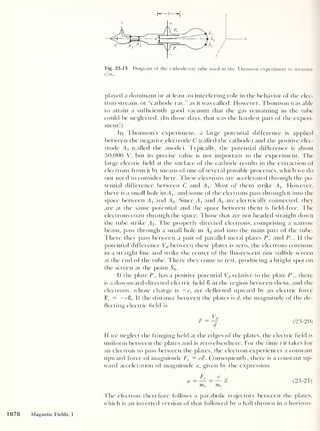
2
e0
2
r
4
or
Pe
=
9
y
32tr
2
e0r
4
for S r? r2 (21-57)
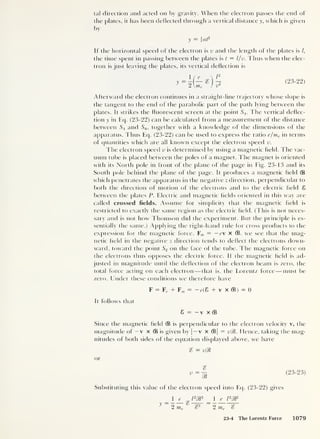
You can find U by integrating pe over volume elements dv that are spherical
shells, concentric with the electrodes, of radius r and thickness dr. Since dv =
477
r
2
dr, you have
U = pe dv = 477 per
2
dr
Arrq
2
r r*r2
dr q
2
C r*dr
3277
2
€0 Jr1
r
4
87760 Jr, r
2
Evaluating the integral gives
or
87760 Vrj r2 /
(21-58)
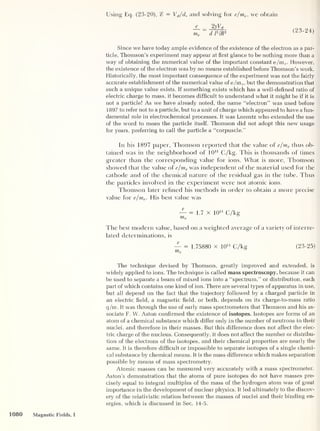
Note that by letting r2 go to infinity in Eqs. (21-57) and (21-58) you immediately
obtain expressions for the energy density and total energy in the electric field of a
single charged spherical electrode of radius rlt with no other electrode close enough
to it to have a significant influence on its field. Even though the volume sur-
rounding the single charged sphere is infinite, the total energy U stored in its elec-
tric field is finite. Can you explain why?
b. Use the expression for U to evaluate the capacitance C of the spherical
capacitor.
All you have to do is solve
for C, obtaining
Then substitute the expression for U. You get
C = <r
(2^
2
/87T60)(l/r1 1 /r,)
or
4 7760
1/ri - 1/r,
(21-59)
You should check this result by modifying the direct calculation which led to the ca-
pacitance evaluated in Eq. (21-49) so that it can be used to calculate the capacitance
of the spherical capacitor. Note that Eq. (21-59), like Eq. (21-49), expresses C in
terms of e0 times a geometric factor.
By letting r2 go to infinity, Eq. (21-59) becomes an expression for what can be
called the capacitance of an isolated spherical electrode of radius r1 . Of course,
21-7 Energy in Capacitors and Electric Fields 1001
there really must be a second electrode for the term “capacitance” to be meaningful.
There is, but this electrode is infinitely far away. This being the case, its shape is of
no consequence.
21-8 DIELECTRICS An insulating substance is called a dielectric. Nearly all practical capaci-
tors are constructed with dielectrics between their electrodes rather than
vacuum (or its near equivalent, air), as we have assumed up to this point. A
principal reason is that the presence of the dielectric increases the capaci-
tance. To understand why, we must understand what happens when an ex-
ternal electric held is applied to a dielectric.
When a dielectric substance is subjected to an external electric held 80 ,
electric forces are exerted on the positively and negatively charged par-
ticles which comprise the substance. The particles of opposite charge tend
to move in opposite directions because the forces exerted on them are op-
positely directed. But a dielectric, being an insulator, is a substance in
which charged particles are not free to move indefinitely. In describing the
motion that does occur, two important cases are to be distinguished.
In the hrst case there are no permanent electric dipoles in the dielec-
tric substance. That is, there are no dipoles in the absence of the external
electric held. This means that for each molecule of the dielectric the
average location of the negative charge (on the electrons) coincides with the
average location of the positive charge (on the nuclei) when there is no ap-
plied electric held. When an electric held 80 is applied to the dielectric from
the outside, it induces electric dipoles —called induced electric dipoles —
inside the dielectric. The applied electric held does this by “stretching”
each of the molecules so that the average location of its negative charge is
displaced from the average location of its positive charge. Figure 21-38 il-
© © © ©
© © © £i
© © © ©
(a)
©iff© ©"a© ©*© ©^©
©"© ©T© wym© ©T©
©"W© ©'TO© ©'strQ ©TO©
Fig. 21-38 (a) Schematic representation of a dielectric material
whose molecules do not have permanent electric dipole moments.
In the absence of an applied electric held £0 ,
the average positions
of each molecule's positive and negative charge coincide. (
b
)
When
= o an electric held £0 is applied to the material, the positive charge in
each molecule is displaced in the direction of £0 and the negative
charge is displaced in the opposite direction. Thus each molecule
becomes an electric dipole. The springs represent the fact that
these are induced dipoles. In other words, if the applied electric
held is removed, the two charges in each dipole will “snap back”
into coincidence, and it will no longer be an electric dipole.
£0 =^0
( b )
1002 The Electric Potential
lustrates the process, picturing each molecule as a positive and negative
charge of equal magnitude whose centers are joined by a spring that repre-
sents the attractive forces they exert on each other. When 80 = 0, each
spring has zero length and the charges overlap completely. The larger the
magnit ude of 80 , the greater is the extension of each spring. Since each in-
duced electric dipole has an electric dipole moment p of magnitude pro-
portional to the separation of its two charges, the electric dipole moment
magnitude increases with increasing magnitude of the applied electric
field. In fact, experiment shows that the magnitude p increases in direct
proportion to the magnitude —provided the applied electric field is not
too large. As for direction, each induced electric dipole moment vector p,
being directed from the negative to the positive charge, is in the direction
of the applied electric field vector 80 .
In the second case, there are permanent electric dipoles in the dielec-
tric substance. For most such substances, in the absence of an applied elec-
tric field So these electric dipoles are randomly oriented because of thermal
agitation. When the electric field is applied, the equal and opposite forces it
exerts on the two charges of each dipole produce a torque on the dipole. As
is indicated schematically in Fig. 21-39, these torques cause the dipoles to
rotate so that their electric dipole moments p come into partial alignment
with the applied electric field 80 . (See also Fig. 21-17.) Experiment demon-
strates that if the applied electric field 8 0 is not too large, the average value
of the components of p along the direction of 80 —a measure of the degree
of alignment —is proportional to the magnitude of 8 0 . (In addition to
aligning the directions of the permanent molecular electric dipole mo-
ments, the applied electric field may increase their magnitudes by the
stretching effect described in the preceding paragraph.)
** •
:
° . *„ » •
.*
: .*
(a)
Fig. 21-39 (a) Schematic representation of a dielectric material
whose molecules have permanent electric dipole moments. The
permanence of each dipole is indicated by connecting its two
charges with a rigid rod, instead of with a spring. In the absence of
an applied electric held £ 0 ,
thermal agitation randomizes the orien-
tation of the dipoles. ( b )
When an electric held £ 0 is applied to the
material, the electric dipole in each molecule rotates in such a way
that the positive charge is displaced in the direction of £ 0 and the
negative charge is displaced in the opposite direction.
^©
0—0 O—© ©—0 s 0 *o
0—^ ©—o ©
—
Cb
)
21-8 Dielectrics 1003
p p p p
p > p a
^
p_^ p_^
^0
P P_^ _P_^
Fig. 21-40 The depolarization field 8d ,
the applied electric field
8 0 ,
and their vector sum, the internal electric field 8 lnt ,
in a slab
of dielectric material. The depolarization field is the electric field
produced by the electric dipoles that the molecules of the ma-
terial constitute. Each electric dipole is indicated by its electric di-
pole moment p. The electric dipole moments, being directed
from the negative to the positive charge of the dipoles, are
aligned in the direction of the applied electric field 80 . This is
demonstrated in Figs. 21-38 and 21-39. The depolarization field
8d is in the direction of the strongest part of the electric field pro-
duced by the individual dipoles. It is shown in Fig. 21-16 that this
direction is opposite to the direction of the electric dipole moment
p. The direction of p being also the direction of £ 0 ,
it follows that
8 d is in the direction opposite to that of 8 0 , as depicted here.
Figure 21-40 shows schematically the macroscopic effect of these
microscopic processes. For simplicity, a rectangular slab of dielectric is
pictured, whose faces are perpendicular to the direction of a uniform elec-
tric held S0 applied from outside the dielectric. Within the body of the di-
electric, electric dipole moments develop —and/or rotate if they are already
present —in such a way that on the average the electric dipole moment
vectors are parallel to the applied electric held vector. Now Fig. 21-16
shows that the electric held 8^ of an electric dipole is strongest in the region
between the two charges, and in this region £> d is antiparallel to the electric
dipole moment p. But p is parallel to the electric held 80 acting on the elec-
tric dipole. Hence in the region where 8d is most important because it has
the largest magnitude, on the average it has a direction opposite to that of
80 . This means that as the magnitudes of the electric dipole moments
increase —and/or their directions increase the degree of alignment
—
under the influence of an applied electric held 80 of increasing magnitude,
there comes into existence a macroscopic, oppositely directed electric
held 8 d of increasing magnitude resulting from the increasing alignment of
the microscopic dipoles. The electric held 8rf
is called the depolarization
field. Since the macroscopic electric dipole moment along the direction of
the applied electric field has an average value proportional to the magni-
tude of the applied field, the magnitude of the depolarization field is also
proportional to that of the applied field.
The actual electric field in the interior of the dielectric, 8int ,
is the
vector sum of the applied and depolarization fields:
Sint = So+Sd (21-60)
Since 80 and 8d are oppositely directed, the terms in this sum tend to
cancel. Thus 8int always has a smaller magnitude than 8o- Also, its magni-
tude <9
lnt is proportional to the magnitude g0 of the applied electric field
since both terms on the right side of Eq. (21-60) have magnitudes propor-
tional to go-
This proportional relation between the magnitude of the internal elec-
tric field in a dielectric material and the magnitude of the external electric
field applied to it is most conveniently stated in terms of the equation
g0
Ke
=~ (21-61)
®int
1004 The Electric Potential
Table 21-2
Room-Temperature Dielectric Constants and Dielectric Strengths
for Various Materials
Material Dielectric constant Ke
Dielectric strength
(in 106
V/m)
Vacuum 1
Air (dry) 1.0006 Approx. 1
Water 80
Glycerine 56
Glass 5 to 10 30 to 150
Polyethylene 2.25 50
Mica 3 to 7 30 to 220
The quantity Ke defined in this equation is a constant called the dielectric
constant. The value of Ke is always greater than 1 for any dielectric sub-
stance, since %nt is always less than %0 . For vacuum, its value is exactly 1.
For a conducting substance the value is Ke = because the equilibrium
value of i’int is always zero in a conductor. Table 2 1-2 gives the values of the
dielectric constant Ke for several different materials.
Except for very special applications, capacitors are always made with a
dielectric between the electrodes. There are three reasons for this. The
hrst reason is structural. When two electrodes are closely spaced to maximize
the capacitance, there is no better way of keeping them together while
keeping them from making direct contact than by sandwiching them with a
thin sheet of dielectric. The second reason is that the dielectric
strength —the maximum electric held a material can sustain without suf-
fering destructive electrical breakdown as it becomes a conductor —is
greater and more stable for many insulating materials than it is for air. This
can be seen from the last column of Table 21-2. The third reason is that the
dielectric increases the capacitance of the capacitor, as we show in the next
paragraph.
Consider a plane-parallel capacitor with vacuum (or for most practical
purposes, air) between its plates. The plates carry charge per unit area of
magnitude |cr| and are separated by distance d. Thus, according to Eq.
(21-47), the electric held between the plates has the magnitude
The difference in electric potential of the two plates is given by Eq.
(21-48o) as
V =%0 d =
ard
Co
Now isolate the plates so that no charge can How on or off them. Then hll
the space between the plates with a dielectric of dielectric constant Ke . This
reduces the magnitude of the electric held between the plates to the value
«? int ,
which Eq. (21-61) shows to be
«, %o .. H
int
Ke Kee0
21-8 Dielectrics 1005
The new value of the electric potential difference of the plates is calculated
from Eq. (21-48o) to be
V = glnt d =
ad
Kee0
This is reduced from the original value by the factor 1 /Ke . But there has
been no change in the charge on the capacitor plates |g|. So the definition of
capacitance C in Eq. (21-456),
shows that since |g|
is unchanged, the decrease in V by the factor 1/Ke is ac-
companied by an increase in C by the factor Ke . The same conclusion is ob-
tained, no matter what the geometry of the capacitor: The capacitance is in-
creased by the factor Ke when an insulating material with that dielectric constant is
inserted between the plates of a capacitor.
EXERCISES
Group A
21-1. Making salt. Use the procedure suggested at the
end of Example 21-1 to estimate the electric potential en-
ergy change during the formation of the molecule NaCl.
21-2. Near a sphere. A solid metal sphere whose radius
is 1.0 cm has a charge of + 1.0 X 10
-8
C.
a. What is the electric potential just outside the sur-
face of the sphere? Take it to be zero infinitely far from
the sphere.
b. At what distance from the surface does the electric
potential fall to one-half its surface value?
21-3. Speedy approach
?
An immobile conducting
sphere of radius R and charge |£)| attracts a body of mass
m whose charge is — |g|. What is the speed of the body
when it is a distance r from the center of the sphere if it
starts from rest at a great distance?
21-4. Tiiangular array.
a. Calculate the electric potential at a point A midway
between charges qx
and q3 in the triangular array of
charges in Fig. 21-4, taking it to be zero at infinity.
b. Do the same for the point B midway between
charges q2 and q3 .
c. Evaluate the work that must be done to move an
electron from A to B
.
21-5. Assembling charges. Calculate the work done to
bring three widely separated equal point charges q to the
apexes of an equilateral triangle of side a.
21-6. At the midway point.
a. Midway between two point charges, qt = + |(?|
and
<72 = |</|, whose separation is d, what is the value of the
electric potential if the value is zero infinitely far from the
charges?
b. What is the rate of change of the electric potential
with respect to position along the line between the charges
at the midway point?
c. What is the value and direction of the electric field
at the midway point?
21-7. Breakdown potential. Charge can be added to a
conductor in air until % at the surface reaches the value of
about 3 x 10⁶
V/m. Higher values of % cause the sur-
rounding air to become conducting so that the excess
charge is carried away.
a. Estimate the maximum charge Q that a sphere of
radius 1 m can acquire.
b. What is the corresponding electric potential V,
taking V = 0 for r = °°?
21-8. Label the equipotentials. Calculate the numerical
values of V for each equipotential in Fig. 21-12, taking
V = 0 at infinity. Use these values to label the equipoten-
tials in the figure.
21-9. Electric potential due to nearest neighbors in steam.
The average distance between water molecules in a steam
chamber at 100°C and 1.0 atm of pressure is approxi-
mately 4.0 x 10
-9
m. Given that the electric dipole mo-
ment magnitude of a water molecule is 6.2 X 10
_3° C-m,
use Eq. (21-24) with 6 = 0 to determine a typical value for
the electric potential experienced by a water molecule due
to a single neighboring molecule 4.0 x 10
-9
m away.
21-10. Electric potential of a dipole. An object with elec-
tric dipole moment p = pi is placed at the origin of the x,
y, z coordinate axes. What is the electric potential V at the
point x = L, y = L, z = L? Employ the convention that
V = 0 infinitely far from the origin.
1006 The Electric Potential
21-11. Equivalent capacitance,
/. In Fig. 21E-1 1, each
capacitor has a capacitance of 1 .00 /xF. What is the equiva-
lent capacitance of the arrangement in part a? What is it in
part b ?
Fig. 21E-11
HHHH
Cb )
21-12. Equivalent capacitance, II. Given three capaci-
tors of 1.00 /xF each, what are four ways of connecting
them and what is t lie equivalent capacitance in each case?
21-13. Equivalent capacitance,
III. Find two different
ways of connecting a set of 1.00-/xF capacitors which will
give an equivalent capacitance of 0.67 pT.
21-14. Plane-parallel capacitor, I.
a. Show that the magnitude of the force with which
one plate of a plane-parallel capacitor (in vacuum or air)
attracts the other is equal to qf/2e0a, where a is the area of
either plate and |c/| is the magnitude of the charge on
either plate.
b. What is the work done by a force applied to slowly
separate the plates when the spacing between them is in-
creased from di to <4?
c. Show that the increase in the potential energy
stored in the capacitor is equal to the work done.
21-15. Plane-parallel capacitor, II. The dielectric in a
plane-parallel capacitor has a dielectric strength of 1.0 X
107
V/m and a dielectric constant of 4.0. Its thickness is
0.10 mm. The area of the plates is 500 cm2
.
a. What is the maximum electric potential difference
between the plates?
b. What is the capacitance?
c. What is the maximum energy that can be stored?
ference between its electrodes is 400 V. The battery is
then disconnected, leaving the capacitor charged. Kero-
sene of dielectric constant 2.5 is poured into the space
between the spherical electrodes, completely filling the
space.
a. What is the electric potential difference when the
capacitor contains kerosene?
b. How is the charge on the capacitor affected?
c. What is the ratio of the final capacitance to the ini-
tial capacitance?
Group B
21-18. Potential differences of charged planes. The three
large parallel insulating planes in Fig. 2 IE- 18 are 1.0 cm
apart. They are uniformly charged, with cr^ = +2.0 X
10
-7
C/m2
,
cr B = +4.0 X 10
-7
C/m2
,
and cr c = +6.0 x
10
-7
C/m2
,
where A, B. and C refer to the left, middle, and
right planes. Calculate the following differences in their
electric potentials:
Fig. 21E-18
a. VB - VA
b. Vc - VB
c. Vc ~ VA
21-19. Charged nonconducting sphere. A noncon-
ducting sphere of radius R has a total charge Q uniformly
distributed throughout its volume. The electric held at a
point inside the charged sphere is radial and has magni-
tude equal to Qr/ATre0R3
,
where r is the distance from the
center. Show that the electric potential at this point is
given by
Q f (3fi
2 - r
2
)
87T€o _ R3
21-16. Plane-parallel capacitor, III. A plane-parallel
capacitor has plates of area a and separation d. Over one
half of this area the region between the plates is evac-
uated; over the other half it is filled with material of die-
lectric constant Ke . What is the capacitance?
21-17. Spherical capacitor, I. A spherical capacitor is
charged with a battery so that the electric potential dif-
taking its value to be zero infinitely far from the sphere.
21-20. Sphere of zero potential. A charge + q
is at a dis-
tance 3/? /2 from a charge -|<?|/2. See Fig. 21E-20. The
figure shows an imaginary sphere of radius R whose
center is on the line joining the two charges and is at dis-
tance R/2 from the negative charge, in the direction away
Exercises 1007
Fig. 21E-20
from both charges. Prove that the electric potential over
this sphere is zero, if it is defined to be zero infinitely far
from the charges.
21-21. Shell game. A conducting sphere of radius
1 cm has a charge of 1 x 10
-8
C. It is at the center of a
conducting shell which has a net charge of 2 X 10
-8
C.
See Fig. 21E-21. The inner and outer radii of the shell
are 2 cm and 3 cm. Take all these numbers to be exact.
Fig. 21E-21
a. What is the charge on (i) the inner surface of the
shell? (ii) the outer surface of the shell?
b. What is the electric potential (letting it be zero at
infinity) (i) just outside the shell? (ii) inside the metal of the
shell? (iii) at the surface of the sphere?
c. What is the difference in electric potential between
the sphere and the shell?
21-22. Far field of a charged disk. Derive Eq. (21-20a)
for the far electric field of a charged disk by applying %z =
— dV/dz directly to Eq. (21-16a).
21-23. Nearfield of a charged disk. Derive Eq. (21-206)
for the near electric field of a charged disk by applying
z
= —dV/dz directly to Eq. (21-166).
21-24. Torque on a dipole. Prove that Eq. (21-32) for
the torque exerted on an electric dipole is valid when the
origin about which the torque is measured is chosen at one
of the charges of the dipole, instead of at its center. What
property of the two forces producing the torque is respon-
sible for the fact that the torque does not depend on the
choice of origin?
21-25. Energy of a dipole. Employ Eq. (21-32), T =
p x 8, in an integration of Eq. (9-58), T = —dU/dO , to
derive Eq. (21-35), U = —
p • 8. Take particular care in
handling signs.
21-26. Electric field in polar coordinates. If V is ex-
pressed in polar coordinates, Eqs. (21-18) become %R =
—dV/dR, where %R is the radial component of 8, and
<^e
= —dV/RdQ where is the transverse component.
a. Evaluate and for the dipole electric potential
given by Eq. (21-26).
b. Show that c?
2 = e?| + agrees with the expres-
sion obtained in cartesian coordinates in Eq. (21 -29a).
21-27. Spherical capacitor, II. Modify the calculation
leading to Eq. (21-49) so that it can be used to calculate the
capacitance of the spherical capacitor in Fig. 21-37. Com-
pare your results with Eq. (21-59).
21-28. Switching capacitors, I.
a. In Fig. 21E-28, the four capacitors are identical.
Switch B is kept open. Switch^ is closed and then opened.
Switch B is now closed. What is the electric potential dif-
ference across each capacitor? The symbol on the right
represents a battery.
b. Starting with uncharged capacitors, switch B is
closed. Then switch A is closed. What is the electric poten-
tial difference across each capacitor?
21-29. Equivalent capacitance, IV.
a. Derive Eq. (21-52) for the equivalent capacitance
of an arbitrary number of capacitors in series.
b. Derive Eq. (21-53) for the equivalent capacitance
of an arbitrary number of capacitors in parallel.
21-30. Switching capacitors, II. In Fig. 2 IE-30, switch A
is closed, then opened. After this, switch C is closed, then
opened. The symbols at the ends represent batteries.
100 V
St SI
+ £_
E +
l.oo mF 1.00 aiF
200 V
Fig. 21E-30
a. If switch B is now closed, what is the electric poten-
tial difference across either capacitor?
b. Calculate the energy loss when switch B is closed.
Account for the energy loss.
21-31. Electricfield energy of a spherical conductor. Prove
that half the energy of the electric field of a charged iso-
lated spherical conductor of radius R is in the region
1008 The Electric Potential
between t lie sphere and an imaginary concentric sphere
of radius 2R.
21-32. Coalescing drops. Two very widely separated
identical spherical drops of water of radius R carry equal
charges q.
a. What is the total electric potential energy of the
system?
b. The two drops coalesce to form a large one with
charge 2 q. What is the ratio of the electric potential energy
of the large drop to the sum of the electric potential en-
ergies of the two small ones?
c. From elementary considerations, show that the
ratio should be greater than 1.
21-33. Dielectric slab. A slab of dielectric is inserted
between plates of a plane-parallel air capacitor. The
thickness of the dielectric is exactly one-half the distance
between the plates. If the dielectric constant of the slab is
exactly 2 , what is the ratio of the capacitance C with the
slab to the capacitance C without it?
21-34. Crabby capacitor. In Fig. 21E-34 a slab of die-
lectric of constant Ke is inserted a small distance into the
space between the plates of a charged plane-parallel air
capacitor. When the slab is released, it is drawn in all the
way.
/ Fig. 2 1 E-34
— /
a. Why does this happen?
b. The potential energy of a charged capacitor is
given by qf/2C. In part a, |g|
does not change but C in-
creases by a factor of Ke . The potential energy, with the
dielectric tilling the gap, is therefore less than the original
potential energy. Account for the missing energy.
c. By equating the work done on the slab to the de-
crease in potential energy, calculate the average force with
which the dielectric is pulled in terms of the original po-
tential energy U.
Group C
21-35. Electron model. A nonconducting sphere of
radius R has a charge which is uniformly distributed
over its volume.
a. Show that the electric potential energy of the
charged sphere is iQ2
/4iTe0R, where Q is the total charge.
Hint: Build up the charged sphere by putting together
uniformly charged spherical shells.
b. Assuming that an electron is such a sphere, calcu-
late its radius by equating the electric potential energy to
its rest mass energy m0c
2
. What is the numerical value of
the radius?
21-36. An inverse fifth-power attraction. A point charge
q attracts an uncharged object by inducing charges in the
latter. If the uncharged object is a small conducting
sphere, the force of attraction varies inversely with the
fifth power of the distance r between the charge and the
center of the sphere. This can be proved in steps as
follows.
a. Find the energy density in the electric field of the
point charge in terms of q and r.
b. When the conducting sphere is placed at any loca-
tion in the field, the interior of the sphere is field-free,
Thus the energy of the electric field is decreased from the
value it had in the absence of the sphere. Calculate the de-
crease for a sphere of radius a.
c. The attraction ol the point charge will pull the
sphere into a region where the field and therefore the en-
ergy density is greater. Calculate the rate at which the
electric field energy decreases with the distance.
d. Let dU be the magnitude of the change in the elec-
tric field energy due to the change dr in the distance of the
conducting sphere from the point charge. Then energy
conservation requires that dU = F dr, where F is the mag-
nitude of the force on the sphere. Calculate F.
No allowance has been made in this calculation for
the rearrangement of the electric field lines so as to be-
come everywhere normal to the surface of the conducting
sphere. Doing so would increase the value of F by a factor
of 3, but would have no effect on the inverse fifth-power
law that is obtained.
21-37. The method of images. A charge + |t/| is at a dis-
tance d from an infinite conducting plane at zero electric
potential. This charge will induce a negative charge on the
plane. What is the force with which the plane attracts the
charge + |<7 |? What is the induced charge per unit area on
the plane? The following steps, sometimes called the
method of images, will lead you to the answers to these
questions.
Place a charge — 1<?|
on the other side of the plane
along the normal from + 1(/|
to the plane and also at a dis-
tance d from the plane. Then remove the conducting
plane as in Fig. 21E-37.
Fig. 21E-37
oo
Exercises 1009
Fig. 21E-40
a. What is the electric potential due to these two
charges at an imaginary plane coinciding with the one re-
moved?
b. What is the direction of the electric held due to the
two charges at this imaginary plane?
c. The results obtained fora and b show that the held
at the imaginary plane due to the two charges is identical
to the held when the conducting plane takes the place of
the charge — 1</|. Hence the attraction of the conducting
plane on + |g|
is the same as the attraction of - |<?|
on + |g|.
Evaluate this attraction.
d. Gauss’ law applied to a conductor gives cr = e0 c?,
where a is the charge per unit area on the surface of the
conductor and % is the magnitude of the electric held
immediately outside the conductor. The value of % can be
found by using the electric held due to the point charges.
Show that % = 2|(/|cf/47re 0 r
3
, where r is the distance from
either point charge to the point where % is being evalu-
ated. From this obtain the expression for cr.
e. By integrating the charge on circular rings cen-
tered about the line connecting the two charges, evaluate
the total induced charge on the plane and show that it is
equal to — |c/|.
21-38. Find the field from superposed potentials. A sta-
tionary positive point charge qx is located at the point
(xj , 3>! . 0), and a negative point charge q2
= — 2 qx is located
at the point (xj ,
— 3^ , 0).
a. Find the electric potential V. Employ the custom-
ary reference V = 0 for r —
>
°°.
b. Find the locus of points in the xy plane for which
V = 0. Express your result in the form y = f(x).
c. Find the point(s) on the x axis for which V = 0.
d. Determine all three components of the electric
held for a general point (x, y, z).
e. Find all points along the x axis where (i) %x = 0; (ii)
= 0.
f. Find the point along the x axis for which the mag-
nitude of the electric held is a maximum, and express this
maximum value in terms of qx and yx
. Hint: Careful con-
sideration of the electric held superposition equation 8 =
8j + 82 can help you avoid much algebraic manipulation.
21-39. A dipole and a point charge. An electric dipole
whose moment is of magnitude p is aligned along an elec-
tric held line due to a point charge q. The dipole’s distance
r from q is much greater than 2d, the distance between the
dipole charges. Show that the magnitude of the force
which the electric held of q exerts on the dipole is equal to
(q/4iTe0)(2p/r3
). Is the force directed toward q, or away
from q?
+q
-<7
d_
d
r
-qid
a. Show that the magnitude of the force which either
dipole exerts on the other is given by (1/4 7re0 )(6/>
2
/r
4
)
Hint: Use Eq. (21-286) with x = 0.
b. Is the force attractive or repulsive?
21-41. Electric dipole in a uniform electricfield. An object
whose electric dipole moment is
p = px. is held hxed in a
uniform external electric held 8 = %y.
a. Find the vector torque T on the object.
b. Suppose the object is a homogeneous solid sphere
of mass m and radius a. The sphere is released from a state
of translational and rotational rest at t = 0, and its dipole
moment is hxed with respect to the sphere, so that the di-
pole moment at time t is given by p(() = p sin 9(t)x —
cos 9(t)y. Use the equation T = dL/dt to obtain an equation
for the angular acceleration d2
6/dt
2
.
c. The initial conditions for the equation obtained in
part b are 6 = rr/2 and dO/dt = 0. Show that the following
equation is satisfied by the dipole: j(bna2
)(d9/dt)
2
+
p% cos 9 = 0.
d. How would you modify the equation presented in
part c to allow for arbitrary initial values of 9 and d9/dt
(but with the initial values of p and dp/dt still confined to
the xy plane)?
21-42. Poisson’s equation. In Sec. 21-5, Gauss’ law and
the relationship between the electric held 8 and the elec-
tric potential V were used to show that in a charge-free
region of space the potential satishes Laplace’s equation:
d
2
V d
2
V d
2
V n
—7 + —7+TT=0
dxr dy~ dz*
The same procedure can easily be generalized to show
that the electric potential always satishes Poisson’s equa-
tion:
21-40. Two dipoles. An electric dipole whose moment
is of magnitude p is aligned along the axis of a similar di-
pole. See Fig. 21E-40. The distance r between the centers
is much greater than 2d, the distance between the opposite
charges of either dipole.
d
2
V d
2
V d
2
V p
dx2
dy
2
dz
2
e0
where p is the local charge density.
a. Make the generalization, thereby deriving Pois
son’s equation.
1010 The Electric Potential
b. Determine the electric field 8. and charge density
p, associated with the electric potential
V(x, y, z) = ae
~bz
2
where a and b are constants.
21-43. The consequences of symmetry. A cubical box has
aluminum faces which are mechanically joined by narrow
insulating spacers which serve as the edges of the cube.
The interior of the box is charge-free. The six faces of the
cube are connected to six different batteries which main-
tain them at the following electric potentials: 5, 15, — 10,
30, 45, and - 25 V.
a. Without using any complicated numerical proce-
dure, determine the electric potential at the center of the
cube. Justify your method.
b. For which object(s) among the following could a
similarly simple means be used to determine the electrical
potential at the geometrical center? (In each case, there
are no interior charges, and various parts of the surface
are held at various given electric potentials.)
(i) a hollow, regular tetrahedron
(ii) a hollow, noncubical rectangular parallelepiped
(iii) a hollow spherical shell
21-44. A charged sheet, I. An infinite sheet containing a
position-dependent charge per unit area lies in the xy
plane; its electric potential is given by V(x,y, 0) = V0 cos(kx).
a. Find the electric potential V(x, y, z) in the charge-
free region on both sides of the infinite sheet. Hint: As-
sume that V{x, y, z) = /(z) cos(foc) and that V —» 0 for z —
»
00 . Why should there be no y-dependence in V(x, y, z) for
z f 0?
b. Evaluate the electric field 8 (x, y, z) for z f 0.
c. Show that the magnitude of the electric field de-
pends only upon z.
21-45. A charged sheet, II. Apply Gauss’ law to find the
charge per unit area cr(x, y) of the sheet described in Exer-
cise 21-44.
Numerical
21-46. Field lines and equipotentials, I. Run the field
lines and equipotentials program to trace a representative
set of electric field lines and equipotential curves for two
charges whose value and locations are: q^ = + 1 (in C) at
x = 0 and z = 0; q2 = + 2 (in C) at x = 0 and z = 5 (in
cm). 1 his work is quite time-consuming if carried out on a
programmable calculator. (But there is no tedium if you
use a computer with a graphic display.) So use values of As
and n which are, respectively, twice as large and twice as
small as those used in Example 21-6. in order to reduce
the time required (unless you use a graphic display com-
puter). Also, evaluate V for each equipotential. Compare
your results with those displayed in Fig. 21-11, and com-
ment on the differences.
21-47. Field lines and equipotentials, II. Run the field
lines and equipotentials program to trace a representative
set of electric field lines and equipotential curves for two
charges whose values and locations are: q1 = + ] (in C) at
x = 0 and z = 0; q2 = — 2 (in C) at x = 0 and z = 5 (in
cm). Also evaluate V for each equipotential. Compare
your results with those displayed in Fig. 21-12, and com-
ment on the differences. The remarks made in Exercise
21-46 about the time required for the calculations apply
here.
21-48. Laplace’s equation, I.
a. This exercise requires the use of a small computer.
Write a program for carrying out an iterative solution of
Laplace’s equation. Follow the lines established by Ex-
ample 21-10, but allow for a more flexible choice of the
number of grid points and for the specification of the val-
ues of V at the boundaries. Test the program by repeating
the calculation in the example, recording the time re-
quired to obtain convergence to two decimal places.
b. Choose a different set of initial values of V at the
interior grid points. Specifically, choose V = 0 at each of
these points. Repeat the calculation, and show that the
same results are obtained. Also record the time required
to obtain the results. Compare the time required for the
two calculations, and explain what the comparison shows.
21-49. Laplace’s equation, II. Run the Laplace’s equa-
tion computer program as in Exercise 21-48 until you ob-
tain convergence to three decimal places. Record your re-
sults. Then repeat the calculation with a grid in which the
spacing of the grid points is halved along both the x and y
axes. Record your results, but only at the positions of the
initial set of grid points. Continue this process, repeatedly
halving the grid point spacing, until the calculation con-
verges with respect to grid point spacing to three-
decimal-place accuracy. When the convergence is
achieved, the results of the numerical calculations will be
identical to this accuracy with the results of analytical cal-
culations.
21-50. Laplace’s equation, III.
a. Apply the Laplace’s equation computer program
written in Exercise 21-48 to find values of V at points in-
side a set of three adjacent long electrodes extending in
the z direction, whose intersections with the xy plane form
a triangle with two perpendicular sides of equal length.
The values of V on the two perpendicular electrodes are
V = 0 and V — + 1 V. The value on the third electrode is
V = + 2 V.
b. Explain briefly the difficulty that arises if the trian-
gle does not have two perpendicular sides of equal length,
and what you would do to handle the difficulty. Laplace’s
equation does not have analytical solutions for the elec-
trode systems considered in either part of this exercise.
Exercises 1011
22
Steady Electric
Currents
22-1 ELECTROMOTIVE Until 1800, the only way to produce the charge transfer necessary to ob-
FORCE AND serve electrical phenomena involved the use of friction. But the electric
ITS SOURCES force i s quite strong. Thus the amount of charge which can be put on an
electrode is limited by the rapid buildup of an electric potential (or poten-
tial for short) on the electrode which prevents further accumulation of like
charge.
Consider a specific example. Because of the strength of the electric
force, the capacitance of practical capacitors is rather small. That is, the
plates of a typical capacitor having a large electric potential difference (or
potential difference for short) carry rather small amounts of charge.
Therefore, when a capacitor is discharged by connecting its electrodes, the
How of charge is either brief or weak, or both.
The invention in 1800 of the voltaic cell changed all this. The familiar
dry cell and mercury cell are forms of a voltaic cell. A battery is a series of
connected voltaic cells. Such devices make it possible to deal with very large
quantities of charge flowing steadily over quite small potential differences.
Today there are many other ways of ch iving such a steady flow, but the vol-
taic cell still has great practical importance. In addition to its widespread
usefulness, moreover, the voltaic cell provides one of the essential links
between the sciences of physics and chemistry, a point to which we return
briefly later.
The establishment of net electric charge in any region of space re-
quires that the charge be separated from charges of opposite sign. (This
happens, for example, in the charge-transfer processes discussed in Chaps.
20 and 21.) A device separating electric charges must do work on those
charges in some way, in order to overcome the electric forces which op-
1012
Fig. 22-1 Schematic drawing of the van de Graaff generator, used to
produce very high potential differences. A hollow spherical electrode
is supported and insulated from the ground by ceramic insulators.
Near the ground, the endless belt passes between a set of wires on one
side and a metal plate on the other side. An electronic device separates
charge and this produces a potential difference of several thousand
volts between the wires and the plate. As a result, a continuous electric
discharge (rather like a steady but very weak lightning discharge) takes
place, which passes through the belt. Electric charge is thus “sprayed”
onto the nonconducting belt, which carries it upward. The motion of
the belt then transfers this charge to the hollow electrode. Until the
charge is inside the electrode, it experiences a strong repulsive force
due to the charge already on the electrode. Work must therefore be
done to move the charge. As is discussed in the text, the energy re-
quired to perform this work is supplied by the mechanical device
(usually an electric motor) which turns the belt. Once the charge on
the belt passes inside the electrode, the electrode exerts no further
force on it, for reasons explained at the end of Chap. 20. As the
charges on the belt come into contact with the metal wires brushing
over the belt inside the hollow electrode, the repulsion among them
causes some of them to leave the belt and flow through the wires to the
outer surface of the electrode. The longer the process continues, the
more charge is accumulated on the electrode. The potential difference
between the hollow electrode and the earth thus increases until a light-
ninglike discharge takes place through the air between them, or along
the surface of one or more of the insulating supports. When the mag-
nitude of the charge transferred from the earth to the electrode is |<?|,
the potential difference V between the two is given by V = q/C, where
C is the capacitance of the system. If the hollow electrode is well insu-
lated from the earth, q
can be made large enough (before discharge
occurs) to result in a value of V equal to several million volts.
pose the separation. That is, the electric potential energy of a system com-
prising equal amounts of positive and negative charge can be increased
only by doing work on the charges. How this work is done on the charges
depends on the particular device employed. The general features of the
process are especially apparent in the case of the van de Graaff generator,
depicted in Fig. 22-1. As is explained in the caption, the separated electric
charge is transferred from one electrode (the earth) to another (the large,
hollow metal sphere) on a moving belt made of a nonconducting material.
This process produces a large potential difference between the electrodes
and thereby gives the system an appreciable amount of electric potential
energy. Because the charges on the belt move against a repulsive electric
force, work must be done to make the belt move. The source of the me-
chanical energy expended in doing this work is the macroscopic device
driving the belt. In principle, it could be a steam engine, in which case
the electric potential energy of the van de Graaff generator is created at the
expense of thermal energy. In practice, the source of the mechanical en-
ergy is an electric motor, so that the mechanical energy required to drive
the belt, and thus create electric potential energy, is itself produced at the
expense of electromagnetic energy.
In the case of the voltaic cell, the source of the energy required to sepa-
rate positive and negative charges, and to place a net positive charge on one
electrode and a net negative charge on the other, is less evident on casual
inspection because it is microscopic. The energy arises from the breaking
and making of chemical bonds in the course of the chemical reactions that
take place between the electrodes and the fluid (called the electrolyte ) in
which they are immersed. In other systems, the energy converted into elec-
tric potential energy initially may be in still other forms.
22-1 Electromotive Force and Its Sources 1013
V
Fig. 22-2 General representation of a
source of electromotive force. By means
of some unspecified mechanism, the de-
vice represented by the shaded rect-
angle separates positive and negative
charges. As a result, there is a potential
difference V between terminals A and C.
Terminal A, called the anode, or positive
terminal, is at the higher potential, and
terminal C, called the cathode, or nega-
tive terminal, is at the lower potential.
Figure 22-2 illustrates in a very general way a device which converts
some other form of energy into electric potential energy by driving apart
positive and negative charges. The device, whose details do not concern us
here, is represented as a rectangle. It has two terminals, shown at opposite
sides of the rectangle. There is a potential difference V between the terminals
resulting from the (unspecified) process taking place inside the device. The
terminal having the higher potential of the two, labeled A, is called the
anode and is usually denoted by the symbol +. The terminal having the
lower potential, labeled C, is called the cathode and is usually denoted by
the symbol —
.
If a small positive test charge q is transported through the device from
the cathode to the anode, the electric potential energy of the system must
be increased by the amount qV. The work per unit charge required to do this
must be performed by the device and is called the electromotive force.
The value of the electromotive force is thus given by the equation
electromotive force
_qV- V (
22- 1 )
The device itself is called a source of electromotive force. It maintains an
electric potential difference between its terminals in a manner analogous to
that in which a water pump maintains a pressure difference between its
inlet and outlet pipes.
There are two important points to be remembered about the electro-
motive force. The first has to do with the name itself, whereas the second
has to do with the connection between the electromotive force and the elec-
tric potential difference associated with it:
1. The word “force” is not used in the precise sense to which it is
restricted in modern scientific terminology. Rather, it is used in the every-
day sense meaning “driving influence.” When the term “electromotive
force” was hrst coined, about 150 years ago, physical terms were not always
used as precisely as today. Both because of the inaccuracy of the terminol-
ogy and because “electromotive force” is a long and awkward term, the
abbreviation emf, derived from the hrst letters of the main components of
the term, is used almost universally in the English-speaking world. (The
letters are pronounced separately, as e-m-f.) The signihcance of the word
“electromotive,” or “producing motion of electricity,” arises from the fact
that sources of emf are used most often to drive electric currents.
2 . While the emf is numerically equal to an electric potential dif-
ference and is measured in units of volts, just as a potential difference, the
emf is not itself a potential difference. The emf produces a potential dif-
ference, but arises from physical phenomena which are not necessarily
electrical in nature. A more important distinction between an emf and a
potential difference arises from the fact that emf represents not potential
difference, but work done per unit charge. This work need not be done by
a conservative force, whereas a potential difference can be defined only for
a conservative force.
The voltaic cell is an important example of a source of emf. A detailed
phenomenological description of the operation of the voltaic cell will be
found in any elementary chemistry text. By means of the process sketched
in Sec. 15-5, chemical reactions provide the “chemical energy” required to
1014 Steady Electric Currents
V (in V)
Fig. 22-3 (a) A voltaic cell. Two electrodes made of different electrically conducting sub-
stances (here shown to be copper and zinc) are immersed in a conducting solution called the
electrolyte (here shown to be a mixture of copper sulfate and zinc sulfate in water). Some of
the metal atoms from each electrode ionize, going into solution as positively charged ions,
each of which leaves one or more electrons behind on the electrode. As a result, each electrode
acquires a negative potential relative to the electrolyte. For each electrode, the magnitude of
the potential is determined by the energy available per atom for the specific ionization reac-
tion involved. Since this energy is different for each of the two electrodes, a potential dif-
ference exists between the electrodes, as suggested by the diagram of part (b). ff the electrodes
are linked by an external conductor, electrons will flow from low potential to high potential. In
the cell shown, the electrons will combine with copper ions at the anode-electrolyte interface,
and copper metal will plate out on the anode. At the same time, removal of the electrons from
the zinc cathode enables an “equal amount” of zinc metal to ionize and go into solution in the
electrolyte. (Can you give a precise meaning to the term “equal amount”?) The process will
continue until either all the zinc is dissolved or all the copper ions in the electrolyte have been
plated out.
separate electrons from atoms. This process, called ionization, produces an
electric potential difference V between the terminals. A schematic diagram
of a voltaic cell is shown in Fig. 22-3, and a brief explanation of its opera-
tion is given in the caption. For the purposes of this discussion, it suffices to
note the following basic principles, which are founded on chemical obser-
vations:
1. Every chemical reaction involving 1 kmol of a substance requires
the transfer of |v| kmol of electrons between that substance and some other
substance. The quantity v is a small positive or negative integer called the
valence of the substance, and most often it lies between —4 and +4. The
overall chemical reaction which drives the voltaic cell, shown in Fig. 22-3«,
for instance, can be carried out simply by dropping powdered zinc into a
solution of copper sulfate. Zinc-metal (Zn) atoms lose two electrons (|jz| = 2)
and become zinc ions (Zn2+
)
in solution. At the same time, copper ions
(Cu2+
) in solution acquire two electrons (|r>| = 2) and come out of solution
as copper-metal (Cu) atoms. This exchange of electrons can be written as
Zn + Cu2+ > Zn2+ + Cu
2. The structure of the voltaic cell is such that the necessary transfer of
electrons takes place through an external connection. The electrons are
propelled by the electric force arising from the potential difference V
between the terminals of the cell. The magnitude of the charge transferred
from cathode to anode with 1 kmol of electrons is Ae, where A — 6.022 X
22-1 Electromotive Force and Its Sources 1015
10
26
is Avogadro’s number, defined in Sec. 17-4, and e is tfie magnitude of
the electron charge. The quantity Ae is called Faraday’s constant That
is, the quantity
& = Ae (22-2)
is the magnitude of the total electric charge on 1 kmol of electrons. To four
significant figures, $F has the value
3F = 6.022 x 10
26
electrons/kmol x 1.602 x 10
-19
C/electron
or
& = 9.649 x 10
7
C/krnol (22-3)
Faraday’s constant can be measured by carrying out an electrochemical
reaction involving n kmol of a substance of known valence v. If the magni-
tude of the total charge transferred through the external connection is
measured to be |#|, we have
|#|
= nv2F (22-4a)
or
= J_
nv
(22-46)
If any two of the quantities 2F, A,
and e are known, the third is deter-
mined by Eq. (22-2), 8F — Ae. As mentioned in Sec. 20-2, the value of e was
first estimated in 1874 by G. Johnstone Stoney from the values of Faraday’s
constant and Avogadro’s number. His value, e — 1 x 10
-20
C, was flawed
by the very poor estimates of Avogadro’s number then available. The first
accurate evaluation of A was made possible by Millikan’s determination of
e. Today there are much more precise methods of measuring the electron
charge —e, but Eq. (22-2) remains an important means of determining
Avogadro’s number.
3. A system in which a chemical reaction takes place often may be
regarded as an isolated system. In the course of the chemical reaction, the
potential energy of the system always changes, for the reasons discussed in
Sec. 15-5. If the potential energy decreases, the reaction is called exothermic
(that is, heat-releasing) because the energy is most commonly transferred to
the outside world in the form of heat energy. The chemical reactions used
in voltaic cells are exothermic. But in a voltaic cell, most of the energy is not
released directly in the form of heat. Rather, it appears largely in the form
of the electric potential energy possessed by the system because it contains
separated positive and negative charges. This energy is converted to still
another form of energy as the charge is propelled through the external
connection from one terminal to the other by the electric force arising from
the potential difference between the terminals. If the potential difference
has magnitude |V| and a charge of magnitude |#|
is transferred via the ex-
ternal connection, the transfer involves a decrease of magnitude qV in the
electric potential energy of the system. It is this energy, sometimes called
electric energy, which is used in the enormous number of different ways
which give electricity so much of its practical importance.
I he connection among the amount of matter undergoing chemical
reaction, the amount of electric charge transferred, and the amount of en-
ergy released by the system to the outside world is considered in Example
22-
1 .
1016 Steady Electric Currents
EXAMPLE 22-1 RM
You have a voltaic cell like that shown in Fig. 22-2a, made with electrodes of zinc
and copper. You remove the zinc electrode from the cell, weigh it, and replace it in
the cell. You measure the potential difference between the terminals attached to the
electrodes and find its magnitude to be |Vj = 1.1 V. You place the entire system in a
calorimeter. Next, you “short-circuit” the cell by connecting a thick copper wire
between the terminals. Using the calorimeter, you measure the heat evolved by the
system. (In particular, you note that the wire becomes quite hot, but the cell be-
comes warm as well.) After some time, you remove the cell from the calorimeter,
disconnect the wire, and weigh the zinc electrode again. You find that its mass has
decreased by 1
.3 g. This zinc goes into solution in the electrolyte in the course of the
chemical reaction. Assume that the emf of the cell did not change appreciably
during the process and that the valence of the zinc in the chemical reaction taking
place in the cell is v = 2.
a. How much charge q has been transferred from one electrode to the other?
The molecular weight of zinc is 65.
In order to use Eq. (22-4a) in finding q, you must first find the number of ki-
lomoles n of zinc which have gone into solution. By definition, the molecular weight
of zinc is the mass, in units of kilograms, of 1 kmol of zinc. Thus 1 kmol of zinc has a
mass of 65 kg, and you have
n
1.3 x IQ-* kg
65 kg/kmol
2.0 x 1CT5
kmol
Since the valence of zinc in the reaction is v = 2, Eq. (22-4«) gives the amount of
electric charge transferred from one electrode to the other as
|<?|
= nvffi
= 2.0 x 10
-5
kmol X 2 x 9.6 x 10
7
C/kmol
or
q
= 3.8 x 10³
C
This is millions of times greater than the amount of charge transferred from one
electrode to the other in the discharge of a typical capacitor.
b. Elsing the electrochemical information you have just acquired, predict the
heat energy output — AH you expect to find when you make the calorimetric mea-
surements.
The charge q is propelled through the wire across a potential difference V =
1.1 V. In this process, which is exothermic, the electric potential energy lost has
magnitude
qV = 3.8 X lo
3
C X 1.1 V = 4.2 X 10
3
J
According to the principle of energy conservation, qV must be equal to the heat
output — AH, since there is no other form of energy into which the electric potential
energy can have been converted. So you have
-AH = 4.2 X 10
3
J
This energy is equivalent to approximately 1 kcal. Thus the chemical energy re-
leased in the reaction of a little more than 1
g of zinc can heat about 1 kg of water
through 1°C. This is the case regardless of whether the chemical energy is con-
verted directly to heat energy in the same chemical reaction carried out directly or
by carrying out the reaction in a voltaic cell where you first convert the chemical en-
ergy to electric energy and then to heat energy. How long would a 1-W flashlight
bulb run on the electric energy produced?
If a source of emf did nothing more than move charge from one ter-
minal to the other, the two terminals would have net charges of opposite
22-1 Electromotive Force and Its Sources 1017
22-2 FLOW OF
ELECTRIC CHARGE
AND ELECTRIC
CURRENT
v
Fig. 22-4 An electric circuit, consisting
of a source of emf whose terminals are
connected externally by a conductor.
The direction 8 of the local electric
field is shown at several locations inside
and outside the source of emf. The
arrowheads describing the electric po-
tential difference V between the termi-
nals of the source of emf denote the
directions of pathways along which the
electric potential increases.
sign and equal magnitude. This is the reason for the standard plus and
minus symbols used for the anode and the cathode, respectively. It is not
necessarily true, however, that the terminals have net charges of opposite
sign. (In the voltaic cell, for instance, the terminals themselves are electri-
cally neutral, or nearly so. And both terminals are electrically connected to
electrodes which have net negative surface charges where they are in con-
tact with the electrolyte.) The significant point is that the charge distribution
through the source of emf is nonuniform in such a way that there is a potential dif-
ference between the terminals.
In the presence of an externally imposed electric field, the charges within a
conductor experience electric forces. And since some of the charges within
a conductor are mobile, there is a flow of charge. This flow will persist until
the buildup of excess charge on some parts of the surface of the conductor,
and the corresponding deficiency of charge on other parts, leads to the
buildup of an internal depolarizing field within the conductor, due to the
separation of charge, which exactly cancels the externally imposed field. If
an isolated conductor is placed in an externally imposed electric field, the
charge redistribution is very rapid, and thus the charge flow persists only
briefly.
But an electric field can be maintained across a conductor indefinitely
by connecting two points on it (say, at its ends) to the terminals of a source
of emf such as a battery, as shown in Fig. 22-4. When charge flows through
the conductor toward one of the terminals to which it is connected, it does
not build up on the surface of the conductor so as- to result in a depo-
larizing field which brings an end to the charge flow. Rather, the source of
emf “pumps” the charge through itself, performing work on the charge as
it does so. In the absence of the “pumping,” the potential difference V
between its terminals would not remain constant, but would diminish as the
flowing charge built up and thus imposed a depolarizing field across the
source of emf as well as across the conductor to whose ends it is connected.
To put it another way, the electric potential difference across a source
of emf implies the existence of an electric field within the source. Since the
ends of the conductor are in contact with the terminals of the source of
emf, the same electric potential difference V must exist across both con-
ductor and source. (Remember that the potential difference between two
points must be independent of the path taken between them.) The electric
potential difference across the conductor is therefore not zero, and there
must be an electric field within the conductor. As long as this electric field
persists, charge flow through the conductor will continue. The net result is
a continual flow of electric charge around a closed pathway. Such a system,
consisting of a source of emf and an external conducting path between its
terminals, is called an electric circuit, or simply a circuit.
In Sec. 16-7 we described the flow of ordinary fluids in terms of the
mass flux A very similar mathematical description can be used for the
flow of electric charge. However, it is developed independently here. Figure
22-5 is almost the same as Fig. 16-18. It depicts a tube of flow —the bundle
of paths, or streamlines, along which fluid passes. The cross-sectional area
of a tube of flow may vary. This may happen in the case of water flow be-
1018 Steady Electric Currents
Lower
Higher '<!
potent ]
Fig. 22-5 A tube of flow of electric charge. The streamlines, called
current lines, are denoted by dashed curves. Their sense is conven-
tionally from higher to lower electric potential, and they are every-
where tangent to the local electric held vector £ . However, the
charge motion has the same sense as the current only if the charge is
positive. Negative charge moves in the opposite sense, from lower to
higher electric potential. By definition of a tube of flow, no charge
passes through the walls of the tube. Since the tube contains no
sources or sinks of charge, the current passing through the surface
M must be equal in the steady state to the current passing through
the surface N.
cause of a variation in the size of the pipe. In the case of flow of electric
charge, the same effect may result from a variation in the size of the wire
carrying the flowing charge.
For water flow, we can draw an imaginary surface across the tube of
flow at any location and use Eq. (16-35) to define the mass flux
dm
dt
(22-5)
The mass flux is thus the mass m of fluid which passes across the surface
per unit time t. We do a completely analogous thing for the flow of electric
charge in a conductor. I he electric charge flux is almost always called elec-
tric current, defined to be the amount of electric charge q passing per unit
time through an imaginary surface (such as M in Fig. 22-5). The symbol i is
universally used for electric current. Thus we have, by definition,
i
dq
dt
( 22-
6)
The unit of electric current must be coulombs per second. This very impor-
tant unit is given the name ampere (A) after the French physicist Andre
Marie Ampere (1775-1836), who was one of the founders of the theory of
electromagnetism. The ampere is thus related to the coulomb by the ex-
pression
1 A = 1 C/s (22-7)
The current i is a signed scalar. We often have used the term “signed
scalar” to denote a vector in one dimension. But the current is not a vector,
even when it describes the flow of charge in a long, thin wire. This is be-
cause of an essential aspect of any flow of charge: it must always flow in an
electric circuit, or closed pathway. Such a closed pathway cannot exist in
one dimension; at best, the long, thin wire is only a part of a complete cir-
cuit. Nevertheless, a current must always have a sense, and it is this sense
that is denoted by the sign of i. Even in the simplest loop, consisting of a
22-2 Flow of Electric Charge and Electric Current 1019
single source of emf whose terminals are joined by an external wire, charge
must flow one way or the other. For currents whose sense does not change with
time, called direct currents, it is conventional to take the positive sense of current as
that of a pathway around the circuit which would befollowed by a positive test charge
that is free to move through the circuit. At any point in the circuit not located in-
side a source of emf, such a test charge would move in the direction speci-
fied by the unit vector 8 having the direction of the local electric field
vector 8. Within a source of emf, the physical mechanism which produces
the emf drives the positive test charge in the sense opposite to that of the
local electric field. If you refer to Fig. 22-4, you will see that this leads to a
sense for the current which is consistent throughout the circuit. (For cur-
rents whose sense does change with time, called alternating currents, it is con-
venient to use a different convention in defining the positive sense of the
current. This convention is introduced in Chap. 26, where alternating cur-
rents are treated for the first time.)
The tube of flow in Fig. 22-5 may be regarded as a segment of an elec-
tric circuit. Some of the many possible pathways which a positive test
charge might take through the tube of flow, in its journey around the cir-
cuit, are shown as dashed lines. These pathways are entirely analogous to the
streamlines used in describing fluid flow, and they all have the same sense.
When streamlines are used to describe electric currents, they are called
current lines. In the absence of places where additional electric charge can
enter or leave the region MN, all the current lines which pass through M in
the figure must also pass through N in the steady state. The current is the
same at M as at N, and by our convention the sense of the current is the
same at M and N as well. Thus for steady currents we can equate the cur-
rent iM passing through M with the current iN passing through N. This gives
us the equation
I'M
= In ( 22- 8)
which is the electrical form of the continuity equation discussed in Chap.
16.
The analogous equation for fluid flow, Eq. (16-37), is —$>M = <J>W . The dif-
ference in sign between the two equations is due to the fact that different conven-
tions are used to define the sense of flow in the two cases.
In analogy to the case of ordinary fluid flow, we can reexpress Eq.
(22-6) in terms of the mobile charge density pq , which is the total mobile
electric charge q per unit volume. We define
Pq - 1
volume occupied by charge q
(22-9)
Both the magnitude and the sign of the mobile charge density depend on
the particular conducting material under consideration. In the interest of
simplicity, we begin by restricting our attention to a material containing
only one type of mobile charge, whose sign is positive. (Many of the so-
called p- type semiconductors are of this sort.) Later in this section, we con-
sider materials (such as most common metals) in which the mobile charges
are electrons, whose sign of charge is negative. In Chap. 23, we gener-
alize to the situation where both positive and negative mobile charges are
1020 Steady Electric Currents
present (as is the case in many solutions, such as salt in water). For the mo-
ment, then, we require that pQ be positive. Nevertheless, the material dis-
plays zero net charge because of the presence of an equal density of immo-
bile charges of the opposite sign.
We also assume that the density of the mobile charges is so great that
they may be considered a continuous fluid from the macroscopic point of
view. This is analogous to the way in which we have considered a large
number of molecules as comprising the special kind of fluid called a gas. In
this case, however, the mobile electric fluid is nearly incompressible, in con-
tradistinction to gases which are highly compressible. The reason for this
lies in a slight extension of the argument made in Sec. 20-2 concerning the
way in which mobile charges distribute themselves within an array of im-
mobile charges of opposite sign. Precisely because the immobile charges are
immobile, their charge density is fixed. If a conductor is in an uncharged
state, the density p9 of the mobile charges must everywhere be equal in
magnitude and opposite in sign to that of the immobile charges. Any local
fluctuation from this condition will bring strong local electric fields into
play. As a consequence, mobile charge will flow into or out of the region of
imbalance in such a way as to restore overall local electrical neutrality.
This state of affairs can be disturbed by the imposition of an external
electric held. In all ordinary conductors, however, the externally imposed
electric held required to drive a substantial current is so small as to be neg-
ligible compared to the internal electric fields produced by even very slight
local deviations of the mobile charge density from its equilibrium value p„.
Thus, in general, a conductor is everywhere electrically neutral even when it
carries a substantial electric current. This is equivalent to the statement that the
electric fluid is incompressible. (Note that the argument just completed is
valid regardless of the sign of the mobile charges.) Excess charge can and
does build up in conductors under certain circumstances —on the plate of
a capacitor, for example. But we have already seen at the beginning of Sec.
22-1 that the process is severely limited. Typical capacitances are small; it
takes very little excess charge on a capacitor plate before the opposing po-
tential brings to a stop the steady current flowing through a wire attached
to the capacitor.
If the ends of a sample of a material having positive mobile charge are
connected to the terminals of a source of emf, there will be a potential dif-
ference across the sample. Consequently, there will be at every location in-
side the sample an electric field 8. We show soon that under the combined
influence of this electric field, which may vary from place to place, and of
effects which are frictional in nature, the mobile electric fluid will move
with a velocity v. This terminal velocity is called the drift velocity. It is pro-
portional to the electric held, and the acceleration of the electric fluid is
zero. (In studying the electric current, as in studying the flow of an ordi-
nary fluid, the ordered velocity of the fluid taken as a whole, and not the
random velocities of the individual particles of which it is comprised, is of
interest.) Since the mobile charge is positive, the drift velocity is parallel to
the electric held at every point in the wire. (In this book we do not consider
the case of anisotropic materials, in which the directional relation between
v and 8 is more complicated.)
Now consider the special case in which the conducting sample is a wire
of uniform cross-sectional area a. In this case, symmetry suggests that the
22-2 Flow of Electric Charge and Electric Current 1021
electric field 8 is everywhere the same in magnitude and is directed along
the wire. We show below that the electric current (or charge flux) can be
written in the form
i = pq a •
8 (22-10)
where 8 is the unit vector in the direction of the electric field at any point in
the wire and v is the drift velocity at the same point. This equation is very
much like Eq. (16-39), which expresses the mass flux <f> w in terms of the
mass density pm and the fluid how speed v in the form <t> m = pmav. The
slightly more complicated form of Eq. (22-10) allows for the later treatment
of charge how in materials where the mobile charge is negative, so that the
current and the motion of charge are in opposite senses. For positive mobile
charge, however, v •
8 = v because v is proportional to 8 and the propor-
tionality constant has a positive value, so that v has the same direction as 8.
Thus Eq. (22-10) becomes
i = pq av for pq
> 0 (22-11)
The derivation of Eq. (22-10) for positive mobile charge is as follows.
Consider an imaginary surface moving with the electric fluid. At a certain
moment, the moving surface passes through the stationary surface M in
Fig. 22-6. A very short time dt later, it has moved through a displacement
ds, whose magnitude is d s • 8. If a is the area of the surface M, the volume
of fluid crossing M during the time interval dt is a ds • 8. According to Eq.
(22-9), its total charge dq is the product of the charge density pq and this vol-
ume, and thus
dq = pqa ds •
8 (22-12)
Using the definition of electric current i given by Eq. (22-6), we obtain
dt
pq a
ds
dt
(22-13)
Now note that the quantity ds/dt is the drift velocity v in the immediate vi-
cinity of M, so that v = ds/dt. The current i can thus be written
i — pqa • 8
in agreement with Eq. (22-10).
We now show that even though Eq. (22-10) was derived for the special
case of mobile charge having positive sign, it is valid also for a material in
Fig. 22-6 Mobile electric charge flows steadily through a conductor of
arbitrary shape. The direction of the electric field is shown by the unit
vectorg The cross-sectional area of the conductor is a. In an infinites-
imal time dt, an imaginary surface moving with the charge, and originally
coinciding with the fixed marker surface at M or N, moves through a dis-
placement ds to the position shown by the solid line. The drift velocity of
the mobile charge is v = ds/dt. Both the electric current i and the density
of mobile charge pq are the same at M and N. Since i = pQa £. the
magnitude of v must be larger at N where the value of a is smaller.
1022 Steady Electric Currents
which the mobile charges have negative sign and the positive charges are
immobile. Consider a material which differs from the material we have just
studied only in that the signs of all charges, both mobile and immobile, are
reversed. For this new material, the mobile charge density p'
q
is given by the
equation pj
= — pq . Since nothing is changed but the sign of the charges, the
same electric held imposed on a sample of the new material will result in
motion of the mobile electric fluid with the same drift speed as before, but
in the opposite direction. That is, the drift velocity v' is given by the equa-
tion v' = —v. Thus for the new material, Eq. (22-10) can be written as
i = p'„a' •
8
or
i
= -pq a(~ *
8) = pq a •
8 (22-14)
The current in this material having negative mobile charge is the same —
both in magnitude and in sense —as the current in the similar material
having positive mobile charge. Reversing the sign of the mobile charge re-
sults in a reversal of the sense of motion of the charge, but does not affect
the current. I he usefulness of this fact becomes increasingly evident in this
and the following four chapters.
It is to be understood that in using Eq. (22-10) the quantities a, v, and 8
must be evaluated at the same location. In the important particular case
where the conductor is homogeneous and has uniform cross-sectional area
(as is often the case for common electrical wiring), a and v have constant
magnitudes throughout the conductor. Example 22-2 demonstrates the ap-
plication of Eq. (22-10) to an electric current flowing through a copper
wire. Fhe mobile charge is negative in copper, as is demonstrated in Sec.
22-4.
EXAMPLE 22-2
A no. 14 copper wire (a size in common use in households) is specified to have
cross-sectional area a = 2.082 X 10 -H
m2
. Find the magnitude and direction of the
drift velocity v when the wire is carrying its maximum rated current i = 15 A. The
mobile-charge density in copper is approximately pq
= —1.3 x 10
10
C/m3
.
(You will
see in Example 22-6 how it is possible to estimate this charge density in metals and
in Sec. 23-3 how a quite accurate value can be obtained.)
Since pq has a negative value, the mobile charges are negative and move in a
direction opposite to that of the electric field. Thus the scalar product v • 8 in Eq.
(22-10) gives you
v •
8 = —v
where the drift speed v is the magnitude of the drift velocity v. Hence you can write
Eq. (22-10) in the simplified form i
= —pQ av. Solving for v and inserting the nu-
merical values given, yon have
i
P<ia
15 A
-1.3 x 10
10
C/m3
x 9.1 x Hr6
m2
5.5 x 10
4
m/s
or a little more than 0.5 mm/s. The direction of motion is opposite to that of the elec-
tric field. According to the definition of electric potential difference, V =
22-2 Flow of Electric Charge and Electric Current 1023
8 • ds, the overall sense of motion of negative charge through the con-
path
ductor is from lower to higher potential or, as it is often put loosely, “from
minus to plus.” The sense of the current i, however, is from higher to lower
potential, or “from plus to minus.”
The very small drift velocity calculated for a commonplace case in Ex-
ample 22-2 is characteristic of the drift velocities associated with electric
currents in metals. The mobile-charge density in metals has so great a mag-
nitude that the electric fluid need not move very fast in order to transport
electric charge at a significant rate. In other words, the electric fluid need
not move very fast in order for there to be a significant electric current.
22-3 OHM’S LAW
0 Source of
adjustable emf N®
Fig. 22-7 Schematic drawing of an
apparatus for determining the relation
between the (adjustable) potential dif-
ference V applied across a sample wire
by means of an adjustable source of
emf, and the current i flowing through
the wire. The current is measured by a
device called an ammeter, denoted by the
circle labeled A. An ammeter measures
the current flowing through it. But since
there is no place in the circuit where
charge can accumulate, this current
must be equal to the current i flowing at
any point in the circuit.
Even before voltaic cells became available in 1800, it was known that some
materials appeared to be better conductors of electric current than others;
that is, some materials would carry more current than others w hen samples
of the same shape and size w'ere connected across the same potential dif-
ference. Cavendish, a brave man, had even made rough —and painful
—
comparisons. He attached sample wires to charged capacitors and dis-
charged the capacitors through the wires and his body by touching the free
ends of the wires. He then compared the intensities of the shocks that he
felt! (Nowadays we have better methods.)
There is no general rule for the experimentally observed dependence
of electric current flow through a sample (say, a wire) on the potential dif-
ference imposed by a source of emf connected across the sample. A vast
variety of possibilities exist, since current can pass through homogeneous
substances or mixtures; through solids, liquids, or gases; or along or
through surfaces or interfaces between substances. The current can de-
pend on the magnitude and t He sense of the imposed potential difference,
as wr
ell as on such other factors as temperature. Indeed, the exploitation of
the possibilities is one of the foundations of the field of electronics.
Figure 22-7 showr
s schematically an apparatus for measuring the rela-
tion between the potential difference V imposed across a sample wire by a
source of emf and the current i driven through the sample. For samples
made of a very large class of substances under a wide range of conditions,
the observed relation is a simple one. For a given sample of this sort, the re-
lation is one of direct proportionality and can be expressed in the form
tocT (22- 15a)
We introduce a proportionality constant 5 and rewrite this relation as an
equation:
i = SV (22-15 b)
The quantity 5 is given the name conductance. The larger the conduc-
tance, the more current flows for a given potential difference.
From Eq. (22-156), it follows that the conductance S is expressed in
units of amperes per volt. This unit is given the name siemens (S). Thus wr
e
have by definition
1024 Steady Electric Currents
1 S = 1 A/V (22-16)
The siemens is named after the distinguished German-British inventor, elec-
trical engineer, and entrepreneur Sir William (Karl Wilhelm von) Siemens
(1823-1883). With his elder brother, Ernst Werner von Siemens (1816-1892), he
pioneered the electric telegraph systems of Germany, Russia, and Brazil. In 1874
he directed the laying of the first transatlantic telegraph cable, inventing much of
the equipment required for the task himself. Just before his death, he completed in
Ireland one of the first electric street railways in the world.
In dealing with practical electric circuits, it is common to call the po-
tential dif ference across any part of the circuit the voltage across it, denoted
by the same symbol V. It is also convenient to regard the voltage as a func-
tion of the current i, rather than vice versa. With this in mind, we rewrite
Eq. (22-156) in the form V — (1 /S)i. We then define the electric resistance
R of a conductor to be the reciprocal of its conductance, so that
(22-17)
In terms of the resistance, Eq. (22-156) can be rewritten in the form
V = iR (22-18)
While conductance is a measure of the ease with which current flows
through a conductor, resistance is a measure of the degree to which the
conductor resists the flow. The unit of electric resistance is siemens
-1
, or
volts per ampere, which is called the ohm (ft —the capital Greek omega is
always spoken “ohm” in this context). Thus we have
1 ft = 1 S
-1 = 1 V/A (22-19)
Equation (22-156), i
= SK, and its equivalent Eq. (22-18), V = iR, are both
called Ohm’s law. In the latter form, Ohm's law states that the potential dif-
ference V across a conductor is equal to the electric current iflowing through it multi-
plied by its resistance R. Any system in which Ohm’s law is a satisfactory
description of the observed dependence of current on the potential dif-
ference across the system is called an ohmic system.
The German physicist Georg Simon Ohm (1787-1854) was the first to make a
systematic investigation of the relation between the voltage across a conductor
and the current flowing through it. The voltaic cells of the time (1826) were not
stable enough to be suitable for such an investigation. Their instability was an im-
portant reason for the long delay between the beginning of serious study of cur-
rent electricity in 1800 and the satisfactory experimental measurement of the
“simple” relation V = iR. Ohm used not an electric battery but a bismuth-copper
thermocouple as the source of emf. A thermocouple is a loop consisting of wires of
two different conducting substances, as shown in Fig. 22-8a. When the two junc-
tions between the two substances are kept at different temperatures, a potential
difference appears between them. Its magnitude is roughly proportional to the
temperature difference. Thus Ohm could adjust the potential difference between
points b and c in the figure by keeping one junction in ice water and heating the
other in a water bath of variable temperature.
Into the gap b to c Ohm inserted wires of different lengths, thicknesses, and
materials. He measured the current (in a relative way) by using a torsion balance to
measure the torque exerted on a magnet held a fixed distance from the wire, as
described in the caption to Fig. 22-8b. (We see why this works in Chap. 23.) With
his relative measurements of voltage and current, Ohm could thus test the rela-
tionship which we have written as the proportionality i « V.
22-3 Ohm's Law 1025
b c <?
Thermometer Thermometer
Fig. 22-8 (a) The use of a bismuth-copper thermocouple as a source of emf.
The potential difference V is roughly proportional to the temperature dif-
ference between the two water baths, (b) Drawing of Ohm's apparatus from his
original paper. In use, the two thermocouple junctions ab and a'b' are im-
mersed in water baths as in part (a). The wire whose resistance is to be mea-
sured is connected between points b andc inside the case of the torsion balance.
For reasons to be discussed in Chap. 23, the magnet tt experiences a torque
proportional to the current flowing through the wire. As in Coulomb’s appa-
ratus (shown in Fig. 20-5), this torque is measured by determining the angle
through which the knob on top of the apparatus must be twisted to restore the
magnet to its undisturbed position.
Ohm never described his experimental results in the compact and simple
form i sc V, or V = iR. This was not done until 1849, when Gustav Kirchhoff
(1824-1887) “saw through" the experimental complications and understood the
macroscopic phenomenon of electric conduction in essentially modern terms.
Nevertheless, any equation which relates current to voltage in a linear fashion is
called Ohm’s law.
The proportionality constants S and R, which appear in the Ohm’s-law
equations i — SV and V = iR, depend on the size and shape of the con-
ductor. For this reason, it is usef ul to define a quantity called the conductivity
cr, which depends only on the material of the conductor. Experiment shows
that the conductance 5 of a series of wires of a given material is directly
proportional to their cross-sectional areas a, and inversely proportional to
their lengths /. We can thus write
S oc a (22-20a)
and
S°c| (22-20b)
We can combine these two proportionalities as 5 °c a/
1
and express the re-
sult as an equation by defining the proportionality constant as the electrical
conductivity cr. We then have
S^cr- ( 22- 21 )
Substituting this expression for S into Ohm’s law in the form i = SV given
by Eq. (22-15 b), we obtain another useful expression of Ohm's law:
i = (r~
l
V (22-22)
1026 Steady Electric Currents
Fig. 22-9 A current-carrying con-
ductor of uniform cross section is di-
vided in imagination into a bundle of
many identical smaller conductors. It is
argued in the text that the small con-
ductors carry equal currents.
The fact, represented in this equation, that the current is directly pro-
portional to the cross-sectional area of a conductor of uniform cross section
suggests strongly that the charge passes through the wire in an evenly dis-
tributed way. That is, if you imagine the wire to be made up of a bundle of
many identical smaller wires, as in Fig. 22-9, each of the smaller wires will
carry the same current as every other one. With this idea in mind, we de-
fine the current density j to be the electric current per unit of cross-
sectional area of the conductor:
i
(22-23)
The quantity j must be expressed in units of amperes per square meter.
(Note that current density j is current per unit of cross-sectional area, in
contrast to the charge density pQ , which is charge per unit volume.) Com-
bining this definition with Eq. (22-22), we obtain
V
for a wire of uniform cross-sectional area.
In the equation immediately above, the quantity V/I depends on the
length l of the particular wire chosen. In order to express the current den-
sity^ in a way which does not depend on so specific a quantity, we make use
of Eq. (21-48rt). In the present notation, this equation is
This is the magnitude of the electric held anywhere in the uniform wire.
Substituting % for V/l in the equation j = crV/l yields the current density in
the form
j = (j% (22-24)
Again we have Ohm’s law. But it is expressed in a way which is independent
of the particular size and shape of the conductor and depends on only the
properties of the material of which it is made.
Moreover, the current density), the conductivity cr, and the electric field mag-
nitude % are local quantities whose values have meaning at any particular point in
the conductor, in contrast to the current i, the resistance R. and the voltage V
across the conductor, which have meaning only with respect to the conductor as a
whole. Thus, even though Eq. (22-24) was derived for the case of a uniform wire
having the same conductivity throughout, it is valid even when a conductor is
nonuniform and has a variable conductivity provided the conductor is ohmic, a
point which must be verified experimentally. We take advantage of the generality
of Eq. (22-24) in Example 22-5.
From Eq. (22-24), it follows that the conductivity cr is expressed in
units of (A/m2
)/(V/m), or (A/V)/m. This is siemens per meter (S/m).
The reciprocal of the conductivity is called the resistivity p:
(22-25a)
(The resistivity p should not be confused with the charge density pq .) It
follows from Eq. (22-25o) that the unit of resistivity is the reciprocal of the
22-3 Ohm’s Law 1027
1028
unit of conductivity, or (S/m)
-1
. If we use the definition of the ohm given
by Eq. (22-19), the unit of resistivity is the ohm-meter (fYm). The resistivity
p. like the conductivity cr, is a specific property of materials and is tabulated
in many reference manuals.
The electric resistance R of a conductor of specified length and uni-
form cross-sectional area can be predicted if the resistivity p of the material
of which it is made is known. Such predictions are frequently of practical
importance. To derive the relation between R and p, we begin with Eq.
(22-22), i = craV/l. Substituting Eq. (22-25a) into this equation, we have i
=
aV/pi. Solving for V gives us
a
We now compare this expression with Eq. (22-18), V = iR. It is immedi-
ately evident that the resistance R is equal to the combination of constants
pi/a. That is, we have
(22-25 b)
The resistance of a conductor is directly proportional to the resistivity of the material
of which it is made, and to its length l, and is inversely proportional to its cross-
sectional area a.
You have now seen Ohm’s law expressed in several different ways. Still
other ways are possible, by using various combinations of the quantities po-
tential difference V, electric field magnitude g, current i, current density j,
conductivity cr, and resistivity p. Which form is most convenient to use de-
pends on the application at hand. But all forms of Ohm’s law make one of
the following two pairs of related statements, conformity to which is the
hallmark of the class of ohmic conductors:
la. The current i passing through an ohmic conductor is directly pro-
portional to the potential difference V across it, the proportionality con-
stant being the conductance 5; that is, i
= ST.
lb. The potential difference across an ohmic conductor is directly
proportional to the current passing through it, the proportionality con-
stant being the resistance R that is, V = iR.
2a. The current density j at any location within an ohmic region in a
conductor is directly proportional to the magnitude g of the electric field at
that location, the proportionality constant being the conductivity cr; that is,
j
= erg.
2b. The magnitude of the electric field at any location within an ohmic
region in a conductor is directly proportional to the current density at that
location, the proportionality constant being the resistivity p; that is, g = ip.
In practical laboratory work, the most commonly applied form of Ohm’s
law is Eq. (22-18), T = iR.
Steady Electric Currents
The resistivity and conductivity of metals are not fixed constants. In
the temperature range around room temperature, the resistivity increases
Table 22-1
Electrical Conductivity, Resistivity, and Temperature Coefficient for
Various Metals and Alloys
(Reference temperature t 0 = 20°C)
Metal o-0 (in 10H
S/m) p0 (in 10 8
ft-m) a (in °C-1
)
Silver 62.9 1.59 0.0058
Copper (hard drawn) 56.47 1.771 0.0038
Gold 41.0 2.44 0.0034
Aluminum 35.41 2.824 0.0039
Tungsten 18 5.6 0.0045
Iron 10 10 0.005
Lead 4.5 22 0.0039
Bismuth 0.83 120 0.004
Mercury 1.0440 95.783 0.00089
Brass 14 7 0.002
Manganin 2.3 44 0.00001
Constantan 2.0 49 0.00001
Nichrome 1.0 100 0.0004
slowly with increasing temperature, and the conductivity decreases corre-
spondingly. It is conventional to express the resistivity as a polynomial
series in the Celsius temperature t. However, it is usually not necessary to
consider terms beyond the term linear in temperature. Given the resistivity
pn at some reference temperature t0 ,
it is usually sufficiently accurate to
express the resistivity p at some other temperature t in the form
p = Po[l + a(t - <0 )] (22-26)
The empirical constant a is called the temperature coefficient of resistiv-
ity. The reference temperature t0 ,
at which the resistivity has the value p0 ,
is
usually (but not always) taken to be t0 = 20°C. Table 22-1 gives values of the
conductivity cr0 and the resistivity p0 at t = t0 and the temperature coeffi-
cient a for various metals and alloys.
In general, “good" metals have high conductivities. By “good" metals is
meant those which have most of or all the classical metallic properties, such as
ductility and luster, and clearly metallic chemical properties, such as exclusively
positive valences. Roughly speaking, metals which possess these properties in
lesser degree are not such good conductors as those which possess them in greater
degree. Consider the extreme cases in Table 22-1. Silver is shiny and highly duc-
tile and always has a chemical valence of + 1 or +2. It has the highest conducti-
vity of all metals at room temperature. Bismuth is dull in appearance and rather
brittle and combines chemically in a variety of complicated ways; it is a poor con-
ductor of electricity, as metals go.
At temperatures far below room temperature, the behavior of metals is both
more complicated and more diverse. Most dramatic among the metals are those
called superconductors. While superconducting metals usually have relatively
low room-temperature conductivities, there is a critical temperature Tc , character-
istic of each, below which its conductivity abruptly becomes infinite. That is,
once started in a loop of a superconducting metal, a current will continue
flowing indefinitely, provided the temperature is kept below Tc . The highest criti-
cal temperature for a pure metal is that for niobium, for which Tc = 8.9 K. Super-
conductors have found important application in the manufacture of high-field
22-3 Ohm’s Law 1029
electromagnets, and they may be used in the near future in long-distance electric
power transmission and in computer memories.
Alloys have much lower conductivities than pure metals, and their tempera-
ture coefficients of conductivity are generally much smaller than those of pure
metals. We discuss some reasons for this in Sec. 22-5.
In Examples 22-3 and 22-4, Ecj. (22-27) and Ohm's law are applied to
situations of practical significance.
EXAMPLE 22-3 m —
—
William Siemens proposed in 1860 that the standard of resistance be a column of
pure mercury exactly 1 m long and 1 mm2
in cross-sectional area, held at a tempera-
ture of exactly 0°C. What is the resistance of this proposed standard in ohms? How
long should the mercury column be if its resistance is to be 1.0000 fl?
Inserting the values of the resistivity p0 and the temperature coefficient a for
mercury from Table 22-1 into Eq. (22-26), you have
p(0°C) = 95.783 x 10“8
fl-m x [1 + 0.00089 “C"1
x (0°C - 20°C)]
= 94.078 x 10
-8
fl-m
And using Eq. (22-256), R = pl/a ,
you obtain
R =
94.078 x 10“8
fl-m x 1 m
1 X 10
-6
nr
0.94078 f!
for a column 1 m long. II the resistance is to be 1.0000 fl, the length of the column
should be
,
RA 1.0000 a x 1 x 10
-6
m2
, nnan
l
= = — „
= 1.0630 m
p 94.0/8 x 10 8
a-m
For many years a mercury column 1.06300 m long, containing a mass of mer-
cury equal to 14.4521 g and a constant cross-sectional area (which, given this
mass, turns out to be very close to 1 mm2
), was the primary standard of resistance,
the international ohm. At a time when means of measuring mass and length were
more accurate than those for voltage and current, this definition was useful for its
high precision and reproducibility. However, it lost its usefulness when this situa-
tion ceased to exist. Today there is no primary standard ohm. Rather, the ohm is
defined to be 1 V/A, as we have done in Eq. (22-19). However, excellent secondary
standards are available, which are stable and convenient to use.
The copper wire of Example 22-2 carries its maximum rated current i
= 15.0 A.
Find the magnitude of the internal electric field which drives the current. The tem-
perature of the wire is 50°C.
Using Eq. (22-24), j
= crcf, you can express the electric-field magnitude in the
form % — j/cr. You can evaluate the current density j by using Eq. (22-23), j = i/a.
Using the value of a from Example 22-2, you have
15.0 A
2.08 x 10“6
in
2
= 7.21 x 10
6
A/m2
To find the conductivity cr, you can use Eq. (22-26),
p = po[l + a(t - to)]
to obtain the value of the resistivity at 50°C and then write Eq. (22-25) in the form
a = 1/p to evaluate the conductivity at the same temperature. Or else you can use
1030 Steady Electric Currents
Eq. (22-26) to derive a general expression for the temperature dependence of o
You have
cr = p' 1 = po
!
[l + a(t - t0 )]
_1
= cr0[l + a(t - t0 )]
_1
Since a rough calculation using the value of a from Table 22-1 shows you that
a(t — t0)
« 1, you can use the mathematical approximation (1 + x)
n — 1 + nx,
which is valid for any exponent n if x <5C 1. So you obtain the general result
cr = <r0[l - a(t
- t0 )] (22-27)
Inserting the numerical values, you find the result
a = 56.47 x 10⁶
S/m x [1 - 0.0038 “C"1
x (50°C - 20°C)] = 50.0 x 10⁶
S/m
Finally, you use the values ofj and cr to calculate
j _ 7.21 x 10
6
A/m2
cr 50.0 X 10
6
S/m
= 0.144 V/m
The result of Example 22-4, with a potential difference of only 0. 144 V
between two points 1 m apart is typical of metal wires carrying ordi-
nary currents.
Up to this point we have discussed only uniform current densities in
cylindrical wires. In this important special case, the current i, the current
density j, and the cross-sectional area a may all be dealt with in terms of
magnitudes only. The direction of the current lines is everywhere along the
wire, and a plane of fixed cross-sectional area can always be drawn normal
to the current lines. Since the current density is uniform, it can be defined
simply as j = i/a. What is more, the electric field has the same magnitude
c? everywhere along the wire.
But this is not always the case. Consider, for example, the disk-shaped
conductor shown in Fig. 22-10. A wire of a material having a much higher
conductivity than that of the disk supplies current to the small high-
conductivity core at its center. Around the edge of the disk is wrapped a
band of the same high-conductivity material. Thus the core and the edge
may be considered as equipotential regions; the potential difference
between them is distributed in some way through the disk. How can we des-
cribe the current through the disk? Since charge cannot accumulate any-
where in the disk, the current flowing out through band B must be equal to
that Howing in through core A. And the same current must pass through
the disk. Specifically, all the current must pass through any closed “hoop”
Fig. 22-10 A disk-shaped conductor. Current flows through the
disk from A to B. In doing so, it must pass through the cylindrical
closed surfaces D and£, and also through the irregular closed sur-
face C. Some current lines are denoted by arrows. By symmetry,
they must be straight, radial lines.
22-3 Ohm’s Law 1031
which cuts through the disk and which contains the center core, but not the
outside edge. Such hoops are the irregular hoop C, as well as the circular
hoop D of radius rD and the circular hoop E of radius rE .
The approach we develop to deal with current (which is a flux of elec-
tric charge) is completely analogous to the approaches used to deal with
fluxes in Chaps. 12, 16, and 20. As before, we choose an infinitesimal area
element da on any one of the hoops and associate with it a vector da, whose
magnitude is numerically equal to the area and whose direction is outward,
normal to the area element. Since the current is not uniform throughout
the disk (note how the current lines shown in Fig. 22-10 spread out with
increasing distance from the center), the current density cannot be uni-
form throughout the disk in either magnitude or direction. In order to
specify the current density completely, we must specify a direction as well
as a magnitude at every location. Thus the current density is a vector j. The
current di passing through the area element da is given by the expression
di = j
•
da (22-28)
Compare this expression with Eq. (20-29),
d<Fe
= 8 •
da (22-29)
to which it is analogous. Equation (22-29) gives the magnitude of an element of
electric flux dd><, in terms of the local electric field magnitude (which is defined to
be the electric flux density) and its direction relative to the orientation of the area
vector da. Equation (22-28), which is mathematically identical but physically
much less abstract, gives the magnitude of an element of electric current in terms
of the local electric current density and its direction relative to the orientation of
the area vector da.
l he total current flowing through any “hoop” is found by integrating
the current density over the hoop which encloses the current source A,
using Eq. (22-28). This gives
i
=
J
di = J j
• da (22-30)
closed closed
surface surface
While we have derived it for the special case of a disk, this equation is valid
for a current-carrying body of any shape, provided that a closed surface is
drawn around the current source.
The equation is, in fact, closely analogous to Gauss’ law, Eqs. (20-36) and
(20-37), which relate the electric flux passing through a closed surface to the
source charge it contains:
Ty = — = I 8 • d a
e0 J
closed
surface
By using the general vectorial definition of the current density j,
Ohm's law can be written in the vectorial form
j
= 0-8 (22-31)
Provided that the material carrying the current is ohmic, Eq. (22-31) can be
applied, no matter how complicated the geometry of the current flow. In
1032 Steady Electric Currents
fact, Eq. (22-31) is valid even when the conductivity <j varies from place to
place.
Current flow through a disk is analyzed in Example 22-5.
EXAMPLE 22-5
A disk like that shown in Fig. 22-10 is made of nichrome. Its radius is 1.0 m, and its
thickness 5 is 0.20 mm. The central core is a copper plug having a radius r1
= 2.0
cm. The disk is surrounded by a copper hoop having an inner radius r2 = 1.0 m,
which fits it tightly.
a. Find the current density at a point 35 cm from the center of the disk when
the current flowing through the disk is i
— 100 A.
b. Find the resistance of the disk at room temperature.
a. Note that the calculation of the current density is analogous to the use of
Gauss’ law to hnd the cylindrically symmetrical electric field associated with a static
charge on a long wire. Once that is done, you can calculate the resistance of the disk
in a manner analogous to that used in finding the capacitance of a cylindrical capac-
itor.
You have from Eq. (22-30)
i = I
j’ da
hoop of
radius 35 cm
By symmetry, the current lines are everywhere perpendicular to the circular hoop
of radius 35 cm. And by symmetry, j is the same at all points for which r = 35 cm.
Thus you have
i
= J
j da = j(2nr8)
hoop
and the current density is
J
=
100 A
27rr5 2 tt x 0.35 m x 2.0 x IQ-4
m
= 2.3 x 10
5
A/m2
b. Since you know i, you can find the resistance R of the disk if you know the
voltage V across it. You can express V in terms of the electric field 8 by using
Eq. (21-445), V = —
J
8 • ds. In this case it takes the form
V = - 8 • dr
You again invoke the symmetry of the situation and argue that the electric field 8 is
everywhere parallel to the radius vector r. Thus you have 8 • dr = ‘S dr, and
therefore
V = - % dr
Interchanging the limits of the integral and reversing its sign give you
V = dr
From Eq. (22-31), j
= cr8, you substitute the magnitudes % = j/a — i/2vr8a, so
that you have
V =
z
,
i f' dr
dr = In -
2vr8(T 2-n8a J,.2
r 2tt8<j r2
And since R = V/i, you obtain
R =
1
In (-
2tt8(t r2
22-3 Ohm's Law 1033
22-4 THE ELECTRON
GAS
Using the value of cr given for Nichrome in Table 22-1, you find
R =
1
In
100 cm
277 x 2.0 x 10
4
m x 1.0 x 10 6
S/m  2.0 cm
3.i x kt3
n
Fig. 22-11 Wire-wound rotating cylin-
der used in the Tolman-Stewart ex-
periment in order to determine the
charge/mass ratio of the charge carriers
in metals. The cylinder is rotated at a
large initial angular speed o> ; , and is
then braked rapidly to a stop.
Ohm's law is only one of many important macroscopic descriptions of elec-
trical properties of metals which cry out for an understanding based on
microscopic considerations. Matter is made up of atoms, which in turn are
made up of negatively charged electrons and positively charged nuclei.
Electrochemical experiments suggest that some of the electrons are bound
relatively loosely to their atoms, since the measured energy typicallv re-
quired to liberate an electron from an atom is a few electron volts. Is the
mobile electric charge which carries current in metals made up of more or
less free electrons, while the compensating immobile positive charge
is made up of the ionized atoms they leave behind, as was asserted with-
out proof in the qualitative description of conductors in Sec. 20-1?
There is direct evidence in support of this view in the experiment of
Tolman and Stewart. This experiment, performed in 1917, is depicted
schematically in Fig. 22-1 1. A cylinder is mounted on a shaft and can be ro-
tated very rapidly. The surface of the cylinder, whose radius is r, is wound
with many turns of wire in a single layer.
After the cylinder has been set spinning at a large angular velocity of
magnitude o>,, it is braked to a stop as quickly as possible. While coming to a
stop, it experiences a large angular acceleration of magnitude a. Thus
every part of the wire experiences an acceleration of magnitude ar. The in-
ertia of any free particles within the wire will make them tend to crowd
toward the “front” end A of the wire as it comes to a stop, like standing pas-
sengers in a crowded bus. But now suppose the particles have charge q.
The charge will pile up toward the front end of the wire, as it comes to a
stop, only until the electric field of magnitude % in the wire, produced by
the crowding, just suffices to oppose the acceleration of the free charged
particles relative to the wire with an electric force of magnitude F = q£. In
this situation, we can write Newton’s second law, for a charged particle, in
the form acceleration = force/mass, or
w>
ar —
m
where m is the mass of a particle. As a result of the crowding of the free
particles toward end A, there is a potential difference of magnitude |Vj
between ends A and B of the wire. Since the free charged particles, called
charge carriers, will pile up toward end A, that end will have the higher po-
tential if the charge carriers are positive. But if the charge carriers which
pile up toward end A are negative, end B will have the higher potential. If
the electric field has uniform magnitude % over the length / of the wire, we
have % — V
//, as shown in Eq. (21 -48a). The magnitude of the ac-
celeration can therefore be written
q M (22-32)
1034 Steady Electric Currents
In principle, then, we could find q/m, the magnitude of the charge-to-
mass ratio of the free charged particles which carry electric current in the
wire, if we could measure the angular acceleration of die cylinder and the
potential difference between the ends of the wire. In addition, the sense of
the potential difference, as expressed in the polarity of the ends, would tell
us whether the free particle charge has a positive or a negative value.
In practice, however, the acceleration is not constant and is very diffi-
cult to measure. What is done instead is the following. The ends of the wire
are connected to the outside world through sliding contacts. These, in turn,
are connected to the terminals of a device called a ballistic galvanometer,
which measures the total charge Q flowing through it during the time in-
terval from ti to tf during which the cylinder is being braked to a stop. That
is, it measures the quantity
<2=1'' dQ
Jtt
But the electric current is defined in Eq. (22-6) to be i = dQ/dt. Thus we
have dQ = i dt, and we can write this integral in the form
Q = I'' idt (22-33)
Jt<
What is the current i? Because of its deceleration, the wire becomes a
source of emf, and there is a potential difference V between its ends, A and
B. This potential difference drives electric charge through the ballistic gal-
vanometer. Thus there is a current i through the ballistic galvanometer,
and the sense of i is from whichever end of the wire, A or B, is at the higher
potential to the end at the lower potential. The wire itself completes the cir-
cuit. Since the acceleration of the cylinder is not constant, the potential dif-
ference V is not constant, and i is not constant either. But at any moment i is
related to V by Ohm’s law, i = V/R , where R is the resistance of the entire
circuit, including the wire wound on the cylinder and the external leads
and ballistic galvanometer. Thus we can write Eq. (22-33) in the form
In order to evaluate this integral, we solve Eq. (22-32) for the magni-
tude of the potential difference and obtain
M = n
ET
We can use this for V if we make sure the integral yields a positive Q. Thus
m rl fr m rl .
where a)f and o»,- are the final and initial angular speeds of the cylinder.
And since the cylinder is brought to rest, we have a)f = 0, so that
m rl
22-4 The Electron Gas 1035
Table 22-2
Tolman-Stewart Results for the
Charge-to-Mass Ratio q/m of
the Free Charges in Selected
Metals and —e/me for Free
Electrons
Charge
carriers in q/m (in C/kg)
Copper
Silver
Aluminum
-1.60 x 10 11
-1.49 X 10 11
-1.54 x 10 11
Free electrons —1.76 x 10 n
in vacuum
This can be solved immediately to yield the magnitude of the charge-to-
mass ratio of the charge carriers in the metal wire. We have
M _ on
m
7
QR
(22-34)
The ballistic galvanometer gives the sense of the charge flow through
it —that is, the sense of the current —as well as the total charge Q. As
already noted, this sense is from A to B through the galavanometer if the
charge carriers are positive, and from B to A if they are negative. The
quantity q/m is thus measured in terms of the magnitude and sense of flow
of the total charge Q flowing through the ballistic galvanometer, the initial
angular speed w,- of the cylinder, and the other directly measurable quan-
tities r, l, and the circuit resistance R. The results of Tolman and Stewart
are given in Table 22-2, together with the charge-to-mass ratio — e/m? mea-
sured for free electrons in a vacuum. The results strongly suggest that the charge
carriers in these metals behave something like free electrons.
It is tempting to go one step farther and argue that the electrons in a
metal comprise a gas —that is, a collection of independent particles con-
fined by only the “walls” which are the surfaces of the metal. If that were so,
we could apply our know ledge of the properties of an ideal gas wholesale.
In Sec. 22-5, we pursue this line of argument in order to develop a micro-
scopic basis for Ohm’s law.
22-5 THE
MICROSCOPIC BASIS
OF ELECTRIC
RESISTANCE
What is it about the way that electric charge flows through metals that leads
to the validity of Ohm’s law, V = iR or j
= cr8? Electric resistance falls into
the category of phenomena we call frictional. In the absence of any other
forces acting on it, a free electron having charge — e and mass me ,
subjected
to a constant electric field 8, will accelerate under the action of an electric
force F = — r8. According to Newton’s second law, we have a constant
acceleration whose value is given by
F =
- e Z
me me
(22-35)
1036 Steady Electric Currents
But, in fact, the current in a metal wire, driven by an electric field 8 because
of a potential difference applied across the wire, can be expressed in terms
of the charge density pq ,
the cross-sectional area a of the wire, and the drift
velocity v of the mobile electric fluid. For negative charge carriers, v is anti-
parallel to 8. The relation given by Ecp (22-10) can therefore be written
i — pqa •
8 = —pQ av (22-36)
The current is thus directly proportional to the drift speed v of the
current-carrying electric fluid, which we are assuming to be a gas of free
electrons. If the current is constant when the voltage is constant, the drift
speed
—
not the acceleration —must be constant. Thus, the electric force
F = — eZ in Eq. (22-35) cannot be the only force on the electrons.
It is possible, however, to account for the constant drift speed in terms
of a frictional force. Typically, a macroscopic fluid frictional force increases
in magnitude with increasing speed of the macroscopic body on which it
acts, until it is equal in magnitude to the force driving the body through the
fluid. Since the direction of the frictional force is opposite to that of the
driving force, the acceleration of the body is then zero, and it moves at con-
stant velocity. In Sec. 5-6, for example, this approach was developed to deal
with the problem of the falling skydiver.
We cannot simply say that there is a frictional force acting on the indi-
vidual electrons which collectively carry the current in a metal. An electron
is a microscopic object. But a frictional force is, by its nature, macroscopic;
it represents an average effect of many microscopic events, each of which
individually is conservative rather than dissipative. Thus we must look into
the averaging process in order to understand the phenomenon of electric
resistance.
We begin by making a distinction between the collective drift velocity of
all the electrons carrying current and the individual random velocity of any-
one of them. If there is an electric current in a wire, the electron gas as a
whole must be flowing down the wire. Since we are supposing that elec-
trons act more or less like the molecules of a gas, the collective flow —that
is, the flow of the electron gas as a whole —must be superimposed on the
random individual motions of the electrons. The very fact that the individ-
ual motions are random means that motion is equally likely in all directions,
and no net charge is conveyed from one point to another as a result of
them. The drift velocity v, however, is superimposed on all the random ve-
locities just as the velocity of the wind is superimposed on the much
greater velocities of all the molecules in the air.
As a general rule, the drift velocity is very much smaller in magnitude than
the random velocities of the electrons. You have seen in Example 22-2 that a typi-
cal drift velocity magnitude is of order 1 mm/s. In contrast, if you assume that an
electron in a metal behaves like an ideal-gas molecule of mass m(
, equal to that of a
free electron, its random thermal velocity has the root-mean-square magnitude
vrms given by Eq. (18-53),
/3 kT 
1,2
t^rms ( )
V mP /
At room temperature (T = 300 K), this yields v rms = 1.2 x io5
m/s, a magnitude
10 8
times greater than that of the drift velocity.
22-5 The Microscopic Basis of Electric Resistance 1037
We are looking for some kind of “frictional force” that tends to reduce
the drift velocity by opposing the electric force which the externally ap-
plied electric held imposes on the electrons, but which does not affect the
random velocities of the individual electrons in a significant way, on the
average.
At first glance, this may seem to be a self-contradictory task. When an
electron is moving, how does it “know” what part of its motion is random
thermal motion and what part is collective drift motion? How can a fric-
tional force act on only the former and not the latter? The key to the matter
lies precisely in the distinction between the orderliness of the drift and the
randomness of the thermal motion. Random motion results in the net trans-
port of no charge. So a mechanism that acts to convert drift motion —
which does result in the transport of charge —into random motion will
serve the purpose of imposing “friction” on the system, by tending to make
the drift motion “coast to a stop.”
In order to introduce such a randomization mechanism, we argue that
the electrons are not completely free to move about in the wire. The metal
of which the wire is made contains many other things besides electrons, and
these act as obstructions with which the electrons make collisions.
It seems reasonable to assume that the metal ions themselves act as the ob-
structions. This is the basis on which the theory we are now developing was origi-
nally conceived, and we follow this assumption for the time being. It will furnish
a check on the theory, since the electrical conductivity turns out to be related to the
distance between collisions. According to our assumption, this should be approxi-
mately equal to the known distance between ions in a metal.
A more precise theory based on the laws of quantum mechanics predicts that
electrons do not collide with the regularly arrayed ions in the crystal lattice which
typifies the structure of pure metals, but only with irregularities of various kinds
in the crystal lattice. We return to this point toward the end of this section.
We argue further that the collisions experienced by the electrons are
completely randomizing. That is, we assert that there is no way of predicting
the direction in which an electron will bounce off an obstruction, on the
basis of the direction in which it was going before it struck the obstruction.
If we think of the electrons as billiard balls and the ions (or other obstruc-
tions) in the metal as bowling balls, the collisions will range from head-on to
barely glancing. As a result, the light “billiard ball” electrons will bounce off
the heavy “bowling ball" ions in all possible directions. Thus, electrons have
no “memory” of their previous motion. To achieve this randomization, we
must assume that the electrons are scattered with equal probability in all
directions. The scattering process is called isotropic scattering.
Between collisions, the electrons are accelerated in an orderly fashion
by the externally applied electric field, thus slightly increasing their speeds.
Each collision converts the resulting orderly motion into random motion.
Consequently, the electric field slightly increases the kinetic energy of
random motion of the electrons —their thermal energy. Through further
collisions, this leads to a corresponding gradual increase in the energy of
thermal vibration of the fixed ions as well. The result is a slight warming of
the conductor as a whole. It is a matter of general experience that this, in
fact, happens when an electric current passes through a conductor —that is
why electric heaters and light bulbs work. The process is called Joule
heating; we discuss it from a macroscopic point of view in Sec. 22-6.
1038 Steady Electric Currents
Let us now consider the part of the velocity acquired by an electron
between collisions, as a result of its acceleration by an externally applied
electric held. According to Eq. (22-35), the acceleration is (
— e/me )E>. If a
time A t has elapsed since the last collision, the velocity At resulting from
this acceleration is
— 8 M
me
(22-37)
In order to concentrate our attention on the collective drift velocity, we
imagine all the electrons in the electron gas to be replaced by an equal
number of “average” electrons. These average electrons have the conven-
ient property that they have no random motion at all! (This is because the
random velocity, averaged over all electrons, is zero.) Thus we can consider
their drift motion only. An average electron begins moving from rest just
after a collision, when its drift velocity has just been completely converted
into random velocity by the collision. It then accelerates in a uniform way,
reaching some maximum velocity vA( = vmax just before the next collision,
and then comes to rest and repeats the process.
If we knew the time between collisions, we could find the average drift
velocity vmax/2. But the actual collision process is random. Sometimes an
electron goes only a very short distance between collisions; at other times it
may go quite a long way without hitting anything. While the time between
collisions varies from case to case, there must be an average time between
collisions. We call this the mean scattering time r (lowercase Greek tau).
We may imagine our average electrons as making collisions at instants
evenly separated by time intervals r. At the end of such an interval, an
average electron has velocity vT
= vmax . The average electrons therefore
have an average drift velocity
<v> 1-fle
2 me
We drop the factor  in recognition of the approximate nature of this calcu-
lation and write
( v)
— 8 (22-38)
me
Equation (22-38) gives a drift velocity which is directly proportional to
the externally applied electric field 8. It is therefore also directly propor-
tional to the electric force which drives the electric current. That is, the pic-
ture we have developed is a typical “frictional” one, even though we have
not introduced an explicit frictional force. Rather, the randomization
mechanism takes the place of a continuous frictional force whose magni-
tude is proportional to that of the drift velocity and whose direction is op-
posite to that of the applied force. The microscopic model which we have
developed of charge flow through a conductor under the influence of an
externally applied electric field thus predicts a drift velocity which is constant
when the externally applied electricfield is constant. Next we show that this result
is essential if Ohm’s law is to be satisfied by the conductor on the macro-
scopic scale.
Since the average velocity (v) is the drift velocity we need in order to
relate the microscopic motion of the electrons to the macroscopic electric
22-5 The Microscopic Basis of Electric Resistance 1039
current, we can now develop the equation which relates them. Written in
terms of the average speed (v), Eq. (22-36) becomes
i
= ~
p
Q a(v)
The mobile charge density pq must also be expressed in terms of micro-
scopic quantities. This is done by noting that pQ is the product of the charge
— e on each electron and the number N of electrons per unit volume. Thus
we have
pq = N( — e) = — Ne (22-39)
We can substitute this value of pq into the equation displayed immediately
above it to obtain
i = Nea(v) (22-40)
In relating the microscopic properties of a metallic conductor to the
macroscopic current passing through it, we do not wish to be concerned
with the shape or size of the sample. Such macroscopic details are not rele-
vant to the microscopic-macroscopic relation in a fundamental way. There-
fore we recast Eq. (22-40) in terms of the current density j. If we assume
that j
is uniform, we can use the definition of its magnitude given by Eq.
(22-23), j = i/a, and rewrite Eq. (22-40) in the form j = Ne(v). Now j
is
always parallel to 8. But 8 is antiparallel to (v) for negative charge carriers.
Thus j
is antiparallel to (v), and we have
j
= -Ne() (22-41)
We now substitute into this equation the value of (v) given by Eq.
(22-38), to obtain
j
= ~Ne
er  „ Ne2
T
— 8 = 8
me / me
(22-42)
Let us compare this equation with the macroscopic Ohm’s law in the form
of Eq. (22-31),
j
= o-8
The comparison shows that the quantity Ne2
T/me ,
whose factors all have
microscopic significance, is equal to the experimentally measurable macro-
scopic conductivity cr. That is,
Ne2
r
ar = (22-43a)
me
Now' Ohm’s law requires that the current density j be proportional to the
electric field magnitude %. This can be true only if the conductivity u,
which appears in Ohm’s law in the form j = cr%, is a constant independent
of Consequently, the quantity on the right side of Eq. (22-43a) must be a
constant independent of %. It is clear that e
2
,
the square of the electron
charge, and me ,
the electron mass, satisfy this condition. The number N of
tree electrons per unit volume will also satisfy the condition as long as the
electric field is not so large that electrons can be given enough kinetic en-
ergy between collisions to allow them to free still more electrons from the
ions. This is certainly the case in ordinary metals carrying ordinary cur-
rents, as you can see from the result of Example 22-4.
We now show that our model predicts that the mean scattering time r
is also independent of the magnitude % of the externally applied electric
1040 Steady Electric Currents
field. The reason is that the field has a direct effect on the drift velocity
only. As long as the drift velocity is very small compared to the random ve-
locities of the individual electrons (and you have seen that it is typically only
10
-8
as large), the distance they cover per unit time is governed essentially
by the latter. And since the collisions made by the electrons are with objects
having some average separation, a change in the electric field has negligible
influence on the time required, on the average, for an electron to pass from
one collision to the next. It follows that the mean scattering time t is indeed
independent of %, and therefore the entire quantity Ne2
T/me on the right
side of Eq. (22-43a) is a constant independent of Thus our model sa-
tisfies Ohm’s law.
Note that the charge — e on the charge carriers (which we assumed from the
beginning to be electrons) enters Eq. (22-43a] only as a square, e
2
. Thus the valid-
ity of Eq. (22-43a )
does not depend on the sign of the charge carriers. If Ohm’s law
is obeyed by some substance other than a metal, where the charge carriers are not
electrons but other particles with a charge-to-mass ratio q/m, the conductivity is
given by the expression
Nq 2
r
(22-43b)
m
We can explore how well this rather crude picture of electrons in a
metal conforms to reality by making comparisons with experimental re-
sults. Solving Eq. (22-43a) for the mean scattering time gives
crrne
~N?
(22-44)
We have no direct way of measuring r and thus checking the theory against
experiment. However, an electron moving with the random speed urms
makes a collision, on the average, every time it travels a distance A given by
A = urmsT (22-45)
This distance is called the mean free path. [As was pointed out in the first
small-print section following Eq. (22-36), the drift speed is very small com-
pared to the random speed. So it does not significantly affect the relation
between collision time and collision distance.] For an ideal gas, Eq. (18-53)
gives for the root-mean-square random speed
(5 kT 
1/2
tW = —— (22-46)
 me )
where k is Boltzmann’s constant and T is the absolute temperature. Substi-
tuting Eqs. (22-44) and (22-46) into Eq. (22-45), we obtain
/3 kT  1/2 <rme
^  me ) Ne2
or
A = ^ (3 kTme Y
12
(22-47)
If the ‘Tree-electron" model we have developed is to be physically mean-
ingful. this value of the mean free path must be comparable to the distance
between ions in the metal, since we have tentatively assumed that the free
22-5 The Microscopic Basis of Electric Resistance 1041
electrons are colliding with the ions which make up the crystalline “skele-
ton" of the metal. This check of the free-electron model against experi-
mental data is carried out in Example 22-6.
EXAMPLE 22-6
Calculate the mean free path for brass at room temperature (
T
= 300 K) and com-
pare it to the interionic distance. Brass is an alloy consisting of about two-thirds
copper and one-third zinc. Since the atomic weights of copper and zinc are 63.57
and 65.38, respectively, you will be accurate enough if you use an average atomic
weight of 64 in finding the number of electrons per unit volume TV and the in-
terionic distance d. Assume that each atom contributes approximately one free elec-
tron, so that the number of electrons is equal to the number of ions.
You have for TV, the number of electrons (or ions) per unit volume.
TV = number of atoms in f kmol
volume of 1 kmol
Avogadro’s number
mass of i kmol/density
For brass, the density is 8.4 X 10
3
kg/m3
. Using this value, together with Avogadro’s
number A = 6.0 X fO
26
, and setting the mass of 1 kmol equal to 64 kg, you have
N =
6.0 x 10
2B
x 8.4 x 103
kg/m3
64 kg
= 7.9 x I02i
This is both the number of ions per cubic meter and the number of electrons per
cubic meter, if you imagine N ions spaced a distance d apart in a cubic array, they
will fill a 1-m cube if the value of d is given by d = 1/TV1 '3
. Thus you have
d =
^ = 2 -3 x lO' 10 m
Inserting the value of TV into Eq. (22-47), and obtaining a from Table 22-1, you find
14 x 106
S
^ ^
(1.60 x 10“19
C) 2
x 7.9 x 1()
28
m~3
(3 x 1.38 x 10“23
J/K x 300 K x 9.1 x 10“31
kg) 1 ' 2
= 7.4 x 10
_1 ° m
So the mean free path is about three times the interionic distance.
The result of Example 22-6 makes the free-electron picture look quite
plausible. Indeed, the mean free path and the interionic distance are quite
comparable for most alloys, where the ions of the constituent elements are
mixed together in more or less random fashion. But for pure metals, the
situation is quite different. Pure copper, for instance, has an interionic dis-
tance about the same as that of brass. But its conductivity is about 4 times
greater at room temperature. According to Eq. (22-47), the mean free path
is directly proportional to the conductivity, so that the mean free path for
pure copper would appear to be something like 12 times the interionic dis-
tance. Even with the crude calculations we have used, it is questionable
whet her the electrons are really colliding with the ions in billiard-ball fash-
ion. It is significant in this connection that the conductivity of alloys does
not change dramatically when the temperature is reduced, but the con-
ductivity of all pure metals increases quite rapidly. At liquid helium
temperatures (T — 4 K) the conductivity of pure single crystals of metals
can be 106
times greater than the room-temperature value, and is usually at
least 103
greater.
1042 Steady Electric Currents
T
1
imp
Temperature T
Fig. 22-12 Schematic plot of the elec-
trical resistivity p of a metal as a function
of absolute temperature T.
The microscopic picture of ohmic conduction in terms of a gas of colliding
free electrons was originally put forward in 1900 by the German physicist P.
Crude (1863-1906), in essentially the way we have developed it. Shortly after-
ward, H. A. Lorentz elaborated the theory by averaging explicitly over the
Maxwell-Boltzmann distribution, instead of using the simple but crude averaging
process of assigning the root-mean-square speed to every electron. For this reason,
the theory of conduction by free electrons acting like ideal-gas molecules is often
called the Drude-Lorentz theory. It is not worth repeating Lorentz’ calculations, be-
cause electrons in metals do not conform to the Maxwell-Boltzmann distribution.
Rather, their explicitly quantum-mechanical behavior makes them follow a quite
different distribution, the so-called Fermi-Dirac distribution, which we do not
discuss in this book. Furthermore, even aside from collisions, the electrons are not
free to move within the metal under the influence of the externally applied electric
field only. They experience a periodic force as they move along. This periodic
force arises from the orderly crystalline array of the positively charged ions in the
metal. A fairly complete general account of the behavior of electrons in metals was
achieved in the 1930s, and it is one of the major accomplishments of modern
solid-state physics.
The failure of the free-electron theory to account properly for the
observed temperature dependence of conductivity is one of its greatest
weaknesses. To see this quantitatively, we solve Eq. (22-47) for the conduc-
tivity cr and obtain
Ne2

a ~
(3 kTme )
ia
If electrons collide with ions, the mean free path A. should not change
much with changing temperature, since the interionic distance changes
only slowly as the metal expands or contracts. Thus the equation immedi-
ately above predicts that the conductivity should be inversely proportional
to the square root of the absolute temperature:
a x T~vl
Experiment contradicts this prediction; the conductivity of pure met
Robert M. Eisberg, Lawrence S. Lerner - Physics_ Foundations and Appli.pdf

Robert M. Eisberg, Lawrence S. Lerner - Physics_ Foundations and Appli.pdf

  • 1.
    PHYSICS volume II Foundationsand Applications ROBERT M. EISBERG LAWRENCE S. LERNER nun
  • 2.
    Selected Physical Quantities Typical symbolfor Quantity magnitude SI unit Dimensions Mass m kilogram, kg M Length 1 meter, m L Time t second, s T Velocity V m/s LT-1 Acceleration a m/s2 LT~2 Angle </>, e radian, rad dimensionless Angular frequency, a> rad/s T-i angular velocity Angular acceleration a rad/s2 r J~'—2 Frequency V hertz, Hz (= s _1 ) T ~1 Momentum, impulse p, I kg • m/s MLT-1 Force F newton, N (= kg m/s2 ) MLT~2 Work, energy W, E, K, U joule, J (= N • m) ML2 T~2 Power P watt, W (= J/s) ML2 T-3 Angular momentum L kg • m2 /s ML2 T^ Torque T N • m ML2 T~2 Moment of inertia I kg • m2 ML2 Stress, pressure cr, p pascal, Pa (= N/m2 ) ML^T-2 Elastic moduli Y, B, G Pa ML-'T~2 Compressibility K Pa”1 M-'LT2 Viscocity V Pa s ML-‘T -1 Temperature T kelvin, K dimensionless Heat H J ML2 T~2 Entropy S J/K ML2 T~2 Electric charge q coulomb, C C Electric flux <t>e N • m2 /C ML3 t-2c-i Electric field % N/C (= V/m) MLT-2 C -1 Electric potential, emf V volt, V ML2 T -2 c-> Electric dipole moment p C • m LC Capacitance c farad, F (= C/V) M~1 L~2 T2 C2 Electric current i ampere, A (= C/s) T_1 C Current density j A/m2 L“2 T-1 C Conductance S siemens, S (= A/V) M_1 L_2 TC2 Resistance R ohm, Fl (=V/A) ML2 T-1 C-2 Conductivity C T S/m M~'L~3 TC2 Resistivity P O • m ML3 T-1 C-2 Magnetic field tesla, T MT-'C-1 Magnetic flux weber, Wb ( = 1 • m2 ) ML2 T_1 C_1 Magnetic dipole moment m A m2 L2 T~'C Magnetic pole strength A m LT_1 C Magnetic permeability P T • m/A MLC~2 Magnetization M A/m L-’T-'C Inductance L henry. H (= V • s/A) ML2 C-2
  • 3.
    WILLIAM H. INGHAM SelectedNon-SI Units and Conversion Factors 360 1 degree of arc (°) = rad = rad = 0.0175 rad 1 minute of arc (') = 2.91 x 10~4 rad 1 second of arc ("} = 4.85 x 10~6 rad 1 day (d) = 86 400 s 1 year (yr) = 3.156 x 10⁷ s 1 Angstrom unit (A) = 0.1 nm = 10~10 m 1 inch (in) = 2.54 cm 1 foot (ft) = 0.3048 m 1 mile (mi) = 1.61 km 1 light year (ly) = 9.46 x 10¹⁵ m 1 liter (1) = 10 -3 m3 1 cm3 = 10 -6 m3 1 atomic mass unit (u) = 1.661 x 10 -27 kg 1 slug = 14.59 kg 1 mole (mol) = 10^3 kmol 1 dyne (dyn) = 10~5 N 1 pound weight (lb) = 4.45 N 1 bar = 105 Pa 1 atmosphere (atm) = 1.013 x 10⁵ Pa 1 mm of mercury (Torr) = 133.3 Pa 1 lb/in2 = 6.90 x 10³ Pa 1 electron volt (eV) = 1.60 x 10⁻¹⁹ | 1 erg = 10 -7 ) 1 kcal = 4186 J 1 cal = 10 -3 kcal = 4.186 J 1 kilowatt-hour (kWh) = 3.6 x 10⁶ J 1 foot-pound (ft • lb) = 1.356 J 1 British thermal unit (BTU) = 1055 J = 0.252 kcal 1 horsepower (hp) = 746 W 1 gauss (G) = 10~4 T Useful Physical Data Quantity Gravitational acceleration, ground level value in United States Mass of earth Mass of moon Mass of sun Average radius of earth Average earth-moon distance Average earth-sun distance Triple point temperature of water Absolute zero of temperature Value 9.80 m/s2 5.99 x 1024 kg 7.36 x 10²² kg 1.99 x 10³° kg 6.367 X 10⁶ m 3.84 x 10⁸ m 149.6 x 10⁹ m = 1 AU 273.16 K = 0.01°C — 273.1 5°C
  • 7.
  • 9.
    PHYSICS Foundations and Applications volumeII ROBERT M. EISBERG Professor of Physics University of California, Santa Barbara LAWRENCE S. LERNER Professor of Physics California State University, Long Beach McGraw-Hill Book Company New York St. Louis San Francisco Auckland Bogota Hamburg Johannesburg London Madrid Mexico Montreal New Delhi Panama Paris Sao Paulo Singapore Sydney Tokyo Toronto
  • 10.
    PHYSICS: Foundations andApplications, volume II Copyright © 1981 by McGraw-Hill, Inc. All rights reserved. Printed in the United States of America. No part of this publication may be repro- duced, stored in a retrieval system, or transmitted, in any form or by any means, electronic, mechanical, photocopying, recording, or otherwise, without the prior written permission of the publisher. 1234567890 RMRM 8987654321 This book was set in Baskerville by Progressive Typographers. 4'he editor was John J. Corrigan; the designer was Merrill Haber; the production supervisor was Dominick Petrellese. The photo researcher was Mira Schachne. The drawings were done by J & R Services, Inc. Rand McNally 8c Company was printer and hinder. Library of Congress Cataloging in Publication Data Eisberg, Robert Martin. Physics, foundations and applications. Includes index. 1. Physics. I. Lerner, Lawrence S., date joint author. II. Title. QC21.2.E4 530 80-24417 ISBN 0-07-019091-7 (v. I) ISBN 0-07-019092-5 (v. II) Cover: “Vega-Nor” by Victor de Vasarely, reproduced by courtesy of the Albright-Knox Art Gallery, Buffalo, New York, and the Vasarely Center, New York, New York.
  • 11.
    Contents PREFACE ix Chapter 16MECHANICS OF CONTINUOUS MEDIA 697 16-1 Continuous Media 697 16-2 Stress and Strain 698 16-3 Fluids and Pressure 706 16-4 Boyle’s Law 713 16-5 Bulk Modulus and Compressibility 714 16-6 Fluid Friction, Laminar Flow, and Turbulent Flow 718 16- 7 Dynamics of Ideal Fluids 725 Exercises 735 Chapter 17 THE PHENOMENOLOGY OF HEAT 743 17- 1 The Phenomenological Approach 743 17-2 Temperature 744 17-3 Charles’ Law 747 17-4 The Equation of State of an Ideal Gas 752 17-5 Thermal Expansion of Solids and Liquids 756 17-6 Heat 761 17- 7 The Mechanical Equivalent of Heat 767 Exercises 772 Chapter 18 KINETIC THEORY AND STATISTICAL MECHANICS 776 18- 1 The Ideal-Gas Model 776 18-2 Kinetic Theory of the Ideal Gas 778 18-3 Improvements to the Kinetic Theory 787 18-4 Heat Capacity and Equipartition 792 18-5 The Boltzmann Factor 800 18-6 The Maxwell-Boltzmann Speed Distribution 818 18- 7 Disorder and Entropy 825 Exercises 835 Chapter 19 THERMODYNAMICS 842 19- 1 Thermodynamic Interactions and the First Law of Thermodynamics 842 19-2 Isometric and Isobaric Processes 848 19-3 Isothermal and Adiabatic Processes 855 19-4 Entropy, Temperature, and Thermodynamic Efficiency 865 19-5 The Carnot Engine and the Second Law of Thermodynamics 870 19-6 Heat Pumps, Refrigerators, and Engines 878 19- 7 The Third Law of Thermodynamics 885 Exercises 888 Chapter 20 THE ELECTRIC FORCE AND THE ELECTRIC FIELD 894 20- 1 The Electromagnetic Force 894 20-2 Electric Charge and Coulomb’s Law 896 v
  • 12.
    20-3 Alpha-Particle Scattering907 20-4 The Electric Field and Electric Field Lines 917 20-5 Electric Flux and Gauss’ Law 926 20-6 Applications of Gauss’ Law 932 Exercises 940 Chapter 21 THE ELECTRIC POTENTIAL 944 21-1 Electric Potential Energy and Electric Potential 944 21-2 Evaluation of Electric Field from Electric Potential 954 21-3 Equipotential Surfaces and Electric Field Lines 958 21-4 Electric Dipoles 964 21-5 Laplace’s Equation 974 21-6 Capacitors and Capacitance 987 21-7 Energy in Capacitors and Electric Fields 997 21-8 Dielectrics 1002 Exercises 1006 Chapter 22 STEADY ELECTRIC CURRENTS 1012 22-1 Electromotive Force and Its Sources 1012 22-2 Flow of Electric Charge and Electric Current 1018 22-3 Ohm’s Law 1024 22-4 The Electron Gas 1034 22-5 The Microscopic Basis of Electric Resistance 1036 22-6 Joule’s Law 1044 22-7 Direct-Current Circuits 1047 Exercises 1055 Chapter 23 MAGNETIC FIELDS, I 1061 23-1 Magnetic Poles and Magnetic Field Lines 1061 23-2 The Magnetic Force and the Magnetic Field 1065 23-3 Cyclotron Resonance and Cyclotrons 1073 23-4 The Lorentz Force 1077 23-5 The Biot-Savart Law 1086 23-6 Ampere’s Law 1096 23-7 Applications of Ampere’s Law 1107 Exercises 1116 Chapter 24 MAGNETIC FIELDS, II 1122 24-1 Ampere’s Experiment and the Ampere 1122 24-2 Relativistic Origin of the Magnetic Force 1129 24-3 Magnetic Dipoles and Their Applications 1140 24-4 Ampere’s Conjecture and Diamagnetism 1150 24-5 Paramagnetism and Ferromagnetism 1157 Exercises 1166 Chapter 25 ELECTROMAGNETIC INDUCTION 1172 25-1 Faraday’s Law: Induced Currents 1172 25-2 Faraday’s Law: The Crucial Role of Changing Magnetic Flux 1178 25-3 Faraday’s Law: Induced Electric Fields 1184 25-4 Electric Generators and Motors 1191 25-5 Inductance and Inductors 1196 25-6 Energy in Inductors and Magnetic Fields 1201 Exercises 1205
  • 13.
    Chapter 26 CHANGINGELECTRIC CURRENTS 1211 26-1 Inductance, Resistance, and Capacitance in Electric Circuits 1211 26-2 The RL Circuit 1212 26-3 The RC Circuit 1217 26-4 The LC Circuit 1221 26-5 The LRC Circuit 1226 26-6 Alternating-Current Circuits: Numerical Description 1235 26-7 Alternating-Current Circuits: Phasor Description 1241 26-8 Alternating-Current Circuits: Analytical Description 1247 26- 9 Power in Alternating-Current Circuits 1255 Exercises 1259 Chapter 27 MAXWELL’S EQUATIONS AND ELECTROMAGNETIC WAVES 1265 27- 1 The Displacement Current 1265 27-2 Maxwell’s Equations 1273 27-3 The Electromagnetic Wave Equations 1274 27-4 Electromagnetic Waves 1281 27-5 Energy and Momentum in Electromagnetic Radiation 1288 27- 6 Emission of Radiation by Accelerated Charges 1295 Exercises 1309 Chapter 28 WAVE OPTICS 1314 28- 1 Huygens’ Construction 1314 28-2 Reflection 1318 28-3 The Speed of Light in Transparent Materials 1325 28-4 Refraction and Total Internal Reflection 1328 28-5 Dispersion 1337 28-6 Two-Slit Diffraction 1340 28-7 Multislit Diffraction 1347 28-8 Single-Slit Diffraction 1354 28- 9 Polarization of Light 1363 Exercises 1368 Chapter 29 RAY OPTICS 1373 29- 1 Wave Optics and Ray Optics 1373 29-2 Fermat’s Principle 1375 29-3 Lenses 1377 29-4 Image Formation 1387 29-5 Optical Systems 1395 29-6 The Matrix Method 1405 29- 7 Applications of the Matrix Method 1417 Exercises 1425 Chapter 30 PARTICLE-WAVE DUALITY 1432 30- 1 The Quantum Domain 1432 30-2 The Emission and Absorption of Photons 1435 30-3 The Scattering of Photons 1444 30-4 Recent Evidence for the Existence of Photons 1452 30-5 The Wavelike Motion of Photons 1453 30-6 Matter Waves 1456 30-7 The Uncertainty Principles 1465 Exercises 1480 Contents vii
  • 14.
    Chapter 31 ENERGYQUANTIZATION IN MATTER 1485 31-1 The Particle in a Box 1485 31-2 The Hydrogen Atom 1492 31-3 Schrodinger’s Equation 1505 31-4 The Harmonic Oscillator 1510 Exercises 1522 ANSWERS Al INDEX II vm Contents
  • 15.
    Preface Science is constructedoffacts, as a house is of stones. But a collection offacts is no more a science than a heap of stones is a house. Henri Poincare Science and Hypothesis In this book we present the science of physics in a carefully structured man- ner which emphasizes its foundations as well as its applications. The struc- ture is flexible enough, however, for there to be paths through it compati- ble with the various presentations encountered in introductory physics courses having calculus as a corequisite or prerequisite. We have always kept in view the idea that a textbook should be a com- plete study aid. Thus we have started each topic at the beginning and have included everything that a student needs to know. T his feature is central to the senior author’s successful textbooks on modern physics and on quan- tum physics. The book is written in an expansive style. Attention paid to motivating the introduction of new topics is one aspect of this style. Another is the space devoted to showing that physics is an experimentally based science. In Volume I direct experimental evidence is repeatedly brought into the developments by the use of photographs. And although the experiments underlying the topics considered in Volume II generally do not lend them- selves to photographic presentation, at least the flavor of the laboratory work is given by including careful descriptions of the experiments. Still another aspect of the expansive style is found in the frequent discussions of the microscopic basis of macroscopic phenomena. Developments are often presented in “spiral" fashion. That is, a quali- tative discussion is followed by a more rigorous treatment. An example is found in the development of Newton’s second law. Chapter 1 introduces its most important features in a purely qualitative way. When the second law is treated systematically in Chap. 4, Newton’s approach, using intuitive no- tions of mass and force, is followed by Mach’s approach, where mass and force are defined logically in terms of momentum in a manner suggested by the analysis of a set of collision experiments. The book contains many features designed to help the student. For in- stance, when a term is defined formally or by implication, or is redefined in a broader way, it is emphasized with boldface letters. And all such items in boldface are listed in the index to make it easy to locate definitions which a student may have forgotten. It is not intended that course lectures cover every point made in the IX
  • 16.
    book. The bookcan be relied upon to do many of the straightforward things that need to be done, thereby freeing the instructor to concentrate on the things that cause students the most trouble. Instructors interested in teaching a self-paced course will find that the completeness of this book makes it well adapted to use in such a course. A novel feature of this book is the use of numerical procedures em- ploying programmable calculating devices. At the risk of giving them more emphasis than is warranted by their importance to the book, we describe in the following paragraphs what these procedures make possible, and how they can be implemented. Numerical procedures are used for: 1. Numerical differentiation and integration. For students concur- rently studying calculus this drives home the fundamental concepts of a limit, a derivative, and an integral. 2. Assistance in curve plotting. This is put to good use in studying bal- listic trajectories, electric field lines and equipotentials, and wave groups. 3. Numerical solution of differential equations. This procedure per- mits the use of Newton’s second law in a variety of cases involving varying forces. It also is applied to the vibration of a circular drumhead, LRC cir- cuits, and Schrodinger’s equation. 4. Simulation of statistical experiments. The procedure allows funda- mental topics of statistical mechanics to be introduced in an elementary way. 5. Multiplication of several 2 by 2 matrices. This makes practical the introduction of a very simple yet very powerful method of doing ray optics. fhe principal advantage of using numerical procedures in the intro- ductory course is that it frees the physics content of the course from the limi- tations normally imposed by the students’ inability to manipulate differen- tial equations analytically or to handle certain other analytical techniques. To give just one example of the many embodied in this book, we have found that students are quite interested in the numerical work on celestial mechanics and are well able to understand the physics involved. It is the mathematical difficulty of the traditionally used analytical techniques that normally mandate the deferral of this material to advanced courses. fhe advantages of the numerical procedures go the other way as well —they open up mathematical horizons not usually accessible to the intro- ductory-level student. The analytical solution of a differential equation generally requires an educated guess at the form of the solution. It is pre- cisely such a guess that the student is not prepared to make, or to accept from others. But the numerical solution suggests the correct guess strongly and directly. Our experience is that students armed with such insight can go through the analytical solution confidently. The book exploits this ad- vantage on several occasions. fhe numerical work can be presented in the lecture part of a course in various ways. One which has proven to be successful is to demonstrate to the students the first numerical procedure that is emphasized by using a closed-circuit TV system to provide an enlarged view of the display of a programmable calculator or small computer running through the proce- dure. (Programs for every numerical procedure used in the book, and step- by-step operating instructions, are given in the accompanying pamphlet, the Numerical Calculation Supplement.) After the demonstration, a graph of
  • 17.
    the results obtainedis shown to the students by projecting a transparency made from the appropriate figure in the book, and the significance of the results is explained. In subsequent lectures involving numerical proce- dures, all that need be done is to graph their results and then discuss the meaning of the results. An instructor who is more inclined to numerical procedures may want to give more demonstrations; one who is less con- vinced of their worth need not give any. The essential point is that explana- tions of the physics emerging from the numerical work can be well under- stood by students who do no more than look carefully at graphs of the results obtained. But it goes without saying that students will get more out of an active involvement with the numerical procedures than a passive one. The most active approach is to ask the students to do several of the homework exer- cises labeled Numerical in each of the fourteen chapters where some use is made of numerical procedures. But the instructor should not assign too many numerical exercises, particularly at first, because some are rather time-consuming. A good way to start is to make the numerical exercises op- tional or to give extra credit for them. Instruction in operating a program- mable calculator or small computer can be given in a laboratory period or in one or two discussion periods. We now describe paths which may be taken through this book, other than the one going continuously from the beginning to the end. 1. Several entire topics can be deleted without difficulty. These are: relativity, Chaps. 14 and 15; fluid dynamics, Secs. 16-6 and 16-7; thermal physics, Chaps. 17 through 19; changing electric currents, Chap. 26; elec- tromagnetic waves, Chap. 27; optics, Chaps. 28 and 29; and quantum phys- ics, Chaps. 30 and 31. 2 . We believe the book contains as much modern physics as should be in the introductory course. This material is distributed throughout the book, but it has been written in such a way that there will be no problem in presenting it all in the final term. To do so, the following material should be skipped in proceeding through the book, and presented at the end: Chaps. 14 and 15; Secs. 20-1, 20-3, 22-4, 22-5, 23-3, 24-2, 24-4, and 24-5. Then close with Chaps. 30 and 31. 3 . In some schools the study of thermal physics is undertaken before that of wave motion. For such a purpose Chaps. 16 through 19 can be treated before Chaps. 12 and 13. 4. If it is desired to present a shorter course in which no major topics are to be deleted, the sections in the following list can be dropped without significantly interrupting the flow of the argument and without passing over material essential to subsequent subject matter. (In some cases it will be necessary to substitute a very brief qualitative summary of the ideas not treated formally when the need for these ideas arises. Sections marked with an asterisk are those to be deleted if it is desired to avoid entirely the wave equation in its various forms. If this is done, electromagnetic radiation may still be treated on a semiquantitative basis.) The sections which can be dropped are: 2-5, 2-8, 3-7, 4-2 (if some of the examples are used later), 5-4, 5-5, 6-1, 6-6, 7-1, 7-3, 8-2, 8-5, 9-7, 10-2, 10-3, 11-2, 11-4, 11-7, 12-3*, 12-4*, 12-5, 12-6, 13-4*, 13-5*, 13-6, 13-7, 13-8, 15-5, 15-6, 16-5, 16-6, 17-5, 18-6, 19-6, 19-7, 20-1, 20-3, 21-5, 21-8, 22-4, 22-5, 23-3, 24-2, 24-4, 24-5, 25-4, 26-6, 26-7, 26-8, 26-9, 27-3*, 27-4*, 27-6, 28-5, 28-7, 29-2, 29-6, Preface xi
  • 18.
    29-7, 30-3, 30-4,31-3, and 3 1 -4. In addition, any material in small print can be dropped. Many persons have assisted us in writing this book. In particular, ad- vice on presentation or on technical points and/or aid in producing many of the photographs was given by R. Dean Ayers, Alfred Bork, John Clauser, Roger H. Hildebrand, Daniel Hone, Anthony Korda, Jill H. Lar- ken, Isidor Lerner, Narcinda R. Lerner, Ralph K. Myers, Roger Osborne, and Abel Rosales. The manuscript was reviewed at various stages, in part or in whole, by Raymond L. Askew, R. Dean Ayers, Carol Bartnick, George H. Bowen, Sumner P. Davis, Joann Eisberg, Lila Eisberg, Austin Gleeson, Russell K. Hobbie, William H. Ingham, Isidor Lerner, Ralph K. Myers, Herbert D. Peckham, Earl R. Pinkston, James Smith, Jacqueline D. Spears, Edwin F. Taylor, Gordon G. Wiseman, Mason Yearian, Arthur M. Yelon, and Dean Zollman. Isidor Lerner contributed many of the exer- cises; others were written by Van Blnemel, Don Chodrow, Eugene God- fredsen, John Hutcherson, William Ingham, Daniel Schechter, and Mark F. Taylor. Dean Zollman assisted greatly in selecting and editing exercises. Don Chodrow and William Ingham checked all solutions, compiled the short answers that appear in the back of the book, and prepared the Solu- tions Manual. Herbert D. Peckham wrote the original versions of the computer programs lor the Numerical Calculation Supplement. Lila Eisberg played a major role in reading proof and prepared the index. Important contributions to the development of the manuscript and its transformation into a book were made by John J. Corrigan, Mel Haber, Annette Hall. Alice Macnow, Peter Nalle, Janice Rogers, [o Satloff, and Robert Zappa at McGraw-Hill, and by our photo researcher, Mira Schaclme. Many students at the University of California, Santa Barbara, and at California State Uni- versity, Long Beach, had a real impact on the manuscript by asking just the right questions in class. To all these persons we express our warmest thanks. Robert M. Eisberg Lawrence S. Lerner
  • 19.
  • 21.
    I Mechanics of Continuous Media 16-1CONTINUOUS We open the second half of our study of physics by returning to the new- MEDIA tonian domain. In developing newtonian mechanics, it was logical to begin with the mechanics ofparticles. Systems containing a single particle or a few particles are the simplest ones to which the laws of mechanics can be ap- plied. Fortunately, many systems which do not actually consist of a small number of particles can be treated for many purposes as if they did. We treated many oscillating systems, for example, as if a point mass were acted on by a Hooke’s-law force exerted by a massless spring. The mechanical de- tails of the part of the system which supplied that force were deliberately ignored. Next considered was the mechanics of rigid bodies, whose parts main- tain a fixed position with respect to one another. In such a body there must be internal forces exerted on the parts by one another. However, we found ways of treating the motion of rigid bodies so that these forces could be neglected. In discussing the mechanics of waves, it is not possible to ignore the in- teractions among neighboring parts of the continuous medium through which the wave propagates. While we still assumed that Hooke’s law was valid, we no longer made an explicit physical separation between ideal, massless springs, which supply the forces that act when the system is dis- turbed, and ideal, inert particles whose mass furnishes an inertial resistance to those forces. Rather, we pictured the mass of the system (such as a string or a drumhead) as smoothly distributed throughout the system. We as- sumed the “springiness” of the system to be likewise smoothly distributed. In other words, we treated the system as a continuous medium whose iner- tial and elastic properties are no longer spatially isolated from one another (as would be the case for a linear array or network of ideal particles hooked 697
  • 22.
    together by idealmassless springs). It was necessary in studying the passage of waves through continuous media to ascribe certain properties to the media. However, we took these properties more or less for granted. In this chapter we study them in detail. Since all matter is made up on the atomic scale of discrete particles, a continuous picture can be valid only on the macroscopic scale. Neverthe- less, it can be very useful. In this and the next three chapters, we consider first the gross behavior of continuous systems and then the microscopic me- chanical behavior which underlies it. In particular, in this chapter we con- sider some of the explicitly mechanical properties of continuous media. Chapter 17 is devoted to their thermal properties. In Chap. 18, the most important aspects of the macroscopic thermal and mechanical behavior of matter are interpreted in terms of the mechanics of their microscopic parts, which are treated as particles. In Chap. 19, we proceed from the micro- scopic back to the macroscopic world and interpret the thermal behavior of macroscopic systems in terms of the branch of physics called thermo- dynamics. 16-2 STRESS AND STRAIN Positive x direction / « 1 1 1 1 [+ A/> 0 (a) Positive x direction ( 6 ) Fig. 16-1 (a) A rod is fixed at one end to a rigid wall. The direction from the fixed end to the free end is taken as the positive x direction. The length of the rod is l. A force F applied in the posi- tive direction results in a positive change Al in the length of the rod. The strain is the ratio A///, which is positive. ( b ) A force F having the same magnitude but opposite direction is applied to the rod. This results in a negative change A l in the length of the rod. The strain is the ratio A l/l, which is negative. Provided they are not stretched too far, most solid bodies obey Hooke’s law. This empirical law was discussed in Sec. 4-6 and applied extensively in Chaps. 6, 7, 12, and 13. These discussions were carried out in terms of the force exerted by the distended body on some other object to which it was at- tached. In what follows, it is preferable to consider the force exerted on the distended body by the other object. This is because we focus our interest on what happens to the distended body itself . If a one-dimensional force, expressed by the signed scalar F, is ap- plied to a solid body along a certain direction (which we take to be the x direction), the body will distort in that direction by an amount given by the signed scalar A/. This is shown in Fig. 16-1, where a rod of undisturbed length / is stretched and compressed by this amount. Within limits soon to be discussed, experiment shows that the distortion and the force are directly proportional. This relationship can be expressed mathematically in the form F = kM (16-1) l he positive proportionality constant k is the force constant. For a given body, the measured value of the force constant k depends on four general circumstances: 1. The size and shape of the body 2. The material of which the body is made 3. The temperature and pressure to which the body is subjected while the measurements are carried out 4. In some cases, the direction in which the body is distended The last of these considerations may seem unfamiliar to you at Hrst, but wood is a very common example of a material whose ability to resist dis- tortion depends on the direction in which the distorting force is applied. The mechanical properties of wood are quite different with the grain and across the grain. Such materials are called anisotropic. Anisotropy is not at all rare. For example, most metals which have been processed in a direc- 698 Mechanics of Continuous Media
  • 23.
    tional fashion, suchas cold-rolled steel, exhibit anisotropic properties. The mathematical technique which has been developed to deal with anisotropy is beyond the scope of this book. Therefore, we do not consider item 4. We limit our discussion to isotropic materials, that is, those whose mechanical properties are the same in all directions. Since most everyday experience with materials takes place close to room temperature and at negligible external pressures, for the most part we confine our discussion to such environments. Therefore, we do not con- sider item 3 either. With these simplifications, we must still consider the size and shape of the object subjected to a force, as well as the material of which it is made. We begin with the latter. Everyone knows that some materials are stiffer than others. This means, stated precisely, that if two identical forms are fabricated from different materials, the object made of the stiffer material will have the larger force constant k. That is, the distortion A/ of the stiffer material will be less for the same applied force F. This leads us naturally to try to express the stiffness of a material quantitatively, in such a way that it is independent of the form into which the material happens to be fabricated. This is of great practical importance to the engineer, for example, who knows what materials are available and needs to design a structure which will bear a given load. The key to the desired quantitative expression for the stiffness of a material lies in taking into consideration the length and thickness of the particular sample which is tested. In Example 4-10, you found that two springs linked end to end have less stiffness than either spring alone. When the two linked springs are subjected to a certain external force F, each spring bears the entire force and thus distorts just as much as it would if it were not linked to the other. Consequently, the linked pair stretches far- ther than either spring alone, and the force constant k' of the pair is smaller than the force constant k of either spring. The main practical advantage in using coil springs is that they can usually be stretched a greater proportion of their undisturbed length than is possible with a straight wire or rod without violating Hooke’s law. Never- theless, although solid straight wires or rods are usually stiffer than the coil springs which were considered in Example 4-10, the very same conclusions apply as long as Hooke’s law is obeyed —that is, as long as the wire or rod is not stretched too far. The result of the example is that if two identical rods each having force constant k are linked end to end, the force constant k' of the combination will be What would be the result for N identical rods? Two identical rods linked end to end amount to the same thing as a single bar twice as long as either original one. Other things being equal, the change in length of a bar of material when it is subjected to a given externalforce is directly proportional to its length. In order to make possible comparisons of samples of material when they are subjected to external forces, in a way which is independent of their length, we define the strain e (lowercase Greek epsilon) to be 16-2 Stress and Strain 699
  • 24.
    The strain eis the change in length A/ of a sample per unit of undistorted length l of the sample; the quantities A/ and / are shown in Fig. 16-1. Since strain is the quotient of two lengths, it is a dimensionless number. The quantity A/ is a signed scalar which is defined so that its value is positive when the sample is stretched and negative when it is compressed. Since the length l of the sample is always positive, the value of the strain e is positive for stretch and negative for compression. To see that the strain is a quantity which is indeed independent of the length of the sample on which it is measured, consider again the system of two identical springs linked end to end. If each spring has length], the two together have length 21. If each spring stretches an amount AJ, the two together stretch by an amount 2A1. Thus the strain of each spring individually is given by e = AI /l. The strain of the two taken together is given by e' = 2 AJ/21 = e. Now that we have defined a quantity, strain, which is independent of the length of the sample, we develop a definition of a quantity which is independent of its thickness. Example 16-1 investigates the effect of thickness by considering two identical rods mounted side by side. EXAMPLE 16-1 Positive x direction F * Fig. 16-2 Illustration for Example 16-1. Two identical steel rods, each having a square cross section of area Aa and a force constant k, are arranged side by side in the apparatus shown in Fig. 16-2. (The as- sumption of a square cross section is for simplicity only and does not affect the con- clusions.) Find the effective force constant k" of the pair. Then let the force constant k for each rod be k = 2 X 10 7 N/m, and find the force constant required to stretch the pair of rods 1 mm. The symmetry of the apparatus is such that the force applied to the crossbar at a point midway between the rods must be balanced by two opposite forces, each of magnitude F/2, exerted by the two rods. According to Hooke’s law, each rod will therefore stretch by an amount Al" given by the equation F 1 F But the whole system stretches by the same amount as either rod, and the force ap- plied to the whole system is F. When you insert these whole-system values into Hooke’s law, you obtain F Al" F F/ 2k or k" = 2k Since the force constant is a measure of stiffness, it is not surprising that two iden- tical rods tied together in parallel, as shown, and sharing the external load are twice as stiff as either rod alone. You can now find the force required to stretch the system an amount A/" = A/ = 1 mm. Since k = 2 x 10 7 N/m, you have for the pair of rods k" = 2 X 2 x 10 7 N/m = 4 x 10 7 N/m Hooke’s law thus gives you F = k" M" = 4 x 10 7 N/m x 1 x 10“3 m = 4 x 10 4 N 700 Mechanics of Continuous Media
  • 25.
    —F / F Fig. 16-3 Arod of cross-sectional area a may be regarded as a bundle of N small rods each of cross-sectional area Aa where a = N Aa. A force applied to the end of the large rod is distributed uniformly among the imaginary small rods. The argument of Example 16-1 can be extended directly to the case in which an arbitrary number N of identical rods of equal cross-sectional area Aa are linked side by side. Such an arrangement is N times stiffer than any one rod. That is, the force constant of the arrangement is N times the indi- vidual force constant k. But such a “bundle” of rods amounts to a single rod of cross-sectional area a = N Aa. See Fig. 16-3. Other things being equal, the stiffness of a rod ( its ability to resist stretching) is directly proportional to its cross-sectional area. This is because the applied force may be thought of as di- vided evenly among the individual members of the imaginary bundle of rods of which the actual rod is made tip. In order to make comparisons of samples of material when they are subjected to external forces F, in a way which is independent of their cross- sectional areas a, we define the stress cr to be The quantity cr (lowercase Greek sigma) is more precisely called the uni- axial stress, that is, the stress along a single axis. It is defined to be the total force applied to an object along that axis, divided by the cross-sectional area of the ob- ject. Thus a thick rod experiences less stress than a thin rod carrying the same load, as an externally imposed force is often called. For a given rod, the stress is proportional to the load. If a load-bearing object has a nonuni- form cross-sectional area, the thinnest part experiences the greatest stress. This is made evident in Fig. 16-4. The force F which appears in Eq. (16-3) is a signed scalar. Its value is defined to be positive when the sample is under tension (is being stretched) and negative when the sample is under compression (is being squeezed). Thus the tensile stress experienced by a sample under tension has a positive value, while the compressive stress experienced by a sample under compression has a negative value. The unit stress is a unit force divided by a unit area, and is expressed in newtons per meter squared in SI. This unit stress is called the pascal (Pa): 1 Pa = 1 N/m2 (16-4) Flow much stress is required to produce a given strain? It depends on the material. The stiffness of a material can be characterized by the ratio of the stress to the strain. This ratio is defined to be the quantity Y: Y = — (16-5a) € The quantity Y, the stress divided by the strain, is called Young’s modulus. Its value is always positive. According to the definitions of stress and strain, both have positive values for a sample which is being stretched, and both have negative values for a sample which is being compressed. Hence the Fig. 16-4 A force applied to the end of a rod of nonuniform cross-sectional area. The stress at any point in the rod is inversely proportional to the cross-sectional area at that point. 16-2 Stress and Strain 701
  • 26.
    Table 16-1 Approximate Valuesof Young’s Modulus for Various Materials Material Y (in 10 10 Pa) Aluminum Brass Copper Glass Gold Iron, cast wrought carbon steel Lead Tin Tungsten 7 9 10 to 12 5 7.8 8.5 to 10.0 18 to 20 19 to 20 1.5 4 to 5 36 quotient on the right side of Eq. (16-5a) always has a positive value. Since the stress is defined to be the applied force F per unit of cross-sectional area a, and the strain is defined to be the change in length A/ per unit of undis- tencled length /, Young’s modulus can be written in the form _ F/a _ F l F “ AJ/l ~ Ala (16-5 b) Young’s modulus is named after its inventor, the brilliant English physician, amateur physicist, and egyptologist Thomas Young (1773-1829). Young is also famous for his experiments on the diffraction of light (discussed in Chap. 28) and was the first to use the term “energy” to denote something very like what we today call kinetic energy (discussed in Chap. 7). The strain e is a dimensionless number, so that the units of Young’s modulus, Y = cr/e, are the same as those of stress cr, namely, pascals. Table 16-1 gives the Young’s modulus for a number of materials. Equation (16-5a) can be written in the form cr = Ye (16-6) Equation (16-6) is Hooke’s law rewritten more generally, so that it applies to the material of which an object is made rather than only to the specific object. This statement is proved in Example 16-2. Show that when Eq. (16-6) is applied to a specific object, it reduces to Hooke’s law in the familiar form F = k A! given by Eq. (16-1). Consider a rod made of a material whose Young’s modulus is Y. Suppose the unstressed length of the rod is / and its cross-sectional area is a. If a force F is ap- plied to this rod, the rod will distend by an amount A/. Equation (16-6) then be- comes F At ~a ~ Y ~l If you multiply both sides of this equation by a, you obtain (16-7a) 702 Mechanics of Continuous Media
  • 27.
    Since Y, a,and l are all constants, you can identify the quantity Ya/l with the force constant k of the rod and rewrite the equation in the form F = k 11 where k = Y — (16-7b) The definition of the force constant given by Eq. ( 1 6-76) makes it clear that the force constant of any object made of a given material is directly proportional to its cross-sectional area and inversely proportional to its length. The results of Example 4-10 for two identical springs linked end to end, and of Example 16-1 for identical rods linked side by side, are special cases of Eq. (16-76). You can used Eq. (16-7a) to predict the force constant for a uniform rod made of a specified substance, as show n in Example 16-3. EXAMPLE 16-3 ^ You are designing the cylindrical suspender rods for a suspension bridge. These rods hang from the main suspension cable and support the roadway. If the rods are to be of steel and if the longest rod is to be 30 m long, what must their diameter be if a 20-ton (2 x 10 4 kg) truck crossing the bridge is not to depress the roadway more than 1 cm? Assume that the spacing of the rods is such that most of the weight of the truck is borne by a single rod at a time, and the distortion of the main cable is relatively negligible. The loading force is the weight of the truck, which is F = 2 x 10 4 kg x 9.8 nr/s2 = 2 x 10³ N. From Eq. ( 16-7a) and Table 16- 1 , you have for the cross-sectional area a FI Yii 2 x 10 5 N x 30 m 20 x 10 10 Pa x 1 x Hr2 m 3 x 1(T3 m2 For a cylindrical rod, a = 7rd 2 /4, where d is the diameter. Thus d = ( 4a/-ir ) 1/2 = (4 x 3 X 10 -3 m2 /7r) 1,a = 0.06 m, or 6 cm. The shorter suspender rods, hanging from the lower part of the main cable, will stretch proportionately less. Since Eq. (16-6) is a form of Hooke’s law, we expect the behavior of a rod under stress to be symmetrical about its undistended length. That is, a compressive stress will shorten the rod by the same amount as an equal tensile (that is, stretching) stress lengthens it. This is true as long as the strain is not so great that Hooke’s law fails to give a correct description of the behavior of the rock In dealing with Young’s modulus, it must always be remem- bered that the constant Y cannot be defined if Hooke’s law' does not apply. As you almost certainly know' from having played with rubber bands as a child, an object which is stretched along one direction becomes thinner as it becomes longer. (Similarly, objects become thicker as they become shorter when they are compressed.) To put it another way, if a stress is ap- plied along the x axis of a set of coordinates fixed with respect to the object, there is a strain along that axis which w'e call the primary strain. This primary strain is accompanied by a strain of opposite sign along the y and z axes, 16-2 Stress and Strain 703
  • 28.
    which we callthe induced strain. The phenomenon is illustrated in Fig. 16-5. F Fig. 16-5 When a rod is stretched, it becomes thinner. Here the applied stress results in a positive primary strain and negative induced strains. We can account qualitatively for this phenomenon on the microscopic level. In an isotropic substance [one whose macroscopic properties are the same in all directions), every atom lies equidistant, on the average, from its nearest neighbors. This is the position in which all the attractive and repulsive forces between it and neighboring atoms balance. In Fig. 16-6 are shown two neighboring atoms A andB, lying along thex direction. When a tensile stress is applied along the x axis, the average interatomic distance along that direction increases as the sample stretches. As A and B separate, their neighbors C and D tend to move toward the axis joining A and B —that is, the stress axis. This displacement of C and D reduces the average interatomic distance toward the undisturbed value. The result in the large is a reduction in the dimensions of the sample in the plane normal to the direction of stress. In similar manner, a compressive stress along the x axis and its accompanying negative strain will result in an expansion of the sample in the yz plane normal to the axis of stress. A uniaxial stress always leads to a change in the volume of the sample. That is, the strain induced in the plane normal to the applied stress (which contains C and D in Fig. 1 6-6) is never sufficient to make up for the primary strain along the stress axis (along which A and B lie in the same figure). In an isotropic substance the induced strain is the same in all directions in the plane normal to the primary strain. The ratio of the induced strain to the primary strain is called Poissons ratio [after the French mathematician and physicist Simon Poisson (1781-1840)]. Poisson’s ratio is expressed mathematically as follows. Suppose that a stress is applied lengthwise to a sample of length /, width w, and thickness t. As a result, the length changes by an amount A/, while the width and thickness change, respectively, by amounts Arc and At, whose values are of opposite sign to that of A/. The pri- mary strain is then given by the ratio A///, while the induced strain has a value given by either the ratio Aw/w or the ratio At/t, which have equal val- ues. Poisson’s ratio v is then defined by the equation Aw/w At/t A/// = “ATfl (16-8) A • D r Ax Fig. 16-6 Idealized microscopic picture of the pro- cess shown in Fig. 16-5. Atoms A, B. C, and D are equidistant in the unstressed isotropic sample. Stress applied along the x axis separates A and B. Atoms C and D move to new equilibrium positions closer to one another, in such a way as to reduce the change in the average interatomic distance produced by the applied stress. Av D I 704 Mechanics of Continuous Media
  • 29.
    (Because of theminus sign in the definition of Poisson’s ratio, v always has a positive value.) If we call the primary strain e and the induced strain e,, we can write Eq. (16-8) in the form e; e (16-9) According to Eq. (16-6), <x = Ee, the stress is proportional to the strain. Therefore, Poisson’s ratio can also be expressed in terms of stress as follows: v = 1 (16-10) < where cr, is the stress induced in a direction perpendicular to the axis of the applied stress cr. Poisson’s ratio can be measured directly by experiment. For most materials, its value lies between 0.1 and 0.4. Fig. 16-7 A rectangular parallelepi- pedal solid sample subjected to shear stress. The two oppositely directed forces of magnitude F are distributed evenly over the opposite faces of area a. The sample is distorted from its original shape, shown in dashed lines, into a non- rectangular parallelepiped. Relative to one face, the opposite face is moved through a displacement A/. The much larger distance between faces is l, so the angle of shear strain, expressed in radians, is y = A///. Besides being stretched or compressed, a solid object can be sheared. Shear is illustrated in Fig. 16-7. It is the kind of stress applied by a pair of shears when it is cutting. A pair of shearing forces of magnitude F is always applied, by definition, in a pair of opposite directions parallel to the surface of the object, but not along a single axis (that is, not uniaxially). To see this, imagine plates of area a, glued to the upper and lower surfaces of the ob- ject shown in the figure, being pulled in opposite directions. We define the shear stress crs to be crs (16-11) This definition is analogous to the one for the uniaxial (tensile or compres- sive) stress. Under the action of a shear stress, the sample will distort as shown. The shear strain y is defined to be M y = ~j (16-12) This is analogous to the definition of the uniaxial (tensile or compressive) strain. In shear, however, the displacement A/ is measured in a direction perpendicular to that along which the reference length l is measured. Note also that the force of magnitude F in Eq. (16-11) is directed parallel —not perpendicular —to the surface of area a. For practical purposes, it is usually sufficient to consider small strains only, where Al/l «. 1. In this case, y is the angle shown in Fig. 16-7, and Al/l is its value expressed in ra- dians. In analogy to what we did in the tensile and compressive cases, we characterize the ability of a material to resist shear deformation by defining the shear modulus G (also often called the modulus of rigidity) to be G = — (16-13) y The unit of G, like that of Young’s modulus Y, is the pascal. For most mate- rials, the value of the shear modulus is somewhat less than half that of Young’s modulus. 16-2 Stress and Strain 705
  • 30.
    16-3 FLUIDS AND PRESSURE F Fig.16-8 A perfectly rigid tube of square cross section having area a is closed at both ends by close-fitting pis- tons on which an external force of mag- nitude F is exerted. The region within the pistons is filled with a uniform fluid in hydrostatic equilibrium. A set of co- ordinate axes is defined as shown. An infinitesimal volume element in the form of a right triangular prism is located with one corner at the origin of these axes. While solids are very familiar, they comprise only a very small part of all the matter in the universe. By far the greater part of that matter is in the form of one or another kind offluid. The most familiar fluids are liquids andgzwcs. (We make a precise distinction between liquids and gases later in this section.) A fluid is defined to be any substance which has negligible or zero resistance to shear stress under the conditions, and for the purposes, at hand. That is, under the smallest shear stress of interest, applied for the shortest time of interest, a fluid yields and deforms indefinitely. This is the process we call flow. (Thus a fluid does not obey Hooke’s law when it is sub- jected to a shear stress.) All the other familiar properties common to fluids can be inferred from this definition. The magnitude of the shear stress and the time during which it is applied are significant. Many substances such as glasses, plastics, and waxes act as solids under ordinary circumstances. They maintain their shapes, obey Hooke’s law, and shatter when struck sharply. But over a long period, or with the application of large shear stresses under circumstances which prevent breakage, they flow like fluids. For example, many glass objects made in antiquity exhibit evidence of having flowed. And even rocks, which are mostly “orthodox” crystalline solids, flow like fluids when the stress and elapsed time have the magnitudes of interest to geologists. (Geologists call the propensity of a particular type of rock to flow under specified conditions of interest its “rheidity.”) For most fluids, it is accurate enough to say that any shear stress, how- ever small, is sufficient to deform the fluid indefinitely —that is, to make it flow. Therefore, if a fluid is completely at rest, there can be no shear stresses any- where within it or at its boundaries. When this is the case, the fluid is said to be in hydrostatic equilibrium. In hydrostatic equilibrium, the force transmitted across any imaginary plane within the fluid —that is, the force exerted by the fluid on one side of the plane on the fluid on the other side — must be directed normal to the plane. The reason is that there can be no shear stress, and therefore no force directed along the plane. The same thing is true at any boundary of the fluid, for example, where it makes contact with the con- tainer that holds it. We now apply the condition for hydrostatic equilibrium to the fluid contained in the system shown in Fig. 16-8. The fluid is confined in a per- fectly rigid, long tube of square cross section, which is closed at both ends by close-fitting pistons. As a result of the force of magnitude F exerted on each of the pistons, the fluid is subjected to stress. In particular, the infini- tesimal volume element of the fluid shown schematically in the center of the tube is subjected to stress. In order to analyze the stress on this element, which has the form of a right triangular prism with base angle 6, we depict it very much “magnified” in Fig. 16-9. According to the general conclusions reached in the previous paragraph, the surrounding fluid exerts the forces shown in the figure on the five sides of the volume element. (The forces are actually distributed uniformly over the sides, but for the purpose of discus- sion we show them as if they were concentrated at the centers of the respec- tive sides on which they are exerted.) Each force is normal to its respective surface. The infinitesimal force dFv is exerted on the vertical rectangular surface in the xz plane, whose area has the infinitesimal value dav . The force dFh is exerted on the horizontal rectangular surface in the xy plane, whose area is dah . The force dFs is exerted on the slanted surface of the volume element, whose area is das . Finally, it is evident by symmetry that the forces 706 Mechanics of Continuous Media
  • 31.
    z Fig. 16-9 “Magnified"view of the infinitesimal volume element of the fluid shown in Fig. 16-8. The rectangular vertical surface has area da v , the horizontal surface has area dah , and the slanted surface has area das . The normal forces exerted on the five faces of the prism by the ad- joining fluid are shown. z"'" -dF, dFh y X on the vertical triangular surfaces have the equal and opposite values dFt and — dF,. Since the entire fluid in Fig. 16-8 is in hydrostatic equilibrium, the infinitesimal volume element of Fig. 16-9 is likewise in hydrostatic equilib- rium and so must be at rest. This can be the case only if the net force acting on the volume element is zero. Using the methods developed in Chap. 5, we treat the infinitesimal volume element of fluid as a free body. Specifi- cally, we add the x, y, and z components of the forces acting on the element and set the three sums thus obtained to zero. For the x components, we ob- tain immediately the trivial result dFt - dF, = 0 The y component of the force dFs has the value — dFs sin 0. Adding this to dFv , which is the y component of the vector dFv, we obtain dFv — dFs sin 0 = 0 Thus the magnitudes dFv and dFs are related by the expression dFv = dFs sin 0 Similarly, the z component of dFs has the value — dFs cos 0. Adding this to dFh, which is the z component of the vector dFh , we obtain dFh ~ dFs cos 0 = 0 Thus the magnitudes dFh and dFs are related by the expression dFh = dFs cos 0 We now wish to calculate the stresses corresponding to the forces ex- erted on the vertical, horizontal, and slanted rectangular surfaces of the volume element depicted in Fig. 16-9. In each case, the stress is compres- sive and is found by dividing the force by the corresponding area. The stress crv on the vertical rectangular surface is therefore given by the ex- pression The quantities dFv and dav on the right side of this equation are both mag- nitudes and thus always have positive values. The minus sign is required to make the value of <x„ conform to the convention that it be negative when crv represents a compressive stress. Similarly, the stress crh cm the horizontal 16-3 Fluids and Pressure 707
  • 32.
    rectangular surface is CTft =dFh dcit. And the stress cr, on the slanted surface is (To dFs da o I he three stresses cr„, crh , and crs obtained immediately above can now be related to one another. To do this, we note that the areas da v and dah can be expressed in terms of the area das and the base angle 9 of the rectangu- lar prism which is the fluid volume element. Referring to Fig. 16-9, which shows that the width of the prism along the x axis is uniform, we have dav = das sin 9 Substituting this value and the value dFv = dFs sin 9 obtained in the last paragraph but one into the expression for crv , we obtain cr„ = - dFv dav dFs sin 9 da, sin 9 dFs da, But the term on the right of the last equality is just the quantity <xs , the stress on the slanted face of the volume element. So we have Vv (Ts In like manner, we find for the area da h of the horizontal rectangular sur- face of the volume element the value dah = das cos 6 Substituting this value and the value dFh — dFs cos 9 obtained in the last paragraph but one into the expression for crh , we obtain CTh dFh dah dFs cos 0 da^ cos 6 dFs das Flere again the last term on the right is the quantity <xs , and we have o~s We have thus found that the stresses exerted on the horizontal, vertical, and slanted sides of the infinitesimal volume element of fluid are the same! Note in particular that this result is independent of the value of the prism angle 9. We can thus conclude that the stress exerted on an infinitesimal element offluid at any particular location within a fluid in hydrostatic equilibrium is inde- pendent of the orientation of its surfaces. That is, at any particular location the stress in a fluid is isotropic —the same in all directions. This isotropic compressive stress, which is one of the properties which typify fluids, is the familiar q uantity pressure. Because it is an isotropic quan- tity, we need not specify the direction of the force or the orientation of the surface area element in defining it. We thexefore drop subscripts and de- fine the pressure p of a fluid at any location within the fluid to be P = dF da (16-14) Like stress, pressure has the dimensions of force divided by area. While 708 Mechanics of Continuous Media
  • 33.
    compressive stress insolids is conventionally defined so that compressive stress is represented by a negative value, pressure is defined so that a posi- tive value of p corresponds to the nearly universal situation in which all parts of a fluid in hydrostatic equilibrium are under compression. The SI unit of pressure, like that of stress, is the pascal, or newton per meter squared. The isotropy of pressure is sometimes expressed in the statement "Pressure is transmitted uniformly in all directions.” This statement is called Pascal’s law, or Pascal’s principle. We have shown how it follows from the definition of stress and the zero shear resistance of fluids. It is eas- ily verified directly by experiment. A pressure gauge submerged in a sta- tionary fluid at a certain point will give the same pressure reading regard- less of its orientation. Pascal’s law was probably known to Archimedes (287—212 b.c.) but was enunciated in detail by Blaise Pascal (1623-1662). Pascal made several important direct contributions to the development of physics, although his impact was greater on mathematics and philosophy. He was the first to suggest that baromet- ric pressure varies with altitude. The first experimental verification was carried out successfully by his brother-in-law in conjunction with a mountain-climbing picnic. Because of its isotropy, pressure is defined unambiguously only within fluids, except for special cases. However, it is possible to apply pressure to an isotropic solid by surrounding it with a fluid in an apparatus of the sort suggested by Fig. 16-8. To emphasize the necessary isotropy of the situa- tion, we refer to the pressure in such cases as hydrostatic pressure (that is, the pressure exerted by a fluid in hydrostatic equilibrium), a term which is occasionally used for emphasis in other contexts as well. There are several other units of pressure in common use besides the pascal: 1. The bar (from the Greek word meaning heaviness or weight): 1 bar = 103 Pa In U.S. meteorological practice, the most widely used unit is the millibar (mbar), equal to 10~3 bar. In current Canadian practice, the kilopascal (1 kPa = 103 Pa) is used, in concord with preferred SI usage. 2. The pressure of the atmosphere at sea level varies slightly as the weather changes. For convenience, the atmosphere (atm) is somewhat arbitrarily defined to be 1 atm = 1.013 bar = 1.013 x 10 5 Pa Other units encountered in meteorological practice are the inch of mercury and the millimeter of mercury, which both refer to barometer readings. This means of measuring pressure is discussed in Example 16-5. 3. In vacuum technology, the popular unit is the torr (not usually abbre- viated). This is the pressure corresponding to a mercury barometer reading of 1 mm. The value is 1 torr = 133 Pa 4. In U.S. engineering practice, the pound per square inch (lb/in 2 ) is still used. The equivalence is 1 lb/in2 = 6.89 x 10³ Pa 16-3 Fluids and Pressure 709
  • 34.
    F Fig. 16-10 Anexternal pressure jf) ext is applied to the fluid confined in the cylinder by the application of a force of magnitude F to the piston of area a. At a point Q at a depth h below the piston, there is an additional internal pressure pint . The value of piM is cal- culated in the text by considering the weight of the column of fluid sup- ported by the imaginary horizontal area element da located at Q. 5. In European engineering practice, kilograms per centimeter squared is used, most familiarly in expressing automobile tire pressures. The unit is mis- named. What is really meant is that pressure which would be exerted if a kilogram mass were to be supported uniformly by a surface of area 1 cm2 , under normal gravitational conditions. That is, 1 “kg/cm2 ” 1 kg x 9.80 m/s2 1 x 10“4 m2 = 9.80 x 10⁴ Pa None of the above units is consistent with any standard system of units; thus they cannot be used in equations containing pressure and other quantities, unless proper conversion factors are included. Of these nonstandard units, we use only the atmosphere in this book. In Fig. 16-10, a fluid is enclosed in a cylinder having a tightly fitting piston. What is the pressure at an arbitrary point Q, located a distance h below the top of the fluid? T his pressure arises from two sources. The first is the external force F exerted by the piston of area a, and the second is the downward force exerted by the weight of the fluid above Q. Both result in isotropic pressures in the fluid. T he pressure p at Q can be written as the sum of two terms, one external and one internal: P — Pext "F pini ( 16-lotf) Since we have pext — F/a, this equation can be written P=~ + Pm. (16-156) The internal pressure pint at point Q is connected with the weight of the fluid lying above it and therefore with the mass of that fluid. It is useful to define density, a quantity which has to clo with the mass m of the fluid but is independent of the volume V of the particular sample being considered. We make the definition P = ^ (16-16) The lowercase Greek letter rho is conventionally used for density. The SI unit of density is the kilogram per meter cubed, which has no special name. In general, the density of a substance depends on the pressure. Con- sider a small sample of volume dV. If the pressure is increased, the volume of the sample will decrease. Thus the same amount of matter will occupy less volume, and the density will therefore increase. This effect is always present. But under familiar conditions of pressure and temperature, we find that nearly all familiar fluids can be clearly separated into two classes. If we start at atmospheric pressure (p = 1 atm) and increase the pressure by a modest amount —say, double it —the volume of the first class of fluids, called liquids, is decreased only slightly (by a fraction of 1 percent). The volume of the second class of fluids called gases, is reduced to about one-half under the same circumstances. (In Chap. 18, we discuss the micro- scopic reasons for this behavior of gases.) For our present purposes, it suf- fices to make the approximation that liquids are incompressible or nearly so, while gases are compressible. Thus liquids have a density which de- pends only weakly on the pressure. For most purposes the density of a liq- uid can be considered a constant under conditions of changing pressure. 710 Mechanics of Continuous Media
  • 35.
    There is avery convenient connection between pressure and density in a uniform liquid. Consider the column of liquid of height h and cross- sectional area da, which lies above Q in Fig. 16-10. The volume of this col- umn is dV = h da. According to Eq. (16-16), its mass is dm = p dV = ph da Its weight is therefore dW = g dm = pgh da where g is the acceleration of gravity. The pressure exerted by the weight of the column is thus Pint = ~da = Pgh (16-17) To this must be added the pressure pext produced by the force on the piston. According to Eqs. (16-15«), (16-156), and (16-17), the total pressure at Q is thus F P = Pext + Pint = ~ + Pgh (16-18) In most cases of practical interest, one term or the other of this equa- tion is negligible. When pressure in a vessel is produced by a piston, the en- tire apparatus is usually small enough that the pressure difference between top and bottom produced by the pressure head h is negligible. In such a case, we have p — pext . On the other hand, when a vessel is deep enough for the pressure head to be significant, it is usually not artificially pressurized, so we have p — pint . Nevertheless, Eq. (16-18) in its complete form can be useful as well as informative, as Example 16-4 shows. EXAMPLE 16-4 A tank contains a pool of mercury 0.30 m deep, covered with a quantity of water which is 1.2 m deep. The density of water is 1.0 x 10 3 kg/m3 , and that of mercury is 13.6 x 10 3 kg/m3 . Find the pressure exerted by the double layer of liquids at the bottom of the tank. First you must find the pressure at the top of the mercury pool. As far as a point below the surface of the mercury is concerned, this may be regarded as the external pressure pex , in Eq. (16-18). You have Pext Pwaterghwater = 1.0 x 10³ kg/m3 x 9.8 m/s2 x 1.2 m = 1.2 x 10 4 Pa You can find the pressure pint exerted by the mercury column itself in the same manner: ^int Pmevcghmere = 13.6 x 10 3 kg/m3 x 9.8 m/s2 x 0.30 m = 4.0 x 10 4 Pa The total pressure at the bottom is thus P = Pext + Pint = (1.2 + 4.0) x 104 Pa = 5.2 x 10 4 Pa iii—"ii pf wni ii ni l 1 ii 1 iiFf miii 'i mm iiii ' Mi iiiBiii—i |i| i ii LTnlike the pressure in a liquid, the pressure in a gas at a given depth cannot be expressed in the simple form of Eq. (16-18), since the density p is not a constant unless the height of the column of gas is quite small. There is 16-3 Fluids and Pressure 711
  • 36.
    Vacuum ^atm d H • •B Mercury Fig.16-11 The mercury barometer. The pressure of the atmosphere patm is equal to that exerted by a column of mercury of height h. Since the space above the mercury column is evacuated, there is no downward force exerted on the top of the column, and pext = 0. The condition that hydrostatic pressure -be isotropic everywhere is satisfied if the upward force exerted on the mer- cury column is just great enough to sup- port its weight. Under these circum- stances, the pressure will be the same at the two nearby points A and B, which lie at a small depth d below the mercury surface in the dish. nonetheless a well-defined pressure at any given depth. Even without knowing the functional relation of pressure to altitude in an atmosphere, it is possible to measure the pressure of the atmosphere at any point (or the pressure of any fluid, for that matter) by means of the barometer. The in- vention of the barometer is generally attributed to Evangelista Torricelli (1608-1647), a student of Galileo. In its simplest form, the barometer is an instrument which compares the air pressure at a given point with the (necessarily equal) pressure pro- duced by a column of an incompressible fluid, usually mercury. See Fig. 16-11. In order to make a mercury barometer, you fill a closed-end tube, of the sort shown in the figure, with mercury. You then close the open end with your thumb, invert the tube, and submerge the end in a dish of mer- cury. When you remove your thumb, some of the mercury will pour out of the tube, leaving a vacuum —a region essentially empty of matter —at the closed end. If there were no air outside the system, the mercury would con- tinue to pour out until the tube was empty to the level of the liquid surface in the dish. However, the surrounding air presses on the surface of the mercury in the dish with a pressure pa , m . The system comes to equilibrium when the pressures on opposite sides of the air-mercury interface are ecjual in magnitude. This happens when the air pressure equals the mercury pressure. To see this, consider the two nearby points A and B in Fig. 16-11, which lie at a small depth d below the surface of the mercury in the dish. The pressure at point A is produced by the weight of a column of mercury of height h + d. The pressure at point B is produced by the weight of a col- umn of mercury of height d, together with the external pressure pext = Patm- If the pressures at A and B were not equal, the mercury in the dish could not be at rest. What makes the barometer convenient is that the pressure exerted by the mercury column can be expressed directly in terms of its readily meas- urable height. Thus the barometer measures pressure directly, without the necessity of separate measurements of force and area. You can determine the pressure by using Eq. (16-17), which reduces for the mercury column to p — pgh. It is a common custom, however (now beginning to die out), to give the “barometric pressure” in units of centi- meters, millimeters, or inches of mercury, without bothering to use Eq. (16-17). These units are not really units of pressure, since they give the height of the mercury column necessary to balance the pressure of the atmosphere rather than the pressure itself. However, you can easily make the conversion, as is illustrated in Example 16-5. The barometric reading (that is, the height of the mercury column in a barometer like that of Fig. 16-1 1) is 760 millimeters of mercury. Find the pressure in pascals. Using Eq. (16-17), you have p = pgh = 13.6 x 10 3 kg/m3 X 9.80 m/s2 x 0.760 nr = 1.013 x 10⁵ Pa The concepts underlying the operation of the barometer are applied in Sec. 16-4 to a study of the relationship between the pressure of a gas and its volume and density. 712 Mechanics of Continuous Media
  • 37.
    16-4 BOYLE’S LAWThe density p of a substance always depends in some manner on the pres- sure p to which it is subject. Equation (16-16), rewritten slightly so as to bring out the functional dependence explicitly, becomes m pW = V(J) <16‘ 19) That is, the density p is influenced by the pressure p because the volume V into which a given mass m of the substance is packed depends on the pres- sure. Gases are substances for which the density is influenced significantly by the pressure because the volume depends strongly on the pressure. In this section we are concerned with the relation between pressure and vol- ume for a fixed quantity of gas. We can determine the relationship between the pressure and the vol- ume for an arbitrary quantity of gas by trapping the gas in a cylinder with a leakproof piston and measuring the pressure in the gas as its volume is varied. In doing such an experiment, we must be sure not to vary any other quantity which might affect the pressure reading obtained for a given vol- ume. It turns out that this condition can be satisfied by keeping the temper- ature constant throughout the experiment. (Temperature effects are stud- ied in Chap. 17.) The experiment, first performed by the Anglo-Irish physicist Robert Boyle (1627-1691), is both simple and ingenious. A quantity of air (other gases would do as well) is trapped in a closed-end U-tube by means of a col- umn of mercury. By allowing air to bubble past the mercury, its pressure can be made equal to atmospheric. See Fig. 16- 12a. After the volume occu- pied by the air has been measured, the pressure can be varied in a con- trolled fashion by pouring more mercury into the open end of the U-tube. See Fig. 16-126. As the pressure is increased by adding mercury, the vol- ume of the trapped air is seen to decrease. As long as the temperature is not changed, the following simple rule is found to apply with considerable accuracy over a fairly wide range of pressures and volumes: Patm r P ~ Patm /ay Mercury (a) Fig. 16-12 Boyle’s apparatus for measuring the volume of a confined quantity of gas as a function of its pressure, (a) By tilting the apparatus, air bubbles can be made to pass back and forth between the open and closed arms until the height of the mercury column is the same in both when the apparatus is level. The pressure of the confined air is then equal to that of the outside atmosphere. By means of prior calibration, the volume V of the confined air can be found by measuring the height / of the air column, (b) More mercury is poured into the open arm of the apparatus. The confined air is compressed to a new volume V , which can be found by measuring the new air column height The pressure of the confined air is now equal to the sum of atmospheric pressure patm and the pressure Ap exerted by the mercury column of height h. P = Patm + Ap (b) 16-4 Boyle’s Law 713
  • 38.
    p K —for trapped gas at constant temperature (16-20a) V or pV = constant for trapped gas at constant temperature (16-206) This relation is known as Boyle’s law. The value of the constant in Eq. (16-206) is different every time the experiment is done. It is plausible to assume that the constant will depend on the amount (that is, the mass) of air trapped in the closed tube. If we think of the trapped air as acting something like a spring under compres- sion (as Boyle did), we may argue that adding more air in the same trapped volume is something iike thickening a spring and thus increasing its stiffness. Indeed, Boyle referred to the resistance of air to compression as the “spring of air.” In Sec. 16-5 we develop a means of describing the “spring of air” in a quantitative fashion. 16-5 BULK MODULUS AND COMPRESSIBILITY When an isotropic substance, either a solid or a fluid, is subjected to hydro- static pressure, its volume is reduced. In the one-dimensional case, the ratio of stress to strain is expressed as the Young’s modulus of the substance. We can express a similar relation in three dimensions between pressure change and volume change. Suppose that an object has a volume V when it is situ- ated in an isotropic environment where the pressure has a certain value. The pressure is then changed by an amount Ap. As a consequence, the vol- ume of the object changes by an amount AE, so that the fractional change of volume is W/V. We define the isothermal bulk modulus B of the sub- stance of which the object is made in a manner analogous to the definition of Young’s modulus, Y = (F/a)/(Al/l). This is done by means of the equa- tion B = — ±P W/V for constant temperature (16-2 la) In the limiting case where the pressure change has the infinitesimal value dp, Eq. (16-2 la) becomes dp B = ~Jy * or constant temperature (16-216) Since an increase in the pressure always results in a decrease in volume, the minus sign is made a part of the definition, so that B will be a positive number. The pressure change Ap appears in the definition rather than the pressure p = —F/a because bulk modulus measurements do not usually begin at zero pressure. (Why does this have no effect on the value of B for a substance obeying Hooke’s law?) The bulk modulus B has the same dimen- sions and units as pressure p, stress cr, and Young’s modulus Y. In the SI system, the unit of B is the pascal. The bulk modulus is a measure of the resistance of a material to com- pression. Although fluids have no resistance to shear and little or none to tensile stress, they do resist compression. You might guess that solids are quite resistant to compression and liquids somewhat less so. Table 16-2, which gives the value of .6 for typical materials at room temperature, bears this out. It shows that solids are generally about 10 times less compressible than liquids. 714 Mechanics of Continuous Media
  • 39.
    Table 16-2 Bulk Modulusfor Typical Solids andI Liquids Substance B (in Pa) Aluminum 7.46 X 10¹⁰ Brass 10.7 X 10¹⁰ Copper 13.1 X 10¹⁰ Glass 1.4 X 10¹⁰ Steel 18 X 1010 Lead 5.0 X 10¹⁰ Diamond 20 X 1010 Ethanol (grain alcohol) 0.9 X 10⁹ Glycerine 4.6 X 10⁹ Mercury 27.0 X 10⁹ Water (20°C) 2.06 X 10⁹ For gases, the bulk modulus can be deduced directly from Boyle’s law. From Ec]. (16-206) we have P=^ (16-22) where c is some constant. If the pressure is changed by an infinitesimal amount dp, the corresponding change in the volume can he found by dif- ferentiating both sides of this equation with respect to V, to obtain dp c ~dV = ~ V* (16-23) Substituting this value of dp/dV into the definition of B, Eq. (16-216), we obtain Comparing this with Eq. (16-22) gives the final result B = p for constant temperature (16-24) Thus/or a gas, the bulk modulus is just equal to the pressure. The limitations on the applicability of this equation are the same as the limitations on Boyle’s law. Generally speaking, it is accurate if the pressure is not too high and the temperature is not too low. It is quite accurate for familiar gases such as oxygen and nitrogen near atmospheric pressure and room temperature. Particularly in the case of gases, it is often more convenient to speak in terms of the susceptibility to compression rather than the resistance to com- pression. For this purpose, we define the compressibility k (lowercase Greek kappa) to be the reciprocal of the bulk modulus. That is, 1 _ B ~ ~ V ~dp (16-25) The compressibility of solids is of the order of 10 -11 Pa -1 . In other words, an increase in pressure of 1 Pa results in a reduction in volume of about 1 part in 1011 . In terms of commonly encountered pressures, a doubling of the pressure from 1 atm to 2 atm results in a reduction in the 16-5 Bulk Modulus and Compressibility 715
  • 40.
    volume of solidsof only about 1 part in 106 . In contrast, a gas will halve its volume upon a doubling of the pressure. We have now defined four quantities having to do with the elastic properties of isotropic substances: Young’s modulus Y, Poisson’s ratio v, the shear modulus G, and the bulk modulus B. They are not all indepen- dent of one another, as Example 16-6 indicates. EXAMPLE 16-6 Express B in terms of Y and r. Young’s modulus and Poisson’s ratio have to do with uniaxial stress, while the bulk modulus has to do with hydrostatic pressure. To find the desired relation, you imagine a sample of material to be subjected first to uniaxial stress and next to hydrostatic pressure; then you compare the resulting volume changes. Begin by considering a solid bar of rectangular cross section which is subjected to a uniaxial compressive stress cr along its length, as shown in Fig. 1 6- 1 3. As a result of the primary strain produced by this stress, the bar will experience a reduction in volume. This reduction is partially compensated for by expansion in the plane normal to the direction of the primary stress. The length / is changed by A/ (which has a negative value), the width w is changed by Aw (which has a positive value), and the thickness t is changed by At (which also has a positive value). Thus the change in volume is AV = (l + Al)(w + Aw)(t + At) — hut Since hut = V, the initial volume, you can write AY ~V - 1 Now Al/l is just the primary strain e. The terms Aw/w and At/t are the induced strains. As you saw in Sec. 16-2, they are equal for an isotropic substance and are equal to the negative of the primary strain times Poisson’s ratio. Expressed mathe- matically, we have Aw At w t Thus the above equation for the fractional volume change AV/V can be written AV —= ( 1 + e)( 1 - re)( 1 - re) ~ 1 = ( 1 + e)( 1 = (1 + e)(l - 2 re + me2 ) - 1 re) 2 - 1 716 Mechanics of Continuous Media
  • 41.
    Since the straine is small compared to 1, you can neglect the term in e 2 . Multiply- ing the remaining terms gives you AT — = e - 2^e Again neglecting the term in e 2 , you obtain AT — = e(l - 2v) 2 re 2 This is the fractional volume change produced by stress along the length /. Now suppose that the sample of Fig. 16-13 is immersed in a fluid, and the fluid and the sample are subjected to a pressure increase of magnitude Ap. Then all six faces of the sample are subjected to equal stress. This is the condition under which the definition of the bulk modulus is applicable. You have just calculated the effect on the volume of the sample due to the stress applied in the direction parallel to its length l. The stress applied in the direction parallel to the thickness t of the sample will produce an equal fractional change in the volume. This is because the ratio AT/T in the equation AT/T = e(l - 2v) is independent of the dimensions of the sample. The same statement pertains to the stress applied in the direction parallel to the width w of the sample. The volume changes due to the stresses applied in all three directions take place together. Thus the total volume change is the sum of the three. (Strictly speaking, the volume changes are additive only if—as is always the case for solids —the changes in vol- ume are small compared to the volume itself. Can you see the need for this restric- tion?) Since the three fractional volume changes are of equal magnitude, the total fractional volume change AT/T is 3 times any one of them. So you have AT - = 36(1 2v) Since the bar has its unstressed volume T when the pressure is zero, the volume change is produced by a change in the applied pressure Ap = p — 0 = p. But this change in pressure is equivalent to a stress — cr applied at the same time along the length, the width, and the thickness of the bar. So you have Ap = — cr, and you can write the definition of B, Eq. (16-21«), in the form B = —V Ap V AT AT Using the value of AT/Tjust obtained, you get B a 1 e 3(1 - 2v) Finally, note that a/e = Y, so that you have Y B 3(1 - 2v) (16-26) Because of the way in which we have defined the bulk modulus, it can never be negative. Since Young’s modulus Y is also always positive (you cannot make something expand by pressing on it!), it follows from Eq. (16-26) that Poisson’s ratio v can never have a value greater than i. Indeed, the value v = i implies a substance which is perfectly incompressible. Can you see why? 16-5 Bulk Modulus and Compressibility 717
  • 42.
    We give twoother useful relations among elastic moduli, without proof. The shear modulus G is related to Y and v by the relation Y G ~ 2(1 + v) and the three elastic moduli are related by J. _ J_ J_ Y ~ 3G + 9B (16-27) (16-28) The proofs of these two equations are in the same spirit as the proof of Eq. (16-26) in Example 16-6. 16-6 FLUID FRICTION, LAMINAR FLOW, AND TURBULENT FLOW When a solid body moves through a fluid (or, what amounts to the same thing, a fluid flows past the body), there is always a force of fluid friction —often called the drag force —opposing the motion. Some of the empirical consequences of this general observation were discussed in Sec. 4-6. As noted there, the magnitude of the drag force depends upon the size and shape of the solid body, its speed relative to the fluid, the density of the fluid, and the viscosity of the fluid. When a relatively small body moves through a fluid at a relatively low speed, the magnitude of the drag force depends on the viscosity of the fluid. In this case, the drag force is often called viscous drag. (The terms “relatively small body” and “relatively low speed” will be defined more quantitatively later in this section.) Loosely speaking, viscosity is a measure of the “thickness” of a fluid. Molasses is quite viscous, water substantially less so, and air very much less so. For most fluids, viscosity depends rather strongly on temperature, as evident in the familiar phrase “slow as molasses in January.” One rough-and-ready way of measuring viscosity quantita- tively is to measure how long it takes a specified quantity of a fluid to flow out of a standard container through a hole of specified dimensions. Such a time, measured in seconds, is in fact the SAE (Society of Automotive Engi- neers) viscosity number used for motor oils. Here we will take a more fundamental view. We have defined a fluid as a substance which cannot sustain a shear stress. For the purposes of this dis- cussion, the word “sustain” is important. LTnlike a solid, a fluid cannot be sheared statically and remain under stress. (That is, if you apply a shear strain to a fluid it has no tendency to “spring back,” but ceases to resist you as soon as you stop moving.) If, however, a pair of shear forces is applied steadily to a fluid, the result is a shear strain which increases uniformly in time. As long as this dynamic —not static —situation holds true, a shear stress is maintained in the fluid. Consider the case illustrated in Fig. 16-14. A fluid fills the space between two very large parallel plates separated by a distance d. Plate B is moving relative to plate A at a speed y0 > which is rather small. There is an imaginary thin layer, called a lamina, of fluid which lies in contact with the stationary plate A. It is plausible to assume (and experiment bears out this assump- tion) that this lamina is substantially at rest. Similarly, we can assume that the lamina in contact with plate B is moving at substantially the same speed 718 Mechanics of Continuous Media
  • 43.
    Plate B b a Plate A if 2 Fig. 16-14 Viscous drag in an idealized system. Two very large parallel plates A and B are separated by a distance d. The space between them is filled with fluid. A constant force F must be applied to plate B to keep it moving at a constant speed v0 with respect to plate A. If a thin lamina of fluid at a uniform distance y from plate A moves with a speed v(y) = v^y/d, the flow is laminar. The text discusses the situation where the fluid is a gas. Adjacent laminae a and b move at speeds va and respectively. Momentum is transferred between the laminae by molecules such as 1 and 2, which migrate from one to the other. as plate B itself. Intermediate laminae move with speed y v(y) = v0 ^ where y is the distance of a lamina from the stationary plate. That is, each lamina slips slowly past its neighbor on the side nearer to plate A, and the speed of any lamina is directly proportional to its distance from plate A. This orderly motion is called laminar flow. Why must a force be continually applied to keep the system in motion? That is, what is the source of the friction? There is no single answer for all fluids, but the qualitative account which follows is correct for gases. Two adjacent laminae a and b are shown schematically in Fig. 16-14. Lamina b is moving faster than lamina a. However, the molecules in both laminae are in continual individual random motion, aside from their par- ticipation in the overall motion of the laminae of which they are part. As a result, molecules continally migrate from one lamina to the next. If mole- cule 1 moves from a to b, it will (on the average) be going too slowly to keep up with the overall motion. Other molecules in lamina b will collide with it in such a way as to accelerate it to the speed characteristic of lamina b (again on the average). The forward-directed forces necessary to maintain the dif- ferences in speeds of the laminae are transmitted from lamina to lamina in the same way. The original source of these forces is plate B. The same thing happens in reverse to molecule 2, which migrates from lamina b to lamina a. It (and molecules acting similarly) must be slowed down. The necessary backward forces come ultimately from plate A. The shear stress applied by the plates to the fluid is defined by Eq. (16-11), <xs = F/a, where F is the applied force and a is the area of either plate. It is found by experiment that c r s is directly proportional to the rela- tive speed of the plates and inversely proportional to the distance between them. This relation is expressed mathematically by the equation (16-29) The proportionality constant rj is called the coefficient of viscosity (or vis- cosity, for short), which we used in Sec. 4-6 without defining it. According to Eq. (16-29), the dimensions of viscosity are those of stress multiplied by length divided by velocity, or stress multiplied by time. The SI unit of vis- cosity is thus the pascal-second (Pa-s). [An older unit of viscosity still in frequent use is the poise (P); 1 P = 0.1 Pa-s.] Some typical values of the co- efficient of viscosity r) are given in Table 4-3. 16-6 Fluid Friction, Laminar Flow, and Turbulent Flow 719
  • 44.
    Scale Fig. 16-15 Arotating-cylinder viscometer. The outer cylinder, of radius r2 , is rotated at any de- sired speed by the turntable. The inner cylinder, of radius r1 , hangs from a torsion balance. Not shown is a mechanism for keeping the inner cy- linder coaxial with the outer one. The fluid whose viscosity is to be measured fills the space between the cylinders to a height h. The viscosity is pro- portional to the angular speed of the outer cylin- der and to the torque, measured by the torsion balance, which is exerted on the inner cylinder. A device used to measure the coefficient of viscosity of fluids is called a viscometer. One form of an important type, called the rotating-cylinder viscometer, is shown schematically in Fig. 16-15. It consists of two metal cyl- inders whose axes are made to coincide with high accuracy. The outer cyl- inder is driven by a variable-speed motor, while the inner one is suspended from a torsion balance. The space between the cylinders is filled with the fluid (usually a liquid) whose viscosity is to be measured. As the outer cylin- der rotates, the liquid transmits to the inner cylinder a torque whose mag- nitude depends on the value of 17. Once the torque, the angular speed of the outer cylinder, and the dimensions of the apparatus are known, the coefficient of viscosity can be calculated by Eq. (16-29). A typical case is il- lustrated in Example 16-7. EXAMPLE 16-7 — ' ' r You use a rotating-cylinder viscometer to measure the coefficient of viscosity of castor oil at a temperature of 20°C. The radius of the inner cylinder is rx = 4.00 cm, and the radius of the outer cylinder is r2 = 4.28 cm. The inner cylinder is sub- merged in the oil to a depth h = 10.2 cm. When the outer cylinder is rotating at 20.0 revolutions per minute, the torsion balance reads a torque T = 3.24 x 10 -2 m-N. Find the viscosity of the castor oil. l ire cylindrical space between the outer and inner cylinders of the viscometer is not a bad approximation to the ideal flat-plate system of Fig. 16-14. This is be- cause the space between the cylinders is quite narrow compared to the radii of the cylinders. Consequently, Eq. (16-29) is applicable to the viscometer. Solving for the coefficient of viscosity, you have 720 Mechanics of Continuous Media d V = crs - Vo (16-30)
  • 45.
    The wetted areaof the inner cylinder is a = 27rr 1 /r. Thus you have as = F/2TT)h, where F is the drag force applied to the inner cylinder by the fluid, which is driven by the outer cylinder. This force results in a torque T = r1 F, which can be read on the scale of the torsion balance. In terms of this torque, the shear stress is crs T 2 miA Since the inner cylinder is at rest, the relative speed v0 of the two cylinders is given by v0 = a>r2 where w is the angular speed of the outer cylinder. And the distance between the cylinders is d = r2 ~ r1 Using the above values of crs , y0 , and d in Eq. (16-30), you obtain _ T(r2 - rt ) ^ 2TTu>rr<Ji (16-31) Inserting the numerical values gives you V = 3.24 x 10~2 m-N x 0.28 x 10~2 m 2tt x 20.0rev/min x 277 rad/rev 60s/min x (4.00 x l(U2 m)2 x 4.28 x 10“2 m x 10.2 x 10 _2 m or 17 = 0.99 Pa-s When a fluid moves relative to a solid body, shear stresses must be present. In Fig. 16-16, a sphere is shown in a stream of fluid. If the relative velocity v0 is small enough, the flow will be laminar. Far away from the sphere, at points A, B, and C, the fluid is essentially unaffected by the sphere, and its velocity is the free-stream velocity v0 . In the lamina of fluid immediately adjacent to the surface of the sphere, the velocity must be es- sentially zero, with intermediate velocities at intermediate points. Thus viscous drag must be present, just as in Fig. 16-14. B Fig. 16-16 In this tracing from a photograph of an actual experiment, a sphere of radius a disturbs the flow of a fluid which moves uniformly at velocity v0 at all points distant from the sphere. If the free-stream speed v0 is small enough, the flow is laminar. The fluid in immediate contact with the sphere is essentially at rest, and the speed of the fluid increases with increasing distance from the sphere, attaining the free-stream speed v0 at distant points such as A, B, and C. The flow pattern is complex. However, the fluid passes along regular stream- lines, some of which are shown. Far from the sphere, the streamlines are nearly straight lines. The streamline AC along the axis of the sphere splits into semi- circular paths around the sphere and reunites into a single straight line behind it. Intermediate streamlines have intermediate shapes. 16-6 Fluid Friction, Laminar Flow, and Turbulent Flow 721
  • 46.
    The situation hereis much more complicated than that in Fig. 16-14. The fluid must part at the front of the sphere and come back together at the back. The description of the fluid velocity as a function of position is therefore a three-dimensional one, and the laminae have a complicated shape, unlike the simple planar laminae of Fig. 16-14. We can describe their shape in terms of the paths taken by small elements of fluid around the sphere. These paths are called streamlines. Although the analysis of the motion of a sphere through a viscous fluid (or vice versa) is cpiite complicated, the result is simple. For a sphere of radius r, the magnitude of the viscous drag force is given by Eq. (4-26). With a slight change of notation, this is F = 6vr)rvo (16-32) That is, the drag force F is directly proportional to the viscosity 77 of the fluid, the radius r of the solid body, and the magnitude of the free-stream velocity, called the free-stream speed v0 . This rule, which is valid for small enough values of v0 , is called Stokes’ law, after the British theoretical physi- cist Sir George Stokes (1819-1903). Stokes’ law is valid only for spherical obstacles to fluid flow. For more complex shapes, the analysis becomes very difficult and may not be possible at all. In such cases, it is possible to resort to approximations to solve the problem numerically, or to rely completely on empirical measurement. Regardless of shape, however, the magnitude of the drag force is propor- tional to the free-stream speed, provided the speed is small enough. What happens as the free-stream speed increases? A point is reached where the flow becomes unstable. The orderly laminae break up and are replaced by turbulent eddies. The resulting turbulent flow is disorderly. Two examples of turbulent flow are illustrated in Fig. 16-17. Fig. 16-17 Turbulent flow past two like cylinders. The cylinders are located one behind the other in the direction of flow in a wind tunnel, and smoke is used to render the flow pattern visible. ( Courtesy of Union Carbide Corporation s Nuclear Division /Oak Ridge National Laboratory.)
  • 47.
    The frictional dragassociated with turbulent flow7 is much greater than that for laminar flow. That is, the drag force is much greater than that pre- dicted by the relation F = (constant) v0 . The turbulent eddies, or vortices, are much more efficient mechanisms for mixing rapidly and slowly moving parts of the fluid than is the interlaminar diffusion process of laminar flow. As a consequence, the solid body must do much more work on the fluid in passing through it. The result is a much more efficient transfer of energy from the solid body to the fluid, and therefore a much more rapid dissipa- tion of the kinetic energy of the body as seen by an observer moving with the fluid at the free-stream speed. It is not usually possible to carry out a complete analysis of turbulent flow. However, a great deal is knowm about important special systems. (One example is the stalling of airplane wings, where an increase in the angle between the wing and the oncoming air leads to a catastrophic increase in drag.) Over a fairly wide range of free-stream speeds v0 the empirical rule of Eq. (4-29) for turbulent flow7 is a fairly good approximation. With a slight change in notation, this is SapVo 2 (16-33) Here p is the density of the fluid, a is the cross-sectional area w'hich the ob- stacle presents to the fluid, and 5, the coefficient of drag, is a dimensionless empirical constant which depends on the shape of the obstacle. The value of 8 is reasonably independent of a, p, and v0 over a fairly large range of these parameters. Some typical values of 8 are quoted in Table 4-4. Equation (16-33) can be understood as follows. Suppose that a solid body having cross-sectional area a moves through the fluid a distance dx with speed v. This speed is equal to the free-stream speed v0 of the fluid relative to the solid body. In moving the distance dx, the body vacates be- hind itself a volume a dx, and this volume must be filled with fluid, which moves into it as the body moves out of it. Now suppose that the interaction between the body and the fluid is such that all the fluid which has replaced the body is dragged along with it —that is, the fluid in the volume a dx acquires a speed v. If its mass is m, it must acquire kinetic energy mr2 /2. If we assume that the fluid is incompressible, its density p is constant. The mass of the fluid being dragged along by the body can be written m — pa dx. Its kinetic energy is thus (apv2 /2)dx. The source of this kinetic energy is the w7 ork dW done on the fluid by the solid body as the body passes through. The work is given by dW = F dx, where F is the force required to drag the body through the fluid at speed v. We therefore have F dx = ( apv2 /2)dx , or apir 2 In effect, a body moving through a fluid does drag some of the fluid along with it. This can be seen in Fig. 16-17, which shows various forms taken by the irregular trail, or wake, of fluid. The turbulent eddies persist, because it takes some time before friction and other influences can bring the fluid in the wake back to rest with respect to the surrounding fluid. This is quite different from the case of laminar flow, where the fluid returns 16-6 Fluid Friction, Laminar Flow, and Turbulent Flow 723
  • 48.
    724 immediately to itsundisturbed state once the solid body has passed. The wake is not in actuality dragged along at a speed v in uniform fashion. But the energy imparted to the wake by the passing solid body of cross-sectional area a is equal to that which would be imparted by an ideal wake having a different cross-sectional area given by the product 8 a. This quantity 8a is the area of an imaginary body which does drag along uniformly a wake having its own cross-sectional area. The value of the constant 8 depends on the shape of the body. A streamlined body, such as an airplane fuselage, slips through the fluid with minimal disturbance to the fluid. The area of the wake is quite small, and the value of 6 is correspondingly small. As noted in Table 4-4, the value of 8 for a streamlined airplane body is only about 0.06. Loosely speaking, this means that only about 6 percent of the displaced fluid is dragged along as the airplane body passes. On the other hand, a circular disk moving face forward through a fluid actually leaves a wake wider than itself ; the corresponding value of 8 is 1.2. You can experi- ment with bodies of similar size but different shape by dragging them through water in a bathtub and observing the differences among their wakes. The constant 8 thus relates the cross-sectional area a of a body to the cross-sectional area of an imaginary body which leaves an ideal wake. It is called the coefficient of drag, as already noted. The force F required to drag the actual body through a fluid at speed v is equal to the force re- quired to drag the imaginary body through the fluid at the same speed. Since F = apv2 /2, we have 8apv2 2 which is Eq. (16-33) because v — tv At large enough values of v, Eq. (16-33) fails also. The way in which it fails depends very much on the specifics of the system in question, and we cannot discuss the matter further here. So far we have spoken loosely about free-stream speeds as being “small enough” or “not too large.” A very useful quantity for determining what these terms mean is the Reynolds number R, defined to be V where d is some dimension typical of the system, p is the density of the fluid, and r is its coefficient of viscosity. For a sphere in a stream of fluid d is the diameter of the sphere; for water in a pipe, it is the pipe diameter; for an airplane, it is some average of the length, width, and height. Transitions from one kind of flow to another in a system of a particular geometry are typified by a certain value of the Reynolds number, called the critical Reynolds number for that particular transition. The same critical Reynolds number will characterize the value of v0 for the transition from laminar to turbulent flow for a bubble of air rising through a pool of water and a bas- ketball falling through the air. Some typical critical Reynolds numbers are given in Table 16-3 for two kinds of transition. All but the last of the table entries specify the upper limit for the applicability of the v 1 rule of Stokes’ law. The last entry sets the upper limit for the v 2 rule of turbulent flow. Since large Reynolds numbers imply turbulent flow and since the number is proportional to the product of the free-stream speed v0 and the typical Mechanics of Continuous Media
  • 49.
    Table 16-3 Some CriticalReynolds Numbers R (approx) Phenomenon 10 1200 3000 20,000 3 X 10⁵ Upper limit for strict conformance to Stokes’ law for a sphere Onset of turbulent flow in a cylindrical pipe with an irregular inlet Onset of turbulent flow in a long cylindrical pipe Onset of turbulent flow in a pipe with entrance section of opti- mized shape Upper limit for v2 law [Eq. (16-33)] dimension d, the v1 rule of Stokes’ law, Eq. (16-32), applies to small bodies moving slowly. The v 2 empirical rule of Eq. (16-33) applies to larger bodies moving more rapidly, while rules involving si ill higher powers of v apply to still larger bodies moving still more rapidly. A nuclear submarine is 100 m long. The shape of its hull is roughly cylindrical, with a diameter of 15 m. When it is submerged, it cruises at a speed of about 40 knots, or 20 m/s. Is the flow of water around the hull laminar or turbulent? Even though the watei in question is seawater rather than pure water, the val- ues of the viscosity t) and density p for pure water are a sufficiently good approxi- mation for the purposes of calculating the Reynolds number. From Table 4-3 you haverj = 1 X 10 -3 Pa-s. And the density of water is p = 1 X 10³ kg/m3 . In choosing a value for d to use in Eq. (16-34), you must guess at some value between the length of 100 m and the diameter of 15 m, so you can try d = 30 m. Equation ( 1 6-34) then gives you R = pv0d 1 x 10 3 kg/m3 x 20 m/s X 30 m T~~ 1 x 10“3 Pa-s = 1 x 10 9 Referring to Table 16-3, you see that this value is far above the critical Reynolds numbers given for transition from laminar to turbulent flow, so the flow must be turbulent and the drag force is probably proportional to a power of v greater than the square. Is the flow of water around a ship ever laminar for practical purposes? Suppose you replace the engine of a ship with one of double power output. Will this affect the maximum speed appreciably? 16-7 DYNAMICS OF Section 16-6 was concerned with fluids in motion. Our attention was fo- IDEAL FLUIDS cused, however, on the frictional forces which remove mechanical energy from the system and hence tend to make it come to rest. Here we adopt the point of view which has proved so fruitful in studying systems of particles —we ignore friction. That is, we assume that the fluid under study has zero viscosity. As an additional simplification, we assume that the fluid is incompressible as well. Such a fluid is called an ideal fluid. Since the constituent elements of a fluid have mass and since they exert forces on one another, fluids can possess kinetic and potential energy just as solids can. However, we do not usually consider the motion of fluids in dis- crete blobs. Rather, we are interested in the way in which they flow in a con- tinuous stream, as in a pipe. It is therefore most useful to consider the en- ergy per unit, volume of the ideal fluid rather than the total energy. 16-7 Dynamics of Ideal Fluid 725
  • 50.
    Fig. 16-18 Atube of flow. Typical streamlines within the tube are shown as clashed lines. All fluid passing through the tube must first penetrate the planar cross section M and later the planar cross section N. But even if we imagine a certain volume of an ideal (and therefore incompressible) fluid to be flowing through a system of pipes, tanks, and so forth, the shape of this volume generally will not remain constant. If the pipe narrows, for instance, a squat, cylindrical volume of fluid will become long and thin, as the "front” end of the cylinder enters the narrow region hrst and speeds up first. To deal with this difficulty, we introduce the con- cept of the tube of flow. We assume that the fluid flows steadily. In this so-called steady state each microscopic element of fluid follows a stream- line (see the definition of streamline in Sec. 16-6). You may think of a tube of flow as a bundle of streamlines, as illustrated in Fig. 16-18. In the ab- sence of viscosity, all elements of the fluid on any surface normal to the streamlines flow at the same speed. 1 bus elements of fluid which are simul- taneously located on the plane surface M will later find themselves simul- taneously on the plane surface N. It follows directly from the definition of a streamline that no fluid enters or leaves the tube of flow through its sides. However, every bit of fluid which crosses the surface M must later cross the surface N. Since the flow is steady, the masses of fluid crossing these surfaces per second are the same. This is true for steady flow even if the fluid is compressible. To see this, imag- ine a hypothetical tube of flow in which the fluid density is uniform, except in one region where it has some greater value, because the pressure there is greater. Even though this region contains more fluid per unit volume than the rest of the tube of flow, matter must leave the region at the same rate as it enters or else the local den- sity will change, in contradiction to what we mean by steady flow. The rate at which mass crosses a surface is called the flux. More specifi- cally, the rate of flow of mass is called the mass flux <I>. That is, if in time dt the mass dm crosses the surface, then the mass flux is defined to be (16-35) [See Sec. 12-6 for a different but related use of the concept of flux. In the three-dimensional situation considered there, we used the symbol S to rep- resent the (energy) flux —that is, the (energy) flow per unit time —across a unit area. Here we use the symbol <f> to represent the total (mass) flux —that is, the (mass) flow per unit time —across a surface of arbitrary area a. The relation between the two quantities is S = df/m] It is useful to reexpress Eq. (16-35) in terms of the density p, the mass per unit volume. From Eq. (16-16) we have m — pV where the mass rn of fluid occupies a volume V. Since the density p is a constant for an incompressible fluid, we can substitute this expression into Eq. (16-35), writing dm = p dV to obtain dV cfi = p— (16-36) It is often convenient to consider flux $ as a signed scalar, with flux into a closed region having a positive value and flux outward having a negative value. For the region enclosed by M and N in Fig. 16-18, you can see that = -&M (16-37) 726 Mechanics of Continuous Media
  • 51.
    Since the fluxthrough the walls of the tube is zero, Eq. (16-37) can be written in the more general form Fig. 16-19 A tube of flow shown in profile. All fluid located on the surface M at a certain instant lies at a time dt later on another surface located a dis- tance ds downstream. The local speed of the fluid is vM = ds/dt. A similar state- ment can be made about fluid which at a certain instant lies on the surface N. But if the area aN of surface N is not the same as the area aM of surface M, then vN / vM . v o = o (16-38) entire surface where “entire surface" includes M, N, and the boundary of the tube of flow between them. Either Eq. (16-37) or (16-38) is called the continuity equa- tion. The continuity equation says simply that the net amount of fluid en- tering the tube of flow is zero, provided that fluid is neither created nor destroyed within the tube. It is true of any closed region in a steadily flow- ing fluid, provided that there are no sources, or sinks, of fluid within the region —that is, places where fluid “appears” or “disappears.” The conti- nuity equation is of fundamental importance in the theory of fluids, where it is quite clear what is flowing. As you will see in Chap. 20, it is equally im- portant in the theory of electricity, where what is “flowing” is not fluid but the much more abstract entity called electric field. Associated with the fluid is a velocity. Consider an imaginary surface, moving with the fluid, which passes through the stationary surface M at a certain moment. At a time dt later, the moving surface will have passed downstream an infinitesimal distance ds, as shown in Fig. 16-19. Since ds is infinitesimal, the cross-sectional area of the tube of flow will not be appre- ciably different from aM, its value at M. The volume dV of the space con- tained between M and the moving surface contains all the fluid which has passed through the surface M in the time dt, and no other fluid has entered this space. The volume of fluid passing M in time dt is thus dV = aM ds Equation (16-36) can therefore be written in the form ds 4>m = pau it Since vM — ds/dt is the speed of fluid flow at M, this can be written <$>m = paMvM (16-39) The same argument can be applied at any other location along the tube of flow, so that in general at any location the flux has magnitude |<f>| = pa(s)v{s) (16-40) where a and v are functions of the distance s along the curved path fol- lowed by the fluid. [Compare this equation with the analogous equation, Eq. (12-62) for energy flux, which in our present notation would be written |<f>|/a = pv.] Now take the case of an incompressible fluid, where p is constant. Combining Eq. (16-40) with Eq. (16-37), the continuity equation for any two surfaces M and N, immediately yields Vm _ <Zn vN aM (16-41) That is, for an incompressible fluid the flow speed is inversely proportional to the cross-sectional area of the tube of flow. 16-7 Dynamics of Ideal Fluid 727
  • 52.
    yM Ly = 0 Fig.16-20 Diagram for the derivation of Bernoulli's theorem. A region MN of a tube of flow is shown. Fluid enters the region through surface M at speed vM . Its local pressure is pM, and M lies at a height yM with respect to an arbi- trary reference level y = 0. Fluid leaves the region through surface TV, where the corresponding parameters are vn, Pn , and yN . We are now ready to apply energy considerations to an incompressible fluid passing through a tube of flow. This will lead to a general expression which relates the change in pressure of the fluid, the change in its speed, and the change in its vertical position as the fluid flows. Through any cross-sectional area such as those labeled M and N in Fig. 16-20, there con- stantly passes a mass flux whose magnitude is |<f>|. If the pressure of the fluid at M is pM, there must be a force FM = pMaM exerted on the fluid above M by the entering fluid. According to Eq. (8-4), the power P expended by a force F applied to an object along the direction of its motion is related to the force and the speed v of the point of application of the force by the re- lation P = Fv. Hence the power necessary to move the fluid is Pm = Fmvm or Pm — PmCImVm This power represents energy flowing into the fluid in the region MN. Ac- cording to Eq. (16-39), the fluid speed vM at M is given by vM = |T| /paM . Since TM , the flux into the region MN at M, has a positive value, this can be written vM = fpM/paM . Thus the input power to the region MN is <PM Pm — Pm P At the same time, mass flux T^ of equal magnitude but opposite sign is leaving the region MN at N. The power required to expel this fluid has the negative value Tv _ TV/ Pn ~ pN P P It represents energy flowing out of the region MN. The net power input P to the region MN is thus P ~ Pm + Pn ~ (Pm Pn) ^ And since TM = |T|, this can be written T P ~ ( Pm ~ Pn) (16-42) Let us assume for the sake of argument that the value of P in Eq. (16-42) is positive. That is, whatever is driving fluid into the region MN must do work on it. (The ultimate source of this work might be a pump.) Since the fluid is ideal, this input tends to increase the energy of the fluid in the region MN. But we have stipulated that the system is in the steady state. This means that the energy content of the region MN (or any other region in the system) cannot change. If this condition is to be satisfied, the fluid must transport out of region MN an amount of energy per unit time equal to the power input. This the fluid can clo if the sum of its kinetic energy and its potential energy as it passes out of the region at N is greater than the corresponding sum as it passes into the region at M. More specifically, the total mechanical energy of the fluid which leaves the region per unit time at N minus the total mechanical energy of the fluid which enters the region per unit time at M must be equal to the power input to the region. 728 Mechanics of Continuous Media
  • 53.
    Equation (16-42) alreadygives a quantitative expression for the power input to region MTV. (If the value of the term pM — pN is negative —that is, if the fluid pressure is greater at TV than at M—the power “input” is negative and thus signifies a power output from the region.) In order to write quan- titatively the equation described in words at the end of the previous para- graph, we must find quantitative expressions for the rates at which the fluid carries energy into and out of the region. We do this separately for kinetic and potential energy, and then we take the sum of the two to find the rate of transport of total energy. First consider the kinetic energy. In a time dt, an amount of fluid having mass dm enters the region MTV at M, where it has a speed vM. The kinetic energy of this fluid is thus dXM = dm x%/2. Thus the rate at which kinetic energy enters the region at M is dKM dm v2 m dt dt 2 But at M, dm/dt = <J>;U , so we have dKM dt = i®MV2 M for the rate at which kinetic energy enters MN at M. An identical argument is made at TV. Here the mass flux is <1> N = — and the fluid flows with speed Vff. This leads to the corresponding expression for the rate dKN/dt at which kinetic energy enters MN at TV. It has the negative value The negative value signifies the fact that kinetic energy is actually leaving MN at TV. The net rate dK/dt at which the fluid carries energy into the region MTV in the form of kinetic energy is dK/dt = dKM/dt + dKN/dt. Consequently, the net rate at which the fluid carries kinetic energy out of the region is _dK _ _cIKn dXM dt dt dt or dK dt — 2 ^m(vN V 2 m) — v%) (16-43) In the particular case shown in Fig. 16-20, this represents a net outflow of kinetic energy, since vN > vM. Similarly, there is a change in the potential energy, since as fluid enters MTV at the height yM (with respect to an arbitrary reference level), an equal amount leaves at the generally different height yN. A calculation analogous to the calculation above for -dK/dt yields a rate —dlJ/dt at which the fluid carries potential energy out of region MTV. This rate is given by dU dt (I l y dUM dt dt or dU dt l^lgOiv - Jm) (16-44) 16-7 Dynamics of Ideal Fluid 729
  • 54.
    where g isthe acceleration of gravity. In the particular case shown in Fig. 16-20, this represents a net outflow of potential energy, since yN > yM. We have now evaluated P, the flow of power into the region MN, and — dK/dt — dU/dt, the rate of flow of mechanical energy out of the region. To satisfy the steady-state condition, these quantities must be equal, so that the total energy content of the region may remain constant. That is, the steady-state condition requires dK _ dU dt dt (16-45) The three quantities in this equation are given, respectively, by Eqs. (16-42), (16-43), and (16-44). Inserting those values into Eq. (16-45) gives |o| (Pm ~ Pn) — = - vh) + - Jm) Canceling the common factor |<I>| and multiplying through by p, we obtain Pm ~ Pn = $P(v 2 n ~ vh) + pg(yN - yM) (16-46) This equation tells us that in the steady state the power put into region MN clue to the pressure difference between its ends results in a change in the speed and/or height of the fluid passing through it. These changes just suf- fice to remove energy from MN at a rate which keeps the energy content of the region constant. We have taken here a point of view subtly different from the one taken in all previous energy calculations. Up to now, we have spoken of the energy (kinetic or potential) possessed by matter. It is still true here that the energy involved is the mechanical energy of matter, namely, the energy of the fluid. But because of the continuous nature of the flow, it is more convenient to think in terms of the energy content of a region. The specific fluid contained in the region changes from instant to instant. But because of the steady flow, the region does not look different from instant to instant. So we argue in terms of the energy content of the region — energy which is actually possessed by different parts of the fluid as time passes —instead of the energy content of a moving “package” of fluid. By doing so we take advantage of the steady state to write what appears superficially to be an energy conservation equation, Eq. (16-45). But neither the region MN nor the fluid system as a whole is an isolated system, and in fact energy is not conserved. The pump or other device driving the fluid through the system continually increases the energy of the fluid. Nevertheless, the energy content of region MN does not change with time, and Eq. (16-45) holds. This pseudoconservation equation is called a steady-state equation. We make further use of such equations in the study of electric current flow. We now rewrite Eq. (16-46) by subtracting pM — pN from both sides. This gives Pn - Pm + ip(v2 N ~ vh) + pg(yN ~ yM) = 0 Defining the differences &p = pN — pM, An2 = v% — vh, and Ay = yN — y^, we can write this equation in the form Ap + ip An2 + pg Ay = 0 (16-47) Since region MN was defined arbitrarily, this equation applies to the dif- ferences betwen any two locations in the fluid. It is called Bernoulli’s 730 Mechanics of Continuous Media
  • 55.
    Fig. 16-21 Applicationof Bernoulli’s theorem to steady flow in a nonlevel pipe of uniform cross section. The theorem gives the change in pressure from plt the value at a location having height ylt to p2 , the value at a location having height y2 . The speed of the fluid does theorem, after Daniel Bernoulli (1700-1782), a noted mathematician and physicist from a family of many distinguished Swiss mathematicians, physi- cists, and other scholars. Bernoulli made significant contributions to the theory of differential equations and to the theory of fluids. Bernoulli’s theorem has a number of important, simple, special cases. If we set v = 0 everywhere (the hydrostatic case), then Aw2 = 0, and Ap = - pg Ay (16-48) This is just Eq. (16-17) written in a slightly different form. Even if the flow speed is not zero but is the same everywhere (as is the case for a pipe of con- stant cross section), Eq. (16-48) still holds. This is illustrated in Fig. 16-21. While such a case differs from the hydrostatic case in that the fluid has kinetic energy, the kinetic energy does not change as the fluid moves along. Thus any increase in the gravitational potential energy of the fluid per unit volume [the third term in Eq. (16-47)] must be accompanied by a numeri- cally equal decrease in the pressure, just as in the hydrostatic case. T his is illustrated in Example 16-9. EXAMPLE 16-9 The tank shown in Fig. 16-22 is kept filled with water to a depth of 8.0 m. a. Find the speed with which the jet of water emerges from the small pipe just at the bottom of the tank. You apply Bernoulli’s theorem to the differences Av2 , A p, and Ay between the locations t and b in Fig. 16-22. Since the tank is large and the pipe is small, you can neglect the speed with which water at the top of the tank descends through the tank to replace the water flowing out via the jet at the bottom. That is, the water has negligible speed until it is actually in the outlet pipe. In applying Eq. (16-47), you can therefore write An2 = vl - 0 so that The water surface in the tank is at atmospheric pressure. But so is the water jet, which consists of water that has emerged from the tank and is not subject to the 16-7 Dynamics of Ideal Fluid 731
  • 56.
    a o 00 Water t < t Fig. 16-22 Illustrationfor Example 16-9. The faucet keeps the tank filled to the top as water flows out through the pipe at the bottom and drips out through the pipe just below the surface. Fig. 16-23 A beach ball is kept sus- pended in the blast of air issuing from a vacuum cleaner hose. The ball is shown at a moment when it has moved to the right of the center of the air blast. In this application of the Venturi effect, the speed v2 of the air passing the ball on the right is less than the speed v1 of the air passing on the left. The air pressure is therefore greater on the right than on the left, and the ball experiences a net force Fnet which tends to restore it to the center of the air blast. hydrostatic pressure of the water in the tank. Since the change in atmospheric pres- sure over a height difference of 8.0 m is negligible, you can write Ap = 0 Equation (16-47) thus becomes ip Av2 + pg Ay = 0, or vl = -2g Ay or vb = V2g(- Ay) (16-49) Comparing water at the top of the tank and at the level of the jet, you have Ay = — 8.0 m Inserting the numerical values given, you have vb = V2 x 9.8 m/s2 X 8.0 m = 13 m/s b. I he upper pipe in Fig. 16-22 is located just under the surface of the water. Its free end is plugged except for a small hole through which water drips. Neg- lecting air resistance, find the speed vt of a drop from the upper pipe just as it falls past the bottom of the tank. You have, in fact already solved this part of the example. Equation (16-49), which uses Bernoulli’s theorem to find the speed of the water in the jet leaving the tank at its bottom, is identical to the expression for the speed of an object which falls from rest through a vertical distance - Ay. Thus you have for the speed of the drops as they pass the bottom of the tank vt = 13 m/s And in general. vt = vb A physical explanation for the identity of the speeds will be given shortly. The fact that a liquid emerges from a tank at a given depth at the same speed which it would acquire in falling from rest through the same vertical distance is called Torricelli’s theorem. Suppose, now, that a fluid flows through a pipe which is level, so that Ay = 0. However, let there be a variation in cross-sectional area, so that An2 7^ 0. Equation (16-47), applied to the differences in the quantities p and v 2 between two parts of the pipe of different cross section, then takes the form Ap = — |p Ay2 (16-50) This equation tells us that an increase in fluid flow speed corresponds to a decrease in pressure. This is the Venturi effect. The fact that the Venturi effect conflicts with “commonsense” notions is the basis of many parlor tricks. In one of these, a small sheet of paper may be made to adhere to the end of a spool by blowing through the opposite end, in spite of the fact that “intuition” tells you that you should be blowing the paper away. In a variation beloved by vacuum cleaner salespeople, the blast of air from the end of the vacuum cleaner hose, directed upward, can be made to keep a large rubber ball apparently suspended in midair. Friction with the surrounding air slows the outer part of the airstream more than the inner part. If the ball moves sideways out of the center of the airstream, the streamlines divide unequally around the ball, with the faster-moving air on the inner side. This is illustrated in Fig. 16-23. The higher 732 Mechanics of Continuous Media
  • 57.
    Fig. 16-24 Schematicdrawing of a Venturi meter. The operation of the device is explained in Example 16-10. pressure of the relatively slow-moving air then pushes the ball back toward the center of the airstream. A quantitative illustration of the Venturi effect is the Venturi meter of Fig. 16-24, which can be used variously to measure fluid fluxes or speeds. Its use is illustrated in Example 16-10. EXAMPLE 16-10 Air flows through the horizontal main tube of the Venturi meter of Fig. 16-24 from left to right. If the U-tube of the meter contains mercury, find the mercury-level difference h between the two arms. Let the radii of the wide and narrow parts of the main tube be r1 = 1.0 cm and r2 = 0.50 cm, respectively, and let the speed of the air entering the meter be vx = 15.0 m/s. The density of air is pair =1.3 kg/m3 , and that of mercury is pme, c = 13.6 x 10 3 kg/m3 . Since the air moves horizontally, you have Ay = 0, and Eq. ((16-47) becomes = -iPaiv An2 (16-51) In order to find Av2 , you begin with Eq. (16-41), v2 /v1 = a^/a2, where a i and a2 are the cross-sectional areas of the two parts of the main tube. This gives you ax r V2 = V — = Vi — a2 ri Thus you have Av2 v v v ri r Inserting this value into Eq. (16-51) leads to the relation AP Paired r ri (16-52) This difference in pressure between the two ends of the mercury-containing U-tube produces a mercury-level difference between the two arms. Specifically, the extra hydrostatic pressure produced by the extra column of mercury in the right armjust compensates for the higher pressure of the air passing above the left arm. You can apply Eq. (16-17), which in the present notation can be written |A/t| — Pmerc£p Taking the absolute value of both sides of Eq. (16-52) and combining the result with this equation, you have 2 PaiTl f 1 16-7 Dynamics of Ideal Fluid 733
  • 58.
    Solving for themercury-level difference h, you obtain , Paii-tti h = 2pmerest (16-53) Inserting the numerical values given, you find the result 1.3 kg/m3 x (15.0 m/s)2 " / 1 ' “ 2 x 13.6 x 10 3 kg/m3 x 9.80 m/s2 L VoT 1 .0 cm 0.50 cm = 0.01 6 m =1.6 cm Fig. 16-25 Schematic drawing of an airspeed indicator. This is a modifica- tion of the Venturi meter which meas- ures the difference in pressure between the freely flowing air at B and the stag- nant air at A. The reason for the paradoxical Venturi effect —the lowering of the in- ternal pressure of a fluid as its speed is increased —is that the pressure of a fluid is related to its potential energy. Note that every term in Eq. (16-47), Ap + ip An2 + pg Ay = 0, has the dimensions of energy per unit volume. The second term, ip Av2 , is the kinetic energy change per unit volume of fluid as it passes from the initial to the final location (for example, from M to N in Fig. 16-20). The third term, pg Ay, is the gravitational potential en- ergy change per unit volume of fluid as it passes from the initial to the final location. The first term in the equation, the quantity Ap, is the potential en- ergy change per unit volume of fluid due to the change in pressure as the fluid passes from the initial to the final location. That is, potential energy is stored in a fluid when the fluid is subjected to pressure. Consider, for instance, the mechanical energy of a small volume ele- ment of water as it passes through the system discussed in Example 16-9 and illustrated in Fig. 16-22. When the water is at the top of the tank, it pos- sesses gravitational potential energy relative to a reference location taken at the bottom of the tank. As the water descends through the tank, its gravita- tional potential energy decreases. But the total mechanical energy of the volume element is conserved because the potential energy associated with the pressure increases by an equal amount. When the water passes through the jet. that potential energy is converted into an equal amount of kinetic energy. But now consider what happens in a level pipe, like that in Fig. 16-24, when an increase in flow speed results in an increase in the kinetic energy per unit volume of the fluid. Since the pipe is level, this increase in kinetic energy can arise only from a decrease in the potential energy associated with pressure. This is what we have called the Venturi effect. An important variant on the Venturi meter is the airspeed indicator il- lustrated in Fig. 16-25. Air moving with free-stream speed u0 passes the two openings A and B. At B, the air flows by essentially unimpeded, and the pres- sure pB is essentially the hydrostatic pressure p0 which would be measured by a barometer, that is, pB = po But in the steady state, when the mercury in the U-tube is in equilibrium as shown, the speed of the air at A must be vA — 0, since the tube presents an obstacle to the passage of air. The streamlines representing the path of the oncoming air split as shown. But the air pre- cisely at A —called the stagnation point —is at rest. Since it was previously moving along the streamline at the free-stream speed u0 > there is a loss of kinetic energy. This must be compensated by an increase in potential en- ergy and hence an increase of pressure to a value pA which is greater than po- The pressure pA is called the stagnation pressure. Fig. 16-25 Schematic drawing of an airspeed indicator. This is a modifica- tion of the Venturi meter which meas- ures the difference in pressure between the freely flowing air at B and the stag- nant air at A. 734 Mechanics of Continuous Media
  • 59.
    As in Example16-10, the pressure difference between the two arms of the U-tube is given by Bernoulli’s equation in the special form of Eq. (16-51). This can be written N? = Pa ~ Po = -2Pair &v2 And since Air = v — v 2 0 = 0 — v2 , we have Aw2 = — u2 . Thus the dif- ference between the stagnation pressure and the hydrostatic pressure is Pa ~ Po = iPaiAo We have already noted that pB — p0 . Consequently, the difference in pres- sure between points A and B is Pa ~ Pb = ipair^o (16-54) That is, the pressure difference is proportional to the square of the air- speed v0 —the free-stream speed of the air flowing past the airspeed indi- cator. In Fig. 16-25 the pressure difference is shown schematically as being measured by means of a mercury-filled U-tube. However, it can be mea- sured by any suitable gauge, which can be calibrated directly in units of speed. In actual practice, it is necessary to compensate for the fact that the density of air pair is itself a function of altitude. In this section we have considered mainly the flow of ideal fluids, whose den- sity may be considered to be constant. In particular, Bernoulli’s theorem depends on this condition. Why? For systems containing liquids only, the condition is well met, since the compressibility of liquids is negligible under commonly encoun- tered conditions. Even in the case of gas flow, Bernoulli’s theorem is often not a bad approximation. In the Venturi meter discussed in Example 16-10, for instance, the pressure difference was sufficient to support a mercury column of height h = 1.6 cm. If the pressure of the incoming air was 1 atm —sufficient to support a mer- cury column of height 7 6 cm—the fractional change in pressure was 1 . 6 cm/7 6 cm = 2 percent. The magnitude of the fractional change in density must be the same. Why? Hence Bernoulli’s theorem produces a result whose accuracy is acceptable for many purposes. However, in cases where the change in fluid flow speed is quite large, the variation in the density of the fluid must be taken into consideration, and Ber- noulli’s theorem no longer applies. Even a liquid may experience a pressure drop so great that it begins to boil spontaneously. This phenomenon is called cavita- tion. Cavitation is a problem in marine propellers, where it can cause serious effi- ciency losses and even damage to the propeller. It must be minimized by careful design. EXERCISES Group A 16-1 Bending. A heavy weight hangs from one end of a plank whose other end is embedded in a wall. As a re- sult, the plank bends somewhat. a. Which part of the plank is under tension? under compression? b. Is there any part of the plank that is neither stretched nor compressed? 16-2. Measuring Young’s modulus. An iron wire 1.0 m long and 1.0 mm in diameter is attached to a hook. When a 1.0- kg mass is hung from the other end, the wire’s length increases by 0.059 mm. What is the value of Young’s mod- ulus for the wire? 16-3. Two in line. A 1.0-m length of aluminum wire is attached to a hook. A 1.0-m length of brass wire is welded to the free end of the aluminum wire, and a 10-kg mass is attached to the free end of the brass wire. If both wires have diameters of 1.0 mm, what will be the total increase in length? Exercises 735
  • 60.
    16-4. The Magdeburghemispheres. Practical vacuum pumps, capable of exhausting most of the air from a closed container, were first developed in the seventeenth century. Exploiting one such pump which he had devel- oped, Otto von Guericke invented the so-called Magde- burg hemispheres as a dramatic demonstration of the existence of air pressure. Two hemispherical metal shells of equal radius R are fitted together rim to rim so that they form an airtight sphere. An exhaust tube mounted on one of them is connected to the vacuum pump. When substantially all of the air has been pumped out of the spherical container, a valve on the tube is closed. A heavy ring on each of the hemispheres is then hitched to a team of strong horses. If the value of R is large enough, and if the system is leakproof, the horses cannot pull the hemi- spheres apart. A student wishes to calculate the force with which the atmosphere presses one of the hemispheres against the other. He multiplies the atmospheric pressure, pa tm, by the surface area of the hemisphere, 2ttR2 . Why is this incor- rect? What is the correct result? 16-5. Height of a barometer column. Standard atmo- spheric pressure can support a column of mercury 760 mm high. a. Show that this is equivalent to 1.01 X 10 5 Pa. b. How high a column of water can the standard atmosphere support? The density of mercury is 13.6 x 10³ kg/m3 , and the density of water is 1.00 x 10³ kg/m3 . 16-6. Sea of air. The density of the earth’s atmo- sphere actually diminishes gradually with height above the earth’s surface. But imagine instead that it is uniform in density and has a well-defined top, as a lake does. If the density of the imaginary atmosphere were equal to the density of the actual atmosphere at sea level, 1.29 kg/m3 , and its sea-level pressure were the same as that of the actual atmosphere, what would be its height? Compare this value with the heights of some actual mountains. 16-7. Pneumatic lift. The piston of an automobile lift of the kind used in service stations is 25.0 cm in diameter. What gauge pressure (excess pressure over atmospheric) does it require to lift a 1500-kg car by having compressed air push against the piston? (The gauge pressure is the pressure measured by a tire gauge.) 16-8. Expansion of a rising bubble. A gas bubble is rising through a considerable depth of water. As the bubble rises, the gas pressure p(J in the bubble continually adjusts itself to equal the water pressure outside the bubble. a. If the bubble is formed at an initial depth d, under the surface with an initial volume Vh find its volume V as a function of its depth d. The pressure at the surface is that of the atmosphere, patm . Neglect any change in the mass or temperature of the gas in the bubble; that is, assume Boyle’s law is applicable. b. A bubble originates at a depth d = 100 m. Let g = 9.8 m/s2 . Assume a uniform water density of 1.0 X 10³ kg/m3 and a pressure of 1.0 atm at the surface. What is the volume of the bubble as it breaks the surface? 16-9. Mississippi mud. A typical riverborne silt par- ticle has a radius of 20 /am = 2.0 x 10 -5 m and a density of 2 x 10³ kg/m3 . a. Find the terminal speed with which such a particle will settle to the bottom of a motionless volume of water. (Unless the speed of internal fluid motions is smaller than this settling speed, the silt particles will not settle to the bottom. Hint: See Example 4-12 and allow for buoyancy.) b. Suppose that you filled a one-liter soda-pop bottle with water from a muddy river, such as the lower Missis- sippi. After all internal motions of the water itself had stopped, about how long would it take for all the silt to settle to the bottom? (Hint: This time is accurately given by the ratio of water depth to terminal speed, because each silt particle reaches its terminal speed in a time very short compared to the total settling time.) c. In the lower part of its course, the Mississippi River is typically 6 m deep and flows at about 1.5 m/s. Suppose that the river is thoroughly laden with silt as it passes Natchez (which is the case) and that there is no ad- ditional mixing due to internal fluid motions once the river passes Natchez (which is not actually the case). How far downstream from Natchez would the river water first become clear to the bottom? 16-10. A child’s garden of Reynolds numbers. a. For each of the following motions, a typical speed v and characteristic dimension d are given. Compute the corresponding Reynolds number. For motions in air, use p = 1.2 kg/m3 and 17 = 1.8 x 10 -5 Pa-s for the density and viscosity, respectively. For motions in water, use the values p = 1.0 x 10 3 kg/m3 and 17 = 1.0 x 10 -3 Pa-s. (i) a peregrine falcon in a hunting dive(u = 70 m/s; d = 0.15 m) (ii) a minnow swimming in a quiet stream (1.0 m/s; 0.030 m) (iii) a paramecium moving about in a pond (1.0 x 10"3 m/s; 2.0 x 1CT4 m) (iv) a pitched baseball (30 m/s; 9.0 x 10 -2 m) (v) a rifle bullet fired underwater (6.0 x 10 2 m/s; 2.0 x 10“2 m) (vi) airborne dust particles settling at terminal speed on a calm day (2.0 x 10~4 m/s; 1.0 x 10 -6 m) (vii) a cruising dirigible (10 m/s; 50 m) b. Construct a logarithmic scale for Reynolds numbers, ranging from R = 1CT5 to R = 10 10 . Mark and label the appropriate location on your scale for each of the motions listed in part a. With the help of Table 16-3, indi- cate which motions should involve laminar flow, which motions should involve turbulent flow described by a quadratic drag law, and which motions are probably too “rapid” to obey a quadratic drag law. 736 Mechanics of Continuous Media
  • 61.
    16-11. Delivery capacityof a pipe. a. Calculate the speed at which the flow of water in a long cylindrical pipe of diameter 2.0 cm becomes turbu- lent. Assume that the temperature is 20°C, and refer to Tables 4-3 and 16-3 for the necessary data. b. When water is flowing through the pipe at the crit- ical speed calculated in part a, what is the rate at which the pipe delivers water to a tank at iis end? Express your answer in m3 /s and in liters/min. c. Suppose someone suggests that the water delivery rate of the pipe to the tank be increased by increasing the pressure produced by the pump which drives water through the system. Why would you advise against this? 16-12. Dimensional check. Show that the Reynolds number R = pv0d/iq is dimensionless. 16-13. Hydraulic press. The apparatus shown in Fig. 16E-13 is filled with a liquid, and the mass of the body resting on piston A is 1.00 kg. If pistons A and B, both of negligible mass, lie at the same level and are stationary, then according to Bernoulli's theorem pA = pB , where p stands for pressure. If the cross-sectional area of piston A is 1.00 cm2 , then pA = 9.8 x 10⁴ Pa, and this must also be the value of pB . i Fig. 16E-13 V J a. If the system is at rest when the body resting on piston B has a mass of 100 kg, what must be the cross- sectional area of piston B't b. Show that energy conservation holds (neglecting friction) if the imposition of a small additional downward force at A leads to the slow descent of piston A and the cor- responding rise of piston B. This device is known as the hydraulic press. 16-14. Under pressure. In Fig. 16E-14, the system is filled to height h with a liquid of density p. The atmo- spheric pressure is patm . Neglecting fluid friction, evaluate the pressure of the fluid at each of the points lablecl 1,2,4, and 5. compare the pressure at point 3 with that at point 5. Patm ± 1 Patm 3 Fig. 16E-14 Group B 16-15. Combined stresses. A bar is subject to a tensile stress, cr = F/a, as in Fig. 16E-15. Consider a thin planar slab within the solid making an angle 0 with the bottom of the bar. For this plane: a. What is the force on its upper surface perpendic- ular to the plane? Parallel to the plane? b. What is the tensile stress at this plane? the shear stress? c. For what value of 0 is the tensile stress a max- imum? the shear stress a maximum? 16-16. Alternative derivation of Pascal's principle. At any given point in a fluid, the pressure is the same in all direc- tions. This can be shown to follow from the fact that the force acting on any surface in a fluid at rest must be at right angles to the surface so that there may be no shear stress. z Fig. 16E-16 Figure 16E-16 represents an infinitesimal triangular prism of fluid anywhere in a fluid in equilibrium. Hence the forces have been drawn at right angles to the surface on which each acts. Two forces that would be labeled Fx have been neglected. Why? a. Show that Fs sin 6 = Fy and Fs cos 0 = Fz . b. Using your answer to part a show that ps = py and Ps ~ Pz so that ps = py = pz , where py , pz , and ps are the pressures on the faces perpendicular to the y axis and the z axis, and the pressure on the slanting face, respectively. 16-17. Force and torque on a dam. The length of a dam is L and its height is H. Its vertical cross-sectional area is thus LH = A. a. Show that the total force exerted by the water against the dam equals pgA H / 2, where p is the density of the water. b. Show i hat the torque about the bottom edge of the dam due to the water is equal to pgA H2 /6. Exercises 737
  • 62.
    16-18. Relative densities.The U-shaped tube in Fig. 16E-18 contains water and carbon tetrachloride. The height AB is 2.5 cm; AC equals 4.0 cm. What is the density ratio Pccij/Pmo? Carbon tetrachloride Fig. 16E-18 16-19. Liquid level. A liquid cannot withstand a shear stress. How does this imply that the surface of a liquid at rest must be level, that is, normal to the gi'avita- tional force? 16-20. Good thing train soup is never hot! A bowl of soup rests on a table in the dining car of a train. If the acceleration of the train is g/4 in the forward direction, what angle does the surface of the soup make with the horizontal? (Hint: See Exercise 16-19.) 16-21. Up, down, sideways. A long capillary (a thin tube) with uniform internal diameter and closed at one end is positioned horizontally. See Fig. 16E-21. In that position, the air trapped in the closed end by mercury in the capillary occupies 30 cm and the mercury 50 cm, as indicated. What will be the length of the column of trapped air when the tube is turned so that it is vertical with the open end up? with the open end down? Assume that the temperature of the system remains unchanged and that the atmospheric pressure at the time of the experiment is 1.0 atm. V Fig. 16E-21 30 cm 50 cm 16-22. Journey to the center of the earth. In a simplified model, the innermost part of the earth is described as a core of molten iron, with a radius of 3500 km. The density of the core ranges from 9 x 10 3 kg/m3 at its outer bound- ary to 12 x 10 3 kg/nr3 at the center. (The average density of the earth as a whole is about 5.5 x I0 3 kg/m3 .) At these pressures, the bulk modulus of iron is 12 X 10 12 Pa. Calcu- late the increase in pressure between the edge of the core and the center of the earth. 16-23. Deep-sea litterbug. As the research submarine Alvin descends through a depth where the pressure is 200 atm, the pilot sees, suspended freely in the water, an open, water-filled plastic container that had been lost on a pre- vious dive. The “normal” density of the plastic at the sur- face is p = 0.75 x 10³ kg/m3 . The bulk modulus of seawater is 2.2 x 10 9 Pa. a. What is the bulk modulus of the plastic? b. What would happen to the container if Alvin nudged it upward or downward? (Is the equilibrium stable?) c. Would you expect to see large amounts of debris suspended at various depths throughout the ocean? Why or why not? 16-24. Relating the elastic moduli. Derive Eq. (16-28), 1/F = 1/3G — 1/9B. from Eqs. (16-26) and (16-27). 16-25. Steel spheres, I. A number of tiny spheres made of steel with density ps , and having various radii rs , are re- leased from rest just under the surface of a tank of water, whose density is p. They fall under the combined action of the net gravitational force (the weight minus the buoyant force) and viscous drag. a. Show that the net gravitational force acting on a sphere has magnitude (47r/3) rf (ps — p) g. b. Assuming that the fluid How around each descend- ing sphere is laminar, find the terminal speed 8 of a sphere in terms of rs , ps . p, and the viscosity p of the water. c. Find the Reynolds number corresponding to the speed v found in part b. Use the sphere diameter 2rs as the “characteristic length.” For what range of radii rs is it correct to assume strictly laminar flow? (See Table 16-3.) d. Obtain numerical results for the quantities found in parts b and c, given that ps = 7.9 x 10³ kg/m3 . 16-26. Reynolds numbers and the rotating viscometer. a. Evaluate the Reynolds number of the flow in the rotating-cylinder viscometer of Example 16-7. Assume that the density of castor oil is 0.96 x 10³ kg/m3 . Compare your result with the “critical" Reynolds numbers given in Table 16-3. b. Do you think that the assumption of laminar flow in Example 16-7 is a valid one? c. How could you use the viscometer to check the as- sumption of laminar flow? d. Suppose you wished to use the same viscometer to check the viscosity of a sample of water. Could you run the turntable at the same speed? If not, approximately what speed should you use? 16-27. Down the drain. A rectangular tank with cross- sectional area A is filled with a liquid to a depth h. There is an opening of area a in the bottom of the tank. Show that the time required for the tank to empty is T = (A/a) V2 h/g. 738 Mechanics of Continuous Media
  • 63.
    Fig. 16E-30 16- 28.Vena contracta. In Fig. 16E-28, the opening through which water leaves the vessel has a sharp edge. When this is the case, the cross-sectional area of the stream to the right of the opening is smaller than the opening. The water has not completed its acceleration at the opening, but continues to speed up for a short dis- tance past it. This causes the stream to narrow and the narrowed region is called the vena contracta. For sharp openings, the observed minimal cross-sectional area for which Torricelli’s theorem holds is 0.62 times the actual opening area. Suppose the vessel is filled to a height h. What is the flux through the opening? Fig. 16E-28 0.62 A 16- 29. A Venturi flowmeter. Figure 16E-29 illustrates a Venturi meter, which can measure the rate at which water is being delivered. The difference in pressure between the locations where the areas of the cross sections are A and a is indicated by the difference d in the water levels in tubes connected to the pipe at these places. Using Bernoulli’s Theorem, show that the volume of water deliv- ered iaer__unit__time, dV/dt, is given by dV/dt = AaV2 gd/(A2 - a 2 ). 1 Fig. 16E-29 16- 30. A siphon. A tube of uniform cross section is used to siphon water from a vessel, as in Fig. 16E-30. The atmospheric pressure is patm = 1.0 x 10 5 Pa. a. Derive an expression for the speed with which the water leaves the tube at B. b. It h2 = 3.0 m, what is the speed with which water flows out at B? c. For this value of h2 , what is the greatest value of h l for which the siphon will work? 16- 31 . Falling water. Water leaves a faucet with a downward velocity of 3.0 m/s. As the water falls below the faucet, it accelerates with acceleration g. The cross- sectional area of the water stream leaving the faucet is 1.0 cm2 . What is the cross-sectional area of the stream 0.50 m below the faucet? 16- 32 . Pumping power. A pump draws water from a reservoir and sends it through a horizontal hose. Since the water starts at rest and is set into motion by the pump, the pump must deliver power P to the water when the flow rate is d>, even if fluid friction is negligible. A new pump is to be ordered which will pump water through the same system at a rate = 20. What must be the power P' of the new pump? Assume that friction is still negligible. Group C 16- 33 . Torsionfiber. Figure 16E-33« illustrates the tor- sion of a hollow cylindrical shell of length L. The upper end is rigidly clamped. AB is a line drawn along the sur- face of the cylinder parallel to its axis. Two antiparallel forces each of magnitude F/2 twist the lower end of the shell through an angle 6. so that the point B moves to B' and the line AB is now the line AB' . The radius of the cylindrical shell is r and its thickness is Ar, which is very much less than r. Torsion is not a new type of deformation. Rather, it is a case of pure shear, as can be seen by imagining the cylin- drical shell slit along AB' and “unrolled” open as in Fig. 16E-33E a. Show that the magnitude of the twisting force is re- lated to the angle of torsion according to the equation 2rrr 2 ArG F ~ z ^ where G is the shear modulus. Exercises 739
  • 64.
    Fig. 16E-33 b. Showthat the torque T produced by the two forces is given by the expression 2vr3 ArG „ T ~ z 6 c. Now consider a solid cylinder of radius R and length L under torsion. It may be considered to be made up of an infinite number of infinitesimally thick cylin- drical shells, each of some radius 0 < r =£ R and of thickness dr. Using the result of part b, write an expression for the torque dT required to twist one such shell through an angle 0. d. Integrate the expression found in part c, and thus obtain an expression for the torque T' required to twist a solid cylindrical wire through an angle 6. Does this expres- sion conform to the rotational form of Hooke’s law, given in Sec. 10-2? e. Describe an experiment by means of which a tor- sion pendulum of the type described in Sec. 10-2 can be used to determine the shear modulus G of the material of which a cylindrical wire is made. This method of mea- suring the shear modulus was first devised by the French engineer and physicist Charles Augustin de Coulomb in the late eighteenth century. An extremely important ap- plication is described in Chap. 20. 16-34. Mercury column. A narrow cylindrical tube of length L, open at both ends, is immersed halfway into a cylinder of mercury. See Fig. 16E-34. The protuding end of the tube is covered and the tube raised until its lower end is just below the surface of the mercury in the cylinder. The mercury barometer height giving the atmospheric pressure is H. (Hint: Refer to Exercise 16-5.) a. What is the height x of the mercury column re- maining in the raised tube? b. Calculate the numerical value of x if L = 50.0 cm and H = 76.0 cm. 1 Fig. 16E-34 16-35. Spinning bowl. An ordinary kitchen mixing bowl is partially filled with water, and placed on a turn- table so that its center coincides with the center of the turntable. The turntable is then made to rotate with angu- lar speed a). Show that when equilibrium is reached the surface of the water assumes the shape of a paraboloid of revolution. (A paraboloid of revolution is the three- dimensional surface swept out when a parabola is rotated about its axis of symmetry. Hint: Refer to the result of Exercise 16-20.) 16-36. The barometric equation for an isothermal atmo- sphere. Suppose that the temperature of the atmosphere were the same everywhere. a. Show that the variation of pressure p with height h is given by p = p0e~wMah where p0 and p0 are the density and pressure at the bottom of the atmosphere. b. If p0 = 1-223 kg/m3 (the density of air at sea level) and p0 = 1.013 X 10⁵ Pa, at what height is p = ip0 ? 16-37. Side by side. Two adjacent samples of gas in a cylindrical chamber are separated by an airtight partition, which is initially held clamped in one place. As shown in Figure 16E-37, sample A has an initial pressure pA and oc- cupies volume VA , while sample B has pressure pB and oc- cupies volume VB . The total volume accessible to the two samples is a constant Vr, so that VB = VT — VA . The clamped partition is released, and the system adjusts itself to an equilibrium in which the final pressures p' A and p' B are equal. The (common) final temperature of the gas samples is the same as the (common) initial temperature. 740 Mechanics of Continuous Media
  • 65.
    fixed total volumeVp Fig. 16E-37 a. Find p' A , p' B , V' A , and VB in terms of pA , pB , VA , and VB . b. Obtain numerical values for p' A /pA and for V' A /VA for the case pB = 3pA and VB = 2VA . 16-38. Steel spheres, II. Consider one of the sinking steel spheres described in Exercise 16-25. Assume that the sphere is small enough that the flow is laminar, even at terminal speed. Furthermore, assume that as the sphere accelerates from rest to its terminal speed, the viscous drag force is given by Stokes’ law, Eq. (16-32), at each in- stant, with v0 being the instantaneous speed vs of the sphere. a. If the sphere is released from rest at time t = 0, find its speed vs as a function of time t. b. Find the distance ds through which the sphere descends in time t. c. How long is required for the sphere to reach each of the following fractions of its terminal speed? (1) 1 - /e = 0.63; (2) 0.90; (3) 0.99. d. What are the distances that correspond to the times found in part c? e. Evaluate numerically the results of parts c and d for a sphere of radius rs = 50 pan = 5.0 x 10 -5 m. How many times its own diameter does this sphere descend be- fore reaching 99 percent of its terminal speed? 16-39. Tiny bubbles. Show that when a small gas bubble is formed underwater, if buoyancy were the only important force, the bubble would have an initial upward acceleration much greater in magnitude than g. The rapid rise of small bubbles can be observed in a glass of carbonated beverage. (Hint : Refer to Exercise 16-38a, and assume that the gas is approximately at atmosphere pressure so that its density is p„ — 1.22 kg/m3 .) 16-40. Deriving the generalform of Stokes’ law by dimen- sional analysis. Assume that the drag force F acting on a sphere falling through a fluid depends only on the viscos- ity r] of the fluid, the radius r of the sphere, and the veloc- ity v of the sphere. The force must then be given by an equation of the form F = (constant) 7) xrvif, where x, y, and z are exponents whose values you would like to deter- mine and the constant is dimensionless. By considering the known dimensions of the quantity F, and the known dimensions of the quantities 17, r, and v, show that x = y = z = 1 , so that the force is given by an equation of the form F = (constant) 7yv. Compare this result with Stokes’ law, Eq. (16-32). 16-41. Poiseuille’s law. In Fig. 16-14, the speed of the fluid in laminar flow is proportional to the first power of the distance from the stationary plate. This is also approx- imately true in the rotating-cylinder viscometer of Fig. 16-15. However, when fluid flows through a cylindrical pipe of radius R and length Lin a direction parallel to the pipe axis, the result is otherwise because of the different geometry. Imagine the fluid in the pipe to be subdivided into cylindrical shells of infinitesimal thickness. These shells correspond to the laminae of Fig. 16-14. The outer- most shell, in contact with the pipe itself, moves with neg- ligible speed. Shells of successively smaller radii move with successively greater speeds, being driven by the pressure difference between the ends of the pipe. The shear stress at any location within the fluid is still given by Eq. (16-29), expressed in the differential form dv This stress has the same value at any point on the surface of a cylinder of radius r (where r < R) and surface area 27rrL. The retarding force exerted on that cylinder by the fluid outside it is thus of magnitude F = crs 2TTrL. Since in the steady state none of the fluid within the cylinder of radius r is accelerating, the net force exerted on the cylin- der must be zero. This is possible only if the retarding force is equal and opposite to the driving force due to the pressure difference Ap between the ends of the cylinder. That driving force is given by the product Apirr2 , where rrr 2 is the area of either end of the cylinder. a. Show that the above argument leads to the equation dv = — AP 2t)L r dr b. Integrate this equation to obtain the relation between v and r for laminar flow in a cylindrical pipe. {Hint: Set the limits of integration at the inner surface of the pipe, where the fluid speed is zero, and at the surface of an arbitrary cylinder of radius r, where the fluid speed is v.) c. Show that if the density of the fluid is p, the fluid flux through the pipe is given by 77 p ApR* $ = 8 r] L fhis relation is known as Poiseuille’s law. 16-42. Mariotte’s bottle. If water runs out of an opening near the bottom of a full container with an open top, the exit speed of the water will decrease as the level of the water drops. If a steady rate of flow is desired, the arrange- ment shown in Figure 16E-42, called Mariotte’s bottle, can be used. The bottle is initially completely full of water. When the water level has fallen so that it lies a (decreasing) distance h + hi above B within the bottle, and a (fixed) distance h above B within the tube (actually at the bottom of the tube): a. What is the pressure at A? Exercises 741
  • 66.
    b. Apply Bernoulli’stheorem to obtain the speed of flow at B. c. What is the pressure of the air trapped in the bottle above the water surface? d. What happens to this pressure as water flows out at Bit What causes this pressure change? 16-43. Letting it out. The opening near the bottom of the vessel in Fig. 16E-43 has an area a. A disk is held against the opening to keep the liquid, of density p, from running out. Fig. 16E-43 a. With what force does the liquid press on the disk? b. The disk is moved away from the opening a short distance. The liquid squirts out, striking the disk inelasti- cally. After striking the disk, the water drops vertically downward. Show that the force exerted by the water on the disk is twice the force in part a. 16-44. Undershot water wheel. In Fig. 16E-44, a steady stream of water of cross-sectional area a and speed v strikes one of the vanes of an undershot water wheel in an ap- proximately normal direction. a. If the vanes are moving with speed V, what is the magnitude of the force exerted by the water stream on the vane? Assume that the water drops vertically from the vane after impact. b. What is the power obtained from the wheel? c. What is the desired relation betwen V and v for maximum power? Fig. 16E-44 d. What is the efficiency of the system at maximum power? [Efficiency is defined to be the ratio of output power to input power (or input energy per unit time).] 16-45. Leaky can. A water-filled can sits on a table. The water squirts out of a small hole in the side of the can, located a distance y below the water surface. The height of the water in the can is h. a. At what distance x from the base of the can, directly below the hole, does the water strike the table top? Neglect air resistance. b. Flow far from the bottom of the can must a second small hole be located if the water coming out of this hole is to have the same range x? c. How far from the surface of the water must the hole be located to give the maximum range? 742 Mechanics of Continuous Media
  • 67.
    S 7 The Phenomenology ofHeat 17-1 THE PHENOMENOLOGICAL APPROACH This chapter is concerned principally with two concepts —temperature and heat —which appear at first glance to lie outside mechanics, the subject matter of this book as it has been developed so far. But the mechanical properties of substances depend very much on their temperature. And physical systems can be made to do mechanical work by transferring heat into and out of them. (Indeed, specially designed systems called heat engines, such as the gasoline engine and the steam turbine, are intended to exploit this fact to the greatest possible advantage.) These are onlv two ex- amples of the many ways in which temperature and heat are closely linked with mechanics, even from the most casual point of view. In this chapter, we deal with temperature and heat, and their applica- tion to mechanical systems, in a phenomenological way. That is, we describe a number of important experimental observations in a systematic, quantita- tive way. But we do not attempt here to understand them in depth, in terms of newtonian mechanics. For example, suppose we heat a specific mechan- ical system —using the term “heat” in the everyday sense —to a certain temperature. We can define heat and temperature quantitatively in terms of the observed changes that occur in the system. From a phenome- nological point of view, “temperature” is nothing more nor less than the scale reading at the end of the mercury column in a particular mechanical system called a thermometer, and “heat” is whatever it is that must be “put into” the system in order to raise its temperature. (We will soon discuss these matters more explicitly.) The quantities thus defined phenomenologically can then be used to quantitatively describe the behavior of a wide variety of mechanical systems. The resulting descriptions, while they can be quite precise and very useful, do not tell us what temperature and heat really are. That is, 743
  • 68.
    they say nothingas to how temperature and heat are related in a funda- mental, logical way to such now-familiar quantities as energy or mo- mentum or to the framework of newtonian mechanics in general. Never- theless, the systematic description to which this chapter is devoted furnishes an essential background for just such a deeper understanding. This is developed in Chap. 18 in terms of the behavior of macroscopic systems as seen from the microscopic point of view. For example, we will relate the pressure, volume, temperature, and quantity of a gas confined in a container to the collisions of the molecules of the gas with the container walls and with one another. Out of this study will emerge an understanding of the microscopic structure of gases. (This is not a trivial matter, as is evi- denced by the fact that the very word “gas” was coined in 1632 as a deriva- tive of the Greek word chaos.) Thus in Chap. 18 the subject matter of this chapter is explicitly incor- porated into newtonian mechanics. Temperature, heat, and other related quantities defined phenomenologically in this chapter are then redefined in more general and fundamental terms. 17-2 TEMPERATURE Although we take the concept of temperature almost for granted, the path of reasoning that leads from the qualitative idea to an unambiguous, uni- versally applicable definition is a moderately intricate one. Such a defini- tion depends in an essential way on the microscopic theory developed in Chap. 18, while the derivation of the theory depends on at least some prior understanding of temperature. Thus we will have to raise ourselves by our own bootstraps. Fortunately, we will be able to do so without resorting to circular reasoning. A rough-and-ready measurement of temperature is essential in all sorts of human activity, notably in cooking, metallurgy, and pottery manu- facture. But there are some fairly delicate cases, too, where temperature measurement is important. As an example, the Paduan physician Sanc- torius was probably the first to use a crude thermometer to obtain consist- ent, objective, and quantitative readings of the small variations in human body temperature for aid in medical diagnosis (although mothers have doubtless been feeling their children’s foreheads for millennia). Credit for the invention of the thermometer Sanctorius used was claimed by his fellow professor Galileo, although it was probably invented independently by others at about the same time. If temperature measurement is to be useful, serviceable thermometers must be built and a temperature scale established. The first problem is a practical one: to devise a thermometer which is rugged, convenient, and reliable and which gives reproducible results over a long period. 1 he mercury-in-glass thermometer, shown schematically in Fig. 17-1, is a very satisfactory solution of this problem over a wide range of applications. As the temperature changes, the mercury expands or contracts slightly in a re- producible fashion. (We discuss thermal expansion in Sec. 17-5. Here it suf- fices to be aware of the phenomenon.) While the glass envelope expands and contracts as well, the mercury does so to a greater extent. Since the relatively large volume of mercury in the bulb can expand only into the very fine (narrow) capillary tube, small changes in this volume —and hence small temperature changes —can be measured. 744 The Phenomenology of Heat
  • 69.
    Fig. 17-1 Schematicillustration of the mercury-in-glass thermom- eter. The thin-walled bulb at the bottom is connected to the very fine, thick-walled, highly uniform capillary tube on which the tem- perature scale is etched. Just as in the barometer, the space above the mercury column is evacuated. Most of the mercury is contained in the bulb, whose volume is much larger than that of the capillary. When the bulb is immersed in the medium whose temperature is to be measured, the mercury soon comes into thermal equilibrium with its surroundings —that is, the mercury and the surrounding medium come to the same temperature. In this process, the tem- perature of the mercury must usually change, and its volume changes slightly in a corresponding manner. Specifically, the mer- cury expands when its temperature is increased and contracts when its temperature is decreased, and the final volume depends on the temperature in a reproducible fashion. Because the capil- lary tube is very fine, a small change in the total volume of the mer- cury results in a readily measurable change in the position of the end of the mercury column. The temperature is read by noting the location along the scale of the end of the mercury column. (The glass envelope also expands and contracts with changing tempera- ture, but this effect is small compared to the expansion and con- traction of the mercury.) The first fairly accurate liquid-in-glass thermometers were devised about 1720 by Daniel G. Fahrenheit (1686-1736). His development of techniques for drawing fine capillary tubes of highly uniform diameter and then filling and evacuating them was a technological triumph of his time. The second problem in practical thermometry is to devise a tempera- ture scale which can be reproduced at will, so that persons measuring tem- peratures at different places and times can compare their results. A fairly satisfactory but completely empirical recipe for doing this is as follows: 1. Pick two phenomena which are believed always to occur at repro- ducible temperatures. 2. Make marks on the scale of a thermometer, constructed in a speci- fied fashion, when it is immersed successively in the two media in which the chosen phenomena are occurring. 3. Divide the distance between the two marks into a convenient number of equally spaced marks. Each of these represents one degree (°) of the temperature scale. In following this recipe, Fahrenheit defined as the zero of temperature the lowest temperature he could then achieve in the laboratory, that of an ice-salt mixture. That is, he immersed the bulb of his thermometer in an ice-salt mixture and then made a mark on its scale which he labeled 0°. For the upper defining temperature, which he chose to call 100°, he took normal human body temperature. One Fahrenheit degree is then automat- ically just 1/100 of the temperature difference between the two defining temperatures, which are called fixed points. It was apparent quite early that the phenomena chosen by Fahrenheit to define his fixed points were not accurately reproducible. As it happens, the lowest temperature that can be obtained with an ice-salt mixture is about 6 Fahrenheit degrees lower than the best he could do. The fact that 17-2 Temperature 745
  • 70.
    human body temperatureis about 98.6°, and not 100°, has to do with the limits of accuracy of Fahrenheit’s early thermometers, as well as with the variability of body temperature. The Fahrenheit scale was therefore redefined by using the melting and boiling “points” of water at atmospheric pressure as the new fixed points. In order to make the newly defined scale approximately reconcil- able to the old one, the new points were defined to be 32° and 212°, respec- tively, which is about what they had been on the old scale. We will soon discuss other very similar redefinitions of temperature scales. I he Fahrenheit scale is almost exclusively of historical interest today; our discussion is intended mostly to show the essentially arbitrary nature of the choice of fixed points and to illustrate the practical considerations which lead to particular choices for these points. The Celsius scale, which we discuss next, is used almost exclusively in the civilized world. Only the United States and a few other countries still use the Fahrenheit scale to a limited and rapidly diminishing extent. The Swedish astronomer Anders Celsius (1701-1744) was among the first to realize fully the importance of using easily reproducible fixed points exclusively (as we have done above in the redefinition of the Fahrenheit scale). Taking the melting point of ice and the boiling point of water at atmospheric pressure as the fixed points, Celsius chose, as had Fahrenheit, to divide the interval between his fixed points into 100 degrees. Since both the interval and the fixed points are different from Fahrenheit’s original ones, the two scales differ in the sizes of their degrees as well as in the loca- tion of their zero points. It is a common misnomer to call the Celsius scale the centigrade scale. Strictly speaking, any scale which has 100 degrees between its fixed points is a centigrade (that is, a 100-degree) scale. In this sense the original Fahr- enheit scale is a centigrade scale. The Celsius scale used to be the particular centigrade scale in which the fixed points are taken to be the freezing and boiling points of water, but even this is no longer true, except approxi- mately. The Celsius scale has been redefined in terms of the absolute tem- perature scale in a manner which we discuss later. This redefinition in- volves only one arbitrarily chosen, fixed point (the other being absolute zero). The old fixed points were abandoned as being too difficult to repro- duce with sufficient accuracy. The fixed point now used is the triple point of water. This is the unique combination of pressure and temperature at which alone water can exist simultaneously in the three phases: solid (ice), liq- uid (water), and gas (water vapor). Since this can happen at one pressure only, there is no possibility that an error in pressure control will result in a temperature error. Such a scale can no longer be spoken of properly as a centigrade scale. The temperature t tp of the triple point is defined to be exactly 0.01 degrees Celsius. We write this definition as *t P = 0.0 1°C (It is conventional to refer to a specific temperature on the Celsius scale in the form “degrees Celsius” (°C). But in referring to a difference between two temperature measurements on this scale, we refer to “Celsius degrees.”) The freezing point of water at atmospheric pressure lies quite close to 0.01 Celsius degrees below the triple-point temperature —that is, quite close to 0°C. The boiling point of water at atmospheric pressure is close to 100°C, 746 The Phenomenology of Heat
  • 71.
    so that thetemperature difference between the freezing and boiling points is close to (but not exactly) 100 Celsius degrees. But that is simply a con- venience; neither of these two points is used in defining the temperature scale. 17-3 CHARLES’ LAW Now that we have an empirical (that is, experimentally based) definition of temperature, let us consider quantitatively the connection between temper- ature and such other quantities as pressure and volume. On the basis of the Boyle’s-law experiment described in Sec. 16-4, we derived an empirical rule connecting pressure with volume under conditions of constant tempera- ture. We now consider a very similar (if somewhat idealized) experiment in which temperature is varied and the volume is observed under conditions of constant pressure. The experimental apparatus, depicted schematically in Fig. 17-2, is called the constant-pressure gas thermometer. A drop of liquid, which is free to move in the long horizontal tube, defines the volume of the gas trapped to the left of it. The pressure of that gas must be equal to atmo- spheric pressure, since the chop will move until it is. With such a device it is easy to make the qualitative observation that the volume of the trapped gas increases with increasing temperature and decreases with decreasing tem- perature. (Indeed, this was the basis of Galileo's primitive thermometer.) In order to make this observation quantitative, hrst we place the gas thermometer in a bath at the triple-point temperature of water. With <t P = 0.01°C, we carefully measure the volume Ttp of the trapped gas. Using an empirical thermometer of the sort described in Sec. 17-2, say a mercury- in-glass one, we prepare a series of baths at various temperatures, both above and below 0.0 1°C. Immersing the gas thermometer successively in these baths, we find that each temperature increase (or decrease) of 1 Celsius degree results in a corresponding increase (or decrease) of the gas volume by ( 1/273. 16)Vtp . That is. if a series of measurements of volume V are made at various temperatures t with the pressure held constant for all measurements, each volume V is related to the corresponding temperature t by the relation V = Utp ^1 + ) f°r constant pressure and mass (17-1) The qualification of constant mass arises from the fact that the gas within the apparatus is trapped. That is, no gas can enter or leave the apparatus. This empirical expression is known as Charles’ law, or Gay-Lussac’s law, after Jacques A. C. Charles (1746-1823) and Joseph Louis Gay-Lussac t t p = 0.01 °c t, > t. tp dp 6 + 273.1 6 ) Fig. 17-2 A constant-pressure gas thermometer. A fixed quantity of gas is confined to the left of the liquid drop in the horizontal arm of the device. The gas pressure must be equal to that of the atmo- sphere. As the temperature changes, the volume of the confined gas changes as shown, relative to its value Ttp at the triple-point tempera- ture f, p = 0.0 1°C. h 0 , Vxv 0 + 273.16 17-3 Charles' Law 747
  • 72.
    (1778-1850), both ofwhom made significant inquiries into the thermal properties of gases. Like Boyle’s law, Charles' law is very general in the sense that it applies to all gases, as long as the temperature is well above the liquefaction point of the gas in question and the pressure is not too high. This is something of a surprise. While we might have expected all gases to contract on cooling, we would probably not have predicted in advance that they would all con- tract at the same rate. If we were to carry out the experiment with a large variety of gases, we would see one after another “drop out” by liquefying as the temperature were lowered. Once liquefied, a substance is no longer a gas, and Charles’ law no longer applies to it. The remaining gases, however, would continue to obey Charles’ law. On the basis of this observation, we assert that insofar as a gas resists liquefaction, it approximates the behavior of what we call an ideal gas —one which obeys Charles’ law perfectly at all temperatures. In this sense, some gases are closer to ideal than others. Helium, in particular, does not liquefy at atmospheric pressure until its volume is only 1.5 percent of Tt p< a point reached at about — 269°C, which is only about 4.2 Celsius de- grees above the temperature at which we would expect its volume to go to zero, according to Eq. (17-1), if it did not liquefy. Thus helium comes very close to approximating an ideal gas. Charles’ law predicts that if we could somehow invent an ideal gas to fill the gas thermometer, the trapped volume would vanish completely at a temperature 273.16 Celsius degrees below the triple-point temperature of water tip . Since D> = 0.0 1°C, this would occur at the Celsius temperature t = — 273.15°C. Thus t = — 273.15°C is the lowest conceivable temperature, at least for gases. It is the best possible choice for a zero point on an absolute temperature scale. If we use such a scale, all temperatures must be positive, at least for gases. This absolute zero is the basis for the Kelvin scale of temperature; we define it to be 0 kelvin (0 K). But we must still define the size of the degree of temperature, called the kelvin. In order to make it quite closely the same as the old centigrade degree, we define the Kelvin temperature of the triple point of water Ttp to have the value Dp = 273.16 K as already noted. The conversion between Kelvin and Celsius temperatures is then given by a simple equation and its inverse, which in fact define the temperature t on the Celsius scale in terms of the temperature T on the Kelvin scale. These are T = t + 273.15 and t = T - 273.15 (17-2) Thus 0°C = 273.15 K. And a temperature difference of 1 Celsius degree is equal to a difference of 1 K. In older literature, the standard nomenclature was °K (degrees Kelvin) or oc- casionally °A (degrees absolute) rather than simply K. The degree sign, however, is really a historical appendage. It tends to be misleading in that it suggests that temperature is a quantity possessing dimensions. Inspection of Eq. (17-1), how- ever, will convince you that it is really a dimensionless number. The kelvin is named after William Thomson, Lord Kelvin (1824-1907), who was probably the 748 The Phenomenology of Heat
  • 73.
    first to suggestthe use of an absolute temperature scale. Kelvin made an enormous number of important contributions to science and engineering, notably in thermo- dynamics and electricity. The use of the Kelvin scale makes possible a simplification of Eq. (17-1). Using the second of Eqs. (17-2) and noting that i tp = 0.01°C, we obtain for the volume V at any Kelvin temperature T the relation V = Vtp[l + (T — 273.15 - 0.01)/273.16], or T V = Ttp — for constant pressure and mass (17-3) This equation shows that the volume of an ideal gas is directly proportional to its absolute temperature. In order to stress the fundamental importance of this point, we rewrite Charles’ law in the general form V/T = Ttp/273.16, or V — = constant for constant pressure and mass (17-4) In Example 17-1, Boyle’s law and Charles’ law are used to describe the behavior of a quantity of confined gas as its pressure and its temperature are changed. EXAMPLE 17-1 ——— ^ The cylinder shown in Fig. 17-3 is equipped with a leakproof piston. A pointer at- tached to the piston rod and a scale provide a means of measuring the cylinder vol- ume V at any time. The cylinder is also fitted with a pressure gauge, so that the pres- sure p of the gas trapped inside it can also be measured. a. The apparatus is immersed in a bath of ice water. Its temperature is thus 7 = 273 K. The position of the piston is adjusted until the cylinder volume is V1 = 1.000 liter (L) (1 L = 1 X 10~3 m3 ). The pressure gauge shows that the gas pressure inside is px = 1.000 atm. With the apparatus still immersed in ice water, the piston is pulled out until the pressure gauge reads p2 — 0.333 atm. A gas heater under the bath is then turned on. All the ice melts, and the bath temperature then slowly rises until the water begins to boil. The system thus comes to a final temperature T3 = 373 K. During this process, the piston is moved as neces- sary to keep the pressure reading constant. Thus the final pressure reading is p3 = p2 = 0.333 atm. What is the final cylinder volume V3 read on the scale? The process has two parts, shown schematically in Fig. 17-4a. In the first part, the temperature of the system remains constant, being fixed at the freezing point of water. Since the piston is leakproof, the mass of the gas in the cylinder re- Fig. 17-3 Illustration for Example 17-1. I I I I II I II I I I II I I I Y I II I I I I II I r I TTT V Volume scale 17-3 Charles' Law 749
  • 74.
    (a) (b) Fig. 17-4 Schematicdiagram of two processes carried out on the system shown in Fig. 17-3 and described in Example 17-1. Each of the two processes involves a temperature change at constant pressure and a pressure change at constant temperature. It is shown in Example 17-1 that if the initial conditions are the same, the final conditions will be the same, regardless of the order in which the changes are carried out. It is only necessary that the temperature and pressure changes be the same in the two cases. mains constant throughout. Consequently, you can use Boyle’s law of Eq. (16-206), pV = constant, to determine the volume V2 of the cylinder which corresponds to the pressure p2 . Since for constant temperature and mass the product pV remains constant, you have P2 V2 = pV1 or In the second part of the process, the pressure of the system remains constant. Consequently, you can use Charles’ law to determine the volume V3 from the pres- sure p2 , the corresponding temperature T2 , and the final temperature T3 . Ex- pressing the temperatures on the Kelvin scale makes possible the use of Charles’ law in the convenient form of Eq. (17-4). Since for constant pressure and mass Charles’ law in this form requires that the ratio V/T remain constant, you have Va = V2 T3 ~ Ti or Inserting into this equation the value of V2 just obtained by applying Boyle’s law to the first part of the process, you find p1 T3 V3 = V1 ^~— (17-5a) pi Ti Since the temperature does not change in the first part of the process, you have T2 = Tx . And since the pressure does not change in the second part of the process, you have p2 = p3 . Making these substitutions in Eq. (l7-5a), you have Pi t3 V3 = V1 ^--^ (17-5 b) Ps T1 750 The Phenomenology of Heat
  • 75.
    When you insertthe numerical values, you obtain V3 = 1-000 L x 1.000 atm 0.333 atm X 373 K 273 K = 4.10 L b. The apparatus is again immersed in a bath of ice water, with the initial con- ditions the same as those in part a. Its temperature is T[ = Tl = 273 K, the cylinder volume is V[ = V1 = 1.000 L and the gas pressure is p[ = p1 = 1.000 atm. This time, the system is first heated until the water in the bath boils. During this part of the process, the piston is moved as necessary to maintain the pressure reading constant, so that when the temperature reaches Ti — 373 K, the pressure is pi = pi. With the apparatus still immersed in boiling water, the piston is pulled out until the pressure gauge reads pi = 0.333 atm. What is the final cylinder volume Vi read on the scale? Again, the process has two parts, shown schematically in Fig. 17-4b. In both parts, again the mass of the gas in the cylinder remains constant. In the first part, the pressure remains constant, so that Charles’ law can be used to determine the volume V' 2 of the cylinder which corresponds to the temperature Ti. You have Vi Ti T[ or In the second part of the process, the temperature of the system remains con- stant. Consequently, you can use Boyle’s law to determine the volume V3 which cor- responds to the final pressure pi. You have PiVi = piVi or p2 Vs = Vi r; Pi Inserting into this equation the value of Vi just obtained by applying Charles’ law to the first part of the process, you find Ti pi vi = t; — T pi (17-6a) Since the pressure does not change in the hrst part of the process, you have pi = p[. And since the temperature does not change in the second part of the process, you have Ti = Ti. Making these substitutions in Eq. ( 1 7-6« ), you have Vi = Ti Tipi Tipi (17-6b) But the initial volume, temperature, and pressure are the same as those in part a. And the final temperature and pressure are also the same as those in part a. Hence you have T3 pi Vi = Vi —^ (17-7a) Ti p3 or, comparing with Eq. ( 1 7-56), Ti = V3 (17-76) 17-3 Charles’ Law 751
  • 76.
    And since youfound V3 = 4. 10 L in part a, you have also Vi = 4.10 L Does it follow from the above discussion that the intermediate volumes V2 and V2 are equal as well? Example 17-1 shows that the final volume of the system does not de- pend on the order in which the operations of temperature change and pressure change are carried out. Indeed, in both parts of the example it was possible to write an ecpiation which expressed the final volume of the system in terms of the final temperature and pressure and the initial vol- ume, temperature, and pressure. While the final values were found by working through an intermediate state represented by p2 , V2 , and T2 (or p2 , V2 , and T2 ), those intermediate quantities did not appear in the result. This suggests a very important principle, which we verify in this and the next two chapters: The pressure, volume, and temperature of a fixed mass of gas are interrelated in a way that does not depend on the particular process through which they were attained. 17-4 THE EQUATION OF STATE OF AN IDEAL GAS In Secs. 16-4 and 17-3, we obtained two quantitative relations among the variables describing the condition of a fixed quantity of gas: pV = constant for T = constant (Boyle’s law) (l7-8a) V — = constant for p — constant (Charles’ law) (17-86) We can write an equation which includes all this information, without the special restrictions placed on each of the above equations. This equation, valid for a fixed quantity of gas, is pV — = constant ( 1 / -9) Note that if we impose either of the special conditions (T or p held fixed), we get back the corresponding “law.” lire empirical constant in Eq. (17-9) must contain as a factor the amount of matter present in the gas. To see that this is so, consider two containers of equal volume V which are separated by a removable partition. Suppose that each container holds the same kind of gas at the same pres- sure p and temperature T. Since everything else is equal, the two containers must hold equal amounts of gas. Now remove the partition. The resulting large container holds twice as much gas as either of the original containers. Its volume is 2V, while the pressure and temperature are still p and T. The quantity on the left side of Eq. (17-9) is thus doubled. So the quantity on the right side of the same equation must also be doubled. Since nothing else has changed, this must be because a doubling of the amount of matter re- sults in a doubling of the value of the constant. Thus we can rewrite Eq. (17-9) in the more explicit but still somewhat ambiguous form pV — = (amount of matter) x (residual constant) (17- 10a) The quantity we have called “amount of matter” can be expressed as a mass, 752 The Phenomenology of Heat
  • 77.
    as we havealways done up to this point. This is certainly consistent with the restrictions we have placed on Boyle’s and Charles’ laws, which are valid only for gases whose mass is fixed. However, Charles’ law in the form of Eq. (17-3), V = Vtp (7’/273.16), suggests that the mass of the gas is not the quan- tity of primary interest. This equation holds (in the range of conditions under which a gas approximates the ideal gas) for all types of gases. But the mass of an individual gas molecule differs from one type of gas to another. Indeed, if the mass of an individual gas molecule is not relevant, the only possible quantity we can insert into Eq. (17- 10a) having to do with the amount of matter present is the number of molecules present. (This number is proportional to the total mass of the gas for any particular gas.) We denote the number of molecules by the symbol N and the residual constant by the symbol k. Equation (17- 10a) can then be written as pV/T = Nk. Di- viding by N yields pv Jjf = k (17-10/d The argument leading to Eq. (17-10/0 may be tested experimentally. If it is correct, the quantity k must have the same value (within experimental error) when evaluated by measurement on many different gases, as long as their behavior approximates that of an ideal gas. Appropriate measure- ments do, in fact, yield this result. The quantity k is called Boltzmann’s con- stant. Its value is measured to be k = 1.3807 x 10“23 J/K (17-11) EXAMPLE 17-2 Show that the units given for Boltzmann’s constant in Eq. (17-11) are correct. Since k is given by Eq. (17-10/0, its units must be the same as those of the quan- tity pV/NT to which it is equal. You thus have (force/area)(voIume) Units of k = — : — —— — (dimensionless n umber) (kelvin) (force-length) _ (energy) (kelvin) (kelvin) In SI, the unit of energy is the joule. Hence you have Units of k — J/K Boltzmann’s constant is named after the Austrian Ludwig Boltzmann (1844-1906). One of the giants of nineteenth-century theoretical physics, Boltz- mann was a staunch advocate of the molecular theory of matter and of the kinetic theory (developed in Chap. 18) which stems from it. He suffered severe fits of de- pression, partly as a result of the reluctance of many of his colleagues to accept his views. Ironically, he committed suicide on the eve of the collapse of resistance to the molecular picture of matter. It is customary to write Ecp (17-10b) in the standard form pV = NkT (17-12) This equation is quite general. The only restriction is that the gas whose behavior it describes must approximate an ideal gas. (For present pur- poses, this restriction means that the temperature of the gas must be well above its liquefaction temperature and that its pressure must not be too 17-4 The Equation of State of an Ideal Gas 753
  • 78.
    great, say, 1atm or less. The ideal gas is defined more precisely in Chap. 18.) Equation (17-12) is therefore called the equation of state of an ideal gas, or the ideal-gas law. Example 17-3 demonstrates a simple application of the ideal-gas law in the form of Eq. (17-12). EXAMPLE 17-3 ——— — How many molecules are present in 1.00 L of air at room temperature (300 K) and atmospheric pressure? From Eq. (17-12) you have In order to solve this equation numerically, the quantities must all be expressed in consistent units. You know, from Sec. 16-3, that 1 atm = 1.013 x 10 5 Pa. Also, you have 1 L = 1 X 10 -3 m3 . Thus you can write, to three significant figures, 1.01 x 10⁵ N/m2 x 1.00 x 10“3 m3 A “ 1.38 x 10“23 J/K x 300 K = 2.45 x 10 22 molecules There is a way of rewriting the ideal-gas law, Eq. (17-12), completely in terms of macroscopic quantities. This is often convenient, since in dealing with macroscopic quantities of gas (or other matter) it is awkward to express the quantity in terms of the number of molecules present. In order to do this, we proceed as follows. The atomic mass unit, introduced in Example 15-6, is defined to be exactly one-twelfth the mass of an atom of carbon- 12, the most common isotope of carbon. Experimental measure- ment shows the atomic mass unit u to have the value u = 1.661 x 10 -27 kg. For any pure substance consisting of identical molecules, a certain quantity of that substance possesses a mass, measured in kilograms, which is nu- merically equal to the mass of any one of its molecules, measured in atomic mass units. This quantity of the substance is defined to be 1 kilomole (kmol). For example, the molecules of hydrogen consist of two atoms each of hydrogen. If a sample consists of the pure isotope hydrogen- 1, whose atomic mass is 1.008 u, then the mass of 1 kmol of the sample is 2 x 1 .008 kg = 2.016 kg. The mass of 1 kmol of a substance can be defined even if one or more of the chemical elements comprising it consist of a mixture of several isotopes. In this case, the average mass of the atoms present is used in place of the mass of any par- ticular isotope. For example, the gas hydrogen chloride (HCl) consists of mole- cules each comprising one hydrogen atom (average mass 1.0 u) and one chlorine atom (average mass 35.5 u). The average mass of the molecules is thus 1.0 u + 35.5 u = 36.5 u. Therefore the mass of 1 kmol of HCl is 36.5 kg. Because of the way in which we have defined the kilomole, 1 kmol of any substance contains the same number of molecules as 1 kmol of any other substance. This is made evident by the following calculation, in which we evaluate the number of molecules present in 1 kmol of an arbitrary substance. We have mass of 1 kmol of molecules (in kg) Number of molecules in 1 kmol = ttt: ; ; — —; —r mass of 1 molecule (in kg) 754 The Phenomenology of Heat
  • 79.
    The denominator ofthis fraction can be expressed in the form [mass of 1 molecule (in u)] x [1 u (in kg)]. Thus we have Number of molecules in 1 kmol _ mass of 1 kmol of molecules (in kg) 1 mass of 1 molecule (in u) 1 u (in kg) The first fraction on the right side of this equation has the numerical value 1, because of the definition of the quantity 1 kmol. Thus the second frac- tion, the reciprocal of the atomic mass unit expressed in kilograms, is equal to the number of molecules in 1 kmol. This number, which is a universal con- stant, is called Avogadro’s number A. The value of A is determined experi- mentally to be A = 6.022 x 10 26 (17-13) Just as 1 kmol is defined to be the quantity of a substance whose mass in kilo- grams is numerically equal to the mass of its individual molecules in atomic mass units, 1 mole (mol) is defined to be the quantity of a substance whose mass in grams is numerically equal to the mass of its individual molecules in atomic mass units. One mole contains 10~3 as many molecules as 1 kmol, that is, 6.022 x 10²³ molecules. In chemical practice, where substances are handled experimentally more often in gram quantities than in kilogram quantities, this is the value usually quoted for Avogadro’s number. In this book, however, we use the kilomole exclu- sively, so that the proper value for Avogadro’s number will be that expressed in Eq. ( 17- 13 ). Since 1 kmol of any substance contains A molecules, n kmol of the same substance must contain nA molecules. If we call the total number of molecules present N, it follows that N = nA. Substituting this value of N into the ideal-gas law, pV = NkT, we have pV = nAkT But Avogadro’s number A and Boltzmann’s constant k are both universal constants. So we may as well lump them together into a single constant. We define the universal gas constant R to be R = Ak (17-1 4zz) The numerical value of R is R = 6.022 x 10 26 x 1.3807 x 10"23 J/K or R = 8.314 x 10 3 J/K (17-14b) Expressing the ideal-gas law in terms of R, we have pV = nRT (17-15) Unlike Boltzmann’s constant, the universal gas constant R can be deter- mined directly by measuring the pressure p, the volume V, and the temper- ature T of a macroscopic sample containing a known number n of kilomoles of some gas under conditions in which its behavior approximates that of an ideal gas. The universal gas constant R plays the same role in equations describ- ing the macroscopic behavior of a gas as Boltzmann’s constant k plays in equations describing the microscopic behavior of the gas. The relation 17-4 The Equation of State of an Ideal Gas 755
  • 80.
    between them thusprovides a vital bridge between the macroscopic and microscopic views of matter. This relation can be obtained by comparing Eq. (17-15) with the microscopic form of the ideal-gas law given by Eq. (17-12), pV = NkT. It is evident from this comparison that the relation is nR = Nk (17-16) That is, the product of the number of moles present in a sample of gas and the uni- versal gas constant is equal to the product of the number of molecules present in the same sample and Boltzmann s constant. From the point of view of describing completely what are called the thermodynamic properties of any system consisting of an assemblage of matter, it often suffices to specify the pressure, volume, amount of matter present, and temperature of the system. When these quantities are speci- fied, it is said that the state of the system is specified. An equation which re- lates these four quantities, as Eq. (17-12) or Eq. (17-15) does when the system comprises an approximately ideal gas, is called an equation of state. For matter in any form other than an ideal gas, the equation of state is always more complicated. In the case of solids, liquids, polymers (such as commercial plastics), or other more complex forms of matter, it may be very complicated indeed. This is a consequence of the fact that the inter- molecular forces are complicated. We will see in Chap. 18 that it is possible to derive the equation of state of an ideal gas from first principles alone, that is, from simple calculations involving the mechanics of particles. It is this fact, taken together with the fact that the behavior of real gases is often well approximated by the behavior of the ideal gas, which makes it worth- while to study ideal gases at length. In more complicated cases it is usually not possible to derive the equation of state entirely from first principles, and the equation retains some of the qualities of an empirical rule. Never- theless, such quasi-empirical equations of state can be very useful not only in calculating practical results, but also in leading to a deeper under- standing of the structure of matter. 17-5 THERMAL EXPANSION OF SOLIDS AND LIQUIDS We saw in Sec. 17-3 that at constant pressure the volume of a gas increases by about 1 part in 300 for every 1 -degree increase in temperature. Solids and liquids usually expand with increasing temperature, too, although at a considerably smaller rate. Typically, a 1-degree change in temperature produces a variation in the length of a piece of solid material of the order of 1 part in 105 . This is not a large change, but the relative incompressibility of solids (and of liquids as well) makes this small change manifest itself in substantial forces, if the material is suitably confined. As we have done before, we begin our inquiry in a purely phenome- nological way. Knowing as we do that solids expand when heated, we at- tempt to make this knowledge quantitative. When a rod of length l is heated through a temperature change AT, its length increases by an amount A/. Observation shows that for a very large class of solids, at tem- peratures within the realm of ordinary experience, the fractional expan- sion A/// is quite closely proportional to AT. This relation can be written in the form of the equation 756 The Phenomenology of Heat A/ -r = a AT (17-17a)
  • 81.
    Table 17-1 Typical Coefficientsof Linear Expansion Material T (in K) a (in 10 6 K ') Aluminum 293 25.5 Calcite 273-358 Parallel to crystal axis 25.1 Perpendicular to axis 5.6 Copper 298-373 16.8 Hard rubber 298-308 84.2 Glass (soft) 300 (approx.) 8.5 Invar 293 0.9 Steel 313 10.5 (typical) Quartz (fused) 273-303 0.42 Wood 275-307 Along grain 2. 5-6.6 Across grain 26-54 where a is a proportionality constant. If we consider an infinitesimal tem- perature change dT instead of the finite temperature change AT, the in- crease in length of the bar will be the infinitesimal quantity dl. Under these circumstances, Eq. (17- 17a) assumes the form dl/l — a dT. We solve this equation for the proportionality constant a and obtain a= ldT (I 7- ! 7 b) This equation may be regarded as the definition of the quantity a, which is called the coefficient of linear expansion. Its value may be determined em- pirically for each material. Table 17-1 gives some typical values of a. Sev- eral points are apparent from inspection of the table. The first, and most striking, is how little the coefficient of expansion varies from material to material. Metals generally have relatively small values of a, and nonmetals have larger ones. Polymers (an example in the table is hard rubber) tend to have rather large values of a, but wood is an exception to this general state- ment. Finally, anisotropic substances (such as calcite) have different values of a for different directions. However, we consider only isotropic sub- stances quantitatively. Example 17-4 explores some of the mechanical aspects of thermal ex- pansion. A rod made of the steel listed in Table 17-1 is 2.50 m long at 300 K and has a cir- cular cross section of diameter 2.00 cm. a. Find the increase in length when the temperature is increased to 350 K. From Eq. (17-1 7« ) you have A/ = al AT Taking the value of the linear expansion coefficient a given for steel in Table 17-1, together with the values given for the rod length l and the temperature change AT, you find from this equation the length change Al = 10.5 x 10~6 K_1 x 2.50 m X 50 K = 1.31 x lO^3 m = 1.31 mm Such a change is rather easy to detect. 17-5 Thermal Expansion of Solids and Liquids 757
  • 82.
    b. If therod is rigidly clamped in a strong holder at 300 K and the rod (but not the bulk of the holder) is heated to 350 K, find the stress along the axis of the rod and the magnitude of the force required to hold it. Take Young’s modulus to be Y = 2.00 x 10“ N/m2 , and assume that the rod is not stressed beyond its elastic limit. If the rod were not clamped, its length would be increased by 1.31 x 10 -3 m. The uniaxial stress rr in the rod is the same as if the rod had been allowed to expand freely and had then been squeezed back to its original length. This process would involve a strain e = A///. And since Young’s modulus is defined to be Y = cr/e, you have A/ a = eY = — Y Using the given numerical values of / and Y and the value of A/ calculated in part a, you obtain 1.31 X 10'3 m a = x 2.00 x 10 11 N/m2 2.50 nr = 1.05 x 10 8 N/m2 The magnitude F of the force is the product of the stress and the cross-sectional area. The area is 7rr 2 , and the radius r is one-half the rod diameter, 2.00 cm. So you have F = 1.05 x 10 8 N/m2 x [> x (1.00 x 10~2 m)2 ] = 3.30 x 10 4 N This is more than 3 tons. c. How much mechanical energy is stored in the rod by heating it? That is, how much mechanical work can it do when it is unclampecl with the temperature at 350 K? If you assume that the rod is not compressed beyond its elastic limit, it will obey Hooke’s law when allowed to expand. According to Eq. (7-58), the potential energy stored in such a system is given by U = k(Al) 2 where k is the force constant given by F Combining the two equations, you have U F A/ I he numerical value is U = 3.30 x 10 4 N x 1.31 x 10“3 m = 21.6 In the case of a long, thin rod, the linear expansion is of greatest inter- est. But the rod expands in girth as well as in length. For a solid of more general shape, and for all fluids, we are interested primarily in the increase in volume rather than that of a specific dimension. Like the fractional linear expansion, the fractional volume expansion —that is, the ratio of the 758 The Phenomenology of Heat
  • 83.
    Fig. 17-5 Anisotropic material is fab- ricated into a cube of side l and vol- ume l 3 , as shown by the solid lines. When its temperature is increased by an amount AT, it expands. According to Eq. (17- 17a), each side of original length l expands by an amount A/ = la AT, so that its hnal length is l + Al = 1(1 + a AT). Thus the cube now has an in- creased volume (Z + Al)3 , as shown by the dashed lines. The fractional change in volume can be expressed in terms of a volume coefficient of expansion y. As explained in the text, y = 3a. volume change AV to the original volume V—is for very many materials proportional to the temperature change AT. Thus, in analogy to Eq. (17- 17a) we can write AV V = y AT (17- 18a) where y is a proportionality constant. Again considering an infinitesimal temperature change dT instead of the finite change AT, we find that Eq. (17- 18a) assumes the form dV/V — y dT. Solving for the proportionality constant y, we obtain 1 dV 7 ~VdT (17-18b) I his equation may be regarded as the definition of the quantity y, which is called the coefficient of volume expansion, or the bulk expansion coeffi- cient. For an isotropic solid or a liquid, there is a simple relation between y and a. Consider the cube of side / shown in Fig. 17-5. Its original volume is V = l 3 . As its temperature is increased, its volume expands at a rate dV_ = d(T) dT dT Evaluating the derivative of / 3 with respect to T, we have d(l 3 )/dT = 3 T dl/dT, or dV I 2 Ji dT dT Inserting this value of dV/dT into Eq. (17-1 8b) and again using the fact that V = l 3 , we have y = — 3/ 2 — y j 3 * 1 dT 3 1 dl l dT But according to Eq. (17-176), a = (1 /l)(dl/dT). Thus we have y = 3a (17-19) Table 17-2 lists the volume coefficients of expansion y for selected liquids at T = 293 K. Example 17-5 discusses the operation of the familiar mercury-in-glass thermometer described in Fig. 17-1 in terms of the coefficient of volume expansion. Table 17-2 Coefficient of Volume Expansion for Typical Liquids at 293 K Substance y (in 10 -6 K ') Ethanol (grain alcohol) 1120 Bromine 1132 Glycerine 505 Mercury 181.9 Water 207 17-5 Thermal Expansion of Solids and Liquids 759
  • 84.
    EXAMPLE 17-5 Vacuum AV Glass envelope Mercury Figure17-6 shows a mercury-in-glass thermometer whose bulb has a volume V = 75.0 mm3 . If the capillary tube has a diameter of 0.100 mm, how far will the end of the mercury column move when the temperature, which is initially near room tem- perature, increases by an amount AT = 1.00 K? Neglect the expansion of the glass and the contribution to the total mercury volume V of the small amount of mercury already in the capillary tube. You have from Eq. (17- 18a) a volume increase AV given by AV = yV AT Using the value of the coefficient of volume expansion y given in Table 17-2 for mercury near room temperature, you have AT = 181.9 x 10⁻⁶ R-1 x 75.0 mm3 x 1.00 K = 1.36 x 10⁻² mm3 If the radius of the capillary is r, the volume of a segment of the capillary having length Al is vr2 A!. Thus the length required to accommodate the additional mercury volume is Fig. 17-6 Schematic drawing of a mer- Using this expression to calculate the numerical value of Al, you obtain cury-in-glass thermometer, discussed in Example 17-5. ^ 1.36 X 10 -2 mm3 A/ ~~ 7T x (5.00 x 10 -2 mm)2 = 1.73 mm Why do you not need to convert the volume into units of cubic meters before car- rying out the calculation? It should be noted that the expansion coefficients a and y are depen- dent on temperature. As has been done in Tables 1 7-1 and 1 7-2, the temper- ature range over which their values have been measured must always be specified. (Where a single temperature is specified, the temperature range of measurement was small and no variation of the coefficient over that range was detected.) There are exceptions to the general rule that materials expand when heated. Most notable is water, which contracts by a fractional volume of about 1 part in 104 when the temperature increases from its melting point of 0°C to 4°C, where water attains its maximum density and begins to ex- pand “normally.” Materials which exhibit this behavior are called icelike. I bis is because they all are characterized by the fact that the solid is less dense than the liquid (remember that ice floats!). Other than water, the most common icelike materials are the heavy metals bismuth and anti- mony. The icelike property is turned to advantage by including these metals in alloys used for precision casting, notably in printing. Most mate- rials contract on freezing and cooling and thus produce castings with rounded edges. But type metal (an alloy of lead, tin, antimony, and some- times bismuth and copper) expands on freezing, forcing its way into the corners of the mold and producing sharp castings. A final generalization may be made concerning expansion coefficients of materials. They all tend to zero at low temperatures. We will see in Chap. 19 that this is a consequence of a fundamental property of matter. 760 The Phenomenology of Heat
  • 85.
    17-6 HEAT Heatand temperature are very closely related concepts, and they are often confused. Part of this confusion arises from the nomenclature we use, which we inherit from a day when temperature as an independent idea did not exist at all. When we raise the temperature of an object, for example, we say that we are making it hotter. There is nothing wrong with that, pro- vided we know what we are talking about. A large part of the confusion between heat and temperature comes from the intimate qualitative connection between “putting heat into” an ob- ject (whatever that may mean in the microscopic sense) and raising its tem- perature. This is analogous to the connection between putting water into a container and raising its water level, two things which are related but are not the same. Indeed, the analogy between raising the water level in a con- tainer by adding water and raising the temperature of an object by heating it, is very useful in understanding what happens from a phenomenological point of view. But like all analogies, it must ultimately fail when it is pushed too far. This failure and the deeper understanding of the nature of heat which arises from it are discussed in Sec. 17-7. The distinction between heat and temperature was hrst made clear by the Scottish chemist and physician Joseph Black (1728-1799). We now make that distinction in phenomenological terms. It takes a greater volume of water to raise the water level in a container of large cross-sectional area by a certain amount than to raise the water level by the same amount in a container of small cross-sectional area. We will use this commonplace observation to illustrate by analogy the fact that one object requires more of the quantity called “heat” to raise its tempera- ture by a certain amount than does another object. That is, what is true of the water capacity of containers is also true of the “heat capacity” of objects in general. In the case of adding water to containers, we can measure directly both the volume of the added water and the change in water level which results from this addition in a specific container. In the analogous case, where heat is “added” to a body, we can measure the resulting change in temperature by using a thermometer. But there is no direct way to mea- sure the “added heat” as we can measure the added volume of water. Rather, we must work backward from the measurement of temperature change to infer the change in “heat content” of an object when its tempera- ture is changed. Let us carry the analogy a little farther. If a container has a cross- sectional area a(y) at level y, the volume of additional water A V required to fill it from some initial level yt to a final level yf is In the same way, the amount of heat AH required to raise the temperature of an object from an initial value 7j- to a final value Tf is given by the expres- sion AH = J Tf C(T) dT (17-20) The empirical quantity C(T) is called the heat capacity of the object. In general, it is a function of the temperature T of the object. Unlike the volume change AU and the cross-sectional area a(y), which we understand outside the context of the water analogy, the quantities AH 17-6 Heat 761
  • 86.
    and C(T) havemeaning only in terms of Eq. (17-20). At this point, there- fore, we can define AH and C(T) only relative to some standard object. To do this, we return to the water analogy. Suppose for some reason we could not measure the volume of a quantity of water directly, but only the water levels in a series of containers. We could still calibrate the cross-sectional areas of the containers in terms of one standard container. We might, for example, siphon water from the standard container into another arbitrary container until the water levels were the same and water ceased to flow. Suppose that the water-level change Ay in the arbitrary container and the level change Ays in the standard container are sufficiently small that both cross-sectional areas are essentially constant. We define “1 area unit” to be the cross-sectional area of the standard container. In terms of this unit, the cross-sectional area of the arbitrary container is a area units. Since the increase in the volume of water in one of the containers must be equal to the decrease in the volume of water in the other, we can equate their magnitudes. This gives us (a area units) Ay = (1 area unit) Ays Solving for a, we obtain a = Ay» Ay In the case of heat, there is an operation analogous to siphoning water from a container having a higher water level to another container having a lower water level. This operation is the placing in close contact of two ob- jects having different temperatures. The temperature of the “hotter” ob- ject will decrease, and that of the “colder” object will increase until their temperatures are the same. (If the two objects are both quantities of water, for example, this operation can be accomplished simply by mixing them.) The standard “container” is taken to be 1 kg of water at 15°C. (This temperature is chosen in part because of its convenience and in part be- cause the heat capacity of water changes relatively slowly with temperature at this temperature.) In analogy with the equation displayed immediately above, which gives the value of the cross-sectional area a of an arbitrary container relative to a standard container, the heat capacity C of an object in the temperature range close to 15°C is found by measuring its temperature change AT and the temperature change ATS of 1 kg of water when the two are brought into close contact until their temperatures are the same. We have r _ ATs AT In the light of the preceding discussion, we can define “quantity of heat." The quantity of heat required to raise the temperature of 1 kg of waterfrom 14.5°C to 15.5°C is called a kilocalorie (kcal). It is sometimes also called a large Calorie (Cal) —this is the dietician’s calorie. The above definition of the kilocalorie is no longer the primary one. You will see in Sec. 17-7 that heat is a form of energy, and the kilocalorie is therefore de- fined in terms of the joule. But for this purely phenomenological discussion, the definition above is adequate. Another unit frequently used is the calorie, or small calorie (cal). Its value is 762 The Phenomenology of Heat
  • 87.
    one-thousandth that ofthe kilocalorie, so that 1 cal = 10 -3 kcal. How much water can be raised in temperature from 14.5°C to 15.5°C by 1 cal of heat? The British thermal unit (Btu], still used in U.S. engineering practice, is the amount of heat required to raise the temperature of 1 pound of water from 63° Fahr- enheit to 64° Fahrenheit. In terms of the kilocalorie, its value is 1 Btu — 0.252 kcal. The heat capacity C(T) of all substances changes abruptly and signifi- cantly when they undergo melting, boiling, or similar phase changes. Even in the absence of such changes, the heat capacities of all substances decrease rapidly with decreasing temperature when the temperature is low enough. (For most substances, “low enough” means at temperatures well below room temperature.) Otherwise, however, the heat capacity for most sub- stances varies quite slowly with temperature and can therefore be regarded as constant for many practical purposes. When this is the case, Eq. (17-20) can be simplified to obtain [ Tf AH = C dT — C(Tf - T,) Jti Calling AT = T{ — Tu we write this in the compact form AH = C AT (17-21) In the particular case where C has the value appropriate to a sample of matter consisting of 1 kg of water in the temperature range between 14.5°C and 15.5°C, Eq. (17-21) becomes the definition ofi quantity of heat AH. To see this, compare Eq. (17-21) applied to this special case with the italicized state- ment used to define the quantity of heat called a kilocalorie. It seems plausible (and it is borne out by experimentation) that the beat capacity of a homogeneous object is directly proportional to its mass m. We therefore define the specific heat capacity c of a substance as its heat capacity per unit mass: c (17-22) In terms of this quantity (which is the one invariably tabulated) we can rewrite Eq. (17-21) in the form AH — cm AT (17-23) That is, the quantity of heat AH required to change the temperature ofi a homoge- neous object whose mass is m, and which is made of a substance whose specific heat capacity is c, by an amount AT is given by the product of the specific heat capacity, the mass, and the temperature change. If the temperature dependence of c is not negligible, we can use an equation like Eq. (17-22) to rewrite Eq. (17-20) in the more general form f T f AH — m c(T) dT (17-24) JTf The units of specific heat capacity are kilocalories per kilogram-kelvin [kcal/(kg-K)] when SI units are used in defining it phenomenologically, as we have just clone. Tables often quote the specific heat capacity in units of calories per grant-degree Celsius [cal/(g-°C]. However, the specific heat capacity of any substance has the same numerical value in either set of units. Can yon see why? The numerical value of the quantity c is also often given in terms of the specific heat ratio, that is, the ratio of the specific heat 17-6 Heat 763
  • 88.
    Table 17-3 Specific HeatRatios of Selected Substances Substance T (in K) Specific heat ratio Water 288 1 (by definition) Ice 271 0.502 Steam (1 atm) 383 0.481 Aluminum 293 0.214 Bromine Solid 260 0.088 Liquid 286-318 0.107 Copper 293 0.0921 Gold 291 0.0312 Lead 293 0.0306 Lithium 373 1.041 Mercury 293 0.03325 Sodium chloride 273 0.204 Ammonia (liquid) 293 1.125 Ethanol 298 0.581 capacity of a substance to that of water at 288 K = 15°C. This ratio also has the same numerical value as the specific heat capacity, since for water at that temperature we have by definition c — 1 kcal/(kg-K) = 1 cal/(g-°C). The specific heat ratio is dimensionless since it is the ratio of two specific heat capacities. (You have probably encountered the specific heat ratio in your previous studies under the name “specific heat." We do not use this name because it is imprecise and tends to be confusing.) Some typical specific heat ratios are given in Table 1 7-3. The specific heat ratios of different substances range over about two orders of magnitude for temperatures in the vicinity of room temperature. Equation (17-23), H = cm AT, was derived on the basis of an anal- ogy between a heat experiment and an experiment involving containers of water. The latter was a thought experiment in which water was transferred between a standard container and an arbitrary container. By doing this, it was possible to determine the cross-sectional area of the arbitrary container relative to that of the standard container. But the analogous heat experi- ment is by no means a thought experiment. Rather, it is a standard method for determining the heat capacity of an object. Examples 17-6 and 17-7 ex- plore the principles of this method, which is called calorimetry (a word derived from Latin and Greek roots meaning "heat measurement”). EXAMPLE 17-6 «^''**°*~***'***'"*i**>**-' •> ' — A 5.00-kg lump of lead having a temperature of 90.0°C is dropped into an insulated container called a calorimeter. The calorimeter holds 10.00 kg of water at an initial temperature of 20.0°C. Neglecting the heat capacity of the container, find the final temperature of the system. You know from experience that the system will come to equilibrium —that is, no further temperature changes will take place in any part of the system —when all parts of it are at the same final temperature Tf. If you neglect any flow of heat into or out of the system comprising the lead and the water, all the heat that flows out of the lead as it cools must how into the water and warm it. Thus you have Ah/iead A//wat er 764 The Phenomenology of Heat
  • 89.
    Assuming the specificheat capacities of lead and water to be constant over the tem- perature range of the experiment, you use Ecj. (17-23) to obtain deadhead ATjead ^water^hvater A7 wat er Dividing both sides of this equation by the quantity rwater , you obtain Oead AT = _ AT wiead ^ ‘ lead ^water * water Water The fraction on the left side of this equation is the specific heat ratio of lead, which you can obtain from Table 17-3. In terms of the final system temperature Tf, the temperature changes are ATlead = 7> - 90.0°C and A T water = Tf - 20.0°C Using these numerical quantities together with the given masses of the lead and the water, you have 0.0306 x 5.00 kg x (Tf - 90.0°C) = -10.00 kg x (Tf - 20.0°C) or Tf - 90°C -10.00 kg Tf - 20°C “ 0.0306 x 5.00 kg " or T, - 90°C = -65.4 Tf + 1 3 10°C or 64.4 Tf = 1 400°C Thus Tr = 1400OC = 21.7°C Because of the relatively large specific heat capacity ot the water, and because the mass of the water is greater than that of the lead, the temperature change of the water is relatively small. Of common substances, water has the largest specific heat capacity, while metals in general have rather small specific heat capacities. Among the metals, the specific heat capacity tends to decrease with increasing density. We return to this point in Chap. 18. Fig. 17-7 Melting a block of ice. It is evident from the way the system is set up that there is a steady flow of heat into the ice. When heat flows into or out of an object, its temperature usually changes in a smooth and steady fashion. An important exception to this statement, however, is the phenomenon called change of phase. The most familiar phase changes are those in which a substance transforms from solid to liquid {melting), from liquid to gas (evaporation or boiling), from solid to gas (sublimation), from gas to solid or liquid (condensation), and from liq- uid to solid (freezing). Such changes of phase violate our primitive observa- tion at the beginning of this section, according to which a flow of heat into or out of a substance is accompanied by a change in temperature. This may seem paradoxical, in view of our assertion that a flow of heat can be de- tected only indirectly, through a change in temperature. However, the ad- dition or extraction of heat appears to be required for the change of phase itself, when it occurs at constant pressure. This can be seen by observing, for example, the melting of a block of ice into which heat is made to flow at a constant rate, as shown in Fig. 17-7. As the ice melts and water appears, the temperature of the system remains at 0°C (provided the system is well stirred to avoid the formation of hot spots, so that it really has a well- defined temperature). The amount of liquid water increases at a constant rate. Only when the last bit of ice disappears does the temperature begin to rise. 17-6 Heat 765
  • 90.
    Table 17-4 Latent Heatsfor Selected Substances Substance Phase change L (in kcal/kg) Water Melting 79.7 Boiling 539.6 Ammonia Boiling 327.1 Copper Melting 42 Lead Melting 5.86 Mercury Melting 2.82 Boiling 65 Ethanol Melting 24.9 Boiling 204 Bromine Boiling 43.7 Helium Boiling 6.0 Nitrogen Melting 6.09 Boiling 47.6 Because the heat flowing into or out of the sample undergoing a phase change seems to “go into hiding” (that is, it produces no temperature change), it is called latent (that is, hidden) heat. When a phase change is car- ried out on a sample of a particular substance at constant pressure, the amount of heat AH required is proportional to the mass m of the sample; that is, AH <x m. The proportionality constant linking AH to m is character- istic of the substance and is called the latent heat L. In terms of the latent heat, we can write the relation AH = Lm (17-25) The units of L are kilocalories per kilogram (kcal/kg). Table 17-4 gives val- ues of the latent heat for selected substances. Water is again atypical in that it has rather large latent heats of both melting and boiling. In Example 17-7 a calorimeter is used to illustrate the fact that the heat required to melt ice can come from the surrounding water, which is cooled in the process. EXAMPLE 17-7 A 3.00-kg block of ice has temperature — 10.0°C. It is dropped into a calorimeter (an insulated container of negligible heat capacity) holding 5.00 kg of water whose tem- perature is 40.0°C. Will the ice all melt? Before the ice can begin to melt, it must be warmed to 0°C. The temperature change is Arjce = 0°C — (— 10.0°C) = 10.0°C. This requires a heat input AHv Ac- cording to Eq. (17-23), it is given by AE/i Cice^tice ATce = 0.502 kcal/(kg-°C) x 3.00 kg x 10.0°C = 15.1 kcal Once the ice has been warmed to its melting point, the process of melting re- quires an additional heat input AH2 . According to Eq. (17-25), this is given by AH2 = Lm = 79.7 kcal/kg x 3.00 kg = 239 kcal The source of heat is the water. In cooling through a temperature change ATvater = 0°C - 40.0°C = -40.0°C, the water gives up an amount of heat AH3 . Again using Eq. (17-23), you have 766 The Phenomenology of Heat
  • 91.
    17-7 THE MECHANICAL EQUIVALENTOF HEAT A//3 Cwater^bvater AYva t er = 1 kcal/(kg-°C) x 5.00 kg x (-40.0°C) = -200 kcal The negative sign implies that heat is flowing out of the water. This heat made avail- able through the cooling of the water, AHz = 200 kcal, is not sufficient to melt all the ice. Indeed, the heat still available when the ice begins to melt is 200 kcal - 15.1 kcal = 185 kcal. This is enough to melt 185 kcal , —rj. — = 2.32 kg of ice 79.7 kcal/kg 8 There w ill thus be 0.68 kg of ice left. Its temperature, and that of the surrounding water, which comprises the original water and that produced by the melting ice, will be 0°C. The device called the calorimeter always operates on the principle suggested by Examples 17-6 and 17-7. A system undergoes a process in- volving the transfer out of or into it of a certain quantity of heat, which is to be measured. The heat is made to flow into or out of a known quantity of matter (usually a fluid and often water) having a known initial temperature and specific heat ratio. In simple cases this is done as in the examples, by immersing the system to be tested directly into the standard fluid. From the temperature change of the standard fluid, the amount of transferred heat can be calculated. In practice, corrections must be made for the heat capac- ity of the calorimeter container itself and for heat flow across the insulating barrier which isolates the calorimeter from its surroundings. Calorimetry is used to measure not only heat capacities and latent heats of phase changes, but also the heats of combustion of foods or fuels and the heat flow involved in many other processes. In Sec. 17-6 we developed the concept of heat and related it to that of tem- perature. Through such experimentally derived quantities as the heat capacity and the thermal expansion coefficients, the two concepts become very useful in describing the properties of matter and their variation. How- ever, nothing has yet been said about what heat is. The water analogy of Sec. 17-6 has been very helpful in developing the concept phenome- nologically. Thus it is tempting to speculate that heat is itself a kind of fluid, whose flow into and out of various physical objects underlies temperature changes, phase changes, and other so-called thermal phenomena. Eighteenth-century investigators mostly took this view and gave the conve- nient name caloric to this “heat fluid” or “caloric fluid.” In what follows, we consider some of the evidence that this caloric theory of heat fails to meet the test of experimental verification. The same experimental tests give strong support to the view that heat is a form of en- ergy. What distinguishes this form of energy from others is that it involves random motion of the microscopic parts of the macroscopic system which “contains” the heat. (The concept of random motion is discussed in detail in Chap. 18.) This view is called the kinetic theory of heat. In this and the fol- lowing two chapters, you will see its power to interpret physical phenomena in ever broader and deeper terms. As was mentioned at the beginning of this chapter, it makes possible an understanding of phenomena involving heat entirely in terms of the principles of mechanics. 17-7 The Mechanical Equivalent of Heat 767
  • 92.
    It has beenknown since prehistoric times that there is a connection between friction and heat. Primitive people have made fire by frictional means for at least 600,000 years. Nails driven into wood are heated sub- stantially; hammering or drilling on metal can produce enough heat to make the metal red-hot. And milkmaids have known for a long time that freshly churned butter is considerably warmer than the cream from which it is made. (We will soon see the elegant scientific use to which Joule put this observation.) The idea which these observations suggest —that heat is a form of motion —dates at least as far as classical Greek times. In 1620, the great English philosopher Francis Bacon (1561-1626) inquired into the nature of heat on the basis of the above observations, taken together with a large number of others. His explicit purpose was to make the study of heat into a model science, conforming to the rules of scientific investigation which he had devised. Although his method was open to question from the modern point of view, he concluded: “Heat is a motion, expansive, restrained, and acting in its strife upon the smaller particles of bodies. ... If in any natural body you can ex- cite a[n] . . . expanding motion, and can so repress this motion and turn it back upon itself, . . . you will undoubtedly generate heat.” One way of elaborating Bacon’s point of view is to postulate that an in- crease of temperature of a body implies its molecules are moving faster. (This motion is random from molecule to molecule, so that the center of mass of the body does not move at all.) It is possible to measure the me- chanical energy AE put into a system by friction. If the system is inside a calorimeter, we can also find the increase A// in the “heat content” of the system from the measured temperature increase and the known heat capacity of the system. For that particular experiment, we can then write the empirical relation A// = J AT (17-26) where J is the proportionality constant determined by the experiment. If A// is measured in kilocalories and AT in joules, the units ofJ must be kilocalo- ries per joule (kcal/J). Now suppose that the experiment is carried out with different systems and with different friction mechanisms. And suppose that (within experi- mental error) the value of J is always the same. Such a result constitutes a strong experimental (though indirect) evidence that heat is indeed a microscopic form of mechanical energy. Moreover, Eq. (17-26) takes on the character of a universal relation. The quantity J becomes the conversion factor which relates the arbitrarily defined unit of “heat” —which is now better called heat energy, or energy in the form of random microscopic motion —to the fundamental unit of energy, the joule. I he earliest semiquantitative effort of note in this direction was the series of experiments performed in the 1780s and 1790s by Rumford. Benjamin Thompson, Count Rumford (1753-1814), is one of the most remarkable personages in the history of science. Born of poor parents in colonial Massachusetts, he died a Count of the Holy Roman Empire. His second wife —he had abandoned his first when he left the United States —was the widow of the im- mortal chemist Lavoisier and was herself an accomplished chemist and leader of Parisian intellectual society. Besides being a physicist, chemist, engineer, nutri- tionist, and agronomist of the first rank, Rumford was an immensely versatile in- ventor, a social engineer and reformer, a master Tory spy and a double agent, an 768 The Phenomenology of Heat
  • 93.
    extraordinarily corrupt butresourceful politician, a military administrator and strategist, a leading popularizer of science and technology, a philanthropist who detested the common people, a maker of innumerable enemies, and a thorough- going rogue. His biography reads like a novel; if offered as fiction, it would almost certainly be rejected as too improbable. One of Rumford’s duties as director of the Bavarian state arsenal was to oversee the boring of cannon. In this process, a solid bronze casting was bored out to the proper size by a cutting tool on a lathelike boring machine. The motive power for the machine was furnished by a team of horses through a system of belts and pulleys. As the boring tool cut chips out of the bronze, much heat was evolved. According to the caloric theory of heat, this came about because the metal could not hold as much caloric when cut into thin chips as it had in the form of a solid chunk, just as a sponge sliced into very thin slivers could not hold much water. The heat produced was so considerable that it was necessary to provide cooling. This was done simply by immersing the casting and the cutting tool in a tank of water. When the boring had proceeded for a while, the water became hot enough to boil. Rumford used the rate of boiling as a rough indication of the rate of evolution of heat. As the cutting proceeds, the tool gets dull, and the cutting rate de- creases even though the horses continue to work at the same rate. Rumford noticed that the rate of boiling remained constant even though the rate at which metal chips were produced (and presumably therefore also the rate at which caloric leaked out) diminished. Rumford repeated the experiment with a completely dull tool which did not cut at all. Nonetheless, the water continued to boil at the same rate. Indeed, the rate of boiling appeared to have more to do with the rate at which the horses worked than with the details of how the tool cut the metal. Rumford argued that the caloric theory could not account for these experi- mental observations satisfactorily. In particular, he could continue to boil water indefinitely with the dull tool. It was not consistent with the theory to argue that the casting was an inexhaustible source of caloric. Rather, Rumford argued, the mechanical work performed by the horses in moving the tool against the resistance of friction was transformed into an equivalent amount of random microscopic motion, or heat. Although Rumford was in general a meticulous experimenter who made careful measurements, he appears never to have made any effort to refine this particular experiment. Nevertheless, his persistent demonstrations, together with his flair for showmanship, were of great importance in re- viving interest in the kinetic theory of heat —that is, the view that heat is nothing more or less than a macroscopic manifestation of random microscopic mo- tion. The best estimate of the value of the constant J in Eq. (17-26), made on the basis of Rumford’s results, leads to the relation 1 kcal — 5700 }. This value for the kilocalorie is about 35 percent higher than the modern value. Accurate measurements of the mechanical equivalent of heat were not made until some decades after Rumford’s work. Between 1840 and the 1870s, Joule performed a long series of classical experiments in which dif- ferent forms of energy were converted into heat in a variety of ways. James Prescott Joule (1818-1889) was a member of a well-to-do family of brewers in Manchester. He was partially crippled by a spinal ailment, and since he 17-7 The Mechanical Equivalent of Heat 769
  • 94.
    was judged unfitto participate in the family business, he devoted himself to scien- tific investigations. In this, he was perhaps the last of the gifted amateurs who had dominated British physics from the death of Newton. One of Joule’s early experimental arrangements is shown in Fig. 17-8. The weights in Fig. 77 of this engraving turned the pulleys and thus ro- tated the paddles in the vessel, which were immersed in water or mercury. In a related experiment, the same weights rubbed two metal parts together. (These are the small plates e and b in Joule’s Fig. 75.) From the heat capac- ity of the liquid and the container, and the temperature rise, the heat was calculated (various corrections were made for radiation losses and other small effects). The mechanical energy input could be calculated from the vertical distance traversed by the known weights. Joule concluded that 772 foot-pounds of mechanical work was equivalent to 1 Btu of heat. Re- stated in terms of modern units, this equivalence is 4240 J = 1 kcal. This is not far different from more precise modern values. Modern measure- ments have become so refined, and confidence in the kinetic theory is so complete for this and other compelling reasons, that the kilocalorie is now defined in terms of the joule. By definition, the relation is exactly 1 kcal s 4186 J (17-27) This definition has been chosen to be in close concord with the best mea- surements made in terms of the old, and independent, definitions of the two units. (There is a tendency in modern physical practice to dispense en- tirely with the kilocalorie as a unit of heat. It is still in favor with chemists and engineers, however, and will likely be with us for a long time.) Example 17-8 considers some of the details of Joule’s experiments. In one of Joule’s experiments he obtained the following data (expressed in modern units): Mass of driving weights (labeled e in Joule's Fig. 77: 26.32 kg Total distance of fall of the weights: 31.85 m Fleat capacity of paddlewheel apparatus: 6.316 kcal/°C Temperature rise of paddlewheel apparatus: 0.316°C Find the value of J, the constant in Eq. (17-26). Take the acceleration of gravity at Joule’s laboratory in Manchester to be 9.812 m/s2 , and neglect small corrections. The kinetic energy input to the calorimeter, which is converted to heat by the friction of the paddles against the water, is equal to the loss of gravitational poten- tial energy by the falling weights. You thus have AE = mg Ah = 26.32 kg X 9.812 m/s2 x 31.85 m = 8225 J The heat input to the system is, according to Eq. (17-21), A H = C AT, where AT is measured in kelvins. But AT = At, where At is measured in Celsius degrees. So you have AH = C At = 6.316 kcal/°C x 0.316°C = 1.996 kcal You thus have J AH ~AE = 2.427 x 1(T4 kcal/J 770 The Phenomenology of Heat
  • 95.
    JUL.. Fig. 17-8 Reproductionof Joule’s illustrations of his apparatus for determining the mechan- ical equivalent of heat. In his Fig. 77, the heavy weights ee drive the paddles of the churnlike calorimeter in the center through a system of pulleys and cords. The details of the calorimeter are shown in Figs. 69 and 70. The temperature rise of the water inside the calorimeter is mea- sured by means of a precise thermometer (not shown) which is inserted through bushing b in Fig. 71. The total mechanical work done by the weights is found by observing the total dis- tance through which they descend, using the scales kk shown in Fig. 77. A clutch mechanism makes it possible to disconnect the paddles inside the calorimeter from the driving mecha- nism. Thus the weights can be “wound up” and allowed to descend numerous times in the course of a single experiment. Joule’s Figs. 72, 73, and 74 illustrate a similar apparatus in which mercury was used as the fluid instead of water. In the apparatus of Figs. 75 and 76, the friction takes place between two solid disks e and b. Within experimental error, all these methods of converting mechanical work to heat by means of friction lead to the same value of the proportionality constant J in the equation AH = J AE. Taking the reciprocal of this number, you find that 1 kcal = 4121 J which differs from the value now established by definition by 1.6 percent. Joule’s experiment does not identify heat with energy, but it does suggest such an identity very strongly. If the phenomena associated with flow of the phenomenologically defined quantity “heat” are always asso- ciated with a precisely proportional transfer of the fundamental quantity energy, there must at least be a strong connection between the two. The precise nature of this connection —or identity —is a major concern of Chap. 19. 17-7 The Mechanical Equivalent of Heat 771
  • 96.
    EXERCISES Group A 17-1. Convenientconversion. a. Find an equation for converting Fahrenheit to Celsius temperature. b. At what temperature is the numerical value the same on both scales? 17-2. Air densities: winter versus summer. How dense is the air on a cold winter day (255 K), as compared to the air on a hot summer day (310 K)? Assume identical pressures and chemical compositions. 17-3. A pressure relief valve. A 3.0-m3 chamber con- tains 8.4 kg of nitrogen gas. The chamber is equipped with a pressure relief valve which is adjusted to open when the total gas pressure reaches 5.0 atm = 5.1 X 10⁵ Pa. What is the maximum temperature to which this system can be heated without activating the valve? The mass of a nitrogen molecule is 28 u. O 17-4. Pressure comparison. Gas chamber A has a vol- ume of 1.0 m3 and a temperature of 350 K. It contains 2.0 kg of argon gas. Gas chamber B has a volume of 3.0 m3 , and a temperature of 300 K. It contains 1.0 kg of helium gas. Which chamber has the higher gas pressure? What is the ratio of pressures? The mass of an argon atom is 40 u, and that of a helium atom is 4 u. 17-5. Ideal gas. One liter of an ideal gas has a mass of 1.98 g at temperature 0°C and pressure 1.00 atm. What is the mass of 1 L of the same gas at 27°C and 1.05 atm? 17-6. Universal gas constant. The density of argon at the pressure of one standard atmosphere and the temper- ature of exactly 0°C is 1.7837 kg/m3 . A kilomole of the gas has a mass of 39.948 kg. From these data, calculate the nu- merical value of the universal gas constant R . 17-7. Thin air. The density of air at sea level is 1.223 kg/m3 when the pressure is one standard atmosphere and the temperature is 15.7°C. What is its density at an altitude of 8.000 km where the pressure is 0.3609 atm and the temperature is — 29.7°C? Assume that air is an ideal gas. 17-8. Allow for expansion. The suspended roadway of a steel bridge is 1500 m long. The ends rest on rollers to allow for expansion. In summer, the temperature may go to 40°C, in winter to — 20°C. How much allowance must be made for expansion at each end of the roadway? 17-9. Snug rim. A steel rim is to be shrink fitted onto a wooden wagon wheel 1.000 m in diameter. If the diame- ter of the rim is 0.998 m, what is the minimum number of Celsius degrees that the rim must be heated to ht on the wheel? 17-10. Count your calories. How many calories are re- quired to change exactly 1 g of ice at — 10°C to steam at atmospheric pressure and 120°C? 17-11. Hot mulled water. A blacksmith plunges a red hot 2.0-kg horseshoe at 1200°C into 8.0 kg of water at 50°C. How much steam will be produced? Take the aver- age specific heat ratio of iron to be 0.108. 17-12. How to stay thin on 2000 kcal a day. What is the average power expenditure of a person whose dailv food intake has an energy equivalent of 2000 kcal? 17-13. Hot shot. A quantity of lead shot is placed in a cardboard tube 1.0 m long. See Fig. 17E-13. When the Fig. 17E-13 tube is turned end for end 15 times, the rise in tempera- ture of the lead shot is measured and found to be 1.0°C. What value does this crude experiment give for the me- chanical equivalent of heat? What is the main source of error? 17-14. A warm shower ? How much higher is the tem- perature of a 50-nt waterfall at the bottom than at the top? Consider only the conversion of gravitational potential en- ergy into heat. Group B 17-15. Constant pressure or constant volume. A cylinder whose inside diameter is 4.00 cm contains air compressed by a piston of mass m = 13.0 kg, which can slide freely in the cylinder. See Fig. 17E-15. The entire arrangement is immersed in a water bath whose temperature can be con- trolled. The system is initially in equilibrium at tempera- Fig. 17E-15 772 The Phenomenology of Heat
  • 97.
    ture Ti =20°C. The initial height of the piston above the bottom of the cylinder is ht = 4.00 cm. a. The temperature of the water bath is gradually in- creased to a final temperature Tf = 100°C. Calculate the height hf of the piston. b. Starting from the same initial conditions specified in part a, the temperature is again gradually raised, and weights are added to the piston to keep its height fixed at hi. Calculate the mass that has been added when the tem- perature has reached Tf = 100°C. 17-16. To get off the ground. a. Pilots of light planes must be careful to calculate their loads on warm days. Why must pilots leaving from or landing at high elevation (for example, Denver, Colorado, or Mexico City) be particularly careful? b. Compare the density of the air at 0°C to the den- sity at 30°C. Assume identical pressures. c. Compare the density of the air at Logan Airport in Boston (elevation 0 m) at 0°C to the density of air at Sta- pleton Field in Denver (elevation 1600 m) at 30°C. At con- stant temperature, the atmospheric pressure p obeys approximately the equation p = p0e~ ,zl8i50> if the elevation z is expressed in meters, and p0 is the atmospheric pres- sure at 0 m. 17-17. Oxygen tank. A pressure gauge indicates the differences between atmospheric pressure and pressure inside the tank. The gauge on a 1.00-m3 oxygen tank reads 30 atm. After some use of the oxygen, the gauge reads 25 atm. How many cubic meters of oxygen at normal at- mospheric pressure were used? There is no tempera- ture change during the time of consumption. 17-18. When gas samples meet. Two samples x and y of the same ideal gas are in adjacent chambers, separated by a thermallv insulating partition. The initial volumes, pressures, and temperatures of the samples are Vx , Vy , px ,py , and Tx . Ty , respectively. The partition is removed, and the single chamber of combined gas is brought to a final temperature Tf . a. Assume that the additional volume made available by the removal of the partition is negligible, so that the final volume is Vx + Vy . Find the final pressure pf . Give your result in terms of Vx , Vy , px , py , Tx , Ty , and Tf. b. Suppose that the removal of the partition makes available an additional volume Vp , so that the final volume is Vx + Vy + Vp . Modify the result of part a to allow for this. 17-19. True pressure from a suspect barometer. A mer- cury barometer of the type described in Example 16-5 reads 740 mm. Because of the low reading, it is suspected that some air is present in the space above the mercury. The space is 60 mm long. The open end of the barometer is lowered further into the mercury reservoir. When the barometer reading is 730 mm, the space above the mer- cury is 40 mm long. What is the true atmospheric pres- sure? 17-20. Connected bulbs. A glass bulb of volume 400 cm3 is connected to another of volume 200 cm3 by means of a tube of negligible volume. The bulbs contain dry air and are both at a common temperature and pres- sure of 20°C and 1.000 atm. The larger bulb is immersed in steam at 100°C; the smaller in melting ice at 0°C. Find the final common pressure. 17-21. Mercury thermometer. Let A/j be the length of the column in a mercury thermometer which corresponds to a rise in temperature At if the expansion of the glass is neglected. Let A / 2 be the actual length which allows for the expansion of the glass. Calculate the numerical value of (A/! — A/aJ/A/j. Only the bulb is immersed in the object whose temperature is being measured. 17-22. Warm barometer. The temperature of a barom- eter increases by AT. The pressure of the air remains con- stant at p0 . Show that the height read by the barometer changes by Ah = y/tAT, where h was the height reading before the temperature change and y is the coefficient of volume expansion. The expansion of the glass is neg- ligible. 17-23. Buckled rail. A steel rail 30 m long is firmly at- tached to the roadbed only at its ends. The sun raises the temperature of the rail by 50°C, causing the rail to buckle. Assuming that the buckled rail consists of two straight parts meeting in the center, calculate how much the center of the rail rises. 17-24. Melt the ice. Initially 48.0 g of ice at 0°C is in an aluminum calorimeter can of mass 2.0 g, also at 0°C. Then 75.0 g of water at 80°C is poured into the can. What is the final temperature? 17-25. Bunsen-burner temperature. A student per- formed the follow'ing experiment to estimate the tempera- ture of a Bunsen-burner flame. He heated a 10-g iron nail for some time in the flame and then plunged the nail into 100 g of water at 10°C. The water temperature rose to 20°C. What result did he get for the temperature of the flame? 17-26. Heat offusion of ice. In an experiment to deter- mine the latent heat of fusion of ice, 200.0 g of water at 30.0°C in an iron can of mass 200.0 g is cooled by the addi- tion of ice to a temperature of 10.0°C. The can w'as weighed at the end of the experiment and found to have increased in mass by 50.0 g. a. Calculate the latent heat of fusion of ice. b. What is the advantage of stopping the addition of ice when the water temperature is 10.0°C? Room tempera- ture is 20.0°C. 17-27. Steam bath. In an experiment, 50.0 g of ice at — 40°C is mixed with 1 1.0 g of steam at 120°C (and 1 atm pressure). Neglecting any heat exchange with the sur- roundings, what is the final temperature? Exercises 773
  • 98.
    Fig. 17E-31 Group C 17-28.A gaseous jack-in-the-box. A box of interior vol- ume Vb has a heavy airtight hinged lid of mass Mt and area A; . The box contains nb kmol of a perfect gas at tem- perature T0 - The box is inside a chamber which also con- tains an additional nc kmol of the gas at the same temper- ature. The gas in the chamber occupies a volume Vc . a. Find the pressure pb in the box in terms of nb , Vb , and T0 . b. Find the pressure pc in the chamber in terms of nc , Vc , and T0 . c. Initially the hinged lid is closed. Show that this re- quires that pb - pc «£ Mig/Ai . d. If the whole system is heated, at what temperature Ti will the gas pressure lift the hinged lid? e. Suppose that starting from T0 . the system is heated to a temperature T' > Tt , and then cooled back to tem- perature T0 . Assume that the hinged lid recloses as soon as the (changing) pressure in the box fails to exceed the (changing) chamber pressure by Mig/Ai . Let n' b denote the number of kilomoles remaining in the box after the heating and recooling. Show that , _ MigVbVc/AiRT' + (nb + nc )Vb Hb Vb + Ve f. Show that the expression for nb given in part e approaches the limiting value (nb + nc )Vc /{Vb + Vc ) as T' —* °°. Can you suggest a simple interpretation for this result? 17-29. Up the chimney. A chimney is 50 m high. The outside air temperature is 0°C. The fire heats the air in the chimney to an average temperature of 273°C. Given this information, it is possible to calculate the speed of the air rising in the chimney? Write a paragraph stating how you could perform the calculation or why you could not. 17-30. Pendulum clock. a. If the length / of a simple pendulum is increased by an infinitesimal amount dl, what will be the fractional decrease in the frequency? b. An approximation to a simple pendulum is a light steel rod of length /, supporting a much heavier concen- trated weight. By what fraction would the rod’s length in- crease for an infinitesimal rise in temperature dT? c. The pendulum clock described in part b keeps accurate time at 15°C. How many seconds per day would it lose if the temperature were 25°C? The frequency of an accurate clock is 86,400 s/day. 17-31. Coefficient ofexpansion for a liquid. When the ex- pansion of a liquid in a vessel is measured to obtain the coefficient y, what is actually obtained directly is y relative to the material of which the container is made. Figure 17E-31 illustrates an apparatus from which the correct value of y can be found without any knowledge of y for the container. Water at temperature Melting t°C ice a. Show that y = (h t — h0 )/h0t. b. If ht — h0 = 1.0 cm, h0 = 100 cm, and t = 20°C, calculate the value of y for the liquid. 17-32. Build a better balance wheel. The balance (timing) wheel of a mechanical wrist watch has a fre- quency of oscillation given by = _L / k _ i V ~ 2tt VMG2 2ttG VM where G is its gyration radius; see Eq. (10-27). The wrist watch keeps accurate time at 25°C. How many seconds would it gain a day at — 25°C if the balance wheel was made of steel? If it was made of Invar? 17-33. Hot capillary tube. A thread of liquid in a uni- form capillary tube is of length L, as measured by a ruler. The temperature of the tube and thread of liquid is raised by AT. Show that the increase in the length of the thread, again measured with a ruler, is AT = (y — 2a) AT, where y is the coefficient of volume expansion of the liquid and a is the coefficient of linear expansion of the tube material. 17-34. Bimetallic strip. A bimetallic strip consists of two thin metal strips of different material welded together. When heated, the strip curves as shown in Fig. 17E-34. Prove that R = d/(a2 — adA T, where R is the Fig. 17E-34 radius of curvature of the strip, a2 and ax are the coeffi- cients of linear expansion of its two constituents, d is the thickness of each, and AT is the increase in temperature. 774 The Phenomenology of Heat
  • 99.
    Fig. 17E-35 17-35.Temperature-independent pendulum clock. The pendulum of a clock illustrated in Fig. 17E-35 has a bob consisting of glass tubes containing mercury supported by a steel rod 80.0 cm long. If the period is to be unaffected by temperature changes, how high should the mercury column be in each of the tubes? 17-36. Hot rods. An aluminum rod and a steel rod, both 50 cm long and with the same cross-sectional area, are placed end to end between two rigid supports. The temperature is raised 20°C. What is the stress in either rod? Young’s modulus for steel is 21 X 1010 N/m2 . Young’s modulus for aluminum is 7.0 x 10 10 N/m2 . 17-37. Specific heat capacity of metals at low temperatures. At low temperatures, the specific heat capacity of metals can be expressed as c = k{T + k3 T3 , where T is in K. For Cu, k 3 = 2.48 x 10~7 cal/tg-K 4 ), Kl = 2.75 x 10“6 cal/(g-K2 ). How much heat energy is required to raise the temperature of a 15-g block of Cu from 5 K to 30 K? Exercises 775
  • 100.
    18 Kinetic Theory and Statistical Mechanics 18-1THE IDEAL- We have arrived at the equation of state of an ideal gas by summarizing the GAS MODEL results of careful experimentation. That is, so far the equation describes a purely empirical relation among its variables. Now we consider the matter from the point of view of newtonian mechanics for the purpose of ex- plaining the relation. Attempts to do this were made by many people, starting from the time that Boyle hrst enunciated his rule concerning the inverse proportionality between the pressure of a gas and its volume. Each attempt involved applying fundamental physical laws to a model of a gas. A model is one of the most powerful tools available to the physical sci- entist. A model of an actual physical system is a simpler system —usually an imaginary one —whose behavior is supposed to be relevant to what happens in the actual system. While a model may be a figment of the imagi- nation, it has one incomparable virtue: It is simple enough that its behavior can be analyzed in some detail by using the basic laws of physics. If we as- sume that a model does not contain logical contradictions and is not in con- flict with these basic laws, its validity is judged by the extent to which the analysis leads to descriptions of its behavior which agree with experimental observations made on the actual system. The better the model, the more its predicted properties have in common with the observed properties of the system it models. Yet even for a very good model it should not be thought that the model is the system. Rather, the model behaves like the system in important respects. Most of the early models for a gas were static. That is, they assumed that the component parts of a gas were at rest. Some of these models as- sumed that a gas was composed of molecules, and others assumed that it was continuous. There were two main kinds of difficulties with the static 776
  • 101.
    models. First, whentheir behavior was analyzed and compared with accu- rate experiments, it became necessary to invent all sorts of special hypothe- ses, many of which were quite implausible. Special hypotheses tend to spoil the main purpose of any model, which is to explain the behavior of a system —in this case a gas —on the basis of well-founded physical laws only. Second, the models tended to be so complex that it was difficult or impos- sible to make quantitative predictions as to how real gases should behave. This precluded stringent tests of the models themselves. The kinetic models of gases that we will now discuss do not share in these difficulties. They make two basic assumptions: 1. Gases are composed of a large number of individual molecules. 2. The molecules are in constant motion. Both of these assumptions have been amply confirmed since 1900 by direct experimental obervation. Kinetic models predict many aspects of the behavior of gases quite ac- curately. Even more encouraging is the fact that it is clear from a kinetic model itself why it fails under those circumstances when it does fail. It is then possible to extend the model very fruitfully by elaboration. More- over, kinetic models make it possible to understand the concept of temper- ature, so far an isolated one, in terms of the laws of mechanics. Still further, it is possible to show that heat, an even more elusive quantity, is a particular form of energy. A kinetic model of a gas was first proposed by Hermann in 1716. In 1738, pre- dictions concerning its behavior were obtained by applying newtonian me- chanics, in the work of Daniel Bernoulli. This work was published, but it lay fallow for over a century. This was due largely to the contemporary distaste for assuming the existence of molecules. No one had ever seen a molecule, and it then appeared highly unlikely that anyone ever would. Today, when we have a very large number of independent means for detecting and studying individual mole- cules, atoms, and even smaller entities, it may seem naive to be so suspicious of molecules. But we cannot say that the skepticism of scientists of earlier days was unwarranted. Indeed, it is the very sort of skepticism, concerning that which is unobserved (or unobservable), on which science must almost certainly be founded if it is to make progress. During the nineteenth century all sorts of indirect evidence for the existence of molecules piled up, both in physics and in chemistry. And during that period the utility of kinetic models of gases (and hence their validity) was well estab- lished by the far-ranging and exceedingly detailed predictions of the behavior of gases to which they lead. Such predictions were made by Maxwell, Boltzmann, Gibbs, Helmholtz, and others. We now describe the simplest kinetic model of a gas and the one that we analyze in Sec. 18-2. It is called the ideal-gas model. In addition to the two assumptions common to all kinetic models—that gases consist of many molecules, which are in constant motion —the ideal gas model assumes that: 3. A gas molecule is so small that it can be considered as an ideal particle —a body of nonzero mass but zero size. 4. The only forces acting between gas molecules and other objects are contact forces. 18-1 The Ideal-Gas Model 777
  • 102.
    The justification ofassumption 3 is that gases are so very much less dense than liquids or solids that the size of a gas molecule is at almost all times negligibly small compared to the separation between it and any other gas molecule. And its size is certainly always negligible compared to the dimen- sions of the container holding the gas. There are two points to be made in justification of assumption 4. One is that a gas molecule has a very small mass. Hence the gravitational forces acting between it and anything else separated from it by an appreciable distance will be so weak that they can be neglected. The other point is that a gas molecule has no net electric charge. So when a gas molecule is at an appreciable distance from some other object, electric forces will not be exerted between them. These two assumptions allow us to neglect any interaction between the gas molecules in a container of gas. Assumption 4 says that two molecules can exert forces on each other only at the instant when they are in contact in a collision, and assumption 3 says that there are no collisions because molecules have no size. Thus in the ideal-gas model a molecule travels with constant momentum in a straight path through a container of gas and never interacts with another molecule. However, the ideal-gas model does allow for interactions between the molecules of a gas and the walls of the container holding the gas. At the in- stant when a molecule moves up to a wall and attempts to enter it, forces arise which are quite strong on the scale of objects of molecular mass. They are electric in nature, but we need not be concerned with their details at this point. Their effect is to produce a contact force which acts on the gas molecule in the direction away from the wall and causes it to bounce back into the region where the gas is contained. At the same time, the gas mole- cule exerts an equal but oppositely directed force on the wall. This force, directed into the wall, and the similar forces exerted on the wall by other gas molecules when they bounce from it, gives rise to the gas pressure ex- erted on the wall. We evaluate the pressure in Sec. 18-2. 18-2 KINETIC THEORY Now we will apply newtonian mechanics to the ideal-gas model in order to OF THE IDEAL GAS derive the equation of state of an ideal gas. In so doing, we work with what is called the kinetic theory of the ideal gas. We have assumed that there are no interactions among the molecules in the ideal-gas model. Hence each one acts precisely as it would if none of the others were present. This makes possible an extremely important sim- plification. We can start by studying a box containing just one single mole- cule and derive an equation of state for such a “gas.” The extension of the theory to a box containing a very large number of molecules then becomes a simple matter of addition. For the moment we assume that each wall of the box is perfectly rigid. That is, we assume that no molecule of the wall can move with respect to any other such molecule, so that an entire wall acts as a single body. And in comparison to the mass of the gas molecule, the wall can be considered as having infinite mass. When the gas molecule collides with a wall of the box containing it, the wall exerts a force on the gas molecule, as described in Sec. 18-1. As a re- sult, momentum is transferred to the gas molecule so that it bounces off the wall. Momentum conservation requires that momentum of the same mag- nitude be transferred to the wall. Now for any body of mass M, its kinetic 778 Kinetic Theory and Statistical Mechanics
  • 103.
    y Fig. 18-1 Amolecule of mass m mov- ing with velocity v in a cubical box of edge length L. energy K is related to the magnitude p of its momentum by the equation K = p 2 /2M. [To obtain this relation, write K = Mv2 / 2 and multiply the right side by M/M to obtain K — (Mv)2 /2M. Then write p = Mil] This equation can be applied to calculate the kinetic energy K = p 2 /2M trans- ferred to the wall of mass M when the gas molecule bounces from it, trans- ferring in the process momentum of magnitude p to the wall. The calcula- tion tells us that K can be considered to be zero since we can consider M to be infinite. And since there is no energy transferred to the wall from the gas molecule, there can be no energy transferred to the gas molecule from the wall. Our assumption —that a wall of the box is perfectly rigid and in- finitely massive in comparison to the mass of a gas molecule —leads to the conclusion that the total mechanical energy of the molecule leaving the wall after a collision is the same as when the molecule approaches the wall be- fore the collision. Figure 18-1 depicts the single-molecule “gas.” For convenience, the box containing the gas is a cube of edge length L. The molecule has mass m and at the instant illustrated is moving with velocity v. Every so often, the molecule bounces from one of the walls in a collision which does not change its total mechanical energy. We describe these collisions by saying the molecule collides elastically with the walls. Since no force is exerted on the molecule except at the walls of the box, we can take the potential energy associated with the molecule to have the value zero everywhere within the walls. Then the total energy of the molecule is the same as its kinetic en- ergy, and we can say that as it bounces elastically from the walls, it main- tains constant kinetic and total energies. (It should be pointed out that if the collisions of the molecule with the walls were inelastic, so that it lost energy in each collision, then in time it would have no energy. The molecule then would not have the constant motion required by the ideal-gas model. Thus the assumptions w’hich lead to elastic collisions are consistent with the ideal-gas model, but ones which lead to inelastic collisions would not be consistent with the model.) In terms of its components along unit vectors x, y, z aligned with the edges of the box in Fig. 18-1, the velocity vector v of the molecule can be written v = vx x + Vy y + vz i Suppose the molecule hits the right-hand wall of the box. We simplify the calculations, without affecting their final results, by assuming that the force exerted on the molecule by a wall is always directed normal to the wall and toward the interior of the box. In this case the force on the molecule acts in the negative x direction. Hence it changes only the x component of the mol- ecule’s momentum and therefore only the x component of its velocity, vx. The force simply reverses the sign of the value of vx. This must be true in order that the molecule’s speed v = (vx + v + v2 z ) 112 be the same after it hits the wall as it is before, so that its kinetic energy remains constant. After the molecule strikes the right-hand wall, it moves off to the left. Which of the five other walls it will strike next we cannot tell in general, but we know that it must soon strike the left-hand wall. Any intermediate colli- sions with other walls will not change the x component of its velocity since, according to our assumption that the forces are normal, these walls cannot exert forces on the molecule in the x direction. Thus since the distance between the right- and left-hand walls is L, the time required for the mole- 18-2 Kinetic Theory of the Ideal Gas 779
  • 104.
    cule to travelbetween them is L/vx , where vx is the magnitude of the x component of its velocity. After the molecule strikes the left-hand wall, the sign of this component of velocity is reversed again, but its magnitude is again unchanged. Hence the molecule takes the same amount of time, L/vx , to travel hack to the right-hand wall, regardless of intermediate colli- sions with other walls. The total time At between collisions with the right-hand wall is therefore given by the expression 2L At=T-, (18-1) Kl The value of At is determined in Example 18-1 for a typical case. EXAMPLE 18-1 —nil'll rT.n.i i ii At room temperature (T = 300 K) a typical oxygen molecule has a velocity compo- nent in the x direction of magnitude luj = 278 m/s. If a single such molecule were confined in a cubical box of edge length L = 1.00 m, how many times per second would it collide with the right-hand wall? From Eq. (18-1) you have At 2 x 1.00 m 278 m/s = 7.19 x 1CT3 s This is the number of seconds per collision. The number of collisions per second is its reciprocal. 1 At 139 s" 1 The collisions are very frequent on the scale of everyday experience. I — — The force exerted on the right-hand wall by the molecule is very non- uniform. Most of the time there is no force at all, but at intervals At = 2L/vx apart there is a large force. This is depicted schematically by the series of uniformly spaced “spikes” in Fig. 18-2. What we would really like to find, though, is the average force exerted by the molecule on the wall, because we ultimately will relate it to the pressure exerted on the wall. This is represented in Fig. 18-2 by the constant-value horizontal line, the area under which is equal to that under the spiked curve. F Fig. 18-2 Spikes representing the time de- pendence of the magnitude of the force ex- erted on the right-hand wall of a box by a molecule bouncing between its walls. The horizontal line represents the magnitude of the average force (F) exerted on the wall. 780 Kinetic Theory and Statistical Mechanics
  • 105.
    We can findthe average force (F) exerted by the molecule on the right-hand wall by calculating the momentum A(rav) transferred to the wall by the molecule in one collision with the wall, dividing by the time interval At between collisions, and then invoking Newton's second law in the form A(mv) At (18-2) Before it collides with the wall, the x component of the molecule’s velocity has the value vx = |yx |. Afterward it has the value vx = — |wj|. The change in this velocity component is its final value minus its initial value, that is, — Ittrl — |uj.| = — 2vx . The change in the x component of the molecule’s momentum is the product of its mass m and this quantity. So the x compo- nent of the momentum changes by the amount — 2m|v r |. Since there are no changes in the y or z components of the molecule’s momentum in its colli- sion with the right-hand wall, this accounts for all the momentum trans- ferred from the wall to the molecule. The law of momentum conservation requires that the momentum transferred from the molecule to the wall be just the negative of this quantity. Hence if we write the momentum trans- ferred to the wall as the vector A (m), the value of this vector is given by the expression A(mv) = 2w.|trr | x Dividing by the time interval At = 2L/vx and then using Eq. (18-2), we find the average force exerted on the right-hand wall to be (F) 2mvx x _m{vx ) 2 , 2L/vx ~ Z X Since (|fx |) 2 — vx , this can be written <F> mv2 x 1 T X This force is exerted on the wall in the outward direction. (18-3) In a formal sense, we can calculate the pressure p exerted on the wall by the molecule by dividing the magnitude of this average force by the area of the wall. It may seem artificial to speak of a pressure (which we usually think of as a steady and distributed effect) produced by the periodic impact of a point molecule at one place or another on a large wall. But under ordi- nary circumstances, the round-trip time At is so short on the macroscopic time scale that even a single molecule would seem to produce a “continu- ous” bombardment. That is, a macroscopic device designed to measure the force would not respond to the fluctuations, but would read the average value. More important, however, is the fact that eventually we will be dealing with a vast number of molecules. Each molecule will be colliding with the walls independently of all the others. These collisions will be so well spread over time, and over the surface of the wall, that the total ob- served effect will be steady, and uniform everywhere on the wall. The situa- tion is indicated schematically in Fig. 18-3. Thus it makes some sense to calculate the pressure exerted on the right-hand wall, of area L2 , by the “one-molecule gas.” Because this pres- sure is exerted in the x direction by a molecule to which we can assign the 18-2 Kinetic Theory of the Ideal Gas 781
  • 106.
    F Fig. 18-3Spikes representing the time de- pendence of the magnitude of the force ex- erted on the right-hand wall of a box con- taining three molecules moving with velocities having x components of different magnitudes |wx |. The molecule with the smallest value of |wx | produces a force, when it bounces from the wall, whose mag- nitude is smaller than that produced by the molecule with the largest value of |t>x | by a factor equal to the ratio of these quantities. Also, the frequency at which it bounces is smaller than that of the other molecule by the same factor. These two effects, taken together, mean that its contribution to the total average force, of magnitude (F), is smaller than that of the other molecule by the square of the factor. label 1, we write it as pXx . Since pressure is defined to be force per unit area, the value of this pressure is , _ K F>I Pl* L2 Using Eq. (18-3), we obtain mv2 x/L mv% Plx = ~lT~ = ~iy or mv Pix = — (18-4) where V = L3 is the volume of the container. It makes complete sense to calculate the pressure if we put a very large number N of molecules in the box. Because the molecules act completely independently of one another, we can write the total pressure px that they exert on the right-hand wall of the box as the sum of the separate pressures —that is, partial pressures —exerted by the individual molecules. Labeling the typical molecule as j, we have N N yyj .7)? = I^rr (18-5) 3=1 j=l This use of the concept of partial pressure is quite consistent with what chem- ists call the law of partial pressures. The law states that the pressure of a gas con- sisting of a mixture of substances is equal to the sum of the pressure which would be exerted by each gaseous substance separately. Here, of course, our gas consists of a “mixture” of “gases” each of which is an individual molecule. Taking all the molecules in the box to have the same mass by setting nij = m for ally, we can pass this common value, as well as the volume V of the box, through the summation sign. We obtain Px=Tf^E vfx ( 18- 6 ) V 3=1 The quantity vfx, the square of the x component of velocity of a molecule, will not be the same for all molecules. The molecules of a gas move in a 782 Kinetic Theory and Statistical Mechanics
  • 107.
    random manner, notin a uniform manner. Nevertheless, we can define an average of this quantity over the collection of molecules. We write the average as (v 2 f and evaluate it by adding the vfx and then dividing by the total number N of molecules. That is, <t£> = t=i N (18-7) Next we solve Eq. (18-7) for the summation over j, to find N(v*) j=i Then we use this relation to substitute the quantity N(v%) for the summa- tion in Eq. (18-6), and we get Nm Px = V (Vi) (18-8) Equation (18-8) gives the total pressure exerted on the right-hand wall of the container by all the molecules. What about the left-hand wall? The pressure there must be the same, although it is exerted in the negative x direction. Aside from the dictates of symmetry, note that Eq. (18-8) con- tains only the square of vx , not vx itself. The square is always positive and therefore independent of direction. There are still four more walls to account for. Or rather, there are two additional pairs of walls to account for, since the argument immediately above demonstrates that the pressure on any wall is the same as that on the opposite wall. The expressions for the pressure py exerted on the front and back walls and for the pressure pz exerted on the top and bottom walls can be derived just as we have done for the left and right walls. The expressions are Pi Nm (v%) Py Nm (vl) Pz Nm (vl) (8-9) 1 he three equations for the pressures on the three pairs of walls are iden- tical in form. We can show that the pressures themselves are identical in value by considering what we mean by the average of the square of the velocity com- ponent appearing in each of these expressions for the pressures. Ac- cording to Eqs. (18-9), the pressures do not depend on the square of the velocity component of any particular molecule. This is an important simpli- fication because the velocity components differ from one molecule to the next. For example, one molecule may be moving very fast in the x direction but quite slowly in the y and z directions. Another may be moving fast in the x and z directions but slowly in the y direction. But whatever may be true of a single molecule, we are dealing here with the squares of the velocity components averaged over a very large number of molecules. Since there is no reason for one direction to be differentfrom any other, these averages must be equal. Hence we must have (vl) =< vl) =(v*> (18-10) Using these equalities in Eqs. (18-9), we get Px = Py = Pz — P ( 18- 11 ) 18-2 Kinetic Theory of the Ideal Gas 783
  • 108.
    We have ihas derived a form of Pascal's law of Sec. 16-3 which states that pressure is uniform in all directions. We therefore drop the subscripts on the pressure and write it as p. The next step in deriving the equation of state for an ideal gas is to write the expression for the square of the velocity of the jth molecule in terms of the sum of the squares of its components. The three-dimensional Pythagorean theorem gives = 71? -|- 7 »? 7 1? uj ujx ' ujy ' ujz We average this relation over the molecules in the box, just as in Eq. (18-7), to obtain ( V 2 ) = (v% + vl + vl) Then we use the fact that the average of a sum of terms equals the sum of their averages. (The operation of taking an average has this property be- cause of its close relation to the operation of taking a summation, and the latter certainly has the property.) Hence we can write (v 2 ) = (vl) + (v2 y) + (vl) Using Eqs. (18-10), we can write this as <^ 2 > = (v%) + (v%) + (vl) or = i(v 2 ) (18-12) Finally, we set px = p in Eq. (18-8), to obtain and then employ Eq. (18-12). The result is 1 Nm P = 3 V (v 2 ) Multiplying the right side by 2/2, we express it as P =¥ 2 N m(v2 ) 3 V 2 (18-13) Let us analyze the physical significance of the factors on the right side of Eq. (1 8-13). The quantity m(v2 ) /2 = (mv2 /2) is the average kinetic energy of a gas molecule. It also is the average total energy of the gas molecule since, as was explained near the beginning of this section, we can take the potential energy of a gas molecule to be zero. So, using the symbol (e) for the average total energy of a gas molecule, we have The quantity Nm(v2 ) /2 = N(e) is the total energy in the gas because it is the product of the average total energy of a gas molecule and the number of molecules in the gas. And (N/V)m(v2 ) /2 = N(e) /V is the total energy di- vided by the volume of the gas. In other words, N(e) /V is the energy den- sity p of the gas. That is, we define 784 Kinetic Theory and Statistical Mechanics
  • 109.
    (18-14) N(e) Thus we have%(N/V)m(v2 ) /2 = i(N/V)(e) = fp. We now can see that Eq. (18-13) states the pressure p exerted by the ideal gas on a wall of the box contain- ing it is equal to two-thirds the total energy density p of the gas: p = fp (18-1 5a) It is a remarkable result of the kinetic theory that the pressure (a surface ef- fect) should be directly proportional to the energy density (a volume ef- fect). The energy density in air, which approximates an ideal gas very well, is evaluated in Example 18-2. EXAMPLE 18-2 Find the energy density of air at atmospheric pressure (p = 1.013 X 10 5 Pa). From Eq. (18- 15a) you have P = ip or p = I x 1.013 X 10⁵ N/m2 = 1.520 x 10 s J/m3 If the energy in 1 m3 of air were completely recoverable in the form of macroscopic mechanical energy, it would be enough energy to lift a body of 1-ton mass more than 15 m. Conversely, if you started with a container holding 1 m3 of air at atmo- spheric pressure, you would have to make it do that much mechanical work in some fashion, in order to extract all the energy. Multiplying Eq. (18- 15a) through by V and then using Eq. (18-14), we obtain pV = fjV(e) (18-156) It appears that we are on the right track toward our goal of relating the mathematical behavior of the ideal-gas model to the actual behavior of a container of a real gas. Since the product of the pressure p and the volume V is equal to a certain quantity, this looks very much like Boyle’s law. It will be identical with Boyle’s law, as far as its experimental consequences are concerned, provided that the quantity on the right side of the equation is held constant. This will be the case if two things are constant: the number iV of gas molecules in the container and the average energy per molecule (e). The first of these conditions is satisfied because the container is closed. The second is satisfied because each molecule maintains a constant total energy as it bounces between the perfectly rigid and infinitely massive walls of the container. Thus the kinetic theory of the ideal gas does yield Boyle's law as a necessary result. We are now ready to make a full-fledged comparison between the re- sults deduced from the kinetic theory, given by Eq. (18-156), and the sum- mary of empirical results given by the ideal-gas law, Eq. (17-14). We write the two equations together for comparison: pV = NkT (describes empirically the results of many measurements on real gases) (18-16) pV = fN{e) (predicts behavior of an ideal gas from energy and momentum conservation) (18-17) 18-2 Kinetic Theory of the Ideal Gas 785
  • 110.
    What must betrue if Eq. (18-17) is to be a useful description of real gases, and not just of the hypothetical model on the basis of which it was derived? The right sides of the two equations must be equal. Equating them gives fiV(e> = NkT where k is Boltzmann’s constant and T is the absolute temperature of the gas. Solving for (e), we obtain <e)=fkT (18-18) The average energy of a. molecule in an ideal gas is proportional to the absolute tem- perature of the gas, the proportionality constant being f times Boltzmann’s constant. Thus the value of a microscopic quantity (e) is reflected directly in the value of a macroscopic quantity T. We can write N(e), the number of molecules in the gas, times the average total energy per molecule as the total energy E in the gas, so that E = N(e) . Then using Eq. (18-18), we have E = iNkT (18- 19a) The toted energy of an ideal gas is proportional to its absolute temperature, and the proportionality constant is I times the product of the number of molecules in the gas and Boltzmann s constant. Another expression for the total energy E can be obtained by em- ploying Eq. (17-16), Nk = nR, where n is the number of kilomoles of gas in the container and R is the universal gas constant. Then we have E = hiRT (18-196) This is a truly remarkable statement: The total energy of an ideal gas is propor- tional to its absolute temperature, and the proportionality constant is f times the prod- uct of the quantity of gas, expressed in kilomoles, and the universal gas constant. These quantities, to which the energy of a gas is related, all have meaning independent of the kinetic theory. The results obtained from the kinetic theory show that temperature, which up to now has been an “orphan” quantity unrelated to the funda- mental quantities mass, length, and time, may be redefined in a funda- mental way. Our definitions of temperature so far have depended on some particular thermometer, be it even so idealized a device as the ideal gas thermometer. We may now use Eq. (18-18) to supplant such empirical definitions of temperature with the more fundamental definition of the absolute temperature T: 2(e) T = (18- 20) We will not be so rash as to throw away our thermometers; they are far too useful. It is easy to insert a thermometer into a container of gas, but much harder to find the energy of all the individual molecules and then to average them to obtain (e). What is important about the redefinition, how- ever, is that it deepens the meaning of the ideal-gas law, pV = NkT = nRT. Up to now it has been an empirical relation between the fundamentally de- fined quantities p and V, on one hand, and the empirical quantity T, on the other. It is now a relation among quantities which can all be understood in fundamental terms. 786 Kinetic Theory and Statistical Mechanics
  • 111.
    Furthermore, the resultsobtained from the kinetic theory cement the connection between heat and energy that was suggested by Joule’s experi- ment. We know that raising the temperature of a gas can be accomplished by heating the gas. In fact, measurements show that through the range of conditions where a gas behaves like an ideal gas, its heat capacity has a con- stant value C. Hence the definition of heat in Eq. (17-21), AH = C AT, shows that the amount of heat AH added to the gas is proportional to its in- crease in temperature AT. And Eq. (18-196) shows that when the tempera- ture of the gas increases by this amount, its total energy content increases by AE = nR AT. Taken together, these two relations show that when an amount of heat AH is added to the gas, its total energy content AE is in- creased by a proportional amount. This is in agreement with Eq. (17-26), AH = J AE, the proportionality suggested by Joule’s experiment. To summarize, in adding heat to an ideal gas, we add energy to the gas. This heat energy is distinguished from other forms of energy by the fact that it is contained in the random motion of the gas molecules. The contribution made by an individual molecule of the ideal gas to the heat en- ergy contained in the gas is the kinetic energy of the molecule. But in con- sidering the entire gas, there is a very important distinction to be made between the heat energy in the gas and what would properly be called the kinetic energy of the gas. If a box filled with an ideal gas at a very low tem- perature is stationary with respect to an observer, the observer would say that the gas contains very little energy of any type. If the box of very cold gas is then set into motion with respect to the observer at a high speed, the observer would say that the gas has an appreciable kinetic energy because all its molecules are moving together. If the box remains stationary but the gas is heated to a high temperature, the observer would say that the gas has appreciable heat energy because all its molecules are moving at random. In both cases the gas, considered as a whole, contains energy, and the energy results from the motion of its molecules. But when the motion is organized, the energy of the gas as a whole is called kinetic energy; when the motion is random, this energy is called heat energy. 18-3 IMPROVEMENTS The ideal-gas model assumes that molecules are of zero size. Such mole- TO THE KINETIC cul es cannot collide with one another, and so there cannot be a transfer of THEORY energy among them. Furthermore, in developing the kinetic theory of the ideal gas, we assumed that the massive walls of the box containing the gas were perfectly rigid. This assumption precludes any transfer of energy between the gas molecules and the walls of the box. No molecule ever hits another molecule; it only bounces elastically between the walls of the box, always maintaining whatever total energy it has at any initial instant. There is a serious difficulty with this picture. Imagine a container di- vided into two equal parts by a removable partition, initially in place as in Fig. 18-4o. Both parts contain the same number of molecules of the same gas. By using heaters inside the container, the gas in compartment 1 is brought to temperature Tu and that in compartment 2 to temperature To, with Tx > To. Because of the proportionality between temperature and average total energy per molecule, this means (e)i > (e) 2 . We then remove the partition and allow the gas molecules to mix, as in Fig. 18-46. If the gases were ideal, so that their molecules did not exchange energy with one 18-3 Improvements to the Kinetic Theory 787
  • 112.
    (a) ib) Ti t2 t x - '1 x x i " a * Betore ' ' / > *T After Fig. 18-4 The mixing of molecules of a gas having a high temperature 7 and molecules of a gas having a low tem- perature T2 , if we assume that the mole- cules are ideal point particles and the walls of the container are perfectly rigid. The arrows represent molecular velocities, showing high-speed mole- cules in the high-temperature gas and low-speed molecules in the low- temperature gas. another, and if the container walls were perfectly rigid, so that the mole- cules did not exchange energy with the walls, all the molecules would retain whatever total energy they had before the partition was removed. Conse- quentlv, we would end up with two intimately mixed but distinct popula- tions of gas molecules —one with molecules of average total energy (e)i and the other with molecules in which this quantity has the value (e) 2 . Our everyday experience with the mixing process suggests that this is not what happens. We have every reason to expect that in a very short time after the removal of the partition the molecules from the two sides will have merged into a single population of gas molecules with an average total energy inter- mediate between (e)i and (e) 2 , and hence with a temperature intermediate between 7 and TV After all, we know that hot air added to cold air yields warm air. In order for this to happen, there must be some way for gas molecules to exchange energy, in contradiction to what we have assumed. Is there a way to allow this to happen without doing essential damage to the suc- cessful results already obtained? There are, in fact, two ways, each of which is suggested by realistic physical considerations. First we will consider how gas molecules exchange energy indirectly by means of the walls of the vessel containing the gas. Now, the walls of a container cannot be perfectly rigid on the molecu- lar scale. The walls are, themselves, composed of atoms (or possibly ions) which are bound to their equilibrium positions by electric forces acting between each of these particles and its neighbors. The forces are much like the forces that would be produced by the set of springs illustrated in Fig. 18-5. When a gas molecule strikes the surface of a wall, it strikes one atom (or at most a few neighbors) and then rebounds into the volume occupied by the gas. In this process the struck atom (or small group of atoms) acts like a body whose mass is not infinitely large compared to that of the gas molecule. So energy —as well as momentum —can be exchanged between a gas molecule and a wall. Fig. 18-5 A model of the atomic structure of the solid material of which the wall of a container is made. 788 Kinetic Theory and Statistical Mechanics
  • 113.
    Consider a single-compartmentbox containing a gas and an internal heater. The heater is turned on so that the temperature of the gas is rapidly raised to some high value, and then the heater is turned off. At this point the temperature of the walls of the box is much lower than that of the gas. This means that the average energy of an atom in the wall is much smaller than that of a molecule of the gas. But the discrepancy does not persist. The constant bombardment by rapidly moving gas molecules soon increases the oscillatory motion of the atoms in the walls and thereby increases their average energy. This increase in energy is at the expense of the average en- ergy of the gas molecules. That is, in most collisions energy is transferred from a gas molecule to a wall atom. The energy transfer does not continue in this direction indefinitely, however. As the energy of the atoms in the walls increases, significant energy begins to How in the other direction as well. Eventually, the energy flow from walls to gas is equal to that from gas to walls, and there is no further net transfer of energy. In this situation it is said that the gas and the walls of the box are in thermal equilibrium. While approaching thermal equilibrium, the temperature of the gas decreases as the energy of its molecules decreases, and the temperature of the walls increases as the energy of its atoms increases. When thermal equilib- rium is achieved, the temperatures of the two parts of the system have reached a common value. In thermal equilibrium, no energy flows from the gas to the walls or from the walls to the gas, on the average. But energy usually is transferred from a gas molecule to a wall atom, or in the other direction, in an individual collision. The point is that saying the gas and the walls have a certain tem- perature says something only about the average value of the energy of a gas molecule and the average energy of a wall atom. The energy of specific particles of either type can have values which depart significantly from the average energy for that type. Consider a gas molecule whose energy is ap- preciably smaller than the average for all the gas molecules, and assume that it happens to collide with a wall atom whose energy is appreciably larger than the average for all the wall atoms. Then the particular wall atom will be moving more rapidly than the average wall atom, and the par- ticular gas molecule will be moving more slowly than the average gas mole- cule, when the two collide. In the collision the wall atom will likely hit the gas molecule so as to knock it back from the wall at a higher speed than when it approached the wall. Energy has been transferred from the wall atom to the gas molecule. It can just as well go the other way if a gas mole- cule whose energy content is appreciably larger than the average for gas molecules strikes a wall atom whose energy content is appreciably smaller than the average for wall atoms. The continual exchanges of energy between the gas and the wall in individual collisions are the mechanism which keeps the two in thermal equilibrium, once thermal equilibrium has been achieved. If, by chance, a sequence of individual collisions occurs in which the energy flow is pre- dominantly in a single direction, then the temperature of the gas will shift slightly one way and that of the wall will shift slightly the other way. But this means that the particles in the part of the gas-plus-walls system that has had a small increase in temperature will be moving a little more rapidly than be- fore. The opposite is true for the particles in the other part. As a conse- quence, they will be moving in such a way that in the next sequence of colli- sions energy will tend to flow predominantly in the other direction, and so the temperatures of the two parts of the system will tend to come back into 18-3 Improvements to the Kinetic Theory 789
  • 114.
    balance. The continualsmall energy exchanges in individual collisions make the thermal equilibrium self-regulating. Now let us reconsider the two-compartment box in Fig. 18-4, assuming that the walls are initially at a temperature less than that of the gas in either compartment. What actually happens after the partition is removed is that the gas with the initially higher temperature loses energy to the walls by means of collisions of its molecules with the atoms of the walls. The same is true for the gas with the initially lower temperature —but it loses energy at a low^er rate. The flow of energy continues until the gas from one compart- ment comes into thermal equilibrium with the walls and the gas from the other compartment does the same. Then the entire system has achieved some common temperature. At this point both gases are in thermal equilib- rium w'ith the walls, and so they are in thermal equilibrium with each other. Since the gases have the same temperatures, they have the same average energies per molecule. Each gas has exchanged energy wdth the wf alls, and so the gases have, in effect, exchanged energy with each other. This indirect exchange of energy between the two gases allows them to come into thermal equilibrium with each other. The process which has taken place is an ex- ample of what is called the zeroth law of thermodynamics: If two objects are each in thermal equilibrium with a third, then they are in thermal equilibrium with each other. There is also a direct exchange of energy between the gases from the two compartments in Fig. 18-4. Although the ideal-gas model assumes gas mol- ecules to be particles of zero size, this is not true of real gases. Because their sizes are not zero, molecules of a real gas do collide with one another. These collisions lead to the transfer of energy between the two gases and thereby provide a mechanism for them to come into thermal equilibrium wr ith each other. We close this section by describing briefly how the kinetic theory deri- vation of the ideal-gas law in Sec. 18-2 can be modified to take into account the size of real gas molecules. The nonzero size produces twr o effects. One is that it makes the molecules of the gas collide with each other, as has just been mentioned. This is in contrast to what was assumed in the derivation of Sec. 18-2. But these collisions cause no change in the results of the deri- vation. The law of momentum conservation requires that in any collision between gas molecules their total momentum be unchanged. A collision only redistributes the momentum between the two molecules of the gas, and this does not change the total rate at which momentum is transferred to the w'alls of the container by the two molecules in their collisions with these walls. The same is true of the entire set of molecules and of the total rate of momentum transfer from the entire set of molecules to the walls. Since this total rate of momentum transfer gives the total force exerted on a w'all and the total force divided by the area of a w'all gives the pressure exerted on it, there is no change in the pressure. The second consequence of the nonzero size of real gas molecules is a reduction of the volume accessible to any molecule from the volume that would be accessible if the molecules had zero size, as assumed in the ideal-gas model. This reduction can be handled by the simple expedient of subtracting from the volume V of the container a small volume b , but making no other modification in the derivation of Sec. 18-2. The result is to 790 Kinetic Theory and Statistical Mechanics
  • 115.
    produce an equationof state for a size which has the form Fig. 18-6 A pair of impenetrable spherical molecules of radii r, at their closest possible approach. The dashed sphere of radius 2 r represents the region of space from which the center of one molecule is excluded by the presence of the other molecule. Its vol- ume is f-7r(2r) 3 = 8|77r3 . In a gas contain- ing N molecules, there are Nl2 such pairs. Thus the total inaccessible volume is (./V/2)8f 77-r 3 = 4Ninr3 . This volume is designated as b in Eq. (18-22). gas comprising molecules of nonzero p(V — b) = NkT (18-2 la) or equally well, p(V — b) = nRT (18-2 lb) This is called the Clausius equation of state, after Rudolf Clausius, the German physicist who first proposed it in the 1850s. Figure 18-6, and the argument given in its caption, shows that if the gas molecules are impenetrable spheres of radius r and volume t-nr 3 and if there are N of them in the gas, then the inaccessible volume b has the value b = 4N($Trr3 ) (18-22) Example 18-3 shows how Eqs. (18-21a), ( 1 8-2 16), and (18-22) can be used to determine the radius of the monatomic molecule helium. EXAMPLE 18-3 A quantity of helium gas equal to 1.230 X 10~3 kmol is pumped into a container whose volume is 1.000 X 10 -3 m3 . With the temperature maintained at 0.0°C, the pressure is measured to be 2.822 x 10 6 Pa. a. Use these data to determine the volume b in the Clausius equation of state. b. Then use the value of b in Eq. (18-22) to determine the radius of the helium molecule. a. Solving Eq. (18-21&) for b, you obtain nRT b = V P Substituting the given values for the volume V, number of kilomoles n, temperature T, pressure p, and the standard value of the universal gas constant R, you have b = 1.000 x 10“3 m3 1.230 x 10“3 x 8.314 x 10 3 J/K x 273.2 K 2.822 x 10 6 Pa = 1.000 x 10"3 m3 - 0.990 x 10“3 m3 or b = 0.010 x 10 -3 m3 = 1.0 x 10“5 m3 b. Solving Eq. (18-22) for the radius r of the molecule gives you l 3 b r ~ l 1677-M 18-3 Improvements to the Kinetic Theory 791
  • 116.
    Now N, thenumber of molecules in the gas, is the product of n, the number of kilo- moles, and Avogadro’s number A, the number of molecules per kilomole. Thus N = nA = 1.23 x KT3 x 6.02 x 10 26 Substituting in this value and the value of b, you find ( 3 x 1.0 x 10 -5 m3 y/3 V I677 x 1.23 x 10“3 x 6.02 x 10 26 / or r = 9.3 x 10“ n nr This result provides a fairly accurate determination of the radius of a helium molecule because such a molecule is very much like an impenetrable sphere, as as- sumed in Eq. (18-22). Its shape is spherical since the helium molecule consists of a single helium atom. Furthermore, a molecule of the noble gas helium has a quite distinct boundary inside which another helium molecule finds it very difficult to penetrate. 18-4 HEAT CAPACITY One of the striking successes of the kinetic theory of gases is its ability, even AND EQUIPARTITION * n ' ts simplest form, to predict the heat capacity of monatomic gases. This is a major subject of this section. In Sec. 17-6 we introduced the idea of the heat capacity per unit mass of some material, called the specific heat capacity c, through Eq. (17-23). Rearranging that equation to obtain an explicit expression for its value, we have 1 AH C ~ m ~T Here m is the mass of the material, AH is the amount of heat added to it, and AT is its temperature increase. Subsequently we have seen that sup- plying heat to a gas is a matter of supplying energy to it. Thus we can just as well specify the specific heat capacity c of a gas in terms of the amount of energy added to it, AT, in raising its temperature by the amount AT, di- vided by the mass m of the gas: 1 AE C ~ m AT Even if c is a function of temperature, we can still use this relation to evalu- ate it by taking the limit as AT approaches zero. Doing so, we obtain 1 dE m dT (18-23) When the heat capacity per unit mass c is expressed in this form, the proper SI units for c are joules per kilogram-kelvin [ J/ (kg- K)]. There is another way of expressing heat capacity which we will find particularly useful here. It is to define a heat capacity per molecule, called the molecular heat capacity c' . Its value is 1 dE_ nJt (18-24) In this expression N is the number of molecules present in the gas, E is its heat energy content, and T is its temperature. 792 Kinetic Theory and Statistical Mechanics
  • 117.
    Table 18-1 Molecular HeatCapacity of Monatomic Gases at Constant Volume Approximate temperature Gas (in K) C' v Helium 300 1.506k Neon 300 1.520k Argon 300 1.508k Sodium 1100 1.512k Potassium 1200 1.521k Mercury 650 1.503k As is discussed in detail in Chap. 19, if the container holding a gas ex- pands as the gas is heated, then not all the energy supplied to the system goes into increasing the energy content of the gas. Some of it goes into the work done by the walls of the container as they push against whatever is restraining them. To avoid this complication, here we consider only cir- cumstances in which a gas is confined to a container of constant volume as the gas is heated. In such circumstances the molecular heat capacity is written as c,', and called the molecular heat capacity at constant volume. The kinetic theory makes a very direct prediction of the molecular heat capacity at constant volume for an ideal gas. The prediction is con- tained in Eq. (18- 19a): E = INkT Calculate the derivative of E with respect to T, keeping N fixed because the gas is confined. The result is dE ~dT tNk Applying this to Eq. (18-24), we obtain immediately c' v = §k for an ideal gas (18-25) The kinetic theory of an ideal gas predicts a molecular heat capacity at constant vol- ume with the temperature-independent value f times Boltzmann s constant k. Table 18-1 lists measured values of c' v for a variety of monatomic gases. In each case the conditions of the measurement are such that the gas obeys well the ideal-gas law, pV = NkT. That is, the pressure is approxi- mately 1 atm, and the temperature is well above the liquefaction point of the gas. If the match between this new prediction of the kinetic theory for the ideal gas were perfect, the values of c» in the last column of the table would all be 1.500&. In fact, the largest deviation from this value is a little more than 1 percent. For polyatomic gases the experimental values of c' v are considerably larger than the value 1.500k predicted by the kinetic theory of an ideal gas. See Table 18-2. Clausius was the first to suggest the explanation of this fact which follows. The molecular heat capacity at constant volume is a measure of how much energy is absorbed by the molecules of a gas when the temperature of the gas increases a certain amount. For monatomic gases the tempera- ture increase is the macroscopic expression of the increase in the average 18-4 Heat Capacity and Equipartition 793
  • 118.
    Rotary Table 18-2 Molecular HeatCapacity of Polyatomic Gases at Constant Volume Atoms per Approximate temperature Gas molecule (in K) C'v Hydrogen (H2 ) 2 300 2.45k Nitric oxide (NO) 2 300 2.51k Oxygen (02 ) 2 300 2.50k Water (steam) (H2 0) 3 800 3.54k Ammonia (NFLd 5 300 3.42k Carbon dioxide (C02 ) 3 300 3.43k y X z (tf) (b) Fig. 18-7 Schematic representations of (a) a monatomic molecule and ( b ) a dia- tomic molecule. kinetic energy of the random motion of the centers of mass of the gas mole- cules. For polyatomic gases it must also be true that the temperature in- crease measures the increase in the kinetic energy of the center-of-mass motion of the molecules. After all, it is the fact that the centers of mass of gas molecules are moving that causes them to collide with the walls of a con- tainer and produce a pressure proportional to the temperature —whether they are monatomic or polyatomic molecules. It follows from the excellent agreement between the value predicted by the kinetic theory of the ideal gas for c' v and the experimental values for monatomic gases that the only way in which monatomic molecules absorb the energy supplied to heat the gas is through an increase in the kinetic energy of their random center- of-mass motions. This must be so since the theory cannot account for an- other way to absorb energy. In contrast, the fact that the experimental val- ues of c' v for polyatomic gases are larger than those predicted by the theory indicates that polyatomic molecules must have additional ways of absorbing energy. If this is so, more energy will have to be supplied to a polyatomic gas in order to produce a certain temperature increase since only part of the energy will go into increasing the center-of-mass motion that registers as a temperature increase. Figure 18-7a shows schematically a monatomic molecule, such as he- lium. It absorbs some of the energy supplied to heat the gas of which it is a part by means of an increase in the kinetic energy of motion of its center of mass. An expression for e, that part of the total energy of the molecule which comes from the energy it absorbs, contains three terms: e = bnv% + 2 mvl + mv (18-26) Here m is the mass of the molecule, and vx, vy, vz are the three components of the velocity of its center of mass. (We exclude the possibility that ab- sorbed energy goes into kinetic energy of rotation about a diameter of the molecule because the results of measurements of c' v given in Table 18-1 show this does not happen, as discussed above. Newtonian mechanics pro- vides no explanation of why it does not happen. Quantum mechanics does, but we cannot go into the explanation here.) Figure 18-7/; is a schematic representation of a polyatomic molecule containing two atoms of the same species, such as hydrogen. Just as the monatomic helium molecule does, the polyatomic molecule absorbs some of the energy supplied to heat the gas of which it is a part by means of an increase in the kinetic energy of motion of its center of mass. But in addi- tion, it absorbs some energy by means of an increase in the kinetic energy of its rotation about its center of mass. (For the moment we assume the 794 Kinetic Theory and Statistical Mechanics
  • 119.
    spacing between theatoms is fixed.) The expression for the part of the mol- ecule’s total energy originating in the energy it absorbs contains five terms: e = mv + mv% + mv + f/tW] + I2o& (18-27) The first three terms represent the kinetic energy of motion of the center of mass, just as for a monatomic molecule. In the last two terms, /, and I2 are the molecule’s moments of inertia for rotation about the axes labeled 1 and 2 in the figure. Axes 1 and 2 are perpendicular to each other, and both are perpendicular to axis 3 extending along a common diameter of the atoms in the molecule. (The molecule does not rotate about a diameter of both atoms because of the same quantum-mechanical property that pre- vents a monatomic molecule from rotating about a diameter of its single atom.) The quantities a> 1 and oj2 are the components of the molecule's angular velocity along axes 1 and 2. Thus the last two terms represent the kinetic energy of rotation of the molecule about axes perpendicular to the one that is a diameter of both atoms. If you review briefly the steps involved in deriving the result c'v = ik for the constant-volume molecular heat capacity of an ideal gas or, equally well, a monatomic gas, you will see that the 3 in the factor | arises because, on the average, molecules of the gas absorb the same amount of energy in each of three different ways. Each of these corresponds to one of the three terms in the energy expression of Eq. (18-26). Next note that the values of c' v listed in Table 18-2 for hydrogen, and other gases with diatomic mole- cules, are all close to the value C' v - k Here the numerator in the fraction multiplying k is 5. And there are five different ways that the molecule has for absorbing energy, corresponding to the five terms in Eq. (18-27). This is not a coincidence, but a consequence of an important theorem, which we now consider. According to the theorem of equipartition of energy, if molecules are in thermal equilibrium with their surroundings, then on the average they absorb an equal amount of energy in each way that they have of absorbing that energy. The name of the theorem reflects the fact that the energy absorbed by mole- cules is partitioned (divided) equally, on the average, between the different ways the molecules have of absorbing energy. [The equipartition theorem applies only if the terms in the expression for the molecule’s total energy are each proportional to the square of a velocity component or to the square of a coordinate —including angular velocity components and angu- lar coordinates. All the cases we consider satisfy this restriction. See Eqs. (18-26) and (18-27), and also Eq. (18-28).] We will give some justification to the equipartition theorem soon. But first we apply it to a gas ol hydrogen molecules. The theorem requires that each of the five different ways which molecules of the gas have of absorbing energy receive, on the average, the same amount of energy, providing the molecules are in thermal equilibrium with one another. Thus when 5 units of energy is absorbed by the molecules of the gas in equilibrium, 3 units goes into increasing the kinetic energy of center-of-mass motion, while 2 units goes into increasing the kinetic energy of rotation. Hence only 3 parts 18-4 Heat Capacity and Equipartition 795
  • 120.
    in 5 ofthe absorbed energy will be the increase in kinetic energy of center-of-mass motion that leads to a temperature increase. To put it an- other way, 5 energy units must be added to the gas to produce the same temperature increase that would be produced by adding 3 energy units if the gas were monatomic. As a consequence cl is f times larger than the value of this quantity for a monatomic gas. Thus the equipartition theorem predicts the value cl = f fk = f&, in good agreement with the results of measurement quoted in Table 18-2. Figure 18-76 indicates another possible motion of the hydrogen mole- cule. In this motion the two atoms move with respect to the molecular center of mass so that the separation between their centers oscillates about its equilibrium value. The atoms oscillate like two equal balls connected to opposite ends of a spring. Can molecules in a hydrogen gas absorb energy by means of an increase in the energy of this motion? Not at T = 300 K, the temperature at which the value cl — k quoted in Table 18-2 was mea- sured. We can say this because the factor f has been completely accounted for by the two motions already discussed. Bui at much higher temperatures experimental evidence indicates that absorption of heat energy into vibrational motion does take place. (The ab- sence of this absorption, except at very high temperatures, is a phenome- non of quantum mechanics. It is explained in Example 18-6 at the end of Sec. 18-5.) At T — 3000 K the measured value of cl is quite close to Ik. This is interpreted to mean that in these circumstances the expression for the total absorbed energy of a hydrogen molecule contains seven terms. The expression is e = mv + mv% + mv + i/jcof + i/2 col + i/uut 2 + kdr (18-28) The next-to-last term on the right side of this equation is the kinetic energy of vibrational motion of the molecule, evaluated by using the reduced-mass procedure of Sec. 1 1-4. That is, /r is the reduced mass of one of the hy- drogen atoms, and u2 is the square of its speed of vibration relative to the other atom of the molecule. In the last term, k is a constant that plays the same role as the force constant in a harmonic oscillator consisting of a body attached to one end of a spring. The cpiantity d is the difference between the center-to-center separation of the two atoms and the equilibrium value of that separation. Thus the last term is the potential energy stored in the “spring” (actually, in the electric interaction between the two atoms) in- volved in the vibrational motion. Each term in Eq. (18-28) corresponds to a different way that molecules of hydrogen gas, in thermal equilibrium at a very high temperature, have of absorbing energy. According to the equipartition theorem, they absorb the same average amount of energy in each way. Hence 7 units of energy must be added to the gas to produce the temperature increase that would result from adding 3 units if the gas were monatomic. And therefore the molecular heat capacity at constant volume should have the value cl = is fk — Ik, as is confirmed by measurement. The equipartition theorem can be proved from very general arguments. But the proof is above the level of this book, so we justify it by the following consider- ations: 1. In cases where a molecule absorbs energy only by increasing the kinetic energy of its center-of-mass motion [as in Eq. (18-26)], the equipartition of this en- 796 Kinetic Theory and Statistical Mechanics
  • 121.
    ergy among thex, y, and z components of this motion reflects the fact that there must be symmetry among the x, y, and z directions. This is essentially the same argument as used in Sec. 18-2 to derive the ideal-gas law from kinetic theory. 2. When the molecule can also absorb energy by increasing the kinetic energy of rotation about its center of mass [as in Eq. (18-27)], then we can say that a self-regulation process —much like the one described in Sec. 18-3 to explain thermal equilibrium —operates to keep the kinetic energy partitioned equally among the terms associated with the various components of the motion of its center of mass and of the rotation about its center of mass. For instance, if by chance the molecule happens to gain rotational energy in excess of the average value, then when it next collides with the wall of the container (or with another molecule), it is likely that it will lose some of this energy and gain some energy of motion of its center of mass. Think of what would happen if a dumbbell spinning rapidly about its axis were thrown slowly at a rigid wall. 3. Next consider a molecule in which, in addition, vibrational motion is pos- sible [as in Eq. (18-28)]. The equipartition of absorbed energy between the poten- tial and kinetic energies associated with the vibration is easy to understand. Just look at Fig. 8-16, which is a plot of the potential and kinetic energies of a har- monic oscillator over several cycles of oscillation. As was noted when the figure was presented, it shows that even for a single harmonic oscillator the potential en- ergy averaged over any cycle equals the kinetic energy averaged over the same cycle. We can obtain two very useful results by noting that the molecular heat capacity at constant volume is just the rate of change with temperature of the average energy content of gas molecules. That is, cV die) dT (18-29) Then we note that in all the cases discussed the value ofc^ is observed to be cV (18-30) where Jf is the number of terms in the expression for the energy e of a mol- ecule. For each term in the expression for the energy content of the molecules of a gas, there is a contribution of k to the molecular heat capacity at constant volume of the gas, k being Boltzmann's constant. This is an important generalization of Eq. (18-25), c' v = |A, which we derived for an ideal monatomic gas using the kinetic theory in its simplest form. To obtain the second result, we note also that if we write the average value of the energy (e) as <e> =Y kT (18-31) then applying Eq. (18-29) produces immediately the observed values of c' v in Eq. (18-30). Hence Eq. (18-31) must give a correct description of the average energy of the molecules (or of atoms if the molecules are mon- atomic) in a gas. In fact, it can be shown that Eq. (18-31) applies to atoms, molecules, or entities of any type that are in a solid, liquid, gas, or any state. In words, this form of the theorem of equipartition of energy says the following: If an en- tity is in thermal equilibrium with its surroundings at absolute temperature T, then for each term in the expressionfor its energy content e there is a contribution ofkT to the average value (e) of that energy, k being Boltzmann s constan t. 18-4 Heat Capacity and Equipartition 797
  • 122.
    Let us usethis form of the equipartition theorem to predict the heat capacity of a. solid. Since it has been fruitful to imagine a diatomic molecule as a pair of balls connected by a spring, we extend the picture to a solid by considering it as a very large number of balls connected by a cubical net- work of springs. This is just the picture of a solid that was presented in Fig. 18-5. Each ball represents an atom. Each spring represents the electric in- teraction between neighboring atoms. When the atoms are in thermal equi- librium at a temperature greater than absolute zero, each oscillates about a certain position as a three-dimensional harmonic oscillator. The expression for the energy content e of one of them contains six terms, a kinetic energy and a potential energy for each of the three coordinates. That is, the oscil- lator energy is e = mv + ikx 2 + mv% -I- iky' 1 + imv'i + ikz 2 (18-32) According to the equipartition theorem, the atoms of the solid have an average energy content (e) given by <€> =Y kT Here Jf = 6 because there are six terms in Eq. (18-32). We adapt Eq. (18-29) to the case at hand by writing it as , _ d(e) C dT In this equation c' represents the heat capacity per atom of the solid. The subscript v, implying the constant-volume restriction, has been dropped because when a solid is heated, its volume changes very little even if it is un- constrained. Differentiating the equation for (e), we obtain or c' = 3k (18-33) Table 18-3 gives experimental values of c' for a variety of solids. The correspondence with our prediction is striking. The fact that for many solids c' — 3k at a temperature in the vicinity of or higher than room tem- perature was discovered experimentally by the chemist P. L. Dulong (1785-1838) and the physicist A. T. Petit (1791 - 1820), and it is called the Table 18-3 Heat Capacities per Atom of Various Solids Approximate temperature Solid (in K) c' Aluminum 400 3.05k Gold 300 2.99k Iodine 240 3.09k Lead 300 3.09k Phosphorus 300 2.96k Silver 400 3.06k 798 Kinetic Theory and Statistical Mechanics
  • 123.
    Dulong- Petit law.In general, metals obey this law, as well as most non- metals. It is in agreement with the theory to find that most nonmetallic solids conform to the Dulong-Petit law. But it is puzzling that most metals con- form as well, because metals are known to have within them free electrons whose numbers are comparable to the number of atoms. If these free elec- trons acted like the molecules of an ideal gas, they would contribute an ad- ditional ik per electron to the heat capacity of the solid, giving a total heat capacity per atom significantly larger than that predicted by the Dulong- Petit law. The unlooked-for conformance of metals to this law, as well as the nonconformance of certain nonmetals such as diamond and graphite, can be explained only by employing quantum mechanics to modify the ex- pression for the energy e absorbed by the individual constituents of the solid. You should use the more detailed understanding you now have of the behavior of atoms in a solid to again go through the argument in Sec. 18-3 concerning energy transfer between gas molecules and wall atoms for a gas in thermal equilibrium with the walls of its container. EXAMPLE 18-4 Find the heat capacity per kilogram of copper by assuming that the Dulong-Petit law applies to it. Then compare your results with the experimental value given in Table 17-3 and comment on the applicability of the law in this case. The atomic weight of copper is 63.5. That is, 1 kmol of copper has a mass of 63.5 kg. First you must relate the heat capacity per kilogram, c, to the heat capacity per atom, c' . In words, the relation is heat capacity _ heat capacity ^ atoms kilomoles kilogram atom kilomole kilogram or heat capacity _ heat capacity/atom X atoms/kilomole kilogram kilograms/kilomole In symbols, it is c c'A ~W where A is Avogadro's number and W is numerically equal to the atomic weight and has the units kilograms per kilomole (kg/kmol). Note that the heat capacity per kilo- gram is inversely proportional to the atomic weight. Assuming the Dulong-Petit law applies, you write c' = 3k, where k is Boltz- mann's constant. Then you have c 3kA ~W The numerical value is 3 x 1.38 x 10~23 J/K x 6.02 x 10 26 kmol"1 63.5 kg-kmol -1 or c = 392 J/(K-kg) 18-4 Heat Capacity and Equipartition 799
  • 124.
    Before comparing thiswith the datum in Table 17-3, you must express c in terms of kilocalories, instead ofjoules. Using Eq. (17-27), 1 kcal = 4186 J. you have c 392 J/(K-kg) 1 kcal 4186 J or c = 0.0936 kcal/(K-kg) The experimental value fore, quoted in Table 17-3 in terms of the specific heat ratio, is c = 0.0921 kcal/(K-kg) The good agreement shows that the Dulong-Petit law applies well to copper. 18-5 THE BOLTZMANN We turn now from the kinetic theory to a closely related but more general FACTOR theory of the behavior of a system containing a large number of objects, such as gas molecules. The more general theory is called statistical me- chanics. Much has been learned when large numbers of molecules are dealt with by considering average values. For instance, we have been able to de- fine and evaluate the very important macroscopic quantity temperature in terms of the average energy of the molecules of a gas. But the average is only the simplest and most familiar of a number of important quantities which describe a collection of objects, such as the molecules of a gas. And the average does not convey all the useful information there is to know about a collection of objects. To give an example, consider the two groups of 10,000 persons whose ages are graphed in Fig. 18-8. Half of the first group consists of persons who are 10 years old, and the other half comprises persons who are 69 years old. The second group consists of equal numbers of persons who are 35, 36, 37, . . . , 44 years old. In each case the average age of the group is (A) = 40 years. However, the death rate of the first group will be much greater than that of the second because death rate does not depend linearly on age but instead increases more and more rapidly as old age is ap- proached. In the above example, important information is contained in the distri- bution of ages which is not conveyed by the average age. A complete descrip- tion of the distribution is given by its distribution function. For instance, the distribution functions nx (A) and n2 (A) of Fig. 18-8 give the number of persons of every possible age comprising the sample populations. The unit of age is taken to be the year, and the distribution functions divide their sample populations into subgroups that each span one year. The function n x (A) specifies the number of persons per unit age that have age A for pop- ulation 1, and the function n2 (A) has the same role for population 2. In this section we develop the distribution function n(e) for a large number of identical objects which are in thermal equilibrium with one another. The quantity e is the energy of an object, and the distribution function gives the number of objects per unit energy that have energy e. If used appropri- ately, the results that we will obtain pertain to objects of any type, such as gas molecules. Like the age distribution functions of Fig. 1 8-8, the energy distribution functions which we will consider must, in principle, be bar-graph functions. 800 Kinetic Theory and Statistical Mechanics
  • 125.
    n 2 (A) n x (A) 5000 0 L 5000 10 2030 40 t <A> Fig. 18-8 Age distribution functions n^A) and w2 (A) for two populations of 10,000 _ persons each. The age distribution func- tions are represented by bar graphs be- cause of the way in which the ages are speci- fied. A person who is 38 years old, for J L_ IJ „. _. example, has passed his or her 38th birth- 50 60 70 day but has not yet attained the 39th birth- Age A (in yr) day. 0 10 20 30 J I I 40 t <A> 50 60 70 Age A (in yr) This is because the number of objects in any sample on which we actually make measurements is finite and we can measure the energy of each object only within finite limits. But although finite, the number of objects is very large in most circumstances, and the energy resolution of a measurement (that is, the ability to distinguish small differences in energy) can be very good. So it will be reasonable for us to approximate the bar-graph function by a continuous function, at a certain point in the development. At the beginning of Sec. 18-3 we discussed qualitatively how two popu- lations of ideal-gas molecules which are mixed come to thermal equilibrium by means of a sequence of energy exchanges. (These were the indirect ex- changes from gas molecule to wall atom to gas molecule.) Let us analyze a quantitative “experiment” in a similar vein. Imagine an isolated system con- sisting of a large number of separated harmonic oscillators. Each of these identical oscillators is a body connected to a spring and able to move only along a fixed line. Any of these oscillators is able to interact with any other. Hence the exchanges of energy between the oscillators, which are required to maintain thermal equilibrium, can take place. We make a great simplifi- cation in the analysis, without affecting the basic results obtained from it, by assuming that the energy exchanges take place between oscillators in- teracting only two at a time, and never three or more at a time. The mechanism of the interaction is not important. But if you want a picture of how it might take place, you can visualize one free body that moves very slowly along a random path until it happens upon an oscillator. The body in the oscillator collides with the free body, giving it part of or all the oscillator’s energy. The free body then carries this energy until by chance it collides with the body in another oscillator. Essentially all its energy is given to this oscillator, and the free body moves away very slowly along some random path. Eventually it comes across an- other oscillator and starts another energy exchange process. We have no idea which oscillator will interact with which other oscil- lator first, which pair will interact next, and so forth. All we know is that it is possible for any one to interact with any other. We therefore make the plau- sible assumption that, in the absence of a reason to think otherwise, it is equally probable that any oscillator will interact with any other oscillator. This is called a postulate of equal a priori probabilities. (A priori is a Latin term meaning “before the fact.”) The assumption is the same as the one which 18-5 The Boltzmann Factor 801
  • 126.
    leads us tobelieve that heads and tails are equally likely in a coin-flipping game or that a playing card pulled from a shuffled deck is just as likely to be the jack of diamonds as the six of hearts. We therefore feel justified in choosing pairs of oscillators at random when we need to decide which oscil- lator is going to interact with which other one next. When two oscillators interact, any fraction of the energy of one can be transferred to the other. The first oscillator may give up a large part of its energy to the second, for example, or the second may give up a small part of its energy to the first. We assume energy is conserved in each of these in- teractions, so that the total energy of the isolated system of oscillators re- mains constant. Thus the sum of the energies of two oscillators cannot change in an interaction between them. But we have no idea how the in- teraction redistributes this energy between them. Therefore again we in- voke a postulate of equal a priori probabilities, and we assume that in each interaction all possible redistributions of energy are equally probable. Hence we choose at random a fraction whose value can lie equally well anywhere between 0 and 1 , let the final energy of one of the interacting oscillators be this fraction of the sum of their initial energies, and let the other oscillator have whatever energy remains. In the “experiment” we begin by assigning each oscillator of the system a certain amount of energy. That is, we start by arbitrarily imposing some energy distribution function on the system. Next two oscillators are picked at random, and their energy is redistributed between them at random. This process is repeated a number of times. We then stop, inspect the energy of each oscillator, and from these energies determine the energy distribution function of the system at this stage. Then we continue the energy redistri- bution processes until we stop again to determine the new energy distribu- tion function. And so on. What we find is that in general the energy distribution function changes from the form we imposed on it initially. The change is rapid at first, but then becomes more gradual until the distribution function settles down to an equilibrium form. After it reaches the equilibrium form, contin- uing the process of randomly redistributing energy between pairs of oscil- lators only makes the energy distribution function execute small fluctua- tions about the equilibrium form. Our “experiment” is not just a thought experiment. It is also an experi- mental simulation that can be carried out on a programmable pocket calculator —provided that the calculator has enough addressable storage registers to keep track of the energy of each of a reasonably large number of oscillators. Or a simulation can be carried out on a small computer. A simulation is possible because there is a quite simple way to make a com- puting device generate the uniformly distributed, random numbers needed to pick out oscillators for interaction and redistribute their total energy among them. An exercise at the end of this chapter indicates the steps in- volved in programming a device to carry out the simulation. Figure 18-9 is an energy distribution function n(e) showing the number of oscillators per unit energy at energy e. It was obtained in an experimental simulation run as follows. The system contained 80 oscil- lators. Initially, each was assigned the same energy, e = 4, with energy measured in some arbitrary unit. Thus a bar graph of the energy distribu- tion function initially imposed on the system would consist of a single bar at e = 4 of height 80. There had been a total of 800 interactions between 802 Kinetic Theory and Statistical Mechanics
  • 127.
    n(e) Fig. 18-9 Energydistribution function ob- tained in an experimental simulation in which all the oscillators were initially as- signed the energy e = 4. Thus the average energy per oscillator is (e) = 4. 17 18 19 20 pairs of oscillators when the data in the figure were recorded. Hence the system had had ample opportunity to approach the equilibrium distribu- tion of energy among its oscillators. This was confirmed, subsequently, by letting the energy redistribution process continue, stopping it periodically to record the new distribution function. It was found always to maintain the general form indicated in the figure by the continuous curve. All that happened was that the subsequent distribution functions fluctuated mildly about the continuous curve. Thus, within the accuracy of the experiment, the continuous curve describes the equilibrium energy distribution func- tion. The continuous curve is also a plot of the decreasing exponential func- tion n(e) = (18-34a) The number 80 is the number of oscillators in the system. The number 4 is the average energy per oscillator. It has this value since initially each of the 80 oscillators had energy 4, so initially the total energy in the system was 320. The total energy is not changed by the energy-conserving interactions. Hence at all times the average energy of the oscillators is 320/80 = 4. Using N to represent the number of oscillators in the system and (e) to represent their average energy, we can express the decreasing exponential function as n(e) = 7 -~,e €li€} (18-346) <e) Evidently the equilibrium energy distribution function is not one in which all oscillators have equal energies. But what happens if we start with a different initial distribution? Figure 18-10 shows the result, after 1200 in- teractions, of starting with the same total energy of 320 units. But in this simulation oscillator 40 was given all the energy to begin with, and the others were given zero initial energy. Thus a bar graph of the initially im- posed energy distribution function would contain a single bar at e = 320 of height 1. At first, most of the randomly chosen interactions are between two oscillators which both have zero energy, and these interactions have no effect on the distribution function. It therefore takes more interactions for the system to reach equilibrium. Nevertheless, the same decreasing expo- nential function 18-5 The Boltzmann Factor 803
  • 128.
    n(e) n(e) = ff 6,4 = ~rr e-ei<d (e> gives an equally good description of the equilibrium energy distribution function. What happens if the average energy (e) of the oscillators is changed? Figure 18-11 shows results obtained by rerunning the simulation with each oscillator given an initial energy e = 2, so that (e) = 2. This energy distribu- tion function was recorded after 800 interactions. Figure 18-12 shows the energy distribution function recorded when oscillator 40 was initially given energy e = 160, the others were given no energy initially, and 1200 interac- tions were allowed to take place. In this run also the average energy of the oscillators was (e) = 160/80 = 2. Again, the two bar graphs of Figs. 18-11 and 18-12 look very similar, and again they are well fitted by the same de- creasing exponential curve. Here the curve is that of the function n(e) = ^e~d2 (18-35a) But this function can also be written as N n(e) — —t e _€/<e> (18-356) The form is identical to that of Eq. (18-346). It is not surprising that the curves of Figs. 18-11 and 18-12 are steeper than those of Figs. 18-9 and 18-10. There is less average energy, and so the energies of individual oscillators tend to lie at lower values. However, the total number of oscillators is the same in all cases, so that the total areas under the curves must be the same. In order for this condition to be satis- fied, n(e) approaches a larger value as e approaches zero in the cases of Figs. 18-11 and 18-12 than in the cases of Figs. 18-9 and 18-10. Whatever the average energy, the equilibrium energy distribution function appears to be strongly weighted in favor of low energies. That is, a quite small number of oscillators with energies considerably larger than the average value (e) are “balanced” by a much larger number with energies less than (e). There are two ways to see in a general manner why this should be so. First, an oscillator is just as likely to lose as to gain energy in any given 804 Kinetic Theory and Statistical Mechanics
  • 129.
    Fig. 18-11 Energydistribution func- tion obtained in an experimental simu- lation in which all the oscillators were initially assigned the energy e = 2. Thus the average energy per oscillator is <e> = 2- Fig. 18-12 Energy distribution func- tion obtained in an experimental simu- lation in which all the oscillators were initially assigned zero energy except os- cillator 40, which was assigned the en- ergy e = 160. Thus the average energy per oscillator is (e> = 2. 18-5 The Boltzmann Factor 805
  • 130.
    interaction. It thereforetakes a fortuitous —and relatively improbable — series of interactions for an oscillator to acquire an energy considerably in excess of the average. And if one oscillator does obtain such a large energy, there is correspondingly less energy available for distribution among the other oscillators, which therefore tend to be crowded toward the low- energy end of the distribution. Second, consider a particular interaction between two oscillators. After the interaction, neither of these oscillators can ever have an energy greater than the sum of the initial energies of the two. The sum thus acts as a high-energy cutoff on the possibilities for that interaction. But all lower energies are possible for one of the oscillators. The smaller a postinteraction energy is for one of the oscillators, the more likely it is to lie below the cutoff and thus be allowable. In particular, the value e — 0 is always allowable and thus is the most probable energy, as the graphs of Figs. 18-9 through 18-12 suggest. At this stage we do not have an explanation of why the equilibrium en- ergy distribution function has the particular form given in Eqs. (18-346) and (18-356). That is, at present we cannot justify the decreasing exponential factor c-e/'e in these equations. But we can justify the constant factor N/(e). The value of the constant factor was not chosen to achieve the best ht to the bar graphs. Rather, it was chosen to normalize the curves. That is, the con- stant factor in the equilibrium energy distribution function of Eqs. (18-346) and ( 18-356) was chosen to satisfy the condition that the sum of the number of oscillators at all energies must be equal to the total number of oscillators N. This sum can be calculated by taking the number of oscillators per unit energy n(e), multiplying by the energy interval de, and then integrating over all possible values of e. Since the value obtained must be N, we must have the normalization condition n(e) de = N ( 18- 36) We can readily prove that the function n(e) of Eqs. (18-34b) and (18-35b) satisfies the normalization condition. Substituting the function into Eq. (18-36) and using the fact that (e) is a constant to write (l/(e>) de as d(e/(e}), we have f°° N f * —e-e/'e>de=N e—e/<e> d(e/(e)) Jo (e) J 0 If we now write x = e/(e), the integral on the right side assumes a form to which we can apply Eq. (7-22) and find its value. That is, we have for this integral | e~x dx = (-e _x ) J=a, - ( — e -J j x=0 = 0 - (-1) J 0 or Using this value, we obtain as required. dx = 1 N — e - de = N o (e) (18-37) 806 Kinetic Theory and Statistical Mechanics
  • 131.
    The decreasing exponentialfactor e~elie) in Eqs. (18-346) and (18-356) can be justified, too. We will do this by using the techniques of statistical mechanics to derive the factor. But as a preliminary, we must develop a few simple concepts of statistics. If you flip a coin, a postulate of equal a priori probabilities tells you that heads (H) and tails (T) are equally likely. On this basis, you can predict that a large number of flips will result in approximately equal numbers of heads and tails. We define the normalized a priori probability of an out- come (or its probability, for short) to be die predicted fraction of the total number of trials which result in that outcome. In this case, for example, the probability of heads, P(H), is P(H) predicted number of heads total number of coin flips 2 (18-38) Of course, P(T) = i also. This means not that the final result of a series of flips will always be exactly 50 percent heads and 50 percent tails, but rather that this is the most likely result. The greater.the departure of a particular result from the most likely result, the less likely it is to be observed. (We re- turn to this point in Sec. 18-7.) Let us throw four coins at once. Coin 1 will fall in a certain way, coin 2 in a certain way, and so on. Suppose, for example, that the result of the throw is as follows: Coin: 12 3 4 Result: H T T T This arrangement, which is one specific possible outcome of a four-coin toss, is called by physicists a microstate. Every possible microstate results from a fall of four coins, each of which is equally likely to fall heads or tails. Thus for the system of four coins all microstates are equally probable. The same is true for any other system. That is, microstates are always specified in such a way that, for any given system, all microstates are equally probable. What is the probability of the microstate specified above? We know that the probability of coin 1 falling heads as required is Now we also re- quire that coin 2 fall tails. But of all the times coin 1 falls heads, coin 2 simultaneously falls tails in only half of them. Thus the probability of the two coins falling as desired is f x } = j. But of all the times this happens, coin 3 falls tails, as required, only half the time. So the first three coins fall as desired for this microstate with a probability x 4 = i. By extending the argument to require that coin 4 also fall tails, we find the probability of the microstate to be P(HTTT) = |x jx|x j = ^ If, as in this example, a microstate depends on thejoint occurrence of two or more independent outcomes (here the falling of the individual coins), its probability is the product of the individual probabilities of the independent outcomes. That is, the so-called joint probability is given by the product P(HTTT) = P(EI)P(T)P(T)P(T) In general. 18-5 The Boltzmann Factor 807
  • 132.
    Table 18-4 Microstates ofa Four-Coin 1 2 3 4 H H H H H H H T H H T H H T H H T H H H H H T T H T H T H T T H T H H T T H T H T T H H H T T T T H T T T T H T T T T H T T T T Toss Macrostate “four heads”: One microstate Macrostate “three heads”: Four microstates Macrostate “two heads”: Six microstates Macrostate “one head”: Four microstates Macrostate “zero heads”: One microstate ^(outcome 1 and outcome 2 and . . . and outcome N) = P(outcome l)P(outcome 2) • • • P(outcome AO (18-39) We can check this result by listing all possible outcomes of the four-coin toss and counting them. They are listed in fable 18-4. There are 16 possi- bilities, all being equally probable microstates. The microstate HTTT is one of them, and so its probability is indeed P(HTTT) = tV Suppose, now, that you are playing a game in which you bet on the number of heads that come up in a four-coin toss. If your bet is that one head and three tails will turn up, you do not particularly care which coin falls which way, but only that any one coin, and only that one, fall heads. Physicists call such an outcome a macrostate. In Table 18-4, all the micro- states belonging to the same macrostate are listed together, and the macro- states are separated by dashed lines. There are four equally probable ways —m other words, microstates —in which one head and three tails can come up. Since any one of these ways will do, the total probability P(one head) of this occurrence is the sum of the four equal probabilities P(HTTT), P(THTT), P(TTHT), and P(TTTH). That is, P(one head) = P(HTTT) + P(THTT) + P(TTHT) + P(TTTH) = lV+lV + l^+lV = 4 And since all the microstates have the same probability, we can also calcu- late the probability of the macrostate as follows: P(one head) = 4P(HTTT) = 4 x iV = So in a fair game you should bet against 4-to-l odds on the one-head mac- rostate. We have just deduced and made use of the following rule: The probabil- 808 Kinetic Theory and Statistical Mechanics
  • 133.
    ity of amacrostate is the number of microstates included in it multiplied by the proba bility of any one of the microstates. The rule is used also in Example 18-5. EXAMPLE 18-5 What is the probability of throwing a 3 with a pair of dice? Each die has six sides numbered 1 through 6 (by means of spots). You employ a postulate of equal a priori probabilities to predict that each of the six numbers is an equally probable result of a throw. Thus the probability of each is i. When you throw both dice, the probability of any microstate must be the joint probability P( any microstate) = |xj = s You now count the microstates which comprise macrostate “3.” There are exactly two: Die: 1 2 Macrostate “3”: Two microstates 2 1 Applying the rule that we have deduced, we evaluate the probability P(3) of the macrostate for throwing a 3 by multiplying the number of its microstates, 2, by the probability of any of them, is- That is, P( 3) = 2x^ = ,l If you are willing to spend some time throwing a pair of dice and recording the number of limes you throw a 3, as well as the total number of throws, you can test this prediction. When you have accumulated enough data for your test to be statisti- cally significant, you will find the prediction to be correct. One of the features of the rule for calculating the probability of a macrostate plays a very important role throughout the remainder of this chapter. It is this: The probability of a certain macrostate of the system is propor- tional to the number of microstates included in that macrostate. We are now ready to apply these statistical ideas to a system compris- ing a set of many identical objects in thermal equilibrium. In this work we will derive the decreasing exponential factor in Eqs. (18-346) and (18-356), which is called the Boltzmannfactor. In addition to being the principal topic of this section, the Boltzmann factor is central to the theory of statistical mechanics. It is of great importance because it plays a key role in the description of microscopic systems in almost all fields of physics. The Boltz- mann factor is also of great importance in applications of physics, such as chemistry and electrical engineering. For example, the operation of the transistor depends on the way in which the Boltzmann factor governs the distribution of energy among the microscopic entities w hich carry electric current through a transistor. Consider a system containing a set of objects which interact to maintain thermal equilibrium. The total energy of the system has the value E, and this value remains constant because the system is isolated from its sur- roundings. All the objects in the system are identical, and there are a very large number N of them. They can be harmonic oscillators, atoms, mole- cules, or anything, providing only that they satisfy what can be called the independence requirement. That is, we require that the fact that one ob- ject happens to have a particular energy have no direct influence on the 18-5 The Boltzmann Factor 809
  • 134.
    probability of anotherobject’s having the same energy. (Of course, there will always be an indirect influence if one object has an energy greater than half the total energy of the system. In this case another object cannot have the same energy because if it did, the sum of the energies of the two objects would exceed the available energy. But this indirect influence has to do with energy conservation and is not a violation of the independence re- quirement.) The independence requirement is satisfied for all systems in the newtonian domain and by systems in the quantum domain in any of the cases with which we will be concerned. But there are very important cases in the quantum domain where the requirement is not satisfied and where the results we will obtain from this argument therefore do not apply. Let one of the objects have energy e x . Specify nothing about the indi- vidual energies of the other objects. Although the individual energies of these N — 1 objects are unknown, it is known that they must have total en- ergy £ — ex . This energy can be distributed among the N - 1 objects in a great many ways, each of which is an equally probable microstate. The number of such microstates depends on E — ci. Since £ is a constant, we can also say that the number of microstates depends on ej. The probability of the macrostate in which one of the objects has energy is proportional to the number of these microstates, all of which are included within the macrostate. Hence, this probability depends on e x and can be written P(efl. The functional dependence of P(ed on e x is yet to be determined. Now let some other object have a specified energy, the energy e2 , and apply the argument of the preceding paragraph. We conclude immediately that the probability of this macrostate can be written as P(e2 ). The two prob- abilities are given by the same function since the objects are identical. But here the function is evaluated for the energy e2 . Next consider a situation in which we specify that some object has en- ergy e x and that some other object has energy e2 . Specifying that some ob- ject has one energy e x does not affect the probability than some other object has some other energy e2 because the objects satisfy the independence re- quirement. In other words, the probabilities remain P(ex ) and P(e2 ) since they are independent probabilities. In view of this independence, the joint probability that an object has energy e x and another object has energy e2 is given by the product P(ei)P(e2 ). Now' we modify slightly the flrst argument to find a different expres- sion for this joint probability. When two objects have energies e x and e2 , the remaining A - 2 objects of the system must have energy £ — (e x + e2 ).Just as in the first argument, we say that there are a large number of ways in w'hich this energy can be distributed over the N — 2 objects, each being an equally probable microstate of the macrostate in which one object has en- ergy e x and another has energy e2 . The number of these microstates de- pends on £ — (e x + e2) or, since £ is a constant, simply on € x + e2 . Since the probability of the macrostate is proportional to the number of microstates, it depends on e x + e2 . We write this probability as P(e 1 + e2 ). The symbol P used for this function is the same as that used before in order to indicate that the functional dependence of this probability on its argument (the quantity within parentheses) is the same as that of the functions P(e x ) and P(c2 ). This is true even though in the present case the microstates involved in deter- mining the probability of a macrostate are microstates of a collection of N - 2 ob- jects of unspecified energies, whereas in the earlier case we were concerned with microstates of collections of N — 1 objects of unspecified energies. To see this, 810 Kinetic Theory and Statistical Mechanics
  • 135.
    consider a situationin which the total energy of the objects of unspecified en- ergies has the same value in both cases. Then by comparing the present case to the earlier case, we find there will be fewer microstates in the macrostate because there are only N - 2 objects of unspecified energies instead of N - 1 . But there will also be fewer microstates altogether—that is, for all macrostates. Thus the normalized probability of a microstate within the macrostate will be greater. When N is large enough that the difference between N — 2 and N — 1 is very small compared to N, the decrease in the number of microstates within the mac- rostate is just compensated by the increase in the probability of each microstate, and there is no change in the probability of the macrostate. We have found two different expressions for the probability that some object has energy e x and some other has energy e2 - The first is P(ei)P(e2). The second is P(ex + e2). Since the two express the same thing, their values are equal: P(e1 )P(e2) = P(ei + e2) (18-40) Equation (18-40) shows that the probability function P(e) is subject to a very strong mathematical restriction: The product of the values of the function for any two particular arguments must equal the value of the function for the sum of those two arguments. The only class of mathematical functions for which this is true is the class of exponentialfunctions. It is most convenient to use e as the base in writing such a function. (Doing so involves no loss of generality. An exponential function written to any other base a can always be converted to the base e by using the relation ax = e xXna .) Consequently, the probability of finding an object at energy e must be either of the form P(e) = Cd36 or of the form P(e) = Ce~ee , where C and (3 are positive constants yet to be deter- mined. The form with the positive exponent would satisfy the mathemati- cal conditions imposed on the function. But it would mean that the proba- bility of finding an object with a certain energy e increased without limit as e increases. This would imply that the system of objects had infinite energy in all circumstances. So the form Cd36 must be rejected on physical grounds. We conclude that the probability P(e) that an object has energy e is given by P(e) = Ce~ ^ (18-41) The following considerations explain why P(e) decreases with increas- ing e. The larger the energy e of one object in the system whose total en- ergy is E, the smaller the energy E — e that remains for the other N — 1 ob- jects of the system. The smaller the energy E — e, the fewer ways there are for it to be shared among the N — 1 objects. That is, the fewer the number of microstates that belong to the macrostate in which one object has energy e. Since the probability of the macrostate is proportional to the number of its microstates, that probability becomes smaller as e becomes larger. And the probability of the macrostate is just equal to P(e). It is most useful to say that P(e) is the probability that “a single-object state at energy e is occupied.” A single-object state is a complete specifica- tion of whatever quantities must be known in order to know everything of interest about the particular condition of a single object. Saying that a single-object state at energy e is occupied amounts to saying that the condi- tion of the object is specified by the quantities associated with that state. Since the single-object state is at energy e, in saying that it is occupied we specify that the energy of the object is e. The utility of this way of speaking will become more apparent as we continue. 18-5 The Boltzmann Factor 811
  • 136.
    We next evaluatethe constant (3 in Eq. (18-41) by focusing our atten- tion on objects of a definite type and then using that equation to calculate the average energy of these objects. Since Eq. (18-41) applies to objects of any type that satisfy the independence requirement, we can use any such type we want. We will use the simplest type —harmonic oscillators. To cal- culate (e), the average over a distribution of identical harmonic oscillators of the energy e of each oscillator, we take every possible value of e, multiply it by the number of oscillators having this value, sum all these products, and then divide by the total number of oscillators. (This procedure for cal- culating a “weighted average” is just the one you would follow in calcu- lating the average age (A) of the persons in some general population. It can also be applied to the particularly simple populations in Fig. 18-8 and leads to the values of (A) already quoted for these populations. Try it.) Consider an energy interval from e to e + de whose size de is small enough that there is very little change in the value of P(e) over the interval. (Physically, the energy interval is not infinitesimal since it must contain a number of single-object states. But the energy interval is small enough to be treated mathematically as an infinitesimal. Hence the symbol de is appropriate.) The probability that any one oscillator has an energy in the interval is the probability P(e) that one of its single-object states in the in- terval is occupied, multiplied by the number of these states contained in the interval. And the number of single-object states contained in the interval is G de , where G is the number of single-object states per unit energy and de is the size of the energy interval. Now the single-object states of a harmonic oscillator are uniformly dis- tributed in energy. That is, G has the same value for all values of e. I bis reasonable-sounding statement is equivalent to the assumption that every possible redistribution of energy between a pair of interacting, identical harmonic oscillators is equally probable in the experimental simulation considered earlier. To see this, note that if the value of G were not inde- pendent of e but, say, had a maximum in a certain range of e, then there would be a tendency for the redistributions of energy to be such that one of the oscillators ends up with an energy in this range just because there are more single-object states there. In Chap. 31 simple quantum mechanics will be used to analyze the behavior of a harmonic oscillator. There you will see that the lack of a dependence of G on e is not just a reasonable-sounding statement or an assumption. It is a necessary consequence of the properties of a harmonic oscillator. Furthermore, you will see that any harmonic oscil- lator which is not in the quantum domain has many single-object states in even a small energy interval de. Thus it makes sense to speak of there being a number of these states in the interval because we assume the harmonic os- cillators are not in the quantum domain. We continue with our task of evaluating (e). Since G de is the number of single-object states in the energy interval de and since P(e) is the proba- bility that any particular one of these states in the interval is occupied, the probability that some single-object state in the interval is occupied is P(e)G de. This is also the probability that one oscillator will have an energy in the interval. Since there are a total of N oscillators in the system, the total number having an energy in the interval is NP(e)G de. As we said before, we calculate the average energy of an oscillator by multiplying this quantity by e, summing over all possible values of e, and then dividing by the total number of oscillators in the system. Because there are many single object 812 Kinetic Theory and Statistical Mechanics
  • 137.
    states in theenergy interval de , we can perform summations by integrating. Thus we have <e> = eNP(e)G de NP(e)G de (18-42) The numerator on the right side of this equation is the energy content of the system in the interval de , integrated over all e. So it is the total energy content of the system. The denominator is the total number of oscillators in the interval de, integrated over all e. Hence it is the total number of oscil- lators in the system. Thus Eq. (18-42) can be interpreted as evaluating the average energy (e) of an oscillator in the system by dividing the total energy content of the system by the total number of oscillators it contains. Using Eq. (18-41) to evaluate P(e), we have <e> = eNCe-^G de NCe-^G de Now the quantities N, C, and, in particular, G do not depend on e. Thus they may be taken through the integral signs and then canceled, to simplify the fraction to ee de <€> =' de J o To facilitate evaluation of the integrals, we multiply both numerator and denominator of the fraction by two factors of /3, and we use the fact that f3 does not depend on e so that it may be moved at will through integral and differential signs. We obtain <e> = Then setting x = f3e , we have <€> J 0 [3ee d( /3e ) /3 e-^d((3e) xe x dx /3 e x dx The integral in the denominator has been shown in Eq. (18-37) to have the value 1. The integral in the numerator is a difficult one, but its value can be obtained immediately by consulting almost any table of definite inte- grals. This value also is 1. So we finally obtain the result or (18-43) 18-5 The Boltzmann Factor 813
  • 138.
    For the systemof harmonic oscillators, the constant ($ equals the reciprocal of their average energy (e). As remarked immediately below Eq. (18-42), the quantity NP{e)G de is the total number of oscillators in the system which will be found in the en- ergy interval from e to t + de. The number per unit energy, n(e), is this quantity divided by de. Thus we have n(e) = NP(e)G (18-44) Using Eq. (18-43) in Eq. (18-41) to evaluate P{e), we obtain n(e) = NCGe -£/<e> We can write this in a simpler way by taking advantage of the fact that A, C, and G are constants for a particular system of harmonic oscillators with a particular total energy and temperature. Hence we can group them into a constant K = NCG and write n(e) = Ke~€lie) (18-45a) The value of K can be determined by applying the normalization condition of Eq. (18-36), I n(e) de = N Jo The calculation in small print following Eq. (18-36) shows that its value must be K = (18-456) <e> Note that since K = NCG, this expression forK gives NCG = N/(e), or c= g^> Thus the value of the constant C in Eq. (18-41) for the general form of the probabil- ity P(e) has been determined in terms of quantities describing the system of har- monic oscillators^ just as the constant /3 has been so determined. But C is very much less important than f3 because the latter leads to a result of universal signifi- cance, as we will soon explain. Now we can make a comparison between our present derivation and the earlier experimental simulation. Using Eq. (18-456) in Eq. (18-45«), we have the following expression for n(e), the number of oscillators per unit energy: N n{e) = ~re -£/<e> (e) This result, derived from statistical theory, is identical to the one obtained from the experimental simulation and described by Eqs. (18-346) and (18-356). We can use the equipartition theorem to connect the average energy (e) of an oscillator with the absolute temperature T of the system in which it is in thermal equilibrium. Since each of the oscillators with which we are 814 Kinetic Theory and Statistical Mechanics
  • 139.
    dealing consists ofa body connected to a spring and moving in one dimen- sion along a fixed line, the expression for its energy e is e = 2 mv2 + {kx 1 Because the oscillators are not in the quantum domain, they can absorb en- ergy by increasing their vibrational motions, no matter what the tempera- ture. (Compare this with the more complicated situation, discussed in Sec. 18-4, that occurs with harmonic oscillators in the quantum domain, such as hydrogen molecules.) So this expression is one that gives the energy e of an oscillator. Since there are two terms in the expression, the second statement of the equipartition theorem says that (e) = ikT = kT where k is Boltzmann’s constant. Using this in Eq. (18-43), we obtain (18-46) The constant /3 has a value given by the reciprocal of the product of Boltz- mann’s constant k and the absolute temperature T of the system. Although we have found this result by using a system containing objects of a particu- lar type (macroscopic harmonic oscillators), it actually applies to a system containing objects of any type. Some experimental justification of this state- ment is presented in Sec. 18-6. An exercise at the end of this chapter pro- vides dieoretical justification. Using our evaluation of /3 in the general expression for the probability P(e) that a single-object state at energy e is occupied, Eq. (18-41), we can write the proportionality P(e) °c e~ £lkT (18-47) We do not put in the constant C needed to write an equality. This constant, which serves to make P(e) a normalized probability, has a value which varies from case to case. In contrast to /3 , there is no way to write an explicit formula for C that applies to all cases. But this is of no consequence. The basic result of this section is contained in the proportionality. This propor- tionality between P(e) and e~ elkT is the most important relation obtained in statistical mechanics. It is important because it is used frequently in almost all fields of physics. The relation says this: If there are a number of objects, of any nature, in thermal equilibrium at absolute temperature T, then the probability P(e) that a single-object state of one of these objects at energy e is occupied decreases exponentially with increasing values of e in proportion to the factor e~ elkT , where k is Boltzmann’s constant. Idle factor e~ €lkl is called the Boltzmann factor. Example 18-6 makes use of the Boltzmann factor. EXAMPLE 18-6 Measurements of the light emitted by a source containing hydrogen gas (that is, measurements of the “spectrum" of this light made by using techniques discussed in Chap. 28) are interpreted to show that a hydrogen molecule can vibrate. In this mo- 18-5 The Boltzmann Factor 815
  • 140.
    e4 =30.59 XKT20 J e 3 = 21.85 X 10⁻²⁰ J lion, the separation between the centers of iis two atoms performs harmonic oscilla- tions about an equilibrium value (as discussed qualitatively in Sec. 18-4). Associated with this vibrational motion is an energy e. The measurements indicate that only certain values of e occur. The hrst four are e, = 4.37 x IQ” 20 J e 2 = 13.1 1 X 10" 20 J e2 = 13.11 x IO"20 J e3 = 21.85 x 1(T20 J e4 = 30.59 x 10“2o J ej =4.37 X io -20 J e = 0 Fig. 18-13 A diagram representing the energies e} of the first four states of vi- brational motion of a hydrogen mole- cule. These energies are plotted in Fig. 18-13 as horizontal lines whose distances above the line e = 0 are proportional measures of the corresponding energies. Each of these energies corresponds to a single-object state of the vibrational motion of the molecule. You shotdd not be surprised to see that these states are uniformly distrib- uted in energy, since this is characteristic of any harmonic oscillator. But you may be very surprised that each is well separated in energy from its neighbors. That is, the energies have a discrete set of values. This is characteristic of a harmonic oscillator whose size is in the atomic or molecular range, so that the oscillator is in the quantum domain. The phenomenon is described by saying that the energy is quan- tized. Energy quantization is explored at length in Chap. 31. a. A sample of hydrogen gas is in thermal equilibrium at room temperature, T = 300 K. Use the Boltzmann factor to calculate P(e2 )/P(e i), the ratio of the proba- bility that a molecule in the gas will occupy its single-object state at energy e2 to the probability that it will occupy its state at energy ej. b. Use the results obtained in part a to evaluate the average vibrational energy (e) of a molecule. c. Repeat parts a and b for T = 600 K. Then calculate the contribution of the vibrational motion to the molecular heat capacity at constant volume, c' v , at room temperature. d. Calculate P(e2 )/P{e1 ) and P{e3 )/P(€i) at T = 10,000 K. Then predict (e) and the contribution of vibrational motion to c' v. a. The probability ratio is given by the ratio of the Boltzmann factors. That is, p{€i) g—eilkT Now e2 - ei = 13.11 x 10“20 | - 4.37 x 10~20 J = 8.74 x IO”20 J And the value of kT at room temperature is kT = 1.38 x 10"23 J/K x 300 K = 4.14 x 1(T 21 J Thus e, - ex 8.74 x 1(T20 I — = = 21 1 kT 4.14 x 1(T 21 J' So you have = e -21.1 = 6 86 x 10-'° P(ex) b. You can see from the result just obtained that the probability of a molecule occupying its single-object state at energy e2 is extremely small relative to the proba- bility of its occupying the one at energy Ex. And a moment's consideration will show you that the relative probability of its occupying the one at energy e3 is completely negligible. Thus to an approximation very much better than the accuracy of the quoted values, you can say that essentially all the molecules are in their single-object states at energy ex- Their average vibrational energy is therefore <e> = Ex = 4.37 x IQ- 20 J 816 Kinetic Theory and Statistical Mechanics
  • 141.
    c. At T= 600 K, you have kT = 2 X 4.14 X 10“21 J and P(e2) = e -*i -i« = 2.49 x 10“s P(ei) Since this relative probability is still extremely small, you again obtain, to a high de- gree of accuracy, (e) = = 4.37 x lO” 20 J Comparing the results found for (e) at T = 600 K with those found at T = 300 K, you see that essentially no energy has been absorbed by the gas through an increase in the vibrational motion of its molecules as a result of the temperature in- crease. I hus you can conclude that the vibrational motion makes no contribution to the molecular heat capacity at constant volume of hydrogen gas at room temperature. This con- clusion agrees with the direct measurements of heat capacity discussed in Sec. 18-4. These considerations provide insight into what is meant in Sec. 18-4 by phrases like “the number of ways of absorbing energy” or “the number of terms in the ex- pression for the energy content,” in referring to the equipartition theorem. The in- ternal structure of hydrogen molecules makes them harmonic oscillators. But they are harmonic oscillators whose size puts them in the quantum domain. As a result, their states of vibrational motion are well separated in energy. In fact, the separa- tion between the lowest state and the one above it, e2 — elt is about 20 times larger than kT at room temperature. Because of the exponential nature of the Boltzmann factor, in these circumstances the oscillators are essentially confined to their lowest energy states of vibrational motion at temperatures up to, and well above, room temperature. They cannot absorb any part of the energy supplied to heat hydrogen gas, by means of an increase in their vibrational motions which "promotes" that mo- tion to the next higher energy. Such a "promotion" requires energy e2 — e l much larger than the energy kT, which is comparable to the energy available per mole- cule. Hence in this temperature range vibrational motion is not to be counted in applying the equipartition theorem. d. At T = 10,000 K, the value of AT is kT = 1.38 x 10“23 J/K x 1.00 x 10 4 K = 1.38 x 10~19 J Now you have e2 - £i 8.74 x 10⁻²⁰ | = = 0 633 kT 1.38 x ur19 J and Also, you have T(62 ) P(€l) e ~0.633 0.531 e3 Cl —— = 2 X 0.633 kT and P(e3 ) — = c ”2 * 0- 633 = 0.281 P(ei) At T = 10,000 K, the energy e2 — is only about half the energy kT. So a mole- cule has a quite appreciable chance of occupying the vibrational single-object state at energy e2 . 1 he same is true ot the one at energy e3 . Indeed, calculation shows that P(e3 )/P(£x ) does not fall below 1 percent until j exceeds 7. (This assumes that the 18-5 The Boltzmann Factor 817
  • 142.
    spacing in ebetween adjacent single-object states continues to be essentially constant as j increases through 7. But the assumption is not critical.) Thus at this quite high temperature the widely separated states of vibrational motion combined with the effect of the Boltzmann factor do not operate to prevent a hydrogen molecule from occupying its single-object states of higher energy by absorbing energy by means of increased vibrational motion. This conclusion gives you justification in arguing that the equipartition theorem can be applied to hydrogen molecules at T = 10,000 K, with the vibrational motion taken into account, to calculate a value of (e) that is at least approximately correct. Hence you may predict that on the average the energy of a molecule has a contribution of approximately kT from the kinetic energy of vibration and a con- tribution of approximately ikT from the potential energy of vibration. Thus the average energy of vibration should be approximately fkT, or (e) — kT If you write a program to make a calculator or computer do the numerical work, you will find it easy to verify this prediction by calculating the value of _ eiP(ei) + e2PGi) + • • • + ejP(ej) P(ei) + T(e2 ) + • • • + P(ej) €1 + eoP{e2 )/P{e-i) + • • • + c_: ;f( tj) jP{ 1 1 ) 1 + P(e2 )/P(e1 ) + • • + P(ej )/P(el ) What is the justification for this equation? How is it related to Eq. (18-42)? At what value of j should you stop? You have concluded that at T = 10,000 K the equipartition theorem can be used to predict an approximate value for (e) by taking vibrational motion into ac- count. So you can also use the theorem to conclude that the contribution of vibra- tional motion to c' v is approximately k = k at this quite high temperature. If you have written a program to evaluate (e), you can verify this prediction by using it to calculate ((e) llj0ooK — (€)io,oook)/( 1 1,000 K - 10,000 K). As discussed in Sec. 18-4, direct measurements of c' v also confirm this prediction. 18-6 THE MAXWELL- BOLTZMANN SPEED DISTRIBUTION In this section we use the Boltzmann factor to find the distribution function n(v) for the speed v of molecules of an ideal gas in thermal equilibrium at a certain temperature. This quantity gives the number of molecules per unit speed as a function of the speed. It provides much more information about what happens in an ideal gas than we have at present. All we know now is the average value of the kinetic energy of the ideal-gas molecules —that is, the average value of something which is proportional to the square of the molecular speed. I he speed distribution function can be written as a product of three factors, in a manner analogous to Eq. (18-44) for the energy distribution function n(e). The quantity n(e) is the number of oscillators per unit energy at energy e. The equation is n(e) — AfP(e)G, where N is the total number of oscillators, P(e) is the probability that a single-object state of an oscillator at energy e is occupied, and G is the number of these states per unit energy. In the present case the independent variable is the speed v, not the energy €. So we write the following equation for n(v), the number of molecules per unit speed: n(v) = NP(v)G(v) (18-48) Here N is the total number of molecules, P{v) is the probability that a single-object state of an ideal-gas molecule at the energy corresponding to 818 Kinetic Theory and Statistical Mechanics
  • 143.
    v z Fig. 18-14 Aconstruction used to show that G(v), the number of different single-object states of an ideal-gas mole- cule per unit speed, is proportional to the square of the speed, v 2 . The spheri- cal shell of inner radius v and outer ra- dius v + dv extends all the way around the origin, although only the part in the positive octant of the vx , v„, vz coordi- nate system is shown. The shell is filled with cubes of equal, small edge lengths 8vx , 8vy , 8vz , of which only two are shown. All velocity vectors v whose tips lie anywhere in a single cube are consid- ered to describe the same single-object state of the molecule. So there are as many such states in the speed interval v to v + dv as there are cubes in the spherical shell. the speed v is occupied, and G(v) is the number of these states per unit speed interval. Equation (18-48) makes the evidently correct statement that the number of molecules per unit speed equals the total number of mole- cules times the probability that any one will be in a single-object state with a certain speed times the number of such states per unit speed. Since an ideal-gas molecule has only translational motion, the relation between its energy e and its speed v is e = mv2 / 2, with m being its mass. The probability that a single-object state at energy e = mv2 /2 is occupied is pro- portional to the Boltzmann factor e~ elkT = e ~mv2l2kT f where k is Boltz- mann’s constant and T is the absolute temperature of the gas. Thus we haVC P(v) k e -™mkT (18-49) The number of single-object states per unit speed interval for an ideal-gas molecule is written in Eq. (18-48) as G(v) because it depends on the molecule’s speed v. (This is in contrast to the number of these states per unit energy interval for a harmonic oscillator, which does not depend on the oscillator’s energy, and so is written as G.) The fact that the number of single-object states per unit speed depends on the speed can be seen by considering two points. First, an ideal-gas molecule with a particular speed v can have many different velocities v. Each velocity that is measurably dif- ferent from other velocities corresponds to a different single-object state of the molecule. This follows from the definition of a single-object state: a com- plete specification of whatever quantities must be known in order to know the particular condition of the object. Such a specification involves not only how fast the molecule is moving (the magnitude of its velocity vector) but also the direction in which it is moving (the direction of its velocity vector). Second, the number of measurably different velocities —and hence of dif- ferent single-object states —in a speed range v to v + dv depends on v. This point is demonstrated in the following paragraph. Figure 18-14 illustrates a velocity vector v extending from the origin of a set of axes vx , vu , vz in a velocity space. Its components lie, respectively, somewhere within the equal ranges vx to vx + 8vx, vy to vy + 8vy , and vz to vz + 8vz . Hence the tip of the vector lies within a little cube of equal edge lengths 8vx, 8vy, and 8vz , as shown. This velocity vector represents one single-object state of the ideal-gas molecule. Any other vector whose tip lies in the same cube is so nearly like the one shown that the difference in the behaviors of the molecule specified by the two vectors is not considered enough to be measurable. That is, such a vector represents the same single-object state of the molecule. But a vector whose tip lies somewhere in the adjacent cube drawn in the figure is sufficiently different that a vector satisfying this criterion specifies a different single-object state of the mole- cule. Now consider the spherical shell centered on the origin with inner radius v and outer radius v + dv. The number of different single-object states in the speed range v to v + dv is just the number of little cubes in this shell. It is given by the volume of the shell divided by the volume of a cube. We do not have to specify the volume of a cube (in other words, what we consider to be a measurable velocity difference) because the point of inter- est is simply that the number of single-object states is proportional to the volume of the shell. This volume is its surface area 47tv 2 multiplied by its thickness dv. Thus the number of different single-object states in the speed range v to v + dv is proportional to 4ttv 2 dv or, equally well, to v2 dv. The number per unit speed, which is the quantity G(v), is proportional to v2 . Hence we conclude that 18-6 The Maxwell-Boltzmann Speed Distribution 819
  • 144.
    ti(v ) (Relative G(v) « v 2 (18-50) Thequantity G(v) is often called the density-of-states factor. Using the proportionalities of Eqs. (18-49) and (18-50) in Eq. (18-48), which is the expression for the number of molecules per unit speed n(v) = NP(v)G{v), we have n(v) oz Ne~mvmkTv2 Since the total number of molecules N is fixed, we can write this as n(v) a v2 e -mv*l2kT Then we can introduce a proportionality constant K to convert it to the equality n(v) = Kv2 e~ mvmkT (18-51) The value of K can be determined by applying the normalization condition of Eq. (18-36). But often it is not necessary to know K. The formula we have obtained for n(v) is called the Maxwell-Boltzmann speed distribu- tion. It was obtained first by James Clerk Maxwell in 1859 and later in a much more general way (similar to the approach we have used) by Boltz- mann. Having been derived for an ideal gas, the Maxwell-Boltzmann speed distribution applies most accurately to gases which most accurately approx- imate an ideal gas. These are the monatomic gases. But it also can be used for a polyatomic gas as an approximation which is accurate insofar as the gas satisfies the ideal-gas law, pV = NkT. This statement can be justified by repeating the derivation, considering only the part of the energy of a mole- cule that arises from its center-of-mass motion. Figure 18- 15 is a plot of the speed distribution n(v), evaluated from Eq. (18-51) for T = 300 K and with m the mass of an oxygen molecule. (Although these molecules are diatomic, at room temperature and pres- sure oxygen behaves very nearly as an ideal gas.) For small values of v, the v (in m/s) Fig. 18-15 The Maxwell-Boltzmann speed distribu- tion n(v) for oxygen at T = 300 K. The curve is not normalized. In other words, the ordinate shows only relative values of n(v). The most probable speed vrap and the root-mean-square speed urms are indicated on the speed axis. Note that vmp corresponds to the peak of the curve. Can you explain qualitatively why z/rms > i> mp? 820 Kinetic Theory and Statistical Mechanics
  • 145.
    n(v) —— [in (m/s) y(in m/s) Fig. 18-16Maxwell-Boltzmann speed distributions n(v) for a container of he- lium gas at T = 300 K and T = 6000 K. The curves are normalized so that the scale of the ordinate is the same for both. That is, the container holds the same number of molecules at both tem- peratures. When multiplied by the total number N of molecules in the gas, a value of the ordinate is the number of molecules in a 1-m/s range of speed. density-of-states factor v 2 increases with increasing v faster than the Boltz- mann factor e ~ mv2l2kr decreases. So their product increases. It reaches a peak, and then, as the exponential Boltzmann factor takes over, it descends. In the descending region the speed distribution is not an expo- nentially decreasing function of v; rather it is an exponentially decreasing function of v2 . Because T appears in the exponent of Eq. (18-51), the Maxwell- Boltzmann distribution is very sensitive to temperature. In Fig. 18-16, the speed distribution is plotted for a gas of the monatomic molecule helium at T — 300 K and T = 6000 K. To facilitate comparison, both curves have been normalized to correspond to the same number of molecules in the gas. That is, the value of the constant K in both has been adjusted so that the areas under both curves have the same value. In the speed distribution of Fig. 18-15, two particular speeds are indi- cated. Each is useful in certain cases where it is sufficient to characterize the speed of the molecules in a gas by a single value. One is the most probable speed ump . The other is the root-mean-square speed urms . Equations for vmp and urms are obtained in Example 18-7. EXAMPLE 18-7 a. Find an expression for the speed t>mp at which the Maxwell-Boltzmann speed distribution has its maximum. At the maximum of the speed distribution n(v), its slope is zero. Hence the value of ump , the speed at which the maximum occurs, can be obtained by calcu- lating dn(v)/dv, setting it equal to zero, and then Ending the value of v that satisfies the resulting equation. Employing the rule for differentiating the product of two functions, you have —(Kv2 e~" n,zl2kT ) dii K ( 9 yg-m&mr l,U ' -mipnkT kT 1 dn(v) dv 18-6 The Maxwell-Boltzmann Speed Distribution 821
  • 146.
    = Kve-mv2 l2kT 2- mv ~kT = 0 The last equality is satisfied for a speed v at which mv 2 — = 0 kT Solving for this speed and calling it ump , you have 12k? ^TTID m (18-52) 1'his is the most probable speed ump . It is the value that you would most probably obtain in a measurement of the speed of an ideal-gas molecule of mass m in a gas at temperature T. b. Find an expression for the speed urms = (( v2 }) 1/2 , the square root of the mean (that is, average) of the square of the speeds of molecules in an ideal gas at tempera- ture T. a You can make use of the kinetic theory results obtained in Sec. 18-2, specifi- cally Eq. (18-18): (e) =|kT Here (e) is the average energy of the ideal-gas molecules. Since for any such mole- cule its energy is e = mv2 /2, you have Hence m(v2 ) _ 3kT 2 ~ 2 or (v 2 ) 3kT m Taking the square root of both sides of this equation and writing (( v2 )) 1/2 = vTms , you have the following expression for the root-mean-square speed urms vrms (18-53) Can you explain why urms is larger than vmp ? c. Air is composed principally of the diatomic molecule nitrogen. Evaluate ump and urms for nitrogen at room temperature, T = 300 K. The molecular weight of ni- trogen is 28.0. That is, 1 kmol of nitrogen has a mass of 28.0 kg. The mass of a nitrogen molecule is mass _ mass/kilomole molecule molecules/kilomole or W m = — A where W is numerically equal to the molecular weight and has units ot kilograms per kilomole (kg/kmol) and where A is Avogadro’s number. Thus 28.0 kg-kmol _1 m ~ 6.02 X 10 26 kmol"1 822 Kinetic Theory and Statistical Mechanics
  • 147.
    Thallium vapor Oven or m =4.65 x 10 -26 kg Using this value of m, you evaluate the most probable speed ump thus: l2kf _ 1 2 x 1.38 x IQ-23 J/K x 300 K Vmp ~ V m ~ V 4.65 x 10“26 kg or urap = 422 m/s You can then obtain the root-mean-square speed urms most easily by comparing Eqs. (18-52) and (18-53). They show that 'iv.mp 1.22ump Hence urms = 1.22 X 422 m/s or urms = 517 m/s This is about 50 percent larger than the speed of sound in nitrogen gas. Why is urms comparable to the speed of sound? In Sec. 18-5 we proved that the Boltzmann factor has the form e~Bt for a collec- tion of objects of any nature. But we proved that /3 = 1/kT only for harmonic os- cillators not in the quantum domain. There is an enormous amount of physical theory based on using the factor e~elkT not just for macroscopic harmonic oscil- lators but also for microscopic atoms and molecules. For instance, the Maxwell- Boltzmann speed distribution is obtained by using the Boltzmann factor to calcu- late occupation probabilities, and the speed distribution is supposed to apply to molecules. This circumstance makes it possible to test experimentally the applica- bility of the Boltzmann factor to molecules by comparing the speed distribution predicted by the Maxwell-Boltzmann theory with the measured speed distribution. To make accurate measurements of the speed distribution is not easy. The first real attempt was carried out around 1920 by Stern. Subsequent experiments by Zartman and Ko from 1930 to 1934, and by others, led to improved results. The best results to date are those obtained by Miller and Kusch in 1955. The apparatus is sketched in Fig. 18-17. A vacuum chamber surrounding the entire apparatus is not shown. A small oven, whose temperature can be controlled very accurately, contains a supply of thallium metal. The temperature is sufficiently high that a vapor made up of monatomic molecules of the metal fills the oven. The pressure (about 10 -6 atm] is low enough that the molecules approximate an ideal gas very Fig. 18-17 Apparatus used by Miller and Kusch to measure the speed distribution of an ideal gas. The entire region is evacuated. Counter 18-6 The Maxwell-Boltzmann Speed Distribution 823
  • 148.
    n(v) (Relative) Fig. 18-18 Thespeed distribution n(v) for thallium molecules. It is unnor- malized and is plotted versus v/vmp with ump being the most probable speed. The circles and triangles are data obtained for T = 870 K and T = 944 K, respectively. The Maxwell-Boltzmann theory predicts that plotting the two sets of data points in this way should make them coincide. They do. The curve is the Maxwell-Boltzmann speed distribution n(v) plotted versus vlvmp . It agrees with the data to within the accuracy expected of the experi- ment. well. There is a small hole in the side of the oven, through which molecules “leak.” That is, a molecule which happens to be heading for the hole simply keeps going. The hole is sufficiently small, however, to introduce only a very small de- viation from the condition of thermal equilibrium in which the vapor would find itself in a completely enclosed chamber. The emerging molecules which happen to be headed toward the cylinder are not stopped by the collimators. The cylinder, in which a number of grooves are cut at an angle to the cylinder axis, is rotating rapidly and uniformly at an accurately determinable speed. If a molecule headed for the cylinder happens to reach it when the groove is in the right position, the molecule enters the groove. It cannot pass the entire length of the groove, however, unless its speed and the rotational speed of the cylinder are so matched that the molecule progresses along the groove just as the groove rotates into position. Any molecule meeting these conditions emerges from the end of the cylinder and strikes the detector, where it is counted. From a plot of the counting rate versus the cylinder speed, a plot can be obtained of the flux of molecules S(v) versus the molecular speed v. The quantity S(v) is the number of molecules per unit speed striking the detector per second. Just as in Eq. (12-56), it is related to the density p[v) of molecules per unit speed in the beam, and their speed v, as follows: S(v) = p[v)v But p(v) is proportional to n(v), the number of molecules per unit speed in the oven. So S(v) a n(v)v or n(v) S(v) OC V The points in Fig. 18-18 are the values ofn(v) obtained from the measurements, and the curve is the prediction of the Maxwell-Boltzmann speed distribution. The magnificent agreement confirms the correctness of applying the Boltzmann factor to molecules that act as an ideal gas, for the purpose of calculating occupation probabilities. 824 Kinetic Theory and Statistical Mechanics
  • 149.
    18-7 DISORDER ANDIn systems containing a large number of objects (such as molecules), nature ENTROPY seems to favor disorder over order. That is, if initially the objects are or- dered in some way and then the system is isolated from external influence, they tend to become disordered with the passage of time. We investigate several striking aspects of the tendency toward disorder in this section, in- troducing in due course the concept of entropy to provide a quantitative measure of the disorder in a system. Our investigation uses two tools we have employed earlier in this chapter: experimental simulation and the Boltzmann occupation probability factor. First let us consider two examples of processes occurring in nature which demonstrate the tendency toward disorder. These natural processes are: 1. A box with a partition contains a hot ideal gas on one side and a cool ideal gas of the same type on the other. Then the partition is removed. In time the hot and cool gases mix intimately, resulting in a warm gas with a single temperature. The molecules in the system originally were ordered in that high-speed molecules were on the hot side of the box and low-speed molecules were on tbe cool side. After the two populations of molecules are allowed to mix and come into equilibrium through energy exchanges with the walls of the box, the molecules are no longer ordered according to speed. In other words, the molecules have become disordered. 2. A quantity of alcohol is poured carefully on top of a container of water. When some time has passed, the alcohol and water become thoroughly mixed. In this case the molecules of the system originally were ordered with those of one type in one region and those of the other type in another region. But as they come into equilibrium through their interac- tions, this order according to type disappears, and so the molecules become disordered. Corresponding to each natural process is an inverse process which does not occur in nature: T. A box is filled with an ideal gas at a certain temperature T. Thus the molecules have a most probable speed ump equal to (2kT/m) 1 ' 2 . But some individual molecules have a speed higher than vmp, and some have a speed lower than that value. In the course of their random motions, the high- speed molecules suddenly And themselves on the left side of the box, while at the same time the low-speed molecules find themselves on the right side. We quickly slide in a partition separating the two sides and end up with two separate containers of gas, one hot and the other cold. 2'. A moonshiner has a vat of fermented corn-squeezin’s consisting of about 10 percent alcohol mixed with 90 percent water. At some instant the random movement of the alcohol molecules around the vat has brought all of them to the top. The moonshiner quickly skims off the al- cohol and avoids the necessity of chopping wood for his still. We will never see one of the unnatural processes actually occur. Never- theless, there is a way in which we can “watch” one. All we need do is to set up its inverse process. Since the inverse process is a natural process, there is no difficulty in doing this. Then we take a motion picture of the natural process and look at it while the film is run backward through the projector. Of course, no one will be fooled. It will be apparent immediately to all 18-7 Disorder and Entropy 825
  • 150.
    Fig. 18-19 Abox divided into two halves by a partition containing a small hole covered by a movable slide. Initially n, molecules are put in the left half and nr in the right half. Then the hole is opened. 0 nl l n, + nr Fig. 18-20 If a number is chosen at random from a uniformly distributed set of numbers that ranges from 0 to 1 in value, the probability that it will be in the shaded part of the range is just the ratio of the extent of that part to the total extent of the range. The ratio is numerically equal to ni/(ni + n r ). watchers that the him is being run backward. The intuitive understanding of how nature works will tell everyone seeing the movies that the projec- tionist is artificially making time “flow backward" to create an illusion. In- deed, the situation can be summarized by a very strong statement. We can say that the natural direction of a process —the direction toward disorder —serves to define the natural direction of the flow of time. These ideas can be demonstrated by carrying out an experimental sim- ulation on a programmable calculator (of the same type used for numerical calculations in other chapters) or on a small computer. The “experiment” is pictured in Fig. 18-19. A box (in which the temperature is everywhere the same) is divided down its center by a partition with a small hole. Keeping the hole closed by a movable slide, you put a certain number of molecules in the left half and some other number of molecules in the right half. All the molecules are identical, and they are molecules of an ideal gas, so they do not interact with one another. Now you open the hole. As the molecules bounce between the walls of their halves of the box, each has the same chance of fortuitiously taking a path that leads it through the hole. So there is an equal chance that any molecule in either half of the box will be the next one to pass through the hole and end up in the other half. In the experiment you monitor the number of molecules in the left half as that number changes each time a molecule passes through the hole in one direction or the other. Consider an instant when there are n molecules in the left half of the box and nr in the right half. Since each molecule has the same chance to be the next one to go through the hole, the probability that the next molecule to do so will be one in the left half is just the number in the left half at that instant divided by the total number. Thus the probability is n//(n; + n r ) that the next thing which will happen is that a molecule in the left half of the box will go to the right half. To see how the process is simulated numerically, consider choosing at random a number u} from a set of numbers distributed uniformly in the range extending from 0 to 1 . The chance that in so doing you will get one whose value lies in any limited part of that range is tin extent of that part divided by the total extent of the range, 1. Hence the probability that the randomly chosen number will be in the part extending from zero to the value nj{ni + nr ) is equal to the extent of that part, rq/(rq + nr). See Fig. 18-20. Comparing this conclusion to the one in the preceding paragraph, you see that the probability that a random number iq uniformly distributed in the range 0 to 1 will have a value tq n; /(n; + nr) is the same as the probability that the next event is for a molecule in the left half of the box to go to the right half. This parallelism makes it possible to simulate the “experiment" in a manner that is in complete agreement with the laws of probability and the properties of icleal-gas molecules, by programming a calculating device so that at each stage in a sequence of calculations it goes through the following steps. (1) Generate a random number from a uniformly distributed set of random numbers with values between 0 and 1. (2) Test it against the cur- rent value of the fraction of molecules in the left half of the box, the numbers of molecules in the two halves being stored in two registers of the device. (3) “Move” a molecule from left to right if the random number is smaller than the fraction by subtracting 1 from the register storing the number of molecules in the left half, or do the opposite if the random 826 Kinetic Theory and Statistical Mechanics
  • 151.
    Fig. 18-21 Asimulation of the experi- ment using equipment depicted in Fig. 18-19. Initially there were 60 molecules in the left half of the box and none in the right half. The points plot successive values of the number of molecules in the left half. number is larger than the fraction. You will find a program that carries out this procedure in the Numerical Calculation Supplement. It is called the molecules-in-a-box program. The program is used in Example 18-8. EXAMPLE 18-8 Run the molecules-in-a-box program, taking the initial numbers of molecules in the left and right halves of the box to be nt = 60 and nr = 0. The results obtained in the simulation are plotted in Fig. 18-21 as a set of points showing the successive values of nt, the number of molecules in the left half of the box. The first passage of a molecule through the hole must result in a decrease in nh since there are initially no molecules in the right half of the box. As soon as there is at least one molecule in the right half, it is possible that the next event will be the pas- sage of a molecule back to the left half, with an increase in nt . But this is a highly unlikely event at first, because there are so few molecules in the right half and so many in the left half. So, as you can see from the figure, the value of at first de- creases monotonically. As the number of molecules in the right half increases, even- tually one of them happens to be the one chosen by chance to go through the hole. At this point there is a small upward fluctuation superimposed on the continuing downward trend in n;. And as n; approaches 30 (half the total number of mole- cules in the box), its fluctuations become more pronounced and its downward trend less pronounced. Ultimately, n / fluctuates about an average value of 30. We can say that the molecules in the box of Example 18-8 initially have a high degree of order because they are all in one half of the box. It can be said just as well that they initially have a low degree of disorder. After the experimental simulation has run for a while, the molecules distribute them- selves rather equally in both halves of the box. This happens spontaneously — the system is completely isolated from external influences once you start the calculating device to simulate opening the hole in the partition. Thus the molecules lose their initial order. That is, their degree of disorder increases. The simultation demonstrates very well the tendency of an isolated system toward disorder. It also demonstrates how natural processes can be used to determine the natural direction of the flow of time. If you look at Fig. 18-21, you can tell immediately that it is plotted with time increasing to the right. Imagine your reaction if someone showed you a movie of the molecules in the box in which the initial value of were 26 (the value at the end of the run in Ex- ample 18-8), with rii subsequently fluctuating around 30 for a minute or two and then spontaneously building up to a value of 60. You would know 18-7 Disorder and Entropy 827
  • 152.
    that the himwas being run backward. Nature defines the direction of the “arrow of time” by the tendency toward disorder in systems containing many bodies. This is striking because the behavior of systems containing only a few bodies is not sensitive to whether time is increasing or decreasing. For instance, Newton’s second law, F = m d2 x/dt 2 , is unchanged if t is replaced by —t since d 2 x/d{ — t) 2 = d 2 x/dt 2 . You can see this if you look again at any of the satel- lite trajectories in Chap. 11. If you have not looked at them recently, you may not remember the direction of rotation of the satellite about the cen- tral body. In fact, either of the two directions is possible. Therefore, if you saw a motion picture of this two-body system with the satellite rotating in a certain direction, you would not be able to tell whether you were seeing what actually happened or a movie in which the satellite was started in the opposite direction but with the direction of time reversed by running the him backward. (The laws of quantum mechanics have the same indepen- dence with respect to time reversal as do those of newtonian mechanics.) Example 18-9 will illustrate to you the distinction between many-body and few-body systems by emphasizing that the tendency toward disorder is a statistical effect that operates only in systems where there is a large enough number of bodies to make possible a meaningful distinction between order and disorder. EXAMPLE 18-9 —— ' — Run the molecules-in-a-box program with the initial number of molecules in the left and right halves of the box being ni = 6 and nr = 0. Figure 18-22 is a plot of the results obtained from the simulation. With 6 mol- ecules in the box, fluctuations dominate and no trend from order to disorder can be discerned. In contrast to the results obtained for 60 molecules in the box, the results obtained here could not be used to determine the direction of the “arrow of time.” That is, you cannot tell by inspecting Fig. 18-22 whether it is plotted with time increasing to the right or to the left. It is evident that the molecules-in-a-box system must be considered a few-body system when it contains 6 molecules and a many- body system when the number of molecules contained is 60. If you start watching the molecules-in-a-box system when there are 60 molecules in the left half and none in the right half, the chances are over- whelming that you will see the number in the left half drop spontane- ously and then hover around 30. But if you start watching it when there are 30 molecules in each half, there is a completely negligible chance that you Fig. 18-22 Results obtained from an experimental simulation beginning with 6 molecules in the left half of the box and none in the right half. 828 Kinetic Theory and Statistical Mechanics
  • 153.
    will see nt spontaneouslybuild up to 60. (The probability of nt increasing monotonically from 30 to 60 has the extremely small value 1.2 X 1 0 —21 . ) Why does the many-body system exhibit the tendency toward disorder? Two different explanations can be given: 1. The value of n* will not increase from 30 to 60 since as soon as ni be- comes appreciably larger than 30 it is appreciably more likely that the pas- sage of a molecule through the hole will decrease nt rather than increase it. The closer nt comes to 60, the greater the chance that the next change will be a decrease. For nt actually to reach 60 would take a whole sequence of very unlikely happenings. 2. The value of will not go to 60 since the system has a very large number of equally probable microstates but only one of them is included in the macrostate describing 60 molecules in the left hall of the box. This statement is completely analogous to the statement that in Table 18-4 the macrostate “four heads” has only one microstate. But included in the macrostate in which 30 molecules are in the left half are very many microstates. The reason is that it makes no difference which of the molecules are among the 30 in the left half. Thus there are many different distributions of the molecules between the two halves that all correspond to 30 in the left half. Each of these is a microstate within the same macrostate for 30 molecules in the left half. Flere there is a complete analogy to the statement in Table 18-4 that the macrostate “two heads” has many micro- states. Since the probability of a macrostate is proportional to the number of its microstates, it follows that there is a much greater probability of hav- ing 30 molecules in the left half of the box than 60. In fact, the macrostate in which there are 30 molecules in the left half of the box (so that the identical molecules are distributed symmetrically between the symmetrical halves of the box) is the macrostate with the greatest number of microstates. The situation is just like the one seen in Table 18-4, where the macrostate “two heads” (the one about which the other possibilities are distributed symmetrically) is the macrostate with the greatest number of microstates. Since the probability of a macrostate is pro- portional to the number of its microstates, the macrostate in which there are 30 molecules in the left half of the box is the most probable macrostate. This is the macrostate toward which the system tends to evolve, because it is the one of highest probability. The macrostate of a system having the highest probability is called the equilibrium macrostate. The name is appropriate since the natural evolu- tion of a system leads it toward its equilibrium macrostate. In other words, it can be said that a system “seeks” its equilibrium macrostate. But there are always fluctuations which cause departures from this trend. The smaller the number of bodies in the system, the greater is the significance of these fluctuations. Fhe first of the explanations that we have given for the behavior of the molecules in a box employs ideas used in the numerical calculations of the experimental simulation. The second uses ideas developed in Sec. 18-6 —ideas better suited to analytical calculations. But both show that the tendency for disorder in a many-body system is a consequence of the laws of probability. Hence it is a property to be understood on the basis of statis- tical mechanics. 18-7 Disorder and Entropy 829
  • 154.
    Our goal isto use statistical mechanics to link the microscopic proper- ties of a system with its macroscopic behavior. A necessary step in the direc- tion of this goal is to give quantitative expression to the qualitative idea of disorder. This is done, along the lines of explanation 2 above, by relating the disorder of a system in a certain macrostate to the number of micro- states belonging to that macrostate. It is a reasonable thing to do since the most probable macrostate is the one with the greatest number of micro- states and the most probable macrostate also is the one of greatest disorder. The amount of disorder is measured by a quantity to which is assigned the symbol S and the name entropy. (The name was introduced by Clausius, who coined it from the Greek word trope, meaning transforma- tion. We will see in Chap. 19 how entropy is connected with the changes, or “transformations,” in systems.) If we use the symbol w for the number of mi- crostates in a macrostate of a system, then we are saying that 5 should in- crease as w increases. However, it proves most convenient to define the new quantity 5 not to be directly proportional to w. Instead it is defined to be proportional to In w (In is the logarithm to the base e). Somejustification for this is found in the observation that in real systems w is usually an extremely large quantity, but In w is of more manageable proportions. The real convenience of so defining S will be seen later here, as well as in Chap. 19. As for the proportionality constant, we take it to be Boltzmann’s con- stant k, for reasons which will become clear later. Thus, by definition, the entropy S of a macrostate containing w microstates has the value S = k In w (18-54) The entropy of a macrostate of a system often is spoken of simply as the en- tropy of the system. We can summarize our basic conclusions to this point by saying that the observed tendency toward disorder as a system approaches equilibrium is a result of the fact that the more disordered macrostates are the more probable ones because they are the ones with more microstates. Further- more, we can say that since the entropy of a system increases as its disorder increases, the tendency toward increased disorder is a tendency toward in- creased entropy. Hence the entropy ofan isolated system increases as the system ap- proaches its equilibrium macrostate. This is one statement of the second law of thermodynamics. Derived here as a consequence of statistical mechanics, it becomes one of the foundation stones of thermodynamics in Chap. 19. We can be more specific by considering two separated subsystems, sub- system 1 in its equilibrium macrostate at temperature Tl and subsystem 2 in its equilibrium macrostate at temperature T2 . At some instant the two are placed in thermal contact to form a total system. At that instant the total system is not in its equilibrium macrostate because its two subsystems have different temperatures. But as time passes, their temperatures come into equality at some value intermediate between 7 and T2 - When this has hap- pened, the total system has attained its equilibrium macrostate. Since at the instant the total system is formed it is in a nonequilibrium macrostate, the total system is in a macrostate that is less probable than the equilibrium macrostate. And since the probability of a macrostate is propor- tional to the number of its microstates, this means that the macrostate of the total system at the instant of formation has fewer microstates than the equilibrium macrostate. In other words, the initial entropy S* of the total 830 Kinetic Theory and Statistical Mechanics
  • 155.
    system is lessthan its final entropy Sf. Thus the change in entropy of the total system, AS = Sf — Si, is positive as it approaches its equilibrium macrostate. When the total system has reached its equilibrium macrostate then henceforth AS will be zero because it will remain in that macrostate and so its entropy will remain constant. Thus it is true of any isolated system that AS ^ 0 (18-55) This is another expression of the second law of thermodynamics. What happens to the individual entropies of the subsystems? We give a partial answer by first proving that the entropy S of the total system is at all times given by the sum of the entropies S x and S2 of its two subsystems. The proof is simple. Let Wi be the number of microstates of subsystem 1 be- longing to a certain macrostate of the total system, and let w2 be the number of microstates of subsystem 2 belonging to that macrostate. For each mi- crostate of subsystem 1, it is possible for subsystem 2 to be in any of w2 dif- ferent microstates. Since it is possible for subsystem 1 to be in any of wx dif- ferent microstates, the total number of different possibilities is wx w2 . This quantity is w, the number of microstates in the total system. That is, W = WiU>2 Now evaluate the entropy of the total system. Using Eq. (18-54), we find S = k In w = k In (wiiu2 ) But the logarithm of the product of two quantities is the sum of their loga- rithms. Hence we have S = k In Wi + k In w2 or, using Eq. (18-54) again, 5 = + S2 (18-56) Entropy is additive. This property, which will be very useful in the study of macroscopic systems, is a principal motivation for defining entropy to be the logarithm of the number of microstates. We can employ the additivity of entropies to write Eq. (18-55), as the total system approaches its equilibrium macrostate, in the form A(S 1 + S2) > 0 or ASj + AS2 > 0 Thus theswra of the changes in entropy of the two subsystems is positive in the process of approach to the equilibrium macrostate by the total system. But at present we cannot say anything about AS X or AS2 individually. Now we derive a very important relation among the change in the en- tropy of a system, the change in its energy, and the temperature of the system. Among other things, this relation will make it possible for us to cal- culate in specific cases the individual changes AS X and AS2 in the entropies of two subsystems when they are brought into thermal contact and the total system then attains its equilibrium macrostate. The sum of these changes then gives the change AS in the entropy of the total system. 18-7 Disorder and Entropy 831
  • 156.
    Fig. 18-23 Aschematic illustration of an isolated system containing many bodies. The total system is considered as a subsystem containing a single body b and a subsystem 5 that contains all the other bodies. An isolated system containing many bodies in its equilibrium macro- state at temperature T is indicated schematically in Fig. 18-23. The figure also indicates that the system can be divided into two subsystems by picking out as one subsystem one of these bodies, body b, and calling everything that remains the subsystem s. Let body b occupy one of its single-object states at energy eb . Then subsystem 5 has whatever remains of the total en- ergy of the system. We write the energy of subsystem 5 as Es . There are two ways to express the probability that this situation occurs. One is to say that it is proportional to the number of microstates belonging to the macrostate describing the situation. Since body b is in one single-object state, this number is the same as the number of microstates belonging to the macro- state in which subsystem 5 has energy Es . We designate this number as w(Es ). The second way of expressing the probability that the situation occurs is to say that it is the probability of the single-object state at energy eb being occupied by body b, which is proportional to the Boltzmann factor e~ e " lkT . Since w(Es ) and e~ e“ lkl are proportional to the same thing, they must be pro- portional to each other. Thus we have w(Es ) = Ae~^,kT (18-57a) where A is some proportionality constant. Since the total system is isolated, its total energy has a fixed value Et given by Et = Es + eb Using this to write eb = Et - Es in Eq. (18-57o), we obtain w(Es) = Ae~tE, ~Es)lkT = Ae~E,lkT e BslkT But e~ E< ,kl is a constant since the temperature T is also fixed. So we can simplify what we have to the form w(Es ) = BeEslkT (18-576) where B is another constant. Now let us evaluate the entropy of subsystem 5 . It is Ss = k In w(Es) = k In (Be ExlkT ) Writing the logarithm of the product as the sum of their logarithms, we get Ss = k In B + k In e EslkT But k In B = C, yet another constant. And, by the definition of a logarithm, In e EslkT = Es /kT. Thus we have - C + kEs kT or Ss = C+y (18-58) Now we find the relation between the change in the entropy Ss of the subsystem and the change in its energy Es that takes place if eb changes. We do this by differentiating Ss with respect to Es . In the differentiation, we hold the temperature T fixed at the value it has throughout the total system. That is, we take the partial derivative with respect to Es of all terms in Eq. (18-58), producing 832 Kinetic Theory and Statistical Mechanics
  • 157.
    Finally, we redefinetfie system of interest to be what we fiave been con- sidering as a subsystem. This system has total energy E = Es , entropy 5 = Ss , and temperature T. In this way we obtain the desired relation _ ss_ t~He (18-59) This important relation follows from specifying the disorder in a system in terms of the entropy, defined to be S = k In w. It shows that the reciprocal /T of the temperature of a system is a measure of the rate dS/ BE at which the dis- order in the system changes as its total energy E changes. The equation 1 /T = dS/dE may be regarded as the definition of temperature. Note that up to this point we have depended on an intuitive notion of what temperature is, bol- stered by Eq. (18-18), (e) = fkT, which defines temperature in terms of the average energy of the moleculesfor an ideal gas only. But Eq. (18-59) de- fines the temperature of a system in terms of the fundamental mechanical quantity E, and the entropy S, in a way which is completely independent of the details of the system. Thus we can define a temperature scale which is the same for all systems —something we take for granted every time we read a ther- mometer! We use various forms of Eq. (18-59) on a number of occasions in Chap. 19. One variation on Eq. (18-59) is obtained by evaluating the infinitesimal change dS in the entropy of a system at temperature T occurring when an infinitesimal amount of energy dE flows into it. We have BS , dS — — dE BE The partial derivative signifies that T is considered to be a constant in this infinitesimal process. Using Eq. (18-59), we can write this as dS = y (18-60) Another variation on Eq. (18-59) is found by looking at things from a macroscopic point of view. Consider a case in which the flow of energy dE into the system is exclusively in the form of heat energy dEi. Then we write dE = dH so that Eq. (18-60) assumes the more restricted form dH dS=— (18-61) This equation gives a differential relation between entropy and the macro- scopic quantities heat and temperature. When n subsystems are brought into thermal contact, the second law of thermodynamics is written in these terms as n 11 rlf-f dS = 2 dSj = J t ^ 0 (18-62) j=l j=l 1 i Suppose, in particular, that we bring two subsystems into thermal con- tact to make a total system. Their initial temperatures are Tu and T2i-, with El,- < T2i, and they reach a final common temperature Tf. In so doing, sub- system 1 gains heat and subsystem 2 loses the same amount of heat. Thus there is no change in the heat energy of the total system. This follows from 18-7 Disorder and Entropy 833
  • 158.
    a form ofthe law of energy conservation, which is known as the first law of thermodynamics in Chap. 19. But there is a change AS in the entropy of the total system: or AS — ASi + AS2 — dS 1 4- dS Tu 'ft/ Tu rr>f dHx [nr dH2 AS = I -zr1 + 1 T, , T1 t2 , t2 (18-63) According to the second law of thermodynamics, the value of AS must sat- isfy the inequality AS 3= 0. Example 18-10 shows that it does, for a specific case, by using Eq. (18-63) to evaluate AS. EXAMPLE 18-10 — " ,ll li rn "i™ 1 A copper can, of negligible heat capacity, contains 1.000 kg of water just above the freezing point. A similar can contains 1.000 kg of waterjust below the boiling point. The two cans are brought into thermal contact. Find the change in entropy of the cold water, of the hot water, and of the total system. To carry out the integrations required to evaluate the terms in Eq. (18-63), you must express dHx and dHo in terms of T. In the present case you can do so bv writing dE = dH in Eq. (18-23) and then solving for dH, to obtain dH = cm dT Ehis applies to either the hot water or the cold water if you use c = 4186 J/(kg-K), the specific heat capacity of water, and m = 1.000 kg. Since the heat capacities of the two systems are equal, the final temperature will be the average of the initial tem- peratures: Tv = Tu + To, 273 K + 373 K 9 323 K You thus have f T'i dT1 ( T'-r dT2 AS = ASX + AS2 = cm — + cm—- J Tu fi Jtu 7 2 Making use of Eq. (7-21) to evaluate the integrals, you find AS = 4186 J/(kg-K) X 1.000 kg{[(ln 7 ’ i )j-j=323 k — (In T1 )j ' 1=273 k] + [(111 7' 2 )r2 =323 K ~ (l n T"2 )7’2 =373 k]} = 4186 J/K x [In (323 K/273 K) + ln (323 K/373 K)] = 4186 J/K x (0.168 - 0.144) or AS = 703 J/K - 603 J/K Thus you have ASi = 703 J/K, AS2 = -603 J/K, and AS = 100 J/K. The entropy of the hot water decreases on cooling, but not as much as the en- tropy of the cold water increases on warming. So the entropy of the total system in- creases. The symmetry of the situation should make it apparent to you that AS will have a maximum value when Ty = Ty = (Tu + T2i)/2, as assumed. (You can give a nu- merical proof by evaluating AS for several pairs of values of T^and Ty which differ by a few degrees from 323 K. How would you prove the statement analytically?) This means that the entropy S of the total system will have a maximum value when its two equal parts have reached a common temperature which is the average of their initial temperatures. 834 Kinetic Theory and Statistical Mechanics
  • 159.
    Example 18-10 allowsus to establish the relation between the concept of the equilibrium macrostate, introduced in this section, and that of thermal equilibrium, introduced in Sec. 18-3. Immediately after the two parts of the total system are put into thermal contact, the total system is not in thermal equilibrium because the two joined parts are not at the same temperature. But as the temperature of the initially cooler part increases and that of the initially warmer part decreases, the two parts approach a common temper- ature. When both parts have the same temperature, the total system is in thermal equilibrium. Furthermore, the total system is not in its equilibrium macrostate immediately after its two parts are joined, but it ends up in the equilibrium macrostate when they have the same temperature. This is so because the entropy of the total system is then a maximum. A maximum entropy means that it is in a macrostate of maximum probability, and this is the equilibrium macrostate. Hence we can say that when a system is in thermal equilibrium, the system is in its equilibrium macrostate. EXERCISES Group A 18-1. Molecules in a gas mixture. One kilomole of he- lium gas and one kilomole of argon gas are in a tightly sealed container whose volume is V = 20 m3 . The gas mixture is allowed to come to equilibrium at room tem- perature. a. What is the average energy of one of the helium molecules? Of one of the argon molecules? b. What is the average speed of one of the helium molecules? Of one of the argon molecules? [One way to state the average speed is to use the “rms (root-mean- square) speed.” urms = V ( v2 ) .] Compare your answers with the speed of sound in air at standard temperature and pressure, vs = 330 m/s. c. Calculate the pressure in the box. 18-2. Ideal gases. Chamber A contains pure helium gas; chamber if contains pure neon gas. The gas pressures and temperatures in the two chambers are the same. Each gas consists of monatomic molecules and can be consid- ered ideal. The mass of a neon atom is five times the mass of a helium atom. a. Compare the number of molecules per unit vol- ume in the two chambers. b. Compare the mass per unit volume in the two chambers. 18-3. Argon gas. A container of volume 8.0 nr 3 con- tains an ideal gas at a temperature of 300 K and a pressure of 2.0 X 10⁴ Pa ( — 0.20 atm). a. What is the total number of gas molecules in the container? b. What is the number of molecules per unit volume? c. What is the total kinetic energy of the gas mole- cules in the container? d. Compare the result of part c with the kinetic en- ergy of a rifle bullet (mass — 3 X 10 -2 kg; speed — 4 x 10² m/s). e. What is the average kinetic energy per molecule in the gas? 18-4. Thermal energies. An energy unit that is useful in the analysis of atomic systems is the electron volt (eV), which is equal to 1.60210 X 10~19 J. a. What is the temperature of an ideal gas whose molecules have an average translational kinetic energy of 1.00 eV? b. What is the average translational kinetic energy (in eV) of the molecules in an ideal gas at room temperature (300 K)? 18-5. Avogadro’s law. Avogadro's law states that equal volumes of ideal gases at the same temperature and pres- sure have equal numbers of molecules. Show that this follows from Eq. (18-13) and the equipartition theorem. 18-6. All that glitters is not gold. A collector of precious metals compares the amount of heat required to raise by one Celsius degree the temperature of one gram of gold and one gram of silver. What does her comparison show? 18-7. Snake eyes. In a throw of three dice, all three showed one spot. In a second throw, the red die showed a two, the white die a three, and the blue die a four. a. Which of the two results was the most probable? b. Calculate the probability of getting three ones on a single throw of the dice. c. Calculate the probability of getting a two, a three, and a four on a throw, regardless of the color of the dice. 18-8. Not likely. a. There are n molecules in a container. What is the probability that, on examination, all the molecules will be found in the left half of the container? b. One kilomole of an ideal gas at 0°C and 1 atm pres- sure contains Avogadro’s number of molecules in 22.4 m3 . How many molecules are there in one cubic centimeter? c. Calculate the numerical value of the probability in part a as a power of 10 if the container has a volume of one cubic centimeter. Exercises 835
  • 160.
    18-9. Molecular energiesand speeds in the terrestrial atmosphere. The hottest naturally occurring air tempera- ture at the earth's surface is approximately 330 K; the cold- est air temperature is about 185 K. a. Express the average kinetic energy per molecule at 185 K as a fraction of the average kinetic energy per mole- cule at 330 K. b. Find the corresponding ratio of rms molecular speeds. 18-10. Entropy change of melting ice. Exactly 1 kg of ice at its melting point is changed to water without increasing its temperature. How much has its entropy increased? 18-11. Velocity selector for molecules. In the apparatus illustrated in Fig. 18-17, the length / of the rotating drum is 20.0 cm and the angular displacement c f> between the entrance and exit of a molecule from the groove is 5.0°. See Fig. 18E-11. Calculate the angular speed of the drum which will select molecules with speeds of 300 m/s. How many rotations per minute is this? Group B 18-12. Ideal gas mixtures. In accordance with the law of partial pressures, in a mixture of ideal gases at temper- ature T, the total pressure is p = 2j (n/AT) = (tjnj)kT = n'kT. Here nj is the number per unit volume of gas mole- cules of type j, and n' is the overall number per unit vol- ume. Let p'j represent the mass per unit volume of gas molecules of typej, and let mj represent the mass of each type j molecule. The “molecular weight" p of type j molecules is given by pj = Amj, where A is Avogadro’s number. a. Show that nj = Ap'j /pj = pj / b. The average molecular weight (p) and the average mass per molecule ( m ) of a gas mixture are defined by ( m) = (p) I A = p' /n' , where p' is the total mass density: p' = Ijp'j . Show that (m) = fan] mj) /fen] ). c. Show that the total pressure p of a mixture of ideal gases is given by p = p'kT/(m). d. The average molecular weight (p) of the terres- trial atmosphere is 28.97 kg/kmol. Find the total mass of the air in a gymnasium where the temperature T = 295 K and the pressure p = 1.00 atm. The gymnasium has dimensions 40 m x 30 m x 10 m. Compare the total mass you obtain to the mass of an African bull elephant (6000 kg). 18-13. Helium chamber and mean free path. A chamber contains (monatomic) helium gas at a pressure of 1.00 atm and a temperature of 273 K. a. What is the number per unit volume n of helium atoms in the chamber? b. The average separation d between any atom and its nearest neighbor is given by the approximate equation d — ( n')~ 113 . Evaluate d for the helium gas. The average distance A that an atom can travel between successive collisions with other atoms is called the mean free path. The mean free path is given by the approximate equation A — 1 /n'cr, where cr is called the collision cross section. The collision cross section does not depend on the gas density. c. For helium atoms at ordinary temperatures, the cross section a is approximately 1 X 10 -20 m2 . Evaluate the mean free path for the sample of helium gas described above . d. Suppose the helium chamber is 1 .0 nr in diameter. At the given temperature of 273 K. how much would the pressure have to be reduced in order for the mean free path to be equal to the chamber diameter? 18-14. Energy transfer by moving piston. Consider an ideal gas confined to a cylinder, one end of which is closed by an extremely massive smooth piston of aread. The x axis is perpendicular to the face of the piston, which moves with velocity wx, compressing the gas. Assume that the piston’s speed u is much less than the average speed of a gas molecule. a. A molecule of mass m impinges on the piston with velocity v = — |ux | x + vyy + vzz. What is its velocity after it strikes the piston? Hint: This question can be answered fairly easily by examining the collision in a reference frame where the piston is at rest, considering it to be elastic. b. What is the change in kinetic energy of the mole- cule as a result of its collision with the piston? c. How much work did the piston do on the mole- cule? d. How much work does the piston do on the entire gas during a time At? e. Now make the approximation that the speed u of the piston is very much less than the average molecular speed and show that the result of part d can be expressed as W = pA Ax, where Ax = u At is the displacement of the piston and p is the gas pressure. Why is this a reasonable result? 18-15. A Clausius gas. Consider a gas of N hard- sphere molecules which obeys the Clausius equation of state. The total volume VN of the molecules themselves is given by VN = N%nr3 = Nv, where r is the radius and v the volume of each molecule. a. Show that the Clausius equation of state, Eq. (18-2 la), can be written as />( 1 — AVN/V) = NkT/V. b. The Clausius equation is an accurate equation of state only when VN « V. Show that under this restric- tion, the following is an accurate expression for the pres- sure: NkT Ua AVn ) NkT , + 4MA V v J V l V 1 836 Kinetic Theory and Statistical Mechanics
  • 161.
    18-16. Equipartition onan air table. A particular air table has retaining rails that are kept in continual steady vibration with the help of an electric vibrator. Pucks on this table serve as a good analogue to hard-sphere molecules in a chamber, provided that the two-dimensional character of the air table is properly taken into account. One variety of puck used on this table is in the form of a circular disk of radius r and uniform density. The rim of each disk is rough, so that these pucks can exert torques upon one an- other during collisions. A second variety of puck has the same mass, radius, and external appearance as the pucks just described. However, this second variety actually has a highly nonuniform mass distribution, with essentially all of the mass concentrated at the rim. How could you recog- nize these pucks if they were moving around among the other variety on the air table? 18-17. Brownian motion. Any particle which is sus- pended in a fluid suffers collisions with the molecules in the fluid. As a result, the particle exhibits an aimless wan- dering called Brownian motion. The suspended particle’s speed and direction are not constant —they change at each collision. Each suspended particle’s rms speed, found as the square root of the time average of the squared speed of that particular particle, can be shown to be equal to the rms speed as evaluated in the standard manner given in the text. a. With the help of the equipartition theorem and of the equality mentioned above, find the time-averaged rms speed of a particle of mass M suspended in a fluid at tem- perature T. b. Evaluate your results for a polyethylene sphere 1.0 X 10 -6 nr in diameter; this object would be just barely visible in a microscope. (The density of polyethylene is 0.95 g/cm3 ; use a temperature of 300 K.) c. For suspended spheres of a given density, how does the rms speed of Brownian motion depend upon the radius of the sphere? That is, find the exponent y in the proportionality wrms « r -y . d. If the rotational motions of a suspended sphere are included, what is the average total kinetic energy of a suspended sphere, as predicted by the equipartition theorem? 18-18. Rotating oxygen molecule. An oxygen molecule can be thought of as a dumbbell. Llsing this model, esti- mate the angular speed of a typical molecule in a con- tainer of oxygen at standard temperature and pressure. How does the rotational speed of one of the atoms in the molecule compare with the average translational speed of the entire molecule? 18-19. Does he have all his marbles ? There are three boxes labeled 1, 2, and 3 and three marbles colored red, green, and blue. How many microstates are there for the macrostate in which a. all the marbles are in box 3? b. two marbles are in box 3 and one is in box 2? c. there is one marble in each box? 18-20. Tossing dice: microstates and macrostates. a. Tbe microstate of a tossed die is easily indexed by the number of spots on the upper face. What is the total number of distinct microstates of a single tossed die? What is the probability of occurrence of any given one of these when a die is tossed? b. A die is tossed once and its upper face observed; the result is denoted by the number of spots T1 . Then the die is tossed again and the result is recorded as T2 . How many distinct outcomes (Xj, T2 ) are possible for this double-toss experiment? c. What are the relative likelihoods of occurrence of each of the double-toss outcomes (7j, T2 )? Justify your answer. What is the actual probability of the particular outcome (4, 2) in a double-toss experiment? The various outcomes (7j, T2 ) are the microstates of the double-toss experiment. d. Let S = 7 + T2 . How many microstates corre- spond to each of the following results (macrostates) in the double-toss experiment? What is the probability of occur- rence of each of the macrostates? (i) 5 3= 9 (iii) 4 =£ S 6 (ii) S = 7 (iv) 5 / 3 e. Find the probability of each of the following mac- rostates in the double-toss experiment. (i) T2 > 7j (iii) T2 - Tj > 3 (ii) T2 = 7J (iv) |T2 - Ti| ^ 2. 18-21. States of a crystal in a magnetic field. Quantum mechanical considerations tell us that when certain mag- netic atoms are placed in a strong magnetic held they can only have energies — e x and -l-e!. A crystal consisting of IV such atoms is placed in a strong magnetic held. a. Describe the single object states, the microstates, and macrostates of the crystal. b. The crystal is in thermal equilibrium at absolute temperature T. Find the probability of each single object state, the average energy of an atom, and the total energy of the crystal. c. Find the molecular heat capacity of the crystal. 18-22. Partitionfunction. The partition function Z of a single object in a system is defined to be Z = 2 e H3e ‘ single object states or, alternatively Z = 2 G(6i)e- e( > energy levels In these expressions f3 = 1/AT. e, is the object’s energy, and G(e,) is the density-of-states factor. a. Show that the average energy of the object is given by _[dZ _ _ d In Z C ~~ Z dp ~ df3 Exercises 837
  • 162.
    b. Show thatthis is also equal to e = ( kT2 /Z)(dZ/dT ) 18-23. An ideal gas in an imaginary world. Consider an ideal gas in a two-dimensional world. a. Modify the arguments leading to Eqs. (18-50) and (18-51), and find G(v) and n(v) for the ideal gas in two di- mensions. b. Find the most probable speed of a molecule in the two-dimensional gas. c. Can you generalize these results to an imaginary- world of D dimensions with D > 3? 18-24. Maxwell-Boltzmann energy distribution. The number of molecules in an ideal gas having speeds between v and v + dv is n{v)dv, where n(v) is the Maxwell-Boltzmann speed distribution function. a. Using the fact that the kinetic energy of a molecule is e = imv2 , find the range of speeds that corresponds to the range of kinetic energies between e and e + de. Then express the number of molecules with kinetic energies in this range as n'(e)de and find n'(e). b. What is the most probable kinetic energy of a mol- ecule? 18-25. Molecules in a box. The molecules-in-a-box sim- ulation is started with 30 molecules in each half of the box. Show analytically that the probability for the number w( of molecules in the left half of the box to monotonically in- crease to 60 is 1.2 x 10 -21 . 18-26. Entropy and a large heat reservoir. A large heat reservoir at 100°C in contact with 1 .0 kg of water warms it to 100°C. Show that there is an increase in the entropy of the entire system. 18-27. Entropy and two large heat reservoirs. A quantity of heat// is transferred from a large heat reservoir at tem- perature Tx to another large heat reservoir at temperature T2 , with Tj > T2 required for spontaneous transfer. The heat reservoirs have such large capacities that there is no observable change in their temperatures. Show that the entropy of the entire system has increased. Group C 18-28. A mixture of Clausius gases, I. Consider two monatomic hard-sphere gases a and /3 with atomic radii ra and rB . A pure sample of gas a obeys the equation _ NqkT Pa0 ~ V - Navaa/2 where vaa = in(ra + ra) 3 = 8377T3 . Expressed in words, vaa is the volume excluded in a collision between two atoms of type a. A pure sample of gas (3 obeys the com- pletely analogous equation NBkT Pm V - NBvBB/ 2 a. Show that if gases a and (3 are mixed, so that they must coexist within the same volume V at temperature T, then the total gas pressure p is given by = NqkT NB kT V — Navaq/2 — NBv q B/ 2 V — NB vBB/ 2 — NqVoB /2 where vaB = f 7 r(ra + rB f. (Hint: Carefully account for the volume excluded by collisions between unlike molecules.) b. Show that the pressure p given in part a exceeds the sum of the pressures pa0 and pB0 which each gas would exert if it were alone in the chamber. Can you suggest a physical explanation for this result? c. Show that p > pa0 + pB0 even if we suppose that rB —» 0. Can you account for this? d. Show that if the two gases happen to be identical, then the expression given in part a is in complete agree- ment with the total pressure that would be obtained by working directly with the equation for a single sample of pure a gas (and using a total number of a molecules equal to the sum Na + NB ). Such agreement is most certainly a necessary condition for self-consistency; verifying the agreement can be a source of confidence in a new and unfamiliar equation, such as that given in part a. 18-29. A mixture of Clausius gases, II. Suppose that two side-by-side chambers, each with the same volume V, , are separated by a removable partition. One chamber con- tains a pure Clausius gas of type a (see Exercise 18-28), while the other chamber contains pure /3-type Clausius gas. The pressures and temperatures in the two chambers are equal and are given by pi and Tt , respectively. The partition separating the gases is removed, allowing the gases to mix and fill the combined volume Vf = 2T,-. The final temperature Tf equals the initial temperature 7’,- . (It is possible to show that this does not require heat flow into or from the walls.) Is the final total pressure pf necessarily equal to the initial common pressure pf If so, why? If not, why not, and under what circumstances, if any, will pf = pf 18-30. Dulong-Petit Law. The Dulong-Petit law, Eq. (18-34), holds true surprisingly well for solids if the tem- perature is high enough. To predict the behavior of the heat capacity at lower temperatures, a quantum-mechan- ical model must be used. One such model, originally used by Einstein, assumes that all atoms in a solid vibrate at the same frequency v. The total energy of a solid of N atoms is then the same as the energy of iN one-dimensional oscil- lators. The correct quantum-mechanical expression for the average energy of this collection of oscillators is (E) = 3Nhv[i + /(e Bhv - U] where f3 = 1/AT, and h = 6.63 X 10 -34 J-s. a. Calculate the heat capacity per atom of the solid, using this model. Show that it can be written as c' where 0 = hv/k. 3R e eiT (e eiT - l) 2 838 Kinetic Theory and Statistical Mechanics
  • 163.
    b. Determine thebehavior of c' in the limit 7 » 0. c. Determine the behavior of c' in the limit T « 0. d. Sketch a graph of your result. How does the pre- diction of this model relate to the Dulong-Petit law? 18-31. Equilibration of harmonic oscillators, I. Consider two separate collections of harmonic oscillators. Collection 1 consists of Ni interacting oscillators; the total energy of collection 1 is £x . Collection 2 consists of N2 interacting os- cillators whose combined total energy is E2 a. What is the average energy (ei) of the oscillators in collection 1? Assuming that the collection has reached equilibrium, what is the probability Px (e)de that any partic- ular oscillator in collection 1 has energy between e and e + de't b. Give the analogous results, (e2 ) and P2 (e)de , for collection 2. c. Write down the number of oscillators per unit en- ergy «i(e) and n2 (e) for the two collections. Suppose now that the two collections are brought into “contact,” so that each oscillator can interact with any of the other Nt + N2 ~ 1 oscillators. At the instant when the collections are brought together, the number of oscillators per unit en- ergy for the combined collection is certainly given by n0 (e) = nfle) + n2 (e). d. What is the total energy E of the combined collec- tion? Find (e), the average energy per oscillator in the combined collection. e. After the combined collection has reached equilib- rium, what is the probability P(e)de that any particular os- cillator in the collection has an energy between e and e + de} What is the equilibrium energy distribution n(e)? f. Show that n(e) = n 0 (e) if and only if (e x ) = (e2 ). g. Show that if e x < e2 , then P(e) < Px (e) for e < (ex ) , and that P(e) < P2 (e) for e > (e2 ). 18-32. Equilibration of harmonic oscillators, II. Consider the two separate collections ot oscillators described in Ex- ercise 18-31. Suppose that Ni = 1000, £x = 2.0 x 10 1 J . N2 = 2000. and £2 = 1.0 x 10“3 J. a. Evaluate (ex ) and (e2 ). b. Carefully graph, to the same vertical and horizon- tal scales, the energy distributions nx (e) and w2 (e) lor 0 < e =£ 2.0 x 10“6 J. c. Use your results for part b to construct a graph of the energy distribution n0 (e) = nx (e) + n2 (e). Suppose that the collections are now combined, as described in the Exercise 18-31. d. Evaluate E and (e). e. Using the same scales as in parts b and c. carefullv graph the equilibrium energy distribution n(e). 18-33. Mean square deviation from the mean. You have seen in Example 18-6 that the average value ot the energy of a single object is 2 €,'£(€,) 2 i i <e> ‘ Xfio * i i where f3 = 1 /kT. The average value of any function of e can be expressed in a similar way: (jf|e)> = ^f(ei)e ~Be '/£ e ~Be< i i (Can you show this to be true?) a. Show that In (V *-*« j -l b. The energy of a gas fluctuates slightly from its average value. The average fluctuation in energy is ex- pressed as the “mean square deviation from the mean”: (Ae2 ) = ((e — (e)) 2 ). Show that (Ae2 ) can also be written as (Ae2 ) = <e 2 > - (e> 2 . 18-34. Determining Boltzmann’s constant. This exer- cise has to do with one method of determining Boltz- mann’s constant k. The Boltzmann factor applies not only to molecules but even to particles large enough to be visible with a microscope, provided they are numerous. The French physicist Perrin applied the equation to a colloidal suspension containing particles visible as microscopic specks. The particles could be considered identical and were maintained at constant temperature. a. Show that the effective weight m'g of a par- ticle of density p immersed in a liquid of density p; is m'g = mg(p — pfl/p, where m is the ordinary mass of the colloi- dal particle. b. Show that the Boltzmann factor results in the rela- tion n = n0e~ m' ahlkT , where n and n0 are the number of par- ticles per unit volume suspended in the liquid at heights which differ by h. c. The radius of the individual particles was too small to measure directly even with the aid of a microscope. Perrin let a film of the suspension evaporate. The colloi- dal particles came together in rows and he could count the number in a row. In one case, there were 34 in a row 0.020 mm long. Assume that they were spheres in con- tact. It had previously been determined that for the parti- cles p = 1.15 g/cm3 . Calculate m. d. The particles were suspended in a solution for which pi was equal to 1.10 g/cm3 . Perrin focused the microscope on one level of the fluid and counted the number of particles visible. He raised the microscope tube to focus on a higher level and did some more counting. He found that n/n0 was 2 when the microscope was raised 0.050 mm. The temperature was 20°C. What does this data give for the value of A? 18-35. Maxwell’s derivation. Maxwell’s original deriva- tion of the relation P(v) °c e~ av2 involved the use of a dia- gram similar to Fig. 18-14. Suppose the probabilities of a molecule having components of velocity vx , vy , and vz are Px(vx ), Py(vy ), and Pz (vz ), respectively. a. Why must the form of these three functions be the same? Exercises 839
  • 164.
    b. If amolecule has these three components of veloc- ity simultaneously, what is the expression for this proba- bility? The choice of the direction of the axes is quite arbi- trary. If a different set of axes were used, vx , vy , and vz would be different and this would change each probabili- ty. But for all sets of axes + xr z is constant, and the probability expression in part b, which should be inde- pendent of the choice of axes, can be written as F(v% + v + v). c. Equate these two expressions for the same proba- bility and show that the equation is satisfied by Ptvf = Ce~arJ and that F(v % + v% + v%) = CV““'l + '» +r“’ = C3 e~ av 18- 36. Maximize the entropy. Prove that the entropy of the total system considered in Example 18-10 maximizes when its two equal parts have reached a common temper- ature which is the average of their initial temperatures. 18-37. General proof that /3 = 1 /kT. The text proves that P(e) = Ce~0e is valid for a system containing objects of any nature, but that the constant in the exponent has the value /3 = /kT only for macroscopic harmonic oscillators. Prove that the relation (3 = 1 /kT applies to objects of any nature, as follows. Let subsystem 1 consist of identical macroscopic harmonic oscillators and subsystem 2 of iden- tical objects of an arbitrary type. The two are in thermal equilibrium with each other, and together they form an isolated system of constant energy E. First justify writing the probability of a macrostate of the system in which sub- system 1 has energy £j as P(E/) = w(ET)/wt , with w(E/) being the number of its microstates and wt the total number of microstates. Then show that P{E{) = Wi(ET)W2 (E — Ef/wt, where and w2 are the number of microstates in subsystems 1 and 2. Nextjustify saying that in thermal equilibrium E± has a value which makes P(£j) be at (or at least near) its maximum value. Maximize P(E/) with respect to £j, and show that this leads to the relation I du(E x ) _ 1 dw2 (E 2 ) Wi(Ei) dEj w2 (E 2 ) BE2 where E2 = E — Ex . Then apply to each subsystem an argument like the one leading to Eq. (18-576), but without assuming /3 = 1 /kT, to show that Wi/Ef) = B1 e l3lE ' and w2 (. E 2 ) = B2e p2E2 . Use this in the relation to obtain (3^ = (32 . Then argue that since /3 X = 1/kT because subsystem 1 consists of macroscopic harmonic oscillators, it follows that ft2 = 1 /kT for subsystem 2 composed of objects of ar- bitrary nature. 18-38. Proof of zeroth law of thermodynamics. Apply parts of the argument outlined in Exercise 1 8-37 to a situ- ation in which three subsystems are in thermal equilib- rium and prove the zeroth law of thermodynamics. Numerical 18-39. Boltzmann factor simulation, I. This exercise re- quires the availability of a programmable calculator with approximately 100 indirectly addressable storage regis- ters, or a small computer. Consult the molecules-in-a-box program in the Numerical Calculation Supplement to see how to generate a uniformly distributed set of random numbers in the range 0 to 1. Then write a program to make the calculating device you use perform the experi- mental simulation that is related to the Boltzmann factor. At each stage of the sequence of calculations, the program should make the device go through the following steps: (1) Generate at random an integer uniformly distributed from 1 through 80, and store the number. (2) Do it again, and store the second random number. (3) Test to see if the two random numbers are equal. If so, go to step 1. (4) Sum the contents of registers whose labels are the two random numbers. (5) Generate a uniformly distributed random number in the range from 0 to 1. (6) Multiply the value obtained in step 4 by the random number produced in step 5, and also by one minus this random number. (7) Store one of the values obtained in step 6 in one of the registers used in step 4, and the other value in the other register. (8) Go to step 1. Use this program to run an experimental simulation like the one whose results are plotted in Fig. 18-9, after entering the initial value of the energy of each molecule in the corresponding storage reg- ister. Compare a plot of your results with that figure. 18- 40 . Boltzmann factor simulation, II. Use the pro- gram written in Exercise 18-39 to run an experimental simulation like the one whose results are plotted in Fig. 18-9, but with half the oscillators given the initial energy e = 8 and the other half given zero initial energy. Com- pare a plot of your results with that figure. 18- 41 . Boltzmann factor simulation, III. Use the pro- gram written in Exercise 18-39 to find the equilibrium dis- tribution when all the oscillators are given the initial energy e = 6. Explain the differences between this dis- tribution and the ones plotted in Figs. 18-9 and 18-11. 18- 42. Boltzmannfactor simulation, IV. Modify the pro- gram written in Exercise 18-39 so that there are only 8 oscillators in the system. Then run an experimental simu- lation in which all the oscillators are given the initial en- ergy e = 4. Compare your results with those plotted in Fig. 18-9. Explain the difference between the two results. 18- 43 . Average vibrational energy. Write a program to make a calculator, or small computer, evaluate the expres- sion given in Example 18-6d for (e), the average energy in the vibrational motion of a hydrogen molecule at a high temperature. Use it to evaluate this quantity at the tem- perature 10,000 K, and compare your result with the pre- diction (e) — kT. 18- 44. Vibrational heat capacity, I. Use the program written in Exercise 18-43 to evaluate the vibrational con- tribution to the molecular heat capacity at constant vol- ume of hydrogen in the temperature range 10,000 K to 11,000 K, using the expression given at the end of Ex- ample 18-6d. Compare your results with the prediction made there that it is approximately equal to k. 840 Kinetic Theory and Statistical Mechanics
  • 165.
    18- 45. Vibrationalheat capacity, II. Use the program written in Exercise 18-43 and the procedure of Exercise 18-44 to evaluate the vibrational contribution to the molecular heat capacity at constant volume of hydrogen in the following temperature ranges: 600 to 700 K. 1000 to 1 100 K. 1500 to 1600 K, 2000 to 2100 K. 3000 to 3100 K, 4000 to 4100 K, 6000 to 6100 K, and 8000 to 8100 K. Use your results to plot the temperature dependence of the vi- brational contribution to the molecular heat capacity of hydrogen. Write a one paragraph discussion of the rela- tion between your plot and the equipartition theorem. 18- 46. Molecules-in-a-box simulation, I. Run the molecules-in-a-box program with the initial numbers ot molecules in the left and right halves of the box being = 0 and nr = 60. Plot your results and compare those shown in Fig. 18-21, commenting on their essential difference. 18- 47 . Molecules-in-a-box simulation, II. Run the molecules-in-a-box program with the initial numbers of molecules in the left and right halves of the box being n; = 0 and nr = 6. Plot your results and compare those shown in Fig. 18-22, commenting on their essential similarity. 18- 48. Molecules-in-a-box simulation, III. Run the molecules-in-a-box program with the initial numbers of molecules in the left and right halves of the box being equal, for the following cases: nt = nr = 2, 4, 8, 16 Stop the calculating device the first time nt equals the ini- tial value of ni + nr . Record the number of moves which were required for all the molecules to go in an extreme fluctuation to the left half of the box. The number of mol- ecules that are contained in cube 10 cm in edge length at room temperature and pressure exceeds 10 20 . How diffi- cult is it for an initial nt = 1 x 10²⁰ , nr = 0 distribution to become an = i X 1020 , nr = i X 1020 distribution? How difficult is it for an initial = i x 1020 , nr = x 1020 dis- tribution to become an nt = 1 X 10²⁰ , n r = 0 distribution? 18 - 49. Random walk. Write a program to make a cal- culator or computer perform a one-dimensional “random walk,” to simulate gas dif f usion. At each stage of the calcu- lation a uniformly distributed random number in the range 0 to 1 is generated, using the routine in the molecules-in-a-box program, and compared to the number i. If the random number is larger, the x coordi- nate of a molecule is increased by 1 by adding 1 to the reg- ister storing its value. Otherwise it is decreased by 1 bv subtracting 1 from that register. In subsequent stages the process is repeated, until you stop the calculating device. Make a run in which the molecule takes 20 “random steps” from the initial location x = 0, and record its final loca- tion. Do the same thing for a total of 20 runs. Then make a bar graph of the final locations of the molecules. Repeat, allowing the molecules to take 80 steps in each walk. Write a paragraph describing the relation between the average distance between the initial and final locations and the number of steps in the walk and explaining it. Write a sec- ond paragraph explaining the connection between the experimental simulation and the dif fusion of a gas of one species through another. Exercises 841
  • 166.
    Thermodynamics 19-1 THERMO- DYNAMIC INTER- ACTIONSAND THE FIRST LAW OF THERMODYNAMICS In this chapter, we continue the study of systems consisting of very many individual entities, such as the molecules of a gas, from a mainly macro- scopic point of view. The insights gained through the study of such systems from a microscopic point of view in Chap. 18 enable us to develop much more powerful methods and to reach much more general conclusions than were possible on the basis of the purely empirical approach of Chaps. 16 and 17. For the most part, we focus our attention on systems which are in thermal equilibrium. As was shown in Sec. 18-7, such a system is in (or very near to) its equilibrium macrostate. In view of this restriction and because of our almost exclusively macroscopic approach, we are concerned with equi- librium macrostates only, and not with microstates or single-object states. Therefore frequently we follow the practice standard in these circum- stances and substitute for the long term “equilibrium macrostate of the system” the short form state of the system (or sometimes just state) which in this chapter means exactly the same thing. The state of a system can be altered by any of a broad class of processes to which the name thermody- namic interactions is given. I he study of such changes, when the system is never allowed to depart significantly from thermal equilibrium, is called equilibrium thermodynamics. (Provided the initial and final macrostates of a system are in thermal equilibrium, it is possible to use equilibrium ther- modynamics to describe the gross changes which take place when the system passes from one to the other through a series of macrostates which deviate significantly from equilibrium. Rut the study of such processes themselves requires the application of nonequilibrium thermodynamics, which is not treated in this book.) 842
  • 167.
    Several simple specialcases of thermodynamic interactions have already been discussed in Chap. 17. Figure 19-1 illustrates the typical system involved in Example 17-1. A gas, consisting of a very large number of molecules, is confined in a cylinder fitted with a gas-tight but frictionless piston of negligible mass. The system can be manipulated in a variety of ways. All these ways involve either the transfer of heat into (or out of) the system, or the performance of mechanical work on (or by) the system, or both. Heat is transferred into (or out of) the system by placing the system in contact with another system, such as a water bath. This process is called thermal interaction. Thermal interaction tends to change the internal en- ergy E of the system. That is, it tends to change the energy of the system as measured by an observer in whose reference frame the system as a whole is at rest. (See the discussion at the end of Sec. 18-2.) In thermodynamic in- teractions, we are interested only in changes in the internal energy. There- fore, we need not be concerned with that part of the internal energy which cannot be affected by manipulating the system. In the system of Fig. 19-1, for example, it is not necessary to consider the binding energy of the atomic nuclei of the gas, because that energy can be neither increased nor decreased by warming the system over the temperature range of interest or by moving the piston. The system can be manipulated also by doing mechanical work on it. This can be done, for instance, by moving the piston inward against the re- sisting force produced by the pressure of the gas. This type of manipula- tion also tends to change the internal energy of the system. Doing work on a system always involves a change in one or more external parameters of the system. An external parameter is some macroscopic quantity (other than temperature) which is under external control. In this example, the significant external parameter is the volume of the cylinder, which can be calibrated in terms of the position of the piston. But for other systems it could be some quite different physical quantity, such as the strength of an externally applied magnetic field. Now, the state of the system —that is, its equilibrium macrostate — depends on its internal energy E, and the state changes as E changes. This is certainly true when the energy is known exactly, as is the case for a mona- Fig. 19-1 A typical system for studying a thermodynamic interaction. A certain quantity of gas is confined in a cylinder. Heat can be transferred into or out of the system by placing the system in thermal contact with a water bath. The volume of the gas can be varied, and me- chanical work thus done, by moving the piston. The scale, the pressure gauge, and the ther- mometer enable measurement of the volume, pressure, and temperature of the gas, respec- tively. 19-1 Thermodynamic Interactions and the First Law of Thermodynamics 843
  • 168.
    (19-1) tomic ideal gaswhere, according to Eqs. (18-19) and (18-16), E = inRT = ipV But it is also true when there is no simple way of determining E, as is usually the case in more complicated systems. We are led by our confidence in the law of energy conservation to assert that if AH is defined to be the amount of heat flowing into the system and AW is the amount of work done on the system by varying one or more external parameters, then the increase A E in the internal energy of the system is given by the sum AE = AH + AW (19-2) This is the first law of thermodynamics. The sign convention is chosen so that positive values of AH and AW both lead to a change AE in the internal energy of the system which has a positive value. (Be careful in comparing with other books, because there are several sign conventions in current use.) In Chap. 18 we concentrated on situations involving thermal interac- tion only. This corresponds to locking the piston in the cylinder in Fig. 19-1 and considering changes in internal energy due to heat flow AH only. For an ideal monatomic gas in particular, we used such a process to derive Eq. (18-25), which expresses c», the molecular heat capacity of an ideal gas at constant volume, in terms of Boltzmann’s constant k. The relation is c' v — k. In taking the macroscopic point of view, it is more convenient to use the kilomole rather than the molecule as the unit of matter. The molar heat capacity at constant volume c", is defined to be the heat capacity of 1 kmol of any substance when it is subjected to a process in which its volume remains fixed. The molar quantity c" is related to the molecular quantity c„ by the expression c'i = Ac' v , where A is Avogadro's number, the number of molecules per kilomole. The molar heat capacity of an ideal gas at constant volume is thus c'v = IAk But the universal gas constant R is defined by Eq. (17- 14a) to be R = Ak. So the molar heat capacity of an ideal gas at constant volume can be written cS = IR (19-3) A process in which the volume of the system remains fixed is called iso- metric. If the cylinder is heated isometrically, the pressure of the gas will increase in conformity with the ideal-gas law in the form p = ( nR/V)T - (constant)T. If the piston is then unlocked, it will move until the pressure p inside the cylinder is equal to the external pressure paim . For a light, fric- tionless piston this motion will be quite sudden. Work will be done in push- ing the external air out of the way, and turbulence will be generated both inside and outside the cylinder. T he motion of the piston may also generate sound waves whose energy is dissipated far from the system. Then it will be impossible to restore the piston to its original position without restoring the lost energy to the system from some external source; the original state of the system cannot be achieved by the system with its new, smaller energy. The process just described typifies the class called irreversible pro- cesses. (Other examples are processes 1 ' and 2' in Sec. 18-7.) Consider such a process as taking place in a large system comprising the universe as a whole. This universal system is divided into two subsystems. Subsystem 1 is
  • 169.
    the system ofinterest, and subsystem 2 is the rest of the universe. The en- ergy of the universe as a whole has not changed as a result of the process. But the entropy of the universe has increased in the conversion of the or- dered motion of the piston to the disordered motion of the two subsystems comprising the universe as a whole. A spontaneous restoration of sub- system 1 to its original state would involve a decrease in entropy. But the word “spontaneous” implies that subsystem 1 is to be either isolated from the rest of the universe (subsystem 2) during the restoration or in both thermal and mechanical equilibrium with the rest of the universe, which consequently exerts no net influence on it. And the second law of thermo- dynamics given by Eq. (18-55), A5 3= 0, requires that the entropy of an iso- lated system (or subsystem) always increase (if it is approaching equilibrium from a nonequilibrium macrostate) or remain the same (if it is initially in an equilibrium macrostate.) The practical impossibility of spontaneous resto- ration is what we mean by “irreversible.” What is most evident from the macroscopic point of view is the way in which the suddenness of the expansion process leads to an irrecoverable “escape” of energy to the outside world. Such a sudden process is called nonquasistatic, for reasons which become clear in the discussion of quasi- static processes immediately below. The “escape” or dissipation of energy from a system can be avoided by making the motion of the system gradual. Instead of releasing the piston, it is possible to reduce the external force holding it in place by an infinitesimal amount. The piston will then move very slowly. The system could be arranged as in Fig. 19-2, so that the resisting force is produced by a weight, which is raised as the cylinder expands. Work is done by the gas on the weight, whose potential energy is increased. The idealized process is called quasistatic because the system is practically (though not quite) at rest —and thus in mechanical equilibrium —at all times. Also, because the mechanical process takes place slowly, the temperature changes which re- sult from the expansion are slow, and the entire system maintains a uni- form temperature. Thus the system is in thermal equilibrium as well. If the force exerted by the weight-cam-gear device were increased by an infinites- imal amount, the energy stored in the weight could be restored to the gas by recompressing the gas to its original equilibrium macrostate. Thus this particular quasistatic process is also a reversible process. Fig. 19-2 A quasistatic process. The gas in the cylinder is initially at atmospheric pressure with the piston at the position labeled A. The system is then heated with the piston locked in place, until the temperature and gas pressure achieve some new, higher values. The piston is then released and moves to the right as the gas in the cylinder expands. Work is done in raising the weight by means of the rack-and- pinion gear, the cam. and the rope which winds up on the cam. As the cylinder expands, the gas pressure decreases and therefore the force exerted by the piston decreases as well. The cam is shaped so that the force exerted by the piston at every moment is just enough to raise the weight. The expansion of the gas therefore takes place very slowly, or quasistati- cally. 19-1 Thermodynamic Interactions and the First Law of Thermodynamics 845
  • 170.
    Fig. 19-3 Anisobaric, quasistatic process. By im- mersing the cylinder in a series of water baths of gradually increasing temperature, the system is warmed from initial temperature Tt to final temper- ature Tf . The piston is exposed to the atmosphere, and the gas pressure is always/) = patm . The gas ex- pands, and the piston moves outward through a dis- placement Ay. The heating and expansion of the system of Figs. 19-1 and 19-2 can also be made to take place simultaneously. The process is different from the one just discussed in important ways. In Fig. 19-3, the cylinder contains n krnol of ideal gas at an initial temperature T. The initial state is specified by the equation of state for an ideal gas: pV = nRT (19-4) Now we change the temperature of the system quasistatically. In principle, this could be done by lifting the system out of one water bath and im- mersing it in a series of similar baths, each of which is very slightly warmer than the last. Flere again, the system is essentially in thermal and mechan- ical equilibrium at all times. The piston remains free and exposed to the outside air throughout this process. Any tendency for the pressure inside the cylinder to change results immediately in a movement of the piston, and the pressure remains constant. Such a process is called isobaric. Let us consider the work clone in an isobaric process. The work done on the system in such a process is not zero, as it is in an isometric (constant-volume) process. As the gas is warmed at constant pressure, it must expand. In Fig. 19-3, the piston, whose area is A, moves outward through a displacement given by the signed scalar Ay, which we take to have a positive value for outward motion. As it does so, it exerts a constant outward force against the outside air, whose pressure is p = pa tm . That force is given by the signed scalar F = pA. The work done by the system on the outside world (that is, the atmosphere) is thus given by the product F Ay = pA Ay. The force exerted by the atmosphere on the piston is equal in magni- tude to, and opposite in direction to, the force exerted by the piston on the atmosphere. Its value is therefore —F= —pA. The work AIT done on the system by the outside world (the atmosphere) is thus given by AIT = -pA Ay Since the quantity A Ay is the volume change AT of the cylinder, the work 846 Thermodynamics
  • 171.
    AW can bewritten Fig. 19-4 A thermodynamic process depicted on a p-V diagram. As the vol- ume of the system changes from VA to VB , the pressure p varies in a way which is described by the curve joining the ini- tial state A to the final state B of the system. This curve is not the only pos- sible path from A to B, and the thermo- dynamic process depicted by it is not the only one by which the system can pass from its initial to its final state. AW = -p Ay (19-5a) Even in a process in which the pressure does not remain constant as the piston moves and the cylinder volume changes —that is, a process which is not isobaric —the work AW done on the system by the outside world can still be expressed in terms of the pressure and the volume change. Consider a part of the process in which the piston moves through an infinitesimal displacement dy. The work dW done on the system is like- wise infinitesimal and is given by the expression dW = —pAdy Here the value of the pressure p is that appropriate to the particular posi- tion of the piston. Since the quantity A dy is the infinitesimal volume change dV of the cylinder, dW can be written dW = —p dV (19-56) Suppose that the entire process begins with the piston in such a posi- tion that the volume of the cylinder has the value V) and ends with the piston in such a position that the volume of the cylinder has the value Vf. Then the total work AW done on the system by the outside world is [vr rvf AW = dW = - pdV (19-5r) J Vi J v. If this equation is to be useful, the pressure p must be determined as a func- tion of the volume V. Fortunately, it is frequently possible to do this, as will become evident in due course. Any process for which p is, in fact, known as a function of V can be de- picted on a graph whose axes are V and p. Figure 19-4 shows such a graph, which is called a p-V diagram. Every point on the plane of the graph for which p and V are positive represents a unique combination of pressure and volume. If, in addition, the system contains a fixed quantity of a certain substance and is in thermal and mechanical equilibrium, each point must have associated with it also a unique temperature, given by the equation of state of that substance. Thus the state of the system is completely specifiedfor every point on the pV plane. Suppose, for example, that the system contains 1 kmol of an ideal gas. Then specifying p and V automatically requires that the temperature be T = pV/R. Depending on the conditions of the process, the system can be made to pass slowly from state A in Fig. 19-4 to state B along any desired path. Each path consists of a sequence of points specifying equilibrium macrostates of the system. And for each such state, the explicit values of p and V imply also specific values of the temperature T, the internal energy E, and (as we will see in more detail presently) the entropy S. According to Eq. (19-5c), the work done by the system on the outside world in expanding from volume VA to the volume VB (that is, the negative f VB of the work done on the system by the outside world) is p dV. This is just JvA the area under the curve in Fig. 19-4. That area depends on the particular path followed in the process. (Such a path represents the passage of the system through a particular sequence of pairs of values p and V.) Thus, although the states represented by points A andfl on the p-V diagram each 19-1 Thermodynamic Interactions and the First Law of Thermodynamics 847
  • 172.
    19-2 ISOMETRIC AND ISOBARICPROCESSES p i Path 1 VA Fig. 19-5 The cycle of a hypothetical heat engine depicted on a p-V diagram. The system passes from state A to state B along path 1 and then returns to state A along path 2. have a unique internal energy E , there is no such thing as a unique “work difference” between them. How can this be? The answer lies in the first law of thermodynamics. For a given energy difference AE between two states, any desired amount of work ATT can be done in passing from one to the other, provided the proper amount of heat AH flows into (or out of) the system. Thus, while the p-V diagram explicitly depicts the work done in a particular process going from state A to state B in the form of the area under the particular curve connecting A and B which describes the process, it implicitly requires a fixed heat flow for any particular process curve. The conclusion is that “heat H" and “work IT” are not uniquely defin- able quantities that can be nsec! to specify the state of a system. Likewise, AH , the heat flowing into the system from the outside world, and ATT, the work clone on the system by the outside world, cannot be used separately to specify the difference between two states. But their sum, which according to the first law of thermodynamics, AE = A.H + ATT, is the internal energy difference AT, can be used for this purpose. Any variable which, like AE,p, or T, can be used to specify the state of a system is called a state variable. Since the work done on a system by the outside world, as it is made to pass from one state to another, depends on the path taken through a diagram like the p-V diagram of Fig. 19-4, the heat flow into the system from the outside world likewise depends on the path. In this observation lies the pos- sibility of heat engines. A heat engine is a device —usually (but not always) a mechanical device in the familiar sense of the word —which cycles a working fluid (such as an ideal gas) repeatedly around a close curve on the p-V diagram. By means of this process, heat energy can be converted into mechanical work, or vice versa. Figure 19-5 shows such a hypothetical heat engine cycle. The system expands from state A (where its volume is VA ) to state B (where its volume is VB ) along the tipper path 1, and then it returns to state A along the lower path 2. As its pressure p and its volume V change through one cycle, the work ATT done on the system by the outside world is, according to Eq. (19-5r), ATT = - path 1 dV - path 2 dV This can be rewritten ATT path 1 path 2 ( 19-6a) The value of the first of these integrals is depicted by the area in Fig. 19-5 shaded with diagonal hatching. The value of the second integral is given by the area shaded with horizontal hatching. Thus the work ATT done on the system in one cycle, being the negative of the difference between the two shaded areas, is the negative of the area inside the closed curve comprising the two paths. We write this relation for the work done on the system as ATT = - closed (19-66) curve This equation is applied to a specific heat engine cycle in Example 19-1. The cycle involves a sequence of isometric or isobaric processes. 848 Thermodynamics
  • 173.
    Fig. 19-6 Aheat engine cycle dis- cussed in Example 19-1. This not very practical cycle is described by a rectan- gular curve on a p-V diagram. N M 0 12 3 4 5 V (in m3 ) 3 X 10s 2? 2 X 10 5 a, c cs i v in5 EXAMPLE 19-1 11 1 1 11 —— l lie cycle of a possible (but not very practical) heat engine is shown in Fig. 19-6. A cylinder having initial volume 3.00 m3 contains 0.100 kmol of helium gas at a pres- sure of 2.00 X 10 5 Pa (about 2 atm). This state is represented by point K in the fig- ure. The system expands quasistatically and isobarically, doing work on some ex- ternal load, until its volume is 5.00 m3 at point L. (In order to keep the pressure con- stant as the volume is increased, the temperature must be increased. Thus heat must be flowing into the system during this part of the cycle.) The piston is then locked in position, fixing the volume, and the pressure is reduced quasistatically and isometrically to 1.00 X 10 5 Pa at point M. (This is done by slowly cooling the system, perhaps by placing it in a series of successively cooler baths.) The system is then compressed quasistatically and isobarically by pushing in on the piston. (In order to keep the pressure constant as the volume is decreased, the temperature must be reduced still further.) At point N, with the volume returned to its initial value of 3.00 nr3 , the piston is again locked to fix the volume, and the pressure is in- creased quasistatically and isometrically to its original value of 2.00 X 10 5 Pa, thus completing the cycle. (In this last step, the temperature must again be increased.) Find the work AW done on the engine in one cycle KLMNK. The easiest way to proceed is to equate the work — AW done by the engine to the area of the rectangle KLMN. That is, the negative displayed in integral of Eq. (19-6(i) has the value -AW = Ap AT = (2.00 x 10 5 Pa - 1.00 x 10 s Pa) x (5.00 m3 - 3.00 m3 ) = 2.00 x 1 0 5 J Therefore AW = -2.00 x 10⁵ J Alternatively, you can get the same result by evaluating fVL r V„ p, rVK AW = - pdV - p dV - pdV - p dV JvK JvL J vM J v„ = -(2.00 x 105 Pa x 2.00 m3 ) - 0 - [1.00 x 10⁵ Pa x (-2.00 m3 )] - 0 or AW = -2.00 x 10 5 J The negative value of AW, the work done on the heat engine by tbe outside world, means that the heat engine does positive work on the outside world. You will see in Example 19-2 that the necessary energy is supplied to the engine from the outside world in the form of heat. It was James Watt who first recognized the connection between the enclosed area of the p-V curve and the mechanical work output of a heat engine (which for Watt meant the steam engine). Following up this idea, Watt invented the s team 19-2 Isometric and Isobaric Processes 849
  • 174.
    Fig. 19-7 Asteam engine indicator, a device which traces the actual operating cycle of a heat engine as a p-V diagram. engine indicator. In modified form, it is still used today in studies of reciprocating engines of all kinds. One form of the device is shown in Fig. 19-7. The cord atQ is attached to the piston rod or some other convenient oscillating part of the engine. Thus the spring-loaded drum D rotates back and forth on its axis as the engine runs, and the angular displacement of the drum is proportional to the instanta- neous volume of the cylinder. The pressure gauge on the left is attached by a tube to the cylinder head, and thus the long arm reads the gas pressure in the cylinder. A pen on the end of the arm writes on a sheet of paper wrapped around the oscil- lating drum and held by the clips CL. It thus produces a p-V diagram. A typical diagram produced by such a device for a single-acting steam engine is shown in Fig. 19-8. Fig. 19-8 A p-V diagram for an operating steam engine, traced by a de- vice like that shown in Fig. 19-7. Having calculated the work input to a hypothetical heat engine in the course of a cycle of operation, we now turn to a calculation of the corre- sponding heat input. This requires that we know the heat capacity at con- stant volume (that is, determined isometrically) and the heat capacity at constant pressure (that is, determined isobarically). In Sec. 17-6, we de- fined the heat capacity of an arbitrary substance in an empirical fashion, but did not specify the conditions under which the warming process was to take place. Here, however, it is important to be explicit in this regard. Gen- eralizing the definition we have already made in Eq. (17-3) for an ideal gas, we therefore refine the definition of Sec. 17-6 and define the molar heat capacity at constant volume cl so that it satisfies the empirical equation A/L = nc'l AT for V = constant (19-7a) In this equation, AH is the heat added to the system which contains n kmol, and A T is the consequent temperature increase. Similarly, we define the 850 Thermodynamics
  • 175.
    molar heat capacityat constant pressure c'l according to the empirical equation AH = nc'l AT for p — constant ( 19-76) In an isobaric (constant-/?) process, the work done on a system by the outside world is given by Eq. (19-5a), AW = —p AW The hrst law of ther- modynamics, AT = AH + AW, can therefore be written in the special form AE = AH - p AT for/? = constant (19-8) And since the process described by this equation is isobaric, we can also substitute into it the value of AH given by Eq. (19-76) to obtain AT = nc’l AT — p AT for p = constant (19-9) The value of c'l depends on the equation of state of the substance to which it applies. If the substance under consideration is a monatomic ideal gas, we can combine the known equation of state, pV = nRT, with Eq. (19-9) to evaluate c'l explicitly. Imagine n kmol of the ideal gas to be con- fined in a cyclinder, where it is subjected to an isobaric process. Since only T and T remain variable, any change AT in the volume must be proportional to a change AT in the temperature. We thus have p AT = nR AT for p — constant (19-10) The internal energy of an ideal gas is determined entirely by its tem- perature. For a monatomic ideal gas, according to Eq. (18-19), E = fnRT. So any change AE in internal energy can be written AT = inR AT (19-11) Substituting Eqs. (19-10) and (19-11) into Eq. (19-9), we find c'l = iR (19- 12a) The molar heat capacity at constant pressure is greater than the molar heat capacity at constant volume. For a monatomic ideal gas, the latter is given by Eq. (19-3), which is c'l = IR (19-126) The difference is due to the fact that the gas expands when it is warmed at constant pressure and therefore does work on the outside world. Conse- quently, energy in the form of heat must be supplied to the system over and above that required to increase its internal energy as its temperature is increased. Therefore more heat input is required to produce a given tem- perature increase than is the case when the system is warmed at constant volume. For a monatomic ideal gas, the difference between the molar heat capacity at constant pressure and that at constant volume can be found by subtracting Eq. (19-126) from Eq. (19-12a). This gives c'l ~ c'l = iR - §R or c'l — c'l = R (19-13) Why is it that for an incompressible fluid the heat capacity difference is c'l - c'l = 0? 19-2 Isometric and Isobaric Processes 851
  • 176.
    In Example 19-2the two molar heat capacities just discussed are used to calculate the heat input required to drive the heat engine of Example 19-1 through one cycle of operation. Thus the first law of thermodynamics is used to connect the net work output - AW of the engine with the neces- sary net heat input AH. EXAMPLE 19-2 For the heat engine of Example 19-1, find the temperatures of the system in the states represented by the points K, L, M, and N in the p-V diagram of Fig. 19-6. Then calculate the heat input, the heat output, and the net heat flow AH into the system during one cycle. The working fluid is helium, and since the maximum pressure is only about 2 atm, you can assume that the ideal-gas law is a good approximation, provided the temperature is always well above the boiling point, 4 K. For any state of the system, the ideal-gas law pV = nRT gives you For the state represented by point K you thus have 2.00 x 10 s Pa x 3.00 m3 r r — — 799 K A 0.100 kmol x 8.31 x 10³ J/(kmol-K) At point L the volume is 5.00/3.00 that at K while the pressure is the same. So the temperature TL is 5.00 Tl = 722 K x = 1203 K At point M the pressure is 1.00/2.00 that at L, w'hile the volume V is unchanged. So you have for the temperature TM 1.00 Tm - 1203 K x — = 602 K And at point N the pressure is 1.00/2.00 that at K, while the volume is unchanged, so the temperature TN is 1.00 7 " = 722 KX 2700 = 361 K There is heat flow along all parts of the cycle. As you saw in Example 19-1, heat must flow into the system along paths NK and KL and out of it along paths LM and MN. For each of these paths, you can calculate the heat flow by using the relation AH = nc" AT, provided that you use in each case the value of the molar heat capac- ity c" which is appropriate to the process taking place and the proper temperature difference ATif = Tf — T,. Path NK is isometric and path KL is isobaric, so you have AHnkl = nc'v A T nk + ncl A T KL = nR(%ATNK + fATKL ) Inserting the numerical values gives you AHNKL = 0.100 kmol x 8.31 x 10³ J/(kmobK) x [f(722 K - 361 K) + §(1203 K - 722 K)] = 1.45 x 10 6 J Similarly, path LM is isometric and path MN is isobaric, so you have AHLMN = nc" ATlm + nc'; A T MN = nR®ATLM + §ATMN) 852 Thermodynamics
  • 177.
    Inserting the numericalvalues gives you AHum = 0.100 kmol x 8.31 x 10 3 J/(kmol-K) x [f(602 K - 1203 K) + f(361 K - 602 K)] = -1.25 x 10 6 J Thus there is a net heat flow AH into the system given by AH = AHnkl + AHlmn = 1.45 x 10 6 J - 1.25 x 10⁶ J = 2.0 x 10⁵ J This positive value indicates that the net heat flow is indeed into the system. The value of AH is exactly the same as that of — AW, the net mechanical work output per cycle calculated in Example 19-1. This must be the case in order for the first law of thermodynamics to be satisfied. Examples 19-1 ancl 19-2 demonstrate the central principle used in applying the hrst law of thermodynamics, AE = AH + AW, to the opera- tion of heat engines. As already noted, neither AH nor AW is a state vari- able (a variable which can be used to describe the state of a system), and therefore it is not possible to analyze the behavior of a thermodynamic system in terms of either taken alone. But their sum AE is a state variable. Thus its value depends on only the state of the system (represented by a point on the p-V diagram), not on how it got there. Consequently, the net change in the internal energy of the system over a closed cycle which begins and ends at the same point is zero. And since for such a closed cycle AE = 0, the hrst law of thermodynamics becomes 0 = AH + AW, or AH = -AW In words, the net heat input to the system over a cycle is equal to the net work output over the cycle. This general statement was verified for a particular system in Examples 19-1 and 19-2. A heat engine is thus a converter of heat energy to mechanical energy. That is, it converts the disordered microscopic energy of the working fluid (in Ex- amples 19-1 and 19-2, an ideal gas) into the ordered energy of motion of a macroscopic object (in the same examples, the piston and whatever ex- ternal mechanism is linked to it). An important relation between the molar heat capacity determined isobarically and the molar heat capacity determined isometrically is their ratio, called the specific heat ratio y. It is defined to be [This quantity has nothing to do with the shear strain defined in Eq. (16-10), for which the same symbol is conventionally used.] For monatomic ideal gases, the value of y is (5R/2)/(3R/2), or y = I for monatomic ideal gases The specific heat ratio y will not have this value for polyatomic gases. But the only property of ideal gases which is actually significant in evaluating the molar heat capacity difference c'p — c" is the equation of state, pV — nRT. So if the behavior of a gas conforms to this equation, the molar heat capacity difference given by Eq. (19-13), c'p — C = R, will be valid even ifc[' 19-2 Isometric and Isobaric Processes 853
  • 178.
    Table 19-1 Specific HeatRatios and Differences for Typical Gases Approximate Atoms per temperature Cp Cp — c'v Gas molecule (in K) y — c " R Helium (He) 1 300 1.66 0.99 Argon (Ar) 1 300 1.67 1.01 Sodium (Na) 1 1100 1.68 1.03 Mercury (Hg) 1 650 1.67 1.01 Hydrogen (H2 ) 2 500 1.40 1.00 Nitric oxide (NO) 2 300 1.40 1.00 Nitrogen (N2 ) 2 300 1.40 1.00 Oxygen (02 ) 2 300 1.40 1.00 Steam (H2 0) 3 800 1.30 1.05 Carbon dioxide (C02 ) 3 300 1.30 1.04 Ammonia (NELd 5 300 1.31 1.06 Dry air 273 1.403 is not equal to 3R/2. Table 19-1 gives values of c'p — c» and y for typical gases. The last column of the table lists experimental values for the ratio {c'p ~ c’v)/R. A deviation of this value from 1 suggests that the behavior of the gas does not conform precisely to the ideal-gas law. In Example 19-3 the value of y is related to microscopic consider- ations. EXAMPLE 19-3 Evaluate the specific heat ratio y of an approximately ideal gas as a function of Jf, the number of terms in the expression for the energy content of a gas molecule, by using the theorem of equipartition of energy in the form of Eq. ( 18-30), c' v = Jfk/2. If you multiply both sides of Eq. (18-30) by Avogadro’s number A to convert from molecular quantities to molar quantities, and use the relations c£ = Ac^ and R = Ak, you obtain c n V JfR ~Y And from Eq. (19-14) the molar heat capacity at constant pressure is (Jf + 2 )R r" = c" + R = Thus you have for y = c'p/c'l, the value Jf + 2 Jf 19- 15 ) The value of y for gases tends downward as the complexity of the mol- ecules increases and the number Jf of energy terms participating in equi- partition tends to increase. You can see that this is so by referring to Table 19-1. The largest possible value of y is § (corresponding to Jf = 3, the smallest possible value of Jf) while the smallest possible value is greater than 1. (In fact, the smallest observed values ofy are just under 1.1.) Here, as in Tables 18-1 and 18-2, it appears that the molecules of diatomic gases seem to have five participating terms, since Table 19-1 gives y = 1.40 = i = (5 + 2)/5 quite closely for all of them. The more complicated mole- 854 Thermodynamics
  • 179.
    19-3 ISOTHERMAL AND ADIABATIC PROCESSES culescertainly seem to have values of N greater than 5, judging from the values of y in the table, but it is impossible to distinguish on this basis between the possibilities Jf = 6 (which would give y = I = 1.33) and Jf = 7 (which would give y = f = 1.29). So far we have considered isometric processes, in which the volume of a system is kept constant while its state is changed, and isobat ic processes, in which the pressure is kept constant while the state is changed. A third im- portant type of process is the isothermal process, in which the temperature is kept constant while the state is changed. In such a process, heat must be able to flow freely into or out of the system while work is done. If the gas-containing cylinder we have been using as an example is immersed in a large water bath while the piston is moved slowly in and out, the process will approximate an isothermal one quite well, provided the walls of the cyl- inder conduct heat well. (Approximately isothermal processes are common in real heat engines, though the details are different.) Isothermal processes are particularly easy to describe for systems com- prising ideal gases. We have already noted that the internal energy £ of a fixed quantity of ideal gas depends on only its temperature. Thus there is no energy change in an isothermal process involving an ideal gas. Since AE — 0, the first law of thermodynamics. AE = AT/ + AIT, can be written AH = —AIT for T = constant, ideal gas (19-16) That is, the amount of heat flowing into the system must be exactly equal to the amount of work done by the system. For ideal gases, isothermal processes are “Boyle’s-law processes.” Since T is held constant, the equation of state becomes pV — constant for T = constant, ideal gas (19-17) which is Boyle’s law. Figure 19-9 is a p-V plot of such a process where it is assumed that the system (say, the cylinder) contains 1 kmol of ideal gas. For a given value of the constant in Eq. (19-17), all points satisfying the equa- tion lie on a hyperbola. And since specifying the value of the constant fixes the temperature, all points on a given hyperbola correspond to the same temperature. The curve is therefore called an isotherm. The family of isotherms specifies the paths for all possible isothermal processes for the system. The physical meaning of the isotherm is that if the piston is moved quasistatically in and out with the cylinder immersed in a water bath, all attainable p-V combinations will lie on the same isotherm. If the working fluid in the cylinder is not an ideal gas but is some other substance, the isotherms will not be hyperbolas but will be more compli- cated curves. Nevertheless, if the equation of state is known, it is always possible to draw the family of isotherms. Even if the equation of state is not known, isotherms can be traced experimentally. The fourth important type of process is the adiabatic process. It repre- sents the opposite extreme from the isothermal process in which heat is al- lowed to How freely in and out of the system so that the temperature can be maintained constant. (The power stroke in a gasoline engine approximates an adiabatic process.) In the adiabatic process, the system is surrounded by perfect thermal insulation, as shown in Fig. 19-10, so that no heat at all can 19-3 Isothermal and Adiabatic Processes 855
  • 180.
    Fig. 19-9 Ap-V plot of a family of isotherms for 1 kmol of an ideal gas. This family of hy- perbolas satisfies a set of equations of the form pV = constant, which is the form assumed by the ideal-gas law when the temperature is con- stant. Thus a system whose initial state is repre- sented by a point on such an isotherm will always be represented by some point on that isotherm, as long as the temperature of the system does not change. Fig. 19-10 Idealized representation of a system in which an adiabatic process can take place. The entire system is sur- rounded by perfect insulation, so that no heat can flow into or out of it. (The heat capacity of the insulation itself is as- sumed to be negligible.) flow into or out of it. That is, an adiabatic process is defined to be one in which A// = 0. [The word is based on the Greek adiabatos, meaning “impermeable (to heat)."] The first law of thermodynamics, AE = AH + AW, implies that under such circumstances any work AW done on the system must result in a change AT in its internal energy. The first law thus becomes AE = AW for an adiabatic process (19-18) What quantity is held constant in an adiabatic process? By definition, T — constant in an isothermal process, just as p — constant in an isobaric process and V = constant in an isometric process. No heat flows into or out of a system in an adiabatic process. But we cannot express this fact by writ- ting H = constant, since H is not a state variable. We can use calorimetric methods to measure the amount of heat A H flowing into or out of a system, but we cannot specify its “heat H" in a unique manner. There is. however, a quantity which will serve our purpose —the en- tropy S. The entropy of a system is well and uniquely defined by Eq. (18-54), 5 = k In w where w is the number of microstates of the system contained in the equi- librium macrostate of interest. Thus S is a state variable. While it is not usually convenient to measure the entropy of a system in these microscopic terms, we have already proved that a change in entropy can be expressed macroscopically in terms of Eq. (18-61), 856 Thermodynamics
  • 181.
    Equation (18-61) isvalid for any infinitesimal process. A finite quasi- static process is made up stepwise of such infinitesimal processes. The en- tropy change of the system, as it passes from an initial state denoted by the subscript i to a final state denoted by the subscript/, is found by integrating both sides of the above equation to obtain AS T, (IH n T But since no heat flows into or out of a system in an adiabatic process, the quantity dH is always zero, and the process can be specified in terms of the zero change in the well-defined state variable, the entropy S. Thus we have the condition AS = 0 or S = constant for an adiabatic process (19-19) (For this reason, the adiabatic process is sometimes called “isentropic.”) What is the adiabatic law for ideal gases which corresponds to the isothermal Boyle’s law, pV = constant? We can make a guess to begin with, based on a consideration of the physical situation. Let the gas in the insu- lated cylinder of Fig. 19-10 do mechanical work by expanding quasistati- cally while the piston pushes against some external resistance, as in Fig. 19-2. While the volume of the cylinder increases, the pressure will de- crease, just as in the isothermal process. The reason is that the gas molecules will strike the walls less often on the average. But there is an additional ef- fect. According to Eq. (19-18), the energy of the gas must also decrease, since work done by the system, — AW, represents energy flowing out of it. (This does not happen in the isothermal process because the loss of energy through mechanical work is made up by a flow of heat energy into the cyl- inder.) As a result of the decrease in the energy of the gas, the average speed of the molecules decreases, and the pressure is decreased by this ad- ditional effect as well. Compared to the isothermal process, then, the pres- sure depends on the volume more strongly in the adiabatic process. Thus we must multiply the pressure by a factor which depends on the volume, but which increases more rapidly than the volume, if we wish the product of the factor with p to remain constant. 1 he simplest such factor is of the form Va , where the constant a is greater than 1. Thus we guess the adia- batic p-V relation to be of the form pVa = constant for 5 = constant (adiabatic process) (19-20) We now refine this argument by applying the equation of state of an ideal gas directly to the adiabatic form of the first law, AE = AW; see Eq. (19-18). If we expand the gas in a cylinder by moving the piston an infini- tesimally small distance, the volume will be increased by an amount dV. Since the pressure remains essentially constant over this very small volume change, the work clone on the gas by the outside world is given by Eq. (19-56), dW = -p dV In an adiabatic process this produces an infinitesimal change in the internal energy of the gas, and the equation AE = AW assumes the infinitesimal form dE = dW. Thus we have dE = —p dV (19-21) 19-3 Isothermal and Adiabatic Processes 857
  • 182.
    In an idealgas, the internal energy depends on only the temperature. Therefore the relation between dE and dT must be the same, regardless of the means by which the energy is changed. So even though the change dE is effected by doing work on the system in a volume c hange instead of by add- ing heat to the system, so that we have dE = dW instead of dE = dH. we can still write an equation identical to that obtained by setting dE = dH in the differential form of Eq. (19-7«), dH = nd' v dT. That is, the equation dE = nc'v dT (19-22) must hold. This is true (for ideal gases only) despite the fact that c", the molar heat capacity at constant volume, was originally defined (and can be experimentally measured) in a constant-volume process. Combining Eqs. (19-21) and (19-22), we obtain nc'v dT = —pdV (19-23) In order to apply the equation of state of the ideal gas, pV = nRT, to this process, we must express it in differential form also. We have d(pV) = nR dT But applying the differential form of Eq. (2-15) to evaluate d(pV) gives d(pV) = pdV + V dp So the differential form of the icleal-gas law is p dV + V dp = nR dT (19-24) Since we want a relation of the form of Eq. (19-20), in which the tem- perature does not appear, we eliminate dT between Eq. (19-24) and Eq. (19-23), to obtain 1 pdV + V dp = -nRp dV— (19-25) ncv or Vdp= - (~ + l) pdV From Ecp (19-13), we have R = c'p — c". Thus the quantity in parentheses in the equation immediately above simplifies to yield 4 + i Cv where y is the specific heat ratio defined in Eq. (19-14). Hence Eq. (19-25) becomes dp dV ~p = (19-26) We now integrate both sides of this differential equation between an arbi- trary initial state characterized by the pressure and volume pi and Vt and an arbitrary final state having pressure and volume pf and Vf . We have [p, dp _ _ [ v r dV_ Jp, J ~ ~ 7 Jvl ~V Evaluating the integrals by means of Eq. (7-21), we obtain (In p)p=Pf - (hi p)p=p. = — y[(ln V) v=Vf - (In V) v=v. ] 858 Thermodynamics
  • 183.
    Since the differenceof two logarithms is equal to the logarithm of their ratio, the equation simplifies to In — y In We now use the rule that for any coefficient —a and any argument z, we have — a In z = In ( z~a ) = In [( 1 /z)"]. This allows us to rewrite the right side of the equation immediately above in the form In (V y /V/). So the equation becomes In In Consequently, pf/pi = Vy / Vf . Rearranging terms, we obtain the result pfV/ = piV 7 for S = constant, ideal gas (19-27a) 1 hat is, the product pVy remains constant as p and V vary in an adiabatic process. Since the initial and final states are chosen arbitrarily, we can drop the subscripts and write pVy — constant for S = constant, ideal gas (19-276) That is, when an ideal gas is subjected to an adiabatic process (for which the entropy S remains constant ), the product of its pressure p and its volume V, ra ised to the power of the specific heat ratio y, remains constant. You should compare this with Boyle’s law, pV = constant, which applies to ideal gases under the condi- tion T — constant. Example 19-4 applies Eq. (19-27«) to a specific situation. EXAMPLE 19-4 An insulated cylinder contains helium, for which y = f, at an initial pressure of 2.00 atm. The piston is allowed to move outward quasistatically until the pressure inside the cylinder has fallen to 1.00 atm. What is the ratio of the final volume E/to the ini- tial volume Vi ? You can write Eq. (19-27a) in the form Pi ft.y5/3 = y5/3 Pl ‘ 2.00 r or 2.00 Solving for the ratio of the final to the initial volume, you obtain Vf y = (2.00) 3' 5 = 1.52 Compare this result with that for the isothermal expansion between the same initial and final pressures, where the ratio is Vf/Vi = 2. Can you explain the fact that the volume ratios are not the same on the basis of the first law of thermodynamics? Adiabatic processes can be plotted on a p-V diagram in the same way as isothermal processes. For an ideal gas, the precise shape of the curve de- pends on the value of y for the gas involved. Figure 19-11 shows two adia- batic curves for 1 kmol of a monatomic ideal gas such as helium (for which y = f) and two for a diatomic ideal gas such as oxygen (for which y = |). 19-3 Isothermal and Adiabatic Processes 859
  • 184.
    p (in Pa) Fig. 19-1 1Adiabatic curves shown on a p-V diagram. Isotherms are shown for comparison. All curves are for 1 kmol of gas. Two adiabatics represent the behavior of a monatomic ideal gas (7 = J), and two adiabatics represent the behavior of a diatomic ideal gas (7 = f). The isotherms represent, respectively, the behavior of any ideal gas at T = 273 K and T = 473 K. Any state of a particular gas is represented by a point on the p-V diagram. That point is the in- tersection of one adiabatic and one isotherm. The slope of the adiabatic is always steeper than that of the isotherm at the same point because the exponent 7 is always greater than 1. For a particular gas, two adiabatics and two isotherms can be used to make up a closed heat engine cycle. This is exemplified by the curve KLMNK, in which the adiabatics LM and NK are appro- priate tor a monatomic ideal gas. Two isotherms are also shown for comparison. Because y is always greater than 1, an adiabatic curve, usually called simply an adiabatic, is always steeper than the isotherm passing through the same point. Since the equation of state links the quantities p, V, and T, the ideal-gas adiabatic law of Eqs. ( 19-27a) and (19-276) can be rewritten in terms of any pair of these variables. One way to do this is to rewrite Eq. (19-27a) in the form pfVf _ (Yiy-1 PiVi Vf ) Now apply the ideal-gas law in the form to obtain or PfVf _ ]j PiVi ~ Tj Tf vr1 TfV/-1 = TiVT1 (19-28o) 860 Thermodynamics
  • 185.
    This can alsobe written in the general form TVy~ 1 = constant for S = constant, ideal gas (19-286) You can use a very similar algebraic manipulation to obtain the equivalent result piiy-i Tf = pvy-i Ti (19-29a) which can also be written p lly~i T = constant for 5 = constant, ideal gas (19-296) Example 19-5 applies Eqs. (19-28«) and (19-29o) to the system of Ex- ample 19-4. EXAMPLE 19-5 In Example 19-4, the cylinder is initially at room temperature, T = 300 K. Find the final temperature Tf. Using Eq. (19-28a), you have 77(1.52 Vi) y~l = 300 K x VJ or Tf = 300 K x (1.52) 1_y = 300 K x (1.52)"2/s = 227 K Alternatively, you can begin with Eq. (19-29a) and write ) Tf = p} ly ~1 x 300 K or Tf = 2 1/y_1 x 300 K = 2~215 x 300 K = 227 K Adiabatic processes are quite common both in naturally occurring phenomena and in practical devices. In order to apply the rule which we have just derived for the behavior of ideal gases under adiabatic conditions, it is necessary to have accurate values of the specific heat ratio y. These val- ues are needed for mixtures of gases (such as air) as well as for pure gases. From the fundamental point of view, a knowledge of the value of y gives insight into the molecular structure of a gas, particularly in a temper- ature range where that structure is changing because of dissociation or other physical or chemical processes. The study of the structure of stars, for example, depends crucially on the estimates made of the value of y for the gaseous material of which stars are largely composed. A knowledge of the value of y is important in many practical applica- tions as well. The mechanical engineer needs to know' it in designing both turbines and reciprocating engines. The chemical engineer needs the in- formation in the design of systems intended for gaseous reaction processes. A particularly elegant experimental method for determining y is Ruchardt’s method (1929). The apparatus, shown in Fig. 19-12, consists of a glass tube having a very precise cylindrical inner bore, which is connected to a large bottle. The system is filled with the gas under study. An accurately round ball (usually a steel ball bearing) is chosen of such a size that it barely fits through the tube. The ball is dropped into the tube. As it falls, a small amount of gas leaks past the ball and serves to reduce frictional contact between the ball and the tube, in much the same way as friction is reduced in the puck-air table system. Since the leakage is rela- tively small, the fall of the ball into the tube compresses the gas. If the tube is long 19-3 Isothermal and Adiabatic Processes 861
  • 186.
    Fig. 19-12 Apparatusfor determination of y by using Riichardt’s method. ' 1 F enough, the ball overshoots the equilibrium point at which its weight is balanced by the excess pressure. As a result, the ball oscillates. The equilibrium point moves slowly downward with time, because of the slow leakage of gas past the ball. But with a ball and tube of carefully matched size it is possible to observe 10 to 20 oscillations, or even more. The oscillation is relatively rapid; the period is typically of the order of 1 s. As the pressure of the gas alternately rises and falls below atmospheric, there are small oscillations of temperature of the gas in the system above and below the am- bient temperature. But they are of too short a duration for any appreciable amount of heat to flow out of or into the system. The system is thus essentially adiabatic, even though no special insulation is used. Consider the ball as it falls down the tube through an infinitesimal displace- ment represented by the signed scalar dz, whose value is taken to be positive up- ward. As it does so, the ball compresses the gas. The gas therefore opposes the descent of the ball by acting on it with a force represented by the signed scalar F. The work done by the gas on the ball is thus given by the product F dz. As usual, however, we consider the work dW done on the gas by the external world. This is given by the product of dz with the reaction force — F exerted on the gas by the ball. Flence we have -F dz = dW (19-30) Substituting Eq. (19-5b), dW = —p dV, into this equation, we obtain F (19-31) 862 Thermodynamics
  • 187.
    We can easilyfind dV/dz. The cross-sectional area swept out by the ball is nr' 2 , where r is the radius of the ball. Thus, as the ball moves through a distance dz, the volume of the trapped gas changes by an amount dV = nr 2 dz, and dV — = nr 2 (19-32) dz In Eq. (19-31), the pressurep depends on the volume and thus on the position of the ball. Since the process is adiabatic, we can express the pressure as an explicit function of the volume by using Eq. (19-27a) and writing p = (PoVo)V -7 (19-33) The quantities p 0 and V0 are the equilibrium values of the pressure and the vol- ume, and the quantity in parentheses is thus a constant for the duration of the experiment. If we substitute Eq. (19-33) into Eq. (19-31), the net force exerted by the gas on the ball is given by dV F = (p 0Vn)V -y - 7— (19-34) We now show that the force F is a linear function of the displacement of the ball from an equilibrium position. Thus the force will obey Hooke’s law. In order to see this, we evaluate the quantity —dF /dz (which we hope will turn out to be a constant that we can identify as the force constant k in the relation dF = -k dz) by taking the derivative of Eq. (19-34) with respect to z: dF _ dF dV dz dV dz d dV (PoV y 0)V dVl dV dz J dz But according to Eq. (19-32), dV /dz = 77-r 2 , and this is a constant. So isp 0VJ. Thus we have dF dz = (P 0V 0 7 ) d dV (V-7 )(7rr 2 ) 2 — y(7rr 2 ) 2 p 0Vo V 7 1 (19-35) We now take advantage of the fact that the volume of the tube is very much smaller than that of the container to which it is attached. Thus there is little loss in precision in making the approximation that the volume V at any instant is neg- ligibly different from the equilibrium volume V„. We therefore have VJV -7-1 = VoVq 7-1 = Vq 1 , and Eq. (19-35) becomes (FF = yTTT^po dz “ V0 (19-36) This is the quantity linking the net force on the ball to its displacement from the equilibrium position at which it would “float” on the slightly compressed gas below it (if it were not for the slight leakage past the ball). And since the quantities on the right side of Eq. (19-36) are all positive constants, -dF /dz is indeed a force constant. Hooke’s law is thus obeyed, and the motion of the ball must be har- monic, just as though it were attached to a spring. The period of oscillation is de- termined by the force constant -dF /dz and the mass m of the ball, according to the relation derived in Sec. 6-5 and given by Eq. (6-28a). Written in terms of the present notation, with r being the period, that relation is 4 _ 1 / — dF /dz r 2 77 V m (19-37) When this equation is solved for the quantity under the square root sign, it yields 1 dF 47t 2 m dz t 2 19-3 Isothermal and Adiabatic Processes 863
  • 188.
    Substituting into thisequation the expression fordF/dz given by Eq. (19-36), we obtain yn2 r 4 p 0 477 2 mV0 = Finally, this can be solved for the specific heat ratio y: 4mV0 T 2 r 4 p0 (19-38) Thus y is expressed entirely in terms of directly measurable quantities. The period r is found by timing the interval required for a number of oscilla- tions and dividing that time by the number of oscillations. The equilibrium pres- sure p 0 is slightly larger than the atmospheric pressure p a t m » because of the weight of the ball. When “floating” at equilibrium, the ball exerts an excess pressure p ' = F /nr2 = mg/nr2 , so that p 0 is given by mg Po=Patm+ ; (19-39) nr The equilibrium volume V0 is a little harder to define unambiguously since the equilibrium position of the ball moves slowly down the tube during the course of the experiment, as gas leaks past it. However, a fair approximation can be made by observing the midpoints of the first and last oscillations in the timed interval and taking the point halfway between them as the upper boundary of the volume of en- closed gas V0 . Since the entire volume of the tube is small compared with that of the large container, the error thus introduced cannot be large. (In a variant of the experiment, a very slow flow of gas into the container through a side arm is ad- justed to compensate for the leakage past the ball.) The analysis of the Riichardt method is applied to actual experimental data in Example 19-6. EXAMPLE 19-6 In performing Riichardt’s experiment using air, you make the following measure- ments: Patm = 0.9869 x 10 5 Pa Volume of container = 4.448 X 10 -3 m3 Correction for average volume of air trapped in tube = 5.19 x 10 -5 m3 Mass m of ball = 8.268 g Acceleration of gravity g = 9.803 m/s2 Radius r of ball = 0.630 cm Period r = 0.810 s Find the value of y for air. H First you find V0 by adding the tube volume correction to the volume of the container. You have V0 = 4.448 x 10 -3 m3 + 0.052 x 10“3 m3 = 4.500 x 10“3 m3 You then use Eq. (19-39) to find p0 : po = 9.869 X 10 4 Pa + 8.268 x 10“3 kg x 9.803 m/s2 n x (0.630 x 10 -2 m)2 You now evaluate y, using Eq. (19-38): = 9.934 x 10 4 Pa 7 4 x 8.268 x 10“3 kg x 4.500 x 10“3 m3 (0.810 s) 2 X (0.630 x 10^2 m) 4 x 9.934 x 10 4 Pa = 1.45 864 Thermodynamics
  • 189.
    19-4 ENTROPY, TEMPERATURE, AND THERMODYNAMIC EFFICIENCY p Path1 Fig. 19-13 A hypothetical heat engine cycle displayed on a p-V diagram. Since air consists mainly of the diatomic gases nitrogen and oxygen, this experi- mental result may be reasonably compared to the theoretical value, which is exactly 1 .4 for an ideal diatomic gas. The presence of about 1 percent of the monatomic gas argon tends to increase the value of y above 1.4, while the presence of lesser amounts of the triatomic gases water vapor and C02 tends to decrease it. In Sec. 19-2 we saw that the mechanical work put out by a heat engine in one cycle of operation is equal to the net heat input. This is a consequence of the hi st law of thermodynamics, which can be viewed as a special form of the principle of energy conservation. Examples 19-1 and 19-2 demon- strated this point numerically for a specific example. In a p-V diagram, the area enclosed by the engine cycle is equal to the mechanical work output. In Fig. 19-5, which is reproduced here as Fig. 19-13, that work output of a heat engine is shown as the difference between the work done by the working fluid on the outside world as it expands and the work clone by the outside world on the working fluid as the latter is compressed back to its initial state, ready to begin another cycle. (In actual engines, the energy required to restore the working fluid to its initial state is often stored temporarily in a flywheel.) It is by manipulating the pres- sure, volume, and temperature of the working fluid that we make path 1 and path 2 as different as possible, and so maximize the net work output. Indeed, this is a major goal of engine design. As you have already seen, heat input and output —and thus net heat input —are not displayed directly on a p-V diagram, but must be inferred by the first law of thermodynamics. Explicit calculation of the sort carried out in Example 19-2 depends on a knowledge of the equation of state of the w'orking fluid. But it is possible to display the engine cycle graphically in a different way, which show's the heal input and output directly, regardless of the working fluid. To see how this is clone, we reconsider the hrst law of thermodynamics from a somewhat more rigorous point of view than that taken in Secs. 19-1 and 19-2. Suppose that the internal energy of a thermodynamic system changes by an infinitesimal amount dE. As w'e have already seen, this change can be effected if there is a flow of heat into the system from (or out of it to) the outside w orld, or if the system has work done on it by (or does work on) the outside world, or both. Calling the infinitesimal quantity of heat flowing into the system dH and the infinitesimal amount of work done on it by the outside world dW, we wT rite the first law of thermodynamics in the form dE = dH + dW (19-40) In Sec. 19-1, we began with the fact that dW could be written as —p dV. Since the path in the pV plane gives p as a function of V, we could integrate the function represented by that path to find the work done on the system in one cycle. This w'ork is given by Eq. (19-66): closed curve Let us do the same thing with the term dH in Eq. (19-40). The aim is to depict graphically AH, the net heat flowing into the engine in one cycle. Once that is done, we can specify a path along which to integrate. That is, we can specify a function w'hose integral yields AH. We use Eq. (18-61), 19-4 ENTROPY, TEMPERATURE, AND THERMODYNAMIC EFFICIENCY p Path 1 Fig. 19-13 A hypothetical heat engine cycle displayed on a p-V diagram. 19-4 Entropy, Temperature, and Thermodynamic Efficiency 865
  • 190.
    T Path 1 Fig. 19-14A hypothetical heat engine cycle displayed on a T-S diagram. The net heat input per cycle to the engine, A//, is represented by the area enclosed by the closed curve comprising path 1 from A to B and path 2 from B to A. Compare with the p-V diagram of Fig. 19-13, in which the area enclosed by the curve represents the net work output per cycle from the engine, —AW. which relates dH to the state variables temperature T and entropy S: dH dS=— (19-41) The equation can be rewritten dH = T dS (19-42) By using this relation and the relation dW = —p dV, the hrst law of thermo- dynamics, dE = dH + dW, assumes the form dE — T dS — p dV (19-43) What has thus been achieved is to write the change dE in the internal en- ergy of the system entirely in terms of state variables. This was not done in Sec. 19-2, and we had to calculate the heat flow AH indirectly. But now we can depict the heat engine cycle in a T-S diagram analogous to the p-V dia- gram already used. Figure 19-14 shows a T-S diagram, on which a hypothetical heat engine cycle is shown. The system passes from state A, whose entropy is SA , to state B, whose entropy is SB . along path 1 . It then returns to state A along path 2. The heat flow AH1 into the system as it passes along path I is found by integrating Eq. (19-42) to obtain AH,= [* dH = P" TdS (19-44a) J A J SA path 1 path 1 The magnitude of AHl is given by the diagonally hatched area in Fig. 19-14. The heat flow A H2 into the system as it passes along path 2 is found similarly and is AH2 = f A dH = [ ' TdS (19-44/?) Jb Js„ path 2 path 2 The magnitude of AH2 is given by the horizontally hatched area in Fig. 19-14. However, AH2 has a negative value, since T is always positive and the integration proceeds from a greater to a smaller value of S, so that the value of dS is always negative. (Physically speaking, the positive value of the quantity — AH2 represents a heat flow out of the system.) The net heat flow AH into the system over the entire cycle is therefore represented by the dif- ference between the two areas, which is the area enclosed by the curve com- prising paths 1 and 2. Expressed mathematically, it is AH = J TdS (19-45) closed curve The system states A andB each have a well-defined entropy. According to Eq. (18-54), S = k In [w(E)] (19-46) the entropy depends on w, the number of microstates belonging to the (macro) state. And w depends on the internal energy E. Thus states A and B each have a well-defined internal energy E, whatever the working fluid may be. In the special case of an ideal gas —and only that special case —we need not appeal to an argument involving the entropy to establish the fact that every point on a T-S diagram specifies a state with a well-defined internal energy. For an ideal gas, this fact follows immediately from the dependence of E on T only. And T is specified for every point on the T-S plane. 866 Thermodynamics
  • 191.
    We have thusdeveloped parallel ways of picturing the terms AW = [ v f [s, — p dV and AH = T dS in the first law. Since AE = 0 for a com- J v, J s, plete heat engine cycle, we can write the first law, AE = AH + A W, in the form AH = -AW (19-47) This equality explains why the p-V and T-S curves for a given heat engine are not independent of each other. It might therefore be argued that Eq. (19-45) gives us nothing new, since the value of A H obtained in this way is numerically equal to the value of — AW obtained from the calculation based on Fig. 19-13. But there is a difference which is very important from both the practical and theoretical points of view. We have already noted that a part of the work done by the system in going from A to B is stored exter- nally (for example, in a flywheel or in the cam-weight mechanism of Fig. 19-2) and is then put back into the system to restore the system to its origi- nal state at point A. But the same restorability does not apply to the heat in Fig. 19-14. A quantity of heat A/T Hows into the engine from a heat source. (For a large steam turbine, the heat source is a boiler; in the familiar automobile engine it is the burning of the fuel in the cylinder itself.) A quantity of heat — AH2 , usually called rejected heat, Hows from the engine into a heat sink. (For the steam turbine this is the so-called condenser; for the automo- bile engine it is the surrounding air into which the exhaust gas passes.) The magnitude |A//i| of the heat flowing into the engine from the heat source is greater than the magnitude | — A/T2 | of the heat flowing out of the engine. (This is evidenced in Fig. 19-14 by the fact that the area under path 1 is greater than that under path 2.) Since this is the case, over an entire cycle the total heat AH flowing into the engine is positive; that is, AH = AHi + A H2 > 0 Unlike the part of the mechanical energy put out by die engine which is stored temporarily in the flywheel and then put back into the engine, the rejected heat — AH2 must be lost forever to the engine. To see why this is so, we express the quantities AHi and AH2 in terms of the temperature T and entropy S. From Eq. (19-44o), we have [b rs„ AH1 = dH= TdS J A J SA path 1 path 1 The value of this integral depends on the specific path, that is, on the spe- cific functional dependence of T on S. But for any particular case die inte- gral has a specific value, and thus AHx has a specific value. That value is equal to the product of some average temperature (T) l with the entropy change SB — SA . That is, there is always some constant temperature (T) x which satisfies the equation [Sr I Sr I' Sr T(S) dS — (T) 1 dS=(T) 1 dS =(T)ASb - SA ) JsA JsA JsA path 1 (This is a special case of wdiat mathematicians call the mean value theorem. Note that the path need be specified only in the first integral in the series of 19-4 Entropy, Temperature, and Thermodynamic Efficiency 867
  • 192.
    equations displayed immediatelyabove. Can you explain why?) Applying this result to the evaluation of AHu we obtain AHx =(T) l (SB - SA ) We follow a parallel argument to evaluate AH2 . Beginning with Eq. ( 1 9-446), we have AH2 = [ A dH = pTdS J B J SB path 2 Here, as before, there is always some average temperature (T) 2 satisfying the equation f TdS =(T)2 (Sa - SB ) JsB path 2 So we have AH2 = (T) 2 (S.4 - SB ) = ~(T)2 (Sb - SA ) The inequality AHl + AH2 > 0 can now be written <T)t(SB - SA ) ~<T) 2 (Sb - SA ) > 0 or (T) 1 >(T) 2 That is, the average temperature at which heat flows into the engine as it performs external work — AIT in each cycle must be greater than the average temperature at which heat flows out of the engine. This inequality explains why the rejected heat cannot be returned to the working fluid for “reuse.” It cannot be because it is heat energy at a re- duced temperature, and it cannot flow back into the working fluid when the engine has returned to state A, ready to accept more heat energy for conversion into mechanical work. To put it another way, the working fluid, left to itself, will not warm itself from the temperatures which characterize it along path 2 to those of path 1 in Fig. 19-14. Note again that |AS| is the same for all paths between A and B. Consequently, there can be no net heat flow into the engine over a complete cycle (and hence no net work output) unless the source temperature (T) 1 is greater than the sink temperature (T) 2 . So the working fluid temperatures along path 2 must be lower than those along path 1 if the engine is to operate at all. We will soon see that this involves a net increase in the entropy of the universe over one engine cycle, even though the entropy of the engine itself is exactly the same every time it is in, say, state A. What leads to this rather abstract statement is a very practical question: How can we characterize the efficiency of a heat engine? In its most general sense, efficiency is a concept which applies more to economics than to phys- ical science. In many applications having nothing to do with physics, we are concerned with getting the greatest possible yield for a given effort, or ex- pense, or both. In this general sense, we define efficiency r (lowercase Greek eta) to be what you get r - —r— r— (19-48) what you pay lor In the case of a heat engine, the efficiency so defined depends on not only 868 Thermodynamics
  • 193.
    the intrinsic characteristicsof the engine but also such things as the cost of fuel, the capital costs of the installation (or the interest costs on the money borrowed to pay for it), the labor costs of operation and maintenance, and so forth. On the output side, this general efficiency depends on the value of the work put out by the engine. While all these things are of the greatest importance to the engineer and the businessperson, the physicist confines the definition of efficiency to the heat energy input A//, to the engine (“what you pay for”) and the useful mechanical energy output — AW (“what you get”). In these narrower but spe- cific terms, we define the thermodynamic efficiency 17 to be V Air "a777 (19-49) Since the numerator and denominator of this fraction have the same units (energy), the efficiency is a dimensionless number. It is very often ex- pressed as a percentage. In actual engines, the useful work output is always diminished by such effects as friction in the moving parts or the need to drive auxiliary machinery associated with the engine, such as fuel feed and cooling water pumps or air draft blowers. These can be minimized (though never completely eliminated) by careful engi- neering design and practice. But while these effects are important, the engineer and the physicist find it useful to distinguish between the overall efficiency, which takes them into consideration, and the thermodynamic efficiency, which ignores them. Naturally, the thermodynamic efficiency is always greater than the overall efficiency. It is the thermodynamic efficiency that we consider here, and specifically in Example 19-7. EXAMPLE 19-7 Find the thermodynamic efficiency of the engine studied in Examples 19-1 and 19-2. You saw in Example 19-1 that the output work per cycle was — AW = 2.0 x 10 5 J. And in Example 19-2, the input heat per cycle was found to be AHNKL = 1.45 X 10 s J . You use these values in Eq. (19-49) to find 2.0 X 10 5 I -n = = 0.14 1 1.45 x 10⁶ J Tfiat is, only 14 percent of the input heat energy is converted by the engine into me- chanical energy. The other 86 percent of the heat energy is discarded to the outside world as rejected heat. In the most general sense, a heat engine is a device which converts heat energy into mechanical energy. (Sometimes the heat energy is converted into some other kind ol macroscopic energy. For example, in the so-called magnetohydroclynamic generator the output is in the form of electric en- ergy.) To put it in microscopic language, a heat engine converts some of the random energy of the molecules of the working fluid into macro- scopic organized energy. In most familiar engines, the output energy is in the form of organized kinetic energy of moving parts. Since the engine is a converter of energy from one form to another, and not a creator of energy, the efficiency of a heat engine can under no circumstances be greater than 100 percent. A hypothetical engine which violated this rule would violate the first law of thermodynamics in the form of Eq. (19-47). It is therefore 19-4 Entropy, Temperature, and Thermodynamic Efficiency 869
  • 194.
    called a perpetual-motionmachine of the first kind. If such an engine could exist, it could not only run itself forever without energy input, but also provide a steady stream of mechanical energy to the outside world. It may be a sad fact that no such machine is possible, but at least we can save a lot of time trying to invent one by knowing in advance that the task is im- possible. (A machine that runs forever without energy input does not vio- late physical law, provided that no energy is extracted from it as it runs. The electric current that can be made to flow in a ring of superconducting mate- rial is in “perpetual motion” in this limited sense. Rotating mechanical systems, operating in high vacuum and suspended magnetically come remarkably close to this situation as well. On a much larger scale, the mo- tion of the solar system is a striking example. But in all these cases the term “efficiency” becomes meaningless, since no energy goes in and none comes out.) 19-5 THE CARNOT ENGINE AND THE SECOND LAW OF THERMODYNAMICS Historically, the question of efficiency of heat engines did not arise until the steam engine had been in widespread use for some time. The earliest engines —particularly those antedating Watt’s engines of the late eigh- teenth century —were so very inefficient (p = 1 percent or less) that it was not clear that any direct connection at all existed between heat input and mechanical energy output. With a rise in coal costs and particularly with the ever-widening use of steam engines at locations far from coal mines, ef- ficiency became a matter of greater concern. A different but related pres- sure toward consideration of efficiency came from the development of steamboats (and later railroad locomotives) which had to carry their fuel, and which consequently could not be practical until they could go a reason- able distance on a full load of coal or wood. But in 1824, even before the equivalence between heat and energy had been clearly established, the young French engineer Nicolas L. Sadi Carnot (1796-1832) published his small book Reflections on the Motive Power ofFire and on the Means Suitable for Developing It. Although Carnot was originally an adherent of the caloric theory of heat, he had doubts which later led him to espouse the kinetic theory. Perhaps on account of his uncertainty con- cerning the basic nature of heat, he couched his theory of heat engines in terms so general that the conclusions did not depend on what heat was. He followed the false but nevertheless fruitful analogy between the way that falling water propels water wheels and the way that the “fall of caloric” from high-temperature source to low-temperature sink propels engines. On this basis, he came to essentially correct conclusions which we will develop immediately below, using a more modern line of argument. Carnot reached these correct results in spite of the fact that at the time of publication of his book he probably did not realize that some of the “falling heat” is converted into mechanical energy. Long after his untimely death of cholera in 1832, a study of his private papers revealed that he had later come to understand this point clearly in the light of the equivalence of heat and energy. Much confusion existed for many years as to the details (and even the title) of Carnot’s work. It was largely ignored at the time of its publication. In 1834, how- ever, it evoked considerable attention when Clapeyron restated Carnot’s argu- ments in vivid geometric form. Clapeyron’s memoir, whose title is similar to Carnot’s, was for many years the main source for Carnot’s ideas because Carnot’s book was very rare. The reprinting of the 1824 work, the painstaking historical 870 Thermodynamics
  • 195.
    T Fig. 19-15 TheCarnot cycle shown on a T-S diagram. Paths AT and MN are isotherms, while paths LM and NK are adiabatics. studies of Lord Kelvin, and the publication in 1878 of Carnot’s notes clarified the matter of historical priorities. To this day, however, Carnot’s book is often wrongly referred to by the title “On the Motive Power of Heat,” which is really closer to the title of Clapeyron’s work. Carnot imagined an ideal engine whose cycle is particularly easy to de- pict on a T-S diagram. T he Carnot cycle is shown in Fig. 19-15. All heat Hows into the engine from the heat source at a single temperature; the process is denoted by the isotherm KL. And all heat Hows out of the engine to the heat sink at a single temperature; the isotherm MN denotes this process. The other two parts of the cycle are the adiabatics LM and NK, for which S remains constant. In the special case where the working fluid is an ideal gas, this cycle is identical to the one shown on the p-V diagram of Fig. 19-16, which is a retracing of the closed curve KLMNK from Fig. 19-1 1. How might such a Carnot engine be operated? The idealized process is shown in Fig. 19-17. Starting at point K in Fig. 19-15 (or in Fig. 19-16, if the working fluid is an ideal gas), the engine is maintained at a temperature Thi by keeping it in ideal thermal contact with a large heat reservoir (say a steam bath) at that temperature. It is allowed to expand quasistatically along path KL. In doing so, it does work on the outside world. And as we have seen, heat flows into the engine during this process. At point L the engine is removed from the heat reservoir and completely insulated ther- mally from the outside world. It is allowed to expand quasistatically along path LM and does more work on the outside world. When this adiabatic ex- pansion has cooled the working fluid of the engine to the temperature Ti0 , at point M, the engine is placed in contact with a second large heat res- ervoir at temperature Tlo . This reservoir maintains the temperature con- stant while external work is expended to compress the working fluid to point N. Since the compression tends to increase the temperature of the working fluid, heat must flow out of the engine during this process. At point N, the engine is again isolated thermally, and more external work is Fig. 19-16 Carnot cycle for an engine whose working fluid is an ideal gas, represented on a p-V diagram. The cycle shown is identical to the closed path KLMNK of Fig. 19-11. Unlike the perfectly general Carnot cycle shown in the T-S diagram of Fig. 19-15, this cycle applies to ideal gases only. On a p-V dia- gram, the Carnot cycles for other kinds of working fluids have different shapes. 19-5 The Carnot Engine and the Second Law of Thermodynamics 871
  • 196.
    KL Isothermal expansion Adiabatic expansionMN Isothermal compression Adiabatic compression Fig. 19-17 Visualization of the operation of a Carnot engine. The cycle is explained in the text. The first illustration represents the process KL of Fig. 19-15. The second illustration rep- resents the process LM, the third the process MN, and the fourth the process NK. expended lo compress the working fluid to its original state at point K. During this process the temperature rises to Thi . We now calculate the efficiency of a Carnot engine. For a working fluid of ideal gas, either Fig. 19-15 or Fig. 19-16 can be used to calculate the heat flow of magnitude |A Hx into the engine from the heat source, the heat flow of magnitude |AH2 | out of the engine to the heat sink, and the net work done during one cycle. You have seen in Examples 19-1, 19-2, and 19-7 that the first law of thermodynamics guarantees the complete equiva- lence of the calculations. However, the calculation is most easily performed by using the T-S diagram, since the cycle has rectangular form on this plot. Much more importantly, the rectangular shape of the Carnot cycle on the T-S diagram is independent of the working fluid, and the result is therefore perfectly general. In the p-V diagram, to the contrary, the shape of the Carnot cycle depends on the equation of state of the working fluid. In Fig. 19-15, heat flows into the engine only during the isothermal process KL, and the heat AH, flowing into the engine from the heat source is given by the area of the diagonally hatched rectangle. That is, Eq. (19-44a) leads immediately to the result AH, = r dH = I T hi dS = Thi P dS = Thi (SL - SK) (19-50) J K J SK J SK isothermal path F=rhi According to Eq. (19-47), AH — — AVF, the work output — AIT of the engine during one cycle must be equal to the net heat input AH over the cycle. The latter is given by Eq. (19-45), AH = j TdS closed curve 872 Thermodynamics
  • 197.
    Carnot efficiency 77 0 0.2 0.40.6 0.8 1.0 Ik Fig. 19-18 Plot of the thermodynamic efficiency 17 * of a Carnot engine as a function of the ratio Tl0 /Thi of the abso- lute temperature of the heat sink to that of the heat source. But we have already noted that the value of this integral is represented by the area enclosed by the cycle on the T-S diagram. And for the Carnot cycle, this is the area of the rectangle KLMN in Fig. 19-15. So we have — AW = AH = (Thi — Tio)(SL - SK) (19-51) We now apply the definition of thermodynamic efficiency, Eq. (19-49), to the Carnot engine. Employing the symbol 77 * for the carnot efficiency —that is, the thermodynamic efficiency of a Carnot engine —we have * _ _ (^m ~ Tl0) (SL - SK) V AH, Thi (SL - SK) or 7)* - T —l 1 T j 2 (19-52) 1 hi This important result shows that the thermodynamic efficiency of a Carnot engine depends on only the input (source) and output (sink) temperatures (expressed as absolute temperatures). That is why Carnot’s uncertainties as to the nature of heat were immaterial, as long as he understood the meaning of temperature. Figure 19-18 is a plot of 17 * versus Tlo /Thi . The importance of the Carnot engine arises mainly from its applica- tion to Carnot’s theorem: No heat engine operating between two heat reservoirs having specified temperatures can be more efficient than a Carnot engine operating between the same reservoirs. That is, Eq. (19-52) sets an absolute upper limit on the efficiency of heat engines, and this limit is determined by the reservoir temperatures only. The theorem is proved by assuming that an engine more efficient than a Carnot engine does exist. This assumption leads to a violation of the sec- ond law of thermodynamics, Eq. (18-55), which states that all thermal pro- cesses lead to either an increase or no change in the entropy of the uni- verse. In preparing to prove Carnot’s theorem, the hi st thing to note is that a Carnot engine is reversible in the sense defined in Sec. 19-1. That is, it can be stopped at any point along its cycle —at any state through which it passes —and restored to a neighboring state through which it has just passed by simply reversing the process. As a consequence, the heat engine can be run entirely in reverse. It is then called a heat pump. When it is run in the direction KNMLK in either Fig. 19-15 or, if the working fluid is an ideal gas, Fig. 19-16, it will remove heat from the low-temperature res- ervoir (which thus becomes the heat source). And it will deposit heat in the high-temperature reservoir (which thus becomes the heat sink). In order to satisfy the first law, the difference in energy must be made up by doing net work on the system. The magnitude of that work input is exactly equal to the work output of the engine when it is running in the forward direction. This is because both of these quantities are given by the area enclosed by the curve KLMNK. (Note that less work is done by the heat pump in ex- panding from N to M than must be done on it to compress it from L to K.) The proof of the theorem is as follows. Suppose that a Carnot engine C, operating between heat reservoirs at temperatures Thi and Tlo , puts out an amount of work — AW per cycle. In doing so, it must take in an amount of heat AHchi from the hotter reservoir and reject an amount of heat 19-5 The Carnot Engine and the Second Law of Thermodynamics 873
  • 198.
    Fig. 19-19 Schematicdiagram of two idealized heat engines. Each engine takes heat energy from a large heat reservoir whose temperature is Thi . It rejects a smaller amount of heat energy to a second large heat reservoir whose temperature has the smaller value 7j0 . Each engine puts out an amount of energy — AW per cycle in the form of mechanical work. To satisfy the first law of thermodynamics, the sum of the magni- tudes of the heat energy and the mechanical energy flowing out of each engine through the two output channels shown must be equal to the magnitude of the heat energy flowing into it through the input channel. This is represented graphically by the widths of the channels, which are proportional to the amount of en- ergy flowing through them. Both engines are designed to put out the same amount of work -AW per cycle. Since the super engine on the right is more efficient than the Carnot engine on the left, it takes in less heat energy from the hotter reservoir and rejects less heat energy to the cooler reservoir than does the Carnot engine. — AHclo to the cooler reservoir. The hrst law of thermodynamics in the form of Eq. (19-47), AH — — AW, establishes a relation between the engine’s work output per cycle and its net heat intake AH per cycle. We have AH = AHc hi + A//ri0 = - AW (19-53) From the definition of the Carnot efficiency r/*, Eq. (19-49) gives us -AW AHCbi =-^ (19-54) for the necessary heat input to the engine per cycle. And combining this equation with Eq. (19-53), we have for the heat output per cycle — A Hcl0 = A HChi + AW = - AW - 1 ) (19-55) Since — AW, the work output of the engine, has a positive value, and since 7)* < 1, the rejected heat — A/4clo has a positive value, as you would expect. Now assume that we can design a more efficient “super engine” S, whose efficiency is 7)' > rj*. In particular, let us design one which puts out exactly the same amount of work per cycle, — AW, as the Carnot engine. As shown in Fig. 19-19, this engine will take in an amount of heat &HShi from the hotter reservoir. According to the same argument as that used for the Carnot engine, we can write AHShi -AW V (19-56) And the super engine will reject to the cooler reservoir an amount of heat -AHsl0 given by -A//5 i 0 - - AW (A - 1 ) (19-57) This quantity, like — AHC 0 , is positive in value. 874 Thermodynamics
  • 199.
    Since the Carnotengine is reversible, we will use the more efficient super engine to run the Carnot engine in reverse as a heat pump, as shown in Fig. 19-20a. And since we have designed the two engines so that the work out- put of the super engine just suffices to run the Carnot engine as a heat pump, no net work is done by the system consisting of the two engines and the two heat reservoirs. However, heat is being transferred from reservoir to reservoir. In each cycle, the super engine removes heat from the hotter reservoir, taking heat AHSM into itself and thus changing the reservoir's in- ternal energy by an amount -A//S hi- At the same time, the Carnot heat pump puts heat into this reservoir, rejecting heat - AF/Chi and thus changing the reservoir’s internal energy by an amount — A//Chi . In each cycle, there- fore, the net heat input A//hi into the hotter reservoir is AHhi = -AHShi - A H Chi (19-58) We now use Eqs. (19-56) and (19-54), with a sign reversal in the latter so that — AW can represent the engine’s work output in both, obtaining A Hhl = AW AW V 7)* = -AW — V (19-59) Fig. 19-20 Arrangement for the proof of Carnot’s theorem, (a) The Carnot engine of Fig. 19-19 is run in reverse as a heat pump. It takes from the cooler reservoir the same amount of heat energy which it rejected to that reservoir when running as an engine in Fig. 19-19. Also, it rejects to the hotter reservoir the same amount of heat energy which it took from that res- ervoir when running as an engine. In order to do this, it must have mechanical work AW done on it. This work is supplied by the super engine, which is runningjust as it did in Fig. 19-19. ( b ) The net result of the process shown in part a. The mechanical work produced by the su- per engine is entirely consumed by the Carnot engine, so that the system as a whole neither puts out nor takes in mechanical work. The super engine transfers less heat energy from the hotter reservoir to the cooler reservoir than the Carnot heat pump transfers in the opposite direction. Consequently, the net effect of the operation of the system is a transfer of heat en- ergy from the cooler to the hotter reservoir, as shown by detailed calculation in the text. For reasons discussed there, this violates the second law of thermodynamics. 19-5 The Carnot Engine and the Second Law of Thermodynamics 875
  • 200.
    Since we haveassumed 17 ' > 17 *, the quantity in parentheses has a positive value. Also, remember that — AW represents the work output of the engine and thus also has a positive value. So we have A//hi > 0 (19-60) This means that the net result of the process shown in Fig. 19-20*7 is an in- crease in the internal energy of the hotter reservoir. We determine the net heat input AHU, to the cooler reservoir in similar fashion. In each cycle, the super engine rejects heat —AHS 0 which flows to the cooler reservoir, changing the reservoir’s internal energy by an amount — AHS o, whose value is positive. At the same time, the Carnot heat pump removes heat from this reservoir, taking heat A HC 0 into itself and thus changing the reservoir’s internal energy by an amount — A Hc i 0 , whose value is negative. In each cycle, therefore, the net heat input A//lo into the cooler reservoir is A/Fio = — AZ/s io — AHc to (19-61) We now use Eqs. (19-57) and (19-55), with a sign reversal in the latter so that — AW can represent the engine’s work output in both, obtaining AHl0 = -AW (Jj - 1 ) + AW (f - l) = -AW (jr - ji) (19-62) Since we have assumed 17 ' > 77*, the quantity in parentheses has a negative value, and since — AW has a positive value, we have AZ/io < 0 (19-63) which means that the net result of the process shown in Fig. 19-20a is a de- crease in the internal energy of the cooler reservoir. Indeed, comparing the value of A//io with that previously obtained for AHh[ , the internal energy change of the hotter reservoir, we have AHl0 = — AHhi (19-64) Thus the net result of the entire process is the removal of a quantity of heat from the cooler reservoir and its transfer to the hotter reservoir, as shown in Fig. 19-20/;. Your intuition probably tells you that this is impossible. In- deed, this intuition, stated precisely, is called the Clausius statement of the second law of thermodynamics: No process is possible in which nothing happens except the transfer of heat from a cooler body to a warmer one. But we can do better than simply asserting that this is a fundamental law of physics. In Sec. 18-7, we defined entropy in microscopic terms and deduced the second law in this form: In a thermal interaction, the entropy ofan isolated system ( possibly consisting of several subsystems) must either increase or re- main the same. Let us show that the system of Fig. 19-20, in violating the Clausius statement of the second law, also violates the microscopic state- ment. We do this by calculating the entropy change of the system as an amount of heat |A//| is transferred from the cooler to the hotter reservoir. The internal energy of the cooler reservoir is changed by an amount — |A//|, and its entropy is changed by an amount ASl0 AH (19-65fl) 876 Thermodynamics
  • 201.
    The internal energyof the hotter reservoir is changed by an amount |A//|, and its entropy is changed by an amount |AH| AShl = ™ (19-656) l hi Thus the total entropy change of the system is AS = ASl0 + AShi = AH (19-66) Since Thi > Tl0 , the quantity in parentheses has a negative value, and we have AS < 0 (19-67) This is a violation of the second law of thermodynamics, which requires that the entropy of an isolated system either increase or remain unchanged. Hence the existence of a heat engine more efficient than a Carnot en- gine amounts to a violation of the second law of thermodynamics, which we derived from fundamental principles in Sec. 18-7. 1 his proves Carnot’s theorem: No heat engine can be more efficient than a Carnot engine operating between the same two heat reservoirs. There is a straightforward corollary to Carnot’s theorem. Let us as- sume that the non-Carnot engine in Fig. 19-19 (now no longer a “super engine”) is also a reversible engine. Assume also that its efficiency is less than that of the Carnot engine. If that is so, we can run the system so that the Carnot engine drives the other engine in reverse as a heat pump. (This is the inverse of the situation in Fig. 19-20«. ) Here again, with the more effi- cient engine running the less efficient one, we will obtain a net result of pumping heat from a low- to a high-temperature reservoir without any work input, in violation of the second law. This conclusion follows: All reversible engines have the same efficiency as a Carnot engine operating between the same heat reservoirs. (Of course, no real engine is exactly reversible. The existence of friction ensures this, even if there were no other irreversible processes taking place. Thus a real engine is certain to be less efficient than a Carnot engine operating between the same reservoirs.) An engine which takes heat energy from a reservoir and converts it en- tirely into mechanical energy does not violate the hrst law, which requires only that the sum of heat energy and mechanical energy be conserved in any conversion process. Such an engine does violate the second law, by de- creasing the entropy of the universe. It is therefore called a perpetual- motion machine of the second kind. It extracts heat AH from the reservoir at temperature T, thus decreasing the entropy of the reservoir by an amount AS = AH/T. But since it rejects no heat elsewhere, there is no other subsystem whose entropy can increase by at least a compensating amount. This leads to the so-called Kelvin-Planck statement of the second law of thermodynamics: No process is possible in which nothing happens except the conversion of heat energyfrom a single reservoir into macroscopic work. Indeed, a Carnot engine rejects just enough heat into the cooler reservoir that the reservoir’s entropy is increased exactly as much as the entropy of the hotter reservoir is decreased as the engine removes heat from it. Thus a Carnot engine does not change the entropy of the universe. It is this consideration which underlies the Carnot efficiency 17* = (Thi — Tlo )/Thi given by Eq. (19-52), as Example 19-8 shows. 19-5 The Carnot Engine and the Second Law of Thermodynamics 877
  • 202.
    EXAMPLE 19-8 19-6 HEATPUMPS, REFRIGERATORS, AND ENGINES HT — rTn— uri!,! | mmm | |( | | •• — m mw— — Show that a heat engine which produces no net change in the entropy of the uni- verse must have efficiency 17 *. An engine with efficiency rj takes in an amount of heat A//hi , whose value is positive, from the hotter reservoir. The internal energy of the hotter reservoir is thus changed by the amount - AHhi , whose value is negative. At the same time, the engine rejects an amount of heat - A//l0 , whose value is positive, to the cooler res- ervoir. The internal energy of the cooler reservoir is thus changed by the amount — A Hl0 , whose value is positive. If the entropy change of the entire system is to be zero, you must have as = 0 = ^+ -A//,o Th Tu But analogues to Eqs. (19-49) and (19-53) show that A //|0 is given by AH]0 = AHhl(v — 1 ). Substituting this value into the equation immediately above gives you 0 = AHhi T!i Tl0 / Solving for 17 , you obtain T0 7jii To = —t —= 17 1 hi 1 hi which is the Carnot efficiency. Just as a Carnot engine run in reverse acts as a heat pump, removing heat from a low-tempeature source and rejecting it to a high-temperature sink, a properly designed real engine can be made to do the same thing. This is the basis of the familiar refrigerator as well as the less common, practical heat pump. The difference between the two is merely a matter of purpose. The refrigerator is designed to maintain an enclosed space at a tempera- ture lower than the ambient temperature, so as to store food, to keep peo- ple comfortable in summer, or for some similar reason. Thus the space being cooled is itself the heat source, and the outside environment is the heat sink. Harking back to the general definition of efficiency, that is, (what you get)/(what you pay for), we characterize a refrigerator by its refrigerator coefficient of performance Er : heat removed from source Er = 7 ^ — (19-b8a) work input to refrigerator In a heat pump, on the other hand, the aim is to warm an enclosed space by extracting heat from the cooler outside world and rejecting it into the en- closure, which thus becomes the heat sink. Here it is more meaningful to define the heat pump coefficient of performance Ehp EhP heat added to sink work input to heat pump (19-68b) These two coefficients of performance are closely related. For a Carnot heat pump, the coefficent is written Eft p. It is simply the reciprocal of the thermodynamic efficiency 77 * given by Eq. (19-52) for the same de- vice run in the forward direction as an engine. Since the thermodynamic efficiency is always less than 1 , the coefficient of performance is always greater than 1. Using Eq. (19-52), we can write Eft p = — Tj* Thi 878 Thermodynamics Thi Tl0 (19-69a)
  • 203.
    we can usethe first law to rewrite the refrigerator coefficient of perform- ance Er given by Eq. (19-68a) in the form ^ _ heat added to sink — work input work input = Ehp - 1 For a Carnot refrigerator, we therefore have from Eq. (19-69«) a coeffi- cient of performance Ef given by E* = Efp - 1 = ^ (19-696) •'hi -<10 In Fig. 19-21, the two coefficients of performance Effp andEji? are plotted as functions of T0/Thi . As the Carnot engine becomes more efficient with a decrease in this temperature ratio (see Fig. 19-18), the Carnot heat pump and refrigerator become more efficient with its increase. Qualitatively speaking, the same is true of real heat pumps. This is why they are most useful in relatively mild climates, where their coefficients of performance can be relatively large. The popularity of heat pumps depends in part on their re- versibility, not in the thermodynamic sense of the word but in the sense that the same unit can be used as an air conditioner (that is, a refrigerator) in summer. We need merely interchange the source and sink connections. But the major economic factors in heat-pump heating are their complexity and high cost compared to the simple furnace and the cost of electricity relative to that of heating fuels. With the Mo 7hi Fig. 19-21 Plot of the refrigerator coefficient of performance E? and the heat pump coefficient of performance Effr, for a Carnot engine run in re- verse as a refrigerator (or heat pump). Plotted on the horizontal axis is To/Thl , the ratio of the temperature of the heat source (in this case the cooler reservoir) and the heat sink (the warmer reservoir). 0.4 0.6 0.8 19-6 Heat Pumps, Refrigerators, and Engines 879
  • 204.
    increasing cost ofpetroleum products, the relative cost of electricity may fall as more reliance is placed on nuclear power plants. But whatever the cost of electric- ity, the cost of using it to drive a heat pump is 1 /Ehp times the cost of direct electric heating. If a Carnot refrigerator were available for household use, it might typ- ically be required to keep food at an absolute temperature T]o = 255 K in its freezer section, when the household temperature was Thi = 295 K. Its coefficient of performance would tfius be 255 K £ '' 295 K - 255 K That is, each 1 J of input energy transfers 6.4 J of heat energy out of the refrigerator compartment. Real household refrigerators have coefficients of performance about half this large at best. One important reason for this is a practical one. Il is not economically feasible, from the point of view of initial capital investment and mechanical reliability, to use a reversible engine at all. The most common kind of household refrigerator works on the cycle shown in Fig. 19-22. The compressor (a highly reliable electric pump) compresses a readily liquefiable gas, usually one of the synthetic fluorocarbons called Freons. The compression process is more or less adia- batic. l he heated, compressed liquid passes through a tube to a set of coils outside the refrigerator. These radiator coils are usually in back, and it is easy to feel the heat evolved by placing your hand near them. (It is impor- tant to keep them reasonably clean and to not block the passage of air past them, so as to minimize Thi .) The compressed liquid, thus cooled to a tem- perature not too far above room temperature, passes into an expansion Insulation Radiator (outside box) Fig. 19-22 (a) Schematic diagram of the operation of the most common form of household refrigerator. ( b ) Both p-V and T-S diagrams of the thermodynamic “cycle” of the refrigerator. Path 1 represents the (approximately) adiabatic compression of the working fluid. (The adiabaticity of this process is more evident in the T-S plot. Can you explain the “corner” on the p-V plot where the gas liquefies?) Along path 2 the working fluid, which has been heated well above room temperature in the adiabatic compression process, cools to approxi- mately room temperature in the radiator coils. This process is isobaric, as can be seen from the p-V plot. The working fluid is then sprayed through a nozzle located inside the freezer compartment, vaporizing from liq- uid back to gas in its rapid expansion. This Joule-Kelvin expansion is nonquasistatic, and the working fluid does not pass through a series of well-defined equilibrium states. Therefore the process cannot be repre- sented as a curve on a state diagram such as a p-V or T-S diagram. When the fluid is again approximately at equilibrium, its temperature and pressure have decreased and its volume and entropy have increased, as represented by the point at the begin- ning of path 4. Along path 4, the fluid warms further in an isobaric process, as it absorbs heat from its surroundings, and re- turns to the compressor for another cycle. 880 Thermodynamics
  • 205.
    chamber located inthe freezer compartment. There the liquid, still under pressure, sprays through a small nozzle, evaporating into a much larger volume at lower pressure. The result is a considerable chop in tempera- ture, and the cooled working fluid —now a gas —can absorb heat from the refrigerator compartment. This Joule-Kelvin expansion process, though it is realizable in a compact, mechanically simple, and very reliable device, is nonquasistatic and highly irreversible thermodynamically. Substantial effi- ciency is sacrificed to simplicity. In the United States, new refrigerators are required by law to carry a figure of merit expressing their efficiency. The figure used, however, takes into consider- ation such other matters as the efficacy of the insulation in the walls. It is thus not directly comparable to the coefficient of performance. Not all real refrigerators are irreversible. The device most often used in mod- ern practice to liquefy helium gas employs a small reciprocating engine run in re- verse, in which the expanding gas does work against a piston. At still lower tem- peratures, the magnetic cooling, or adiabatic demagnetization, refrigerator is used. It has no moving parts at all, and yet it approximates a Carnot engine. The sample to be cooled is placed in good thermal contact with a quantity of a so- called paramagnetic salt. For our purposes, the paramagnetic salt may be consid- ered as containing a collection of atom-sized bar magnets, each mounted on a tiny pivot; see Fig. 19-23. These magnets are in permanent thermal contact with the salt considered as a whole, and particularly with the crystal system we have idea- lized as an array of bodies connected by a network of springs. In the absence of an external magnetic field, the magnets are oriented in all possible directions. In this disordered state, the entropy of the magnets, and thus of the entire system, is rela- tively high. The entire system is well insulated, but it is placed in good thermal contact with a container of liquid helium, chilled by evaporation to about 1.2 K. One way of doing this is by making the thermal connection with a metal rod. Fig. 19-23 Schematic diagram of the adiabatic demagnetization process used to achieve very low temperatures. The first T-S diagram represents the isothermal magnetization of a sample of paramagnetic salt (the “working fluid”) in thermal contact with a bath of liquid helium. The magnetization process lines up the atomic magnets and thus orders them, reducing their en- tropy, while heat flows to the bath. The second T-S diagram represents the demagnetization, in which the alignment of the atomic magnets is destroyed, with their entropy increasing in the process. But the sample as a whole is thermally isolated, and therefore the overall process must be adiabatic. So heat flows to the atomic magnets from the sample as a whole, and the sample temperature is reduced. Magnetic field Paramagnetic salt Thermal contact broken T= 1.2 K Magnetic field Magnet turned off T = 1.2 K T = 1 0~2 K M 19-6 Heat Pumps, Refrigerators, and Engines 881
  • 206.
    A large externalmagnet is now turned on, and the little bar magnets line up along the external magnetic field. The order of the system is thus increased, and the entropy is decreased. This process is depicted by the isothermal path KL on the T-S diagram in Fig. 19-23. The thermal contact to the helium bath is broken, leaving the system ther- mally isolated. Then the external magnet is turned off. The orientation of the atomic magnets therefore returns to its original random state, and this means their entropy must increase. Thus, as far as the subsystem comprising the atomic magnets is concerned, the quantity T AS = AH has a positive value (since the temperature is always positive). But the system as a whole is thermally isolated, and thus its internal energy must remain constant. So heat flows from the other “components” of the system, notably the molecular vibrations, to the atomic magnets. The result is a fall in the temperature. The entropy of the entire system remains constant in this adiabatic process, and thus the system passes along path LM on the T-S diagram in Fig. 19-23. Very tiny amounts of heat are involved in magnetic cooling, but the tempera- ture drop is dramatic. By beginning at 1.2 K, it is possible to achieve temperatures in the neighborhood of 10 -2 K, a hundredfold reduction. The analogous process using nuclear magnetism can be used to reach temperatures of order 10 -6 K, the lowest yet achieved. The process is not usually continued cyclically, and so the rectangular Carnot cycle on the T-S diagram is not completed. The reason is that the heat capacities of materials at very low temperatures are so small that it is not usually possible to approximate a large heat reservoir with which the paramagnetic refrigerator can interact isothermally. Let us now compare real heat engine systems with the Carnot engine. Perhaps the most obviously unrealistic property of the Carnot engine is the way in which it is transferred from heat source to thermal isolation to heat sink. In any real engine, the working fluid is brought to the mechanical de- vice (cylinder or turbine) which is the heart (and the most obvious part) of the engine. But this difference is not thermodynamically significant. There are other more important, if less visible, differences between real and Carnot engines. Principal among these is the fact that it is rarely, if ever, possible in a real system to approximate the isothermal Carnot heat transfer condition. As a result, the ideal efficiency is determined by some sort of average input and exhaust temperatures (which were called ( T) i and <T) 2 , respectively, in Sec. 19-4) rather than by the highest and lowest tem- peratures present during the cycle. This immediately reduces the efficiency below the Carnot efficiency, r?* = (Thi — TIo )/7 hi , given by Eq. (19-52). In order to see how the conditions imposed by reality affect the design and properties of heat engines, we consider very briefly two important types. One is the steam turbine, used very widely in large electric gen- erating plants and ships. The other is the most common kind of gasoline engine (known technically as the Otto engine), used in most automobiles and countless other applications. The steam turbine is currently the most important type of external- combustion engine. In such an engine, the cycle does not take place en- tirely in the turbine (or cylinder), but in various parts of the closed system shown in Fig. 19-24. Steam is produced at the highest temperature practi- cable in a boiler and passes under pressure to the turbine. There it expands in approximately adiabatic fashion and emerges at a reduced temperature and pressure to pass into the condenser. In the condenser, the coldest sub- stance readily available in quantity is used to cool the steam to the lowest 882 Thermodynamics
  • 207.
    Exhaust gas Fig. 19-24 Schematicdiagram of a steam turbine system. The closed system is typical of large external- combustion engines. Turbine AW„ out temperature practicable. The boiler and condenser temperatures establish the ideal Carnot efficiency and thus limit the maximum efficiency which can be expected from the system. (This is one reason why large power plants are placed near rivers or large bodies of water, if it is at all possible to do so.) In the condensation process, the steam condenses to liquid water. The condensed water is pumped back into tbe boiler by a feed pump. Since the boiler is under pressure, the water must be compressed. The compression is approximately adiabatic. In a Carnot engine, this process would result in bringing the working fluid back to the boiler temperature. But water, being a liquid, changes its volume and temperature little under compression. When its pressure is equal to that in the boiler, its temperature is still well below that of the steam in the boiler. Therefore the water must be heated in a process as close to reversible as possible. This is usually accomplished with multistage boilers, aided by a series of preheaters which may employ the heat from the stack gases or the low-pressure steam exhausted from the turbine. But even if the heating process were reversible, it would still take place at a temperature whose average value is considerably less than that of the boiler itself. The thermodynamic efficiency is thus impaired. There is yet another important limit on attainable efficiency. The highest temperature available in the flame of common fuels is quite high —3000 K is not difficult to achieve. But a practical upper limit on boiler temperature is set by the strength of materials at high temperature and by the properties of water, the working fluid. Roughly speaking, this upper limit is Thi = 800 K. It is not possible to take advantage of the much higher Carnot efficiency which would result if Thi were the flame tempera- ture. 19-6 Heat Pumps, Refrigerators, and Engines 883
  • 208.
    If we takethe condenser temperature Ti0 to be roughly 300 K, the Carnot efficiency is about 0.63, or 63 percent. The actual efficiency achieved by the most modern steam plants is about 49 percent. Any sub- stantial improvement will depend on new technology’s allowing the use of much higher boiler temperatures. Nuclear fission steam plants differ thermodynamically from fossil-fuel plants only in the way that the water is heated. However, the hostile envi- ronment in which parts of the heating system must operate, subject to in- tense nuclear radiation, rules out the use of some of the strongest materials (such as special steels). It also requires that the components be operated at lower temperatures and pressures than would be possible in the absence of the radiation. Consequently, nuclear plants are operated at substantially lower temperatures Thi than fossil-fuel plants. Their overall efficiency is currently about 30 percent, although improvement is still fairly rapid. The gasoline engine presents a series of problems which are different in detail, but still fall into the same general categories. The gasoline engine is an internal-combustion engine —that is, one in which the heat is pro- duced by chemical reaction right inside the cylinder. Indeed, all parts of the cycle take place in the engine proper. As a consequence, the working fluid cannot recirculate, but is created anew in each engine cycle. The idealized form of the most important type of gasoline-engine cycle is called the four-stroke Otto cycle. Its operation is shown schemati- cally in Fig. 19-25«, and the p-V diagram of the cycle is shown in Fig. 19-256. An air-fuel mixture is drawn into the cylinder during the outward intake stroke of the piston. The intake valve then closes, and the mixture is compressed approximately acliabatically during the compression stroke. Near the point of maximum compression, a spark ignites the mixture, which burns quite rapidly. Ideally, the combustion is so fast that the piston hardly moves during its course. Thus the “heat input” to the engine occurs under isometric conditions. The actual combustion process is far from quasistatic. It is difficult to measure —or even define —the working fluid temperature under such conditions. Locally, however, the temperature may reach 6000 K. The effective input temperature is far lower. It is further reduced by the contact of the hot gas with the cylinder walls, which have a relatively high heat capacity and are kept relatively cool. In the idealized picture, however, the hot gas expands more or less acliabatically in the power stroke and then escapes irreversibly through the exhaust valve, which opens at the end of the stroke. Finally, the residual working fluid is pushed out of the cylinder during the exhaust stroke, and a fresh quantity of air-fuel mixture is drawn in. It can be shown that the ideal efficiency of tfie Otto cycle is given by the expression 7] = 1 - r J -y (19-70) where r, the compression ratio, is the ratio of the maximum volume of the cylinder to its minimum volume and y is the specific heat ratio. (This result applies to the adiabatic compression ratio of Carnot engines as well.) The practical compression ratio is limited by the cost and availability of fuels which do not ignite prematurely as they are heated by adiabatic compres- sion. With lead-free fuels, a practical limit is about r = 9. Since y — 1.4, this corresponds to an ideal efficiency j) — 58 percent. In fact, attainable effi- 884 Thermodynamics
  • 209.
    Intake Exhaust valve valve Fuel-air mixtureM Spark /Plug riW />|X ri-U-1 Intake Compression Ignition stroke stroke Power stroke (a) Exhaust Exhaust valve Exhaust opens stroke Exhaust gas Fig. 19-25 (a) Operation of the four- stroke Otto cycle, a typical internal- combustion cycle. ( b ) The Otto cycle shown on a p-V diagram. ( b ) ciencies run rather lower than 30 percent. In any case, Otto engines are rarely operated under the constant-load, constant-speed conditions which maximize efficiency. 19-7 THE THIRD LAW If thermodynamics is to be treated as a self-contained science, it requires OF THERMODYNAMICS one more fundamental law for its foundation. Like the zeroth, hrst, and second laws of thermodynamics, the third law of thermodynamics can be derived from statistical considerations. One way of stating the third law is as follows: The absolute zero of temperature can, in principle, be approached as closely as desired, but can never be attained in a finite number of steps. A nonrigorous justification of this law follows. Imagine that we have a Carnot refrigerator whose working fluid has a total heat capacity C, which is, in general, a function of the temperature. This refrigerator is to be used to cool a heat source to absolute zero. The heat extracted from that source is rejected to a sink at a temperature Thi which is AT higher than Tl0 , the source temperature. As the source is cooled and Tlo decreases, some other refrigerator is used to cool the sink so as to keep AT constant, as shown in Fig. 19-26. In each cycle, the Carnot refrigerator extracts an amount of heat from the source given by A// = C AT (19-71) as the working fluid is cycled through a temperature difference AT = 19-7 The Third Law of Thermodynamics 885
  • 210.
    Fig. 19-26 Ahypothetical apparatus for cooling a heat source to absolute AH zero. The inability of this idealized apparatus to carry out its task in a finite number of cycles exemplifies the third law of thermodynamics. Auxiliary refrigerator O AH Heat sink for T = T = T + AT 1 1 hi Mo Carnot refrigerator | AH Carnot refrigerator -i AH Heat source T = T]o to be cooled to T = 0 Thi — Co. If we let AT be arbitrarily small, we can use Eq. (19-42), dH = T dS, and write Eq. (19-71) in tbe form T dS = C dT Thus the entropy change of the heat source in one such cycle of the refrig- erator is C dS=jdT (19-72) If we cool the source from an initial tempeature Tt to a final temperature Tf, we reduce its entropy by an amount [Tf C AS = - dT (19-73) J Ti 1 Ellis is also the amount of entropy which “passes through" the reversible Carnot refrigerator. That is, the refrigerator increases the entropy of the heat sink by AS. Now let us try to make Tf = 0. That is, let us try to cool the heat source to absolute zero. We then have AS = f°^dT (19-74) J 7) l The quantity AS on the left side of this equation cannot be infinite. To see this, note that AS represents the difference S (0) — S(T ; ). The definition of entropy is given by Eq. (18-54], S = k In [w(E]], where k is Boltzmann’s con- stant and w(E) is the number of microstates available to the system when its in- ternal energy is E. At any nonzero temperature T,-, w(E) is a finite number, 886 Thermodynamics
  • 211.
    although it canbe very large. Consequently, S(T f ) is finite. And when T = 0, the number of microstates cannot be less than 1, so we can discount the possibility that S (0) = k In 0 = —°°. But if AS is not to be infinite, the integrand on the right side of Eq. (19-74) must not “blow up” as T approaches zero. This can be the case only if C >0 as T >0 (19-75) That is, the heat capacity of the working fluid in the Carnot refrigerator must approach zero sufficiently rapidly, as T approaches zero, to ensure that the integral has a finite value. The physical significance is that in each cycle, the refrigerator is ca- pable of removing less heat from the source than it did in the previous cycle. Although it cannot be proved rigorously here, the total heat removed from the source is described mathematically by a convergent infinite series. At best, an infinite number of terms, representing an infinite number of refrigerator cycles, are required to reach absolute zero. Since each cycle of a real refrigerator takes a finite amount of time to execute, even an ideal Carnot refrigerator cannot reach absolute zero in a finite amount of time. However, there is no bar in principle against using such a refrigerator to reach an arbitrarily low finite temperature. If a Carnot refrigerator cannot reach absolute zero in a finite number of cycles, no other refrigerator can do so, since we have seen that no other refrigerator can have a higher coefficient of performance. It is not neces- sary that the Carnot refrigerator operate on the basis of a gas in a cylinder. Note that the adiabatic demagnetization refrigerator discussed in Sec. 19-6 operates in principle as a Carnot refrigerator. Note also that the require- ment of Eq. (19-75), that the specific heat of the working fluid approach zero as the temperature approaches absolute zero, applies to all matter, since no particular working fluid was specified. Implicit in this discussion of the third law of thermodynamics is an alternative way of stating the law: As the temperature of a system approaches ab- solute zero, its entropy approaches a constant value S 0 This is a direct conse- quence of the microscopic definition of entropy, which was used explicitly in the discussion of Eq. (19-74). Because of the direct dependence of the third law on the microscopic definition of entropy, a deeper inquiry leads to the conclusion that the third law has an essentially quantum-mechanical nature. This is to be expected, since the microscopic behavior of the statis- tical world in which entropy is defined is quantum-mechanical. We have considered, on the basis of statistical mechanics, all four of the fundamental laws that underlie all macroscopic thermodynamic interac- tions. Thermodynamics is thus grafted onto the main stem of physics. The four laws of thermodynamics may be summarized as follows: 0. If two systems are in thermal equilibrium with a third system, then they are in thermal equilibrium with each other. 1. The change in the internal energy E of a system, as it passes from one equilibrium state to another, is equal to the sum of the heat energy input A77 via thermal interaction and the work AW done on the system by varying one or more external parameters: AT = H + AW 19-7 The Third Law of Thermodynamics 887
  • 212.
    2. In anythermodynamic interaction among the subsystems of an iso- lated system involving the transfer of heat, the performance of mechanical work, or both, the entropy of the system must either remain constant or in- crease: A5 55 0 3. The absolute zero of temperature can be approached but cannot be attained by any physical process. Because of the underlying statistical nature of these laws, it is possible to express them trenchantly, if indirectly, in the language of the gambling casino: 0. You can’t be luckier than any other player. 1. You can't win more than the whole pot. 2. You can’t do any better than to break even. 3. You can’t cash in all your chips and get out of the game. EXERCISES Group A 19-1. From water to steam. The volume of one kilogram of water at 100°C is about 1 x 10 -3 m3 . The volume of the vapor formed when it boils at this temperature and at standard atmospheric pressure is 1.671 m3 . a. How much work is done in pushing back the atmosphere? b. How much is the increase in the internal energy when the liquid changes to vapor? c. Is this increase in internal energy an increase in kinetic energy, in potential energy, or in both? 19-2. It works! Exactly 1 kmol of air expands isother- mally and reversibly at 300 K from 2.00 atm pressure to 1 .00 atm. Calculate the work done by the gas. 19-3 .Joule’s experiment. In Fig. 19E-3, A contains one kilomole of an ideal gas at pressure p and tempera- ture T. B is an evacuated space of the same volume. When the partition between the chambers is removed, the gas rushes into B, filling both chambers. Joule performed this experiment and could detect no temperature change in either the gas or the surroundings. A B Fig. 19E-3 a. Is the process quasistatic or irreversible? What is the value of AH? of AW? of AE? b. Accepting Joule’s result, how does E for an ideal gas depend on the volume of the gas? 19-4. Adiabatic expansion. In an adiabatic process, 1.00 kmol of oxygen at 5.00 atm pressure and 300 K tem- perature expands so that its final pressure is 1.00 atm. What is its final volume and temperature? Consider the gas as ideal. 19-5. It r ork done in compressing gas. From physical con- siderations, show that the work done in compressing adia- batically and reversibly n kilomoles of an ideal gas is W = nCv'(Tf — Ti), where Tf and ZJ are the final and initial temperatures. 19-6. Diesel engine. The compression ratio in a diesel engine is 16 to 1. If the initial temperature of the air being compressed is 300 K, what is its temperature at the end of the compression stroke? Consider air an ideal gas under these conditions. 19-7. Liquefying helium. When helium gas is liquefied, it is initially cooled by adiabatic reversible expansion from 15.0 atm pressure to 1.00 atm pressure. Calculate the final temperature if the gas was at a temperature of 290 K. 19-8. Adiabatic compression. An insulated cylinder con- tains 0.200 m3 of carbon dioxide at room temperature (300 K) and atmospheric pressure (1.01 x 10° Pa). It is compressed adiabatically until the pressure is increased to 1.00 x 10⁶ Pa. Find the final volume and temperature of the gas. 19-9. Monatomic or diatomic ? As a sample of gas is al- lowed to expand quasistatically and adiabatically, its pres- sure drops from 1.20 X 10⁵ Pa to 1.00 x 10⁵ Pa, and its temperature drops from 300 K to 280 K. Is the gas mona- tomic or diatomic? 888 Thermodynamics
  • 213.
    19-10. Fill inthe blanks. The p-V diagram in Fig. 19E-10 represents a reversible cycle of operations per- formed by an ideal gas in which MN is an isothermal and NK an adiabatic. Fill in the chart for this cycle, using + to indicate an increase in the quantity listed, — to indicate a decrease, and 0 to indicate no change. P Fig. 19E-10 Path A AW AE AT AS KL LM MN NK 19-11. Carnot engine, I. The work output of a Carnot engine is 1.00 x 10³ J. Its operating temperatures are Thi = 400 K and 7j0 = 300 K. a. How much energy is absorbed by the working sub- stance during the isothermal expansion? b. How much energy is rejected to the low- temperature heat reservoir? 19-12. Carnot engine, II. A Carnot engine removes 16 units of heat from the high-temperature reservoir. Its ef- ficiency is 1/4. a. How much heat does it give up to the low- temperature reservoir? What is the work output? b. If the temperature of the heat source is 400 K, what is the temperature of the heat sink? 19-13. Heat pump. A heat pump is to be used to heat a house to an inside temperature of 20°C. Compare its ideal coef hcient of performance E*p for the cases when the out- side temperature is — 10°C (14°F) and when it is + 10°C (50°F). 19-14. Efficient performance. Show that the relation between the Carnot efficiency 17 * and the Carnot coeffi- cient of performance E? is Ef = (1 — r]*)/r}*. Group B 19-15. Work done by a heat engine. Imagine the cylin- der and piston arrangement in Fig. 19-1 immersed in a large tank of water at a temperature of 300 K and con- taining 0.200 knrol of an ideal gas. a. What volume must the cylinder have so that the piston does not move when it is in contact with the open air at sea level? b. Now let the same cylinder and piston be immersed in a large water tank at a temperature of 360 K, and con- strained from expanding or contracting. What will the new value be for the pressure of the gas inside the cylin- der? c. Finally, let the piston move slowly until the pres- sure in the cylinder is equal to atmospheric pressure. How much work has been done by the piston on the sur- roundings outside of the cylinder? d. Show all changes in state of the gas in the cylinder on a p-V diagram. 19-16. Moles following a straight-line path. a. n kmol of a monatomic ideal gas is taken quasistati- cally from state A to state C along the straight-line path shown in Fig. 19E-16. For this process, calculate the work AW done on the gas, the increase AE of its internal energy, and the heat AH added to the gas. Express all answers in terms of pA and VA . P Fig. 19E-16 b. Repeat part a if the gas is taken quasistatically from A to C along the path ABC. c. Explain the similarities and differences between the results of parts a and b. 19-17. Compressing an ideal gas. n kmol of an ideal gas is compressed quasistatically at constant temperature from an initial volume VA to a final volume Vg < VA How much work was done on the gas to compress it? How much heat was added to the gas? 19-18. Cycling helium. A sample containing 1.00 kmol of the nearly ideal gas helium is put through the cycle of operations shown in Fig. 19E-18.5C is an isothermal, and pA = 1.00 atm, VA = 22.4 m3 , pB = 2.00 atm. a. What are TA , 7 e , and F c ? Exercises 889
  • 214.
    p Fig. 19E-18 b.Calculate the work output during the cycle. c. Show that this work is equal to the net heat ab- sorbed by the gas. d. Calculate the efficiency of the cycle. 19-19. Cycling an ideal gas. In the cycle shown in Fig. 19E-19.TB and CD are isotherms. The working substance may be considered an ideal gas. P Fig. 19E-19 a. For each of the four parts of the cycle, are the quantities AH', AIT, AE, AT, and AS positive or nega- tive according to the sign convention used in the text? b. When the working substance returns to A after one complete cycle, are these five quantities positive or negative compared with their original value? 19-20. Slopes of adiabatics and isothermals. In a p-V dia- gram an adiabatic and an isothermal curve for an ideal gas intersect. Show that the absolute value of the slope of the adiabatic is y times that of the isothermal. Hence the adia- batic curve is steeper because the specific heat ratio y is greater than 1 . 19-21. Isothermal expansion, n kmol of an ideal gas ex- pands isothermally from volume VA to volume VB > VA . Find the change in entropy of the gas. 19-22. Work on an ideal gas. a. Show that the work on an ideal gas in an adiabatic expansion from Vt to Vf is W = (pf Vf — pt Vf )/(y - 1). b. Referring to Fig. 19-16 for the Carnot cycle, show that the net work along the adiabatics NK and LM is zero by using the result obtained for part a. 19-23. Isothermal expansion, work, and entropy change. One kilomole of an ideal gas expands reversibly and iso- thermally to twice its original volume. a. Show that the work done on the gas is equal to —RT In 2. b. What is the change in entropy of the gas? 19-24. Two ways to calculate work. A sample of ideal gas expands adiabatically and quasistatically from an initial state of pressure pA and volume VA to a final state of pres- sure pB and volume VB . Find the work done on the gas during this process and express it in terms oi pA , VA , pB , VB , and y. a. directly from W = - f{p dV. b. from the first law of thermodynamics and Eqs. (19-13) and (19-14). 19-25. Compressibility. The compressibility of a sub- stance is a measure of that substance's deformability under pressure. It is defined as 1 dV K ~ V dp The compressibility of an ideal gas depends on the condi- tions under which it is compressed. Show that if an ideal gas is compressed isothermally its compressibility is 1 /p, whereas if it is compressed adiabatically its compressibility is l/yp. 19-26. Heat engine, I. A monatomic ideal gas is used as the working fluid of a heat engine which operates qua- sistatically in the elliptical cycle ABCDA shown in Fig. 19E-26. (The area of an ellipse of semimajor axis a and semiminor axis b is 7mb.) Fig. 19E-26 a. Find the work output for one cycle of operation of this engine. b. If the input part of the cycle is taken to be the arc ABC, find the heat energy input AHx . c. Find the thermodynamic efficiency of this engine. 890 Thermodynamics
  • 215.
    19-27. Heat engine,II. n kmol of a diatomic ideal gas is used as the working fluid of a heat engine which operates quasistatically in the cycle ABCA shown in Fig. 19E-27. Here p B = 2pA , Vc = 3VA , and the process BC is a straight line on a p-V diagram. P Fig. 19E-27 B A VA Vc =3 VA a. Find the work output for one cycle of operation of the engine. b. Find the heat input and the thermodynamic effi- ciency of the engine. c. Find the change of entropy of the gas for the pro- cesses AB , BC, and CA, and show that the change of en- tropy for a whole cycle is zero. 19-28. It’s illegal. Suppose a Carnot engine takes in heat AHChi at temperature Thi and rejects heat ~AHC 0 (A//Cl0 is negative) at temperature 7j0 . Suppose a su- per engine of higher efficiency operates between the same temperatures and rejects heat — AHS i 0 equal to — AHC 0 - a. Show that the heat absorbed by the super engine from the high temperature source, AF/ Shi , is greater than AHchi- b. Show that -A1T5 > - AWC . c. Show that the existence of such a super engine would make it possible to drive a freighter across the ocean with the only heat consumed coming from the ocean itself. d. State the second law of thermodynamics in the form violated by the super engine in this problem. 19-29. Ottomobile engine. This exercise demonstrates the derivation of Eq. (19-70) for the efficiency of the ideal Otto cycle. Let m be the mass of the mixture of gasoline vapor and air and cv the specific heat capacity. Then Hin = mcv(TD - Tc) and |//out | = mcv(TE ~ TB). a. Show that the efficiency is equal to 17 = 1 — (Tb - Tb )/(Td - Tc ) b. Show that TC/TD = TB /TE and therefore that 17 = 1 - Tb /Tc , where TB and Tc are the temperatures at the beginning and end of the compression stroke. c. Show that 17 = 1 — r1_v. d. Show that an ideal Otto engine is less efficient than a Carnot engine operating between the source and sink temperatures Thi and 7j0 . 19-30. Heat engine, III. A reversible heat engine using a diatomic ideal gas as a working fluid operates in the fol- lowing cycle: Starting at pressure pA and volume VA , the gas expands isothermally until its volume has increased to VB = 3T^. It is then cooled isometrically until its pressure has dropped sufficiently (to pc ) that it can be compressed adiabatically back to its initial state. a. Sketch the cycle on a p-V diagram and find the pressure pc as a multiple of pA . b. Find the thermodynamic efficiency of the engine. c. If the engine is run in reverse as a refrigerator, find its coefficient of performance. d. Repeat parts b and c for a Carnot engine operating with the same maximum and minimum temperatures. Compare your results with those of parts b and c. Group C 19-31. Isothermal compression. A monatomic ideal gas is compressed from an initial volume T, to a final volume Vf. During the compression, there is a transfer of heat which maintains the temperature of the gas at its initial value so that Tf = T, . The sample contains n kmol of the gas. a. Find the initial and final pressures pi and pf , in terms of n, V, , T, and Vf . b. What is the pressure p(V) of the gas during this isothermal compression? c. Find the work AIT done on the gas during the compression. Express your result in terms of n, Tt , and the compression ratio Vt /Vf. d. Find the heat AH added to the gas during the com- pression. e. Compare the work found in part c to the constant total internal energy for the following values of Vf : (i) Vf = VJ2 (ii) Vf = V{ /3 (iii) Vf = Vt/5 19-32. Van der Waals equation of state. a. Derive an expression for the work done on a system undergoing isothermal compression (or expan- sion) from volume Vj to V2 for a gas which obeys the van der Waals equation of state, (p + aJH/V2 ) (V — bJf) = nRT. b. The numerical values of a and b in SI units for hy- drogen gas (H2 ) are approximately 24,800 and 0.0266 respectively, and for oxygen (02 ) they are 138,000 and 0.0318. How large is the correction introduced by using the van der Waals equation of state when calculating the work required to compress 0.100 kmol of H2 and of 02 from 10.0 m3 to 0.100 m3 at temperatures of 300 K and 600 K? 19-33. Specific heat ratio for an ideal gas mixture. a. Ideal gas 1 is chemically pure (that is, homoge- neous, or having only one type of molecule). It has a spe- cific heat ratio ji . Ideal gas 2 is also pure; its specific heat ratio is y2 Suppose that a sample of an ideal gas consists of /1n kmol of gas 1 mixed with f2n kmol of gas 2, with fx + fi = 1 • Then f and /2 are the fractional abundances (by number) of gases 1 and 2, and the mixture contains a total Exercises 891
  • 216.
    of n kmol.Show that under adiabatic changes, the gas mixture obeys an equation of the form pVy = constant. Obtain an expression for y in terms of ji , y2 ,/i> and /2 • b. Generalize the result of part a to obtain an expres- sion for the specific heat ratio y of a mixture of K different pure gases k. with specific heat ratios yk and fractional abundances fk , for k = 1, 2, . . . , K. 19-34. Hang gliders will get a rise out of this. In the main, the sun’s rays are not absorbed by the transparent atmosphere but are absorbed by the opaque ground. This heats the air in contact with the ground, which as a result becomes less dense than neighboring unheatecl air. The buoyant force makes the heated air rise. At higher alti- tudes, the pressure on this rising air decreases so that the rising air continues to expand. The expansion is essen- tially adiabatic because of the poor thermal conductivity of air. Assume that the air is dry so that no condensation occurs. a. Show' that the temperature gradient dT/dh, where T is temperature and h is height, is constant and equal to Mg (y — )/y. where M is the mass of one kilomole of air. b. What is the numerical value of the temperature gradient? For air, M equals 28.8 kg/kmol. c. What would be the finite height of such an atmo- sphere if the ground temperature were 17°C? 19-35. Height of the atmosphere. Exercise 19-34 ex- plains why, to a hrst approximation, the earth’s atmo- sphere can be considered to behave adiabatically. Show that such an atmosphere has a finite height and calculate hm if the sealevel density p0 were 1.21 kg/m3 corresponding to an average sealevel temperature of 17°C with p0 equal to one standard atmosphere. In the actual atmosphere, the rise of air due to its heating by the warm earth surface continues only to about 1 1 km. The region above this height is called the strato- sphere. 19-36. Adiabatic pressurizations. a. A chamber contains n kmol of an ideal gas whose specific heat ratio is y. The initial volume, temperature, and pressure are V,- , T, , and p,- , respectively. The gas is now adiabatically compressed until the pressure is pf . Find the final volume Vf and the final temperature Tf in terms of Vi. Ti, pi, pf , and y. b. Obtain numerical values for the ratios Vf /Vt and Tf/Ti in the case of pure helium gas (y = f) or a pres- sure ratio pf/pi = 2. c. Obtain numerical values as in part b for pure ni- trogen gas (y = |). d. Suppose the chamber described in part a contains a mixture of n/ 2 kmol of helium and n/2 kmol of ni- trogen. Use the result of Exercise 19-33 to find the specific heat ratio for the mixture. e. Obtain numerical values for Vf /Vi and Tf /Ti if the helium-nitrogen mixture described in part d is com- pressed to pf/pi = 2. Compare your results with the corre- sponding results in parts b and c. 19-37. Entropy of an ideal gas. Consider a sample con- sisting of n kmol of an ideal gas with specific heat ratio y. Fet S(T, V) represent its entropy; denote S(T0 , V0 ) by 50 . a. Show that S(T. V0 ) = S0 + [nR/(y - 1)] In (T/T0 ). b. Show' that S(T0 , V) = S0 + nR In (V/V0 ). c. Combine the results of parts a and b to show that S(T, V) - S0 = nR In + In Justify your procedure carefully. d. Which causes a greater entropy increase for a sample of a monatomic ideal gas, an isothermal doubling of the volume or an isometric doubling of the absolute temperature? 19-38. Kelvin’s thermodynamic temperatures. The effi- ciency of a Carnot cycle does not depend on the nature of the working substance. (See Sec. 19-5.) That is. A/7in ~ |A//„ut | AHm — f(Thi , 7j0) or or |A/7„U ,| A/fin 7j0 ) AF/jn |A//0Ut 1 1 ~ f(Thi > T|0) F(Thi , ^0) In 1848, William Thomson, later Lord Kelvin, pro- posed that F(Thi , 7j0 ) be taken equal to 0hi /0]O . The quantities 0 are called thermodynamic temperatures and would be independent of any particular substance. The thermodynamic temperatures 0 can be shown to be the same as the temperatures T used in the ideal gas relation pV = nRT. a. Referring to Fig. 19-16, for a Carnot cycle using an ideal gas, calculate A Hm for one kilomole of the gas in terms of VK , VL , and Thi . b. Calculate |A//0Ut | in terms of VN , VM , and 7j0 . c. With the aid ol Eq. (19-28<7), prove that Vl/Vk = VM/VN . d. Show that AHjAHouX = Thi /7j0 = 0hi /0io so that the ideal gas temperatures are the same as Kelvin’s ther- modynamic temperatures. 19-39. Cooling doiun. A new electric refrigerator has just been installed in a home, and its temperature is ini- tially 7 hi , the temperature of the surroundings. The refrigerator’s interior and contents have a total heat capacity C w'hich does not vary with temperature in the range 7j0 =£ T =£ Thi . The refrigerator is turned on, and 892 Thermodynamics
  • 217.
    the interior temperaturedrops slowly and continuously until the desired value TUl is reached. a. Assuming that the internal temperature changes very little in each cycle of' the refrigerant, show that the minimum electrical energy Wmin required to complete the cooling process is given by wmin = crhi _ Jjp Thi , j b. Evaluate the ratio [Wmin/C(Thi - T]0)] for the case In ) - 1 lo Thi = 30°C (303 K) and T,0 = 3°C. 19-40. Pumping heat. a. Find the coefficient of performance of a reversible heat pump which is being used to maintain a temperature of 17°C (290 K) in an enclosure which is surrounded by air at - 18°C (255 K). b. Suppose that air from a cave is available for use as the low-temperature reservoir. If the temperature of that air is 8°C, what is the coefficient of performance of a reversible heat pump being used to maintain a 17°C inte- rior temperature? c. What percentage savings in work input is obtained by utilizing a cave-air reservoir? Hint: The rate of heat loss from the enclosure to the exterior does not depend upon what is being used as the low-temperature reservoir in the heat-pump cycle. 19-41. Revived interest in old ideas. Spurred on by the search for more efficient uses of available fuels, interest has been revived in the improvement of the Stirling engine, a hot air engine invented bv the Scottish engineer Robert Stirling. Operation of this engine is as follows. First ait' is compressed isothermally at an initial tempera- ture T0 from an initial pressure and volume p0 and l 0 to new values pi and Vx . This isothermal compression is then followed by isometric heating to a new temperature Tj Next the air is expanded, again isothermally, back to its initial volume V0 . Finally, tbe gas is cooled isometrically to the original temperature T0 . a. Derive an expression for the efficiency of the Stirling engine in terms of the lower and upper tempera- tures of the cycle and the volumes for the case of an ideal monatomic gas as the working fluid. b. Draw the process on a p-V diagram. c. On the same diagram indicate the departure from the ideal case for a gas which follows the van der Waals equation of state (see Exercise 19-32). How does this de- parture from the ideal-gas state affect the efficiency of the engine? 19-42. Entropy change recalculated microscopically. One kilomole of an ideal gas expands isothermally from vol- ume V to 2T. Since the temperature is constant, there is no change in the energy, which is all kinetic. However, the spatial distribution of the molecules is different. At the end, half of the molecules are in V on the left of the con- tainer. Originally all were in this V. a. Show that the number w of microstates which re- sult from the possibility of a molecule being in the left or right half is o W N(N — 1) • • - 1 ) Nl b. Stirling’s formula for approximating Nl (N- factorial) when N is large is Nl — NN/e N. Evaluate w using this valid approximation and use your result to calculate the entropy of the gas. c. How many microstates are there in the macrostate in which all the molecules are in the left half? Calculate the change in entropy and compare the result with that obtained in Exercise 19-23, where the entropy change was calculated macroscopically. 19-43. Energy, specific heat, and entropy of a two-state system. A system has only two microstates, with energies 6! = 0 and e2 = e. The results of Chap. 18 can be used to show that the average energy E(T) for this system is given by E(T) = ee~ dkT /( 1 + e~ dkT ) a. Find C(T) = dE/dT. Show that C(T) 0 as T 0 and as T — b. As T 0, the probability that the system is in the lower state approached unity, so the entropy S —» 0 as T —> 0. What value should the entropy approach in the high-temperature limit (AT 55=- e)? c. Write an expression for S(T) in terms of an inte- gral over dT' from 0 to T of some quantity. Exercises 893
  • 218.
    20 The Electric Force andthe Electric Field 20-1 THE We now begin a sequence of eight chapters that explore the properties and ELECTROMAGNETIC consequences of the electromagnetic force. This force is one of the four FORCE fundamentalforces of nature. The other three are the gravitational force, the strong nuclear force, ancl the weak nuclear force. These four forces are said to be fundamental because every type of interaction between two ob- jects of any species can be attributed to one or more of them. The earlier chapters of this book abound with examples of the familiar gravi- tational force —the force observed in the attractive interaction between every pair of objects of macroscopic size, such as the earth and Newton’s falling apple or the earth and the moon. The two nuclear forces operate only between those parts of two objects whose separation is smaller than the radius of a typical atomic nu- cleus. Hence on the macroscopic scale of our everyday lives the existence of the nuclear forces is not directly evident in the way that the existence of the gravita- tional force is evident. Nevertheless, the nuclear forces have a key role in the operation of the universe. For instance, they are responsible for the processes which make the sun luminous. The electromagnetic force is less familiar than the gravitational force (but much more familiar than the nuclear forces). Yet consequences of the electromag- netic force are very common. It is likely that you are now supported against the downward-acting gravitational force that the earth exerts on you by an upward- acting contact force exerted on you by a chair. And you do not slide off the seat be- cause of the forces of contact friction. Both of these familiar macroscopic forces are consequences of electromagnetic forces operating at the microscopic level between many atoms in the two surfaces in contact. Two bodies exert electromagnetic forces on each other if both have the attribute known as electric charge. There are two types of charge, called negative and positive. An electron has a specific amount of negative charge, 894
  • 219.
    and a protonhas the same amount of positive charge. The nucleus of an atom contains, in addition to uncharged neutrons, a certain number of protons (the number determines the type of atom). When the atom is in its normal state, there are as many electrons surrounding the nucleus as there are protons in the nucleus. In this situation, it is said that the atom has no net electric charge, or that it is electrically neutral. All other circumstances being the same, the force exerted by a certain negative charge on some other charged object is equal in magnitude but opposite in direction to the force exerted by an equal positive charge on the object. Now the circum- stances for an electron and a proton in an atom are not the same (for in- stance, their positions and velocities differ). Nevertheless, in a neutral atom most of, or all, the electromagnetic forces exerted by its negatively charged electrons on some charged object external to the atom are canceled by the electromagnetic forces exerted by its equal number of positively charged protons on that object. As a consequence, direct evidence of electromag- netic forces exerted by two separated objects on each other may be difficult to obtain if one or both are composed entirely of neutral atoms. For such evidence usually it is necessary that the electrical neutrality of both objects be disturbed by removing or adding electrons. A way to do this is described soon. However, if two neutral objects are brought into intimate contact, then elec- tromagnetic forces of appreciable strength develop between the atoms of the two in the region of contact. This occurs because the electrons in the atoms can get much closer to each other than can the nuclei. Resulting from this are the contact force and the contact friction force, mentioned above. In the simplest situation in which two objects exert electromagnetic forces on each other, both have a net charge because in each the total number of electrons differs from the total number of protons. Such a situa- tion is the one we consider in this chapter and the next. Furthermore, in these two chapters we make the simplification of restricting our attention to cases in which one of these objects is at rest with respect to the person who is observing the interaction between the two. (The other object may also be at rest, or it may be moving.) In such cases each of the electromagnetic forces exerted by one object on the other has a form that we call the electric force. (Tater we turn out attention to the so-called magnetic force. Electromag- netic forces of this form are exerted by charged objects on each other when both are moving with respect to the observer. Magnetic forces are exerted also when there is a charged object that is moving with respect to an ob- server and an electrically neutral metal wire through which electrons move with respect to the observer to produce an electric current.) Our discussion of the electric force will lead us directly to the closely related concept of the electricfield. The properties of the electric force and of the electric held con- stitute the principal topic of this chapter. We will soon see that in some regards there is a great similarity between the electric force and the gravitational force. But there are also great differences. Perhaps the most striking is this: The gravitational forces exerted by two bodies on each other are always attractive, whereas the electric forces exerted by two bodies on each other are sometimes attractive and sometimes repulsive. Whether the electric force is attractive or repulsive depends on the relative signs of the net charges in the two bodies. Specifically, if both bodies contain more electrons than protons, so that both have a net negative charge, then 20-1 The Electromagnetic Force 895
  • 220.
    m Fig. 20-1 Ananalogy to the emission and subsequent reabsorption of a photon by an electron. The black dot represents a person throwing a boomer- ang whose trajectory is shown by the directed curve. Fig. 20-2 When two people exchange boomerangs as shown, the effect is the same as if they exerted attractive forces on each other. (a) ( b ) Fig. 20-3 The effect of two people exchanging boomerangs in the manner depicted is the same as if each exerted a repulsive force on the other. each body exerts a repulsive electric force on the other. And if for both bodies the number of protons exceeds the number of electrons, so that both have a net positive charge, then, too, the force that each exerts on the other is repulsive. But if die net charge of one body is negative and that of the other is positive, then each exerts an attractive electric force on the other. Succinctly put, like charges repel and unlike charges attract. The theory of quantum electrodynamics provides a very detailed explanation of what happens when repulsive electric forces operate between bodies of like net charge or when attractive electric forces operate between bodies of unlike net charge. (Indeed, it is the most precise theory in physics today.) The level of the theory is far above that of this book. But an analogy can be presented which, although very crude, still conveys well the flavor of the explanation. In quantum electrodynamics, an isolated charged particle (like a single electron or a single proton) is continually emitting and then reabsorbing a small bundle of electro- magnetic radiation called a “photon.” The situation is quite analogous to a person standing on the slippery surface of a frozen lake and passing time by throwing out a boomerang and then catching it as it comes back. When the boomerang is thrown to the left, as in Fig. 20-la, conservation of momentum requires that the person start moving to the right. But this motion is soon stopped by the mo- mentum delivered to the person by the boomerang, which is caught when it is again moving to the left. The small displacement of the person to the right while the boomerang is in flight is canceled by the oppositely directed displacement that occurs in the next throw, which is illustrated in Fig. 20-lb. The process continues, with the equivalent properties of space in all directions making all directions of throw equally likely. Now imagine placing in the vicinity of the first person a second who is doing the same thing. Assume they are of the opposite sex so that when they notice each other, they obey the tendency of opposite sexes to attract. The way they do this is illustrated in Fig. 20-2a orb. Since space is no longer equivalent in all directions, they are not constrained to throw their boomerangs in all directions with equal likelihood. Instead each throws a boomerang in the direction away from the other, and each catches the other’s boomerang when it is “on its way back.” If you ana- lyze the momentum transfers, you see immediately that all of them are in such a direction as to cause the two persons to move together after the exchange of boo- merangs. It is as if attractive forces acted between them. Next assume the two persons are of the same sex and feel the territorial imper- ative to keep apart. They do so in the manner illustrated in Fig. 20-3a or b. Each throws a boomerang toward the other and catches the other’s boomerang “on the way out.” Now the momentum transfers cause them to move apart. In effect, a re- pulsion results from the exchange. It should be pointed out that this analogy suffers from the fundamental defect that it depends on the presence of air in the region occupied by the two persons, since a boomerang thrown in vacuum will travel away, never to return. In con- trast, electric forces are exerted between two charged particles in vacuum. A photon is able to do what a boomerang cannot do. 20-2 ELECTRIC Electrical phenomena have been known since time immemorial. Written CHARGE AND accounts stretch back as far as classical Greece of the way that certain pairs COULOMB’S LAW substances, having been rubbed together, will attract each other as well as attract small bits of substances like paper. Before the modern era, amber was one of the best available materials for demonstrating this phenome- non. The attraction was therefore called electric after the Greek word elek- tron, meaning amber. 896 The Electric Force and the Electric Field
  • 221.
    + ( b ) Fig. 20-4(a) A metal sphere that has been given a negative charge by adding electrons to it. ( b ) A metal sphere that has been given a positive charge by removing electrons from it. In either case, whatever charge is given to the conducting body ends distributed over its surface. The spherical shape of the body causes the distribution to be uni- form. That is, there is the same amount of charge on each equal area of the sur- face because each of these areas is equivalent for a sphere. Whether the charges given to the conducting body are negative or positive, they distribute themselves so as to maximize the spacings between near neighbors. In other words, when there is an excess of electrons, each of the extra electrons acts like a particle under the influence of repulsive forces exerted on it by all other such particles. And when there is a deficiency of electrons, each of the missing electrons acts like a particle under the influence of repulsive forces exerted on it by all other such particles. It was not until t he 1 730s that it was clearly demonstrated that the elec- tric force could be either attractive or repulsive. This was hrst clone by the French investigator Charles Dn Fay. Two objects made of the same mate- rial (for example, two glass rods) can be charged electrically by brisk rub- bing with an object made of some other material (for example, a silk cloth). When this is done, the glass rods repel each other and attract the silk cloth. Around 1750, the American statesman-scientist Benjamin Franklin introduced the convention that when a glass rod is rubbed with a silk cloth, the glass receives a positive charge and the silk receives a negative charge. We now know that when a glass rod and a silk cloth are rubbed together, electrons are transferred across the surfaces in contact from the glass to the silk. Electric charge is not. created in the process, just transferred. As a result, the silk ends up with more electrons than protons and the glass with more protons than electrons. For consistency with Franklin’s conven- tion that the net charge of the silk is negative and that of the glass is posi- tive, we must say that an electron has a negative charge and a proton has a posi- tive charge. I bis is the reason for the signs used to describe the different types of charges of the two particles. By the middle of the eighteenth century, it had become clear that al- most all familiar solid materials can be divided fairly unambiguously into two classes. Materials in the hrst class are most commonly called insulators, and those in the second class are called conductors. Glass and nearly all plastics are insulators, whereas all metals are conductors. The distinction has to do with the mobility of electric charge placed on a material. If charges are added to an ideal insulator, they remain just where they are placed initially because charges cannot move through an insulator or along its surface. But if charges are added to a conductor, they are free to move. In normal circumstances any material is electrically neutral because it contains the same number of electrons as protons. When an object is given a negative charge —or, as it is said, charged negatively —electrons are added to the object. The object is given positive charge —that is, charged positively —in almost all cases not by adding protons to it but by removing electrons from it. The reason is simply that it is easy to remove electrons from an object but very difficult to add the atomic nuclei in which protons are found. When electrons are removed from the object, it then has more protons than electrons and so has a positive charge. Since in effect a defi- ciency of negative charge is equivalent to an excess of positive charge, we can speak, and think, in terms of positive charge being added to a body, even though what really happens is that negative charge has been removed from it. When a certain region of a solid body is charged negatively (by adding electrons) or charged positively (by removing electrons), what happens next depends on whether the body is an insulator or a conductor. If the body is an insulator, the charge stays where it is placed initially. But if the body is a conductor, any charge given to it at any point is free to move through the body. Within a very short time this charge moves to the surface of the body, if it is not initially there, and spreads over the surface. After i he charge given to the body has spread over its surface, the motion ceases. The charge distribution that results is illustrated in Fig. 20-4 for two simple cases. Whether a conducting body is charged negatively or charged posi- tively, the charges given to the body act as if they move only under the influence of the repulsive forces they exert on each other because they are 20-2 Electric Charge and Coulomb's Law 897
  • 222.
    all either negative,or positive. That is, they spread over the surface of the body. The interior of the conducting body remains electrically neutral, fhus for our present purposes everything about a conductor can be ig- nored except that it has a surface which determines where any charge placed on it will reside. The key factor in the behavior of a conductor is that its interior remains elec- trically neutral, no matter whether it is charged negatively, charged positively, or uncharged. A formal proof of this is given in Sec. 20-6, but the reason why it happens can be explained in simple terms here. In its normal state any material is electrically neutral overall, since there is as much positive charge in the nuclei of its atoms as there is negative charge in the atomic electrons. When the mate- rial is a conductor, some of these electrons, called the conduction electrons, are not constrained to each remain in a particular atom. Rather the conduction elec- trons are free to move through the conductor. The conduction electrons form something like a cloud of negative charge. No matter what the state of charge of the conductor overall, in equilibrium the cloud of conduction electrons must be distributed through the interior so that any small interior region is electrically neutral. That is, the total number of electrons in the region equals the total number of protons. To see this, consider what would happen if in some such region the cloud of conduction electrons were not dense enough, so that the total number of electrons was smaller than the total number of protons and the region had a net positive charge. Then the region would exert attractive forces on the negatively charged conduction electrons in the cloud adjacent to it. Some of these electrons would move into the region. The motion would cease only when the region be- came electrically neutral. The opposite would happen if the region had a net nega- tive charge. Thus when there is no general motion of conduction electrons in a conductor, every part of the interior of the conductor must then be electrically neutral. The argument above does not apply at the surface of a conductor. This is be- cause the conditions at the surface of a body are quite different from the condi- tions in its interior. The different conditions give rise to electric forces acting at the surface which have different (and more complicated] properties than those acting in the interior. Hence we cannot argue that the surface of a conductor re- mains electrically neutral in all circumstances. In fact, it certainly does not do so. Since in all circumstances the interior of a conductor is electrically neutral when there is no general motion of charge, any charge that has been given to the con- ductor must then reside on its surface. Where else can this charge be? Most of l he qualitative macroscopic properties of the electric force, and of the electrical behavior of common materials, had been thoroughly investigated and applied over a wide variety of circumstances by the late eighteenth century. There was continual improvement in the apparatus used to produce transfer of electric charge between two objects —that is, to produce a negative charge on one and an equal positive charge on the other. (In subsequent chapters we consider modern techniques, such as the use of a battery.) As experience with electrical phenomena accumulated, it became evi- dent that significant further progress depended on determining quantita- tively the basic properties of l he electric forces that two charged bodies exert on each other. The two questions which required answers were: 1. How does the electric force vary with the distance between two elec- trically charged bodies? 2. How does the force vary with the amount of electric charge on each of the two bodies? 898 The Electric Force and the Electric Field
  • 223.
    We approach thesequestions from the point of view of the people who first attacked and answered them. From such a point of view, it seems rea- sonable as a beginning to look for analogies with Newton’s law of gravita- tion, which, like the electric force, acts on pairs of bodies not in actual con- tact with each other. According to Eq. fl 1-6/ ) the gravitational law is given by Fkj = G yrijm k v 2 rjk The magnitude of the gravitational force Fkj exerted on body k of mass mk by body j of mass m, is inversely proportional to the square of the distance rjk from body j to body k, and G is the experimentally determined propor- tionality constant. (The bodies must be small compared to the distance between them if this equation is to have a clear meaning.) Daniel Bernoulli seems to have been the first to suggest, in 1760, applying the inverse-square law, by analogy, to the electric force. But analogy is not the same as experi- ment. An experiment is needed to see whether the inverse-square law ap- plies to the electric force or, if not, what the actual functional relationship is between the force and the distance between the charged bodies. The second question, concerning the dependence of the force on the quantity of charge on the bodies, is a knottier one. How can we determine this dependence if we have not devised a way to measure the quantity of charge? The answer is best discussed in the framework of the experiment itself. For the moment, we can guess that there exists a physical quantity which we will call electric charge q. It is analogous to mass in the sense that all material objects possess more or less of it. Only experiment can indicate whether it enters into the electric force law in the same way that mass enters Newton’s law for the force of gravity. We can reformulate the two questions in terms of the hoped-for anal- ogy with Newton’s law of gravitation by asking a single question: Is the elec- tric force law of the form Fkj = (constant) --j^ (20-1) Gr- in this equation, as in the equation expressing Newton’s law of gravitation, Fkj is the magnitude of the force exerted on charged body k by the charge on body/ qj and |? fc | are the magnitudes of the charges on the two bodies, and rjk is the distance from j to k. The reformulated question we have posed was first answered with a fair degree of precision by Charles Augustin cle Coulomb (1736-1806). He used an adaptation of the torsion pendulum (see Sec. 10-2), which he called the torsion balance. Figure 20-5 is a drawing of Coulomb's apparatus, reproduced from the paper reporting the results of his measurements. The torsion balance AC is suspended from an adjustable knob, which can be turned and whose position can be noted by the reading of a pointer P on an angle scale. Cou- lomb’s torsion fiber is a fine bronze wire. The cross member of the tor- sion balance, called the beam, must be made of a good insulator. Coulomb used hardened shellac. On one end of the beam is a spherical ball A, which can be charged and on which the force is to be measured. Coulomb’s sphere is made of elder bush pith (for lightness) which has been coated with gold foil to make its surface conducting. The counterweight C on the other end of the beam is a disk of light cardboard or similar material. The disk shape maximizes air resistance as the balance beam swings and thus 20-2 Electric Charge and Coulomb's Law 899
  • 224.
    Fig. 20-5 Coulomb’sillustration of his apparatus. helps to damp out quickly the oscillations of the beam. The entire torsion balance is mounted in a glass case on which an angle scale is marked. Thus air currents are excluded from the apparatus, and the position of the bal- ance beam can be readily measured. The hrst part of the Coulomb experiment is intended to determine the dependence of the electric force on distance. The fixed sphere B, which also has a conducting surface, is given an excess charge by touching it mo- mentarily with a rod that has been charged by rubbing against some other material. Sphere A, which initially is neutral, then begins to move toward sphere B, even though A is neutral. This happens because mobile charge in A can move freely over its metal surface, and does so in such a way that a certain amount of charge of sign opposite to that of the charged sphere B concentrates on the surface of A nearest B , while an equal amount of charge of sign the same as that of B concentrates on the surface of A far- thest from B. Sphere B then attracts the charge of opposite sign on the near surface of A and repels the charge of like sign on the far surface of A. But the attraction is stronger than the repulsion because the attracted charge is closer than the repelled charge. Hence there is a net force acting on A which pulls it toward B. When sphere A touches sphere B , part of the excess charge on B immediately moves to A. This is a result of the mutual repulsions between the charges on B, which tend to make them keep as far apart as possible. Now both spheres A and B have an excess charge of the same sign. Sphere A is then repelled, and the balance beam moves from the posi- tion shown in Fig. 20-6o. As the motion continues, the torsion fiber twists until the equilibrium position shown in Fig. 20-66 is achieved. The knob is then turned, further twisting the torsion fiber, until the balance beam is re- turned to its original position, as in Fig. 20-6c. The angle 6 X is the angle through which the torsion fiber is twisted. This angle determines the torque exerted on the torsion balance beam. The force exerted on sphere A as a result of the twist in the fiber is proportional to this torque. Also, the force is equal and opposite to the electric force exerted on sphere A be- cause of the presence of sphere 5, since sphere A is now in equilibrium. The center-to-center distance r, between the two charged spheres is now measured. If this distance is large compared to the radii of the spheres, then the force acting between them is the same as it would be if all the net charge on each sphere were located at the center of the sphere. Fig. 20-6 Experimental demonstration that the magnitude of the electric force between two charged metal balls is inversely proportional to their center-to-center distance. 900 The Electric Force and the Electric Field
  • 225.
    The justification forthis statement involves two things. First, when the charges added to an isolated metal sphere spread over its surface because of their mutual repulsions, they end up in a distribution that has the same number of charges per unit area everywhere. This uniform distribution is a consequence of the symmetry of a spherical surface. For such a surface any other distribution does not maximize the spacings between near neighbors. The situation becomes more complicated if a second metal sphere with the same sign of charge as that of the first sphere is brought near the first sphere. Now there are repulsions between the charges in one sphere and those in the other which compete with the repulsions between the charges on each sphere. The result is that the uniform distribution of charges on each sphere is disturbed, and there will be some accumulation of charges in each sphere at the part of the surface farthest from the other sphere. But if the center-to-center distance between the spheres is large compared to their radii, the competition will be dominated by the repulsions between the charges on each sphere. That is, on each sphere the charge will be very nearly uniformly dis- tributed over the surface. Second, when charges are distributed uniformly over a spherical surface, the electric force produced on any external charged object is identical to the force that would be produced if all these charges were concentrated at the center. This property is completely analogous to one involving the gravitational force and a uniform, massive, thin spherical shell. It was justified qualitatively for the gravitational case in the caption to Fig. 11-5. It is proved quantitatively later in this chapter. Sphere B is now brought closer to sphere A, as shown in Fig. 20-6 d. Sphere A is thus repelled by an increased electric force, and it swings away, twisting the torsion fiber still further. The adjustable knob is again twisted sufficiently to return the torsion beam to its original position, as shown in Fig. 20-6c. The new angle 02 and the new center-to-center distance r2 are measured. Since r2 < rq, the electric repulsive force exerted on sphere A is greater than in the former case, and d2 > (fi. That is, it takes a larger twist of the torsion fiber to balance an increased electric force. This process can be repeated for different distances and for different initial charges. (Care must be taken, however, to carry out the measure- ments quickly, so as to minimize leakage of charge from the two spheres.) Within the limits of the accuracy of the experiment, the data always conform to the ride ( 20- 2 ) Since the angle 6 is proportional to the electric force exerted on sphere A by sphere B, the conclusion is that the strength of this force is inversely pro- portional to the square of the center-to-center distance between them, all other factors being held constant. If the separation between the spheres is large compared to their radii, then the situation is the same as if all the charge on each sphere were located at the central point, and the center- to-center distance becomes simply the distance between the two point charges. Thus Eq. (20-2) is an experimental demonstration of the propor- tionality between Fkj and 1 /r]k in Eq. (20-1). The accuracy of the experi- ment is not very high, but later we describe an experiment which confirms this proportionality to an extremely high degree of accuracy. I he second part of the Coulomb experiment is intended to determine whether the electric force Fki has the proportionality to |<7 j| or to |gfc |, found in Eq. (20-1). The situation in Fig. 20-7a is the same as that in Fig. 20-6c. 20-2 Electric Charge and Coulomb’s Law 901
  • 226.
    0 (a) B T 0 (c) {d) Fig. 20-7Experimental demonstration that the magnitude of the electric force between two charged metal balls is proportional to the charge on one of them. Spheres A and B have been given charge of the same sign, and the balance beam has been twisted back to its original position by adjusting the knob from which the torsion fiber is suspended. Then an uncharged metal sphere B' of dimensions and construction identical to that of the metal sphere B, and also mounted on an insulating wand, is touched momentarily to sphere B. When this happens, some of the charges on sphere B flow to sphere B' because the repulsive forces that act between like charges make each charge get as far away as possible from all the other charges. Since spheres B and B' are identical, the symmetry of the situation dictates that this is achieved when eactly half of the charge originally on B flows to B' . Sphere .B' is now withdrawn, as in Fig. 20-7c. Since the charge on B has been reduced, the electric repulsive force acting on sphere A is reduced, and the twisted torsion fiber can untwist partially, forcing sphere A closer to sphere B. In Fig. 20-7 d, the knob is adjusted to restore the torsion beam to its original position with the center-to-center distance r2 , and the angle 02 is measured. Within the limits of experimental accuracy, halving the charge on sphere B halves the torque required to keep the torsion beam at its original position. The electric force on sphere A is thus directly proportional to the charge qB on sphere B. For reasons of symmetry, expressed in terms of either Newton’s third law or the law of momentum conservation, the elec- tric force must be directly proportional also to the charge qA on sphere A. (See Sec. 11-1 for a completely analogous discussion of this point with respect to the gravitational force.) The results of the two parts of the Coulomb experiment can be com- bined in the mathematical statement, called Coulomb’s law, Fkj = (constant) dihk 9 rjk (20-3) Coulomb’s law confirms the conjecture made in Eq. (20-1). The law applies to two charged bodies whose dimensions are both very small compared to the distance between them. Usually this is expressed by saying that it applies to two point charges. The law states that the magnitude Fki of the electricforce ex- erted on charge q k by charge q^ is proportional to the product |# fc ||#j| of their magni- tudes and inversely proportional to the square of the distance rjk from charge j to charge k. The direction of the force exerted on charge q k by charge qj is de- termined by the rule that like charges repel and unlike charges attract. If the proportionality constant in Eq. (20-3) is given some agreed-upon value, then the equation can be used to determine the magnitude of the unit of electric charge that corresponds to this value of the constant. In principle this can be done by performing a Coulomb experiment with spheres A and B identical so that it is easy to give both the same charge |#|. Then Fkj can be measured from the properties of the torsion balance and the twist angle, and rjk can be measured. The equation is solved for |^|, pro- ducing M = Fkjrjk 1/2 constant / Knowing the values of Fkj and rjk and given the agreed-upon value of the constant, we can then determine the value of |<?| in terms of the electric 902 The Electric Force and the Electric Field
  • 227.
    charge unit correspondingto the value of the constant. This is tantamount to determining the electric charge unit itself. But as we have mentioned, the Coulomb experiment is inaccurate. This is one reason why Coulomb’s law is not used to define the unit of elec- tric charge. A far more accurate, and useful, definition is obtained by means of measurements involving theflow of electric charge called electric current. In fact, what is done is to define the unit of current by means that are discussed in Chaps. 22 and 23. Since current is charge flow per second, the unit of charge can then be expressed in terms of the unit of current. Thus the charge unit is defined indirectly in terms of the definition of the current unit. Once the charge unit is so defined, the value of the proportionality constant in Coulomb’s law can be determined, since everything else has then been specified. In SI units this proportionality constant is written as l/47re0 . (The symbol e is the Greek letter epsilon, and e0 is read “epsilon naught.”) Thus Eq. (20-3) is written Fki = i Wihk 4ve 0 rffc (20-4a) The awkward form of the constant l/477e0 is the price paid so that a convenient form will appear in equations, which we come across later, that are more frequently used than Coulomb’s law. The unit of electric charge is called the coulomb (C). It is defined to be the amount of electric charge which flows past a given point in a wire in 1 s when the current in the wire is 1 ampere (A). The best value of the con- stant l/47re0 corresponding to this definition of the charge unit is com- piled from a variety of experimental results less direct but more accurate than the Coulomb experiment. It is = 8.987551790 x 10⁹ N-m2 /C 2 4776o For many practical purposes, the easy-to-remember value = 9 x 10⁹ N-m2 /C 2 4776 0 is sufficiently accurate. (20-46) (20-4c) The system of electrical units in which Coulomb’s law takes the form of Eq. (20-4a) was originally introduced by the Italian engineer Giovanni Giorgi shortly after 1900. It was immediately popular with electrical engineers because of its practical convenience. Physicists, however, were more reluctant to adopt the sys- tem, mainly because it tends to obscure the fundamental connection between electricity and magnetism. But the advantages of the system greatly outweigh the disadvantages, and the agreement to use the system is now essentially universal. Coulomb’s law has one complication not possessed by Newton’s law of gravitation. The electric force can be either repulsive (if the two charges are like) or attractive (if they are unlike). We can take care of the direction of the force automatically by writing Coulomb’s law in the vector form Fkj 1 QjQk 2 *3k 47760 rjk (20-5) 20-2 Electric Charge and Coulomb’s Law 903
  • 228.
    9/ A. r ik Qk + Fig. 20-8 Accordingto the vector form of Coulomb’s law, the direction Fkj of the force exerted on charge qk by charge q} is the same as that of the unit vector rjk from charge q, to charge qk when the charges have the same signs. The force has the direction opposite to that of the unit vector rjk when the charges have opposite signs. r ik 9/9k > 0 + r ik <7/9 * < 0 9/9* < 0 Here ¥kj is the vector specifying the direction and magnitude of the force exerted on charge k by charge j; q, and q k are signed scalars giving the mag- nitude and sign of their charges; rjk is the distance between j and k; and rjk is a unit vector in the directionfromj to k. Figure 20-8 illustrates the applica- tion of Eq. (20-5) to determine the direction of the force in all possible cases. Example 20-1 will give you an idea of both the size of the electric charge unit and the strength of the electric force. EXAMPLE 20-1 How big is a coulomb? One way to get a feeling for it is to calculate the force on either of two 1-C charges when they are separated by 1 m. Another way is to find the magnitude of two equal charges, each of which experiences a force of magni- tude 1 N when they are separated by 1 m. Make both these calculations. Equation (20-4a) gives you F-9 x 10⁹ N-nr/C2 x - = 9 x 10 9 N (1 m) 2 This is an enormous force. It is almost equal to the weight of a million-ton mass. Rearranging Eq. (20-4a), you obtain (4ve 0 Fr2 ) 112 = |_9 x JO 9 N-irr/C2 X 1 N X (1 m)2 1/2 = l X lfr5 C Thus at the very human-scale separation of 1 m, the human-scale force of 1 N is ex- erted by each of two charges on the other when their magnitudes are approximately 10 microcoulombs (/u.C ). In 1891, the Irish physicist G. Johnstone Stoney suggested the name electron for the (then hypothetical) indivisible charge of electricity. (Ear- lier, in 1874, he had used electrochemical data, together with the very crude value of Avogadro’s number then available, to estimate its magni- tude at 1 x 1 0“20 C.) In 1909, the U.S. physicist Robert A. Millikan made direct measurements on quite small numbers of electrons, using the beauti- ful "oil drop” technique that is described in Chap. 21. He confirmed that the electron charge has a negative value and obtained a magnitude which is 904 The Electric Force and the Electric Field
  • 229.
    quite close tothe currently accepted value. The magnitude of the electron charge is expressed universally by the symbol e. In other words, when Eq. (20-5) is used, the charge on an electron is written as q = — e. The most reli- able modern value for the magnitude of the electron charge is e = 1.6021892 x 10“19 C (20-6a) For many practical purposes, the approximate value e= 1.60 x 10~ 19 C (20-66) is sufficiently accurate. In 1897, the British physicist J. J. Thomson had performed a series of experiments, which we discuss in detail in Sec. 23-3. From these experi- ments he could deduce the ratio of the magnitude e of the electron charge to the value me of the electron mass. His value for the charge-to-mass ratio was quite close to the modern value, which to three decimal places is ™ = 1.76 x 10 n C/kg (20-7) Compared to the charge-to-mass ratio of, say, one of the charged spheres in Coulomb’s experiment, the value of this ratio for an electron is extremely large. From Eqs. (20-66) and (20-7), we can calculate the electron mass: e _ 1.60 x 10⁻¹⁹ C me e/m e 1.76 x 10¹¹ C/kg or me = 9.11 x W~31 kg (20-8) (More precisely put, the value quoted is the electron rest mass. But the elec- trons in Thomson’s experiment moved at nonrelativistic speeds where there is no meaningful distinction to be made between relativistic mass and rest mass. That will be the case for all the motions with which we deal in our treatment of the electromagnetic force. So we use simply the word “mass.”) The mass of an electron is less than 0. 1 percent of the mass of a hydrogen atom and less than 0.001 percent of the mass of a uranium atom. Many other types of microscopic charged particles are known to exist in nature, although most are not stable and decay rapidly into other par- ticles. All have a charge equal to ±e if they are what are called elementary particles (such as an electron or a proton) or ±e multiplied by some small integer if they are particles (such as an atomic nucleus) formed from some small number of elementary particles. And since a macroscopic charged body is charged because it has a certain number of electrons more or less than its normal complement, the charge on the body is equal to ±e multi- plied by some large integer. Thus the charge on any object can be only one of the discrete set of values ±e, ±2e, ±3e, . . . . This feature is described by saying electric charge is quantized. The most important stable positively charged particle is the proton, which has a charge q — +e. 1 hat the proton charge is precisely + e is evi- denced by the results of very accurate experiments which show that the hy- drogen atom, consisting of one proton and one electron, has zero net 20-2 Electric Charge and Coulomb’s Law 905
  • 230.
    charge. The protonis much more massive than the electron. The proton mass is approximately mp = 1.67 x 10~27 kg (20-9) or about 1836me . For every charged particle there exists an antiparticle, that is, a par- ticle having a mass identical to that of the particle and a charge of identical magnitude but opposite sign. This assertion is supported by a great variety of direct and indirect experimental evidence. The antiparticle of the elec- tron is called the positron; that of the proton is called the antiproton. When an electron and a positron come together, they may annihilate each other, that is, disappear. When this happens, in the process two uncharged particles appear, called photons. Each photon is a bundle of electromag- netic radiation. Before the annihilation, the total charge present is — e + e — 0. Afterward it is 0 + 0 = 0. Conversely, it is possible under proper circumstances to create electrons and positrons from photons —but only in electron-positron pairs. The total charge present before such a pair-production process is zero since photons are uncharged. It is also zero afterward since the charge of an electron is the negative of that of a posi- tron. The essential point is that the total amount of electric charge in the universe never changes, since charge can be created or destroyed only with the simultaneous creation or destruction of an equal amount of opposite charge. This feature is described by saying electric charge is conserved. Example 20-2 applies Coulomb’s law to a simple model of the hy- drogen atom. EXAMPLE 20-2 1 " —1 In a simplified view, the stable hydrogen atom consists of a single electron revolving in a circular orbit around a much more massive proton, to which it is bound by the attractive electric force exerted between these oppositely charged particles. (This picture is very consciously analogous to that of a single planet revolving around a much more massive sun, to which it is bound by the attractive gravitational force.) The radius of the hydrogen atom is r = 5.29 x 10~ n m. Find the strength of the force on the electron, its centripetal acceleration, and its orbital speed, assuming the correctness of this picture of the atom and the applicability of Newton’s laws of mo- tion to systems of atomic size. Using Eq. (20-4a), F 1 klkl 4776 0 r 2 you have F = 8.99 x 10⁹ N-nr/C2 x (1.60 x 1Q~ 19 C)2 (5.29 X KT11 m)2 = 8.23 x 10“8 N This is by no means a small force when you consider the tiny mass me = 9. 1 1 x 10 -31 kg of the particle on which it is acting. To see this, you calculate the centripetal acceleration by using Newton’s second law in the form F a = — m 906 The Electric Force and the Electric Field
  • 231.
    You have a 8.23 xIQ-8 N 9.11 x IQ’31 kg = 9.03 x 10²² m/s2 The orbital speed is given from the expression a = v2 /r for centripetal acceleration. It is v = ( ar) m or v = (9.03 x 10²² m/s2 x 5.29 x KT11 m)1/2 = 2.19 x 10⁶ m/s Since this speed is less than 1 percent of the speed of light, you are consistent in applying the nonrelativistic form of Newton’s second law. 20-3 ALPHA-PARTICLE I n Sec. 1 1-5, we made numerical studies of bodies moving under the influ- SCATTERING ence of the gravitational force. Much of the work we did there can be ap- plied to the study of a body moving under the influence of an electric force, because the mathematical similarities between Newton’s law of gravitation and Coulomb’s law of the electric force are very great. You can see this by direct comparison: gravitational force electric force r m5 mk f. u „2 rt k rjk 1 Wk - 47760 rf k Jk If the electron obeyed Newton’s laws of motion in interactions on the atomic scale (and we see in Chap. 31 how and to what extent it does not do so), the only difference between the orbit of a planet about a star and the orbit of an electi on about a proton would be one of scale. Something new is introduced, however, when we consider the motion of a positively charged particle in the vicinity of another positively charged particle. The force is repulsive, which never happens in the gravitational case. This is the situation in alpha-particle scattering. At the center of every atom there is a small, positively charged body called the nucleus. When the atom is in its normal state, the nucleus is sur- rounded by the number of negatively charged electrons that makes the atom electrically neutral overall. An alpha particle is the nucleus of the particular atom helium. That is, if the two electrons normally present in a helium atom are removed, what remains is an alpha particle. An alpha par- ticle has a charge q ~ +2e and a mass ma = 6.65 x 10 -27 kg. Alpha particles are emitted spontaneously by various radioactive sub- stances. The commonly used substance is radium, which emits alpha par- ticles whose speeds are about 1 X 10⁷ m/s. If one of these high-speed alpha particles passes through a thin foil of some material, experiments show that it has a small chance of being scattered through an appreciable angle. (Strictly speaking, the word “scatter” refers to the behavior of a large number of objects, as when you throw a handful of rocks against a tree and they scatter. Nevertheless, we will follow the universal usage of nuclear and elementary-particle physics in which the word is used to describe what happens when a single particle interacts with some other object and is deflected.) 20-3 Alpha-Particle Scattering 907
  • 232.
    Fig. 20-9 Acloud chamber photograph of an alpha particle scattering from an oxygen nu- cleus. The nucleus is part of an atom of the gas filling the cloud chamber. Each of the long, unforked “tracks” shows the path followed by an alpha particle emitted from a radioactive source located to the left of the region photographed. These paths are straight, except near their ends where the there-slowly-moving alpha particles experience multiple small-angle scattering from atomic electrons. The forked track shows the single large-angle scattering of interest. The longer prong extending generally upward from the apex of the fork is the track of the scattered alpha particle and the shorter prong extending generally downward is the track of the recoiling oxygen nucleus. This photograph was made by P. M. S. Blackett in 1923. Thus occasionally an alpha particle emerges from the foil traveling along a path which is at an appreciable angle to its path upon entering. The cloud chamber photograph in Fig. 20-9 shows an example of large-angle alpha-particle scattering. We will use Coulomb’s law to predict some of the features of alpha-particle scattering, for the purpose of comparison with those observed in the alpha-particle scattering experiments. An alpha particle passing through the atoms in a foil of material in- teracts with both the electrons and the nuclei of these atoms because it has electric charge and so do they. But for it to be scattered through an appre- ciable angle in an encounter with any other particle, two requirements must be met: (1) The particle from which it scatters must have a comparable or greater mass; (2) there must be a strong force of some nature exerted between it and the particle from which it scatters. Requirement 1 is intui- tively obvious if you imagine a bowling ball scattering from a billiard ball. There will be only a slight deflection of the bowling ball from its original path —that is, its scattering angle will be small —because the mass of the billiard ball from which it scatters is small compared to its own mass. Re- quirement 2 follows from the fact that appreciable momentum must be transferred to the alpha particle from the particle scattering it if the scat- tering angle is to be appreciable. For this to happen, a strong force must be exerted between the two during their encounter. Now the mass of an electron is very small compared to the mass of an atom. Hence almost all the mass of any atom resides in its nucleus. Since an alpha particle is itself a nucleus, it is very massive compared to an electron. (Speci- fically, its mass is ma — 7300me .) Thus the electrons in the atoms of the foil certainly fail to satisfy requirement 1. But the nuclei in the atoms satisfy this requirement since they have mass comparable to that of the alpha par- ticle. So we turn our attention to these nuclei. What about requirement 2? In comparison to the size of an atom, an alpha particle —and any other atomic nucleus —is so very small that it can be regarded as a charged point particle. (Later we will see how alpha- particle scattering can be used to measure nuclear radii. These measure- ments, and many others, show that the radius of a nucleus is about 10 -5 times the radius of the atom containing that nucleus.) If in traveling through the foil the alpha particle happens to pass very near the nucleus at the center of one of the atoms in the foil, then a strong electric force will be exerted between the positively charged alpha particle and the positively charged nucleus. But it must be a close passage because Coulomb’s law 908 The Electric Force and the Electric Field
  • 233.
    Alpha parti jVn y o y A Nucleus ''"Targetarea for impact parameter to be less than 1 y0 | Fig. 20-10 An alpha particle approaching a nucleus with impact parameter |y0 |. shows that the strength of the electric force is inversely proportional to the square of the separation between the alpha particle and the nucleus. (Note, however, that a collision involving actual contact is not required.) If we call any angle larger than 0.1 rad = 6° an “appreciable angle,” then calcula- tions soon to be presented show that even for the highly charged gold nu- cleus, the force it exerts on a passing alpha particle is large enough to scatter it through an appreciable angle only if the alpha particle ap- proaches with an impact parameter less than about 3 x 10~13 m. The im- pact parameter is the magnitude of the quantity y0 depicted in Fig. 20-10. It is the distance between the initial trajectory of the alpha particle and the trajectory which would lead to a head-on collision. Since the impact parameter must be less than about 3 X 10 -13 m for there to be a scattering at an appreciable angle, the alpha particle must pass through a “target area” in the form of a circular disk of radius about 3 x 10 -13 m. See Fig. 20-10. The area of this target is about 7t(3 x 10 -13 m)2 — 3 x 1 0 -25 m2 . In contrast, the “target area” presented to the alpha particle by the entire atom containing the nucleus is the area of a circular disk of radius equal to the atomic radius. This radius is about 2 x 10 _1° m for gold atoms, and so the associated target area is about 7r( 2 x 10⁻¹⁰ m)2 - 1 x ltr19 m2 . Now an alpha particle passing through an atom in a gold foil is not “aimed” at the nucleus. There is no way that this can be done. In other words, on the atomic scale the alpha particle is “aimed” at random. Hence the probability that it will pass close enough to a nucleus to be scattered through an appreciable angle is given by the target area ratio 3 x 10~25 m2 /(l x 10 -19 m2 ) = 3 x 10 -6 . The chance of scattering through an appreciable angle in passing through one atom of the foil is very small indeed. A gold foil used in the experiment is made very thin in order to keep the alpha particles from slowing significantly in their passage through it. A typical foil is only about 1 X 10 -6 m thick. (It is not difficult to beat a gold foil to this thickness.) Since the diameter of a gold atom is about 4 x 10 _1 ° m, such a foil is about 1 x 10 -6 m/(4 x 10 -6 m/atom) — 3 x 10 3 atoms thick. Therefore, in passing through all the atoms in the foil, the alpha particle has a total probability of being scattered through an appre- 20-3 Alpha-Particle Scattering 909
  • 234.
    ciable angle whichis something like 3 x 10~6 x 3 x 1 0 3 = 1 x 10~2 . This estimate tells us that we do not have to consider two sequential scatterings through appreciable angles in the passage of an alpha particle through the thin foil. Since the probability of one such scattering occurring is only about 1 x 10~2 , the probability of two of these independent events occur- ring is only about (1 x 10 -2 ) 2 = 1 x 10 -4 . Also the estimate we have made explains why most of the alpha particles seen in Fig. 20-9 do not experience scattering through an appreciable angle as they go through the chamber. The means to calculate numerically the trajectories of alpha particles scattering from gold nuclei have been almost completely developed in Secs. 11-4 and 11-5, where we considered the attractive inverse-square gravita- tional force between two massive bodies instead of the repulsive inverse- square electric force between two bodies with like charge. Adapting the earlier work to the case at hand is a matter of using Coulomb’s law to evalu- ate the constant a in the quantities Qx and Qy appearing in differential equations just like Eqs. (1 1-29). The value of a will be negative in this case since here the force is repulsive, instead of attractive. The adaptation is car- ried out in Example 20-3. Following the developments of Secs. 11-4 and 11-5, set up a pair of differential equations that can be used to calculate the trajectory of an alpha particle which passes near a gold nucleus. Even though a gold nucleus is one of the most massive nuclei, its mass. mAll = 3.27 X 1(T25 kg, is only about 45 times larger than ma = 6.65 x 10 -27 kg, the mass of an alpha particle. Thus it is not a good approximation to assume the nucleus will remain stationary during its interaction with an alpha particle. And such an approx- imation would be still poorer for studying the scattering of alpha particles by nuclei that are not among the most massive. But it is easy to avoid the approximation com- pletely by taking advantage of the reduced-mass procedure developed in Sec. 11-4. You replace the nucleus of mass mn with a particle of infinite mass and substitute for the alpha particle of mass ma a particle whose reduced mass [a is evaluated, using Eq. (1 1-20Y), to be ma mn ma + mn ( 20- 10 ) Next make a sketch of the situation at a particular instant, as in Fig. 20-11, which is similar to Fig. 11-13. The nucleus (of infinite mass) is fixed at the origin, and the alpha particle (of reduced mass /a) is at a location specified by the vector r. The vector F represents the electric force on the alpha particle, and its x and y com- ponents Fx and Fu are shown. The components of acceleration of the alpha particle in the x and y directions are given by Newton’s second law: d2 x _ Fx dt 2 /a and (20-1 la) d2 y Fy dt 2 /a ( 20-11 b) These equations are analogous to Eqs. (ll-26a) and (11-266), which describe the acceleration of a planet under the action of a gravitational force. If </> is the angle between the positive x axis and r, you have Fx = F cos </> = F x (x 2 + y 2 ) 112 (20-12a) 910 The Electric Force and the Electric Field
  • 235.
    Fig. 20-11 Theforce F acting on an alpha particle when its position relative to the nucleus is r. and F sin 0 = F ( x 2 + y 2 ) 2l/2 (20-126) where F is the magnitude of the electric force. But according to Coulomb’s law, Eq. (20-4a), the value of F is 1 IffoJ iffnl ‘Wln 1 4776 0 r 2 47re0 x2 + y 2 (20-13) where the positive quantities qa and q„ are the electric charges on the alpha particle and nucleus, respectively. Combining Eqs. (20- 12a), (20-126), and (20-13) and applying the result to Eqs. (20-1 la) and (20-116), you have d2 x 1, e d2 y dt 2 ^ 4-n-eoM (x 2 + y 2 ) 312 qaqn >’ 4776 oM (x 2 + y 2 ) 3'2 (20- 14a) (20-146) Now you define the parameter —a to equal the multiplicative constant in Eqs. (20- 14a) and (20-146). Then you can write qo// n 4776 o/X (20-15) Also you can write the exponent of the x2 + y 2 term in Eqs. (20-14a) and (20-146) as /3 . Using these two quantities, you then put Eqs. (20- 14a) and (20-146) in the form ^ = Q* (20-16a) and = (20-166) where Qx = —ax(x2 + y 2 ) e (20-17 a) 20-3 Alpha-Particle Scattering 911
  • 236.
    and ay(x2 + y 2 ) 0 Q« -- (20-176) In this case of an inverse-square electric force you have (3 = — f , just as in the case of the inverse-square gravitational force. Equations (20-16) and (20- 1 7) are identical to Eqs. ( 1 1-29) and (1 1-30) and can be solved by employing exactly the same numerical procedure. This procedure is given by Ecjs. (11-21). In Examples 20-4 and 20-5 you will investigate the effect on the alpha-particle trajectory of varying the impact parameter. The examples use the conditions of the 1909 experiment of Rutherford, Geiger, and Marsden, which are best discussed further in the light of the results of the examples. EXAMPLE 20-4 ——' — Alpha particles emitted in the radioactive decay of radium have kinetic energy equal to 7.63 X 1 0 —13 J . Using the central-force program in the Numerical Calcula- tion Supplement, find the trajectory of such a particle incident upon a gold nucleus with impact parameter equal to 1.60 X 10 -14 m. This is roughly twice the radius of the gold nucleus. The mass and charge of the alpha particle are ma = 6.65 x 10 -27 kg and qa = +2e; the mass and charge of the gold nucleus are mAu = 3.27 X 10 -25 kg and qAu = +79e. First you must compute the reduced mass /r. From Eq. (20-10) it is ma m Au ma + mAu 6.65 x IQ-27 kg x 3.27 x lQ-« kg 6.65 x 10⁻²⁷ kg + 3.27 x 10“25 kg 8 Then you must evaluate a, the constant which determines the sign and strength of the electric force. Using Eq. (20-15), you have a QcxQau 47re 0/u -8.99 x 10⁹ N-m2 /C2 x — 5.60 m3 /s 2 2 x 1.60 x 1Q~19 C x 79 x 1.60 x 10~ 6.52 x 10⁻²⁷ kg You also need values for the initial velocity components of the alpha particle. Aligning the positive x axis with the direction of its initial motion, as in Fig. 20-10, allows you to write (dy/dt ) 0 = 0. To determine (dx/dt ) 0 , you assume that initially the alpha particle is far enough away from the nucleus that it has not lost an appreciable amount of its kinetic energy as a result of the increase of the potential energy asso- ciated with the electric force in the system. Then you evaluate (dx/dt ) 0 in terms of the given kinetic energy K = ix[(dx/dt)0J/ 2, as follows: 912 (dx/dt)o = / 2 x 7.63 x 1Q~ 13 J 6.52 x 10“27 kg 1/2 = 1.53 x 10 7 m/s (What does this figure tell you about the accuracy of using newtonian mechanics, in- stead of relativistic mechanics?) For initial coordinates of the alpha particle, you take x0 = -3.00 x 10 -13 m and y0 = 1.60 x 10 -14 m. This makes its initial distance from the nucleus about 20 times the nuclear radius. So the electric force acting on the alpha particle initially is about l/(20)2 = 1/400 of its value at the nuclear surface, and it is reasonable to assume that the alpha particle has not yet lost appreciable kinetic energy. The value of y0 corresponds to the specified impact parameter. Finally, you choose a time interval At = 1.50 x 10~21 s. This choice is such that The Electric Force and the Electric Field
  • 237.
    the alpha particlewould traverse the distance from its initial position to its closest approach to the nucleus in about 15 time intervals if no electric force were exerted on it. So you can expect to obtain about 15 points on the incoming part of the trajec- tory, enough to give you a good idea of its properties. You thus have the following initial values and parameters to enter in the storage registers: x0 = — 3 x 10~13 (in m); (dx/dt)0 = 1.53 X 10 7 (in m/s); y0 = 1.6 x 10 -14 (in m); (dy/dt)o = 0; t0 = 0; At = 1 .5 x 10 -21 (in s); a = -5.6 (in m3 /s 2 ); /3 = —1.5. The sequence of alpha-particle positions produced by the calculating device run with these values is plotted as a series of dots in Fig. 20-12. The alpha particle at first is moving along a very nearly straight line, covering very nearly equal distances in equal time intervals. Thus at first the alpha particle maintains a very nearly con- stant velocity. This indicates that it is not losing kinetic energy, as has been assumed. But as the alpha particle approaches the gold nucleus, the repulsive electric force begins to act more and more strongly on it and slows it down very considerably, so that the alpha particle covers less distance in the time interval. Also the force acts to change the direction of the alpha particle’s motion so that it is deflected through a large angle. The alpha particle then speeds up as it leaves the vicinity of the nucleus, being pushed away by the repulsive force. The final path of the alpha particle is a straight line along which it moves at a speed equal to its initial speed. You can mea- sure the scattering angle 0 directly from the graph. This is the angle between the final and initial straight-line portions of the trajectory. In this case it has the value 6 = 108°. Fig. 20-12 An alpha particle from a radium source scattered by a gold nucleus. The impact parameter is 1.6 x 10~ 14 m. y (in 10 13 m) .v (in 10 13 m) 20-3 Alpha-Particle Scattering 913
  • 238.
    y (in 1013 m) Fig. 20-13 Scattering of alpha particles, originating from a radium source, when incident on a gold nucleus with several impact parameters. EXAMPLE 20-5 Repeat the calculation of Example 20-4, but use an impact parameter twice, four times, eight times, and sixteen times the value 1.6 x 10 -14 m used in that example. ® Figure 20-13 adds to the trajectory obtained in Example 20-4 those obtained here. The trajectory for y0 = 3.2 x 10 -14 m is shown as a series of x’s. The scat- tering angle for this trajectory is 8 = 69°. For y 0 = 6.4 X 10 -14 m, the trajectory is shown as a series of crosses, and 8 = 38°. For y0 = 12.8 x 10 -14 m the trajectory is plotted as a series of open circles, and 8 = 17°. And for y0 = 25.6 x 10 -14 m, open triangles are used to plot the trajectory, and the scattering angle that results is 8 = 6°. Why does the scattering angle decrease so rapidly with increasing impact parameter? What is the connection between the fact that the trajectories are hyper- bolas and the fact that the alpha particle is undergoing central force motion with a positive total energy? (See Sec. 11-6.) Example 20-5 shows that alpha particles from the radioactive source used in the experiments of Rutherford and his collaborators are scattered through angles greater than 6° when passing thi'ough gold atoms only if the impact parameter is less than about 3 x 10 -13 m. This is the figure we used in the calculation preceding Example 20-3. There we concluded that in passing through a gold foil with a thickness typical of that used in the experiments, about 1 percent of the alpha particles would be scattered through angles greater than 6°. If you consider the two trajectories in Fig. 914 The Electric Force and the Electric Field
  • 239.
    20-13 with thesmallest impact parameters, you should be able to modify the calculation to conclude that something like 0.01 percent of the alpha particles will be scattered through angles greater than 90°. This conclusion is the central one in Rutherford’s landmark discovery of the existence of atomic nuclei. The story is recounted in the material in small print that follows. p Fig. 20-14 The apparatus used by Rutherford and his collaborators. After he provided strong experimental support to the existence of electrons toward the close of the nineteenth century, J. J. Thomson suggested that the atom was constmcted something like a spherical “plum pudding” —what Americans would call a “raisin cake,” with the “raisins” being electrons and the “cake” being a continuous distribution of positive charge. Since Thomson knew that the mass of an electron is very small compared to the mass of an atom, he knew that al- most all the atomic mass was contained in the positively charged material he be- lieved to be distributed uniformly over the atomic volume. Such an atom would never be able to scatter an alpha particle through an appreciable angle. Its elec- trons cannot do so because they do not satisfy the comparable-or-greater-mass re- quirement discussed at the beginning of this section. The positively charged mate- rial spread over the atomic volume cannot scatter an alpha particle because it does not satisfy the strong-force requirement. This is because an alpha particle travel- ing through this material is never close enough at any one time to enough positive charge to experience a strong electric force. But Thomson’s model did predict that the electrons would produce very small angle scattering of alpha particles passing through a thin foil. Ernest Rutherford was born in New Zealand, but studied in England and did most of his scientific work there and in Canada. Around 1908 he and his German associate Hans Geiger (who later invented the Geiger counter) built the apparatus shown in Fig. 20-14 to study alpha-particle scattering. Inside the evacuated chamber, a stream of alpha particles emitted by the radium source R passes through a narrow channel, whose outer end is atD. This “collimates” the alpha particles into a narrow beam, which is directed onto a thin gold foilF. A scattered alpha particle striking a small zinc sulfide screen S was detected by using the microscope M to observe the tiny flash of light produced when it strikes S . The scattering angle being studied could be varied by rotating the microscope and screen about the vertical axis. Geiger performed a very long series of experiments in which he counted the number of scattered alpha particles as a function of scattering angle. But he con- centrated on small scattering angles because this is where the Thomson model predicted that the scattered alpha particles would be found. Indeed, Geiger con- firmed that almost every alpha particle striking the foil passed through it to emerge on a path whose direction differed from the direction of the incident beam by an angle less than 1°. Ernest Marsden, a 20-year-old student, had just come to the laboratory, ready to begin research. Geiger suggested to Rutherford that it would be good practice for Marsden to look for alpha particles scattered through large angles. Neither of them really expected Marsden to find anything while he was sharpening his tech- nical skills. But within a few days he had seen large-angle scattering. In fact, he found that about 0.01 percent of the alpha particles incident upon the foil were scattered at an angle greater than 90°. In other words, this small—but nonzero —percentage of the alpha particles emerged from the side of the foil on which they were incident. As Rutherford wrote in 1937, “It was quite the most incredible event ... in my life. It was almost as incredible as if you fired a 15-inch shell at a piece of tissue paper and it came back and hit you.” Overcoming his amazement at the experimental results, Rutherford went through an analysis like the one at the beginning of this section and concluded that the results could be explained only by assuming that all the positive charge in an atom, and almost all the mass, are concentrated in a very small region he called 20-3 Alpha-Particle Scattering 915
  • 240.
    the atomic nucleus.(He placed the nucleus at the center of the atom from consid- erations of symmetry.) This conclusion constituted the discovery of the nucleus, a discovery that opened a new era in physics —and in world history. In detailed calculations that he made in 1911, Rutherford proved that the probability of an alpha particle scattering at any particular large angle is proportional to the square of the electric charge on the nuclei of the atoms in the foil. This charge is written as Z(+e), where Z is a positive integer. The relation was then used by Rutherford's collaborators to determine experimentally the value of Z for a variety of atoms. The measured values of Z turned out to equal what chemists called the atomic number of the atom, that is, the number ordering the atom in the chemical periodic table. Since in its normal state an atom has no net electric charge, if the nuclear charge is Z( + c), the total electron charge must be Z(~e). So Z is also the number of electrons in an atom. Thus the experiments showed, for the first time, that the atomic number Z of an atom is the number of electrons in the atom. Rutherford also showed that the alpha-particle scattering experiments lead to the very important conclusion that the radius of a nucleus is smaller than that of the atom containing the nucleus by afactor of the order of magnitude of 10~5 . The way he did this is explained below in small print. Rutherford’s analytical calculations were based on the assumption that the force acting between an alpha particle and a nucleus is always an electric force between two point charges —just as we assumed in our numerical calculations. This basic assumption is justified if the charge on the alpha particle is distributed with spherical symmetry, if the same is true of the charge on the nucleus, and if two never begin to overlap. (To be precise, the separation between their surfaces actually must never be less than about 2 x 10 -15 m, so that the strong nuclear force is never exerted between them. Rutherford did not know this.) If the assump- tion is satisfied, then the force acting on the alpha particle will be just the electric force that it would feel if all its charge were concentrated at its center and all the nuclear charge were concentrated at the nuclear center. Some justification for this statement was given in small print above Eq. (20-2) when Coulomb's experiment was discussed. Proof is given later in this chapter. But if at the distance of closest approach to the nucleus the distance between the centers of the alpha particle and nucleus is less than the sum of their radii, then they are not separated and the basic assumption is not satisfied. In such an event the measured scattering probability may be expected to deviate from the probability calculated on the basis of the assumption. No such deviations were seen throughout the entire range of scattering angle in the experiments carried out on nuclei of high atomic number, such as gold, for which Z = 79. The reason is that such nuclei are so highly charged that the alpha particle cannot overcome the strong repulsive force exerted on it and come close to the nucleus. If for the 8 = 108° trajectory of Fig. 20-13 you measure the separation between the center of the nucleus (the origin) and the center of the alpha particle at its point of closest approach (the point on the trajectory closest to the origin), you will find that it is about 46 x 10~15 m. For a backward scattering trajectory —that is, one with 8 = 180°—the distance of closest approach will be a minimum, as you can see by inspecting the trend shown in Fig. 20-12. Rutherford calculated the value of the minimum distance of closest approach to be 42 x 10 -15 m. Hence he could con- clude that the agreement between the measured and predicted scattering probabil- ities means that the sum of the radii of the alpha particle and the gold nucleus is less than 42 x 10 -15 m. Deviations between experiment and theory were seen in the scattering at angles near 180° of alpha particles from nuclei of aluminum atoms, which have 916 The Electric Force and the Electric Field
  • 241.
    the low atomicnumber Z =13. The low charge on the nuclei reduces the repul- sion they exert on the alpha particles, allowing them to come closer —particularly for scattering angles near 6 - 180°. Rutherford correctly interpreted the devia- tions to occur because the alpha particle and nucleus overlap slightly at the point of closest approach. He then calculated the center-to-center separation at this point for 6 = 180°, obtaining 7 x 1CT15 m. He suggested that this value represents an estimate of the sum of the radii of an alpha particle and an aluminum nucleus. A variety of modern experiments (including the scattering of high-energy alpha particles obtained from accelerators] show that the radii of the alpha particle and of the aluminum nucleus are about 2 x 10 -15 m and 3 x 1CT15 m, respectively. Their sum is in reasonable agreement with Rutherford’s estimate. (The agreement is very good if 2 x 10 -15 m is added to account for the fact that the strong nuclear force acts if the surfaces are closer than that amount.) The value of about 3 x 10 -15 m for the radius of an aluminum nucleus is to be compared with a value of about 1 x 10~10 m for the radius of an aluminum atom. (The comparison should not be pushed too far since neither a nucleus nor an atom has a completely abrupt “edge” like a bowling ball. And some nuclei are noticeably nonspherical, looking more like a football than a bowling ball. So characterizing a nucleus or an atom as having a particular radius can be only an approximation.) The two values lead to Rutherford’s conclusion that the radius of a nucleus is smaller than that of the atom containing the nucleus by a factor of the order of magnitude 10 -5 . 20-4 THE ELECTRIC FIELD AND ELECTRIC FIELD LINES Fig. 20-15 The electric force Ff exerted on a positive test charge q, by a source charge q, which is assumed to be posi- tive. The vector r gives the location of the test charge relative to the source charge. The quantity F,/q, is defined to be the electric field £ of the source charge at location r. The electricfield of a charged body is closely related to the electric force that it exerts on any other charged body. In this section we introduce the elec- tric held as a device that makes the computation of the electric force more convenient. Then we show how an electric held can be represented pic- torially in terms of what are called electricfield lines. In Sec. 20-5 the proper- ties of electric held lines are used in a simple way to develop a very power- ful computational and conceptual principle known as Gauss’ law. In Fig. 20-15 a hxed point charge q is located at a certain position in space. As a result of the presence of q, any other point charge q t will experi- ence a force given by Coulomb’s law. The magnitude and direction of this force F( will depend on the position vector r of q t relative to q. Depending on the signs of q and q t , the direction of Ff is always either the same as or opposite to the direction of r itself. In principle, we can determine its mag- nitude Ft by attaching a small spring scale to q t and moving it around so as to measure Ft as a function of r, the magnitude of its position vector. Also, Ft depends in direct proportion on the magnitude of q,. If, for example, we replace q t with another point charge q' t = q t /2, then at every position the force on q', will be just half that on q t . If we are mainly interested in exploring the effect of the point charge q, which we call the source charge, we are not very interested in the value of the point charge q t , which we call the test charge. So let us divide q t out, rewriting Coulomb’s law, F< = ( l/47T60 )(qqt /r2 )r, in a form which gives the force on the test charge per unit charge of the test charge. We have Fr _ 1 q q, 4 7r€ 0 r 2 (20-18) In this equation F, is the force exerted on the test charge qt by the source charge q, r is the distance from the source charge to the test charge, and r is a unit vector in the direction from the source charge to the test charge. The force per unit charge acting on a test charge located at some point is known as the electric field 8 at that point. 20-4 The Electric Field and Electric Field Lines 917
  • 242.
    The use ofthis name is actually something of a misnomer. The electric field, as you will see later in this chapter, is an entity which extends over all space. The quantity £ is one of its most important properties. The official name of the quan- tity 8 is “electric field intensity.’’ Nevertheless, the name “electric field” is loosely but universally employed for 8. We adopt this name because we wish to reserve the term “intensity” for a quite different class of quantities. The value of the electric field 8 is given by the definition (20-19) The electric field 8 is a vector, since it is defined as a vector divided by a scalar. The SI unit of its magnitude is newtons per coulomb (N/C). Both the magnitude and the direction of 8 at any location are determined by Eq. (20-19). The direction is the same as that of the electric force acting on a positive test charge located there. Note that although a test charge is in- timately involved in the definition of the electric field, the electric field is nevertheless a property of the source charge only. It does not depend at all on the test charge because the value q t of this charge has been removed from 8 by defining it as F, divided by qt . Thus the electric field is associated with the source charge, not with the test charge. But to determine experimentally the value of 8 at some location in the space surrounding the source charge, we must place a test charge at that location, mea- sure the force Fr exerted on it by the source charge, and then divide by q ( . In do- ing this, we must be very sure that the equal but opposite reaction force exerted by the test charge on the source charge does not cause the source charge to move. Any movement would make 8 have a value at the measurement location different from the value it had there before the measurement. This restriction becomes par- ticularly significant when we try to survey the electric field associated with source charges distributed on the surface of a conductor. If the test charge is too big, it may result in a redistribution of the source charges. We will call the electric field associated with a source charge the “electric field of the source charge.” The electric field of a single point-source charge q can be found by combining Coulomb’s law, Eq. (20-18), and the definition of electric field, Eq. (20-19), to obtain a form of Coulomb’s law that involves the electric field explicitly. It is ( 20- 20) If q is positive, 8 is everywhere directed away from the point-source charge; if q is negative, 8 is everywhere directed toward the charge. Its magnitude % at a distance r from the charge is ql^neyi 3'. To find the electric field of a set of n point-source charges, we take ad- vantage of the experimental fact that the electric forces exerted on a test charge qt by a number of other charges q 1 , q2 , . . . , q 3 , . . . , q„ add vec- torially, just as is the case for all other types of forces. That is, we can write the force Ff on q t as the sum Ff — Ffl + Fj2 + • • • + Ffj + • • • + Ffn ( 20- 21 ) 918 The Electric Force and the Electric Field
  • 243.
    (a) />• Q (b) P (c) Fig. 20-16 (a)A charge distribution and a charge q at point P. ( b ) To find the force F exerted by the charge distribu- tion on the charge q, we first find the electric field £ of the charge distribution at P. In this step Eq. (20-25) is used, and there is no reference to charge q. (c) Then we find F from £ and q. In this step Eq. (20-26) is used, and there is no reference to the charge distribution. Here ¥tj is the force exerted on q t by the presence of the source charge qj. Evaluating the terms such as Ftj by means of Coulomb’s law, we have F, = 47760 Ml f + Ml r i „2 r lt ^ y 2 r 2f ^ ' It '2 1 + + + q n q t 1 nt nt ( 20- 22 ) where rjt is the vector from q} to q t . Dividing by the common factor q t gives us an expression for 8, the electric held of the set of point-source charges: s-S- qt 4776n q i - r 2 T It r + *1/1 o r 2 t ' rit + rjt + rit + q n nt nt (20-23) This can be written in terms of the electric fields 8j of the individual source charges qj. To do so, we use Eq. (20-20) and obtain 8 — Si + 8 2 + Sj + + 2, (20-24) Thus electric fields combine vectorially, just as electric forces combine ac- cording to the vector addition of Eq. (20-21). In summation notation, Eq. (20-23) assumes the form 8 = 1 V . t— 2, 72 4776 0 “ rjt (20-25) Equation (20-25) allows us to calculate the electric held 8 of a set of point-source charges at all positions in space. Then the electric held at any position can be used to calculate the elec- tric force exerted on a charge located at that position. This force F is the force per unit charge acting on a charge at that position, 8, multiplied by the amount of its charge, q. That is, F = qS (20-26) [This is just Eq. (20-19) with the subscript t dropped because the charge q on which the force is exerted is not a test charge.] Thus the force exerted by a distribution of charges on some other charge is calculated in two steps. First, Eq. (20-25) is used to evaluate the electric held at the location of the other charge. Second, Eq. (20-26) is used to evaluate the electric force on that charge resulting from the electric held at its location. The computational convenience of this two-step procedure is that once 8 has been calculated from Eq. (20-25) for a certain set of charges, it never has to be calculated again. When 8 is known, Eq. (20-26) can be used to calculate immediately the force F acting on any other charge q —no matter what its sign or magnitude. The procedure is indicated sche- matically in Fig. 20-16. If only a single point charge is the source of the electric field that acts on an- other point charge, there does not seem to be much practical advantage in using the two-step procedure instead of a direct application of Coulomb’s law. This may be true for the cases presently considered, where at least one of the charges always is at rest with respect to the observer. But in more general cases involving a pair of point charges, the two-step procedure made possible by introducing the electric field (and also the magnetic field present in such cases) can be a necessity —not just a convenience. Coulomb’s law describes the electric forces that two separated point charges exert on each other. If you reread the material at the end of Sec. 4-5, you will be reminded that such “action at a distance” forces fail to satisfy Newton’s law of ac- 20-4 The Electric Field and Electric Field Lines 919
  • 244.
    tion and reactionif there is an abrupt change in a characteristic of one of the charges that is important to the interaction between the two. Such is the case if one charge is given a sequence of accelerations which set it into oscillatory mo- tion. If this happens, then its interaction with the other charge will cause that charge to start oscillating too —but only after a certain delay. Because of the delay, the force which the first charge exerts on the second is not accompanied by an equal but opposite force exerted by the second charge on the first, in violation of the law of action and reaction. This is very serious since the law follows directly from the fundamental law of momentum conservation and the fundamental defi- nition of force as rate of change of momentum. The material at the end of Sec. 4-5 sketches the way that the difficulty is elimi- nated by going from the idea that two charges interact directly through action- at-a-distance forces to the idea that they interact indirectly by means of a field. In this two-step process, the oscillating charge interacts with its own field and sets up an oscillation in the field. The oscillation propagates through the field, eventu- ally arriving at the other charge. There an interaction occurs between the field and that charge, which sets the charge into oscillation. At each step the interaction takes place at a particular location —just like an interaction between two pucks colliding on an air table —and a pair of forces is exerted between a charge and a field which do satisfy the law of action and reaction. In this picture the field carries momentum from one charge to the other by means of the photons men- tioned at the end of Sec. 20-1. Because momentum is transferred from one to the other, the two charges exert forces on each other. But there is a delay in- volved because photons do not travel with infinite speed. By introducing the concept of electric field and the associated two-step proce- dure in the simple situation we deal with here, we are laying foundations essential to understanding the more complicated situations we treat later. In Example 20-6 the electric field of a set of point charges is evaluated, and then used to calculate the electric force that is exerted on another charge. EXAMPLE 20-6 ' 1 a. Three point charges, q1 = + 1.00 X 10 -6 C, q 2 = —2.00 X 10 -6 C, and q 3 = +3.00 x 10 -6 C, are fixed rigidly at the vertices of an isosceles triangle, as shown in Fig. 20-17. Find the electric field 8 at the midpoint P of the base of the tri- angle. b. A point charge q = —4.00 X 10 -6 C is moved to P. What electric force F acts on this charge? <7 3 =+3.00 X 10 6 C Fig. 20-17 ~6 C Illustration for Example 920 The Electric Force and the Electric Field
  • 245.
    a. You useEq. (20-25), with n = 3, to write 4776(1 <h 2 1 r It , ?2 - + TIT r2 ' r 2t Then define x and y axes as shown in the figure so that you can express r u , the vector from to the point P where the held is to be evaluated, as r1( = (0.200 m)(+x), with x being a unit vector in the positive x direction. Similarly, you express the other two vectors as r2t = (0.200 m)( — x) and r3( = (0.300 m)(— y). Then you have 8 = 8.99 x 10⁹ N-m2 /C 2 + 1.00 x 10 -6 C „ - 2.00 x 10~6 C (+x) + —(-x) ( 0.200 m) 2 (0.200 m) = 8.99 x 109 x (7.50 x l(r5 x - 3.33 x 1CT5 y) N/C + 3.00 x 10 -6 C , „ -| ( — v) (0.300 m)2 v y The magnitude of the electric held is obtained by using the pythagorean theorem: S = 8.99 x 10 9 x [(7.50 x 1CT5 ) 2 + (3.33 x KT5 ) 2 ] 1 ' 2 N/C = 7.39 x 10⁵ N/C The direction of the electric held can be specihed in terms of the angle 8% between its direction and the positive x axis. Using the dehnition of the tangent of an angle, you find its value to be = tan tan 1 / —3.33 x 1 Q 5 V 7.50 x ur5 j -23.9° The direction of 8 is shown in the hsrure. o b. If you know 8 at the point P, calculating the force F which is exerted on a charge q placed at that point is simply a matter of using Eq. (20-26), F = r/8 For the magnitude of F you have F = q% = 4.00 x 10-6 C x 7.39 x 105 N/C = 2.96 N The direction of F is opposite to the direction of 8 , as shown in the figure, since q has a negative value. Hence the angle 0F between F and the positive x axis is 8 f = 180° - |%| = 180.0° - 23.9° = 156.1° It often happens in electrical studies that the situation involves a set of source charges whose distribution can he regarded as continuous. The elec- tric held of such a distribution can be calculated by using the methods of integral calculus. Figure 20-18 shows a region of space over which an elec- tric charge q is distributed. We wish to find the electric held 8 at point P, p <7 Fig. 20-18 A continuous distribution of charge. The total charge q is subdivided in imagination into infinites- imal parts clq contained in infinitesimal regions, one of which is shown. Since these regions approximate points. Coulomb’s law can be applied to calculating the electric field at the arbitrary point P outside the charge distri- bution. 20-4 The Electric Field and Electric Field Lines 921
  • 246.
    where a testcharge qt is located. As is usual in such situations, we divide the distributed charge into infinitesimal elements clq , as shown in the figure. Each of these elements can be considered as a point charge. So we can use Coulomb’s law to write its contribution d F to the total force acting on q, as d F = 1 qt dq f 47760 r 2 Dividing d¥ by the amount q t of charge on the test charge, we find the force per unit charge on the test charge. This is just <78, the contribution of dq to the electric field at the location of the test charge. In other words, d£> = dF/qt , so that d& = 1 dq „ 1 5 - r 47760 r (20-27 a) Next we integrate over the source charge distribution to sum the individual contributions of all the elements of charge in the distribution. We obtain charge charge distribution distribution The integral on the left side is just the electric field 8 of all the continu- ously distributed charge q. So we have charge distribution (20-275) You should compare this equation with Eq. (20-25), which is the analogous summation for a set of discrete charges. Because the integral on the right side of Eq. (20-275) is an integral of a vector quantity, it can be quite difficult to evaluate unless the charge distri- bution has a high degree of symmetry. Example 20-7 considers a distribu- tion of charge which is symmetrical about a line, which makes it relatively easy to use Eq. (20-275) to evaluate its electric field anywhere along that line. In Sec. 20-5 we develop a method of evaluating electric fields of certain symmetrical charge distributions which exploits their symmetry in a very effective way and makes it easy to evaluate these fields. In Chap. 21 an indi- rect method is developed that applies to continuous distributions of any type. But it involves integration of a scalar quantity, so it is not too difficult to use for asymmetric charge distributions. EXAMPLE 20-7 Figure 20-19 shows a circular loop of radius k, made of fine copper wire. The con- ducting loop is given a macroscopic positive charge q. Find the electric field 8 at a point P on the axis of the loop at a distance z from its center. B Because a large number of charges have been added to the wire, you can con- sider them to be distributed continuously over its surface. Since all regions of the symmetrical loop are equivalent, the charge distribution is uniform around the loop. With this distribution, the ratio of the charge dq on an infinitesimal segment of the loop to the total charge q equals the ratio of the length ds of the segment to the total length 2-nk of the loop. That is, dq _ ds q 2 irk 922 The Electric Force and the Electric Field
  • 247.
    Writing dq interms of the length element ds, you have Fig. 20-19 A loop of copper wire having a positive charge q. The shading indicates the continuous distribution of charge. dq Q 2 77A ds This infinitesimal element of charge, taken by itself, has associated with it an infini- tesimal held dZ at the axial point P. The direction of dZ is away from its source dq, as shown in the figure. You must add to this element of electric held all the others associated with inhnitesimal elements of charge elsewhere on the loop. The sym- metry of the system can be exploited to make this task easier. To exploit the symmetry, you hrst express the vector dZ in terms of its compo- nents d%> z and d%> ± . As shown in the hgure, the component d%z is along the axis of the loop, and the component d%± is perpendicular to the axis and lies in the plane containing P, ds, and the center of the loop. Next you note that in summing all the contributions to the electric held of the loop, each component d%± will be exactly canceled by an equal but opposite component d%' ± of the held associated with the charge dq' in the element ds' of the loop directly opposite to the element ds. Thus the total electric held at P will be the sum of contributions of only the z components of the inhnitesimal helds, d%z . You therefore need calculate only the value of d%z . The hgure shows that it is related to the magnitude d¥> of the inhnitesimal held dZ as follows: d%z = d% cos (f> = d% - = d% Z 2 /2 r (z~ + ky Using Eq. (20-27a) to evaluate d'S, you have ise _ 1 q/Zirk _ q d ^ i 9 ds 2 l 2 L* 47re0 r 877 e0A z + A 1 ds Hence ,ce = __J z , 2 877 2 e0A (z 2 + A 2 ) 3 ' 2 To hnd %z , you must integrate d%z around the loop. Since the entire factor multiplying ds on the right side of the equation is a constant as far as this integration is concerned, you have = / = 877 2 e0A(I 2 + A 2 ) 3'2 i ds loop loop But integrating the length element ds around the loop just gives you the circumfer- ence 27tA of the loop. So you obtain Z = cp + & z z = qz2irk 87r 2 e0 A(z 2 + A 2 ) : 23/2 or 1 ?z - 4 7T€0 (Z 2 + A 2 ) 3/2 (20-28) Here z is a unit vector in the direction along the axis from the loop to the point where the held is evaluated, as shown in the hgure. To check this result, consider the extreme cases z = 0 and z A. In the hrst case you get £ = 0. That is, Eq. (20-28) predicts that the electric held at the center of the loop will be zero. This is certainly what you would expect on the basis of sym- metry. For z = 0 all the electric held elements dZ lie entirely in the plane of the loop, and they cancel exactly in pairs, as you have seen above. To put it even more simply, a positive test charge at the center of the loop feels no net electric force be- 20-4 The Electric Field and Electric Field Lines 923
  • 248.
    cause it isrepelled equally by all the elements of positive charge distributed symmet- rically around it. In the case z k , Eq. (20-28) predicts that 47re 0 z 2 This is the same result as that which would be obtained if all the charge in the loop were located at its center. This makes sense since the electric force acting on a test charge at a very great distance from the loop should be the same whether the source charge is distributed around the loop or concentrated at its center. The electric field of one or more source charges is a vector field. That is, at each point in the space surrounding the source of the field, the field is described by a vector 8 of a certain magnitude and a certain direction. A direct pictorial representation of an electric field is difficult to create be- cause it involves constructing a vector at each of a large number of repre- sentative points in the field. And in such a representation there are so many different vectors that it is difficult to interpret their significance. The Brit- ish investigator of electrical phenomena Michael Faraday (1791-1867) in- troduced a way to picture an electric field very conveniently in terms of what he called lines of force but are called more accurately electric field lines. The properties of electric field lines are as follows: 1. An electric field line emanates from a point charge that is a source of the electric field 8 which is represented in part by the line. 2. An electric field line is a directed line having at every position along the line the same direction as 8 at that position. 3. Electric field lines emanate from a point charge symmetrically in all directions. 4. The total number of electric field lines emanating from a point Fig. 20-20 Electric field lines for a posi- tive point charge q. The spherical sur- face of radius r is used in the text to show that the number of lines per unit area crossing an imaginary surface normal to the direction of the lines is proportional to the magnitude of the electric field. 924 The Electric Force and the Electric Field
  • 249.
    (b) Fig. 20-21 Atwo-dimensional rep- resentation of the electric field lines for (a) a positive point charge, (b) a negative point charge. Fig. 20-22 A two-dimensional repre- sentation of the electric field lines for a set of two separated point charges. Their signs are opposite, but their mag- nitudes are the same. In the absence of other charges, none of the field lines terminate. Instead they extend continu- ously from the positive charge to the negative charge. charge is proportional to the magnitude q of that charge. (The value of the proportionality constant is chosen arbitrarily so as to provide the clearest pictorial representation of the electric field.) 5. The number of electric field lines per unit area crossing an imagi- nary surface normal to the direction of the lines at any location is propor- tional to the magnitude of 8 at that location. (The value of the proportion- ality constant is arbitrary because the total number of lines emanating from the charge is arbitrary.) Figure 20-20 shows the electric field lines that represent an electric field 8 whose source is a positive point charge q. In agreement with proper- ties 1 and 2, each line is everywhere directed away from the positive charge because 8 everywhere is in that direction. The lines emanate uniformly in all directions from the point charge. This is required by property 3, whose justification is simply that space is symmetrically disposed about a point charge in all directions. As is allowed by property 4, the total number of lines used in the figure was chosen so that there are enough to make what goes on clear, but not so many as to make the figure difficult to construct or to interpret. To see that property 5 is satisfied, imagine a sphere of radius r centered on the source charge, as in the figure. The surface area of the sphere is 47rr 2 . Its surface is everywhere normal to the lines crossing the sur- face. So at any location on the sphere the number of lines crossing the sur- face per unit area is just the total number N of lines divided by the total surface area 47rr 2 . Property 5 says that N/^nr2 . Since A is a constant, this is equivalent to the proportionality % « 1/r2 . Is this proportionality correct? You can see immediately that it is from the form of Coulomb’s law given in Eq. (20-20), = ^/47re 0 r 2 . Since q/4-ne 0 is a constant, it is evident that property 5 of electric field lines correctly describes the way that the magnitude of the electric field of a point-source charge varies in proportion to the inverse of the square of the distance from the charge. Because the pattern of field lines for a point charge is the same in any plane passing through the charge, it really is not necessary to use three di- mensions to show the pattern. Thus Fig. 20-2 la depicts the pattern in Fig. 20-20 by showing its cross section in the plane of the page. The electric field lines in Fig. 20-2 lb are those of a point charge whose magnitude is the same as that of the one in Fig. 20-2 la but whose sign is negative. The pattern is the same except for the fact that the field lines are everywhere directed toward the negative charge since 8 is everywhere in that direction. The situation depicted in the figure is frequently described by saying that electric field lines begin on positive charges and end on negative charges. Figure 20-22 shows a cross section in the plane of the page of the field line pattern for a set of two separated point charges. Charge 1 has a certain positive charge, and charge 2 has an equal negative charge. Very near charge 1 the pattern is indistinguishable from the single positive point charge pattern in Fig. 20-2 la. And very near charge 2 it cannot be distin- guished from the single negative point charge pattern in Fig. 20-216. The reason is that at a location very near one of the charges, the inverse-square distance dependence of the electric field of each single charge results in the complete domination of the contribution of the near charge to the electric field 8 of the pair of charges over that of the far charge. Thus each line 20-4 The Electric Field and Electric Field Lines 925
  • 250.
    begins on thepositive charge and initially goes almost straight out because it follows Sj, which is directed out from charge 1. But as the line continues away from charge 1 , the contribution 82 that charge 2 makes to 8 becomes relatively more and more important. Since 8 2 is directed into charge 2, this makes the line begin to bend toward charge 2. As it continues, the line bends more and more toward charge 2 , until finally it comes straight in to end on that negative charge. Why is it that at the location on each line equi- distant from the two source charges the line is parallel to the symmetry axis? Why are the lines most closely spaced in the region halfway between the two charges? 20-5 ELECTRIC FLUX By introducing a quantity known as electricflux we can obtain what is called AND GAUSS’ LAW Gauss’ law. Gauss’ law is equivalent to Coulomb’s law. But it has two signifi- cant advantages over Coulomb’s law in certain circumstances. One is that Gauss’ law makes it particularly easy to evaluate the electric fields of certain symmetrical charge distributions. The other advantage is that Gauss’ law provides a particularly clear insight into certain basic properties of the elec- tric field of any charge distribution. Gauss’ law is named after its originator, the mathematician Karl Friedrich Gauss (1775-1855). In this section we develop Gauss’ law (using an argument involving electric field lines that is quite different from the argument used by Gauss himself). Section 20-6 is devoted to applying Gauss’ law to a variety of important cases. If some quantity is flowing through a three-dimensional space, the rate at which it crosses a fixed surface is called a flux. For example, when dis- cussing fluid flow in Sec. 16-7, we defined the mass flux to be the rate at which the flow carries mass across a fixed marker surface. But the flowing quantity does not have to be material. In fact, our first use of flux in a three-dimensional situation was in Sec. 12-6, where we defined the energy flux in a wave as the rate at which the wave carries energy across a fixed marker surface. In an electric field there is nothing material. Nor is anything flowing. Nevertheless, the idea of an electric flux is strongly suggested by the simi- larities between electric field lines and the streamlines used to describe fluid flow. (See Fig. 16-16 for an example of streamlines.) The electric field lines drawn in Fig. 20-2 la look like streamlines that would be drawn to rep- resent fluid flowing uniformly in all directions out of a source of fluid into the surrounding space. In Fig. 20-2 16 they look like streamlines represent- ing fluid flowing uniformly from all directions into a sink of the fluid (that is, a point where the fluid is withdrawn from the surrounding space). And in Fig. 20-22 the electric field lines have the same appearance as stream- lines representing fluid flowing out of a source and then into a nearby sink. A quantitative expression of the electric flux can be based on the prop- erty of electric field lines that requires the number of lines beginning on a positive point charge to be proportional to the value of the charge. When the proportionality constant is specified, the relation between the value of the charge and the number of field lines beginning on it becomes specific. This makes it possible either to determine the number of field lines by mea- suring the value of the charge or to determine the value of the charge by counting the number of field lines. That number is the electric flux origi- nating on the charge. The value of the electric flux, and therefore the value of the charge 926 The Electric Force and the Electric Field
  • 251.
    Fig. 20-24 Aclosed surface and an in- finitesimal element of that surface. The surface element vector da has a direc- tion out of the enclosed region and nor- mal to the plane ot the surface element. Its magnitude da equals the area of the surface element. For the particular sur- face element illustrated, da appears to be pointing directly away from the charge, as a field line does. But this is not true in general. Find a region where the direction of da is significantly different from that of a nearby field line —in other words, significantly different from the direction of the electric field £. Fig. 20-23 To aid in counting the number of field lines beginning on the positive charge q, we imagine a closed surface of arbitrary shape surrounding the charge. Next we mark each passage of a field line through the surface from the region inside to the region outside. Then we count this number. You will see in Fig. 20-27 that when properly interpreted, this procedure is valid even if the surface —or the field lines —is so convoluted that some field lines pass through the surface more than once. giving rise to it, can be found by counting the number of field lines begin- ning on the charge. A methodical way to make the count is to take any region of space that contains only the charge and then count the number of penetrations of a field line outward through the surface enclosing the region. Since the region can have any shape, providing it contains only the charge, the closed surface surrounding the charge can have any shape. This simple idea is illustrated in Fig. 20-23. It is the basic one involved in Gauss’ law: What passes out through a closed surface is just what originates in the region enclosed by the surface. We now proceed to give an explicit formu- lation of electric 11 ux and Gauss’ law. Shown in Fig. 20-24 are a closed surface and an infinitesimal element of the surface. Both the area of this surface element and its orientation in space are specified by the surface element vector da, illustrated in the fig- ure. By definition, the magnitude da of the vector equals the area of the sur- face element. The direction of the vector is defined to be that normal to the surface element and outward from the region enclosed by the surface. Suc- cinctly put, da is in the outward normal direction. The electric field at the surface element is specified by the vector 8. We define the electric flux element d<t> e passing out of the enclosed region through the surface element to be d<$> e = 8 • da (20-29) Fhe total electric flux <t> (, passing out of the entire enclosed region is the integral of d<t> e over the closed surface: = J d®e closed surface By using the definition of d<t> e , the expression for 4> P becomes = | 8 • da (20-30) closed surface The reason for defining the electric flux element in this way can be seen by evaluating the dot product in Eq. (20-29). The equation then be- comes d<t> = cf cos 6 da 20-5 Electric Flux and Gauss’ Law 927
  • 252.
    Fig. 20-25 Thesolid square represents an infinitesimal surface element of area da. It is in a plane normal to the surface element vector da. The dashed rec- tangle is the projection of the surface element onto a plane normal to the elec- tric fields. For convenience, the square has been oriented so that one side is par- allel to the plane containing £ and da. If 6 is the angle between 8 and da. the pro- jection reduces one dimension of the surface element by the factor cos 6. The other dimension is unchanged. Hence the area of the projected surface ele- ment is smaller than that of the unpro- jected surface element by the factor cos 6. In other words, the projected area is cos 6 da. Fig. 20-26 A spherical surface of radius r centered on a positive point charge q. The electric field £ is shown at the location of an element da of the surface. where 9 is the angle between the directions of 8 and da. Figure 20-25 and its caption show that cos 9 da is just the area covered by the projection of the surface element onto a plane normal to the direction of 8. Every held line which passes out of the enclosed region through the surface element must cross the projection of the surface element on this plane. This is be- cause the held lines are parallel to the direction of 8 and therefore parallel to the lines connecting the corners of the surface element represented by da with the corners of the projection of that surface element on the plane normal to 8. Now one property of held lines requires that the number per unit area crossing the plane be proportional to <9, the magnitude of 8, since the plane is normal to the direction of 8. Hence % cos 9 da must be propor- tional to the number of lines per unit area crossing the plane multiplied by an area on this plane crossed by every line passing through the surface ele- ment. In other words, c? cos 9 da is proportional to the number of lines passing out through the surface element. As far as the property of held lines is concerned, the value of the proportionality constant is arbitrary. But to have a specihc measure of the number of lines, we must specify the value of this proportionality constant. We do so by giving it the simplest value, 1. Thus we say that the number of held lines passing out of the enclosed region through the surface element is numerically equal to % cos 9 da. In- troducing the symbol to represent this number, we then have Eq. (20-29). " Let us use Eq. (20-30) to evaluate the electric flux <f> e passing out through an imaginary closed surface surrounding a point charge q. This is particularly easy to do if we take the surface to be a sphere centered on the charge, as in Fig. 20-26. The figure shows a representative surface element vector da. It points directly away from the center of the sphere. The electric held vector 8 at that surface element is shown also, with its direction based on the assumption that the charge q has a positive value. This vector, too, points directly away from the center of the sphere where the source charge is located. Thus 8 is parallel to da, and so 8 • da = % cos 0 da = % da (20-31) As a consequence, Eq. (20-30), <P e = I 8 ’ da closed surface simplifies to <P e = j % da closed surface But % has the same value everywhere over the surface of the sphere cen- tered on the point charge that is its source. Hence we can pass % through the integral sign and obtain = % j da spherical surface The value of the integral is just 47rr 2 , the total surface area of the sphere. Thus we have 928 The Electric Force and the Electric Field <f> e — c?47rr 2 (20-32)
  • 253.
    Now we evaluate% at locations on the surface of the sphere, all of which are at the same distance r from the charge q, by using Coulomb’s law in the form of Eq. (20-20): ce> 1 Q © — o 47re0 r 2 Inserting this value in Eq. (20-32), we obtain the result 1 q 47re 0 r 2 47rr2 or <& e =— (20-33) Co Note that the radius of the sphere has canceled and does not appear in the expression relating the total flux <t> e to the value of the source charge q. This certainly is as it should be. The total number of electric field lines pass- ing out through the sphere that we imagine to be centered on the point charge q is just the total number that begin on q. That number, <f> e , cannot depend on the radius of the sphere. Rather it depends only on the fact that the sphere is a closed surface containing the charge q. Since we have taken the point charge q to have a positive value, Eq. (20-33) shows that the electric flux <E> e has a positive value. This means that the electric field lines are passing outward through the sphere surrounding the positive charge, as we defined them to do. If we take q to have a nega- tive value instead, then 8 will point inward toward the center of the sphere where the charge is located, while da, being always in the outward normal direction, will not change. This causes Eq. (20-31) to yield 8 • da = — % da. Also, Eq. (20-20) now yields % = -^/47re0 r 2 . The minus sign is re- quired when the quantity q has a negative value so that the quantity — q will have a positive value. This is necessary since %, being the magnitude of a vector, always has a positive value. As minus signs are introduced into two factors that produce the final result, their net effect is to make no change in that result. In other words, Eq. (20-33) applies to both positive and negative charges, with being a signed scalar just as q is. When q is positive, then 4> e is positive and the field lines penetrate the sphere surrounding the charge in the outward direction. When q is negative, then <J> e is negative and the field lines penetrate the sphere in the inward direction. The magnitude of <t> e is, in both cases, the number of field lines. For a positive q this number is the number of lines that begin on the charge. For a negative q it is the number that end on the charge. We can make a powerful extension of the result in Eq. (20-33). First we note that the number of lines in the field of a single positive point charge that cross out through any surface surrounding the charge is the same as the number that cross out through a spherical surface centered on the charge. This fact is illustrated in Fig. 20-27. It is a consequence of the fact that the electric flux <b e is a property of the charge, not of the surface with which we surround the charge in our imagination to help us evaluate The same holds for the number of lines crossing inward through any sur- face surrounding a negative point charge. Hence, Eq. (20-33) applies no 20-5 Electric Flux and Gauss' Law 929
  • 254.
    930 Fig. 20-27 Apositive point charge surrounded by two closed surfaces. One is a sphere centered on the charge, and the other has an arbitrary shape. Both are represented by their cross sections in the plane of the page. The electric held lines are represented in the same way. The pas- sage of a held line through the spherical surface outward from the region which it encloses occurs in 14 places. For the surface of arbitrary shape there are 15 outward crossings and 1 inward crossing. So the net number of outward crossings is 14 here also. This result is due to the fact that held lines beginning on the positive charge cannot end in either of the regions enclosed by the surfaces because there are no other charges in these regions. matter what closed surface surrounding the point charge is used to evalu- ate the electric flux resulting from the presence of the charge. Next, we consider a set of n point charges q t , q 2 , . . . , q n , all within the same closed surface. Equation (20-33) will apply to each of these point charges, since it makes no difference where the charge is located within the closed surface. Thus the values of the electric fluxes d> el , <bp 2 , . . . , arising from the presence of the charges are given by the equations ®el ^62 4l ^0 (H Adding, we obtain <E> e i + <f> p2 + • • • + = (<7i + q 2 + ' ' ' + q n ) (20-34) e o The sum on the left side of Eq. (20-34) is the total electric flux penetrating through the closed surface: Tp! + fbp 2 + • • • + Opn = Tp (20-35a) Furthermore, the sum on the right side of Eq. (20-34) is the total electric charge q contained within the surface: qi + q 2 + + q„ = q (20-35 b) Hence Eq. (20-34) can be written <S> e = ± (20-36) £o This can be expressed in terms of the total electric held 8 at the closed sur- face by using Eq. (20-30) again. Doing so, we obtain I 8 • da = — (20-37) J e 0 closed surface The Electric Force and the Electric Field
  • 255.
    Equation (20-37) isGauss’ law: The integral over any closed surface of the dot product of the electric field 8 at the surface and the outwardly directed surface ele- ment vector da. equals the charge q contained within the surface divided by the con- stant e 0 . Fig. 20-28 A schematic representation of the electric field lines for a set of four charges of equal magnitude, three being positive and one being negative. The magnitude is such that four field lines begin on each positive charge and four end on the negative charge. A closed surface surrounds the charges. The electric field at the surface is in the generally outward direction, except near the negative charge. Note that there are nine places where a field line penetrates the surface outward and one where a field line penetrates inward. The net number of outward penetra- tions is eight. This agrees with the fact that there are three positive charges and one negative charge within the surface, for a net charge of two positive charges, and with the fact that four lines should emerge from the surface for each posi- tive charge. Note also that field lines never cross one another. Why not? You should note that a positive value of q in Eq. (20-37) does not neces- sarily mean that all the charges within the closed surface are positive, but only that there are more positive charges than negative charges. If q has a negative value, then the opposite is true. Also you should note that a posi- tive value of the integral of 8 • da over the surface does not necessarily mean that 8 at the surface is everywhere in the generally outward direction so that the sign of 8 • da is everywhere positive. Rather, it means only that the positive contributions of 8 * da to the integral outweigh the negative contributions. The opposite is true if the value of the integral is negative. Figure 20-28 illustrates these points schematically in a case where the charge and therefore also the integral have a positive value. Several comments are in order: 1. Gauss’ law is not dependent on the concept of counting the number of electric held lines that cross a surface surrounding a set of source charges —even though we used this concept in our development of the law. Just as electric held lines provide a way of visualizing properties of the elec- tric held, so the number of held lines crossing a surface provides a way of visualizing properties of the electric flux through that surface. But Cou- lomb's law and the properties of the electric held can be presented without making reference to electric held lines. (This is the way we presented them earlier in this chapter.) And arguments can be given which lead to Gauss’ law and the properties of the electric Hux but have nothing to do with counting electric held lines. (This is true of Gauss’ own arguments.) 2. We derived Gauss’ law by using Coulomb’s law. But it is very easy to derive Coulomb’s law from Gauss’ law. (An exercise at the end of this chapter suggests how you do this.) Hence Gauss’ law can be considered to be as basic as Coulomb’s law. From a theoretical point of view, the two laws are on an equal footing. 3. Gauss’ law and Coulomb’s law are on an equal footing from an experimental point of view, too. Thefirst experiments (those described in Sec. 20-2) provide direct evidence for Coulomb’s law. But the most accurate experiments (described in Sec. 20-6) provide direct evidence for Gauss’ law. 4. As is shown in Sec. 20-6, Gauss’ law makes it easy to evaluate the electric helds of certain symmetrical charge distributions —much easier than it would be to do this by applying Coulomb's law to the charge distri- butions. Other applications of Gauss’ law are given in subsequent chapters. If we consider all aspects of the study of the electromagnetic force, Gauss’ law is more useful —and therefore more frequently used —than Cou- lomb’s law. A hint at the utility of Gauss’ law is given by the presence of the factor 477 in the proportionality constant 1/47re 0 of Coulomb’s law and its ab- sence in the proportionality constant l/e0 of Gauss’ law. The two propor- 20-5 Electric Flux and Gauss’ Law 931
  • 256.
    tionality constants mustdiffer by a factor of 4 tt because that factor relates the area of a sphere to the square of its radius, and Gauss' law is obtained from Coulomb’s law by integrating over the surface of a sphere. In the systems of units used before the introduction of the present system by the engineer Giovanni Giorgi, the 4-7t appeared in Gauss’ law, not Coulomb’s law. In the earliest version of what has evolved into the now universally ac- cepted SI system, Giorgi switched the 4n to Coulomb’s law. One reason is the convenience that results if it does not appear in the more frequently used of the two laws. Because the constant appearing in Gauss’ law is just the reciprocal of e0 , the value of e0 is important. Using the value of l/47re0 given in Eq. (20-46) and a calculator, we find e 0 = 8.854187818 x 10“12 C2 /(N-m2 ) Often it is adequate to use the approximate value e 0 = 8.85 x 10“12 C2 /(N-m2 ) (20-38a) (20-386) The constant e 0 is called the permittivity of free space. The name was in- troduced at an early stage, for reasons that are not pertinent to our present understanding of the electromagnetic force. 20-6 APPLICATIONS Gauss law, OF GAUSS’ LAW closed surface relates an integral of 8 • da over all the locations on an imaginary closed surface, of arbitrary shape, to the total charge q enclosed by the surface. It says nothing directly about the value of the electric held 8 itself at any par- ticular location on the surface. Nevertheless, for certain charge distribu- tions Gauss' law is very useful for finding the values of 8 at all locations on the surface. Most of these charge distributions are ones with enough sym- metry that the electric held has a high degree of symmetry. If this is the case and if the closed surface is chosen to have a symmetry appropriate to that of the electric held, then the integral can be very easy to evaluate in terms of the values of 8 at various locations on the surface. By equating the integral to q/e0 , these values of 8 are then determined. A closed surface, carefully chosen to facilitate the evaluation of the integral in Gauss’ law, is called a gaussian surface. To be more specihc, a gaussian surface usually is chosen so that it con- sists of a surface, or of several joined surfaces, that encloses some region and has a simple shape. Each part of a gaussian surface is usually chosen to have one or the other of two features: (1) It is so oriented that 8 is every- where perpendicular to the surface element vectors da, so that 8 • da = 0 everywhere on the surface; (2) it is so oriented that 8 is everywhere parallel to da and has a uniform magnitude %, so that everywhere on the surface 8 • da = % da, with constant. The way gaussian surfaces are chosen and used is best demonstrated by employing them in specihc cases. Examples 20-8 through 20- 1 1 serve this purpose. 932 The Electric Force and the Electric Field
  • 257.
    EXAMPLE 20-8 Positive chargeis distributed uniformly on a plane of infinite extent. The charge per unit area has the value a. Calculate the electric held 8 at a distance r from the plane. (A charge distribution of infinite extent is unrealistic, but easily treated. And as is explained after this example, the results of the treatment provide a good approximation to those found for a real charge distribution that occurs frequently.) First you sketch the uniform positive charge distribution and the point P at which the electric held 8 is to be evaluated, as in Fig. 20-29a. Then you use sym- metry arguments to determine as much as possible about the characteristics of 8. Since charge is distributed uniformly over the plane, symmetry dictates that 8 must have a direction along the normal to the plane which passes through P. Otherwise, 8 would have a component along a particular direction parallel to the plane. This cannot be since all directions parallel to the plane are completely equivalent. Of the two directions along the normal, 8 is in the direction away from the plane because the charge on the plane is positive. Thus if P is to the right of the plane, then 8 is directed to the right; and if P is to the left of the plane, then 8 is directed to the left. Symmetry also requires 8 to have the same magnitude at all points P whose distance from the plane has the same value r. If this were not true, then there would be some particular direction parallel to the plane in which the magnitude of 8 increases, in violation of the equivalence of all such directions. Taking your cue from the geometry of the situation, you next specify a gaus- sian surface as in Fig. 20-296. It is in the form of a cylinder with an axis normal to the charged plane that intercepts an area a of the plane, extends to the left and right of the plane a distance r, and is closed at its ends by flat surfaces parallel to the plane. With this choice for a gaussian surface, the integral in Gauss’ law splits into the sum of three integrals: | 8 • da, — j 8 • da + J 8 • da + j 8 • da (20-39) closed left right cylindrical surface surface surface surface For the integral over the left surface, 8 is directed to the left and so is the sur- face element vector da. So you have 8 • da = da. Furthermore, <? has a constant value over the left surface since all points on it are equidistant from the charged plane. Hence you have | 8 • da ~ j' % da = % J da left left left surface surface surface € P r Fig. 20-29 A figure used in Example 20-8 to evaluate the electric field of positive elec- tric charge distributed uniformly over an infinite plane, (a) The shading indicates the continuous, uniform charge distribution on the part of the plane that is depicted. ( b ) The charge contained within the gaussian surface is emphasized with darker shading. (a) da t Area a J , k da £ ^ da .-» — r~ ^ r (b) 20-6 Applications of Gauss’ Law 933
  • 258.
    Since the integralof the magnitude da of the surface element vector over the left surface is just equal to the area a of that surface, you obtain I 8 • da = %a (20-40) left surface For the integral over the right surface, both 8 and da are directed to the right, instead of to the left. But what counts is that they are parallel to each other, as be- fore. So the same result is obtained, to wit: | 8 • da = %a (20-41) right surface It is not necessary to make a distinction between the values of % in Eqs. (20-40) and (20-41). Since the left and right surfaces are at the same distance r from the charged plane, symmetry dictates that the values of % at these surfaces must be the same. For the cylindrical surface you have 8 • da = 0. The reason is that at all loca- tions on this surface 8 is parallel to the surface. But the vector da representing a surface element is always normal to the surface of which the element is a part. Therefore 8 is everywhere perpendicular to da on the cylindrical surface, and so the dot product is zero. Thus you have | 8 • da = 0 (20-42) cylindrical surface Using Eqs. (20-40) through (20-42) in Eq. (20-39), you obtain the following evalua- tion of the integral in Gauss’ law: I S-da = 2%a (20-43) closed surface The next step is to calculate q, the total charge contained in the closed gaussian surface. The charge is located on the charged plane. Its quantity is the charge per unit area on the plane, cr, multiplied by the area of the plane that lies within the cyl- inder, a. Thus q = era (20-44) According to Gauss" law, I 8 • da = -2- J e 0 closed surface Substituting Eqs. (20-43) and (20-44) into this equation gives you the result or 2%a — — (20-45) This is the magnitude of the electric held 8 at point P. Its direction is away from the plane carrying positive charge per unit area cr. Note that % does not depend on the distance r from the plane to P. You may have expected that as the distance r from the uniformly charged, infinite plane to the point P in its electric field increases, the mag- 934 The Electric Force and the Electric Field
  • 259.
    nitude of theelectric field should decrease. But Eq. (20-45) shows that the electric field actually maintains a constant magnitude % as this distance in- creases. To get an intuitive understanding of the situation, think of the electric field lines. Since the number of these lines crossing a unit area normal to their direction is proportional to %, a decreasing % would mean that the field lines are spreading apart as they get farther from the charged plane. But if the lines emanating uniformly from the uniformly charged plane spread apart in some regions of the field, they necessarily bunch together in others because they never begin or end in charge-free space. The symmetry of the situation does not allow either spreading or bunching to occur. The field lines must maintain the same spacing as they get farther from the charged plane. If you still have doubts, you can verify this qualitative statement —and also the quantitative values of % found in Eq. (20-45) —by a calculation that has nothing to do with electric field lines or with the closely related Gauss’ law. To do so, consider a loop-shaped segment of the charge distribution, centered on its in- tersection with the perpendicular from the point P in the field. The inner and outer radii of the segment are k and k + dk. The electric field at P due to the seg- ment can be obtained immediately by setting the charge in Eq. (20-28) equal to the charge density times the area of the loop. Then integrate from k = 0 to k = °° Fig. 20-30 A cross section in the plane of the page representing qualitatively the electric field lines emanating from a positively charged conducting plate of finite extent. No real charge distribution extends uniformly over an infinite plane, as was assumed in the calculation leading to Eq. (20-45). Still, the equation is quite useful. Visualize a large, flat metal plate to which positive charges have been added. The tendency to maximize spacings between near- neighbor charges imposed by the mutual repulsions will make the charges spread over the surface of the plate in a distribution which is uniform, ex- cept very near the edges. (There is more charge per unit area very near the edges than elsewhere because there are no charges beyond the edges to repel the charges very near the edges.) At a point P whose distance r from the plate is small compared to its distance from any edge, there is no signifi- cant distinction to be made between the actual situation and the one as- sumed in obtaining Eq. (20-45) because the edges are relatively far away and have little effect on the electric field. So the expression % — cr/2eQ may be used in this case to find a very good approximation to the actual magni- tude of the electric field. This is done by setting the charge per nnit area cr equal to the total charge q on the plate divided by its total area a. We use this approximation on several occasions in Chap. 21. At the other extreme, consider a point P so far from the plate that the distance r from any part of the plate to P has essentially the same value. In this case there is no significant distinction to be made between the actual sit- uation and one in which all the charge on the plate is concentrated at a point. Thus % will decrease with increasing r in proportion to r~2 . For inter- mediate cases % will have a dependence on r which is intermediate between being proportional to r° and proportional to r -2 . See Fig. 20-30. How are Example 20-8 and the related discussion modified if the charge in the distribution is negative? EXAMPLE 20-9 A thin, spherical metal shell of radius R is charged uniformly, the total charge on the shell being q = — 1</|. Find the electric field 8 outside the shell. The spherical symmetry of the charge distribution should suggest taking for a 20-6 Applications of Gauss’ Law 935
  • 260.
    da R Fig. 20-31 Afigure used in Example 20-9 to evaluate the electric field due to a negatively charged, thin metal shell of radius R at a point outside the shell. Darker shading is used to represent the continuous charge distribution. gaussian surface a sphere concentric with the charged shell. Since you want to de- termine S outside the shell of radius R, the spherical gaussian surface must have a larger radius r, as in Fig. 20-31. Everywhere on the gaussian surface 8 is directed inward toward the negative charge distribution. But the surface element vector da always is directed outward. So you have 8 • da = —% da. Also, «? has the same value everywhere on the sphere because of the symmetry of the situation. Thus the integral in Gauss’ law can be written | 8 • da = J — % da = —<? J da closed spherical spherical surface surface surface The last integral is just the area of the sphere, 47rr 2 . Hence you have | 8 • da = — closed surface Using Gauss’ law to equate this to — |<?|/e 0 , the charge within the closed sur- face divided by €0 , you obtain — «?477r 2 This leads directly to the result g = _L_M 47760 T zM for r > R Employing the outward-directed unit vector r and remembering that the value of q is negative, you can write this in the vector form 8 = —0 r for r > R 47760 r (20-46) The negative value of q makes 8 be directed inward. But you can easily modify the calculation to show that Eq. (20-46) applies just as well when q has a positive value. Except for the restriction that it applies only outside the spherical shell on which charge q is distributed uniformly, Eq. (20-46) tells us that the elec- tric held 8 depends on the distance r from the center of the shell in exactly the way that Eq. (20-20) tells us that 8 depends on the distance r from a point charge q. That is, the electric field of charge q distributed uniformly over a spherical shell is identical at all locations outside the shell to the electric field of the same charge q concentrated at a single point at the center of the shell. It is not sur- prising that this result holds for locations whose distance from the shell is very large compared to the radius of the shell. From such a location, an ob- server cannot distinguish the spherical shell from a geometric point. But Gauss’ law shows the italicized statement is true even at locations just out- side the shell! This result provides the quantitative proof of the property needed to justify measuring center-to-center spacings of the two uniformly charged, spherical metal shells in Coulomb’s experiment. The result can be extended to find the electric field outside a solid, spherically symmetrical charge distribution. In Fig. 20-32 we dissect the solid charge distribution into nested, concentric spherical shells of inner radius r and outer radius r + dr—like the layers of an onion. Each shell has a uniform charge distribution, but the density of charge can vary from shell 936 The Electric Force and the Electric Field
  • 261.
    Fig. 20-32 Acutaway view of a sphere of radius R, divided into nested shells of thickness dr. EXAMPLE 20-10 Fig. 20-33 A figure used in Example 20-10 to evaluate the electric field of a negatively charged, thin metal shell of radius R at a point inside the shell. Lighter shading is used to represent the continuous charge distribution. to shell. In other words, the charge density can depend on r as long as it is the same everywhere at a particular value of r. Considering only locations outside the radius R of the outermost shell, we can say that each shell makes the same contribution to the total electric held 8 as would be made by a point charge at the common center, whose charge equals the charge of the shell. The total charge on all these overlapping point charges is just the total charge of the spherically symmetrical charge distribution. Thus the electric field of charge q distributed with spherical symmetry is identical at all loca- tions outside the distribution to the electricfield of the same charge q concentrated at a single point at the center of the distribution. Since Gauss’ law is equivalent to Coulomb’s law, and since the mathe- matical form of Coulomb’s law for the electric force is identical to that of Newton’s law for the gravitational force, there is a gravitational analogue of Gauss’ law. It can be used in arguments almost identical to those above to reach the following conclusion. Outside a body with a spherically symmet- rical mass distribution, the gravitational force which it exerts on some other body is identical with the force that would be exerted on that body by a par- ticle located at the center of the spherically symmetrical body and having the same mass as that body. This verifies the guess we made in Sec. 11-1. Newton needed to prove it in order to show that the moon and an apple were both attracted to the earth by gravitational interaction. The proof using Gauss’ law requires almost no calculation. But Newton’s proof, which involves a three-dimensional integration, is quite laborious and gave him great difficulty. Gauss’ law can also be used to determine the electric held inside a uni- formly charged spherical shell, as you will see in Example 20-10. Find the electric field 8 inside the thin, uniformly charged spherical shell consid- ered in Example 20-9 of radius R having charge q = — q |. Figure 20-33 shows a concentric sphere of radius r < R that serves as a gaus- sian surface. In this case Gauss’ law, f 8-da=^- J e 0 closed surface tells you that | 8 • da. = 0 for r < R spherical surface The reason is that the q in Gauss’ law is always the total charge inside the closed sur- face, which in this case is zero. Now Gauss’ law requires only that the integral of 8 • da over the surface of the gaussian sphere be zero. But the complete spherical symmetry of the situation makes it evident that the vectors 8 and da. will both have spherical symmetry. Thus the integral cannot have zero value because on some parts of the sphere 8 • da has positive values while on others it has compensating negative values. The only possi- bility is that 8 • da be zero everywhere on the sphere. Since da is not zero and since 8 is not perpendicular to da. you can conclude that 8 = 0 for r < R (20-47) 20-6 Applications of Gauss’ Law 937
  • 262.
    A Fig. 20-34 Across section in the plane of the page representing a negatively charged, spherical, metal shell and a unit positive test charge at a point P inside the shell. The other symbols are explained in the text. EXAMPLE 20-11 It can be seen intuitively that the electric field is zero at the center of a uniformly charged, spherical shell. There is the same amount of charge of the same sign in any pair of equal area elements lying at opposite ends of a diameter of the shell. These equal charges exert forces of equal strength on a positive test charge at the center since they are at equal distances from it. But the two forces are in opposite directions and so cancel. Since the same cancellation is obtained for every other such pair of area elements, there is zero total electric force acting on the test charge. The fact that there is zero electric field at any location inside a uni- formly charged spherical shell, as proved in Example 20-10 by using Gauss’ law, is not intuitively evident. But this fact can be shown to be a conse- quence of Coulomb's law, as it must be in light of the equivalence of Cou- lomb’s law and Gauss’ law. Figure 20-34 is supposed to represent cones and C[, with the same small apex angles, extending to the left and right from an off-center positive test charge at P. All the negative charge on the shell within the region intercepted by the left cone Cx exerts a force Fx on the test charge directed to the left. All the charge within the region inter- cepted by the right coneCj exerts a force FJ directed to the right. The mag- nitude fq of the force to the left is proportional to the amount of charge in- tercepted to the left, and that is proportional to r, the square of the axial length of the left cone. But Coulomb’s law states that iq is also inversely pro- portional to rf, the square of the distance from the intercepted charge to the test charge. So fq is independent of rq . The same is true offq, the mag- nitude of the force to the right. Hence the equality fq = F[ holds just as well for the off-center test charge as for an on-center one, as far as these particular cones are concerned, and the left and right forces exerted on the test charge cancel. If you first prove that the angles d2 and d 2 in the figure are equal, so that the ratio of the areas cut off by the general cones C2 and C2 is proportional to the ratio of the squares of their axial dimensions r2 and r 2 , you can apply the same argument to this pair. Thus a complete can- cellation is obtained, and there is no electric force acting on the test charge. Most applications of Gauss’ law are to systems in which source charges are distributed with a high degree of symmetry, such as the uniformly charged spherical shell, or the uniformly charged plane of infinite extent, analyzed in examples of this section. Another highly symmetrical system, whose analysis is reserved for you to do in an exercise at the end of this chapter, is a uniformly charged straight line of infinite length. In that exer- cise you will prove that if A is the charge per unit length distributed along the infinite straight line, then the electric field 8 at a point at distance r from the line is given by 8 = 1 277e0 (20-48) The unit vector r is directed perpendicularly from the line to the point. However, there are some important applications of Gauss’ law to systems completely devoid of symmetry. One is given in Example 20-11. A solid metal body, of arbitrary shape, is shown in Fig. 20-35. The body is given a certain charge. Use Gauss’ law to show that this charge must distribute itself in such a way that when the distribution process ceases, all the charge is on the surface of the metal body. 938 The Electric Force and the Electric Field
  • 263.
    Fig. 20-35 Across section in the plane of the page of a solid metal body of arbitrary shape. The circle represents the cross section of a gaussian surface within the body whose size and location are arbitrary. Fig. 20-36 A cutaway view of a nega- tively charged metal shell, of arbitrary shape. Just inside the shell is a gaussian surface. First you imagine a gaussian surface to be constructed around any region inside the metal body. Such a closed surface is indicated in Fig. 20-35, along with one of its typical surface elements da. When there is no longer a general motion of charge through the metal body because the charge has attained its equilibrium distribution, there can no longer be an electric held anywhere in the interior of the body. This is so because if there were such an electric held, then it would drive charges through the conductor, in violation of the statement that the charges are at rest. Hence, you can say that everywhere on the gaussian surface 8 = 0. And so 8 • da = 0 every- where on that surface. Then you apply Gauss’ law: 8 • da = — £o closed surface Since the integrand is everywhere zero, the integral itself is zero. Thus Gauss’ law requires that q = 0, where q is the net charge contained within the gaussian surface. But this result is obtained no matter what region inside the metal body is enclosed by the gaussian surface. Therefore you can conclude that there is no net charge anywhere inside the metal body. From this you can say that all the charge given to the body must reside on its surface, as soon as the charge reaches its equilibrium dis- tribution. The same statement was justified on different grounds in Sec. 20-2. Figure 20-36 depicts a charged metal shell, of arbitrary shape. Since charge moves freely through metal, it will distribute itself along the sur- faces of the shell. This was proved in Example 20-11. But here there are two surfaces, an inner one and an outer one. Will there be charge on both? No. All the charge added to the metal shell with reside on its outer surface, in equilibrium. An intuitive argument leading to this conclusion is based on the fact that like charges repel. You should be able to give such an argu- ment. A formal argument leading to the same conclusion is based on Gauss’ law and is much like the one in Example 20- 1 1 . Can you give this argument? In contrast to the highly symmetrical distribution of source charges in the case of the uniformly charged, spherical shell considered earlier, for the situation in Fig. 20-36 there is no symmetry in the distribution of source charges. Nevertheless, the electric field is zero at any location in the interior of a charged metal shell, no matter what its shape, just as 8 is zero anywhere inside a uniformly charged, spherical shell. It is not feasible to prove this statement by a direct application of Coulomb’s law, as can be done for the corre- sponding statement about a uniformly charged, spherical shell. The reason is that the charge placed on an arbitrary conducting shell distributes itself in a complicated way that depends on the exact shape of the shell and is very difficult to calculate. Until the distribution of source charges is known, there is no way to make dfiect use of Coulomb’s law. (In Chap. 21 you will see that this charge tends to concentrate in regions where the curvature of the surface of the shell is highest. And you will also see that there is a method that could determine the charge distribution. But it is not easy.) Gauss’ law can be used in a quite simple argument to prove the itali- cized statement above. The gaussian surface indicated in Fig. 20-36 is con- structed just inside the charged metal shell. Since there is zero charge en- closed by the gaussian surface, Gauss’ law requires that I 8 da = 0 (20-49) closed surface 20-6 Applications of Gauss' Law 939
  • 264.
    At any locationon the closed gaussian surface da is directed outward. And if 8 is not zero at any location, then it certainly must have a direction which is essentially the same as that of da. The reason is that da points toward the nearest of the negative charges on the outer surface of the metal shell. If there are electric held lines, then they must be heading in the direction of those charges. Hence if 8 is not zero, then the quantity 8 • da must have a positive value. The same is true for every region of the closed surface. This means that the integral in Eq. (20-49) cannot be equal to zero on account of cancellation between regions where 8 • da is positive and ones where it is negative. It follows that 8 • da must be zero everywhere on the closed surface. Now da is not zero, and we have just shown that the zero value of 8 • da certainly cannot be due to 8 and da being perpendicular. We must conclude that 8 is zero at all locations just inside the charged metal shell. Since there is no electric held at any location just inside the metal shell, there are no electric held lines at any of these locations. But electric held lines begin and end only on charges, and there are no charges anywhere in- side the metal shell. Hence, there being no electric held lines just inside the metal shell, there can be none anywhere inside it. In other words, the elec- tric held 8 is zero everywhere inside the charged metal shell, as we set out to prove. The prediction that there is no electric held inside a charged metal shell was tested experimentally in a qualitative way by Faraday and in a quantitative manner by Henry Cavendish, another of the early inves- tigators of the electric force. Improved techniques were used by a succes- sion of other workers, culminating in an experiment performed in 1971 by E. R. Williams, J. E. Faller, and H. A. Hill. Since the experiment tests Gauss’ law, it also tests Coulomb’s law. The specihc feature of Coulomb’s law tested is the variation with the distance r between two point charges of the magnitude F of the force they exert on each other. If F K l/r n with n = 2 precisely, then there will be precisely zero electric held inside the shell. The experiment showed that the electric held is zero to within such extremely narrow limits that Williams, Faller, and Hill were able to conclude that the value of n is 2 to within about 1 part in 1016 . The inverse-square dependence of Coulomb’s law is the most accurately known property of nature! EXERCISES Group A 20-1. Repulsive spheres, I. Two small charged spheres repel each other with a force of 0.090 N when they are 10 cm apart. What will be the repulsive force if they are moved until they are 30 cm apart? 20-2. Testing! Testing! A charge of +3.0 x 10 -8 C is 10 cm from one of —3.0 x 10 -8 C. A test charge of + 1 .0 X 10 -8 C is placed midway between them. What is the mag- nitude and direction of the force on the test charge? 20-3. Comparing electric and gravitationalforce. a. Calculate the electric force of repulsion between two protons 1.0 cm apart. b. Calculate the gravitational force of attraction between the two protons of part a. c. What is the ratio of the electric to the gravitational force? 20-4. Accelerated alpha particle. To a first approxi- mation, a uranium nucleus may be considered a uni- formly charged sphere with a total charge of +92 e. Simi- larly, an alpha particle can be treated as a smaller sphere with a charge of +2 e and a mass of 6.7 X 10~27 kg. What is the magnitude of the acceleration of the alpha particle when its center is at a distance of 2.0 x 10 -14 nr from the center of the uranium nucleus? Assume that the alpha particle and uranium nucleus do not overlap, and that the 940 The Electric Force and the Electric Field
  • 265.
    Fig. 20E-12 latter isso massive compared to the former that the ura- nium nucleus may be considered to be at rest in the iner- tial frame used to evaluate the acceleration of the alpha particle. 20-5. Nuclear decay. A lead-210 nucleus decays by emitting an electron, forming a product nucleus bismuth-210. What does the principle of charge conserva- tion enable you to conclude about the product nucleus? 20-6. Repulsive spheres, II. Two small identical metal spheres have equal like charges. They are suspended by insulating threads and repel each other with a force of 0.10 N when 10 cm apart, measured center-to-center. They are separated, holding them by the threads. One is touched to an identical uncharged insulated metal sphere. The other is treated in the same manner using a different identical uncharged insulated metal sphere. They are then brought together until they are again 10 cm apart. With what force do they repel each other? 20-7. Electron in uniform field, I. What is the magni- tude of the acceleration of an electron in a uniform elec- tric field of 2.0 X 10⁴ N/C? What is the direction of the acceleration? 20-8. Electron in uniform field, II. How long does it take an electron in a uniform field of 1.0 x 10⁴ N/C to ac- quire 2.0 percent of the speed of light, if it starts from rest? 20-9. Crossing forbidden. Explain why it is impossible for electric field lines to cross. 20-10. Zap! a. When the electric field in ait reaches a value of about 3 X 10⁶ N/C, the air becomes conducting and charge begins to leak oil the charged object producing the electric field. What is the maximum charge that can reside on a metal sphere of radius 1 .0 cm in air? b. I f this maximum charge were positive, how many electrons were removed from the sphere while charging it? c. 11 the 1 .0-cm sphere were copper, how many electrons would it contain? Each copper atom has 29 elec- trons. The molecular weight of copper is 63.5, and the density of copper is 8.9 X 1 0 3 kg/m3 . d. What fraction of the electrons were removed from the copper sphere? 20-11. Coulomb’s law from Gauss’ law. By applying Gauss’ law to a point charge, derive Coulomb’s law. 20-12. Induced charge. a. A ball carrying charge + 1</| is introduced into the hollow of an insulated conductor through an opening of negligible size. See Fig. 20E-12. The ball is suspended by an insulated thread. Explain how Gauss’ law leads to the conclusion that there is a charge — |</| on the inner surface of the conductor. b. The conductor was originally neutral. Explain how there can be a charge - 1<?| on one part of it. Group B 20-13. Suspended spheres, I. a. Two small identical metal spheres, each of mass m, are given identical charges q and suspended by insulating threads of length /. Prove that in equilibrium the angle 0 which each thread makes with the vertical satisfies the re- lation sin 3 6/cos 9 = q 2 /6Tre0 mgl2 . b. If m = 1.0 x 10 -4 kg and l = 1.0 m, what is q if they come to rest at a center-to-center separation of 0.080 m? 20-14. Suspended spheres, II. Two small identical metal spheres are charged, one with +8.0 x 10 -8 C, the other with —2.0 X 10 -8 C. The spheres are suspended by insu- lating threads and moved 1.0 m apart. The force of attrac- tion between them is measured. By means of the threads they are brought into contact and once again moved 1.0 m apart. What is the ratio of the new force between them to the original force? 20-15. Large-angle scattering. Following the procedure suggested immediately below Example 20-5, show that approximately 0.01 percent of the alpha particles in the experiment considered there will be scattered through angles greater than 90°. 20-16. Parabolic electron trajectory. Two oppositely and equally charged parallel metal plates furnish a uniform electric field of strength % at right angles to their surfaces. An electron is injected into the field with its initial velocity v0 parallel to the plates. Take the direction of v0 as the direction of the % axis. The y axis is in the direction of the field. The origin is at the point of entry into the field. Show that the trajectory is a parabola whose equation is y = (j£e/mev%)x 2 , where —e and me are the charge and mass of the electron. 20-17. Equilibrium point. Charges of +4.0 x 10 8 C and — 1.0 X 10 -8 C are placed 1.0 m apart. a. At what point is the electric field zero? b. Considering only motion along the line connecting the source charges, show quantitatively that a positive test charge at this point is in unstable equilibrium. c. Give a brief qualitative discussion showing that the point is one of stable equilibrium for the test charge with respect to motion along a line perpendicular to the line connecting the source charges. 20-18. Charged ring. The electric field due to a uni- formly charged ring is given on the axis of the ring by Eq. (20-28). Show that its magnitude is a maximum at z = ±k/V2. Exercises 941
  • 266.
    20-19. Square arrayof charges. Four equal charges + 1 < 7 | are placed at the corners of a square of side a. a. What is the magnitude and direction of the electric held at each corner? b. What is the electric held at the center of the square? c. What is the sign and magnitude of the charge which would produce zero electric held at each of the corners if it were placed at the center of the square? 20-20. Long charged wire, I. Use Coulomb’s law to hnd the electric held S at a distance r from an infinitely long metal wire, of very small diameter, which has a positive charge X per unit length. Compare your results with Eq. (20-48), obtained from Gauss’ law. 20-21. Long charged wire, II. An infinitely long straight wire has a uniform charge X per unit length. Use Gauss’ law to show that the electric held 8 it produces at a point whose distance from the wire is r is given by Eq. (20-48). Explain why Eq. (20-48) is more general than the result obtained in Exercise 20-20. 20-22. Sphere and plate. A small metal sphere of mass m is hanging from an insulating thread attached to the top edge of a very large metal plate which is hxed in a vertical plane. The plate is given a charge whose surface density (counting the charge on both sides) is cr. The sphere, ini- tially touching the plate, acquires a charge q from the plate. Show that tan 0 = qcr/2eamg, where 0 is the equilib- rium angle between the thread and the plate. 20-23. Field near charged conductor. All excess charges on any conductor reside on its surface. These charges pro- duce an electric held outside the surface. Immediately outside the surface, the direction of 8 at every location is normal to the surface at that location, since otherwise charge would be moving along the surface in response to 8. Use Gauss’ law to prove that the magnitude % of the electric held at any location immediately outside the sur- face is given by % = cr/e0 , where a is the charge per unit area on the surface at that location. 20-24. No charge inside. Use Gauss’ law to prove that all charge given to a metal shell ends up distributed over the outer surface of the shell. 20-25. No field inside. Prove that the angles 02 and 0' 2 in Fig. 20-34 are equal, thereby completing the Coulomb’s-law proof that there is no electric held inside a uniformly charged spherical shell. Group C 20-26. Balancing the force. Two equal charges +|Q| are placed at opposite corners of a square of side a. Two other equal charges — q are placed at the remaining two corners. a. What is the value |Q|/|<?| if the force on either charge + |Q | is to be zero? b. What is the magnitude and direction of the force on either charge - q with this value of |(2|/|?|? 20-27. Triangular array of charges, I. Three equal charges q are placed at the apexes of an equilateral trian- gle of side a. a. What is the electric held at the center of the trian- gle (the intersection of the medians)? b. What is the magnitude and direction of the force experienced by each charge due to the presence of the other two? 20-28. Three suspended spheres. A charge q is given to each of three small identical spheres, each of mass m, which are suspended from a single point by insulating threads, each of length a. The spheres repel each other until they are at the corners of an equilateral triangle of side a. Show that q 2 = mga2 4Treo //0). Hint: The point of suspension is the vertex of the regular tetrahedron in Fig. 20E-28. 20-29. Maximum deflection angle, I. Evaluate the order of magnitude of the maximum possible deflection angle, 0max , when an alpha particle of mass ma collides with a free and initially stationary electron of mass me , as follows. First justify the statement that in the collision of a very massive body, moving initially at speed v, with a free and initially stationary body of small mass, the speed of the latter after the collision cannot be greater than 2v. Do this by considering the collision in a reference frame moving with the massive body, and then transforming to the frame in which the other body initially is stationary. Then show that A pa , the magnitude of the maximum change in the momentum of the alpha particle in the collision, is 2me v. Let the momentum change vector be perpendicular to the initial alpha particle momentum vector, whose mag- nitude is pa = mav, and show that 0max — Apjpa . Then put it all together and obtain a numerical estimate for 0max . 20-30. Maximum deflection angle, II. Evaluate the order of magnitude of the maximum possible deflection angle, #max , when an alpha particle of mass ma passes through the positive charge + Ze uniformly distributed over a sphere of atomic radius R in Thomson’s “raisin- cake” model of the atom, as follows. First explain why the order of magnitude of the maximum force acting on the alpha particle is F — 2Ze2 /4Tre 0R2 . Then explain why you can estimate the maximum magnitude Apa of the mo- mentum transferred to the alpha particle by taking the product of F and the time At required for it to pass 942 The Electric Force and the Electric Field
  • 267.
    through the atom.Find A pa and also evaluate pa , the mag- nitude of the alpha particle’s initial momentum. Then use these quantities as in Exercise 20-29 to obtain a numerical estimate for 0max . 20-31. Triangular array of charges, II. Three equal charges + |r?| are placed at the corners of the base of a reg- ular tetrahedron with sides of length a. See Fig. 20E-28. Prove that the electric field at the fourth vertex has a mag- nitude equal to Z6|<7|/47re0« 2 . What is the direction of the electric held? Hint: The vertex lies vertically above the center of the base. 20-32. Circular disk. A circular disk is given a uniform charge per unit area ot cr. Find the electric held at a point P on the axis of (he disk by dividing it into circular strips and applying Eq. (20-28). Specifically: a. Show that at P, the magnitude of the electric held is % = (cr/2e0 )(l — cos 8), where 8 is the angle subtended by the radius of the disk at P. See Fig. 20E-32. b. By extending the radius of the disk to inhnity, show that the result gives the electric held due to an infinite charged hat plate quoted in Eq. (20-45). 20-33. “ Raisin-cake” atom. In the Thomson “raisin- cake” model of the hydrogen atom, the positive charge +e is uniformly distributed over a sphere of radius Ii. Em- bedded in the center of the sphere is a much smaller par- ticle of mass me , the electron, with charge — e. This is the normal state of the atom, since the electric held is zero at the center of the positive sphere. a. Consider a spherical surface of radius r concentric with the sphere of positive charge. Show that the magni- tude of the electric held is % = er/4Tre0 R3 at a distance r from the center of the positive charge. Explain why its direction is away from the center. b. If the electron at the center is displaced to r, it will experience a force of magnitude e 2 r/4ne0R3 tending to restore it to the center. Show that the electron will oscillate about the center with a frequency y = _^_ / 1 2nR V 47T€0 Rme c. For R = 5.3 x 10 _n m, the radius of a hydrogen atom, calculate v. 20-34. Evaluate the charge distribution. The charge on a nonconducting sphere is distributed in a spherically sym- metric fashion so that the charge density p varies only with r, the distance from the center. If %, the magnitude of the electric held, is constant throughout the sphere, show by means of Gauss’ law that p = 2% e0/r. 20-35. Please confirm. Confirm the Gauss’-law results of Example 20-8 by performing the Coulomb’s-law calcu- lation outlined in small print below that example. 20-36. Coulomb’s law and the dimensionality of space. Equations (20-18) and (20-45), and the results of Exercises 20-20 or 20-21, can be summarized by saying that the dependence of the electric held on the distance r from its source obeys the proportionality % « r~ 2 for a point source, % « r _1 for an infinite uniform line source, and % <x r ° for an inhnite uniform plane source. It can also be said that the electric held of a point source is three- dimensional, the electric held of an inhnite uniform line source is two-dimensional, and the electric held of an inh- nite uniform plane source is one-dimensional. Write sev- eral paragraphs justifying the second statement and its re- lation to the first. Then comment on the relation between Coulomb’s law and the fact that space is three- dimensional. Numerical 20-37. Alpha-particle scattering, I. Run the central- force program for alpha-particle scattering with the same initial values and parameters as in Example 20-4, except let the impact parameter be zero to generate a “head-on” approach, followed by a scattering through 180°. Deter- mine the distance of closest approach of the alpha particle to the nucleus. Compare this minimum distance of closest approach with the value 42 X 10~15 m quoted in the text, obtained from analytical calculations by Rutherford. 20-38. Alpha-particle scattering, II. Run the central- force program for alpha-particle scattering with the same initial values and parameters as in Example 20-4, except use the value of the parameter a appropriate to the alumi- num nucleus, with ZM =13 and mM = 4.48 X 10“26 kg. Compare your trajectory with the one plotted in Fig. 20-12, and explain their differences. 20-39. Alpha-particle scattering, III. When alpha par- ticles of kinetic energy 6.4 X 10~12 J = 40 MeV are scat- tered from uranium nuclei, as the scattering angle be- comes larger than about 60° departures become apparent between the observed behavior and the behavior pre- dicted by assuming that the only force acting between the two bodies is the one given by Coulomb’s law for point charges. This is interpreted as due to the onset of the strong nuclear force. Use these experimental observations and the central-force motion program to estimate the radius of the uranium nucleus in the following way. Eval- uate the parameter a, using the fact that Zv = 92 and mv = 3.95 X 10 -25 kg. Next evaluate ( dx/dt)0 . Then make several runs, using different values of y0 until you get a scattering angle of about 60°. The nuclear radius is approximately equal to the distance of closest approach for the 60° trajectory, less about 2x1 0 -15 m for the alpha- particle radius and about 2 X 10~15 m for the distance over which the strong nuclear force acts. Exercises 943
  • 268.
    ri| ri| The Electric Potential 21-1ELECTRIC POTENTIAL ENERGY AND ELECTRIC POTENTIAL The techniques of Chap. 20 enable us to evaluate the electric force exerted on a particle having a given charge by other charged particles. Knowing this force, and given the mass of the particle on which it is exerted, we can determine the acceleration of the particle by using Newton’s second law. From the acceleration we can find the particle’s motion. Similar analyses will lead to a determination of the motions of the other particles in a system of particles interacting by means of electric forces. But our experience with mechanics has taught us that it is often much more efficient to analyze the behavior of a system by applying energy relations than by applying Newton’s laws of motion directly. Basic to any such analysis is the concept of potential energy. In this chapter we consider properties and applications of the po- tential energy associated with the electric force, called the electric potential energy. We also consider the electric potential energy per unit charge on a test charge, called the electric potential. The electric force exerted on a charged particle by another charged particle is given by an expression with the same mathematical form as the one giving the gravitational force exerted on a particle having mass by an- other particle having mass. Consequently, an expression for the electric po- tential energy of a system of two particles can be developed in a way com- pletely parallel to the way we developed the gravitational potential energy in Sec. 1 1-6. Figure 21-1, which is analogous to Fig. 11-18, shows a source charge q and a test charge qt . The position of the source charge is fixed in the reference frame used in the figure. But the test charge moves along the path indicated from a position with respect to the source charge given by the vector r, to one given by the vector rf . The figure is drawn under the as- sumption that the source and test charges are of the same sign, so that the 944
  • 269.
    s f Fig. 21-1Diagram for evaluating the change in electric potential energy of a system consisting of a source charge and a test charge as the test charge moves along a segment of its path from initial position s t to final position sf . The coordinates s{ and sf are measured along the path from some fixed origin lying on the path. At any point along the path, the di- rection of the electric force F, exerted on the test charge is F, = r, where r is the position vector from the source charge to the test charge and where it is assumed that both charges are of the same sign. As the test charge moves through the infinitesimal displacement ds, the electric force does work dW = F, • ds. The diagram shows this is equal to dW = F( • dr = F dr, as discussed in the text. force F, exerted on the test charge has the same direction as that of the unit vector r directed from the source charge to the test charge. But the result to be obtained does not depend on this assumption. The hrst step in finding an expression for a potential energy associated with the force F, is to calculate the work W done by this force acting on the test charge when it moves from its initial position to its final position. Ac- cording to the definition of work, Eq. (7-35), W has the value W = I *' Fr • ds (21-1) JSf Elere ds is a displacement vector along the path of the test charge, st is a coordinate measured along that path which specifies the initial position of the test charge, and sf is a similar coordinate specifying its final position. Coulomb’s law gives the force F, as F, _J_ <¥h . 47T€0 r 2 F Using this in Eq. (21-1), we have W = 1 47760 mt ds ( 21 - 2 ) It can be seen from Fig. 21-1 that r • ds = 1 cos 6 ds = dr. That is, r • ds has the value dr of the radial component of ds. Using this fact and the fact that (l/47re0 )^ f is a constant, we get W - 1 477-60 Evaluating the integral, we obtain (2i - 3> In this expression, rt and rf are the magnitudes of the vectors r, and rf describing the initial and final positions of the test charge with respect to the source charge. That the work W done by the electric force Ff acting on the test charge depends only on its initial and final distances from the 21-1 Electric Potential Energy and Electric Potential 945
  • 270.
    source charge —andnot on the path followed by the test charge in going between its initial and final positions —tells us that the electric force is a con- servative force. (See Sec. 7-5.) Since the electric force is a conservative force, an electric potential en- ergy can be defined. (See Sec. 7-6.) We do this by using the work-potential energy relation of Eq. (7-46), which in our present notation is AU = -W This relation expresses the change A U in the potential energy of the source charge-test charge system, as the test charge passes from its initial to its final position, in terms of the negative of the work W done by the force acting on the test charge. Using Eq. (21-3) to evaluate the work W, we have for the change A U in the electric potential energy U associated with the force AU 1 47Te0 mt (21-4) Equation (21-4) states that if the source and test charges are of the same sign, so that qqt has a positive value, then the electric potential energy U de- creases as the test charge moves away from the source charge. To see this, note that for such motion rf > r, and hence /rf < /ri, leading to a nega- tive value for AU . Conversely, U increases as the test charge moves toward the source charge. If the source and test charge are of the opposite sign, then U increases as their separation increases and decreases as the separa- tion decreases. We can deal with specific values of the electric potential energy U of the source charge-test charge system —instead of just the changes A U in these values —if we agree on a reference position at which U is assigned the value 0. Just as in the very analogous case of the gravitational potential en- ergy for a system of two particles with mass, most often it is convenient to choose this reference position as one where r = That is, we agree that U = 0 for r = so that the electric potential energy is zero when the two charges are separated by an infinite distance. If we then suppose that the test charge is initially at a position infinitely distant from the source charge (at q = °°) and moves to a final position whose distance from the source charge has the arbitrary value r (at rf — r), we have from Eq. (21-4) A U = 1 <Mt 4776o r But U = 0 at the initial position since it is the reference position. Conse- quently, the value of U at the final position is equal to the change AU. Thus we have U = A U. Putting it all together, we obtain the following expression for the electric potential energy U of a system of two point charges q and q t when they are separated by a distance r: U = — taking U — 0 for r = °° (21-5) 47reo r s Although derived by considering point charges, Eq. (21-5) can be ap- plied to calculate the electric potential energy U for a system of two extended charge distributions, one with total charge q and the other with total charge 946 The Electric Potential
  • 271.
    Energy < it, providing the threefollowing conditions are satished: (1) Each charge distribution has spherical symmetry; (2) the charge distributions do not penetrate each other; (3) their separation r is measured center to center. The considerations of Sec. 20-7 show this to be true because when these conditions are satished, the electric force exerted by one extended charge distribution on the other is exactly the same as if all the charge of each were concentrated at a point at its center. Since the electric potential energy U of the system of two extended charge distributions is calculated from the work done by this force, it will have the value given by making such use of Eq. (21-5). Example 21-1 applies this conclusion to a very important case. EXAMPLE 21-1 Figure 21-2 is a reproduction of Fig. 15-15. It shows the principal features of the experimentally determined potential energy U for the fission of a uranium-235 nu- cleus versus the center-to-center separation r of its two constituent parts. As we ex- plained when the figure was presented in Chap. 15, the smoothly descending part of the curve corresponds to the electric potential energy of the system of two frag- ments into which the nucleus splits by fission. For the purpose of obtaining an esti- mate, assume that each of these fission fragments carries a charge of +46c (half the charge of the uranium nucleus) and that this charge is distributed through each fragment with spherical symmetry. Then use Eq. (21-5) to calculate the electric po- tential energy of the system of two fission fragments when their center-to-center separation r has the smallest value found in the smooth part of the curve, 1.2 x 10 -14 nr. (For smaller values of r the adjacent surfaces of the fission fragments are so close that the strong nuclear force begins to act between them, causing U to dip below the values predicted by considering only the electric force.) Compare your prediction with the value of U read from the figure at r = 1.2 X 10~ 14 m. Treating one fission fragment as the “source charge,” q = +46c, and the other as the “test charge,” qt = +46e, and setting r = 1.2 x 10 -14 m, Eq. (21-5) gives you U = i qqt 47760 r = 4.0 X ltr 11 = 9.0 x 10 9 N-m2 /C2 (46 X 1.6 x 10“ 19 C)2 1.2 x 10- in This value of the electric potential energy agrees with the value of U obtained from the figure to within about 25 percent. You cannot expect the calculated value to be in better agreement with the experimental value. One reason is that the charge of the uranium nucleus is not evenly shared by the fission fragments, as as- sumed in the calculation. Another is that when the fission fragments are verv close, they are not perfectly spherical, as was assumed. Nevertheless, you have used Eq. (21-5) to obtain an approximate prediction of the value of the quantity U, which was explained in Sec. 15-5 to be essentially equal to the energy released in the 235 nucleus! Fig. 21-2 The potential energy U as a function of the center-to- center separation r of the fission fragments in the nuclear reaction leading to the fission of uranium. Except at the smallest values of t- shown, the potential energy is due entirely to the electric force which each fragment exerts on the other. 21-1 Electric Potential Energy and Electric Potential 947
  • 272.
    In Sec. 15-5we discussed the process in which energy is released when a posi- tive sodium ion Na+ comes together with a negative chlorine ion Cl - to form the molecule NaCl. See Fig. 15-13. The value of the electric potential energy change in this process can also be predicted —more accurately than the value just obtained —by applying Eq. (21-5). (To do this, you must be careful in handling the signs of the charges and also of the way the value of U is chosen at r = °°.) Thus Eq. (21-5) also can be used to estimate the value of the quantity U, which in Sec. 15-5 was shown to determine the energy release in a typical chemical reaction —a quan- tity' as important as the one estimated in this example. When dealing with the electric force F, exerted on a test charge qt by a source charge q, we have found it very useful to define the electric force per unit charge of the test charge, Ft /qt , which is called the electric held 8. It is just as useful to do the analogous thing when we deal with the electric po- tential energy U associated with the electric force exerted on the test charge. We define the electric potential energy per unit charge of the test charge to be the electric potential V. That is, Qt (Take care to avoid confusing the quite different quantities having almost identical names: the electric potential energy U and the electric poten- tial V.) Equation (21-5) gives an expression for the electric potential energy U for a system containing a point-source charge q and a point-test charge qt with separation r, taking U = 0 for r = To find the corresponding ex- pression for the electric potential V, we use Eq. (21-5) in the definition of Eq. (21-6), and we have = ( 1 /4TTe0 )qqt /r ht Canceling qt , we obtain the expression for the electric potential V of a point- source charge q at a distance r from the charge: V = - 7 —— - taking V = 0 for r — °° (21-7) 477eo r The qualification stated in Eq. (21-7) is necessary because just as we must agree that U = 0 for r = °° to obtain the specific value of U in Eq. (2 1-5), so, too, we must agree that V = 0 at r = 00 to obtain the value of V specified in Eq. (21-7). In other words, we can write V as in Eq. (21-7) if we have agreed that the electric potential is zero at an infinite distance from a source charge. Equation (21-7) shows that the electric potential V is a property of the source charge q only, even though a test charge qt is involved in defining V. This is because the value of qt has been removed from V since V is found by dividing U by qt . The sign of the electric potential V in Eq. (21-7) is the same as that of the source charge q. The sign of the electric potential energy U of a system containing the source charge q and the test charge qt will be the same as or opposite to that of V depending on whether the test charge is positive or negative. To be specific, if qt has a positive value, then the values of U and V will have the 948 The Electric Potential
  • 273.
    same sign; ifqt has a negative value, then the values of U and V will have op- posite signs. The SI unit for electric potential is joules per coulomb (J/C). This is so because V = U/qt , because the quantity U is measured in joules, and be- cause the quantity qt is measured in coulombs. The electric potential unit is given the name volt (V). Thus 1 V = 1 J/C The volt is named after the Italian physicist Alessandro Volta (1745-1827). Volta invented the voltaic pile (the ancestor of the modern electric battery). In this work he found it necessary to apply an instrument (a precursor of the modern voltmeter) capable of measuring with reasonable sensitivity the difference between the electric potentials at two points when a voltaic pile is connected between them. Example 21-2 evaluates V and U in a simple case. EXAMPLE 21-2 The electron in a hydrogen atom is most probably at a distance r = 5.29 X 10 -11 m from the proton, which is the nucleus of the atom. Considering the proton to be a source charge, evaluate its electric potential V at a distance from it equal to the quoted value of r. Then evaluate the electric potential energy U of the atom. The charge q of a proton is q = -he. Hence, using Eq. (21-7), you have 1 9 V =- 1 = 8.99 x 47T60 r 10 9 N-m2 /C2 1.60 x 10" 19 C 5.29 x 10“ n m = 27.2 V Now you consider the electron to be a test charge qt = — e located at the posi- tion where V has been evaluated. Then you find the value of U by writing Eq. (21-6), the definition of V in terms of U and qt , as U = q,V = -eV = -1.60 x 10~ 19 C x 27.2 V = -4.36 x 10“ 18 J Note that the procedure used in Example 21-2 to calculate the electric potential energy U of the system involves first considering only the pres- ence of the charge q and Ending the value of its electric potential V at the position of interest. Then the presence of the charge qt at that position is taken into account, and the value of U for the system of two charges is found from the equation U = qt V. This two-step procedure is analogous to —and has the same advantages as —the procedure used to calculate the electric force F exerted on a charge qt by a charge q by first finding the elec- tric field 8 of charge q at the position of charge qt , and then finding F from the equation F = qt £>. Note also that Example 21-2 illustrates a case where the negative sign of the test charge (the electron) leads to an electric potential V and an elec- tric potential energy U of opposite signs. The source charge (the proton) is positive, so V has a positive value. But U has a negative value. You can see the origin of the negative value of U from the following basic considerations. Since an attractive force is exerted on the test charge by the source charge, positive work will be done by this force as the test charge moves in from an infinite distance, where the electric potential en- ergy has the agreed-upon value zero, to a position nearer the source charge. The work-potential energy relation, W = — A U, shows that when 21-1 Electric Potential Energy and Electric Potential 949
  • 274.
    the work Wdone is positive, the change At/ in electric potential energy is negative. Thus the electric potential energy U of the system is negative when the separation between the two charges is finite. The joule is an inconveniently large unit for expressing energies typi- cal of atomic systems, such as the electric potential energy U found in Ex- ample 21-2. A unit of convenient size can be obtained by writing Eq. (21-6) as U = qt V (21-8) Then this equation is used to evaluate the electric potential energy of a system containing a particle with a positive charge whose magnitude is that of one electron charge at a position where the electric potential has a positive value of magnitude one volt. This energy is taken as a unit of energy. It is called the electron-volt and is written eV. Its value is obtained by setting qt = +e and V — +1 V in Eq. (21-8), to give 1 eV = e x 1 V = 1.60 x KT9 C x 1 V or 1 eV = 1.60 x 10“19 J (21-9) Expressed in terms of electron-volts, the electric potential energy U found in Example 21-2 for a hydrogen atom has the numerical value U = — 27.2 eV. This is so because the electron in the atom is a particle carrying the charge qt = — e and is at a position where the electric potential has the value V = 27.2 V. p • Fig. 21-3 A charge distribution and a test charge at position P . Now we extend our consideration of electric potential to cases where the source charge consists of a set of n point charges q x , q2 , ... ,q} , ... , qn , instead ofjust a single point charge (or a spherically symmetrical charge distribution that can be treated as a single point charge). The situation is il- lustrated in Fig. 21-3. At the position P of the test charge, the electric po- tential of the typical source charge q} has the value Vj. As is justified in the next paragraph, the total electric potential at P has the value V given by V = Vj + V2 + • + Vj + + V„ (21-10) In words, this equation states that electric potentials are additive. Applying to it expressions obtained from Eq. (21-7) for the electric potential Vj of the point-source charge qjt we have y = T J_ («! + «!+. • •+«' + • + 4:7T€q ?i T2 Y j Here r5 is the distance from source charge qx to the position P. In summation notation this important result assumes the form Qn ( 21 - 11 ) V - 1 A Qj 47760 rJ ( 21 - 12 ) The result in Ecp (21-12) is based on the additivity of electric poten- tials. An intuitive justification of this property is found by considering the fact that potential energies are additive. Since electric potential is just elec- tric potential energy per unit charge of the test charge, electric potentials also are additive. A more formal justification can be found by starting with the fact that the total electric force F, acting on the test charge is given by 950 The Electric Potential
  • 275.
    <73 =+3.00 X1CT6 C Fig. 21-4 Illustration for Example 21-3. F, = F,, + Ff2 + • • • + F,. + • • • + ~Ftn , where F^ is the force exerted on the test charge by source charge q 3 . By substituting this into Eq. (21-1) and then repeating the calculations leading to Eq. (21-7), the result obtained is precisely that given in Eq. (21-1 1). An application of Eq. (21-11) is found in Example 21-3. EXAMPLE 21-3 Figure 21-4 shows the same triangular array of three point charges depicted in Fig. 20-17. Find the electric potential V of these source charges at the midpoint P of the base of the triangle. According to Eq. (21-10), V = Vi + V2 + V3 where V1 , V2 , and V3 are the electric potentials of the individual source charges qlt q2 , and q3 . More particularly, Eq. (21-11) shows that = 1 ( ( Il + ( Il 47760 Wl r2 <73 r3 where rx , r2 , and r3 are the distances to point P from q1 , q2 , and q3 . Inserting the nu- merical values taken from the figure, you obtain V = 8.99 x 10 9 N-m2 /C2 + 1 .00 x 10 -6 C —2.00 x 10 -6 C +3.00 x 10 -6 C + 0.200 m 0.200 m 0.300 m or 7 V = 4.50 x 10⁴ V You should compare the calculation of the electric potential V at point P in Example 21-3 with the calculation of the electric field 8 at point P in Example 20-6o. The comparison will convince you that it is much easier to find the electric potential of a set of charges than to find their electric field. The reason is that finding V involves the scalar addition O V = 1 y Qj 47760 pi rs whereas finding 8 involves the vector addition 4776, « q5 , o J=1 rj 21-1 Electric Potential Energy and Electric Potential 951
  • 276.
    dq q Fig. 21-5 Acontinuous distribution of charge. Scalar addition is usually much less laborious than vector addition. We will be able to take advantage of this fact after we develop a way of calculating electric fields from electric potentials in Sec. 21-2. But hrst we conclude this section by considering the electric potential of a continuously distributed set of source charges. Figure 21-5 shows source charge q distributed continuously over a certain region of space. We would like to find the electric potential V at a point P. To clo this we divide the source charge into infinitesimal elements dq and then consider each ele- ment to be a point charge. This allows us to use Eq. (21-7) to write dV 1 dq 47T£o r (21-13) Here dq is the charge in an element of the source charge, r is the distance from it to P, and dV is its contribution to the electric potential at P. Next we integrate Eq. (21-13) over the charge distribution: I dV = 47T£0 charge distribution charge distribution The integral on the left side of this equality gives the electric potential V at P because it sums the contributions to V from all the charge in the distribu- tion. Thus we have 1 f (k 477£0 J r charge distribution (21-14) Example 21-4 shows an application of this equation. EXAMPLE 21-4 ——'tnim— n Figure 21-6 depicts a circular disk of radius b having a uniformly distributed charge q. Find the electric potential V at a point P along the axis of the disk at a distance z from its center. According to Eq. (21-14), 1 f dq E=q— — 47re0 J r disk To evaluate the integral, you draw a ring of infinitesimal width dR, as shown in the figure. Every part of this ring is at the same distance r from P. This being the case, the ring can be taken as a single element containing charge dq. The value of dq can be found by considering the fact that if the radius of the ring is R , it has an area 27tR dR, whereas the area of the entire disk is irb 2 . Since the charge is uni- 952 The Electric Potential
  • 277.
    p Fig. 21-6 Auniformly charged, circu- lar disk of radius b and a point P located on its axis at distance z. formly distributed, the ring contains a fraction dq/q of the entire charge on the disk equal to 2 ttR dR/nb2 , its share of the entire area of the disk. Thus you have dq 2 ttR dR q 7zb 2 or 2qR dR dq = b' The distance r from any point on the ring to P is given by the pythagorean theorem: r = (R2 + z 2 ) 112 As shown in the figure, the coordinate z is measured along the axis of the disk from an origin at the disk. Now that you have expressions for dq and r, you can write the expression for V as V 1 2qR dR 20/2 47re0 Jo b 2 (R2 + z R dR 20/2 27Te0b 2 Jo (R2 + z : The limits on the integral are as written since R ranges from 0 to b over the disk. Keeping in mind that z is a constant when the integration is performed and con- sulting a table of integrals, you find R dR o (R2 + z 2 ) 1 ' 2 So you get V = = [(R 2 + z 2 y2 ]R=b - [(A 2 + zT2 L=0 = ( b 2 + z 2 ) 1 '2 - z 9 2iT6ob 2 [( b 2 + z 2 ) 1/2 - z] (21-15) To check this result, consider the case where the distance from the disk to P is quite large compared to the radius of the disk itself; that is, z» b. In order to make the behavior of V as a function of z more apparent, you take advantage of the condition z » b to expand the term ( b 2 + z 2 ) 1 /2 in Eq. (21-15). This is done by writ- ing it in the form / b 2 (b 2 + z 2 ) 1 '2 = z (l + -J and then using the binomial expansion approximation for z » b b 2 i/2 1 + “o' 1 b 2 1 + ¥ z 2 Hence to a high degree of accuracy you have 1 b 2 ( b 2 + z 2 ) 1/2 = z + — — for z » b 2 z The quantity in brackets in Eq. (21-15) thus can be written 1 b 2 [( b 2 + z 2 ) 1/2 - z] = and the equation itself reduces to 2 z for z » V = 47T€0 Z for z » b (21-16a) 21-1 Electric Potential Energy and Electric Potential 953
  • 278.
    This is thesame as the expression for the electric potential of a point charge q lo- cated at the center of the disk. It is what you would expect because when z » b, the distance from any point on the disk to the point P is equal to z within a very small fractional error. That is, from a great distance the disk looks like a point. The opposite extreme case, z <5c: b, is the one in which the distance from the disk to P is quite small compared to the radius of the disk. When this is true, the quantity z 2 in the term ( b 2 + z 2 ) 1 '2 of Eq. (21-15) can be neglected in comparison to the quantity b 2 . Thus to a high degree of accuracy the bracket in the equation re- duces to [(b 2 ) 112 — z] = b — z, and the equation itself reduces to V = „ q ,- 9 (b - z) for z « 6 (21-166) 2ne0 b~ Example 2 1-5 will show you how to interpret this limiting behavior of V so as to con- clude that it is in agreement with a previously obtained result. 21-2 EVALUATION OF ELECTRIC FIELD FROM ELECTRIC POTENTIAL As has been noted, the task of calculating the electric potential V of a cer- tain set of charges is much less difficult than calculating the electric field 8 of these source charges. The reason is that calculating V involves a scalar summation (or integration), while calculating 8 involves a vector summa- tion (or integration). But sometimes you really need to know 8, not V. In such circumstances calculating 8 directly from the charge distribution by means of Coulomb’s law often is not the easiest method. Less effort is in- volved when the following two-step method is employed: 1. The electric potential V is calculated from the charge distribution. 2. The procedure developed immediately below is used to evaluate 8 from V. The development is brief since it is just an application of the proce- dure developed in Sec. 7-7 for evaluating force from potential energy. We begin with Eqs. (7-59): Fx Fy Fz dU(x, y, z) dx dU(x, y, z) dy dU(x, y, z) dz The quantity U(x, y, z) is a potential energy that depends on the three coor- dinates x, y, z, and the quantities Fx , Fy , Fz are the components along the three coordinate axes of the force associated with the potential energy. These relations apply to any potential energy and its associated force, in- cluding an electric potential energy and the electric force giving rise to it. This being the case, we consider a test charge qt at a position whose coordi- nates are x, y, z. The electric force exerted on it by a set of source charges is F,, whose components are Ftx , Ft , and FL . The electric potential energy of the system arising from this force is U(x, y, z). The connection between 954 The Electric Potential
  • 279.
    the electric forceand the electric potential energy is Ftx = F*.= Ft = 8U(x, y, z) dx dU{x, y, z) dy dU(x, y, z) dz Let us divide both sides of each of these three equations by qt , the charge on the test charge, and then use the fact that q, is a constant to make it a part of the quantity whose partial derivative is to be evaluated. We have Ftx 1 dU(x, y, z) d[U{x, y, z) /qP Qt Qt dx dx Ft. 1 dU(x, y, z) d[U(x, y, z)/qt Qt Qt dy dy Ft, _ 1 dU(x, y, z) d[U(x, y, z)/qt ] Qt Qt dz dz Now the electric held 8 is defined to be (2 1-1 la) (21-17b) (21-17c) Qt so that %x = FtJqt, %y = Ft Jqt , and %z = Ft Jqt . And the electric potential V is defined to be V(x, y, z) U(x, y, z) Qt Using these definitions in Eqs. (21-17), we obtain the desired relations between the electric held and the electric potential: Fig. 21-7 A uniform electric field directed along the x axis, represented by electric field lines and by the electric field vector 8. Also indicated are planes parallel to the yz plane. The electric po- tential V has a constant value on each plane because V depends on only x. The value of V decreases as x increases. The displacement vector ds shown is used when this figure is reconsidered later. S’* dV(x, y, z) dx dV(x, y, z) dy dV(x, y, z) dz (2 1-1 8a) (21-186) (2 1-1 8c) The component along a coordinate axis of the electricfield of a set ofsource charges is given by the negative of the partial derivative with respect to that coordinate of the electric potential of the source charges. The simplest interpretation of Eqs. (21-18) is found in a case where the electric held is uniform (or can be considered essentially uniform) in some region. If we let the x axis extend along the direction of 8 in this region, as in Fig. 21-7, then %y = 0 and — 0. Hence Eqs. (21-186) and (21-1 8c ) read dV(x, y, z) dy = 0 and dV(x, y, z) dz = 0 21-2 Evaluation of Electric Field from Electric Potential 955
  • 280.
    These two relationstell us that the electric potential V has no y or z depen- dence in the region, and so it can be written V(x). Equation (2 1-1 8a) thus reads 3V(x) But %x = %. Also, there is no distinction between the partial derivative and the ordinary derivative in this case, so (hat dV(x)/dx = dV/dx. Therefore we have This tells us that the magnitude of the electricfield equals the magnitude of the rate of change of electric potential with respect to position, and the direction of the electric field is the direction in which the electric potential decreases most rapidly. Although the italicized statement just made was obtained by consider- ing a uniform electric held, it is valid even when the electric held varies from point to point. The reason is that the statement concerns a relation between the electric held and the electric potential in the immediate neigh- borhood of some point. So it is unaffected by what these quantities do at some other point. Equations (21-18) can be used to evaluate the electric held of a charge distribution from the electric potential of the distribution. Numerical re- sults of such an evaluation can be stated by expressing the magnitude of the electric held in units of volts per meter (V/m), as suggested by an equation such as %x — — dV(x, y, z)/dx, instead of newtons per coulomb, as suggested by an equation such as %x = FtJqt . That the two units are equivalent is shown as follows: V 1 N-m N 1 “ = 1 r = 1 T = 1 r m C-m (. m C Example 21-5 employs Eqs. (21-18) in evaluating the electric held at points along the axis of a uniformly charged circular disk from the electric potential at these points found in Example 21-4. EXAMPLE 21-5 Evaluate the electric held at a point P along the axis of the circular disk of Example 21-4, having radius b and uniformly distributed charge q, as illustrated in Fig. 21-6. Do this by using in Eqs. (21-18) the expression given by Eq. (21-15) for the depen- dence of the electric potential on the axial coordinate z of point P. Writing the electric potential in Eq. (21-15) as V(z), you have V(z) = - [( b 2 + z 2 ) 1/2 - z] 27760 b 2 Applying Eqs. (21-18a) and (21-186) to this electric potential gives you dV(z) dx = 0 and %y dV(z) dy 0 These results tell you that the electric held 8 at points on the axis of the disk has no components in directions perpendicular to the axis. This is in agreement with con- 956 The Electric Potential
  • 281.
    elusions that canbe drawn from a simple symmetry argument. What is the argu- ment? Applying Eq. (2 1-1 Be), you obtain = - dV(z) = dz Q 2 7re 0 6 2 dz I2'77'e 0 6 1 [( b 2 + z 2 ) 1 ' 2 - z] | (6 2 + z 2 )-1/2 (2z) - 1 or sr2 q 2ne0 b 2 [1 - z(6 2 + z 2 )- 1/2 ] (21-19) This is the required expression for the electric held. Just as you did for Eq. (21-15) in Example 21-4, you can check Eq. (21-19) by considering its limiting behavior. In the limit z » b (that is, when the distance from the disk to P is large compared to the radius of the disk), you make use of the binomial expansion approximation by writing 1 bus (ib 2 + z 2 )- 1 ' 2 = z” 1 2 z 2 1 b 2 z(b 2 + z 2)-112 = 1 - 2 ^ and the quantity in brackets in Eq. (21-19) becomes 1 - z(6 2 + z 2 ) b l 9 Z“ So to a very good approximation you can write Eq. (21-19) as «?2 = -—-—r for z » b (21-20a) 47re 0 z You also can obtain the same result by applying %z = - dV(z)/dz directly to Eq. (21-16a). The result certainly makes sense because it says that very far away from the disk its electric held is the same as that of a charge q located at its center. In the limit z « b (in other words, when the distance from the disk to P is small compared to its radius), the term z(6 2 + z 2 ) 112 in the brackets of Eq. (21-19) will be small compared to the hrst term, 1. Hence the value of the quantity in brackets will be nearly equal to 1, and you can write with good accuracy = ——r, for z«b (21 -20 b) 2 Tre 0 b Another way you can obtain the same result is to use Eq. (21-166) in the relation %z = — dV{z)/ dz. The result is in agreement with the one obtained in Example 20-8, where Gauss’ law was applied to evaluate the electric held by a plane of infinite ex- tent, carrying the uniform charge per unit area cr. According to Eq. (20-45), its value is % = cr/2e0 . For z <5C b the edges of the uniformly charged disk are so far away from the point P, compared to the distance from the disk to P, that they might as well be inhnitely far away. That is, the fact that the disk is of finite extent should make no difference to the value of the electric held. The charge per unit area on the disk carrying charge q is cr = q/vb2 , since rrb 2 is its area. Thus if we drop the sub- script z in Eq. (21-206) to conform to the notation used in Eq. (20-45), the former can be written % = o-/2e0 , in agreement with the latter. Equations (21-20a) and (21-206) show that very near the charged disk the elec- tric held along its axis has a magnitude independent of the distance from the disk, whereas far from the disk this held decreases in inverse proportion to the square of 21-2 Evaluation of Electric Field from Electric Potential 957
  • 282.
    the distance. Atintermediate distances the magnitude of the electric held has the intermediate dependence given by Eq. (21-19) for z neither small nor large com- pared to b. These equations provide you with quantitative justification of the quali- tative arguments given in the material following Example 20-8. The relation between electric field and electric potential can be put into a form different from, but closely connected with, the form given in Eqs. (21-18). To develop this useful reexpression of the relation, we con- sider a test charge qt in electric field 8. The electric force exerted on the test charge is F, = qt E>. When the test charge experiences a displacement ds, the work dW done by this force is dW = F, • ds = qt 8 ds. The work-potential energy relation says that the change dU in the electric potential energy as- sociated with the electric force is dU = —dW — — q t E> • ds. We write this as dU/qt = — 8 • ds. And since qt is a constant, we can also write it as d(U/qt ) = — 8 * ds. But U/qt — V, the electric potential. Thus we have the desired relation dV = - 8- ds (21-21) The infinitesimal change in the electric potential occurring in an infinitesimal dis- placement is the negative of the dot product of the electricfield and the displacement. You can see the connection between Eqs. (21-18) and Eq. (21-21) by considering again the situation illustrated in Fig. 21-7. In a certain region the electric field 8 is uniform, and tfie x axis is directed along 8. As before, in this situation Eqs. (21-18) reduce to dx The relation can be written dV = — % dx Taking the displacement ds in Eq. (21-21) to be in the direction of 8 . and therefore in the x direction, gives 8 • ds = % ds = % dx. Thus Eq. (21-21) reduces to the relation dV = — % dx in complete agreement with the one obtained from Eqs. (21-18). Frequent use will be made of Eq. (21-21). 21-3 EQUIPOTENTIAL SURFACES AND ELECTRIC FIELD LINES At any point P in an electric field 8 it is possible to construct an infinites- imal surface centered on the point and oriented normal to the direction of the electric field at the point. The construction is indicated in Fig. 21-8a. Also shown in the figure is an infinitesimal displacement vector ds from P to any other point P' lying in the surface. According to Eq. (21-21), the change dV in the electric potential in going from P to P’ is dV = -8 • ds. But since ds is perpendicular to 8, we have 8 • ds = 0 and so dV = 0. From this it follows that the electric potential V is constant over the infinitesimal surface normal to the electric field 8 . At a boundary of the infinitesimal surface, another similar surface can be constructed normal to the electric field at its center. The two adjoining surfaces are shown in Fig. 21-86. The surfaces have a common value of electric potential V at their common boundary. So V has the same value 958 The Electric Potential
  • 283.
    Fig. 21-8 (a)An infinitesimal surface centered on point P and oriented such that the electric field £ at P is normal to the surface. Point P' also lies in the sur- face, so the displacement vector ds from P to P' is perpendicular to the vector £. ( b ) Adjacent infinitesimal surfaces with a common boundary. Each is oriented so that £ is normal to it at its center. over both surfaces. This process can be repeated at the other boundaries and then continued to the boundaries of the adjoining surfaces —with each infinitesimal surface being constructed normal to the local direction of the electric field —until a complete surface results. If the source of the electric field is a single point charge, the resulting surface will be a sphere centered on the source, as shown in Fig. 21-9. Also shown are electric field lines emanating from the point charge. They all are normal to the surface where they cross it because the field lines everywhere are in the direction of 8 while the surface everywhere is normal to that direction. (Remember that the surface of a sphere is everywhere normal to its radii.) If the source of the electric field is more complex than a single point charge, then both the surface and the field lines will be correspondingly more complex. But still the field lines will always be normal to the surface where they cross it. The electric potential V has a constant value over the entire surface. The reason is that any finite displacement in the surface is a sum of infini- tesimal displacements ds, all of which lead to dV = 0 since for all of them 8 • ds = 0 because ds is perpendicular to 8. We therefore can characterize the surface by writing V = constant The surface, on which the electric potential V everywhere has an equal value, is called an equipotential surface, or an equipotential for short. Wherever an electric field line crosses an equipotential surface, it is normal to the surface. Any source charge, or set of source charges, is surrounded by a nest of equipotential surfaces. The electric potential has a constant value on each surface, and the value differs from one surface to another. Figure 21-10 in- Fig. 21-9 For a single point-source charge, a spherical surface centered on the charge is one on which the electric potential has a constant value. The elec- tric field lines radiate uniformly from the charge. Fig. 21-10 A schematic representation in two dimensions of the actual three-di- mensional equipotential surfaces and electric field lines for a positive point charge. The field lines have arrow- heads; the curves representing equipo- tentials do not. Although the value of the electric potential V decreases in going from one equipotential to the next in the direction away from the charge, particular values of V for each equipotential are not specified. Thus the information provided by the equi- potentials is qualitative in that they give the shapes of the surfaces of constant V but not specific values of V on each sur- face. The same is true of the electric field lines, which give the direction of the electric field £ but not its magni- tude. The equipotentials can be made quantitative by using techniques devel- oped earlier in this chapter to evaluate V at some point on each of them. But there is no way to make the electric field lines completely quantitative by using the techniques developed in Chap. 20. This is because the magnitude of £ de- termines the number of field lines per unit of normal area, and there is no way to represent this essentially three-di- mensional feature quantitatively in a two-dimensional figure. 21-3 Equipotential Surfaces and Electric Field Lines 959
  • 284.
    dicates the equipotentialsurfaces, and also the electric held lines, for the simplest case —a single positive point charge. Because both the equipoten- tial surfaces and the pattern of held lines are symmetric about any axis passing through the charge, the hgure can give an adequate representation of both by showing their cross sections in the plane of the page. As has already been concluded, each equipotential surface is a sphere centered on the source charge. A different way to reach the same conclusion is through Eq. (21-7), This evaluates the electric potential V of a source charge q at a position whose distance from q is r. All positions at which V has the same value are on one equipotential surface. Such a surface is a sphere centered on the source charge, because all positions on it correspond to the same value of r and therefore to the same value of V. Equation (21-7) makes it apparent that the closer an equipotential surface is to the positive source charge (that is, the smaller the value of r), the larger is the positive value of V on the sur- face. The equipotential surfaces shown in the hgure are not labeled with numerical values of V. But this could be done if the value of q were speci- fied, the value of r for each surface measured, and then Eq. (21-7) used to evaluate V. Figure 21-11 represents equipotential surfaces and electric held lines in the same way as Fig. 21-10. But in this hgure their source consists of two separated point charges, both charges being positive and having the same magnitude. What changes would be required to make Figs. 21-10 and 21-1 1 represent equipotential surfaces and electric held lines if in both the source charges were negative? Fig. 21-11 A schematic, two-di- mensional representation of the equipotential surfaces and elec- tric held lines for a set of two sep- arated point charges of the same sign and magnitude. The held lines have arrowheads denoting their direction. As in Fig. 21-10, the information provided by the hgure is qualitative because the values of V and % are not speci- fied.
  • 285.
    Although they existin three rather than in two dimensions, a nest of equipotential surfaces is analogous to a set of contour curves on a map. If you follow a contour curve along a hillside, you remain at the same height regardless of the complexities of the shape of the hill. If you follow an equi- potential surface, you remain at the same electric potential no matter how complicated the distribution of its source charges. Thus in Fig. 21-1 1 the locations of the nearby positive source charges of equal magnitude are analogous to the locations of nearby “peaks” of equal height in a mountain range. And the location halfway between the charges is analogous to the lo- cation of the “saddle” halfway between the peaks. The electric held lines are analogous to the paths of steepest descent from one contour curve of a map to its neighbor. Since electric held lines are everywhere normal to equipotential surfaces, a held line is the shortest path from a given point on one equipotential to any point on a neighboring equipotential. All other paths will be “gentler”; that is, they will take you through a greater distance in passing through the same difference in elec- tric potential. The construction of Fig. 21-10 is a matter of very simple geometry. But the construction of Fig. 21-11 is not simple. Such a hgure can be ob- tained from numerical calculations which trace the electric held lines, and also the equipotentials, produced by a set of two equal point charges. The calculations employ the held lines and equipotentials program given in the Numerical Calculation Supplement. The operations carried out by the programmable calculator, or small computer, used in the calculations are as follows. To produce the held lines, the value of each charge and the x and z coordinates of its location are stored in the programmed computing device. For simplicity, it is assumed in the program that charge q x has a value q x = + 1 and location x = 0, z = 0. It also is assumed that charge q2 has the location x = 0, z = 5. Hence the program defines charge q x to be the unit of charge and its distance from q2 to be 5 units of distance. Also stored in the device is a value of a distance A.s (which typically is chosen to be ts to too of the distance between the charges), and the value of an integer n (typically 5). Then the x and z coor- dinates of some initial point in the held are stored, and execution of the program is started. By using the equation £ = (1/47Te0)(q/r 2 ) r, in effect the device evaluates %x and %z , the components of the electric held vectors produced at the initial held point by each charge. It then adds the corre- sponding components and uses the rule 6 — tan _1 (^/^x) to determine the direction of the total electric held vector at the initial held point. Next, it evaluates the x and z components of a displacement As whose magnitude is A5 and whose direction 6 is that of the total electric held just determined. It then adds these components to the x and z coordinates of the held point. If the change in these coordinates is small, this produces a good approxi- mation to the coordinates of the point at a distance As from the initial point and on the same held line as the initial point. This concludes the hrst cycle of calculation. The device then repeats the cycle, in effect taking another step of length As whose direction is approximately along the electric held line. Every n steps it stops, displaying the current values of the x and z coor- dinates of the point on the held line so that they can be plotted on graph paper. (It plots them for you if the device is a computer with a graphic dis- play.) To plot another held line, the entire procedure is repeated, but starting with a different initial point. 21-3 Equipotential Surfaces and Electric Field Lines 961
  • 286.
    The calculations whichtrace equipotentials are the same as those just described for the held lines, except that the program is modified so that after the direction of the total electric held vector at a point is determined, the calculating device finds a direction perpendicular to it before continuing with the calculation. Equipotentials are everywhere oriented so that a direc- tion along them is perpendicular to the local direction of the electric held line. Hence this procedure produces, in good approximation, the coordi- nates of the points on a curve representing an equipotential passing through the initial held point. (The calculations do not determine the nu- merical values of the electric potential for each of the equipotential curves. If the values are needed, they must be obtained from separate calculations. Such calculations are readily performed for each equipotential curve by choosing the point at which it intersects the axis passing through the two charges.) This numerical procedure was used to produce the held lines and equipotentials, displayed in Fig. 21-11, for two separated charges of same magnitude and sign. It was also used to produce the held lines for two charges of same magnitude but different sign, shown in Fig. 20-22. Ex- ample 21-6 uses the procedure to yield plots of the held lines and equipo- tentials for two charges of different magnitude and sign. EXAMPLE 21-6 Use the held lines and equipotentials program to trace a representative set of elec- tric held lines and equipotential curves for two charges whose values and locations are: q1 = + 1 (in C) at x = 0 and z = 0; q2 = —4 (in C) at x = 0 and z = 5 (in cm). Generally, you can obtain good accuracy by using a step length of As = 0.1 cm, and you can obtain enough information by taking n = 10 so that only every tenth calculated point is plotted. But very near the charges the equipotentials have quite high curvature, so that for accuracy you should use As = 0.025 cm with n = 10. Far from the charges the held lines have quite low curvature, and it suffices to take As = 0.2 cm and n = 5. Since both the electric held lines and the equipotential curves will be symmetrical about the z axis passing through the two charges, you need perform the calculations for only the part of the xz plane lying on one side of that axis. The held lines and equipotentials can be extended to cover the entire plane if you take advantage of their symmetry. Typical results are displayed in Fig. 21-12. The plotted points are shown, as well as smooth curves you draw through them and then extend by symmetry. You should label each equipotential curve in Fig. 21-12 with the numerical value of V on that curve. What must you do to obtain the information you need to do this? The equipotential surfaces and electric held lines of sources com- prising three or more point charges can be found by extending the nu- merical calculations just considered to such cases. In principle, the exten- sion is just a matter of finding and adding components of the electric held more than two at a time. But in practice the necessary increase in number-handling capacity soon requires a full-sized computer as the number of point charges increases. In some such cases, analytical methods can be used in place of numerical ones. But these analytical methods also become complicated when the number of charges is not small, unless the charge distribution is highly symmetrical. In Sec. 21-5 we develop a proce- 962 The Electric Potential
  • 287.
    Fig. 21-12 Electricfield lines and equipotendal curves in any plane passing through the axis joining the charges, obtained in Example 21-6 for a system of two separated point charges of differing sign and magnitude. Note that since the system has a net charge which is negative, field lines come into tire system from all directions to end on the negative charge. The field lines very near the negative charge are not uniformly distributed as, strictly speaking, they should be. The reason is that extra lines have been included to illustrate the transition between lines beginning on the positive charge and lines coming in from outside the system. A related departure of the diagram from strict accuracy is that it does not show 4 times as many lines ending on the charge q = — 4 C as there are beginning on the charge q = + 1 C. 21-3 Equipotential Surfaces and Electric Field Lines 963
  • 288.
    dure that isvery useful for finding equipotential surfaces of a source con- taining many charges, providing the charges are contained on one or more bodies made of some conducting material. Electric field lines can always be constructed, once the equipotential surfaces have been found, by requiring each line to be normal to every surface through which it passes. 21-4 ELECTRIC When a molecule is in its normal state, there are as many negatively DIPOLES charged electrons surrounding the nuclei of its atoms as there are posi- tively charged protons in these nuclei. Since the charges on an electron and a proton are of the same magnitude, there is no net charge on the mole- cule. But although electrically neutral, most molecules have charge distri- butions which are not spherically symmetrical (noble-gas molecules are exceptions). In the simplest cases, the most important attribute of these charge distributions is that the average position of the negative charge in the molecule does not coincide with the average position of its positive charge. A very important example is the water molecule, shown schematically in Fig. 21-13 a. Also indicated in that figure are the average positions of the negative and positive charges in the molecule. On the average, the negative charge is quite near the oxygen nucleus because the electrons tend to spend more time near it than near the hydrogen nuclei. The average position of the positive charge is a little farther from the oxygen nucleus. For many purposes the actual charge distribution in a water molecule can be replaced by the charge distribution shown in Fig. 21-136. All the negative charge is replaced by an equal amount of charge located at the average position of the actual charge, and the same is done for the positive 1 X 1CT 10 m Hydrogen nucleus Hydrogen nucleus Oxygen nucleus Average position ofposffrve charge Average position of negative charge (a) Fig. 21-13 (a) A water molecule. It is formed when two hydrogen atoms bond to an oxygen atom. Each of these three atoms is indicated by a sphere centered on its nucleus. The sphere represents the electron distri- bution surrounding the nucleus. But the representa- tion is very schematic since the spherical symmetry that the electron distributions have when the atoms are free and independent is modified when they join to form the molecule. That is, the overall electron distribution in the molecule is not accurately described by the super- position of three spherical distributions. Shown to scale are the positions of each of the nuclei in the molecule, the average position of the positive charge in the mole- cule (the charges on the nuclei), and the average posi- tion of the negative charge in the molecule (the charges on its electrons). The two average positions do not coin- cide because the electron distribution is not actually a superposition of three spherical distributions. ( b ) A water molecule represented by a point charge equal to its total positive charge at the average location of this charge, and another point charge equal to its total neg- ative charge at the location of this charge. The two point charges constitute an electric dipole. 964 The Electric Potential
  • 289.
    charge. Thus thereare two separated point charges of equal magnitude but opposite sign. These two charges form what is called an electric dipole. Numerous substances other than water contain such permanent electric dipoles. And electric dipoles are induced when an external electric held is applied to any substance which is not a conductor. What happens is that the applied electric held “stretches” the molecules of the substance, dis- placing the average position of its negative charge from that of its positive charge. Although a molecule may not normally constitute an electric dipole because the average positions of its negative and positive charge coincide, when an electric field is applied to the molecule, the negative charge moves in the direction opposite to that of the held and the positive charge moves in the same direction as that of the held. The result is that an electric dipole is induced in the molecule. In this section we concentrate our attention on permanent electric di- poles, leaving a treatment of induced electric dipoles for Sec. 21-8. First we investigate the electric potential and electric held of a permanent electric dipole. Later we investigate the behavior of a permanent electric dipole when an external electric held is applied to it. EXAMPLE 21-7 An electric dipole consists of charges q+ = +|^| and — — 1^|, separated by dis- tance 2d. Find the electric potential V of the dipole at any point P whose distance R from the center of the dipole is large compared with 2d. You begin by making a sketch like Fig. 21-14 of the geometric situation. Speci- fically, you choose the coordinate axes so that the two charges of the dipole are situ- ated on the z axis indicated in the figure, whose origin is at the center of the dipole Z Fig. 21-14 A sketch used in Example 21-7 to evaluate the electric potential due to an electric dipole. P 21-4 Electric Dipoles 965
  • 290.
    and whose positivedirection is from the negative charge to the positive one. You represent the distances to the point P from q+ and q-, respectively, as R+ and R_. Then you can use Eq. (21-11) to write the electric potential V at P as V = 1 + ^ w / 1 1 47760 R+ + rJ 47760 ^R+ P- ) or 1 47Te0 R - - R+ R+R_ ( 21 - 22) Since the point P is very distant from the dipole —that is, R » 2d— simplifying approximations become possible. Call the angles between the positive z axis and the lines to P from q+ , </_, and the center of the dipole, respectively, 8+, 0-, and 6, as in Fig. 21-14. These angles are almost the same because the three lines are very nearly parallel when P is very distant. But you cannot ignore the difference in the lengths of these lines since Eq. (21-22) shows that V depends on this difference. To evaluate R- — R+, you can use the following approximation: Drop a perpendic- ular from q+ to the line joining q- to P, as shown by the dashed line in Fig. 21-14. The difference Z?_ — R+ is then approximately the distance from the perpendicular to q-. Also shown in Fig. 21-14 is that the cosine of the angle 8_ is given by the ratio of R- — R+ to 2d, the distance between the two charges. Using the fact that 8- — 8, you have R- - R+ — 2d cos 8- — 2d cos 8 (21-23a) Furthermore, since the difference in the two lengths is small compared to the lengths themselves, you can make the approximation (21-236) Inserting the approximations of Eqs. (21 -23«) and (21-236) in Eq. (21-22), you ob- tain the result V = 47760 q2d- cos 8 R2 for R » 2d (21-24) a— Equation (21-24) shows that at large distances R from an electric di- pole, its electric potential falls off as R~2 . This contrasts with the fact that the electric potential of a single point charge falls off as Z? -1 , as you can see by writing Eq. (21-7) as V = (l/47re0 )R~1 . The more rapid decrease in V with increasing R for an electric dipole is a result of the tendency of its two oppositely signed charges to cancel each other in their effects. With increasing R this cancellation becomes more effective since the distances from the two charges to P become more similar. The factor cos 6 in Eq. (21-24) is also plausible. Every point on the x axis show'll in Fig. 21-14 (6 = 90° and cos 6 = 0) is equidistant from two equal and opposite charges. Thus everywhere along the x axis the sum of the tw'o individual electric potentials of the individual charges is zero — even though the sum of the individual electric fields of these charges is not zero. To look at it another way, first consider that although the net electric field at any point along the x axis is not zero, it is always directed perpendic- ular to that axis. This is so because there is a cancellation of the x compo- nents of the electric fields of the equidistant, oppositely signed charges. Hence if a test charge comes in from infinity along the x axis, its displace- ment ds is everywhere perpendicular to the electric field £ . Thus dV = 966 The Electric Potential
  • 291.
    — 8 •ds = 0 always, and so at all positions along the x axis V has the same value V = 0 that it has at infinity. On the other hand, at points along the z axis (9 = 0° or 180° and cos 9 = 1 or — 1) the difference in the distances to point P from the two charges is as great as possible, and the cancellation effect is minimized. Thus for a fixed distance R from the center of the dipole, the electric po- tential has its greatest magnitude at 9 = 0° or 180°. Another feature of the cos 9 dependence is that V > 0 in the range 0° =£ 9 < 90° and V < 0 in the range 90° < 9 180°. This simply reflects the fact that in the first range P is closer to the positive charge while in the second it is closer to the negative charge. Equation (21-24) shows that for a given large value of R, and for a given value of 9 , the value of the electric potential V of a dipole depends not on the particular value of q, the magnitude of either of its charges, nor on the particular value of 2d, their separation, but only on the charge magnitude-separation product q2d. This product, which characterizes an electric dipole, is called its electric dipole moment magnitude p. That is, by definition P = q2d (21-25) Expressed in terms of the magnitude p of the electric dipole moment, Eq. (21-24) becomes V = - r — p -—ppr~ for R » 2d (21-26) 47T€o EXAMPLE 21-8 ' n— ii h— Using Eq. (21-26), find %x and %z , the x and z components of the electric field at a distant point P of an electric dipole whose electric dipole moment has magnitude p. The positive direction of the z axis is from the negative to the positive charge of the dipole, as specified in deriving Eq. (21-26). The positive x axis is chosen in an arbi- trary direction perpendicular to that of the z axis. The coordinate origin is at the center of the dipole. Using the values of %x and thus determined, find the magni- tude and direction of 8. You calculate the electric field components from the electric potential by using the relations %x = —dV/dx and ^ = — dV/dz of Eqs. (21-18a) and (2 1- 18c). But be- fore doing this, you must express V as a function of x and z. Making a sketch as in Fig. 21-15, you see that and that cos 6 = z (x 2 + z 2 ) 1 '2 R2 = x 2 + z* where x and z are the coordinates of P. Substituting these values into Eq. (21-26), you obtain V(x, z) 1 z UrTo P (x 2 + z 2 ) 3 ' 2 for R » 2d (21-27) You can now find the components of the electric field by partial differentiation of Eq. (21-27). First you compute = - dV(x, z) dx 1 3xz 47760 ' (X 2 + /) 5/2 for R » 2d (21-28 a) 21-4 Electric Dipoles 967
  • 292.
    Fig. 21-15 Asketch used in Exam- ple 21-8 to evaluate the electric field due to an electric dipole. Then you compute dV{x, z) dz 1 1 3z 2 4-7760 U* 2 + Z 2 ) 3/2 (x 2 + Z 2 ) 5/2 _ 1 47760 c 2 + z 2 — 3z 2 so that o 2 2 77“ — XT . P . 9 4-7760 1 (X 2 + Z 2 ) 5/2 (X 2 + Z 2 ) 5 ' 2 J for ft » 2d (21-286) You can use these results to find the magnitude of the electric held 8 from the relation (?* + *|) 1 « ~9z 2 x2 + 4z 2 + x 2 — 4z2 x2 ~ 1/2 J [ (4z 2 + x2 ) (z 2 + x2 )" (x 2 + z 2 ) 5 4-7760 ^ (x 2 + z 2 ) 5 1/2 1 (4z 2 + x2 ) 2l/2 47760 (X 2 + Z 2 ) 2 1 ( R 2 + 3z 2 ) 1/2 p- 47760 ^ -R 4 For the direction of 6, you have /?_ <p = tan 1 (— 1 = tan 1 for R » 2d 3xz ^2z2 - x2 where <f> is the angle between the positive z axis and 8 for R » 2d (21 -29a) (21-296) 968 The Electric Potential
  • 293.
    Inspecting Eq. (21-29a),you can see that far from an electric dipole the magnitude of its electric held decreases with increasing distance R as R~3 . The contrast is with the R~2 dependence for the electric held magni- tude of a single point charge. How is this related to the contrast between the R dependences of the electric potentials of an electric dipole and a point charge discussed below Example 21-7? What is the direction of the electric held at a point far from the dipole which is on the positive z axis, on the negative z axis, on the plane perpendicular to the z axis and bisecting the dipole? The electric held of an electric dipole can also be calculated directly by taking the vector sum of the electric helds of its two point charges. To do so, however, requires much more effort than the method used in Examples 21-7 and 21-8. And even the less laborious method becomes very laborious when used to calculate the electric held near the dipole, where the approxi- mations made possible by the restriction R » 2d cannot be applied. But in any region the numerical method used in Example 21-6 can be employed in a straightforward way to trace the electric held lines and the equipotential curves of an electric dipole. Results obtained by doing this are shown in Fig. 21-16. The specihc values of the electric potential V used to label the equipotentials were computed by taking |#| = 1 x 10 -10 C and 2d = 5 x 10 -2 m. The computations were made at the points where the equipotentials intersect the line passing between the charges, by using Eq. ( 21 - 22 ). Fig. 21-16 A cross section in the plane of the page of the set of electric field lines and equipotential surfaces of an electric dipole. Taking |<?| = 1 X 10 -10 C and 2d = 5 x 10 -2 m, values of the elec- tric potential V have been computed and then used to label the equipotentials. Note that the electric field has its maximum magni- tude in the region midway between the two charges. This is visual- ized by means of the density of electric field lines, which is largest in that region, so that the number of field lines per unit of perpendic- ular area is largest there. It is also visualized by means of the spac- ing between the equipotentials, which is smallest in that region. Thus the rate of change of electric potential with respect to posi- tion is largest there. 21-4 Electric Dipoles 969
  • 294.
    q+ = +1 <7 1 Fig. 21-17 An electric dipole of dipole moment p = q 2ch in a uniform applied electric field 8, whose field lines are directed parallel to the x axis. F X Having considered the properties of the electric held of an electric di- pole (as well as those of the electric potential associated with this held), we now turn to a quite separate consideration. What is the effect on an electric dipole of an external electric held in which it is situated? Figure 21-17 illus- trates an electric dipole placed in an external electric held. This electric held 8 is that of a set of source charges not shown. It is constant in magni- tude and direction throughout the region where the dipole is located. The figure shows that there are electric forces exerted on the positive and neg- ative charges of the dipole whose values are, respectively, F+ = ^+8 = |<y |S and F_ = q- = — |f/|8. These two forces are of equal magnitude but op- posite direction. Thus no netforce is exerted on an electric dipole by a uniform, ap- plied electric field. However, the external electric held does cause a torque to be exerted on the dipole. The torque tends to rotate the dipole about its center so as to align the direction from its negative to positive charge with the direction of the electric held. We obtain an expression for this torque by choosing an origin 0 at the point midway between the two charges of the dipole and then specifying the positions of its positive and negative charges relative to 0 by the vectors d+ and d_, shown in the figure. The torques T+ and T_ about O that act on the two charges are, by the definition of torque, d_ = — d+ and I — — F+ So d_ x F^ = ( — d+) x ( — F+ ) = d+ x F+ Iherefore T = 2d+ x F+ = 2d+ x q & or T = | 9 |2d+ x 8 (21-30) 970 The Electric Potential
  • 295.
    The quantity |^|2d+appearing in this expression is a vector version of the scalar quantity p = q2d dehnecl in Eq. (21-25) as the electric dipole mo- ment magnitude. We now define the vector quantity to be the electric di- pole moment p of the dipole. That is, P — k|2d+ (21-31) Here d+ is the vector extending from the midpoint of the dipole to its pos- itive charge, and |#| is the magnitude of either charge. In terms of p, Eq. (21-30) for the total torque on the electric dipole assumes the form T = p x 8 (21-32) The torque exerted on an electric dipole by a uniform, applied electric field equals the cross product oj its electric dipole moment vector and the applied electric field vector. Note that the statement does not specify about which origin the torque is measured. The reason is that it has the same value regardless of which ori- gin is used. You can verify this by repeating the calculation with a different choice of origin —try it with the origin at one charge. If an electric dipole in an applied electric field changes its orientation in the sense specified by the torque acting on it, then this torque does posi- tive work. The energy involved is supplied from energy stored in the system comprising the applied electric field and the electric dipole. In other words, there is a potential energy of orientation in this system, which changes by an amount equal to the negative of the work done by the asso- ciated torque. The situation is very much like the one involving a force that acts on a test charge in an applied electric field. When this single charge changes its position so that the force does positive work, the potential en- ergy stored in the applied electric field-test charge system changes by an amount equal to the negative of the work done. We can evaluate a dipole’s orientational potential energy U in a uni- form, applied electric field by summing the electric potential energies U+ and t/_ of its positive and negative charges. These are U+ = q+V+ and where V+ and T_ are the values of the electric potential at the positions of the two charges. Thus U = U+ + U- = q+ V+ + 9_y_ = qV+ ~ qV- or U = q(V+ - V.) (21-33) To evaluate V+ — V_, we take an x axis extending in the direction of the applied electric field 8. as indicated in Fig. 21-17. Then we write y+ - y_ = (21-34) Here x+ and x_ are the x coordinates of the positive and negative charges, as is also indicated in the figure. Next we write Eq. (21-21), dV = — 8 • ds, for the case where ds is in the direction of 8 and has magnitude dx. We obtain dV = dx 21-4 Electric Dipoles 971
  • 296.
    Using this inEq. (21-34), we have V+ - V- = - % dx = - !x- LX- dx The integral immediately gives us y+ - u_ = -%(x+ - x-) With this substituted in Eq. (21-33), we find U = — qS{x+ — X-) Now the hgure shows that x+ — X- = 2d cos 6 where 6 is the angle between the direction of the electric dipole moment vector p and the electric held vector 8. Therefore we have U — — q2d S cos 6 = — pS cos 6 In terms of the vectors, this result can be expressed as U = - p • 8 (21-35) The orientational potential energy of an electric dipole in a uniform, applied electric field eq uals the negative of the dot product of its electric dipole moment vector and the applied electric field vector. Note that the reference value U = 0 corresponds to the reference orientation in which the electric dipole moment p is per- pendicular to the applied electric held 8 (6 = 90°). When the dipole is oriented with p parallel to 8 (6 = 0°), the orientational potential energy has the minimum value Umin = —pS. When it is oriented with p anti parallel to 8 (6 = 180°), this energy has the maximum value Umax = P'S. Although they have been derived by assuming that the applied electric held 8 is uniform, the equations T = p x 6 and U = — p • 8 can be used in most circumstances when 8 varies from one location to the next. The variation in 8 over the region occupied by a small electric dipole (such as a molecule) usually will be small, and so the equations can be employed if 8 is interpreted to represent the value at the center of the dipole. In con- trast, the conclusion that the net force on an electric dipole has the value F = 0 is not true if 8 varies. Can you explain why? Example 21-9 makes use of Eq. (21-35). EXAMPLE 21-9 An inventor comes to you for advice on a design for an electric household refriger- ator. He claims great reliability and economy of manufacture, on the ground that the only moving part is a small, cheap, low-pressure water pump. The idea, which is quite analogous to that of the magnetic refrigerator described in Sec. 19-6, is sketched schematically in Fig. 21-18. Pure water in the left branch of the loop is sub- jected to the strongest electric field which will not lead to an electric discharge through the water —the magnitude is about % = 1 X 10⁵ N/C. The water then flows into the cooling coils inside the refrigerator box, represented by the lower branch of the loop, where there is no electric held. The water molecules, whose per- manent electric dipole moments have been aligned by the applied electric held, now randomize their orientations. This disordering means there is an increase AS in the entropy of the water. Thus since the temperature T is positive, the quantity T AS is positive. But Eq. (18-61) states that T AS = AH. The positive value of the heat AH means that heat must how into the water from the contents of the refrigerator box 972 The Electric Potential
  • 297.
    4- + ++ + Refrigerator box Fig. 21-18 A schematic diagram of a proposed household refrigerator. Its operation involves the interaction of electric dipoles with an applied electric field, as explained in Example 21-9. through the walls of the cooling coils comprising the lower branch. This reduces the temperature inside the box. The water, containing heat energy transferred to it from the contents of the refrigerator, now passes out of the box and through a small pump in the right branch of the loop. The pump serves solely to maintain the flow of water around the loop. Next the water reenters the electric field in the top branch of the loop. As a result, the electric dipole moments of the water molecules are realigned. This ordering leads to a decrease in the entropy of the water. Hence the quantity T AS = AH is negative. This means that heat flows out of the water through the radiator coils of the upper branch and into the surrounding atmos- phere. The water then continues around the loop. How should you advise the in- ventor about the feasibility of his design? Tell him that his invention will work, in principle. Then raise the practical question: At what rate must water flow through the loop in order to remove a sig- nificant amount of heat from the refrigerator box? You can get a useful answer to this question by making the most optimistic predictions possible. For this purpose you assume that there is no interaction among individual water molecules. That is, you assume that each molecule will “see” only the external electric field applied to the water, and not the electric fields produced by the electric dipoles in neighboring water molecules (which tend to oppose the external field as the molecules align in that field). You refer to a physics handbook and find that the electric dipole mo- ment of water has the magnitude p = 6 x 10 -30 C-m. This is one of the largest val- ues for any substance. So the choice of working fluid seems at first glance to be a good one because the external electric field will have a relatively large effect on the alignment of the water molecules. When the molecular electric dipole moments p are lined up in the external electric field 8, the angle 6 between p and 8 has the value 8 = 0°. Thus according to Eq. (21-35), the orientational potential energy per molecule is f7initial = —/><£. After they have passed through the cooling coils inside the refrigerator box, their orienta- tional potential energy has the value f/flnal = 0 because they are in a region where % = 0. Thus the energy change per molecule has the value AU = f/final - Cinitial = 0 = p% = 6 x l(r30 C-m x 1 x 10⁵ N/C or AU = 6 x 10 25 J /molecule This is equal to the heat energy AH per molecule absorbed by the water from the contents of the refrigerator box. Now you look at the specifications of a typical household refrigerator, and you find that it is expected to be able to remove heat energy from the contents of the box at a rate of about 100 W = 100 J/s. So the water flow through the loop must be at least 100 1/s ——7 - — = 2 x 10 26 molecules/s 6 x 10 25 J/molecule Since Avogadro’s number is 6 x 1026 molecules per kilomole, this is about i kmol/s. And since the molecular weight of water is 18, it amounts to about 18 kg/kmol x J kmol/s = 6 kg/s —that is, 6 kg of water passing through the loop each second, or approximately 90 gallons per minute. At the very least, you can tell the inventor that his pump is not going to be small! In an ordinary, compressor-type refrigerator the heat energy per molecule carried by the working fluid is about five orders of magnitude larger than the value of AU calculated above. 21-4 Electric Dipoles 973
  • 298.
    21-5 LAPLACE’S Ifyou know how all the source charges qj are distributed in a certain EQUATION region, you can determine the total electric field 8 of these charges by applying Coulomb’s law to each charge. This requires evaluating the vector sum of their individual fields, as in Sec. 20-4. When the distribution of source charges is sufficiently symmetrical, much less effort is needed to use Gauss' law to determine the electric flux and then to find 8 from the flux, as in Sec. 20-5. For a distribution that does not have enough symmetry to permit this, it is advantageous to deal with scalar electric potentials rather than vector electric fields. You find the electric potential of each source charge, evaluate the sum of these potentials to get the total electric poten- tial V, and then obtain 8 by differentiating V with respect to position, as in Sec. 21-4. But in many cases you would like to know the electric potential V and the corresponding electric field 8 in a certain region when you do not know the location of the source charges. Instead, you know V along the bounda- ries of the region. For an example consider Fig. 21-19. Four long metal plates are fastened together by insulating material and enclose a region of square cross section. The terminals of two electric batteries are connected to the plates by metal wires, as shown in the figure. The operation of batter- ies is described in some detail in Chap. 22. Here it suffices to say that when the connections are made, the batteries cause charge to flow through the wires and onto the plates. In a very short time the motion of charge ceases. When this occurs, the difference between the electric potential at any point connected by conducting material with one terminal of a battery differs from the electric potential at any point similarly connected to the other +2 V Fig. 21-19 A system of four long electrodes on which the values of the electric potential are V = 0, V = + 1 V, V = + 1 V, and V = + 2 V. What are the values of V at points within the region surrounded by the electrodes, and not near O J their ends? 1-V battery 1-V battery 974 The Electric Potential
  • 299.
    terminal by anamount whose magnitude depends on the specifications of (he battery. In the case illustrated, this amount is 1 V for both batteries. The sign of the difference in electric potential is determined by the signs used to label the two battery terminals. Specifically, the points connected to a terminal labeled as positive are at an electric potential V which is more positive than those connected to a terminal labeled as negative. If you inspect the figure, you will see (hat (he result of connecting the two batter- ies to the plates as shown is that relative to the value of V on the near plate, (he value on the left and right plates is made more positive by 1 V and the value on (he far plate more positive by 2 V. For the situation illustrated in (he figure, it is most convenient to take the reference position that must be specified to define specific values of V as a position on the near plate (and not a position at infinity, as usually is clone with a system containing one or more known source charges and no batteries). With this definition of refer- ence position, the values of the electric potential on the near, left, right, and far plates are, respectively, V = 0, V = + 1 V, V = + 1 V, and V = + 2 V. Implicit in the explanation just given is the fact that the electric potential V has the same value everywhere in a conducting body when there is no charge moving in the body. This is true since in such circumstances there must be zero electric field everywhere in the interior of the body —otherwise charge would be moving through the body because it is conducting. Hence dV = — £ • ds = 0 everywhere within the body, and so V has the same value at every interior point. At the very surface of the body there can be a non- zero electric field. But its direction must be normal to the surface so that S • ds = 0, where ds is any direction parallel to the surface. There will be such an electric field if the surface is charged, £ being in the outward normal direction if the charge is positive and in the inward normal direc- tion if the charge is negative. Since the charge cannot move out of the sur- face of the conducting body into the insulating material that surrounds it, this electric field will produce no motion of charge. (If £ had the opposite direction, charge would move into the interior of the conducting body.) Metal plates across which differences of electric potential are main- tained by batteries, or by other means, are called electrodes. The batteries in Fig. 21-19 cause charges to flow onto the electrodes when they are con- nected. Thus there are charges on the boundaries of the region sur- rounded by the electrodes. On account of the presence of these source charges there is an electric field within the region, which you would like to determine. But the only thing you know about the locations of these source charges is that they have a complicated, nonuniform distribution on the electrodes. In principle it is possible to make a laboratory measurement of the source charge distribution on the boundaries of the region and then to apply Coulomb’s law. But this would be very difficult in practice. A much better way is to make use of Laplace’s equation. This equation allows you to determine the electric potential V at any point within a charge-free region, provided that you know V along the boundaries of the region. The source charges do not enter into the calculation. Once you know V within the region, you can use (he relation between V and 8 to determine 8 by dif- ferentiating. Laplace’s equation is not an independent law. It is derived from Gauss' law. But Gauss’ law can be derived from Coulomb’s law, to which it is logi- 21-5 Laplace's Equation 975
  • 300.
    cally equivalent, aswe saw in Sec. 20-5. So Laplace’s equation is really a re- formulation of Coulomb’s law, just as Gauss’ law is. Much like Gauss’ law, Laplace’s equation not only facilitates particular calculations but also pro- vides important physical insights into general properties of electric poten- tials and fields. In this section we derive Laplace’s equation from Gauss’ law. Then we make a qualitative investigation of the behavior of its solu- tions. The behavior is reasonably simple, and it will suggest an equally simple mechanical system that has a quite analogous behavior. This anal- ogy is exploited to develop the physical insights just mentioned. The sec- tion closes with a calculation using Lapace’s equation to determine the elec- tric potential V in the interior region of the system illustrated in Fig. 21-19. Fig. 21-20 A gaussian surface enclos- I he calculation employs a very straightforward numerical method, ing an infinitesimal charge-free region. Figure 21-20 shows a charge-free region in the shape of an infinitesimal cube whose edge lengths measured along the x, y, and z axes are dx, dy, and dz, respectively. In this region there is a nonuniform electric field 8 = %xk + c?,,y + %zi, where x, y, and z are unit vectors in the positive x, y, and z directions. We will apply Gauss’ law to this charge-free region to derive a relation that must be satisfied by 8 in the region. Laplace’s equation for the corresponding electric potential V will then follow immediately. The deri- vation will be simplified, without the generality of its results being restricted, if we assume that the components 1o x , %y , and %z of the electric field all have positive values in the region under consideration. Since there is no charge within the region, Gauss’ law, Eq. (20-37), re- quires that | 8 • da = 0 (21-36) closed surface The integral is taken over the six faces of the cube that are the boundaries of the region. Consider first the “right-hand” face of the cube. This is the face of area dy dz on which the x coordinate has the value x + dx. For this face the outward surface-element vector da points in the positive x direction, and therefore it can be written da = da x. Thus we have 8 • da = (^x + fv y + g2z) • da x = %x da. Hence the integral over the surface ol the face is face dy dz face dy dz at x + dx at x + dx The integral on the right side of this equality is exactly equal to the average value of %x over the face at x + dx times the area dy dz of the face. Since the face is infinitesimal, this average value of %x must be extremely close to the value of %x at the center of the face. Writing the value of %x at the center of the face at x + dx as (cfx)x+dx , we therefore have 8 • da = r &r da Consequently, 1 )x+djc dy dz face dy dz at x + dx I 8 • da (i%x)jc+dx dy dz face dy dz at x + dx Next consider the “left-hand” face of area dy dz and on which the x 976
  • 301.
    coordinate has thevalue x. For this face the outward surface-element vector cla points in the negative x direction, and so it can be written da = — da x. Thus here we have 8 • da = («? x x + %vy + %zz) • ( — da x) = — %x da. The integral is j 8 • da = — J %x da face dy dz face dy dz at x at x Thus we have | 8 • da = — { < &x )x dy dz face dy dz at x where (%x) x is the value of %x at the center of the face at coordinate x. The sum of the integrals of 8 • da over the pair of faces of area dy dz is g • da + 8 • da = ( % x) x+dx dy dz - {%x)x dy clz face dy dz face dy dz at x + dx at x {J$x)x+dx - (%x)x] dy dz The quantity in brackets is the difference between the values of %x at the centers of the pair of faces of the infinitesimal cube. Since the two faces are only an infinitesimal distance dx part, the quantity can be expressed as the rate of change of %x with respect to x at the center of the cube times the dis- tance dx between the faces. That is, (%x)x+dx - (%x)x = dx We employ partial derivative notation because the x component of the elec- tric field, %x , may depend on any of or all the independent variables x, y, z, but we want the rate of change with respect to x only. Using this relation, we obtain f f d % I 8 • da + I 8 • da — dx dy dz (21-37a) face dy dz face dy dz at x + dx at x In completely similar ways, we can obtain and | 8 • da + J 8 • rfa = d^y „ dy dx dz dy (21-376) face dx dz face dx dz at y + dy at y j 6 • da + Cr> a.p II d%z _ dz dx dy dz 7 (21-37c) face dx dy face dx dy at z + dz at z If we now add Eqs. (21-37a), (21-376), and (21-37c), the left side of the equality that is produced is just the integral of 8 • da over the closed sur- face formed by all six faces of the cube. So the addition yields 8 • da = ^dx dy dz + ^dy dxdz+^ dx J dy J dz dz dx dy closed surface 977
  • 302.
    or I 8 • da closed surface d%* + d%y + d%z dxdy dz J dx dy dz But Gauss' law, Eq. (21-36), tells us that the integral on the left side of this equation equals zero, since no charge is within the closed surface. There- fore the quantity on the right side must also be equal to zero. This can be true only if d^x 8%> y £ + + = 0 dx dy dz To introduce the electric potential V, we use Eqs. (21-18): dV dx dV dy These allow us to write our result as S* = dV dz _d_/_ ar d ( a ( dV - dx dx / + dy dy ) + dz dz ) ^ Finally, we multiply through by — 1 and use second partial derivative nota- tion to obtain Laplace’s equation: d 2 V d 2 V d 2 V dx 2 + dy 2 + dz 2 (21-38) I bis equation plays an important role in many fields of science and engi- neering, since it governs the behavior ot not only electric potentials but also such things as gravitational potentials, velocity “potentials" in fluid flow, and temperatures in heat flow. Laplace’s equation describes the possible behavior of the electric po- tential V in a charge-free region of space. The description has a geometri- cal interpretation based on the fact that the second derivative of any func- tion with respect to one of its independent variables determines the curva- ture of a plot of the function versus that variable. For instance, take a case where V is a function of x alone, that is, V = T(x). It is a familiar fact that in such a case the second derivative d 2 V(x)/dx2 at any point x measures the cur- vature of a plot of V(x) versus x at that point. The magnitude of the curva- ture increases with the magnitude of d 2 V(x)/dx2 , and the plot is concave up- ward or concave downward according to whether d 2 V(x)/dx 2 is positive or negative. When V is a function of three variables, such as V = V(x, y, z), there are three basic curvatures at any point. Holding any two of the variables fixed and permitting the third one to change allows an investigation of the curva- ture of a plot of V(x, y, z) along the direction of the changing variable. The curvature is determined by the second partial derivative with respect to that variable in a way completely similar to that just described. For ex- ample, the magnitude of d 2 V(x, y, z)/ dy 2 specifies the magnitude of the cur- vature at x, y, z of a plot of V(x, y, z) with x and z held constant and y allowed to vary. The plot is concave upward if d 2 V(x, y, z )/dy 2 > 0 and concave downward if d 2 V(x, y, z)/dy 2 < 0. With these geometrical properties in mind, Laplace’s equation. 978 The Electric Potential
  • 303.
    V(x.y) Fig. 21-21 Att lie central point the sur- face V(x, y) has no curvature in either thex or they direction. V(x.y) (a) V(x,y) (b ) d 2 V/dx2 + d 2 V/ dy 2 + d 2 V/ dz 2 = 0, can be interpreted as saying that any function V(x, y, z), which describes the way an electric potential varies from point to point in a charge-free region, must everywhere be such that its curvatures along the mutually perpendicular x, y, and z directions add to zero. It is easy to illustrate this interpretation in a case where the potential is a function of only two variables, say V = V(x, y). Except near the ends of the electrodes, the electric potential in the region inside the system of long metal plates of Fig. 21-19 has this property if we orient the coordinate axes as in the figure so that the z axis is vertical. In the inside region we have d 2 V/ dz2 = 0, and Laplace’s equation reduces to d 2 V(x, y) d 2 V(x, y) - + ^- = 0 < 21 - 39) Consider any point x, y in the region where Eq. (21-39) is valid. There are only two ways for V{x, y) to satisfy the equation at that point. The first way is for both derivatives to be equal to zero. The second is for one of them to have a positive value and the other to have a negative value of exactly the same magnitude. Figure 21-21 illustrates the first type of solution in a region near the point. It is a surface obtained by plotting V(x, y) along an axis perpendicular to an xy plane. In a small locality surrounding a point where both d 2 V(x, y)/dx2 = 0 and d 2 V(x, y)/dy2 — 0, the surface V(x, y) is a plane. It can have any inclination, but it must be locally planar since there is no curva- ture in either the x or they direction. Figure 21-22a and b pictures the local behavior of the surface specified by V(x, y) near a point where d 2 V(x, y)/dx2 = — d 2 V(x, y)/dy 2 ^ 0. For this second type of solution to La- place’s equation at the point, the V(x, y) surface is locally saddlelike. It can he concave upward along the x direction and concave downward along the y direction, or vice versa. The tangent to the surface at the point can have any inclination. The complete surface specified by the behavior of V(x, y) at all points in the charge-free region is a “patch work” of adjoining surface elements, each of which looks like one of those shown in Fig. 21-21 or 21-22. At no point within the region can the surface have a maximum, or a minimum, since the former requires that both d 2 V(x, y)/dx2 < 0 and d 2 V(x, y)/dy 2 < 0, while the latter requires that both be greater than zero. Can you see that a maximum or a minimum would imply the presence of charge? If a rubber sheet is stretched between supports of different heights at the boundaries of a region, then within the region it will form a surface which has properties analogous to those just described for the complete V(x, y) surface. At all points within the region, the stretched sheet will be lo- Fig. 21-22 (a) At the central point the surface V(x, y) has a positive curvature in the x direction and an equal negative curvature in they direction. ( b ) At the central point the surface V(x, y) has a negative curva- ture in thex direction and an equal positive curvature in the y direction. 21-5 Laplace's Equation 979
  • 304.
    !!(x,y) Fig. 21-23An infinitesimal piece of’ a uniformly stretched rubber sheet and the tension f orces of equal magnitude exerted on ii by the adjacent parts of the sheet. Each pair of forces ac ling on opposite edges is like I he single pair of forces acting on opposite ends of the piece of stretched siring in Fig. 12-8. The pair acting on the left and right edges gives a net upward force because the piece is concave upward along the x direction. The force is proportional to iPH(x, y)/i)x 2 , where // (x, y) specifies I he height of the sheet as a function of i he coordinates x, y, providing the angle between the H(x, y) surface and the xy plane is small. This is comparable to K(|. ( 1 2-24) for I he net upward force acting on I he piece of string. The total upward force on the piece of sheet due to both pairs of forces acting on its edges is proportional to ii' 1 ft (x, y)/i)x l + y)/()y‘ t the second term comes from ihe curvature in the y di- rection. Since ihe piece is stationary, this force must be zero, and therefore !)' l H{x, y)/dx1 + ft 2 // (x, y)/ fly 2 = 0. This equation is satisfied by the piece illustrated in the fig- iu e since ii has as much downward curvature along the y direct ion as ii has upward curvature along the x direction, so !) 2 H(x, y)/dy2 = —<l 2 /-/(x, y)/<)x i . t ally planar or locally saddlelike. It cannot have a maximum or a minimum at any point inside the boundaries where it is supported. The analogy is more than qualitative. At all points where the sheet is not touching a sup- port, the function H(x, y) specifying the height above an xy plane of a uni- formly stretched sheet satisfies an equation mathematically identical to La- place’s equation for ihe electric potential —providing the slope angle between the ll(x, y) surface and the xy plane is everywhere small enough that its sine or tangent is essentially equal to the angle itsell. You can see that i his is so by studying Fig. 21-23 and its caption. Because the height function H(x, y) for a stretched rubber sheet in an unsupported region satisfies the same equation as the potential function V(x, y) in an uncharged region, a rubber sheet provides a mechanical system that accurately models (that is, behaves in a manner analogous to) the electrical system. To use the model, first you make a scale drawing on an xy plane of the intersections with that plane of each metal electrode at the boundaries of the electrical system. Then you construct supports along these outlines whose heights above (or below) the plane are proportional to the positive (or negative) electric potentials on (he electrodes and stretch the sheet between ihe supports. It automatically forms a surface whose height everywhere in the region within the boundaries is proportional to the electric potential for the system in that region. The model acts like an “analogue computer” that produces the solution of Laplace’s equation for the specified boundary values of the electric potential V(x, y). Prior to the advent ol digital computers, this procedure was used frequently by scientists and engineers to solve Laplace’s equation for two- dimensional boundary value problems that were difficult or impossible to treat by analytical means. Figures 2 1-24 through 21-27 illustrate the stretched rubber-sheet anal- ogy applied to some simple electrode configurations. An outer frame must be used to keep the sheet stretched; this frame acts like an outer boundary. The unsupported regions, or uncharged regions, lie between it and the boundaries determined by the supports at various heights, or electrodes at various electric pot ent ials. If the distance from any part of the frame to any part of a support representing an electrode is large compared to the widths of i he supports, and if t he height of the frame defines the height of the xy plane, then to a good approximation the effect of the frame is the same as the effect of choosing the electric potential to have the value zero infinitely far from the electrodes. 980 The Electric Potential
  • 305.
    Fig. 21-24 Stretchedrubber-sheet analogue of the electric potential V(x,y) surrounding a long, straight metal wire of finite diameter. The wire has been given a certain amount of posit ive charge, so that at its surface V has a certain positive value. Near the frame holding the rubber sheet in tension the an- alogy is not accurate since V(x, y) really reaches zero only at infinity. And accuracy is limited near the post representing the wire since its height has been exaggerated, for the sake of clarity, causing the angle between the sheet and the plane of the frame to become large. What is the electric field like? What happens to the electric potential, and the corre- sponding electric field, if t fie value of V at t lie wire is held constant while the diameter of the wire is reduced. Figure 21-25 The electric potential V (x, y) in the vicinity of two long, straight parallel wires on which the values of V are made equal but opposite, flow does the electric field compare to the one in the vicinity of an electric dipole made from two small charged spheres? Fig. 21-26 A long, straight wire on which the elec- tric potential has a certain positive value V is placed near a parallel, metal plane on which V = 0. The electric potential V(x, y) to the left of the plane is just like that in the left half of Fig. 21-25. Why? 21-5 Laplace’s Equation 981
  • 306.
    Fig. 21-27 Theelectric potential V(x, y) inside and outside a long, straight metal tube of noncircular cross section, on the surface of which it has a posi- tive value V. Since the electric potential has the same value V everywhere inside the tube, there can be no electric field in this region. The decrease in the values of V(x, y) in the region outside the tube is most rapid near the part of the tube where its sur- face bends most abruptly —that is, near the pointed end of the tube. Why is this so? The significance of this behavior of V(x, y) is discussed in the text. Particularly interesting is the surface formed by the sheet inside the cylinder in Fig. 21-27. The cylinder of noncircular cross section is of con- stant height since the electric potential is constant at all points on the sur- face of the cylindrical metal electrode of noncircular cross section which it represents. The sheet will maintain that height everywhere within the cyl- inder. Thus the electric potential will be V(x, y) = constant within the metal electrode. As a consequence, the electric held components will be %x = — dV(x, y)/dx — 0 and — — dV{x, y)/dy = 0 in this region. There will be no electric held in the region within the electrode, even though the region is surrounded by the charges that must be on the electrode because its elec- tric potential is not zero. This analogy gives a very clear insight into the reason why there is no electric field within a charged metal cylinder, no matter what the shape of its cross section is. How does it carry over to the three-dimensional case of a charged metal shell of arbitrary shape? Note that the height of the stretched sheet in the region just outside the cylinder decreases most rapidly where its surface bends most rapidly. Thus for the analogous system the electric potential decreases most rapidly just outside the “most pointed” part of the electrode. This means that the magnitude % of the electric held will be greatest just outside this part of the electrode. You can see so by writing Eq. (21-21), dV = — 8* <is, with the dis- placement ds taken parallel to the direction of 8 so that dV = — % ds or f = — dV/ds. The last equation makes it clear that % will be largest where dV/ds has the most negative value. A related consequence is that the charge on the surface of the elec- trode will be most concentrated where the electrode is most pointed. This is because the value of c? just outside its surface is proportional to the value of the charge per unit area, cr, at the surface. You can find qualitative justifica- tion for a proportionality between % and cr in the fact that the electric held lines emanate from the charges on the surface and are normal to the sur- face just outside it. Thus the number of electric held lines per unit of sur- face area is proportional to the charge per unit of surface area. Since the number of lines per unit area is proportional to it follows that % is pro- portional to cr. (Alternatively, you can follow an exercise in Chap. 20 and apply Gauss’ law to prove the quantitative relation % = cr/e0 .) 982 The Electric Potential
  • 307.
    A lightning rodis a three-dimensional example taking advantage of the prop- erties discussed in the two preceding paragraphs. Frictional effects in a turbulent atmosphere often lead to a large accumulation of charge on a cloud. In “favorable” circumstances the resulting electric field in the region between the cloud and the earth can produce the electric discharge that is called lightning. A lightning rod is a metal rod with a sharply pointed end connected by a thick conducting wire to the earth. When a charged cloud passes overhead, charge of the opposite sign is at- tracted from the earth through the wire to the electrode, where it is concentrated at the pointed end. Just outside this region the electric field has a relatively large magnitude. The consequence is that if it is at all possible for lightning to strike, it will strike the lightning rod and then pass harmlessly through the conducting wire to the earth, instead of striking a building in the vicinity. Many other insights into qualitative properties of electric potentials and electric fields can he found in the stretched rubber-sheet analogy. And usually you do not need to employ an actual rubber sheet. Your intuition will tell you well enough what surface such a sheet would form. Try it on the electrode configuration shown in Fig. 21-19. Obtaining a quantitative solution to Laplace’s equation for a certain set of boundary values by using a stretched rubber sheet as an analogue com- puter is a cumbersome procedure with limited accuracy. Furthermore, the analogy is restricted to potential functions involving only two coordinates, while Laplace’s equation applies just as well to those involving three coordi- nates. So Laplace’s equation usually is solved by mathematical methods. But analytical solutions to this second-order partial differential equation can be found for systems of electrodes only if the boundaries of the elec- trodes lie along constant coordinate surfaces of certain sets of coordinates. And the analytical solutions are cpiite complicated. For many systems of great practical interest there is no analytical solu- tion to Laplace’s equation because the electrodes do not have the required symmetry. However, there is an extremely simple method for obtaining a numerical solution to the equation. As is characteristic of numerical proce- dures, the method can be applied successfully to all cases involving La- place’s equation. And it provides a typical example of how partial differen- tial equations are solved numerically. We explain the method and then demonstrate its application. You can see the basis of the numerical method by inspecting Figs. 21-21 and 21-22. The plane shown in Fig. 21-21 is a part of a V(x, y) surface for which the two coordinates lie within small ranges of the same size. Be- cause it is a plane, it is evident that the value of V(x, y) at the point at its center equals the average of the values of V{x, y) at the four points labeled a, b, c, d. This is true no matter how the plane is inclined. Furthermore, the same property applies to either of the saddlelike V(x, y) surfaces shown in Fig. 21-22. The central value of T(x, y) for the surface in Fig. 21-22o is larger than the average of its values at points a and c because the surface is concave downward between these points. But it is also smaller, by exactly the same amount, than the average of the values of V(x, y) at points b and d. This is so because according to Laplace’s equation the surface is concave upward with a curvature between those points that is precisely equal in magnitude, though opposite in sign, to the curvature of the surface between points a and c. As a consequence, the value of V(x, y) at the center of this surface is also equal to the average of its values at points a, b, c, d. The same is true for the surface in Fig. 21-22 b. And this statement remains 21-5 Laplace’s Equation 983
  • 308.
    true independent ofthe inclination of the tangent to either surface at its central point. Thus Laplace’s equation says, in effect, thatt/ic value ofV(x, y) at any point in a charge-free region must be the average of its values atfour symmet- rically disposed, nearby surrounding points. Example 21-10 makes use of this property of the electric potential. This basic property can also be obtained directly from Laplace’s equation, Eq. (21-39), d 2 V(x, y) d 2 V(x, y) dx2 + dy2 by applying to it the definition of a partial derivative. The first partial derivative with respect tox ofV(x, y) at the point x, y can be defined in terms of the approxi- mation dV(x, y) V(x + Ax/2, y) — V(x - Ax/2, y) dx Ax (21-40) with the understanding that the approximation is better as the separation Ax between the two symmetrically disposed points at which V(x, y) is evaluated be- comes smaller. In the limit Ax —» 0, this is completely equivalent to a definition involving the more familiar expression [V(x + Ax,y) -V(x,y)]/Ax. But Eq. (21-40) has the advantage of providing a more accurate approximation to dV (x, y)/dx for any value of the finite quantity Ax. The second partial derivative with respect to x can be expressed similarly by using Eq. (21-40) to compute d/dx of dV (x, y)/dx. That is, d TdV(x,y)~ dx L dx [V((x + Ax/2) + Ax/2, y) - V ((x - Ax/2) + Ax/2, y)] Ax Ax [V((x + Ax/2) — Ax/2, y) — V((x - Ax/2) - Ax/2, y)] Ax Ax or d 2 V(x, y) __ V(x + Ax , y) — 2V (x , y) + V(x - Ax , y) dx 2 “ (Ax) 2 Similarly, we have for the second partial derivative with respect to y (21-41) d 2 V(x, y) V(x, y + Ay) - 2V(x, y) + V(x, y - Ay) ^ ^ dy 2 ~ (Ay) 2 1 ' J Setting Ax = Ay in Eqs. (21-40) and (21-41) and then substituting into Eq. (21-39), we find V(x + Ax, y) + V(x Ax, y) + V(x, y + Ay) + V(x, y - Ay) - 4V(x, y) (Ax) 2 for Ax = Ay Then multiplying through by (Ax) 2 and transposing, we obtain V(x, y) V(x + Ax, y) + V(x - Ax, y) + V(x, y + Ay) + V(x, y - Ay) 4 for Ax = Ay (21-43) This approximate equality becomes exact when Ax and Ay go to zero. The right side of this equation is precisely the average of the values of the function V at the four symmetrically disposed points surrounding the point x, y. The left side of the equation is the value of V atx, y. So the equation makes the same statement as the italicized sentence immediately preceding this small-print material, which was based on the geometry of Figs. 21-21 and 21-22. If V is a function of the three coor- 984 The Electric Potential
  • 309.
    dinatesx, y, z,then the three terms of Eq. (21-38) are all present. Consequently, the three-dimensional equivalent of Eq. (21-43) is an equation involving one-sixth of the sum of six terms. The first four are similar to those in the numerator of Eq. (21-43); the last two are V(x, y, z + Az) and V(x, y, z — Az). The result expressed in Eq. (21-43) is Laplace’s equation for the two coordi- nates x and y, written in the form of a difference equation. It is equivalent to the differential equation form of Eq. (21-39). Since numerical solution of equations always involves finite differences like Ax, rather than infinitesimal differences like dx, numerical solutions to Lapace’s equation are found by applying the dif- ference equation. The method for doing this involves performing a set of simple calculations repeatedly in a manner explained in Example 21-10. But although the calculations involve only the simplest arithmetic, in a typical three-coordinate problem the numerical method requires a much larger set of memory registers than is available in any but the most sophisticated programmable calculators. So the work usually is done on a computer. However, it is possible to obtain an approximate numerical solution to Laplace’s equation for the particularly simple two-coordinate problem depicted in Fig. 21-19 by using only a pencil and paper for a memory and a manual calculator to carry out the arithemtic. Following Ex- ample 21-10 through will give you a good impression of what goes on in a com- puter solution of a more complicated problem. EXAMPLE 21-10 Fig. 21-28 A uniform grid of points inside the system of electrodes shown in Fig. 21-19. The electric potential at these points is evaluated in Example 21- 10 . Find approximate values of the electric potential V at 16 points arranged in a uni- form 4x4 grid on a cross-sectional plane through die region within the system of long electrodes in Fig. 21-19, and not near their ends. To do this, you construct a uniform 6x6 grid of points arranged as shown in Fig. 21-28. The edges of this grid are at the intersections of the electrodes with the cross-sectional plane. So the electric potential V at almost all the edge points has the known values given in the figure in units of volts. The values of V at the four corner points are ambiguous, but they are not needed in the calculation. To start the calculation, you assign values of V to all the interior grid points. Since solving differential equations often involves some form of guessing, it is not surprising that you must guess these values. The final values to be obtained do not depend on the values guessed at the start. But the more reasonable the assumed starting values, the more rapid will be the process of obtaining the final values. The set of values labeled "start” in Table 21-1 shows a crude, but not unreasonable, ini- tial assignment that you can make for V at the interior grid points. The first step in the calculation is to compute new values of V at each interior grid point from the starting values in the interior of the grid and the fixed values on the boundary of the grid. Each new value is obtained by taking the average of the starting values at the four surrounding points. This procedure agrees with the itali- cized statement preceding the last material in small print and with Eq. (21-43) derived in that material. For instance, the new value at the upper left interior point is (1 + 1.00 + 1.00 + 2)/4 = 1.25. You enter this in the upper left interior location of the set labeled "first iteration" in the table. Then you compute and enter the rest of the new interior values in the same way, using always the starting values in the interior of the grid and the fixed values on its boundary. Next you repeat the process, using the values obtained in the first iteration to produce those labeled “second iteration.” The “iterative” process is continued, with all values used in computing averages at each step of the process being values obtained in the preceding step. You stop the process when the change in values obtained from one iteration to the next becomes negligible. In this example the values are seen to be adequately close to convergence at the end of the sixth iteration. There is no change in most of them from the fifth iteration. And the changes that do occur are no greater than one digit in the last decimal place retained. Since the numbers are rounded off to that digit, none of their accuracies is better than that, and so there is no reason to continue. Also, there is no reason to keep more decimal places in the calculations unless a finer arid is used. 985
  • 310.
    Table 21-1 An IterativeSolution of Laplace’s Equation 2 2 2 2 1 1.00 1.00 1.00 1.00 1 1 1.00 1.00 1.00 1.00 1 1 1.00 1.00 1.00 1.00 1 1 1.00 1.00 1.00 1.00 1 0 0 0 0 Start 2 2 2 2 2 2 2 2 2 2 2 2 1 1.25 1.25 1.25 1.25 1 1 1.31 1.38 1.38 1.31 1 1 1.36 1.44 1.44 1.36 1 1 1.00 1.00 1.00 1.00 1 1 1.06 1.06 1.06 1.06 1 1 1.08 1.11 1.11 1.08 1 1 1.00 1.00 1.00 1.00 1 1 0.94 0.94 0.94 0.94 1 1 0.92 0.89 0.89 0.92 1 1 0.75 0.75 0.75 0.75 1 1 0.69 0.63 0.63 0.69 1 1 0.64 0.57 0.57 0.64 1 0 0 0 0 0 0 0 0 0 0 0 0 First iteration Second iteration Third iteration 2 2 2 2 2 2 2 2 2 2 2 2 1 1.38 1.48 1.48 1.38 1 1 1.40 1.50 1.50 1.40 1 1 1.40 1.51 1.51 1.40 1 1 1.10 1.13 1.13 1.10 1 1 1.10 1.15 1.15 1.10 1 1 1.11 1.15 1.15 1.11 1 1 0.90 0.87 0.87 0.90 1 1 0.90 0.86 0.86 0.90 1 1 0.89 0.86 0.86 0.89 1 1 0.62 0.53 0.53 0.62 1 1 0.61 0.51 0.51 0.61 1 1 0.60 0.50 0.50 0.60 1 0 0 0 0 Fourth iteration 0 0 0 0 Fifth iteration 0 0 0 0 Sixth iteration The results obtained are plotted in Fig. 21-29. Does the V(x, y) surface they de- fine agree with the qualitative one you were asked earlier to obtain for the electrode system of Fig. 21-19 by using the stretched rubber-sheet analogy and your intui- tion? Are the final results really independent of those guessed at the start? You can answer this question by repeating the calculation, using a different starting guess. You will find that the answer is yes. The reason why the process converges, and con- verges to values that do not depend on the starting values for the interior grid points, is that at each step the same values are always used for the boundary points. Because of the way that the averages must be computed in accordance with La- place's equation, the boundary values will always ultimately “impose their will” on the interior values. What would you do to obtain the electric held 8 from the electric potential V? How could the calculation be extended to determine the values of V, and 8. at a cross-sectional plane passing through the ends of the electrodes? 986 The Electric Potential
  • 311.
    V(x.y) 0 V Fig. 21-29A plot of the electric po- tential inside the system of electrodes shown in Fig. 21-19. 21-6 CAPACITORS AND In its simplest form, a capacitor consists of two closely spaced metal plates, CAPACITANCE with charge +|c/| on one and charge — |g| on the other. Because of the pres- ence of the charges, the electric potential has different values at the two plates. If we take the value of the electric potential at the negatively charged plate to be zero, its value V at the positively charged plate is the electric potential difference between the plates. The values of |c/| and V prove to be proportional for a particular capacitor. Hence they are related by the equation |^| = CV. The proportionality constant C, called the capaci- tance, depends on only the geometry of the capacitor and the nature of the insulating material between the plates. The name is appropriate because the equation |<y| = CV shows that the greater the value of C, the larger the capacity to hold charge |t/| for a given electric potential difference V. In fact, one of the principal uses of capacitors is for the (temporary) storage of elec- tric charge. In this section and the next we investigate the basic properties of capacitors with simple geometries and vacuum (or its practical equivalent, air) between the plates. In Sec. 21-8 we learn how, given a capacitor of a particular size and shape, to increase its capacitance considerably by filling the region between the plates with certain types of insulating materials. Many applications of capacitors are considered in subsequent chapters. We now proceed to a development of the equation |g| = CV. Consider an electrically neutral piece of metal of any shape, which we call electrode 1. We give it a charge — 1<?| by adding electrons. These electrons must come from somewhere. Assume that they came from a single other initially neu- tral piece of metal, electrode 2, there being nothing else in the vicinity. Then electrode 2 must have been given a charge +|^| at the same time that electrode 1 was given the charge — 1</|. The situation is illustrated in Fig. 21-30. When the electrodes are charged, there is an electric held 8 in their vicinity, which has similarities to the electric held of an electric dipole. Be- cause of this electric held the electric potential has different values at the two electrodes. We are interested in the difference between the values of the electric potential at the two electrodes. As in Sec. 21-5, we can avoid the need of in- troducing a symbol such as AF to represent this quantity by choosing the reference location required to specify values of the electric potential to be at the negatively charged electrode 1. Then the electric potential has the 21-6 Capacitors and Capacitance 987
  • 312.
    Fig. 21-30 Twoelectrodes of arbitrary shape and carrying charge of the same magnitude but opposite sign. The curve between the two is an arbitrary path of integration used to compute the differ- ence in the electric potential at the two electrodes. — q distributed over surface value zero there and some other value V at the positively charged electrode 2. That value V is also the electric potential difference between the two elec- trodes. To be specific, the electric potential difference V between elec- trodes 1 and 2 is V = Using Eq. (21-21), we can write this as V — — ds (21-44a) (21-446) The integral is over the elements ds of any path from any point on the sur- face of electrode 1 to any point on the surface of electrode 2. As is illus- trated in Fig. 21-30, the general direction of 8 is from the positively charged electrode 2 to the negatively charged electrode 1, whereas ds is generally in the opposite direction. Thus 8 • ds most often has a negative value, and so the integral in Eq. (21-446) has a negative value. Because of the minus sign in the equation, the value of V is positive. The value of the electric potential difference V does not depend on the path used in Eq. (21-446) to integrate 8 • ds between the two electrodes. But it does depend on the electric held 8. In turn, 8 depends on two factors. First, 8 depends on the geometry of the system, that is, on the shapes of the electrodes and on their separation. Except for a few highly symmetrical cases, the dependence is complicated. Second. 8 depends on the magnitude |<?| of the charges on the electrodes. But this dependence is very simple, no matter what the geometry of the system. If we imagine doubling the value of |<?|, this will lead to a distribution of individual charges over the two electrodes that has the same pattern as before, but with twice the original charge density everywhere. The new charge distribution will lead to an electric held with held lines of the same shape as the original one, but with twice the field-line density everywhere because there is twice as much charge on which lines begin and end. In other words, increasing q by some factor will cause an increase in the magnitude of 8 by the same factor at all locations. Equation (21-446) shows that this, in turn, will cause V to increase by that factor. So V and |#| are proportional to each other. Note that this is true for two electrodes of any geometry, and not just for electrodes in the form of a pair of closely spaced plates. The most useful way to express this universal proportionality is by writing the equality q = CV (21-45a) Here C is a proportionality constant, whose value depends on only the geometry of the system (assuming, as we have, that the two electrodes are 988 The Electric Potential
  • 313.
    Area a + ~ invacuum). For the reasons indicated earlier, C is called the capacitance of the two-electrode system, and the system itself is known as a capacitor. Thus Eq. (2 1 -45a) says that the charge on either electrode of a capacitor is given by the product of its capacitance and the electric potential difference between the elec- trodes. + - £ e, £ = 0 _Jh £ = 0 Plate 2 Plate 1 + 1 <7 1 distributed over surface + — I q I distributed over surface *— Separation d An explicit expression for the quantity C in Eq. (21-45a) serves as a definition of capacitance. Solving that equation for C, we have (21-456) The capacitance of a capacitor is defined as the charge on either electrode divided by the electric potential difference between the electrodes. The SI unit of capacitance is called the farad (F), in honor of Michael Faraday. If a capacitor has a capacitance of 1 F, then the positive and nega- tive charges on its two electrodes have magnitudes of 1 C when their poten- tial difference is 1 V. The values of C ordinarily encountered are much smaller, so submultiples frequently are used. One of these is the micro- farad (p.F). Another is the picofarad (pF), which is called the micro-micro- farad (p,/u,F) in older literature. The relations are Fig. 21-31 A plane-parallel capacitor. Relative to practical capacitors, the sepa- ration between the plates has been exag- gerated for clarity, and the dimensions of the plates have been reduced for con- venience. 1 F = 1 C/V (21-46a) 1 (jlY = 10 -6 F (21-466) 1 pF = 10- 12 F (21-46c) In all cases the capacitance C of a capacitor can be determined experi- mentally by charging a capacitor so that the difference between the electric potential of its two electrodes has a value measured by an appropriate meter to be V, by completely discharging it through a meter capable of measuring the charge |<?| flowing from one electrode to the other as it dis- charges, and then by evaluating C = q/V. In certain cases the geometry is symmetrical enough for C to be obtained by calculation. By far the most frequently encountered of these symmetrical cases is the plane-parallel capacitor indicated in Fig. 21-31. The vertical lines rep- resent the intersections with the page of two metal plates in parallel planes that are separated by a distance d, with the dimensions of the plates being very large compared to d. Each of these plates has an area a. One carries charge +|<?| and the other charge — |<j|. The horizontal lines connected to the plates represent wires used to conduct the charges to them. We now determine the total electric field due to the charges of the system by evaluating the separate fields due to the charges on each plate and then adding these two fields. On a particular plate, each charge is re- pelled by all the other charges of like sign. So the charges tend to distribute themselves uniformly over the plate. In fact, the charge distribution is uni- form on each plate, except near its edges. But since the plate is very large, all but a very small part of the charge is located well inside the edges. Therefore, to a good approximation we can ignore the edges and treat each plate as if it had the same uniform charge distribution as the “infinite” sheet of charge depicted in Fig. 20-29. The results obtained by considering that figure tell us that the positively charged plate produces a uniform elec- tric field S+, which is everywhere directed perpendicularly away from the plate. According to Eq. (20-45), its magnitude is 21-6 Capacitors and Capacitance 989
  • 314.
    £+ = I ai 2e« where |cr|is the magnitude of the charge per unit area on either plate. That is, I , w a I he negatively charged plate gives rise to exactly the same type of elec- tric held, except that it is everywhere directed perpendicularly toward that plate. So its magnitude is The total electric held 8 produced by the charges on the two plates is 8 = 8 + + 8 _ The electric helds 8 + , 8_, and 8 are indicated in Fig. 21-31. In the regions outside the capacitor plates 8+ is always directed oppositely to 8_, and so 8 is everywhere zero. In the region between the plates 8+ has the same direc- tion as 8_. Thus the total held 8 in this inner region has the magnitude % = £+ + = 2 %+ Evaluating in terms of <x and e0 , we have g = — (21-47) The direction of 8 is from the positively charged plate to the negatively charged one since it is the direction of the force on a positive test charge placed between the plates. (Note that with this electric held the charges re- side on the inner surface of each capacitor plate.) The simplicity of the electric held 8 between the plates of a plane- parallel capacitor makes it easy to evaluate the electric potential difference V between the plates. In Ecj. (21-446), V = — j " 8 • ds we choose a straight integration path from some point on the negatively charged plate 1 to a point which is directly opposite it on the positively charged plate 2. Figure 21-31 shows that 8 and ds are everywhere anti- parallel on this path, and we have 8 • ds = — <? ds. Furthermore % has the constant value given by Eq. (21-47). So we have V = J 2 % ds = % J 2 ds 1 he last integral is just equal to d, the length of the path. Thus we obtain V = %d (21 -48a) 990 The Electric Potential
  • 315.
    Fig. 21-32 Astretched rubber-sheet analogue showing the electric potential in the region near the edges of the plates of a plane-parallel capacitor, and also in the region well inside the edges. All parts of the frame holding the rubber sheet in tension are very far away. Using Eq. (21-47) with cr = q/a in Eq. (21 -48a), we have (21-486) where d is the separation between the plates. Now we can compute the capacitance C of the plane-parallel capacitor from its defining relation, Eq. (21-456), Evaluating V from Eq. (21-486), we find C = tt^ I qd/e0a or (21-49) If we neglect the effects of its edges, the capacitance of a plane-parallel capaci- tor is proportional to the area a of its plates and inversely proportional to their sepa- ration d. The permittivity constant e0 is the proportionality constant. Note that the capacitance depends essentially on the geometrical properties of the system of two electrodes. Figure 21-32 illustrates a stretched rubber-sheet analogue to a plane-parallel capacitor. It shows a uniformly varying electric potential V everywhere in the region between the plates at a distance from the edges somewhat larger than the separation between the plates. This corresponds to a uniform electric field 8 in the region. Near the edges the behavior of 8 is more complicated. The pattern of electric field lines produced by a plane-parallel capacitor is illustrated in Fig. 21 -33a. The results that we have obtained concerning capacitors are applied to a specific case in Example 21-11. EXAMPLE 21-11 A plane- parallel capacitor has circular plates of radius r = 10.0 cm, separated by a distance d = 1.00 mm. How much charge is stored on each plate when their electric potential difference has the value V = 100 V? 21-6 Capacitors and Capacitance 991
  • 316.
    Fig. 21-33 (a)The electric field lines of a standard plane-parallel ca- pacitor. Well inside the edges of the plates, the field lines are very uni- form. But near the edges they bow out to form the “fringing field” out- side the capacitor plates. ( b ) In a guarded capacitor, ring-shaped electrodes surround the capacitor plates. Each guard ring is insulated from the adjacent plate, but is kept at the same electric potential by an independent circuit not shown in the figure. The electric field lines be- tween the guard rings are nonuniform. The electric field lines between the capacitor plates are very uniform —even up to the edges. To calculate C, you first evaluate the plate area a = nr2 = tt( 1 .00 X 10 -1 m)2 = 3.14 X 10 -2 m2 From Ecp (21-49), you have for the capacitance e0a 8.85 x 10 -12 C2 /(N-m2 ) X 3.14 X 10 -2 m2 C ~ ~d~ ~ 1.00 x 10 -3 m = 2.8 x 10 -10 F = 2.8 x 10 2 pF It is not appropriate to quote the capacitance to more than two significant figures because you evaluated it from Eq. (21-49), which ignores the effects of the edges of the capacitor plates. Figures 21-32 and 21 -33a show that these effects occur in a region whose radial extent Ar is comparable to the separation d of the plates. Hence the ratio Ar/r — d/r = 10 -3 m/10-1 m = 1 percent gives a measure of the accuracy to be expected from the equation. To determine the magnitude |(?| of the charge stored on either plate of the capacitor, you evaluate from Eq. (21 -45a) |?| = CV = 2.8 x 10 -1 ° F x 1.00 x 10 2 V = 2.8 x 10 -8 C By using the arrangement shown in Fig. 21-33b it is possible to elimi- nate the effects of the edges of a plane-parallel capacitor. The guard rings surrounding the capacitor are separately maintained at the same electric potentials as the capacitor plates. The “edge effects” are thus removed from the capacitor itself to the guard rings. Consequently, the electric field between the capacitor plates is uniform, up to their very edges, and the field in the capacitor accurately satisfies the assumption made in deriving Ecp (21-49), C = e0 a/d. So this equation can be applied with accuracy to evaluate C. Guarded capacitors are used to provide standard values of ca- pacitance for laboratory calibration purposes. They can also be used to de- The Electric Potential
  • 317.
    termine ihe valueof the permittivity constant e0 . Accurate measurements are made of the area a and separation d of the plates of the capacitor within the guard rings. Next its capacitance C is determined from Eq. (21-45£), C = q/V, by measuring the magnitude q of the charge on the plates when there is a measured electric potential difference V between them. Then Eq. (21-49), in the form e0 = Cd/a, is used to determine e0 . In 1909 R. A. Millikan exploited the fact that the electric held well in- side a plane-parallel capacitor has a uniform and easily determined magni- tude in the first experiment which demonstrated that all electrons have the same charge, and which measured its magnitude e. Taken together with J.J. Thomson’s I 897 experiment (described in Chap. 23) showing that all elec- trons have the same charge-to-mass ratio e/m, Millikan’s work established the existence of the electron as a particle of specific charge and mass. We give a simplified account of Millikan’s experimental procedure. I he procedure is based on the observation that when a liquid is sprayed into fine chops by an atomizer (like a perfume sprayer), the fric- tion results in the presence of a very small amount of charge on most of the drops. Drops of oil, charged in this way, are sprayed into the central region of a plane-parallel capacitor with horizontal plates. While a microscope is tised to watch a particular drop, the electric potential difference between the capacitor plates is adjusted in sign and magnitude so that an upward electric force of magnilude q% acting on the drop just supports it against the downward gravitational force of magnitude Mg. In this equilibrium condition I q% = Mg where |#| is the magnitude of the charge on the oil drop, M is its mass, g is the gravitational acceleration, and % is the magnitude of the electric field. In the central region of a plane-parallel capacitor the electric field is uniform and has a magnitude given by Eq. (21 -48a) to be Here V is the electric potential difference between the capacitor plates, and d is their separation. Thus the equilibrium condition is , V Id = Ms or Mgd V To determine the oil drop mass M, the capacitor is discharged by con- necting a conducting wire between its plates, so that no electric force acts on the drop. It then falls under the influence of gravity, rapidly reaching a constant terminal speed v. The value of v is measured with the aid of a graduated distance scale in the microscope and an accurate clock. A termi- nal speed is reached because of the effect of fluid friction between the drop and the air through which it falls. The fluid friction obeys Stokes' law be- cause the drops are very small and they are moving very slowly. Hence Eq. (4-26) applies and requires that at terminal speed Mg = dinqrv 21-6 Capacitors and Capacitance 993
  • 318.
    Here iq isthe coefficient of viscosity of air, the value of which is determined in a separate measurement, and r is the radius of the drop. The radius also is related to the mass of the drop and the known density p of the oil by the equation M = §7rr 3 p By eliminating r between the last two equations, an expression is obtained which makes it possible to determine M. Then by using its value in the ex- pression for q, the magnitude of the charge on the oil drop, this charge can be evaluated. After studying many different oil drops, Millikan found that within the accuracy of his measurements all the values obtained for q could be fitted by the formula kl = ne where n is a small integer and the charge e is a constant. He correctly inter- preted this result to mean that the charge on any oil ch op consisted of an integral number of electron charges, e being the magnitude of that charge. In work done in 1913 he found the value of e to be 1.592 x 10 -19 C, not too far from the best modern value 1.602 x 10~19 C. In electric circuits, capacitors are often connected in various ways. We now consider the two simplest and most important of these ways. A parallel connection of two capacitors is shown in Fig. 21 -34a, and a series connec- tion is shown in Fig. 21-35a. These figures use the standard electrical symbols for capacitors and the conducting wires leading from their plates. The symbol is reminiscent of an actual drawing of a plane-parallel capaci- tor with two parallel lines representing its plates and two more lines repre- senting the wires through which charge flows onto the plates. But the symbol is used to represent a capacitor of any geometry. Can the two capacitors C: and C2 which are connected in parallel be re- placed with a single capacitor of capacitance C whose electrical properties are identical to those of the pair? If so, what must the value of C be? And can the capacitors and C2 which are connected in series be replaced with a single capacitor of capacitance C whose electrical properties are identical to those of the pair? If so, what must the value of C be in this case? In both the parallel and series cases, such a replacement is indeed pos- sible. In the parallel case, the replacement capacitor must have the capaci- tance C = Ci + C2 for parallel connection (21-50) Fig. 21-34 (a) Two capacitors of capacitance Cx and C2 connected Fig. 21-35 (a) Two capacitors of capacitance Cj and C2 connected in parallel. ( b ) A single equivalent capacitor ol capacitance C. in series. ( b ) A single equivalent capacitor of capacitance C. C, c, c2 C a 1 1 1 1 6 a b C II 1 (a) ( b ) 994 The Electric Potential
  • 319.
    In the seriescase, the replacement capacitor must have a value of C which satisfies the equation — = — + — for series connection (21-51) C Ci C2 fhe proof of these statements follows. To prove Eq. (21-50), note that the electric potential difference V is the same across the plates of both of the parallel-connected capacitors in Fig. 21 -34a. This is because the wire connecting the plates on the left makes them into a single, continuous conducting surface and thus constrains them to be at the same electric potential. This is also true of the plates on the right. Since the electric potential difference between the plates of both capacitors has the same value V, the magnitudes of the charges on their plates are Mi = CX V and q 2 — C2 V. The magnitude of the total charge on the plates connected to a, or to b, is M = Mi + Ms = c,v + c2 t or M = (Ci + c2 )v Now consider the single capacitor shown in Fig. 21-346, and let the electric potential difference V between its plates be equal to the value of V for the parallel-connected capacitors in Fig. 21 -34a. Then the charge M on its plates is given by the relation M = cv If the single capacitor is to have electrical properties identical to those of the parallel-connected capacitors, then when the values of V are equal, the values of M must also be equal. Comparison of the two equations displayed above shows that this will be true, providing that C = Cx + C2 , as stated in Eq. (21-50). There is a very straightforward interpretation of Eq. (21-50) for the case of two adjacent plane-parallel capacitors having the same plate separa- tion d and connected in parallel. Can you explain what it is? To prove Eq. (21-51), imagine that the series-connected capacitors are charged by connecting point a to the positive terminal of a battery and point b to its negative terminal. Electrons will flow out of one battery termi- nal and into the other, so that a charge +M is placed on the left plate of Cx and a charge — M is placed on the right plate of C2 . These charges are responsible for an electric field along tfie wire connecting tire other two plates. The electric field makes electrons in the wire flow until the right plate of Cx has charge — M and the left plate of C2 has charge +M. When this equilibrium situation is achieved, there is no more electric field along tfie wire to make electrons How. You can see this by noting that when the right plate of C1 has charge — 1</|, then along the wire the electric field of tfie charge on that plate will just cancel the electric field of the charge + M on the left plate of Cx . And in the equilibrium situation the same kind of can- cellation occurs for C2 . Thus the charges on both plates of both capacitors end up with the same magnitude M- Then the electric potential difference across one capacitor is Vx = q/C x , and that across the other is V2 — q/C2 . 21-6 Capacitors and Capacitance 995
  • 320.
    So the totalelectric potential difference from a to b is V = Vj + V2 M W Cx c2 or For the single capacitor shown in Fig. 21-356, when the electric poten- tial difference V between its plates is equal to the value of V for the series-connected capacitors in Fig. 21-35a, the charge q on its plates sa- tisfies the relation v= h*1 The single capacitor will be identical in its electrical properties to the series-connected capacitors if this value of M equals the value given by the equation displayed at the end of the last paragraph. Comparison shows that this will be true if 1/C = 1/Ci + 1/C2 , as stated in Eq. (21-51). Can you come up with a physical interpretation of Eq. (21-51) for the case of two series-connected, plane-parallel capacitors with plates having identical dimensions? Imagine that the wire connecting the capacitors shrinks to zero length, so that the adjacent plates merge into a single metal plate. Then ask yourself what role, if any, this plate plays in the system. Example 21-12 involves the rules for calculating the capacitance of a set of capacitors connected in series or in parallel. If you need a capacitor with C = 0.25 /xF, but the only ones in the storeroom have C = 1.00 fiF, must you delay finishing your experiment? No. You can connect four of the available- capacitors in series. The first two, taken as a system, have a capacitance given by 111 2 C ~~ 1.00 pY + 1.00 /xF ~ 1.00 /xF or C = 0.50 /xF The system composed of the second two has the same capacitance. So the capaci- tance of the series-connected combination of all four is C', where 111 2 C7 “ 0.50 fiF + 0.50 /txF " 0.50 /xF or C' = 0.25 jixF You should prove that any number of capacitors with C1; C2 , C3 , . . . con- nected in series is equivalent to a single one whose capacitance is given by 1111 “=—+—+—+• • • for series connection (21-52) L C>i C/2 C/3 Also prove that when they are connected in parallel, the equivalent capacitance is C = Ci + C2 + C3 + for parallel connection (21-53) 996 The Electric Potential
  • 321.
    21-7 ENERGY IN CAPACITORSAND ELECTRIC FIELDS dq +q — Iql Fig. 21-36 An infinitesimal amount of positive charge, dq, transferred from the negatively charged plate of a capaci- tor to the positively charged plate. Then describe two different connections of the 1.00-/U.F capacitors that could be used to produce a capacitance of 0.67 /jlF . A capacitor in an electrical system has properties very much like those of a spring in a mechanical system. Suppose that you have partly charged a capacitor and are continuing the process. You must add electrons to the electrode that already has a surplus of electrons. In so doing, you must overcome the repulsion of like charges. Also, you must remove electrons from the electrode that already has a deficiency of electrons and thus has a net positive charge. This operation is opposed by the attraction of unlike charges. So an ever-increasing force must be applied to the charges you move successively when you continue charging the electrodes. By Cou- lomb’s law, the strength of the force is proportional to the amount of charge (he electrodes already hold. Compare this process to stretching a spring. If it is already extended, it takes force to extend it further. And by Hooke’s law, the force is proportional to the amount it is already extended. Just as work is done by the force required to change the length of a spring from its relaxed value, so is work clone by the force required to change the charge on capacitor electrodes from their uncharged state. In both cases the work appears as potential energy stored in the system. We will evaluate this potential energy. Assume the electrodes in Fig. 21-36 already have charges of the oppo- site sign and the same magnitude |^|. Then the electric potential at the posi- tively charged electrode will differ from that at the negatively charged elec- trode by the positive quantity V. Let us apply the definition of electric potential in terms of electric potential energy and amount of test charge, to evaluate the increase in the electric potential energy of the system when additional positive charge is transferred from the negative electrode of the capacitor to its positive electrode. If a test charge q, is moved in this manner through the electric potential difference V, there will be a difference U between the value of the electric potential energy of the system after it is moved and the value of this quantity before it is moved. According to Eq. (21-6), the relation among these quantities is U = Vqt . But we can apply this relation only if there is no appreciable increase in V during the charge transfer as a result of the transfer itself increasing the charge on the capaci- tor by an appreciable amount. To ensure the applicability of the relation, we let qt be infinitesimal. We write it as dq, because the transfer leads to a change in the charge |t/| on the electrodes. Since the transferred charge is infinitesimal, the electric potential energy difference arising from the transfer also will be infinitesimal. Its value is dU = V dq Now |<jf| = CV, and C is a constant. Thus we have dq = C dV, and we can express the infinitesimal potential energy change as dU = VC dV The total change in this potential energy when the capacitor is brought to a final charged state with V = Vf from an initial uncharged state with V = 0 is obtained by integrating. During the process the potential energy charges to U — Uf from the initial value U = 0, so we have 21-7 ENERGY IN CAPACITORS AND ELECTRIC FIELDS dq I +q —Iql Fig. 21-36 An infinitesimal amount of positive charge, dq, transferred from the negatively charged plate of a capaci- tor to the positively charged plate. 997
  • 322.
    Since C isa constant, we can write this as dU = C V ' V dV Jo Jo Evaluating the integrals, we find CV} Now the unneeded subscript / can be chopped, to give the result CV2 u = - Y (21-54) The quantity U is the potential energy stored in a capacitor of capacitance C when it is charged so that the electric potential difference between its electrodes is V. Using |#| = CV, we can express the potential energy in the capacitor in the alternative form (21-55) In this form we can see again the analogy between the distortion x of a spring and the charge q on capacitor plates. For a spring the potential en- ergy is given by the familiar expression where k is the Hooke’s-law constant that specifies the stiffness of the spring. Comparison shows that q is analogous to x and that 1/C is analogous to k. Can you explain why the reciprocal of its capacitance is a measure of the “stiffness” of a capacitor? We associate the energy stored in a charged capacitor with the electric field of the capacitor. After all, the work expended in charging it is done by the force exerted to overcome the effect of the electric field on the charge moved from one electrode to the other. Since the electric field is distributed throughout the region near the capacitor electrodes, it is reasonable to say that the energy in the field is similarly distributed. The relation between the strength of the electric field in a certain ele- ment of volume and the energy contained in the volume element is particu- larly easy to obtain by considering a guard-ring plane-parallel capacitor. In such a capacitor, the electric field of the charge on the plates is accurately the same everywhere in the region between the plates and is zero else- where. Its magnitude c? in the region between the plates can be evaluated in terms of the electric potential difference V across the plates and their spacing d by using Eq. (21-48«): Eater it will prove very convenient to express the energy stored in the elec- tric field in terms of its energy per unit volume. This quantity is called the electric field energy density p,,. Since it is intimately associated with the electric field, it must be constant everywhere in the region between the
  • 323.
    capacitor plates (where% is constant) and zero everywhere outside that region (where % is zero). The volume of the region is ad, where a is the area of either plate. So we have U_ _ CV2 P e ad 2ad where we have used Eq. (2 1-54) to evaluate the total energy U in the electric field. Since V = %d, this can be written C&d Pe 2a Then we evaluate C for the guard-ring plane-parallel capacitor from Eq. (21-49), c = L d and obtain immediately We have shown that the electric held energy density is one-half the permittivity constant times the square of the Held strength. Although we have obtained this important result by treating a special case where % is constant everywhere that it is nonzero, the result is valid no matter how % varies. The reason is that Eq. (21-56) relates the value of pe in the immedi- ate vicinity of a point in the Held to the value of % at that point, and this re- lation is unaffected by what these quantities do at some other point. The full significance Eq. (21-56) will not become apparent until we make an in-depth study of the properties of electric and magnetic fields in the chapter on electromagnetic waves. At an earlier stage we will see the signifi- cance of Eqs. (21-54) and (21-55). One or the other of these is usually the most convenient equation to employ in dealing with the energy content U of a specific capacitor because they relate it by direct proportion to the readily measured quantities V2 , the square of the electric potential dif- ference between its plates, or to q 2 , the square of the charge on them. Examples 21-13 and 21-14 employ relations developed in this section. EXAMPLE 21-13 Calculate the electric field, the electric field energy density, and the energy stored in the plane-parallel capacitor of Example 21-1 1. It has circular plates of radius 10.0 cm separated by 1.00 mm, and the electric potential difference between them is 100 V. You find the electric field by using Eq. (21 -48a) to evaluate 100 V 1.00 X 10~3 m = 1.00 x 10 5 V/m This is a fairly large electric field, as judged by the values commonly encountered. Then you can obtain the electric field energy density by evaluating Eq. (21-56): Pe = eo^2 2 8.85 x 10~ 12 C7(N-m2 ) x (1.00 X 10 5 V/m)2 2 = 4.4 x 10 -2 J/m3 21-7 Energy in Capacitors and Electric Fields 999
  • 324.
    Because of thesmall value of e0 , the energy density is not large in comparison to the energy densities of other systems we deal with in the everyday world, such as the density of energy in a charged storage battery. To obtain the energy stored in the capacitor, knowing the energy per unit vol- ume pe in its electric held, you can multiply pe by the volume irr 2 d of the held: U = pe 7rr 2 d = 4.4 x 10~2 J/m3 X 77- X (ICG1 m)2 x 10~3 m = 1.4 x 10“6 J But a more direct way to get this result is to use the capacitance C = 2.8 X 10_I° F obtained in Example 21-11 and to evaluate Eq. (21-54): CV2 2.8 x 10“ 10 F x (1.00 x 10 2 V) 2 , „ U= —= g = L4 x 10 J The hrst calculation of U does provide a worthwhile insight. It shows that the total energy stored in the electric held is very small because there is a small energy density extending over a small volume. Many practical capacitors have capacitances much larger than the one dealt with in this example. If the electric potential difference across their plates is large, such capacitors can store very significant amounts of energy. A capacitor small enough to pick up easily can contain enough energy to be lethal if you discharge it through your body by touching both of the wires connected to the plates. Be warned! a. Obtain expressions for the electric held energy density pe and energy con- tent U for the spherical capacitor shown in Fig. 21-37, when the inner and outer spheres hold charges +|<?| and — 1#|, respectively. Gauss’ law tells you that there is no electric held inside the spherical elec- trode of radius rx and none outside the spherical electrode of radius r2 . And it tells you that in between the held is associated with the charge on the inner electrode only, and has magnitude % = q 4ve0r 2 Fig. 21-37 A spherical capacitor consist- ing of spherical metal shells of radii rx and 1000 The Electric Potential
  • 325.
    So pe in(his region is e0 <£ 2 _ e0 q 2 ~~2~~ ~ 2(477) 2 e0 2 r 4 or Pe = 9 y 32tr 2 e0r 4 for S r? r2 (21-57) You can find U by integrating pe over volume elements dv that are spherical shells, concentric with the electrodes, of radius r and thickness dr. Since dv = 477 r 2 dr, you have U = pe dv = 477 per 2 dr Arrq 2 r r*r2 dr q 2 C r*dr 3277 2 €0 Jr1 r 4 87760 Jr, r 2 Evaluating the integral gives or 87760 Vrj r2 / (21-58) Note that by letting r2 go to infinity in Eqs. (21-57) and (21-58) you immediately obtain expressions for the energy density and total energy in the electric field of a single charged spherical electrode of radius rlt with no other electrode close enough to it to have a significant influence on its field. Even though the volume sur- rounding the single charged sphere is infinite, the total energy U stored in its elec- tric field is finite. Can you explain why? b. Use the expression for U to evaluate the capacitance C of the spherical capacitor. All you have to do is solve for C, obtaining Then substitute the expression for U. You get C = <r (2^ 2 /87T60)(l/r1 1 /r,) or 4 7760 1/ri - 1/r, (21-59) You should check this result by modifying the direct calculation which led to the ca- pacitance evaluated in Eq. (21-49) so that it can be used to calculate the capacitance of the spherical capacitor. Note that Eq. (21-59), like Eq. (21-49), expresses C in terms of e0 times a geometric factor. By letting r2 go to infinity, Eq. (21-59) becomes an expression for what can be called the capacitance of an isolated spherical electrode of radius r1 . Of course, 21-7 Energy in Capacitors and Electric Fields 1001
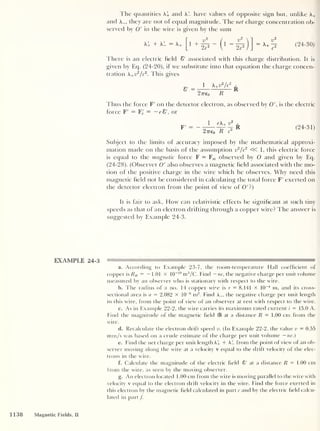
  • 326.
    there really mustbe a second electrode for the term “capacitance” to be meaningful. There is, but this electrode is infinitely far away. This being the case, its shape is of no consequence. 21-8 DIELECTRICS An insulating substance is called a dielectric. Nearly all practical capaci- tors are constructed with dielectrics between their electrodes rather than vacuum (or its near equivalent, air), as we have assumed up to this point. A principal reason is that the presence of the dielectric increases the capaci- tance. To understand why, we must understand what happens when an ex- ternal electric held is applied to a dielectric. When a dielectric substance is subjected to an external electric held 80 , electric forces are exerted on the positively and negatively charged par- ticles which comprise the substance. The particles of opposite charge tend to move in opposite directions because the forces exerted on them are op- positely directed. But a dielectric, being an insulator, is a substance in which charged particles are not free to move indefinitely. In describing the motion that does occur, two important cases are to be distinguished. In the hrst case there are no permanent electric dipoles in the dielec- tric substance. That is, there are no dipoles in the absence of the external electric held. This means that for each molecule of the dielectric the average location of the negative charge (on the electrons) coincides with the average location of the positive charge (on the nuclei) when there is no ap- plied electric held. When an electric held 80 is applied to the dielectric from the outside, it induces electric dipoles —called induced electric dipoles — inside the dielectric. The applied electric held does this by “stretching” each of the molecules so that the average location of its negative charge is displaced from the average location of its positive charge. Figure 21-38 il- © © © © © © © £i © © © © (a) ©iff© ©"a© ©*© ©^© ©"© ©T© wym© ©T© ©"W© ©'TO© ©'strQ ©TO© Fig. 21-38 (a) Schematic representation of a dielectric material whose molecules do not have permanent electric dipole moments. In the absence of an applied electric held £0 , the average positions of each molecule's positive and negative charge coincide. ( b ) When = o an electric held £0 is applied to the material, the positive charge in each molecule is displaced in the direction of £0 and the negative charge is displaced in the opposite direction. Thus each molecule becomes an electric dipole. The springs represent the fact that these are induced dipoles. In other words, if the applied electric held is removed, the two charges in each dipole will “snap back” into coincidence, and it will no longer be an electric dipole. £0 =^0 ( b ) 1002 The Electric Potential
  • 327.
    lustrates the process,picturing each molecule as a positive and negative charge of equal magnitude whose centers are joined by a spring that repre- sents the attractive forces they exert on each other. When 80 = 0, each spring has zero length and the charges overlap completely. The larger the magnit ude of 80 , the greater is the extension of each spring. Since each in- duced electric dipole has an electric dipole moment p of magnitude pro- portional to the separation of its two charges, the electric dipole moment magnitude increases with increasing magnitude of the applied electric field. In fact, experiment shows that the magnitude p increases in direct proportion to the magnitude —provided the applied electric field is not too large. As for direction, each induced electric dipole moment vector p, being directed from the negative to the positive charge, is in the direction of the applied electric field vector 80 . In the second case, there are permanent electric dipoles in the dielec- tric substance. For most such substances, in the absence of an applied elec- tric field So these electric dipoles are randomly oriented because of thermal agitation. When the electric field is applied, the equal and opposite forces it exerts on the two charges of each dipole produce a torque on the dipole. As is indicated schematically in Fig. 21-39, these torques cause the dipoles to rotate so that their electric dipole moments p come into partial alignment with the applied electric field 80 . (See also Fig. 21-17.) Experiment demon- strates that if the applied electric field 8 0 is not too large, the average value of the components of p along the direction of 80 —a measure of the degree of alignment —is proportional to the magnitude of 8 0 . (In addition to aligning the directions of the permanent molecular electric dipole mo- ments, the applied electric field may increase their magnitudes by the stretching effect described in the preceding paragraph.) ** • : ° . *„ » • .* : .* (a) Fig. 21-39 (a) Schematic representation of a dielectric material whose molecules have permanent electric dipole moments. The permanence of each dipole is indicated by connecting its two charges with a rigid rod, instead of with a spring. In the absence of an applied electric held £ 0 , thermal agitation randomizes the orien- tation of the dipoles. ( b ) When an electric held £ 0 is applied to the material, the electric dipole in each molecule rotates in such a way that the positive charge is displaced in the direction of £ 0 and the negative charge is displaced in the opposite direction. ^© 0—0 O—© ©—0 s 0 *o 0—^ ©—o © — Cb ) 21-8 Dielectrics 1003
  • 328.
    p p pp p > p a ^ p_^ p_^ ^0 P P_^ _P_^ Fig. 21-40 The depolarization field 8d , the applied electric field 8 0 , and their vector sum, the internal electric field 8 lnt , in a slab of dielectric material. The depolarization field is the electric field produced by the electric dipoles that the molecules of the ma- terial constitute. Each electric dipole is indicated by its electric di- pole moment p. The electric dipole moments, being directed from the negative to the positive charge of the dipoles, are aligned in the direction of the applied electric field 80 . This is demonstrated in Figs. 21-38 and 21-39. The depolarization field 8d is in the direction of the strongest part of the electric field pro- duced by the individual dipoles. It is shown in Fig. 21-16 that this direction is opposite to the direction of the electric dipole moment p. The direction of p being also the direction of £ 0 , it follows that 8 d is in the direction opposite to that of 8 0 , as depicted here. Figure 21-40 shows schematically the macroscopic effect of these microscopic processes. For simplicity, a rectangular slab of dielectric is pictured, whose faces are perpendicular to the direction of a uniform elec- tric held S0 applied from outside the dielectric. Within the body of the di- electric, electric dipole moments develop —and/or rotate if they are already present —in such a way that on the average the electric dipole moment vectors are parallel to the applied electric held vector. Now Fig. 21-16 shows that the electric held 8^ of an electric dipole is strongest in the region between the two charges, and in this region £> d is antiparallel to the electric dipole moment p. But p is parallel to the electric held 80 acting on the elec- tric dipole. Hence in the region where 8d is most important because it has the largest magnitude, on the average it has a direction opposite to that of 80 . This means that as the magnitudes of the electric dipole moments increase —and/or their directions increase the degree of alignment — under the influence of an applied electric held 80 of increasing magnitude, there comes into existence a macroscopic, oppositely directed electric held 8 d of increasing magnitude resulting from the increasing alignment of the microscopic dipoles. The electric held 8rf is called the depolarization field. Since the macroscopic electric dipole moment along the direction of the applied electric field has an average value proportional to the magni- tude of the applied field, the magnitude of the depolarization field is also proportional to that of the applied field. The actual electric field in the interior of the dielectric, 8int , is the vector sum of the applied and depolarization fields: Sint = So+Sd (21-60) Since 80 and 8d are oppositely directed, the terms in this sum tend to cancel. Thus 8int always has a smaller magnitude than 8o- Also, its magni- tude <9 lnt is proportional to the magnitude g0 of the applied electric field since both terms on the right side of Eq. (21-60) have magnitudes propor- tional to go- This proportional relation between the magnitude of the internal elec- tric field in a dielectric material and the magnitude of the external electric field applied to it is most conveniently stated in terms of the equation g0 Ke =~ (21-61) ®int 1004 The Electric Potential
  • 329.
    Table 21-2 Room-Temperature DielectricConstants and Dielectric Strengths for Various Materials Material Dielectric constant Ke Dielectric strength (in 106 V/m) Vacuum 1 Air (dry) 1.0006 Approx. 1 Water 80 Glycerine 56 Glass 5 to 10 30 to 150 Polyethylene 2.25 50 Mica 3 to 7 30 to 220 The quantity Ke defined in this equation is a constant called the dielectric constant. The value of Ke is always greater than 1 for any dielectric sub- stance, since %nt is always less than %0 . For vacuum, its value is exactly 1. For a conducting substance the value is Ke = because the equilibrium value of i’int is always zero in a conductor. Table 2 1-2 gives the values of the dielectric constant Ke for several different materials. Except for very special applications, capacitors are always made with a dielectric between the electrodes. There are three reasons for this. The hrst reason is structural. When two electrodes are closely spaced to maximize the capacitance, there is no better way of keeping them together while keeping them from making direct contact than by sandwiching them with a thin sheet of dielectric. The second reason is that the dielectric strength —the maximum electric held a material can sustain without suf- fering destructive electrical breakdown as it becomes a conductor —is greater and more stable for many insulating materials than it is for air. This can be seen from the last column of Table 21-2. The third reason is that the dielectric increases the capacitance of the capacitor, as we show in the next paragraph. Consider a plane-parallel capacitor with vacuum (or for most practical purposes, air) between its plates. The plates carry charge per unit area of magnitude |cr| and are separated by distance d. Thus, according to Eq. (21-47), the electric held between the plates has the magnitude The difference in electric potential of the two plates is given by Eq. (21-48o) as V =%0 d = ard Co Now isolate the plates so that no charge can How on or off them. Then hll the space between the plates with a dielectric of dielectric constant Ke . This reduces the magnitude of the electric held between the plates to the value «? int , which Eq. (21-61) shows to be «, %o .. H int Ke Kee0 21-8 Dielectrics 1005
  • 330.
    The new valueof the electric potential difference of the plates is calculated from Eq. (21-48o) to be V = glnt d = ad Kee0 This is reduced from the original value by the factor 1 /Ke . But there has been no change in the charge on the capacitor plates |g|. So the definition of capacitance C in Eq. (21-456), shows that since |g| is unchanged, the decrease in V by the factor 1/Ke is ac- companied by an increase in C by the factor Ke . The same conclusion is ob- tained, no matter what the geometry of the capacitor: The capacitance is in- creased by the factor Ke when an insulating material with that dielectric constant is inserted between the plates of a capacitor. EXERCISES Group A 21-1. Making salt. Use the procedure suggested at the end of Example 21-1 to estimate the electric potential en- ergy change during the formation of the molecule NaCl. 21-2. Near a sphere. A solid metal sphere whose radius is 1.0 cm has a charge of + 1.0 X 10 -8 C. a. What is the electric potential just outside the sur- face of the sphere? Take it to be zero infinitely far from the sphere. b. At what distance from the surface does the electric potential fall to one-half its surface value? 21-3. Speedy approach ? An immobile conducting sphere of radius R and charge |£)| attracts a body of mass m whose charge is — |g|. What is the speed of the body when it is a distance r from the center of the sphere if it starts from rest at a great distance? 21-4. Tiiangular array. a. Calculate the electric potential at a point A midway between charges qx and q3 in the triangular array of charges in Fig. 21-4, taking it to be zero at infinity. b. Do the same for the point B midway between charges q2 and q3 . c. Evaluate the work that must be done to move an electron from A to B . 21-5. Assembling charges. Calculate the work done to bring three widely separated equal point charges q to the apexes of an equilateral triangle of side a. 21-6. At the midway point. a. Midway between two point charges, qt = + |(?| and <72 = |</|, whose separation is d, what is the value of the electric potential if the value is zero infinitely far from the charges? b. What is the rate of change of the electric potential with respect to position along the line between the charges at the midway point? c. What is the value and direction of the electric field at the midway point? 21-7. Breakdown potential. Charge can be added to a conductor in air until % at the surface reaches the value of about 3 x 10⁶ V/m. Higher values of % cause the sur- rounding air to become conducting so that the excess charge is carried away. a. Estimate the maximum charge Q that a sphere of radius 1 m can acquire. b. What is the corresponding electric potential V, taking V = 0 for r = °°? 21-8. Label the equipotentials. Calculate the numerical values of V for each equipotential in Fig. 21-12, taking V = 0 at infinity. Use these values to label the equipoten- tials in the figure. 21-9. Electric potential due to nearest neighbors in steam. The average distance between water molecules in a steam chamber at 100°C and 1.0 atm of pressure is approxi- mately 4.0 x 10 -9 m. Given that the electric dipole mo- ment magnitude of a water molecule is 6.2 X 10 _3° C-m, use Eq. (21-24) with 6 = 0 to determine a typical value for the electric potential experienced by a water molecule due to a single neighboring molecule 4.0 x 10 -9 m away. 21-10. Electric potential of a dipole. An object with elec- tric dipole moment p = pi is placed at the origin of the x, y, z coordinate axes. What is the electric potential V at the point x = L, y = L, z = L? Employ the convention that V = 0 infinitely far from the origin. 1006 The Electric Potential
  • 331.
    21-11. Equivalent capacitance, /.In Fig. 21E-1 1, each capacitor has a capacitance of 1 .00 /xF. What is the equiva- lent capacitance of the arrangement in part a? What is it in part b ? Fig. 21E-11 HHHH Cb ) 21-12. Equivalent capacitance, II. Given three capaci- tors of 1.00 /xF each, what are four ways of connecting them and what is t lie equivalent capacitance in each case? 21-13. Equivalent capacitance, III. Find two different ways of connecting a set of 1.00-/xF capacitors which will give an equivalent capacitance of 0.67 pT. 21-14. Plane-parallel capacitor, I. a. Show that the magnitude of the force with which one plate of a plane-parallel capacitor (in vacuum or air) attracts the other is equal to qf/2e0a, where a is the area of either plate and |c/| is the magnitude of the charge on either plate. b. What is the work done by a force applied to slowly separate the plates when the spacing between them is in- creased from di to <4? c. Show that the increase in the potential energy stored in the capacitor is equal to the work done. 21-15. Plane-parallel capacitor, II. The dielectric in a plane-parallel capacitor has a dielectric strength of 1.0 X 10⁷ V/m and a dielectric constant of 4.0. Its thickness is 0.10 mm. The area of the plates is 500 cm2 . a. What is the maximum electric potential difference between the plates? b. What is the capacitance? c. What is the maximum energy that can be stored? ference between its electrodes is 400 V. The battery is then disconnected, leaving the capacitor charged. Kero- sene of dielectric constant 2.5 is poured into the space between the spherical electrodes, completely filling the space. a. What is the electric potential difference when the capacitor contains kerosene? b. How is the charge on the capacitor affected? c. What is the ratio of the final capacitance to the ini- tial capacitance? Group B 21-18. Potential differences of charged planes. The three large parallel insulating planes in Fig. 2 IE- 18 are 1.0 cm apart. They are uniformly charged, with cr^ = +2.0 X 10 -7 C/m2 , cr B = +4.0 X 10 -7 C/m2 , and cr c = +6.0 x 10 -7 C/m2 , where A, B. and C refer to the left, middle, and right planes. Calculate the following differences in their electric potentials: Fig. 21E-18 a. VB - VA b. Vc - VB c. Vc ~ VA 21-19. Charged nonconducting sphere. A noncon- ducting sphere of radius R has a total charge Q uniformly distributed throughout its volume. The electric held at a point inside the charged sphere is radial and has magni- tude equal to Qr/ATre0R3 , where r is the distance from the center. Show that the electric potential at this point is given by Q f (3fi 2 - r 2 ) 87T€o _ R3 21-16. Plane-parallel capacitor, III. A plane-parallel capacitor has plates of area a and separation d. Over one half of this area the region between the plates is evac- uated; over the other half it is filled with material of die- lectric constant Ke . What is the capacitance? 21-17. Spherical capacitor, I. A spherical capacitor is charged with a battery so that the electric potential dif- taking its value to be zero infinitely far from the sphere. 21-20. Sphere of zero potential. A charge + q is at a dis- tance 3/? /2 from a charge -|<?|/2. See Fig. 21E-20. The figure shows an imaginary sphere of radius R whose center is on the line joining the two charges and is at dis- tance R/2 from the negative charge, in the direction away Exercises 1007
  • 332.
    Fig. 21E-20 from bothcharges. Prove that the electric potential over this sphere is zero, if it is defined to be zero infinitely far from the charges. 21-21. Shell game. A conducting sphere of radius 1 cm has a charge of 1 x 10 -8 C. It is at the center of a conducting shell which has a net charge of 2 X 10 -8 C. See Fig. 21E-21. The inner and outer radii of the shell are 2 cm and 3 cm. Take all these numbers to be exact. Fig. 21E-21 a. What is the charge on (i) the inner surface of the shell? (ii) the outer surface of the shell? b. What is the electric potential (letting it be zero at infinity) (i) just outside the shell? (ii) inside the metal of the shell? (iii) at the surface of the sphere? c. What is the difference in electric potential between the sphere and the shell? 21-22. Far field of a charged disk. Derive Eq. (21-20a) for the far electric field of a charged disk by applying %z = — dV/dz directly to Eq. (21-16a). 21-23. Nearfield of a charged disk. Derive Eq. (21-206) for the near electric field of a charged disk by applying z = —dV/dz directly to Eq. (21-166). 21-24. Torque on a dipole. Prove that Eq. (21-32) for the torque exerted on an electric dipole is valid when the origin about which the torque is measured is chosen at one of the charges of the dipole, instead of at its center. What property of the two forces producing the torque is respon- sible for the fact that the torque does not depend on the choice of origin? 21-25. Energy of a dipole. Employ Eq. (21-32), T = p x 8, in an integration of Eq. (9-58), T = —dU/dO , to derive Eq. (21-35), U = — p • 8. Take particular care in handling signs. 21-26. Electric field in polar coordinates. If V is ex- pressed in polar coordinates, Eqs. (21-18) become %R = —dV/dR, where %R is the radial component of 8, and <^e = —dV/RdQ where is the transverse component. a. Evaluate and for the dipole electric potential given by Eq. (21-26). b. Show that c? 2 = e?| + agrees with the expres- sion obtained in cartesian coordinates in Eq. (21 -29a). 21-27. Spherical capacitor, II. Modify the calculation leading to Eq. (21-49) so that it can be used to calculate the capacitance of the spherical capacitor in Fig. 21-37. Com- pare your results with Eq. (21-59). 21-28. Switching capacitors, I. a. In Fig. 21E-28, the four capacitors are identical. Switch B is kept open. Switch^ is closed and then opened. Switch B is now closed. What is the electric potential dif- ference across each capacitor? The symbol on the right represents a battery. b. Starting with uncharged capacitors, switch B is closed. Then switch A is closed. What is the electric poten- tial difference across each capacitor? 21-29. Equivalent capacitance, IV. a. Derive Eq. (21-52) for the equivalent capacitance of an arbitrary number of capacitors in series. b. Derive Eq. (21-53) for the equivalent capacitance of an arbitrary number of capacitors in parallel. 21-30. Switching capacitors, II. In Fig. 2 IE-30, switch A is closed, then opened. After this, switch C is closed, then opened. The symbols at the ends represent batteries. 100 V St SI + £_ E + l.oo mF 1.00 aiF 200 V Fig. 21E-30 a. If switch B is now closed, what is the electric poten- tial difference across either capacitor? b. Calculate the energy loss when switch B is closed. Account for the energy loss. 21-31. Electricfield energy of a spherical conductor. Prove that half the energy of the electric field of a charged iso- lated spherical conductor of radius R is in the region 1008 The Electric Potential
  • 333.
    between t liesphere and an imaginary concentric sphere of radius 2R. 21-32. Coalescing drops. Two very widely separated identical spherical drops of water of radius R carry equal charges q. a. What is the total electric potential energy of the system? b. The two drops coalesce to form a large one with charge 2 q. What is the ratio of the electric potential energy of the large drop to the sum of the electric potential en- ergies of the two small ones? c. From elementary considerations, show that the ratio should be greater than 1. 21-33. Dielectric slab. A slab of dielectric is inserted between plates of a plane-parallel air capacitor. The thickness of the dielectric is exactly one-half the distance between the plates. If the dielectric constant of the slab is exactly 2 , what is the ratio of the capacitance C with the slab to the capacitance C without it? 21-34. Crabby capacitor. In Fig. 21E-34 a slab of die- lectric of constant Ke is inserted a small distance into the space between the plates of a charged plane-parallel air capacitor. When the slab is released, it is drawn in all the way. / Fig. 2 1 E-34 — / a. Why does this happen? b. The potential energy of a charged capacitor is given by qf/2C. In part a, |g| does not change but C in- creases by a factor of Ke . The potential energy, with the dielectric tilling the gap, is therefore less than the original potential energy. Account for the missing energy. c. By equating the work done on the slab to the de- crease in potential energy, calculate the average force with which the dielectric is pulled in terms of the original po- tential energy U. Group C 21-35. Electron model. A nonconducting sphere of radius R has a charge which is uniformly distributed over its volume. a. Show that the electric potential energy of the charged sphere is iQ2 /4iTe0R, where Q is the total charge. Hint: Build up the charged sphere by putting together uniformly charged spherical shells. b. Assuming that an electron is such a sphere, calcu- late its radius by equating the electric potential energy to its rest mass energy m0c 2 . What is the numerical value of the radius? 21-36. An inverse fifth-power attraction. A point charge q attracts an uncharged object by inducing charges in the latter. If the uncharged object is a small conducting sphere, the force of attraction varies inversely with the fifth power of the distance r between the charge and the center of the sphere. This can be proved in steps as follows. a. Find the energy density in the electric field of the point charge in terms of q and r. b. When the conducting sphere is placed at any loca- tion in the field, the interior of the sphere is field-free, Thus the energy of the electric field is decreased from the value it had in the absence of the sphere. Calculate the de- crease for a sphere of radius a. c. The attraction ol the point charge will pull the sphere into a region where the field and therefore the en- ergy density is greater. Calculate the rate at which the electric field energy decreases with the distance. d. Let dU be the magnitude of the change in the elec- tric field energy due to the change dr in the distance of the conducting sphere from the point charge. Then energy conservation requires that dU = F dr, where F is the mag- nitude of the force on the sphere. Calculate F. No allowance has been made in this calculation for the rearrangement of the electric field lines so as to be- come everywhere normal to the surface of the conducting sphere. Doing so would increase the value of F by a factor of 3, but would have no effect on the inverse fifth-power law that is obtained. 21-37. The method of images. A charge + |t/| is at a dis- tance d from an infinite conducting plane at zero electric potential. This charge will induce a negative charge on the plane. What is the force with which the plane attracts the charge + |<7 |? What is the induced charge per unit area on the plane? The following steps, sometimes called the method of images, will lead you to the answers to these questions. Place a charge — 1<?| on the other side of the plane along the normal from + 1(/| to the plane and also at a dis- tance d from the plane. Then remove the conducting plane as in Fig. 21E-37. Fig. 21E-37 oo Exercises 1009
  • 334.
    Fig. 21E-40 a. Whatis the electric potential due to these two charges at an imaginary plane coinciding with the one re- moved? b. What is the direction of the electric held due to the two charges at this imaginary plane? c. The results obtained fora and b show that the held at the imaginary plane due to the two charges is identical to the held when the conducting plane takes the place of the charge — 1</|. Hence the attraction of the conducting plane on + |g| is the same as the attraction of - |<?| on + |g|. Evaluate this attraction. d. Gauss’ law applied to a conductor gives cr = e0 c?, where a is the charge per unit area on the surface of the conductor and % is the magnitude of the electric held immediately outside the conductor. The value of % can be found by using the electric held due to the point charges. Show that % = 2|(/|cf/47re 0 r 3 , where r is the distance from either point charge to the point where % is being evalu- ated. From this obtain the expression for cr. e. By integrating the charge on circular rings cen- tered about the line connecting the two charges, evaluate the total induced charge on the plane and show that it is equal to — |c/|. 21-38. Find the field from superposed potentials. A sta- tionary positive point charge qx is located at the point (xj , 3>! . 0), and a negative point charge q2 = — 2 qx is located at the point (xj , — 3^ , 0). a. Find the electric potential V. Employ the custom- ary reference V = 0 for r — > °°. b. Find the locus of points in the xy plane for which V = 0. Express your result in the form y = f(x). c. Find the point(s) on the x axis for which V = 0. d. Determine all three components of the electric held for a general point (x, y, z). e. Find all points along the x axis where (i) %x = 0; (ii) = 0. f. Find the point along the x axis for which the mag- nitude of the electric held is a maximum, and express this maximum value in terms of qx and yx . Hint: Careful con- sideration of the electric held superposition equation 8 = 8j + 82 can help you avoid much algebraic manipulation. 21-39. A dipole and a point charge. An electric dipole whose moment is of magnitude p is aligned along an elec- tric held line due to a point charge q. The dipole’s distance r from q is much greater than 2d, the distance between the dipole charges. Show that the magnitude of the force which the electric held of q exerts on the dipole is equal to (q/4iTe0)(2p/r3 ). Is the force directed toward q, or away from q? +q -<7 d_ d r -qid a. Show that the magnitude of the force which either dipole exerts on the other is given by (1/4 7re0 )(6/> 2 /r 4 ) Hint: Use Eq. (21-286) with x = 0. b. Is the force attractive or repulsive? 21-41. Electric dipole in a uniform electricfield. An object whose electric dipole moment is p = px. is held hxed in a uniform external electric held 8 = %y. a. Find the vector torque T on the object. b. Suppose the object is a homogeneous solid sphere of mass m and radius a. The sphere is released from a state of translational and rotational rest at t = 0, and its dipole moment is hxed with respect to the sphere, so that the di- pole moment at time t is given by p(() = p sin 9(t)x — cos 9(t)y. Use the equation T = dL/dt to obtain an equation for the angular acceleration d2 6/dt 2 . c. The initial conditions for the equation obtained in part b are 6 = rr/2 and dO/dt = 0. Show that the following equation is satisfied by the dipole: j(bna2 )(d9/dt) 2 + p% cos 9 = 0. d. How would you modify the equation presented in part c to allow for arbitrary initial values of 9 and d9/dt (but with the initial values of p and dp/dt still confined to the xy plane)? 21-42. Poisson’s equation. In Sec. 21-5, Gauss’ law and the relationship between the electric held 8 and the elec- tric potential V were used to show that in a charge-free region of space the potential satishes Laplace’s equation: d 2 V d 2 V d 2 V n —7 + —7+TT=0 dxr dy~ dz* The same procedure can easily be generalized to show that the electric potential always satishes Poisson’s equa- tion: 21-40. Two dipoles. An electric dipole whose moment is of magnitude p is aligned along the axis of a similar di- pole. See Fig. 21E-40. The distance r between the centers is much greater than 2d, the distance between the opposite charges of either dipole. d 2 V d 2 V d 2 V p dx2 dy 2 dz 2 e0 where p is the local charge density. a. Make the generalization, thereby deriving Pois son’s equation. 1010 The Electric Potential
  • 335.
    b. Determine theelectric field 8. and charge density p, associated with the electric potential V(x, y, z) = ae ~bz 2 where a and b are constants. 21-43. The consequences of symmetry. A cubical box has aluminum faces which are mechanically joined by narrow insulating spacers which serve as the edges of the cube. The interior of the box is charge-free. The six faces of the cube are connected to six different batteries which main- tain them at the following electric potentials: 5, 15, — 10, 30, 45, and - 25 V. a. Without using any complicated numerical proce- dure, determine the electric potential at the center of the cube. Justify your method. b. For which object(s) among the following could a similarly simple means be used to determine the electrical potential at the geometrical center? (In each case, there are no interior charges, and various parts of the surface are held at various given electric potentials.) (i) a hollow, regular tetrahedron (ii) a hollow, noncubical rectangular parallelepiped (iii) a hollow spherical shell 21-44. A charged sheet, I. An infinite sheet containing a position-dependent charge per unit area lies in the xy plane; its electric potential is given by V(x,y, 0) = V0 cos(kx). a. Find the electric potential V(x, y, z) in the charge- free region on both sides of the infinite sheet. Hint: As- sume that V{x, y, z) = /(z) cos(foc) and that V —» 0 for z — » 00 . Why should there be no y-dependence in V(x, y, z) for z f 0? b. Evaluate the electric field 8 (x, y, z) for z f 0. c. Show that the magnitude of the electric field de- pends only upon z. 21-45. A charged sheet, II. Apply Gauss’ law to find the charge per unit area cr(x, y) of the sheet described in Exer- cise 21-44. Numerical 21-46. Field lines and equipotentials, I. Run the field lines and equipotentials program to trace a representative set of electric field lines and equipotential curves for two charges whose value and locations are: q^ = + 1 (in C) at x = 0 and z = 0; q2 = + 2 (in C) at x = 0 and z = 5 (in cm). 1 his work is quite time-consuming if carried out on a programmable calculator. (But there is no tedium if you use a computer with a graphic display.) So use values of As and n which are, respectively, twice as large and twice as small as those used in Example 21-6. in order to reduce the time required (unless you use a graphic display com- puter). Also, evaluate V for each equipotential. Compare your results with those displayed in Fig. 21-11, and com- ment on the differences. 21-47. Field lines and equipotentials, II. Run the field lines and equipotentials program to trace a representative set of electric field lines and equipotential curves for two charges whose values and locations are: q1 = + ] (in C) at x = 0 and z = 0; q2 = — 2 (in C) at x = 0 and z = 5 (in cm). Also evaluate V for each equipotential. Compare your results with those displayed in Fig. 21-12, and com- ment on the differences. The remarks made in Exercise 21-46 about the time required for the calculations apply here. 21-48. Laplace’s equation, I. a. This exercise requires the use of a small computer. Write a program for carrying out an iterative solution of Laplace’s equation. Follow the lines established by Ex- ample 21-10, but allow for a more flexible choice of the number of grid points and for the specification of the val- ues of V at the boundaries. Test the program by repeating the calculation in the example, recording the time re- quired to obtain convergence to two decimal places. b. Choose a different set of initial values of V at the interior grid points. Specifically, choose V = 0 at each of these points. Repeat the calculation, and show that the same results are obtained. Also record the time required to obtain the results. Compare the time required for the two calculations, and explain what the comparison shows. 21-49. Laplace’s equation, II. Run the Laplace’s equa- tion computer program as in Exercise 21-48 until you ob- tain convergence to three decimal places. Record your re- sults. Then repeat the calculation with a grid in which the spacing of the grid points is halved along both the x and y axes. Record your results, but only at the positions of the initial set of grid points. Continue this process, repeatedly halving the grid point spacing, until the calculation con- verges with respect to grid point spacing to three- decimal-place accuracy. When the convergence is achieved, the results of the numerical calculations will be identical to this accuracy with the results of analytical cal- culations. 21-50. Laplace’s equation, III. a. Apply the Laplace’s equation computer program written in Exercise 21-48 to find values of V at points in- side a set of three adjacent long electrodes extending in the z direction, whose intersections with the xy plane form a triangle with two perpendicular sides of equal length. The values of V on the two perpendicular electrodes are V = 0 and V — + 1 V. The value on the third electrode is V = + 2 V. b. Explain briefly the difficulty that arises if the trian- gle does not have two perpendicular sides of equal length, and what you would do to handle the difficulty. Laplace’s equation does not have analytical solutions for the elec- trode systems considered in either part of this exercise. Exercises 1011
  • 336.
    22 Steady Electric Currents 22-1 ELECTROMOTIVEUntil 1800, the only way to produce the charge transfer necessary to ob- FORCE AND serve electrical phenomena involved the use of friction. But the electric ITS SOURCES force i s quite strong. Thus the amount of charge which can be put on an electrode is limited by the rapid buildup of an electric potential (or poten- tial for short) on the electrode which prevents further accumulation of like charge. Consider a specific example. Because of the strength of the electric force, the capacitance of practical capacitors is rather small. That is, the plates of a typical capacitor having a large electric potential difference (or potential difference for short) carry rather small amounts of charge. Therefore, when a capacitor is discharged by connecting its electrodes, the How of charge is either brief or weak, or both. The invention in 1800 of the voltaic cell changed all this. The familiar dry cell and mercury cell are forms of a voltaic cell. A battery is a series of connected voltaic cells. Such devices make it possible to deal with very large quantities of charge flowing steadily over quite small potential differences. Today there are many other ways of ch iving such a steady flow, but the vol- taic cell still has great practical importance. In addition to its widespread usefulness, moreover, the voltaic cell provides one of the essential links between the sciences of physics and chemistry, a point to which we return briefly later. The establishment of net electric charge in any region of space re- quires that the charge be separated from charges of opposite sign. (This happens, for example, in the charge-transfer processes discussed in Chaps. 20 and 21.) A device separating electric charges must do work on those charges in some way, in order to overcome the electric forces which op- 1012
  • 337.
    Fig. 22-1 Schematicdrawing of the van de Graaff generator, used to produce very high potential differences. A hollow spherical electrode is supported and insulated from the ground by ceramic insulators. Near the ground, the endless belt passes between a set of wires on one side and a metal plate on the other side. An electronic device separates charge and this produces a potential difference of several thousand volts between the wires and the plate. As a result, a continuous electric discharge (rather like a steady but very weak lightning discharge) takes place, which passes through the belt. Electric charge is thus “sprayed” onto the nonconducting belt, which carries it upward. The motion of the belt then transfers this charge to the hollow electrode. Until the charge is inside the electrode, it experiences a strong repulsive force due to the charge already on the electrode. Work must therefore be done to move the charge. As is discussed in the text, the energy re- quired to perform this work is supplied by the mechanical device (usually an electric motor) which turns the belt. Once the charge on the belt passes inside the electrode, the electrode exerts no further force on it, for reasons explained at the end of Chap. 20. As the charges on the belt come into contact with the metal wires brushing over the belt inside the hollow electrode, the repulsion among them causes some of them to leave the belt and flow through the wires to the outer surface of the electrode. The longer the process continues, the more charge is accumulated on the electrode. The potential difference between the hollow electrode and the earth thus increases until a light- ninglike discharge takes place through the air between them, or along the surface of one or more of the insulating supports. When the mag- nitude of the charge transferred from the earth to the electrode is |<?|, the potential difference V between the two is given by V = q/C, where C is the capacitance of the system. If the hollow electrode is well insu- lated from the earth, q can be made large enough (before discharge occurs) to result in a value of V equal to several million volts. pose the separation. That is, the electric potential energy of a system com- prising equal amounts of positive and negative charge can be increased only by doing work on the charges. How this work is done on the charges depends on the particular device employed. The general features of the process are especially apparent in the case of the van de Graaff generator, depicted in Fig. 22-1. As is explained in the caption, the separated electric charge is transferred from one electrode (the earth) to another (the large, hollow metal sphere) on a moving belt made of a nonconducting material. This process produces a large potential difference between the electrodes and thereby gives the system an appreciable amount of electric potential energy. Because the charges on the belt move against a repulsive electric force, work must be done to make the belt move. The source of the me- chanical energy expended in doing this work is the macroscopic device driving the belt. In principle, it could be a steam engine, in which case the electric potential energy of the van de Graaff generator is created at the expense of thermal energy. In practice, the source of the mechanical en- ergy is an electric motor, so that the mechanical energy required to drive the belt, and thus create electric potential energy, is itself produced at the expense of electromagnetic energy. In the case of the voltaic cell, the source of the energy required to sepa- rate positive and negative charges, and to place a net positive charge on one electrode and a net negative charge on the other, is less evident on casual inspection because it is microscopic. The energy arises from the breaking and making of chemical bonds in the course of the chemical reactions that take place between the electrodes and the fluid (called the electrolyte ) in which they are immersed. In other systems, the energy converted into elec- tric potential energy initially may be in still other forms. 22-1 Electromotive Force and Its Sources 1013
  • 338.
    V Fig. 22-2 Generalrepresentation of a source of electromotive force. By means of some unspecified mechanism, the de- vice represented by the shaded rect- angle separates positive and negative charges. As a result, there is a potential difference V between terminals A and C. Terminal A, called the anode, or positive terminal, is at the higher potential, and terminal C, called the cathode, or nega- tive terminal, is at the lower potential. Figure 22-2 illustrates in a very general way a device which converts some other form of energy into electric potential energy by driving apart positive and negative charges. The device, whose details do not concern us here, is represented as a rectangle. It has two terminals, shown at opposite sides of the rectangle. There is a potential difference V between the terminals resulting from the (unspecified) process taking place inside the device. The terminal having the higher potential of the two, labeled A, is called the anode and is usually denoted by the symbol +. The terminal having the lower potential, labeled C, is called the cathode and is usually denoted by the symbol — . If a small positive test charge q is transported through the device from the cathode to the anode, the electric potential energy of the system must be increased by the amount qV. The work per unit charge required to do this must be performed by the device and is called the electromotive force. The value of the electromotive force is thus given by the equation electromotive force _qV- V ( 22- 1 ) The device itself is called a source of electromotive force. It maintains an electric potential difference between its terminals in a manner analogous to that in which a water pump maintains a pressure difference between its inlet and outlet pipes. There are two important points to be remembered about the electro- motive force. The first has to do with the name itself, whereas the second has to do with the connection between the electromotive force and the elec- tric potential difference associated with it: 1. The word “force” is not used in the precise sense to which it is restricted in modern scientific terminology. Rather, it is used in the every- day sense meaning “driving influence.” When the term “electromotive force” was hrst coined, about 150 years ago, physical terms were not always used as precisely as today. Both because of the inaccuracy of the terminol- ogy and because “electromotive force” is a long and awkward term, the abbreviation emf, derived from the hrst letters of the main components of the term, is used almost universally in the English-speaking world. (The letters are pronounced separately, as e-m-f.) The signihcance of the word “electromotive,” or “producing motion of electricity,” arises from the fact that sources of emf are used most often to drive electric currents. 2 . While the emf is numerically equal to an electric potential dif- ference and is measured in units of volts, just as a potential difference, the emf is not itself a potential difference. The emf produces a potential dif- ference, but arises from physical phenomena which are not necessarily electrical in nature. A more important distinction between an emf and a potential difference arises from the fact that emf represents not potential difference, but work done per unit charge. This work need not be done by a conservative force, whereas a potential difference can be defined only for a conservative force. The voltaic cell is an important example of a source of emf. A detailed phenomenological description of the operation of the voltaic cell will be found in any elementary chemistry text. By means of the process sketched in Sec. 15-5, chemical reactions provide the “chemical energy” required to 1014 Steady Electric Currents
  • 339.
    V (in V) Fig.22-3 (a) A voltaic cell. Two electrodes made of different electrically conducting sub- stances (here shown to be copper and zinc) are immersed in a conducting solution called the electrolyte (here shown to be a mixture of copper sulfate and zinc sulfate in water). Some of the metal atoms from each electrode ionize, going into solution as positively charged ions, each of which leaves one or more electrons behind on the electrode. As a result, each electrode acquires a negative potential relative to the electrolyte. For each electrode, the magnitude of the potential is determined by the energy available per atom for the specific ionization reac- tion involved. Since this energy is different for each of the two electrodes, a potential dif- ference exists between the electrodes, as suggested by the diagram of part (b). ff the electrodes are linked by an external conductor, electrons will flow from low potential to high potential. In the cell shown, the electrons will combine with copper ions at the anode-electrolyte interface, and copper metal will plate out on the anode. At the same time, removal of the electrons from the zinc cathode enables an “equal amount” of zinc metal to ionize and go into solution in the electrolyte. (Can you give a precise meaning to the term “equal amount”?) The process will continue until either all the zinc is dissolved or all the copper ions in the electrolyte have been plated out. separate electrons from atoms. This process, called ionization, produces an electric potential difference V between the terminals. A schematic diagram of a voltaic cell is shown in Fig. 22-3, and a brief explanation of its opera- tion is given in the caption. For the purposes of this discussion, it suffices to note the following basic principles, which are founded on chemical obser- vations: 1. Every chemical reaction involving 1 kmol of a substance requires the transfer of |v| kmol of electrons between that substance and some other substance. The quantity v is a small positive or negative integer called the valence of the substance, and most often it lies between —4 and +4. The overall chemical reaction which drives the voltaic cell, shown in Fig. 22-3«, for instance, can be carried out simply by dropping powdered zinc into a solution of copper sulfate. Zinc-metal (Zn) atoms lose two electrons (|jz| = 2) and become zinc ions (Zn2+ ) in solution. At the same time, copper ions (Cu2+ ) in solution acquire two electrons (|r>| = 2) and come out of solution as copper-metal (Cu) atoms. This exchange of electrons can be written as Zn + Cu2+ > Zn2+ + Cu 2. The structure of the voltaic cell is such that the necessary transfer of electrons takes place through an external connection. The electrons are propelled by the electric force arising from the potential difference V between the terminals of the cell. The magnitude of the charge transferred from cathode to anode with 1 kmol of electrons is Ae, where A — 6.022 X 22-1 Electromotive Force and Its Sources 1015
  • 340.
    10 26 is Avogadro’s number,defined in Sec. 17-4, and e is tfie magnitude of the electron charge. The quantity Ae is called Faraday’s constant That is, the quantity & = Ae (22-2) is the magnitude of the total electric charge on 1 kmol of electrons. To four significant figures, $F has the value 3F = 6.022 x 10 26 electrons/kmol x 1.602 x 10 -19 C/electron or & = 9.649 x 10 7 C/krnol (22-3) Faraday’s constant can be measured by carrying out an electrochemical reaction involving n kmol of a substance of known valence v. If the magni- tude of the total charge transferred through the external connection is measured to be |#|, we have |#| = nv2F (22-4a) or = J_ nv (22-46) If any two of the quantities 2F, A, and e are known, the third is deter- mined by Eq. (22-2), 8F — Ae. As mentioned in Sec. 20-2, the value of e was first estimated in 1874 by G. Johnstone Stoney from the values of Faraday’s constant and Avogadro’s number. His value, e — 1 x 10 -20 C, was flawed by the very poor estimates of Avogadro’s number then available. The first accurate evaluation of A was made possible by Millikan’s determination of e. Today there are much more precise methods of measuring the electron charge —e, but Eq. (22-2) remains an important means of determining Avogadro’s number. 3. A system in which a chemical reaction takes place often may be regarded as an isolated system. In the course of the chemical reaction, the potential energy of the system always changes, for the reasons discussed in Sec. 15-5. If the potential energy decreases, the reaction is called exothermic (that is, heat-releasing) because the energy is most commonly transferred to the outside world in the form of heat energy. The chemical reactions used in voltaic cells are exothermic. But in a voltaic cell, most of the energy is not released directly in the form of heat. Rather, it appears largely in the form of the electric potential energy possessed by the system because it contains separated positive and negative charges. This energy is converted to still another form of energy as the charge is propelled through the external connection from one terminal to the other by the electric force arising from the potential difference between the terminals. If the potential difference has magnitude |V| and a charge of magnitude |#| is transferred via the ex- ternal connection, the transfer involves a decrease of magnitude qV in the electric potential energy of the system. It is this energy, sometimes called electric energy, which is used in the enormous number of different ways which give electricity so much of its practical importance. I he connection among the amount of matter undergoing chemical reaction, the amount of electric charge transferred, and the amount of en- ergy released by the system to the outside world is considered in Example 22- 1 . 1016 Steady Electric Currents
  • 341.
    EXAMPLE 22-1 RM Youhave a voltaic cell like that shown in Fig. 22-2a, made with electrodes of zinc and copper. You remove the zinc electrode from the cell, weigh it, and replace it in the cell. You measure the potential difference between the terminals attached to the electrodes and find its magnitude to be |Vj = 1.1 V. You place the entire system in a calorimeter. Next, you “short-circuit” the cell by connecting a thick copper wire between the terminals. Using the calorimeter, you measure the heat evolved by the system. (In particular, you note that the wire becomes quite hot, but the cell be- comes warm as well.) After some time, you remove the cell from the calorimeter, disconnect the wire, and weigh the zinc electrode again. You find that its mass has decreased by 1 .3 g. This zinc goes into solution in the electrolyte in the course of the chemical reaction. Assume that the emf of the cell did not change appreciably during the process and that the valence of the zinc in the chemical reaction taking place in the cell is v = 2. a. How much charge q has been transferred from one electrode to the other? The molecular weight of zinc is 65. In order to use Eq. (22-4a) in finding q, you must first find the number of ki- lomoles n of zinc which have gone into solution. By definition, the molecular weight of zinc is the mass, in units of kilograms, of 1 kmol of zinc. Thus 1 kmol of zinc has a mass of 65 kg, and you have n 1.3 x IQ-* kg 65 kg/kmol 2.0 x 1CT5 kmol Since the valence of zinc in the reaction is v = 2, Eq. (22-4«) gives the amount of electric charge transferred from one electrode to the other as |<?| = nvffi = 2.0 x 10 -5 kmol X 2 x 9.6 x 10 7 C/kmol or q = 3.8 x 10³ C This is millions of times greater than the amount of charge transferred from one electrode to the other in the discharge of a typical capacitor. b. Elsing the electrochemical information you have just acquired, predict the heat energy output — AH you expect to find when you make the calorimetric mea- surements. The charge q is propelled through the wire across a potential difference V = 1.1 V. In this process, which is exothermic, the electric potential energy lost has magnitude qV = 3.8 X lo 3 C X 1.1 V = 4.2 X 10 3 J According to the principle of energy conservation, qV must be equal to the heat output — AH, since there is no other form of energy into which the electric potential energy can have been converted. So you have -AH = 4.2 X 10 3 J This energy is equivalent to approximately 1 kcal. Thus the chemical energy re- leased in the reaction of a little more than 1 g of zinc can heat about 1 kg of water through 1°C. This is the case regardless of whether the chemical energy is con- verted directly to heat energy in the same chemical reaction carried out directly or by carrying out the reaction in a voltaic cell where you first convert the chemical en- ergy to electric energy and then to heat energy. How long would a 1-W flashlight bulb run on the electric energy produced? If a source of emf did nothing more than move charge from one ter- minal to the other, the two terminals would have net charges of opposite 22-1 Electromotive Force and Its Sources 1017
  • 342.
    22-2 FLOW OF ELECTRICCHARGE AND ELECTRIC CURRENT v Fig. 22-4 An electric circuit, consisting of a source of emf whose terminals are connected externally by a conductor. The direction 8 of the local electric field is shown at several locations inside and outside the source of emf. The arrowheads describing the electric po- tential difference V between the termi- nals of the source of emf denote the directions of pathways along which the electric potential increases. sign and equal magnitude. This is the reason for the standard plus and minus symbols used for the anode and the cathode, respectively. It is not necessarily true, however, that the terminals have net charges of opposite sign. (In the voltaic cell, for instance, the terminals themselves are electri- cally neutral, or nearly so. And both terminals are electrically connected to electrodes which have net negative surface charges where they are in con- tact with the electrolyte.) The significant point is that the charge distribution through the source of emf is nonuniform in such a way that there is a potential dif- ference between the terminals. In the presence of an externally imposed electric field, the charges within a conductor experience electric forces. And since some of the charges within a conductor are mobile, there is a flow of charge. This flow will persist until the buildup of excess charge on some parts of the surface of the conductor, and the corresponding deficiency of charge on other parts, leads to the buildup of an internal depolarizing field within the conductor, due to the separation of charge, which exactly cancels the externally imposed field. If an isolated conductor is placed in an externally imposed electric field, the charge redistribution is very rapid, and thus the charge flow persists only briefly. But an electric field can be maintained across a conductor indefinitely by connecting two points on it (say, at its ends) to the terminals of a source of emf such as a battery, as shown in Fig. 22-4. When charge flows through the conductor toward one of the terminals to which it is connected, it does not build up on the surface of the conductor so as- to result in a depo- larizing field which brings an end to the charge flow. Rather, the source of emf “pumps” the charge through itself, performing work on the charge as it does so. In the absence of the “pumping,” the potential difference V between its terminals would not remain constant, but would diminish as the flowing charge built up and thus imposed a depolarizing field across the source of emf as well as across the conductor to whose ends it is connected. To put it another way, the electric potential difference across a source of emf implies the existence of an electric field within the source. Since the ends of the conductor are in contact with the terminals of the source of emf, the same electric potential difference V must exist across both con- ductor and source. (Remember that the potential difference between two points must be independent of the path taken between them.) The electric potential difference across the conductor is therefore not zero, and there must be an electric field within the conductor. As long as this electric field persists, charge flow through the conductor will continue. The net result is a continual flow of electric charge around a closed pathway. Such a system, consisting of a source of emf and an external conducting path between its terminals, is called an electric circuit, or simply a circuit. In Sec. 16-7 we described the flow of ordinary fluids in terms of the mass flux A very similar mathematical description can be used for the flow of electric charge. However, it is developed independently here. Figure 22-5 is almost the same as Fig. 16-18. It depicts a tube of flow —the bundle of paths, or streamlines, along which fluid passes. The cross-sectional area of a tube of flow may vary. This may happen in the case of water flow be- 1018 Steady Electric Currents
  • 343.
    Lower Higher '<! potent ] Fig.22-5 A tube of flow of electric charge. The streamlines, called current lines, are denoted by dashed curves. Their sense is conven- tionally from higher to lower electric potential, and they are every- where tangent to the local electric held vector £ . However, the charge motion has the same sense as the current only if the charge is positive. Negative charge moves in the opposite sense, from lower to higher electric potential. By definition of a tube of flow, no charge passes through the walls of the tube. Since the tube contains no sources or sinks of charge, the current passing through the surface M must be equal in the steady state to the current passing through the surface N. cause of a variation in the size of the pipe. In the case of flow of electric charge, the same effect may result from a variation in the size of the wire carrying the flowing charge. For water flow, we can draw an imaginary surface across the tube of flow at any location and use Eq. (16-35) to define the mass flux dm dt (22-5) The mass flux is thus the mass m of fluid which passes across the surface per unit time t. We do a completely analogous thing for the flow of electric charge in a conductor. I he electric charge flux is almost always called elec- tric current, defined to be the amount of electric charge q passing per unit time through an imaginary surface (such as M in Fig. 22-5). The symbol i is universally used for electric current. Thus we have, by definition, i dq dt ( 22- 6) The unit of electric current must be coulombs per second. This very impor- tant unit is given the name ampere (A) after the French physicist Andre Marie Ampere (1775-1836), who was one of the founders of the theory of electromagnetism. The ampere is thus related to the coulomb by the ex- pression 1 A = 1 C/s (22-7) The current i is a signed scalar. We often have used the term “signed scalar” to denote a vector in one dimension. But the current is not a vector, even when it describes the flow of charge in a long, thin wire. This is be- cause of an essential aspect of any flow of charge: it must always flow in an electric circuit, or closed pathway. Such a closed pathway cannot exist in one dimension; at best, the long, thin wire is only a part of a complete cir- cuit. Nevertheless, a current must always have a sense, and it is this sense that is denoted by the sign of i. Even in the simplest loop, consisting of a 22-2 Flow of Electric Charge and Electric Current 1019
  • 344.
    single source ofemf whose terminals are joined by an external wire, charge must flow one way or the other. For currents whose sense does not change with time, called direct currents, it is conventional to take the positive sense of current as that of a pathway around the circuit which would befollowed by a positive test charge that is free to move through the circuit. At any point in the circuit not located in- side a source of emf, such a test charge would move in the direction speci- fied by the unit vector 8 having the direction of the local electric field vector 8. Within a source of emf, the physical mechanism which produces the emf drives the positive test charge in the sense opposite to that of the local electric field. If you refer to Fig. 22-4, you will see that this leads to a sense for the current which is consistent throughout the circuit. (For cur- rents whose sense does change with time, called alternating currents, it is con- venient to use a different convention in defining the positive sense of the current. This convention is introduced in Chap. 26, where alternating cur- rents are treated for the first time.) The tube of flow in Fig. 22-5 may be regarded as a segment of an elec- tric circuit. Some of the many possible pathways which a positive test charge might take through the tube of flow, in its journey around the cir- cuit, are shown as dashed lines. These pathways are entirely analogous to the streamlines used in describing fluid flow, and they all have the same sense. When streamlines are used to describe electric currents, they are called current lines. In the absence of places where additional electric charge can enter or leave the region MN, all the current lines which pass through M in the figure must also pass through N in the steady state. The current is the same at M as at N, and by our convention the sense of the current is the same at M and N as well. Thus for steady currents we can equate the cur- rent iM passing through M with the current iN passing through N. This gives us the equation I'M = In ( 22- 8) which is the electrical form of the continuity equation discussed in Chap. 16. The analogous equation for fluid flow, Eq. (16-37), is —$>M = <J>W . The dif- ference in sign between the two equations is due to the fact that different conven- tions are used to define the sense of flow in the two cases. In analogy to the case of ordinary fluid flow, we can reexpress Eq. (22-6) in terms of the mobile charge density pq , which is the total mobile electric charge q per unit volume. We define Pq - 1 volume occupied by charge q (22-9) Both the magnitude and the sign of the mobile charge density depend on the particular conducting material under consideration. In the interest of simplicity, we begin by restricting our attention to a material containing only one type of mobile charge, whose sign is positive. (Many of the so- called p- type semiconductors are of this sort.) Later in this section, we con- sider materials (such as most common metals) in which the mobile charges are electrons, whose sign of charge is negative. In Chap. 23, we gener- alize to the situation where both positive and negative mobile charges are 1020 Steady Electric Currents
  • 345.
    present (as isthe case in many solutions, such as salt in water). For the mo- ment, then, we require that pQ be positive. Nevertheless, the material dis- plays zero net charge because of the presence of an equal density of immo- bile charges of the opposite sign. We also assume that the density of the mobile charges is so great that they may be considered a continuous fluid from the macroscopic point of view. This is analogous to the way in which we have considered a large number of molecules as comprising the special kind of fluid called a gas. In this case, however, the mobile electric fluid is nearly incompressible, in con- tradistinction to gases which are highly compressible. The reason for this lies in a slight extension of the argument made in Sec. 20-2 concerning the way in which mobile charges distribute themselves within an array of im- mobile charges of opposite sign. Precisely because the immobile charges are immobile, their charge density is fixed. If a conductor is in an uncharged state, the density p9 of the mobile charges must everywhere be equal in magnitude and opposite in sign to that of the immobile charges. Any local fluctuation from this condition will bring strong local electric fields into play. As a consequence, mobile charge will flow into or out of the region of imbalance in such a way as to restore overall local electrical neutrality. This state of affairs can be disturbed by the imposition of an external electric held. In all ordinary conductors, however, the externally imposed electric held required to drive a substantial current is so small as to be neg- ligible compared to the internal electric fields produced by even very slight local deviations of the mobile charge density from its equilibrium value p„. Thus, in general, a conductor is everywhere electrically neutral even when it carries a substantial electric current. This is equivalent to the statement that the electric fluid is incompressible. (Note that the argument just completed is valid regardless of the sign of the mobile charges.) Excess charge can and does build up in conductors under certain circumstances —on the plate of a capacitor, for example. But we have already seen at the beginning of Sec. 22-1 that the process is severely limited. Typical capacitances are small; it takes very little excess charge on a capacitor plate before the opposing po- tential brings to a stop the steady current flowing through a wire attached to the capacitor. If the ends of a sample of a material having positive mobile charge are connected to the terminals of a source of emf, there will be a potential dif- ference across the sample. Consequently, there will be at every location in- side the sample an electric field 8. We show soon that under the combined influence of this electric field, which may vary from place to place, and of effects which are frictional in nature, the mobile electric fluid will move with a velocity v. This terminal velocity is called the drift velocity. It is pro- portional to the electric held, and the acceleration of the electric fluid is zero. (In studying the electric current, as in studying the flow of an ordi- nary fluid, the ordered velocity of the fluid taken as a whole, and not the random velocities of the individual particles of which it is comprised, is of interest.) Since the mobile charge is positive, the drift velocity is parallel to the electric held at every point in the wire. (In this book we do not consider the case of anisotropic materials, in which the directional relation between v and 8 is more complicated.) Now consider the special case in which the conducting sample is a wire of uniform cross-sectional area a. In this case, symmetry suggests that the 22-2 Flow of Electric Charge and Electric Current 1021
  • 346.
    electric field 8is everywhere the same in magnitude and is directed along the wire. We show below that the electric current (or charge flux) can be written in the form i = pq a • 8 (22-10) where 8 is the unit vector in the direction of the electric field at any point in the wire and v is the drift velocity at the same point. This equation is very much like Eq. (16-39), which expresses the mass flux <f> w in terms of the mass density pm and the fluid how speed v in the form <t> m = pmav. The slightly more complicated form of Eq. (22-10) allows for the later treatment of charge how in materials where the mobile charge is negative, so that the current and the motion of charge are in opposite senses. For positive mobile charge, however, v • 8 = v because v is proportional to 8 and the propor- tionality constant has a positive value, so that v has the same direction as 8. Thus Eq. (22-10) becomes i = pq av for pq > 0 (22-11) The derivation of Eq. (22-10) for positive mobile charge is as follows. Consider an imaginary surface moving with the electric fluid. At a certain moment, the moving surface passes through the stationary surface M in Fig. 22-6. A very short time dt later, it has moved through a displacement ds, whose magnitude is d s • 8. If a is the area of the surface M, the volume of fluid crossing M during the time interval dt is a ds • 8. According to Eq. (22-9), its total charge dq is the product of the charge density pq and this vol- ume, and thus dq = pqa ds • 8 (22-12) Using the definition of electric current i given by Eq. (22-6), we obtain dt pq a ds dt (22-13) Now note that the quantity ds/dt is the drift velocity v in the immediate vi- cinity of M, so that v = ds/dt. The current i can thus be written i — pqa • 8 in agreement with Eq. (22-10). We now show that even though Eq. (22-10) was derived for the special case of mobile charge having positive sign, it is valid also for a material in Fig. 22-6 Mobile electric charge flows steadily through a conductor of arbitrary shape. The direction of the electric field is shown by the unit vectorg The cross-sectional area of the conductor is a. In an infinites- imal time dt, an imaginary surface moving with the charge, and originally coinciding with the fixed marker surface at M or N, moves through a dis- placement ds to the position shown by the solid line. The drift velocity of the mobile charge is v = ds/dt. Both the electric current i and the density of mobile charge pq are the same at M and N. Since i = pQa £. the magnitude of v must be larger at N where the value of a is smaller. 1022 Steady Electric Currents
  • 347.
    which the mobilecharges have negative sign and the positive charges are immobile. Consider a material which differs from the material we have just studied only in that the signs of all charges, both mobile and immobile, are reversed. For this new material, the mobile charge density p' q is given by the equation pj = — pq . Since nothing is changed but the sign of the charges, the same electric held imposed on a sample of the new material will result in motion of the mobile electric fluid with the same drift speed as before, but in the opposite direction. That is, the drift velocity v' is given by the equa- tion v' = —v. Thus for the new material, Eq. (22-10) can be written as i = p'„a' • 8 or i = -pq a(~ * 8) = pq a • 8 (22-14) The current in this material having negative mobile charge is the same — both in magnitude and in sense —as the current in the similar material having positive mobile charge. Reversing the sign of the mobile charge re- sults in a reversal of the sense of motion of the charge, but does not affect the current. I he usefulness of this fact becomes increasingly evident in this and the following four chapters. It is to be understood that in using Eq. (22-10) the quantities a, v, and 8 must be evaluated at the same location. In the important particular case where the conductor is homogeneous and has uniform cross-sectional area (as is often the case for common electrical wiring), a and v have constant magnitudes throughout the conductor. Example 22-2 demonstrates the ap- plication of Eq. (22-10) to an electric current flowing through a copper wire. Fhe mobile charge is negative in copper, as is demonstrated in Sec. 22-4. EXAMPLE 22-2 A no. 14 copper wire (a size in common use in households) is specified to have cross-sectional area a = 2.082 X 10 -H m2 . Find the magnitude and direction of the drift velocity v when the wire is carrying its maximum rated current i = 15 A. The mobile-charge density in copper is approximately pq = —1.3 x 10 10 C/m3 . (You will see in Example 22-6 how it is possible to estimate this charge density in metals and in Sec. 23-3 how a quite accurate value can be obtained.) Since pq has a negative value, the mobile charges are negative and move in a direction opposite to that of the electric field. Thus the scalar product v • 8 in Eq. (22-10) gives you v • 8 = —v where the drift speed v is the magnitude of the drift velocity v. Hence you can write Eq. (22-10) in the simplified form i = —pQ av. Solving for v and inserting the nu- merical values given, yon have i P<ia 15 A -1.3 x 10 10 C/m3 x 9.1 x Hr6 m2 5.5 x 10 4 m/s or a little more than 0.5 mm/s. The direction of motion is opposite to that of the elec- tric field. According to the definition of electric potential difference, V = 22-2 Flow of Electric Charge and Electric Current 1023
  • 348.
    8 • ds,the overall sense of motion of negative charge through the con- path ductor is from lower to higher potential or, as it is often put loosely, “from minus to plus.” The sense of the current i, however, is from higher to lower potential, or “from plus to minus.” The very small drift velocity calculated for a commonplace case in Ex- ample 22-2 is characteristic of the drift velocities associated with electric currents in metals. The mobile-charge density in metals has so great a mag- nitude that the electric fluid need not move very fast in order to transport electric charge at a significant rate. In other words, the electric fluid need not move very fast in order for there to be a significant electric current. 22-3 OHM’S LAW 0 Source of adjustable emf N® Fig. 22-7 Schematic drawing of an apparatus for determining the relation between the (adjustable) potential dif- ference V applied across a sample wire by means of an adjustable source of emf, and the current i flowing through the wire. The current is measured by a device called an ammeter, denoted by the circle labeled A. An ammeter measures the current flowing through it. But since there is no place in the circuit where charge can accumulate, this current must be equal to the current i flowing at any point in the circuit. Even before voltaic cells became available in 1800, it was known that some materials appeared to be better conductors of electric current than others; that is, some materials would carry more current than others w hen samples of the same shape and size w'ere connected across the same potential dif- ference. Cavendish, a brave man, had even made rough —and painful — comparisons. He attached sample wires to charged capacitors and dis- charged the capacitors through the wires and his body by touching the free ends of the wires. He then compared the intensities of the shocks that he felt! (Nowadays we have better methods.) There is no general rule for the experimentally observed dependence of electric current flow through a sample (say, a wire) on the potential dif- ference imposed by a source of emf connected across the sample. A vast variety of possibilities exist, since current can pass through homogeneous substances or mixtures; through solids, liquids, or gases; or along or through surfaces or interfaces between substances. The current can de- pend on the magnitude and t He sense of the imposed potential difference, as wr ell as on such other factors as temperature. Indeed, the exploitation of the possibilities is one of the foundations of the field of electronics. Figure 22-7 showr s schematically an apparatus for measuring the rela- tion between the potential difference V imposed across a sample wire by a source of emf and the current i driven through the sample. For samples made of a very large class of substances under a wide range of conditions, the observed relation is a simple one. For a given sample of this sort, the re- lation is one of direct proportionality and can be expressed in the form tocT (22- 15a) We introduce a proportionality constant 5 and rewrite this relation as an equation: i = SV (22-15 b) The quantity 5 is given the name conductance. The larger the conduc- tance, the more current flows for a given potential difference. From Eq. (22-156), it follows that the conductance S is expressed in units of amperes per volt. This unit is given the name siemens (S). Thus wr e have by definition 1024 Steady Electric Currents 1 S = 1 A/V (22-16)
  • 349.
    The siemens isnamed after the distinguished German-British inventor, elec- trical engineer, and entrepreneur Sir William (Karl Wilhelm von) Siemens (1823-1883). With his elder brother, Ernst Werner von Siemens (1816-1892), he pioneered the electric telegraph systems of Germany, Russia, and Brazil. In 1874 he directed the laying of the first transatlantic telegraph cable, inventing much of the equipment required for the task himself. Just before his death, he completed in Ireland one of the first electric street railways in the world. In dealing with practical electric circuits, it is common to call the po- tential dif ference across any part of the circuit the voltage across it, denoted by the same symbol V. It is also convenient to regard the voltage as a func- tion of the current i, rather than vice versa. With this in mind, we rewrite Eq. (22-156) in the form V — (1 /S)i. We then define the electric resistance R of a conductor to be the reciprocal of its conductance, so that (22-17) In terms of the resistance, Eq. (22-156) can be rewritten in the form V = iR (22-18) While conductance is a measure of the ease with which current flows through a conductor, resistance is a measure of the degree to which the conductor resists the flow. The unit of electric resistance is siemens -1 , or volts per ampere, which is called the ohm (ft —the capital Greek omega is always spoken “ohm” in this context). Thus we have 1 ft = 1 S -1 = 1 V/A (22-19) Equation (22-156), i = SK, and its equivalent Eq. (22-18), V = iR, are both called Ohm’s law. In the latter form, Ohm's law states that the potential dif- ference V across a conductor is equal to the electric current iflowing through it multi- plied by its resistance R. Any system in which Ohm’s law is a satisfactory description of the observed dependence of current on the potential dif- ference across the system is called an ohmic system. The German physicist Georg Simon Ohm (1787-1854) was the first to make a systematic investigation of the relation between the voltage across a conductor and the current flowing through it. The voltaic cells of the time (1826) were not stable enough to be suitable for such an investigation. Their instability was an im- portant reason for the long delay between the beginning of serious study of cur- rent electricity in 1800 and the satisfactory experimental measurement of the “simple” relation V = iR. Ohm used not an electric battery but a bismuth-copper thermocouple as the source of emf. A thermocouple is a loop consisting of wires of two different conducting substances, as shown in Fig. 22-8a. When the two junc- tions between the two substances are kept at different temperatures, a potential difference appears between them. Its magnitude is roughly proportional to the temperature difference. Thus Ohm could adjust the potential difference between points b and c in the figure by keeping one junction in ice water and heating the other in a water bath of variable temperature. Into the gap b to c Ohm inserted wires of different lengths, thicknesses, and materials. He measured the current (in a relative way) by using a torsion balance to measure the torque exerted on a magnet held a fixed distance from the wire, as described in the caption to Fig. 22-8b. (We see why this works in Chap. 23.) With his relative measurements of voltage and current, Ohm could thus test the rela- tionship which we have written as the proportionality i « V. 22-3 Ohm's Law 1025
  • 350.
    b c <? ThermometerThermometer Fig. 22-8 (a) The use of a bismuth-copper thermocouple as a source of emf. The potential difference V is roughly proportional to the temperature dif- ference between the two water baths, (b) Drawing of Ohm's apparatus from his original paper. In use, the two thermocouple junctions ab and a'b' are im- mersed in water baths as in part (a). The wire whose resistance is to be mea- sured is connected between points b andc inside the case of the torsion balance. For reasons to be discussed in Chap. 23, the magnet tt experiences a torque proportional to the current flowing through the wire. As in Coulomb’s appa- ratus (shown in Fig. 20-5), this torque is measured by determining the angle through which the knob on top of the apparatus must be twisted to restore the magnet to its undisturbed position. Ohm never described his experimental results in the compact and simple form i sc V, or V = iR. This was not done until 1849, when Gustav Kirchhoff (1824-1887) “saw through" the experimental complications and understood the macroscopic phenomenon of electric conduction in essentially modern terms. Nevertheless, any equation which relates current to voltage in a linear fashion is called Ohm’s law. The proportionality constants S and R, which appear in the Ohm’s-law equations i — SV and V = iR, depend on the size and shape of the con- ductor. For this reason, it is usef ul to define a quantity called the conductivity cr, which depends only on the material of the conductor. Experiment shows that the conductance 5 of a series of wires of a given material is directly proportional to their cross-sectional areas a, and inversely proportional to their lengths /. We can thus write S oc a (22-20a) and S°c| (22-20b) We can combine these two proportionalities as 5 °c a/ 1 and express the re- sult as an equation by defining the proportionality constant as the electrical conductivity cr. We then have S^cr- ( 22- 21 ) Substituting this expression for S into Ohm’s law in the form i = SV given by Eq. (22-15 b), we obtain another useful expression of Ohm's law: i = (r~ l V (22-22) 1026 Steady Electric Currents
  • 351.
    Fig. 22-9 Acurrent-carrying con- ductor of uniform cross section is di- vided in imagination into a bundle of many identical smaller conductors. It is argued in the text that the small con- ductors carry equal currents. The fact, represented in this equation, that the current is directly pro- portional to the cross-sectional area of a conductor of uniform cross section suggests strongly that the charge passes through the wire in an evenly dis- tributed way. That is, if you imagine the wire to be made up of a bundle of many identical smaller wires, as in Fig. 22-9, each of the smaller wires will carry the same current as every other one. With this idea in mind, we de- fine the current density j to be the electric current per unit of cross- sectional area of the conductor: i (22-23) The quantity j must be expressed in units of amperes per square meter. (Note that current density j is current per unit of cross-sectional area, in contrast to the charge density pQ , which is charge per unit volume.) Com- bining this definition with Eq. (22-22), we obtain V for a wire of uniform cross-sectional area. In the equation immediately above, the quantity V/I depends on the length l of the particular wire chosen. In order to express the current den- sity^ in a way which does not depend on so specific a quantity, we make use of Eq. (21-48rt). In the present notation, this equation is This is the magnitude of the electric held anywhere in the uniform wire. Substituting % for V/l in the equation j = crV/l yields the current density in the form j = (j% (22-24) Again we have Ohm’s law. But it is expressed in a way which is independent of the particular size and shape of the conductor and depends on only the properties of the material of which it is made. Moreover, the current density), the conductivity cr, and the electric field mag- nitude % are local quantities whose values have meaning at any particular point in the conductor, in contrast to the current i, the resistance R. and the voltage V across the conductor, which have meaning only with respect to the conductor as a whole. Thus, even though Eq. (22-24) was derived for the case of a uniform wire having the same conductivity throughout, it is valid even when a conductor is nonuniform and has a variable conductivity provided the conductor is ohmic, a point which must be verified experimentally. We take advantage of the generality of Eq. (22-24) in Example 22-5. From Eq. (22-24), it follows that the conductivity cr is expressed in units of (A/m2 )/(V/m), or (A/V)/m. This is siemens per meter (S/m). The reciprocal of the conductivity is called the resistivity p: (22-25a) (The resistivity p should not be confused with the charge density pq .) It follows from Eq. (22-25o) that the unit of resistivity is the reciprocal of the 22-3 Ohm’s Law 1027
  • 352.
    1028 unit of conductivity,or (S/m) -1 . If we use the definition of the ohm given by Eq. (22-19), the unit of resistivity is the ohm-meter (fYm). The resistivity p. like the conductivity cr, is a specific property of materials and is tabulated in many reference manuals. The electric resistance R of a conductor of specified length and uni- form cross-sectional area can be predicted if the resistivity p of the material of which it is made is known. Such predictions are frequently of practical importance. To derive the relation between R and p, we begin with Eq. (22-22), i = craV/l. Substituting Eq. (22-25a) into this equation, we have i = aV/pi. Solving for V gives us a We now compare this expression with Eq. (22-18), V = iR. It is immedi- ately evident that the resistance R is equal to the combination of constants pi/a. That is, we have (22-25 b) The resistance of a conductor is directly proportional to the resistivity of the material of which it is made, and to its length l, and is inversely proportional to its cross- sectional area a. You have now seen Ohm’s law expressed in several different ways. Still other ways are possible, by using various combinations of the quantities po- tential difference V, electric field magnitude g, current i, current density j, conductivity cr, and resistivity p. Which form is most convenient to use de- pends on the application at hand. But all forms of Ohm’s law make one of the following two pairs of related statements, conformity to which is the hallmark of the class of ohmic conductors: la. The current i passing through an ohmic conductor is directly pro- portional to the potential difference V across it, the proportionality con- stant being the conductance 5; that is, i = ST. lb. The potential difference across an ohmic conductor is directly proportional to the current passing through it, the proportionality con- stant being the resistance R that is, V = iR. 2a. The current density j at any location within an ohmic region in a conductor is directly proportional to the magnitude g of the electric field at that location, the proportionality constant being the conductivity cr; that is, j = erg. 2b. The magnitude of the electric field at any location within an ohmic region in a conductor is directly proportional to the current density at that location, the proportionality constant being the resistivity p; that is, g = ip. In practical laboratory work, the most commonly applied form of Ohm’s law is Eq. (22-18), T = iR. Steady Electric Currents The resistivity and conductivity of metals are not fixed constants. In the temperature range around room temperature, the resistivity increases
  • 353.
    Table 22-1 Electrical Conductivity,Resistivity, and Temperature Coefficient for Various Metals and Alloys (Reference temperature t 0 = 20°C) Metal o-0 (in 10H S/m) p0 (in 10 8 ft-m) a (in °C-1 ) Silver 62.9 1.59 0.0058 Copper (hard drawn) 56.47 1.771 0.0038 Gold 41.0 2.44 0.0034 Aluminum 35.41 2.824 0.0039 Tungsten 18 5.6 0.0045 Iron 10 10 0.005 Lead 4.5 22 0.0039 Bismuth 0.83 120 0.004 Mercury 1.0440 95.783 0.00089 Brass 14 7 0.002 Manganin 2.3 44 0.00001 Constantan 2.0 49 0.00001 Nichrome 1.0 100 0.0004 slowly with increasing temperature, and the conductivity decreases corre- spondingly. It is conventional to express the resistivity as a polynomial series in the Celsius temperature t. However, it is usually not necessary to consider terms beyond the term linear in temperature. Given the resistivity pn at some reference temperature t0 , it is usually sufficiently accurate to express the resistivity p at some other temperature t in the form p = Po[l + a(t - <0 )] (22-26) The empirical constant a is called the temperature coefficient of resistiv- ity. The reference temperature t0 , at which the resistivity has the value p0 , is usually (but not always) taken to be t0 = 20°C. Table 22-1 gives values of the conductivity cr0 and the resistivity p0 at t = t0 and the temperature coeffi- cient a for various metals and alloys. In general, “good" metals have high conductivities. By “good" metals is meant those which have most of or all the classical metallic properties, such as ductility and luster, and clearly metallic chemical properties, such as exclusively positive valences. Roughly speaking, metals which possess these properties in lesser degree are not such good conductors as those which possess them in greater degree. Consider the extreme cases in Table 22-1. Silver is shiny and highly duc- tile and always has a chemical valence of + 1 or +2. It has the highest conducti- vity of all metals at room temperature. Bismuth is dull in appearance and rather brittle and combines chemically in a variety of complicated ways; it is a poor con- ductor of electricity, as metals go. At temperatures far below room temperature, the behavior of metals is both more complicated and more diverse. Most dramatic among the metals are those called superconductors. While superconducting metals usually have relatively low room-temperature conductivities, there is a critical temperature Tc , character- istic of each, below which its conductivity abruptly becomes infinite. That is, once started in a loop of a superconducting metal, a current will continue flowing indefinitely, provided the temperature is kept below Tc . The highest criti- cal temperature for a pure metal is that for niobium, for which Tc = 8.9 K. Super- conductors have found important application in the manufacture of high-field 22-3 Ohm’s Law 1029
  • 354.
    electromagnets, and theymay be used in the near future in long-distance electric power transmission and in computer memories. Alloys have much lower conductivities than pure metals, and their tempera- ture coefficients of conductivity are generally much smaller than those of pure metals. We discuss some reasons for this in Sec. 22-5. In Examples 22-3 and 22-4, Ecj. (22-27) and Ohm's law are applied to situations of practical significance. EXAMPLE 22-3 m — — William Siemens proposed in 1860 that the standard of resistance be a column of pure mercury exactly 1 m long and 1 mm2 in cross-sectional area, held at a tempera- ture of exactly 0°C. What is the resistance of this proposed standard in ohms? How long should the mercury column be if its resistance is to be 1.0000 fl? Inserting the values of the resistivity p0 and the temperature coefficient a for mercury from Table 22-1 into Eq. (22-26), you have p(0°C) = 95.783 x 10“8 fl-m x [1 + 0.00089 “C"1 x (0°C - 20°C)] = 94.078 x 10 -8 fl-m And using Eq. (22-256), R = pl/a , you obtain R = 94.078 x 10“8 fl-m x 1 m 1 X 10 -6 nr 0.94078 f! for a column 1 m long. II the resistance is to be 1.0000 fl, the length of the column should be , RA 1.0000 a x 1 x 10 -6 m2 , nnan l = = — „ = 1.0630 m p 94.0/8 x 10 8 a-m For many years a mercury column 1.06300 m long, containing a mass of mer- cury equal to 14.4521 g and a constant cross-sectional area (which, given this mass, turns out to be very close to 1 mm2 ), was the primary standard of resistance, the international ohm. At a time when means of measuring mass and length were more accurate than those for voltage and current, this definition was useful for its high precision and reproducibility. However, it lost its usefulness when this situa- tion ceased to exist. Today there is no primary standard ohm. Rather, the ohm is defined to be 1 V/A, as we have done in Eq. (22-19). However, excellent secondary standards are available, which are stable and convenient to use. The copper wire of Example 22-2 carries its maximum rated current i = 15.0 A. Find the magnitude of the internal electric field which drives the current. The tem- perature of the wire is 50°C. Using Eq. (22-24), j = crcf, you can express the electric-field magnitude in the form % — j/cr. You can evaluate the current density j by using Eq. (22-23), j = i/a. Using the value of a from Example 22-2, you have 15.0 A 2.08 x 10“6 in 2 = 7.21 x 10 6 A/m2 To find the conductivity cr, you can use Eq. (22-26), p = po[l + a(t - to)] to obtain the value of the resistivity at 50°C and then write Eq. (22-25) in the form a = 1/p to evaluate the conductivity at the same temperature. Or else you can use 1030 Steady Electric Currents
  • 355.
    Eq. (22-26) toderive a general expression for the temperature dependence of o You have cr = p' 1 = po ! [l + a(t - t0 )] _1 = cr0[l + a(t - t0 )] _1 Since a rough calculation using the value of a from Table 22-1 shows you that a(t — t0) « 1, you can use the mathematical approximation (1 + x) n — 1 + nx, which is valid for any exponent n if x <5C 1. So you obtain the general result cr = <r0[l - a(t - t0 )] (22-27) Inserting the numerical values, you find the result a = 56.47 x 10⁶ S/m x [1 - 0.0038 “C"1 x (50°C - 20°C)] = 50.0 x 10⁶ S/m Finally, you use the values ofj and cr to calculate j _ 7.21 x 10 6 A/m2 cr 50.0 X 10 6 S/m = 0.144 V/m The result of Example 22-4, with a potential difference of only 0. 144 V between two points 1 m apart is typical of metal wires carrying ordi- nary currents. Up to this point we have discussed only uniform current densities in cylindrical wires. In this important special case, the current i, the current density j, and the cross-sectional area a may all be dealt with in terms of magnitudes only. The direction of the current lines is everywhere along the wire, and a plane of fixed cross-sectional area can always be drawn normal to the current lines. Since the current density is uniform, it can be defined simply as j = i/a. What is more, the electric field has the same magnitude c? everywhere along the wire. But this is not always the case. Consider, for example, the disk-shaped conductor shown in Fig. 22-10. A wire of a material having a much higher conductivity than that of the disk supplies current to the small high- conductivity core at its center. Around the edge of the disk is wrapped a band of the same high-conductivity material. Thus the core and the edge may be considered as equipotential regions; the potential difference between them is distributed in some way through the disk. How can we des- cribe the current through the disk? Since charge cannot accumulate any- where in the disk, the current flowing out through band B must be equal to that Howing in through core A. And the same current must pass through the disk. Specifically, all the current must pass through any closed “hoop” Fig. 22-10 A disk-shaped conductor. Current flows through the disk from A to B. In doing so, it must pass through the cylindrical closed surfaces D and£, and also through the irregular closed sur- face C. Some current lines are denoted by arrows. By symmetry, they must be straight, radial lines. 22-3 Ohm’s Law 1031
  • 356.
    which cuts throughthe disk and which contains the center core, but not the outside edge. Such hoops are the irregular hoop C, as well as the circular hoop D of radius rD and the circular hoop E of radius rE . The approach we develop to deal with current (which is a flux of elec- tric charge) is completely analogous to the approaches used to deal with fluxes in Chaps. 12, 16, and 20. As before, we choose an infinitesimal area element da on any one of the hoops and associate with it a vector da, whose magnitude is numerically equal to the area and whose direction is outward, normal to the area element. Since the current is not uniform throughout the disk (note how the current lines shown in Fig. 22-10 spread out with increasing distance from the center), the current density cannot be uni- form throughout the disk in either magnitude or direction. In order to specify the current density completely, we must specify a direction as well as a magnitude at every location. Thus the current density is a vector j. The current di passing through the area element da is given by the expression di = j • da (22-28) Compare this expression with Eq. (20-29), d<Fe = 8 • da (22-29) to which it is analogous. Equation (22-29) gives the magnitude of an element of electric flux dd><, in terms of the local electric field magnitude (which is defined to be the electric flux density) and its direction relative to the orientation of the area vector da. Equation (22-28), which is mathematically identical but physically much less abstract, gives the magnitude of an element of electric current in terms of the local electric current density and its direction relative to the orientation of the area vector da. l he total current flowing through any “hoop” is found by integrating the current density over the hoop which encloses the current source A, using Eq. (22-28). This gives i = J di = J j • da (22-30) closed closed surface surface While we have derived it for the special case of a disk, this equation is valid for a current-carrying body of any shape, provided that a closed surface is drawn around the current source. The equation is, in fact, closely analogous to Gauss’ law, Eqs. (20-36) and (20-37), which relate the electric flux passing through a closed surface to the source charge it contains: Ty = — = I 8 • d a e0 J closed surface By using the general vectorial definition of the current density j, Ohm's law can be written in the vectorial form j = 0-8 (22-31) Provided that the material carrying the current is ohmic, Eq. (22-31) can be applied, no matter how complicated the geometry of the current flow. In 1032 Steady Electric Currents
  • 357.
    fact, Eq. (22-31)is valid even when the conductivity <j varies from place to place. Current flow through a disk is analyzed in Example 22-5. EXAMPLE 22-5 A disk like that shown in Fig. 22-10 is made of nichrome. Its radius is 1.0 m, and its thickness 5 is 0.20 mm. The central core is a copper plug having a radius r1 = 2.0 cm. The disk is surrounded by a copper hoop having an inner radius r2 = 1.0 m, which fits it tightly. a. Find the current density at a point 35 cm from the center of the disk when the current flowing through the disk is i — 100 A. b. Find the resistance of the disk at room temperature. a. Note that the calculation of the current density is analogous to the use of Gauss’ law to hnd the cylindrically symmetrical electric field associated with a static charge on a long wire. Once that is done, you can calculate the resistance of the disk in a manner analogous to that used in finding the capacitance of a cylindrical capac- itor. You have from Eq. (22-30) i = I j’ da hoop of radius 35 cm By symmetry, the current lines are everywhere perpendicular to the circular hoop of radius 35 cm. And by symmetry, j is the same at all points for which r = 35 cm. Thus you have i = J j da = j(2nr8) hoop and the current density is J = 100 A 27rr5 2 tt x 0.35 m x 2.0 x IQ-4 m = 2.3 x 10 5 A/m2 b. Since you know i, you can find the resistance R of the disk if you know the voltage V across it. You can express V in terms of the electric field 8 by using Eq. (21-445), V = — J 8 • ds. In this case it takes the form V = - 8 • dr You again invoke the symmetry of the situation and argue that the electric field 8 is everywhere parallel to the radius vector r. Thus you have 8 • dr = ‘S dr, and therefore V = - % dr Interchanging the limits of the integral and reversing its sign give you V = dr From Eq. (22-31), j = cr8, you substitute the magnitudes % = j/a — i/2vr8a, so that you have V = z , i f' dr dr = In - 2vr8(T 2-n8a J,.2 r 2tt8<j r2 And since R = V/i, you obtain R = 1 In (- 2tt8(t r2 22-3 Ohm's Law 1033
  • 358.
    22-4 THE ELECTRON GAS Usingthe value of cr given for Nichrome in Table 22-1, you find R = 1 In 100 cm 277 x 2.0 x 10 4 m x 1.0 x 10 6 S/m 2.0 cm 3.i x kt3 n Fig. 22-11 Wire-wound rotating cylin- der used in the Tolman-Stewart ex- periment in order to determine the charge/mass ratio of the charge carriers in metals. The cylinder is rotated at a large initial angular speed o> ; , and is then braked rapidly to a stop. Ohm's law is only one of many important macroscopic descriptions of elec- trical properties of metals which cry out for an understanding based on microscopic considerations. Matter is made up of atoms, which in turn are made up of negatively charged electrons and positively charged nuclei. Electrochemical experiments suggest that some of the electrons are bound relatively loosely to their atoms, since the measured energy typicallv re- quired to liberate an electron from an atom is a few electron volts. Is the mobile electric charge which carries current in metals made up of more or less free electrons, while the compensating immobile positive charge is made up of the ionized atoms they leave behind, as was asserted with- out proof in the qualitative description of conductors in Sec. 20-1? There is direct evidence in support of this view in the experiment of Tolman and Stewart. This experiment, performed in 1917, is depicted schematically in Fig. 22-1 1. A cylinder is mounted on a shaft and can be ro- tated very rapidly. The surface of the cylinder, whose radius is r, is wound with many turns of wire in a single layer. After the cylinder has been set spinning at a large angular velocity of magnitude o>,, it is braked to a stop as quickly as possible. While coming to a stop, it experiences a large angular acceleration of magnitude a. Thus every part of the wire experiences an acceleration of magnitude ar. The in- ertia of any free particles within the wire will make them tend to crowd toward the “front” end A of the wire as it comes to a stop, like standing pas- sengers in a crowded bus. But now suppose the particles have charge q. The charge will pile up toward the front end of the wire, as it comes to a stop, only until the electric field of magnitude % in the wire, produced by the crowding, just suffices to oppose the acceleration of the free charged particles relative to the wire with an electric force of magnitude F = q£. In this situation, we can write Newton’s second law, for a charged particle, in the form acceleration = force/mass, or w> ar — m where m is the mass of a particle. As a result of the crowding of the free particles toward end A, there is a potential difference of magnitude |Vj between ends A and B of the wire. Since the free charged particles, called charge carriers, will pile up toward end A, that end will have the higher po- tential if the charge carriers are positive. But if the charge carriers which pile up toward end A are negative, end B will have the higher potential. If the electric field has uniform magnitude % over the length / of the wire, we have % — V //, as shown in Eq. (21 -48a). The magnitude of the ac- celeration can therefore be written q M (22-32) 1034 Steady Electric Currents
  • 359.
    In principle, then,we could find q/m, the magnitude of the charge-to- mass ratio of the free charged particles which carry electric current in the wire, if we could measure the angular acceleration of die cylinder and the potential difference between the ends of the wire. In addition, the sense of the potential difference, as expressed in the polarity of the ends, would tell us whether the free particle charge has a positive or a negative value. In practice, however, the acceleration is not constant and is very diffi- cult to measure. What is done instead is the following. The ends of the wire are connected to the outside world through sliding contacts. These, in turn, are connected to the terminals of a device called a ballistic galvanometer, which measures the total charge Q flowing through it during the time in- terval from ti to tf during which the cylinder is being braked to a stop. That is, it measures the quantity <2=1'' dQ Jtt But the electric current is defined in Eq. (22-6) to be i = dQ/dt. Thus we have dQ = i dt, and we can write this integral in the form Q = I'' idt (22-33) Jt< What is the current i? Because of its deceleration, the wire becomes a source of emf, and there is a potential difference V between its ends, A and B. This potential difference drives electric charge through the ballistic gal- vanometer. Thus there is a current i through the ballistic galvanometer, and the sense of i is from whichever end of the wire, A or B, is at the higher potential to the end at the lower potential. The wire itself completes the cir- cuit. Since the acceleration of the cylinder is not constant, the potential dif- ference V is not constant, and i is not constant either. But at any moment i is related to V by Ohm’s law, i = V/R , where R is the resistance of the entire circuit, including the wire wound on the cylinder and the external leads and ballistic galvanometer. Thus we can write Eq. (22-33) in the form In order to evaluate this integral, we solve Eq. (22-32) for the magni- tude of the potential difference and obtain M = n ET We can use this for V if we make sure the integral yields a positive Q. Thus m rl fr m rl . where a)f and o»,- are the final and initial angular speeds of the cylinder. And since the cylinder is brought to rest, we have a)f = 0, so that m rl 22-4 The Electron Gas 1035
  • 360.
    Table 22-2 Tolman-Stewart Resultsfor the Charge-to-Mass Ratio q/m of the Free Charges in Selected Metals and —e/me for Free Electrons Charge carriers in q/m (in C/kg) Copper Silver Aluminum -1.60 x 10 11 -1.49 X 10 11 -1.54 x 10 11 Free electrons —1.76 x 10 n in vacuum This can be solved immediately to yield the magnitude of the charge-to- mass ratio of the charge carriers in the metal wire. We have M _ on m 7 QR (22-34) The ballistic galvanometer gives the sense of the charge flow through it —that is, the sense of the current —as well as the total charge Q. As already noted, this sense is from A to B through the galavanometer if the charge carriers are positive, and from B to A if they are negative. The quantity q/m is thus measured in terms of the magnitude and sense of flow of the total charge Q flowing through the ballistic galvanometer, the initial angular speed w,- of the cylinder, and the other directly measurable quan- tities r, l, and the circuit resistance R. The results of Tolman and Stewart are given in Table 22-2, together with the charge-to-mass ratio — e/m? mea- sured for free electrons in a vacuum. The results strongly suggest that the charge carriers in these metals behave something like free electrons. It is tempting to go one step farther and argue that the electrons in a metal comprise a gas —that is, a collection of independent particles con- fined by only the “walls” which are the surfaces of the metal. If that were so, we could apply our know ledge of the properties of an ideal gas wholesale. In Sec. 22-5, we pursue this line of argument in order to develop a micro- scopic basis for Ohm’s law. 22-5 THE MICROSCOPIC BASIS OF ELECTRIC RESISTANCE What is it about the way that electric charge flows through metals that leads to the validity of Ohm’s law, V = iR or j = cr8? Electric resistance falls into the category of phenomena we call frictional. In the absence of any other forces acting on it, a free electron having charge — e and mass me , subjected to a constant electric field 8, will accelerate under the action of an electric force F = — r8. According to Newton’s second law, we have a constant acceleration whose value is given by F = - e Z me me (22-35) 1036 Steady Electric Currents
  • 361.
    But, in fact,the current in a metal wire, driven by an electric field 8 because of a potential difference applied across the wire, can be expressed in terms of the charge density pq , the cross-sectional area a of the wire, and the drift velocity v of the mobile electric fluid. For negative charge carriers, v is anti- parallel to 8. The relation given by Ecp (22-10) can therefore be written i — pqa • 8 = —pQ av (22-36) The current is thus directly proportional to the drift speed v of the current-carrying electric fluid, which we are assuming to be a gas of free electrons. If the current is constant when the voltage is constant, the drift speed — not the acceleration —must be constant. Thus, the electric force F = — eZ in Eq. (22-35) cannot be the only force on the electrons. It is possible, however, to account for the constant drift speed in terms of a frictional force. Typically, a macroscopic fluid frictional force increases in magnitude with increasing speed of the macroscopic body on which it acts, until it is equal in magnitude to the force driving the body through the fluid. Since the direction of the frictional force is opposite to that of the driving force, the acceleration of the body is then zero, and it moves at con- stant velocity. In Sec. 5-6, for example, this approach was developed to deal with the problem of the falling skydiver. We cannot simply say that there is a frictional force acting on the indi- vidual electrons which collectively carry the current in a metal. An electron is a microscopic object. But a frictional force is, by its nature, macroscopic; it represents an average effect of many microscopic events, each of which individually is conservative rather than dissipative. Thus we must look into the averaging process in order to understand the phenomenon of electric resistance. We begin by making a distinction between the collective drift velocity of all the electrons carrying current and the individual random velocity of any- one of them. If there is an electric current in a wire, the electron gas as a whole must be flowing down the wire. Since we are supposing that elec- trons act more or less like the molecules of a gas, the collective flow —that is, the flow of the electron gas as a whole —must be superimposed on the random individual motions of the electrons. The very fact that the individ- ual motions are random means that motion is equally likely in all directions, and no net charge is conveyed from one point to another as a result of them. The drift velocity v, however, is superimposed on all the random ve- locities just as the velocity of the wind is superimposed on the much greater velocities of all the molecules in the air. As a general rule, the drift velocity is very much smaller in magnitude than the random velocities of the electrons. You have seen in Example 22-2 that a typi- cal drift velocity magnitude is of order 1 mm/s. In contrast, if you assume that an electron in a metal behaves like an ideal-gas molecule of mass m( , equal to that of a free electron, its random thermal velocity has the root-mean-square magnitude vrms given by Eq. (18-53), /3 kT 1,2 t^rms ( ) V mP / At room temperature (T = 300 K), this yields v rms = 1.2 x io5 m/s, a magnitude 10 8 times greater than that of the drift velocity. 22-5 The Microscopic Basis of Electric Resistance 1037
  • 362.
    We are lookingfor some kind of “frictional force” that tends to reduce the drift velocity by opposing the electric force which the externally ap- plied electric held imposes on the electrons, but which does not affect the random velocities of the individual electrons in a significant way, on the average. At first glance, this may seem to be a self-contradictory task. When an electron is moving, how does it “know” what part of its motion is random thermal motion and what part is collective drift motion? How can a fric- tional force act on only the former and not the latter? The key to the matter lies precisely in the distinction between the orderliness of the drift and the randomness of the thermal motion. Random motion results in the net trans- port of no charge. So a mechanism that acts to convert drift motion — which does result in the transport of charge —into random motion will serve the purpose of imposing “friction” on the system, by tending to make the drift motion “coast to a stop.” In order to introduce such a randomization mechanism, we argue that the electrons are not completely free to move about in the wire. The metal of which the wire is made contains many other things besides electrons, and these act as obstructions with which the electrons make collisions. It seems reasonable to assume that the metal ions themselves act as the ob- structions. This is the basis on which the theory we are now developing was origi- nally conceived, and we follow this assumption for the time being. It will furnish a check on the theory, since the electrical conductivity turns out to be related to the distance between collisions. According to our assumption, this should be approxi- mately equal to the known distance between ions in a metal. A more precise theory based on the laws of quantum mechanics predicts that electrons do not collide with the regularly arrayed ions in the crystal lattice which typifies the structure of pure metals, but only with irregularities of various kinds in the crystal lattice. We return to this point toward the end of this section. We argue further that the collisions experienced by the electrons are completely randomizing. That is, we assert that there is no way of predicting the direction in which an electron will bounce off an obstruction, on the basis of the direction in which it was going before it struck the obstruction. If we think of the electrons as billiard balls and the ions (or other obstruc- tions) in the metal as bowling balls, the collisions will range from head-on to barely glancing. As a result, the light “billiard ball” electrons will bounce off the heavy “bowling ball" ions in all possible directions. Thus, electrons have no “memory” of their previous motion. To achieve this randomization, we must assume that the electrons are scattered with equal probability in all directions. The scattering process is called isotropic scattering. Between collisions, the electrons are accelerated in an orderly fashion by the externally applied electric field, thus slightly increasing their speeds. Each collision converts the resulting orderly motion into random motion. Consequently, the electric field slightly increases the kinetic energy of random motion of the electrons —their thermal energy. Through further collisions, this leads to a corresponding gradual increase in the energy of thermal vibration of the fixed ions as well. The result is a slight warming of the conductor as a whole. It is a matter of general experience that this, in fact, happens when an electric current passes through a conductor —that is why electric heaters and light bulbs work. The process is called Joule heating; we discuss it from a macroscopic point of view in Sec. 22-6. 1038 Steady Electric Currents
  • 363.
    Let us nowconsider the part of the velocity acquired by an electron between collisions, as a result of its acceleration by an externally applied electric held. According to Eq. (22-35), the acceleration is ( — e/me )E>. If a time A t has elapsed since the last collision, the velocity At resulting from this acceleration is — 8 M me (22-37) In order to concentrate our attention on the collective drift velocity, we imagine all the electrons in the electron gas to be replaced by an equal number of “average” electrons. These average electrons have the conven- ient property that they have no random motion at all! (This is because the random velocity, averaged over all electrons, is zero.) Thus we can consider their drift motion only. An average electron begins moving from rest just after a collision, when its drift velocity has just been completely converted into random velocity by the collision. It then accelerates in a uniform way, reaching some maximum velocity vA( = vmax just before the next collision, and then comes to rest and repeats the process. If we knew the time between collisions, we could find the average drift velocity vmax/2. But the actual collision process is random. Sometimes an electron goes only a very short distance between collisions; at other times it may go quite a long way without hitting anything. While the time between collisions varies from case to case, there must be an average time between collisions. We call this the mean scattering time r (lowercase Greek tau). We may imagine our average electrons as making collisions at instants evenly separated by time intervals r. At the end of such an interval, an average electron has velocity vT = vmax . The average electrons therefore have an average drift velocity <v> 1-fle 2 me We drop the factor in recognition of the approximate nature of this calcu- lation and write ( v) — 8 (22-38) me Equation (22-38) gives a drift velocity which is directly proportional to the externally applied electric field 8. It is therefore also directly propor- tional to the electric force which drives the electric current. That is, the pic- ture we have developed is a typical “frictional” one, even though we have not introduced an explicit frictional force. Rather, the randomization mechanism takes the place of a continuous frictional force whose magni- tude is proportional to that of the drift velocity and whose direction is op- posite to that of the applied force. The microscopic model which we have developed of charge flow through a conductor under the influence of an externally applied electric field thus predicts a drift velocity which is constant when the externally applied electricfield is constant. Next we show that this result is essential if Ohm’s law is to be satisfied by the conductor on the macro- scopic scale. Since the average velocity (v) is the drift velocity we need in order to relate the microscopic motion of the electrons to the macroscopic electric 22-5 The Microscopic Basis of Electric Resistance 1039
  • 364.
    current, we cannow develop the equation which relates them. Written in terms of the average speed (v), Eq. (22-36) becomes i = ~ p Q a(v) The mobile charge density pq must also be expressed in terms of micro- scopic quantities. This is done by noting that pQ is the product of the charge — e on each electron and the number N of electrons per unit volume. Thus we have pq = N( — e) = — Ne (22-39) We can substitute this value of pq into the equation displayed immediately above it to obtain i = Nea(v) (22-40) In relating the microscopic properties of a metallic conductor to the macroscopic current passing through it, we do not wish to be concerned with the shape or size of the sample. Such macroscopic details are not rele- vant to the microscopic-macroscopic relation in a fundamental way. There- fore we recast Eq. (22-40) in terms of the current density j. If we assume that j is uniform, we can use the definition of its magnitude given by Eq. (22-23), j = i/a, and rewrite Eq. (22-40) in the form j = Ne(v). Now j is always parallel to 8. But 8 is antiparallel to (v) for negative charge carriers. Thus j is antiparallel to (v), and we have j = -Ne() (22-41) We now substitute into this equation the value of (v) given by Eq. (22-38), to obtain j = ~Ne er „ Ne2 T — 8 = 8 me / me (22-42) Let us compare this equation with the macroscopic Ohm’s law in the form of Eq. (22-31), j = o-8 The comparison shows that the quantity Ne2 T/me , whose factors all have microscopic significance, is equal to the experimentally measurable macro- scopic conductivity cr. That is, Ne2 r ar = (22-43a) me Now' Ohm’s law requires that the current density j be proportional to the electric field magnitude %. This can be true only if the conductivity u, which appears in Ohm’s law in the form j = cr%, is a constant independent of Consequently, the quantity on the right side of Eq. (22-43a) must be a constant independent of %. It is clear that e 2 , the square of the electron charge, and me , the electron mass, satisfy this condition. The number N of tree electrons per unit volume will also satisfy the condition as long as the electric field is not so large that electrons can be given enough kinetic en- ergy between collisions to allow them to free still more electrons from the ions. This is certainly the case in ordinary metals carrying ordinary cur- rents, as you can see from the result of Example 22-4. We now show that our model predicts that the mean scattering time r is also independent of the magnitude % of the externally applied electric 1040 Steady Electric Currents
  • 365.
    field. The reasonis that the field has a direct effect on the drift velocity only. As long as the drift velocity is very small compared to the random ve- locities of the individual electrons (and you have seen that it is typically only 10 -8 as large), the distance they cover per unit time is governed essentially by the latter. And since the collisions made by the electrons are with objects having some average separation, a change in the electric field has negligible influence on the time required, on the average, for an electron to pass from one collision to the next. It follows that the mean scattering time t is indeed independent of %, and therefore the entire quantity Ne2 T/me on the right side of Eq. (22-43a) is a constant independent of Thus our model sa- tisfies Ohm’s law. Note that the charge — e on the charge carriers (which we assumed from the beginning to be electrons) enters Eq. (22-43a] only as a square, e 2 . Thus the valid- ity of Eq. (22-43a ) does not depend on the sign of the charge carriers. If Ohm’s law is obeyed by some substance other than a metal, where the charge carriers are not electrons but other particles with a charge-to-mass ratio q/m, the conductivity is given by the expression Nq 2 r (22-43b) m We can explore how well this rather crude picture of electrons in a metal conforms to reality by making comparisons with experimental re- sults. Solving Eq. (22-43a) for the mean scattering time gives crrne ~N? (22-44) We have no direct way of measuring r and thus checking the theory against experiment. However, an electron moving with the random speed urms makes a collision, on the average, every time it travels a distance A given by A = urmsT (22-45) This distance is called the mean free path. [As was pointed out in the first small-print section following Eq. (22-36), the drift speed is very small com- pared to the random speed. So it does not significantly affect the relation between collision time and collision distance.] For an ideal gas, Eq. (18-53) gives for the root-mean-square random speed (5 kT 1/2 tW = —— (22-46) me ) where k is Boltzmann’s constant and T is the absolute temperature. Substi- tuting Eqs. (22-44) and (22-46) into Eq. (22-45), we obtain /3 kT 1/2 <rme ^ me ) Ne2 or A = ^ (3 kTme Y 12 (22-47) If the ‘Tree-electron" model we have developed is to be physically mean- ingful. this value of the mean free path must be comparable to the distance between ions in the metal, since we have tentatively assumed that the free 22-5 The Microscopic Basis of Electric Resistance 1041
  • 366.
    electrons are collidingwith the ions which make up the crystalline “skele- ton" of the metal. This check of the free-electron model against experi- mental data is carried out in Example 22-6. EXAMPLE 22-6 Calculate the mean free path for brass at room temperature ( T = 300 K) and com- pare it to the interionic distance. Brass is an alloy consisting of about two-thirds copper and one-third zinc. Since the atomic weights of copper and zinc are 63.57 and 65.38, respectively, you will be accurate enough if you use an average atomic weight of 64 in finding the number of electrons per unit volume TV and the in- terionic distance d. Assume that each atom contributes approximately one free elec- tron, so that the number of electrons is equal to the number of ions. You have for TV, the number of electrons (or ions) per unit volume. TV = number of atoms in f kmol volume of 1 kmol Avogadro’s number mass of i kmol/density For brass, the density is 8.4 X 10 3 kg/m3 . Using this value, together with Avogadro’s number A = 6.0 X fO 26 , and setting the mass of 1 kmol equal to 64 kg, you have N = 6.0 x 10 2B x 8.4 x 103 kg/m3 64 kg = 7.9 x I02i This is both the number of ions per cubic meter and the number of electrons per cubic meter, if you imagine N ions spaced a distance d apart in a cubic array, they will fill a 1-m cube if the value of d is given by d = 1/TV1 '3 . Thus you have d = ^ = 2 -3 x lO' 10 m Inserting the value of TV into Eq. (22-47), and obtaining a from Table 22-1, you find 14 x 106 S ^ ^ (1.60 x 10“19 C) 2 x 7.9 x 1() 28 m~3 (3 x 1.38 x 10“23 J/K x 300 K x 9.1 x 10“31 kg) 1 ' 2 = 7.4 x 10 _1 ° m So the mean free path is about three times the interionic distance. The result of Example 22-6 makes the free-electron picture look quite plausible. Indeed, the mean free path and the interionic distance are quite comparable for most alloys, where the ions of the constituent elements are mixed together in more or less random fashion. But for pure metals, the situation is quite different. Pure copper, for instance, has an interionic dis- tance about the same as that of brass. But its conductivity is about 4 times greater at room temperature. According to Eq. (22-47), the mean free path is directly proportional to the conductivity, so that the mean free path for pure copper would appear to be something like 12 times the interionic dis- tance. Even with the crude calculations we have used, it is questionable whet her the electrons are really colliding with the ions in billiard-ball fash- ion. It is significant in this connection that the conductivity of alloys does not change dramatically when the temperature is reduced, but the con- ductivity of all pure metals increases quite rapidly. At liquid helium temperatures (T — 4 K) the conductivity of pure single crystals of metals can be 106 times greater than the room-temperature value, and is usually at least 103 greater. 1042 Steady Electric Currents
  • 367.
    T 1 imp Temperature T Fig. 22-12Schematic plot of the elec- trical resistivity p of a metal as a function of absolute temperature T. The microscopic picture of ohmic conduction in terms of a gas of colliding free electrons was originally put forward in 1900 by the German physicist P. Crude (1863-1906), in essentially the way we have developed it. Shortly after- ward, H. A. Lorentz elaborated the theory by averaging explicitly over the Maxwell-Boltzmann distribution, instead of using the simple but crude averaging process of assigning the root-mean-square speed to every electron. For this reason, the theory of conduction by free electrons acting like ideal-gas molecules is often called the Drude-Lorentz theory. It is not worth repeating Lorentz’ calculations, be- cause electrons in metals do not conform to the Maxwell-Boltzmann distribution. Rather, their explicitly quantum-mechanical behavior makes them follow a quite different distribution, the so-called Fermi-Dirac distribution, which we do not discuss in this book. Furthermore, even aside from collisions, the electrons are not free to move within the metal under the influence of the externally applied electric field only. They experience a periodic force as they move along. This periodic force arises from the orderly crystalline array of the positively charged ions in the metal. A fairly complete general account of the behavior of electrons in metals was achieved in the 1930s, and it is one of the major accomplishments of modern solid-state physics. The failure of the free-electron theory to account properly for the observed temperature dependence of conductivity is one of its greatest weaknesses. To see this quantitatively, we solve Eq. (22-47) for the conduc- tivity cr and obtain Ne2 a ~ (3 kTme ) ia If electrons collide with ions, the mean free path A. should not change much with changing temperature, since the interionic distance changes only slowly as the metal expands or contracts. Thus the equation immedi- ately above predicts that the conductivity should be inversely proportional to the square root of the absolute temperature: a x T~vl Experiment contradicts this prediction; the conductivity of pure met