Downloaded 976 times
![Chapter 4
4-3 Determine the instability strain in terms of n for a material loaded in tension
while subjected to a hydrostatic pressure P. Assume σ=Kεn
.
Solution: Hydrostatic stress has no effect on yielding so ε = n.
4-4 A thin-wall tube with closed ends is pressurized internally. Assume that
σ=150ε0.25
(MPa).
a) At what value of effective strain will instability occur with respect to pressure.
b)Find the pressure at instability if the tube had an initial diameter of 10 mm, and a 4-
1 If σ=Kεn
, the onset of tensile instability occurs when n = εu. Determine the
instability strain as a function of n if
a) σ=A(B+ε)n
b) σ=Aen
where e is the engineering strain.
Solution: a) At instability, σ = dσ/dε; A(B+ε)n
= nAB(B+ε)n-1
; ε = n(1+B)
b) σ=Aen
, dσ/dε = σ, but (dσ/dε) = (dσ/de)(dε/de). Since e =
ln(1+ε), (dε/de) = 1/(1+ε) and dσ/de = σ(dε/de).
dσ/de = nAen
. nAen-I
= Aen
(1+e), e/(1+e) = n, e = n/(1-n)
4-2 Consider a balloon made of a material that shows linear elastic behavior to
fracture and has a Poisson’s ratio of ½. If the initial diameter is do, find the diameter,
d, at the highest pressure.
Solution: P = 4σt/d; dP = 0 = 4[(σ/d)dt + (t/d)dσ – (tσ/d2
)dd];
dσ/σ = -dr/r – dt = (3/2)dε; dσ/dε = (3/2)σ; Substituting dσ/dε = E,
E = (3/2)εE; ε = 2/3. ln(d/do) = ε/2 = 1/3, so d = doexp(1/3) = 1.40do
b) wall thickness of 0.5 mm.
Solution: a) P = (2t/d)σ = (2to/do){[exp(-ε)]/[exp(ε)]}k(√4/3)n
εn
= (2to/do)k(√4/3)n
)
{[exp(-2ε)]εn
.
dP = 0 = (2to/do)k(√(4/3)n
)[nexp(-2ε)εn-1
+2εn
exp(-2ε)], ε = n/2
b) P = (2to/do)k(√4/3)n
){[exp(-2ε)]εn
=
(40)(150)(4/3)0.25/2
[0.25exp(-0.5)(0.25)0.125
+ 2(0.125).25
exp(-.25)] = 49 MPa
4-5 Figure 4.10 shows an aluminum tube fitted over a steel rod. The steel may be
considered rigid and the friction between the aluminum and the steel may be
neglected. If σ=160ε0.25
(MPa)for the tube and it is loaded as indicated, Calculate
the force, F, at instability.
10 cm
1 mm
steel
aluminum
F
Figure 4.10 Sketch for Problem 4-5.
12](https://image.slidesharecdn.com/solutionmanual4-6-150303094023-conversion-gate01/75/Solution-manual-4-6-1-2048.jpg)
![Solution: This is a plane-strain situation. σ = F/(πdt), Substituting t = toexp(-ε) and d
= do, and σ = √(3/4)σ , F = (3/4)n/2
εn
/[πdotoexp(-ε)] = [(3/4)n/2
/(πdoto)][εn
exp(ε)].
dF = 0; εn
exp(ε) + nεn
exp(ε) = 0; ε = n.
F = {(3/4)0.125
/[π(0.01)(0.001)]}(0.125)0.25
exp(0.125) = 20.7 kN
4.6 A thin-wall tube with closed ends is subjected to an ever-increasing internal
pressure. Find the dimensions r and t in terms of the original dimensions ro and to at
maximum pressure. Assume σ=500ε0.20
MPa..
Solution: This is a plane-strain situation, P = 2tσ/d; Substituting σ = √(3/4)σ =
500(4/3)0.20
ε0.20
, t = toexp(-ε) and d = doexp(ε),
P = 500(4/3)0.20
ε0.20
(to/do)exp(-2ε) = [500(4/3)0.20
(to/do][ε0.20
exp(-2ε)]
dP = 0 = [500(4/3)0.20
(to/do][0.2ε-0.80
exp(-2ε) -2ε0.20
exp(-2ε)]; ε= 0.2/2 = 0.10
P = [500(4/3)0.20
(to/do][(0.10)0.20
exp(-0.2)] =
4.7 Consider the internal pressurization of a thin-wall sphere by an ideal gas for
which PV = constant. One may envision an instability condition for which the
decrease of pressure with volume, (-dP/dV)gas, due to gas expansion is less than the
rate of decrease in pressure that the sphere can withstand, (-dP/dV)sph. For such a
condition, catastrophic expansion would occur. If σ=Kεn
, find ε as a function of n.
Solution: Assume a fixed amount of gas and neglect any temperature
changes. PV = constant, so d(PV) = 0 = PdV + vdP or dP = -PdV/V.
V = (4/3)πr3
, so dV = 4πr2
dr and dV/V = 3dr/r = 3dεr. Now, dεr =
dεθ = -dεr/2, so
dε = [(2/3)(dεr
2
+ dεθ
2
+ dεt
2
)]1/2
= 2dεr or dV/V = (3/2) dε,
then dP = -P(3/2) dε (1)
For the sphere, where σ = Kε n
and P = 2σrt/r and σr = σθ, σt = 0,
dP = (2σr/r)dt + (2t/r)dσr - (2stt/r)(dt/t + dσr/σr - dr/r) (2)
Here σ = σr = Kε n
, so dσ /σ = n dε/ε ,
dεr = dr/r = dεθ , det = dt/t =-2dεr = -2dεθ (3)
Using (3) in (1)
dP = (2σrt/r)[ddεt + n dε/ε -dεr], but dε = 2dεr and dε = -dεt
so dP = P[-dε + ndε /ε - dε /2] = P(n/ε - 3/2)dε (4)
Equating (1) and (4), -P(3/2)dε = P(n/ε - 3/2)dε or
n/ε = 0 so ε = ∞ and instability is not predicted.
4.8 For rubber stretched under biaxial tension σx = σy = σ, the stress is given by σ
= NkT(λ2 -1/λ4) where λ is the stretch ratio, Lx/Lxo = Ly/Lyo. Consider what this
equation predicts about how the pressure in a spherical rubber balloon varies during
the inflation. For to = ro , plot P vs. λ and determine the strain, λ, at which the
pressure is a maximum
12](https://image.slidesharecdn.com/solutionmanual4-6-150303094023-conversion-gate01/75/Solution-manual-4-6-2-2048.jpg)
![Solution: Plotting
.2
.4
.6
1 1.2 1.4 1.6 1.8 2
0.6
0.4
0.2
0
lambda
P/(2to/ro)
P = (2t/r) = (2to/ro)(1/λ -1/λ7
) dP/dλ = (2to/ro)(-λ-2
+7λ-8
)= 0, λ-2
=7λ-8
.
λ6
= 7, λ = 71/6
=1.38
4.9 For a material that has a stress-strain relationship of the form, σ=A−Bexp(−Cε)
where A, B and C are constants, find the true strain at the onset of necking and
express the tensile strength, Su in terms of the constants.
Solution: dσ/dε = σ; BCexp(-Cε) = A-Bexp(-Cε); A = exp(-Cε)B(C+1);
exp(-Cε)= A/[B)C+1)]; ε = -ln{A/[B(C+1)]}/C
Su - = σmaxexp(ε) = A-{A/[B(C+1)]}C+1
????
4-10 A tensile bar was machined with a stepped gage section. The two diameters
were 2.0 and 1.9 cm. After some stretching the diameters were found to be 1.893 and
1.698 cm. Find n in the expression σ=Kεn
, find ε as a function of n.
Solution:
f = (0.0297/0.0303) = 0.9802, εb = 0.2, εa = n
Substituting into fεa
n
exp(-εa) = εb
n
exp(-εb)
0.9802n
nexp(-n) = 0.2n
exp(-0.2); 0.9802n
nexp(-n/.2) - 0819 = 0
by trial and error, n = 0.301
4-11 In a rolled sheet, it is not uncommon to find variations of thickness of ±1%
from one place to another. Consider a sheet nominally 0.8 mm thick with a ±1%
variation of thickness. (Some places are 0.808 mm and others are 0.792 mm thick.)
How high would n have to be to insure that in a tensile specimen every point was
strained to at least ε = 0.20 before the thinner section necked?
Solution:
Let the region with the smaller diameter be designated a and the region with the
larger diameter be b. Using a force balance, fεa
n
exp(-εa) = fεb
n
exp(-εb) ; εa =
ln(1.9/1.698) = 0.2248,
εb = 2ln(2/1.893) = 0.1100, f = (1.9/2)2 = 0.9025.
0.9025(0.2248)ln(0.799) = (0.110)ln(0.896)
(.2248/.110)n = 1.243; n = ln1.243/ln2.0455 = 0.304
12](https://image.slidesharecdn.com/solutionmanual4-6-150303094023-conversion-gate01/75/Solution-manual-4-6-3-2048.jpg)
![4-12 A material undergoes linear strain hardening so that σ = Y + 1.35Yε, is
stretched in tension.
a) At what strain will necking begin?
b) A stepped tensile specimen was made from this material with the diameter of
region A being 0.990 times the diameter of region B. What would be the strain in
region B when region a reached a strain of 0.20?
Solution: a) dσ/dε = 1.35Y = σ = Y(1+1.35ε); ε = 0.35/1.35 = 0.26
b) F = σAAA = σBAB = Y(1 + 1.35εA)AAoexp(-εA) = Y(1 + 1.35x0.20)ABo exp(-0.20)
(1 + 1.35εA)exp(-εA) = (1 + 1.35x0.20)(1/0.99)exp(-0.20) = 1.050
Region A will not have yielded
Chapter 5
5.1 Low-carbon steel is being replaced by HSLA steels in automobiles to save
weight because the higher strengths of HSLA steels permit use of thinner gauges. In
laboratory tests at a strain rate of about 10-3
s-1
, one grade of HSLA steel has a yield
strength of 420 MPa with a0 strain-rate exponent of m = 0.005 while for a low-carbon
steel, Y = 240 MPa and m = 0.015. Calculate the percent weight saving possible for
the same panel strength assuming
a. a strain rate of 10-3
s-1
,
b. crash conditions with a strain rate of 10+4
s-
.
Solution: Assume the thickness are chosen so both materials can sustain the same force at
yielding. Then t2Y2 = t1Y1, or t2/t1 = Y1/Y2. Since both steels have the same density,
W2/W1 = t2/t1 = Y1/Y2 = 35/60 = 0.583.
% weight reduction = (W1-W2)/W1 = 1- W2/W1 = 1 - 0.583 = 41.7%
b) Now W2/W1 = [Y2(104/10-3).03]/[Y1(104/10-3).01] = (Y1/Y2)(107).03-.01 =
1.380(Y1/Y2) = 1.380.0.583 = 0.805
% weight reduction = 1 - 0.805 = 19.5%
c.
5.2 The thickness of a sheet varies from 8.00 mm to 8.10 mm depending on
location so tensile specimens cut from a sheet have different thicknesses.
a. For a material with n = 0.15 and m = 0, what will be the strain in the
thicker region when the thinner region necks?
b. If n = 0 and m = 0.05, find the strain in the thicker region then the strain in
the thinner region is 0.5 and ∞.
Solution: a) Substituting n = 0.15, f = 8/.810 = 0.9877 and εa = n = 0.15 into fεa
nexp(-εa) =
εb
nexp(-εb), 0.9877(0.15)0.15
exp(-0.15) = εb
0.15exp(-eβ); εb
0.15exp(-εb) = 0.6395
Solving by trial and error, εb = 0.096 [This agrees with fig. 4-8]
b) Substituting m = 0.15 and εa = 0.50 into eq. (5-11)
12](https://image.slidesharecdn.com/solutionmanual4-6-150303094023-conversion-gate01/75/Solution-manual-4-6-4-2048.jpg)
![exp(-εb/m)-1 = f1/m [exp(-εa/m) -1], and solving, εb* = 0.327.
For εa = ∞, eb* = -mln(1-f1/m) = -0.15ln(1- 0.98761/.15) = 0.379
5.3 a) Find the % elongation in the diagonal ligaments in Figure 5.6, assuming
that the ligaments make an angle of 75° with the horizontal.
b) Assuming that f = 0.98 and n = 0, what value of m is required for the variation of
thickness along the ligaments be held to 20%? (The thickness of the thinnest region
is 0.80 times the thickness of the thickest region.)
Solution: a) L/Lo = 1/cos75 = 3.864. elongation = L/Lo - 1 = 2.864 = 286 %
b) The average strain = 3.864 = 1.352. First assume that this is the largest strain, so εa
= 1.352. tb/ta = 1.20 = [tboexp(-εb)]/[taoexp(-εa)] = (1/f)exp(-εb)/exp(-εa)
exp(-εb) = 1.2(0.98)exp(-1.352) = 0.3043, eb = 1.897
Now substituting into exp(-εa/m) - 1 = f1/m[exp(-εb/m) - 1] exp(-1.352/m) - 1 =
(0.98)1/m[exp(-1.897/m) - 1]. Solving by trial and error, m = 0.577
The other extreme assumption is that eb = 1.352. Then following the same procedure,
exp(-1.897/m) - 1 = (0.98)1/m[exp(- 1.352/m) - 1]. Solving by trial and error, m = 0.66. The
correct answer must be between 0.577 and 0.66. A reasonable estimate is m = 0.62
5.4 Find the value of m’ in equation 5.10 that best fits the data in Figure 5.28.
Solution: m' = dσ/dln(ε¥), dσ = m' dln(ε¥) = m'(dε¥/ε¥)
also σ = C`εm so dσ = mC ε¥m-1d`ε.
Equating m'(dε¥/ε¥) = mC ε¥m-1d Ýε , m' = mC ε¥m = mσ
Using points from Fig 5-28, m = 0.05 at s = 30 ksi,
m' = 30(0.05) = 1.5 ksi
Also for m = 0.022, σ = 60 ksi so m' = 60(0.022) = 1.32 ksi
and for m = 0.012, σ = 100 ksi so m' = 100(0.012) = 1.20 ksi
These average to m' = 1.3 ksi
5.5 From the data in Figure 5.23, estimate Q in equation 5.12 and m in equation
5.1 for aluminum at 400°C.
12
Figure 5.28 Effect of
stress level on the strain-
rate sensitivity of steel.
Adapted from A. Saxena
and D. A. Chatfield, SAE
Paper 760209 (1976)](https://image.slidesharecdn.com/solutionmanual4-6-150303094023-conversion-gate01/75/Solution-manual-4-6-5-2048.jpg)
![Solution: ε¥= Aexp[-Q/(RT)] so Ýε 2/ Ýε 1 =exp[-(Q/R)(1/T2-1/T1)] and Q = Rln( Ýε 2/ Ýε 1)/
(1/T1-1/T2) = R∆ln Ýε /∆(1/T)
The slope of the 2500 psi line at 400°C is ∆ln Ýε /D(1/T) = ln100/0.22x10-3 = 20,900°C
So Q = 8.31x20,900 = 174x103 J/mole or 174 kJ/mole
b) For σ = C Ýε m, m = ln(σ2/σ1)/ln Ýε 2/ Ýε 1 ). At 400°C, σ = 4000 psi gives ε¥= 4/min. and σ
= 1500 psi gives Ýε = 0.25/min. Substituting,
m = ln(4000/1500)/ln(4/0.25 ) = 0.354
5.6 Estimate the total elongation in a tensile bar if
a. f = 0.98, m = 0.5 and n = 0
b. f = 0.75, m = 0.8 and n = 0.
Solution: a)Substituting f = 0.98 and m = 0.5 into εb* = -mln(1-f1/m),
eb* = -0.5ln(1-0.982) =1.1615, l/lo = exp(eb) = exp(1.1615) = 5.02 (502 %)
b) With f = 0.75 and m = 0.8 , εb* = -0.8ln(1-0.751/.8) = 0.958
l/lo = exp(εb) = exp(0.958) = 2.06 (206 %)
5.7 Estimate the shear strain necessary in the shear bands of Figure 5.27 necessary
to explain the formation of untempered martensite if the tensile strength level was
1.75 GPa, n = 0 and adiabatic conditions prevailed.
Solution: ∆T = ασε/(ρC) so ε = ρC∆T/ασ a. Untempered martensite can only be formed
from austenite, so austenite must have formed in the shear bands. Thus the temperature must
have risen to at least 750°C. Assuming an initial temperature of 20°C, ∆T = 730°C. Substituting
ρ = 7.87Mg/m3,
C = 0.46 kJ/kg.°C and α = 1, ε = 1.53. Assuming pure shear, γ = 2ε = 3.06.
5.8 During superplastic forming it is often necessary to maintain a constant the
strain rate.
a. Describe qualitatively how the gas pressure should be varied to form a
hemispherical dome by bulging a sheet clamped over a circular hole with gas
pressure.
b. Compare the gas pressure required to form a hemispherical dome of 5
cm diameter with the pressure for a 0.5 m diameter dome.
Solution: a) For a constant Ýε , σ must be constant (i.e. σ = C Ýε m) but σ = Pρ/(2t) (Equation. 3-
19). Although t decreases as the bulge is formed, its change is small compared with the change
of r which decreases from ∞ at the start to the radius of the dome. Therefore P must increase
gradually from 0 at the start to a maximum at the hemispherical shape, roughly in proportion to
1/r.
b) For a 20 in. dia. dome, the pressure is 1/10 that for a 2 in. dome since P is roughly
proportional to 1/ρ.
12](https://image.slidesharecdn.com/solutionmanual4-6-150303094023-conversion-gate01/75/Solution-manual-4-6-6-2048.jpg)
![5.9 During a creep experiment under constant stress, the strain rate was found to
double when the temperature was suddenly increases from 290C to 300°. What is the
apparent activation energy for creep?
b. The stress level in a tension test increased by 1.8% when the strain rate was
increased by a factor of 8. Find the value of m.
Solution: a) Since ε¥= Aexp[-Q/(RT)], Ýε 2/ Ýε 1 =exp[-(Q/R)(1/T2-1/T1)] and
Q = Rln( Ýε 2/ Ýε 1)/(1/T1-1/T2) = 8.32ln2/(1/563-1/573) =186x103 J/mole or 186 kJ/mole
b) m = ln(σ2/σ1)/ln( Ýε 2/ Ýε 1) = ln(1.018)/ln8 = 0.0086
5-10 Figure 5.29 gives data for high-temperature creep of α-zirconium. In this
range of temperatures, the strain rate is independent of strain.
a. Determine the value of m that best describes the data at 780°C
b. Determine the activation energy, Q, in the temperature range 700°C to 810°C
at about 14 MPa.
Solution: a) m = ln(σ2/σ1)/ln( Ýε 2/ Ýε 1) = ln(20/10)/ln(2.6x10-3
/3.2x10-5
) = 0.104.
b) Q = Rln( Ýε 2/ Ýε 1)/(1/T1-1/T2) = 8.ln(8x10⁻⁴
/4.5x10-5
) /(1/073-1/1093) = 212 kJ/mole
5.10 Tension tests were made in two different labs on two different materials. In
both the strain hardening exponent was found to be 0.20, but the post-uniform
elongations were quite different. Offer two plausible explanations.
Solution: One possibility is that the two materials had different values of m. Another
is that the two labs used specimens with different ratios of gauge length-to-diameter.
Chapter 6
6.1 The diameter, D0, of a round rod can be reduced to D1 either by a tensile force
of F1 or by drawing through a die with a force, Fd. as sketched in Figure 6.9.
12
Figure 5.29 Strain-rate
vs. stress for α-
zirconium at several
temperatures.](https://image.slidesharecdn.com/solutionmanual4-6-150303094023-conversion-gate01/75/Solution-manual-4-6-7-2048.jpg)
![Assuming ideal work in drawing, compare F1 and Fd (or σ1 and σd) to achieve the
same reduction.
Figure 6.9 Sketch for Problem 6-1
Solution: In drawing, the homogeneous work per volume wa = the drawing stress, σd, so σd =
σdε∫ = Kεn+1/(n+1) assuming η = 1. The tensile stress required to induce a strain ε1 is σ1 =
Kε1
n. Comparing, σd/σ1 = ε1/(n+1). The maximum uniform strain in tension is n, so the ratio
σd/σ1 < 1.
6-2 Calculate the maximum possible reduction, r, in wire drawing for a material
whose stress strain curve is approximated by σ=200ε0.18
MPa. Assume an efficiency
of 65%.
Solution: ε* = n(1+η) = 0.18(1.5) = 0.27. ε = ln[1/(1-r)], r = 1 – exp(-ε) = 23.7%
6-3 An aluminum alloy billet is being hot extruded from 20 cm diameter to 5 cm
diameter as sketched in Figure 6.10. If the flow stress at the extrusion temperature is
40 MPa. Assume η = 0.5.
a) What extrusion pressure is required?
b) Calculate the lateral pressure on the die walls.
die
die
billetPext 5 cm
20 cm
Figure 6.10 Aluminum billet being extruded.
12](https://image.slidesharecdn.com/solutionmanual4-6-150303094023-conversion-gate01/75/Solution-manual-4-6-8-2048.jpg)
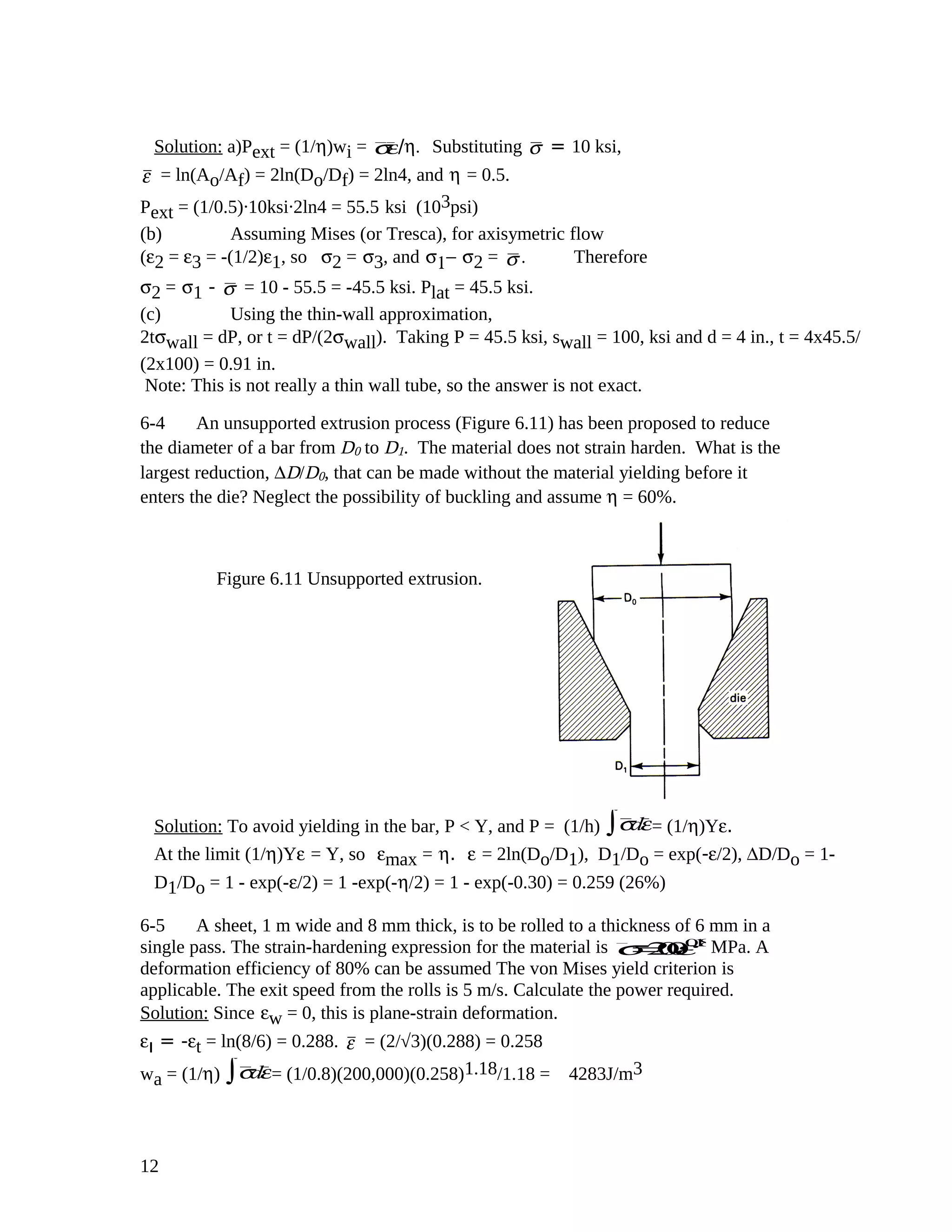
![The rate of work is wa
.velocity.cross-sectional area = 4283J/m3.(5m/s)(1x0.006m2) = 128 J/s.
6-6 The strains in a material for which σ=350ε0.20
MPa are ε1 = 0.200 and
ε2 = -0.125. Calculate the work per volume assuming η = 1.
Solution: ε3 = -ε1 + ε3 = -.200 + .125 = -.075
ε = [(2/3))0.22 + 0.1252 + 0.0752)1/2 = 0.202
[Check: 0.2 < 0.202 < 1.15x0.2]
w = Kε n+1/(n+1) = 350x0.2021.2/1.2 = 678MJ/m3
6-7 You are asked to plan a wire-drawing schedule to reduce copper wire from 1
mm to 0.4 mm diameter. How many wire drawing passes would be required if to be
sure of no failures, the drawing stress never exceeds 80% of the flow stress and the
efficiency is assumed to be 60%?
Solution: The maximum strain per pass ε = = 0.6 . The total strain must be ln(1/0.4) =
1.22. Note that 1.22/0.6 = 2.033. Three passes are required (not 2).
6.8 Derive an expression for ε* at the initiation of drawing when the outlet
diameter is produced by machining.
Solution: In this case, the maximum drawing stress is .
σd(max) = Su = K(n/e)n so (n/e)n = (1/η)ε*n+1/(n+1), where e = the base of natural logarithms
ε* = [η(n+1)(n/e)n]1/(n+1)
6.9 For a material with a stress-strain relation, σ = A + Bε, find the maximum strain
per wire drawing pass if µ = 0.75.
Solution: σd = σdε∫ = ∫(A + Bε)dε = Aε + (Β/2)ε2
. The drawing limit corresponds
to
σ = σd or A + Bε = Aε + (Β/2)ε2
. (Β/2)ε2
+(Α−Β)ε - A = 0. Using the
quadratic formula, ε = {-(A-B)±√[(A-B)2
+ 4AB/2]}/B = {-(A-B)±√[(A2
+B2
]}/B
12](https://image.slidesharecdn.com/solutionmanual4-6-150303094023-conversion-gate01/75/Solution-manual-4-6-10-2048.jpg)

This document contains solutions to problems involving the instability strain and necking behavior of materials under tension. 1) For a material loaded in tension where stress is related to strain by σ=Kεn, the instability strain occurs when n equals strain. The document also finds expressions for instability strain as a function of n for two different stress-strain relationships. 2) Other problems determine instability strain and pressure for thin-walled tubes undergoing internal pressurization. Expressions are derived for instability strain in terms of the stress exponent n. 3) The final problems consider the effect of non-uniform thickness on necking behavior and determine conditions required to limit thickness variations during necking.


![Assignment [4] machining with solutions](https://cdn.slidesharecdn.com/ss_thumbnails/assignment4machining-withsolutions-121213110841-phpapp02-thumbnail.jpg?width=640&height=640&fit=bounds)


