Done by:
M. Zeeshan Behleem
Std Id: 11916
Table of
Contents
 Introduction
 History
 Goal of A.I
 Advantages
 Problems Faced
INTRODUCTION
Common definition: AI is
field which attempts to
build intelligent machine
and tries to understand
intelligence entities.
Ques: What is intelligence?
Answer: Learning manipulating facts, but also
creativity, consciousness, emotion and intuition.
Ques: Can machine be intelligent ?
Answer: Up to the present day it is not sure whether
it is possible to build a machine that has all aspects
of intelligence.
This kind of research is central in the field of AI.
3
HISTORY
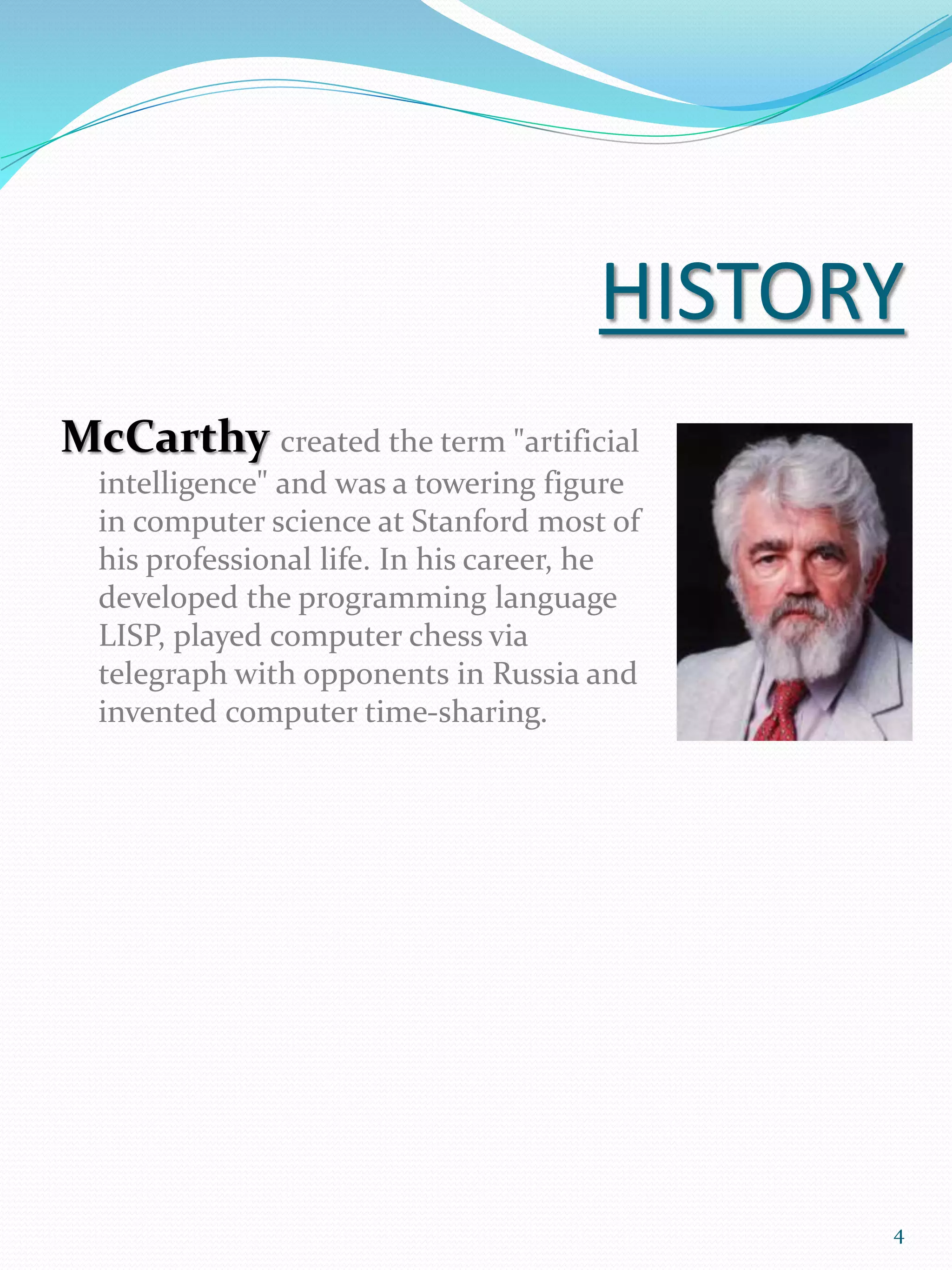
McCarthy created the term "artificial
intelligence" and was a towering figure
in computer science at Stanford most of
his professional life. In his career, he
developed the programming language
LISP, played computer chess via
telegraph with opponents in Russia and
invented computer time-sharing.
4
THE GOALS
1. Deduction, reasoning, Problem solving
2. Knowledge Representation
3. Planning
4. Natural Language Processing
5. Motion and Manipulation
6. Perception
7. Social Intelligence
8. General Intelligence
9. Creativity
The goals of artificial intelligence are :
5
ADVANTAGES
1. With AI, the chances of
error are almost nil &
greater precision and
accuracy is achieved.
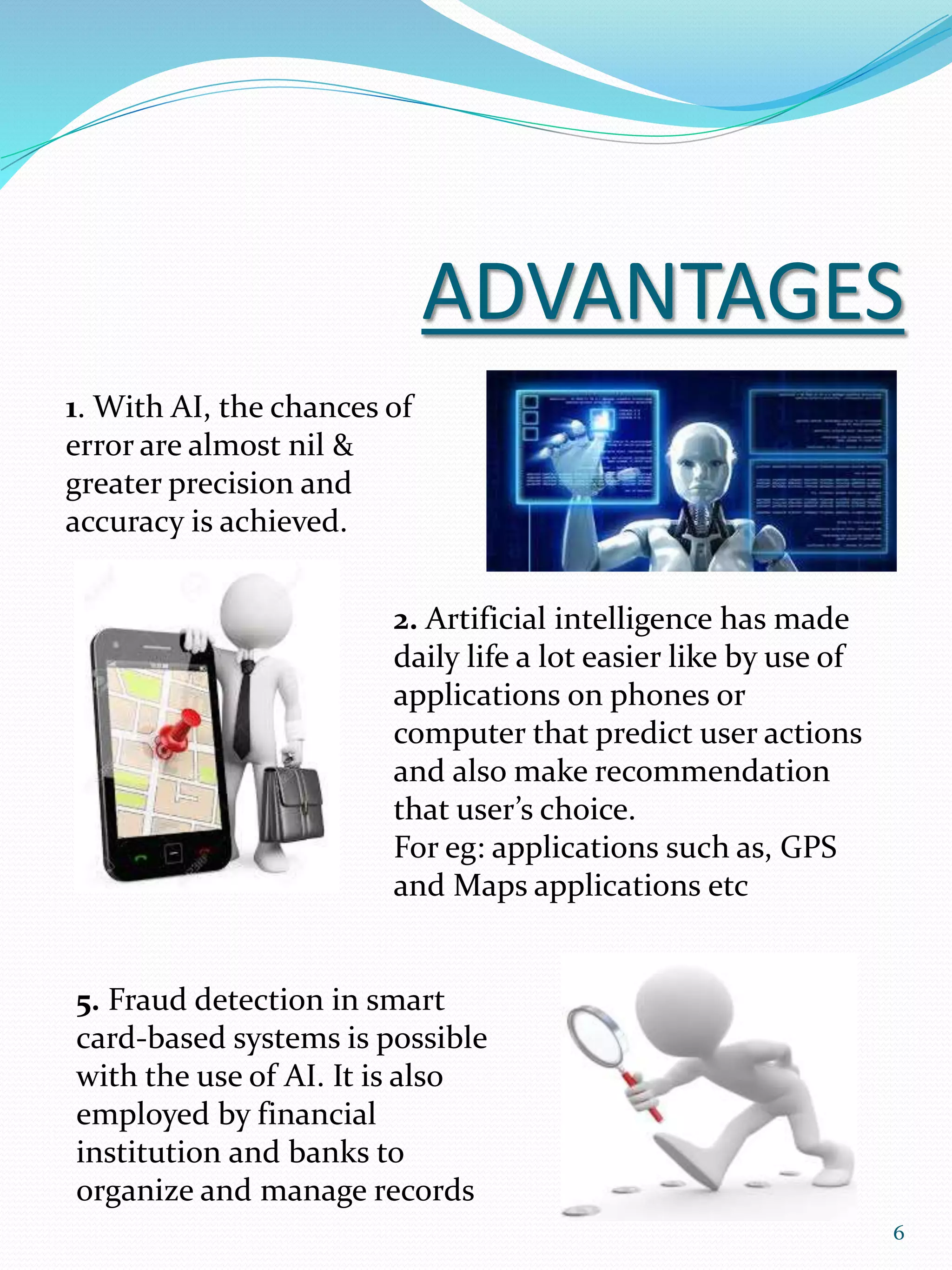
2. Artificial intelligence has made
daily life a lot easier like by use of
applications on phones or
computer that predict user actions
and also make recommendation
that user’s choice.
For eg: applications such as, GPS
and Maps applications etc
5. Fraud detection in smart
card-based systems is possible
with the use of AI. It is also
employed by financial
institution and banks to
organize and manage records
6
4. The greatest advantage of artificial
intelligence is that machines do not
requires sleep or breaks, and are able to
function without stopping. They can
continuously perform the task without
getting bored or tired.
5. Machine do not need to receive a
pay check every month. While they
are quite costly to maintain and
power, this cost is greatly less than
what an entire company full of
human employees would have to
paid. The costs are also minimized
and controlled.
7
PROBLEMS FACED
Artificial intelligence is a gift, it is something extraordinary
but all glitters is not gold! It has its disadvantages as well.
• As you may have seen in many films
such as the matrix, robot or even kids
films such as WALL.E, if we rely on
machines to do almost everything for us
we have become so dependent, that if they
were to simple shut down.
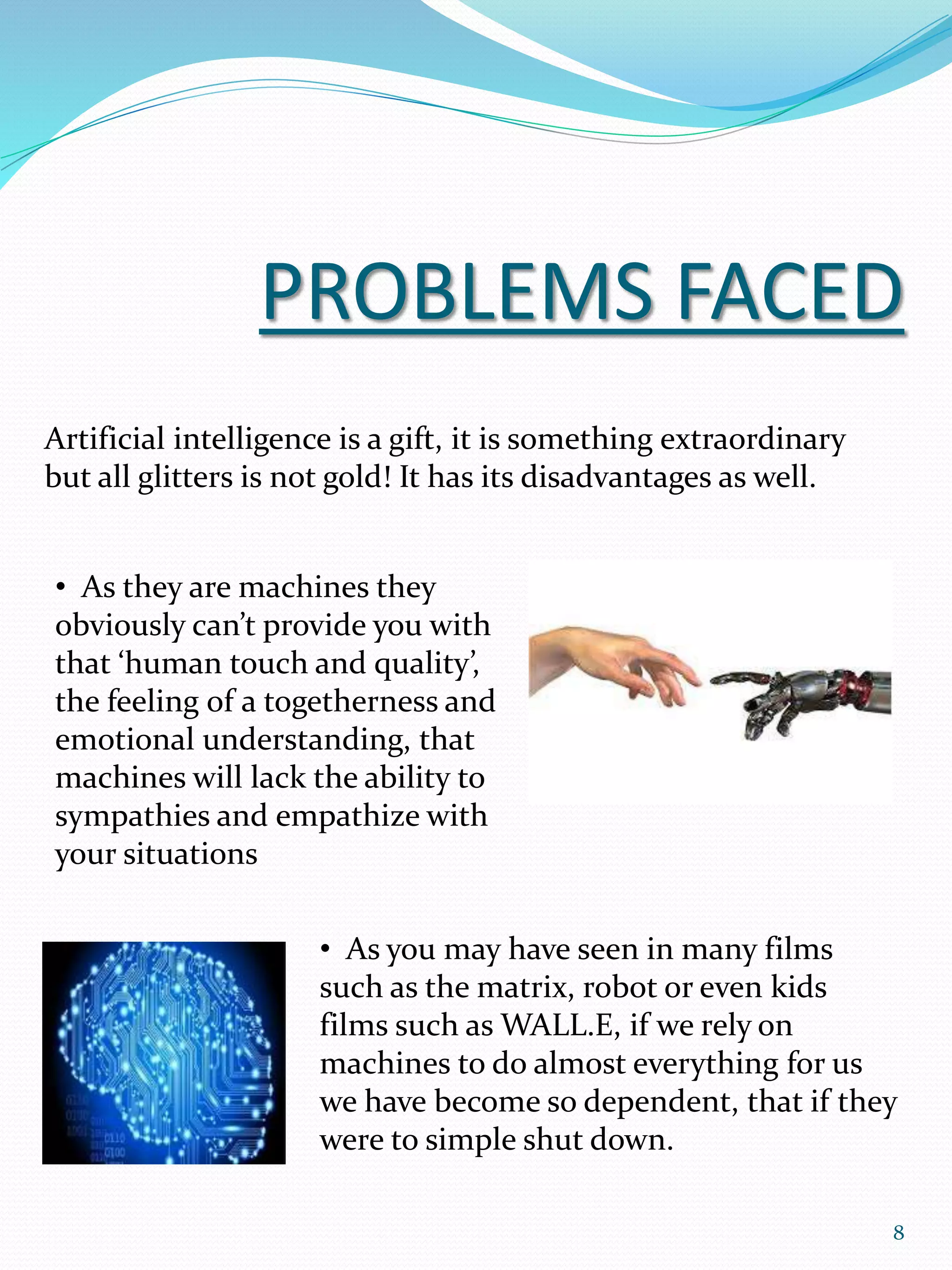
• As they are machines they
obviously can’t provide you with
that ‘human touch and quality’,
the feeling of a togetherness and
emotional understanding, that
machines will lack the ability to
sympathies and empathize with
your situations
8
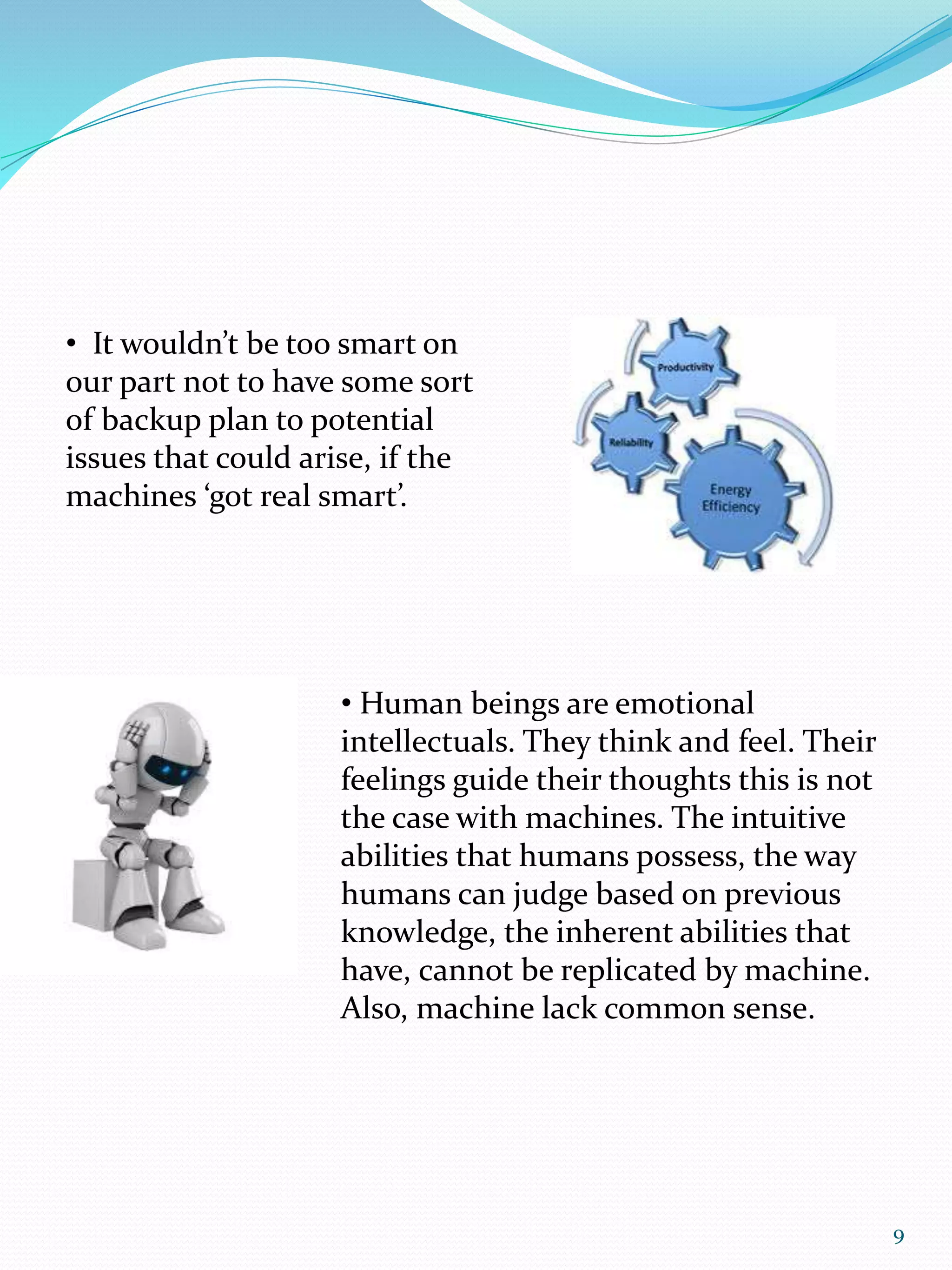
• It wouldn’t be too smart on
our part not to have some sort
of backup plan to potential
issues that could arise, if the
machines ‘got real smart’.
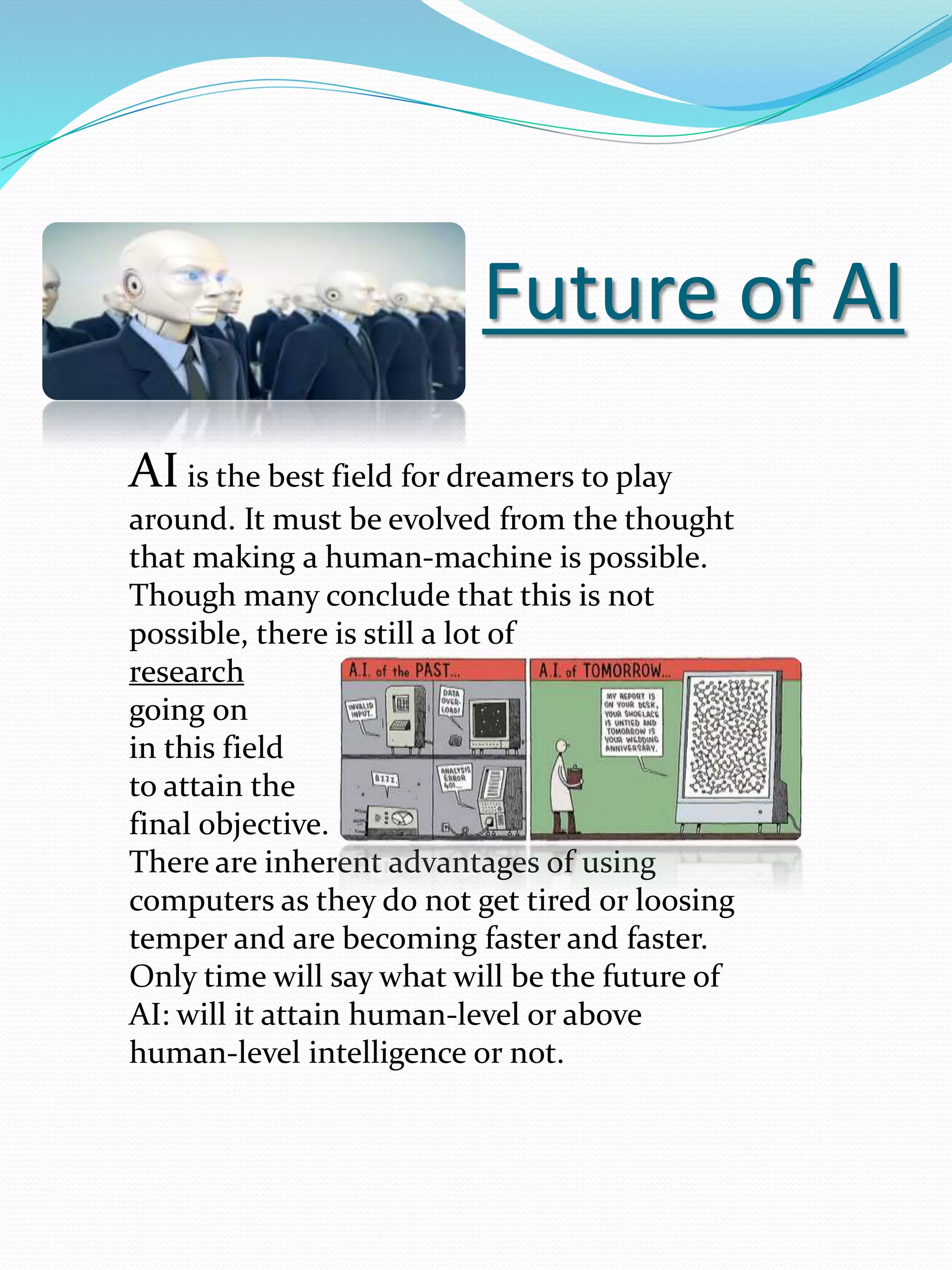
• Human beings are emotional
intellectuals. They think and feel. Their
feelings guide their thoughts this is not
the case with machines. The intuitive
abilities that humans possess, the way
humans can judge based on previous
knowledge, the inherent abilities that
have, cannot be replicated by machine.
Also, machine lack common sense.
9
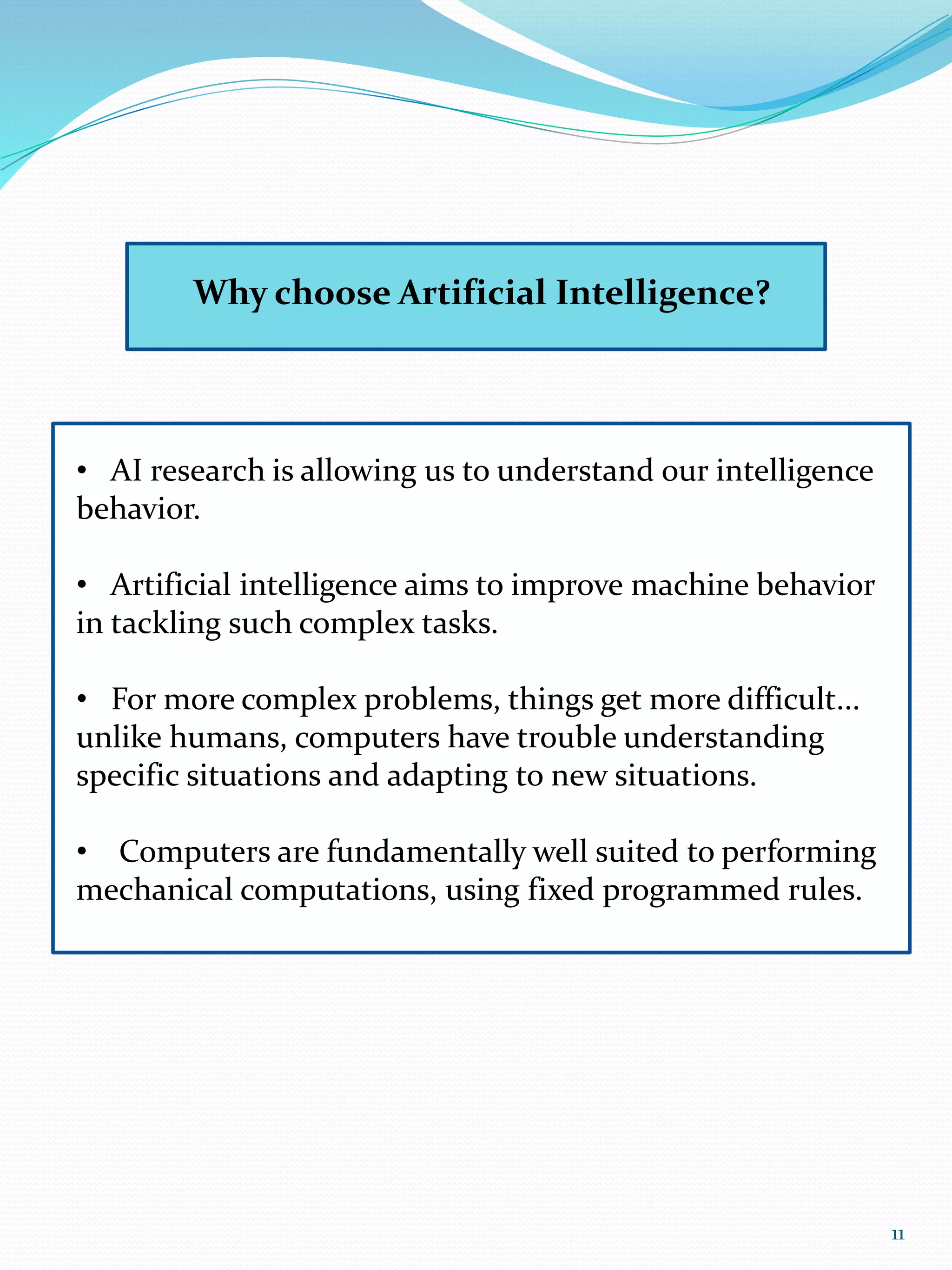
Future of AI
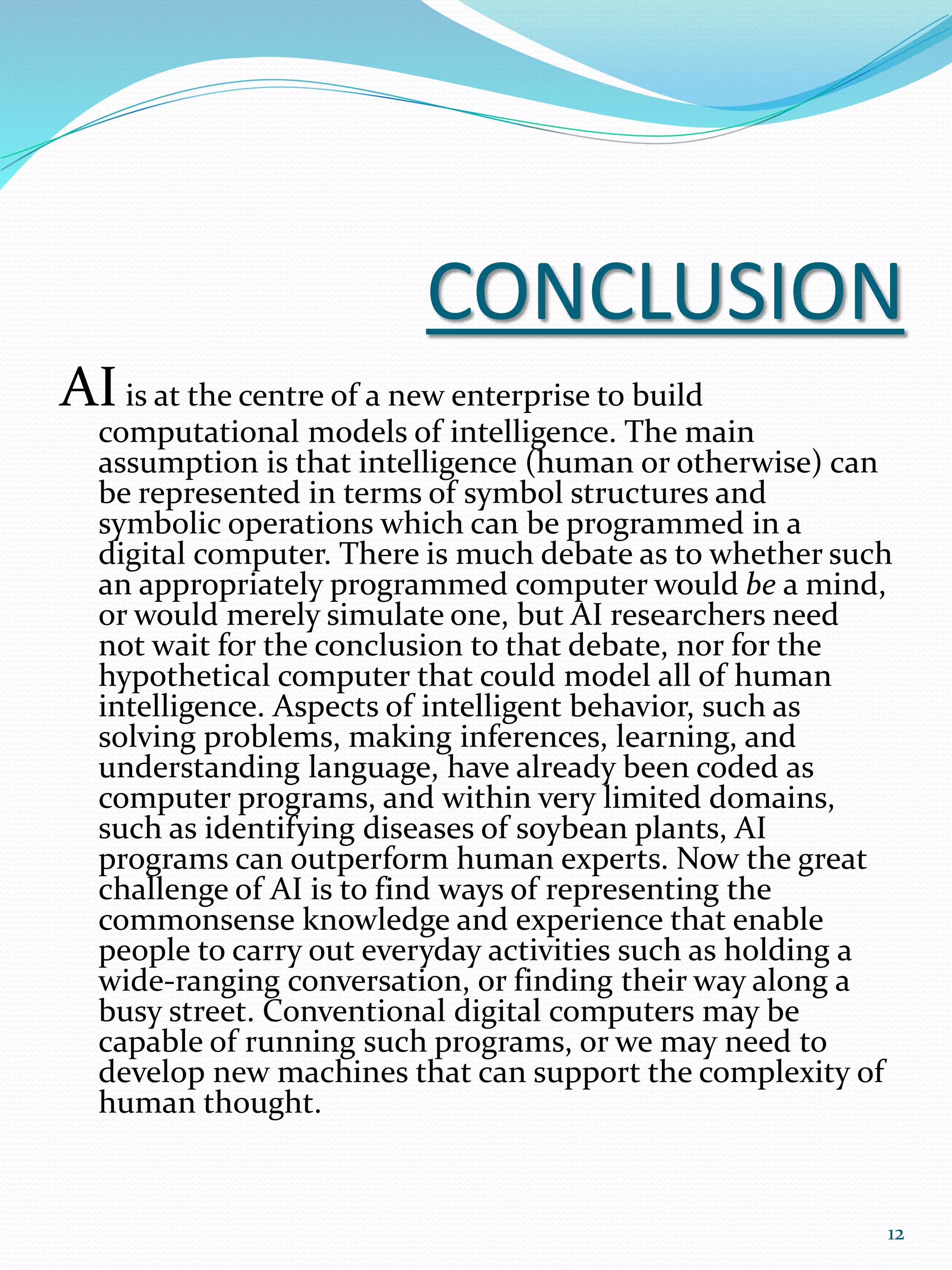
AI is the best field for dreamers to play
around. It must be evolved from the thought
that making a human-machine is possible.
Though many conclude that this is not
possible, there is still a lot of
research
going on
in this field
to attain the
final objective.
There are inherent advantages of using
computers as they do not get tired or loosing
temper and are becoming faster and faster.
Only time will say what will be the future of
AI: will it attain human-level or above
human-level intelligence or not.
Why choose Artificial Intelligence?
• AI research is allowing us to understand our intelligence
behavior.
• Artificial intelligence aims to improve machine behavior
in tackling such complex tasks.
• For more complex problems, things get more difficult...
unlike humans, computers have trouble understanding
specific situations and adapting to new situations.
• Computers are fundamentally well suited to performing
mechanical computations, using fixed programmed rules.
11
CONCLUSION
AIis at the centre of a new enterprise to build
computational models of intelligence. The main
assumption is that intelligence (human or otherwise) can
be represented in terms of symbol structures and
symbolic operations which can be programmed in a
digital computer. There is much debate as to whether such
an appropriately programmed computer would be a mind,
or would merely simulate one, but AI researchers need
not wait for the conclusion to that debate, nor for the
hypothetical computer that could model all of human
intelligence. Aspects of intelligent behavior, such as
solving problems, making inferences, learning, and
understanding language, have already been coded as
computer programs, and within very limited domains,
such as identifying diseases of soybean plants, AI
programs can outperform human experts. Now the great
challenge of AI is to find ways of representing the
commonsense knowledge and experience that enable
people to carry out everyday activities such as holding a
wide-ranging conversation, or finding their way along a
busy street. Conventional digital computers may be
capable of running such programs, or we may need to
develop new machines that can support the complexity of
human thought.
12

Artificial intelligence

  • 1.
    Done by: M. ZeeshanBehleem Std Id: 11916
  • 2.
    Table of Contents  Introduction History  Goal of A.I  Advantages  Problems Faced
  • 3.
    INTRODUCTION Common definition: AIis field which attempts to build intelligent machine and tries to understand intelligence entities. Ques: What is intelligence? Answer: Learning manipulating facts, but also creativity, consciousness, emotion and intuition. Ques: Can machine be intelligent ? Answer: Up to the present day it is not sure whether it is possible to build a machine that has all aspects of intelligence. This kind of research is central in the field of AI. 3
  • 4.
    HISTORY McCarthy created theterm "artificial intelligence" and was a towering figure in computer science at Stanford most of his professional life. In his career, he developed the programming language LISP, played computer chess via telegraph with opponents in Russia and invented computer time-sharing. 4
  • 5.
    THE GOALS 1. Deduction,reasoning, Problem solving 2. Knowledge Representation 3. Planning 4. Natural Language Processing 5. Motion and Manipulation 6. Perception 7. Social Intelligence 8. General Intelligence 9. Creativity The goals of artificial intelligence are : 5
  • 6.
    ADVANTAGES 1. With AI,the chances of error are almost nil & greater precision and accuracy is achieved. 2. Artificial intelligence has made daily life a lot easier like by use of applications on phones or computer that predict user actions and also make recommendation that user’s choice. For eg: applications such as, GPS and Maps applications etc 5. Fraud detection in smart card-based systems is possible with the use of AI. It is also employed by financial institution and banks to organize and manage records 6
  • 7.
    4. The greatestadvantage of artificial intelligence is that machines do not requires sleep or breaks, and are able to function without stopping. They can continuously perform the task without getting bored or tired. 5. Machine do not need to receive a pay check every month. While they are quite costly to maintain and power, this cost is greatly less than what an entire company full of human employees would have to paid. The costs are also minimized and controlled. 7
  • 8.
    PROBLEMS FACED Artificial intelligenceis a gift, it is something extraordinary but all glitters is not gold! It has its disadvantages as well. • As you may have seen in many films such as the matrix, robot or even kids films such as WALL.E, if we rely on machines to do almost everything for us we have become so dependent, that if they were to simple shut down. • As they are machines they obviously can’t provide you with that ‘human touch and quality’, the feeling of a togetherness and emotional understanding, that machines will lack the ability to sympathies and empathize with your situations 8
  • 9.
    • It wouldn’tbe too smart on our part not to have some sort of backup plan to potential issues that could arise, if the machines ‘got real smart’. • Human beings are emotional intellectuals. They think and feel. Their feelings guide their thoughts this is not the case with machines. The intuitive abilities that humans possess, the way humans can judge based on previous knowledge, the inherent abilities that have, cannot be replicated by machine. Also, machine lack common sense. 9
  • 10.
    Future of AI AIis the best field for dreamers to play around. It must be evolved from the thought that making a human-machine is possible. Though many conclude that this is not possible, there is still a lot of research going on in this field to attain the final objective. There are inherent advantages of using computers as they do not get tired or loosing temper and are becoming faster and faster. Only time will say what will be the future of AI: will it attain human-level or above human-level intelligence or not.
  • 11.
    Why choose ArtificialIntelligence? • AI research is allowing us to understand our intelligence behavior. • Artificial intelligence aims to improve machine behavior in tackling such complex tasks. • For more complex problems, things get more difficult... unlike humans, computers have trouble understanding specific situations and adapting to new situations. • Computers are fundamentally well suited to performing mechanical computations, using fixed programmed rules. 11
  • 12.
    CONCLUSION AIis at thecentre of a new enterprise to build computational models of intelligence. The main assumption is that intelligence (human or otherwise) can be represented in terms of symbol structures and symbolic operations which can be programmed in a digital computer. There is much debate as to whether such an appropriately programmed computer would be a mind, or would merely simulate one, but AI researchers need not wait for the conclusion to that debate, nor for the hypothetical computer that could model all of human intelligence. Aspects of intelligent behavior, such as solving problems, making inferences, learning, and understanding language, have already been coded as computer programs, and within very limited domains, such as identifying diseases of soybean plants, AI programs can outperform human experts. Now the great challenge of AI is to find ways of representing the commonsense knowledge and experience that enable people to carry out everyday activities such as holding a wide-ranging conversation, or finding their way along a busy street. Conventional digital computers may be capable of running such programs, or we may need to develop new machines that can support the complexity of human thought. 12