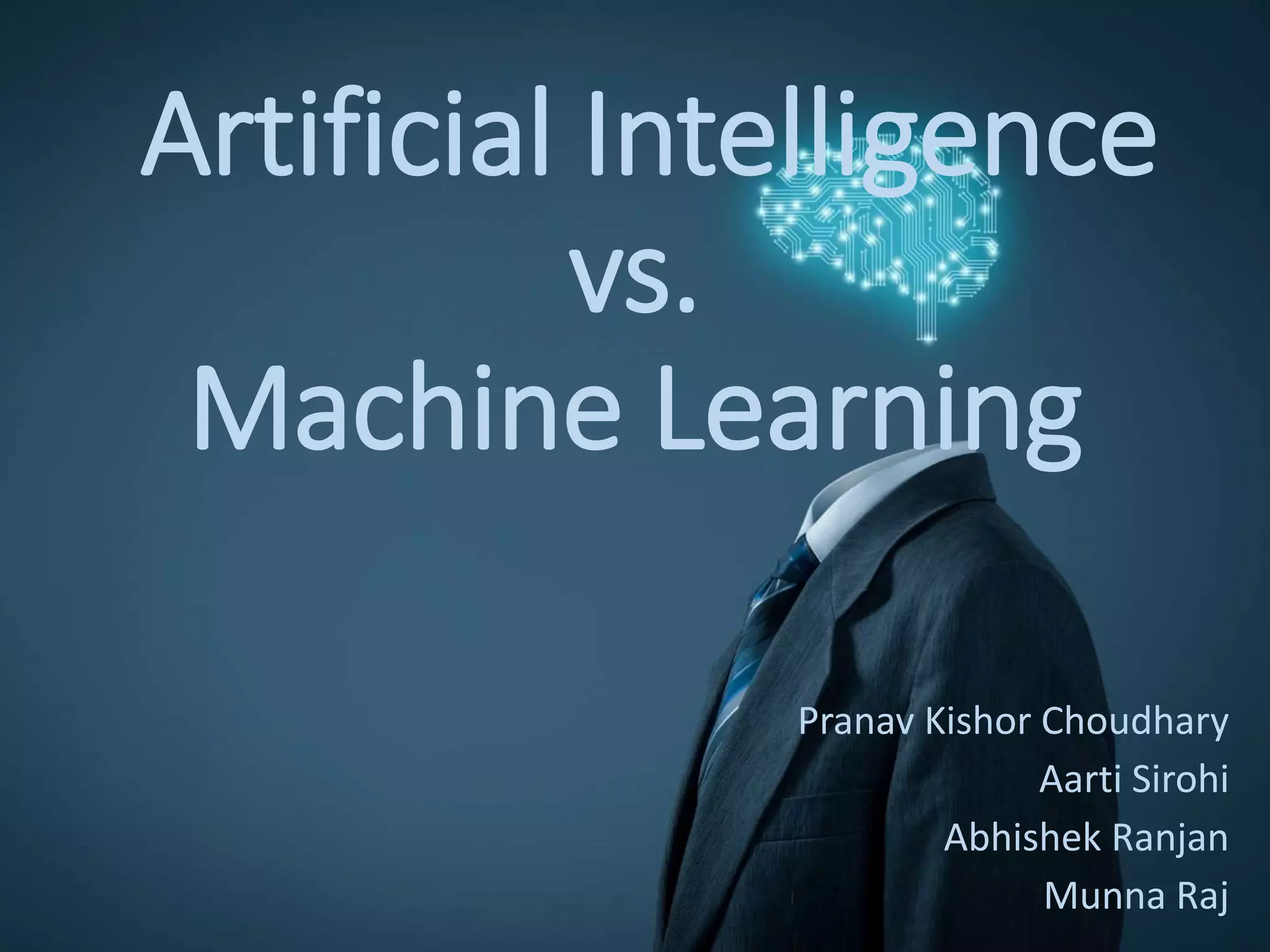

Artificial Intelligence
vs.
Machine Learning
Pranav Kishor Choudhary
Aarti Sirohi
Abhishek Ranjan
Munna Raj
Artificial Intelligence(AI)
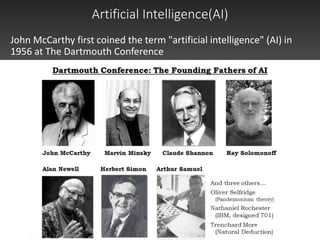
John McCarthy first coined the term "artificial intelligence" (AI) in
1956 at The Dartmouth Conference
Concept of Artificial Intelligence(AI)
The original definition/concept of AI:
“Every aspect of learning or any other feature of intelligence can in
principle be so precisely described that a machine can be made to
simulate it. An attempt will be made to find how to make machines
use language, form abstractions and concepts, solve kinds of
problems now reserved for humans, and improve themselves.”
Source: Forbes; Artificial Intelligence (AI) Defined; Aug 27, 2017
Intelligence
According to Jack Copeland, Intelligence is Defined by:
• Generalization Learning
• Reasoning
• Problem Solving
• Perception
• Language understanding
Source: from the book “Artificial Intelligence: A Philosophical Introduction ?" by Jack
Copeland.
Aspect of Artificial Intelligence(AI)
The original 7 aspect of AI (Proposed in 1956 at Dartmouth College)
1. Stimulating higher functions of the human brain
2. Programming a computer to use general language.
3. Arranging hypothetical neurons in a manner so that they can form
concepts.
4. A way to determine and measure problem complexity.
5. Self-Improvement
6. Abstraction: Defined as the quality of dealing with the ideas rather
than events.
7. Randomness and Creativity.
Source: Stanford University website; A PROPOSAL FOR THE DARTMOUTH SUMMER RESEARCH
PROJECT ON ARTIFICIAL INTELLIGENCE;
Aspect of Artificial Intelligence(AI)
The original 7 aspect of AI (Proposed in 1956 at Dartmouth College)
1. Stimulating higher functions of the human brain
2. Programming a computer to use general language.
3. Arranging hypothetical neurons in a manner so that they can form
concepts.
4. A way to determine and measure problem complexity.
5. Self-Improvement
6. Abstraction: Defined as the quality of dealing with the ideas rather
than events.
7. Randomness and Creativity.
Source: Stanford University website; A PROPOSAL FOR THE DARTMOUTH SUMMER RESEARCH
PROJECT ON ARTIFICIAL INTELLIGENCE;
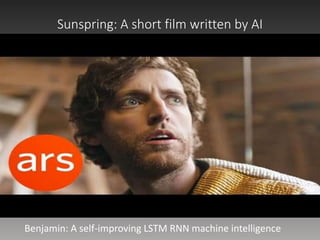
Sunspring: A short film written by AI
Benjamin: A self-improving LSTM RNN machine intelligence
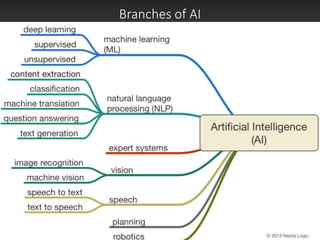
Branches of AI
• Machine Learning
• Computer Vision
• Natural Language Processing
• Robotics
• Pattern Recognition
• Knowledge Management
Branches of AI
Types of AI in terms of approach
• Strong AI: Strong AI is simulating the human brain by building
system that think in the process give us an insight into how the
brain works. (Still in it’s infancy stage)
• Weak AI: Weak AI is a system that behaves like a human but
doesn’t give us an insight of how the brain works
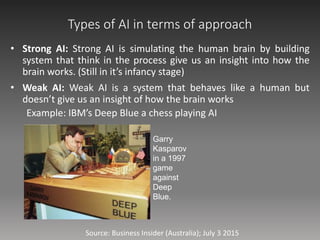
Example: IBM’s Deep Blue a chess playing AI
Garry
Kasparov
in a 1997
game
against
Deep
Blue.
Source: Business Insider (Australia); July 3 2015
Agents and environments
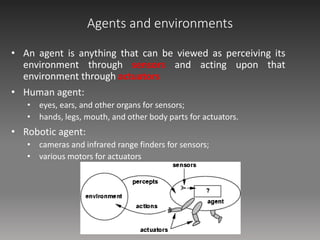
• An agent is anything that can be viewed as perceiving its
environment through sensors and acting upon that
environment through actuators
• Human agent:
• eyes, ears, and other organs for sensors;
• hands, legs, mouth, and other body parts for actuators.
• Robotic agent:
• cameras and infrared range finders for sensors;
• various motors for actuators
Machine Learning
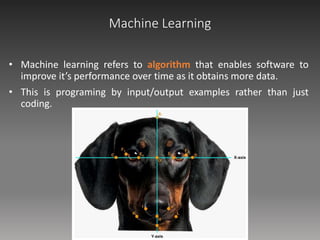
• Machine learning refers to algorithm that enables software to
improve it’s performance over time as it obtains more data.
• This is programing by input/output examples rather than just
coding.
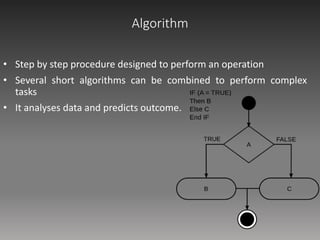
Algorithm
• Step by step procedure designed to perform an operation
• Several short algorithms can be combined to perform complex
tasks
• It analyses data and predicts outcome.
Aspect Machine Learning
• It’s Subset of AI
• It’s Method of data analysis
• It uses
• Data Mining
• Predictive Modeling
• It uses predicted outcome to improve future predictions
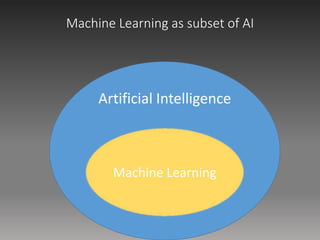
Machine Learning as subset of AI
Artificial Intelligence
Machine Learning
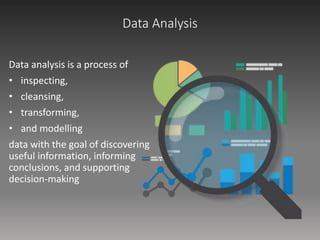
Data Analysis
Data analysis is a process of
• inspecting,
• cleansing,
• transforming,
• and modelling
data with the goal of discovering
useful information, informing
conclusions, and supporting
decision-making
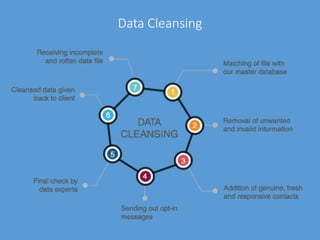
Data Cleansing
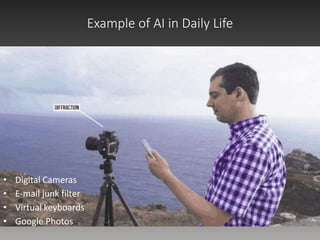
Example of AI in Daily Life
• Digital Cameras
• E-mail junk filter
• Virtual keyboards
• Google Photos
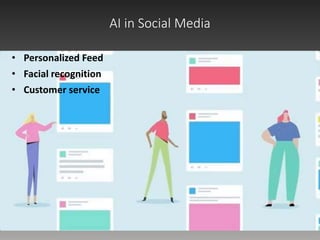
AI in Social Media
• Personalized Feed
• Facial recognition
• Customer service
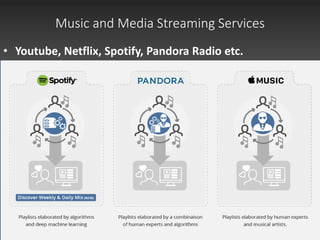
Music and Media Streaming Services
• Youtube, Netflix, Spotify, Pandora Radio etc.
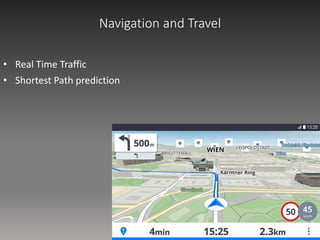
Navigation and Travel
• Real Time Traffic
• Shortest Path prediction
Use of AI in Business
• Online Ads Network
• Targeted Ad
• User Statistic
• 250 billion US dollars Industry
• Banking and Finance
• Customer service,
• Fraud protection,
• Investment
• Smart Home Devices
• Smart Lights
• Thermostats
• Personal Assistants
• Security and Surveillance
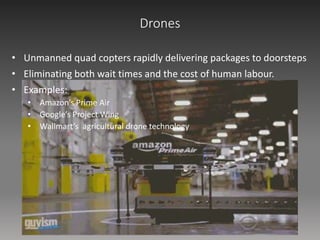
Drones
• Unmanned quad copters rapidly delivering packages to doorsteps
• Eliminating both wait times and the cost of human labour.
• Examples:
• Amazon’s Prime Air
• Google’s Project Wing
• Wallmart’s agricultural drone technology
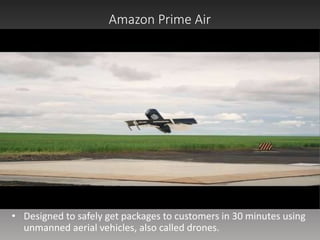
Amazon Prime Air
• Designed to safely get packages to customers in 30 minutes using
unmanned aerial vehicles, also called drones.
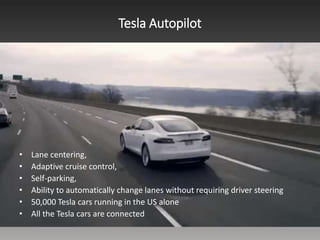
Tesla Autopilot
• Lane centering,
• Adaptive cruise control,
• Self-parking,
• Ability to automatically change lanes without requiring driver steering
• 50,000 Tesla cars running in the US alone
• All the Tesla cars are connected
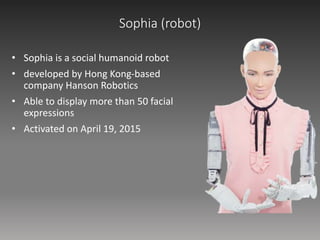
Sophia (robot)
• Sophia is a social humanoid robot
• developed by Hong Kong-based
company Hanson Robotics
• Able to display more than 50 facial
expressions
• Activated on April 19, 2015
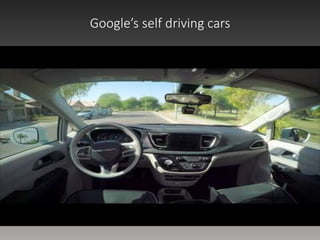
Google’s self driving cars
Risk/Drawbacks of AI
• Limited Ability
• Difficult Code
• High Cost
• Slow Real Time Response
• Can’t Handle Emergency Situation
• AI replacing human
• Unemployment in Future
• Autonomous AI War machines
• Robots may get out of control
• Peoples paranoia about AI
Future of AI
• Cyborg Technology
• Taking Over Dangerous Jobs
• Solving Climate Change
• Medical diagnostic procedures
• Jobs in Artificial Intelligence.
• Fully Automated Traffic
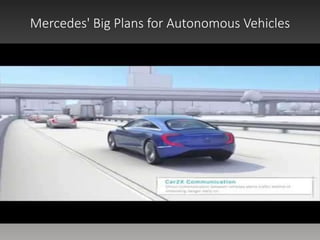
Mercedes' Big Plans for Autonomous Vehicles
Conclusion
As we can see, all of our lives are impacted by artificial intelligence
on a daily basis. Whether we are using our smartphones, surfing
the internet, buying products online, using navigation, wasting time
on social media or listening to songs on our favourite music
streaming service, AI is impacting our choices in one way or
another.
Artificial Intelligence has come a long way from sci-fi to our every
day live. But it’s a Double-edged sword.
As Elon Musk has described artificial intelligence
“summoning the demon”
and the creation of a rival to human intelligence is probably the
biggest threat facing the world.
Thank You
any Querries

Artificial Intelligence vs. Machine Learning

  • 1.
    Artificial Intelligence vs. Machine Learning PranavKishor Choudhary Aarti Sirohi Abhishek Ranjan Munna Raj
  • 2.
    Artificial Intelligence(AI) John McCarthyfirst coined the term "artificial intelligence" (AI) in 1956 at The Dartmouth Conference
  • 3.
    Concept of ArtificialIntelligence(AI) The original definition/concept of AI: “Every aspect of learning or any other feature of intelligence can in principle be so precisely described that a machine can be made to simulate it. An attempt will be made to find how to make machines use language, form abstractions and concepts, solve kinds of problems now reserved for humans, and improve themselves.” Source: Forbes; Artificial Intelligence (AI) Defined; Aug 27, 2017
  • 4.
    Intelligence According to JackCopeland, Intelligence is Defined by: • Generalization Learning • Reasoning • Problem Solving • Perception • Language understanding Source: from the book “Artificial Intelligence: A Philosophical Introduction ?" by Jack Copeland.
  • 5.
    Aspect of ArtificialIntelligence(AI) The original 7 aspect of AI (Proposed in 1956 at Dartmouth College) 1. Stimulating higher functions of the human brain 2. Programming a computer to use general language. 3. Arranging hypothetical neurons in a manner so that they can form concepts. 4. A way to determine and measure problem complexity. 5. Self-Improvement 6. Abstraction: Defined as the quality of dealing with the ideas rather than events. 7. Randomness and Creativity. Source: Stanford University website; A PROPOSAL FOR THE DARTMOUTH SUMMER RESEARCH PROJECT ON ARTIFICIAL INTELLIGENCE;
  • 6.
    Aspect of ArtificialIntelligence(AI) The original 7 aspect of AI (Proposed in 1956 at Dartmouth College) 1. Stimulating higher functions of the human brain 2. Programming a computer to use general language. 3. Arranging hypothetical neurons in a manner so that they can form concepts. 4. A way to determine and measure problem complexity. 5. Self-Improvement 6. Abstraction: Defined as the quality of dealing with the ideas rather than events. 7. Randomness and Creativity. Source: Stanford University website; A PROPOSAL FOR THE DARTMOUTH SUMMER RESEARCH PROJECT ON ARTIFICIAL INTELLIGENCE;
  • 7.
    Sunspring: A shortfilm written by AI Benjamin: A self-improving LSTM RNN machine intelligence
  • 8.
    Branches of AI •Machine Learning • Computer Vision • Natural Language Processing • Robotics • Pattern Recognition • Knowledge Management
  • 9.
  • 10.
    Types of AIin terms of approach • Strong AI: Strong AI is simulating the human brain by building system that think in the process give us an insight into how the brain works. (Still in it’s infancy stage) • Weak AI: Weak AI is a system that behaves like a human but doesn’t give us an insight of how the brain works Example: IBM’s Deep Blue a chess playing AI Garry Kasparov in a 1997 game against Deep Blue. Source: Business Insider (Australia); July 3 2015
  • 11.
    Agents and environments •An agent is anything that can be viewed as perceiving its environment through sensors and acting upon that environment through actuators • Human agent: • eyes, ears, and other organs for sensors; • hands, legs, mouth, and other body parts for actuators. • Robotic agent: • cameras and infrared range finders for sensors; • various motors for actuators
  • 12.
    Machine Learning • Machinelearning refers to algorithm that enables software to improve it’s performance over time as it obtains more data. • This is programing by input/output examples rather than just coding.
  • 13.
    Algorithm • Step bystep procedure designed to perform an operation • Several short algorithms can be combined to perform complex tasks • It analyses data and predicts outcome.
  • 14.
    Aspect Machine Learning •It’s Subset of AI • It’s Method of data analysis • It uses • Data Mining • Predictive Modeling • It uses predicted outcome to improve future predictions
  • 15.
    Machine Learning assubset of AI Artificial Intelligence Machine Learning
  • 16.
    Data Analysis Data analysisis a process of • inspecting, • cleansing, • transforming, • and modelling data with the goal of discovering useful information, informing conclusions, and supporting decision-making
  • 17.
  • 18.
    Example of AIin Daily Life • Digital Cameras • E-mail junk filter • Virtual keyboards • Google Photos
  • 19.
    AI in SocialMedia • Personalized Feed • Facial recognition • Customer service
  • 20.
    Music and MediaStreaming Services • Youtube, Netflix, Spotify, Pandora Radio etc.
  • 21.
    Navigation and Travel •Real Time Traffic • Shortest Path prediction
  • 22.
    Use of AIin Business • Online Ads Network • Targeted Ad • User Statistic • 250 billion US dollars Industry • Banking and Finance • Customer service, • Fraud protection, • Investment • Smart Home Devices • Smart Lights • Thermostats • Personal Assistants • Security and Surveillance
  • 23.
    Drones • Unmanned quadcopters rapidly delivering packages to doorsteps • Eliminating both wait times and the cost of human labour. • Examples: • Amazon’s Prime Air • Google’s Project Wing • Wallmart’s agricultural drone technology
  • 24.
    Amazon Prime Air •Designed to safely get packages to customers in 30 minutes using unmanned aerial vehicles, also called drones.
  • 25.
    Tesla Autopilot • Lanecentering, • Adaptive cruise control, • Self-parking, • Ability to automatically change lanes without requiring driver steering • 50,000 Tesla cars running in the US alone • All the Tesla cars are connected
  • 26.
    Sophia (robot) • Sophiais a social humanoid robot • developed by Hong Kong-based company Hanson Robotics • Able to display more than 50 facial expressions • Activated on April 19, 2015
  • 27.
  • 28.
    Risk/Drawbacks of AI •Limited Ability • Difficult Code • High Cost • Slow Real Time Response • Can’t Handle Emergency Situation • AI replacing human • Unemployment in Future • Autonomous AI War machines • Robots may get out of control • Peoples paranoia about AI
  • 29.
    Future of AI •Cyborg Technology • Taking Over Dangerous Jobs • Solving Climate Change • Medical diagnostic procedures • Jobs in Artificial Intelligence. • Fully Automated Traffic
  • 30.
    Mercedes' Big Plansfor Autonomous Vehicles
  • 31.
    Conclusion As we cansee, all of our lives are impacted by artificial intelligence on a daily basis. Whether we are using our smartphones, surfing the internet, buying products online, using navigation, wasting time on social media or listening to songs on our favourite music streaming service, AI is impacting our choices in one way or another. Artificial Intelligence has come a long way from sci-fi to our every day live. But it’s a Double-edged sword. As Elon Musk has described artificial intelligence “summoning the demon” and the creation of a rival to human intelligence is probably the biggest threat facing the world.
  • 32.

Editor's Notes

  • #2 There’s a lot of buzz around the term Artificial Intelligence and the term AI seems to be thrown around a lot.
  • #3 John McCarthy (September 4, 1927 – October 24, 2011) was an American computer scientist McCarthy was one of the founders of the discipline of artificial intelligence He coined the term "artificial intelligence" (AI) in 1956 at The Dartmouth Conference
  • #4  In other words, AI is a machine with the ability to solve the problem that are usually done by the us human, with our natural intelligence. A computer would demonstrate a form of intelligence when it learns how to improve itself at solving these problems.
  • #5 Jack Copeland, has written several books on AI. Generalization Learning: That is learning that enables the learner to be able to perform better in situations not previously encountered. Reasoning: Reason is to draw conclusion appropriate to the situation in hand. Problem Solving: Given such an such data find X Perception: Analysing scanned environment and analysing features and relationships between objects , self driving cars are an example. Language understanding: Understanding language by following syntax and other rules similar to a human
  • #7 After all these years we have completed the language, measure of problem complexity and self improvement to at least some degree. However randomness and creativity is just started to be explored. In recent times we have seen couple of web episodes and short films co written or completely written by AI. On creativity benchmark they are not of really great quality but still it’s a remarkable success in field of AI.
  • #8 The screenplay was written by an artificial intelligence. The goal of the film was to see if a computer could write a screenplay that could win a competition. It stars Thomas Middleditch, Elisabeth Grey, and Humphrey Ker as three people. The script of the film was authored by a recurrent neural network called long short-term memory (LSTM) by an AI bot named Benjamin Originally made for the Sci-Fi-London film festival's 48hr Challenge, it was released online by technology news website Ars Technica on 9 June 2016 Benjamin, the automatic screenwriter: Called the world's 1st automatic screenwriter, Benjamin is a self-improving LSTM RNN (Recurrent Neural Network) machine intelligence trained on human screenplays conceived by Goodwin and Sharp. It was trained to write the screenplay by feeding it with a corpus of dozens of sci-fi screenplays found online—mostly movies from the 1980s and 90s.
  • #9 There are many other branches of AI.
  • #10 Best example of NLP is Shazam Music Discovery app. You hear an unknown song, open the app and let the app listen to the same and will return you song name and artist with links.
  • #11 Strong AI: The principle behind Strong AI is that the machines could be made to think or in other words could represent human minds in the future. If that is the case, those machines will have the ability to reason, think and do all functions that a human is capable of doing. But according to most people, this technology will never be developed or at least it will take a very long time. However, Strong AI, which is in its infant stage, promises a lot due to the recent developments in nanotechnology. Nano bots, which can help us fight diseases and also make us more intelligent, are being designed. Weak AI: The principle behind Weak AI is simply the fact that machines can be made to act as if they are intelligent. For example, when a human player plays chess against a computer, the human player may feel as if the computer is actually making impressive moves. But the chess application is not thinking and planning at all. All the moves it makes are previously fed in to the computer by a human and that is how it is ensured that the software will make the right moves at the right times. It Processed millions of moves before it made any actual move on the chessboard.
  • #12 These are the hardware aspect of artificial Intelligence. Sensors are the medium by which we perceive the environment and actuators are the medium by which we act. In other words by sensors we take input and by actuators we give output. The automation of activities that we associate with human thinking, activities such as decision-making, problem solving, learning… (Bellman)
  • #13 Machine Learning applications can read text and work out whether the person who wrote it is making a complaint or offering congratulations. They can also listen to a piece of music, decide whether it is likely to make someone happy or sad, and find other pieces of music to match the mood. (eg. Like music streaming service spotify does, it can recommend music which is certainly liked by the listener) Example: A programmer would have no idea how to make a program to recognize a dog. But he can create a program that can learn to do so. If he gives program enough data in the form images of dogs and let it process and learn. When he gives the program an image of new dog that it’s never seen before it can easily recognise as dog with relative ease .
  • #14 An algorithm is a set of rules to be followed when solving problems. In machine learning, algorithms take in data and perform calculations to find an answer. The calculations can be very simple or they can be more on the complex side. Algorithms should deliver the correct answer in the most efficient manner. Using an algorithm to predict an outcome of an event is not machine learning. Using the outcome of your prediction to improve future predictions is.
  • #15 Machine learning is a particular approach to artificial intelligence Machine learning is a method of data analysis that automates analytical model building. Machine learning enables software applications to become more accurate in forecasting outcomes without being specially programmed. The processes involved in machine learning are like data mining and predictive modelling. They require searching through data to look for patterns and adjusting program actions appropriately. Most of people are familiar with machine learning from shopping on the Internet and being offered products related to their purchase.
  • #16 You can think of artificial intelligence as a broader umbrella under which machine learning come. Machine Learning is a subset of AI which enables the computer to act and make data-driven decisions to carry out a certain task. These programs or algorithms are designed in a way that they can learn and improve over time when exposed to new data
  • #17 Data Is at the Heart of the Matter: Whether you are using an algorithm, artificial intelligence, or machine learning, one thing is certain: if the data being used is flawed, then the insights and information extracted will be flawed
  • #18  “The process of detecting and correcting (or removing) corrupt or inaccurate records from a record set, table, or database and refers to identifying incomplete, incorrect or irrelevant parts of the data and then replacing, modifying or deleting the dirty or coarse data.” And according to the Crowd Flower Data Science report, data scientists spend the majority of their time cleansing data — and surprisingly this is also their least favourite part of their job. Despite this, it is also the most important part, as the output can’t be trusted if the data hasn’t been cleansed.
  • #19  Digital Cameras: Face detection In camera, portrait mode and adding depth to images worth single lens is all done by AI. Camera of iPhone and Oppo is better not only because of superior hardware but also because of AI. Gmail junk filter: If you keep marking certain email from certain senders after some time AI would automatically mark them as junk and move them to junk folder without your notice. Virtual keyboards: are now using AI to learn typing habits of user to predict word and help them type more accurately.
  • #20 Social Media Feeds: From the feeds that you see in your timeline to the notifications that you receive from these apps, everything is curated by AI. AI takes all your past behaviour, web searches, interactions, and everything else that you do when you are on these websites and tailors the experience just for you. (That’s why internet is called echo chamber, it reinforces your beliefs) Facial recognition: Facebook uses Facial Recognition to enhance tagging feature. Customer service: It’s not possible to respond to a lot of customer’s queries quickly, the artificial intelligence helps to prioritize the queries of the customers, and to find out whether the messages are from trolls or real users. Some time customers could have been talking to an AI not a real person.
  • #21 Good: These services can predict recommendations with such accuracy that you will be amazed. They uses your watch history and than match it with their database and other million’s of playlist available online to predict exactly what you will like. Bad: going down the YouTube rabbit hole wasting countless hours just watching the recommended videos. That recommended videos section has become so good at knowing our taste that it’s scary. Spotify’s approach, called collaborative filtering, is to collect as much data as possible on a user’s listening behavior and then compare it to that collected from other users.
  • #22 Both Google and Apple along with other navigation services use artificial intelligence to interpret hundreds of thousands of data point that they receive to give you real-time traffic data.
  • #23 Ad Network: One of the biggest users of artificial intelligence is the online ad industry which uses AI to not only track user statistics but also serve us ads based on those statistics. Without AI, the online ad industry will just fail as it would show random ads to users with no connection to their preferences what so ever. AI has become so successful in determining our interests and serving us ads that the global digital ad industry has crossed 250 billion US dollars with the industry projected to cross the 300 billion mark in 2019 Banking and finance: the banking and finance industry heavily relies on artificial intelligence for things like customer service, fraud protection, investment, and more? A simple example is the automated emails that you receive from banks whenever you do an out of the ordinary transaction. Well, that’s AI watching over your account and trying to warn you of any fraud. AI is also being trained to look at large samples of fraud data and find a pattern so that you can be warned before it happens to you. Also, when you hitch a little snag and chat with bank’s customer service, chances are that you are chatting with an AI bot. Even the big players in the finance industry use AI to analyze data to find the best avenues to invest money so they can get the most returns with the least risk. Smart home devices: there are smart thermostats which adjust the temperature based on your preferences, smart lights that change the color and intensity of lights based on time and much more. Security and Survilance: With technologies like object recognition and facial recognition getting better and better every day, it won’t be long when all the security camera feeds are being monitored by an AI and not a human. While there’s still time before AI can be fully implemented, this is going to be our future
  • #24 These are the development which seems like straight out a sci-fi movie. Amazon and Walmart are heavily investing in drone delivery programs and it will become a reality far sooner than what you expect. militaries all over the world are already using successful drone programs.
  • #25 This video was taken on 7 dec 2016.
  • #26 Tesla cars are a prime example of how the AI is impacting our daily life. Did you know that all the Tesla cars are connected and the things that your car learns is shared across all the cars? That means, if you had to take an unanticipated hard-left on a cross-road, all the Tesla cars will know how to maneuver that turn after they are updated. There are already more than 50,000 Tesla cars running in the US alone.
  • #27 A humanoid robot is a robot with its body shape built to resemble the human body.
  • #28 Waymo, which started as the Google self-driving car project in 2009. Is a subsidiary of Alphabet Inc. parent company of Goolge.
  • #30 Cyborg Technology: A cyborg is a being with both organic and biomechatronic body parts. Taking Over Dangerous Jobs: like bomb defusing. Solving Climate Change: Machines have more access to data than one person ever could — storing a mind-boggling number of statistics. We can use big data so that AI could one day identify trends. Also, it comes with the use that information to come up with solutions to the world’s biggest problems Medical Diagnostic change: AI services will offer the perfect surgical robots and finely tuned diagnostic algorithms to solve complex surgical and clinical problems Jobs in Artificial Intelligence. Computational philosopher: to ensure human-aligned ethics are embedded in AI algorithms Robot personality designer Robot obedience trainer Autonomous vehicle infrastructure designer: new road and traffic signs to be read by a computer Algorithm trainers: Algorithm trainers include the growing army of so-called “click workers.” That helps algorithms learn to recognize images or analyze sentiment, for instance.
  • #31 This video by Mercedes gives a glimpse of what will be the face of traffic in future.
  • #32 In a speech in October at the Massachusetts Institute of Technology, Mr Musk described artificial intelligence (AI) as “summoning the demon”, and the creation of a rival to human intelligence as probably the biggest threat facing the world