Chapter 3
Aartificial Intelligence
Activity
• How do you define the word Artificial? And the word Intelligence?
What is AI?
• Artificial defines "man-made“, and intelligence defines
"thinking power"
• Or “the ability to learn and solve problems”, hence Artificial
Intelligence means "a man-made thinking power.“
• AI is a branch of computer science by which we can create
intelligent machines which can behave like a human, think like
humans, and able to make decisions
• Intelligence is the ability to acquire and apply knowledge.
• Knowledge is the information acquired through experience.
• Experience is the knowledge gained through exposure
(training).
Cont’d
• Therefore, artificial intelligence as the “copy of something
natural (i.e., human beings) ‘WHO’ is capable of acquiring and
applying the information it has gained through exposure.”
• AI exists when a machine can have human-based skills such as
learning, reasoning, and solving problems
• With AI you do not need to preprogram a machine to do some
work, despite that you can create a machine with programmed
algorithms which can work with own intelligence.
Cont’d
Intelligence is composed of:
• Reasoning
• Learning
• Problem Solving
• Perception
• Linguistic Intelligence
Cont’d
An AI system is composed of:
• Agent
• Environment
• An agent (e.g., human or robot) is anything that can perceive
its environment through sensors and acts upon that
environment through effectors.
• Intelligent agents must be able to set goals and achieve them
• Machine perception is the ability to use input from sensors
(such as cameras, microphones, sensors, etc.) to deduce
aspects of the world. e.g., Computer Vision
Cont’d
High-profile examples of AI include:
• Autonomous vehicles (such as drones and self-driving cars),
• Medical diagnosis
• Creating art (such as poetry),
• Proving mathematical theorems,
• Playing games (such as Chess or Go),
• Search engines (such as Google search),
• Online assistants (such as Siri)
• Image recognition in photographs,
• Spam filtering,
• Prediction of judicial decisions and targeting
• Online advertisements
Cont’d
Machine Learning (ML) is an advanced form of AI where the
machine can learn as it goes rather than having every action
programmed by humans
ML, a fundamental concept of AI research since the field’s
inception, is the study of computer algorithms that improve
automatically through experience.
The term ML was introduced by Arthur Samuel in 1959.
Neural networks(NN) are biologically inspired networks that
extract features from the data in a hierarchical fashion.
The field of NNs with several hidden layers is called deep
learning
Need for Artificial Intelligence
Need for Artificial Intelligence
1. To create expert systems that exhibit intelligent behavior
with the capability to learn, demonstrate, explain and advice
its users.
2. Helping machines find solutions to complex problems like
humans do and applying them as algorithms in a computer-
friendly manner
Goals of Artificial Intelligence
1. Replicate human intelligence
2. Solve Knowledge-intensive tasks
3. An intelligent connection of perception and action
4. Building a machine which can perform tasks that requires
human intelligence such as:
• Proving a theorem
• Playing chess
• Plan some surgical operation
• Driving a car in traffic
5. Creating some system which can exhibit intelligent behavior,
learn new things by itself, demonstrate, explain, and can
advise to its user
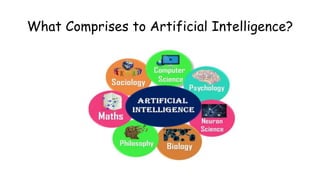
What Comprises to Artificial Intelligence?
To create the AI-first we should know that how intelligence is
composed,
So Intelligence is an intangible part of our brain which is a
combination of Reasoning, learning, problem-solving,
perception, language understanding, etc.
To achieve the above factors for a machine or software
Artificial Intelligence requires different disciplines shown in
the figure:
What Comprises to Artificial Intelligence?
Advantages and Disadvantages of Artificial Intelligence
Advantages of Artificial Intelligence:
• High Accuracy with fewer errors: AI systems are prone to fewer
errors and high accuracy as it takes decisions as per pre-experience.
• High-Speed: AI systems can be of very high-speed and fast-decision
making, e.g., AI systems can beat a chess champion in the Chess game.
• High reliability: AI machines are highly reliable and can perform the
same action multiple times with high accuracy.
• Useful for risky areas: AI machines can be helpful in situations such
as defusing a bomb, exploring the ocean floor, where to employ a
human can be risky.
• Digital Assistant: AI can be very useful to provide digital assistant to
users such as AI technology is currently used by various E-commerce
websites to show the products as per customer requirements
• Useful as a public utility: AI can be very useful for public utilities
such as a self driving car, facial recognition for security purposes,
Natural language processing (for search engines, for spelling checker,
for assistant like Siri, for translation like google translate)
Cont’d
Disadvantage of AI
 High Cost: The HW and SW requirement of AI is very costly as it requires
lots of maintenance to meet current world requirements.
 Can't think out of the box: Even we are making smarter machines with AI,
but still they cannot work out of the box, as the robot will only do that work
for which they are trained, or programmed.
 No feelings and emotions: AI machines can be an outstanding performer, but
still it does not have the feeling so it cannot make any kind of emotional
attachment with humans, and may sometime be harmful for users if the
proper care is not taken.
 Increase dependence on machines: With the increment of technology, people
are getting more dependent on devices and hence they are losing their mental
capabilities.
 No Original Creativity: As humans are so creative and can imagine some new
ideas but still AI machines cannot beat this power of human intelligence and
cannot be creative and imaginative.
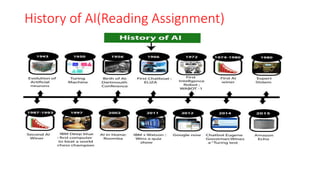
History of AI(Reading Assignment)
Levels of AI
Stage 1 – Rule-Based Systems
• Is a system that applies human-made rules to store, sort and
manipulate data. In doing so, it mimics human intelligence.
• It’s a logical program that uses pre-defined rules to make
deductions and choices to perform automated actions.
Stage 2 – Context Awareness and Retention
• Algorithms that develop information about the specific domain
they are being applied in.
• They are trained on the knowledge and experience of the best
humans, and their knowledge base can be updated as new
situations and queries arise. Well known applications of this
level are chatbots and “roboadvisors”
Cont’d
Stage 3 – Domain-Specific Expertise
• Going beyond the capability of humans, these systems build up
expertise in a specific context taking in massive volumes of
information which they can use for decision making.
• Successful use cases have been seen in cancer diagnosis and the
well-known Google Deepmind’s AlphaGo.
• Currently, this type is limited to one domain only would forget all it
knows about that domain if you started to teach it something else.
Stage 4 – Reasoning Machines
• These algorithms have some ability to attribute mental states to
themselves and others – they have a sense of beliefs, intentions,
knowledge, and how their own logic works.
• This means they could reason or negotiate with humans and other
machines.
• At the moment these algorithms are still in development, however,
commercial applications are expected within the next few years
Cont’d
Stage 5 – Self Aware Systems / Artificial General Intelligence (AGI)
• These systems have human-like intelligence – the most commonly
portrayed AI in media – however, no such use is in evidence today. It is
the goal of many working in AI and some believe it could be realized
already from 2024.
Stage 6 – Artificial Superintelligence (ASI)
• AI algorithms can outsmart even the most intelligent humans in every
domain.
• Logically it is difficult for humans to articulate what the capabilities
might be, yet we would hope examples would include solving problems we
have failed to so far, such as world hunger and dangerous environmental
change.
• Views vary as to when and whether such a capability could even be
possible, yet there a few experts who claim it can be realized by 2029.
• Fiction has tackled this idea for a long time, for example in the film Ex
Machina or Terminator.
Cont’d
Stage 7 – Singularity and Transcendence
• This is the idea that development provided by ASI (Stage 6) leads
to a massive expansion in human capability.
• Human augmentation could connect our brains to each other and to a
future successor of the current internet, creating a “hive mind”
that shares ideas, solves problems collectively, and even gives
others access to our dreams as observers or participants.
• Pushing this idea further, we might go beyond the limits of the
human body and connect to other forms of intelligence on the planet
– animals, plants, weather systems, and the natural environment.
• Some proponents of singularity such as Ray Kurzweil, Google’s
Director of Engineering, suggest we could see it happen by 2045 as
a result of exponential rates of progress across a range of science
and technology disciplines.
• The other side of the fence argues that singularity is impossible
and human consciousness could never be digitized
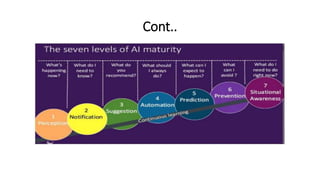
Cont..
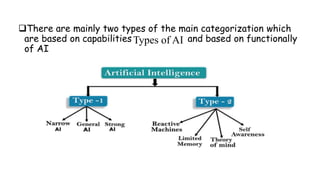
Types of AI
There are mainly two types of the main categorization which
are based on capabilities and based on functionally
of AI
Cont’d
Based on Capabilities
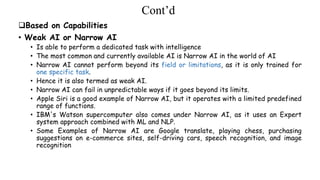
• Weak AI or Narrow AI
• Is able to perform a dedicated task with intelligence
• The most common and currently available AI is Narrow AI in the world of AI
• Narrow AI cannot perform beyond its field or limitations, as it is only trained for
one specific task.
• Hence it is also termed as weak AI.
• Narrow AI can fail in unpredictable ways if it goes beyond its limits.
• Apple Siri is a good example of Narrow AI, but it operates with a limited predefined
range of functions.
• IBM's Watson supercomputer also comes under Narrow AI, as it uses an Expert
system approach combined with ML and NLP.
• Some Examples of Narrow AI are Google translate, playing chess, purchasing
suggestions on e-commerce sites, self-driving cars, speech recognition, and image
recognition
Cont’d
Based on Capabilities
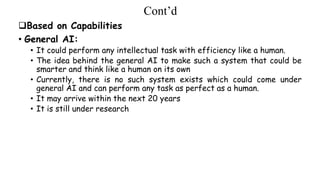
• General AI:
• It could perform any intellectual task with efficiency like a human.
• The idea behind the general AI to make such a system that could be
smarter and think like a human on its own
• Currently, there is no such system exists which could come under
general AI and can perform any task as perfect as a human.
• It may arrive within the next 20 years
• It is still under research
Cont’d
Based on Capabilities
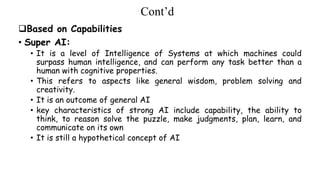
• Super AI:
• It is a level of Intelligence of Systems at which machines could
surpass human intelligence, and can perform any task better than a
human with cognitive properties.
• This refers to aspects like general wisdom, problem solving and
creativity.
• It is an outcome of general AI
• key characteristics of strong AI include capability, the ability to
think, to reason solve the puzzle, make judgments, plan, learn, and
communicate on its own
• It is still a hypothetical concept of AI
Cont’d
Based on the functionality
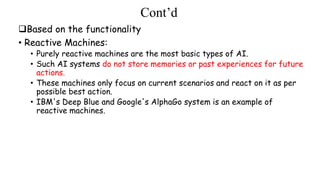
• Reactive Machines:
• Purely reactive machines are the most basic types of AI.
• Such AI systems do not store memories or past experiences for future
actions.
• These machines only focus on current scenarios and react on it as per
possible best action.
• IBM's Deep Blue and Google's AlphaGo system is an example of
reactive machines.
Cont’d
Based on the functionality
• Limited Memory
• It can store past experiences or some data for a short period of time.
• These machines can use stored data for a limited time period only.
• Self-driving cars are one of the best examples of Limited Memory
systems.
• These cars can store the recent speed of nearby cars, the distance
of other cars, speed limits, and other information to navigate the road
Cont’d
Based on the functionality
• Theory of Mind
• It should understand human emotions, people, beliefs, and be able to
interact socially like humans.
• This type of AI machines is still not developed, but researchers are
making lots of efforts and improvement for developing such AI
machines
Cont’d
Based on the functionality
• Self-Awareness
• It is the future of AI
• These machines will be super intelligent and will have their own
consciousness, sentiments, and self-awareness.
• These machines will be smarter than the human mind.
• Self-Awareness AI does not exist in reality still and it is a
hypothetical concept
How humans think?
The goal of many researchers is to create strong and general
AI that learns like a human and can solve general problems as
the human brain does
How does a human being think?
Intelligence or the cognitive process is composed of three
main stages:
• Observe and input the information or data in the brain.
• Interpret and evaluate the input that is received from the
surrounding environment.
• Make decisions as a reaction towards what you received as
input and interpreted and evaluated.
Cont’d
AI researchers are simulating the same stages in building AI
systems or models.
This process represents the main three layers or components
of AI systems.
Mapping human thinking to AI components
Because AI is the science of simulating human thinking, it is
possible to map the human thinking stages to the layers or
components of AI systems
In the first stage, humans acquire information from their
surrounding environments
• Through human senses, such as sight, hearing, smell, taste, and touch,
• through human organs, such as eyes, ears, and
• other sensing organs, for example, the hands
In AI models, this stage is represented by the sensing layer, which
perceives information from the surrounding environment.
This information is specific to the AI application
These E.g. sensing agents such as voice recognition for sensing
voice and visual imaging recognition for sensing images
agents or sensors take the role of the hearing and sight senses in
humans.
Cont’d
The second stage is interpreting and evaluating the input data
In AI Models, this stage is represented by the interpretation
layer, that is, reasoning and thinking about the gathered input
that is acquired by the sensing layer
The third stage is related to taking action or making decisions.
 After evaluating the input data, the interacting layer
performs the necessary tasks.
Robotic movement control and speech generation are examples
of functions that are implemented in the interacting layer
Influencers of AI
Influential factors that accelerate the rise of AI:
• Big data: Structured data versus unstructured data
• Advancements in computer processing speed and new chip
architectures
• Cloud computing and APIs
• The emergence of data science
Big Data
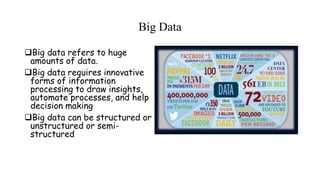
Big data refers to huge
amounts of data.
Big data requires innovative
forms of information
processing to draw insights,
automate processes, and help
decision making
Big data can be structured or
unstructured or semi-
structured
Define Structure, Unstructured and Semi structured data
Structured data versus unstructured data
Structured data is corresponds to a formal pattern, such as traditional
data sets and databases
Computers primarily process structured data, that is, information with
an organized structure, such as a RDB that is searchable by simple and
straightforward search engine algorithms or SQL statements
But, real-world data such as the type that humans deal with constantly
does not have a high degree of organization.
For example, text that is written or spoken in natural language (the
language that humans speak) does not constitute structured data.
Unstructured data is not contained in a regular database and is growing
exponentially, making up most of the data in the world
Advancements in computer processing speed, new chip
architectures, and big data file systems
Significant advancements in computer processing and memory
speeds enable us to make sense of the information that is
generated by big data more quickly.
In the past, statisticians and early data scientists were limited
to working with sample data sets.
In recent years, big data and the ability to process a large
amount of data at high speeds have enabled researchers and
developers to access and work with massive sets of data.
Processing speeds and new computer chip architectures
contribute to the rapid evolution of AI applications
Cont’d
The meaning of big data expanded beyond the volume of data after
the release of a paper by Google on MapReduce and the Google File
System (GFS), which evolved into the Apache Hadoop opensource
project.
The Hadoop file system is a distributed file system that may run on a
cluster of commodity machines, where the storage of data is
distributed among the cluster and the processing is distributed too.
 This approach determines the speed with which data is processed.
This approach includes an element of complexity with the
introduction of new, structured, unstructured, and multi-structured
data types
Large manufacturers of computer chips such as IBM and Intel are
prototyping “brain-like” chips whose architecture is configured to
mimic the biological brain’s network of neurons and the connections
between them called synapses.
Cloud computing and application programming interfaces
Cloud computing is a general term that describes the delivery
of on-demand services, usually through the internet, on a pay-
per-use basis.
Companies worldwide offer their services to customers over
cloud platforms.
These services might be data analysis, social media, video
storage, e-commerce, and AI capabilities that are available
through the internet and supported by cloud computing
The Emergence of Data Science
Data science is a new profession that combines several
disciplines, such as statistics, data analysis, machine learning,
and others.
The goal of data science is to extract knowledge or insights
from data in various forms, either structured or unstructured,
which is like data mining.
After you collect a large enough volume of data, patterns
emerge.
Then, data scientists use learning algorithms on these
patterns.
 Data science uses machine learning and AI to process big
data.
Applications of AI
AI is becoming essential for today's time because it can solve
complex problems in an efficient way in multiple industries,
such as Healthcare, entertainment, finance, education, etc.
AI is making our daily life more comfortable and faster.
AI has different application in different sectors such as
agriculture, finance, healthcare, gaming etc.
Cont’d
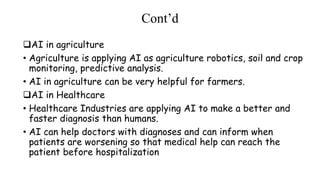
AI in agriculture
• Agriculture is applying AI as agriculture robotics, soil and crop
monitoring, predictive analysis.
• AI in agriculture can be very helpful for farmers.
AI in Healthcare
• Healthcare Industries are applying AI to make a better and
faster diagnosis than humans.
• AI can help doctors with diagnoses and can inform when
patients are worsening so that medical help can reach the
patient before hospitalization
Cont’d
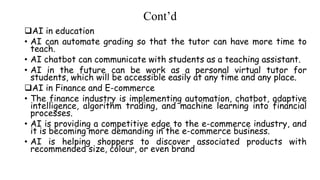
AI in education
• AI can automate grading so that the tutor can have more time to
teach.
• AI chatbot can communicate with students as a teaching assistant.
• AI in the future can be work as a personal virtual tutor for
students, which will be accessible easily at any time and any place.
AI in Finance and E-commerce
• The finance industry is implementing automation, chatbot, adaptive
intelligence, algorithm trading, and machine learning into financial
processes.
• AI is providing a competitive edge to the e-commerce industry, and
it is becoming more demanding in the e-commerce business.
• AI is helping shoppers to discover associated products with
recommended size, colour, or even brand
Cont’d
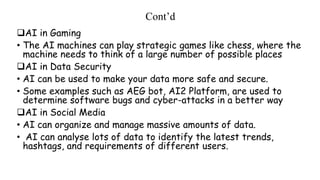
AI in Gaming
• The AI machines can play strategic games like chess, where the
machine needs to think of a large number of possible places
AI in Data Security
• AI can be used to make your data more safe and secure.
• Some examples such as AEG bot, AI2 Platform, are used to
determine software bugs and cyber-attacks in a better way
AI in Social Media
• AI can organize and manage massive amounts of data.
• AI can analyse lots of data to identify the latest trends,
hashtags, and requirements of different users.
Cont’d
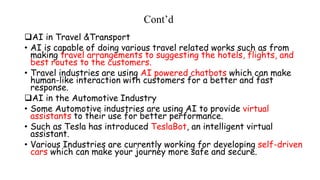
AI in Travel &Transport
• AI is capable of doing various travel related works such as from
making travel arrangements to suggesting the hotels, flights, and
best routes to the customers.
• Travel industries are using AI powered chatbots which can make
human-like interaction with customers for a better and fast
response.
AI in the Automotive Industry
• Some Automotive industries are using AI to provide virtual
assistants to their use for better performance.
• Such as Tesla has introduced TeslaBot, an intelligent virtual
assistant.
• Various Industries are currently working for developing self-driven
cars which can make your journey more safe and secure.
Cont’d
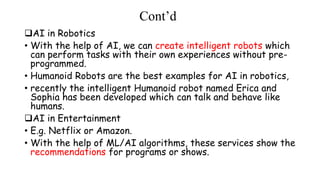
AI in Robotics
• With the help of AI, we can create intelligent robots which
can perform tasks with their own experiences without pre-
programmed.
• Humanoid Robots are the best examples for AI in robotics,
• recently the intelligent Humanoid robot named Erica and
Sophia has been developed which can talk and behave like
humans.
AI in Entertainment
• E.g. Netflix or Amazon.
• With the help of ML/AI algorithms, these services show the
recommendations for programs or shows.
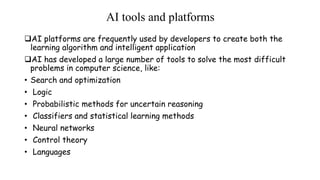
AI tools and platforms
AI platforms are frequently used by developers to create both the
learning algorithm and intelligent application
AI has developed a large number of tools to solve the most difficult
problems in computer science, like:
• Search and optimization
• Logic
• Probabilistic methods for uncertain reasoning
• Classifiers and statistical learning methods
• Neural networks
• Control theory
• Languages
Cont’d
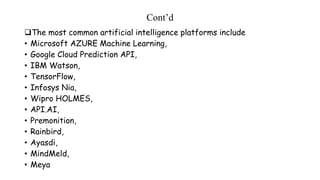
The most common artificial intelligence platforms include
• Microsoft AZURE Machine Learning,
• Google Cloud Prediction API,
• IBM Watson,
• TensorFlow,
• Infosys Nia,
• Wipro HOLMES,
• API.AI,
• Premonition,
• Rainbird,
• Ayasdi,
• MindMeld,
• Meya
Cont’d
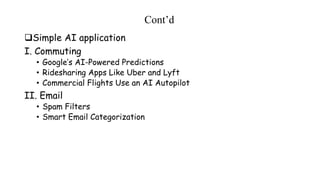
Simple AI application
I. Commuting
• Google’s AI-Powered Predictions
• Ridesharing Apps Like Uber and Lyft
• Commercial Flights Use an AI Autopilot
II. Email
• Spam Filters
• Smart Email Categorization
Cont’d
III. Social Networking
• Facebook - When you upload photos to Facebook, the service
automatically highlights faces and suggests friends tag.
• Pinterest - Pinterest uses computer vision, an application of AI
where computers are taught to “see,” in order to automatically
identify objects in images (or “pins”) and then recommend visually
similar pins.
• Instagram - Instagram, which Facebook acquired in 2012, uses
machine learning to identify the contextual meaning of emoji, which
have been steadily replacing slang (for instance, a laughing emoji
could replace “lol”)
• Snapchat - Snapchat introduced facial filters, called Lenses, in
2015.
• These filters track facial movements, allowing users to add
animated effects or digital masks that adjust when their faces
moved
Cont’d
IV. Online Shopping
• Search - Your Amazon searches (“ironing board”, “pizza stone”, “Android charger”, etc.)
quickly return a list of the most relevant products related to your search
• Recommendations
• Amazon uses ANN to generate these product recommendations.
V. Mobile Use
• Voice-to-Text - A standard feature on smartphones today is voice-to-text.
• Smart Personal Assistants - Now that voice-to-text technology is accurate enough to
rely on for basic conversation, it has become the control interface for a new generation
of smart personal assistants.
 Siri and Google Now (now succeeded by the more sophisticated Google Assistant), which
could perform internet searches, set reminders, and integrate with your calendar.
• Amazon expanded upon this model with the announcement of
complementary hardware and software components:
 Alexa, an AI-powered personal assistant that accepts voice commands to create to-
do lists, order items online, set reminders, and answer questions (via internet
searches)
 Echo (and later, Dot) smart speakers that allow you to integrate Alexa into your
living room and use voice commands to ask natural language questions, play music,
order pizza, hail an Uber, and integrate with smart home devices
Question?

chapter 3 - Artificial Intelligence.pptx

  • 1.
  • 2.
    Activity • How doyou define the word Artificial? And the word Intelligence?
  • 3.
    What is AI? •Artificial defines "man-made“, and intelligence defines "thinking power" • Or “the ability to learn and solve problems”, hence Artificial Intelligence means "a man-made thinking power.“ • AI is a branch of computer science by which we can create intelligent machines which can behave like a human, think like humans, and able to make decisions • Intelligence is the ability to acquire and apply knowledge. • Knowledge is the information acquired through experience. • Experience is the knowledge gained through exposure (training).
  • 4.
    Cont’d • Therefore, artificialintelligence as the “copy of something natural (i.e., human beings) ‘WHO’ is capable of acquiring and applying the information it has gained through exposure.” • AI exists when a machine can have human-based skills such as learning, reasoning, and solving problems • With AI you do not need to preprogram a machine to do some work, despite that you can create a machine with programmed algorithms which can work with own intelligence.
  • 5.
    Cont’d Intelligence is composedof: • Reasoning • Learning • Problem Solving • Perception • Linguistic Intelligence
  • 6.
    Cont’d An AI systemis composed of: • Agent • Environment • An agent (e.g., human or robot) is anything that can perceive its environment through sensors and acts upon that environment through effectors. • Intelligent agents must be able to set goals and achieve them • Machine perception is the ability to use input from sensors (such as cameras, microphones, sensors, etc.) to deduce aspects of the world. e.g., Computer Vision
  • 7.
    Cont’d High-profile examples ofAI include: • Autonomous vehicles (such as drones and self-driving cars), • Medical diagnosis • Creating art (such as poetry), • Proving mathematical theorems, • Playing games (such as Chess or Go), • Search engines (such as Google search), • Online assistants (such as Siri) • Image recognition in photographs, • Spam filtering, • Prediction of judicial decisions and targeting • Online advertisements
  • 8.
    Cont’d Machine Learning (ML)is an advanced form of AI where the machine can learn as it goes rather than having every action programmed by humans ML, a fundamental concept of AI research since the field’s inception, is the study of computer algorithms that improve automatically through experience. The term ML was introduced by Arthur Samuel in 1959. Neural networks(NN) are biologically inspired networks that extract features from the data in a hierarchical fashion. The field of NNs with several hidden layers is called deep learning
  • 9.
    Need for ArtificialIntelligence Need for Artificial Intelligence 1. To create expert systems that exhibit intelligent behavior with the capability to learn, demonstrate, explain and advice its users. 2. Helping machines find solutions to complex problems like humans do and applying them as algorithms in a computer- friendly manner
  • 10.
    Goals of ArtificialIntelligence 1. Replicate human intelligence 2. Solve Knowledge-intensive tasks 3. An intelligent connection of perception and action 4. Building a machine which can perform tasks that requires human intelligence such as: • Proving a theorem • Playing chess • Plan some surgical operation • Driving a car in traffic 5. Creating some system which can exhibit intelligent behavior, learn new things by itself, demonstrate, explain, and can advise to its user
  • 11.
    What Comprises toArtificial Intelligence? To create the AI-first we should know that how intelligence is composed, So Intelligence is an intangible part of our brain which is a combination of Reasoning, learning, problem-solving, perception, language understanding, etc. To achieve the above factors for a machine or software Artificial Intelligence requires different disciplines shown in the figure:
  • 12.
    What Comprises toArtificial Intelligence?
  • 13.
    Advantages and Disadvantagesof Artificial Intelligence Advantages of Artificial Intelligence: • High Accuracy with fewer errors: AI systems are prone to fewer errors and high accuracy as it takes decisions as per pre-experience. • High-Speed: AI systems can be of very high-speed and fast-decision making, e.g., AI systems can beat a chess champion in the Chess game. • High reliability: AI machines are highly reliable and can perform the same action multiple times with high accuracy. • Useful for risky areas: AI machines can be helpful in situations such as defusing a bomb, exploring the ocean floor, where to employ a human can be risky. • Digital Assistant: AI can be very useful to provide digital assistant to users such as AI technology is currently used by various E-commerce websites to show the products as per customer requirements • Useful as a public utility: AI can be very useful for public utilities such as a self driving car, facial recognition for security purposes, Natural language processing (for search engines, for spelling checker, for assistant like Siri, for translation like google translate)
  • 14.
    Cont’d Disadvantage of AI High Cost: The HW and SW requirement of AI is very costly as it requires lots of maintenance to meet current world requirements.  Can't think out of the box: Even we are making smarter machines with AI, but still they cannot work out of the box, as the robot will only do that work for which they are trained, or programmed.  No feelings and emotions: AI machines can be an outstanding performer, but still it does not have the feeling so it cannot make any kind of emotional attachment with humans, and may sometime be harmful for users if the proper care is not taken.  Increase dependence on machines: With the increment of technology, people are getting more dependent on devices and hence they are losing their mental capabilities.  No Original Creativity: As humans are so creative and can imagine some new ideas but still AI machines cannot beat this power of human intelligence and cannot be creative and imaginative.
  • 15.
  • 16.
    Levels of AI Stage1 – Rule-Based Systems • Is a system that applies human-made rules to store, sort and manipulate data. In doing so, it mimics human intelligence. • It’s a logical program that uses pre-defined rules to make deductions and choices to perform automated actions. Stage 2 – Context Awareness and Retention • Algorithms that develop information about the specific domain they are being applied in. • They are trained on the knowledge and experience of the best humans, and their knowledge base can be updated as new situations and queries arise. Well known applications of this level are chatbots and “roboadvisors”
  • 17.
    Cont’d Stage 3 –Domain-Specific Expertise • Going beyond the capability of humans, these systems build up expertise in a specific context taking in massive volumes of information which they can use for decision making. • Successful use cases have been seen in cancer diagnosis and the well-known Google Deepmind’s AlphaGo. • Currently, this type is limited to one domain only would forget all it knows about that domain if you started to teach it something else. Stage 4 – Reasoning Machines • These algorithms have some ability to attribute mental states to themselves and others – they have a sense of beliefs, intentions, knowledge, and how their own logic works. • This means they could reason or negotiate with humans and other machines. • At the moment these algorithms are still in development, however, commercial applications are expected within the next few years
  • 18.
    Cont’d Stage 5 –Self Aware Systems / Artificial General Intelligence (AGI) • These systems have human-like intelligence – the most commonly portrayed AI in media – however, no such use is in evidence today. It is the goal of many working in AI and some believe it could be realized already from 2024. Stage 6 – Artificial Superintelligence (ASI) • AI algorithms can outsmart even the most intelligent humans in every domain. • Logically it is difficult for humans to articulate what the capabilities might be, yet we would hope examples would include solving problems we have failed to so far, such as world hunger and dangerous environmental change. • Views vary as to when and whether such a capability could even be possible, yet there a few experts who claim it can be realized by 2029. • Fiction has tackled this idea for a long time, for example in the film Ex Machina or Terminator.
  • 19.
    Cont’d Stage 7 –Singularity and Transcendence • This is the idea that development provided by ASI (Stage 6) leads to a massive expansion in human capability. • Human augmentation could connect our brains to each other and to a future successor of the current internet, creating a “hive mind” that shares ideas, solves problems collectively, and even gives others access to our dreams as observers or participants. • Pushing this idea further, we might go beyond the limits of the human body and connect to other forms of intelligence on the planet – animals, plants, weather systems, and the natural environment. • Some proponents of singularity such as Ray Kurzweil, Google’s Director of Engineering, suggest we could see it happen by 2045 as a result of exponential rates of progress across a range of science and technology disciplines. • The other side of the fence argues that singularity is impossible and human consciousness could never be digitized
  • 20.
  • 21.
    Types of AI Thereare mainly two types of the main categorization which are based on capabilities and based on functionally of AI
  • 22.
    Cont’d Based on Capabilities •Weak AI or Narrow AI • Is able to perform a dedicated task with intelligence • The most common and currently available AI is Narrow AI in the world of AI • Narrow AI cannot perform beyond its field or limitations, as it is only trained for one specific task. • Hence it is also termed as weak AI. • Narrow AI can fail in unpredictable ways if it goes beyond its limits. • Apple Siri is a good example of Narrow AI, but it operates with a limited predefined range of functions. • IBM's Watson supercomputer also comes under Narrow AI, as it uses an Expert system approach combined with ML and NLP. • Some Examples of Narrow AI are Google translate, playing chess, purchasing suggestions on e-commerce sites, self-driving cars, speech recognition, and image recognition
  • 23.
    Cont’d Based on Capabilities •General AI: • It could perform any intellectual task with efficiency like a human. • The idea behind the general AI to make such a system that could be smarter and think like a human on its own • Currently, there is no such system exists which could come under general AI and can perform any task as perfect as a human. • It may arrive within the next 20 years • It is still under research
  • 24.
    Cont’d Based on Capabilities •Super AI: • It is a level of Intelligence of Systems at which machines could surpass human intelligence, and can perform any task better than a human with cognitive properties. • This refers to aspects like general wisdom, problem solving and creativity. • It is an outcome of general AI • key characteristics of strong AI include capability, the ability to think, to reason solve the puzzle, make judgments, plan, learn, and communicate on its own • It is still a hypothetical concept of AI
  • 25.
    Cont’d Based on thefunctionality • Reactive Machines: • Purely reactive machines are the most basic types of AI. • Such AI systems do not store memories or past experiences for future actions. • These machines only focus on current scenarios and react on it as per possible best action. • IBM's Deep Blue and Google's AlphaGo system is an example of reactive machines.
  • 26.
    Cont’d Based on thefunctionality • Limited Memory • It can store past experiences or some data for a short period of time. • These machines can use stored data for a limited time period only. • Self-driving cars are one of the best examples of Limited Memory systems. • These cars can store the recent speed of nearby cars, the distance of other cars, speed limits, and other information to navigate the road
  • 27.
    Cont’d Based on thefunctionality • Theory of Mind • It should understand human emotions, people, beliefs, and be able to interact socially like humans. • This type of AI machines is still not developed, but researchers are making lots of efforts and improvement for developing such AI machines
  • 28.
    Cont’d Based on thefunctionality • Self-Awareness • It is the future of AI • These machines will be super intelligent and will have their own consciousness, sentiments, and self-awareness. • These machines will be smarter than the human mind. • Self-Awareness AI does not exist in reality still and it is a hypothetical concept
  • 29.
    How humans think? Thegoal of many researchers is to create strong and general AI that learns like a human and can solve general problems as the human brain does How does a human being think? Intelligence or the cognitive process is composed of three main stages: • Observe and input the information or data in the brain. • Interpret and evaluate the input that is received from the surrounding environment. • Make decisions as a reaction towards what you received as input and interpreted and evaluated.
  • 30.
    Cont’d AI researchers aresimulating the same stages in building AI systems or models. This process represents the main three layers or components of AI systems.
  • 31.
    Mapping human thinkingto AI components Because AI is the science of simulating human thinking, it is possible to map the human thinking stages to the layers or components of AI systems In the first stage, humans acquire information from their surrounding environments • Through human senses, such as sight, hearing, smell, taste, and touch, • through human organs, such as eyes, ears, and • other sensing organs, for example, the hands In AI models, this stage is represented by the sensing layer, which perceives information from the surrounding environment. This information is specific to the AI application These E.g. sensing agents such as voice recognition for sensing voice and visual imaging recognition for sensing images agents or sensors take the role of the hearing and sight senses in humans.
  • 32.
    Cont’d The second stageis interpreting and evaluating the input data In AI Models, this stage is represented by the interpretation layer, that is, reasoning and thinking about the gathered input that is acquired by the sensing layer The third stage is related to taking action or making decisions.  After evaluating the input data, the interacting layer performs the necessary tasks. Robotic movement control and speech generation are examples of functions that are implemented in the interacting layer
  • 33.
    Influencers of AI Influentialfactors that accelerate the rise of AI: • Big data: Structured data versus unstructured data • Advancements in computer processing speed and new chip architectures • Cloud computing and APIs • The emergence of data science
  • 34.
    Big Data Big datarefers to huge amounts of data. Big data requires innovative forms of information processing to draw insights, automate processes, and help decision making Big data can be structured or unstructured or semi- structured
  • 35.
    Define Structure, Unstructuredand Semi structured data Structured data versus unstructured data Structured data is corresponds to a formal pattern, such as traditional data sets and databases Computers primarily process structured data, that is, information with an organized structure, such as a RDB that is searchable by simple and straightforward search engine algorithms or SQL statements But, real-world data such as the type that humans deal with constantly does not have a high degree of organization. For example, text that is written or spoken in natural language (the language that humans speak) does not constitute structured data. Unstructured data is not contained in a regular database and is growing exponentially, making up most of the data in the world
  • 36.
    Advancements in computerprocessing speed, new chip architectures, and big data file systems Significant advancements in computer processing and memory speeds enable us to make sense of the information that is generated by big data more quickly. In the past, statisticians and early data scientists were limited to working with sample data sets. In recent years, big data and the ability to process a large amount of data at high speeds have enabled researchers and developers to access and work with massive sets of data. Processing speeds and new computer chip architectures contribute to the rapid evolution of AI applications
  • 37.
    Cont’d The meaning ofbig data expanded beyond the volume of data after the release of a paper by Google on MapReduce and the Google File System (GFS), which evolved into the Apache Hadoop opensource project. The Hadoop file system is a distributed file system that may run on a cluster of commodity machines, where the storage of data is distributed among the cluster and the processing is distributed too.  This approach determines the speed with which data is processed. This approach includes an element of complexity with the introduction of new, structured, unstructured, and multi-structured data types Large manufacturers of computer chips such as IBM and Intel are prototyping “brain-like” chips whose architecture is configured to mimic the biological brain’s network of neurons and the connections between them called synapses.
  • 38.
    Cloud computing andapplication programming interfaces Cloud computing is a general term that describes the delivery of on-demand services, usually through the internet, on a pay- per-use basis. Companies worldwide offer their services to customers over cloud platforms. These services might be data analysis, social media, video storage, e-commerce, and AI capabilities that are available through the internet and supported by cloud computing
  • 39.
    The Emergence ofData Science Data science is a new profession that combines several disciplines, such as statistics, data analysis, machine learning, and others. The goal of data science is to extract knowledge or insights from data in various forms, either structured or unstructured, which is like data mining. After you collect a large enough volume of data, patterns emerge. Then, data scientists use learning algorithms on these patterns.  Data science uses machine learning and AI to process big data.
  • 40.
    Applications of AI AIis becoming essential for today's time because it can solve complex problems in an efficient way in multiple industries, such as Healthcare, entertainment, finance, education, etc. AI is making our daily life more comfortable and faster. AI has different application in different sectors such as agriculture, finance, healthcare, gaming etc.
  • 41.
    Cont’d AI in agriculture •Agriculture is applying AI as agriculture robotics, soil and crop monitoring, predictive analysis. • AI in agriculture can be very helpful for farmers. AI in Healthcare • Healthcare Industries are applying AI to make a better and faster diagnosis than humans. • AI can help doctors with diagnoses and can inform when patients are worsening so that medical help can reach the patient before hospitalization
  • 42.
    Cont’d AI in education •AI can automate grading so that the tutor can have more time to teach. • AI chatbot can communicate with students as a teaching assistant. • AI in the future can be work as a personal virtual tutor for students, which will be accessible easily at any time and any place. AI in Finance and E-commerce • The finance industry is implementing automation, chatbot, adaptive intelligence, algorithm trading, and machine learning into financial processes. • AI is providing a competitive edge to the e-commerce industry, and it is becoming more demanding in the e-commerce business. • AI is helping shoppers to discover associated products with recommended size, colour, or even brand
  • 43.
    Cont’d AI in Gaming •The AI machines can play strategic games like chess, where the machine needs to think of a large number of possible places AI in Data Security • AI can be used to make your data more safe and secure. • Some examples such as AEG bot, AI2 Platform, are used to determine software bugs and cyber-attacks in a better way AI in Social Media • AI can organize and manage massive amounts of data. • AI can analyse lots of data to identify the latest trends, hashtags, and requirements of different users.
  • 44.
    Cont’d AI in Travel&Transport • AI is capable of doing various travel related works such as from making travel arrangements to suggesting the hotels, flights, and best routes to the customers. • Travel industries are using AI powered chatbots which can make human-like interaction with customers for a better and fast response. AI in the Automotive Industry • Some Automotive industries are using AI to provide virtual assistants to their use for better performance. • Such as Tesla has introduced TeslaBot, an intelligent virtual assistant. • Various Industries are currently working for developing self-driven cars which can make your journey more safe and secure.
  • 45.
    Cont’d AI in Robotics •With the help of AI, we can create intelligent robots which can perform tasks with their own experiences without pre- programmed. • Humanoid Robots are the best examples for AI in robotics, • recently the intelligent Humanoid robot named Erica and Sophia has been developed which can talk and behave like humans. AI in Entertainment • E.g. Netflix or Amazon. • With the help of ML/AI algorithms, these services show the recommendations for programs or shows.
  • 46.
    AI tools andplatforms AI platforms are frequently used by developers to create both the learning algorithm and intelligent application AI has developed a large number of tools to solve the most difficult problems in computer science, like: • Search and optimization • Logic • Probabilistic methods for uncertain reasoning • Classifiers and statistical learning methods • Neural networks • Control theory • Languages
  • 47.
    Cont’d The most commonartificial intelligence platforms include • Microsoft AZURE Machine Learning, • Google Cloud Prediction API, • IBM Watson, • TensorFlow, • Infosys Nia, • Wipro HOLMES, • API.AI, • Premonition, • Rainbird, • Ayasdi, • MindMeld, • Meya
  • 48.
    Cont’d Simple AI application I.Commuting • Google’s AI-Powered Predictions • Ridesharing Apps Like Uber and Lyft • Commercial Flights Use an AI Autopilot II. Email • Spam Filters • Smart Email Categorization
  • 49.
    Cont’d III. Social Networking •Facebook - When you upload photos to Facebook, the service automatically highlights faces and suggests friends tag. • Pinterest - Pinterest uses computer vision, an application of AI where computers are taught to “see,” in order to automatically identify objects in images (or “pins”) and then recommend visually similar pins. • Instagram - Instagram, which Facebook acquired in 2012, uses machine learning to identify the contextual meaning of emoji, which have been steadily replacing slang (for instance, a laughing emoji could replace “lol”) • Snapchat - Snapchat introduced facial filters, called Lenses, in 2015. • These filters track facial movements, allowing users to add animated effects or digital masks that adjust when their faces moved
  • 50.
    Cont’d IV. Online Shopping •Search - Your Amazon searches (“ironing board”, “pizza stone”, “Android charger”, etc.) quickly return a list of the most relevant products related to your search • Recommendations • Amazon uses ANN to generate these product recommendations. V. Mobile Use • Voice-to-Text - A standard feature on smartphones today is voice-to-text. • Smart Personal Assistants - Now that voice-to-text technology is accurate enough to rely on for basic conversation, it has become the control interface for a new generation of smart personal assistants.  Siri and Google Now (now succeeded by the more sophisticated Google Assistant), which could perform internet searches, set reminders, and integrate with your calendar. • Amazon expanded upon this model with the announcement of complementary hardware and software components:  Alexa, an AI-powered personal assistant that accepts voice commands to create to- do lists, order items online, set reminders, and answer questions (via internet searches)  Echo (and later, Dot) smart speakers that allow you to integrate Alexa into your living room and use voice commands to ask natural language questions, play music, order pizza, hail an Uber, and integrate with smart home devices
  • 51.