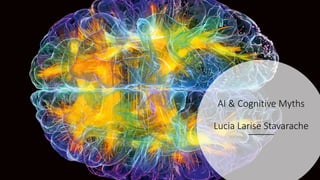
AI & Cognitive Myths
Lucia Larise Stavarache
Myth
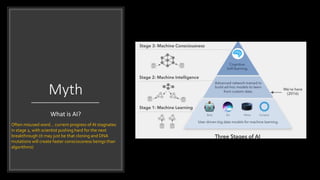
What is AI?
Often misused word… current progress of AI stagnates
in stage 2, with scientist pushing hard for the next
breakthrough (it may just be that cloning and DNA
mutations will create faster consciousness beings than
algorithms)
Myth
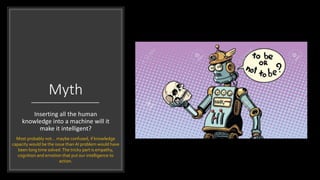
Inserting all the human
knowledge into a machine will it
make it intelligent?
Most probably not… maybe confused, if knowledge
capacity would be the issue than AI problem would have
been long time solved.The tricky part is empathy,
cognition and emotion that put our intelligence to
action.
Myth
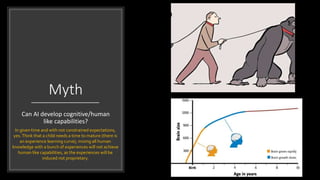
Can AI develop cognitive/human
like capabilities?
In given time and with not constrained expectations,
yes.Think that a child needs a time to mature (there is
an experience learning curve), mixing all human
knowledge with a bunch of experiences will not achieve
human like capabilities, as the experiences will be
induced not proprietary.
Myth
I am ever going to win Jeopardy
and Go with all of the AI agents
there?
There are just so many possibilities that we can compute,
remember we are also playing games for fun not to beat
the RAM.
Myth
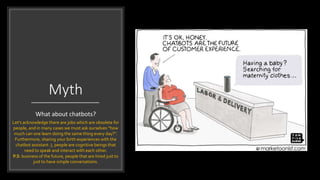
What about chatbots?
Let’s acknowledge there are jobs which are obsolete for
people, and in many cases we must ask ourselves “how
much can one learn doing the same thing every day?”.
Furthermore, sharing your birth experiences with the
chatbot assistant :), people are cognitive beings that
need to speak and interact with each other.
P.S: business of the future, people that are hired just to
just to have simple conversations.
There are multiple ways to build a chatbot:
AIML: You can use Artificial Intelligence Markup Language (AIML) to create
conversational flows for your bot. AIML is very easy to learn and basically an
extension of XML.
NLP/NLU: Natural Language Processing (NLP) and Natural Language
Understanding (NLU) attempt to solve the problem by parsing language into
entities, intents and a few other categories. Different NLP platforms may
different names however the essence is more so the same.
Machine Learning: The ‘other’ option is to build your own NLP/NLU by using
Machine Learning. One of the first things to consider will be the type of
want to build.
https://www.quora.com/What-are-some-open-source-AI-chatbots-that-use-
machine-learning
Analyzing the alternatives, not all our conversations are intents or
entities, therefore my strong believe a bot should be more than “an if
else intention mapping in different forms”, there has to be a
combination between an NLU language (maybe AIML maybe not), that
closely maps human interactions together with reinforcement learning,
DL and ML to develop a program/bot that has the ability to learn and
achieve human like personality, and in time auto modify its core
behavior as it develops true consciousness.
https://www.smartsheet.com/artificial-intelligence-chatbots
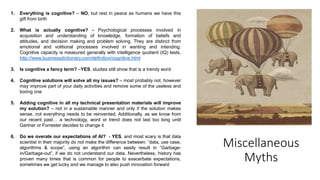
Miscellaneous
Myths
1. Everything is cognitive? – NO, but rest in peace as humans we have this
gift from birth
2. What is actually cognitive? - Psychological processes involved in
acquisition and understanding of knowledge, formation of beliefs and
attitudes, and decision making and problem solving. They are distinct from
emotional and volitional processes involved in wanting and intending.
Cognitive capacity is measured generally with intelligence quotient (IQ) tests.
http://www.businessdictionary.com/definition/cognitive.html
3. Is cognitive a fancy term? –YES, studies still show that is a trendy word
4. Cognitive solutions will solve all my issues? – most probably not, however
may improve part of your daily activities and remove some of the useless and
boring one
5. Adding cognitive in all my technical presentation materials will improve
my solution? – not in a sustainable manner and only if the solution makes
sense, not everything needs to be reinvented. Additionally, as we know from
our recent past… a technology, word or trend does not last too long until
Gartner or Forrester decides to change it
6. Do we overate our expectations of AI? - YES, and most scary is that data
scientist in their majority do not make the difference between: ”data, use case,
algorithms & scope”, using an algorithm can easily result in “Garbage-
in/Garbage-out”, if we do not understand our data. Nevertheless, history has
proven many times that is common for people to exacerbate expectations,
sometimes we get lucky and we manage to also push innovation forward
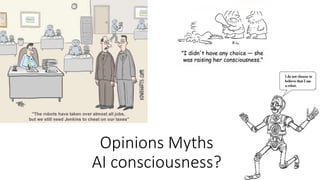
Opinions Myths
AI consciousness?
Thank you!
To all the geeks out there that go an extra mile!

Ai Myths

  • 1.
    AI & CognitiveMyths Lucia Larise Stavarache
  • 2.
    Myth What is AI? Oftenmisused word… current progress of AI stagnates in stage 2, with scientist pushing hard for the next breakthrough (it may just be that cloning and DNA mutations will create faster consciousness beings than algorithms)
  • 3.
    Myth Inserting all thehuman knowledge into a machine will it make it intelligent? Most probably not… maybe confused, if knowledge capacity would be the issue than AI problem would have been long time solved.The tricky part is empathy, cognition and emotion that put our intelligence to action.
  • 4.
    Myth Can AI developcognitive/human like capabilities? In given time and with not constrained expectations, yes.Think that a child needs a time to mature (there is an experience learning curve), mixing all human knowledge with a bunch of experiences will not achieve human like capabilities, as the experiences will be induced not proprietary.
  • 5.
    Myth I am evergoing to win Jeopardy and Go with all of the AI agents there? There are just so many possibilities that we can compute, remember we are also playing games for fun not to beat the RAM.
  • 6.
    Myth What about chatbots? Let’sacknowledge there are jobs which are obsolete for people, and in many cases we must ask ourselves “how much can one learn doing the same thing every day?”. Furthermore, sharing your birth experiences with the chatbot assistant :), people are cognitive beings that need to speak and interact with each other. P.S: business of the future, people that are hired just to just to have simple conversations.
  • 7.
    There are multipleways to build a chatbot: AIML: You can use Artificial Intelligence Markup Language (AIML) to create conversational flows for your bot. AIML is very easy to learn and basically an extension of XML. NLP/NLU: Natural Language Processing (NLP) and Natural Language Understanding (NLU) attempt to solve the problem by parsing language into entities, intents and a few other categories. Different NLP platforms may different names however the essence is more so the same. Machine Learning: The ‘other’ option is to build your own NLP/NLU by using Machine Learning. One of the first things to consider will be the type of want to build. https://www.quora.com/What-are-some-open-source-AI-chatbots-that-use- machine-learning Analyzing the alternatives, not all our conversations are intents or entities, therefore my strong believe a bot should be more than “an if else intention mapping in different forms”, there has to be a combination between an NLU language (maybe AIML maybe not), that closely maps human interactions together with reinforcement learning, DL and ML to develop a program/bot that has the ability to learn and achieve human like personality, and in time auto modify its core behavior as it develops true consciousness. https://www.smartsheet.com/artificial-intelligence-chatbots
  • 8.
    Miscellaneous Myths 1. Everything iscognitive? – NO, but rest in peace as humans we have this gift from birth 2. What is actually cognitive? - Psychological processes involved in acquisition and understanding of knowledge, formation of beliefs and attitudes, and decision making and problem solving. They are distinct from emotional and volitional processes involved in wanting and intending. Cognitive capacity is measured generally with intelligence quotient (IQ) tests. http://www.businessdictionary.com/definition/cognitive.html 3. Is cognitive a fancy term? –YES, studies still show that is a trendy word 4. Cognitive solutions will solve all my issues? – most probably not, however may improve part of your daily activities and remove some of the useless and boring one 5. Adding cognitive in all my technical presentation materials will improve my solution? – not in a sustainable manner and only if the solution makes sense, not everything needs to be reinvented. Additionally, as we know from our recent past… a technology, word or trend does not last too long until Gartner or Forrester decides to change it 6. Do we overate our expectations of AI? - YES, and most scary is that data scientist in their majority do not make the difference between: ”data, use case, algorithms & scope”, using an algorithm can easily result in “Garbage- in/Garbage-out”, if we do not understand our data. Nevertheless, history has proven many times that is common for people to exacerbate expectations, sometimes we get lucky and we manage to also push innovation forward
  • 9.
  • 10.
    Thank you! To allthe geeks out there that go an extra mile!