ARTIFICIAL
INTELLIGENC
E
CLASS-VIII
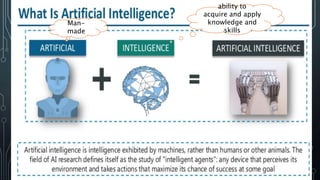
ability to
acquire and apply
knowledge and
skills
Man-
made
https://www.youtube.com/watch?v=UFDOY1wOOz0&app=desk
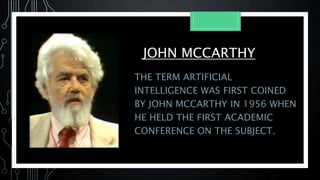
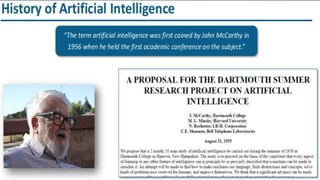
JOHN MCCARTHY
THE TERM ARTIFICIAL
INTELLIGENCE WAS FIRST COINED
BY JOHN MCCARTHY IN 1956 WHEN
HE HELD THE FIRST ACADEMIC
CONFERENCE ON THE SUBJECT.
ARTIFICIAL INTELLIGENCE
Artificial Intelligence (AI) is a field of computer science
aimed at developing machines which are intelligent enough to do
certain tasks that would normally be performed only by humans. It
uses machine learning to continuously learn and adapt its algorithms
to become smarter each time and autonomously undertake actions
without human intervention. Machine learning essentially means
machines learning on their own to improve their functioning without
human intervention.
ARTIFICIAL INTELLIGENCE
Artificial Intelligence (AI) refers to the ability of
machines to perform cognitive tasks like thinking,
perceiving, learning, problem solving and decision making;
it is inspired by the ways people use their brains to perceive,
learn, reason out and decide the action
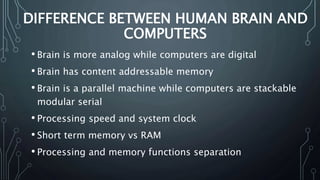
DIFFERENCE BETWEEN HUMAN BRAIN AND
COMPUTERS
• Brain is more analog while computers are digital
• Brain has content addressable memory
• Brain is a parallel machine while computers are stackable
modular serial
• Processing speed and system clock
• Short term memory vs RAM
• Processing and memory functions separation
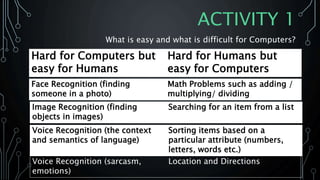
ACTIVITY 1
What is easy and what is difficult for Computers?
Hard for Computers but
easy for Humans
Hard for Humans but
easy for Computers
Voice Recognition (the context
and semantics of language)
Sorting items based on a
particular attribute (numbers,
letters, words etc.)
Voice Recognition (sarcasm,
emotions)
Location and Directions
Face Recognition (finding
someone in a photo)
Math Problems such as adding /
multiplying/ dividing
Image Recognition (finding
objects in images)
Searching for an item from a list
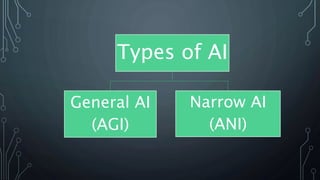
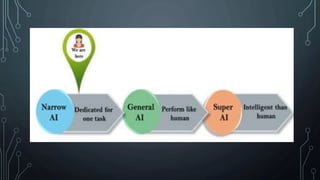
Types of AI
General AI
(AGI)
Narrow AI
(ANI)
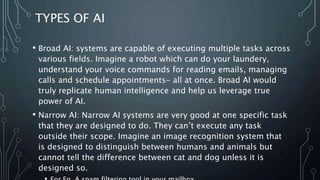
TYPES OF AI
• Broad AI: systems are capable of executing multiple tasks across
various fields. Imagine a robot which can do your laundery,
understand your voice commands for reading emails, managing
calls and schedule appointments- all at once. Broad AI would
truly replicate human intelligence and help us leverage true
power of AI.
• Narrow AI: Narrow AI systems are very good at one specific task
that they are designed to do. They can’t execute any task
outside their scope. Imagine an image recognition system that
is designed to distinguish between humans and animals but
cannot tell the difference between cat and dog unless it is
designed so.
TYPES OF AI
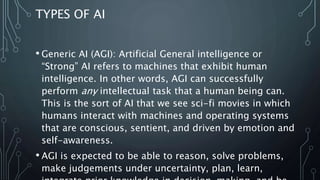
• Generic AI (AGI): Artificial General intelligence or
“Strong” AI refers to machines that exhibit human
intelligence. In other words, AGI can successfully
perform any intellectual task that a human being can.
This is the sort of AI that we see sci-fi movies in which
humans interact with machines and operating systems
that are conscious, sentient, and driven by emotion and
self-awareness.
• AGI is expected to be able to reason, solve problems,
make judgements under uncertainty, plan, learn,
A BIG LEAP IN PURSUING GENERAL AI- IBM
WATSON
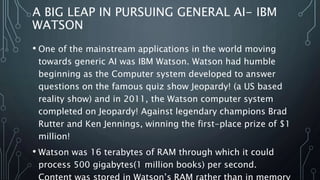
• One of the mainstream applications in the world moving
towards generic AI was IBM Watson. Watson had humble
beginning as the Computer system developed to answer
questions on the famous quiz show Jeopardy! (a US based
reality show) and in 2011, the Watson computer system
completed on Jeopardy! Against legendary champions Brad
Rutter and Ken Jennings, winning the first-place prize of $1
million!
• Watson was 16 terabytes of RAM through which it could
process 500 gigabytes(1 million books) per second.
TYPES OF AI
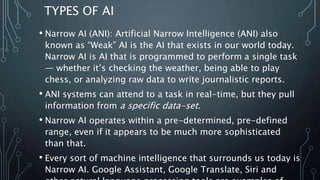
• Narrow AI (ANI): Artificial Narrow Intelligence (ANI) also
known as “Weak” AI is the AI that exists in our world today.
Narrow AI is AI that is programmed to perform a single task
— whether it’s checking the weather, being able to play
chess, or analyzing raw data to write journalistic reports.
• ANI systems can attend to a task in real-time, but they pull
information from a specific data-set.
• Narrow AI operates within a pre-determined, pre-defined
range, even if it appears to be much more sophisticated
than that.
• Every sort of machine intelligence that surrounds us today is
Narrow AI. Google Assistant, Google Translate, Siri and
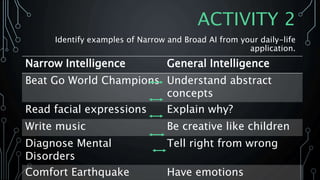
ACTIVITY 2
Identify examples of Narrow and Broad AI from your daily-life
application.
Narrow Intelligence General Intelligence
Beat Go World Champions Understand abstract
concepts
Read facial expressions Explain why?
Write music Be creative like children
Diagnose Mental
Disorders
Tell right from wrong
Comfort Earthquake Have emotions
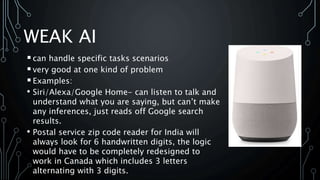
WEAK AI
can handle specific tasks scenarios
very good at one kind of problem
Examples:
• Siri/Alexa/Google Home- can listen to talk and
understand what you are saying, but can’t make
any inferences, just reads off Google search
results.
• Postal service zip code reader for India will
always look for 6 handwritten digits, the logic
would have to be completely redesigned to
work in Canada which includes 3 letters
alternating with 3 digits.
STRONG AI
Strong AI is generalized – it can generalize its knowledge to
solve more than one kind of problem.
Intellectual strength, not physical strength
Displays human-like behavior
Examples:
• Can guess answers to questions, give you ideas based on
past understanding.
• Postal service zip code reader can adapt from 5 digits to 3
digits and letters almost immediately.
AUTOMATED AND AUTONOMOUS
PROCESSING
Automated System Autonomous System
It is deterministic in nature. IF
this THEN that.
It is probabilistic in nature which
means that it is based on inputs,
situation and context.
Will always produce same
answer /response for a specific
query.
Can give different
answers/output to the same set
of inputs based on the context
Most Computers and algorithms
work on this approach.
The human brain works in a
similar way as an autonomous
system and most strong AI
systems would be like a fully
autonomous decision-making
ACTIVITY 3
How does a Driverless Car Work ?
List down various technologies and sensors being used in a self-
driving car.
How do you think AI is being used here? Is this narrow or general AI?
Strong or Weak AI?
https://www.youtube.com/watch?v=taMP_n3wL7M
FUN TIME
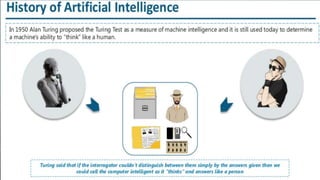
Did you know Google Assistant came close to passing the Turing
Test.
See how Google passes the Turing Test:
https://www.youtube.com/watch?v=JvbHu_b
Va_g
ACTIVITY 4
Rock, Paper and Scissors
https://www.afiniti.com/corporate/rock-
paper-scissors
Analyze the game with larger perspective.
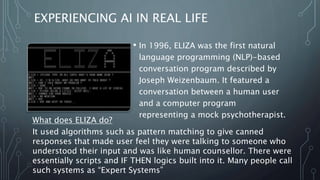
EXPERIENCING AI IN REAL LIFE
• In 1996, ELIZA was the first natural
language programming (NLP)-based
conversation program described by
Joseph Weizenbaum. It featured a
conversation between a human user
and a computer program
representing a mock psychotherapist.
What does ELIZA do?
It used algorithms such as pattern matching to give canned
responses that made user feel they were talking to someone who
understood their input and was like human counsellor. There were
essentially scripts and IF THEN logics built into it. Many people call
such systems as “Expert Systems”
DID YOU KNOW?
• Sophia was the first bot that was recently offered citizenship by
the kingdom of Saudi Arabia!
• https://www.youtube.com/watch?v=IsFv_gKS3YE
BENEFITS OF AI
• AI would have a low error rate compared to humans, if coded
properly. They would have incredible precision, accuracy, and
speed.
• They won't be affected by hostile environments, thus able to
complete dangerous tasks, explore in space, and endure
problems that would injure or kill us.
-This can even mean mining and digging fuels that would
otherwise be hostile for humans.
• Replace humans in repetitive, tedious tasks and in many
laborious places of work.
• Predict what a user will type, ask, search, and do. They can
easily act as assistants and can recommend or direct various
actions.
BENEFITS OF AI
• Can detect fraud in card-based systems, and possibly
other systems in the future.
• Interact with humans for entertainment or a task as
avatars or robots.
- An example of this is AI for playing many videogames.
• They can think logically without emotions, making
rational decisions with less or no mistakes.
• They don't need to sleep, rest, take breaks, or get
entertained, as they don't get bored or tired.
LIMITATIONS OF AI
• Data Availability: Any AI system needs training data to start
and then test data for ensuring that it has learnt properly.
Data can be in the form of images, audio or video which
poses a bog challenge in interpreting and using it in AI
systems. It also heavy in size and comes in multiple formats
and quality.
• Bias: Human being often have bias about certain things. It
could be reasonable or unreasonable. When algorithms are
developed by humans, their bias also sometimes creeps into
the AI system and becomes its bias.
• Emotional Intelligence: AI uses Natural Language Processing
LIMITATIONS OF AI
• HIGH COST OF IMPLEMENTATION: Setting up AI-based
machines, computers, etc. entails huge costs given the
complexity of engineering that goes into building one.
Further, the astronomical expense doesn’t stop there as
repair and maintenance also run into thousands of dollars.
• LACKS CREATIVITY: AI’s creativity is limited to the creative ability
of the person who programs and commands them. Although they
can help you in designing and creating something special, they
still can’t compete with the human brain.
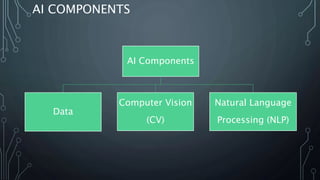
AI COMPONENTS
AI Components
Data
Computer Vision
(CV)
Natural Language
Processing (NLP)
DATA IDENTIFICATION AND COLLECTION
• Data is the starting point for all AI applications. These data
sets can be numeric (sales, insurance premium, weather
data etc.) Categorical (color, gender etc.), even
unstructured free text (comments, audio, images, videos,
notes, feedback).
• Data collection is the process of identifying various
sources of data(structured and unstructured), collecting
data and preparing to label it. We need to make sure that
data collected is in the correct format and aligned with
project requirements.
• It starts with having basic hardware, sensors and devices
in places to capture the data required for our AI model.
Next stage is having right storage system having IT
infrastructure (servers, cloud storage etc.) and systems
• We then need to do data cleaning to ensure that right data
in correct format is available to run any analytics or data
science models on it.
• The next step is to run data visualization models,
classification of data, data labelling and defining some
analytics metrics for identified set of data.
• The final stage is to apply Machine Learning algorithms to
identify patterns and forecast future trends on data. We
need to do A/B testing to iterate on the model.
• Companies like Google, Amazon and Facebook are
dominating their industries because they were the first
begin building data sets. Their data set have become so
large and complicated and their data collection and
analysis is so sophisticated that they are able to grow it to
their competitive advantage.
COMPUTER VISION
• Computer Vision is a subset of AI that lets machine see and extract
meaning from pixels in an image. CV aims to mirror how human vision
works and interpret things we see.
• Deep learning can work hand in hand with CV creating powerful
systems such as searching images in Google, tagging of friends in
social media, apps which can create a future aged version of your face,
speech-to-text translation, intrusion detection system.
• Computer Vision (CV) has been around for over 50 years. Its
development began in 1950’s around the same time when artificial
intelligence gained prominence.
• Some CV applications include self-driving cars, facial recognition-based
tracking systems with vision cameras and Amazon Go.
AMAZON GO
• Amazon Go is a new kind of store with no checkout required.
Amazon claims it to be world’s most advanced shopping
technology as you never have wait in line.
• With the Just walk out shopping experience, simply use the
Amazon Go app to enter the store, take the products you want,
and go! No lines, no checkouts.
• The key underlying technology in these amazing use cases is
computer vision.
NATURAL LANGUAGE PROCESSING
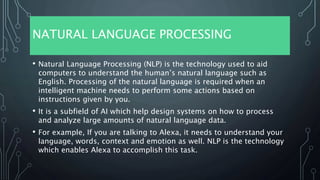
• Natural Language Processing (NLP) is the technology used to aid
computers to understand the human’s natural language such as
English. Processing of the natural language is required when an
intelligent machine needs to perform some actions based on
instructions given by you.
• It is a subfield of AI which help design systems on how to process
and analyze large amounts of natural language data.
• For example, If you are talking to Alexa, it needs to understand your
language, words, context and emotion as well. NLP is the technology
which enables Alexa to accomplish this task.
NATURAL LANGUAGE PROCESSING
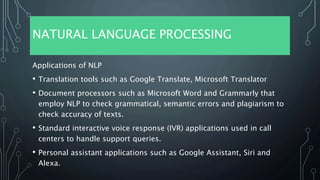
Applications of NLP
• Translation tools such as Google Translate, Microsoft Translator
• Document processors such as Microsoft Word and Grammarly that
employ NLP to check grammatical, semantic errors and plagiarism to
check accuracy of texts.
• Standard interactive voice response (IVR) applications used in call
centers to handle support queries.
• Personal assistant applications such as Google Assistant, Siri and
Alexa.
ARTIFICAL
INTELLIGENC
E
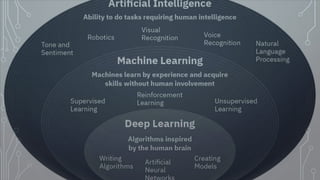
MACHINE
LEARNING
DEEP
LEARNING
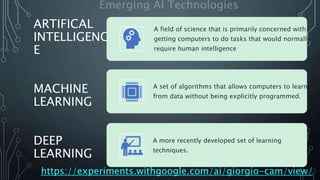
A field of science that is primarily concerned with
getting computers to do tasks that would normally
require human intelligence
A set of algorithms that allows computers to learn
from data without being explicitly programmed.
A more recently developed set of learning
techniques.
https://experiments.withgoogle.com/ai/giorgio-cam/view/
Emerging AI Technologies
MACHINE LEARNING AND DEEP LEARNING
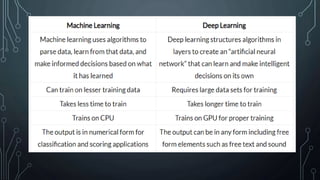
• Machine Learning enables a machine to “recognize” and
“learn” the patterns in the training set of data. The
machine learns by looking for patterns from the training
data set and then builds a model.
• ML, enables machines to improve at tasks with experience.
The machine learns from its mistakes and takes them into
consideration in the next execution. It improvises itself
using its own experiences.
• DL, enables software to train itself to perform tasks with
vast amounts of data. In deep learning, the machine is
trained with huge amounts of data which helps it into
training itself around the data. Such machines are
CH-1 Introduction to Artificial Intelligence for class 9.pptx

CH-1 Introduction to Artificial Intelligence for class 9.pptx

  • 1.
  • 2.
    ability to acquire andapply knowledge and skills Man- made
  • 3.
  • 4.
    JOHN MCCARTHY THE TERMARTIFICIAL INTELLIGENCE WAS FIRST COINED BY JOHN MCCARTHY IN 1956 WHEN HE HELD THE FIRST ACADEMIC CONFERENCE ON THE SUBJECT.
  • 7.
    ARTIFICIAL INTELLIGENCE Artificial Intelligence(AI) is a field of computer science aimed at developing machines which are intelligent enough to do certain tasks that would normally be performed only by humans. It uses machine learning to continuously learn and adapt its algorithms to become smarter each time and autonomously undertake actions without human intervention. Machine learning essentially means machines learning on their own to improve their functioning without human intervention.
  • 8.
    ARTIFICIAL INTELLIGENCE Artificial Intelligence(AI) refers to the ability of machines to perform cognitive tasks like thinking, perceiving, learning, problem solving and decision making; it is inspired by the ways people use their brains to perceive, learn, reason out and decide the action
  • 9.
    DIFFERENCE BETWEEN HUMANBRAIN AND COMPUTERS • Brain is more analog while computers are digital • Brain has content addressable memory • Brain is a parallel machine while computers are stackable modular serial • Processing speed and system clock • Short term memory vs RAM • Processing and memory functions separation
  • 10.
    ACTIVITY 1 What iseasy and what is difficult for Computers? Hard for Computers but easy for Humans Hard for Humans but easy for Computers Voice Recognition (the context and semantics of language) Sorting items based on a particular attribute (numbers, letters, words etc.) Voice Recognition (sarcasm, emotions) Location and Directions Face Recognition (finding someone in a photo) Math Problems such as adding / multiplying/ dividing Image Recognition (finding objects in images) Searching for an item from a list
  • 11.
    Types of AI GeneralAI (AGI) Narrow AI (ANI)
  • 12.
    TYPES OF AI •Broad AI: systems are capable of executing multiple tasks across various fields. Imagine a robot which can do your laundery, understand your voice commands for reading emails, managing calls and schedule appointments- all at once. Broad AI would truly replicate human intelligence and help us leverage true power of AI. • Narrow AI: Narrow AI systems are very good at one specific task that they are designed to do. They can’t execute any task outside their scope. Imagine an image recognition system that is designed to distinguish between humans and animals but cannot tell the difference between cat and dog unless it is designed so.
  • 13.
    TYPES OF AI •Generic AI (AGI): Artificial General intelligence or “Strong” AI refers to machines that exhibit human intelligence. In other words, AGI can successfully perform any intellectual task that a human being can. This is the sort of AI that we see sci-fi movies in which humans interact with machines and operating systems that are conscious, sentient, and driven by emotion and self-awareness. • AGI is expected to be able to reason, solve problems, make judgements under uncertainty, plan, learn,
  • 14.
    A BIG LEAPIN PURSUING GENERAL AI- IBM WATSON • One of the mainstream applications in the world moving towards generic AI was IBM Watson. Watson had humble beginning as the Computer system developed to answer questions on the famous quiz show Jeopardy! (a US based reality show) and in 2011, the Watson computer system completed on Jeopardy! Against legendary champions Brad Rutter and Ken Jennings, winning the first-place prize of $1 million! • Watson was 16 terabytes of RAM through which it could process 500 gigabytes(1 million books) per second.
  • 15.
    TYPES OF AI •Narrow AI (ANI): Artificial Narrow Intelligence (ANI) also known as “Weak” AI is the AI that exists in our world today. Narrow AI is AI that is programmed to perform a single task — whether it’s checking the weather, being able to play chess, or analyzing raw data to write journalistic reports. • ANI systems can attend to a task in real-time, but they pull information from a specific data-set. • Narrow AI operates within a pre-determined, pre-defined range, even if it appears to be much more sophisticated than that. • Every sort of machine intelligence that surrounds us today is Narrow AI. Google Assistant, Google Translate, Siri and
  • 16.
    ACTIVITY 2 Identify examplesof Narrow and Broad AI from your daily-life application. Narrow Intelligence General Intelligence Beat Go World Champions Understand abstract concepts Read facial expressions Explain why? Write music Be creative like children Diagnose Mental Disorders Tell right from wrong Comfort Earthquake Have emotions
  • 17.
    WEAK AI can handlespecific tasks scenarios very good at one kind of problem Examples: • Siri/Alexa/Google Home- can listen to talk and understand what you are saying, but can’t make any inferences, just reads off Google search results. • Postal service zip code reader for India will always look for 6 handwritten digits, the logic would have to be completely redesigned to work in Canada which includes 3 letters alternating with 3 digits.
  • 18.
    STRONG AI Strong AIis generalized – it can generalize its knowledge to solve more than one kind of problem. Intellectual strength, not physical strength Displays human-like behavior Examples: • Can guess answers to questions, give you ideas based on past understanding. • Postal service zip code reader can adapt from 5 digits to 3 digits and letters almost immediately.
  • 19.
    AUTOMATED AND AUTONOMOUS PROCESSING AutomatedSystem Autonomous System It is deterministic in nature. IF this THEN that. It is probabilistic in nature which means that it is based on inputs, situation and context. Will always produce same answer /response for a specific query. Can give different answers/output to the same set of inputs based on the context Most Computers and algorithms work on this approach. The human brain works in a similar way as an autonomous system and most strong AI systems would be like a fully autonomous decision-making
  • 21.
    ACTIVITY 3 How doesa Driverless Car Work ? List down various technologies and sensors being used in a self- driving car. How do you think AI is being used here? Is this narrow or general AI? Strong or Weak AI? https://www.youtube.com/watch?v=taMP_n3wL7M
  • 22.
    FUN TIME Did youknow Google Assistant came close to passing the Turing Test. See how Google passes the Turing Test: https://www.youtube.com/watch?v=JvbHu_b Va_g
  • 23.
    ACTIVITY 4 Rock, Paperand Scissors https://www.afiniti.com/corporate/rock- paper-scissors Analyze the game with larger perspective.
  • 24.
    EXPERIENCING AI INREAL LIFE • In 1996, ELIZA was the first natural language programming (NLP)-based conversation program described by Joseph Weizenbaum. It featured a conversation between a human user and a computer program representing a mock psychotherapist. What does ELIZA do? It used algorithms such as pattern matching to give canned responses that made user feel they were talking to someone who understood their input and was like human counsellor. There were essentially scripts and IF THEN logics built into it. Many people call such systems as “Expert Systems”
  • 25.
    DID YOU KNOW? •Sophia was the first bot that was recently offered citizenship by the kingdom of Saudi Arabia! • https://www.youtube.com/watch?v=IsFv_gKS3YE
  • 26.
    BENEFITS OF AI •AI would have a low error rate compared to humans, if coded properly. They would have incredible precision, accuracy, and speed. • They won't be affected by hostile environments, thus able to complete dangerous tasks, explore in space, and endure problems that would injure or kill us. -This can even mean mining and digging fuels that would otherwise be hostile for humans. • Replace humans in repetitive, tedious tasks and in many laborious places of work. • Predict what a user will type, ask, search, and do. They can easily act as assistants and can recommend or direct various actions.
  • 27.
    BENEFITS OF AI •Can detect fraud in card-based systems, and possibly other systems in the future. • Interact with humans for entertainment or a task as avatars or robots. - An example of this is AI for playing many videogames. • They can think logically without emotions, making rational decisions with less or no mistakes. • They don't need to sleep, rest, take breaks, or get entertained, as they don't get bored or tired.
  • 28.
    LIMITATIONS OF AI •Data Availability: Any AI system needs training data to start and then test data for ensuring that it has learnt properly. Data can be in the form of images, audio or video which poses a bog challenge in interpreting and using it in AI systems. It also heavy in size and comes in multiple formats and quality. • Bias: Human being often have bias about certain things. It could be reasonable or unreasonable. When algorithms are developed by humans, their bias also sometimes creeps into the AI system and becomes its bias. • Emotional Intelligence: AI uses Natural Language Processing
  • 29.
    LIMITATIONS OF AI •HIGH COST OF IMPLEMENTATION: Setting up AI-based machines, computers, etc. entails huge costs given the complexity of engineering that goes into building one. Further, the astronomical expense doesn’t stop there as repair and maintenance also run into thousands of dollars. • LACKS CREATIVITY: AI’s creativity is limited to the creative ability of the person who programs and commands them. Although they can help you in designing and creating something special, they still can’t compete with the human brain.
  • 30.
    AI COMPONENTS AI Components Data ComputerVision (CV) Natural Language Processing (NLP)
  • 31.
    DATA IDENTIFICATION ANDCOLLECTION • Data is the starting point for all AI applications. These data sets can be numeric (sales, insurance premium, weather data etc.) Categorical (color, gender etc.), even unstructured free text (comments, audio, images, videos, notes, feedback). • Data collection is the process of identifying various sources of data(structured and unstructured), collecting data and preparing to label it. We need to make sure that data collected is in the correct format and aligned with project requirements. • It starts with having basic hardware, sensors and devices in places to capture the data required for our AI model. Next stage is having right storage system having IT infrastructure (servers, cloud storage etc.) and systems
  • 32.
    • We thenneed to do data cleaning to ensure that right data in correct format is available to run any analytics or data science models on it. • The next step is to run data visualization models, classification of data, data labelling and defining some analytics metrics for identified set of data. • The final stage is to apply Machine Learning algorithms to identify patterns and forecast future trends on data. We need to do A/B testing to iterate on the model. • Companies like Google, Amazon and Facebook are dominating their industries because they were the first begin building data sets. Their data set have become so large and complicated and their data collection and analysis is so sophisticated that they are able to grow it to their competitive advantage.
  • 33.
    COMPUTER VISION • ComputerVision is a subset of AI that lets machine see and extract meaning from pixels in an image. CV aims to mirror how human vision works and interpret things we see. • Deep learning can work hand in hand with CV creating powerful systems such as searching images in Google, tagging of friends in social media, apps which can create a future aged version of your face, speech-to-text translation, intrusion detection system. • Computer Vision (CV) has been around for over 50 years. Its development began in 1950’s around the same time when artificial intelligence gained prominence. • Some CV applications include self-driving cars, facial recognition-based tracking systems with vision cameras and Amazon Go.
  • 34.
    AMAZON GO • AmazonGo is a new kind of store with no checkout required. Amazon claims it to be world’s most advanced shopping technology as you never have wait in line. • With the Just walk out shopping experience, simply use the Amazon Go app to enter the store, take the products you want, and go! No lines, no checkouts. • The key underlying technology in these amazing use cases is computer vision.
  • 35.
    NATURAL LANGUAGE PROCESSING •Natural Language Processing (NLP) is the technology used to aid computers to understand the human’s natural language such as English. Processing of the natural language is required when an intelligent machine needs to perform some actions based on instructions given by you. • It is a subfield of AI which help design systems on how to process and analyze large amounts of natural language data. • For example, If you are talking to Alexa, it needs to understand your language, words, context and emotion as well. NLP is the technology which enables Alexa to accomplish this task.
  • 36.
    NATURAL LANGUAGE PROCESSING Applicationsof NLP • Translation tools such as Google Translate, Microsoft Translator • Document processors such as Microsoft Word and Grammarly that employ NLP to check grammatical, semantic errors and plagiarism to check accuracy of texts. • Standard interactive voice response (IVR) applications used in call centers to handle support queries. • Personal assistant applications such as Google Assistant, Siri and Alexa.
  • 37.
    ARTIFICAL INTELLIGENC E MACHINE LEARNING DEEP LEARNING A field ofscience that is primarily concerned with getting computers to do tasks that would normally require human intelligence A set of algorithms that allows computers to learn from data without being explicitly programmed. A more recently developed set of learning techniques. https://experiments.withgoogle.com/ai/giorgio-cam/view/ Emerging AI Technologies
  • 39.
    MACHINE LEARNING ANDDEEP LEARNING • Machine Learning enables a machine to “recognize” and “learn” the patterns in the training set of data. The machine learns by looking for patterns from the training data set and then builds a model. • ML, enables machines to improve at tasks with experience. The machine learns from its mistakes and takes them into consideration in the next execution. It improvises itself using its own experiences. • DL, enables software to train itself to perform tasks with vast amounts of data. In deep learning, the machine is trained with huge amounts of data which helps it into training itself around the data. Such machines are