
ARTIFICIAL INTELLIGENCE
-Jitendra Kumar Yadav
DAV Public School, Gumla
WHAT IS INTELLIGENCE?
 Humans have been developing machines
which can make their lives easier.
 Machines are made with an intent of
accomplishing tasks which are either too
tedious for humans or are time consuming.
 Hence, It is Humans mental ability to solve
problems.
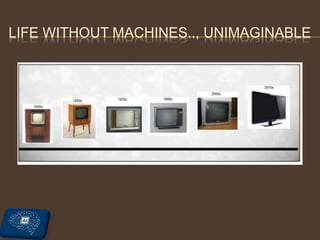
LIFE WITHOUT MACHINES.., UNIMAGINABLE
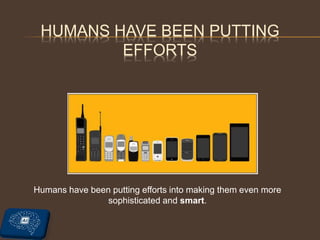
HUMANS HAVE BEEN PUTTING
EFFORTS
Humans have been putting efforts into making them even more
sophisticated and smart.
TODAY’S PHONES CAN DO MUCH MORE
THAN JUST CALL-UP PEOPLE.
WHAT IS ARTIFICIAL INTELLIGENCE
ANYWAY?
 It is made up of two words “Artificial” and
“Intelligence”.
 Artificial : something which is man-made,
which does not occur naturally.
 Intelligence : the ‘ability to perceive or infer
information, and to retain it as knowledge to
be applied towards adaptive behaviours
within an environment or context.’
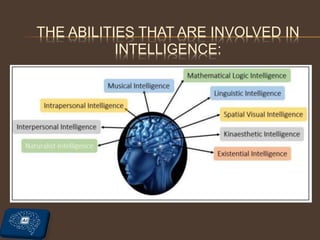
THE ABILITIES THAT ARE INVOLVED IN
INTELLIGENCE:
MATHEMATICAL LOGICAL
REASONING INTELLIGENCE
 A person's ability to
regulate, measure,
and understand
numerical symbols,
abstraction and logic.
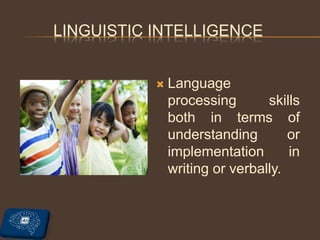
LINGUISTIC INTELLIGENCE
 Language
processing skills
both in terms of
understanding or
implementation in
writing or verbally.
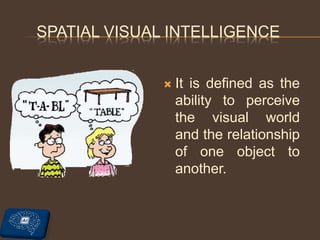
SPATIAL VISUAL INTELLIGENCE
 It is defined as the
ability to perceive
the visual world
and the relationship
of one object to
another.
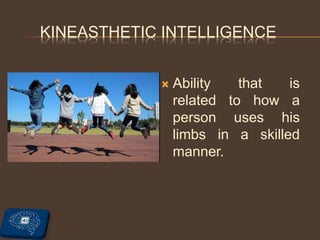
KINEASTHETIC INTELLIGENCE
 Ability that is
related to how a
person uses his
limbs in a skilled
manner.
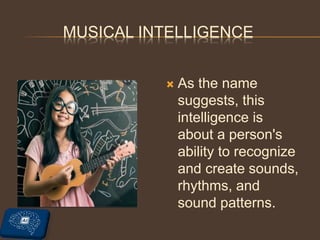
MUSICAL INTELLIGENCE
 As the name
suggests, this
intelligence is
about a person's
ability to recognize
and create sounds,
rhythms, and
sound patterns.
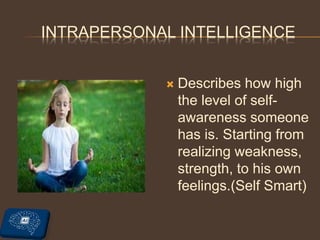
INTRAPERSONAL INTELLIGENCE
 Describes how high
the level of self-
awareness someone
has is. Starting from
realizing weakness,
strength, to his own
feelings.(Self Smart)
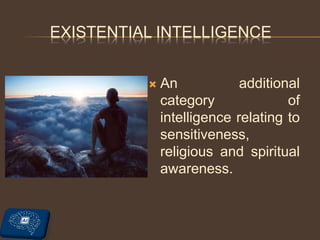
EXISTENTIAL INTELLIGENCE
 An additional
category of
intelligence relating to
sensitiveness,
religious and spiritual
awareness.
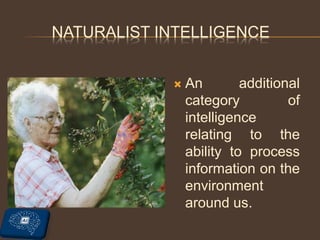
NATURALIST INTELLIGENCE
 An additional
category of
intelligence
relating to the
ability to process
information on the
environment
around us.
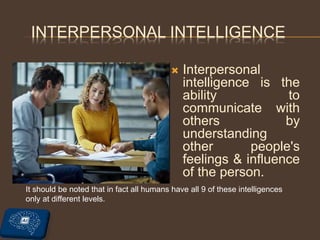
INTERPERSONAL INTELLIGENCE
 Interpersonal
intelligence is the
ability to
communicate with
others by
understanding
other people's
feelings & influence
of the person.
It should be noted that in fact all humans have all 9 of these intelligences
only at different levels.
DEFINITION OF INTELLIGENCE
• Ability to interact with the real world
 To perceive, understand and act
▪ Example: Speech Recognition – Understanding and
synthesis
▪ Example: Image Recognition
▪ Example: Ability to take action: to have an effect
• Reasoning and planning
 Modelling the external world, given input
▪ Solving new problems, planning and making decisions
▪ Ability to deal with unexpected problems, uncertainties
• Learning and adaptation
 Continuous learning and adapting graph
▪ Our internal models are always being updated
▪ Example: Baby learning to categorize and recognise
animals
WHAT IS ARTIFICIAL INTELLIGENCE?
The ability of a machine to mimic human traits,
i.e., make decisions, predict the future, learn
and improve on its own.
A machine is artificially intelligent when it can
accomplish tasks by itself - collect data,
understand it, analyse it, learn from it, and
improve it.
HOW DO MACHINES BECOME
ARTIFICIALLY INTELLIGENT?
As, Humans become more and more intelligent
with time as they gain experiences during
their lives, similarly, machines also become
intelligent once they are trained with some
information which helps them achieve their
tasks.
AI machines also keep updating their
knowledge to optimise their output.
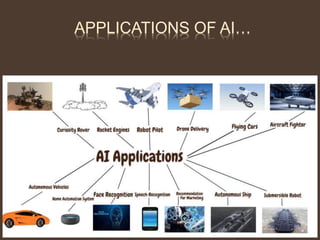
APPLICATIONS OF AI
 Google:
 Siri
 Google Maps
 Fifa Sports(Games)
 Amazon.com
 Snapchat, Facebook, WhatsApp, Twitter, etc
 AI Health Consultant
 Smart devices
APPLICATIONS OF AI…
WHAT IS NOT AI?
 Important thing to note:
Any machine that has been trained with data
and can make decisions/predictions on its
own can be termed as AI. Here, the term
‘training’ is important.
 Examples of Not AI:
Washing Machine: It is an example of
automation, not AI.
 Air Conditioner: It is an example of Internet of
Things (IoT), not AI.
WHAT IS NOT AI? contd…
NITI AAYOG SAYS, AI MEANS…
 The ability of machines to perform cognitive
tasks like thinking, perceiving, learning,
problem solving and decision making.
WORLD ECONOMIC FORUM SAYS…,
 It is the software engine that drives the
Fourth Industrial Revolution. Its impact can
already be seen in homes, businesses and
political processes.
 AI is a form of intelligence;
 A type of technology and a field of study.
 AI theory and development of computer
systems (both machines and software) are
able to perform tasks that normally require
human intelligence.
HENCE, “AI” IS…
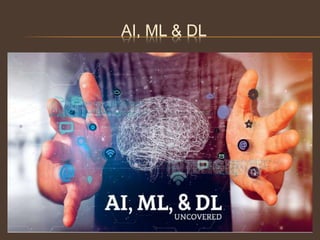
AI, ML & DL
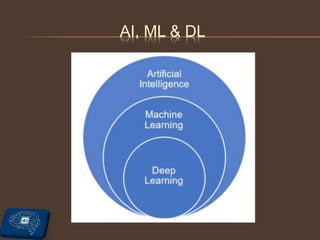
AI, ML & DL
ARTIFICIAL INTELLIGENCE (AI)
 A technique that enables computers to
mimic human intelligence.
 It gives the ability to machines to recognize
a human’s face; to move and manipulate
objects;
 to understand the voice commands by
humans, and also do other tasks.
 The AI-enabled machines think
algorithmically and execute intelligently.
MACHINE LEARNING (ML)
 It is a subset of Artificial Intelligence.
 It enables machines to improve at tasks with
experience (data).
 The intention of ML is to enable machines to
learn by themselves using the provided data
and make accurate Predictions/ Decisions.
DEEP LEARNING (DL)
 It enables software to train itself to perform
tasks with vast amounts of data.
 Here, the machine is trained with huge
amounts of data which helps it in training
itself around the data.
 Such machines are intelligent enough to
develop algorithms for themselves.
 Deep Learning is the most advanced form of
Artificial Intelligence out of these three.
Then comes Machine Learning which is
intermediately intelligent and Artificial
Intelligence covers all the concepts and
algorithms which, in some way or the other
mimic human intelligence.
DEEP LEARNING (DL)contd…
INTRODUCTION TO AI DOMAINS
AI becomes intelligent according to the
training which it gets. For training, the
machine is fed with datasets. On the basis of
Dataset fed to machines, AI models can be
broadly categorised into three domains:
 Data science
 Computer Vision
 Natural Language Processing
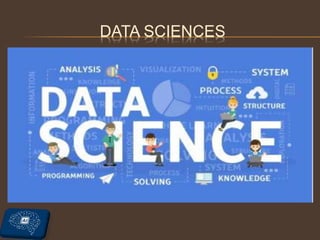
DATA SCIENCES
 It is a domain of AI related to data systems
and processes, in which the system collects
numerous data, maintains data sets and
derives meaning/sense out of them, which is
next used to make a decision.
 Example: Price Comparison websites:
PriceGrabber, PriceRunner, Junglee,
Shopzilla, Dealtime, etc.
DATA SCIENCES
COMPUTER VISION
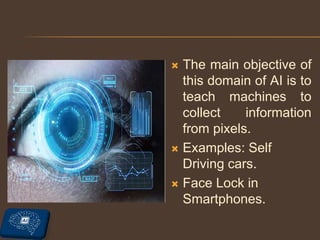
 CV depicts the capability of a machine to get
and analyse visual information and
afterwards predict some decisions about it.
 The entire process involves image acquiring,
screening, analysing, identifying and
extracting information.
 This extensive processing helps computers
to understand any visual content and act on
it accordingly.
 The main objective of
this domain of AI is to
teach machines to
collect information
from pixels.
 Examples: Self
Driving cars.
 Face Lock in
Smartphones.
NATURAL LANGUAGE PROCESSING
 NLP, is a branch of artificial intelligence that deals
with the interaction between computers and humans
using the natural language.
 Natural language refers to language that is spoken
and written by people, and
 NLP attempts to extract information from the spoken
and written word using algorithms.
 The ultimate objective of NLP is to read, decipher,
understand, and make sense of the human
languages in a manner that is valuable.
 Examples of NLP: Email filters, Smart Assistants
NATURAL LANGUAGE PROCESSING
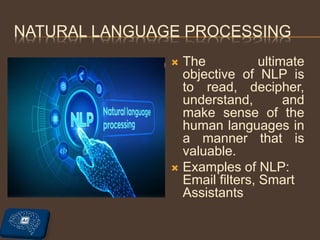
 The ultimate
objective of NLP is
to read, decipher,
understand, and
make sense of the
human languages in
a manner that is
valuable.
 Examples of NLP:
Email filters, Smart
Assistants
AI ETHICS
 It refers to the ethical issues surrounding
the use of artificial intelligence (AI)
technology.
 Example: Case of Self driving Cars
(Scenario 1: Accident took place,
Scenario 2: Who is Responsible?)
DATA PRIVACY
 It is an area of data protection that concerns
the proper handling of sensitive
data including, notably, personal data but also
other confidential data, such as certain financial
data and intellectual property data, to meet
regulatory requirements as well as protecting
the confidentiality and immutability of the data.
 Example:
How are many apps using our information and
recommending products/services?
AI BIAS
 A phenomenon that occurs when an
algorithm produces results that are
systemically prejudiced due to erroneous
assumptions in DL.
Ex:
 Majorly, all the virtual assistants have a
female voice.
 If we search on Google for salons, the first
few searches are mostly for female salons
AI ACCESS
 Since Artificial Intelligence is still a budding
technology, not everyone has the opportunity
to access it. The people who can afford AI
enabled devices make the most of it while
others who cannot are left behind.
 Example: AI creates unemployment
AI FOR KIDS
From a very early age, Kids thinking
capabilities increase, they start becoming
techno-savvy and eventually they learn
everything more easily than an adult.
But should technology be given to
children so young?

Introduction to Artificial Intelligence (Std.X)

  • 1.
    ARTIFICIAL INTELLIGENCE -Jitendra KumarYadav DAV Public School, Gumla
  • 2.
    WHAT IS INTELLIGENCE? Humans have been developing machines which can make their lives easier.  Machines are made with an intent of accomplishing tasks which are either too tedious for humans or are time consuming.  Hence, It is Humans mental ability to solve problems.
  • 3.
  • 4.
    HUMANS HAVE BEENPUTTING EFFORTS Humans have been putting efforts into making them even more sophisticated and smart.
  • 5.
    TODAY’S PHONES CANDO MUCH MORE THAN JUST CALL-UP PEOPLE.
  • 6.
    WHAT IS ARTIFICIALINTELLIGENCE ANYWAY?  It is made up of two words “Artificial” and “Intelligence”.  Artificial : something which is man-made, which does not occur naturally.  Intelligence : the ‘ability to perceive or infer information, and to retain it as knowledge to be applied towards adaptive behaviours within an environment or context.’
  • 7.
    THE ABILITIES THATARE INVOLVED IN INTELLIGENCE:
  • 8.
    MATHEMATICAL LOGICAL REASONING INTELLIGENCE A person's ability to regulate, measure, and understand numerical symbols, abstraction and logic.
  • 9.
    LINGUISTIC INTELLIGENCE  Language processingskills both in terms of understanding or implementation in writing or verbally.
  • 10.
    SPATIAL VISUAL INTELLIGENCE It is defined as the ability to perceive the visual world and the relationship of one object to another.
  • 11.
    KINEASTHETIC INTELLIGENCE  Abilitythat is related to how a person uses his limbs in a skilled manner.
  • 12.
    MUSICAL INTELLIGENCE  Asthe name suggests, this intelligence is about a person's ability to recognize and create sounds, rhythms, and sound patterns.
  • 13.
    INTRAPERSONAL INTELLIGENCE  Describeshow high the level of self- awareness someone has is. Starting from realizing weakness, strength, to his own feelings.(Self Smart)
  • 14.
    EXISTENTIAL INTELLIGENCE  Anadditional category of intelligence relating to sensitiveness, religious and spiritual awareness.
  • 15.
    NATURALIST INTELLIGENCE  Anadditional category of intelligence relating to the ability to process information on the environment around us.
  • 16.
    INTERPERSONAL INTELLIGENCE  Interpersonal intelligenceis the ability to communicate with others by understanding other people's feelings & influence of the person. It should be noted that in fact all humans have all 9 of these intelligences only at different levels.
  • 17.
    DEFINITION OF INTELLIGENCE •Ability to interact with the real world  To perceive, understand and act ▪ Example: Speech Recognition – Understanding and synthesis ▪ Example: Image Recognition ▪ Example: Ability to take action: to have an effect • Reasoning and planning  Modelling the external world, given input ▪ Solving new problems, planning and making decisions ▪ Ability to deal with unexpected problems, uncertainties • Learning and adaptation  Continuous learning and adapting graph ▪ Our internal models are always being updated ▪ Example: Baby learning to categorize and recognise animals
  • 18.
    WHAT IS ARTIFICIALINTELLIGENCE? The ability of a machine to mimic human traits, i.e., make decisions, predict the future, learn and improve on its own. A machine is artificially intelligent when it can accomplish tasks by itself - collect data, understand it, analyse it, learn from it, and improve it.
  • 19.
    HOW DO MACHINESBECOME ARTIFICIALLY INTELLIGENT? As, Humans become more and more intelligent with time as they gain experiences during their lives, similarly, machines also become intelligent once they are trained with some information which helps them achieve their tasks. AI machines also keep updating their knowledge to optimise their output.
  • 20.
    APPLICATIONS OF AI Google:  Siri  Google Maps  Fifa Sports(Games)  Amazon.com  Snapchat, Facebook, WhatsApp, Twitter, etc  AI Health Consultant  Smart devices
  • 21.
  • 22.
    WHAT IS NOTAI?  Important thing to note: Any machine that has been trained with data and can make decisions/predictions on its own can be termed as AI. Here, the term ‘training’ is important.  Examples of Not AI: Washing Machine: It is an example of automation, not AI.
  • 23.
     Air Conditioner:It is an example of Internet of Things (IoT), not AI. WHAT IS NOT AI? contd…
  • 24.
    NITI AAYOG SAYS,AI MEANS…  The ability of machines to perform cognitive tasks like thinking, perceiving, learning, problem solving and decision making.
  • 25.
    WORLD ECONOMIC FORUMSAYS…,  It is the software engine that drives the Fourth Industrial Revolution. Its impact can already be seen in homes, businesses and political processes.
  • 26.
     AI isa form of intelligence;  A type of technology and a field of study.  AI theory and development of computer systems (both machines and software) are able to perform tasks that normally require human intelligence. HENCE, “AI” IS…
  • 27.
  • 28.
  • 29.
    ARTIFICIAL INTELLIGENCE (AI) A technique that enables computers to mimic human intelligence.  It gives the ability to machines to recognize a human’s face; to move and manipulate objects;  to understand the voice commands by humans, and also do other tasks.  The AI-enabled machines think algorithmically and execute intelligently.
  • 30.
    MACHINE LEARNING (ML) It is a subset of Artificial Intelligence.  It enables machines to improve at tasks with experience (data).  The intention of ML is to enable machines to learn by themselves using the provided data and make accurate Predictions/ Decisions.
  • 31.
    DEEP LEARNING (DL) It enables software to train itself to perform tasks with vast amounts of data.  Here, the machine is trained with huge amounts of data which helps it in training itself around the data.  Such machines are intelligent enough to develop algorithms for themselves.  Deep Learning is the most advanced form of Artificial Intelligence out of these three.
  • 32.
    Then comes MachineLearning which is intermediately intelligent and Artificial Intelligence covers all the concepts and algorithms which, in some way or the other mimic human intelligence. DEEP LEARNING (DL)contd…
  • 33.
    INTRODUCTION TO AIDOMAINS AI becomes intelligent according to the training which it gets. For training, the machine is fed with datasets. On the basis of Dataset fed to machines, AI models can be broadly categorised into three domains:  Data science  Computer Vision  Natural Language Processing
  • 34.
    DATA SCIENCES  Itis a domain of AI related to data systems and processes, in which the system collects numerous data, maintains data sets and derives meaning/sense out of them, which is next used to make a decision.  Example: Price Comparison websites: PriceGrabber, PriceRunner, Junglee, Shopzilla, Dealtime, etc.
  • 35.
  • 36.
    COMPUTER VISION  CVdepicts the capability of a machine to get and analyse visual information and afterwards predict some decisions about it.  The entire process involves image acquiring, screening, analysing, identifying and extracting information.  This extensive processing helps computers to understand any visual content and act on it accordingly.
  • 37.
     The mainobjective of this domain of AI is to teach machines to collect information from pixels.  Examples: Self Driving cars.  Face Lock in Smartphones.
  • 38.
    NATURAL LANGUAGE PROCESSING NLP, is a branch of artificial intelligence that deals with the interaction between computers and humans using the natural language.  Natural language refers to language that is spoken and written by people, and  NLP attempts to extract information from the spoken and written word using algorithms.  The ultimate objective of NLP is to read, decipher, understand, and make sense of the human languages in a manner that is valuable.  Examples of NLP: Email filters, Smart Assistants
  • 39.
    NATURAL LANGUAGE PROCESSING The ultimate objective of NLP is to read, decipher, understand, and make sense of the human languages in a manner that is valuable.  Examples of NLP: Email filters, Smart Assistants
  • 40.
    AI ETHICS  Itrefers to the ethical issues surrounding the use of artificial intelligence (AI) technology.  Example: Case of Self driving Cars (Scenario 1: Accident took place, Scenario 2: Who is Responsible?)
  • 41.
    DATA PRIVACY  Itis an area of data protection that concerns the proper handling of sensitive data including, notably, personal data but also other confidential data, such as certain financial data and intellectual property data, to meet regulatory requirements as well as protecting the confidentiality and immutability of the data.  Example: How are many apps using our information and recommending products/services?
  • 42.
    AI BIAS  Aphenomenon that occurs when an algorithm produces results that are systemically prejudiced due to erroneous assumptions in DL. Ex:  Majorly, all the virtual assistants have a female voice.  If we search on Google for salons, the first few searches are mostly for female salons
  • 43.
    AI ACCESS  SinceArtificial Intelligence is still a budding technology, not everyone has the opportunity to access it. The people who can afford AI enabled devices make the most of it while others who cannot are left behind.  Example: AI creates unemployment
  • 44.
    AI FOR KIDS Froma very early age, Kids thinking capabilities increase, they start becoming techno-savvy and eventually they learn everything more easily than an adult. But should technology be given to children so young?

Editor's Notes

  • #33 There are a lot of applications of AI out of which few are those which come under ML out of which very few can be labelled as DL. Therefore, Machine Learning (ML) and Deep Learning (DL) are part of Artificial Intelligence (AI), but not everything that is Machine learning will be Deep learning.