
Hannah Masila
S13/20824/12
Forget Me Not…
Contents
• Motivation
• What is Blue Brain?
• Why do we need Blue Brain?
• How does the brain work?
• Brain simulation
• Current research work
• Hardware and Software Requirements
• Advantages
• Disadvantages
• Conclusion
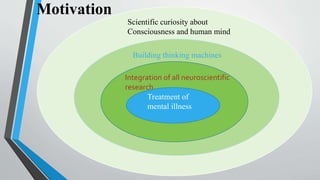
Motivation
Scientific curiosity about
Consciousness and human mind
Building thinking machines
Integration of all neuroscientific
research
Treatment of
mental illness
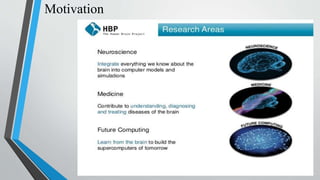
Motivation
What is blue brain?
BLUE BRAIN - The name of the world’s first virtual brain.
The Blue Brain Technology is an attempt to reverse engineer the
human brain and recreate it at the cellular level inside a computer
simulation
The Blue Brain Project was founded in May 2005 by Henry
Markram at the EPFL in Switzerland.
What is Blue Brain?
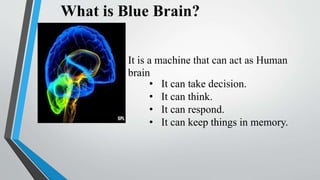
• It can take decision.
• It can think.
• It can respond.
• It can keep things in memory.
It is a machine that can act as Human
brain
Why do we need Blue Brain?
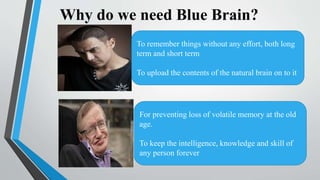
To remember things without any effort, both long
term and short term
To upload the contents of the natural brain on to it
For preventing loss of volatile memory at the old
age.
To keep the intelligence, knowledge and skill of
any person forever
How does the brain work?
• This action of getting information from the surrounding
environment
• The receptor cells, through sensory neurons, send a message
straight to the brain
Sensory input
Integration
• It is the interpretation of things we have felt, tasted, and
touched with our sensory neurons into responses that the
body recognizes.
How does the brain work?
Motor output
• Once the brain has interpreted the stimulus, it sends a
message through motor neurons to effecter cells, muscle
or gland cells, which actually work to perform requests
and act upon our environment.
Brain simulation
• There are two ways in which we can get information from a
natural brain. These are invasive and noninvasive techniques.
• The most promising is the use of very small robots called
nanobots
• These nanobots will carefully scan the structure of our brain,
providing a complete readout of the connections between each
neuron.
• This information can then be entered into a computer and
continues to function as the natural brain
Brain simulation
• Scientist have already created artificial neurons with silicon
chips.
• It has also been tested that these neurons can receive the input
from the sensory cells.
• So, the electric impulses from the sensory cells can be received
through these artificial neurons and send to a super computer for
the interpretation.
Sensory input
Integration
• The interpretation of the electric impulses received by the
artificial neuron can be done by means of a set of register .
• The different values in these register will represent
different states of the brain.
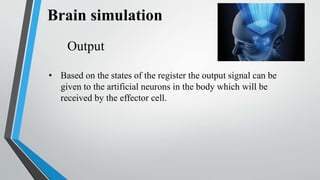
Output
• Based on the states of the register the output signal can be
given to the artificial neurons in the body which will be
received by the effector cell.
Too many words? Lets do some watching!!!
In the video, the real Alois had been murdered that morning but
her brain had been simulated into a computer.
The computer had then been implanted into a robot which
resembled her.
She was constantly updating information on the simulator and
through this, they were able to capture the murderer of the real
Alois
Video explanation
Current research work
IBM, in partnership with scientists at Switzerland's Ecole
Polytechnique Federale de Lausanne's (EPFL) Brain and Mind
Institute are working on the Blue brain project.
They had developed first single cellular cell by
2005.
In November 2007, the project reported the end of the
first phase, delivering a data-driven process for creating,
validating, and researching the neocortical column.
Current research work
The first artificial cellular neocortical column of 10,000 cells
was built by 2008.
By July 2011 a cellular mesocircuit of 100 neocortical columns
with a million cells in total was built.
A cellular rat brain with 100 mesocircuits totaling a hundred
million cells was built by 2014.
Current research work
Finally a cellular human brain is predicted possible by 2023
equivalent to 1000 rat brains with a total of a hundred billion
cells
Scientists will begin simulating the brain's biological systems
and output the data as a working 3-dimensional model that
will recreate the high-speed electro-chemical interactions that
take place within the brain's interior.
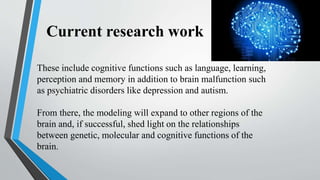
Current research work
These include cognitive functions such as language, learning,
perception and memory in addition to brain malfunction such
as psychiatric disorders like depression and autism.
From there, the modeling will expand to other regions of the
brain and, if successful, shed light on the relationships
between genetic, molecular and cognitive functions of the
brain.
Hardware/Software Requirements
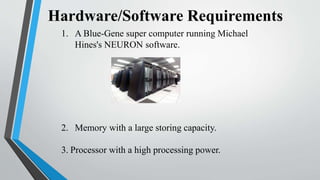
1. A Blue-Gene super computer running Michael
Hines's NEURON software.
2. Memory with a large storing capacity.
3. Processor with a high processing power.
Hardware/Software Requirements
4. A program to convert the electric impulses from the
brain to input signal, which is to be received by the
computer, and vice versa.
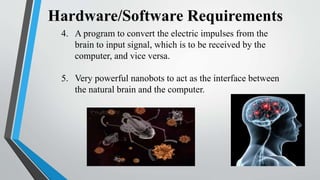
5. Very powerful nanobots to act as the interface between
the natural brain and the computer.
Advantages
1. Human Being can remember things without any effort.
2. Decision can be made without the presence of a person.
3. Even after the death of a person his intelligence can be
used.
4. The activity of different animals can be understood. That
means by interpretation of the electric impulses from the
brain of the animals, their thinking can be understood
easily.
Disadvantages
Further, there are many new dangers these technologies
will open. We will be susceptible to new forms of harm.
1. We will become very dependent on computer systems.
2. Social Threats may use this against society.
3. Computer viruses will become headache.
4. The real threat, however, is the fear of change that people
have when it comes to new technologies. That fear may
culminate in a large resistance. Clear evidence of this type of
fear is found today with respect to human cloning.
Conclusion
In conclusion, we will be able to transfer ourselves into
computers at some point.
Most arguments against this outcome are seemingly easy to
circumvent. They are either simple minded, or simply require
further time for technology to increase. The only serious
threats raised are also overcome as we note the combination of
biological and digital technologies.
While the road ahead is long, already researches have been
gaining great insights from their model.
Thank You..!

Blue Brain Technology

  • 1.
  • 2.
    Contents • Motivation • Whatis Blue Brain? • Why do we need Blue Brain? • How does the brain work? • Brain simulation • Current research work • Hardware and Software Requirements • Advantages • Disadvantages • Conclusion
  • 3.
    Motivation Scientific curiosity about Consciousnessand human mind Building thinking machines Integration of all neuroscientific research Treatment of mental illness
  • 4.
  • 5.
    What is bluebrain? BLUE BRAIN - The name of the world’s first virtual brain. The Blue Brain Technology is an attempt to reverse engineer the human brain and recreate it at the cellular level inside a computer simulation The Blue Brain Project was founded in May 2005 by Henry Markram at the EPFL in Switzerland.
  • 6.
    What is BlueBrain? • It can take decision. • It can think. • It can respond. • It can keep things in memory. It is a machine that can act as Human brain
  • 7.
    Why do weneed Blue Brain? To remember things without any effort, both long term and short term To upload the contents of the natural brain on to it For preventing loss of volatile memory at the old age. To keep the intelligence, knowledge and skill of any person forever
  • 8.
    How does thebrain work? • This action of getting information from the surrounding environment • The receptor cells, through sensory neurons, send a message straight to the brain Sensory input Integration • It is the interpretation of things we have felt, tasted, and touched with our sensory neurons into responses that the body recognizes.
  • 9.
    How does thebrain work? Motor output • Once the brain has interpreted the stimulus, it sends a message through motor neurons to effecter cells, muscle or gland cells, which actually work to perform requests and act upon our environment.
  • 10.
    Brain simulation • Thereare two ways in which we can get information from a natural brain. These are invasive and noninvasive techniques. • The most promising is the use of very small robots called nanobots • These nanobots will carefully scan the structure of our brain, providing a complete readout of the connections between each neuron. • This information can then be entered into a computer and continues to function as the natural brain
  • 11.
    Brain simulation • Scientisthave already created artificial neurons with silicon chips. • It has also been tested that these neurons can receive the input from the sensory cells. • So, the electric impulses from the sensory cells can be received through these artificial neurons and send to a super computer for the interpretation. Sensory input
  • 12.
    Integration • The interpretationof the electric impulses received by the artificial neuron can be done by means of a set of register . • The different values in these register will represent different states of the brain.
  • 13.
    Output • Based onthe states of the register the output signal can be given to the artificial neurons in the body which will be received by the effector cell.
  • 14.
    Too many words?Lets do some watching!!!
  • 15.
    In the video,the real Alois had been murdered that morning but her brain had been simulated into a computer. The computer had then been implanted into a robot which resembled her. She was constantly updating information on the simulator and through this, they were able to capture the murderer of the real Alois Video explanation
  • 16.
    Current research work IBM,in partnership with scientists at Switzerland's Ecole Polytechnique Federale de Lausanne's (EPFL) Brain and Mind Institute are working on the Blue brain project. They had developed first single cellular cell by 2005. In November 2007, the project reported the end of the first phase, delivering a data-driven process for creating, validating, and researching the neocortical column.
  • 17.
    Current research work Thefirst artificial cellular neocortical column of 10,000 cells was built by 2008. By July 2011 a cellular mesocircuit of 100 neocortical columns with a million cells in total was built. A cellular rat brain with 100 mesocircuits totaling a hundred million cells was built by 2014.
  • 18.
    Current research work Finallya cellular human brain is predicted possible by 2023 equivalent to 1000 rat brains with a total of a hundred billion cells Scientists will begin simulating the brain's biological systems and output the data as a working 3-dimensional model that will recreate the high-speed electro-chemical interactions that take place within the brain's interior.
  • 19.
    Current research work Theseinclude cognitive functions such as language, learning, perception and memory in addition to brain malfunction such as psychiatric disorders like depression and autism. From there, the modeling will expand to other regions of the brain and, if successful, shed light on the relationships between genetic, molecular and cognitive functions of the brain.
  • 20.
    Hardware/Software Requirements 1. ABlue-Gene super computer running Michael Hines's NEURON software. 2. Memory with a large storing capacity. 3. Processor with a high processing power.
  • 21.
    Hardware/Software Requirements 4. Aprogram to convert the electric impulses from the brain to input signal, which is to be received by the computer, and vice versa. 5. Very powerful nanobots to act as the interface between the natural brain and the computer.
  • 22.
    Advantages 1. Human Beingcan remember things without any effort. 2. Decision can be made without the presence of a person. 3. Even after the death of a person his intelligence can be used. 4. The activity of different animals can be understood. That means by interpretation of the electric impulses from the brain of the animals, their thinking can be understood easily.
  • 23.
    Disadvantages Further, there aremany new dangers these technologies will open. We will be susceptible to new forms of harm. 1. We will become very dependent on computer systems. 2. Social Threats may use this against society. 3. Computer viruses will become headache. 4. The real threat, however, is the fear of change that people have when it comes to new technologies. That fear may culminate in a large resistance. Clear evidence of this type of fear is found today with respect to human cloning.
  • 24.
    Conclusion In conclusion, wewill be able to transfer ourselves into computers at some point. Most arguments against this outcome are seemingly easy to circumvent. They are either simple minded, or simply require further time for technology to increase. The only serious threats raised are also overcome as we note the combination of biological and digital technologies. While the road ahead is long, already researches have been gaining great insights from their model.
  • 25.