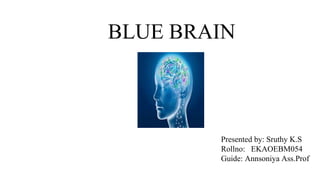
BLUE BRAIN
Presented by: Sruthy K.S
Rollno: EKAOEBM054
Guide: Annsoniya Ass.Prof
OVERVIEW
● Introduction
● Motivations
● Steps
● Literature Survey
● Methodology
● Problem Defined
● Outcomes
● Limitations
● Conclusion
INTRODUCTION
● Blue Brain is the world's first comprehensive attempt to reverse-engineer the
mammalian brain, ie recreating human brain from cellular level.
● Name of world's first virtual brain that can act and think like a brain, based on
past experiences and responses.
● Why? Human Brain- Most valuable creation of the god, complex circuitry, reason
for the intelligence of human beings, which is destroyed completely after the death.
● How ? Artificially linking the neurons in the computer by placing thirty million
synapses in their proper 3D position.
● ARTIFICIAL INTELLIGENCE- back pane of BB, technology that build intelligent
machines and impart intelligent agents
MOTIVATIONS
Treatment of Brain Dysfunctioning
Scientific curiosity about
consciousness and the human
mind.
Collecting of related past stories.
Building thinking machine.
Literature Survey
Out of the Blue- JONAH LEHRER
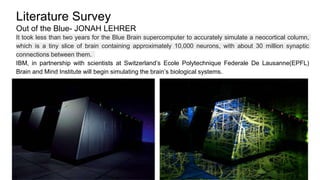
It took less than two years for the Blue Brain supercomputer to accurately simulate a neocortical column,
which is a tiny slice of brain containing approximately 10,000 neurons, with about 30 million synaptic
connections between them.
IBM, in partnership with scientists at Switzerland’s Ecole Polytechnique Federale De Lausanne(EPFL)
Brain and Mind Institute will begin simulating the brain’s biological systems.
Ray Kurzweil’s Predictions
Nanobots are small robots that travel through the circulatory system to monitor the structure & activity of
central nervous system. It provides an interface with the computers ie as close as our mind can while we
still reside in our biological form.
Nanobots carefully scan the structure of our brain, providing a complete readout of the connections
between each neuron. They would also record the current state of the brain. This information when enter
into the brain could then continue to function like a human.
Nanobots in Biomedical Application
Nanorobot for Cancer Treatment.
Brain Aneurysm Treatment
Design Of Nanobots
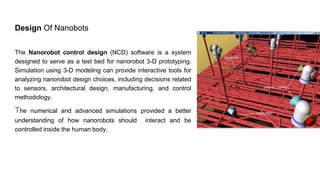
The Nanorobot control design (NCD) software is a system
designed to serve as a test bed for nanorobot 3-D prototyping.
Simulation using 3-D modeling can provide interactive tools for
analyzing nanorobot design choices, including decisions related
to sensors, architectural design, manufacturing, and control
methodology.
The numerical and advanced simulations provided a better
understanding of how nanorobots should interact and be
controlled inside the human body.
Problem Defined
.
● Reviving back of information from dead brain- historical data
● Avoid memory loss.
● Replacement of ear implants.
● Eradication of Crimes, Drug abuse, intoxicant addictions..
● Relief from Psychological conditions.
● Preservation of brain after death.
Methodology
Neuroscie
nce
Domain
Data Analysis
Image
Processing
Visualisation
Information
Tools
Block Diagram
● Learning & Cataloging Neurons.
● Morphology (Comparative,Functional,Experimental)
● Electrophysiology behavior of Neurons.
● Factors, location within cortex, population density.
● Form, function & positioning with help of Algorithms.
● Patch clamp, Bright field microscope with computer assisted
● Reconstruction of neuron structure enclosed in a
● Faraday cage to reduce electromagnetic Interference
● Mounted on a Floatingtable to reduce Vibrations.
1. Data Acquisition(Biologically realistic virtual Neurons)
12 Patch Clamp
2. Simulation
The Simulation step involves synthesizing virtual cells using the algorithms that were found
to describe real neurons.The algorithms and parameters are adjusted for the age, species, and
disease stage of the animal being simulated.First a network skeleton is built from all the
different kinds of synthesized neurons. Then the cells are connected together according to the
rules that have been found experimentally. Finally the neurons are functionalized and the
simulation brought to life. The patterns of emergent behavior are viewed with visualization
software.
● INPUT(silicon chips)
● INTERPRETATION- (reg)
● OUTPUT(reg & states)
● MEMORY(gathering past)
● PROCESSING(stored states)
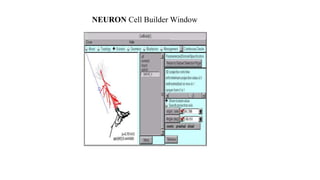
NEURON Cell Builder Window
3. VISUALISATION
The BBP-SDK is used to inspect models and simulations. The SDK is a C++ library wrapped
in Java and Python.
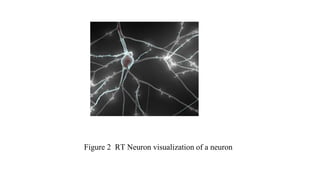
RT Neuron is the primary application used by the BBP for visualization of neural simulations.
RT Neuron is ad-hoc software written specifically for neural simulations, i.e. it is not
generalisable to other types of simulation. RTNeuron takes the outputfrom Hodgkin-Huxley
simulations in NEURON and render them in 3D. This allows researchers to watch as
activation potentials propagate through a neuron and between neurons. The animations can
be stopped, started and zoomed, thusletting researchers interact with the model. The
visualizations are multi-scale that is they can render individual neuronsor a whole cortical
column. The image right was rendered in RTNeuron.
Figure 2 RT Neuron visualization of a neuron
Outcomes
● Detailed and accurate data about the brain.
● Analysis of newborn neuron
● Tracking Emergence of Intelligence
● Understanding Complexity
● Cracking Neural code.
● Drug discovery
Limitations
● Dependancy of humans on machines.
● Power consumption(50 billion neurons and 500 trillion connections)
● Hacking Neural schema- misuse of personal details
● Malware & Viruses.
● Interconnectivity
Conclusion
Human Brain is the complex circuitry in the world and we will be able to scan ourselves in
the computer in the near future.With the combination of biology & digital technologies,
the serious threats in the development of virtual brain was able to overcome. With the
implementation of Blue Brain in 2023 new theories of consciousness can be generated and
challenge the understanding of intelligence.
Future Scope
1. First version of Blue brain having 10000 neurons has already created
& simulated.
2. Selection of Properties & the efficiency of the circuit takes time.
3. Aim about deep learning of brain components with its functioning &
dis functioning.
4. Learn impact of one component on another by analysing different
data sets.
5. We can assume that the Digital Era in Neuroscience begin with the
launch of the Human brain project.
References
The Blue brain project, Hil, sean: Markram Henry, International conference of IEEE 2008.
http://thebeutifulbrain.com/2010/02/bluebrain-film-preview/
https://www.researchgate.net/publication/277475210_Nanobots_The_future_of_medicine
https://www.researchgate.net/publication/281064331_Blue_Brain
https://www.researchgate.net/publication/254038100_Nano_robots_in_Bio_medical_application
http://www.nanorobotdesign.com/ncd http://www.sci-news.com/othersciences/neuroscience/science-
reconstruction-rat-neocortex-03330.html
http://www.artificialbrains.com/blue-brain-project
https://www.youtube.com/watch?v=sunBviJCE3w
https://www.computerworld.com/article/2559910/app-development/blue-brain-power--modeling-the-brain-with-
a-supercomputer.html
Acknowledgement
I am thankful to our seminar coordinator Dr. Prof Yuvaraj Velusamy, my guide
Assist Prof Ann Soniya for their valuable guidance and inputs. I am also grateful to
all other department staff for their constant support and cooperation through this
entire venture.
THANK YOU
Additional Details
3d neuron morphology
reconstruction
Cortical mesocircuit
simulation
Synapticallly coupled neurons
A smart chip: Scientists in Europe are using conventional chip production techniques to create circuits that mimic the structure
and function of the human brain. This early prototype has just 384 neurons and 100,000 synapses, but the latest version
contains 200,000 neurons and 50 million synapses.
NEUROCORTICAL COLUMN MODELLING
Henry Markram December 2006- IBM SIMULATION & uploading of rat Neocortical
column - smallest functional unit of neocortex- responsible for conscious thoughts.
2005 - First single cellular model.
2008 - First artificial neocortical column.
2011 - Mesocircuit (100 col)
2014 - A complete Rat Brain
2023 - A cellular HUMAN BRAIN

Seminar blue brain

  • 1.
    BLUE BRAIN Presented by:Sruthy K.S Rollno: EKAOEBM054 Guide: Annsoniya Ass.Prof
  • 2.
    OVERVIEW ● Introduction ● Motivations ●Steps ● Literature Survey ● Methodology ● Problem Defined ● Outcomes ● Limitations ● Conclusion
  • 3.
    INTRODUCTION ● Blue Brainis the world's first comprehensive attempt to reverse-engineer the mammalian brain, ie recreating human brain from cellular level. ● Name of world's first virtual brain that can act and think like a brain, based on past experiences and responses. ● Why? Human Brain- Most valuable creation of the god, complex circuitry, reason for the intelligence of human beings, which is destroyed completely after the death. ● How ? Artificially linking the neurons in the computer by placing thirty million synapses in their proper 3D position. ● ARTIFICIAL INTELLIGENCE- back pane of BB, technology that build intelligent machines and impart intelligent agents
  • 4.
    MOTIVATIONS Treatment of BrainDysfunctioning Scientific curiosity about consciousness and the human mind. Collecting of related past stories. Building thinking machine.
  • 6.
    Literature Survey Out ofthe Blue- JONAH LEHRER It took less than two years for the Blue Brain supercomputer to accurately simulate a neocortical column, which is a tiny slice of brain containing approximately 10,000 neurons, with about 30 million synaptic connections between them. IBM, in partnership with scientists at Switzerland’s Ecole Polytechnique Federale De Lausanne(EPFL) Brain and Mind Institute will begin simulating the brain’s biological systems.
  • 8.
    Ray Kurzweil’s Predictions Nanobotsare small robots that travel through the circulatory system to monitor the structure & activity of central nervous system. It provides an interface with the computers ie as close as our mind can while we still reside in our biological form. Nanobots carefully scan the structure of our brain, providing a complete readout of the connections between each neuron. They would also record the current state of the brain. This information when enter into the brain could then continue to function like a human.
  • 9.
    Nanobots in BiomedicalApplication Nanorobot for Cancer Treatment. Brain Aneurysm Treatment
  • 10.
    Design Of Nanobots TheNanorobot control design (NCD) software is a system designed to serve as a test bed for nanorobot 3-D prototyping. Simulation using 3-D modeling can provide interactive tools for analyzing nanorobot design choices, including decisions related to sensors, architectural design, manufacturing, and control methodology. The numerical and advanced simulations provided a better understanding of how nanorobots should interact and be controlled inside the human body.
  • 11.
    Problem Defined . ● Revivingback of information from dead brain- historical data ● Avoid memory loss. ● Replacement of ear implants. ● Eradication of Crimes, Drug abuse, intoxicant addictions.. ● Relief from Psychological conditions. ● Preservation of brain after death.
  • 12.
  • 13.
    ● Learning &Cataloging Neurons. ● Morphology (Comparative,Functional,Experimental) ● Electrophysiology behavior of Neurons. ● Factors, location within cortex, population density. ● Form, function & positioning with help of Algorithms. ● Patch clamp, Bright field microscope with computer assisted ● Reconstruction of neuron structure enclosed in a ● Faraday cage to reduce electromagnetic Interference ● Mounted on a Floatingtable to reduce Vibrations. 1. Data Acquisition(Biologically realistic virtual Neurons) 12 Patch Clamp
  • 15.
    2. Simulation The Simulationstep involves synthesizing virtual cells using the algorithms that were found to describe real neurons.The algorithms and parameters are adjusted for the age, species, and disease stage of the animal being simulated.First a network skeleton is built from all the different kinds of synthesized neurons. Then the cells are connected together according to the rules that have been found experimentally. Finally the neurons are functionalized and the simulation brought to life. The patterns of emergent behavior are viewed with visualization software. ● INPUT(silicon chips) ● INTERPRETATION- (reg) ● OUTPUT(reg & states) ● MEMORY(gathering past) ● PROCESSING(stored states)
  • 16.
  • 17.
    3. VISUALISATION The BBP-SDKis used to inspect models and simulations. The SDK is a C++ library wrapped in Java and Python. RT Neuron is the primary application used by the BBP for visualization of neural simulations. RT Neuron is ad-hoc software written specifically for neural simulations, i.e. it is not generalisable to other types of simulation. RTNeuron takes the outputfrom Hodgkin-Huxley simulations in NEURON and render them in 3D. This allows researchers to watch as activation potentials propagate through a neuron and between neurons. The animations can be stopped, started and zoomed, thusletting researchers interact with the model. The visualizations are multi-scale that is they can render individual neuronsor a whole cortical column. The image right was rendered in RTNeuron.
  • 18.
    Figure 2 RTNeuron visualization of a neuron
  • 19.
    Outcomes ● Detailed andaccurate data about the brain. ● Analysis of newborn neuron ● Tracking Emergence of Intelligence ● Understanding Complexity ● Cracking Neural code. ● Drug discovery
  • 20.
    Limitations ● Dependancy ofhumans on machines. ● Power consumption(50 billion neurons and 500 trillion connections) ● Hacking Neural schema- misuse of personal details ● Malware & Viruses. ● Interconnectivity
  • 21.
    Conclusion Human Brain isthe complex circuitry in the world and we will be able to scan ourselves in the computer in the near future.With the combination of biology & digital technologies, the serious threats in the development of virtual brain was able to overcome. With the implementation of Blue Brain in 2023 new theories of consciousness can be generated and challenge the understanding of intelligence.
  • 22.
    Future Scope 1. Firstversion of Blue brain having 10000 neurons has already created & simulated. 2. Selection of Properties & the efficiency of the circuit takes time. 3. Aim about deep learning of brain components with its functioning & dis functioning. 4. Learn impact of one component on another by analysing different data sets. 5. We can assume that the Digital Era in Neuroscience begin with the launch of the Human brain project.
  • 23.
    References The Blue brainproject, Hil, sean: Markram Henry, International conference of IEEE 2008. http://thebeutifulbrain.com/2010/02/bluebrain-film-preview/ https://www.researchgate.net/publication/277475210_Nanobots_The_future_of_medicine https://www.researchgate.net/publication/281064331_Blue_Brain https://www.researchgate.net/publication/254038100_Nano_robots_in_Bio_medical_application http://www.nanorobotdesign.com/ncd http://www.sci-news.com/othersciences/neuroscience/science- reconstruction-rat-neocortex-03330.html http://www.artificialbrains.com/blue-brain-project https://www.youtube.com/watch?v=sunBviJCE3w https://www.computerworld.com/article/2559910/app-development/blue-brain-power--modeling-the-brain-with- a-supercomputer.html
  • 24.
    Acknowledgement I am thankfulto our seminar coordinator Dr. Prof Yuvaraj Velusamy, my guide Assist Prof Ann Soniya for their valuable guidance and inputs. I am also grateful to all other department staff for their constant support and cooperation through this entire venture.
  • 25.
  • 26.
  • 27.
    3d neuron morphology reconstruction Corticalmesocircuit simulation Synapticallly coupled neurons
  • 28.
    A smart chip:Scientists in Europe are using conventional chip production techniques to create circuits that mimic the structure and function of the human brain. This early prototype has just 384 neurons and 100,000 synapses, but the latest version contains 200,000 neurons and 50 million synapses.
  • 29.
    NEUROCORTICAL COLUMN MODELLING HenryMarkram December 2006- IBM SIMULATION & uploading of rat Neocortical column - smallest functional unit of neocortex- responsible for conscious thoughts. 2005 - First single cellular model. 2008 - First artificial neocortical column. 2011 - Mesocircuit (100 col) 2014 - A complete Rat Brain 2023 - A cellular HUMAN BRAIN