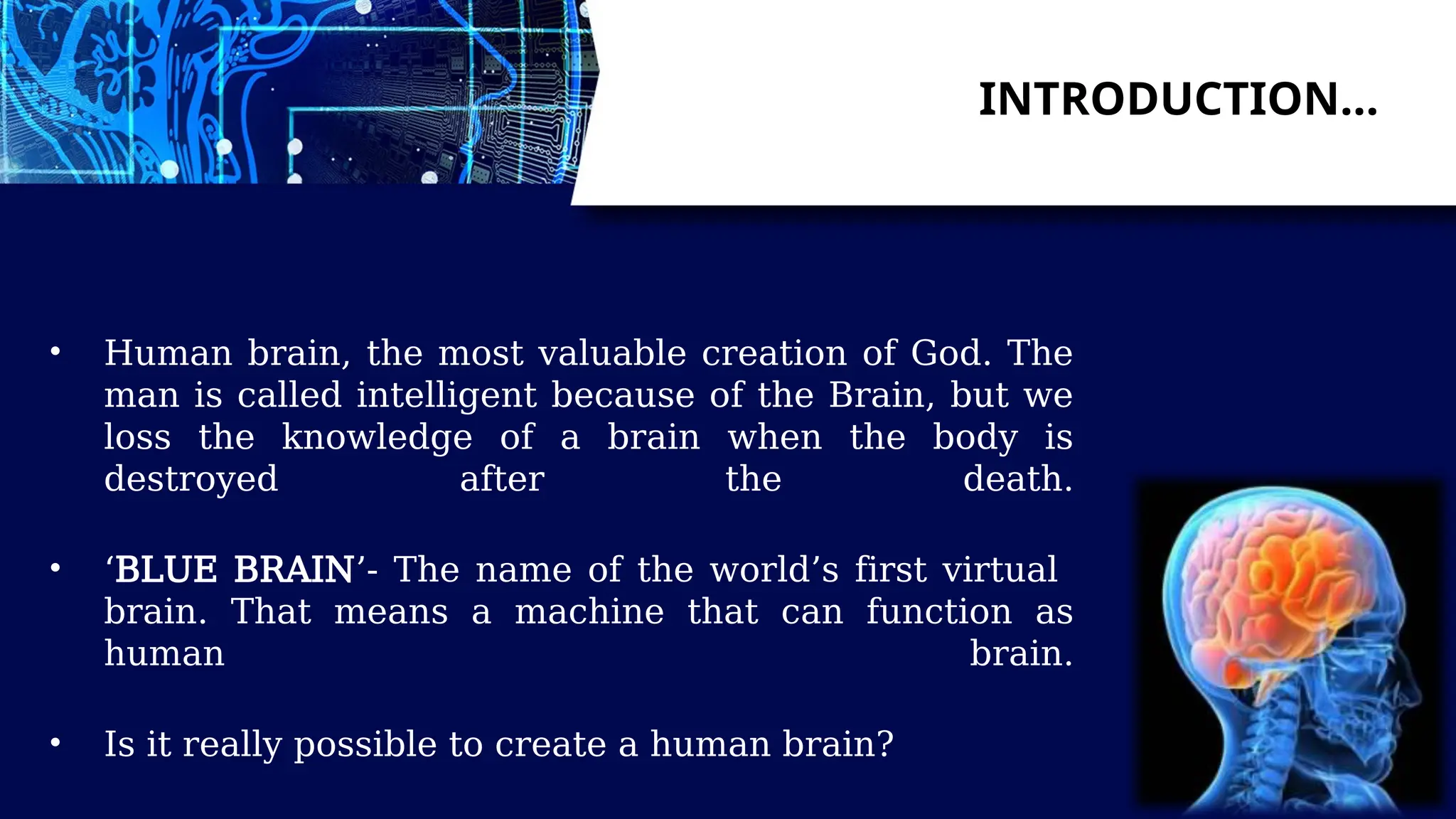
The presentation introduces the Blue Brain Project, a joint initiative by IBM and EPFL, aiming to create the world’s first virtual brain by reverse engineering the human brain into a supercomputer. The project’s goals include preserving human intelligence after death, aiding in the study of brain functions, and supporting treatments for neurological diseases like Parkinson’s.
Key points covered:
Concept: A machine that mimics human thinking, memory, and decision-making.
Need: To store and utilize human knowledge permanently and automate tasks.
Method: Using nanobots to scan the brain and upload its structure and data into computers.
Requirements: Supercomputers (like IBM’s Blue Gene), vast storage, powerful processors, and advanced software.
Advantages: Enhanced memory, decision-making without presence, aiding the disabled, and advancing neuroscience.
Disadvantages: Dependence on machines, security threats, ethical issues, high costs, and risks of reduced human interaction.
Applications: Drug discovery, neural modeling, data preservation, prosthetics, and future “brain-in-computer” possibilities.
Future outlook: By 2047, most human knowledge may exist in cyberspace, with advanced simulations and potential integration of brain-computer systems.
👉 In essence, it’s about digitally replicating the human brain to preserve intelligence, aid research, and extend human capabilities—while raising ethical, technical, and societal concerns.