Artemisea
Aradhana Sen
Department of Vegetables and Spice Crops
Faculty of Horticulture, uttar Banga Krishi Viswavidyaalaya, Pundibaari,
Coochbehar, WB- 736165
e-mail: nini.sen20@gmail.com
Scientific name: Artemisia annua Linn. (2n=18)
Family: Asteraceae
Local name: Sweet worm wood / Annual worm wood / Sweet annie / Sweet sagewort
(English)
Origin: It is originated from China and grows mainly in the middle, eastern and southern
parts of Europe and in the Northern, middle and eastern parts of Asia
Plant parts used: Whole herb at full bloom stage
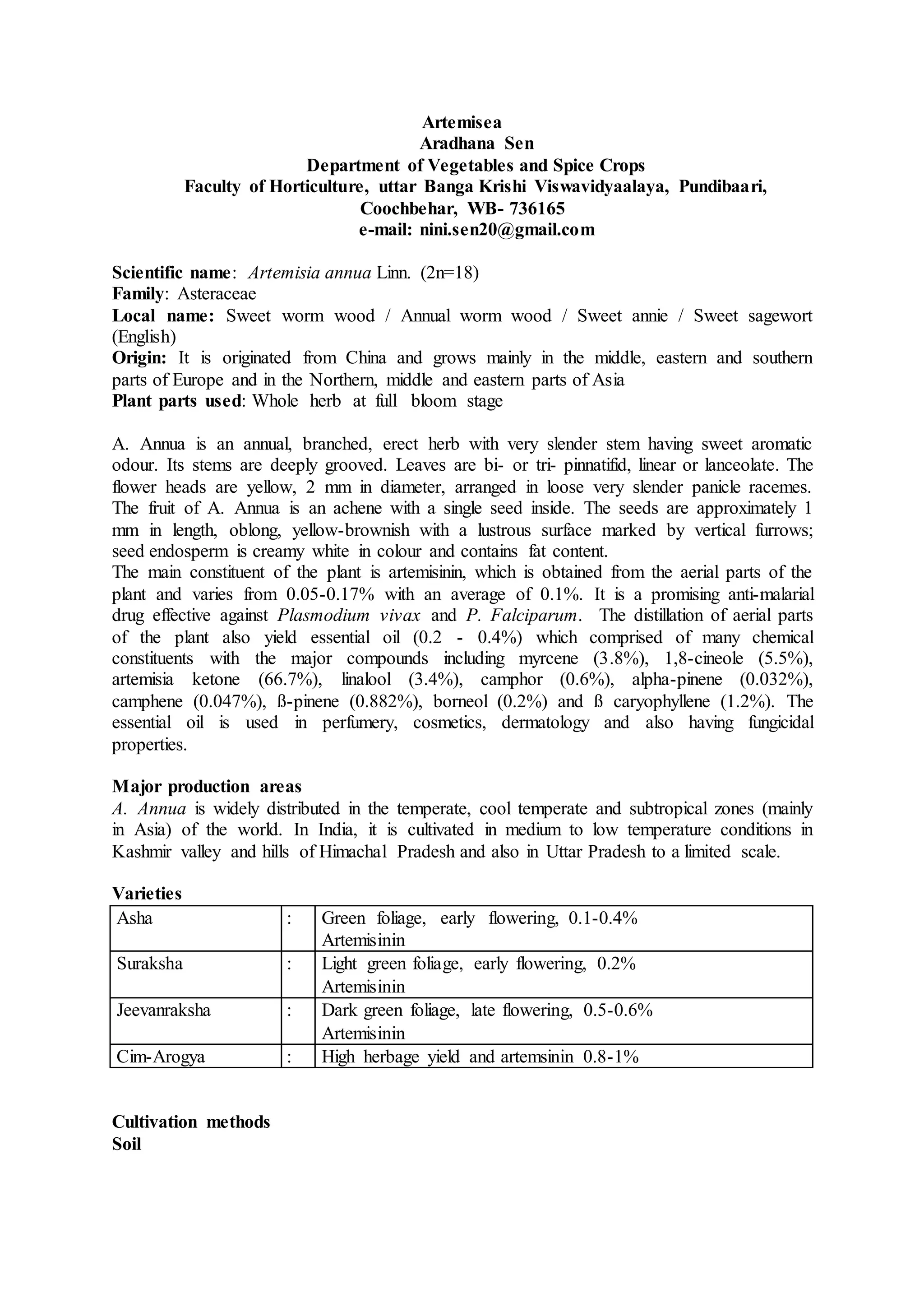
A. Annua is an annual, branched, erect herb with very slender stem having sweet aromatic
odour. Its stems are deeply grooved. Leaves are bi- or tri- pinnatifid, linear or lanceolate. The
flower heads are yellow, 2 mm in diameter, arranged in loose very slender panicle racemes.
The fruit of A. Annua is an achene with a single seed inside. The seeds are approximately 1
mm in length, oblong, yellow-brownish with a lustrous surface marked by vertical furrows;
seed endosperm is creamy white in colour and contains fat content.
The main constituent of the plant is artemisinin, which is obtained from the aerial parts of the
plant and varies from 0.05-0.17% with an average of 0.1%. It is a promising anti-malarial
drug effective against Plasmodium vivax and P. Falciparum. The distillation of aerial parts
of the plant also yield essential oil (0.2 - 0.4%) which comprised of many chemical
constituents with the major compounds including myrcene (3.8%), 1,8-cineole (5.5%),
artemisia ketone (66.7%), linalool (3.4%), camphor (0.6%), alpha-pinene (0.032%),
camphene (0.047%), ß-pinene (0.882%), borneol (0.2%) and ß caryophyllene (1.2%). The
essential oil is used in perfumery, cosmetics, dermatology and also having fungicidal
properties.
Major production areas
A. Annua is widely distributed in the temperate, cool temperate and subtropical zones (mainly
in Asia) of the world. In India, it is cultivated in medium to low temperature conditions in
Kashmir valley and hills of Himachal Pradesh and also in Uttar Pradesh to a limited scale.
Varieties
Asha : Green foliage, early flowering, 0.1-0.4%
Artemisinin
Suraksha : Light green foliage, early flowering, 0.2%
Artemisinin
Jeevanraksha : Dark green foliage, late flowering, 0.5-0.6%
Artemisinin
Cim-Arogya : High herbage yield and artemsinin 0.8-1%
Cultivation methods
Soil
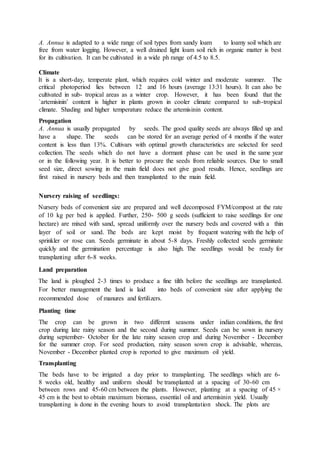
A. Annua is adapted to a wide range of soil types from sandy loam to loamy soil which are
free from water logging. However, a well drained light loam soil rich in organic matter is best
for its cultivation. It can be cultivated in a wide ph range of 4.5 to 8.5.
Climate
It is a short-day, temperate plant, which requires cold winter and moderate summer. The
critical photoperiod lies between 12 and 16 hours (average 13:31 hours). It can also be
cultivated in sub- tropical areas as a winter crop. However, it has been found that the
`artemisinin’ content is higher in plants grown in cooler climate compared to sub-tropical
climate. Shading and higher temperature reduce the artemisinin content.
Propagation
A. Annua is usually propagated by seeds. The good quality seeds are always filled up and
have a shape. The seeds can be stored for an average period of 4 months if the water
content is less than 13%. Cultivars with optimal growth characteristics are selected for seed
collection. The seeds which do not have a dormant phase can be used in the same year
or in the following year. It is better to procure the seeds from reliable sources. Due to small
seed size, direct sowing in the main field does not give good results. Hence, seedlings are
first raised in nursery beds and then transplanted to the main field.
Nursery raising of seedlings:
Nursery beds of convenient size are prepared and well decomposed FYM/compost at the rate
of 10 kg per bed is applied. Further, 250- 500 g seeds (sufficient to raise seedlings for one
hectare) are mixed with sand, spread uniformly over the nursery beds and covered with a thin
layer of soil or sand. The beds are kept moist by frequent watering with the help of
sprinkler or rose can. Seeds germinate in about 5-8 days. Freshly collected seeds germinate
quickly and the germination percentage is also high. The seedlings would be ready for
transplanting after 6-8 weeks.
Land preparation
The land is ploughed 2-3 times to produce a fine tilth before the seedlings are transplanted.
For better management the land is laid into beds of convenient size after applying the
recommended dose of manures and fertilizers.
Planting time
The crop can be grown in two different seasons under indian conditions, the first
crop during late rainy season and the second during summer. Seeds can be sown in nursery
during september- October for the late rainy season crop and during November - December
for the summer crop. For seed production, rainy season sown crop is advisable, whereas,
November - December planted crop is reported to give maximum oil yield.
Transplanting
The beds have to be irrigated a day prior to transplanting. The seedlings which are 6-
8 weeks old, healthy and uniform should be transplanted at a spacing of 30-60 cm
between rows and 45-60 cm between the plants. However, planting at a spacing of 45 ×
45 cm is the best to obtain maximum biomass, essential oil and artemisinin yield. Usually
transplanting is done in the evening hours to avoid transplantation shock. The plots are
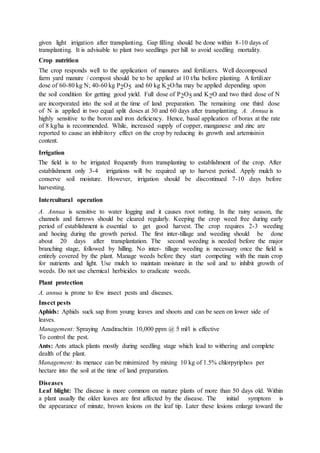
given light irrigation after transplanting. Gap filling should be done within 8-10 days of
transplanting. It is advisable to plant two seedlings per hill to avoid seedling mortality.
Crop nutrition
The crop responds well to the application of manures and fertilizers. Well decomposed
farm yard manure / compost should be to be applied at 10 t/ha before planting. A fertilizer
dose of 60-80 kg N; 40-60 kg P2O5 and 60 kg K2O/ha may be applied depending upon
the soil condition for getting good yield. Full dose of P2O5 and K2O and two third dose of N
are incorporated into the soil at the time of land preparation. The remaining one third dose
of N is applied in two equal split doses at 30 and 60 days after transplanting. A. Annua is
highly sensitive to the boron and iron deficiency. Hence, basal application of borax at the rate
of 8 kg/ha is recommended. While, increased supply of copper, manganese and zinc are
reported to cause an inhibitory effect on the crop by reducing its growth and artemisinin
content.
Irrigation
The field is to be irrigated frequently from transplanting to establishment of the crop. After
establishment only 3-4 irrigations will be required up to harvest period. Apply mulch to
conserve soil moisture. However, irrigation should be discontinued 7-10 days before
harvesting.
Intercultural operation
A. Annua is sensitive to water logging and it causes root rotting. In the rainy season, the
channels and furrows should be cleared regularly. Keeping the crop weed free during early
period of establishment is essential to get good harvest. The crop requires 2-3 weeding
and hoeing during the growth period. The first inter-tillage and weeding should be done
about 20 days after transplantation. The second weeding is needed before the major
branching stage, followed by hilling. No inter- tillage weeding is necessary once the field is
entirely covered by the plant. Manage weeds before they start competing with the main crop
for nutrients and light. Use mulch to maintain moisture in the soil and to inhibit growth of
weeds. Do not use chemical herbicides to eradicate weeds.
Plant protection
A. annua is prone to few insect pests and diseases.
Insect pests
Aphids: Aphids suck sap from young leaves and shoots and can be seen on lower side of
leaves.
Management: Spraying Azadirachtin 10,000 ppm @ 5 ml/l is effective
To control the pest.
Ants: Ants attack plants mostly during seedling stage which lead to withering and complete
dealth of the plant.
Management: its menace can be minimized by mixing 10 kg of 1.5% chlorpyriphos per
hectare into the soil at the time of land preparation.
Diseases
Leaf blight: The disease is more common on mature plants of more than 50 days old. Within
a plant usually the older leaves are first affected by the disease. The initial symptom is
the appearance of minute, brown lesions on the leaf tip. Later these lesions enlarge toward the
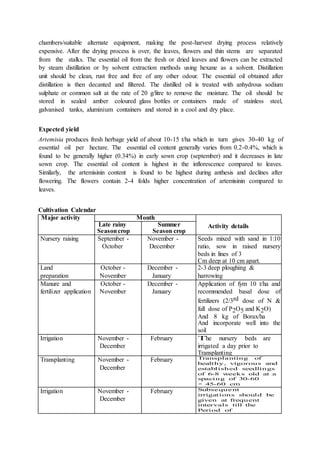
middle and lamina of the leaves gradually turn yellowish. As the spots grew in size, the leaves
often curled upward. Once the necrotic area covers majority of the leaf lamina, the leaf
showes a blighted appearance. In cases of severe infection, small branches and inflorescences
also become blighted.
Management: The disease can be controlled by spraying of Bordeaux mixture 1%.
Damping off: the disease usually occurs in young seedlings which rot, collapse and die
rapidly.
Management: Disease can be overcome by adjusting the planting time, to get bright weather
during the early stages of establishment of crop.
Root rot: The typical symptoms of this disease is withering of the whole plant. Later
root turns black and rotting occurs.
Management: increase organic matter content in the soil, remove sick plants and apply
Trichoderma to that site; follow crop rotation.
Viral diseases: in virus affected plants new leaves appear wrinkled and shrunken and have
reduced leaf size.
Management: For managing viral disease control the aphids which are the vectors by
spraying botanical pesticide [Azadirachtin 1% (10,000 ppm) @ 5 ml/l].
Harvesting
The crop is ready for harvesting in 4.5 - 5 months after transplanting. Although the content
of artemisinin is affected by numerous factors such as geographical conditions, harvesting
time, temperature and fertilizer application, harvesting time is critically important to ensure
optimum content of artemisinin in A. Annua. The crop is to be harvested at full bloom
stage, as harvesting at this stage recorded the maximum herb yield, essential oil and artem-
isisnin content. Delayed harvest before flowering results in low yield of artemisinin as well as
essential oil. The crop is harvested by cutting the plants with sickle at 15-30 cm above
the ground level. Harvest the crop in dry weather or during the hottest part of the day. Do not
harvest when it is raining, or early in the morning when there is dew on the ground.
The intermittent / multi harvesting of early planted full grown crops leads to relatively large
sized leaf mass at the expense of stem mass and thereby resulted in high yield of
artemisinin. Further, experiments also shows that A. Annua crop is suitable for ratooning with
intermittent harvests at four times viz., 77, 132, 186 and 216 days after transplanting. It gives
more yield of artemisinin than those harvested only once, twice or thrice.
Processing
Post harvest processing is usually the most critical stage in determining the end quality of the
aromatic plant material. Transport the harvested plant parts for processing as quickly as
possible. Protect the plants from heat and rain during transportation. The post-harvest
practices of A. Annua include drying of herbage (leaves and thin stems) under ambient
conditions; separation of and storage of herbage in moisture proof containers/packages. The
adoption of multi-harvesting will allow spread of post-harvest operations over many
months and extraction of the herbage in batches of convenient volume.
The harvested crop needs to be dried to about 5-10% moisture content before its
chemical extraction. While the crops harvested in the summer (May/June) and winter
(October/November) seasons can be economically shade dried, but those harvested in the
rainy season (July–september) may require the use of specially aerated drying
chambers/suitable alternate equipment, making the post-harvest drying process relatively
expensive. After the drying process is over, the leaves, flowers and thin stems are separated
from the stalks. The essential oil from the fresh or dried leaves and flowers can be extracted
by steam distillation or by solvent extraction methods using hexane as a solvent. Distillation
unit should be clean, rust free and free of any other odour. The essential oil obtained after
distillation is then decanted and filtered. The distilled oil is treated with anhydrous sodium
sulphate or common salt at the rate of 20 g/litre to remove the moisture. The oil should be
stored in sealed amber coloured glass bottles or containers made of stainless steel,
galvanised tanks, aluminium containers and stored in a cool and dry place.
Expected yield
Artemisia produces fresh herbage yield of about 10-15 t/ha which in turn gives 30-40 kg of
essential oil per hectare. The essential oil content generally varies from 0.2-0.4%, which is
found to be generally higher (0.34%) in early sown crop (september) and it decreases in late
sown crop. The essential oil content is highest in the inflorescence compared to leaves.
Similarly, the artemisinin content is found to be highest during anthesis and declines after
flowering. The flowers contain 2-4 folds higher concentration of artemisinin compared to
leaves.
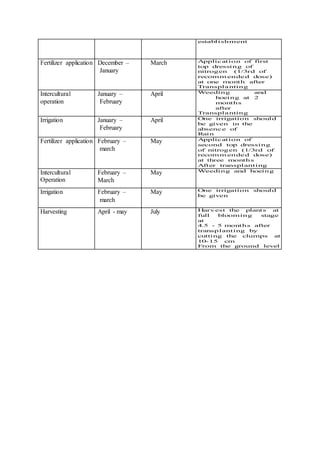
Cultivation Calendar
Major activity Month
Activity detailsLate rainy
Seasoncrop
Summer
Season crop
Nursery raising September -
October
November -
December
Seeds mixed with sand in 1:10
ratio, sow in raised nursery
beds in lines of 3
Cm deep at 10 cm apart.
Land
preparation
October -
November
December -
January
2-3 deep ploughing &
harrowing
Manure and
fertilizer application
October -
November
December -
January
Application of fym 10 t/ha and
recommended basal dose of
fertilizers (2/3rd dose of N &
full dose of P2O5 and K2O)
And 8 kg of Borax/ha
And incorporate well into the
soil
Irrigation November -
December
February The nursery beds are
irrigated a day prior to
Transplanting
Transplanting November -
December
February Transplanting of
healthy, vigorous and
established seedlings
of 6-8 weeks old at a
spacing of 30-60
× 45-60 cm
Irrigation November -
December
February Subsequent
irrigations should be
given at frequent
intervals till the
Period of
establishment
Fertilizer application December –
January
March Application of first
top dressing of
nitrogen (1/3rd of
recomm ended dose)
at one month after
Transplanting
Intercultural
operation
January –
February
April Weeding and
hoeing at 2
months
after
Transplanting
Irrigation January –
February
April One irrigation should
be given in the
absence of
Rain
Fertilizer application February –
march
May Application of
second top dressing
of nitrogen (1/3rd of
recomm ended dose)
at three months
After transplanting
Intercultural
Operation
February –
March
May Weeding and hoeing
Irrigation February –
march
May One irrigation should
be given
Harvesting April - may July Harvest the plants at
full blooming stage
at
4.5 - 5 months after
transplanting by
cutting the clumps at
10-15 cm
From the ground level

Artemesia

  • 1.
    Artemisea Aradhana Sen Department ofVegetables and Spice Crops Faculty of Horticulture, uttar Banga Krishi Viswavidyaalaya, Pundibaari, Coochbehar, WB- 736165 e-mail: nini.sen20@gmail.com Scientific name: Artemisia annua Linn. (2n=18) Family: Asteraceae Local name: Sweet worm wood / Annual worm wood / Sweet annie / Sweet sagewort (English) Origin: It is originated from China and grows mainly in the middle, eastern and southern parts of Europe and in the Northern, middle and eastern parts of Asia Plant parts used: Whole herb at full bloom stage A. Annua is an annual, branched, erect herb with very slender stem having sweet aromatic odour. Its stems are deeply grooved. Leaves are bi- or tri- pinnatifid, linear or lanceolate. The flower heads are yellow, 2 mm in diameter, arranged in loose very slender panicle racemes. The fruit of A. Annua is an achene with a single seed inside. The seeds are approximately 1 mm in length, oblong, yellow-brownish with a lustrous surface marked by vertical furrows; seed endosperm is creamy white in colour and contains fat content. The main constituent of the plant is artemisinin, which is obtained from the aerial parts of the plant and varies from 0.05-0.17% with an average of 0.1%. It is a promising anti-malarial drug effective against Plasmodium vivax and P. Falciparum. The distillation of aerial parts of the plant also yield essential oil (0.2 - 0.4%) which comprised of many chemical constituents with the major compounds including myrcene (3.8%), 1,8-cineole (5.5%), artemisia ketone (66.7%), linalool (3.4%), camphor (0.6%), alpha-pinene (0.032%), camphene (0.047%), ß-pinene (0.882%), borneol (0.2%) and ß caryophyllene (1.2%). The essential oil is used in perfumery, cosmetics, dermatology and also having fungicidal properties. Major production areas A. Annua is widely distributed in the temperate, cool temperate and subtropical zones (mainly in Asia) of the world. In India, it is cultivated in medium to low temperature conditions in Kashmir valley and hills of Himachal Pradesh and also in Uttar Pradesh to a limited scale. Varieties Asha : Green foliage, early flowering, 0.1-0.4% Artemisinin Suraksha : Light green foliage, early flowering, 0.2% Artemisinin Jeevanraksha : Dark green foliage, late flowering, 0.5-0.6% Artemisinin Cim-Arogya : High herbage yield and artemsinin 0.8-1% Cultivation methods Soil
  • 2.
    A. Annua isadapted to a wide range of soil types from sandy loam to loamy soil which are free from water logging. However, a well drained light loam soil rich in organic matter is best for its cultivation. It can be cultivated in a wide ph range of 4.5 to 8.5. Climate It is a short-day, temperate plant, which requires cold winter and moderate summer. The critical photoperiod lies between 12 and 16 hours (average 13:31 hours). It can also be cultivated in sub- tropical areas as a winter crop. However, it has been found that the `artemisinin’ content is higher in plants grown in cooler climate compared to sub-tropical climate. Shading and higher temperature reduce the artemisinin content. Propagation A. Annua is usually propagated by seeds. The good quality seeds are always filled up and have a shape. The seeds can be stored for an average period of 4 months if the water content is less than 13%. Cultivars with optimal growth characteristics are selected for seed collection. The seeds which do not have a dormant phase can be used in the same year or in the following year. It is better to procure the seeds from reliable sources. Due to small seed size, direct sowing in the main field does not give good results. Hence, seedlings are first raised in nursery beds and then transplanted to the main field. Nursery raising of seedlings: Nursery beds of convenient size are prepared and well decomposed FYM/compost at the rate of 10 kg per bed is applied. Further, 250- 500 g seeds (sufficient to raise seedlings for one hectare) are mixed with sand, spread uniformly over the nursery beds and covered with a thin layer of soil or sand. The beds are kept moist by frequent watering with the help of sprinkler or rose can. Seeds germinate in about 5-8 days. Freshly collected seeds germinate quickly and the germination percentage is also high. The seedlings would be ready for transplanting after 6-8 weeks. Land preparation The land is ploughed 2-3 times to produce a fine tilth before the seedlings are transplanted. For better management the land is laid into beds of convenient size after applying the recommended dose of manures and fertilizers. Planting time The crop can be grown in two different seasons under indian conditions, the first crop during late rainy season and the second during summer. Seeds can be sown in nursery during september- October for the late rainy season crop and during November - December for the summer crop. For seed production, rainy season sown crop is advisable, whereas, November - December planted crop is reported to give maximum oil yield. Transplanting The beds have to be irrigated a day prior to transplanting. The seedlings which are 6- 8 weeks old, healthy and uniform should be transplanted at a spacing of 30-60 cm between rows and 45-60 cm between the plants. However, planting at a spacing of 45 × 45 cm is the best to obtain maximum biomass, essential oil and artemisinin yield. Usually transplanting is done in the evening hours to avoid transplantation shock. The plots are
  • 3.
    given light irrigationafter transplanting. Gap filling should be done within 8-10 days of transplanting. It is advisable to plant two seedlings per hill to avoid seedling mortality. Crop nutrition The crop responds well to the application of manures and fertilizers. Well decomposed farm yard manure / compost should be to be applied at 10 t/ha before planting. A fertilizer dose of 60-80 kg N; 40-60 kg P2O5 and 60 kg K2O/ha may be applied depending upon the soil condition for getting good yield. Full dose of P2O5 and K2O and two third dose of N are incorporated into the soil at the time of land preparation. The remaining one third dose of N is applied in two equal split doses at 30 and 60 days after transplanting. A. Annua is highly sensitive to the boron and iron deficiency. Hence, basal application of borax at the rate of 8 kg/ha is recommended. While, increased supply of copper, manganese and zinc are reported to cause an inhibitory effect on the crop by reducing its growth and artemisinin content. Irrigation The field is to be irrigated frequently from transplanting to establishment of the crop. After establishment only 3-4 irrigations will be required up to harvest period. Apply mulch to conserve soil moisture. However, irrigation should be discontinued 7-10 days before harvesting. Intercultural operation A. Annua is sensitive to water logging and it causes root rotting. In the rainy season, the channels and furrows should be cleared regularly. Keeping the crop weed free during early period of establishment is essential to get good harvest. The crop requires 2-3 weeding and hoeing during the growth period. The first inter-tillage and weeding should be done about 20 days after transplantation. The second weeding is needed before the major branching stage, followed by hilling. No inter- tillage weeding is necessary once the field is entirely covered by the plant. Manage weeds before they start competing with the main crop for nutrients and light. Use mulch to maintain moisture in the soil and to inhibit growth of weeds. Do not use chemical herbicides to eradicate weeds. Plant protection A. annua is prone to few insect pests and diseases. Insect pests Aphids: Aphids suck sap from young leaves and shoots and can be seen on lower side of leaves. Management: Spraying Azadirachtin 10,000 ppm @ 5 ml/l is effective To control the pest. Ants: Ants attack plants mostly during seedling stage which lead to withering and complete dealth of the plant. Management: its menace can be minimized by mixing 10 kg of 1.5% chlorpyriphos per hectare into the soil at the time of land preparation. Diseases Leaf blight: The disease is more common on mature plants of more than 50 days old. Within a plant usually the older leaves are first affected by the disease. The initial symptom is the appearance of minute, brown lesions on the leaf tip. Later these lesions enlarge toward the
  • 4.
    middle and laminaof the leaves gradually turn yellowish. As the spots grew in size, the leaves often curled upward. Once the necrotic area covers majority of the leaf lamina, the leaf showes a blighted appearance. In cases of severe infection, small branches and inflorescences also become blighted. Management: The disease can be controlled by spraying of Bordeaux mixture 1%. Damping off: the disease usually occurs in young seedlings which rot, collapse and die rapidly. Management: Disease can be overcome by adjusting the planting time, to get bright weather during the early stages of establishment of crop. Root rot: The typical symptoms of this disease is withering of the whole plant. Later root turns black and rotting occurs. Management: increase organic matter content in the soil, remove sick plants and apply Trichoderma to that site; follow crop rotation. Viral diseases: in virus affected plants new leaves appear wrinkled and shrunken and have reduced leaf size. Management: For managing viral disease control the aphids which are the vectors by spraying botanical pesticide [Azadirachtin 1% (10,000 ppm) @ 5 ml/l]. Harvesting The crop is ready for harvesting in 4.5 - 5 months after transplanting. Although the content of artemisinin is affected by numerous factors such as geographical conditions, harvesting time, temperature and fertilizer application, harvesting time is critically important to ensure optimum content of artemisinin in A. Annua. The crop is to be harvested at full bloom stage, as harvesting at this stage recorded the maximum herb yield, essential oil and artem- isisnin content. Delayed harvest before flowering results in low yield of artemisinin as well as essential oil. The crop is harvested by cutting the plants with sickle at 15-30 cm above the ground level. Harvest the crop in dry weather or during the hottest part of the day. Do not harvest when it is raining, or early in the morning when there is dew on the ground. The intermittent / multi harvesting of early planted full grown crops leads to relatively large sized leaf mass at the expense of stem mass and thereby resulted in high yield of artemisinin. Further, experiments also shows that A. Annua crop is suitable for ratooning with intermittent harvests at four times viz., 77, 132, 186 and 216 days after transplanting. It gives more yield of artemisinin than those harvested only once, twice or thrice. Processing Post harvest processing is usually the most critical stage in determining the end quality of the aromatic plant material. Transport the harvested plant parts for processing as quickly as possible. Protect the plants from heat and rain during transportation. The post-harvest practices of A. Annua include drying of herbage (leaves and thin stems) under ambient conditions; separation of and storage of herbage in moisture proof containers/packages. The adoption of multi-harvesting will allow spread of post-harvest operations over many months and extraction of the herbage in batches of convenient volume. The harvested crop needs to be dried to about 5-10% moisture content before its chemical extraction. While the crops harvested in the summer (May/June) and winter (October/November) seasons can be economically shade dried, but those harvested in the rainy season (July–september) may require the use of specially aerated drying
  • 5.
    chambers/suitable alternate equipment,making the post-harvest drying process relatively expensive. After the drying process is over, the leaves, flowers and thin stems are separated from the stalks. The essential oil from the fresh or dried leaves and flowers can be extracted by steam distillation or by solvent extraction methods using hexane as a solvent. Distillation unit should be clean, rust free and free of any other odour. The essential oil obtained after distillation is then decanted and filtered. The distilled oil is treated with anhydrous sodium sulphate or common salt at the rate of 20 g/litre to remove the moisture. The oil should be stored in sealed amber coloured glass bottles or containers made of stainless steel, galvanised tanks, aluminium containers and stored in a cool and dry place. Expected yield Artemisia produces fresh herbage yield of about 10-15 t/ha which in turn gives 30-40 kg of essential oil per hectare. The essential oil content generally varies from 0.2-0.4%, which is found to be generally higher (0.34%) in early sown crop (september) and it decreases in late sown crop. The essential oil content is highest in the inflorescence compared to leaves. Similarly, the artemisinin content is found to be highest during anthesis and declines after flowering. The flowers contain 2-4 folds higher concentration of artemisinin compared to leaves. Cultivation Calendar Major activity Month Activity detailsLate rainy Seasoncrop Summer Season crop Nursery raising September - October November - December Seeds mixed with sand in 1:10 ratio, sow in raised nursery beds in lines of 3 Cm deep at 10 cm apart. Land preparation October - November December - January 2-3 deep ploughing & harrowing Manure and fertilizer application October - November December - January Application of fym 10 t/ha and recommended basal dose of fertilizers (2/3rd dose of N & full dose of P2O5 and K2O) And 8 kg of Borax/ha And incorporate well into the soil Irrigation November - December February The nursery beds are irrigated a day prior to Transplanting Transplanting November - December February Transplanting of healthy, vigorous and established seedlings of 6-8 weeks old at a spacing of 30-60 × 45-60 cm Irrigation November - December February Subsequent irrigations should be given at frequent intervals till the Period of
  • 6.
    establishment Fertilizer application December– January March Application of first top dressing of nitrogen (1/3rd of recomm ended dose) at one month after Transplanting Intercultural operation January – February April Weeding and hoeing at 2 months after Transplanting Irrigation January – February April One irrigation should be given in the absence of Rain Fertilizer application February – march May Application of second top dressing of nitrogen (1/3rd of recomm ended dose) at three months After transplanting Intercultural Operation February – March May Weeding and hoeing Irrigation February – march May One irrigation should be given Harvesting April - may July Harvest the plants at full blooming stage at 4.5 - 5 months after transplanting by cutting the clumps at 10-15 cm From the ground level