An Overview of
the Taxus Plant
Contents
Introduction
Distribution and habitat
Cultivation and collection
Morphological characters
Microscopical characters
Biochemical constituents
Uses
Conservation status
Taxus Plant 2
Introduction of Taxus plant
Taxus Plant 3
Synonyms
 Common Yew, Himalayan yew, Talispatra
Biological source
 Taxus consists of dried roots, bark, and leaves of various
Taxus species i.e. Taxus wallichiana, Taxus baccata, Taxus
cuspidata, Taxus Canadensis.
Family:
Taxaceae
Distribution and Habitat:
It is mainly found in
• India
• China
• Myanmar
• Canada
• Nepal
In Nepal they occurred in between 2300-3400m of Himalayan region.
Taxus Plant 4
Cultivation and Collection
Taxus Plant 5
It is a very slow-developing evergreen tree that belongs to gymnosperm. It
grows well in any kind of soil. It can bear bitter cold and grows well in shade as
well as in sun. Taxus plants are planted as an ornamental plants in parks and
gardens.
Taxol is isolated from the trunk/bark of Taxus wallichiana.
Generally 1 Kg Taxol will be isolated from seven tons of dried bark.
the content of Taxol in the leaves is comparatively more.
The drying process of the plant is very much related to the content of Taxol. The
drying should be done at 40-50°C.
Macroscopical
Characters
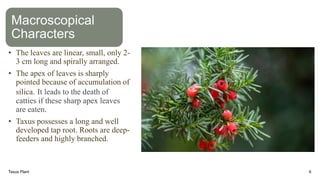
• The leaves are linear, small, only 2-
3 cm long and spirally arranged.
• The apex of leaves is sharply
pointed because of accumulation of
silica. It leads to the death of
catties if these sharp apex leaves
are eaten.
• Taxus possesses a long and well
developed tap root. Roots are deep-
feeders and highly branched.
Taxus Plant 6
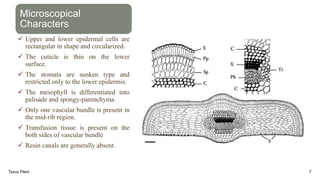
Microscopical
Characters
 Upper and lower epidermal cells are
rectangular in shape and circularized.
 The cuticle is thin on the lower
surface.
 The stomata are sunken type and
restricted only to the lower epidermis.
 The mesophyll is differentiated into
palisade and spongy-parenchyma.
 Only one vascular bundle is present in
the mid-rib region.
 Transfusion tissue is present on the
both sides of vascular bundle
 Resin canals are generally absent.
Taxus Plant 7
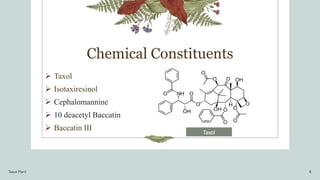
Chemical Constituents
 Taxol
 Isotaxiresinol
 Cephalomannine
 10 deacetyl Baccatin
 Baccatin III
Taxus Plant 8
Taxol
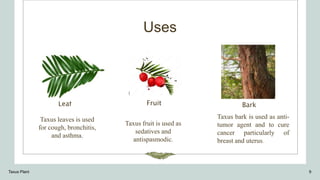
Uses
Leaf
Taxus leaves is used
for cough, bronchitis,
and asthma.
Fruit
Taxus fruit is used as
sedatives and
antispasmodic.
Bark
Taxus bark is used as anti-
tumor agent and to cure
cancer particularly of
breast and uterus.
Taxus Plant 9
Thank you
Taxus Plant 10

taxus2.pptx

  • 1.
    An Overview of theTaxus Plant
  • 2.
    Contents Introduction Distribution and habitat Cultivationand collection Morphological characters Microscopical characters Biochemical constituents Uses Conservation status Taxus Plant 2
  • 3.
    Introduction of Taxusplant Taxus Plant 3 Synonyms  Common Yew, Himalayan yew, Talispatra Biological source  Taxus consists of dried roots, bark, and leaves of various Taxus species i.e. Taxus wallichiana, Taxus baccata, Taxus cuspidata, Taxus Canadensis.
  • 4.
    Family: Taxaceae Distribution and Habitat: Itis mainly found in • India • China • Myanmar • Canada • Nepal In Nepal they occurred in between 2300-3400m of Himalayan region. Taxus Plant 4
  • 5.
    Cultivation and Collection TaxusPlant 5 It is a very slow-developing evergreen tree that belongs to gymnosperm. It grows well in any kind of soil. It can bear bitter cold and grows well in shade as well as in sun. Taxus plants are planted as an ornamental plants in parks and gardens. Taxol is isolated from the trunk/bark of Taxus wallichiana. Generally 1 Kg Taxol will be isolated from seven tons of dried bark. the content of Taxol in the leaves is comparatively more. The drying process of the plant is very much related to the content of Taxol. The drying should be done at 40-50°C.
  • 6.
    Macroscopical Characters • The leavesare linear, small, only 2- 3 cm long and spirally arranged. • The apex of leaves is sharply pointed because of accumulation of silica. It leads to the death of catties if these sharp apex leaves are eaten. • Taxus possesses a long and well developed tap root. Roots are deep- feeders and highly branched. Taxus Plant 6
  • 7.
    Microscopical Characters  Upper andlower epidermal cells are rectangular in shape and circularized.  The cuticle is thin on the lower surface.  The stomata are sunken type and restricted only to the lower epidermis.  The mesophyll is differentiated into palisade and spongy-parenchyma.  Only one vascular bundle is present in the mid-rib region.  Transfusion tissue is present on the both sides of vascular bundle  Resin canals are generally absent. Taxus Plant 7
  • 8.
    Chemical Constituents  Taxol Isotaxiresinol  Cephalomannine  10 deacetyl Baccatin  Baccatin III Taxus Plant 8 Taxol
  • 9.
    Uses Leaf Taxus leaves isused for cough, bronchitis, and asthma. Fruit Taxus fruit is used as sedatives and antispasmodic. Bark Taxus bark is used as anti- tumor agent and to cure cancer particularly of breast and uterus. Taxus Plant 9
  • 10.