Sweet Potato/ Spanish Potato
Botanical Name Ipomoea batatas L. (Poir)
Family Convolvulaceae
Chromosome No. 2N=6X= 90 (extremely heterozygous & hexaploid)
Edible part Tuberous root
Origin South America. Portuguese brought it in to India in
early 16th
century.
Progenitor Ipomoea trifida
Distribution
• According to FAO, Sweet potatoes are grown in 111 countries, of which 101 are classified as
developing nations
• Among the world’s root crops, sweet potato ranks second only to potato in economic
importance.
• In 2021, the global production of Sweet potato amounted to 88.9 million MT approx.
• Major countries producing sweet potatoes are- China, Malavi, Tanzania, Indonesia,
Vietnam, Angola, Ethiopia, Nigeria, Uganda and USA.
• China is the largest producer and consumer of sweet potato
Area, Production and Productivity (India)
• India shares 3.22% of global area and 1.88% of global production of sweet potato.
• According to NHB in 2021
• Area under SP production: 128000 ha
• Production: 1460000 t
• Productivity: 11.41 t/ha
• Major States growing (area) : 1st
Odisha, 2nd
UP, 3rd
WB, 4th
MP, 5th
Chattisgarh, 6th
Karnataka,
7th
Assam etc.
• Production leading states: Orissa > Kerala > W. B. > U. P. > Chhattisgarh
• Major importing countries from India: UAE > Maldives > Nepal > Japan > Bahrain
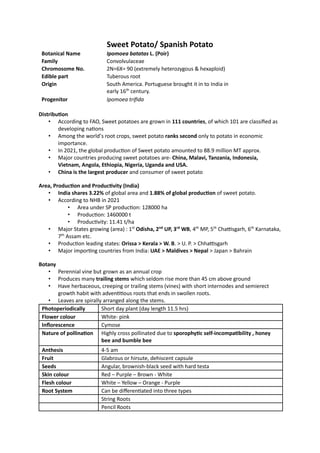
Botany
• Perennial vine but grown as an annual crop
• Produces many trailing stems which seldom rise more than 45 cm above ground
• Have herbaceous, creeping or trailing stems (vines) with short internodes and semierect
growth habit with adventitious roots that ends in swollen roots.
• Leaves are spirally arranged along the stems.
Photoperiodically Short day plant (day length 11.5 hrs)
Flower colour White- pink
Inflorescence Cymose
Nature of pollination Highly cross pollinated due to sporophytic self-incompatibility , honey
bee and bumble bee
Anthesis 4-5 am
Fruit Glabrous or hirsute, dehiscent capsule
Seeds Angular, brownish-black seed with hard testa
Skin colour Red – Purple – Brown - White
Flesh colour White – Yellow – Orange - Purple
Root System Can be differentiated into three types
String Roots
Pencil Roots
Tuber bearing roots
Differences between tuberous roots and ordinary roots in sweet potato.
Tuberous root Ordinary roots
1. Synthesizes food materials in them They cannot do so
2. Edible Non edible
3. Xylem is having 5 or 6 plates Xylem is having 3 to 4 plates
4. Small pith centre Large pith centre
5. Root primordial is larger Root primordial is smaller
6. Thick roots with different shape and size Thin and long roots
7. Receive Food materials from different plant
parts and accumulated
Absorb nutrients from soil and supply to
different plant parts
Nutritional value
Nutritional Value per 100 g
Energy : 490 kJ
Carbohydrate: 25-32 %
Ascorbic Acid: 23-25 mg
Thiamine (B1): 0.1 mg
Riboflavin (B2): 0.05-0.06 mg
Niacin (B3): 0.6-0.9 mg
Pyridoxine (B6)
Pantothenic acid (B5)
Ca: 30-34 mg
Fe: 0.8-1 mg
Mg: 24 mg
P: 49 mg
K: 373 mg
Na: 13 mg
• Deep orange or yellow coloured varieties are rich in beta-carotene and other biologically
active carotenoids
• Leaves contains more Fe and Ca compared to tubers, but due to presence of oxalate and
phytate in in leaves they are poorly absorbed in the body.
• Only non leguminous plant to contain trypsin inhibitor
• Mouldy tubers contains ipomeamarone and ipomeamaranol which are toxic to liver and
other organs.
Uses of Sweet potato
• Human consumption:
• sweet potato tuber after boiling, steaming, baking or frying
• sweet potato floor is processed for Candies, Noodles and Chapatti as a substitute of
wheat flour.,
• baked products like golden bread buns biofortified with beta carotene rich sweet
potato can add value to rural and urban diet
• Industrial products:
• Starch is used in textiles, paper, cosmetics, food manufacturing industries,
preparation of adhesive and glucose.,
• purple colour sweet potato containing anthocyanin is used for commercial
production of food colourants (eg., Ayamurasaki, Murasakimasari and Akemurasaki
cultivars)
• An excellent source of fibre, vitamin B6, E and C. especially raw leaves are rich source of
ascorbic acid and some of Vitamin B
• Good for the heart.
• Helps in controlling blood sugar due to low glycaemic index.
• Good for digestion and contains a good amount of starch
• Have strong immunity and anti-inflammatory properties
• Helps in relieving stress
• Leaves are used to treat diabetes, hookworm etc
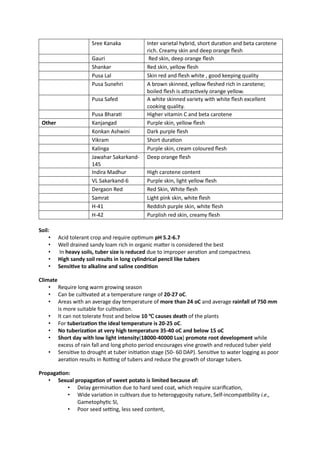
Variety: Sweet potato varieties differ in shape, size and colour of leaves, tubers and nature of tuber
flesh.
Source Varieties/Hybrids Characteristic features
Introduction Triumph Nancy Hall
Clonal selection Sree Nanadani Creamy skin, white flesh, draught tolerent
Sree Vardhani Purple skin, yellow flesh, rich in carotene, early
maturing
Sree Bhadra Light pink skin, creamy flesh
Bidhan Jagannath High carotene content
Indira Naveen Short duration
Indira Nandini Medium duration
RAU Rajendra
Shakarkand-5
Yield 20 t/ha. In 90-105 days resistant to fusarium wilt
and cercospora leaf spot disease and sweet potato
weevil. Can tolerate water logging for a week
Tuber skin: white
Flesh: greenish white
RS-35
RS-47 Purple skin, white flesh, tolerant to SP weevil
RS-43 Late cultivar, moderately tolerant to SP weevil and
cercospora leaf spot
Skin: white, Flesh: white
RS 47 Purple skin, white flesh
RS 92 Skin: red, flesh: white
TNAU Kal Megh Round tubers, very early (90 DAP) and yield 26t/ha
ANGARU,
Hyderabad
Cross-4 Yield 20-30 t/ha in 90-105 days; highly susceptible to
weevil infestation
Others Kiran High starch content (29-30 %) , red skin orange flesh
Fortified varieties Bhu Sona Beta carotene rich (12-5-40 mg/100 g) variety.
Bhu Krishna Anthocyanin rich variety
Hybridization
(CTCRI,
Thiruanatpuram)
H41 Sweet and low fibre content
H42
Sree Varsha Double cross hybrid
Sree Rethna A spreading variety with purple skin, organge flesh and
excellent cooking quality; yield 20-26 t/ha in 90-105
Sree Arun A spreading variety with pink skin, cream flesh and
good cooking quality; yield 20-28 t/ha in 90-100 days.
Sree Varun A spreading variety with pink skin, cream flesh and
good cooking quality; yield 20-28 t/ha in 90-100 days.
Sree Kanaka Inter varietal hybrid, short duration and beta carotene
rich. Creamy skin and deep orange flesh
Gauri Red skin, deep orange flesh
Shankar Red skin, yellow flesh
Pusa Lal Skin red and flesh white , good keeping quality
Pusa Sunehri A brown skinned, yellow fleshed rich in carotene;
boiled flesh is attractively orange yellow.
Pusa Safed A white skinned variety with white flesh excellent
cooking quality.
Pusa Bharati Higher vitamin C and beta carotene
Other Kanjangad Purple skin, yellow flesh
Konkan Ashwini Dark purple flesh
Vikram Short duration
Kalinga Purple skin, cream coloured flesh
Jawahar Sakarkand-
145
Deep orange flesh
Indira Madhur High carotene content
VL Sakarkand-6 Purple skin, light yellow flesh
Dergaon Red Red Skin, White flesh
Samrat Light pink skin, white flesh
H-41 Reddish purple skin, white flesh
H-42 Purplish red skin, creamy flesh
Soil:
• Acid tolerant crop and require optimum pH 5.2-6.7
• Well drained sandy loam rich in organic matter is considered the best
• In heavy soils, tuber size is reduced due to improper aeration and compactness
• High sandy soil results in long cylindrical pencil like tubers
• Sensitive to alkaline and saline condition
Climate
• Require long warm growing season
• Can be cultivated at a temperature range of 20-27 oC.
• Areas with an average day temperature of more than 24 oC and average rainfall of 750 mm
is more suitable for cultivation.
• It can not tolerate frost and below 10 ℃ causes death of the plants
• For tuberization the ideal temperature is 20-25 oC.
• No tuberization at very high temperature 35-40 oC and below 15 oC
• Short day with low light intensity(18000-40000 Lux) promote root development while
excess of rain fall and long photo period encourages vine growth and reduced tuber yield
• Sensitive to drought at tuber initiation stage (50- 60 DAP). Sensitive to water logging as poor
aeration results in Rotting of tubers and reduce the growth of storage tubers.
Propagation:
• Sexual propagation of sweet potato is limited because of:
• Delay germination due to hard seed coat, which require scarification,
• Wide variation in cultivars due to heterogygosity nature, Self-incompatibility i.e.,
Gametophytic SI,
• Poor seed setting, less seed content,
• Plant grown from seeds are poorly developed top growth & tuberous root.
• Commercial propagation is done by: Stem or Root cuttings and Advantageous root (Clip)
that grows out from primary ones during storage.
Nursery Management:
Primary Nursery
• Prepared about 2 months before planting in main field
• Area: 100 m2
• Seed rate: 100 kg medium sized weevil free seed tubers per ha, weighing 125- 150 g each
• Spacing = 60 cm × 20 cm and 5-6 cm deep,
• N= 1.5 kg/ 100 m2 as top dressing after 15 days of planting.
• Irrigation at alternate day till first 10 days and once in 3 days afterward.
• Vine gets ready for planting in 2nd nursery after 40-45 days.
• Cut the vine to a length of 20-30 cm for multiplication in second nursery.
Secondary Nursery:
• Vines are used to multiply for planting in main field.
• Area: 500 m2,
• 25-30 cm length cuttings are planted,
• Spacing should be 60 cm × 20 cm,
• FYM- 1 kg/m2, Urea of 5 kg in two splits (15 and 30 DAP),
• ready for planting in main field after 45 days of planting in 2nd nursery.
Selection of Planting Material
• Vines of 20-30 cm length with at least 3-4 nodes are found to be ideal as a planting material
• Cuttings obtained from apical and middle portion of vines are preferable to get higher
sprouting percentage and better tuber yield
Preparation of planting material
• Cuttings with intact leaves are stored under shade for two days before planting in the main
field to promote better root initiation, early establishment and higher yield
Planting
Planting Time
• Rainfed (Kharif): June - August
• Irrigated (Rabi)- October - December (Ideal time for vine cutting is late Sep- early
Oct.)
• Major area under sweet potato is planted during rabi season
• Propagule rate: 40000-50000 cuttings/ha
Methods of planting
• Land is ploughed to a depth of 20 cm and harrowed to pulvarise the soil. The planting
methods followed are:
a) Mound: under drainage problem area
b) Ridge: In sloppy area to prevent erosion
c) Furrow: Bhubaneswar and Orissa
d) Flat: Recommended in Bihar
• Note: Ridge (20-25cm high) method is best followed by furrow and flat methods.
• Cuttings are planted in soil with both ends exposed and middle portion buried in the soil at
5-10 cm depth i.e. flat planting
• Vines are also planted in an inclined position with half of its length buried in the soil
Spacing
• Closer spacing is generally recommended to achieve maximum yield
• Spacing : 30-60 cm between rows and 15-20 cm between plants
• In Indo Gangetic plains: 30-45 cm x 30-45 cm
• Spacing of 60 cm x 20 cm can accommodate about 83000 cuttings per ha
Manures and fertilizers:
• FYM: 10 t/ha, N:P:K: 90:80:90 kg/ha (GFR, Bihar), Azospirillum @ 2 kg/ha (Vine dipping)
and 10 kg/ha soil application.
• Full dose of P2O5 and K2O and half dose of N2 should be given at the time of planting,
whereas remaining half dose of N2 should be applied one month after planting along with
first weeding and earthing up
• In case of micronutrient deficiencies Zn SO4 (1-2 %), Ammonium ferric sulphate (1-2 %) and
MnSO4 (0.1%) spray are recommended.
Weed control:
• Critical period: 30-45DAP.
• Later, on weeds are supressed due to smothering effect.
• Weeding and earthing up along with top dressing between 15-30 days is beneficial.
• Turning of vine is practiced in sweet potato, pruning back to 20-30cm s also practiced after a
month.
• Turning of vines: the vines are lifted at nodes 30 DAP to prevent rooting and to facilitate
better tuber development
Irrigation
• A light irrigation is given after planting, to maintain sufficient moisture, which gives proper
establishment to crop
• Continuous long phase of draught reduces the tuber yield
• Irrigation at 10-15 days interval should be applied if thereis insufficient moisture
• Critical stage of moisture supply is 40 (DAP)
• Growth crack of sweet potato is an important physiological disorder caused due to moisture
imbalance.
Cropping System
• SP has been found to grow under different cropping sequence in eastern and southern
regions of India
• Ideal cropping sequence in eastern India are:
North Bihar 1. Maize (Kharif)- Sweet Potato (Autumn)- Wheat (Rabi)- Moong (Summer)
2. Maize (Kharif)-Sweet potato- Onion (Rainy)
West Bengal 1. Moong (Summer)- Colocasia (Pre-kharif)-Sweet Potato (Autumn)
2. Moong- EFY- SP
Orissa 1. Mid-season Paddy (Rainy)- SP- Fallow
2. Maize- SP- Fallow
Chhattisgarh Vegetable Cowpea+ SP
• Intercropping: SP is cultivated as intercrop in cashew orchard upto prebearing period of 5 yrs
with recommended dose of fertilizer (60: 40: 60 kg/ha)
Harvesting
• Crop matures in100-135 DAP depending on variety and environmental condition:
• Early cultivar: 90-105 DAP
• Mid and Late cultivars: 110-120 DAP
• Generally harvesting is recommended at 120 DAP
• Delay in harvesting increases sweet potato weevil infestation
• Light irrigation 2-3 days before harvesting makes digging easier
• Yield: 10-20 t/ha depending of variety and cultural practices
• Upto 30 t/ha yield may be obtained if proper improved cultural practices are followed
Post harvest losses
• SP tubers are subjected to several types of post harvest losses
• Physical damage
• Weight loss
• Pathological decay
• Sprouting
• Weevil infestation (Cylas formicarius)- major cause of storage loss
Curing:
• Curing results in healing of wounds during post-harvest handling. It provides barrier to
further loss and stops microbial invasion of the tissue
• Tubers are cured at 30-33 oC temperature and 85-90% Relative Humidity for 5-7 days. It
helps in the formation of protective layer (callus) on injured portion i.e., wound healing
process.
• Wound healing process includes- Rapid healing of wounds (Suberization of wounded root
surface). To increase toughness of skin (Periderm) and minimise microbial infection.
Storage:
• At 13-16 ℃ temperature and 85-90 % R. H. it can be stored for 6 months
• Red skinned varieties can be stored better than white skinned variety
• Storage in sand and sawdust helps limit spoilage and enhance shelf life of the tubers
Physiological disorders:
• Growth crack: Due to excessive moisture or moisture stress, Delay harvesting
• Control: Use potassium to check tuber cracking
Disease: Pox and Scurf are serious diseases in neutral pH. Feathery mottled disease, Mycoplasma
disease, Vector- Aphid etc.
• Control: Use virus free planting materials
Insect: Sweet potato weevil, Pest like ants, Feeds on all parts prefers tuberous roots, White grub
makes tunnel in the tubers rendering them to bitter for human
• Control: Use pheromone trap @ 1trap/100 m2

Sweet Potato.docx

  • 1.
    Sweet Potato/ SpanishPotato Botanical Name Ipomoea batatas L. (Poir) Family Convolvulaceae Chromosome No. 2N=6X= 90 (extremely heterozygous & hexaploid) Edible part Tuberous root Origin South America. Portuguese brought it in to India in early 16th century. Progenitor Ipomoea trifida Distribution • According to FAO, Sweet potatoes are grown in 111 countries, of which 101 are classified as developing nations • Among the world’s root crops, sweet potato ranks second only to potato in economic importance. • In 2021, the global production of Sweet potato amounted to 88.9 million MT approx. • Major countries producing sweet potatoes are- China, Malavi, Tanzania, Indonesia, Vietnam, Angola, Ethiopia, Nigeria, Uganda and USA. • China is the largest producer and consumer of sweet potato Area, Production and Productivity (India) • India shares 3.22% of global area and 1.88% of global production of sweet potato. • According to NHB in 2021 • Area under SP production: 128000 ha • Production: 1460000 t • Productivity: 11.41 t/ha • Major States growing (area) : 1st Odisha, 2nd UP, 3rd WB, 4th MP, 5th Chattisgarh, 6th Karnataka, 7th Assam etc. • Production leading states: Orissa > Kerala > W. B. > U. P. > Chhattisgarh • Major importing countries from India: UAE > Maldives > Nepal > Japan > Bahrain Botany • Perennial vine but grown as an annual crop • Produces many trailing stems which seldom rise more than 45 cm above ground • Have herbaceous, creeping or trailing stems (vines) with short internodes and semierect growth habit with adventitious roots that ends in swollen roots. • Leaves are spirally arranged along the stems. Photoperiodically Short day plant (day length 11.5 hrs) Flower colour White- pink Inflorescence Cymose Nature of pollination Highly cross pollinated due to sporophytic self-incompatibility , honey bee and bumble bee Anthesis 4-5 am Fruit Glabrous or hirsute, dehiscent capsule Seeds Angular, brownish-black seed with hard testa Skin colour Red – Purple – Brown - White Flesh colour White – Yellow – Orange - Purple Root System Can be differentiated into three types String Roots Pencil Roots
  • 2.
    Tuber bearing roots Differencesbetween tuberous roots and ordinary roots in sweet potato. Tuberous root Ordinary roots 1. Synthesizes food materials in them They cannot do so 2. Edible Non edible 3. Xylem is having 5 or 6 plates Xylem is having 3 to 4 plates 4. Small pith centre Large pith centre 5. Root primordial is larger Root primordial is smaller 6. Thick roots with different shape and size Thin and long roots 7. Receive Food materials from different plant parts and accumulated Absorb nutrients from soil and supply to different plant parts Nutritional value Nutritional Value per 100 g Energy : 490 kJ Carbohydrate: 25-32 % Ascorbic Acid: 23-25 mg Thiamine (B1): 0.1 mg Riboflavin (B2): 0.05-0.06 mg Niacin (B3): 0.6-0.9 mg Pyridoxine (B6) Pantothenic acid (B5) Ca: 30-34 mg Fe: 0.8-1 mg Mg: 24 mg P: 49 mg K: 373 mg Na: 13 mg • Deep orange or yellow coloured varieties are rich in beta-carotene and other biologically active carotenoids • Leaves contains more Fe and Ca compared to tubers, but due to presence of oxalate and phytate in in leaves they are poorly absorbed in the body. • Only non leguminous plant to contain trypsin inhibitor • Mouldy tubers contains ipomeamarone and ipomeamaranol which are toxic to liver and other organs. Uses of Sweet potato • Human consumption: • sweet potato tuber after boiling, steaming, baking or frying • sweet potato floor is processed for Candies, Noodles and Chapatti as a substitute of wheat flour., • baked products like golden bread buns biofortified with beta carotene rich sweet potato can add value to rural and urban diet • Industrial products: • Starch is used in textiles, paper, cosmetics, food manufacturing industries, preparation of adhesive and glucose., • purple colour sweet potato containing anthocyanin is used for commercial production of food colourants (eg., Ayamurasaki, Murasakimasari and Akemurasaki cultivars) • An excellent source of fibre, vitamin B6, E and C. especially raw leaves are rich source of ascorbic acid and some of Vitamin B • Good for the heart. • Helps in controlling blood sugar due to low glycaemic index. • Good for digestion and contains a good amount of starch
  • 3.
    • Have strongimmunity and anti-inflammatory properties • Helps in relieving stress • Leaves are used to treat diabetes, hookworm etc Variety: Sweet potato varieties differ in shape, size and colour of leaves, tubers and nature of tuber flesh. Source Varieties/Hybrids Characteristic features Introduction Triumph Nancy Hall Clonal selection Sree Nanadani Creamy skin, white flesh, draught tolerent Sree Vardhani Purple skin, yellow flesh, rich in carotene, early maturing Sree Bhadra Light pink skin, creamy flesh Bidhan Jagannath High carotene content Indira Naveen Short duration Indira Nandini Medium duration RAU Rajendra Shakarkand-5 Yield 20 t/ha. In 90-105 days resistant to fusarium wilt and cercospora leaf spot disease and sweet potato weevil. Can tolerate water logging for a week Tuber skin: white Flesh: greenish white RS-35 RS-47 Purple skin, white flesh, tolerant to SP weevil RS-43 Late cultivar, moderately tolerant to SP weevil and cercospora leaf spot Skin: white, Flesh: white RS 47 Purple skin, white flesh RS 92 Skin: red, flesh: white TNAU Kal Megh Round tubers, very early (90 DAP) and yield 26t/ha ANGARU, Hyderabad Cross-4 Yield 20-30 t/ha in 90-105 days; highly susceptible to weevil infestation Others Kiran High starch content (29-30 %) , red skin orange flesh Fortified varieties Bhu Sona Beta carotene rich (12-5-40 mg/100 g) variety. Bhu Krishna Anthocyanin rich variety Hybridization (CTCRI, Thiruanatpuram) H41 Sweet and low fibre content H42 Sree Varsha Double cross hybrid Sree Rethna A spreading variety with purple skin, organge flesh and excellent cooking quality; yield 20-26 t/ha in 90-105 Sree Arun A spreading variety with pink skin, cream flesh and good cooking quality; yield 20-28 t/ha in 90-100 days. Sree Varun A spreading variety with pink skin, cream flesh and good cooking quality; yield 20-28 t/ha in 90-100 days.
  • 4.
    Sree Kanaka Intervarietal hybrid, short duration and beta carotene rich. Creamy skin and deep orange flesh Gauri Red skin, deep orange flesh Shankar Red skin, yellow flesh Pusa Lal Skin red and flesh white , good keeping quality Pusa Sunehri A brown skinned, yellow fleshed rich in carotene; boiled flesh is attractively orange yellow. Pusa Safed A white skinned variety with white flesh excellent cooking quality. Pusa Bharati Higher vitamin C and beta carotene Other Kanjangad Purple skin, yellow flesh Konkan Ashwini Dark purple flesh Vikram Short duration Kalinga Purple skin, cream coloured flesh Jawahar Sakarkand- 145 Deep orange flesh Indira Madhur High carotene content VL Sakarkand-6 Purple skin, light yellow flesh Dergaon Red Red Skin, White flesh Samrat Light pink skin, white flesh H-41 Reddish purple skin, white flesh H-42 Purplish red skin, creamy flesh Soil: • Acid tolerant crop and require optimum pH 5.2-6.7 • Well drained sandy loam rich in organic matter is considered the best • In heavy soils, tuber size is reduced due to improper aeration and compactness • High sandy soil results in long cylindrical pencil like tubers • Sensitive to alkaline and saline condition Climate • Require long warm growing season • Can be cultivated at a temperature range of 20-27 oC. • Areas with an average day temperature of more than 24 oC and average rainfall of 750 mm is more suitable for cultivation. • It can not tolerate frost and below 10 ℃ causes death of the plants • For tuberization the ideal temperature is 20-25 oC. • No tuberization at very high temperature 35-40 oC and below 15 oC • Short day with low light intensity(18000-40000 Lux) promote root development while excess of rain fall and long photo period encourages vine growth and reduced tuber yield • Sensitive to drought at tuber initiation stage (50- 60 DAP). Sensitive to water logging as poor aeration results in Rotting of tubers and reduce the growth of storage tubers. Propagation: • Sexual propagation of sweet potato is limited because of: • Delay germination due to hard seed coat, which require scarification, • Wide variation in cultivars due to heterogygosity nature, Self-incompatibility i.e., Gametophytic SI, • Poor seed setting, less seed content,
  • 5.
    • Plant grownfrom seeds are poorly developed top growth & tuberous root. • Commercial propagation is done by: Stem or Root cuttings and Advantageous root (Clip) that grows out from primary ones during storage. Nursery Management: Primary Nursery • Prepared about 2 months before planting in main field • Area: 100 m2 • Seed rate: 100 kg medium sized weevil free seed tubers per ha, weighing 125- 150 g each • Spacing = 60 cm × 20 cm and 5-6 cm deep, • N= 1.5 kg/ 100 m2 as top dressing after 15 days of planting. • Irrigation at alternate day till first 10 days and once in 3 days afterward. • Vine gets ready for planting in 2nd nursery after 40-45 days. • Cut the vine to a length of 20-30 cm for multiplication in second nursery. Secondary Nursery: • Vines are used to multiply for planting in main field. • Area: 500 m2, • 25-30 cm length cuttings are planted, • Spacing should be 60 cm × 20 cm, • FYM- 1 kg/m2, Urea of 5 kg in two splits (15 and 30 DAP), • ready for planting in main field after 45 days of planting in 2nd nursery. Selection of Planting Material • Vines of 20-30 cm length with at least 3-4 nodes are found to be ideal as a planting material • Cuttings obtained from apical and middle portion of vines are preferable to get higher sprouting percentage and better tuber yield Preparation of planting material • Cuttings with intact leaves are stored under shade for two days before planting in the main field to promote better root initiation, early establishment and higher yield Planting Planting Time • Rainfed (Kharif): June - August • Irrigated (Rabi)- October - December (Ideal time for vine cutting is late Sep- early Oct.) • Major area under sweet potato is planted during rabi season • Propagule rate: 40000-50000 cuttings/ha Methods of planting • Land is ploughed to a depth of 20 cm and harrowed to pulvarise the soil. The planting methods followed are: a) Mound: under drainage problem area b) Ridge: In sloppy area to prevent erosion c) Furrow: Bhubaneswar and Orissa d) Flat: Recommended in Bihar • Note: Ridge (20-25cm high) method is best followed by furrow and flat methods. • Cuttings are planted in soil with both ends exposed and middle portion buried in the soil at 5-10 cm depth i.e. flat planting • Vines are also planted in an inclined position with half of its length buried in the soil Spacing • Closer spacing is generally recommended to achieve maximum yield • Spacing : 30-60 cm between rows and 15-20 cm between plants • In Indo Gangetic plains: 30-45 cm x 30-45 cm • Spacing of 60 cm x 20 cm can accommodate about 83000 cuttings per ha
  • 6.
    Manures and fertilizers: •FYM: 10 t/ha, N:P:K: 90:80:90 kg/ha (GFR, Bihar), Azospirillum @ 2 kg/ha (Vine dipping) and 10 kg/ha soil application. • Full dose of P2O5 and K2O and half dose of N2 should be given at the time of planting, whereas remaining half dose of N2 should be applied one month after planting along with first weeding and earthing up • In case of micronutrient deficiencies Zn SO4 (1-2 %), Ammonium ferric sulphate (1-2 %) and MnSO4 (0.1%) spray are recommended. Weed control: • Critical period: 30-45DAP. • Later, on weeds are supressed due to smothering effect. • Weeding and earthing up along with top dressing between 15-30 days is beneficial. • Turning of vine is practiced in sweet potato, pruning back to 20-30cm s also practiced after a month. • Turning of vines: the vines are lifted at nodes 30 DAP to prevent rooting and to facilitate better tuber development Irrigation • A light irrigation is given after planting, to maintain sufficient moisture, which gives proper establishment to crop • Continuous long phase of draught reduces the tuber yield • Irrigation at 10-15 days interval should be applied if thereis insufficient moisture • Critical stage of moisture supply is 40 (DAP) • Growth crack of sweet potato is an important physiological disorder caused due to moisture imbalance. Cropping System • SP has been found to grow under different cropping sequence in eastern and southern regions of India • Ideal cropping sequence in eastern India are: North Bihar 1. Maize (Kharif)- Sweet Potato (Autumn)- Wheat (Rabi)- Moong (Summer) 2. Maize (Kharif)-Sweet potato- Onion (Rainy) West Bengal 1. Moong (Summer)- Colocasia (Pre-kharif)-Sweet Potato (Autumn) 2. Moong- EFY- SP Orissa 1. Mid-season Paddy (Rainy)- SP- Fallow 2. Maize- SP- Fallow Chhattisgarh Vegetable Cowpea+ SP • Intercropping: SP is cultivated as intercrop in cashew orchard upto prebearing period of 5 yrs with recommended dose of fertilizer (60: 40: 60 kg/ha) Harvesting • Crop matures in100-135 DAP depending on variety and environmental condition: • Early cultivar: 90-105 DAP • Mid and Late cultivars: 110-120 DAP • Generally harvesting is recommended at 120 DAP • Delay in harvesting increases sweet potato weevil infestation • Light irrigation 2-3 days before harvesting makes digging easier • Yield: 10-20 t/ha depending of variety and cultural practices
  • 7.
    • Upto 30t/ha yield may be obtained if proper improved cultural practices are followed Post harvest losses • SP tubers are subjected to several types of post harvest losses • Physical damage • Weight loss • Pathological decay • Sprouting • Weevil infestation (Cylas formicarius)- major cause of storage loss Curing: • Curing results in healing of wounds during post-harvest handling. It provides barrier to further loss and stops microbial invasion of the tissue • Tubers are cured at 30-33 oC temperature and 85-90% Relative Humidity for 5-7 days. It helps in the formation of protective layer (callus) on injured portion i.e., wound healing process. • Wound healing process includes- Rapid healing of wounds (Suberization of wounded root surface). To increase toughness of skin (Periderm) and minimise microbial infection. Storage: • At 13-16 ℃ temperature and 85-90 % R. H. it can be stored for 6 months • Red skinned varieties can be stored better than white skinned variety • Storage in sand and sawdust helps limit spoilage and enhance shelf life of the tubers Physiological disorders: • Growth crack: Due to excessive moisture or moisture stress, Delay harvesting • Control: Use potassium to check tuber cracking Disease: Pox and Scurf are serious diseases in neutral pH. Feathery mottled disease, Mycoplasma disease, Vector- Aphid etc. • Control: Use virus free planting materials Insect: Sweet potato weevil, Pest like ants, Feeds on all parts prefers tuberous roots, White grub makes tunnel in the tubers rendering them to bitter for human • Control: Use pheromone trap @ 1trap/100 m2