Evaluating Art Chapter 13
Evaluation We all evaluate by express our likes and dislikes every day Quality The idea of what makes an artwork quality varies form person to person, culture to culture, and age to age
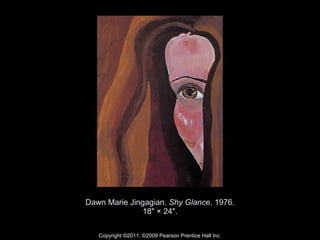
Dawn Marie Jingagian.  Shy Glance . 1976. 18" × 24". Copyright ©2011, ©2009 Pearson Prentice Hall Inc.
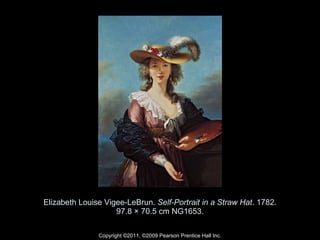
Elizabeth Louise Vigee-LeBrun.  Self-Portrait in a Straw Hat . 1782. 97.8 × 70.5 cm NG1653. Copyright ©2011, ©2009 Pearson Prentice Hall Inc.
Evaluation Once you decide whether you like a piece or not, you need to ask yourself why you like or dislike it? Ask yourself what you are looking for.  What do you find valuable in a piece of artwork?
Art Criticism Art criticism refers to making discriminating judgments Three basic theories Formal theories which focus attention on composition and how an artwork is influenced by past works of art Contextual theories which consider art as a prodct of a culture and value system Expressive theories which pay attention to the artist’s expression of a personality or world view
Formal Theories Looks carefully at how the composition come together to create a visual experience They believe that the most important influence on an artwork is past artwork that the artist has seen or studied The subject or theme of the work is less important The date of when the work was made is very important
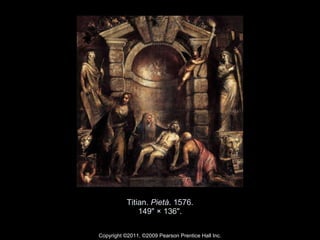
Titian.  Pietà . 1576. 149" × 136". Copyright ©2011, ©2009 Pearson Prentice Hall Inc.
Contextual Theories Contextual theorist look and the environment that the artwork was made in.  The cultural values, politics, economy… They tend to ask the question: What was going on in the culture at that time?
Expressive Theories All artwork is made by people.  The skill level, personal intent, emotional state, gender, etc will effect the creative process The most important information to expressive theorists is:  Who made the artwork? They are looking for psychological insight, personal meanings
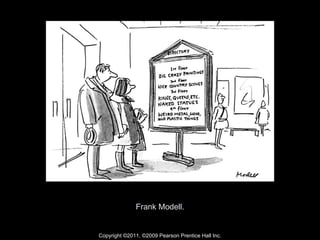
Frank Modell. Copyright ©2011, ©2009 Pearson Prentice Hall Inc.

Art Appreciation-Chapter13

  • 1.
  • 2.
    Evaluation We allevaluate by express our likes and dislikes every day Quality The idea of what makes an artwork quality varies form person to person, culture to culture, and age to age
  • 3.
    Dawn Marie Jingagian. Shy Glance . 1976. 18" × 24". Copyright ©2011, ©2009 Pearson Prentice Hall Inc.
  • 4.
    Elizabeth Louise Vigee-LeBrun. Self-Portrait in a Straw Hat . 1782. 97.8 × 70.5 cm NG1653. Copyright ©2011, ©2009 Pearson Prentice Hall Inc.
  • 5.
    Evaluation Once youdecide whether you like a piece or not, you need to ask yourself why you like or dislike it? Ask yourself what you are looking for. What do you find valuable in a piece of artwork?
  • 6.
    Art Criticism Artcriticism refers to making discriminating judgments Three basic theories Formal theories which focus attention on composition and how an artwork is influenced by past works of art Contextual theories which consider art as a prodct of a culture and value system Expressive theories which pay attention to the artist’s expression of a personality or world view
  • 7.
    Formal Theories Lookscarefully at how the composition come together to create a visual experience They believe that the most important influence on an artwork is past artwork that the artist has seen or studied The subject or theme of the work is less important The date of when the work was made is very important
  • 8.
    Titian. Pietà. 1576. 149" × 136". Copyright ©2011, ©2009 Pearson Prentice Hall Inc.
  • 9.
    Contextual Theories Contextualtheorist look and the environment that the artwork was made in. The cultural values, politics, economy… They tend to ask the question: What was going on in the culture at that time?
  • 10.
    Expressive Theories Allartwork is made by people. The skill level, personal intent, emotional state, gender, etc will effect the creative process The most important information to expressive theorists is: Who made the artwork? They are looking for psychological insight, personal meanings
  • 11.
    Frank Modell. Copyright©2011, ©2009 Pearson Prentice Hall Inc.

Editor's Notes

  • #4 The Museum of Bad Art, Dedham, MA.
  • #5 NG1653. © National Gallery, London.
  • #9 SCALA\\Art Resource, N.Y.
  • #12 © The New Yorker Collection, 1983. Frank Modell from cartoonbank.com. All Rights Reserved.