ART APPRECIATION
JHONNY PET TOPASI, LPT,CSE, MAIE
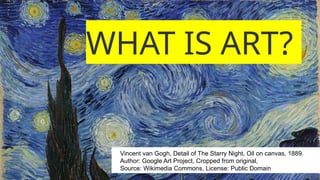
WHAT IS ART?
Vincent van Gogh, Detail of The Starry Night, Oil on canvas, 1889.
Author: Google Art Project, Cropped from original,
Source: Wikimedia Commons, License: Public Domain
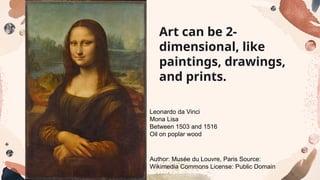
Art can be 2-
dimensional, like
paintings, drawings,
and prints.
Leonardo da Vinci
Mona Lisa
Between 1503 and 1516
Oil on poplar wood
Author: Musée du Louvre, Paris Source:
Wikimedia Commons License: Public Domain
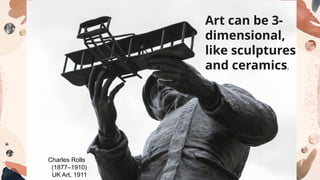
Art can be 3-
dimensional,
like sculptures
and ceramics.
Charles Rolls
(1877–1910)
UK Art, 1911
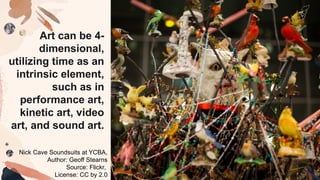
Art can be 4-
dimensional,
utilizing time as an
intrinsic element,
such as in
performance art,
kinetic art, video
art, and sound art.
Nick Cave Soundsuits at YCBA,
Author: Geoff Stearns
Source: Flickr,
License: CC by 2.0
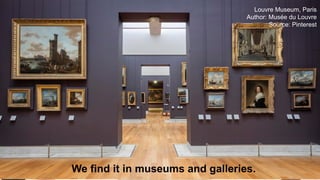
We find it in museums and galleries.
Louvre Museum, Paris
Author: Musée du Louvre
Source: Pinterest
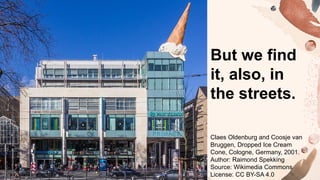
But we find
it, also, in
the streets.
Claes Oldenburg and Coosje van
Bruggen, Dropped Ice Cream
Cone, Cologne, Germany, 2001.
Author: Raimond Spekking
Source: Wikimedia Commons
License: CC BY-SA 4.0
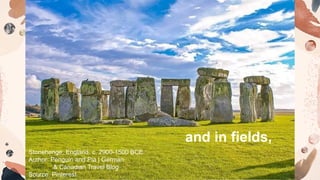
Stonehenge, England. c. 2900-1500 BCE.
Author: Penguin and Pia | German
& Canadian Travel Blog
Source: Pinterest
and in fields,
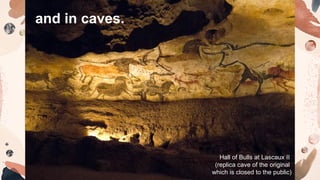
and in caves.
Hall of Bulls at Lascaux II
(replica cave of the original
which is closed to the public)
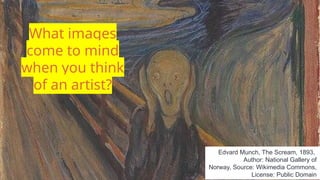
What images
come to mind
when you think
of an artist?
Edvard Munch, The Scream, 1893,
Author: National Gallery of
Norway, Source: Wikimedia Commons,
License: Public Domain
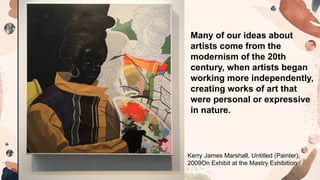
Many of our ideas about
artists come from the
modernism of the 20th
century, when artists began
working more independently,
creating works of art that
were personal or expressive
in nature.
Kerry James Marshall, Untitled (Painter),
2009On Exhibit at the Mastry Exhibition
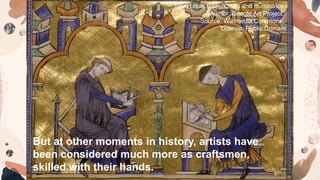
But at other moments in history, artists have
been considered much more as craftsmen,
skilled with their hands.
Saint Louis Bible, Cleric and Illuminator.
Author: Google Art Project,
Source: Wikimedia Commons,
License: Public Domain
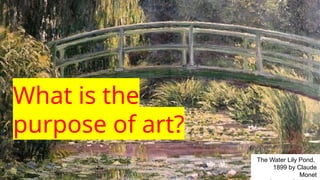
What is the
purpose of art?
The Water Lily Pond,
1899 by Claude
Monet
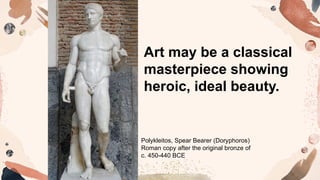
Art may be a classical
masterpiece showing
heroic, ideal beauty.
Polykleitos, Spear Bearer (Doryphoros)
Roman copy after the original bronze of
c. 450-440 BCE
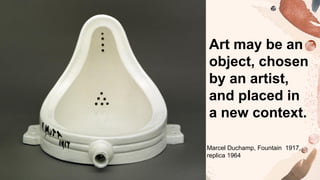
Art may be an
object, chosen
by an artist,
and placed in
a new context.
Marcel Duchamp, Fountain 1917,
replica 1964
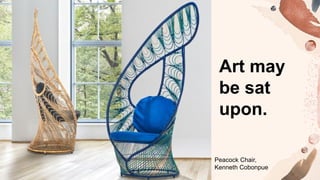
Peacock Chair,
Kenneth Cobonpue
Art may
be sat
upon.
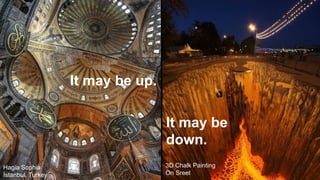
It may be up.
It may be
down.
3D Chalk Painting
On Sreet
Hagia Sophia
İstanbul, Turkey
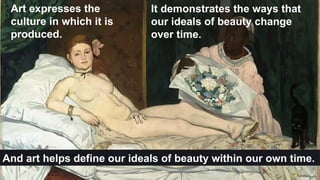
Art expresses the
culture in which it is
produced.
It demonstrates the ways that
our ideals of beauty change
over time.
And art helps define our ideals of beauty within our own time.
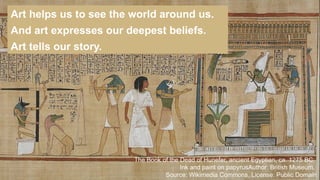
Art helps us to see the world around us.
And art expresses our deepest beliefs.
Art tells our story.
The Book of the Dead of Hunefer, ancient Egyptian, ca. 1275 BC,
Ink and paint on papyrusAuthor: British Museum,
Source: Wikimedia Commons, License: Public Domain
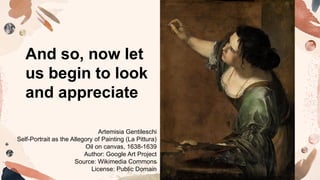
And so, now let
us begin to look
and appreciate
Artemisia Gentileschi
Self-Portrait as the Allegory of Painting (La Pittura)
Oil on canvas, 1638-1639
Author: Google Art Project
Source: Wikimedia Commons
License: Public Domain
ASSUMPTIONS AND NATURE OF ARTS
CREATIVITY & IMAGINATION
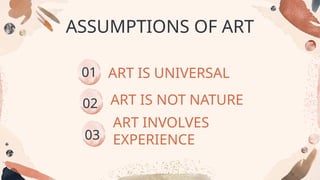
ART IS UNIVERSAL
01
ART IS NOT NATURE
02
ART INVOLVES
EXPERIENCE
03
ASSUMPTIONS OF ART
ART IS
UNIVERSAL
Art has always been
timeless and universal,
spanning to generations and
continents through and
through
MISCONCEPTIO
N
Art is not a
factor in
determining
art.
ART IS NOT
NATURE
Artists are not
expected to
duplicate
nature just as
even scientist
cannot make
nature with
their elaborate
studies.
Art is man’s expression of
his perception of nature.
Art, not directed by
representation of reality, is a
perception of reality.
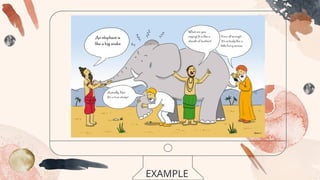
EXAMPLE
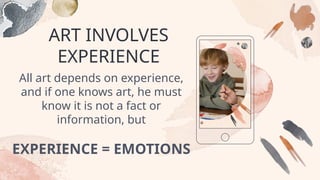
ART INVOLVES
EXPERIENCE
All art depends on experience,
and if one knows art, he must
know it is not a fact or
information, but
EXPERIENCE = EMOTIONS
❑ It takes an artist to make art. One may perceive beauty on a daily basis.
However, not every beautiful thing that can be seen or experienced may
truly be called a work of art.
❑ Art is a product of man’s creativity, imagination, and expression.
❑ Not everyone can be considered an artist, but all are spectators of art.
❑ We are able to distinguish what is fine and beautiful from what is not and
what good quality is and from poor.
❑ This gives us a role in the field of art appreciation.
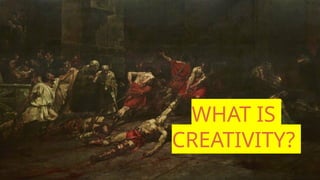
WHAT IS
CREATIVITY?
Creativity
comes from the
Latin term creō",
"to create, make"
Something is
creative when…
⮚ We haven’t seen
anything like it
⮚ It is out of
ordinary
⮚ Original
Art starts in the
Human mind.
It all begins with
IMAGINATION
ART APPRECIATION
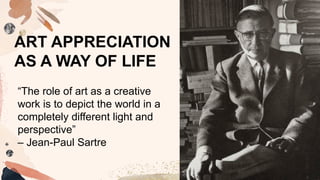
AS A WAY OF LIFE
“The role of art as a creative
work is to depict the world in a
completely different light and
perspective”
– Jean-Paul Sartre
Art Appreciation as a Way of Life
❖ Each artwork beholds beauty in its own kind, the kind that the artist
sees and wants the viewers to perceive.
❖ More often than not, people are blind to this beauty and only those who
have developed a fine sense of appreciation can experience and see
the art the way the artist did.
❖ Hence, refining one’s ability to appreciate arts allows him to deeply
understand the purpose of an artwork and recognize the beauty it
possesses.
❖ In cultivating an appreciation of art, one should also exercise and
develop his taste for things that are fine and beautiful.
Art Appreciation as a
Way of Life
❖ This allows individuals to make intelligent choices and
decisions in acquiring necessities and luxuries,
knowing what gives better value for time or money
while taking into consideration the aesthetic and
practical value.
❖ Learning to appreciate art no matter what vocation or
profession you have, will lead to a fuller and more
meaningful life.
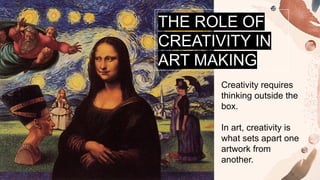
THE ROLE OF
CREATIVITY IN
ART MAKING
Creativity requires
thinking outside the
box.
In art, creativity is
what sets apart one
artwork from
another.
When can we say that
something is creative?
✔ When we have not seen
anything like it
✔ When it is out of the
ordinary
✔ When it is not just a copy
or imitation of someone’s
work
ORIGINALITY
Nowadays, being creative can be quite challenging.
Creativity should be backed with careful research on
related art to avoid conflicts.…
“Imagination is more important
than knowledge. For knowledge
is limited to all we now know
and understand, while
imagination embraces the entire
world, and all there ever will be
to know and understand.”
– Albert Einstein
ART AS A PRODUCT OF
IMAGINATION, IMAGINATION
AS A PRODUCT OF ART
❖ Imagination is not constrained by the walls of the norm, but
goes beyond that.
❖ Through imagination, one is able to craft something bold,
something new, and something better in the hopes of creating
something that will stimulate change.
❖ In artist’s mind sits a vast gallery of artworks
❖ An artwork does not need to be a real thing, but can be
something that is imaginary.
❖ However, something imaginary does not necessarily mean it
cannot be called art. Artists use their imagination that gives
birth to reality through creation.
❖ Imagination allows endless possibilities.
❖ In the same way that imagination produces art, art also
inspires imagination.
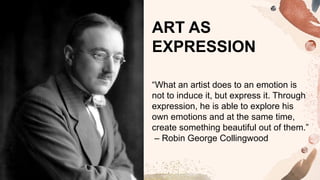
“What an artist does to an emotion is
not to induce it, but express it. Through
expression, he is able to explore his
own emotions and at the same time,
create something beautiful out of them.”
– Robin George Collingwood
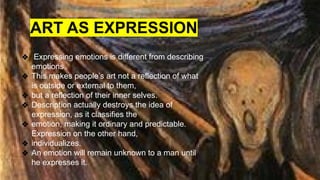
ART AS
EXPRESSION
❖ Expressing emotions is different from describing
emotions.
❖ This makes people’s art not a reflection of what
is outside or external to them,
❖ but a reflection of their inner selves.
❖ Description actually destroys the idea of
expression, as it classifies the
❖ emotion, making it ordinary and predictable.
Expression on the other hand,
❖ individualizes.
❖ An emotion will remain unknown to a man until
he expresses it.
ART AS EXPRESSION
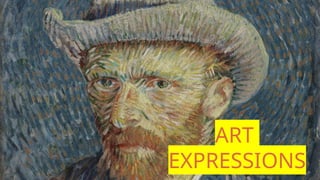
ART
EXPRESSIONS
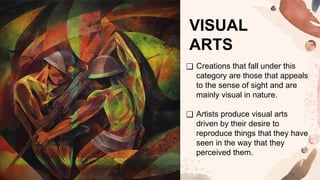
VISUAL
ARTS
❑ Creations that fall under this
category are those that appeals
to the sense of sight and are
mainly visual in nature.
❑ Artists produce visual arts
driven by their desire to
reproduce things that they have
seen in the way that they
perceived them.
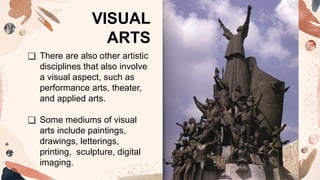
❑ There are also other artistic
disciplines that also involve
a visual aspect, such as
performance arts, theater,
and applied arts.
❑ Some mediums of visual
arts include paintings,
drawings, letterings,
printing, sculpture, digital
imaging.
VISUAL
ARTS
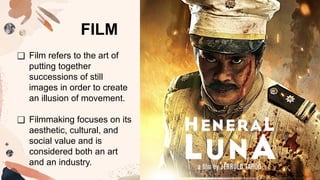
❑ Film refers to the art of
putting together
successions of still
images in order to create
an illusion of movement.
❑ Filmmaking focuses on its
aesthetic, cultural, and
social value and is
considered both an art
and an industry.
FILM
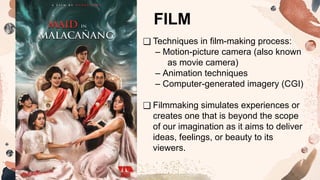
❑ Techniques in film-making process:
– Motion-picture camera (also known
as movie camera)
– Animation techniques
– Computer-generated imagery (CGI)
❑ Filmmaking simulates experiences or
creates one that is beyond the scope
of our imagination as it aims to deliver
ideas, feelings, or beauty to its
viewers.
FILM
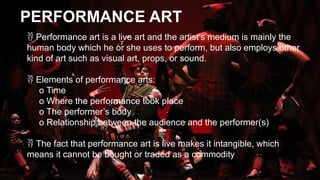
PERFORMANCE ART
 Performance art is a live art and the artist’s medium is mainly the
human body which he or she uses to perform, but also employs other
kind of art such as visual art, props, or sound.
 Elements of performance arts:
o Time
o Where the performance took place
o The performer’s body
o Relationship between the audience and the performer(s)
 The fact that performance art is live makes it intangible, which
means it cannot be bought or traded as a commodity
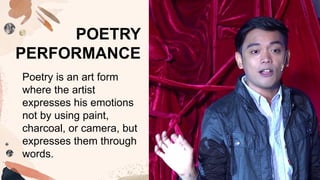
Poetry is an art form
where the artist
expresses his emotions
not by using paint,
charcoal, or camera, but
expresses them through
words.
POETRY
PERFORMANCE
❑ These words are carefully
selected to exhibit clarity and
beauty and to stimulate strong
emotions of joy, anger, love, and
sorrow among others.
❑ It uses a word’s emotional,
musical, and spatial values that
go beyond its literal meaning to
narrate emphasize, argue, or
convince.
❑ These words combined with
movements, tone, volume, and
intensity of the delivery add to
the artistic, value of the poem.
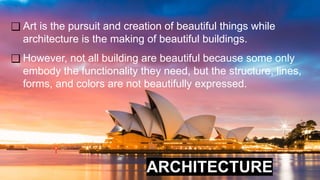
ARCHITECTURE
❑ Art is the pursuit and creation of beautiful things while
architecture is the making of beautiful buildings.
❑ However, not all building are beautiful because some only
embody the functionality they need, but the structure, lines,
forms, and colors are not beautifully expressed.
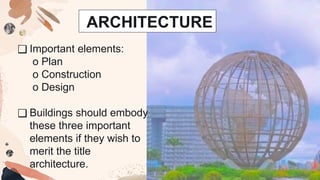
❑ Important elements:
o Plan
o Construction
o Design
❑ Buildings should embody
these three important
elements if they wish to
merit the title
architecture.
ARCHITECTURE
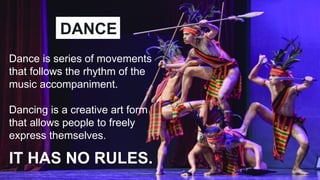
Dance is series of movements
that follows the rhythm of the
music accompaniment.
Dancing is a creative art form
that allows people to freely
express themselves.
IT HAS NO RULES.
DANCE
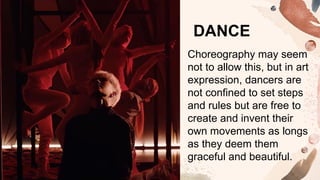
Choreography may seem
not to allow this, but in art
expression, dancers are
not confined to set steps
and rules but are free to
create and invent their
own movements as longs
as they deem them
graceful and beautiful.
DANCE
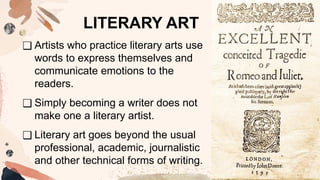
❑ Artists who practice literary arts use
words to express themselves and
communicate emotions to the
readers.
❑ Simply becoming a writer does not
make one a literary artist.
❑ Literary art goes beyond the usual
professional, academic, journalistic
and other technical forms of writing.
LITERARY ART
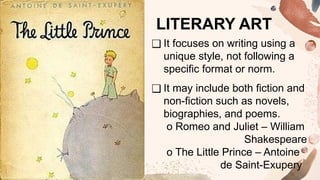
❑ It focuses on writing using a
unique style, not following a
specific format or norm.
❑ It may include both fiction and
non-fiction such as novels,
biographies, and poems.
o Romeo and Juliet – William
Shakespeare
o The Little Prince – Antoine
de Saint-Exupery
LITERARY ART
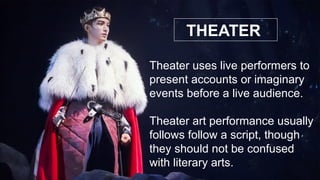
Theater uses live performers to
present accounts or imaginary
events before a live audience.
Theater art performance usually
follows follow a script, though
they should not be confused
with literary arts.
THEATER
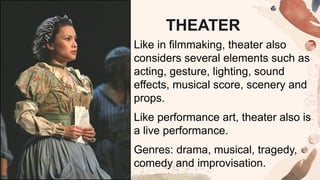
Like in filmmaking, theater also
considers several elements such as
acting, gesture, lighting, sound
effects, musical score, scenery and
props.
Like performance art, theater also is
a live performance.
Genres: drama, musical, tragedy,
comedy and improvisation.
THEATER
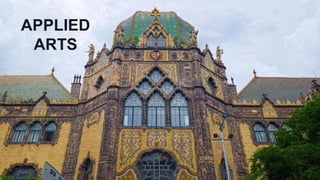
APPLIED
ARTS
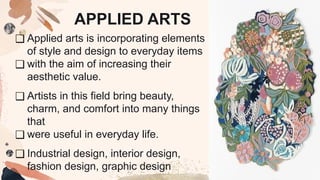
❑ Applied arts is incorporating elements
of style and design to everyday items
❑ with the aim of increasing their
aesthetic value.
❑ Artists in this field bring beauty,
charm, and comfort into many things
that
❑ were useful in everyday life.
❑ Industrial design, interior design,
fashion design, graphic design
APPLIED ARTS
FUNCTIONS &
PHILOSOPHICAL
PERSPECTIVES
ON ART
Aristotelian “telos”
• Every particular substance in the world has an end, or
telos in Greek, which translates into “purpose”.
• Telos is intricately linked with function: For a thing to
reach its purpose, it also has to fulfill its function.
• The telos and function of a thing are both related to a
thing’s identity. What makes a human being a human
being is his capacity for thinking.
• The telos, the function and the “whatness” of a thing
are all interconnected.
FUNCTIONS OF ART
When one speaks of function, one is
practically talking about the use of the
object whose function is in question.
An inquiry on the
function of art is an
inquiry on what art is for.
What is the Rizal monument for?
Why was it erected in Rizal Park
or what then was called Luneta or
Bagumbayan?
Is it for pure sentimental value?
Is it for aesthetic value?
Or does it send a message to
those who witness it?
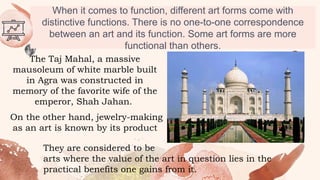
When it comes to function, different art forms come with
distinctive functions. There is no one-to-one correspondence
between an art and its function. Some art forms are more
functional than others.
The Taj Mahal, a massive
mausoleum of white marble built
in Agra was constructed in
memory of the favorite wife of the
emperor, Shah Jahan.
On the other hand, jewelry-making
as an art is known by its product
They are considered to be
arts where the value of the art in question lies in the
practical benefits one gains from it.
What about the practical
function of painting and
literature?
▪Even if painting and literature are not focusing on
the practical benefits, it can never be the case that
they do not have any function.
▪Noli Me Tangere and El Filibusterismo
▪They go beyond their literary worth. They are
functional “in so far as they are designed to
accomplish some definite end” (Dudley et al. 1960)
Art can be generally classified into
two: Directly Functional and
Indirectly Functional.
▪a) Directly Functional Art – Art that we use in a daily
basis and serves a literal or tangible function in our
lives. (e.g. Clothes, Architectural and Engineering,
Structures, Money, Furniture)
▪b) Indirectly Functional Art – Art that are ‘perceived
through the senses.” Not used literally to live but
accompanies life (e.g. Painting, Theatre, Literature)
• Both Directly Functional and Indirectly Functional
Arts tend to cross each other’s paths and
change roles or even fuse purposes.
• Some Directly Functional Art have a sole
purpose which is for functionality, but the
designs incorporated made the decorative art
transcend from its basic form to a highly artistic
form of art.
Artistic Functions can be
classified into 4:
1. Aesthetic 3. Social
2. Utilitarian 4. Cultural
1. Aesthetic Function
▪ An artwork functions aesthetically when it
becomes an instrument for mankind to be
cognizant of its beauty where feelings of joy and
appreciation are manifested.
2. Utilitarian Function
▪ Art serves this function when it is used to give
comfort, convenience, and happiness to human
beings. It served basic functions such as clothing,
food, and shelter, and other things that make humans
live with happiness and ease.
3. Social Function
▪ Art serves this purpose when it bridges connection
among people. Also when it encourages unity and good
relationship among people. With this, people become
more understanding and could somehow create a
better society
4. Cultural Function
▪ Art serves as an aperture towards skills, knowledge,
attitudes, customs, and traditions of different people.
The art helps preserve, share and transmit culture of
people from one generation to another
Classifications
of the
Functions of Art
1. Personal functions
of art
▪ The personal functions of art are
varied and highly subjective.
▪ An artist may create an art out of
the need for self-expression.
▪ It can also be mere entertainment
for his intended audience.
▪ An art may also be therapeutic.
2. Social functions
of art
▪ Art is considered to have a social function if and when
it addresses a particular collective interest as opposed
to a personal interest.
▪ Art may convey message of protest, contestation, or
whatever message the artist intends his work to carry.
▪ Art can also depict social conditions.
▪ Pictures of poverty; performance art like plays or
satires.
3. Physical functions
of art
▪ The physical functions of art are the
easiest to spot and understand.
▪ They are crafted in order to serve some
physical purpose.
▪ Architecture, jewelry-making and even
interior design are all forms of arts that
have physical function.
Other functions of
art
▪ Music in its original form was principally functional
because it was used for dance and religion. The
ancient world saw music only as an instrument to
facilitate worship and invocation to gods.
▪ Today, music has expanded its function and coverage.
It can be used for self-expression. It is also used as a
wonderful accompaniment to stage plays and motion
pictures.
▪ Music can mean a multitude of meanings to different
people.
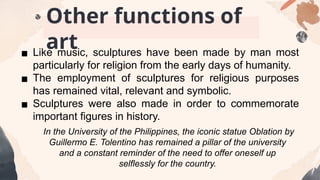
▪ Like music, sculptures have been made by man most
particularly for religion from the early days of humanity.
▪ The employment of sculptures for religious purposes
has remained vital, relevant and symbolic.
▪ Sculptures were also made in order to commemorate
important figures in history.
In the University of the Philippines, the iconic statue Oblation by
Guillermo E. Tolentino has remained a pillar of the university
and a constant reminder of the need to offer oneself up
selflessly for the country.
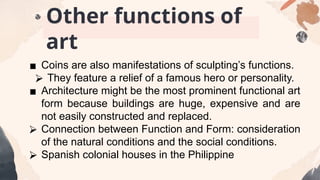
Other functions of
art
▪ Coins are also manifestations of sculpting’s functions.
⮚ They feature a relief of a famous hero or personality.
▪ Architecture might be the most prominent functional art
form because buildings are huge, expensive and are
not easily constructed and replaced.
⮚ Connection between Function and Form: consideration
of the natural conditions and the social conditions.
⮚ Spanish colonial houses in the Philippine
Other functions of
art
Does art always have to be
functional?
• While it has been shown that most arts are
functional, still there are some which are not. The
value of a work of art does not depend on function
but the work itself.
• Meanwhile, those whose functions are ascertained
have a different story. A functional object cannot
be claimed to be beautiful unless it can perform its
function sufficiently.
• Art demands so much more than mere efficiency.
Efficiency cannot be mistaken as beauty
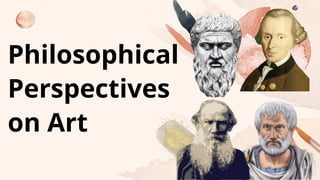
Philosophical
Perspectives
on Art
1. Art as an
imitation
• Plato’s The Republic
• It paints a picture of artists as imitators and art as mere
imitation. In order for the state to be ideal, Plato advised
against the inclusion of art as a subject in the curriculum
and the banning of artists in the Republic.
• He was convinced that artists merely reinforce the belief
in copies and discourage men to reach for the real entities
in the World of Forms.
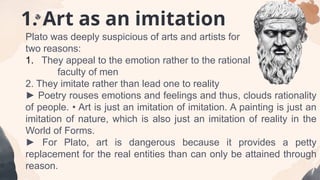
1. Art as an imitation
Plato was deeply suspicious of arts and artists for
two reasons:
1. They appeal to the emotion rather to the rational
faculty of men
2. They imitate rather than lead one to reality
► Poetry rouses emotions and feelings and thus, clouds rationality
of people. • Art is just an imitation of imitation. A painting is just an
imitation of nature, which is also just an imitation of reality in the
World of Forms.
► For Plato, art is dangerous because it provides a petty
replacement for the real entities than can only be attained through
reason.
In his theory if Mimesis, Plato
says that all Art is mimetic by
nature; art is an imitation of life.
He believed that ‘idea’ is the
ultimate reality. Art imitates idea
and so it is imitation of reality.
Plato’s Theory of
Mimesis
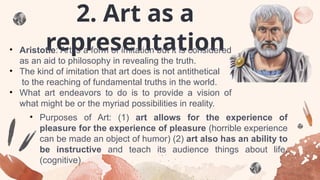
2. Art as a
representation
• Aristotle: Art is a form of imitation but it is considered
as an aid to philosophy in revealing the truth.
• The kind of imitation that art does is not antithetical
to the reaching of fundamental truths in the world.
• What art endeavors to do is to provide a vision of
what might be or the myriad possibilities in reality.
• Purposes of Art: (1) art allows for the experience of
pleasure for the experience of pleasure (horrible experience
can be made an object of humor) (2) art also has an ability to
be instructive and teach its audience things about life.
(cognitive)
All the Arts have their own techniques and rational
principles, and it is through mastery of these that the
artist/ craftsman brings his conceptions to life. Yes, the
arts of copy nature but their representations are fuller
and more meaningful than nature gives us in the raw.
That is their strength. We do not therefore need to insist
on some moral purpose for art, which is thus free to
represent all manner of things present, past, imagined
or institutionally-required.
Aristotle’s Theory
of
Representations
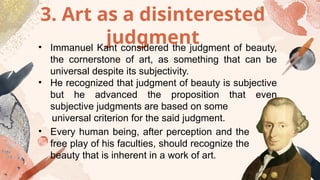
3. Art as a disinterested
judgment
• Immanuel Kant considered the judgment of beauty,
the cornerstone of art, as something that can be
universal despite its subjectivity.
• He recognized that judgment of beauty is subjective
but he advanced the proposition that even
subjective judgments are based on some
universal criterion for the said judgment.
• Every human being, after perception and the
free play of his faculties, should recognize the
beauty that is inherent in a work of art.
How and in what sense
can a judgment of
beauty, which ordinarily
is considered to be a
subjective feeling, be
considered objective or
universal?
HOW ARE THESE TWO
STATEMENTS
DIFFERENT?
1. “I like this painting.”
2. “This painting is
beautiful.”
• The first is clearly a judgment of taste (subjective), while the second is
an aesthetic judgment (objective).
• Making an aesthetic judgment requires us to be disinterested. In other
words, we should try to go beyond our individual tastes and
preferences so that we can appreciate art from a universal standpoint.
3. Art as a disinterested
judgment
• Kant argued the purpose of art is to be ‘purposeless’. It
should not have justify any reason of existing and being
valued other than the fact that it is art. Our experience of
art -the ways we appreciate and criticize work – is
therefore wholly commanded by aesthetic pleasure and
delight, separate to the rest of the world.
• Practically speaking, it usually meant that art should
avoid social, political, and moral themes and concentrate
instead on creating beauty, so it really meant “art for the
sake of beauty and its elevating effects.
Kant’s “L’Art por
L’Art
(Art for Art’s Sake)
4. Art as a communication of
emotion
• According to Leo Tolstoy, art plays a huge role in communication to its
audience’s emotions that the artist previously experienced. In the same
that language communicates information to other people, art
communicates emotions.
• Leo Tolstoy defended the production of the sometimes truly extravagant
art, like operas, despite extremely poverty in the world.
• Art serves as a language, a communication device that articulates
feelings and emotions that are otherwise unavailable to the audience.
• As a purveyor of man’s innermost feelings and thoughts, art is
given a unique opportunity to serve as a mechanism for social unity.
• Art serves as a mechanism of cohesion for everyone.
• Art is central to man’s existence because it makes
accessible feelings and emotions of people
from the past and present.
• “ The ceremony of art touches the deepest realms of he psyche
and he sacred dimension of the artistic creative process. The
sacred level of art not only transforms something into art, but
also transforms the artist at the very core of his or her being.
This way of doing and relating to art makes the process and
context of art-making infinitely more important than the product.”
• It’s an escape from the hustle and bustle of a long active day of
work and meetings. It’s an escape from the chaos that our
uncertain thoughts cause within us. It’s an escape our unrelating
running footsteps that we focus on more intensely than
reminding ourselves to take magical depths of deep breaths.
Art as an escape
ARTISTIC INTEGRITY
Never settle for anything but your
absolute best effort – an effort that
may be exhausting and frustrating
but that will ultimately serve you in
good stead as an artist and as a
human being
CONSONANCE and
DISSONANCE
The impression of stability and repose
(consonance) in relation to the impression
of tension or clash (dissonance)
experienced by a listener when certain
combinations of tones or notes are
sounded together
SCALE and PROPORTION
• Scale refers to the size of an object (as a whole
in relationship to another object (as another
whole). In art the size relationship between an
object and the human body is significant.
• Proportion refers to the relative size of parts of
a whole (elements within an object). We often
think of proportions in terms of size
relationships within the human body.
CLARITY and RADIANCE
• A clear design values clarity over novelty. (Clear
instead of clever.) Novel for novel’s sake is for
designers who create solutions for themselves.
Solutions that don’t value goals or problems.
• Radiance is a type of glowing: either from a light
source like the sun or a healthy, beaming
person.
THE REPRESENTIONAL
THEORY
• States that the fundamental,
definitive quality of art is the
ability to capture some
aspect of reality.
THE SUBJECT
• The Subject of art refers to any person, object, scene
or event described or represented in a work of art.
• Representational (e.g. Paintings, Sculptures, etc.)
• Non-Representational (e.g. Architectural Structures)
• Many contemporary painters have turned away from
representational to non-objective painting. They have
shifted their attention to the work of art as an object in
itself, an exciting combination of shapes and colors that
fulfills an aesthetic need without having to represent
images or tell a story.
• Many modern paintings are like this making them more
difficult to comprehend
WAYS OF
REPRESENTING
SUBJECTS
REALISM/ NATURALISM
Generally the attempt to represent
subject matter truthfully, without
artificiality and avoiding artistic
conventions, or implausible, exotic, and
supernatural elements.
ABSTRACTION
• The artist selects and renders the objects with
their shapes, colors and positions altered.
• In others, the original objects have been
reduced to simple geometric shapes and they
can be rarely identified unless the artist named
in in title.
• Artist’s concern is the rendering of the essence
of the subjects rather than the natural form
DISTORTION
• Could mean twisting,
stretching or deforming the
natural shape of the object.
• It is usually done to
dramatize the shape of a
figure or to create an
emotional effect.
SURREALISM
• It is a method where the artist in giving
expression to what it is in the
subconscious composes dreamlike
scenes that show an irrational
arrangement of objects.
• The images are recognizable,
sometimes drawn from the nature but
they are so combined in utterly fantastic
KINDS &
SOURCES OF
SUBJECTS
• Nature
• Animals
• Portrait or Human
Figures
• History and
Legends
•
KINDS & SOURCES OF
SUBJECTS
• Religion and
Mythology
• Dreams and
Fantasies
• Cityscapes
• Seascapes
ART and
BEAUTY
• “Beauty is in the Phi of the Beholder.”
• Dr. Stephen Marquardt has studies human beauty for years
in his practice of oral and maxillofacial surgery. Dr.
Marquardt performed cross-cultural surveys on beauty and
found that all groups had the same perceptions of facial
beauty.
• 1.618:1
• This particular relationship is the Golden Ratio. It is a
mathematical ratio that seems to appear recurrently in
beautiful things in nature as well as in other things that are
THE UGLY AND THE TRAGIC
IN ART
• There is nothing that may be considered as in
improper subject when it comes to art.
• The grotesque the ugly, and the tragic are all
legitimate subjects as the pleasurable and the
beautiful are.
• Many, in fact, have often deviated away from the
stereotyped and beautiful subjects.
• The greatest play, movies, and musicals are invariably
tragedies.
• And many our songs speak about love denied or lost.
CONTENT
(Levels of Meaning)
Factual
Meaning
The literal statement
or the narrative
content in the work
which can be directly
apprehended because
the objects presented
are easily recognized.
Conventiona
l Meaning
Refers to the special
meaning that a certain
object or color has a
particular culture or
group of people.
Subjective
Meaning
Any personal meaning consciously or
unconsciously conveyed by the artist
using a private symbolism which stems
from his own association of certain
objects, actions or colors with past
experiences
ARTIST AND
ARTISANS;PRODUCTION
PROCESS, MEDIUM,
TECHNIQUE, CURATION
ART APPRECIATION
WHAT IS THE
DIFFERENCE
BETWEEN
ARTIST AND
ARTISAN?
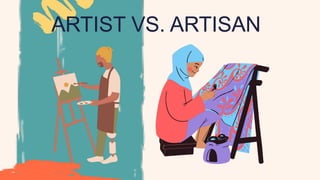
ARTIST VS. ARTISAN
-AN ARTIST IS A PERSON WHO PERFORMS
ALL FORMS OF CREATIVE ARTS. THE
WORD " ARTIST" IS GENERALLY DEFINED
AS AN ART PRACTITIONER, SUCH AS A
PAINTER, SCULPTOR, CHOREOGRAPHER,
DANCER, WRITER, POET, MUSICIANS, AND
THE LIKE, WHO PRODUCES OR CREATES
INDIRECTLY FUNCTIONAL ARTS WITH
AESTHETIC VALUE USING IMAGINATION.
-AN ARTIST IS A CRAFTSMAN SUCH AS
CARPENTER, CARVER. PLUMBER,
BLACKSMITH, WEAVER. EMBROIDERER,AND
THE LIKE WHO PRODUCES DIRECTLY
FUNCTIONAL AND/OR DECORATIVE ARTS
-HELP US IN MEETING OUR BASIC NEEDS,
SUCH AS FOOD, SHELTER, CLOTHING,
DWELLING, FURNITURE; THEY CRAFT
EVERYTHING THAT MAKES OUR LIFE EASIER
ARTIST VS. ARTISAN
-ARE CREATIVE INDIVIDUALS WHO USE THEIR
IMAGINATION AND SKILLS TO COMMUNICATE
IN AN ART FORM.
-LOOK TO MANY SOURCES FOR INSPIRATION
-EXHIBIT THE COURAGE TO TAKE RISK
-THEY ARE ABLE TO SEE THEIR SURROUNDINGS
IN NEW AND UNUSUAL WAYS.
-SOME ARTISTS AE SELF-TAUGHT AD HE BEEN
CALLED FOLK -ARTIST BECAUSE THEY ARE NOT
EDUCATED IN TRADITIONAL ARTISTIC METHODS
-IS BASICALLY A PHYSICAL
WORKER WHO OBJECTS WITH
HIS OR HER HANDS, AND WHO
THROUGH SKILL, EXPERIENCE,
AND ABILITY CAN PRODUCE
THINGS OF GREAT BEAUTY, AS
WELL AS USEFULLNESS.
ARTIST VS. ARTISAN
CURATOR
- CURATOR, WHO IS A MANAGER OR OVERSEER, AND
USUALLY A CURATOR OR KEEPER OF CULTURAL HERITAGE
INSTITUTION IS A CONTENT SPECIALIST CHARGED WITH AN
INSTITUTIONS COLLECTIONS
-TOBE SUCCESSFUL, A CURATOR SHOULD BE ORGANIZED,
PASSIONATE, KNOWLEDGEABLE, ADEPT AT MULTI-TASKING,
AND PROFICIENT AT WRITING
ART BUYER
- IS A PROFESSIONAL WHO IS KNOWLEDGEABLE IN ART WHO
MAY SCOUT TALENTS FOR AN ADVERTISING AGENCY SEEKING
TO EMPLOY AN ART DIRECTOR, WHO MAY LOOK FOR AN ART
FOR A COLLECTOR OR A COMPANY
ART DEALER
- A PERSON OR A COMPANY THAT BUYS AND SELLS WORKS
OF ART. IT OFTEN STUDY THE HISTORY OF ART BEFORE
STARTING THEIR CAREER.
3 STAGES IN ART MAKING
1. PRE- PRODUCTION OR SUBJECT DEVELOPMENT
2. PRODUCTION OR MEDIUM MANIPULATION
3. POST PRODUCTION (COMPLETION) OR EXHIBITION
- THIS ENDS WHEN THE PLANNING ENDS, AND THE CONTENT STARTS BEING PRODUCED
- A METHOD OF JOINING DIVERSE MATERIAL INPUTS AND UNIMPORTANT INPUTS
-ACT OF CREATING OUTPUT, A GOOD OR SERVICE THAT HAS SIGNIFICANCE AND CONTRIBUTES TO THE
UTILITY OF INDIVIDUALS.
- ONCE AN ARTWORK IS FINISHED, IT WILL BE DISPLAYED CIRCULATED, AND PERFORMED FOR THE
AUDIENCE AND PUBLIC TO SEE OR WATCH
MEDIUM VS TECHNIQUE
- REFERS TO THE MATERIALS THAT ARE
USED BY AN ARTIST TO CREATE A WORK
OF AR. THE PLURAL FOR OF MEDIUM IS
MEDIA. WITHOUT THE MEDIUM, AN IDEA
REMAINS A CONCEPT OR IT WOULD JUST
DWELL IN THE WALLS OF THE ARTISTS
IMAGINATION.
- REFERS TO THE ARTISTS ABILITY AND
KNOWLEDGE OR TECHNICAL KNOW-HOW
IN MANIPULATING THE MEDIUM. IT IS
THE MANNER BY WHICH THE ARTIST
CONTROL THE MEDIUM TO ACHIEVE THE
DESIRED EFFECTS;THUS, IT IS IN THE
TECHNIQUE THAT ARTIST DIFFER FROM
ONE ANOTHER.
ELEMENTS AND
PRINCIPLES
OF
ARTS
ART APPRECIATION
- THE VISUAL ART TERMS SEPARATE
INTO THE ELEMENTS AND PRINCIPLES
OF ART. THE ELEMENTS OF ART ARE
COLOR, FORM, LINE, SHAPE, SPACE
AND TEXTURE. THE PRINCIPLES OF
ARTS ARE SCALE, PROPORTION UNITY,
VARIETY,RHYTHM, MASS, SHAPE SPACE
BALANCE, VOLUME, PERSPECTIVE AND
DEPTH.
ELEMENTS OF ARTS
COLOR
- COLOR IS THE VISUAL PERCEPTION SEEN BY THE HUMAN EYE.THIS CONVEYS
FEELINGS AND MOODS WITHIN THE PAINTING OR ANY ARTS. COLOR CONTAINS
CHARACTERISTICES LIKE HUE, VALUE AND SATURATION.
FORM
- GIVES SHAPE TO A PIECE OF ART, WHETHER IT IS THE CONSTRAINTS OF A LINE IN A
PAINTING OR THE EDGE OF THE SCULPTURE. IT IS ALSO THE EXPRESSION OF ALL THE
FORMAL ELEMENTS OF ART IN A PIECE OF WORK
ELEMENTS OF ARTS
LINE
- PRIMARILY A DOT OR SERIES OF DOTS. THE DOTS FORM A LINE, WHICH CAN VARY
IN THICKNESS COLOR AND SHAPE. A LINE IS A TWO DIMENSIONAL SHAPE UNLESS
THE ERTIST GIVES IT VOLUME OR MASS. MULTIPLE LINES DEVELOPS INTO A
DRAWING MORE RECOGNIZABLE THAN A LINE CREATING A FORM RESEMBLING THE
OUTSIDE OF IT'S SHAPE.
SHAPE
- DEFINES AS HAVING SOME SORT OF OUTLINE OR BOUNDARY, WHETHER THE
SHAPE IS TWO OR THREE DIMENSIONAL. THE SHAPE CAN BE GEOMETRIC (KNOWN
SHAPE) OR ORGANIC (FREE FORM SHAPE)
ELEMENTS OF ARTS
SPACE
TEXTURE
- CAN BE ROUGH OR SMOOTH TO THE TOUCH, IMITATING A PARTICULAR FEEL OR
SENSATION. THE TEXTURE IS ALSO HOW YOUR EYE PERCEIVES A SURFACE, WHETHER
IT IS FLAT WITH LITTLE TEXTURE OR DISPLAYS VARIATIONS ON THE SURFACE,
IMITATING ROCK, WOOD, STONEZ FABRIC.
- IS THE AREA AROUND THE FOCAL POINT OF THE ART PIECE AND MIGHT BE
POSITIVE OR NEGATIVE, SHALLOW OR DEEP, OPEN. OR CLOSED. SPACE IS THE AREA
AROUND THE ART FORM; IN THE CASE OF A BUILDING, IT IS THE AREA BEHIND,
OVER. INSIDE, OR NEXT TO THE STRUCTURE
PRINCIPLES OF ARTS
BALANCE
CONTRAST
- DEFINED AS THE DIFFERENCE IN COLORS TO CREATE A PIECE OF VISUAL ART. CAN
ALSO BE SUBTLE WHEN USING MONOCHROMATIC COLORS, GIVING VARIETY AND
UNITY THE FINAL PIECE OF ART.
- REFERS TO THE DISTRIBUTION OF WEIGHT IN THE APPARENT WEIGHT OF THE
PIECE. ARCHES ARE BUILT FOR STRUCTURAL DESIGN AND TO HOLD THE ROOF IN
PLACE, ALLOWING FOR PASSAGE OF PEOPLE BELOW THE ARCH AND CREATING
BALANCE VISUALLY AND STRUCTURALLY.
PRINCIPLES OF ARTS
EMPHASIS
RHYTHM/ MOVEMENT
- RHYTHM IN A PIECE OF ART DENOTES A TYPE OF REPETITION USED TO EITHER
DEMONSTRATE MOVEMENT OR EXPANSE. FOR INSTANCE, IN A PAINTING OF WAVES
CRASHING, A VIEWER WILL AUTOMATICALLY SEE THE MOVEMENT AS THE WAVE
FINISHES. THE USE OF BOLD AND DIRECTIONAL BRUSHWORK WILL ALSO PROVIDE
MOVEMENT IN A PAINTING.
- CAN BE COLOR, UNITY, BALANCE, OR ANY OTHER PRINCIPLE OR ELEMENT OF ART
USED TO CREATE A FOCAL POINT.
PRINCIPLES OF ARTS
PROPORTION/SCALE
- PROPORTION IS THE RELATIONSHIP BETWEEN ITEMS IN A PAINTING, FOR EXAMPLE,
BETWEEN THE SKY AND MOUNTAINS. IF THE SKY IS MORE THAN TWO-THIRDS OF THE
PAINTING, IT LOOKS OUT OF PROPORTION. THE SCALE IN ART IS SIMILAR TO PROPORTION,
AND IF SOMETHING IS NOT TO SCALE, IT CAN LOOK ODD. IF THERE IS A PERSON IN THE
PICTURE AND THEIR HANDS ARE TOO LARGE FOR THEIR BODY, THEN IT WILL LOOK OUT OF
SCALE. ARTISTS CAN ALSO USE SCALE AND PROPORTION TO EXAGGERATE PEOPLE OR
LANDSCAPES TO THEIR ADVANTAGE
PRINCIPLES OF ARTS
UNITY AND VARIETY
- IN ART, UNITY CONVEYS A SENSE OF COMPLETENESS, PLEASURE WHEN VIEWING THE ART,
AND COHESIVENESS TO THE ART, AND HOW THE PATTERNS WORK TOGETHER BRINGS UNITY
TO THE PICTURE OR OBJECT. AS THE OPPOSITE OF UNITY, VARIETY SHOULD PROVOKE
CHANGES AND AWARENESS IN THE ART PIECE. COLORS CAN PROVIDE UNITY WHEN THEY
ARE IN THE SAME COLOR GROUPS, AND A SPLASH OF RED CAN PROVIDE VARIETY.
PRINCIPLES OF ARTS
PATTERN
- PATTERN IS THE WAY SOMETHING IS ORGANIZED AND REPEATED IN ITS SHAPE OR FORM
AND CAN FLOW WITHOUT MUCH STRUCTURE IN SOME RANDOM REPETITION. PATTERNS
MIGHT BRANCH OUT SIMILAR TO FLOWERS ON A PLANT OR FORM SPIRALS AND CIRCLES AS
A GROUP OF SOAP BUBBLES OR SEEM IRREGULAR IN THE CRACKED, DRY MUD. ALL WORKS
OF ART HAVE SOME SORT OF PATTERN EVEN THOUGH IT MAY BE HARD TO DISCERN; THE
PATTERN WILL FORM BY THE COLORS, THE ILLUSTRATIONS, THE SHAPE, OR NUMEROUS
OTHER ART METHODS.
ART HISTORY
(Asian, Western,
Philippines)
CAVE ART, EGYPTIAN AND
GREEK
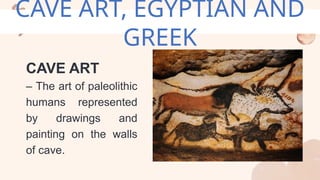
CAVE ART
– The art of paleolithic
humans represented
by drawings and
painting on the walls
of cave.
CAVE ART, EGYPTIAN AND
GREEK
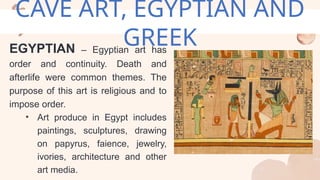
EGYPTIAN – Egyptian art has
order and continuity. Death and
afterlife were common themes. The
purpose of this art is religious and to
impose order.
• Art produce in Egypt includes
paintings, sculptures, drawing
on papyrus, faience, jewelry,
ivories, architecture and other
art media.
CAVE ART, EGYPTIAN AND
GREEK
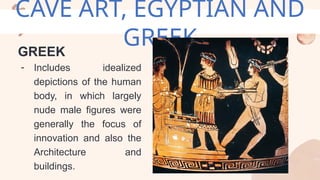
GREEK
- Includes idealized
depictions of the human
body, in which largely
nude male figures were
generally the focus of
innovation and also the
Architecture and
buildings.
ROMAN & MEDIAVAL
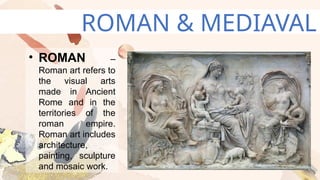
• ROMAN –
Roman art refers to
the visual arts
made in Ancient
Rome and in the
territories of the
roman empire.
Roman art includes
architecture,
painting, sculpture
and mosaic work.
ROMAN & MEDIAVAL
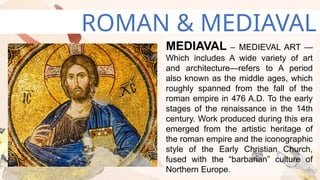
MEDIAVAL – MEDIEVAL ART —
Which includes A wide variety of art
and architecture—refers to A period
also known as the middle ages, which
roughly spanned from the fall of the
roman empire in 476 A.D. To the early
stages of the renaissance in the 14th
century. Work produced during this era
emerged from the artistic heritage of
the roman empire and the iconographic
style of the Early Christian Church,
fused with the “barbarian” culture of
Northern Europe.
CHINESE PRINTING AND
JAPANESE PRINT
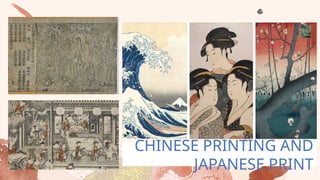
CHINESE PRINTING – The process of printing starts in China.
Because of this process a variety of items like calendars and religious
texts are produced. Chinese woodblock were first used to print designs in
silk or cloth. Then the creation of paper came. Paper was made by
creating a mix of bark and rags that would float on water. Before the
invention of printing everything had to be written by hand. This took a long
time and meant that books and other written materials were very rare and
expensive. Around 220 ad the Chinese began printing pictures on silk and
other fabrics. Then around 650 ad they began printing on paper using
wooden blocks. However, woodblock prints were not regarded as an art
form of its own. They were rather meant as a means to make a precise
reproduction of existing paintings.
CHINESE PRINTING AND
JAPANESE PRINT
JAPANESE PRINTING – is a technique best known
for its use in the ukiyo-e Artistic genre of single sheets, but it
was also used for printing books in the same period. The
Japanese water-based inks provide a wide range of Vivid
colors, glazes, and transparency.
WOODLOCK PRINTING – A technique for printing
text, images or patterns used widely throughout East Asia
and originating in China in antiquity as a method of printing
on textiles and later paper.
CHINESE PRINTING AND
JAPANESE PRINT
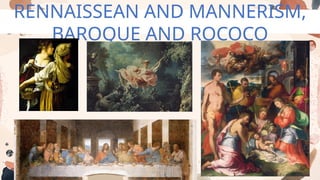
RENNAISSEAN AND MANNERISM,
BAROQUE AND ROCOCO
• RENAISSANCE – Move away from purely spiritual
concerns to more human and classical.
• MANNERISM – Mannerism is a style that emerged in 1530
and lasted until the end of the century. It is named after
Maniera, an Italian term for “style” or “Manner,” and refers to
a stylized, exaggerated approach to painting and sculpture.
• BAROQUE – Response to reformation more theatrical and
dramatic scenes and depictions to attract commoners.
• ROCOCO – Appealed to wealthy class or nobility.
RENNAISSEAN AND MANNERISM,
BAROQUE AND ROCOCO
NEO-CLASSICISM AND
ROMANTIC AND REALISM
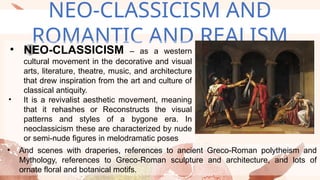
• NEO-CLASSICISM – as a western
cultural movement in the decorative and visual
arts, literature, theatre, music, and architecture
that drew inspiration from the art and culture of
classical antiquity.
• It is a revivalist aesthetic movement, meaning
that it rehashes or Reconstructs the visual
patterns and styles of a bygone era. In
neoclassicism these are characterized by nude
or semi-nude figures in melodramatic poses
• And scenes with draperies, references to ancient Greco-Roman polytheism and
Mythology, references to Greco-Roman sculpture and architecture, and lots of
ornate floral and botanical motifs.
NEO-CLASSICISM AND
ROMANTIC AND REALISM
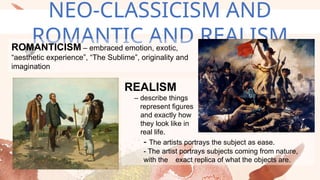
ROMANTICISM – embraced emotion, exotic,
“aesthetic experience”, “The Sublime”, originality and
imagination
REALISM
– describe things
represent figures
and exactly how
they look like in
real life.
- The artists portrays the subject as ease.
- The artist portrays subjects coming from nature,
with the exact replica of what the objects are.
IMPRESSIONISM AND POST-
IMPRESSIONISM
• IMPRESSIONISM – the artist depicts
what stimulates the eye. They are more
concerned with the effects of lights that would
get the attention of the audience.
• POST-IMPRESSIONISM – It is
characterized by a subjective approach to
painting, as artists opted to evoke emotion
rather than realism in their work.
NEO-IMPRESSIONISM
NEO-IMPRESSIONISM – refers to a
pictorial technique where color pigments are no
longer mixed either on the palette or directly on
canvas, but instead placed as small dots side by
side.
SYMBOLISM AND ART
NAVEAU
• SYMBOLISM – the visible sign of something
invisible such as ideas or quality.
- symbolism possesses some difficulty at
understanding.
• ART NOUVEAU – is characterized by its
use of a long sinuous, organic line and was
employed most often in architecture, interior
design, jewelry and glass design, posters and
illustrations.
FAUVISM AND
EMPRESSIONISM
FAUVISM – it employs colors to express the
emotions of the artist.
- the artist uses bright and extreme colors in
order to assume positive characters.
EXPRESSIONISM – artistic style in which
the artist tried to describe not the objective reality
but the subjective emotions objects and events that
are out of him.
CUBISM AND FUTURISM
• CUBISM – artists used geometric figures like
cones, sphere and cylinders.
- it shows the flatness of the picture and
rejects traditional perspective.
• FUTURISM – characterized by technology,
modernity, youth, and speed. It Includes objects in
an urbanized cities.
ABSTRACT OR NON-
OBJECTIVE
• ABSTRACT – there is no subject
but only his feelings and ideas. you
cannot figure out the subject/object.
- refers to visual works that move
beyond reality as contrasted to
realism.
PHOTO-REALISM
INSTALLATION ARTS
PHOTO-REALISM
– a genre of art that
encompasses painting,
drawing and other graphic
media, in which an artist
studies photograph and
then attempts to reproduce
the image as realistically as
possible in another
medium.
INSTALLATION
ARTS
– it is the term for works,
room-sized or larger, in
which the whole space is
considered a single
unified artwork.
SOULMAKING (SOUL, SOUND,
& STRUCTURE)
SOULMAKING
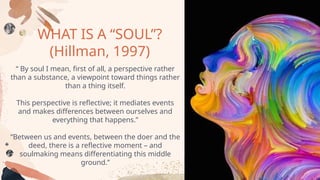
WHAT IS A “SOUL”?
(Hillman, 1997)
“ By soul I mean, first of all, a perspective rather
than a substance, a viewpoint toward things rather
than a thing itself.
This perspective is reflective; it mediates events
and makes differences between ourselves and
everything that happens.”
“Between us and events, between the doer and the
deed, there is a reflective moment – and
soulmaking means differentiating this middle
ground.’’
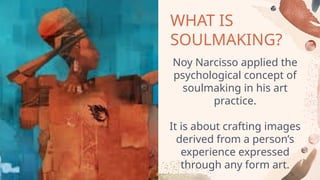
Noy Narcisso applied the
psychological concept of
soulmaking in his art
practice.
It is about crafting images
derived from a person’s
experience expressed
through any form art.
WHAT IS
SOULMAKING?
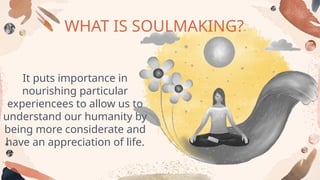
WHAT IS SOULMAKING?
It puts importance in
nourishing particular
experiencees to allow us to
understand our humanity by
being more considerate and
have an appreciation of life.
DA VINCIAN
PRINCIPLES
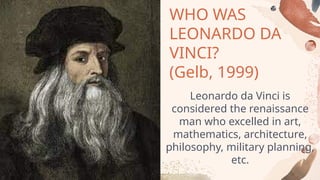
WHO WAS
LEONARDO DA
VINCI?
(Gelb, 1999)
Leonardo da Vinci is
considered the renaissance
man who excelled in art,
mathematics, architecture,
philosophy, military planning,
etc.
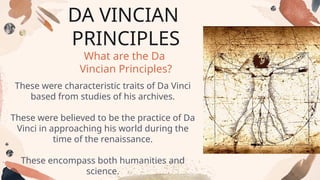
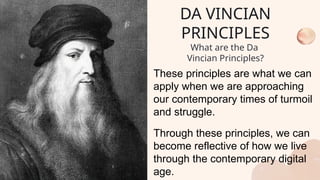
DA VINCIAN
PRINCIPLES
What are the Da
Vincian Principles?
These were characteristic traits of Da Vinci
based from studies of his archives.
These were believed to be the practice of Da
Vinci in approaching his world during the
time of the renaissance.
These encompass both humanities and
science.
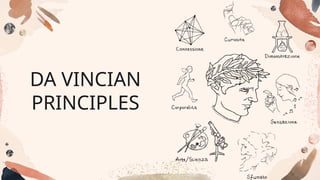
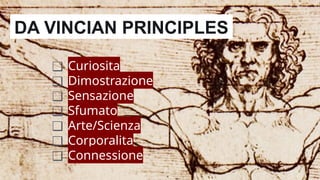
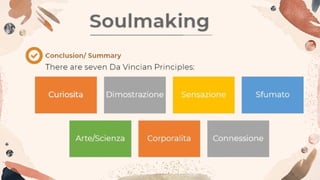
❑ Curiosita
❑ Dimostrazione
❑ Sensazione
❑ Sfumato
❑ Arte/Scienza
❑ Corporalita
❑ Connessione
DA VINCIAN PRINCIPLES
CURIOSITA
Curiosita is an
insatiably
curious approach
to life and an
unrelenting
quest for
continuous
learning.
DEMOSTRAZIONE
Demostrazione is a
commitment to test
knowledge through
experience, persistence,
and willingness to learn
from mistakes
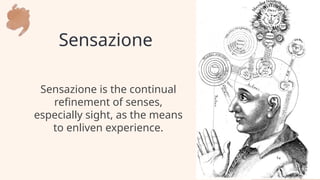
Sensazione
Sensazione is the continual
refinement of senses,
especially sight, as the means
to enliven experience.
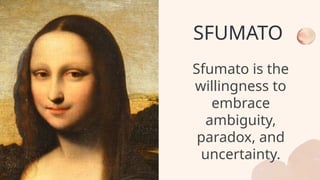
SFUMATO
Sfumato is the
willingness to
embrace
ambiguity,
paradox, and
uncertainty.
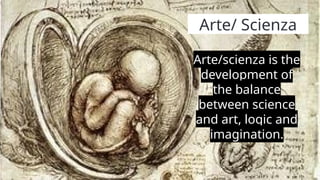
Arte/ Scienza
Arte/scienza is the
development of
the balance
between science
and art, logic and
imagination.
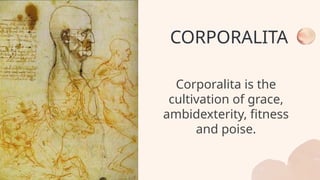
CORPORALITA
Corporalita is the
cultivation of grace,
ambidexterity, fitness
and poise.
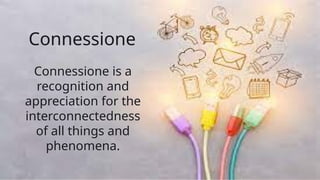
Connessione
Connessione is a
recognition and
appreciation for the
interconnectedness
of all things and
phenomena.
These principles are what we can
apply when we are approaching
our contemporary times of turmoil
and struggle.
Through these principles, we can
become reflective of how we live
through the contemporary digital
age.
DA VINCIAN
PRINCIPLES
What are the Da
Vincian Principles?
WORKSHOPS on
IMPROVISATIONS ,
INSTALLATION,
TRANSCREATION
2ND GRADE
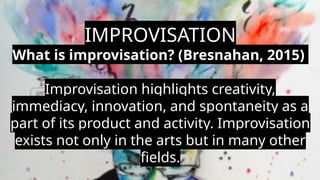
IMPROVISATION
What is improvisation? (Bresnahan, 2015)
Improvisation highlights creativity,
immediacy, innovation, and spontaneity as a
part of its product and activity. Improvisation
exists not only in the arts but in many other
fields.
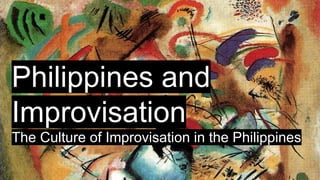
Philippines and
Improvisation
The Culture of Improvisation in the Philippines
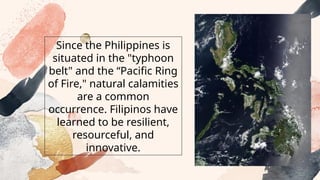
Since the Philippines is
situated in the "typhoon
belt" and the “Pacific Ring
of Fire," natural calamities
are a common
occurrence. Filipinos have
learned to be resilient,
resourceful, and
innovative.
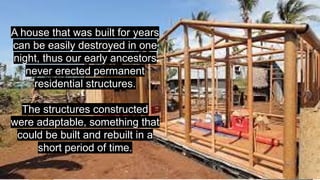
A house that was built for years
can be easily destroyed in one
night, thus our early ancestors
never erected permanent
residential structures.
The structures constructed
were adaptable, something that
could be built and rebuilt in a
short period of time.
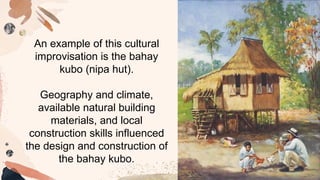
An example of this cultural
improvisation is the bahay
kubo (nipa hut).
Geography and climate,
available natural building
materials, and local
construction skills influenced
the design and construction of
the bahay kubo.
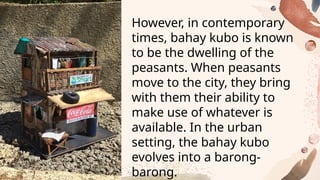
However, in contemporary
times, bahay kubo is known
to be the dwelling of the
peasants. When peasants
move to the city, they bring
with them their ability to
make use of whatever is
available. In the urban
setting, the bahay kubo
evolves into a barong-
barong.
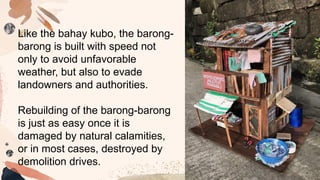
Like the bahay kubo, the barong-
barong is built with speed not
only to avoid unfavorable
weather, but also to evade
landowners and authorities.
Rebuilding of the barong-barong
is just as easy once it is
damaged by natural calamities,
or in most cases, destroyed by
demolition drives.
Improvisation
in the Arts
How is improvisation applied in the arts?
What is
improvisation?
(Bresnahan,
2015)
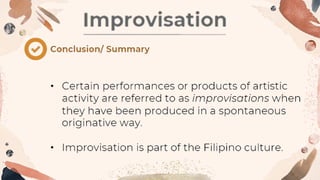
In a general sense, improvisation is
spontaneous, unplanned or otherwise
free-ranging creativity.
Certain performances or products of
artistic activity are referred to as
improvisations when they have been
produced in a spontaneous
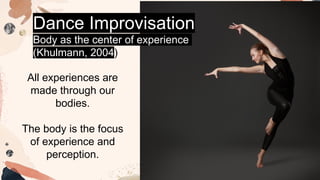
All experiences are
made through our
bodies.
The body is the focus
of experience and
perception.
Dance Improvisation
Body as the center of experience
(Khulmann, 2004)
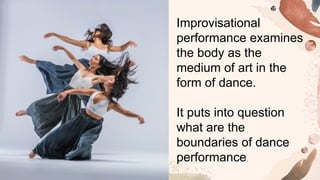
Improvisational
performance examines
the body as the
medium of art in the
form of dance.
It puts into question
what are the
boundaries of dance
performance.
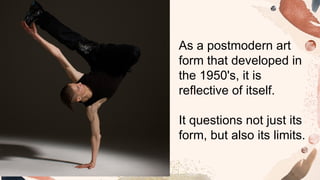
As a postmodern art
form that developed in
the 1950's, it is
reflective of itself.
It questions not just its
form, but also its limits.
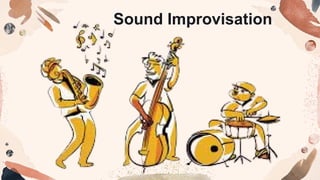
Sound Improvisation
The extemporaneous composition or free
performance of a musical passage, usually
in a manner conforming to certain stylistic
norms but unfettered by the prescriptive
features of a specific musical text.
“the creation of music in the course of
performance
Music that is created by the performer
during the moment of performance
Sound Improvisation
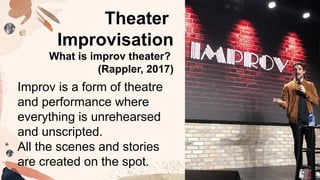
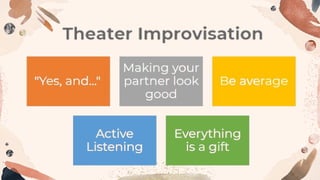
Improv is a form of theatre
and performance where
everything is unrehearsed
and unscripted.
All the scenes and stories
are created on the spot.
Theater
Improvisation
What is improv theater?
(Rappler, 2017)
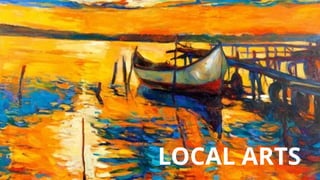
LOCAL ARTS
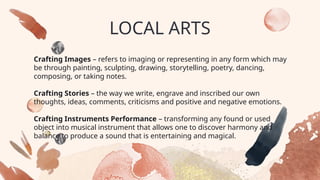
LOCAL ARTS
Crafting Images – refers to imaging or representing in any form which may
be through painting, sculpting, drawing, storytelling, poetry, dancing,
composing, or taking notes.
Crafting Stories – the way we write, engrave and inscribed our own
thoughts, ideas, comments, criticisms and positive and negative emotions.
Crafting Instruments Performance – transforming any found or used
object into musical instrument that allows one to discover harmony and
balance to produce a sound that is entertaining and magical.
INDIGENOUS ARTS
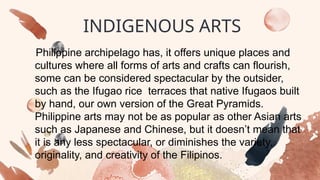
Philippine archipelago has, it offers unique places and
cultures where all forms of arts and crafts can flourish,
some can be considered spectacular by the outsider,
such as the Ifugao rice terraces that native Ifugaos built
by hand, our own version of the Great Pyramids.
Philippine arts may not be as popular as other Asian arts
such as Japanese and Chinese, but it doesn’t mean that
it is any less spectacular, or diminishes the variety,
originality, and creativity of the Filipinos.
ARCHITECTURE
INDIGENOUS ART
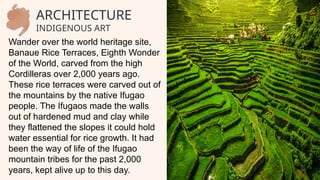
Wander over the world heritage site,
Banaue Rice Terraces, Eighth Wonder
of the World, carved from the high
Cordilleras over 2,000 years ago.
These rice terraces were carved out of
the mountains by the native Ifugao
people. The Ifugaos made the walls
out of hardened mud and clay while
they flattened the slopes it could hold
water essential for rice growth. It had
been the way of life of the Ifugao
mountain tribes for the past 2,000
years, kept alive up to this day.
SCULPTURE
INDIGENOUS ART
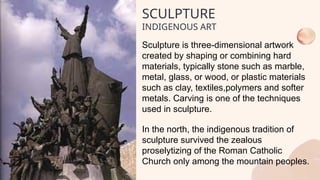
Sculpture is three-dimensional artwork
created by shaping or combining hard
materials, typically stone such as marble,
metal, glass, or wood, or plastic materials
such as clay, textiles,polymers and softer
metals. Carving is one of the techniques
used in sculpture.
In the north, the indigenous tradition of
sculpture survived the zealous
proselytizing of the Roman Catholic
Church only among the mountain peoples.
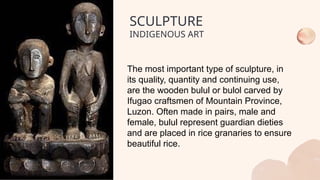
The most important type of sculpture, in
its quality, quantity and continuing use,
are the wooden bulul or bulol carved by
Ifugao craftsmen of Mountain Province,
Luzon. Often made in pairs, male and
female, bulul represent guardian dieties
and are placed in rice granaries to ensure
beautiful rice.
SCULPTURE
INDIGENOUS ART
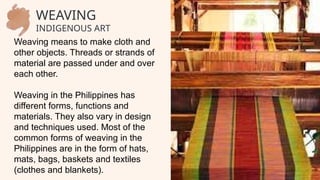
Weaving means to make cloth and
other objects. Threads or strands of
material are passed under and over
each other.
Weaving in the Philippines has
different forms, functions and
materials. They also vary in design
and techniques used. Most of the
common forms of weaving in the
Philippines are in the form of hats,
mats, bags, baskets and textiles
(clothes and blankets).
WEAVING
INDIGENOUS ART
WEAVING
INDIGENOUS ART
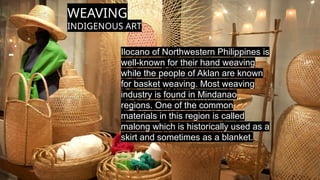
Ilocano of Northwestern Philippines is
well-known for their hand weaving
while the people of Aklan are known
for basket weaving. Most weaving
industry is found in Mindanao
regions. One of the common
materials in this region is called
malong which is historically used as a
skirt and sometimes as a blanket.
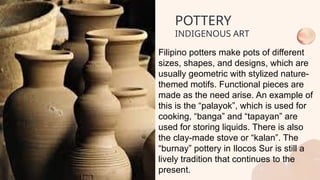
Filipino potters make pots of different
sizes, shapes, and designs, which are
usually geometric with stylized nature-
themed motifs. Functional pieces are
made as the need arise. An example of
this is the “palayok”, which is used for
cooking, “banga” and “tapayan” are
used for storing liquids. There is also
the clay-made stove or “kalan”. The
“burnay” pottery in Ilocos Sur is still a
lively tradition that continues to the
present.
POTTERY
INDIGENOUS ART
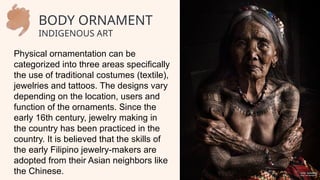
Physical ornamentation can be
categorized into three areas specifically
the use of traditional costumes (textile),
jewelries and tattoos. The designs vary
depending on the location, users and
function of the ornaments. Since the
early 16th century, jewelry making in
the country has been practiced in the
country. It is believed that the skills of
the early Filipino jewelry-makers are
adopted from their Asian neighbors like
the Chinese.
BODY ORNAMENT
INDIGENOUS ART
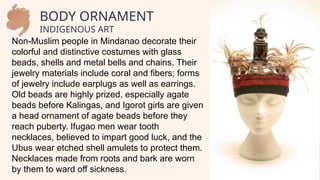
Non-Muslim people in Mindanao decorate their
colorful and distinctive costumes with glass
beads, shells and metal bells and chains. Their
jewelry materials include coral and fibers; forms
of jewelry include earplugs as well as earrings.
Old beads are highly prized, especially agate
beads before Kalingas, and Igorot girls are given
a head ornament of agate beads before they
reach puberty. Ifugao men wear tooth
necklaces, believed to impart good luck, and the
Ubus wear etched shell amulets to protect them.
Necklaces made from roots and bark are worn
by them to ward off sickness.
BODY ORNAMENT
INDIGENOUS ART
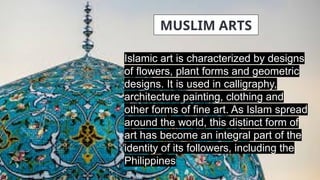
Islamic art is characterized by designs
of flowers, plant forms and geometric
designs. It is used in calligraphy,
architecture painting, clothing and
other forms of fine art. As Islam spread
around the world, this distinct form of
art has become an integral part of the
identity of its followers, including the
Philippines
MUSLIM ARTS
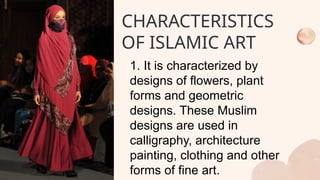
1. It is characterized by
designs of flowers, plant
forms and geometric
designs. These Muslim
designs are used in
calligraphy, architecture
painting, clothing and other
forms of fine art.
CHARACTERISTICS
OF ISLAMIC ART
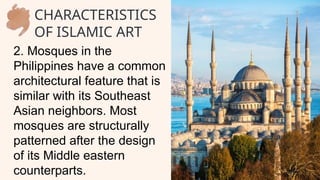
2. Mosques in the
Philippines have a common
architectural feature that is
similar with its Southeast
Asian neighbors. Most
mosques are structurally
patterned after the design
of its Middle eastern
counterparts.
CHARACTERISTICS
OF ISLAMIC ART
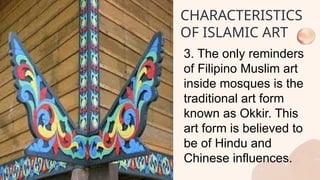
3. The only reminders
of Filipino Muslim art
inside mosques is the
traditional art form
known as Okkir. This
art form is believed to
be of Hindu and
Chinese influences.
CHARACTERISTICS
OF ISLAMIC ART
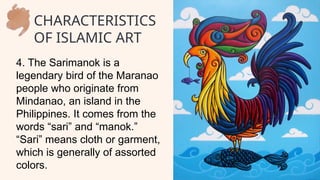
4. The Sarimanok is a
legendary bird of the Maranao
people who originate from
Mindanao, an island in the
Philippines. It comes from the
words “sari” and “manok.”
“Sari” means cloth or garment,
which is generally of assorted
colors.
CHARACTERISTICS
OF ISLAMIC ART
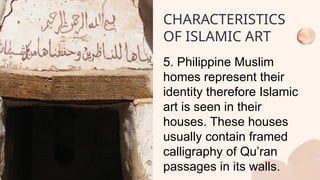
5. Philippine Muslim
homes represent their
identity therefore Islamic
art is seen in their
houses. These houses
usually contain framed
calligraphy of Qu’ran
passages in its walls.
CHARACTERISTICS
OF ISLAMIC ART
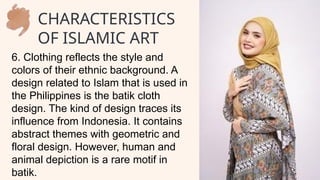
6. Clothing reflects the style and
colors of their ethnic background. A
design related to Islam that is used in
the Philippines is the batik cloth
design. The kind of design traces its
influence from Indonesia. It contains
abstract themes with geometric and
floral design. However, human and
animal depiction is a rare motif in
batik.
CHARACTERISTICS
OF ISLAMIC ART
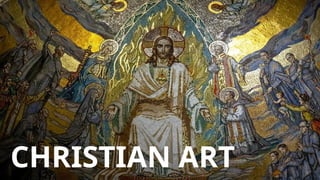
CHRISTIAN ART
The Spanish friars introduced Western painting in the
Philippines to artisans who learned to copy on two-
dimensional form from the religious icons that the friars
brought from Spain. For the first centuries of Spanish
colonization, painting was limited to religious icons. Portraits
of saints and of the Holy Family became a familiar sight in
churches. Other subject matters include the passion of
Christ, the Via Crucis, the crucifixion, portrayal of heaven
and hell.
PAINTING
CHRISTIAN ART
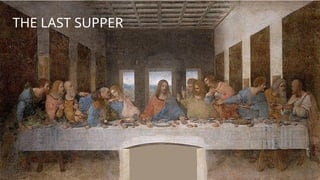
THE LAST SUPPER
Several Filipino painters had the chance to study and work
abroad. Among them were Juan Novicio Luna and Felix
Resureccion Hidalgo who became the first International Artists
when they won the gold and silver medals in the 1884 Madrid
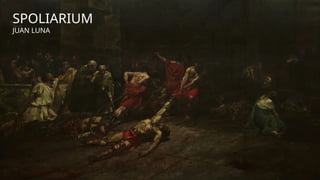
Exposition. Luna’s academic painting Spoliarium won gold
medal. It showed the dead and dying Roman Gladiators being
dragged into the basement of the Coliseum. It is often
interpreted as an allusion to Imperial Spain’s oppression of the
natives. Though winning the gold medal , Luna was not
awarded the Medal of Excellence, the top award for the
competition, because he was a Filipino.
PAINTING
CHRISTIAN ART
SPOLIARIUM
JUAN LUNA
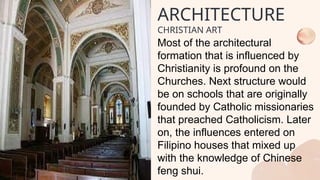
Most of the architectural
formation that is influenced by
Christianity is profound on the
Churches. Next structure would
be on schools that are originally
founded by Catholic missionaries
that preached Catholicism. Later
on, the influences entered on
Filipino houses that mixed up
with the knowledge of Chinese
feng shui.
ARCHITECTURE
CHRISTIAN ART
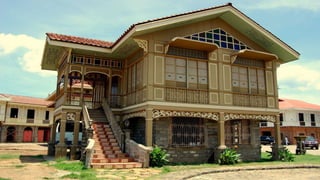
The early houses that were built during the Spanish eras include a place
of worship called the altar. It is also common that these houses contain
statues of different saints, images of Mary, Christ and other religious items.
Rehabilitation and reconstruction confronted the country after World War
II. From this period onto the 70s, Philippine architecture was dominated by
the American style. The independent Philippines expressed its identity
implementing Modernism through the utilization of reinforced concrete,
steel and glass, the predominance of cubic forms, geometric shapes and
Cartesian grids, and the absence of applied decoration.
ARCHITECTURE
CHRISTIAN ART
CONTEMPORARY ART
Contemporary art is the art of the present, which is
continuously in process and in flux. A statement that
an artist makes about life, thoughts, ideas, beliefs,
and many other things that define human life. Art is
the expression of one’s feelings through creating
something out of their imagination. Contemporary art
is art produced at the present period in time.
Contemporary art includes and develops from Postmodern art,
which is itself successor to Modern Art.
With the advent of modernism, many Philippine arts were
developing particularly in the field of sculpture where there is a shift
in sculptural process which led to an almost complete freedom of
materials and process. A wide variety of materials may be worked
by removal such as carving, assembled by welding or modeling, or
molded, or cast. Foremost of which is Solomon Saprid, a modern
Philippine sculptor who became known for his works in bronze
which he created by welding scraps of metal, producing a
characteristic jagged effect.
CONTEMPORARY ART
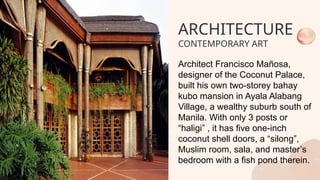
Architect Francisco Mañosa,
designer of the Coconut Palace,
built his own two-storey bahay
kubo mansion in Ayala Alabang
Village, a wealthy suburb south of
Manila. With only 3 posts or
“haligi” , it has five one-inch
coconut shell doors, a “silong”,
Muslim room, sala, and master’s
bedroom with a fish pond therein.
ARCHITECTURE
CONTEMPORARY ART
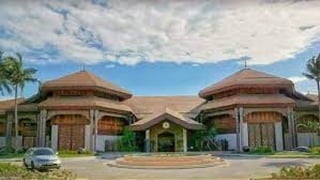
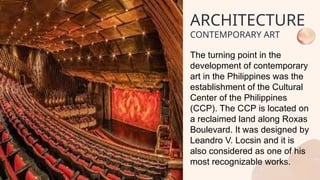
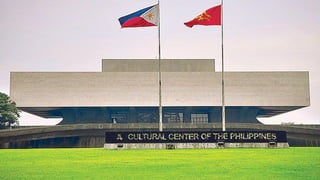
The turning point in the
development of contemporary
art in the Philippines was the
establishment of the Cultural
Center of the Philippines
(CCP). The CCP is located on
a reclaimed land along Roxas
Boulevard. It was designed by
Leandro V. Locsin and it is
also considered as one of his
most recognizable works.
ARCHITECTURE
CONTEMPORARY ART
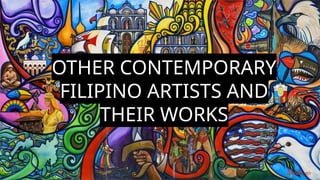
OTHER CONTEMPORARY
FILIPINO ARTISTS AND
THEIR WORKS
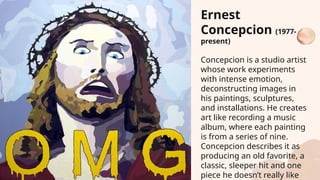
Ernest
Concepcion (1977-
present)
Concepcion is a studio artist
whose work experiments
with intense emotion,
deconstructing images in
his paintings, sculptures,
and installations. He creates
art like recording a music
album, where each painting
is from a series of nine.
Concepcion describes it as
producing an old favorite, a
classic, sleeper hit and one
piece he doesn’t really like
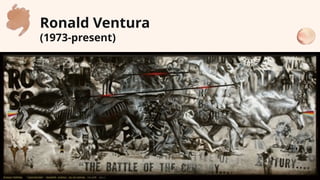
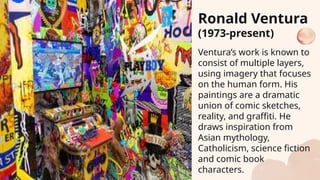
Ronald Ventura
(1973-present)
Ventura’s work is known to
consist of multiple layers,
using imagery that focuses
on the human form. His
paintings are a dramatic
union of comic sketches,
reality, and graffiti. He
draws inspiration from
Asian mythology,
Catholicism, science fiction
and comic book
characters.
Ronald Ventura
(1973-present)
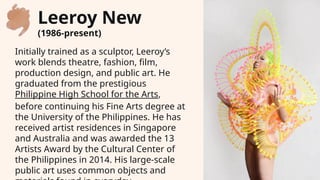
Initially trained as a sculptor, Leeroy’s
work blends theatre, fashion, film,
production design, and public art. He
graduated from the prestigious
Philippine High School for the Arts,
before continuing his Fine Arts degree at
the University of the Philippines. He has
received artist residences in Singapore
and Australia and was awarded the 13
Artists Award by the Cultural Center of
the Philippines in 2014. His large-scale
public art uses common objects and
Leeroy New
(1986-present)
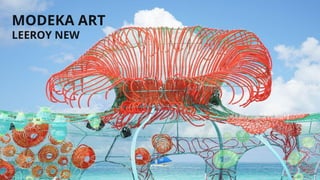
MODEKA ART
LEEROY NEW
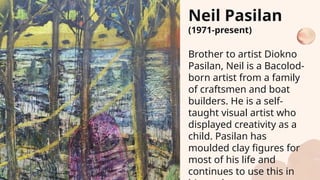
Neil Pasilan
(1971-present)
Brother to artist Diokno
Pasilan, Neil is a Bacolod-
born artist from a family
of craftsmen and boat
builders. He is a self-
taught visual artist who
displayed creativity as a
child. Pasilan has
moulded clay figures for
most of his life and
continues to use this in
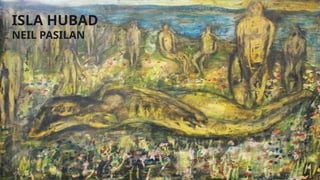
ISLA HUBAD
NEIL PASILAN
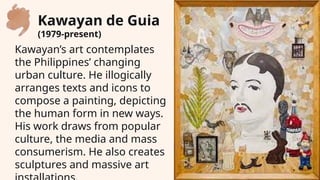
Kawayan’s art contemplates
the Philippines’ changing
urban culture. He illogically
arranges texts and icons to
compose a painting, depicting
the human form in new ways.
His work draws from popular
culture, the media and mass
consumerism. He also creates
sculptures and massive art
Kawayan de Guia
(1979-present)
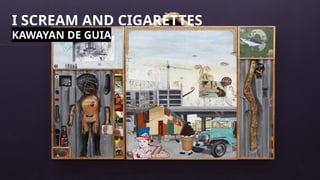
I SCREAM AND CIGARETTES
KAWAYAN DE GUIA
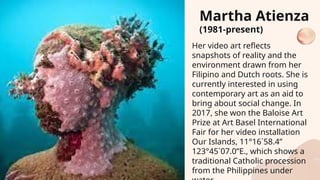
Her video art reflects
snapshots of reality and the
environment drawn from her
Filipino and Dutch roots. She is
currently interested in using
contemporary art as an aid to
bring about social change. In
2017, she won the Baloise Art
Prize at Art Basel International
Fair for her video installation
Our Islands, 11°16`58.4”
123°45`07.0”E., which shows a
traditional Catholic procession
from the Philippines under
Martha Atienza
(1981-present)
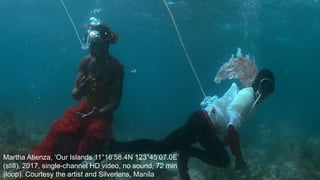
Martha Atienza, ‘Our Islands 11°16’58.4N 123°45’07.0E’
(still), 2017, single-channel HD video, no sound, 72 min
(loop). Courtesy the artist and Silverlens, Manila
ART APPREhttps://www.youtube.com/watch?v=HMT4dUxrD4sCIATION (1).pptx

ART APPREhttps://www.youtube.com/watch?v=HMT4dUxrD4sCIATION (1).pptx

  • 1.
    ART APPRECIATION JHONNY PETTOPASI, LPT,CSE, MAIE
  • 2.
    WHAT IS ART? Vincentvan Gogh, Detail of The Starry Night, Oil on canvas, 1889. Author: Google Art Project, Cropped from original, Source: Wikimedia Commons, License: Public Domain
  • 3.
    Art can be2- dimensional, like paintings, drawings, and prints. Leonardo da Vinci Mona Lisa Between 1503 and 1516 Oil on poplar wood Author: Musée du Louvre, Paris Source: Wikimedia Commons License: Public Domain
  • 4.
    Art can be3- dimensional, like sculptures and ceramics. Charles Rolls (1877–1910) UK Art, 1911
  • 5.
    Art can be4- dimensional, utilizing time as an intrinsic element, such as in performance art, kinetic art, video art, and sound art. Nick Cave Soundsuits at YCBA, Author: Geoff Stearns Source: Flickr, License: CC by 2.0
  • 6.
    We find itin museums and galleries. Louvre Museum, Paris Author: Musée du Louvre Source: Pinterest
  • 7.
    But we find it,also, in the streets. Claes Oldenburg and Coosje van Bruggen, Dropped Ice Cream Cone, Cologne, Germany, 2001. Author: Raimond Spekking Source: Wikimedia Commons License: CC BY-SA 4.0
  • 8.
    Stonehenge, England. c.2900-1500 BCE. Author: Penguin and Pia | German & Canadian Travel Blog Source: Pinterest and in fields,
  • 9.
    and in caves. Hallof Bulls at Lascaux II (replica cave of the original which is closed to the public)
  • 10.
    What images come tomind when you think of an artist? Edvard Munch, The Scream, 1893, Author: National Gallery of Norway, Source: Wikimedia Commons, License: Public Domain
  • 11.
    Many of ourideas about artists come from the modernism of the 20th century, when artists began working more independently, creating works of art that were personal or expressive in nature. Kerry James Marshall, Untitled (Painter), 2009On Exhibit at the Mastry Exhibition
  • 12.
    But at othermoments in history, artists have been considered much more as craftsmen, skilled with their hands. Saint Louis Bible, Cleric and Illuminator. Author: Google Art Project, Source: Wikimedia Commons, License: Public Domain
  • 13.
    What is the purposeof art? The Water Lily Pond, 1899 by Claude Monet
  • 14.
    Art may bea classical masterpiece showing heroic, ideal beauty. Polykleitos, Spear Bearer (Doryphoros) Roman copy after the original bronze of c. 450-440 BCE
  • 15.
    Art may bean object, chosen by an artist, and placed in a new context. Marcel Duchamp, Fountain 1917, replica 1964
  • 16.
  • 17.
    It may beup. It may be down. 3D Chalk Painting On Sreet Hagia Sophia İstanbul, Turkey
  • 18.
    Art expresses the culturein which it is produced. It demonstrates the ways that our ideals of beauty change over time. And art helps define our ideals of beauty within our own time.
  • 19.
    Art helps usto see the world around us. And art expresses our deepest beliefs. Art tells our story. The Book of the Dead of Hunefer, ancient Egyptian, ca. 1275 BC, Ink and paint on papyrusAuthor: British Museum, Source: Wikimedia Commons, License: Public Domain
  • 20.
    And so, nowlet us begin to look and appreciate Artemisia Gentileschi Self-Portrait as the Allegory of Painting (La Pittura) Oil on canvas, 1638-1639 Author: Google Art Project Source: Wikimedia Commons License: Public Domain
  • 22.
    ASSUMPTIONS AND NATUREOF ARTS CREATIVITY & IMAGINATION
  • 23.
    ART IS UNIVERSAL 01 ARTIS NOT NATURE 02 ART INVOLVES EXPERIENCE 03 ASSUMPTIONS OF ART
  • 24.
    ART IS UNIVERSAL Art hasalways been timeless and universal, spanning to generations and continents through and through MISCONCEPTIO N Art is not a factor in determining art.
  • 25.
    ART IS NOT NATURE Artistsare not expected to duplicate nature just as even scientist cannot make nature with their elaborate studies. Art is man’s expression of his perception of nature. Art, not directed by representation of reality, is a perception of reality.
  • 26.
  • 27.
    ART INVOLVES EXPERIENCE All artdepends on experience, and if one knows art, he must know it is not a fact or information, but EXPERIENCE = EMOTIONS
  • 28.
    ❑ It takesan artist to make art. One may perceive beauty on a daily basis. However, not every beautiful thing that can be seen or experienced may truly be called a work of art. ❑ Art is a product of man’s creativity, imagination, and expression. ❑ Not everyone can be considered an artist, but all are spectators of art. ❑ We are able to distinguish what is fine and beautiful from what is not and what good quality is and from poor. ❑ This gives us a role in the field of art appreciation.
  • 29.
  • 30.
    Creativity comes from the Latinterm creō", "to create, make"
  • 31.
    Something is creative when… ⮚We haven’t seen anything like it ⮚ It is out of ordinary ⮚ Original
  • 32.
    Art starts inthe Human mind. It all begins with IMAGINATION
  • 33.
    ART APPRECIATION AS AWAY OF LIFE “The role of art as a creative work is to depict the world in a completely different light and perspective” – Jean-Paul Sartre
  • 34.
    Art Appreciation asa Way of Life ❖ Each artwork beholds beauty in its own kind, the kind that the artist sees and wants the viewers to perceive. ❖ More often than not, people are blind to this beauty and only those who have developed a fine sense of appreciation can experience and see the art the way the artist did. ❖ Hence, refining one’s ability to appreciate arts allows him to deeply understand the purpose of an artwork and recognize the beauty it possesses. ❖ In cultivating an appreciation of art, one should also exercise and develop his taste for things that are fine and beautiful.
  • 35.
    Art Appreciation asa Way of Life ❖ This allows individuals to make intelligent choices and decisions in acquiring necessities and luxuries, knowing what gives better value for time or money while taking into consideration the aesthetic and practical value. ❖ Learning to appreciate art no matter what vocation or profession you have, will lead to a fuller and more meaningful life.
  • 36.
    THE ROLE OF CREATIVITYIN ART MAKING Creativity requires thinking outside the box. In art, creativity is what sets apart one artwork from another.
  • 37.
    When can wesay that something is creative? ✔ When we have not seen anything like it ✔ When it is out of the ordinary ✔ When it is not just a copy or imitation of someone’s work ORIGINALITY
  • 38.
    Nowadays, being creativecan be quite challenging. Creativity should be backed with careful research on related art to avoid conflicts.…
  • 39.
    “Imagination is moreimportant than knowledge. For knowledge is limited to all we now know and understand, while imagination embraces the entire world, and all there ever will be to know and understand.” – Albert Einstein ART AS A PRODUCT OF IMAGINATION, IMAGINATION AS A PRODUCT OF ART
  • 40.
    ❖ Imagination isnot constrained by the walls of the norm, but goes beyond that. ❖ Through imagination, one is able to craft something bold, something new, and something better in the hopes of creating something that will stimulate change. ❖ In artist’s mind sits a vast gallery of artworks ❖ An artwork does not need to be a real thing, but can be something that is imaginary. ❖ However, something imaginary does not necessarily mean it cannot be called art. Artists use their imagination that gives birth to reality through creation. ❖ Imagination allows endless possibilities. ❖ In the same way that imagination produces art, art also inspires imagination.
  • 41.
    “What an artistdoes to an emotion is not to induce it, but express it. Through expression, he is able to explore his own emotions and at the same time, create something beautiful out of them.” – Robin George Collingwood ART AS EXPRESSION
  • 42.
    ❖ Expressing emotionsis different from describing emotions. ❖ This makes people’s art not a reflection of what is outside or external to them, ❖ but a reflection of their inner selves. ❖ Description actually destroys the idea of expression, as it classifies the ❖ emotion, making it ordinary and predictable. Expression on the other hand, ❖ individualizes. ❖ An emotion will remain unknown to a man until he expresses it. ART AS EXPRESSION
  • 43.
  • 44.
    VISUAL ARTS ❑ Creations thatfall under this category are those that appeals to the sense of sight and are mainly visual in nature. ❑ Artists produce visual arts driven by their desire to reproduce things that they have seen in the way that they perceived them.
  • 45.
    ❑ There arealso other artistic disciplines that also involve a visual aspect, such as performance arts, theater, and applied arts. ❑ Some mediums of visual arts include paintings, drawings, letterings, printing, sculpture, digital imaging. VISUAL ARTS
  • 46.
    ❑ Film refersto the art of putting together successions of still images in order to create an illusion of movement. ❑ Filmmaking focuses on its aesthetic, cultural, and social value and is considered both an art and an industry. FILM
  • 47.
    ❑ Techniques infilm-making process: – Motion-picture camera (also known as movie camera) – Animation techniques – Computer-generated imagery (CGI) ❑ Filmmaking simulates experiences or creates one that is beyond the scope of our imagination as it aims to deliver ideas, feelings, or beauty to its viewers. FILM
  • 48.
    PERFORMANCE ART  Performanceart is a live art and the artist’s medium is mainly the human body which he or she uses to perform, but also employs other kind of art such as visual art, props, or sound.  Elements of performance arts: o Time o Where the performance took place o The performer’s body o Relationship between the audience and the performer(s)  The fact that performance art is live makes it intangible, which means it cannot be bought or traded as a commodity
  • 49.
    Poetry is anart form where the artist expresses his emotions not by using paint, charcoal, or camera, but expresses them through words. POETRY PERFORMANCE
  • 50.
    ❑ These wordsare carefully selected to exhibit clarity and beauty and to stimulate strong emotions of joy, anger, love, and sorrow among others. ❑ It uses a word’s emotional, musical, and spatial values that go beyond its literal meaning to narrate emphasize, argue, or convince. ❑ These words combined with movements, tone, volume, and intensity of the delivery add to the artistic, value of the poem.
  • 51.
    ARCHITECTURE ❑ Art isthe pursuit and creation of beautiful things while architecture is the making of beautiful buildings. ❑ However, not all building are beautiful because some only embody the functionality they need, but the structure, lines, forms, and colors are not beautifully expressed.
  • 52.
    ❑ Important elements: oPlan o Construction o Design ❑ Buildings should embody these three important elements if they wish to merit the title architecture. ARCHITECTURE
  • 53.
    Dance is seriesof movements that follows the rhythm of the music accompaniment. Dancing is a creative art form that allows people to freely express themselves. IT HAS NO RULES. DANCE
  • 54.
    Choreography may seem notto allow this, but in art expression, dancers are not confined to set steps and rules but are free to create and invent their own movements as longs as they deem them graceful and beautiful. DANCE
  • 55.
    ❑ Artists whopractice literary arts use words to express themselves and communicate emotions to the readers. ❑ Simply becoming a writer does not make one a literary artist. ❑ Literary art goes beyond the usual professional, academic, journalistic and other technical forms of writing. LITERARY ART
  • 56.
    ❑ It focuseson writing using a unique style, not following a specific format or norm. ❑ It may include both fiction and non-fiction such as novels, biographies, and poems. o Romeo and Juliet – William Shakespeare o The Little Prince – Antoine de Saint-Exupery LITERARY ART
  • 57.
    Theater uses liveperformers to present accounts or imaginary events before a live audience. Theater art performance usually follows follow a script, though they should not be confused with literary arts. THEATER
  • 58.
    Like in filmmaking,theater also considers several elements such as acting, gesture, lighting, sound effects, musical score, scenery and props. Like performance art, theater also is a live performance. Genres: drama, musical, tragedy, comedy and improvisation. THEATER
  • 59.
  • 60.
    ❑ Applied artsis incorporating elements of style and design to everyday items ❑ with the aim of increasing their aesthetic value. ❑ Artists in this field bring beauty, charm, and comfort into many things that ❑ were useful in everyday life. ❑ Industrial design, interior design, fashion design, graphic design APPLIED ARTS
  • 61.
  • 62.
    Aristotelian “telos” • Everyparticular substance in the world has an end, or telos in Greek, which translates into “purpose”. • Telos is intricately linked with function: For a thing to reach its purpose, it also has to fulfill its function. • The telos and function of a thing are both related to a thing’s identity. What makes a human being a human being is his capacity for thinking. • The telos, the function and the “whatness” of a thing are all interconnected.
  • 63.
    FUNCTIONS OF ART Whenone speaks of function, one is practically talking about the use of the object whose function is in question. An inquiry on the function of art is an inquiry on what art is for.
  • 64.
    What is theRizal monument for? Why was it erected in Rizal Park or what then was called Luneta or Bagumbayan? Is it for pure sentimental value? Is it for aesthetic value? Or does it send a message to those who witness it?
  • 65.
    When it comesto function, different art forms come with distinctive functions. There is no one-to-one correspondence between an art and its function. Some art forms are more functional than others. The Taj Mahal, a massive mausoleum of white marble built in Agra was constructed in memory of the favorite wife of the emperor, Shah Jahan. On the other hand, jewelry-making as an art is known by its product They are considered to be arts where the value of the art in question lies in the practical benefits one gains from it.
  • 66.
    What about thepractical function of painting and literature? ▪Even if painting and literature are not focusing on the practical benefits, it can never be the case that they do not have any function. ▪Noli Me Tangere and El Filibusterismo ▪They go beyond their literary worth. They are functional “in so far as they are designed to accomplish some definite end” (Dudley et al. 1960)
  • 67.
    Art can begenerally classified into two: Directly Functional and Indirectly Functional. ▪a) Directly Functional Art – Art that we use in a daily basis and serves a literal or tangible function in our lives. (e.g. Clothes, Architectural and Engineering, Structures, Money, Furniture) ▪b) Indirectly Functional Art – Art that are ‘perceived through the senses.” Not used literally to live but accompanies life (e.g. Painting, Theatre, Literature)
  • 68.
    • Both DirectlyFunctional and Indirectly Functional Arts tend to cross each other’s paths and change roles or even fuse purposes. • Some Directly Functional Art have a sole purpose which is for functionality, but the designs incorporated made the decorative art transcend from its basic form to a highly artistic form of art.
  • 69.
    Artistic Functions canbe classified into 4: 1. Aesthetic 3. Social 2. Utilitarian 4. Cultural
  • 70.
    1. Aesthetic Function ▪An artwork functions aesthetically when it becomes an instrument for mankind to be cognizant of its beauty where feelings of joy and appreciation are manifested. 2. Utilitarian Function ▪ Art serves this function when it is used to give comfort, convenience, and happiness to human beings. It served basic functions such as clothing, food, and shelter, and other things that make humans live with happiness and ease.
  • 71.
    3. Social Function ▪Art serves this purpose when it bridges connection among people. Also when it encourages unity and good relationship among people. With this, people become more understanding and could somehow create a better society 4. Cultural Function ▪ Art serves as an aperture towards skills, knowledge, attitudes, customs, and traditions of different people. The art helps preserve, share and transmit culture of people from one generation to another
  • 72.
  • 73.
    1. Personal functions ofart ▪ The personal functions of art are varied and highly subjective. ▪ An artist may create an art out of the need for self-expression. ▪ It can also be mere entertainment for his intended audience. ▪ An art may also be therapeutic.
  • 74.
    2. Social functions ofart ▪ Art is considered to have a social function if and when it addresses a particular collective interest as opposed to a personal interest. ▪ Art may convey message of protest, contestation, or whatever message the artist intends his work to carry. ▪ Art can also depict social conditions. ▪ Pictures of poverty; performance art like plays or satires.
  • 75.
    3. Physical functions ofart ▪ The physical functions of art are the easiest to spot and understand. ▪ They are crafted in order to serve some physical purpose. ▪ Architecture, jewelry-making and even interior design are all forms of arts that have physical function.
  • 76.
    Other functions of art ▪Music in its original form was principally functional because it was used for dance and religion. The ancient world saw music only as an instrument to facilitate worship and invocation to gods. ▪ Today, music has expanded its function and coverage. It can be used for self-expression. It is also used as a wonderful accompaniment to stage plays and motion pictures. ▪ Music can mean a multitude of meanings to different people.
  • 77.
    ▪ Like music,sculptures have been made by man most particularly for religion from the early days of humanity. ▪ The employment of sculptures for religious purposes has remained vital, relevant and symbolic. ▪ Sculptures were also made in order to commemorate important figures in history. In the University of the Philippines, the iconic statue Oblation by Guillermo E. Tolentino has remained a pillar of the university and a constant reminder of the need to offer oneself up selflessly for the country. Other functions of art
  • 78.
    ▪ Coins arealso manifestations of sculpting’s functions. ⮚ They feature a relief of a famous hero or personality. ▪ Architecture might be the most prominent functional art form because buildings are huge, expensive and are not easily constructed and replaced. ⮚ Connection between Function and Form: consideration of the natural conditions and the social conditions. ⮚ Spanish colonial houses in the Philippine Other functions of art
  • 79.
    Does art alwayshave to be functional? • While it has been shown that most arts are functional, still there are some which are not. The value of a work of art does not depend on function but the work itself. • Meanwhile, those whose functions are ascertained have a different story. A functional object cannot be claimed to be beautiful unless it can perform its function sufficiently. • Art demands so much more than mere efficiency. Efficiency cannot be mistaken as beauty
  • 80.
  • 81.
    1. Art asan imitation • Plato’s The Republic • It paints a picture of artists as imitators and art as mere imitation. In order for the state to be ideal, Plato advised against the inclusion of art as a subject in the curriculum and the banning of artists in the Republic. • He was convinced that artists merely reinforce the belief in copies and discourage men to reach for the real entities in the World of Forms.
  • 82.
    1. Art asan imitation Plato was deeply suspicious of arts and artists for two reasons: 1. They appeal to the emotion rather to the rational faculty of men 2. They imitate rather than lead one to reality ► Poetry rouses emotions and feelings and thus, clouds rationality of people. • Art is just an imitation of imitation. A painting is just an imitation of nature, which is also just an imitation of reality in the World of Forms. ► For Plato, art is dangerous because it provides a petty replacement for the real entities than can only be attained through reason.
  • 83.
    In his theoryif Mimesis, Plato says that all Art is mimetic by nature; art is an imitation of life. He believed that ‘idea’ is the ultimate reality. Art imitates idea and so it is imitation of reality. Plato’s Theory of Mimesis
  • 84.
    2. Art asa representation • Aristotle: Art is a form of imitation but it is considered as an aid to philosophy in revealing the truth. • The kind of imitation that art does is not antithetical to the reaching of fundamental truths in the world. • What art endeavors to do is to provide a vision of what might be or the myriad possibilities in reality. • Purposes of Art: (1) art allows for the experience of pleasure for the experience of pleasure (horrible experience can be made an object of humor) (2) art also has an ability to be instructive and teach its audience things about life. (cognitive)
  • 85.
    All the Artshave their own techniques and rational principles, and it is through mastery of these that the artist/ craftsman brings his conceptions to life. Yes, the arts of copy nature but their representations are fuller and more meaningful than nature gives us in the raw. That is their strength. We do not therefore need to insist on some moral purpose for art, which is thus free to represent all manner of things present, past, imagined or institutionally-required. Aristotle’s Theory of Representations
  • 86.
    3. Art asa disinterested judgment • Immanuel Kant considered the judgment of beauty, the cornerstone of art, as something that can be universal despite its subjectivity. • He recognized that judgment of beauty is subjective but he advanced the proposition that even subjective judgments are based on some universal criterion for the said judgment. • Every human being, after perception and the free play of his faculties, should recognize the beauty that is inherent in a work of art.
  • 87.
    How and inwhat sense can a judgment of beauty, which ordinarily is considered to be a subjective feeling, be considered objective or universal? HOW ARE THESE TWO STATEMENTS DIFFERENT? 1. “I like this painting.” 2. “This painting is beautiful.” • The first is clearly a judgment of taste (subjective), while the second is an aesthetic judgment (objective). • Making an aesthetic judgment requires us to be disinterested. In other words, we should try to go beyond our individual tastes and preferences so that we can appreciate art from a universal standpoint. 3. Art as a disinterested judgment
  • 88.
    • Kant arguedthe purpose of art is to be ‘purposeless’. It should not have justify any reason of existing and being valued other than the fact that it is art. Our experience of art -the ways we appreciate and criticize work – is therefore wholly commanded by aesthetic pleasure and delight, separate to the rest of the world. • Practically speaking, it usually meant that art should avoid social, political, and moral themes and concentrate instead on creating beauty, so it really meant “art for the sake of beauty and its elevating effects. Kant’s “L’Art por L’Art (Art for Art’s Sake)
  • 89.
    4. Art asa communication of emotion • According to Leo Tolstoy, art plays a huge role in communication to its audience’s emotions that the artist previously experienced. In the same that language communicates information to other people, art communicates emotions. • Leo Tolstoy defended the production of the sometimes truly extravagant art, like operas, despite extremely poverty in the world. • Art serves as a language, a communication device that articulates feelings and emotions that are otherwise unavailable to the audience. • As a purveyor of man’s innermost feelings and thoughts, art is given a unique opportunity to serve as a mechanism for social unity. • Art serves as a mechanism of cohesion for everyone. • Art is central to man’s existence because it makes accessible feelings and emotions of people from the past and present.
  • 90.
    • “ Theceremony of art touches the deepest realms of he psyche and he sacred dimension of the artistic creative process. The sacred level of art not only transforms something into art, but also transforms the artist at the very core of his or her being. This way of doing and relating to art makes the process and context of art-making infinitely more important than the product.” • It’s an escape from the hustle and bustle of a long active day of work and meetings. It’s an escape from the chaos that our uncertain thoughts cause within us. It’s an escape our unrelating running footsteps that we focus on more intensely than reminding ourselves to take magical depths of deep breaths. Art as an escape
  • 91.
    ARTISTIC INTEGRITY Never settlefor anything but your absolute best effort – an effort that may be exhausting and frustrating but that will ultimately serve you in good stead as an artist and as a human being
  • 92.
    CONSONANCE and DISSONANCE The impressionof stability and repose (consonance) in relation to the impression of tension or clash (dissonance) experienced by a listener when certain combinations of tones or notes are sounded together
  • 93.
    SCALE and PROPORTION •Scale refers to the size of an object (as a whole in relationship to another object (as another whole). In art the size relationship between an object and the human body is significant. • Proportion refers to the relative size of parts of a whole (elements within an object). We often think of proportions in terms of size relationships within the human body.
  • 94.
    CLARITY and RADIANCE •A clear design values clarity over novelty. (Clear instead of clever.) Novel for novel’s sake is for designers who create solutions for themselves. Solutions that don’t value goals or problems. • Radiance is a type of glowing: either from a light source like the sun or a healthy, beaming person.
  • 95.
    THE REPRESENTIONAL THEORY • Statesthat the fundamental, definitive quality of art is the ability to capture some aspect of reality.
  • 96.
  • 97.
    • The Subjectof art refers to any person, object, scene or event described or represented in a work of art. • Representational (e.g. Paintings, Sculptures, etc.) • Non-Representational (e.g. Architectural Structures) • Many contemporary painters have turned away from representational to non-objective painting. They have shifted their attention to the work of art as an object in itself, an exciting combination of shapes and colors that fulfills an aesthetic need without having to represent images or tell a story. • Many modern paintings are like this making them more difficult to comprehend
  • 98.
  • 99.
    REALISM/ NATURALISM Generally theattempt to represent subject matter truthfully, without artificiality and avoiding artistic conventions, or implausible, exotic, and supernatural elements.
  • 100.
    ABSTRACTION • The artistselects and renders the objects with their shapes, colors and positions altered. • In others, the original objects have been reduced to simple geometric shapes and they can be rarely identified unless the artist named in in title. • Artist’s concern is the rendering of the essence of the subjects rather than the natural form
  • 101.
    DISTORTION • Could meantwisting, stretching or deforming the natural shape of the object. • It is usually done to dramatize the shape of a figure or to create an emotional effect.
  • 102.
    SURREALISM • It isa method where the artist in giving expression to what it is in the subconscious composes dreamlike scenes that show an irrational arrangement of objects. • The images are recognizable, sometimes drawn from the nature but they are so combined in utterly fantastic
  • 103.
  • 104.
    • Nature • Animals •Portrait or Human Figures • History and Legends • KINDS & SOURCES OF SUBJECTS • Religion and Mythology • Dreams and Fantasies • Cityscapes • Seascapes
  • 105.
    ART and BEAUTY • “Beautyis in the Phi of the Beholder.” • Dr. Stephen Marquardt has studies human beauty for years in his practice of oral and maxillofacial surgery. Dr. Marquardt performed cross-cultural surveys on beauty and found that all groups had the same perceptions of facial beauty. • 1.618:1 • This particular relationship is the Golden Ratio. It is a mathematical ratio that seems to appear recurrently in beautiful things in nature as well as in other things that are
  • 106.
    THE UGLY ANDTHE TRAGIC IN ART • There is nothing that may be considered as in improper subject when it comes to art. • The grotesque the ugly, and the tragic are all legitimate subjects as the pleasurable and the beautiful are. • Many, in fact, have often deviated away from the stereotyped and beautiful subjects. • The greatest play, movies, and musicals are invariably tragedies. • And many our songs speak about love denied or lost.
  • 107.
  • 108.
    Factual Meaning The literal statement orthe narrative content in the work which can be directly apprehended because the objects presented are easily recognized. Conventiona l Meaning Refers to the special meaning that a certain object or color has a particular culture or group of people.
  • 109.
    Subjective Meaning Any personal meaningconsciously or unconsciously conveyed by the artist using a private symbolism which stems from his own association of certain objects, actions or colors with past experiences
  • 110.
  • 111.
  • 112.
    ARTIST VS. ARTISAN -ANARTIST IS A PERSON WHO PERFORMS ALL FORMS OF CREATIVE ARTS. THE WORD " ARTIST" IS GENERALLY DEFINED AS AN ART PRACTITIONER, SUCH AS A PAINTER, SCULPTOR, CHOREOGRAPHER, DANCER, WRITER, POET, MUSICIANS, AND THE LIKE, WHO PRODUCES OR CREATES INDIRECTLY FUNCTIONAL ARTS WITH AESTHETIC VALUE USING IMAGINATION. -AN ARTIST IS A CRAFTSMAN SUCH AS CARPENTER, CARVER. PLUMBER, BLACKSMITH, WEAVER. EMBROIDERER,AND THE LIKE WHO PRODUCES DIRECTLY FUNCTIONAL AND/OR DECORATIVE ARTS -HELP US IN MEETING OUR BASIC NEEDS, SUCH AS FOOD, SHELTER, CLOTHING, DWELLING, FURNITURE; THEY CRAFT EVERYTHING THAT MAKES OUR LIFE EASIER
  • 113.
    ARTIST VS. ARTISAN -ARECREATIVE INDIVIDUALS WHO USE THEIR IMAGINATION AND SKILLS TO COMMUNICATE IN AN ART FORM. -LOOK TO MANY SOURCES FOR INSPIRATION -EXHIBIT THE COURAGE TO TAKE RISK -THEY ARE ABLE TO SEE THEIR SURROUNDINGS IN NEW AND UNUSUAL WAYS. -SOME ARTISTS AE SELF-TAUGHT AD HE BEEN CALLED FOLK -ARTIST BECAUSE THEY ARE NOT EDUCATED IN TRADITIONAL ARTISTIC METHODS -IS BASICALLY A PHYSICAL WORKER WHO OBJECTS WITH HIS OR HER HANDS, AND WHO THROUGH SKILL, EXPERIENCE, AND ABILITY CAN PRODUCE THINGS OF GREAT BEAUTY, AS WELL AS USEFULLNESS.
  • 114.
  • 115.
    CURATOR - CURATOR, WHOIS A MANAGER OR OVERSEER, AND USUALLY A CURATOR OR KEEPER OF CULTURAL HERITAGE INSTITUTION IS A CONTENT SPECIALIST CHARGED WITH AN INSTITUTIONS COLLECTIONS -TOBE SUCCESSFUL, A CURATOR SHOULD BE ORGANIZED, PASSIONATE, KNOWLEDGEABLE, ADEPT AT MULTI-TASKING, AND PROFICIENT AT WRITING
  • 116.
    ART BUYER - ISA PROFESSIONAL WHO IS KNOWLEDGEABLE IN ART WHO MAY SCOUT TALENTS FOR AN ADVERTISING AGENCY SEEKING TO EMPLOY AN ART DIRECTOR, WHO MAY LOOK FOR AN ART FOR A COLLECTOR OR A COMPANY ART DEALER - A PERSON OR A COMPANY THAT BUYS AND SELLS WORKS OF ART. IT OFTEN STUDY THE HISTORY OF ART BEFORE STARTING THEIR CAREER.
  • 117.
    3 STAGES INART MAKING 1. PRE- PRODUCTION OR SUBJECT DEVELOPMENT 2. PRODUCTION OR MEDIUM MANIPULATION 3. POST PRODUCTION (COMPLETION) OR EXHIBITION - THIS ENDS WHEN THE PLANNING ENDS, AND THE CONTENT STARTS BEING PRODUCED - A METHOD OF JOINING DIVERSE MATERIAL INPUTS AND UNIMPORTANT INPUTS -ACT OF CREATING OUTPUT, A GOOD OR SERVICE THAT HAS SIGNIFICANCE AND CONTRIBUTES TO THE UTILITY OF INDIVIDUALS. - ONCE AN ARTWORK IS FINISHED, IT WILL BE DISPLAYED CIRCULATED, AND PERFORMED FOR THE AUDIENCE AND PUBLIC TO SEE OR WATCH
  • 118.
    MEDIUM VS TECHNIQUE -REFERS TO THE MATERIALS THAT ARE USED BY AN ARTIST TO CREATE A WORK OF AR. THE PLURAL FOR OF MEDIUM IS MEDIA. WITHOUT THE MEDIUM, AN IDEA REMAINS A CONCEPT OR IT WOULD JUST DWELL IN THE WALLS OF THE ARTISTS IMAGINATION. - REFERS TO THE ARTISTS ABILITY AND KNOWLEDGE OR TECHNICAL KNOW-HOW IN MANIPULATING THE MEDIUM. IT IS THE MANNER BY WHICH THE ARTIST CONTROL THE MEDIUM TO ACHIEVE THE DESIRED EFFECTS;THUS, IT IS IN THE TECHNIQUE THAT ARTIST DIFFER FROM ONE ANOTHER.
  • 119.
  • 120.
    - THE VISUALART TERMS SEPARATE INTO THE ELEMENTS AND PRINCIPLES OF ART. THE ELEMENTS OF ART ARE COLOR, FORM, LINE, SHAPE, SPACE AND TEXTURE. THE PRINCIPLES OF ARTS ARE SCALE, PROPORTION UNITY, VARIETY,RHYTHM, MASS, SHAPE SPACE BALANCE, VOLUME, PERSPECTIVE AND DEPTH.
  • 121.
    ELEMENTS OF ARTS COLOR -COLOR IS THE VISUAL PERCEPTION SEEN BY THE HUMAN EYE.THIS CONVEYS FEELINGS AND MOODS WITHIN THE PAINTING OR ANY ARTS. COLOR CONTAINS CHARACTERISTICES LIKE HUE, VALUE AND SATURATION. FORM - GIVES SHAPE TO A PIECE OF ART, WHETHER IT IS THE CONSTRAINTS OF A LINE IN A PAINTING OR THE EDGE OF THE SCULPTURE. IT IS ALSO THE EXPRESSION OF ALL THE FORMAL ELEMENTS OF ART IN A PIECE OF WORK
  • 122.
    ELEMENTS OF ARTS LINE -PRIMARILY A DOT OR SERIES OF DOTS. THE DOTS FORM A LINE, WHICH CAN VARY IN THICKNESS COLOR AND SHAPE. A LINE IS A TWO DIMENSIONAL SHAPE UNLESS THE ERTIST GIVES IT VOLUME OR MASS. MULTIPLE LINES DEVELOPS INTO A DRAWING MORE RECOGNIZABLE THAN A LINE CREATING A FORM RESEMBLING THE OUTSIDE OF IT'S SHAPE. SHAPE - DEFINES AS HAVING SOME SORT OF OUTLINE OR BOUNDARY, WHETHER THE SHAPE IS TWO OR THREE DIMENSIONAL. THE SHAPE CAN BE GEOMETRIC (KNOWN SHAPE) OR ORGANIC (FREE FORM SHAPE)
  • 123.
    ELEMENTS OF ARTS SPACE TEXTURE -CAN BE ROUGH OR SMOOTH TO THE TOUCH, IMITATING A PARTICULAR FEEL OR SENSATION. THE TEXTURE IS ALSO HOW YOUR EYE PERCEIVES A SURFACE, WHETHER IT IS FLAT WITH LITTLE TEXTURE OR DISPLAYS VARIATIONS ON THE SURFACE, IMITATING ROCK, WOOD, STONEZ FABRIC. - IS THE AREA AROUND THE FOCAL POINT OF THE ART PIECE AND MIGHT BE POSITIVE OR NEGATIVE, SHALLOW OR DEEP, OPEN. OR CLOSED. SPACE IS THE AREA AROUND THE ART FORM; IN THE CASE OF A BUILDING, IT IS THE AREA BEHIND, OVER. INSIDE, OR NEXT TO THE STRUCTURE
  • 124.
    PRINCIPLES OF ARTS BALANCE CONTRAST -DEFINED AS THE DIFFERENCE IN COLORS TO CREATE A PIECE OF VISUAL ART. CAN ALSO BE SUBTLE WHEN USING MONOCHROMATIC COLORS, GIVING VARIETY AND UNITY THE FINAL PIECE OF ART. - REFERS TO THE DISTRIBUTION OF WEIGHT IN THE APPARENT WEIGHT OF THE PIECE. ARCHES ARE BUILT FOR STRUCTURAL DESIGN AND TO HOLD THE ROOF IN PLACE, ALLOWING FOR PASSAGE OF PEOPLE BELOW THE ARCH AND CREATING BALANCE VISUALLY AND STRUCTURALLY.
  • 125.
    PRINCIPLES OF ARTS EMPHASIS RHYTHM/MOVEMENT - RHYTHM IN A PIECE OF ART DENOTES A TYPE OF REPETITION USED TO EITHER DEMONSTRATE MOVEMENT OR EXPANSE. FOR INSTANCE, IN A PAINTING OF WAVES CRASHING, A VIEWER WILL AUTOMATICALLY SEE THE MOVEMENT AS THE WAVE FINISHES. THE USE OF BOLD AND DIRECTIONAL BRUSHWORK WILL ALSO PROVIDE MOVEMENT IN A PAINTING. - CAN BE COLOR, UNITY, BALANCE, OR ANY OTHER PRINCIPLE OR ELEMENT OF ART USED TO CREATE A FOCAL POINT.
  • 126.
    PRINCIPLES OF ARTS PROPORTION/SCALE -PROPORTION IS THE RELATIONSHIP BETWEEN ITEMS IN A PAINTING, FOR EXAMPLE, BETWEEN THE SKY AND MOUNTAINS. IF THE SKY IS MORE THAN TWO-THIRDS OF THE PAINTING, IT LOOKS OUT OF PROPORTION. THE SCALE IN ART IS SIMILAR TO PROPORTION, AND IF SOMETHING IS NOT TO SCALE, IT CAN LOOK ODD. IF THERE IS A PERSON IN THE PICTURE AND THEIR HANDS ARE TOO LARGE FOR THEIR BODY, THEN IT WILL LOOK OUT OF SCALE. ARTISTS CAN ALSO USE SCALE AND PROPORTION TO EXAGGERATE PEOPLE OR LANDSCAPES TO THEIR ADVANTAGE
  • 127.
    PRINCIPLES OF ARTS UNITYAND VARIETY - IN ART, UNITY CONVEYS A SENSE OF COMPLETENESS, PLEASURE WHEN VIEWING THE ART, AND COHESIVENESS TO THE ART, AND HOW THE PATTERNS WORK TOGETHER BRINGS UNITY TO THE PICTURE OR OBJECT. AS THE OPPOSITE OF UNITY, VARIETY SHOULD PROVOKE CHANGES AND AWARENESS IN THE ART PIECE. COLORS CAN PROVIDE UNITY WHEN THEY ARE IN THE SAME COLOR GROUPS, AND A SPLASH OF RED CAN PROVIDE VARIETY.
  • 128.
    PRINCIPLES OF ARTS PATTERN -PATTERN IS THE WAY SOMETHING IS ORGANIZED AND REPEATED IN ITS SHAPE OR FORM AND CAN FLOW WITHOUT MUCH STRUCTURE IN SOME RANDOM REPETITION. PATTERNS MIGHT BRANCH OUT SIMILAR TO FLOWERS ON A PLANT OR FORM SPIRALS AND CIRCLES AS A GROUP OF SOAP BUBBLES OR SEEM IRREGULAR IN THE CRACKED, DRY MUD. ALL WORKS OF ART HAVE SOME SORT OF PATTERN EVEN THOUGH IT MAY BE HARD TO DISCERN; THE PATTERN WILL FORM BY THE COLORS, THE ILLUSTRATIONS, THE SHAPE, OR NUMEROUS OTHER ART METHODS.
  • 129.
  • 130.
    CAVE ART, EGYPTIANAND GREEK CAVE ART – The art of paleolithic humans represented by drawings and painting on the walls of cave.
  • 131.
    CAVE ART, EGYPTIANAND GREEK EGYPTIAN – Egyptian art has order and continuity. Death and afterlife were common themes. The purpose of this art is religious and to impose order. • Art produce in Egypt includes paintings, sculptures, drawing on papyrus, faience, jewelry, ivories, architecture and other art media.
  • 132.
    CAVE ART, EGYPTIANAND GREEK GREEK - Includes idealized depictions of the human body, in which largely nude male figures were generally the focus of innovation and also the Architecture and buildings.
  • 133.
    ROMAN & MEDIAVAL •ROMAN – Roman art refers to the visual arts made in Ancient Rome and in the territories of the roman empire. Roman art includes architecture, painting, sculpture and mosaic work.
  • 134.
    ROMAN & MEDIAVAL MEDIAVAL– MEDIEVAL ART — Which includes A wide variety of art and architecture—refers to A period also known as the middle ages, which roughly spanned from the fall of the roman empire in 476 A.D. To the early stages of the renaissance in the 14th century. Work produced during this era emerged from the artistic heritage of the roman empire and the iconographic style of the Early Christian Church, fused with the “barbarian” culture of Northern Europe.
  • 135.
    CHINESE PRINTING AND JAPANESEPRINT CHINESE PRINTING – The process of printing starts in China. Because of this process a variety of items like calendars and religious texts are produced. Chinese woodblock were first used to print designs in silk or cloth. Then the creation of paper came. Paper was made by creating a mix of bark and rags that would float on water. Before the invention of printing everything had to be written by hand. This took a long time and meant that books and other written materials were very rare and expensive. Around 220 ad the Chinese began printing pictures on silk and other fabrics. Then around 650 ad they began printing on paper using wooden blocks. However, woodblock prints were not regarded as an art form of its own. They were rather meant as a means to make a precise reproduction of existing paintings.
  • 136.
    CHINESE PRINTING AND JAPANESEPRINT JAPANESE PRINTING – is a technique best known for its use in the ukiyo-e Artistic genre of single sheets, but it was also used for printing books in the same period. The Japanese water-based inks provide a wide range of Vivid colors, glazes, and transparency. WOODLOCK PRINTING – A technique for printing text, images or patterns used widely throughout East Asia and originating in China in antiquity as a method of printing on textiles and later paper.
  • 137.
  • 138.
    RENNAISSEAN AND MANNERISM, BAROQUEAND ROCOCO • RENAISSANCE – Move away from purely spiritual concerns to more human and classical. • MANNERISM – Mannerism is a style that emerged in 1530 and lasted until the end of the century. It is named after Maniera, an Italian term for “style” or “Manner,” and refers to a stylized, exaggerated approach to painting and sculpture. • BAROQUE – Response to reformation more theatrical and dramatic scenes and depictions to attract commoners. • ROCOCO – Appealed to wealthy class or nobility.
  • 139.
  • 140.
    NEO-CLASSICISM AND ROMANTIC ANDREALISM • NEO-CLASSICISM – as a western cultural movement in the decorative and visual arts, literature, theatre, music, and architecture that drew inspiration from the art and culture of classical antiquity. • It is a revivalist aesthetic movement, meaning that it rehashes or Reconstructs the visual patterns and styles of a bygone era. In neoclassicism these are characterized by nude or semi-nude figures in melodramatic poses • And scenes with draperies, references to ancient Greco-Roman polytheism and Mythology, references to Greco-Roman sculpture and architecture, and lots of ornate floral and botanical motifs.
  • 141.
    NEO-CLASSICISM AND ROMANTIC ANDREALISM ROMANTICISM – embraced emotion, exotic, “aesthetic experience”, “The Sublime”, originality and imagination REALISM – describe things represent figures and exactly how they look like in real life. - The artists portrays the subject as ease. - The artist portrays subjects coming from nature, with the exact replica of what the objects are.
  • 142.
    IMPRESSIONISM AND POST- IMPRESSIONISM •IMPRESSIONISM – the artist depicts what stimulates the eye. They are more concerned with the effects of lights that would get the attention of the audience. • POST-IMPRESSIONISM – It is characterized by a subjective approach to painting, as artists opted to evoke emotion rather than realism in their work.
  • 143.
    NEO-IMPRESSIONISM NEO-IMPRESSIONISM – refersto a pictorial technique where color pigments are no longer mixed either on the palette or directly on canvas, but instead placed as small dots side by side.
  • 144.
    SYMBOLISM AND ART NAVEAU •SYMBOLISM – the visible sign of something invisible such as ideas or quality. - symbolism possesses some difficulty at understanding. • ART NOUVEAU – is characterized by its use of a long sinuous, organic line and was employed most often in architecture, interior design, jewelry and glass design, posters and illustrations.
  • 145.
    FAUVISM AND EMPRESSIONISM FAUVISM –it employs colors to express the emotions of the artist. - the artist uses bright and extreme colors in order to assume positive characters. EXPRESSIONISM – artistic style in which the artist tried to describe not the objective reality but the subjective emotions objects and events that are out of him.
  • 146.
    CUBISM AND FUTURISM •CUBISM – artists used geometric figures like cones, sphere and cylinders. - it shows the flatness of the picture and rejects traditional perspective. • FUTURISM – characterized by technology, modernity, youth, and speed. It Includes objects in an urbanized cities.
  • 147.
    ABSTRACT OR NON- OBJECTIVE •ABSTRACT – there is no subject but only his feelings and ideas. you cannot figure out the subject/object. - refers to visual works that move beyond reality as contrasted to realism.
  • 148.
    PHOTO-REALISM INSTALLATION ARTS PHOTO-REALISM – agenre of art that encompasses painting, drawing and other graphic media, in which an artist studies photograph and then attempts to reproduce the image as realistically as possible in another medium. INSTALLATION ARTS – it is the term for works, room-sized or larger, in which the whole space is considered a single unified artwork.
  • 149.
  • 150.
  • 151.
    WHAT IS A“SOUL”? (Hillman, 1997) “ By soul I mean, first of all, a perspective rather than a substance, a viewpoint toward things rather than a thing itself. This perspective is reflective; it mediates events and makes differences between ourselves and everything that happens.” “Between us and events, between the doer and the deed, there is a reflective moment – and soulmaking means differentiating this middle ground.’’
  • 152.
    Noy Narcisso appliedthe psychological concept of soulmaking in his art practice. It is about crafting images derived from a person’s experience expressed through any form art. WHAT IS SOULMAKING?
  • 153.
    WHAT IS SOULMAKING? Itputs importance in nourishing particular experiencees to allow us to understand our humanity by being more considerate and have an appreciation of life.
  • 154.
  • 155.
    WHO WAS LEONARDO DA VINCI? (Gelb,1999) Leonardo da Vinci is considered the renaissance man who excelled in art, mathematics, architecture, philosophy, military planning, etc.
  • 156.
    DA VINCIAN PRINCIPLES What arethe Da Vincian Principles? These were characteristic traits of Da Vinci based from studies of his archives. These were believed to be the practice of Da Vinci in approaching his world during the time of the renaissance. These encompass both humanities and science.
  • 157.
    ❑ Curiosita ❑ Dimostrazione ❑Sensazione ❑ Sfumato ❑ Arte/Scienza ❑ Corporalita ❑ Connessione DA VINCIAN PRINCIPLES
  • 158.
    CURIOSITA Curiosita is an insatiably curiousapproach to life and an unrelenting quest for continuous learning. DEMOSTRAZIONE Demostrazione is a commitment to test knowledge through experience, persistence, and willingness to learn from mistakes
  • 159.
    Sensazione Sensazione is thecontinual refinement of senses, especially sight, as the means to enliven experience.
  • 160.
    SFUMATO Sfumato is the willingnessto embrace ambiguity, paradox, and uncertainty.
  • 161.
    Arte/ Scienza Arte/scienza isthe development of the balance between science and art, logic and imagination.
  • 162.
    CORPORALITA Corporalita is the cultivationof grace, ambidexterity, fitness and poise.
  • 163.
    Connessione Connessione is a recognitionand appreciation for the interconnectedness of all things and phenomena.
  • 164.
    These principles arewhat we can apply when we are approaching our contemporary times of turmoil and struggle. Through these principles, we can become reflective of how we live through the contemporary digital age. DA VINCIAN PRINCIPLES What are the Da Vincian Principles?
  • 167.
  • 168.
    IMPROVISATION What is improvisation?(Bresnahan, 2015) Improvisation highlights creativity, immediacy, innovation, and spontaneity as a part of its product and activity. Improvisation exists not only in the arts but in many other fields.
  • 169.
    Philippines and Improvisation The Cultureof Improvisation in the Philippines
  • 170.
    Since the Philippinesis situated in the "typhoon belt" and the “Pacific Ring of Fire," natural calamities are a common occurrence. Filipinos have learned to be resilient, resourceful, and innovative.
  • 171.
    A house thatwas built for years can be easily destroyed in one night, thus our early ancestors never erected permanent residential structures. The structures constructed were adaptable, something that could be built and rebuilt in a short period of time.
  • 172.
    An example ofthis cultural improvisation is the bahay kubo (nipa hut). Geography and climate, available natural building materials, and local construction skills influenced the design and construction of the bahay kubo.
  • 173.
    However, in contemporary times,bahay kubo is known to be the dwelling of the peasants. When peasants move to the city, they bring with them their ability to make use of whatever is available. In the urban setting, the bahay kubo evolves into a barong- barong.
  • 174.
    Like the bahaykubo, the barong- barong is built with speed not only to avoid unfavorable weather, but also to evade landowners and authorities. Rebuilding of the barong-barong is just as easy once it is damaged by natural calamities, or in most cases, destroyed by demolition drives.
  • 175.
    Improvisation in the Arts Howis improvisation applied in the arts?
  • 176.
    What is improvisation? (Bresnahan, 2015) In ageneral sense, improvisation is spontaneous, unplanned or otherwise free-ranging creativity. Certain performances or products of artistic activity are referred to as improvisations when they have been produced in a spontaneous
  • 177.
    All experiences are madethrough our bodies. The body is the focus of experience and perception. Dance Improvisation Body as the center of experience (Khulmann, 2004)
  • 178.
    Improvisational performance examines the bodyas the medium of art in the form of dance. It puts into question what are the boundaries of dance performance.
  • 179.
    As a postmodernart form that developed in the 1950's, it is reflective of itself. It questions not just its form, but also its limits.
  • 180.
  • 181.
    The extemporaneous compositionor free performance of a musical passage, usually in a manner conforming to certain stylistic norms but unfettered by the prescriptive features of a specific musical text. “the creation of music in the course of performance Music that is created by the performer during the moment of performance Sound Improvisation
  • 182.
    Improv is aform of theatre and performance where everything is unrehearsed and unscripted. All the scenes and stories are created on the spot. Theater Improvisation What is improv theater? (Rappler, 2017)
  • 185.
  • 186.
    LOCAL ARTS Crafting Images– refers to imaging or representing in any form which may be through painting, sculpting, drawing, storytelling, poetry, dancing, composing, or taking notes. Crafting Stories – the way we write, engrave and inscribed our own thoughts, ideas, comments, criticisms and positive and negative emotions. Crafting Instruments Performance – transforming any found or used object into musical instrument that allows one to discover harmony and balance to produce a sound that is entertaining and magical.
  • 187.
    INDIGENOUS ARTS Philippine archipelagohas, it offers unique places and cultures where all forms of arts and crafts can flourish, some can be considered spectacular by the outsider, such as the Ifugao rice terraces that native Ifugaos built by hand, our own version of the Great Pyramids. Philippine arts may not be as popular as other Asian arts such as Japanese and Chinese, but it doesn’t mean that it is any less spectacular, or diminishes the variety, originality, and creativity of the Filipinos.
  • 188.
    ARCHITECTURE INDIGENOUS ART Wander overthe world heritage site, Banaue Rice Terraces, Eighth Wonder of the World, carved from the high Cordilleras over 2,000 years ago. These rice terraces were carved out of the mountains by the native Ifugao people. The Ifugaos made the walls out of hardened mud and clay while they flattened the slopes it could hold water essential for rice growth. It had been the way of life of the Ifugao mountain tribes for the past 2,000 years, kept alive up to this day.
  • 189.
    SCULPTURE INDIGENOUS ART Sculpture isthree-dimensional artwork created by shaping or combining hard materials, typically stone such as marble, metal, glass, or wood, or plastic materials such as clay, textiles,polymers and softer metals. Carving is one of the techniques used in sculpture. In the north, the indigenous tradition of sculpture survived the zealous proselytizing of the Roman Catholic Church only among the mountain peoples.
  • 190.
    The most importanttype of sculpture, in its quality, quantity and continuing use, are the wooden bulul or bulol carved by Ifugao craftsmen of Mountain Province, Luzon. Often made in pairs, male and female, bulul represent guardian dieties and are placed in rice granaries to ensure beautiful rice. SCULPTURE INDIGENOUS ART
  • 191.
    Weaving means tomake cloth and other objects. Threads or strands of material are passed under and over each other. Weaving in the Philippines has different forms, functions and materials. They also vary in design and techniques used. Most of the common forms of weaving in the Philippines are in the form of hats, mats, bags, baskets and textiles (clothes and blankets). WEAVING INDIGENOUS ART
  • 192.
    WEAVING INDIGENOUS ART Ilocano ofNorthwestern Philippines is well-known for their hand weaving while the people of Aklan are known for basket weaving. Most weaving industry is found in Mindanao regions. One of the common materials in this region is called malong which is historically used as a skirt and sometimes as a blanket.
  • 193.
    Filipino potters makepots of different sizes, shapes, and designs, which are usually geometric with stylized nature- themed motifs. Functional pieces are made as the need arise. An example of this is the “palayok”, which is used for cooking, “banga” and “tapayan” are used for storing liquids. There is also the clay-made stove or “kalan”. The “burnay” pottery in Ilocos Sur is still a lively tradition that continues to the present. POTTERY INDIGENOUS ART
  • 194.
    Physical ornamentation canbe categorized into three areas specifically the use of traditional costumes (textile), jewelries and tattoos. The designs vary depending on the location, users and function of the ornaments. Since the early 16th century, jewelry making in the country has been practiced in the country. It is believed that the skills of the early Filipino jewelry-makers are adopted from their Asian neighbors like the Chinese. BODY ORNAMENT INDIGENOUS ART
  • 195.
    Non-Muslim people inMindanao decorate their colorful and distinctive costumes with glass beads, shells and metal bells and chains. Their jewelry materials include coral and fibers; forms of jewelry include earplugs as well as earrings. Old beads are highly prized, especially agate beads before Kalingas, and Igorot girls are given a head ornament of agate beads before they reach puberty. Ifugao men wear tooth necklaces, believed to impart good luck, and the Ubus wear etched shell amulets to protect them. Necklaces made from roots and bark are worn by them to ward off sickness. BODY ORNAMENT INDIGENOUS ART
  • 196.
    Islamic art ischaracterized by designs of flowers, plant forms and geometric designs. It is used in calligraphy, architecture painting, clothing and other forms of fine art. As Islam spread around the world, this distinct form of art has become an integral part of the identity of its followers, including the Philippines MUSLIM ARTS
  • 197.
    1. It ischaracterized by designs of flowers, plant forms and geometric designs. These Muslim designs are used in calligraphy, architecture painting, clothing and other forms of fine art. CHARACTERISTICS OF ISLAMIC ART
  • 198.
    2. Mosques inthe Philippines have a common architectural feature that is similar with its Southeast Asian neighbors. Most mosques are structurally patterned after the design of its Middle eastern counterparts. CHARACTERISTICS OF ISLAMIC ART
  • 199.
    3. The onlyreminders of Filipino Muslim art inside mosques is the traditional art form known as Okkir. This art form is believed to be of Hindu and Chinese influences. CHARACTERISTICS OF ISLAMIC ART
  • 200.
    4. The Sarimanokis a legendary bird of the Maranao people who originate from Mindanao, an island in the Philippines. It comes from the words “sari” and “manok.” “Sari” means cloth or garment, which is generally of assorted colors. CHARACTERISTICS OF ISLAMIC ART
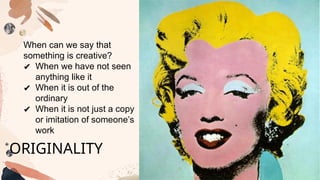
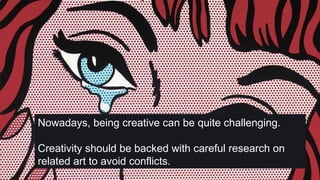
  • 201.
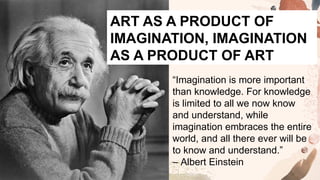
    5. Philippine Muslim homesrepresent their identity therefore Islamic art is seen in their houses. These houses usually contain framed calligraphy of Qu’ran passages in its walls. CHARACTERISTICS OF ISLAMIC ART
  • 202.
    6. Clothing reflectsthe style and colors of their ethnic background. A design related to Islam that is used in the Philippines is the batik cloth design. The kind of design traces its influence from Indonesia. It contains abstract themes with geometric and floral design. However, human and animal depiction is a rare motif in batik. CHARACTERISTICS OF ISLAMIC ART
  • 203.
  • 204.
    The Spanish friarsintroduced Western painting in the Philippines to artisans who learned to copy on two- dimensional form from the religious icons that the friars brought from Spain. For the first centuries of Spanish colonization, painting was limited to religious icons. Portraits of saints and of the Holy Family became a familiar sight in churches. Other subject matters include the passion of Christ, the Via Crucis, the crucifixion, portrayal of heaven and hell. PAINTING CHRISTIAN ART
  • 205.
  • 206.
    Several Filipino paintershad the chance to study and work abroad. Among them were Juan Novicio Luna and Felix Resureccion Hidalgo who became the first International Artists when they won the gold and silver medals in the 1884 Madrid Exposition. Luna’s academic painting Spoliarium won gold medal. It showed the dead and dying Roman Gladiators being dragged into the basement of the Coliseum. It is often interpreted as an allusion to Imperial Spain’s oppression of the natives. Though winning the gold medal , Luna was not awarded the Medal of Excellence, the top award for the competition, because he was a Filipino. PAINTING CHRISTIAN ART
  • 207.
  • 208.
    Most of thearchitectural formation that is influenced by Christianity is profound on the Churches. Next structure would be on schools that are originally founded by Catholic missionaries that preached Catholicism. Later on, the influences entered on Filipino houses that mixed up with the knowledge of Chinese feng shui. ARCHITECTURE CHRISTIAN ART
  • 209.
    The early housesthat were built during the Spanish eras include a place of worship called the altar. It is also common that these houses contain statues of different saints, images of Mary, Christ and other religious items. Rehabilitation and reconstruction confronted the country after World War II. From this period onto the 70s, Philippine architecture was dominated by the American style. The independent Philippines expressed its identity implementing Modernism through the utilization of reinforced concrete, steel and glass, the predominance of cubic forms, geometric shapes and Cartesian grids, and the absence of applied decoration. ARCHITECTURE CHRISTIAN ART
  • 211.
    CONTEMPORARY ART Contemporary artis the art of the present, which is continuously in process and in flux. A statement that an artist makes about life, thoughts, ideas, beliefs, and many other things that define human life. Art is the expression of one’s feelings through creating something out of their imagination. Contemporary art is art produced at the present period in time.
  • 212.
    Contemporary art includesand develops from Postmodern art, which is itself successor to Modern Art. With the advent of modernism, many Philippine arts were developing particularly in the field of sculpture where there is a shift in sculptural process which led to an almost complete freedom of materials and process. A wide variety of materials may be worked by removal such as carving, assembled by welding or modeling, or molded, or cast. Foremost of which is Solomon Saprid, a modern Philippine sculptor who became known for his works in bronze which he created by welding scraps of metal, producing a characteristic jagged effect. CONTEMPORARY ART
  • 213.
    Architect Francisco Mañosa, designerof the Coconut Palace, built his own two-storey bahay kubo mansion in Ayala Alabang Village, a wealthy suburb south of Manila. With only 3 posts or “haligi” , it has five one-inch coconut shell doors, a “silong”, Muslim room, sala, and master’s bedroom with a fish pond therein. ARCHITECTURE CONTEMPORARY ART
  • 215.
    The turning pointin the development of contemporary art in the Philippines was the establishment of the Cultural Center of the Philippines (CCP). The CCP is located on a reclaimed land along Roxas Boulevard. It was designed by Leandro V. Locsin and it is also considered as one of his most recognizable works. ARCHITECTURE CONTEMPORARY ART
  • 217.
  • 218.
    Ernest Concepcion (1977- present) Concepcion isa studio artist whose work experiments with intense emotion, deconstructing images in his paintings, sculptures, and installations. He creates art like recording a music album, where each painting is from a series of nine. Concepcion describes it as producing an old favorite, a classic, sleeper hit and one piece he doesn’t really like
  • 219.
  • 220.
    Ventura’s work isknown to consist of multiple layers, using imagery that focuses on the human form. His paintings are a dramatic union of comic sketches, reality, and graffiti. He draws inspiration from Asian mythology, Catholicism, science fiction and comic book characters. Ronald Ventura (1973-present)
  • 221.
    Initially trained asa sculptor, Leeroy’s work blends theatre, fashion, film, production design, and public art. He graduated from the prestigious Philippine High School for the Arts, before continuing his Fine Arts degree at the University of the Philippines. He has received artist residences in Singapore and Australia and was awarded the 13 Artists Award by the Cultural Center of the Philippines in 2014. His large-scale public art uses common objects and Leeroy New (1986-present)
  • 222.
  • 223.
    Neil Pasilan (1971-present) Brother toartist Diokno Pasilan, Neil is a Bacolod- born artist from a family of craftsmen and boat builders. He is a self- taught visual artist who displayed creativity as a child. Pasilan has moulded clay figures for most of his life and continues to use this in
  • 224.
  • 225.
    Kawayan’s art contemplates thePhilippines’ changing urban culture. He illogically arranges texts and icons to compose a painting, depicting the human form in new ways. His work draws from popular culture, the media and mass consumerism. He also creates sculptures and massive art Kawayan de Guia (1979-present)
  • 226.
    I SCREAM ANDCIGARETTES KAWAYAN DE GUIA
  • 227.
    Her video artreflects snapshots of reality and the environment drawn from her Filipino and Dutch roots. She is currently interested in using contemporary art as an aid to bring about social change. In 2017, she won the Baloise Art Prize at Art Basel International Fair for her video installation Our Islands, 11°16`58.4” 123°45`07.0”E., which shows a traditional Catholic procession from the Philippines under Martha Atienza (1981-present)
  • 228.
    Martha Atienza, ‘OurIslands 11°16’58.4N 123°45’07.0E’ (still), 2017, single-channel HD video, no sound, 72 min (loop). Courtesy the artist and Silverlens, Manila