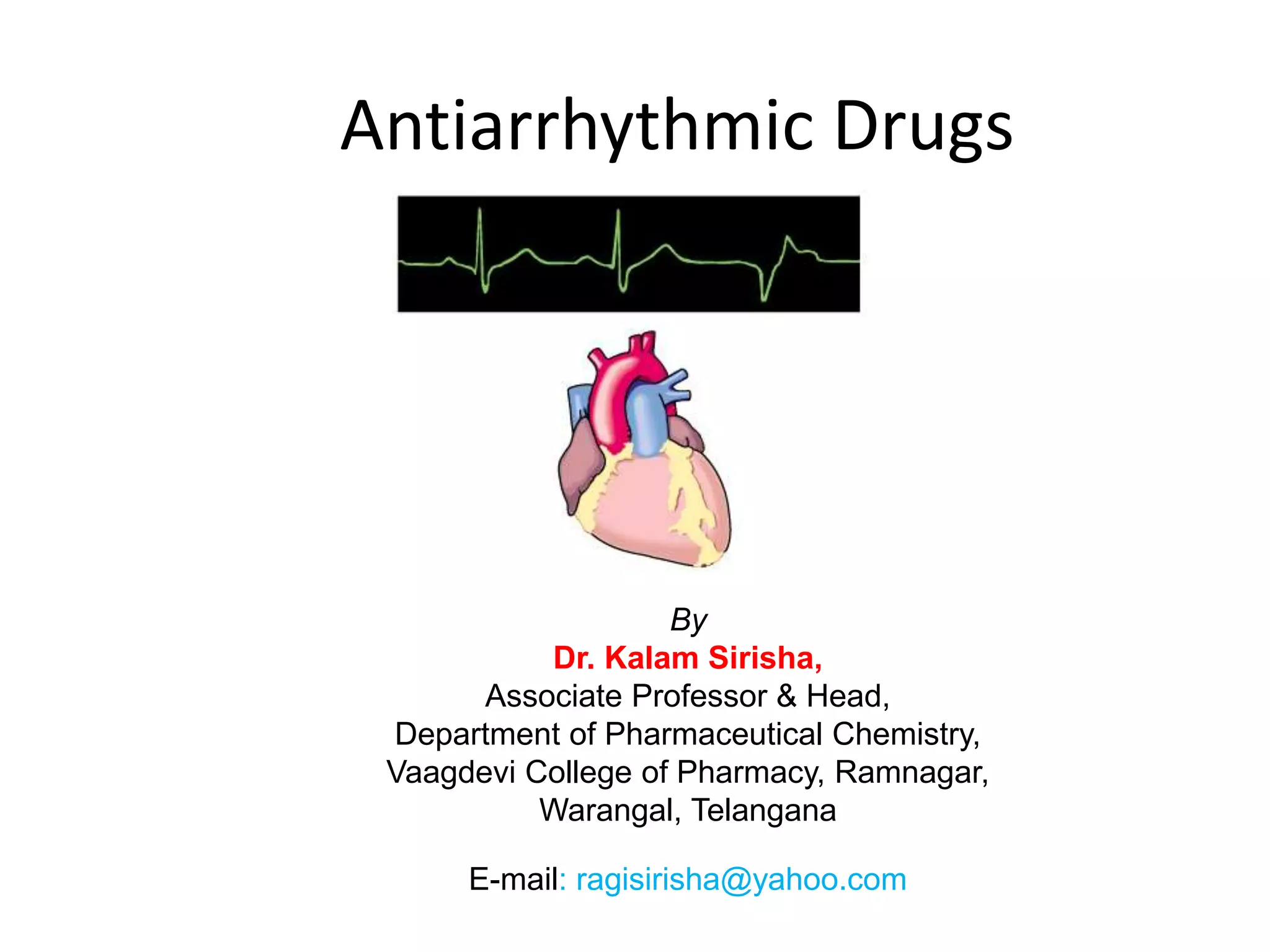
Antiarrhythmic Drugs
By
Dr. Kalam Sirisha,
Associate Professor & Head,
Department of Pharmaceutical Chemistry,
Vaagdevi College of Pharmacy, Ramnagar,
Warangal, Telangana
E-mail: ragisirisha@yahoo.com
Background
• to function efficiently, heart needs to contract sequentially
(atria, then ventricles) and in synchronicity
• Relaxation must occur between contractions (not true for
other types of muscle [exhibit tetany  contract and hold
contraction for certain length of time])
• Coordination of heartbeat is a result of a complex,
coordinated sequence of changes in membrane potentials
and electrical discharges in various heart tissues
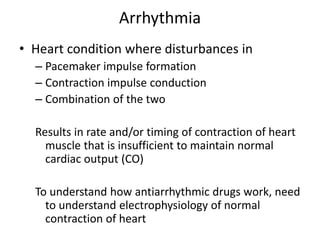
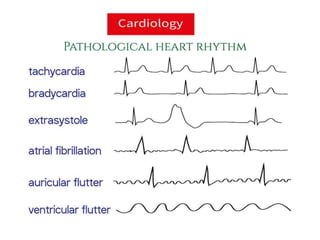
Arrhythmia
• Heart condition where disturbances in
– Pacemaker impulse formation
– Contraction impulse conduction
– Combination of the two
Results in rate and/or timing of contraction of heart
muscle that is insufficient to maintain normal
cardiac output (CO)
To understand how antiarrhythmic drugs work, need
to understand electrophysiology of normal
contraction of heart
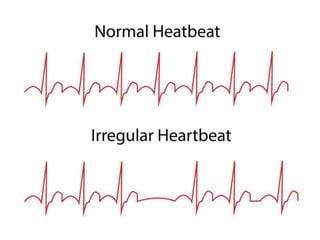
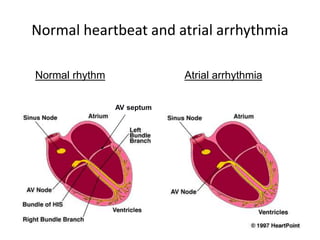
Normal heartbeat and atrial arrhythmia
Normal rhythm Atrial arrhythmia
AV septum
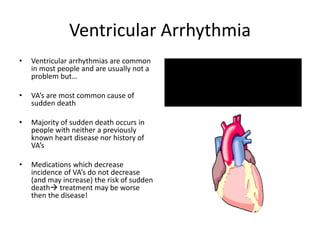
Ventricular Arrhythmia
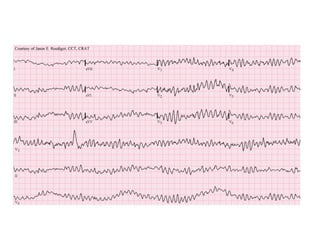
• Ventricular arrhythmias are common
in most people and are usually not a
problem but…
• VA’s are most common cause of
sudden death
• Majority of sudden death occurs in
people with neither a previously
known heart disease nor history of
VA’s
• Medications which decrease
incidence of VA’s do not decrease
(and may increase) the risk of sudden
death treatment may be worse
then the disease!
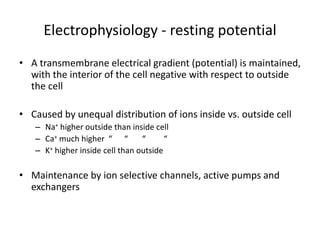
Electrophysiology - resting potential
• A transmembrane electrical gradient (potential) is maintained,
with the interior of the cell negative with respect to outside
the cell
• Caused by unequal distribution of ions inside vs. outside cell
– Na+ higher outside than inside cell
– Ca+ much higher “ “ “ “
– K+ higher inside cell than outside
• Maintenance by ion selective channels, active pumps and
exchangers
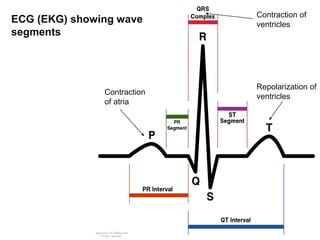
ECG (EKG) showing wave
segments
Contraction
of atria
Contraction of
ventricles
Repolarization of
ventricles
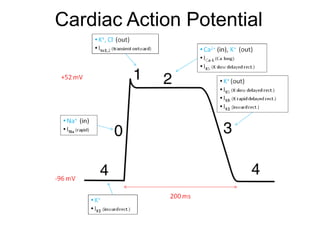
Cardiac Action Potential
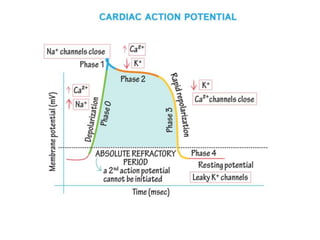
THE CARDIAC ACTION
POTENTIAL
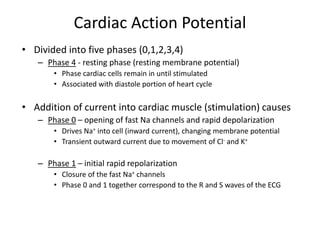
Cardiac Action Potential
• Divided into five phases (0,1,2,3,4)
– Phase 4 - resting phase (resting membrane potential)
• Phase cardiac cells remain in until stimulated
• Associated with diastole portion of heart cycle
• Addition of current into cardiac muscle (stimulation) causes
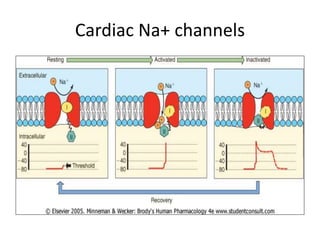
– Phase 0 – opening of fast Na channels and rapid depolarization
• Drives Na+ into cell (inward current), changing membrane potential
• Transient outward current due to movement of Cl- and K+
– Phase 1 – initial rapid repolarization
• Closure of the fast Na+ channels
• Phase 0 and 1 together correspond to the R and S waves of the ECG
Cardiac Na+ channels
Cardiac Action Potential (con’t)
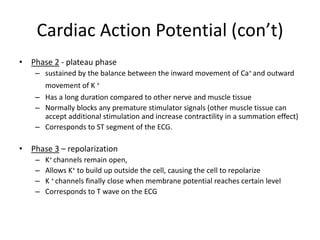
• Phase 2 - plateau phase
– sustained by the balance between the inward movement of Ca+ and outward
movement of K +
– Has a long duration compared to other nerve and muscle tissue
– Normally blocks any premature stimulator signals (other muscle tissue can
accept additional stimulation and increase contractility in a summation effect)
– Corresponds to ST segment of the ECG.
• Phase 3 – repolarization
– K+ channels remain open,
– Allows K+ to build up outside the cell, causing the cell to repolarize
– K + channels finally close when membrane potential reaches certain level
– Corresponds to T wave on the ECG
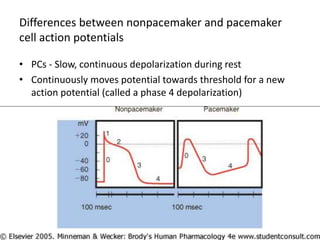
Differences between nonpacemaker and pacemaker
cell action potentials
• PCs - Slow, continuous depolarization during rest
• Continuously moves potential towards threshold for a new
action potential (called a phase 4 depolarization)
Mechanisms of Cardiac Arrhythmias
• Result from disorders of impulse formation,
conduction, or both
• Causes of arrhythmias
– Cardiac ischemia
– Excessive discharge or sensitivity to autonomic
transmitters
– Exposure to toxic substances
– Unknown etiology
Disorders of impulse formation
• No signal from the pacemaker site
• Development of an ectopic pacemaker
– May arise from conduction cells (most are capable of spontaneous
activity)
– Usually under control of SA node  if it slows down too much
conduction cells could become dominant
– Often a result of other injury (ischemia, hypoxia)
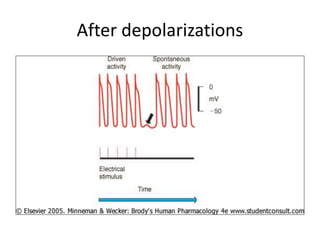
• Development of oscillatory afterdepolariztions
– Can initiate spontaneous activity in nonpacemaker tissue
– May be result of drugs (digitalis, norepinephrine) used to treat other
cardiopathologies
After depolarizations
Disorders of impulse conduction
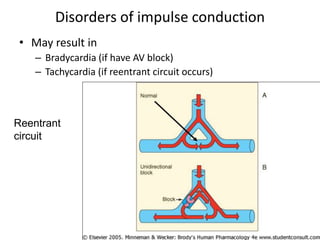
• May result in
– Bradycardia (if have AV block)
– Tachycardia (if reentrant circuit occurs)
Reentrant
circuit
Antiarrhythmic drugs
• Biggest problem – antiarrhythmics can cause
arrhythmia!
– Example: Treatment of a non-life threatening
tachycardia may cause fatal ventricular arrhythmia
– Must be vigilant in determining dosing, blood
levels, and in follow-up when prescribing
antiarrhythmics
Therapeutic overview
• Na+ channel blockade
• β-adrenergic receptor blockade
• Prolong repolarization
• Ca2+ channel blockade
• Adenosine
• Digitalis glycosides
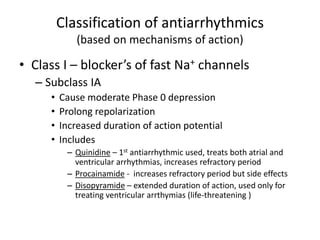
Classification of antiarrhythmics
(based on mechanisms of action)
• Class I – blocker’s of fast Na+ channels
– Subclass IA
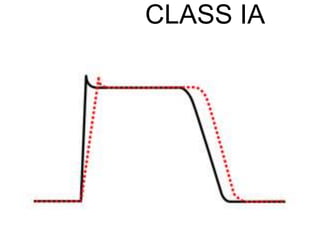
• Cause moderate Phase 0 depression
• Prolong repolarization
• Increased duration of action potential
• Includes
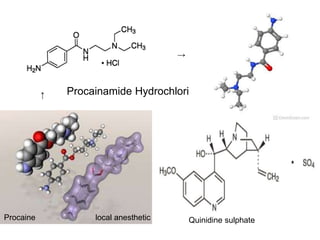
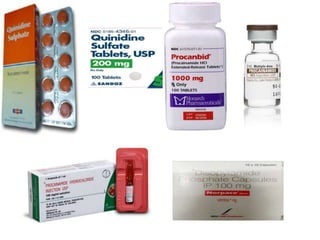
– Quinidine – 1st antiarrhythmic used, treats both atrial and
ventricular arrhythmias, increases refractory period
– Procainamide - increases refractory period but side effects
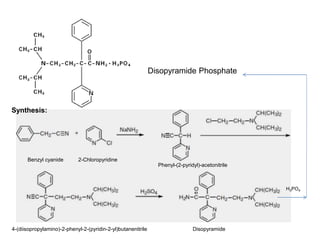
– Disopyramide – extended duration of action, used only for
treating ventricular arrthymias (life-threatening )
CLASS IA
IALASS IA
Procainamide Hydrochloride
Procaine local anesthetic Quinidine sulphate
→
↑
Disopyramide Phosphate
Disopyramide4-(diisopropylamino)-2-phenyl-2-(pyridin-2-yl)butanenitrile
Benzyl cyanide 2-Chloropyridine
Phenyl-(2-pyridyl)-acetonitrile
H3PO4
Synthesis:
Classification of antiarrhythmics
(based on mechanisms of action)
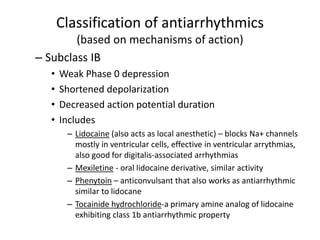
– Subclass IB
• Weak Phase 0 depression
• Shortened depolarization
• Decreased action potential duration
• Includes
– Lidocaine (also acts as local anesthetic) – blocks Na+ channels
mostly in ventricular cells, effective in ventricular arrythmias,
also good for digitalis-associated arrhythmias
– Mexiletine - oral lidocaine derivative, similar activity
– Phenytoin – anticonvulsant that also works as antiarrhythmic
similar to lidocane
– Tocainide hydrochloride-a primary amine analog of lidocaine
exhibiting class 1b antiarrhythmic property
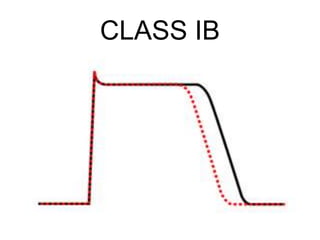
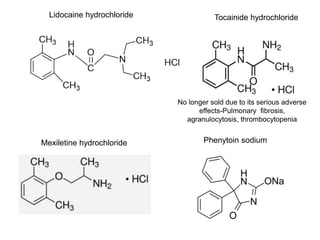
CLASS IB
Lidocaine hydrochloride Tocainide hydrochloride
Mexiletine hydrochloride Phenytoin sodium
No longer sold due to its serious adverse
effects-Pulmonary fibrosis,
agranulocytosis, thrombocytopenia
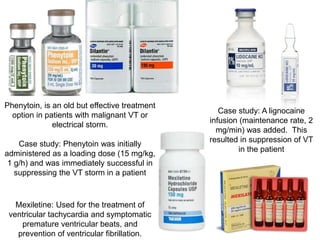
Phenytoin, is an old but effective treatment
option in patients with malignant VT or
electrical storm.
Case study: Phenytoin was initially
administered as a loading dose (15 mg/kg,
1 g/h) and was immediately successful in
suppressing the VT storm in a patient
Case study: A lignocaine
infusion (maintenance rate, 2
mg/min) was added. This
resulted in suppression of VT
in the patient
Mexiletine: Used for the treatment of
ventricular tachycardia and symptomatic
premature ventricular beats, and
prevention of ventricular fibrillation.
Classification of antiarrhythmics
(based on mechanisms of action)
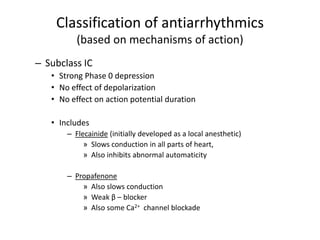
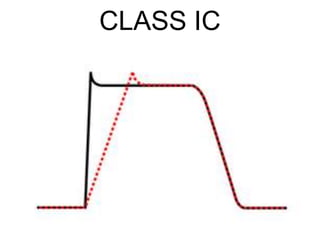
– Subclass IC
• Strong Phase 0 depression
• No effect of depolarization
• No effect on action potential duration
• Includes
– Flecainide (initially developed as a local anesthetic)
» Slows conduction in all parts of heart,
» Also inhibits abnormal automaticity
– Propafenone
» Also slows conduction
» Weak β – blocker
» Also some Ca2+ channel blockade
CLASS IC
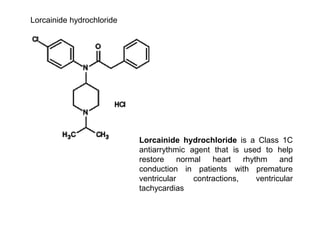
Lorcainide hydrochloride
Lorcainide hydrochloride is a Class 1C
antiarrythmic agent that is used to help
restore normal heart rhythm and
conduction in patients with premature
ventricular contractions, ventricular
tachycardias
Classification of antiarrhythmics
(based on mechanisms of action)
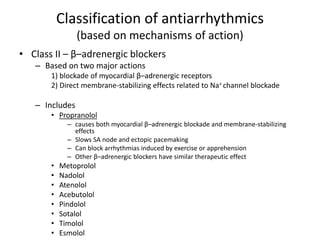
• Class II – β–adrenergic blockers
– Based on two major actions
1) blockade of myocardial β–adrenergic receptors
2) Direct membrane-stabilizing effects related to Na+ channel blockade
– Includes
• Propranolol
– causes both myocardial β–adrenergic blockade and membrane-stabilizing
effects
– Slows SA node and ectopic pacemaking
– Can block arrhythmias induced by exercise or apprehension
– Other β–adrenergic blockers have similar therapeutic effect
• Metoprolol
• Nadolol
• Atenolol
• Acebutolol
• Pindolol
• Sotalol
• Timolol
• Esmolol
Classification of antiarrhythmics
(based on mechanisms of action)
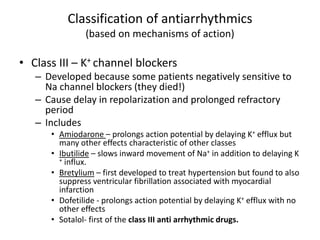
• Class III – K+ channel blockers
– Developed because some patients negatively sensitive to
Na channel blockers (they died!)
– Cause delay in repolarization and prolonged refractory
period
– Includes
• Amiodarone – prolongs action potential by delaying K+ efflux but
many other effects characteristic of other classes
• Ibutilide – slows inward movement of Na+ in addition to delaying K
+ influx.
• Bretylium – first developed to treat hypertension but found to also
suppress ventricular fibrillation associated with myocardial
infarction
• Dofetilide - prolongs action potential by delaying K+ efflux with no
other effects
• Sotalol- first of the class III anti arrhythmic drugs.
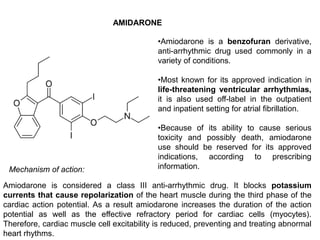
AMIDARONE
•Amiodarone is a benzofuran derivative,
anti-arrhythmic drug used commonly in a
variety of conditions.
•Most known for its approved indication in
life-threatening ventricular arrhythmias,
it is also used off-label in the outpatient
and inpatient setting for atrial fibrillation.
•Because of its ability to cause serious
toxicity and possibly death, amiodarone
use should be reserved for its approved
indications, according to prescribing
information.
Amiodarone is considered a class III anti-arrhythmic drug. It blocks potassium
currents that cause repolarization of the heart muscle during the third phase of the
cardiac action potential. As a result amiodarone increases the duration of the action
potential as well as the effective refractory period for cardiac cells (myocytes).
Therefore, cardiac muscle cell excitability is reduced, preventing and treating abnormal
heart rhythms.
Mechanism of action:
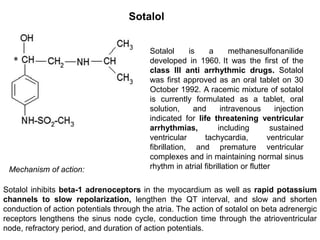
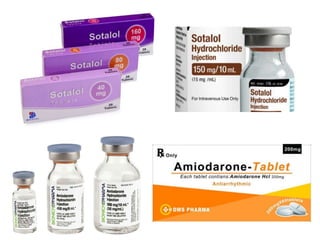
Sotalol
Sotalol is a methanesulfonanilide
developed in 1960. It was the first of the
class III anti arrhythmic drugs. Sotalol
was first approved as an oral tablet on 30
October 1992. A racemic mixture of sotalol
is currently formulated as a tablet, oral
solution, and intravenous injection
indicated for life threatening ventricular
arrhythmias, including sustained
ventricular tachycardia, ventricular
fibrillation, and premature ventricular
complexes and in maintaining normal sinus
rhythm in atrial fibrillation or flutter
Sotalol inhibits beta-1 adrenoceptors in the myocardium as well as rapid potassium
channels to slow repolarization, lengthen the QT interval, and slow and shorten
conduction of action potentials through the atria. The action of sotalol on beta adrenergic
receptors lengthens the sinus node cycle, conduction time through the atrioventricular
node, refractory period, and duration of action potentials.
Mechanism of action:
Classification of antiarrhythmics
(based on mechanisms of action)
• Class IV – Ca2+ channel blockers
– slow rate of AV-conduction in patients with atrial
fibrillation
– Includes
• Verapamil – blocks Na+ channels in addition to Ca2+;
also slows SA node in tachycardia
• Diltiazem
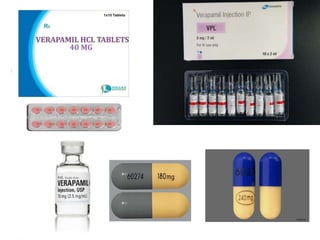
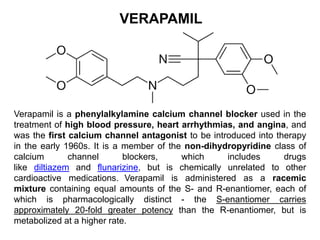
VERAPAMIL
Verapamil is a phenylalkylamine calcium channel blocker used in the
treatment of high blood pressure, heart arrhythmias, and angina, and
was the first calcium channel antagonist to be introduced into therapy
in the early 1960s. It is a member of the non-dihydropyridine class of
calcium channel blockers, which includes drugs
like diltiazem and flunarizine, but is chemically unrelated to other
cardioactive medications. Verapamil is administered as a racemic
mixture containing equal amounts of the S- and R-enantiomer, each of
which is pharmacologically distinct - the S-enantiomer carries
approximately 20-fold greater potency than the R-enantiomer, but is
metabolized at a higher rate.
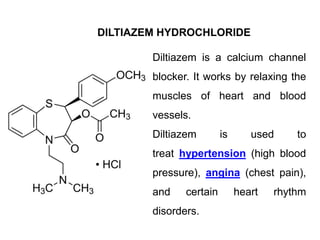
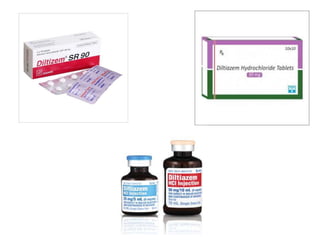
DILTIAZEM HYDROCHLORIDE
Diltiazem is a calcium channel
blocker. It works by relaxing the
muscles of heart and blood
vessels.
Diltiazem is used to
treat hypertension (high blood
pressure), angina (chest pain),
and certain heart rhythm
disorders.
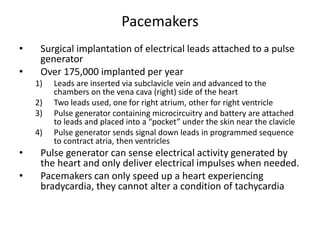
Pacemakers
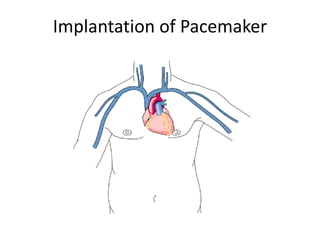
• Surgical implantation of electrical leads attached to a pulse
generator
• Over 175,000 implanted per year
1) Leads are inserted via subclavicle vein and advanced to the
chambers on the vena cava (right) side of the heart
2) Two leads used, one for right atrium, other for right ventricle
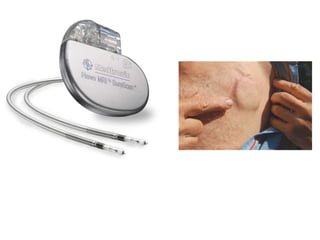
3) Pulse generator containing microcircuitry and battery are attached
to leads and placed into a “pocket” under the skin near the clavicle
4) Pulse generator sends signal down leads in programmed sequence
to contract atria, then ventricles
• Pulse generator can sense electrical activity generated by
the heart and only deliver electrical impulses when needed.
• Pacemakers can only speed up a heart experiencing
bradycardia, they cannot alter a condition of tachycardia
Implantation of Pacemaker
My special thanks to all the sources whose images have been utilized in
preparing this presentation
THANK YOU ONE AND
ALL!!!

Antiarrythmic drugs

  • 1.
    Antiarrhythmic Drugs By Dr. KalamSirisha, Associate Professor & Head, Department of Pharmaceutical Chemistry, Vaagdevi College of Pharmacy, Ramnagar, Warangal, Telangana E-mail: ragisirisha@yahoo.com
  • 2.
    Background • to functionefficiently, heart needs to contract sequentially (atria, then ventricles) and in synchronicity • Relaxation must occur between contractions (not true for other types of muscle [exhibit tetany  contract and hold contraction for certain length of time]) • Coordination of heartbeat is a result of a complex, coordinated sequence of changes in membrane potentials and electrical discharges in various heart tissues
  • 3.
    Arrhythmia • Heart conditionwhere disturbances in – Pacemaker impulse formation – Contraction impulse conduction – Combination of the two Results in rate and/or timing of contraction of heart muscle that is insufficient to maintain normal cardiac output (CO) To understand how antiarrhythmic drugs work, need to understand electrophysiology of normal contraction of heart
  • 7.
    Normal heartbeat andatrial arrhythmia Normal rhythm Atrial arrhythmia AV septum
  • 8.
    Ventricular Arrhythmia • Ventriculararrhythmias are common in most people and are usually not a problem but… • VA’s are most common cause of sudden death • Majority of sudden death occurs in people with neither a previously known heart disease nor history of VA’s • Medications which decrease incidence of VA’s do not decrease (and may increase) the risk of sudden death treatment may be worse then the disease!
  • 9.
    Electrophysiology - restingpotential • A transmembrane electrical gradient (potential) is maintained, with the interior of the cell negative with respect to outside the cell • Caused by unequal distribution of ions inside vs. outside cell – Na+ higher outside than inside cell – Ca+ much higher “ “ “ “ – K+ higher inside cell than outside • Maintenance by ion selective channels, active pumps and exchangers
  • 10.
    ECG (EKG) showingwave segments Contraction of atria Contraction of ventricles Repolarization of ventricles
  • 11.
  • 12.
  • 13.
    Cardiac Action Potential •Divided into five phases (0,1,2,3,4) – Phase 4 - resting phase (resting membrane potential) • Phase cardiac cells remain in until stimulated • Associated with diastole portion of heart cycle • Addition of current into cardiac muscle (stimulation) causes – Phase 0 – opening of fast Na channels and rapid depolarization • Drives Na+ into cell (inward current), changing membrane potential • Transient outward current due to movement of Cl- and K+ – Phase 1 – initial rapid repolarization • Closure of the fast Na+ channels • Phase 0 and 1 together correspond to the R and S waves of the ECG
  • 14.
  • 15.
    Cardiac Action Potential(con’t) • Phase 2 - plateau phase – sustained by the balance between the inward movement of Ca+ and outward movement of K + – Has a long duration compared to other nerve and muscle tissue – Normally blocks any premature stimulator signals (other muscle tissue can accept additional stimulation and increase contractility in a summation effect) – Corresponds to ST segment of the ECG. • Phase 3 – repolarization – K+ channels remain open, – Allows K+ to build up outside the cell, causing the cell to repolarize – K + channels finally close when membrane potential reaches certain level – Corresponds to T wave on the ECG
  • 16.
    Differences between nonpacemakerand pacemaker cell action potentials • PCs - Slow, continuous depolarization during rest • Continuously moves potential towards threshold for a new action potential (called a phase 4 depolarization)
  • 17.
    Mechanisms of CardiacArrhythmias • Result from disorders of impulse formation, conduction, or both • Causes of arrhythmias – Cardiac ischemia – Excessive discharge or sensitivity to autonomic transmitters – Exposure to toxic substances – Unknown etiology
  • 18.
    Disorders of impulseformation • No signal from the pacemaker site • Development of an ectopic pacemaker – May arise from conduction cells (most are capable of spontaneous activity) – Usually under control of SA node  if it slows down too much conduction cells could become dominant – Often a result of other injury (ischemia, hypoxia) • Development of oscillatory afterdepolariztions – Can initiate spontaneous activity in nonpacemaker tissue – May be result of drugs (digitalis, norepinephrine) used to treat other cardiopathologies
  • 19.
  • 20.
    Disorders of impulseconduction • May result in – Bradycardia (if have AV block) – Tachycardia (if reentrant circuit occurs) Reentrant circuit
  • 21.
    Antiarrhythmic drugs • Biggestproblem – antiarrhythmics can cause arrhythmia! – Example: Treatment of a non-life threatening tachycardia may cause fatal ventricular arrhythmia – Must be vigilant in determining dosing, blood levels, and in follow-up when prescribing antiarrhythmics
  • 22.
    Therapeutic overview • Na+channel blockade • β-adrenergic receptor blockade • Prolong repolarization • Ca2+ channel blockade • Adenosine • Digitalis glycosides
  • 23.
    Classification of antiarrhythmics (basedon mechanisms of action) • Class I – blocker’s of fast Na+ channels – Subclass IA • Cause moderate Phase 0 depression • Prolong repolarization • Increased duration of action potential • Includes – Quinidine – 1st antiarrhythmic used, treats both atrial and ventricular arrhythmias, increases refractory period – Procainamide - increases refractory period but side effects – Disopyramide – extended duration of action, used only for treating ventricular arrthymias (life-threatening )
  • 24.
  • 25.
    Procainamide Hydrochloride Procaine localanesthetic Quinidine sulphate → ↑
  • 26.
  • 28.
    Classification of antiarrhythmics (basedon mechanisms of action) – Subclass IB • Weak Phase 0 depression • Shortened depolarization • Decreased action potential duration • Includes – Lidocaine (also acts as local anesthetic) – blocks Na+ channels mostly in ventricular cells, effective in ventricular arrythmias, also good for digitalis-associated arrhythmias – Mexiletine - oral lidocaine derivative, similar activity – Phenytoin – anticonvulsant that also works as antiarrhythmic similar to lidocane – Tocainide hydrochloride-a primary amine analog of lidocaine exhibiting class 1b antiarrhythmic property
  • 29.
  • 30.
    Lidocaine hydrochloride Tocainidehydrochloride Mexiletine hydrochloride Phenytoin sodium No longer sold due to its serious adverse effects-Pulmonary fibrosis, agranulocytosis, thrombocytopenia
  • 31.
    Phenytoin, is anold but effective treatment option in patients with malignant VT or electrical storm. Case study: Phenytoin was initially administered as a loading dose (15 mg/kg, 1 g/h) and was immediately successful in suppressing the VT storm in a patient Case study: A lignocaine infusion (maintenance rate, 2 mg/min) was added. This resulted in suppression of VT in the patient Mexiletine: Used for the treatment of ventricular tachycardia and symptomatic premature ventricular beats, and prevention of ventricular fibrillation.
  • 32.
    Classification of antiarrhythmics (basedon mechanisms of action) – Subclass IC • Strong Phase 0 depression • No effect of depolarization • No effect on action potential duration • Includes – Flecainide (initially developed as a local anesthetic) » Slows conduction in all parts of heart, » Also inhibits abnormal automaticity – Propafenone » Also slows conduction » Weak β – blocker » Also some Ca2+ channel blockade
  • 33.
  • 34.
    Lorcainide hydrochloride Lorcainide hydrochlorideis a Class 1C antiarrythmic agent that is used to help restore normal heart rhythm and conduction in patients with premature ventricular contractions, ventricular tachycardias
  • 35.
    Classification of antiarrhythmics (basedon mechanisms of action) • Class II – β–adrenergic blockers – Based on two major actions 1) blockade of myocardial β–adrenergic receptors 2) Direct membrane-stabilizing effects related to Na+ channel blockade – Includes • Propranolol – causes both myocardial β–adrenergic blockade and membrane-stabilizing effects – Slows SA node and ectopic pacemaking – Can block arrhythmias induced by exercise or apprehension – Other β–adrenergic blockers have similar therapeutic effect • Metoprolol • Nadolol • Atenolol • Acebutolol • Pindolol • Sotalol • Timolol • Esmolol
  • 36.
    Classification of antiarrhythmics (basedon mechanisms of action) • Class III – K+ channel blockers – Developed because some patients negatively sensitive to Na channel blockers (they died!) – Cause delay in repolarization and prolonged refractory period – Includes • Amiodarone – prolongs action potential by delaying K+ efflux but many other effects characteristic of other classes • Ibutilide – slows inward movement of Na+ in addition to delaying K + influx. • Bretylium – first developed to treat hypertension but found to also suppress ventricular fibrillation associated with myocardial infarction • Dofetilide - prolongs action potential by delaying K+ efflux with no other effects • Sotalol- first of the class III anti arrhythmic drugs.
  • 37.
    AMIDARONE •Amiodarone is abenzofuran derivative, anti-arrhythmic drug used commonly in a variety of conditions. •Most known for its approved indication in life-threatening ventricular arrhythmias, it is also used off-label in the outpatient and inpatient setting for atrial fibrillation. •Because of its ability to cause serious toxicity and possibly death, amiodarone use should be reserved for its approved indications, according to prescribing information. Amiodarone is considered a class III anti-arrhythmic drug. It blocks potassium currents that cause repolarization of the heart muscle during the third phase of the cardiac action potential. As a result amiodarone increases the duration of the action potential as well as the effective refractory period for cardiac cells (myocytes). Therefore, cardiac muscle cell excitability is reduced, preventing and treating abnormal heart rhythms. Mechanism of action:
  • 38.
    Sotalol Sotalol is amethanesulfonanilide developed in 1960. It was the first of the class III anti arrhythmic drugs. Sotalol was first approved as an oral tablet on 30 October 1992. A racemic mixture of sotalol is currently formulated as a tablet, oral solution, and intravenous injection indicated for life threatening ventricular arrhythmias, including sustained ventricular tachycardia, ventricular fibrillation, and premature ventricular complexes and in maintaining normal sinus rhythm in atrial fibrillation or flutter Sotalol inhibits beta-1 adrenoceptors in the myocardium as well as rapid potassium channels to slow repolarization, lengthen the QT interval, and slow and shorten conduction of action potentials through the atria. The action of sotalol on beta adrenergic receptors lengthens the sinus node cycle, conduction time through the atrioventricular node, refractory period, and duration of action potentials. Mechanism of action:
  • 40.
    Classification of antiarrhythmics (basedon mechanisms of action) • Class IV – Ca2+ channel blockers – slow rate of AV-conduction in patients with atrial fibrillation – Includes • Verapamil – blocks Na+ channels in addition to Ca2+; also slows SA node in tachycardia • Diltiazem
  • 41.
    VERAPAMIL Verapamil is aphenylalkylamine calcium channel blocker used in the treatment of high blood pressure, heart arrhythmias, and angina, and was the first calcium channel antagonist to be introduced into therapy in the early 1960s. It is a member of the non-dihydropyridine class of calcium channel blockers, which includes drugs like diltiazem and flunarizine, but is chemically unrelated to other cardioactive medications. Verapamil is administered as a racemic mixture containing equal amounts of the S- and R-enantiomer, each of which is pharmacologically distinct - the S-enantiomer carries approximately 20-fold greater potency than the R-enantiomer, but is metabolized at a higher rate.
  • 43.
    DILTIAZEM HYDROCHLORIDE Diltiazem isa calcium channel blocker. It works by relaxing the muscles of heart and blood vessels. Diltiazem is used to treat hypertension (high blood pressure), angina (chest pain), and certain heart rhythm disorders.
  • 45.
    Pacemakers • Surgical implantationof electrical leads attached to a pulse generator • Over 175,000 implanted per year 1) Leads are inserted via subclavicle vein and advanced to the chambers on the vena cava (right) side of the heart 2) Two leads used, one for right atrium, other for right ventricle 3) Pulse generator containing microcircuitry and battery are attached to leads and placed into a “pocket” under the skin near the clavicle 4) Pulse generator sends signal down leads in programmed sequence to contract atria, then ventricles • Pulse generator can sense electrical activity generated by the heart and only deliver electrical impulses when needed. • Pacemakers can only speed up a heart experiencing bradycardia, they cannot alter a condition of tachycardia
  • 46.
  • 48.
    My special thanksto all the sources whose images have been utilized in preparing this presentation THANK YOU ONE AND ALL!!!

Editor's Notes

  • #13 There are 5 phases in the cardiac action potential Phase 4: resting membrane potential (-85 to -95 mV) Phase 0: depolarization (opening of Na+ channels—Na+ rushes in) Phase 1: inactivation of Na+ channels Phase 2:influx of Ca2+ coupled with the slow outflow of K+ causing plateau Phase 3: repolarization (release of K+) Phase 4:resting membrane potential
  • #25 As you can see here, it blunts the upstroke and prolongs phase 2
  • #30 The IB drugs blunt the upstroke slightly because it is a weak sodium channel blocker, but it also has action at potassium channels which is why it shortens the action potential duration