

Seminar on
Presentingby:
Banny S.V
BENZENE AND IT’S DERIVATIVES
 Aromatic compounds:-
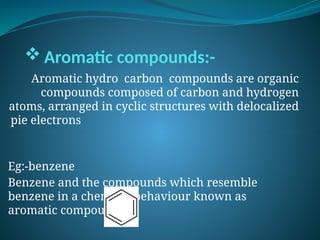
Aromatic hydro carbon compounds are organic
compounds composed of carbon and hydrogen
atoms, arranged in cyclic structures with delocalized
pie electrons
Eg:-benzene
Benzene and the compounds which resemble
benzene in a chemical behaviour known as
aromatic compounds.
Aromaticity (or)aromatic characters
Aromaticity defined as a property of the
conjugated cyclo alkenes which enhances the
stability of a molecule due to the delocalization
of electrons present in the
pie-pie orbitals
 The strucutral criteria must be satisfied for a
compound to be and an aromatic:
Aromaticity (or)aromatic characters
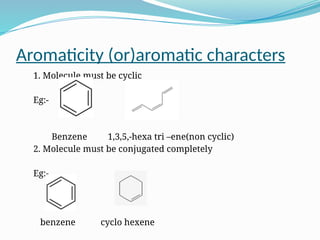
1. Molecule must be cyclic
Eg:-
Benzene 1,3,5,-hexa tri –ene(non cyclic)
2. Molecule must be conjugated completely
Eg:-
benzene cyclo hexene
Aromaticity (or)aromatic characters
3. Structure must be in planar(pie electron density
present above and below the plane)
4.Molecule should satisfy “huckle rule”(4n+2pie
electron rule)
huckle gave certain rule for defining the
aromaticity of organic compounds, the total
number of pie electrons in the molecule should be
4n+2
n=integer{0,1,2,3….}
Aromaticity (or)aromatic characters
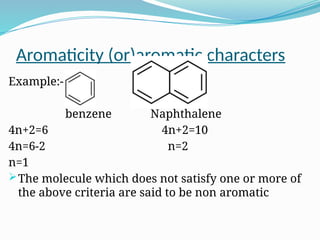
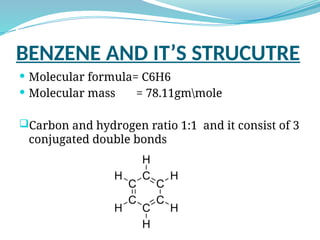
Example:-
benzene Naphthalene
4n+2=6 4n+2=10
4n=6-2 n=2
n=1
The molecule which does not satisfy one or more of
the above criteria are said to be non aromatic
BENZENE AND IT’S STRUCUTRE
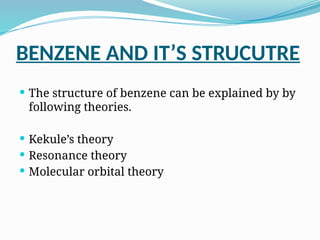
 Molecular formula= C6H6
 Molecular mass = 78.11gmmole
Carbon and hydrogen ratio 1:1 and it consist of 3
conjugated double bonds
BENZENE AND IT’S STRUCUTRE
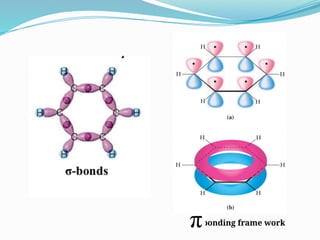
 The structure of benzene can be explained by by
following theories.
 Kekule’s theory
 Resonance theory
 Molecular orbital theory
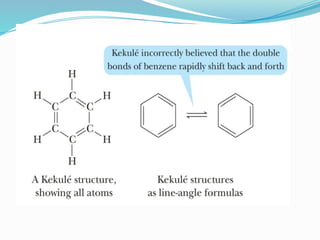
Kekule’s theory
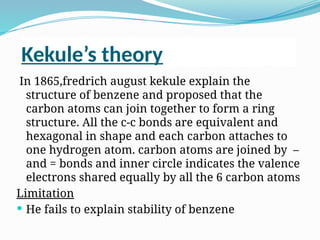
In 1865,fredrich august kekule explain the
structure of benzene and proposed that the
carbon atoms can join together to form a ring
structure. All the c-c bonds are equivalent and
hexagonal in shape and each carbon attaches to
one hydrogen atom. carbon atoms are joined by –
and = bonds and inner circle indicates the valence
electrons shared equally by all the 6 carbon atoms
Limitation
 He fails to explain stability of benzene
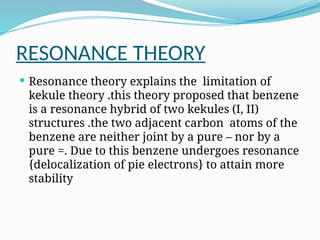
RESONANCE THEORY
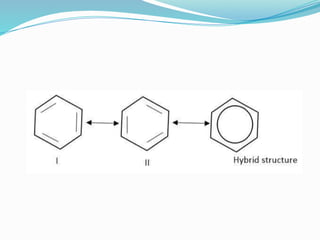
 Resonance theory explains the limitation of
kekule theory .this theory proposed that benzene
is a resonance hybrid of two kekules (I, II)
structures .the two adjacent carbon atoms of the
benzene are neither joint by a pure – nor by a
pure =. Due to this benzene undergoes resonance
{delocalization of pie electrons} to attain more
stability
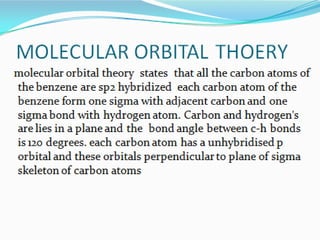
bonding frame work
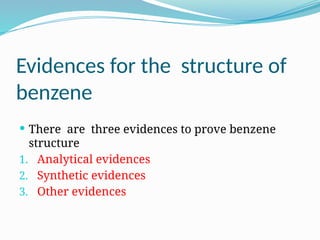
Evidences for the structure of
benzene
 There are three evidences to prove benzene
structure
1. Analytical evidences
2. Synthetic evidences
3. Other evidences
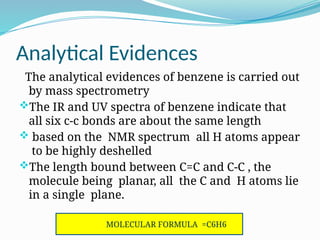
Analytical Evidences
The analytical evidences of benzene is carried out
by mass spectrometry
The IR and UV spectra of benzene indicate that
all six c-c bonds are about the same length
 based on the NMR spectrum all H atoms appear
to be highly deshelled
The length bound between C=C and C-C , the
molecule being planar, all the C and H atoms lie
in a single plane.
MOLECULAR FORMULA =C6H6
Synthetic evidences
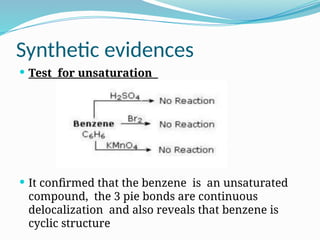
 Test for unsaturation
 It confirmed that the benzene is an unsaturated
compound, the 3 pie bonds are continuous
delocalization and also reveals that benzene is
cyclic structure
Other evidences
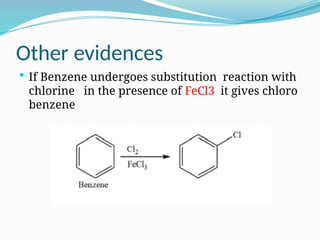
 If Benzene undergoes substitution reaction with
chlorine in the presence of FeCl3 it gives chloro
benzene
Other evidences
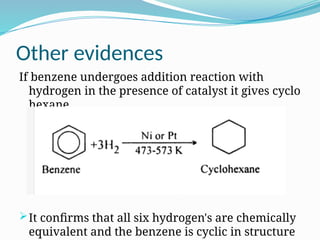
If benzene undergoes addition reaction with
hydrogen in the presence of catalyst it gives cyclo
hexane
It confirms that all six hydrogen's are chemically
equivalent and the benzene is cyclic in structure
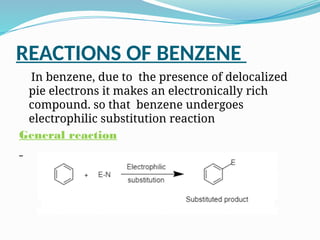
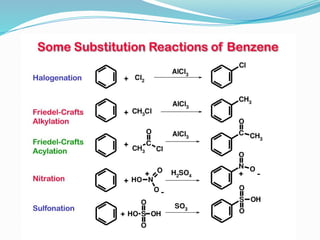
REACTIONS OF BENZENE
In benzene, due to the presence of delocalized
pie electrons it makes an electronically rich
compound. so that benzene undergoes
electrophilic substitution reaction
General reaction
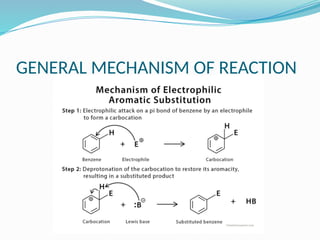
GENERAL MECHANISM OF REACTION
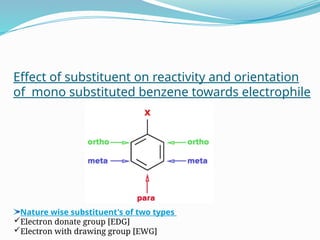
Effect of substituent on reactivity and orientation
of mono substituted benzene towards electrophile
Nature wise substituent's of two types
Electron donate group [EDG]
Electron with drawing group [EWG]
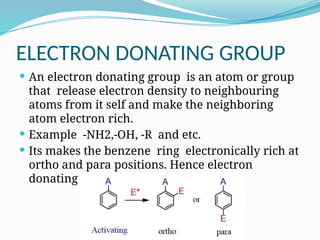
ELECTRON DONATING GROUP
 An electron donating group is an atom or group
that release electron density to neighbouring
atoms from it self and make the neighboring
atom electron rich.
 Example -NH2,-OH, -R and etc.
 Its makes the benzene ring electronically rich at
ortho and para positions. Hence electron
donating are ortho and para directors
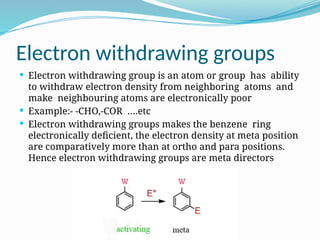
Electron withdrawing groups
 Electron withdrawing group is an atom or group has ability
to withdraw electron density from neighboring atoms and
make neighbouring atoms are electronically poor
 Example:- -CHO,-COR ….etc
 Electron withdrawing groups makes the benzene ring
electronically deficient, the electron density at meta position
are comparatively more than at ortho and para positions.
Hence electron withdrawing groups are meta directors
🧪 Benzene & Its Derivatives | Aromaticity, Structure & Reactions in Organic Chemistry